Welcome to America’s Loneliest Highway

“You can just pull over to the side of the road and camp anywhere…” explained the park ranger, as I told him about my plans to cross Highway 50, the loneliest highway in America. “…It’s generally accepted,” he continued.

He pulled a map out from under his desk. It was folded like a standard brochure, but he unfolded it again and again, until the whole state of Nevada covered his desk. I had taken the advice from the little placard on the table in the cafe the day before which read, “Ask a park ranger about Nevada ghost towns. The ranger had explained how to get to the abandoned town of Hamilton, and he pointed out another place on the map. “That one is on private land now. There’s a mining company that owns it, but you still might be able to see some of the building.”

My plan was to cross Highway 50 to Lake Tahoe on the far west side of the state. I wanted to camp at Berlin-Ichthyosaur State Park to break up the journey and see the ghost town that park preserved. I was asking the ranger if there were any other ghost towns worth a stop along the way, and if he thought I’d be able to find a vacant campsite at Berlin-Ichthyosaur.  He was an older, friendly man, who equipped me with the you can do this-  it’ll be an adventure kind of spirit.  So, out of the Great Basin National Park visitor center I left with my map of Nevada in hand along with some exclusive knowledge on ghost town. I was excited to have them both.

This morning I had gotten up early and took a stroll through the Bristlecone Pine forest in Great Basin National Park. The park is home to the oldest trees in the world Pinus longaeva, the Bristlecone Pine. The oldest one was removed from the park in 1964 at 4,900 years old. Today still many ancients stand in the grove next to Wheeler Peak. They only grow at an altitude between 9,00 to 11,500 feet. Here they have found their niche, where they aren’t disrupted. They are slow growing, and often, as the National Park Service puts it “out-competed.” So they have, in a sense, retreated to conditions in which other trees can’t survive.

A short interpretive hike, tells you the  names and ages of the the trees. What fascinates me about such old trees is putting them in context of history, and considering all of the things they out date, such as all modern wars and the birth of Jesus. They precede the rise of the Roman empire. They might have been standing back during the rule of King Tut. These trees have stood through much of the milestones tumult of the world.

DSC05975Looking at them, you wouldn’t guess their age. They are rather girthy, but not that tall in comparison to something like the Sequoia or Redwood, which we often equate with age. Their branches are unique as they twist and curve like strings of warm taffy.  Once you fully consider how old they are, they start to look elderly. Their exterior is painted many different shades of brown, and the trunks and limbs are brushed with indentations and grooves, like a wrinkly old man who’s spent too many days out in the sun. At the same time, the way they look is almost fanciful. Although extremely still and sturdy, the dramatic twisted growth and exotic posture make these trees appear frozen in mid-dance, manipulated by some strange sorcery.

Nevada, never ceases to amaze me. I wouldn’t have thought the world’s oldest trees resided in such a place. As I closed my car door and spread out my new map on my drivers seat, I was gearing up to see what other surprises this state held in the middle of its expanse. I buckled up, programed my gps, plugged in my camera to charge, and…realized I needed gas.

As a courtesy of the National Park Service, the park map labeled the location of the nearest gas station- or might I say, the only gas station around. It was in Baker Nevada, the town in the desert at the foot of the park. When I arrived I was very skeptical. There was no building nor sign. There was just a single pump next to an old lamp post and a garbage can in the middle of a gravel lot. It looked to me like the remnants of an old gas station that used to stand here. Maybe I could mark this off as my first ghost town experience of the trip. Maybe this gas station predated the Bristlecone Pines.

I double checked my map. This was it. I pulled up to the pump and got out of my car into the oppressive heat and dead silence. Sure enough, there was a credit card reader. The pump was functional. I was sincerely surprised, and found the whole situation comical. This part of Nevada was truly a foreign place to me.  I filled up, knowing that while traveling across what’s called “America’s loneliest highway,” gas would be sparse.

This little gas station, if we so generously permit it such a term, is the most fitting post and right of passage to Highway 50. Many places have their iconic monuments upon entry. The United States as a whole has the Statue of Liberty, San Francisco has the Golden Gate Bridge, Yellowstone has Roosevelt Arch, and Highway 50 has this gas pump.  It sums up the whole Highway 50 experience: Get ready for a whole lot of nothing, but a few really genuine surprises.

DSC05873

Read the previous entry “Summiting Wheeler Peak,” here: https://joshthehodge.wordpress.com/2018/03/25/summiting-wheeler-peak/

Facebook: http://facebook.com/joshua.hodge

Instagram: http://www.instagram.com/joshthehodge/

Summiting Wheeler Peak

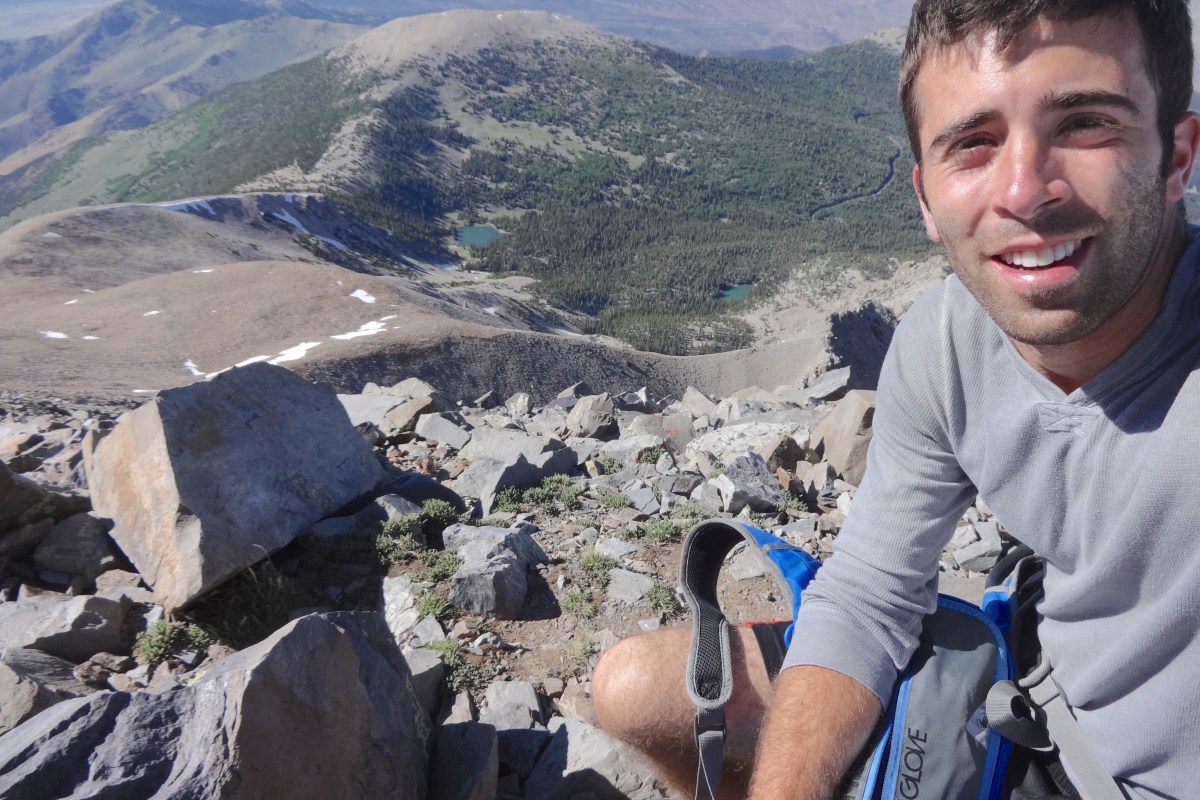
I looked up at the mountain. I don’t know about this, I thought. I had never summited something quite like this before. This was Wheeler Peak in Great Basin National Park, at 13,065 feet. It was bold and bald, nothing grew on its mountain top.

The guys in the Rock the Park show, which I had become so accustomed to watching, didn’t make it to the top. They turned around in their Great Basin episode, but they had tried it in the winter, in the snow. I had the summer advantedge.

DSC05887 (2)I stood there in a prairie along the mountain side, among bunchgrass and black sage, looking up at the mountain peek. The view looked like Wheeler Peak, and the adjoining peaks, used to all be connected at a higher point, all composing one grand mountain, but over time that higher summit crumbled to pieces and formed the rock glacier. Nevertheless, Wheeler Peak stands very tall. It’s Nevada’s highest peak. Although just summiting the beast alone seemed impossible, one of my questions was, do I have time? I was not getting an early start. It was well into the afternoon.

I had started the day sitting at the Mather Overlook, which is  just a pull out from the main park road. I drove down there early and had a peaceful morning, reading some of my book about the history of the National Park Service while fittingly sitting there next to a plaque in honor of Stephen Mather, the first director of the National Park Service. I then proceeded back down to the lower lands of the park, where I cleaned out my car at a dump station. I was waiting for my scheduled tour of Lehman Caves.

“What’s your favorite national park,” the park ranger asked each member of the group before our tour.

“Death Valley,” I shared, without hesitation.

“Alrighty,” she said, as she would say after completing, or beginning, every sentence. She also had an accent that was very indistinguishable. It’s a shame I remember more about the rangers speach patterns than the actual Lehman Caves. But the tour was very pleasant. I enjoyed it.

After the tour, I ate a sandwich in the cafe right next to the Lehman Caves Visitor Center. A little stand alone placard in the middle of my table, read “Ask a park ranger about ghost towns of Nevada.” I most certainly will, I thought, considering I would be traveling all across the state on Highway 50, and ghost towns fascinate me.   

After lunch I drove back up to the higher reaches of the park and eventually found myself geared up, looking at the towering Wheeler Peak and trying to decide if I should hike it. I tried to imagine where the trail might lead and tried to visualize it before me on the landscape. It looked like it made its way through the sparse forest of pinyon and juniper with granite out crops and prairie, until it reached the spine of an exposed ridge which gradually climbed until it hit a secondary base of the mountain, where a steep incline would begin around the back of the mountain. The total elevation gain would be 3,000 feet, not terrible, yet significant, especially since nearly all of it was completely exposed.

Welp, I’m here. I concluded it was time to give it a try. I figured the worst thing that could happen is that I’d had to turn around and come back, or be blown of the mountain by extreme winds. Actually the latter, I could have never imagined.

On my way through the prairie I spotted a group of wild turkey and some deer. On the other side of the prairie, growth became sparse, except for a tree every once in a while, jutting up from shambles of granite.

DSC05917Eventually there was nothing left except me on the slanted fields of rock crumble. The trail evolved into switchbacks, and since the landscape was so uniform, it was difficult at times to know exactly where the trail was supposed to be.

I reached a point where I could look down to my left and see Teresa and Stella lake  as miniature little puddles below. To my right, I looked out on the desert expanse of Nevada. Directly behind me I saw the spine ridge and the forest I had traversed, and in front of me there was just more rock leading up to the peak

Then it hit me, the realization of just how high up I was. It was disorienting. I’d never had such a clear 360 degree view at such an elevation. Also the way the landscape was not strictly in terms of vertical or horizontal orientation, but mountain ridges and landscapes were at odd diagonals, crooked, yet beautiful, made me feel uneasy. I began to feel a bit dizzy, and my heart began to beat a little extra fast, on top of what was already needed for this strenuous hike.

Just a little further up the mountain, and the wind was gusting. It made the loose fitting parts of my hoodie flap against  me violently. It blew into my ears so forcefully that it hurt. I pulled my hood over my head and held it tight, pinching it at the bottom so it wouldn’t blow off. It wasn’t enough to protect my ears. I had to turn my head sideways to evade the harsh gusts, and then I had to get low. When I stood tall, I felt my knees switching between wobbling and clenching, trying to maintain stance.

There was sincere fear that the wind would blow me off the mountain, that I could go flapping in the wind, tossed around and dropped somewhere out in the desert below. It didn’t help, that throughout the course of the year I had been having repeated nightmares involving the wind. In each one I’d be walking across the Brooklyn Bridge in New York, and the wind would be so powerful it would always blow something valuable out of my hands and then the wind would wisp me off the bridge and I’d fall down into the cold water of the Hudson. No fun. It all stems back from one December on the Brooklyn Bridge when the wind did try to steal a backpack right off my back. As it had been ripped off me into the air I held on by one strap and was able to pull it back down. That event left a scarring impression on me.

But here on Wheeler Peak, this wasn’t just imagined. The wind was extreme and I could feel it trying to move my body. So, I proceeded up the mountain in a somewhat pitiful manner, reminding myself of Gollum from Lord of the Rings crawling over rocks never quite standing up fully.

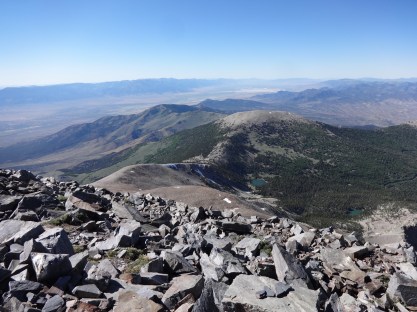
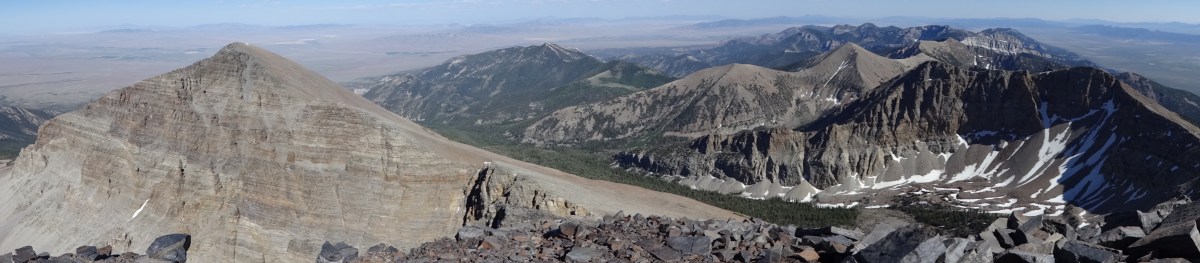
DSC05922When I reached the top, the wind had dissipated greatly. I was stunned by the view. Hundreds of miles of Nevada was visible in all directions. Here I could truly see just how mountainous Nevada was, with mountains all over in near and far reaches, with sharp points, and slanted slopes, snow caps, and hidden forests, and valleys of desert between them all, covering great expanses. Just across from Wheeler peak was another peak that rose on a mountain which looked like it had been sliced by a knife with such a shark direct cut down to its base.

The sky up here was a very profound blue. It seemed as if I was elevated into a different atmosphere. When I looked out in the distance I could see a layer of lighter slightly murkier sky below, and I could see clouds in some far reaches that were well below where I was standing. As silly as it may sound, it felt like space was just a stone’s throw away.

Up here, there were two little topless shelters made of rocks, stacked on top each other, from the landscape. I imagined they were for people to camp in. I went inside, and wanted to rest a minute, and look out the structure door into the world below, but I didn’t trust these structures to hold up, especially if more wind was to come. I didn’t want rock collapsing on me. In one of these structures there was a mailbox stuck in the rocks, in it was a notebook- a log for people to record their accomplishments. Many people had filled it with Bible verses, I supposed they were inspired spiritually by such a view and height as this.

It’s spiritually affirming to reach a mountain top. It puts all of existence into focus. When you look down and ahead on the far reaches, you realize just how small your problems really are. And when you accomplish the task of reaching a mountain top, it reveals to you in a spiritual sense that you can get out of your canyons, traverse the desert, and reach the mountain top.

I also think mountain tops are places of hope and a taste of eternity- a place of beauty where we can look back on our lives, complete, and see what we have endured and how we fit into a bigger picture. You see, many of us, on our journey’s from the canyons and deserts of life into the mountains, find places of peace that God has hidden and given to us on the journey, like the little pristine forest hidden in the Great Basin National Park. But the mountaintop itself, the peek, is something that I believe can’t be reached in this life. The mountaintop is the pinnacle and completion of existence, a place of utter fulfillment, which we reach only when our time in this world is up and our souls have been accounted for. It’s the completion. It is the destination. And all of life’s journey in this world is preparing and leading us to it. 

So in this life, when we physically reach these mountaintops, they are appealing and satisfying to the soul. They inspire us, because they are a taste of an eternity and completion that we all naturally long for.

They also reflect the beauty of God and remind us that there is far more to existence than what we cling so tightly to in the world below


Read the next entry, “Welcome to America’s Loneliest Highway,” here: https://joshthehodge.wordpress.com/2018/04/02/welcome-to-americas-loneliest-highway/

Read the previous entry, “The Greatness of Great Basin,” here: https://joshthehodge.wordpress.com/2018/03/22/the-hidden-greatness-of-great-basin/

Facebook: http://facebook.com/joshua.hodge

Instagram: http://www.instagram.com/joshthehodge/


The Hidden Greatness of Great Basin

I rested in my tent, and I mean truly rested. There had not been any other moment in my life in which I felt as calm as I did that evening in my tent in Great Basin National Park.

When I arrived earlier in the day, I looped around Wheeler Peak Campground twice, looking for a vacant site. The campground seemed to be full, but eventually I struck success and found a perfect site.

This was a developed campground, and so the road was paved. There was a place to park my car, and my campsite had a picnic table and a fire ring. As an added bonus, this particular site had a patch of pine trees, and within the patch of trees was a flat barren area to pitch my tent. I could camp in my own miniature forest in the welcoming shade. This would be greatly appreciated, after having spent most of the day in the hot desert sun.

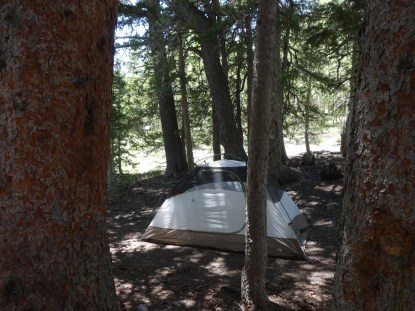
DSC05697This little forest gave me a feeling of privacy and security, despite the dead squirrel in there, just a few feet from where I pitched my tent. Flies buzzed around it. I made a mental note to make sure to avoid it. The last thing I wanted to do was to clean fresh juicy squirrel guts from my hiking boots or feel them ooze onto the sides of my flip flops.  It hadn’t crossed my mind that the real concern should be the carcass attracting other animals.

After I set up camp,  I went for a hike, taking the trail which began in the campground. The campground was named after Wheeler Peak, because the mountain peak towered over it. The trailhead led to the peak, but the trailhead also veered to Stella Lake and Teresa Lake, both which were small lakes at the bottom of the rock glacier. I took in these two lakes and saved the hike to Wheeler Peak for the following day.

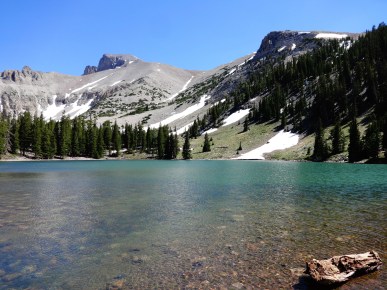
Up here above the Great Basin Desert, the forest was warm and spacious. Pine needles, fallen tree limbs, and streams covered the forest floor so beautifully. I made my way through the forest, observantly, with a full sense of wonder. This type of open forest was new to me. What sort of animals live here? What sort of plants and features might I expect to see? The the trail eventually led to Stella Lake. I stood there alone. The bright sun shone down, and the landscape opened up to a pristine view.

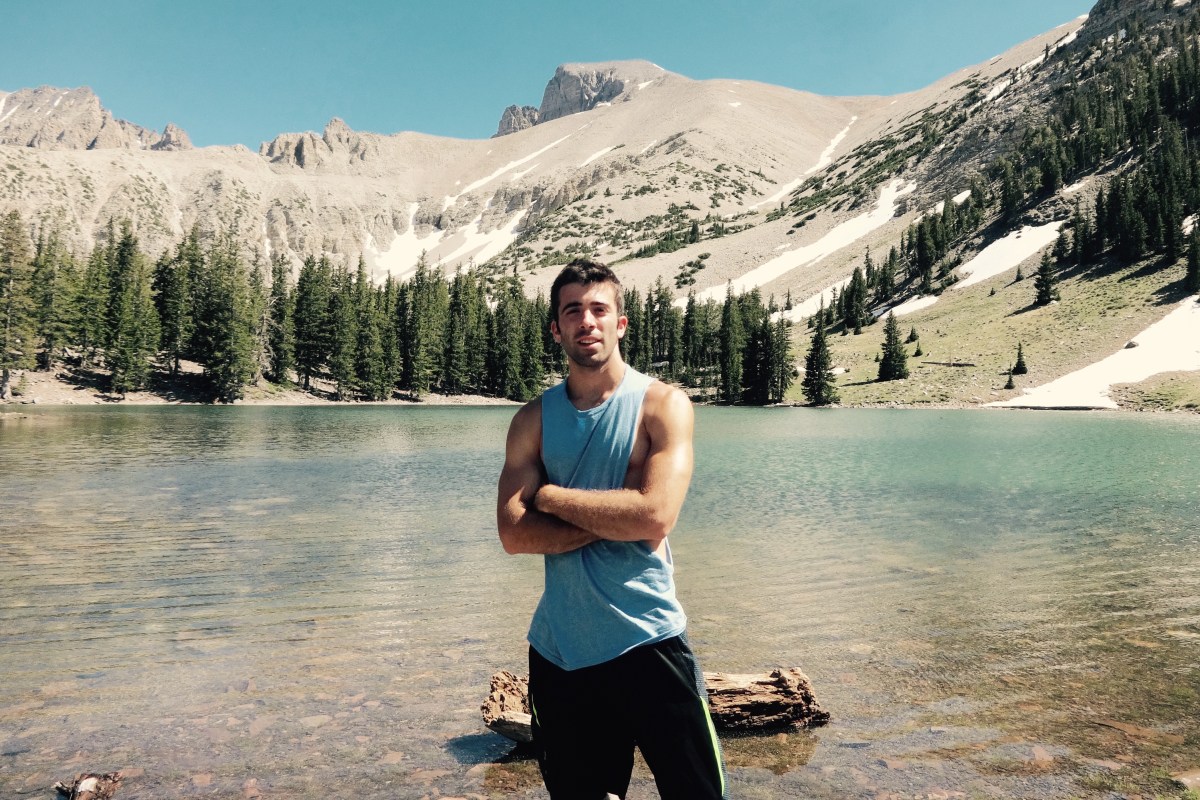
Except for a few patches of snow, I saw crumbled rock spread all over the landscape amidst clusters of pines. It was evident that all the rocks had fallen over time from the focal point. Just beyond the pines in the far reaches was it: Wheeler Peak, in all its majesty with a prominent rock glacier cascading from its height. This was the Great Basin National Park I had seen in pictures. Looking down, the water was turquoise, stealing blue from the clear sky and reflecting green from the pines surrounding it. Up close, the water was very clear. I could see jumbled rocks just on the other side of the small ripples caused by the gentle warm breeze. Who would have ever guessed that up here hidden in the heights beyond the heat of the desert was such a place. What else is Nevada hiding up in its mountains?

DSC05712This lake before me was not very big. It was small. I could easily swim from one side to the other. It seemed more like a pool. That combined with the fact that the pine trees weren’t terribly tall, the rocks around had fallen in relatively small fragments, and the only wildlife I had observed were chipmunks playfully running around, gave this place a sort of miniature feel. This sensation was appealing. It made the place welcoming, homey, manageable. It was like I had come upon a secret, exclusive, pocket-sized Montana.

DSC05745It seemed as if the forest of the park was only possible because of Wheeler Peak. Here at the base of this giant rock feature was the collection of its ice melt, the fruit of its shade. It created conditions for this pristine forest. It was another paradise hidden in the high reaches of a mountain.

Sometimes in our spiritual lives, the greatest places of pristine serenity are up in high reaches, well beyond the canyons in which so many people dwell. It takes initiative and determination to get to these places. Sometimes it involves making it past the desert of life, in which everything seems so fruitless and barren. In other instances it might mean walking over the snowpack, with not a trail in site, but relying on the guidance of God’s spirit. When you’re traversing your mountain, you may not see these secret places, hidden up in the high reaches, but they will surprise you, if you endure.

It’s important to say that arriving at these places of peace in life require you to be well elevated from your canyons. It may be you are stuck in a canyon of addiction, of insecurity, of selfishness, of anger, or of any ailment. Places of peace may not be found until you make your way up into the mountains. If you are stuck below in the canyon, you’ve got to ask yourself what is it going to take for you to get to your place of peace? Forgiveness, admittance, reliance? What about all of these?

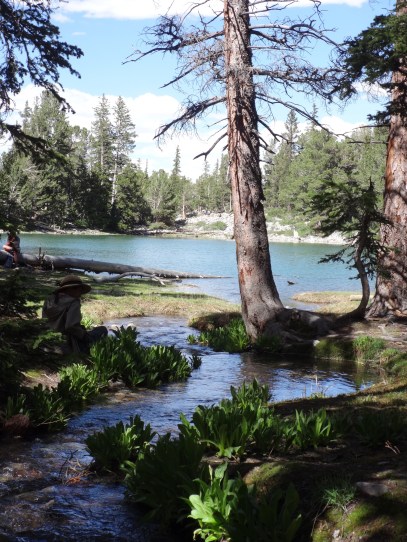
Life is not easy, but we all long for places of peace. I also want to be free flowing and pure like the little streams of water that flowed from the mountain lakes into Leham Creek. They flowed smoothly and quickly, just with a subtle trickling sound, and they meandered and swerved through the forest, clear and cool- not a care. Their flow was level to the ground around it. They weren’t carving out canyons, stirring up trouble, but flowed right along with the landscape of life. I remember holding my camera to take some pictures and thinking, I’ve never seen water flow more beautifully in my life.

My hike had been extremely pleasant, with the company of the sweet pines, the warm and gentle dry air around me, the vibrant blue and green colors of the ice melt water, the captivating vista of Wheeler Peak, the pine cones and pines needles spread all across the forest floor, chipmunks scurrying about, birds singing up in the trees, and the subtle trickle of the water meandering through the forest.

When I got back to camp, I felt, in a sense, high. It felt like nature had just shot something sedating through my veins. Maybe it was the altitude, or perhaps I was just tired and relieved from the desert. Or maybe it was the gift of a beautiful landscape and the exercise in the forest that released endorphins.

DSC05829I sat down on my sleeping bag, in my tent, tucked in between the pines, and I was at perfect blissful ease. I brought into my tent with me my water bottle and my book on the West. I took a sip of my water and laid down. The sleeping bag felt soft, silky, and warm, as it slid under my skin of my arms and brushed against my heels. Beneath it was the comfort of my air mattress filled full. I stretched my legs out and I could almost hear them giving off a sigh of relief. My head sunk heavily into my pillow. I looked up through the top of my tent into the limbs of the pine trees. Just beyond them was the rich blue sky and a few clouds lingering. I could gaze at this view for hours, I thought.

The lighting was perfect in my tent, coming in proportionally on all sides of the white tent, making my skin almost appear as if it was glowing that dusty red of southern Utah. The greenness of my sleeping bag was illuminated by the light, complementing the color of the pines overhead. I was relaxed, but my senses were keen and aware.

The temperature here was perfect. The air was deeply breathable, and the sides of my tent subtly radiated heat. I felt perfect, wrapped up in the womb of nature which was going to birth my rejuviation. I broke open my book, and started to read, then I fell deep asleep.

I woke up in the early night. I hadn’t expected to fall asleep and sleep so long and so deeply. I thought about just staying put in the tent, but concluded I really needed to eat. So I lifted myself up, stepped out of my tent, walked through my little forest and over to the other end, where I built a fire in the ring. I gathered up as much warmth from it as I could, because the air had grown cool. I cooked some oatmeal  and ate whatever other snacks I had. I wrote a few postcards and then called it a night. I walked back into my mini-forest and zipped myself into my tent for a night of deep rejuvenating sleep.

DSC05726

Read the previous entry “Reflections on the People of Rural Nevada,” here:

https://joshthehodge.wordpress.com/2018/03/15/reflections-on-the-people-of-rural-nevada/

Facebook: http://facebook.com/joshua.hodge

Instagram: http://www.instagram.com/joshthehodge/


Reflections on the People of Rural Nevada

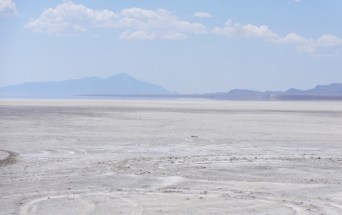
Approaching Great Basin National Park, I was driving through some serious desert in which nothing would grow. To me it appeared to be a giant salt flat. The ground was white and contrasted the blue and purple mountains in the distance. I pulled over to the side of the road to take in the scenery. I stepped out of my car and the heat was extreme.

DSC05694 (1)There was no way for me to gage the distance of the expanse before me, for there were no objects to give perspective. There was nothing but a grand mirage of water. It appeared that the desert housed a great lake, but the image disappeared at certain angles and the illusion waved in the heat. I knew it was desert trickery.

I’d seen pictures of Great Basin National Park. How could its beautiful streams, glacier ponds, and pine forests appear in the midst of this? I drove further into nowhere. No other car, business nor home had been spotted in a long time. The desert eventually permitted low lying shrubbery, but it was still a very typical Nevada desert nonetheless. The scenery would have to make a drastic change if I was going to arrive at the park I’d seen in the pictures.

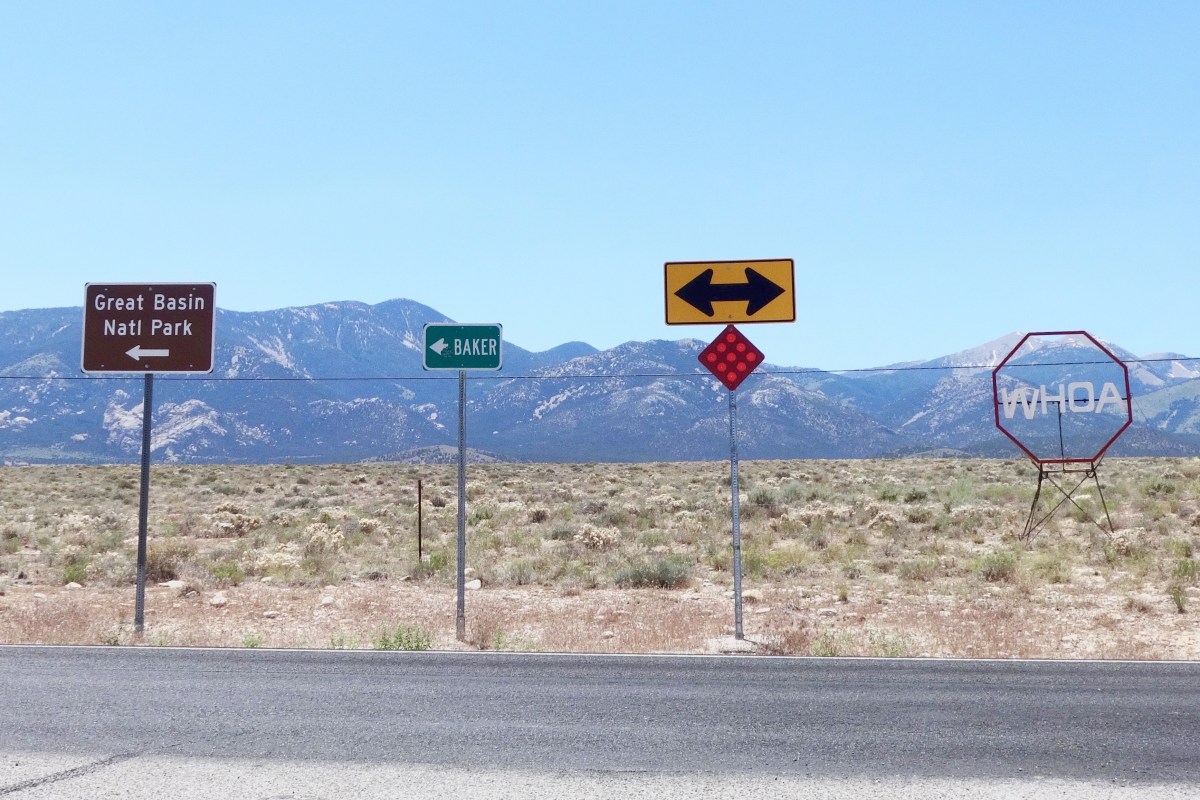
And it did. The mountains in the distance grew taller as I approached them. I knew the park had to be tucked up in the mountains. After zipping across the flat desert road, which was so inviting for high speeds, I came to a “T” in the road. An arrow pointed in both directions and a large stop sign read “WHOA!” An arrow pointed left to Baker, and another arrow also pointed left to “Great Basin National Park.” There was no indication of what a right turn would yield.

DSC05874
Museum of the Future

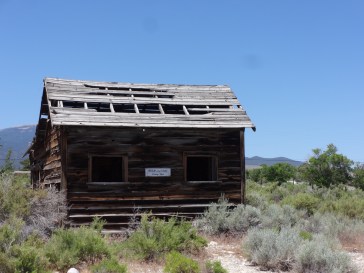
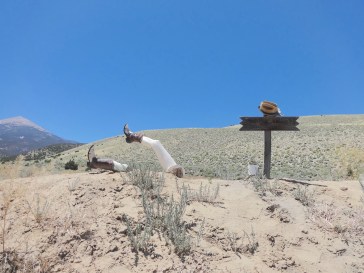
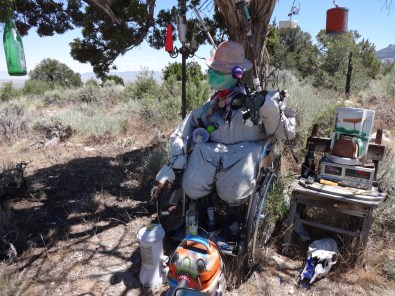
I soon arrived Baker, Nevada, gateway to the National Park. The place consisted of people living in dilapidated trailers, an abandoned shack with a sign posted “Museum of the Future,” a car which looked like it had been abandoned in the 1920s, some sort of business labeled “The Happy Outlaw,” and quirky and seemingly random pieces of roadside art. There was a manakin lady’s legs sticking up from the ground, as if she had plummeted or was pulled into the Nevada desert. Another piece featured an alien in a wheelchair adorned with old electronics and parts of appliances. This is so weird, I thought. I like this. This is so Nevada.DSC05875

I am an outsider to Nevada, and from my outsider perspective, here is how I see it. Rural Nevada residents embrace their weirdness. They even showcase it, and irony is their forte. Things don’t always have to make sense for them. They don’t have to have a theme or message. You just shoot for random and strange, but throw in some irony when possible, and that is pleasing, such as the abandoned shack labeled “Museum of the Future.”

DSC05880 (1)This is not just an observation based on Baker. Elsewhere in Nevada I’ve seen some interesting sites. Once I stopped at a gas station, and in the men’s room, I relieved myself into a cascading urinal fountain adored with rocks and greenery, where people had thrown pennies in, as if making a wish. Also outside of Death Valley, on the Nevada side, in the abandoned city of Rhyolite I’d seen the figures of the last supper recreated as lifesize ghost statues. Nevada is just full of surprises. I mean, in Baker you don’t get a stop sign, you get a “WHOA!” sign. They just have to be different.

DSC05876When I come across these rough looking trailers isolated in the desert, it’s not something I look down on or fear. I don’t think these people are hostile, or unrelatable by any means. Some may be living in poverty, and life may not be ideal, but for many, this is just how they live in Nevada. Many people have moved to Nevada and have chosen to live here in this way. It’s so far isolated from the rest of the country that sometimes these lots of land don’t have access to the full array of utilities, and there’s no one around to build a house hundreds of miles out in the desert. So, the only option is to resort to a trailer.

DSC05881Another thing worth mentioning in my observations about rural Nevada is the fascination with the supernatural and extraterrestrial. The supernatural fascination, I think, is tied back to all the ghost towns they have. These ghost towns have held so much life and so many stories, and then they were suddenly abandoned after the silver rush, but stories live on, or are speculated. And so in these places that have been abandoned there are allusions of the past that are almost seeable and believable, just like the mirage of water in the desert. It’s as if the beating heart of Nevada is a ghost itself, but a ghost really wouldn’t have a beating heart, would it? That’s just a piece of Nevada irony for you.

The extraterrestrial fascination may have in part to do with the mysterious Area 51 housed in the state and the vast claims of UFO sightings in the area. But, also, when you are isolated hundreds of miles out in the desert, with not a soul to talk to, and the heat is really getting to you, I could imagine your mind could convince you of, or conjure of stories of, alien encounters.

However, when it comes to  Nevada, I love it! There’s nothing like it.

When I arrived at the park boundary, I didn’t stop at the park visitor center. My priority was to secure a campsite in the Wheeler Peak Campground. I proceeded straight up the mountain, where the landscape changed into a dry pine forest. I was able to secure a great campsite within a small patch of trees. Like Nevada itself, Great Basin National Park is full of surprises, and is an underrated gem. It would become one of my new favorite National Parks! I wouldn’t say stop here and check it out, I’d say Whoa!, have. a. look!

DSC05872

Read the next entry “The Greatness of Great Basin,” here: https://joshthehodge.wordpress.com/2018/03/22/the-hidden-greatness-of-great-basin/

Read the previous entry “Assaulted at Yuba Lake,” here:

https://joshthehodge.wordpress.com/2018/03/14/assaulted-at-yuba-lake/

Facebook: http://facebook.com/joshua.hodge

Instagram: http://www.instagram.com/joshthehodge/

Assaulted at Yuba Lake

“I’m going to be lost and homeless,” were my thoughts. I had made the day long drive from the San Juan mountains across Colorado to the middle of Utah to Yuba Lake State Park. On my trip I had pulled over a few times to take pictures, sat in road construction where I did some reading, and stopped to eat. Now here at Yuba Lake, I knew the campground gates closed at a certain hour and I felt that I had just made it in time, but the number on my reservation didn’t match any in the campground. I was running out of time. The sun was setting. The day was over. If I couldn’t find my site before dark and the gates closed, what could I do?

I looped around a second and third time on the smooth black asphalt of the developed campground. A group of children, out playing with a ball, started to give me questioning looks. I had concluded there must be another campground in the park. I stopped by a bulletin board. It had a map, although poorly labeled and hard to read. It looked like there was perhaps a campground on the side of the lake and the drive did not look short. Forget my reservation, I thought. By the time I’d get there the gate would be locked. I’ll just stay here, but I soon realized I couldn’t. Another drive around revealed to me that the campground was full.

I felt I only had one option, to journey across to the other side of the park. I’d have to set aside my concern that the gate would be locked and work a little more diligently to find my site in the darkness of the remote Utah night, but I could do that. There was the possibility that I could end up with no place to stay, but I remembered the pictures of the campsite. It looked so beautiful. It could be a let down if I couldn’t find it.

So, my journey took me on a rough dusty unpaved road in the dark remote desert over to the other side of the lake. It took me about an hour, as I drove slowly to keep my car from falling to pieces. My cars headlights were the only light I had in the darkness of night, and I was waiting for some sort of creature to scurry in from the desert brush, into the road, in the line of visibility, but it never happened.

When I arrived there was no gate, but a grouping of three or four campsites, very remote and largely underdeveloped. It was evident why a gate was not needed. No one comes out this way. I was alone, an hour’s drive from the next human, in the dark, somewhere in remote Utah, next to Yuba Lake. Okay. I dig this. This is kind of cool, I thought. I was relieved that I found a place I could call home for the night.

I gave a sigh of relief. Then I opened my car door and was assaulted. Bugs poured in the car, flew up my nostrils, buzzed in my ear, and darted at my eyes. They were annoying little gnats and miniscule moth type creatures. I quickly closed the door and turned my air conditioning on high to blow the insects to the back of the car. These insects were fierce. I didn’t notice any of them biting, so that was good, but they were overwhelmingly invasive and annoying. I guess since Yuba Lake is the only body of water for hundreds of miles out here in the desert, all the insects congregate here and have wild Vegas style parties.

I needed a clear strategy for this. I needed to minimize the number of times I’d open the car door, and I needed to set up and get in my tent the quickest way possible. I popped the trunk and swiftly went out to grab my tent and the bag with my toothbrush. I implemented my in car toothbrushing method, which I invented in the Rocky Mountains, and then put on my head lamp. The insects immediately swarmed around the light all over my face when I opened the car door, but I figured out that they weren’t drawn to the head lamp if I set it to the red light setting.

So with the red glow of my headlamp, I managed to set up my tent with such hurry that you’d think my life depended on it. I threw in a pillow and a sleeping bag, and jumped in, zipping the tent closed as fast as I could. Fortunately very few insects snuck in with me, and the ones who did were quickly annihilated. I layed down and laughed. What a crazy experience. I laughed in response the craziness of the whole situation, driving miles and miles into nowhere and getting ready for bed and setting up camp in a wild fury, but I also laughed with a giddy notion of relief. I was finally in for the night, and I was safe.

I pulled out my book on the West and red another chapter. Reading puts me at ease and keeps me company when I find myself completely alone in remote and unknown places. I discovered this when I was alone up in the remote reaches of Manti Lasal.

That night I slept very well. I made up for the lost sleep the night before in the freezing San Juan Mountains. I was able to stay asleep well into the sun rising. It’s radiance warmed my whole tent, embracing me in comfort. I eventually sat up, and looked out my tent window to the beautiful Yuba Lake. The sandiness of the desert hills met the pale blue of the lake, reflecting the clear sky. The insects were gone, the air was clear, and a refreshed spirit of adventure was painted in the morning sky.

I put on a pair of well worn and ripped jeans that I rolled up to the knees and I put on my Rocky Mountain cap. I walked around the edge of the water, right next to my campsite. Small waves lapped on the sandy shore, while the warm sun welcomed me and introduced me to the new day.

Read the next entry “Reflections on the People of Rural Nevada,” here:

https://joshthehodge.wordpress.com/2018/03/15/reflections-on-the-people-of-rural-nevada/

previous entry “A Night in the Ice Lake Basin,” here:

https://joshthehodge.wordpress.com/2018/03/12/a-night-in-the-ice-lake-basin/

Facebook: http://facebook.com/joshua.hodge

Instagram: http://www.instagram.com/joshthehodge/


A Night in the Ice Lake Basin

“Whatcha doin’?” I asked my cousin Paul, as I sat down by the fire.

“Cookin’ socks,” he replied.

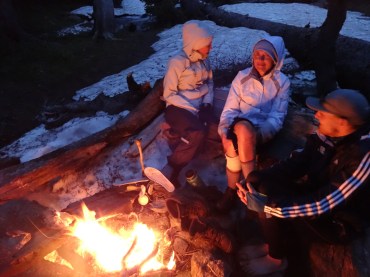
Some people roast marshmallows, or cook hot dogs, but Paul was holding our socks over the fire, cooking socks, in attempt to dry them. The trek up to the Ice Lakes had involved lots of snow getting into our boots. Paul had a found a tree branch laying around which curved in such a manner that it was perfect for laying our socks across and holding over the fire.DSC05587

Everyone had volunteered their socks including myself. We also set our boots next to the fire to try and dry them. Sadly Mary’s boots were a little too close and got singed.

It was early evening, but the temperature had already dropped greatly. We were all in our hoodies and jackets and had our bare feet propped up against rocks next to the fire, inviting the soothing heat to keep them warm.  

Paul handed off the sock roasting responsibility to me and went in search of more wood for the fire. It was a very hungry fire, burning things up quickly. I found a place to prop up the sock drying branch so I could be hands free.

DSC05592We all had contributed to finding firewood and kindling, but Paul won the prize for this.  There was a pattern. He’d disappear. We would carry on conversation, and, after a while, he would return with arms full of wood and kindling. At one point I remember we all laughed. Paul had found an enormous piece of tree trunk and was carrying it to camp over his head, seemingly effortlessly, like an experienced woodsman. He had a grin on his face seeping from his sense of personal accomplishment,  I would assume. The question on all our minds was where did he find that, and how did he resolve to lift it?

“That’s so Paul,” Jonathan commented.

There had clearly been a place set up to have a fire prior to our arrival. Paul had taken the lead in renovating the area. He found logs and rocks and assembled them to create a bench with a backrest and armrests. We had our own living room set. Eventually everyone discovered they could put rocks close to the fire to heat them up and then remove them from the fires edge to warm their feet. I initially had the best seat. I was tucked in the corner of the constructed bench, sitting on the log, my back resting against a broken piece of timber, and my feet on a smooth rock warmed to the perfect temperature by the fire. In due time I rotated out from my comfortable corner to let someone else enjoy the prime sitting spot.

There was still quite a bit of day left, but no one had plans to leave the fire. The air around us was just too cold and wet, and some of us were sore from the hikes of carrying all our supplies for camping up the mountains and then trekking up snow to the Ice Lakes.

As we sat there poking around the fire a Marmot probably thirty feet away would crawl up out of its burrow, take a few steps forward, shout at us, and then run back into his hole. It happened a few times. Sometimes he wouldn’t make a noise but would just watch us. He was probably trying to figure out what we were and what we were doing here.

Jonathan had brought some sort of soup to cook by the fire for himself, but the rest of us just snacked on dry goods. Jonathan also heated a Clif Bar over the fire, which is a tactic I’ve now adopted. The bars become pleasantly soft and warm. However, they do absorb really well a smoky flavor which takes some getting used to.

DSC05597After we were by the fire for many hours, the conversation died down, and I decided to open a round of Would You Rather, something I learned from my younger brother, Timothy. You go around in a circle taking turns, posing ridiculous questions like “Would you rather jump out of an airplane or plummet down Yosemite Falls?”

When night had fallen and the fire turned to glowing embers, we checked into our tents for the night. I was unprepared, not knowing this would be the coldest night of my existence.

I had fallen asleep okay, but in the middle of the night I awoke freezing. I was very uncomfortable. I had only packed one sleeping bag, a small lightweight one that’s packaging stated it was good for temperatures down to forty degrees. It was for sure below forty degrees. I would assume the temperature had plummeted below freezing. The sweatshirt I was wearing and my lightweight sleeping bag was not enough. I should have known better. On top of that, my head had no warmth to sink into. I had only brought my very small trunk pillow which seemed to absorb the cool air. And here I was in Kelty, my lightweight and airy tent. I should have been more prepared, but, aside from the Rocky Mountains, I had spent weeks in the desert and temperatures like this were unimaginable.

There were a couple things I could do. First, I took the nylon bag which the sleeping bag is stored in and I put it over my head, trying to capture the heat of my breath. Secondly, I put my hands in my pants, for they were growing numb. There was a third option too. I could climb into another tent, but there were questions on my mind:, First, would that be socially acceptable? Even if it’s not, isn’t it okay in dire situations like this? Is this an emergency? Will I be ok? Which tent would be the less awkward one to climb into, the tent with my Aunt Mary and Jonathan or the tent with Paul and Ines? I unzipped my tent and looked outside contemplating going over to one of their tents. I couldn’t pull myself to do it. I’ll suffer, I concluded. So with my head in a bag and my hands in my pants, I slept on and off, waking up cold and uncomfortable, and reminding myself that the night will end. Warmth will come in the morning. Never before was I more glad for the morning’s arrival.

DSC05598That morning we didn’t stay long in the basin. We were all cold and hungry. As the others were slowly waking up and putting themselves together, I walked around camp, admiring the expanse of the basin waking up. It was beautiful. The sun was golden and caused everything that was wet and frozen to shimmer in its light. Paul and Ines also walked around and sat together on a fallen tree trunk, looking out into the basin. No one said anything. I suppose we were all taking in the awe of our surroundings and trying to thaw out. I walked out from the shade to feel the slightest bit of warmth falling from the sun. It wasn’t much, but I’d take it.

I remember when we were packing up, Jonathan was shaking off the morning due from his tent, neatly folding it, making sure every corner matched. I, on the other hand, am much more haphazard when packing my tent. I live in the fine line between the type A and type B personalities. Tent packing, just not on the top of my priorities. To each his own, and I should learn to keep better care of some of my things.

When we were all packed up, we hiked back across the basin, crossed over the streams and rivers, down the forests and prairies, and made it back to the car. I talked with Ines a lot on the hike down. I didn’t know her very well. I had only met her briefly in a couple of family occasions. I was very pleased to get to know her. We got to talking about life in Germany, and I was extended the offer to come visit.

Back at the cars, there was talk by my cousins of bathing in the river, but I knew I didn’t have much time to spare and needed to get on my way. My goal was to drive 7 hours to the western side of Utah, to Yuba Lake State Park. Aunt Mary and my cousins would continue their adventure on to Arches National Park. I brought out my map and spread it across the top of my car and explained some of the features worth seeing, and recommended a stop at the Moab diner.

Then it was time to part ways. It was sad, to leave, but I felt so thankful for the experiences shared together. From Mesa Verde to the Ice Lakes, the adventures with this bunch are truly unique and special. They will last with me forever.

Read the next entry, “Assaulted at Yuba Lake,” here:

https://joshthehodge.wordpress.com/2018/03/14/assaulted-at-yuba-lake/

Read the previous entry “When Life’s Path is Frozen Over,” here:

https://joshthehodge.wordpress.com/2018/03/10/when-lifes-path-is-frozen-over/

Facebook: http://facebook.com/joshua.hodge

Instagram: http://www.instagram.com/joshthehodge/

When Life’s Path is Frozen Over

It was the middle of the day and the moment had come. It was time to temporarily part from our camp in the San Juan Mountains and ascend to the Ice Lakes.

Jonathan had awoke from his nap. The rest of us were fully oriented to our camp surroundings, and we were ready for the next leg of our adventure.  The plan was to ascend, enjoy the stunning beauty, and come back down to camp later and enjoy a fire and an evening in the basin.

We knew that in the forecast rain was very likely, and beyond the basin, in the distance, a dark ominous sky grew. We knew we had no time to spare. We wanted to get to the Ice Lakes before the storm, for there is no comfort found in being on top of a mountain in the midst of lightning.

The trail up to the Ice Lakes was right behind our camp. It was very steep most of the time, meandering up the mountainside. Much of it was covered in layers of snow, and so the journey was largely a trek on top snowpack. It required us all to sort of hunch over to balance our weight and maintain stance on the mountain.

I had my handy trekking pole with me to dig into the snow and pull myself forward. I decided to lend it to Aunt Mary. She would have been fine without it, but I thought she could use it more than myself. She was very grateful. When I hike in a group I very much have a team mineset. We are like one unit or one creature, and so it’s important to support each other to reach the goal.

At times there was question of which way to go, because we could not locate the path in the midst of all the snow. Recollecting this sparks another parallel to life. I feel that there are definite right answers to many things in life, very much so in a moral sense. In certain situations there are certain decisions which are moral and just that need to be made. These are the pathways in life which lead to certain outcomes and chains of events, but life is full of noise, of opinions, of differing views, of distractions, of complications, and sometimes these clear and definite trails become covered in our perceptions. We can’t find them, and we search and search our lives for meaning, trying to find our way. However, sometime we search life with a cold heart, and when a heart stays cold, the ice doesn’t melt and there’s little to no chance of finding the path. If we break open our hearts and allow the healing power God to enter in and his compassion to influence our lives, it’s easier for the snow to melt and for us find our ways

Other times, despite our closeness to God, and seeking his direction,  the unwanted storms of life will not cease, our paths for major life decisions are not clear. It’s like when a canyon forms, not by choice but by the forces around us. It’s in these moments when we need to realize that we don’t always need to see the path. The spirit of God leads us over the snowpack when the trail is nowhere to be seen. That spirit can move us forward, when confusion is so apparent in the world around us. He guides our moral compass. But it’s a matter of trust, a matter of surrendering fear, a matter of realizing you may not see where you are going, but you are not lost.

I think that is so true about my life. Some people have definite five years plans, and ten year plans, and they know exactly where they are going and have a plan on how to get there. There’s nothing wrong with that. I believe setting goals and having a vision  is very important, but I’ve lived enough life to know that too much faith and hope in one’s own plans, and especially on one’s method to get there, can lead to major disappointments. Personally, I feel like much of my life is walking on top snowpack. I continue day by day seeking direction, making plans, but surrendering those plans to God. Sometimes the snow melts around me and direction becomes clear, and in those moments I savor scenery and enjoy it. Ecclesiastes 7:14 reminds us, “When times are good, enjoy them, but when times are bad, consider this: God has made one day as well as the other, and man never knows what the future may bring.”

More often in life, storms leave snowpack, and I continue with trust and confidence knowing that the Spirit of God leads me. I may not always know where I am going, but I am certainly not lost.

In both a spiritual and physical sense, I find it very rare to feel lost in life. It’s an understanding that nowhere in this world is outside the realm of God’s power. He is always with me. Even in the most daunting and foreign places are still within God’s dominion. Also, spiritually and emotionally, nothing escapes God’s vigilance and intervention. It reminds me of one of my favorite yet simplest bible verses, Psalm 37:4, “The angel of the Lord encamps around those who fear him and delivers them.” This especially sticks out to me, because I know what it means to “encamp”. It’s traveling from one place to another, not staying put, but finding residence in temporary places, and so the verse doesn’t say the Angel of the Lord sets up permanent residence at our mailing address, it says the Angel of the Lord “encamps”- travels with us. There is nowhere I can go in this life to fall out of the intervention of God’s protection. Even in the darkest canyons, the Angel of the Lord will set up camp with us. On our way out of the canyon, up into our mountains, when the storm rolls in and the snow covers the trail, the Angel of the Lord is there to protect us and God’s Spirit is there to lead. How could I possibly ever be lost when the divine presence of God is with me?

That is something to celebrate and put us at ease. But it’s all a choice. Some people choose to live their lives in canyons alone. They are unwilling to acknowledge how they’ve gotten there, and in their pride they attempt mountains covered in snow with no guide. As for me, I’d be completely lost and I would not have true peace, and so I’ve made another choice.

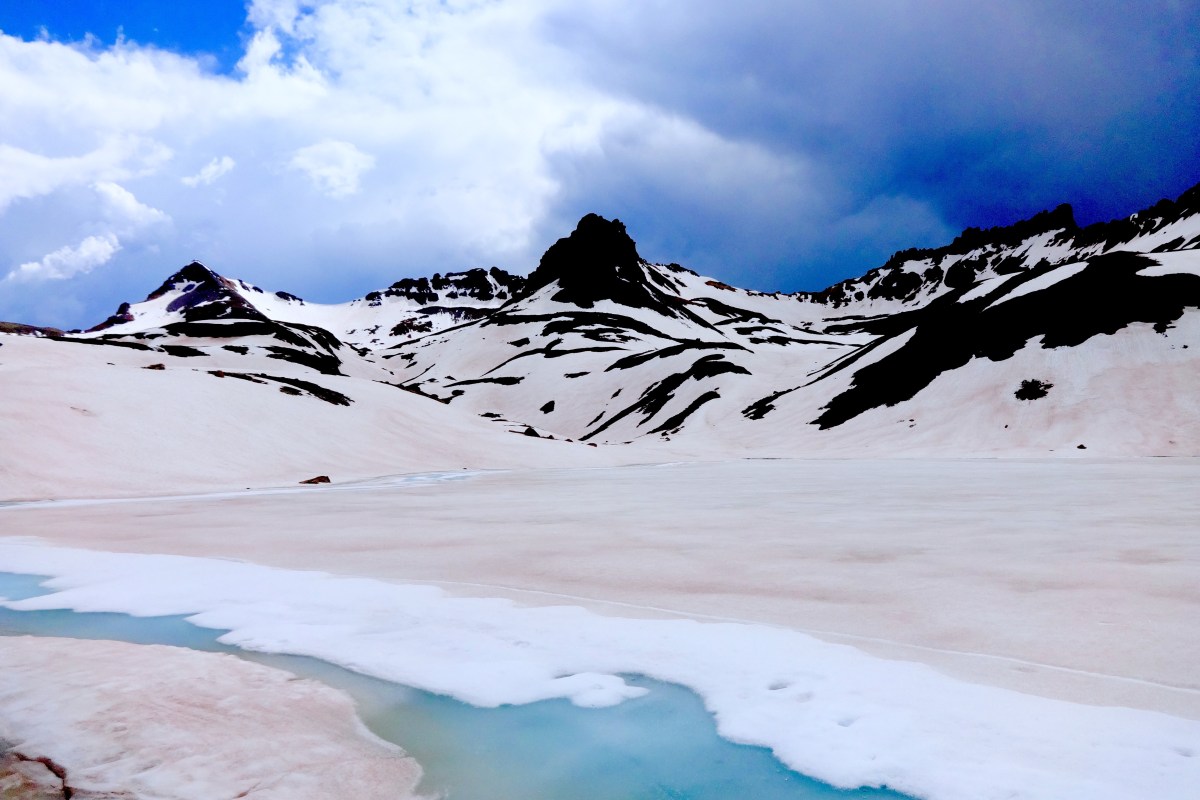
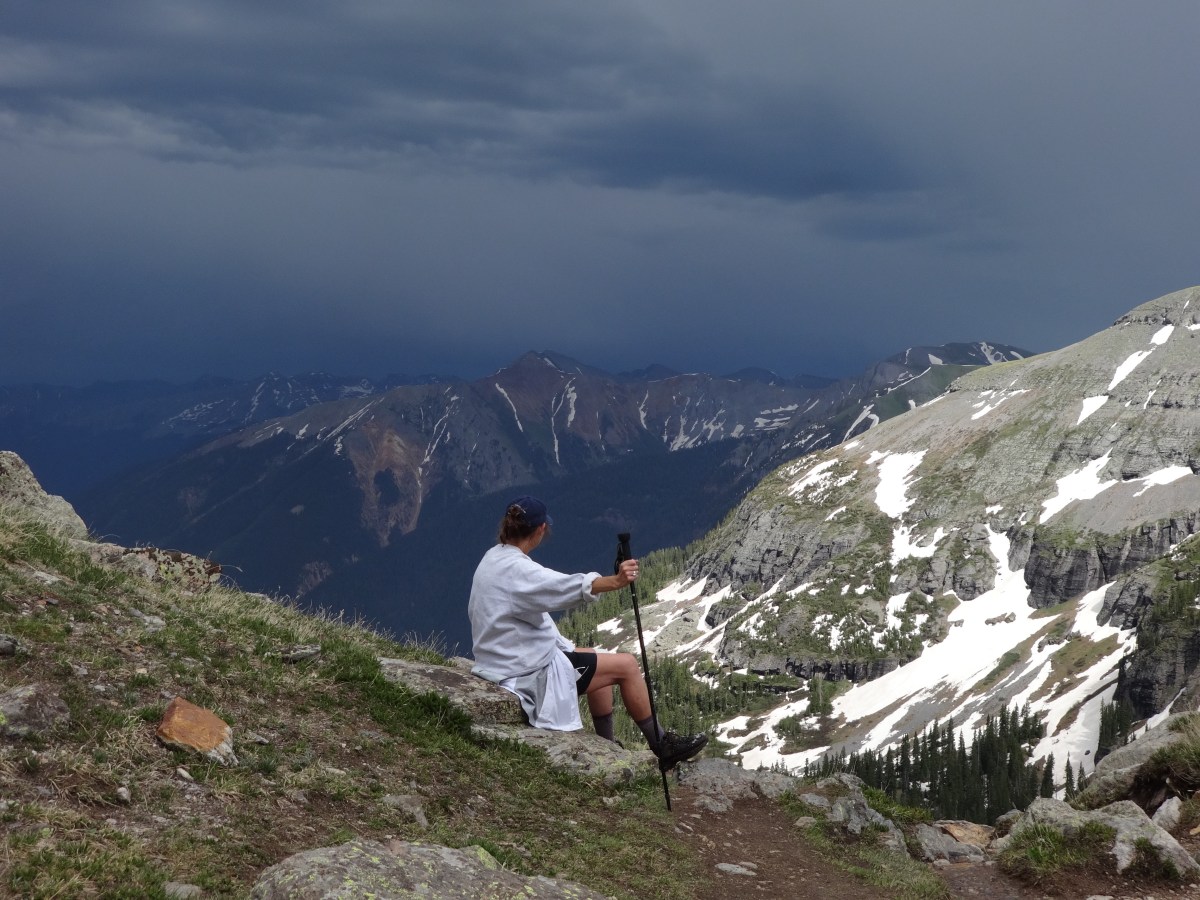
True peace also doesn’t mean you never have or concerns or acute worry. These things can be mechanisms to spur intelligent thinking and action, like Aunt Mary warning us “We need to turn around” as she turned to look at the deep dark ominous sky growing towards us. We were all spread out. Mary was at the end of the pack, Jonathan and I were in the middle, and Paul and Ines were somewhere up above already nearing the Ice Lakes. Mary called out numerous times with concern in her voice. Not wild and unchained fear, but intellect calling out as a mother’s need to protect her family. I had paused a couple of times and wondered if we should indeed turn around, but despite her hesitation, Mary proceeded forward. We came up over a ridge and reached the Ice Lakes. It was named very appropriately, because it was all frozen over. Snow and ice was everywhere. A stream of turquoise spread across where the water was slightly warmer, and the very peak of the mountain stood up behind it covered in snow except for a few stripes of dark exposed rock. Although silly as it may sound, the best way to describe it is that It looked like were were among a giant mass of chocolate chip ice cream.

Despite snow on ground all around, the air was not particularly cold. We were all in shorts, and I was even in a tank top. In the photos it looks a little odd. It doesn’t appear to make sense. In such an environment, it seems like we should have been bundled up to the extreme.

We took some photos together, but didn’t stay long. The storm behind did look like it was approaching determinedly.

DSC05574
Cousin Paul sliding down to the basin.

On our descent, Paul went sliding down on a portion of the snowy mountain side. It was a lot quicker and faster going down. We made it back to our camp in the basin safely.


Except for a light sprinkling, a storm never came, but the temperature changed for sure,  and it became very cold. We would spend the rest of the day and evening huddled around a fire, drying our wet socks, and keeping warm.

DSC05572
Aunt Mary looking into the storm

Read the next entry, “A Night in the Ice Lake Basin,” here:

https://joshthehodge.wordpress.com/2018/03/12/a-night-in-the-ice-lake-basin/

Read the previous entry “Backpacking in the San Juan Mountains,” here:

https://joshthehodge.wordpress.com/2018/03/10/backpacking-in-the-san-juan-mountains/

Facebook: http://facebook.com/joshua.hodge

Instagram: http://www.instagram.com/joshthehodge/

Backpacking in the San Juan Mountains

The dirt road we were traveling on was bumpy, rattling my little rental car and swinging my National Park pass hangtag side to side like a violent pendulum. It was a prime example of a washboard road, and the grooves on this road might as well have been paved.  My cousin Jonathan and I were in this car trailing Paul who was in another, leading the way with Mary and Ines.

We were on our way to the trailhead which would guide our adventure up into the San Juan Mountains where we would camp and visit the Ice Lakes. I had only a vague idea of what to expect, because I hadn’t even seen photographs of this place. I was trusting my cousin, Paul, with this adventure. After all, since he’d come all the way from Germany for a visit, and this hike was on his list of things to do, it must have been well researched.

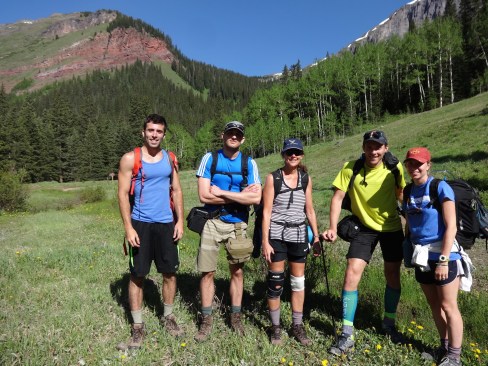
We came to a small parking area nestled down in a valley with a rushing river and a footbridge on one side and prairie on the other. Elsewhere, dark pines stood. We were in an area managed by the National Forest Service. There were a few other cars, but the place was by no means busy. We quickly geared up, took a group photo, and were on our way.DSC05455

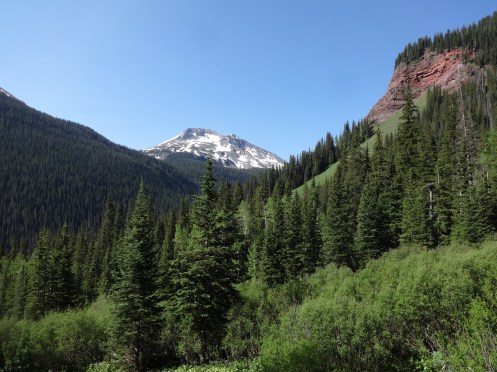
The morning was absolutely beautiful. The sky was pure blue, the sun bright and cheerful. Vibrant colors were painted all around- the green of the pine and prairie, the orange and greys of the Colorado rock, the white of the leftover snow in the high reaches, and even the bright yellowness of Paul’s neon shirt. The sun was at such a position, and the air so clear, that every wrinkle and crack of rock was exposed, every tree top was distinguishable, and the dance of every rustling leaf was visible. The landscape was in the highest of definition, fully awake and alive.DSC05465

The hike was about two miles. The whole thing was an incline, but it wasn’t terribly steep, There was a series of switchbacks along the ascent, which lessened the immediate incline. The trail by nature was not difficult, but my backpack was by no means light. I was carrying a lot of water and it weighed me down, and so it made this hike pretty strenuous. I’ve thought back to this hike in other challenging backpacking situations. I remind myself,  “If I can hike up the San Juan Mountains with that backpack, I can certainly do this.”

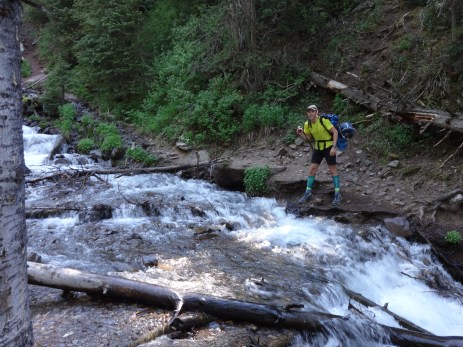
The hike took us on a very narrow path into a thick pine forest with lots of growth on the forest floor. At one point, near the beginning of our journey, we came to a rushing stream. We had to cross it by our own creativity. Ines took off her shoes, carefully placing her feet on stones to cross. I kept my waterproof boots on and trudged through the water. Paul leaped over. Mary and Jonathan found their own ways.DSC05460

We came to a second wilder, more intense, crossing later on. Two logs had been placed across the rushing water, but with nothing to hold onto, it became a careful balancing act. We found two large thin pieces of tree limbs that Mary held onto on either side. She stuck them down into the rush of the water, like trekking poles, to help keep balance and cross over.  

As we ascended the mountains, we came to a hybrid aspen and pine forest which let out into a wild grass prairie on the mountain side. It reminded me of my journey up the mountain in Manti Lasal.

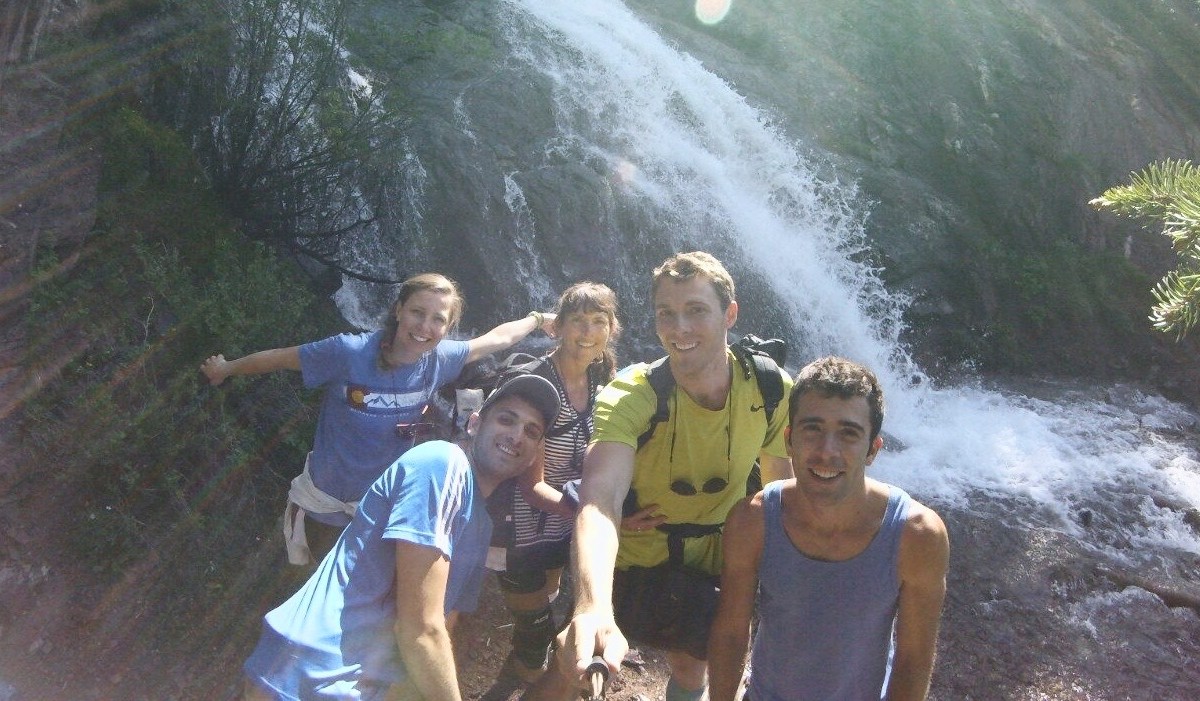
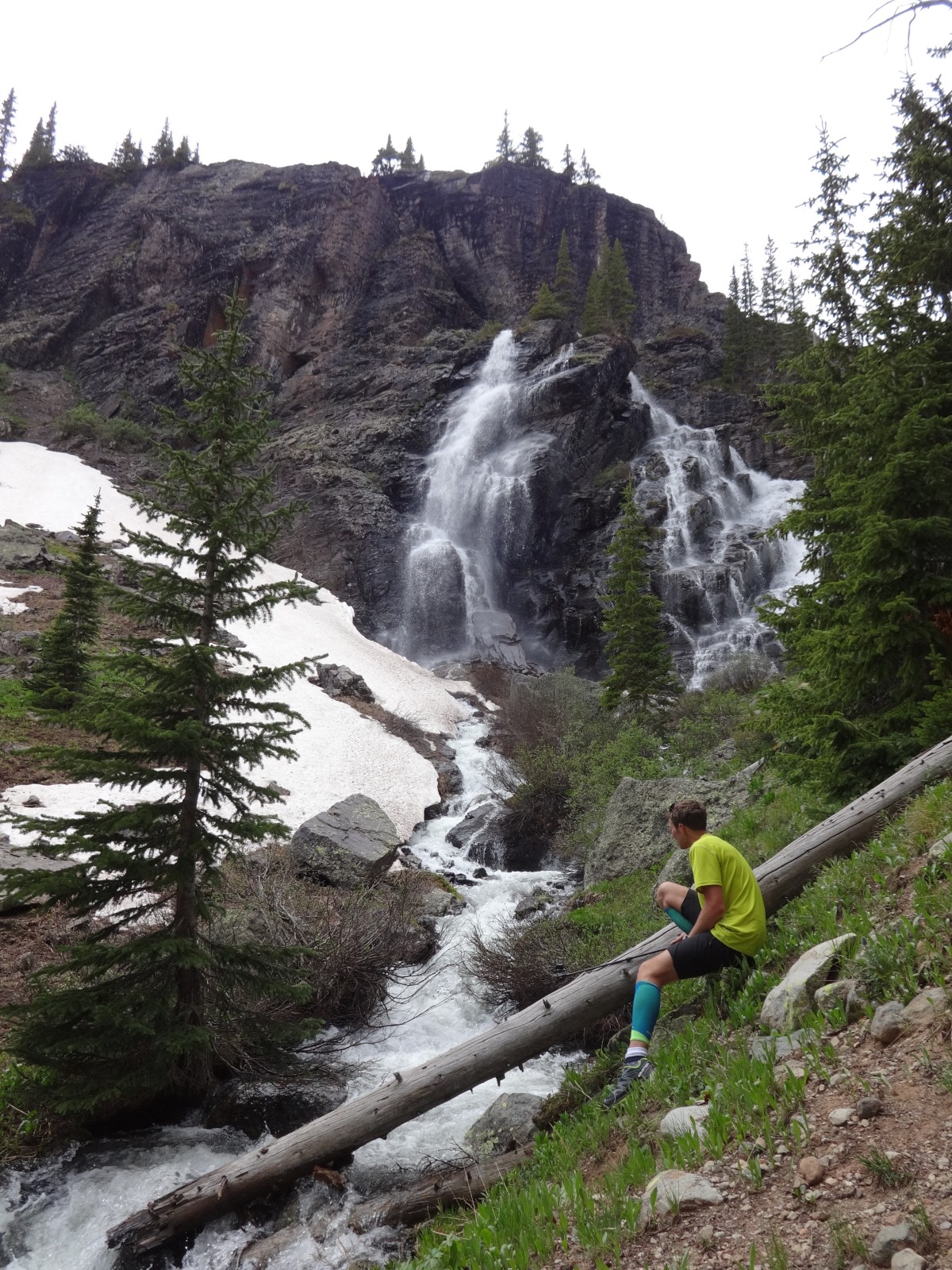
About halfway up our ascent, we came to a waterfall just off to the side of the trail. It was loud and dropped very sharply. We were able to stand right next to it.  Paul had a Go-Pro camera on a stick, we took a group photo. It was also around this time that Jonathan discovered that he left a camera lens or a battery back in my car. He chose to go down to retrieve it. He ran, and it didn’t take long for him to catch back up with us, but after the extra mileage, he was tired.

We found a spot to take a short break. It was in an area of prairie where trees stepped aside to present a majestic view of the valley which curved around a bold mountain. The mountain in view had an exposed top of grey rock with streaks of snow painted down its side. All around, below, were thick congregations of pines, sharply pointing upward.

Alongside the trail, there was a rock boulder maybe fifteen feet high. Jonathan and I climbed up to the top where I was able to catch Jonathan, on camera, in a pensive pose with the mountain behind him.DSC05476

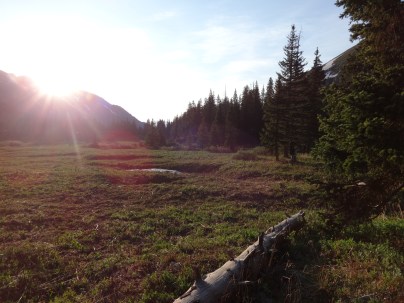
After our short break, we continued on our journey, climbing higher and higher, the backpack straps digging deeper and deeper into our shoulders, and then we reached our summit! We found ourselves in the most beautiful basin. The entire floor of this basin was covered in wildflower plants. They weren’t in bloom, but they filled the air with a sweet aroma. All around were the slopes of green wild grass growing up the sides of the basin. On these slopes were streams of water cascading down from ice melt. It was so fanciful, so perfect.  Places like this aren’t known to exist outside of fantasy. On the basin floor the streams of rushing water spread in all directions among the wild flower plants, creating a series of islands. This was all thousands of feet up in the mountains. It was a little bowl of paradise removed from the rest of the world, elevated up here, tucked away, hidden, and we were the only ones present. We had the whole basin to ourselves. And, although we were clearly exposed in the realm of nature, because we were down in a basin, it felt like were sheltered in this exclusive paradise.

Our destination to set up camp was over by a small collection of pine trees on the far end of the basin, to get there was a bit of a trick, because the streams of water which spread out on the basin floor did so in such a wild manner, and some of these streams were wide and forceful. We had to troubleshoot numerous times, finding our way on and off numerous prairie islands, backtracking when the streams were too wide for crossing.DSC05491

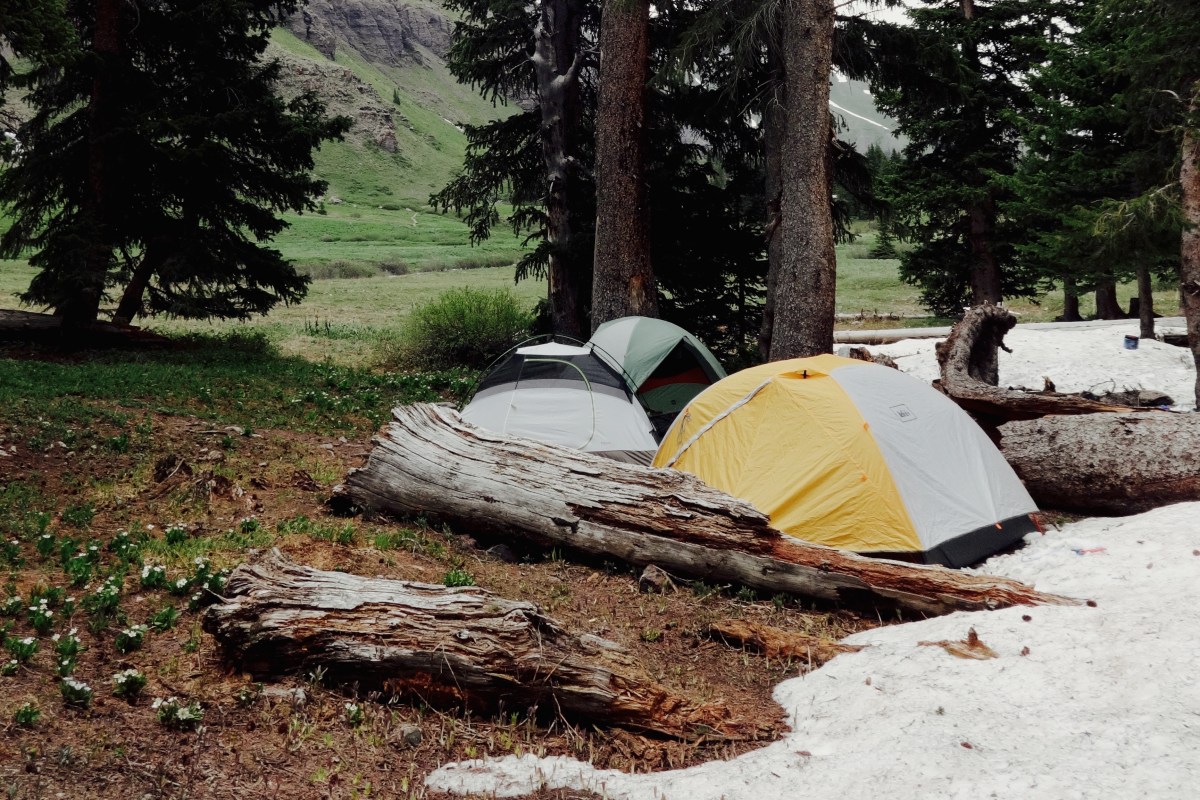
When we made it to the pine trees, there were mounds of snow protected by the shade. Among them were a few fallen trees creating places to sit down. Next to these were natural pads of pine needles and flat ground to pitch tents. Fittingly so, we set up camp. We placed our tents all relatively close to each other’s, next to the tall pines.  Our camp was near the far end of the basin where a beautiful waterfall, split as it fell, creating two side-by-side waterfalls, which crashed so elegantly down against rocks and into the the network of streams. At the base of the falls were a collection of shards of dark wet rocks that had crumbled down with the falling water.DSC05516

DSC05518Despite being out in the wild, I felt sheltered twofold. First, we were down in a basin with the sloping walls around us, placing us in our own little world. Secondly, we were in the fold of the small patch of forest with a strong sense of camp establishment. We had our little tent village, or the bedrooms as I liked to call them. Next to that was a mound of snow, were were had refrigeration- our natural kitchen. I had taken out my water bottles and stuck them in the snow.  Next to that, was a collection of stumps, fallen tree parts, and rock oddities, creating an area to sit down and have a fire- the natural living room, the common area. All of this was hidden and sheltered by the cover of the pines. Never before had nature seemed so accommodating. It was as if it was saying, welcome to my finest. Make yourself at home.

After we set up camp, we went around exploring our immediate surroundings, admiring the waterfalls, collecting wood for a fire. During all of this exploration, Jonathan was inside his tent taking a nap. He was tired from his extra hiking of having backtracked for his missing camera parts. Plus his recent sleep schedule was not his usual he had with the Air Force.

I could hardly believe I was here, that this was real, that this was where we would get to spend the night, a backpackers paradise, a deep cleansing oasis for the soul. And there was more to be seen than the wonders already set before us. Once Jonathan would awake from his nap, we would take an afternoon hike from camp up to the Ice Lakes.

Read the next entry “When Life’s Path is Frozen Over,” here: https://joshthehodge.wordpress.com/2018/03/10/when-lifes-path-is-frozen-over

Read the previous entry “Mesa Verde with My Cousins,” here:

https://joshthehodge.wordpress.com/2018/02/04/mesa-verde-with-my-cousins/

Facebook: http://facebook.com/joshua.hodge

Instagram: http://www.instagram.com/joshthehodge/

Mesa Verde with My Cousins

The living room floor was covered in gear and supplies all laid out and organized in piles and distinct sections. We were prepping for our overnight backpacking journey up into the San Juan Mountains to camp in a valley by the Ice Lakes. We had to divy up supplies and see whose pack could carry which things. We hadn’t even begun our journey, but I was excited. The spirit of adventure was alive and thriving.

I had never backpacked overnight with anyone and here we were, this was actually going to happen! And for once, I didn’t have to take the lead. My cousin Paul had sought this trail and plan. He had seen it online while in Germany and had been waiting to do it next time he was in the U.S.. I was relieved to be a follower. All I needed to do was make sure I packed what I needed for the adventure. My aunt Mary, cousin Jonathan, cousin Paul and his wife Ines were all packing at the same time, asking each other questions, trading off supplies, helping each other come to decisions about what was best. I loaned Paul an inflatable pillow, and I volunteered to carry the majority of the water supply. Jonathan, volunteered his pack to carry our bear canister with most of our food supply. We weren’t sure if there were even bears in the mountains, but better safe than sorry. Food, however, wasn’t our strongest of priorities, but we packed what would sustain us. We had apples, peanut butter and jelly sandwiches, jerky, Clif bars, and trail mix. I had also tucked away in my backpack some electrolyte gummies. I had noticed how useful they had been on other hikes.

A couple of us had hiking backpacks, but some of the others had standard back-to-school type backpacks bulging with supplies. So we got creative, tying things to packs with ropes and miscellaneous straps. We didn’t have the most expensive backpacking gear, but we were going to make this work.

When we finished packing, I went out on the terrace of the abode-like apartment Airbnb we were staying in, and sat there with Paul and Ines. We were relaxing and snacking on some vegetables and cherries, enjoying the summer heat slowly fade in the late evening, and writing in the guest book for the Airbnb. The host lived in an apartment on the bottom floor of the building. I had never met her, but the others had been there for a couple days and apparently she had been very friendly and had even brought a homemade breakfast bread to them. I was able to sample it. It was delicious. Although I do not remember exactly what the note we wrote in her guest book was, I’m sure there was appreciation expressed for her bread.

Sometimes it’s the most simple things that stick out more apparent in our memories. Sitting here on this terrace with my cousins is just such a fond memory of mine. Three things about it made it special to me. First off, it was a conclusion of such a fine day. We had spent the day touring around Mesa Verde National Park. It was also the eve of a grand adventure into the San Juan Mountains, and it was also the joy and comfort of reconnecting and resting in the company of family after having been alone for weeks.

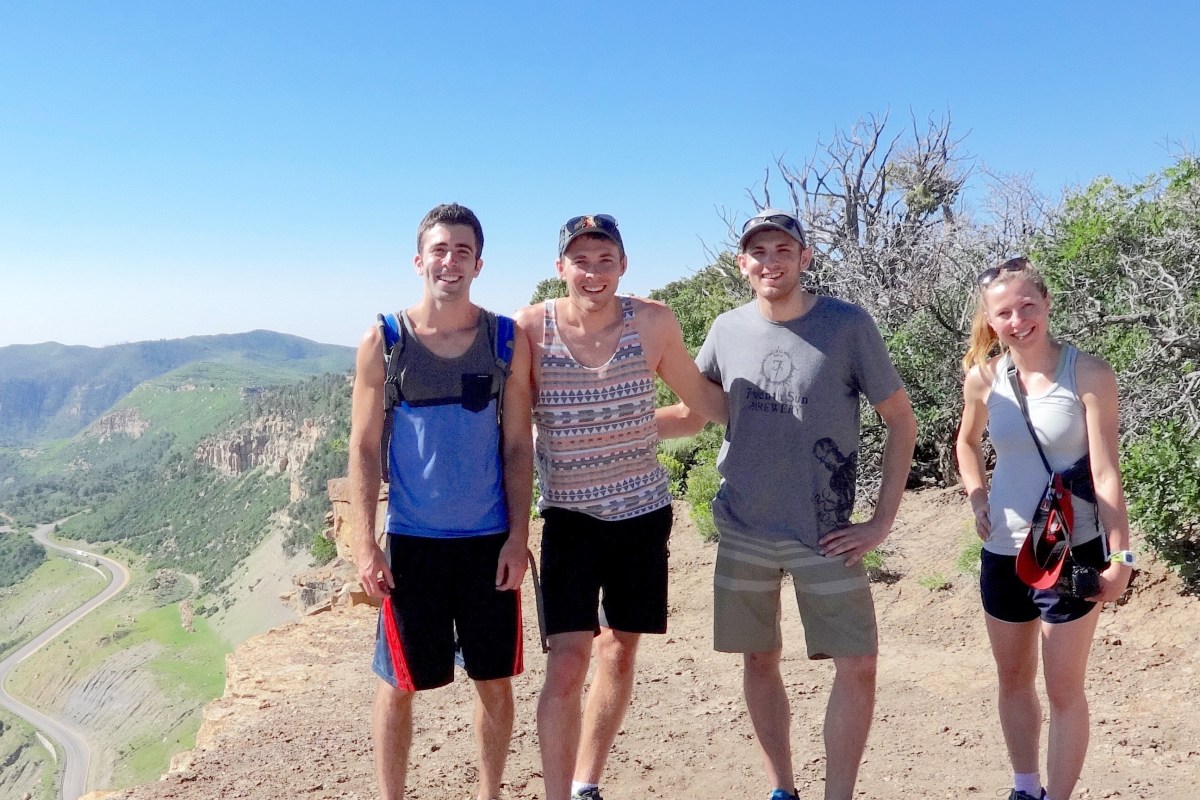
In the morning, we had arrived at Mesa Verde early, shortly after the park opened. We wanted to make sure we could secure tickets for a tour of the Cliff Palace. It was a success, and my Aunt Mary kindly purchased the tickets for all of us. I then made sure we all stopped to see the park film, because personally, we know, for me, a National Park visit is not complete without seeing the park film. After that, we went on a short hike up to the top of the mesa where we took some nice cousinly photos and looked down at the windy road we had ascended in the park.

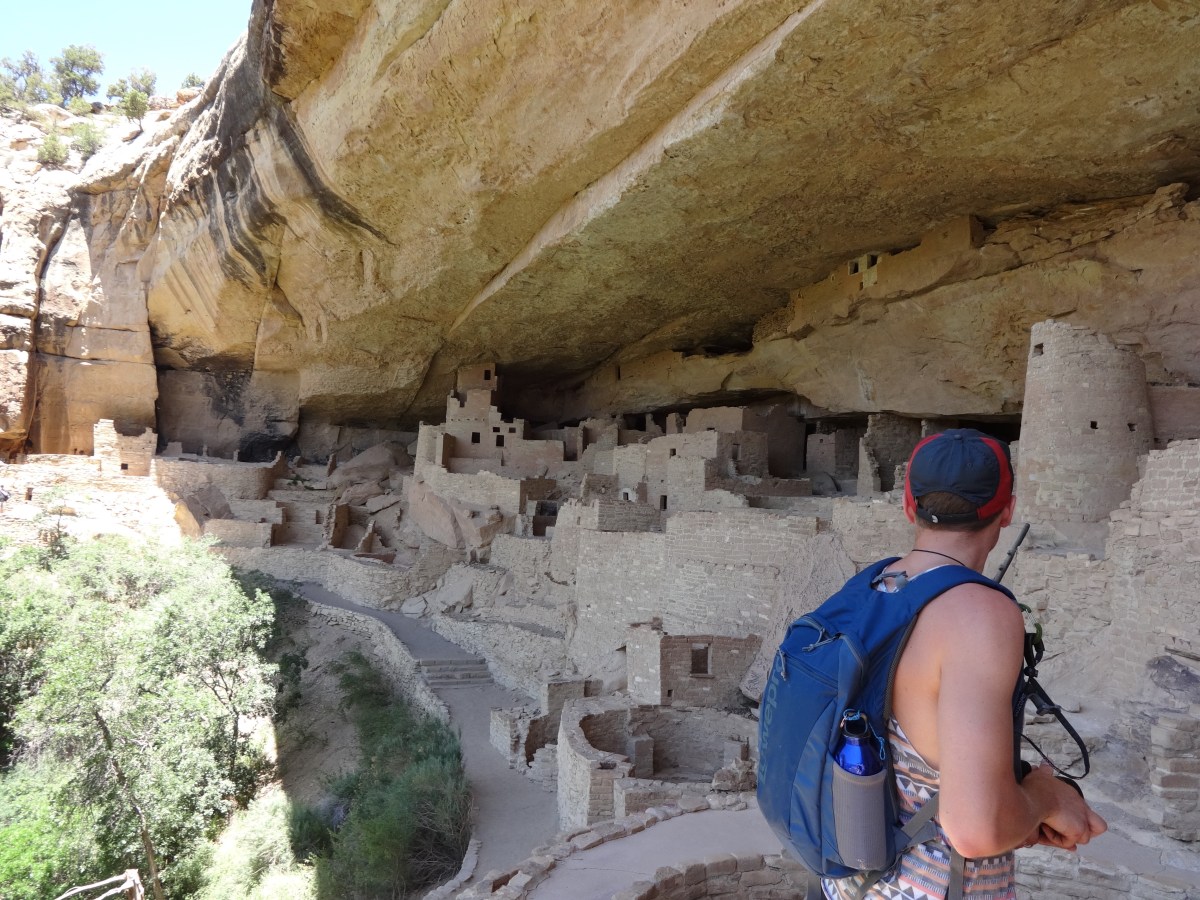
Our tour of the Grand Palace went well. The tour took us down around and inside the famous rock houses that comes to most minds when Mesa Verde is mentioned. The large and intricate rock house city hidden under the overhang of the mesa was impressive. There were about fifteen of us on the tour.  We were guided and informed by a round native american park ranger, with a black braided ponytail sticking out behind his ranger hat. He carried with him a spray bottle, and along the tour he asked us tourists trivia questions. If any of us were correct we earned a spray from his bottle. It sounds silly, and I thought it was a little much at first, but the second time I answered a question correctly I gladly accepted a spray. The dry summer heat of southern Colorado is oppressive, any relief should always be accepted.

What’s most fascinating to me about Mesa Verde is how the inhabitants of this place seemingly suddenly disappeared. No one knows what happened to them. It’s believed that at its prime 22,000 people lived here. There is speculation that drought led them to other places where they assimilated into other native cultures. To me that doesn’t make sense. How could a civilization build an entire city like this and have the resolve to abandon it and move to another location? Furthermore how could there be no history of this migration and assimilation of one people group into another. Let’s imagine for a moment they migrated and into the  Navajo or Ute society. Wouldn’t their certainly be history, or at least legends, of such a large invasion of another people group. It doesn’t add up to me. These people literally disappeared from Mesa Verde, leaving no trace nor evidence, which leads me to certainly not yet believe but still entertain the thought of some sort of extraterrestrial intervention. Call me crazy, but it’s also the wild imagination I have that allows to me speculate and entertain the thought. It’s fun to conjure up your own theories to the matter.

Mesa Verde, unlike many National Parks, doesn’t have an abundance of recreational opportunities. There are not a lot of hiking trails, and the terrain is not terribly unique in my opinion. The main attraction are these rock houses, and they are justly deserve all the attention they get, but, in all my experiences, this part seems more like a National Historic Site. However, curious enough, how could it be a Historic Site, if we really don’t know that much about the people who lived here nor a timeline of their events. It could be something new: a National Mystery Park.

Leaving Mesa Verde, we headed into Durango, Colorado. A classic railroad town turned tourist hub. We walked around Main Avenue, which is lively with numerous restaurants, cafes, and shops. Most of the buildings were made of brick with arched windows, and tasteful facades that were true to the architecture of the buildings the represented. We were looking for a place to have a mid day meal.

The downtown had a classic small town feel to it. We got distracted from seeking food to looking at t-shirts. Aunt Mary wanted a Durango t-shirt, and so we went into a few t-shirt shops. Durango had been a special place for the her, because here is where they got on the historic Durango and Silverton Train and took it out to go white water rafting. Also Aunt Mary rarely gets to see her kids, as they all live so far away. I also purchased a t-shirt, because although I didn’t  get to see much of Durango, it is where I got reunited with my aunt and cousins. That held significance.

Our mid day meal proved to be tasty. We ate at a local brewery with very atypical and delicious burgers. I believed mine included avocado and mango. I remember my cousins had asked me how my brothers were doing. I told them about Timothy graduating from college and seeking his place in the world, and telling them about my older brother, Nathan. They hadn’t heard all the details of how Nathan’s chocolate company, Raaka Chocolate,  in Brooklyn had grown into a new factory and how my brother has really become a leader in the connoisseur chocolate world.

After our meal, we ran a few errands, popped into Dairy Queen for a treat, and headed back to the Airbnb, where we began our package and assembly party, getting ready for the adventure the following day. We also had to clean up the place, as we were checking out early the next morning and wouldn’t be back. The day ended with me sitting out on the terrace with my cousins munching on the fruit and vegetable tray we had put together. The day had been full and rich, and so I relaxed in the peace of a day well spent and the anticipation of the adventure ahead.

DSC05442
Cousin Paul at the Cliff Palace

Read the next entry “Backpacking in the San Juan Mountains,” here: 

https://joshthehodge.wordpress.com/2018/03/10/backpacking-in-the-san-juan-mountains/

Read the previous entry “On the Great Sand Dunes,” here:

https://joshthehodge.wordpress.com/2018/01/27/on-the-great-sand-dunes/

Facebook: http://facebook.com/joshua.hodge

Instagram: http://www.instagram.com/joshthehodge/


On the Great Sand Dunes

I could see them from seventy miles away, the Great Sand Dunes of Colorado. I was intrigued by this park well before arriving. It was another park I heard very little about. It was founded as a National Monument in 1932 by Herbert Hoover but gained the title National Park and Preserve in 2004 by an act of Congress. Sand dunes have always fascinated me, just because they are so different than anything I’m used to. This would be my fourth trip to desert sand dunes. The first was my harrowing plight for survival in a sand storm in Death Valley. The second was in Coral Pink Sand Dunes State Park in southern Utah, where I peacefully watched the sunset over the pink sand. My third experience was in Huacachina, Peru where I went sand-boarding with my brother and sister-in-law.

I had driven about five hours from Rocky Mountain National Park to Great Sand Dunes National Park and Preserve. It was now the middle of the day. Just like my arrival at all National Parks, I had picked out some accompanying music. Since I would be greeted with large sand dunes, it was time again for some more Star Wars music. This time it was Rey’s Theme from The Force Awakens. That song is heard when Rey is traveling about and sliding down the sand dunes on her home planet of Jakku. That’s the connection. That’s why it was chosen.

While I was approaching the park, I was again draining my battery from my Chromebook into my cell phone. I had tried plugging the charging cord from my phone directly into the USB port in the car. I thought it was charging, but all along it was wasting battery. I had on and off communication with my cousin, Jonathan, days prior. I knew him and other family were in Colorado, but I didn’t know their exact whereabouts nor plans. I was trying to connect with them. I assumed draining a Chromebook battery into a cell phone was not good for the life of the Chromebook battery, but I remembered the purpose of buying this Chromebook in the first place. I had purchased it super cheap the summer before, just outside of McFarland, California simply to back up photos from my travels. This device was meant to be an emergency travel device, and connecting with my cousins and aunt would be far more valuable than this piece of technology.  Arriving at Great Sand Dunes National Park and Preserve I still had no plans with my cousins. I didn’t know why reaching them was so difficult, but later I would learn why.

Great Sand Dunes National Park and Preserve is a very isolated park. I drove many miles in wide open space with very little civilization in sight. I had spoken to a Park Ranger about this park the following summer in Grand Teton National Park. He told me that this park was petitioned to transition from a National Monument to a National Park in efforts to increase tourism in the area.

When I arrived at the park my first stop was the campground. Plan A was to set up camp in the park campground. Plan B was to obtain a wilderness permit and camp out in the sand dunes. I was able to pursue Plan A, as there were still a few sites left. I thought arriving mid-day I would have no luck, but perhaps because this place was so very hot, maybe it wasn’t quite appealing for the general camper.

The campsite I chose faced the sand dunes but I could only see one large dune which served as a wall, hiding all the curves and waves of the other dunes behind it.DSC05324
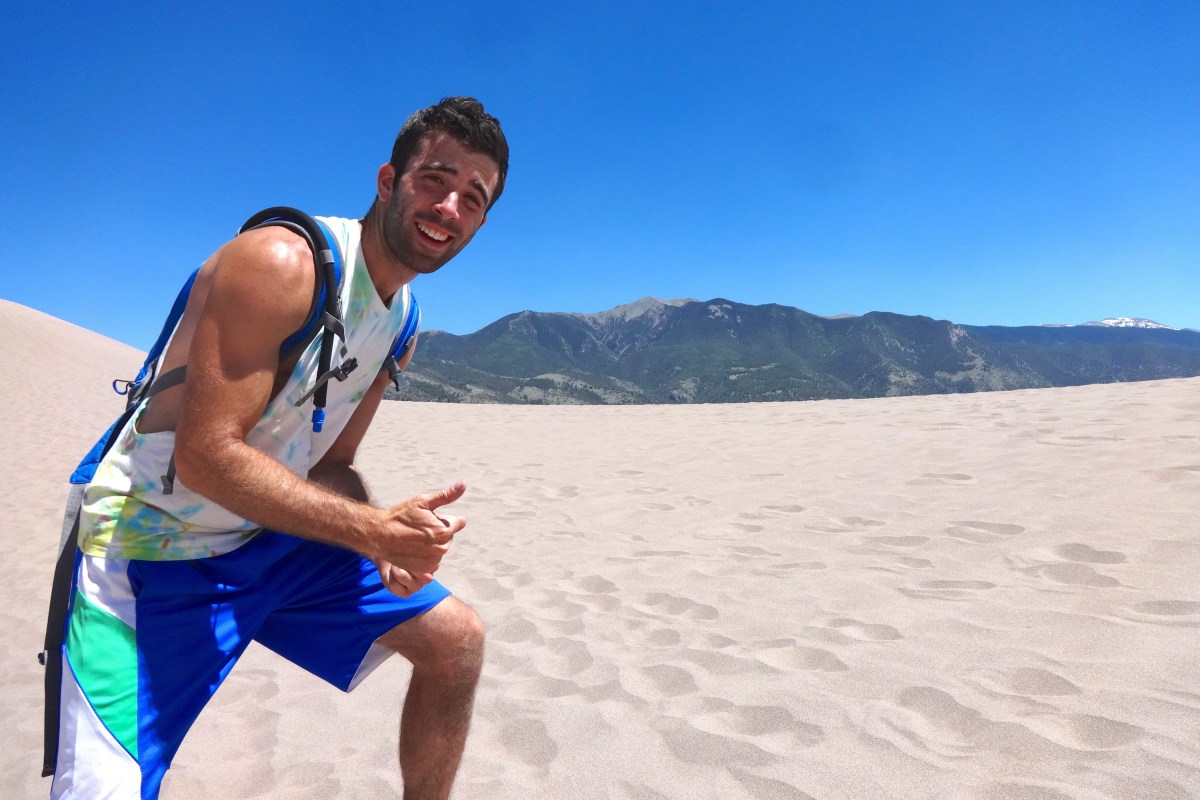
I quickly set up Kelty, hopped in my car, and drove to the visitor center. Then I was off to the dunes. There are no trails on the dunes. There is simply a large parking lot and the great sand expanse. I applied sunscreen in plenty, filled up my hydration pack, and then needed to make a decision about footwear. I thought I had come up with a brilliant idea. I didn’t want to wear my boots because I thought they would be too heavy in the sand. I didn’t want to wear my tennis shoes, because I knew they would collect sand, especially since one of my shoes had caught on fire from campfire embers and had a nice hole burnt through on top. I was imagining the sand collecting in my shoes and making the trek uncomfortable. I knew I couldn’t go barefoot, because there were many warning signs about that. The park warned that in the summer afternoon the sand can reach temperatures up to 150 degrees. My genius idea was to go in socks.

A group of young adventurers from a vehicle next to me approached “Do you know what we should wear out there,” one of them asked as I was getting myself together.

“I am just going like this “I replied, standing shirtless in a pair of blue gym shorts and socks.

“Have you been here before.”

“No I haven’t” I replied

“What should we wear on our feet.”

“I don’t know, but I’m just wearing socks.”

“That’s a good idea,” he replied. I thought so to. I was glad to share my wisdom.

I began my trek barefoot, because at first there was a stretch of water trickling down from snow melt in the the mountains far away, that created a very shallow river on top the sand. Many people were congregated in this area, wading their feet. Children ran about splashing in the water and playing with the sand, as if at the beach.

After crossing the water, the incline began, and the expanse of dry hot desert dunes stretched on for miles. Socks were on, and traveling was great. Although the area of sand dunes was very expansive, it was not endless. In all directions were the tall rocky mountains of Colorado with pine trees and snow melt creating stripes down their sides. It was an interesting contrast to be in stifling hot sand dunes, looking around at mountains with snow. It was also interesting to think that just yesterday I was venturing through deep snow drifts on my attempt to make it to Mount Ida. Colorado is definitely a place of contrasts.

The sand dunes were relatively busy. People were following each others footprints to dune peaks. As typical, I wanted to to go farther than anyone else. So I trudged further and further up and down sand dunes, which is not easy. It takes maybe five times the effort than hiking on solid ground, because with each step your feet sink, and there is not stable ground to push yourself off of. Hiking downward is fun though, because you can descend inclines too steep and perilous for solid ground. On sand there’s no harm done when you fall, tumble, and slide. The sand is a giant encompassing cushion.

Here the color of the sand was uniformly a typical beige color. No plants grew. It was everything you might imagine sand dunes to be. Nothing out of the ordinary like pink sand, or black sand, or wild scary-looking desert shrubs. It was just a giant sand box of a place.

I had reached the highest dune I could see from when I began my quest. Standing on top, DSC05337I could see there were more mighty dunes in the distance, which were temping to pursue. But at the moment, my feet felt like they were on fire. Wearing socks was not a bright idea. Hot sand found its way into the socks over and over again, and was burning my feet. The hot sand mixed with coarse friction had also burned and ripped a giant hole in one of my socks. It appeared as if part of the sock had disintegrated.  I was about a mile and a half in, but my feet couldn’t endure anymore hiking, so I turned around. I wasn’t disappointed the least bit. I felt like I got a true Great Sand Dunes experience, greater than the rest of the tourists who gave up much sooner than me.
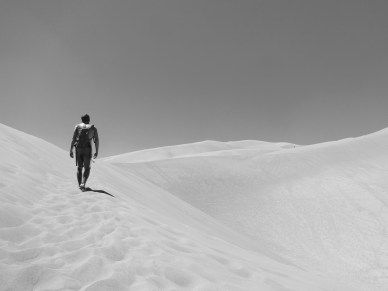
On the way back, I remember sitting down for a moment and looking around, at the sand, the mountains, and the people way below. I remember thinking, how in the world did I get here? Although I knew the answer, it was all sort of a marvel to me that I found myself in such a unique and different place than where I typically live my life. This sort of moment had happened more than once on my trip. In these pauses I try to take it all in. My life sort of replays summatively through my mind. It’s a summary of my weaknesses that I conjure up. I think back to when I was a teenager, being so depressed that I didn’t care to be alive anymore. At that time self-doubt and insecurity ripped me apart inside, and my world was so small. It didn’t extend beyond my own feelings.

I also think back to college when I was incredibly sick and weak, plagued with complicated Ulcerative Colitis and Pancreatitis. I grew tired climbing just one flight of stairs. Then I was hospitalized. I remember when I was able to walk again. I went out into the hospital courtyard with my walker, and just being able to stand on my feet, clinging onto my walker in that little landscape patch between cement buildings, was enough for me to find hope.

Now, here I was sitting on top of a giant sand dune, in the beating sun, thousands of miles removed from home, alive, strong, full of spirit. I’d come from the Sonoran Desert, seeing Saguaro cactus, through the Petrified Forest, across the plains of the Navajo Nation, around the canyons of Utah, up to aspen forests and alpine tundra of Colorado, and now here I was on a giant sand dune. I’d climbed higher than everyone else. They tired before me. I looked down at them as little ants. I realized my past was marked by canyons of illness that kept me trapped in low places, but now I was on a mountain, not by my own doing, but by the force of restoration and strength attributed to God.

In addition to marveling at how far I’d come, I was also struck in wonder by the diverse beauty of the United States. A few years ago I would have never even imagined that such a place as Great Sand Dunes National Park and Preserve existed in the United States. The more and more I travel to National Parks, the more I fall in love with this country. It is so full and rich in natural beauty. I remember, when I was younger I thought that the United States was just sort of uniform place with varying degrees in temperature. I couldn’t have been more wrong. The United States in amazingly rich in geological diversity. The National Park service does a great job at preserving all of these wonders and surprises.

After trying to take it all in, I began my hike down the sand dunes back to my car, tumbling and sliding down, despite my feet were in much pain. I had to arch my feet, trying to keep contact with sand limited to the tips of my toes and my heels. I had to pause at times and raise one foot up in the air to give it a chance to cool off, cooling down from the 150 degrees of the sand to the 105 degrees of the air. It was such a relief when I got back to the shallow river, and placed my feet in the ice melt water. I hoped the other young travelers from the parking lot hadn’t followed my example in footwear.DSC05389
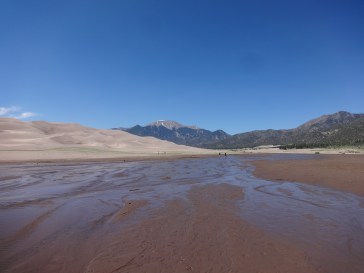
I would have stayed longer in the river if it weren’t for some intrusive ranchera music blaring and ruining the serenity. A group of people had set up a canopy by the river where they had a picnic and enjoyed their choice music. I would have been happy listening to the water trickle and the wind wisp across the sand. It’s okay. I let it go. I wanted to go relax at my campsite and figure out a plan for the evening from there.

Back at my site I had received a text from my cousin, Jonathan. He and his family had been busy white water rafting most of the day, but now they were done and staying at an Airbnb in Durango, Colorado. I was welcomed to come spend the night there and visit Mesa Verde the following day, and then backpack overnight in the San Juan Mountains to the Ice Lakes the next day.

I plugged in the address into my GPS. They were about 160 miles away, which would equal roughly 3 hours of travel. I would arrive at night, but it wouldn’t be a problem. Sign me up!

I tore down my tent and threw my it back into my car. I found the campground host to inquire about a refund. She said refunds are never issued but I could sell my campsite. So I peddled around and sold my site to a couple at a slightly discounted price. Then I was out of there.

Durango, here I come! I was excited to see family. I had seen my cousin Jonathan the summer before when we adventured around Yosemite National Park together. It was a memorable time, and he was great company.  That was the last time I’d seen him. I would have liked to have seen him more, but I lived in Kentucky and he was stationed in California with the Airforce. As kids, we were decently close, although I would only  see him in the summer when my family would travel back to Princeton, Illinois. I thought we had a pretty good cousin bond, given our limited time together, but then the expanse of time grew larger between us and we grew up. When we met up in Yosemite, it had been years since I’d spent any time with him. I wasn’t sure how our interactions would go, but I couldn’t have asked for a better adventure buddy and a better time. Sure, we had grown and time brought change, but we were family and we were able to reconnect effortlessly and have a great time.

I also hadn’t seen my cousin Paul and his wife, Ines, in a few years. They had been living in Germany and their lives would be very different from what I last knew. And then there was my aunt Mary who lived in Illinois, whom I hadn’t seen in even a longer period of time. I knew she had endured heavy challenges and changes in life, and I admired her for her strength and raising my cousins, whom I respect so greatly, in the midst of it. I was so excited to see all of them and go on adventures together.

When I arrived, Paul and Mary were still awake. I spoke with them for a while, filling them in on my adventures and them filling me in on theirs. Their white water rafting trip was seriously legit. They rode some high class rapids and took the famous Durango and Silverton Railroad to their launching point. After visiting with them, I got laundry started, took a much needed shower, shaved, and retired to the living-room floor where they all had kindly left the comforters from their beds. I had a plush island of comfiness to myself, luxurious compared to the weeks of tent camping I had grown used to.

I was happy. Although I hadn’t seem these family members together in a long time, there was comfort in being with them. I had found a little piece of home way out in Colorado.


Read the next entry “Mesa Verde with My Cousins,” here:

https://joshthehodge.wordpress.com/2018/02/04/mesa-verde-with-my-cousins/

Read the previous entry “Chillin’ Like a Moose,” here:

https://joshthehodge.wordpress.com/2018/01/21/chillin-like-a-moose/

Facebook: http://facebook.com/joshua.hodge

Instagram: http://www.instagram.com/joshthehodge/
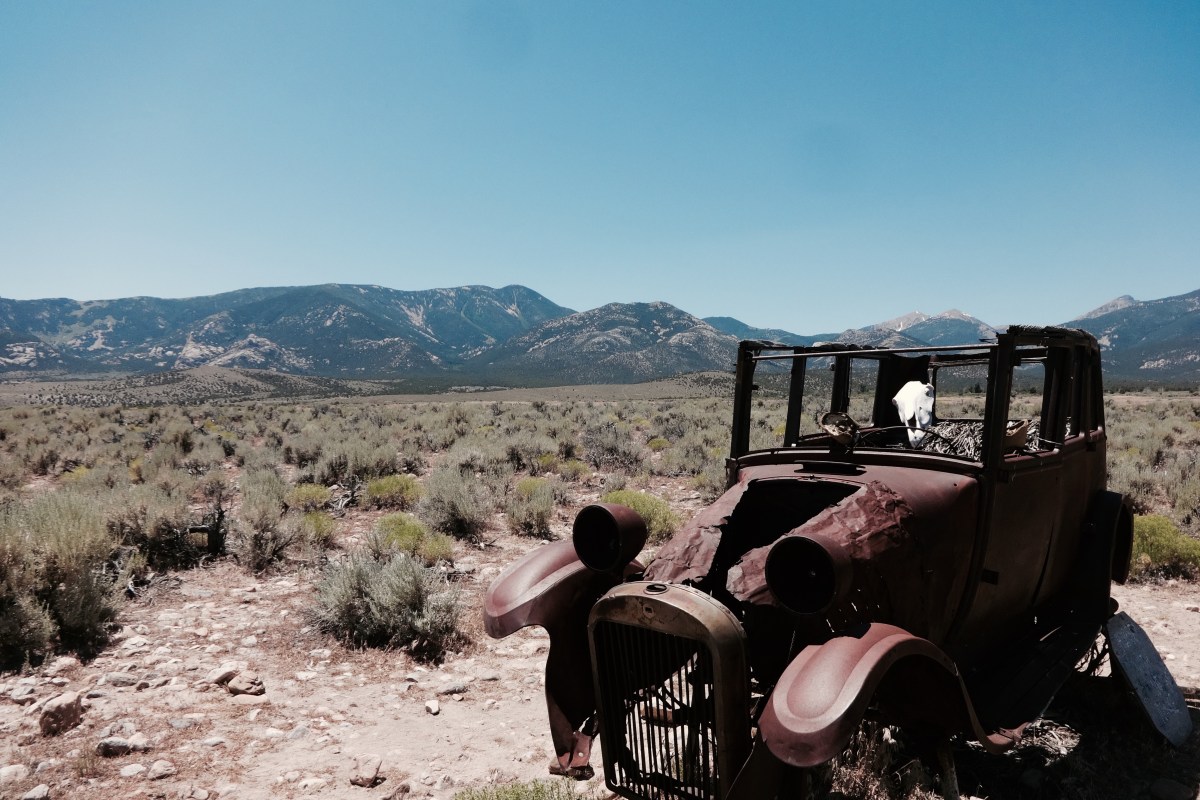
Chillin’ Like a Moose

“Why, hello there,” I said to the moose who chose to make my acquaintance. He nonchalantly came by as if we were old friends. I sat at a picnic table off to the side of Coyote Valley. I heard a rustle in the brush behind me, and a moose emerged, ever so unphased.

I had read some notices about moose, how they can be dangerous, how they can charge. This moose didn’t seem the least bit aggressive. He was just out for an mid-day stroll, enjoying the park just like all the other visitors. I reached for my camera to take his picture, but the lighting just wasn’t enough. The pictures weren’t very satisfying. I put the camera away and took in this moment of an up close encounter with a moose.

I had been sitting there, relaxing, enjoying the beautiful view of the valley and writing in

DSC05308
Coyote Valley

my notebook reflections on my experience in Canyonlands. I was writing about my emotional experience sitting on the canyon rim and the voice of God speaking to me ever so clearly. Tears of thankfulness and spiritual renewal fell down upon the journal. Then the moose arrived, and that particular emotional moment ended as I was faced with another of excitement I had seen photographers with huge lens trying to take photos of wildlife elsewhere in this park and others, but here I was feet away from a giant moose walking so slowly and carefree. I was putting forth no effort in being able to see the moose. It just paroosed right past me. Sometimes the greatest things just come so expectantly and nonchalantly.

After the moose passed by, I felt my visit to Coyote Valley had been fulfilled. I had finished writing the entry in my journal and was ready to move on and see what Grand Lake was all about.

DSC05267
Cabin at Holzwarth Ranch

This morning was when I attempted but failed to reach the top of Mount Ida. That was followed by a stop at the Alpine Visitor center, where I had lunch in the cafeteria. I then had proceeded to Holzwarth Historic District. There a short trail leads through the meadow of the valley to the guest cabins from an old ranch of the early 1900s which is now preserved by the National Park Service. The cabins are furnished like they would have been back in the day. I couldn’t go inside but I peeked in all the windows and imagined what it would have been like to stay here years ago. This all led up to me finding my way to Coyote Valley where I had stopped to write and met the moose.


DSC05228
Grand Lake while brushing my teeth

Now I was on my way to Grand Lake. Grand Lake is the name of the lake and town on the southwest side of the park. I had camped next to the lake on my second night of visiting the Rockies. Although the lake was beautiful to see at night, my campsite was right next to a road, and my neighbors seemingly enjoyed top forty hits instead of the sound and solitude of nature. That night I had left my campsite to sit in my car by the lake. There I brushed my teeth and enjoyed the beauty of the scene. I had collected enough water gallons that by now I had figured out the trick of brushing my teeth and getting ready for bed without visiting a restroom. I would spit water into its own gallon jug, and pour clean water from another jug into a used McDonalds cup to rinse my mouth. This sticks in my memory, because it was the most beautiful place I ever brushed my teeth. The lake, the mountains, the stars, the cool night sky. It was all so nice, and this is where I also first implemented my non bathroom brushing teeth procedures which would come in handy later in campgrounds without running water.

DSC05232 (1)
Elk in Campsite

The next morning, at this campground, I packed the tent first thing. Although I had reserved and paid to stay here another night, I just couldn’t bear to wake up to Katy Perry roaring again. From here I had traveled into the park. I arrived by 7am, and was able to secure a site inside the park at Timber Creek. When I was setting up camp an elk walked right through the campsite next to mine and paused, just chillin like the moose. I was able to capture a few good pictures.

Setting up my tent, I couldn’t find the tent fly. I had concluded I must have left it at the campground by Grand Lake. I drove all the way back to check. I didn’t see it, nor had my pop-infused neighbors seen it. Come to find out, I set my tent up in Timber Creek right on top the fly. This all happened this morning, and by evening, here I was returning to Grand Lake once again. I wanted to check out the Grand Lake Lodge and have dinner downtown.

As I approached the driveway to Grand Lake lodge I wasn’t sure if it was acceptable for one such as I, lowly and penny pinching to visit such a wealthy establishment. And I didn’t know just how fancy the place was. I didn’t know if there would be some sort of snazzy valet parking. I didn’t know if I could freely walk into the lobby, but I thought, hey, why not find out? Plus it’s a Lodge, just the term evokes a sort of friendliness.

DSC05312
View from Grand Lake Lodge

I had walked into the lodge at Bryce Canyon and had hung out quite a bit in their lobby, but the difference here was that this lodge was not technically in the National Park. It was right outside the park. I arrived and decided I would play it like I was a guest staying there. So I walked right in the lobby and out the backdoor where the patio and pool were. It was a stunning view with the pool right next to a beautiful lake with rocky mountains surrounding it. It wasn’t a very big pool but it was quite busy. I noticed signs for a wedding.

I went inside and paroosed around the gift shop. The lobby was made of all wood and was nice, but there was nothing too extraordinary about it. The view of the lake out the back was what made this place well worth the stop. Inside I decided to take a break and sit for a while on a swinging bench and free some memory on my camera card.

After resting at Grand Lake Lodge I proceeded into Grand Lake. There I at dinner at a place called Sagebrush I had read about on Tripadvisor. The food was delicious and the helping was heaping, even for the ravenous hiker I was. I had a BBQ half chicken, mashed potatoes, baked beans, and cornbread. The waitress was very friendly. She asked me many questions. Are you traveling alone? Where are you from? Where are you camping? She told me that she thought I was extremely “cool” and that she would love to be doing what I was doing. She gave me a recommendation on a free place to camp, but I didn’t know where she was referring to. She was very attentive and came over to talk to me frequently. I am not good at picking up signals but this was very evident. She wanted to make a connection, but for whatever reason she had not drawn my attention like the young lady at the Petrified Forest. So I let her go.

After my meal, I walked along the mainstreet in my flip flops. I let my feet breathe, and I just walked slowly and carefree- at ease, just like the moose, with no hurry. I looked in the shop windows and passed by many restaurants. It was touristy, but with a more tactful and homey feel than its rival, Estes Park, which was overly crowded and blaringly commercial for my liking.

Along my walk I stopped for some cherry chocolate chip  ice cream, and walked over to a park which was more like a city green. I noticed a gazebo in the middle and this reminded me of something. Presently, and for the past few days, I was in a power crisis. My cell phone battery had died, and I couldn’t charge it in the car, because I had blown a fuse. I didn’t know at the time that it was just a easy fix fuze issue.  I thought the charging outlet was broken entirely.  However, I had no way to charge my phone in the car. I had drained the battery from my Chromebook into my phone, yet the phone was still soon to lose power. I had been on a lookout for outlets, unfortunately no bathrooms in the National Park had outlets. Two days prior, when passing through a small town nearby, there was a local visitor center, where there was a private bathroom with an outlet. I took my time in that bathroom, really prolonging my number two, in order to try and pick up some charge for my phone.

Here, now in Grand Lake, I had noticed outlets inside the park gazebo. Perfect! I grabbed my chargers in my car and plugged in my devices in the Gazebo. There was a pair of young teenage lovers there as well, which didn’t even make things awkward. I didn’t care. I had important priorities. I needed power. There was also wifi! It was important for me to keep my phone on, because I was waiting for a call or text from my cousin Jonathan. There was talk of meeting up with him and some other family within the next few days. I was anxiously awaiting communication from him. It would determine my route of travel, and I didn’t want to miss the opportunity to connect.

After sitting in the park gazebo for a while, uploading some photos to facebook, and finishing my ice cream, I headed back into the National Park, back to my campsite for my final night in the Rocky Mountains. It had been a hodgepodge of a day, from packing up and setting up camp in the early a.m. with an elk by my side, to getting lost on route to Mount Ida and encountering Noah, making my way to the Holzwarth cabins and Coyote Valley where I met a moose, visiting Grand Lake Lodge, and then taking in downtown with delicious food. Tomorrow, the adventure would continue, looping around Colorado, heading down to Great Sand Dunes National Park and Preserve, and reconnecting with my cousins.

Read the next entry “On the Great Sand Dunes,” here:

https://joshthehodge.wordpress.com/2018/01/27/on-the-great-sand-dunes/

Read the previous entry “Lost on Mount Ida,” here: 

https://joshthehodge.wordpress.com/2018/01/18/lost-on-mount-ida-2/

Facebook: http://facebook.com/joshua.hodge

Instagram: http://www.instagram.com/joshthehodge/
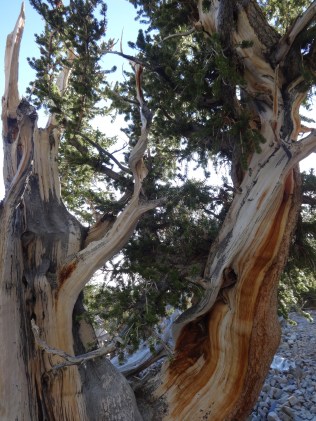
Lost on Mount Ida

“You’ll never make it,” she warned, returning to the parking lot from her intended hike. Never make it? Do you know who you are talking to? This is Josh Hodge, the one who has found his way out after falling into Bryce Canyon, the one who yesterday climbed a waterfall to Sky Pond. I will make it, I said in my mind. The goal was to hike to the top of Mount Ida, via the Continental Divide over the alpine tundra. I had seen pictures. It looked stunning. “The snow is too deep. You’ll lose the trail,” she continued.

I could have taken her warning to heart, but without a doubt, I knew I had to try for myself. I’ve lived enough life to know I can’t always trust what  people say. I mean, after all, people were saying the world would end with Y2K, Donald Trump would never become president, and Anakin Skywalker would bring balance to the force, yet here we are. And now try and tell me it’s impossible to summit Mount Ida. We’ll just see about that.

So I proceeded all geared up, and only after a few yards in, I began asking myself, now wait a minute…where is the trail? Snow completely covered everything, and here I was, basically at the beginning of the hike, questioning where the trail was. I could only see in retrospect that this would be foreshadowing of the entire experience. It was good, that to begin with, there were footprints to follow. Some hikers had taken a switchback approach, while others made steep shortcuts. Not knowing which was the proper route, I ended up taking both routes. The trail had left the small parking lot and ascended into the pine forest, and that is when the footprints disappeared. The snow was now up to my knees. Every once in a while I would sink down into the snow, but at other times my feet remained on top the frozen snowpack.

If I were a trail, which way would I go? That became my train of thought.  Following a switchback approach no longer seemed feasible, because the incline was too steep and there was no seemingly possible way to hike alongside the mountain. Only going vertical  seemed possible. And so I proceeded, only soon to find out that it might be a little too steep. If my feet would slip and lose grip of the snow, I would plummet down this mountainside, crashing back into the parking lot and maybe banging my head against rocks on the way down. I cautiously maneuvered my way up to a small patch of level ground. To the right there was more incline. In front of me there was even more, and to the left there were rocks and the sound of water rushing under the snow. Since I could hear water but not see it, it made me begin to question what other things were hidden under the snow. What sort of crevices, ravines, water sources and perils were hidden from sight? I trenched toward the rush of water, slowly, carefully placing my steps trying to assure myself the ground was stable under the snow. This was too much. This couldn’t be the way up, I thought. I had to have missed something. I concluded I needed to backtrack. The only problem was that going down, what I had ascended, was very intimidating.

My feet were able to grip their way up, but would obviously slide on their way down. I scanned the scene to feed it into my problem solving matrix. Here was the plan: If I fall, I fall, but I need to strategically plan my fall so that I can stop myself by clinging onto, or falling into,  trees along the way.

3-2-1 go!

I slid, falling down on my behind. And Thump! I hit tree one…and thump! tree two. Phew!  I made it to the level ground. My heart was racing, but a smile spread across my face. That was pretty fun. I was the ball traveling down the ping pong machine.

From another place of level ground, I made a decision to attempt the switchback method, so I snuggled up against the mountain and slowly shimmied my way against it. I was ascending, slowly but surely, leaving the bald landscape and returning back into the forest. The snow became increasingly deeper. I found myself trudging through snow up to my waist. I came to realize this was no switchback route, because there were no turns in direction of incline. My route was all in the same direction. I also came to realize the snow depth had grown much deeper than my waist. My weight sunk into the snow in such a way that the depth was measured by my waist but my feet were still standing on a great measure of compacted snow. This could be ten or twenty feet deep, I began to realize. Each step became a moment of uneasiness. How far would I sink in?  I feared sinking so deep that I would be stuck. I tried clinging onto the grey rock face to my left, but every so often I would lose grip and sink into the snow.

I was completely alone again. No one else had taken this route or made it this far. The parking lot was now far behind and below me. Everyone else had given up much sooner. So should have I, I thought. The prospect of falling deep into the snow, being stuck, and never having anyone find me was horrifying. I had to get out of here. I could see dirt and rock up ahead. I was presently just on top the middle of a giant snow drift.

When I reached ground again, I gave off a sigh of relief. It was like I had just been walking on top of clouds, knowing their consistency was not stable, knowing I could fall through at any moment. What a relief it was to be on solid ground I could stomp ground firmly under my boots. My legs felt wobbly and disoriented, sort of the feeling I get after swimming or riding a bicycle for an extended period of time. I looked ahead through the trees and there was a bald- a section of tundra free from snow, jutting off the side of the mountain. I proceeded to it, knowing here I could get a glimpse of the environment surrounding me and assess the situation.

I caught something colorful with my eyes. Resting against a tree on the edge of the bald was a small canister. This was exciting in two ways. First off, it was a sign that I wasn’t the only human to take this route. Someone else, at some point, had made it up here, so perhaps there was an easier way down. Secondly, It’s a geocache! I thought. Geocaching is an outdoor activity where one follows GPS coordinates to find hidden objects. Often times they are small canisters, containing little trinkets and a log book to sign off on your accomplishment. I had just began geocaching in the spring and had even done a bit with my parents at the beginning of the summer. How cool to accidentally stumble upon a geocache, I thought.

I raced over to the canister. It was made of pottery, and painted all over in bright colors. How fancy, I observed. I opened it, and to my dismay, it contained nothing but dirt. Befuddled, I put the lid back on it and examined the container. Among the colorful design were the white letters “Noah” painted. Under the name were two dates, the latter 1997, revealing to me that these were the ashes of a teenager named Noah. Feeling a bit uncomfortable like I had just desecrated something sacred, I set the canister down. Have his ashed been up here since 1997? No way! Are those ashes inside or just dirt? I didn’t want to think about it. I proceeded to the bald and took a few pictures. The mountainous landscape around me, suggested nothing about what my next move should be. I knew I did not want to attempt continuing up the mountain, but I did not want to attempt going back the way I came, and I had no idea in what direction my next move should be. I returned and sat down next to Noah. “Well…” I told him, “we are lost together,” but the stark contract was that I was alive and he wasn’t. It’s like in a movie when someone gets locked in a creepy dungeon cell, or stuck in a remote cave, and a skeleton sits there, as a warning that no one makes it out alive. That’s the type of feeling I entertained for a moment. However, I knew Noah didn’t die here. He was placed.

Then… What’s that sound? No, it wasn’t Noah. There were other hikers, coming from another direction. “Over here” I called out. I came upon a pair of hikers, also lost. They were two guys, maybe ten years older than myself, who had come up a different route but were now lost. They inquired about how I came up. I pointed, but told them I didn’t suggest it. One of them went over to observe my route and turned around. I told you so. We decided to divide and conquer in attempt to find a route.  We split up, each going in a different direction. None of use were successful and rejoined in the middle. “How about that way?” One guy pointed in a unpromising direction. I followed. I didn’t necessarily trust that these guys would bring us back to the parking lot, but I thought it’s better to be lost with other people, other alive people that is, than just with Noah.

We started descending in a valley on a very shallow covering of snow. While doing so we got to talking about hiking and National Parks and onto the topic of Yosemite and the hike I have not yet done up to the top of Half Dome. On our journey, we came to a barren area of lumps of wispy grass frozen and covered over with snow. Here we came upon another hiker. He became the leader of the pack, assuring us a way back to the parking lot. We all proceeded as a ragtag pack of hikers, who all got lost, who all got defeated by Mount Ida, but who were so appreciative of finding each other.

I sat back down in my car, relieved to no longer be lost, feeling the humbling effect of defeat and replaying the words of the sassy girl, “you’ll never make it.” She was right. I failed. However, what a story! Getting lost, finding Noah, teaming up as a pack of hikers to find our way out. It was a good experience. I was satisfied. Sometimes I feel like I have the  instinct to prove others wrong, and sometimes those instances of attempted proof are not always successful but are instead met with failure. But it’s in the failure that I learn humility, I discover my limits, and come away with stories to tell. So, tell me again I can’t do something. Watch me succeed or watch me fail. Either way, I come out better off.

Read the previous entry “Trekking to Sky Pond,” here: 

https://joshthehodge.wordpress.com/2018/01/08/trekking-to-sky-pond/

Facebook: http://facebook.com/joshua.hodge

Instagram: http://www.instagram.com/joshthehodge/