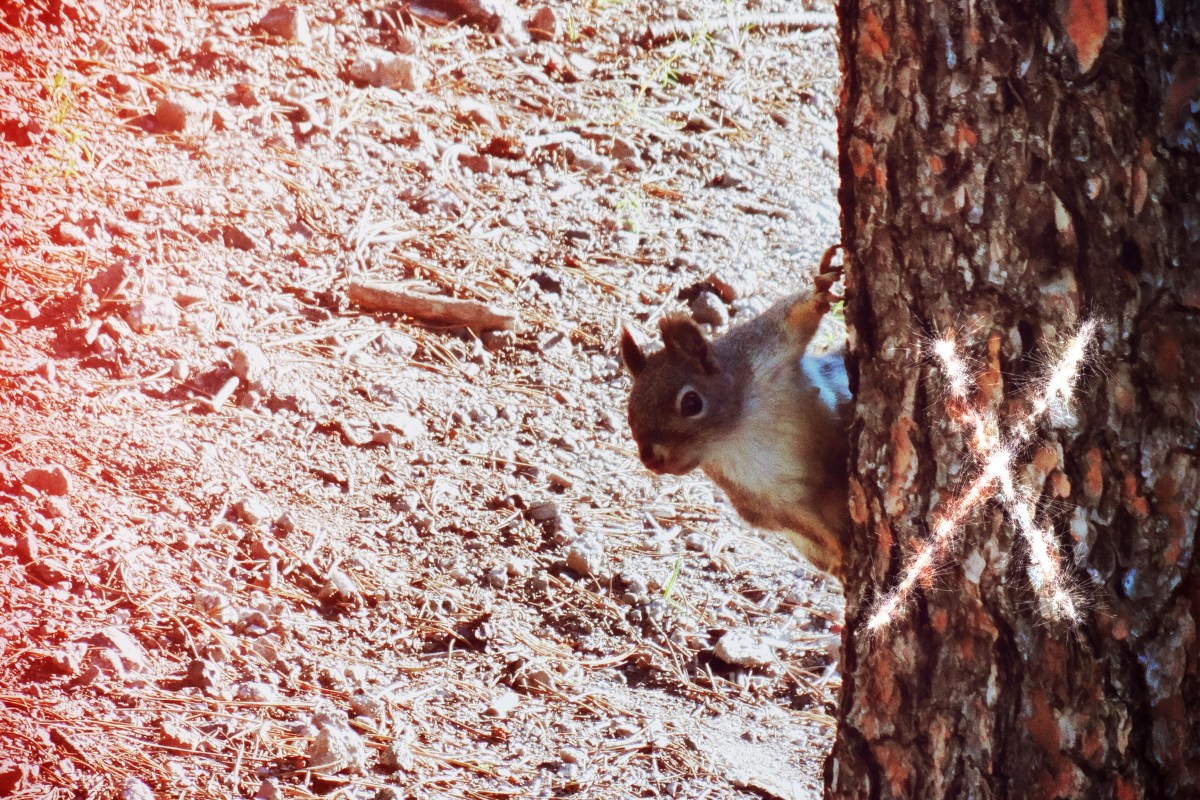
Attack of the Squirrels

This was no ordinary enemy. It was smart, effective, and ruthless. I came back to my camp to find it had been violated.

In the morning I woke up early to go for a hike, having slept so peacefully in the quiet pine-filled forest of Lassen Volcanic National Park in Northern California. The campground was comfortable. A bed of pine needles was spread everywhere giving it a naturally soft and cushioned surface. At night I could look through the pines and see the star filled skies. This morning, as the sun filtered through the trees, it made the ground like gold.

I changed into some suitable clothes for hiking and threw my backpack and everything I had with me in my tent into the car for safety. I left behind, of course, my sleeping bag and pillow. I zipped and locked everything and was off for a hike. I was in the Manzanita Campground and there was a trailhead for the Manzanita Creek Trail at the edge of the campground. I made my way from Loop C to Loop D  and then along the path in the forest. During my hike I saw scores of pinecones just strewn all about the forest floor. They were of that enormous type I’d seen the days before, some as big as my head. They were from the sugar pine tree. I’d read that some of these pinecones can reach a length of two feet.

The hike was rather uneventful and un-notable- no striking characteristics of features to set it apart from any stretch of forest in the park. I hiked for maybe a couple miles until the snow banks became so dense and tall that the trail was entirely lost. Just the day before I had gone on a hike up Prospect Peak and had gotten lost in a similar fashion. Of course I found my way back eventually, but I wasn’t ready to get lost again today. There were other things to see and do This hike was just a bonus to kick start the day, so I decided to turn around and head back toward camp. On my return I passed by two older men also out for a morning hike. “How’s the trail up ahead?” one of them asked.

“It kind of just disappears with the snow. I didn’t know where to go,” I replied

As I strolled back into camp I rounded the loop and came to my site. I could feel my blood pressure rise. Something was not right. The side of my tent was flailing. It had been ripped and was dangling and floating in the quiet breeze. My initial thought was that my camp has been attacked by a bear. A bear must have ripped into my tent! How could this be? I raced up to my tent and looked around. I didn’t leave any food nor anything with any odor in my tent, just the air mattress, sleeping bag, and pillow. As I observed the rip, I noted it  was peculiarly neat, almost as if it was carefully unwoven at the tent seam. A bear would have been more vicious and careless, I thought. Something doesn’t add up.

 Just at this moment the campground host was making his morning rounds in his golf cart. I ran over to him. “Can you come over and check out what happened to my tent?” I asked

 He followed me over, took one glance, and without hesitation declared “squirrels”

“I beg your pardon?” I asked. Just kidding. I never talk like that, instead: “What?!” I exclaimed.  Was he joking? How am I supposed to respond?

“That’s right, squirrels. They were after the stuffin’ in your sleepin’ bag. I betcha they used it to make their nests all nice and warm.”

I had never heard of such a thing. I considered myself pretty intelligent and well-versed in the ways of camping, and I was responsible and cautious. I knew not to leave anything of odor in my tent. All my food was in the bear box and I even made sure nothing valuable was left out, because you can never have the assurance of trust with strange humans. But squirrels? I had never thought that squirrels would be a threat.

“Oh yeah, they are a real problem ‘round here. There was a couple here with motorcycles- real nice ones. They woke up in the morning  to find the squirrels had chewed right through the leather seats of their motorcycles and pulled out the stuffin’. We even have to be careful with the tires on the RVs. Sometimes they’re after the rubber and can tear those things up. That’s why we have tire covers.”

I never would have imagined such a thing.

“It’s definitely the squirrels,” the man said as he reached his hand into my tent and pointed out some squirrel droppings sprinkled across my air mattress. How indecent! How corrupt! I was not happy. This was Kelty, my expensive tent. Since the weather was really nice and the temperatures quite comfortable, I wanted to sleep in my airy tent, where I could look up and see the sugar pines and the night sky. I thought this was going to be a safe place for my tent. But squirrels? How dare they! I took pictures of them the day before. I thought they were cute and friendly little woodland creatures, not vandals and thieves, taking stuffing from the very pillow I lay my head to rest on.

At the campsite next to me was a man packing up his things. I went over and I asked if he had any tape. He lent me his roll of classic duct tape, and so I taped my tent together. Take that squirrels!

This time I did not add this incident to my list of misfortunes. Instead, I laughed it off. This was quite funny and would make a story, I thought. Never before did I have a tale to tell of my camp being systematically invaded by squirrels and my tent chewed into by these rodents. 

This was the second tent destroyed on this trip. The first one was True Blue with it’s tent pole snapped in a monsoon at Guadalupe Mountains National Park. Despite the misfortune, somehow my paradigm had shifted. I wasn’t focused on the negativity. I accepted this moment as part of the adventure. It is what it is, and there is nothing I could have done to have prevented this, for I did not have the knowledge to know about the threatening squirrels, and I didn’t even know to seek such knowledge. This had to happen for me to learn, and it had to happen for me to write this episode of my adventure.

When I reflect upon it, I think of how the forests out East are so lush and rich and full of plant life, so much so that the animals usually don’t care about the camper and his set up. Occasionally you’ll have a curious raccoon come by the campground at night, maybe a skunk (that’s another story), but as for the bears and the squirrels, they have a whole lush forest to enjoy. They don’t care about people’s riches.

Here in California where the forest is so dry, where drought has ravaged the land for so many years, where the plant life is scarce, these squirrels are desperate. They will go to the extremes of chewing into people’s tents and ripping the stuffing out of their pillows to make nests. And the bears too warrant concern for personal property. I remember at Sequoia National Park. in the visitor center, watching a film of bears ripping off doors of automobiles to get inside and consume whatever smelled edible. They even went to the extremes of eating car seats if they smelled appetizing.

Many of us not from California look upon California and say it is full of crazies. Like with any place, and any such statement, it can’t be applied to everyone, but here it certainly can be applied to the animals. Guard your pillows!

Read the previous entry “Lost in Lassen” here: Lost in Lassen – on the verge (joshthehodge.com)

Check out my book Canyonlands: my adventures in the national parks and the beautiful wild here: https://www.amazon.com/Canyonlands-adventures-National-Parks-beautiful/dp/1711397873

Singing into a Volcanic Crater

“O say can you see, by the dawn’s early light…” I found myself singing into a volcanic crater in the high reaches of California. “…What so proudly we hailed at the twilight’s last gleaming…” What was it about this volcano that spurred on my patriotism and brought forth the anthem? I was in Lassen Volcanic National Park in Northern California. This active volcanic area is asleep, but it was only about a hundred years ago it experienced hundreds of volcanic eruptions in a three year span. In 1907 Theodore Roosevelt, noting the exceptional beauty of the area, designated it as two National Monuments: Lassen Peak National Monument and Cinder Cone National Monument. Nine years later in 1916 these monuments were established as one National Park. 

Lassen Volcanic is quite a wonder. Although “asleep,” it’s clearly alive. In the park museum I learned that early pioneers and homesteaders making their way across California noted the “fire in the sky” from the volcanos. Although this fire in the sky hasn’t been seen for a hundred years, there are still areas of the park with thermal springs and fumaroles boiling up from the earth’s fiery depths, reminding the visitor that beneath the earth’s thin crust much is in motion. Here all four types of volcanoes are present: cinder cone, composite, shield, and plug dome. The park features the world’s largest plug dome volcano: Lassen Peak and the last volcano in the Cascades mountain range. Although now monitored for seismic activity, Lassen Peak  will not be asleep forever and will erupt again, they say. It’s all in a matter of time. Comforting. 

I was very much looking forward to visiting this park. The pictures I had seen of it were just beautiful with pine forests, picturesque lakes, towering volcanic peaks, rich blue skies. It was even more beautiful than photographs could depict. It is certainly one of the underrated National Parks in my opinion. It is quite astounding and unique and doesn’t get the attention it deserves. It’s just so scenic, straight from magazines, and its volcanic landscape is so young and fascinating. 

When I first arrived, I visited the Loomis Museum which also doubled as a visitor center. It was constructed in 1927 by Benjamin Franklin Loomis who was a homesteader and photographer  instrumental in incorporating the area into a National Park. His museum displayed his photographs of the 1915 eruption, and he eventually donated the museum to the National Park Service. Here I soaked up some history and geology and to my dismay learned that the majority of the park was closed due to impassible snow. I was quite disappointed initially. I particularly wanted to see Bumpass Hell, the section of the park with the fumaroles and thermal springs, a mini Yellowstone-like area. Despite this closure, I’d still find plenty to explore and enjoy. I started off with a stroll along Reflection Lake, which was beside the museum. It was so tranquil. The ground was carpeted in large golden pine needles, beneath aromatic pines, and I beheld some pinecones as large as my head. This park reminded me in some aspects of Great Basin National Park in that it was this hidden little wonderland up in the mountains. 

I decided I’d spend the afternoon and evening going for a hike. One of the most popular hikes of the park was still accessible. That was the trail to Cinder Cone. The trail started into the sparse forest, proceeded to black sand, and spiraled up the cone to the crater atop. I trudged. It was quite challenging. Going uphill in sand took extra effort and strain on the leg muscles. I naturally tried to push myself up with each step but ended up partially digging my feet into the sand. My rate of progress was not adequate for the effort I was exerting, but this was the only way. This cone I was ascending was completely barren and I was so curious as to see what the crater way up there would look like. 

The air was hot, dry and thin, and there was a calm stillness to it. I was out here alone. At least I thought so, until a man started coming down the trail as I rounded a turn. I asked him something like “Is it worth it?” or “Am I almost there?” and then we got to talking. I told him I was from Kentucky. He told me he was from a city in California.

The question of “What brings you all the way out here from Kentucky?” led to me explaining how I was a teacher on a National Park road trip, and then we went right into talking about teaching. I came to find out he was also a teacher, a 5th grade math teacher. 

“You’re a Spanish teacher? In elementary school?” he questioned in surprise. “We don’t even have Spanish in elementary school here in California.”

 I wanted so badly to say: “Well, we’re just a bit more progressive in Kentucky,” but I bit my tongue. I thought it was a funny statement, but wasn’t sure if he would find it so. “Progressivism” is a hijacked political term, but California as a whole prides itself on being “progressive.” Kentucky isn’t often regarded as cutting edge, but in education, and particularly in the district in which I teach, I’d say it is- in a more classical sense of the term. Secretly, inside, I was proud Kentucky one-upped California in this regard.

When I got to the top of the volcano, a large crater was on display, uniform in appearance, of dark brown sand; and at the rim were fragments of red rock, so bright they almost looked bloody. I trailed a worn path padded into the malleable terrain around the rim of the crater. I was in awe of its size and magnitude. I found myself standing there at the rim singing the National Anthem into the crater. Maybe it was a ripple from the patriotism I felt at Roosevelt Arch in Yellowstone; maybe it was because I felt like I had really achieved something by climbing up to the top of this crater, like America has achieved so much in its young life through so much toil and effort; or maybe it was just simple appreciation for the marvelous natural wonders of my nation. Maybe it was the line “And the rocket’s red glare, the bombs bursting in air,” conjuring up images of a volcano erupting. I was sincere, but I also laughed at myself afterward. Who sings the National Anthem into a crater? Well, I do. Perhaps I’ve spent too much time out in the wild alone. Perhaps I’ve lost it. If I’ve lost it, I quite enjoy it. It’s not everyday I get to sing the National Anthem into a volcanic crater. 

On the opposite side of the crater from where I arrived at the time, I could look out and see the marvelous lava beds stretching across the landscape. Apparently marvelous is not the formal word for the lava beds. The official name is the “Fantastic Lava Beds”. And they certainly were fantastic! Unlike Craters of the Moon, where the entire landscape seems to be some volcanic wonderland, here, from up on the crater looking down, one can certainly see precisely where lava had once flowed alongside the forest, for the forest grove is still complete by the beds. Petrified waves of lava sprawled across the land, dark and ominous, and eventually spilled into a rich blue lake nestled at the foot of another volcano laden with snow. Aside this lava bed, and closer to the volcano I was upon, were pumice fields. These “fields” were very bumpy and rolled like waves frozen in time. On the tops of some of these mounds were spots of red, orange, and pink rock appearing almost like welts or blisters on the earth’s skin- a certainly unique natural wonder to behold. 

O say can you see, by the dawn’s early light,

What so proudly we hailed at the twilight’s last gleaming,

Whose broad stripes and bright stars through the perilous fight,

O’er the ramparts we watched, were so gallantly streaming?

And the rocket’s red glare, the bombs bursting in air,

Gave proof through the night that our flag was still there;

O say does that star-spangled banner yet wave

O’er the land of the free and the home of the brave?

Lost it? Not yet, but soon I was about to become genuinely lost as a mountain trail would disappear on me. 

Read the previous entry “Bruneau Dunes and the Kangaroo Rats” here: Bruneau Dunes and the Kangaroo Rats – on the verge (joshthehodge.com)

Check out my book Canyonlands: my adventures in the national parks and the beautiful wild here: https://www.amazon.com/Canyonlands-adventures-National-Parks-beautiful/dp/1711397873