Camping at Golden Bluffs with an Unexpected Visitor

The sun grew bold, piercing through the forest, creating stark contrast against the dark Redwoods. My adventure companion, Zach, and I were backpacking through the Redwood Forest in northern California on our way to the Pacific Ocean to the Golden Bluffs Campground. The hike in total was to be about seven miles, but just a few miles in my backpack was getting quite heavy. I kept adjusting the straps, raising it and lowering it on my back trying to find the most comfortable position. We could have driven to the campground, but I wanted the novelty of hiking across the forest and achieving that great sense of accomplishment. 

Along the way it was rather interesting. Many of the Redwoods had hollow cavities, or had fallen to make natural bridges. I did cross one such bridge, and poked my head into a few tree cavities, but I wasn’t quite as far reaching as Zach, who climbed up into a few trees, reaching great heights. One of the first times we ever went hiking together I noted how much he truly interacts with the forest. In the Big South Fork, back in Kentucky he’d shimmy his way up a tree trunk, just hugging onto it. He’d be atop a giant boulder in a matter of seconds, and he’d pick a vine or plant from the forest and tie it around his wrist. He was a creature of the wild. 

With the light shining so powerfully above and really spilling into the forest, it revealed how the forest wasn’t as dense as previously perceived. Yes, there were lots of ferns everywhere, and a Redwood can be found in any direction. However, apart from the Redwoods, other trees were absent, and the Redwoods don’t branch and sprawl like some other trees, but more like bloom towards their tops, leaving a vacancy in the forest, a void space between one tree and the next. The path we were on was also a well-worn one, so I didn’t quite feel as though I was the wildest of places that I had perhaps expected. It was a pretty well worn playground. We were on a path called the John Irvine Loop and technically we were not in the National Park, but a state park. The area’s full name is “Redwood Forest National and State Parks.” That’s what all the signage proclaimed.  It’s a conglomerate of state parks and one limited region of federal land. Its three most comprising parks are Jedediah Smith Redwoods State Park, Del Norte Coast Redwood State Park, and Prairie Creek Redwoods State Park. We were in the latter.

In my book, Canyonlands: My adventures in the National Parks and beautiful wild I made a lot of Star Wars references. I was a considerable fan at the time, but I’m sad of what has come of the franchise. I do believe however, here it is worth mentioning that the Redwood Forest is the planet of Endor in Return of the Jedi. It’s the land of Ewoks and imperial speeders zooming past Redwoods and giant ferns. If anyone has seen the movie, this just helps paint a visual. I was getting a little worn out by the scenery however. It was the weight on my back, and the hard worn trail, that I believe were getting to me. After a while the landscape was a bit monotonous. I had tried to take many photos but the great contrast in lighting made it hard for my photos to turn out desirable. I was ready to get to the ocean!

Before we emerged from the forest we passed by an area called Fern Canyon. It was all according to plan. Fern Canyon is about a mile hike through a level canyon, about as wide as a two lane road. It wanders along Home Creek, and a number of times we hopped over or walked in the creek. We also had to maneuver over a few fallen tree trunks. The canyon walls were about a couple stories high and were sprouting with moisture-loving ferns. In some breaks between the ferns adornment, I could see water dripping down the canyon walls and mosses hugging tight. It was a unique nature feature but limited in display. The canyon narrowed us in, inhibiting our view of the rest of the forest, and all we could see was green. Green ferns, and more green ferns. 

Then….

The Pacific Ocean! We ran out onto the sand, dropping our bags and taking off our boots. The hike, though, not much to report on, had taken a major part of the day. The excitement to have finally made it to the ocean was real. I changed into my swim trunks and envisioned a refreshing swim, but when my feet hit the water, I knew I would not be swimming at all. It was very cold. That was enough. 

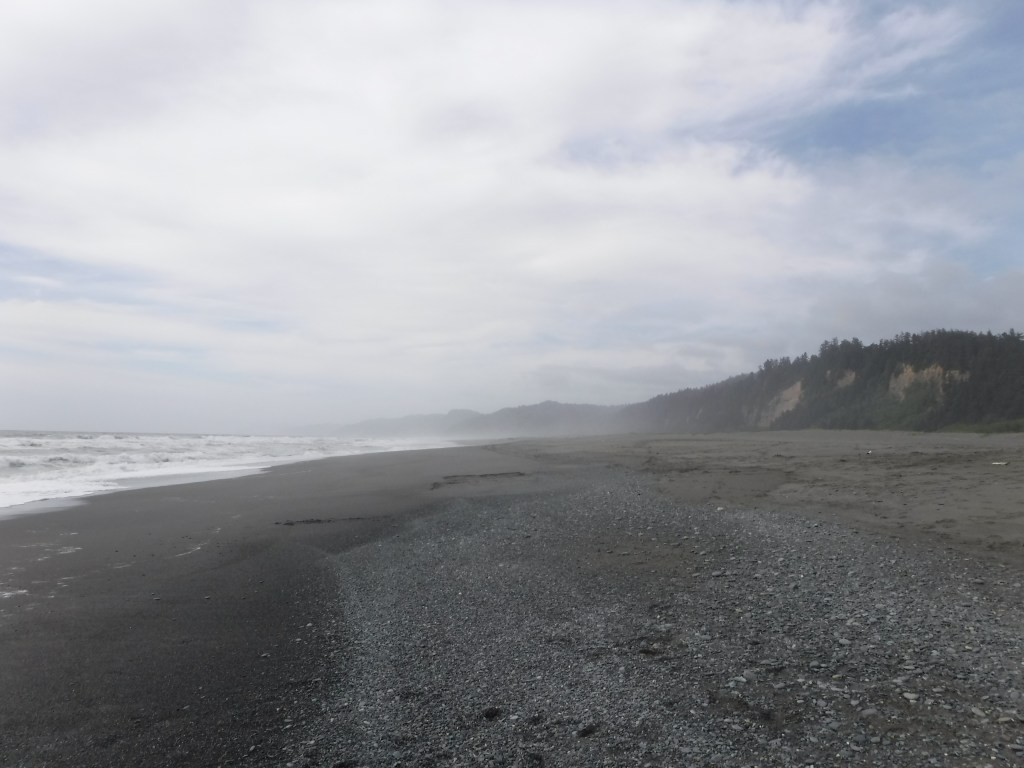
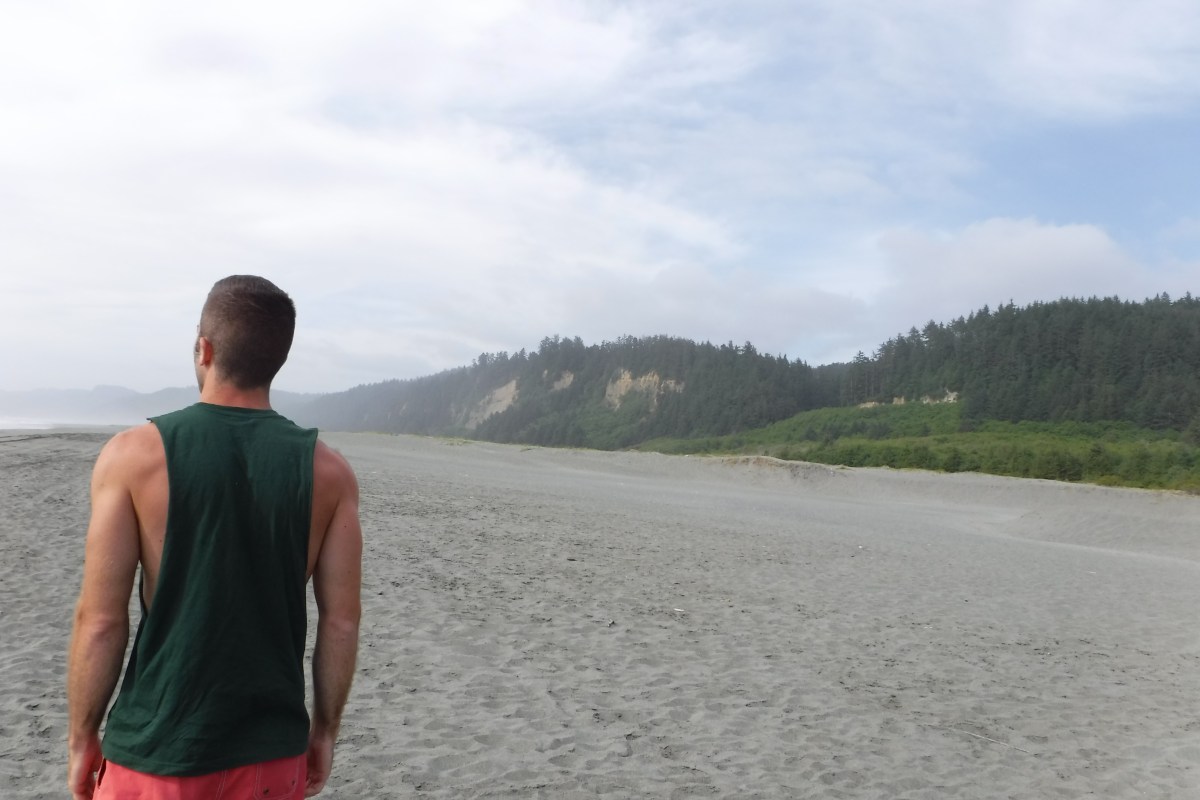
Looking back I noticed how the forest had abruptly ended and the landscape turned immediately into sand. There was no cohesive graduation of landscape. It was drastic. We had come out of a low line of the forest, but stretching ahead and behind I saw the forest rise and fall on sandy bluffs. Much of the bluffs were covered in greenery with sand patches peeking out. We were in a very wide inlet of the ocean, but could not see where the ends of the bluffs curved, because the ocean sprayed a fine cool mist cloaking the landscape. And if it was not spraying it was creeping up from the ocean giving a hazy appearance. This was not the fun in the sun, warm summer beach I may have been hoping for. This was a damp, chilling beach, with sand of a dismal gray color. It was a large beach. I could imagine one could walk out very far into shallow water with such a low gradient, and the sand was very fine, except for the patches of small rock and shell shards that showed up every so often. 
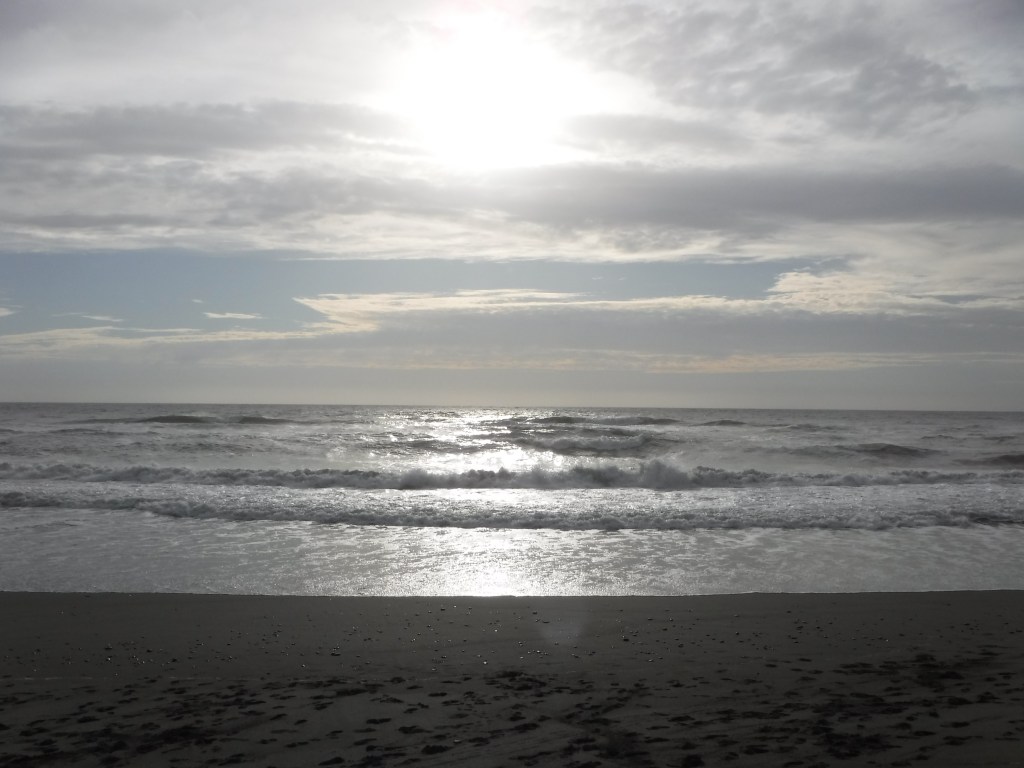
I realized swimming or basking in the sun just wasn’t going to happen, but I did recline on the moist gray sand for a while. Zach went out into a shallow sliver of ocean, and a large wave came rolling in and really got him good. I was observing, taking in my surroundings. The way the light hit the water with the reflection of misty opaque sky, made the ocean appear as silver–  a long stream of tinsel with crescendoing waves of white. After a brief rest, we carried on, boots in hand. There was one more mile south on the sand to Golden Bluffs Campground. It was a strenuous final stretch, having backpacked for so long, and now our feet sinking into sand with each step. At some points I walked in the tire grooves of a jeep or some vehicle that had previously been out on the sand. Unfortunately those tracks had adulterated the otherwise wild and natural landscape. 

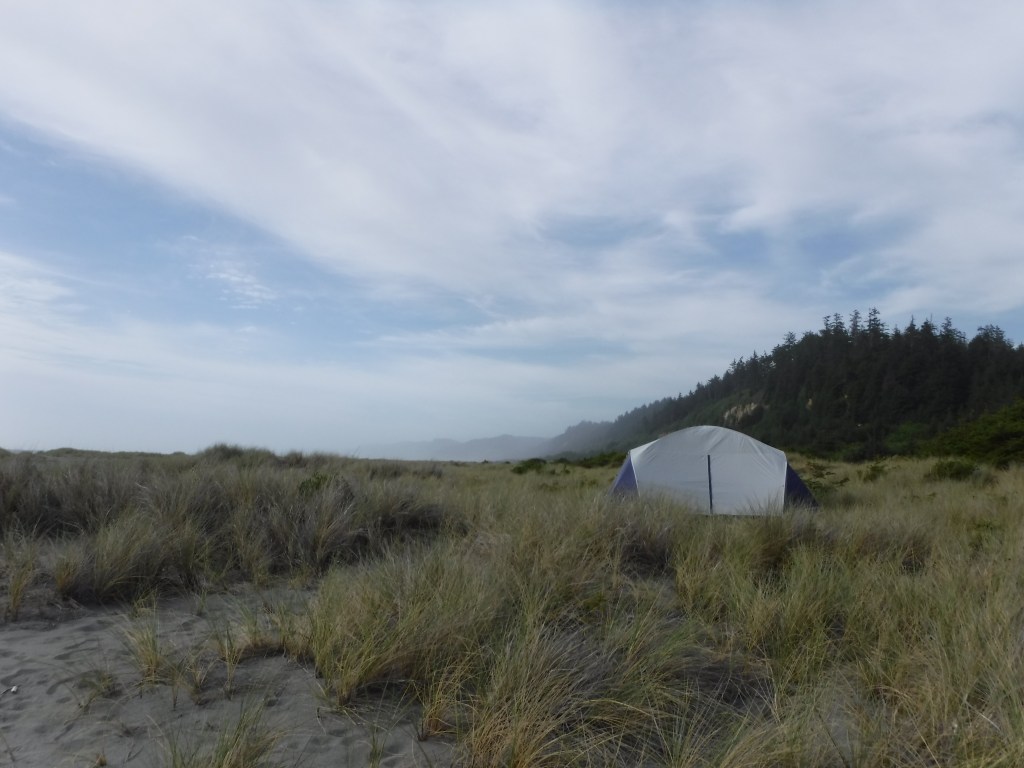
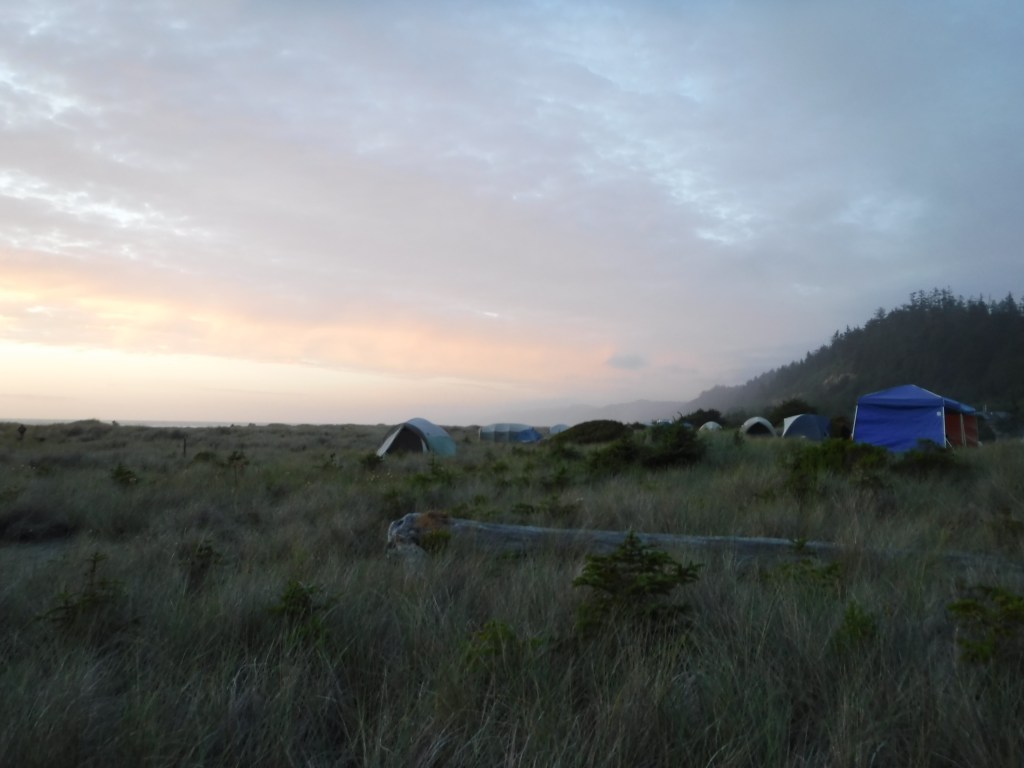
Up ahead we started to see tent domes sticking up among wispy beach grass. Some of the blades were green but most were golden. Here we were at Golden Bluffs. It did indeed look just like it did in the magazine. I had seen this campground in a Sunset Magazine edition on Best Places to Camp in the West. When I saw it printed on those pages I knew  I wanted to be there in person. I had arrived!
After passing by a number of occupied campsites, we located ours which I had reserved in advance. All the other campsites had vehicles beside them. We seemed to be the only ones who hiked here. When we reached our campsite we were surprised to find that it too was already occupied. This has happened to me before in my camping adventures. It’s usually some couple not following the rules and feeling a great sense of entitlement. But this instance was very different, for it was not occupied by any human at all. No. It was occupied by an elk–  a large bull with a full rack of antlers. It was munching on the wispy grass. We approached. It did not budge nor was it phased. It looked up once,to quickly dismiss us and keep eating. It had no cares. “Excuse me, but I have a reservation for this site,” I said. He didn’t acknowledge me. 
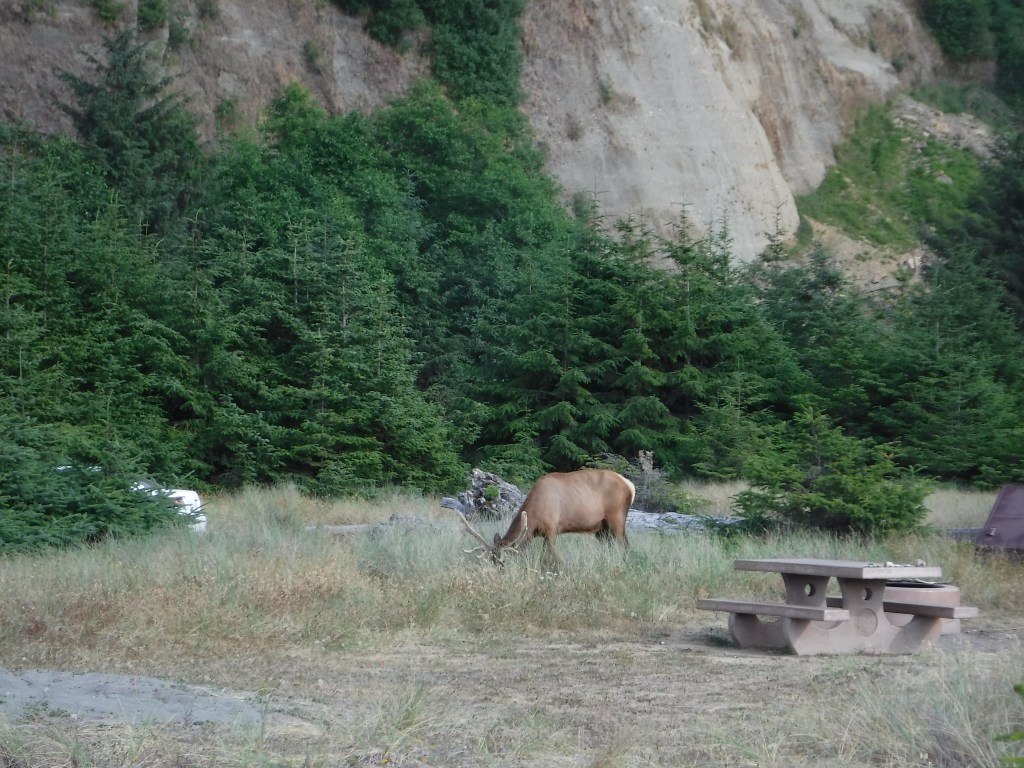
We plopped our backpacks down by the cement picnic table. The elk was about a mere twelve feet from us, right alongside the area to pitch the tents. It was clear the elk was in no hurry to move, so maybe we shouldn’t be either. He was by no means threatening. I took out some beef Jerky and gatorade from my backpack. We sat there on the ground propped against the seat of the picnic tables, just watching our personal elk. I thought we might as well get situated for this spectacle. I had pulled out our hors d’oeuvres and embraced this exquisite evening of intimate dining with an elk at the Golden Bluffs. How fancy!  

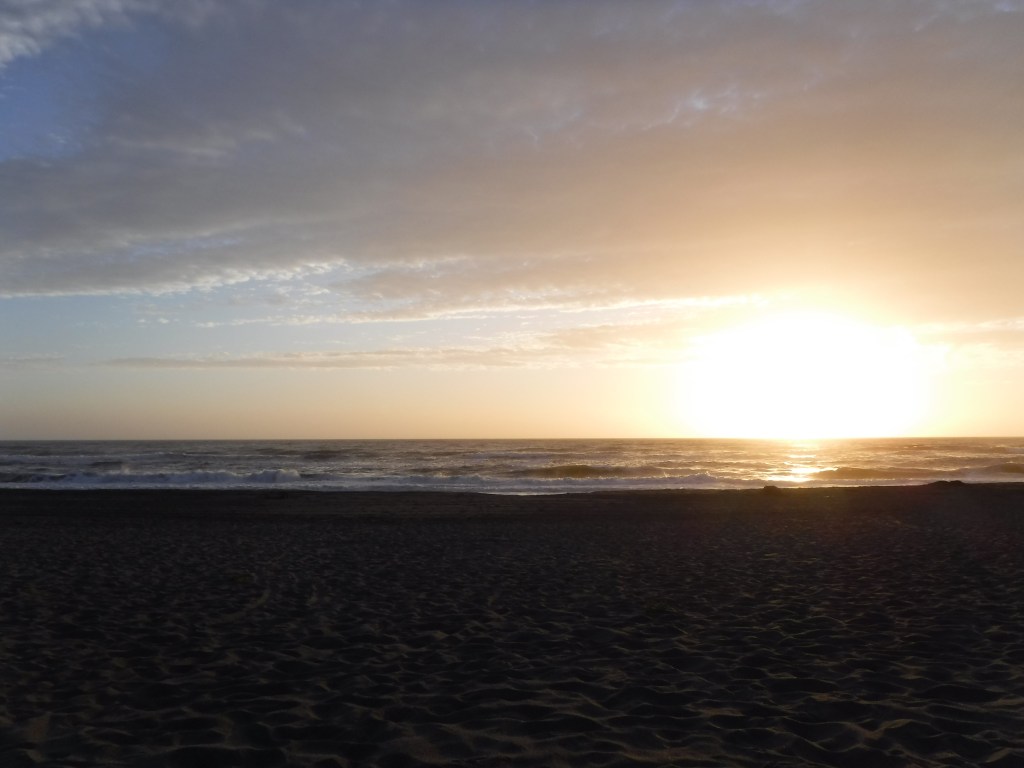
When it came time to set up our tents, he was right there with us. After my tent was set I went over to the beach– the pure natural beach of the northern California coast. The sun was starting to set, and it was indeed very golden, making the dismal gray sand turn gold, and the bluff behind me by the tree line glow, and the wispy grasses encompassing our tents radiant. I wanted to enjoy the moment more than I actually did. Everything looked so warm and elegant, but I was freezing cold. I was wearing a flannel shirt over my cut-off and a pair of sweatpants. It was certainly not enough. I wrapped and held my arms close for warmth. I reclined on the sand, not long, but enough to notice the dual tone of the sunset, gold and blue. It was not like the sunset at Lake Tahoe. This was a very distinct two tone sunset, but no two sunsets are the same, just as no two lives are the same. 

Back at the campground, we were searching out firewood and noticed our elk had moved on to another site. An obviously drunk camper, walking around, offered us one of his bundles of firewood. “We’ll take it.” It was enough to make a fire to heat our cans of chicken noodle soup and dip in our Triscuits. After eating and enjoying the warmth of the fire for a bit, and going over the next day’s plan with Zach, I then secured the fly of my tent, to shield from any bit of cold and wind, and I climbed inside. I nestled myself into my sleeping bag in the sand beneath my tent floor and fell asleep. 
If you enjoyed reading this, check out my book Canyonlands: My adventures in the National Parks“

Check out my previous entry here: “The Inspiration of the Redwood Forest”
Ghosts and Gold: The Arrested Decay of Bodie and Your Life

I was up on the highlands early in the morning, pulling over to take a photo of the hundreds of sheep grazing in the pasture. I had never seen so many before.  It reminded me of John Muir’s summer in the Sierra as a shepherd. Maybe this was a familiar view he saw: little fleecy clouds grazing up and down the hillside and the sky a cloudless blue. I was on my way to a ghost town: Bodie State Historic Site. This one had been on the radar for a while. It is the ghost town of all ghost towns. I say this because of it being the largest intact ghost town, boasting over two hundred remaining structures. The citizens once claimed it was the largest city in California with a population of around 10,000, when it peaked in 1880. 

Today it is a thirteen mile drive off the highway to this ghosted metropolis in the heights. The last three miles were dirt and rock, and there was a car before me obstructing my view by spinning up clouds of dust. I was doing the same for the car behind me. I certainly wasn’t visiting this place alone like when visiting many of the other ghost towns throughout my travels. The dusty road finally curved around and spilled into a flat sandy parking lot. There were dozens of other cars. I popped my trunk to get my backpack and gear up for exploration. The car that had been trailing me pulled up beside me and a husband and wife stepped out. “That was quite a drive,” the man said.

“It sure was,” I agreed. Was he referring to the scenery of treeless pastures, the rocky road, or the hundreds of sheep? I didn’t know, but I appreciated his friendliness and no apparent resentment for the clouds of dust I sent billowing his way. 

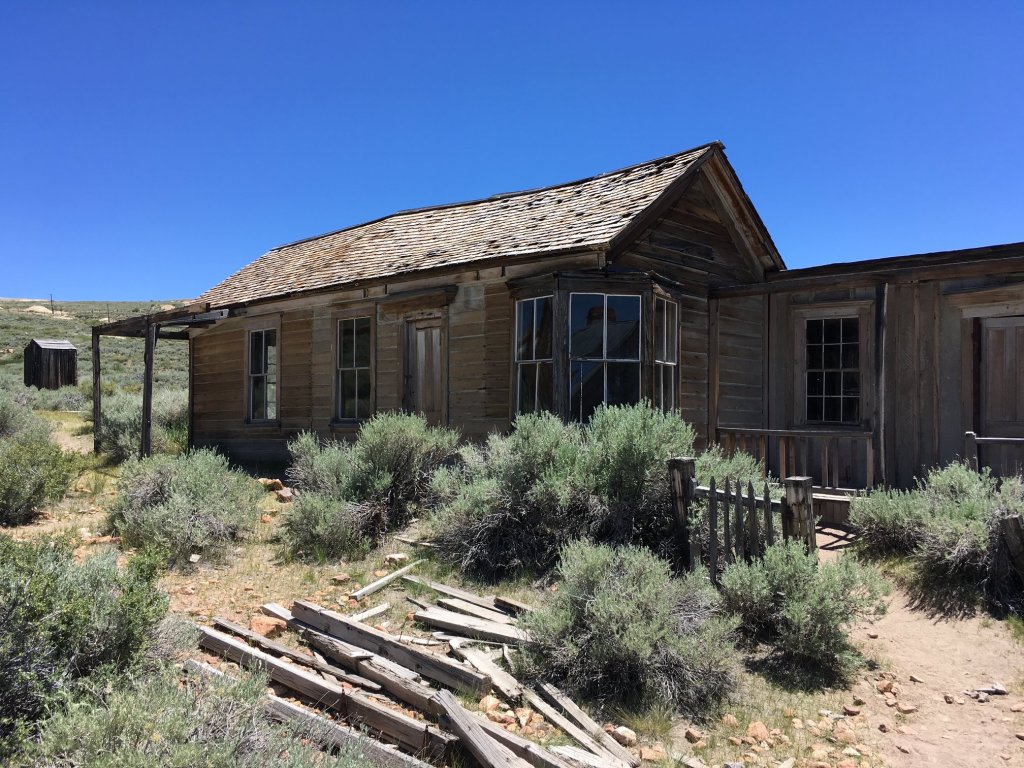
I was enthralled when I stepped foot into the dusty streets of Bodie. It was more than I could have imagined, and by “more,” I mean it in the literal sense- so many structures and pathways to explore! The pictures of the place online were quite intriguing, but in reality this place was on the next level, and it was so quintessentially old Wild West. I felt as if I was upon some movie set or propelled back in time. However, the buildings were rightfully weathered by time telling me this was a rare relic of the past. 

 I was excited to explore it all, but as disciplined as I am in such matters, I first had to watch the park film. What did I learn? This was a place rich in multiple ways. It mined about $34 million in gold and silver in its time, adjusted to about $100 million today. It is also rich in the history and stories it holds. I felt one must spend a lot of time here to really get to know Bodie. I would only get to brush upon the knowledge of its rich history. 

I learned that the gold and silver mines in Bodie were once owned by the Standard Mining Company, and atypical of many other mining towns, the Standard Mining Company did not own the town. All the other businesses in town were private. When Bodie was booming, it even had its own town within its town. The influx of Chinese immigrants who worked on the railroad and in lumbering, to support the town, sought to keep their own customs and traditions in their own community within Bodie. Yes, this is a ghost town with a Chinatown that once had its own general store, saloon, and Taoist temple. I would learn many more interesting facts about Bodie later on a tour. But to set the scene, and frame things in context, Bodie went through many fluxes in population in part due to fires, assumed mineral depletion, and eventual unprofitability of the mines. It stayed alive until 1942, when the U.S. government’s War Production Board passed an order which shut down all non-essential gold mines in the country. Bodie’s last remaining mine was closed and mining never resumed. The Cain family, who owned much of the land, was conscious of its historical significance and hired a caretaker to look after the place in the 1940s, until they transferred it over to the state of California in 1962, after it was named a National Historic Landmark. 

I looked out. Streets intersected with streets everywhere. There were flat lanes, and hilly neighborhoods. All the buildings were in uniform, composed of dark vertical wooden boards. Out in the distance, forming the Bodie skyline, was the Standard Stamp Mill, which I would get to tour later.  

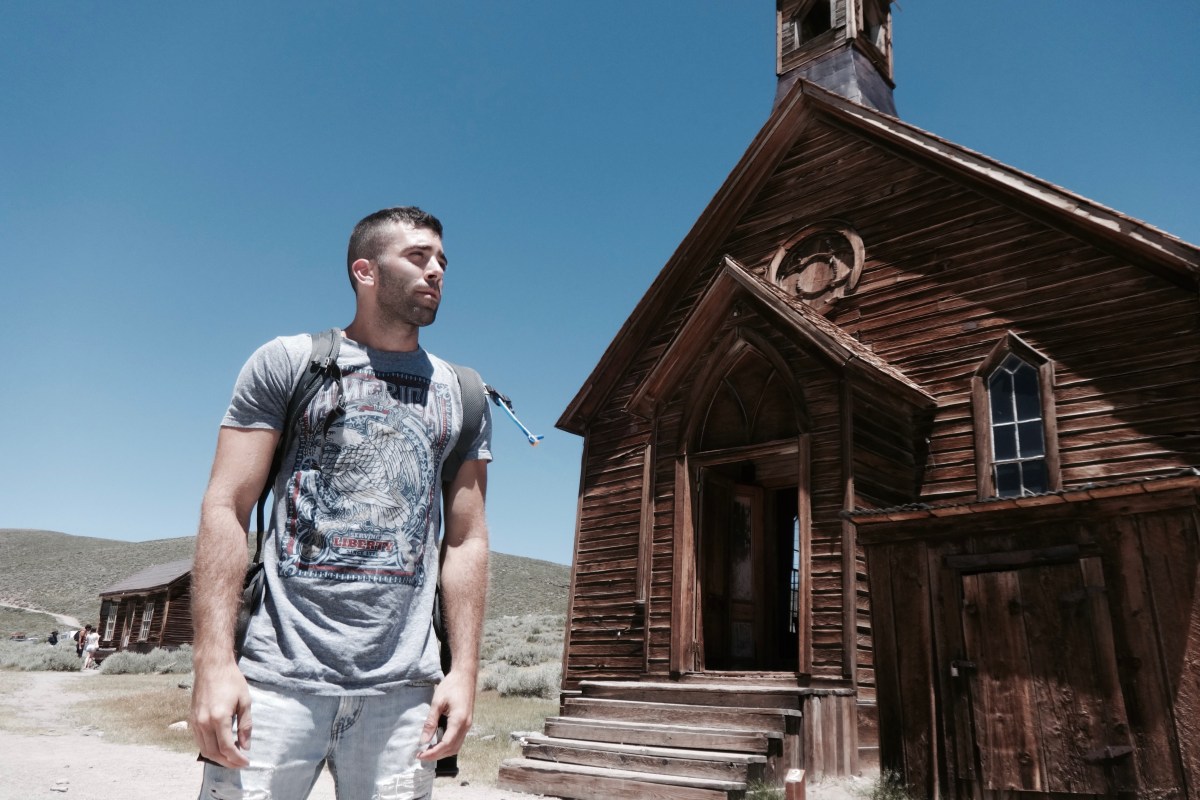
The first structure I saw entering Bodie was the Methodist church. It is perhaps the most iconic feature of the town despite it wearing the uniform dark wooden boards and not doing much to stick out. It was modest. Along with its simple gable roof were its triangular window peaks, short rising steeple, and protruding foyer. I learned that Bodie was booming for over a full year without a church. It was a lawless place. One of its ministers, Reverend F.M. Warrington, described it as “…a sea of sin, lashed by the tempest of lust and passion.” I can’t imagine how difficult it must have been to minister and feel a sense of obligation to a congregation in such a place.  

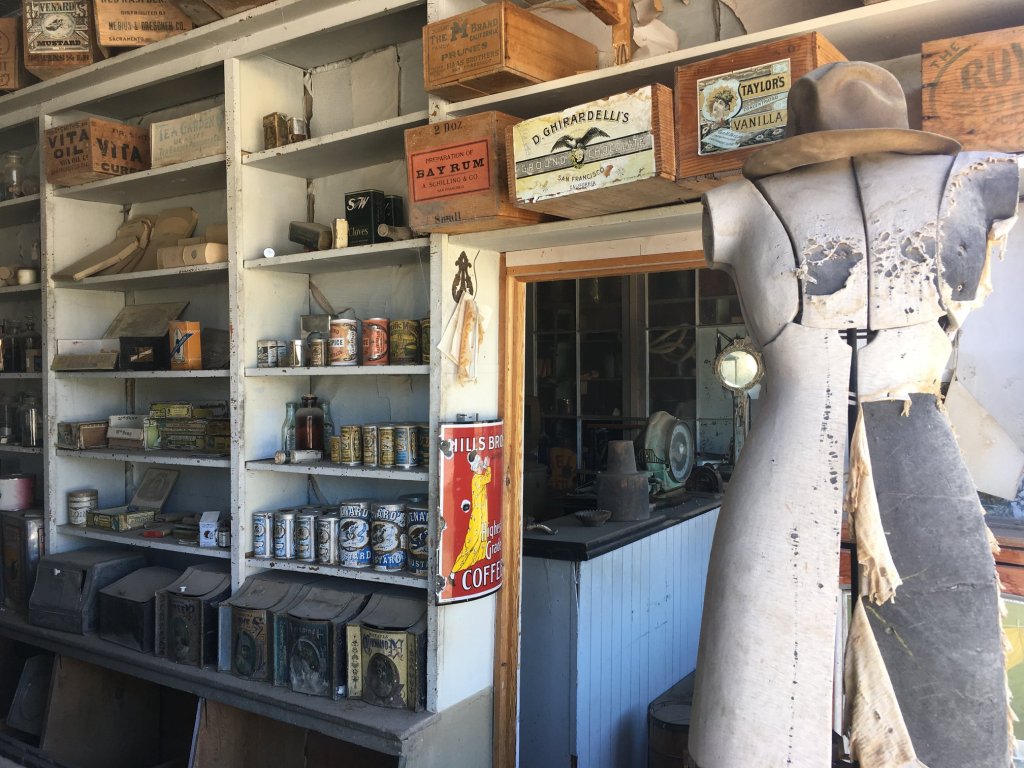
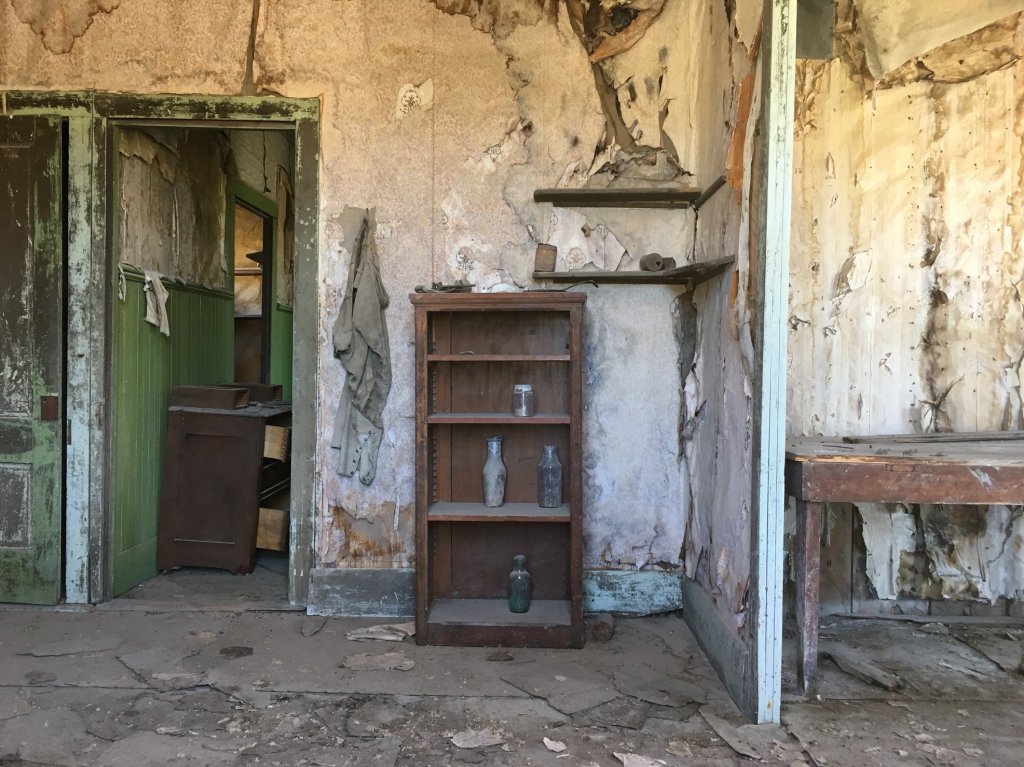
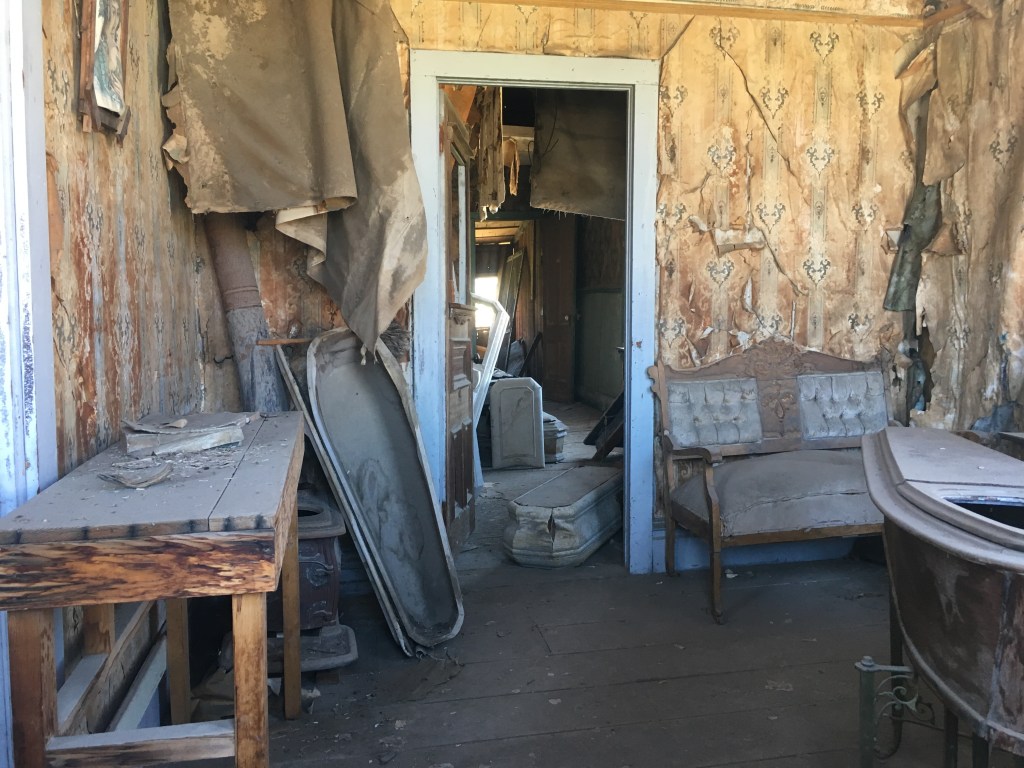
Traveling down the main streets, most of the buildings were closed and locked but I could go up to the windows and cup my hands around my eyes against the glass to peek in. Nearly every building was furnished. In the homes I saw tables and chairs, vanities, sewing machines, beds, rotten mattresses, wallpaper peeling off, canteens, and bottles and hats sitting about. One building was a pool hall, and the pool table still lay next to a furnace and a bar. One of the general stores was well stocked with just about everything you could imagine a general store to have back then, but everything was just about everywhere, in such a state of disarray and decay, that just that disorder and abandonment gave it a haunting sort of feel. 

Ghost towns are not named so because of the supernatural, but simply the term refers to a place that has been abandoned. However, seeing so many things so shamelessly abandoned and rotting away certainly gave me a sort of spooked aura. It was especially evident in one building with the way the light filtered in the window, dispersed through a laced curtain, and crept across the warped floorboard, casting natural shadows. If anyplace here was to be truly haunted, though, it would have to be the mortuary. It looked just like one of the many other houses, but I cupped my hands around my eyes and against the window to peek inside. A large coffin lay horizontal in the room, and up against the wall leaned two infant caskets. I felt something distinctly unique about being at a mortuary in a ghost town looking at infant coffins. Perhaps it was just a sure reminder of the fallen state of humanity. Here I was in a place left abandoned, rotting away, where life once lived, fixing eyes upon caskets, a reminder of the finite nature of our existence on this earth, and I was looking at infant caskets, symbolic of lives sadly taken prematurely. 

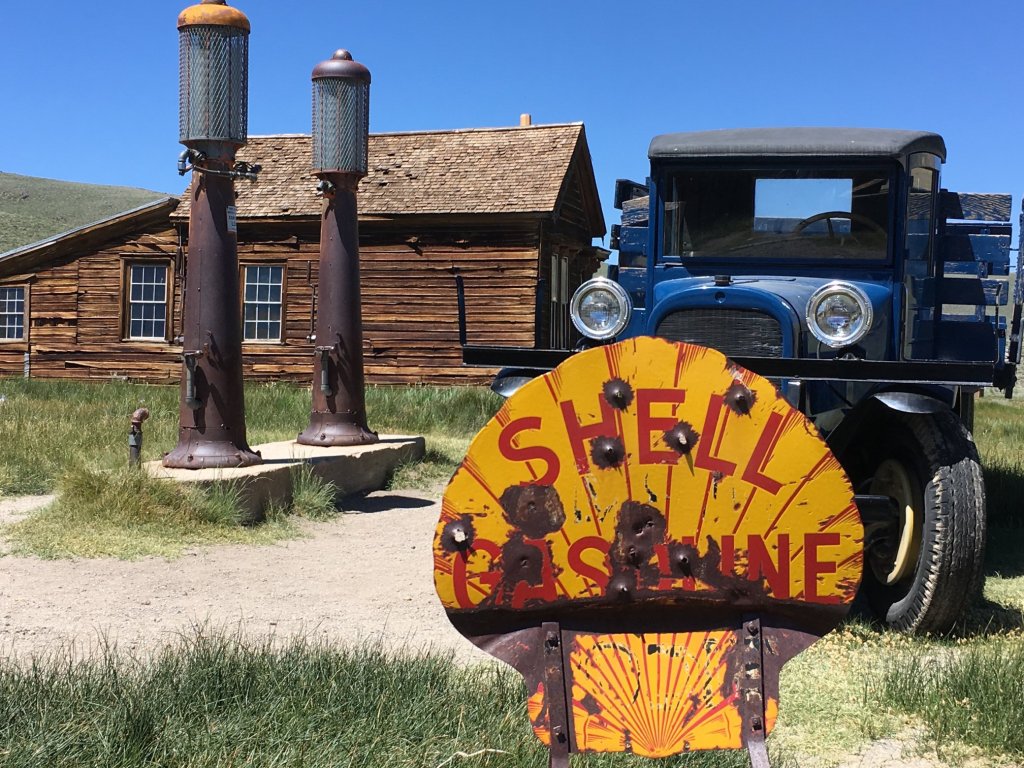
I did a bit more wandering myself, peeking in the windows of the school house, which was in near mint condition, and an old gas station with the oldest shell sign I’ve ever seen. I stopped for a moment at the old two story hotel which had me imagining people coming to this place and checking into a room. Why were they here? Was it for business or just visiting? Would they check into their rooms and then maybe head out on the street to find a place to have dinner or stir up ruckus in a saloon? What sort of men would wander over to “Virgin Alley”? This place once had a lot going on. Now its buildings were void of life and silent. 

After a bit of wandering, I went on a guided tour up to the Standard Stamp Mill. The ranger led a group of about fifteen of us up the dusty streets of Bodie. Before coming to the Mill we walked by the once home of Theodore Hoover, older brother of president Herbert Hoover. I was fascinated that this place had a connection with Herbert Hoover through his brother. I visited Herbert Hoover National Historic Site in Iowa the previous fall and learned all about him. It was there in the old quaker meeting house in the Herbert Hoover family’s village that I took time to ponder and reflect upon my last summer’s lesson to “be still, calm and quiet.” I love how in visiting National and State Parks, there are so many connections between people and events across the country. In the earlier days of our Republic, the people of influence had broad sweeping connections across the nation. One thing that happened here had another effect that happened there. These commonly occurring characters and connections help tie everything together and paint one grand story of the United States. 

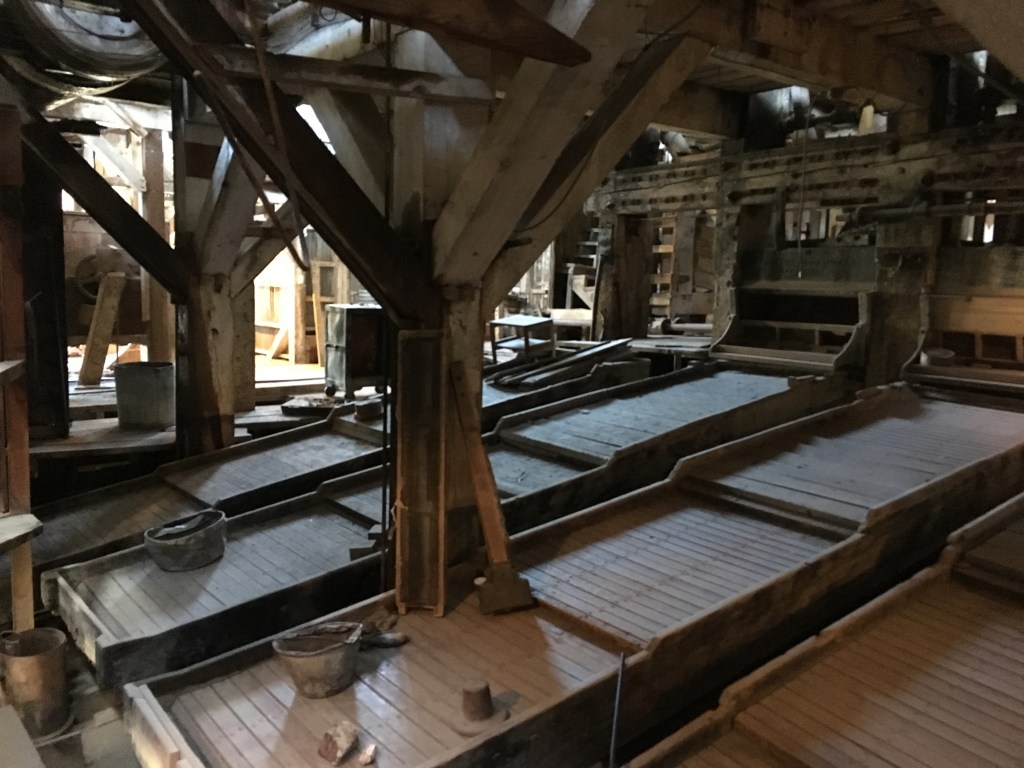
 Once inside the Standard Mill we saw all the powerful mechanics, giant gears, and heavy equipment. The ranger explained the stamping process of this mill, how these giant stamps would literally crash down upon rocks and break the mineral deposits. Then a series of magnets and mesh beds would sort out the gold and silver. The most interesting thing the ranger shared with us here was how early employees in this mill were known for trying to steal gold from the mill. They would hide it in their pockets, so Theodore Hoover, who was manager of the mine, established uniform outfits- jumpsuits with no pockets. These thieving employees found other ways to steal, however. In the hot mine a man may stage a wiping of his brow or a hand comb through the hair, leaving behind gold dust to later be collected from his hair, eyebrows, or eye lashes. 

Here in the mine, the ranger also gave a super fascinating fact: In recent years, a Canadian mining company surveyed the land, finding about $2 trillion worth of gold still deposited in the hills around Bodie. The U.S. government stripped the mining permit from the Canadian company and now the state of California just sits on 2 trillion dollars of gold beneath its land. At first mention, I thought, California needs to mine that to pay off its debt, but the more I’ve thought about it, I’ve realized it’s better kept reserved, for I don’t think the California government is by any means fiscally responsible to handle such a sum of wealth.  

History and gold mining aside, I think there is a lot to learn from ghost towns about life. I’ve written about this before in my book, Canyonlands: My adventures in the National Parks and beautiful wild, but Bodie, I find, taught me something different. You see, the park ranger explained how Bodie was in a state of “arrested decay.” Meaning, the place is in a state of decay, but they are trying to arrest that decay, so nothing is to be changed, restored, revitalized, or repurposed. The place is simply to be arrested in its state of abandonment and decay. The only intervention is to occasionally add a support to a building to keep it standing. So, because of “arrested decay,” in every building dust is collected, walls are rotting, items are unprotected and weathered by age. Many of the buildings are even left messy inside. Old cans, cartridges, bottles, hats, and books lay about, left abandoned, in the same location, untouched for ages. This had me thinking about life. 

As we age, we are prone to find our own lives in a state of arrested decay. I look at all these physical objects left abandoned in Bodie and I see them as metaphors for the non-physical, but rather spiritual, things we have accumulated in life. We each have an array of experiences, stories, lessons learned, and passions which we have collected over the years. These are all valuable things, gained for many purposes. But I think, as we age, apathy has a way of arresting some of these things and causing us to abandon them despite their value. We no longer put them to use. We get old and we move past these things, and instead of seeking action and influence, we make excuses. But did you not have these experiences for a purpose, and did you not learn these lessons in life to share them? Did you not develop passion to let it stay dormant, collecting dust? Many have places in their lives that are in arrested decay, and it truly is a great loss. We need to exercise the abilities we’ve been given, nourish the passions that have been instilled, and share what we have learned in life to build up others. 

Dennis Rainey in his book Stepping Up: A call to courageous manhood, explains how, as we get older, we are fed a series of lies which rob us of the perception of our own value and worth. We rely on excuses which deem us irrelevant and rob us of our dignity. He talks about the final years of life as some of the most influential. It is here one has accumulated the most experience, wisdom, and lessons learned. All of these things are great riches to be passed on, but many men keep them to themselves. Rainey writes, “What an opportunity we have as we enter into the final years of life to use the wisdom and influence we’ve accumulated and reach out to the next generation.” He also goes on to say, “God created men not to rust out but to wear out as they stretch toward the finish line.” We are to be utilitarian with all we have been given, and, with age, our toolbelt is much more hardy than when we were younger. As written in Job 12:12, “Wisdom belongs to the aged, and understanding to the old.”

 I’d regret for anyone to cup their hands around your life and peek into your soul finding all the valuable spiritual things of life collected, laying abandoned. It’s not an easy question to ask but it is one Bodie beckons: Is your life but a ghost town in arrested decay? It doesn’t have to be. Take a look inside. What do you have there in your spiritual storeroom? What can you share? Think about it like this: You are not a state park but a city full of spiritual investments. There are no ghost towns in the kingdom of God, so dust yourself off and get on with life! 

And also, maybe like in Bodie, there’s so much more treasure still to be mined from life. Don’t just sit on it. Fire up the stamp mill!

Read the previous “episode” Manzanar and the Questions it Raises for Today

Check out my book Canyonland: My adventures in the National Parks and the beautiful wild

www.joshhodge.com

She Tried to Kill Me: Death Valley’s Claim on My Life

Hold on Josh. Hold on. You’ve got to, or you’re going to die. I could feel myself beginning to slip from consciousness. I was in a desert canyon in Death Valley National Park in southern California. It was 122 degrees outside this summer day without a single cloud in the sky. The sun beat down harshly. I was out for a hike, not a long one, just a few miles, but I was competing with nature. I thought it wasn’t going to be a challenging match, but Death Valley was winning. I began to experience lightheadedness. My hearing began to sound muffled. Then there was the dreaded fading of colors. Hold on. Don’t let yourself go. If I were to pass out, it would only be a matter of minutes before Death Valley would dry me out and bake me in its inferno. I was hiking uphill on jagged triangular rock and badland formations on the Badlands Loops Trail, trying to make it out of the canyon. Normally this would be easy, for I’m fit and capable, and this wasn’t even very steep, but here in the harshness of the desert, with the oppressive heat, my body was giving up. Am I dehydrated? Or am I lacking salt? Or is it heat stroke? The body could be overheated, no longer having the ability to cool down to a life sustaining temperature. Maybe my body just could not keep up with the extreme heat of Death Valley. 

My heart began to race rapidly. Oh no, I know how this goes. Soon it could beat out of control, bringing me to the ground. I’ve fainted before, at Big Bend National Park, but luckily I was inside around other people. Here I was completely alone, except for with her, Death Valley. We had met before. She caught me in a sand storm summers before. 

The Badlands Loop

There was a little bit of shade just up against the short canyon wall. There were fragments of broken rock down by my feet, which seemed, in my present state, so far away and unreachable, but there was one big enough for me to sit upon. I lowered myself slowly and cautiously. Any quick movements, any exertion whatsoever, could cause me to black out. I crossed my legs, the most comfortable position to keep myself up from complete collapse. My vision went blurry for a moment, but I still had a grasp on it. I focused on breathing slow, deep breaths.  

I had water, but I wasn’t sure if that’s what I needed. If I was salt deprived, this would worsen my symptoms. However, it could be life-saving as well. I took a sip of my water which had turned hot from the all-consuming heat. I poured the rest on my head. Although hot, it was not as hot as the air around me. It could cool me off just a bit. And if salt was what I needed, there was one thing I could do. Sweat contains salt. I began to lick my arms. It’s not that I was particularly sweaty, for one doesn’t sweat in Death Valley, as sweat immediately evaporates in the extremely dry climate. But even this being the case, there should still be leftover salt deposits on the skin, I thought.

I had overestimated my strength in the desert. It didn’t help that I did this hike shirtless. I like the feeling of the desert sun on my skin, and I thought that in the heat the less clothes the better, but actually if I had worn something to cover my torso it could have provided shade for the body and maybe I wouldn’t have overheated as quickly. 

I had not yet cried for help. I was only about a mile from Zabriskie Point, a popular lookout point, where people would be present, marveling over nature’s artistic display of giant jagged rock formations, but I was so far down in a canyon with a sea of rock formations before me that I could not hear any of them, and I don’t think they would hear me. If I were to exert my voice loudly, this might take too much energy and cause me to lose my consciousness. I could not make a phone call. My phone was in the car. I left it there, for there was no service out here anyway. It was just me and her, Death Valley. I’ve always said she is my favorite park. She is so different and unique from all the others. Her views are so astounding, Her mountains are so tall. Her valley is so wide. She is rich in history of gold, silver, and borax mining. She’s the keeper of abandoned mines and ghost towns. She’s so strong and so dramatic, and this was one of the many features I liked about her, but she was also ruthless. She lures people in with beauty and mystique, as in the past she tempted with her riches of gold and silver. She’s a masterful artist, skillful at manipulation, luring man in to choke and turn him back to the very sand from which formed him. 

She caught me. She had me right where she wanted me. Though a lover turned hostile, I had done her no wrong, but merciless she pursued me. I focused on breathing and said a prayer. After a few minutes my heart returned to a normal pace, colors in my vision returned, and my hearing was sharp. I was okay. I had to get up and continue. Time was of the essence. I needed to get back to the car. I stood up slowly, and I walked carefully. A peace had brushed over me, despite concern still guiding me. I was able to be calm yet knowing the urgency. I made progress, slowly, calmly, not letting my heart rate spike. 

The trail wound up and down and around wavey rocks and canyon walls, until I could see up ahead the sharp pointed rocks of Zambriski Point. I could see people on the rim taking pictures, and it was a sign of relief. Slowly and methodically, I made it back to the lookout point among the other tourists. They were nonchalantly posing for photos in front of the jagged points spiking up from the canyon. I then was assumed to be another one of them, but no one knew what I had just experienced. I got back to the car and turned the air conditioning on high. I had some hot gatorade, and dry snacks. They seemed to help. I longed for something cold and refreshing, but nothing here would be cold. It was all hot. 

Zambriski Point

I’m done with hikes for the day, I concluded. After resting in my car for a few minutes, I was ready to check out the Furnace Creek Inn, one of the two accommodations in Death Valley National Park. I wasn’t going to stay. I just wanted to see it. I had learned about this historic inn from a documentary about National Park lodges. It was built in 1927 by the Pacific Coast Borax Company before the area was declared a national monument and later a National Park. This inn was once a desert oasis for Hollywood elites, and to this day, it says on its website that it “still pampers every guest.” I had to see it for myself. 

Its a structure that very much fits in with the landscape. Its foundation and lower level walls are constructed with rocks from the very desert. It’s building blocks were formed from the very sand of Death Valley. After I parked my car I walked up the drive. On one side there was a lawn with a tall fountain. Yes, there was a lawn in Death Valley! I could scarcely believe my eyes. On the other side of me was a wall skillfully crafted out of rocks and above it a patio for guests. Up above was the main level of the establishment. To get there there was a rounded tunnel that cut through the rock wall and seemingly went back to a staircase. Lights were affixed in the tunnel to light the way. How unique of an entryway, I thought. It seemed sort of like I was approaching some passageway in a medieval castle, but as soon as I entered the tunnel, a large aggressive wasp darted towards my face. I abruptly moved my head, evading its assault. It buzzed around me loudly and invasively. I ran back out of the tunnel to the drive. I had thought I was alone, but then I saw a lady walking her way around the front of the inn. I must have looked ridiculous, running away erratically from a wasp. I immediately regained composure, stood upright, and walked moderately. I smiled and nodded my head politely. “Hello,” I said, as if nothing unusual had just happened. 

I walked around the rock wall to another staircase that led up to the main lobby of the inn. Inside I was quite impressed. I beheld a beautiful lobby of simple elegance. Intricate tilework spread through the lobby and into the halls. Big rounded windows looked out into palms and the desert mountains in the distance. Oritenal rugs sprawled out beneath wingback chairs and floor lamps. I did feel out of place, however, and began to wonder if this was alright, that I, a mere vagabond of the desert, was welcome in such an establishment. If I knew it was so nice, I would have dressed a bit differently from my gym shorts, cut-off, and hiking boots. But I decided to ignore my attire and just walk about the place as if I belonged. No one had to know I was a foolish young man who nearly died in the desert, who really is not sure where he is spending the night, and could no way afford this place. I could pretend and carry myself as if I knew exactly where I was and what I was doing. Some National Park lodges encourage visitors and are quite welcoming. This seemed just a little bit prestigious and more intimate to me, but I pretended like I belonged the best I could, given the circumstances. I wanted to appreciate its architecture, elegance, air conditioning….and pool?!

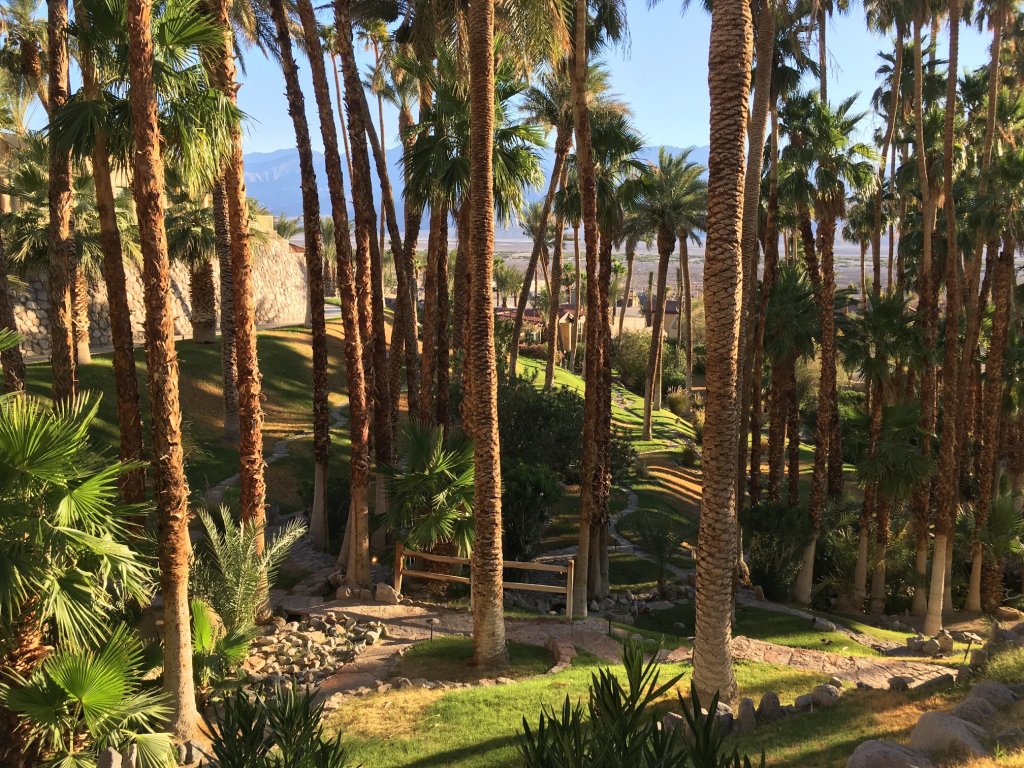
I walked out into the oasis garden behind the inn. I was so completely surprised that such a place existed in Death Valley. Here was a forest of palm trees on a hillside blanketed in green grass. Small winding stone pathways and stairs meandered around it and over a bubbling brook and rippling pond. Little stone walls held up the hillsides of tasteful landscaping. This place looked so cared for and so astounding to exist in such a barren place as Death Valley. Between the palms, in the distance, I could see the large expanse of the desert and its mountains standing tall. What a contrast! More immediately before me I was faced with a large natural spring fed swimming pool. Its poolside was encased by beautiful stone architecture with arches resting on cornerstones, and it was all in the shade. After being so exhausted in the desert, and strolling now still in the oppressive heat, the thought of being engulfed beneath the water of a swimming pool seemed so perfect and just what I most wanted. I had been successful thus far in pretending as if I belonged at the inn, walking around the lobby and garden oasis. What if I just took it one step further and helped myself to a little swim? I was very close to letting myself walk through the gate and into the pool, but I first noted that it would be quite obvious if anyone was watching, for no one else was at the pool. Then my moral conscience kicked in. This was not for me. It was desirable. It would be so nice, but it was not mine. 

the garden oasis

Back at my car I noted cell service here by the inn and sent a text to my mom telling her about the 122 degree temperature. She responded “You are not going to camp in that!” She knew that was my plan, and it still was my plan. 

I drove thirty minutes to the Stovepipe Wells Village. I remembered the general store here from my previous visit. I bought a Death Valley Black Cherry soda in a long-neck glass bottle here back on my first National Park adventure. Inside I was greeted by a self-serve soda fountain. I got myself the mega jumbo cup, nearly filled it with small nuggets of ice from the dispenser, then poured over it cold refreshing blue Powerade. When I left the store and took the first sip through the straw, it was the most heavenly experience. My body was crying for this so badly: the sugar, the sodium, the electrolytes, and most welcome of all, the cold. I couldn’t take it in fast enough. I may not have made it into the pool at Furnace Creek, but this ice-filled cup of Powerade drowning me was the most perfect thing at the moment. Death Valley had tried to take me, I survived, still weary and war torn, but now I’d just powered up. It was going to be a good night. 

Next order of business: finding a site and setting up camp. There were a number of first-come -first-serve campgrounds in Death Valley. In accordance with my itinerary, I was on my way to the Emigrant Campground when I discovered, along the way, a large sandy lot where others had parked and pitched tents. It sat a little bit elevated on a plain that sloped down into the valley. It displayed a beautiful open expansive view. The sun was setting, and I preferred not to set up camp in the dark. I figured this area would be fine. There were no numbered sites, no bathroom, but I could do without. I pitched my tent, and then went for a walk. 

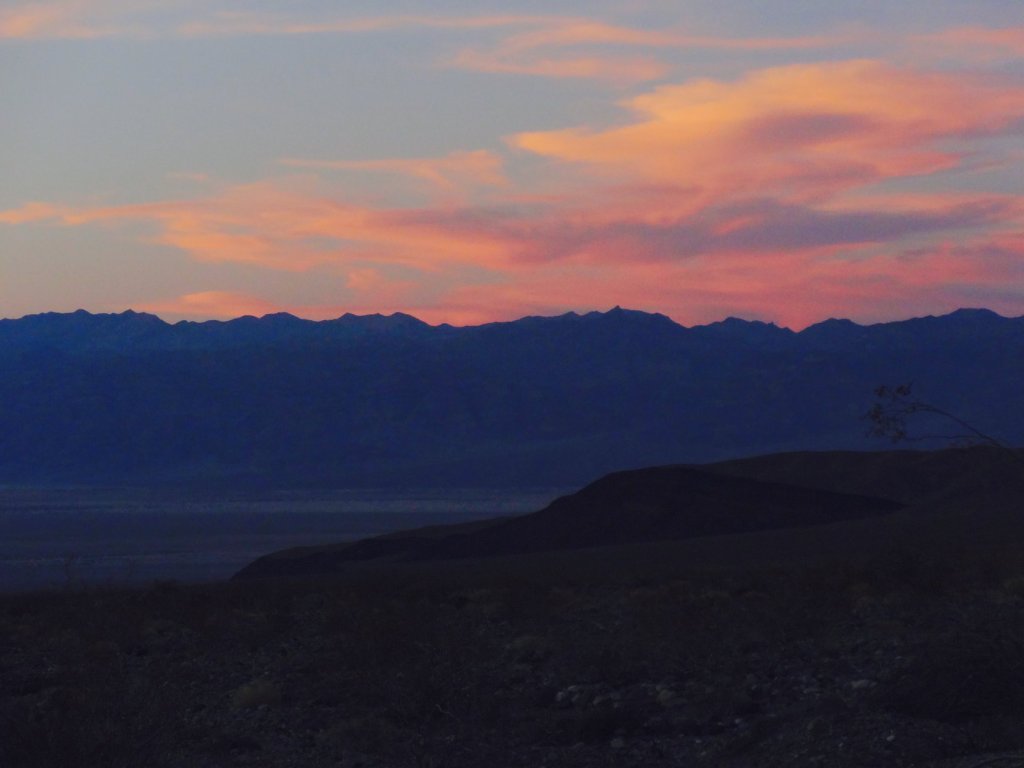
I passed by a ranger station or some park service building in the middle of the road that looked closed for the summer. Just past it I paused. I deviated from the road and stood up upon a rock looking out. The sun had set. The mountains were a rich dark blue, and the sky a vibrant pink. This beauty was enough to give shiver with goosebumps, even in the extreme heat. Out in the valley there appeared to be a lake, but I knew it was just the giant salt flats contrasting the surroundings. Everything was so giant, so huge- the mountains, the expanse of the valley, the salt flats. Everything seemed to flow smoothly from the Artist’s brush. Even with such an incredibly huge view, the desert was so still, calm, and quiet. This confirmed all the more that Death Valley remained my favorite National Park. She has a unique overwhelming effect on my soul. I love her, despite the fact she tried to kill me. 

With a calmness of the late evening desert seeping through my being, I walked slowly and relaxed back to my tent and shed a few tears in response to such beauty. This was also my first stop of my very first grand National Park adventure back in 2015. I was coming back to where it all started, my following in love with the Parks, where excitement and wonder was so fresh and new. The desert reminded me of all I had seen and experienced since, and I felt extremely grateful. 

Back at my car I brushed my teeth and didn’t bother changing clothes for the night. It would all be coming off in this heat. I checked the temperature from the car before I locked it up for the night. It displayed an even 100 degrees. I noticed I had cell service and decided to respond to my mom’s text over her concern about me camping in the heat when I told her it was 122 degrees earlier. I responded “No worries. It has cooled off…it’s only 100 degrees now.”

I crawled into my tent. Death Valley had spared me and now was as beautiful and captivating as ever.

Read my previous entry here: Monoliths and Stars: Wonders of the Mojave
Check out my book Still, Calm, and Quiet, here: https://www.amazon.com/dp/B093RMBNCP

Monoliths and Stars: Wonders of the Mojave

I thought I had seen it all, that there was no type of landscape which I had not become accustomed to throughout my travels. It was quite a disheartening feeling to consider, what could possibly be left? The good news, though, is that I had not been completely spoiled; that I was far from it. Only ignorance had pervaded my thoughts, for I stood before something entirely new- a landscape previously uncataloged in my mind- a monolithic wonder in the Mojave National Preserve. The very thought in my mind was, Wow, I couldn’t have imagined something like this.

This moment was near the end of my day. I had started about 295 miles away in Phoenix, Arizona, where the first night of my trip had been spent at the house of my cousin Matthew and his wife Robin. By the time I traveled across the remainder of Arizona and into California to the Mojave National Preserve, it was late evening. My plan had been to visit the Kelso Dunes and hike a short three miles to a mountain peak, but this would have to wait until the following day.

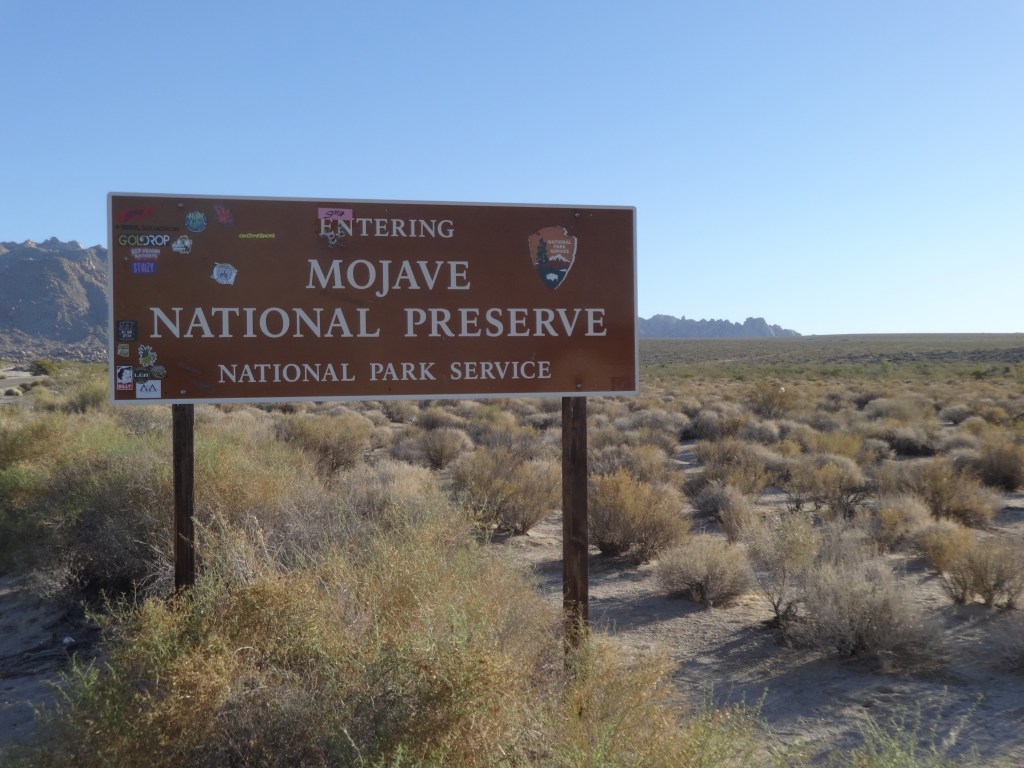
Although sandwiched between interstate 40 and Interstate 15, and a mere sixty miles from Las Vegas, this park has yet preserved its remote feel. When I turned to enter the park, I was greeted with the official National Park Service sign. Visitors had tatted up the corners of the sign with stickers and a few bullet holes punctured the middle, telling me that this area was not as well supervised as some of the other parks. I entered from the south on my way to the Hole-In-The-Wall campground. It was first come- first serve, and I wasn’t concerned about finding a site, for I read that visitation was low in the summer. The Mojave desert is just not a place most people want to be in the summer with the sweltering temperatures, but my only concern was the drive, for a number of roads in the park were marked unpaved, including the one to this campground. Before I hit the dusty sand roads, I was cruising along the pavement among grand stretches of desert. Dry shrubs nearly covered the terrain, and every once in a while a cactus, yucca, or Joshua tree would stick up. Around me I saw crumbly mountains and mesas in the distance. I hadn’t expected the expanse of this area to be so enormous. 

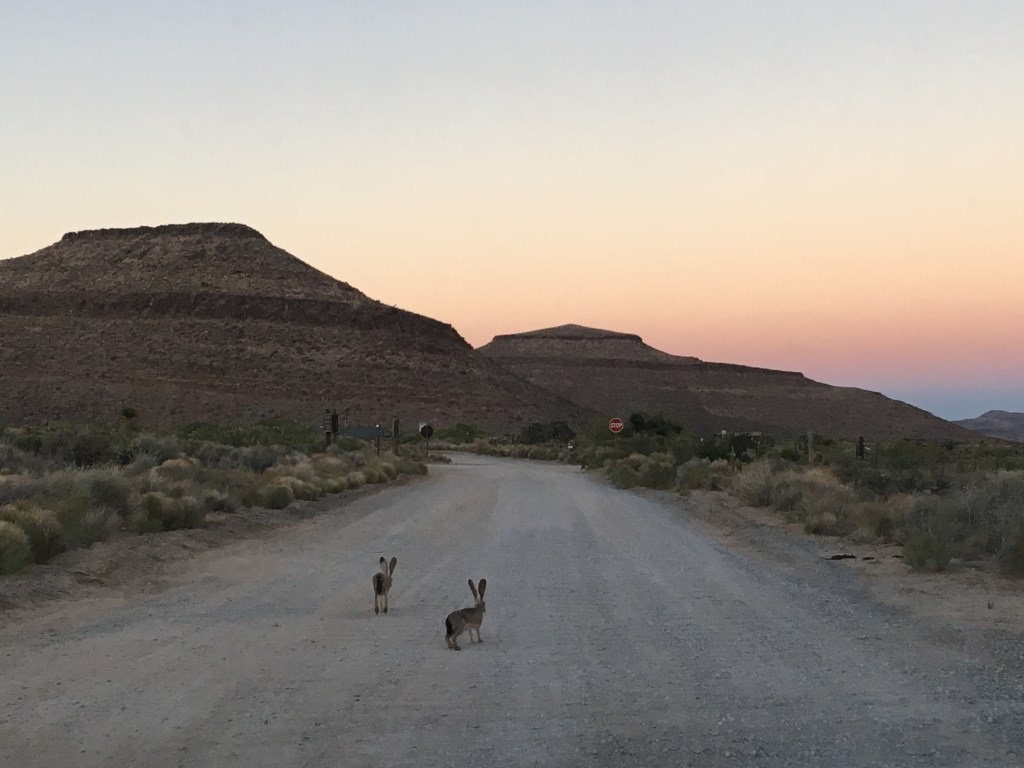
When I reached the bumpy dirt road, before me crawled an animal I had never seen before. Its fur was dark, and its appearance was prominent. Although nor particularly large in the grand scheme of things, it was larger than anything I was expecting to see. I got out my cell phone and texted my friend Zack in Kentucky, who would be joining me on the adventure in a few days. “I just saw a wolverine,” I typed. I was wrong, so embarrassingly wrong. I did not know. Wolverines do not live in the American Southwest. They are mammals of the far North. We can file this next to the instance on my first adventure, when I thought I saw a wolf, but it was really just a coyote. What I had just experienced was my first sighting of a badger. When I neared the campground I witnessed a pair of black tailed jack rabbits situated in the middle of the drive, jumping further down the road and then off into the shrubbery as I neared .

Finding a campsite was not hard. I was alone, except for one other occupied site. I quickly pitched my tent at a site far from the others, on the opposite side of the campground. I was distracted at times by a nosy little desert cottontail, whom I pursued to capture a photo of, and who surprisingly let me get closer than I expected. Back to work, I got my tent set up swiftly, as I was planning to get at least one hike in before the day’s end. Once I had everything set up, I drove over to the Hole-In-The-Wall visitor center. It was an old Western style wooden ranch building with a wrap-around porch. There was a clear place for a sign to identify the ranch, but it had been removed, and the flag pole out front was also bare- a sure sign that this was definitely off season. It would have been the perfect time for a tumbleweed to tumble on by or a vulture cry to sound off in the distance, for I was very much alone and very much in the desert. I checked around the perimeter of the abandoned visitor center for any maps or trail guides, but nothing. I was on my own.

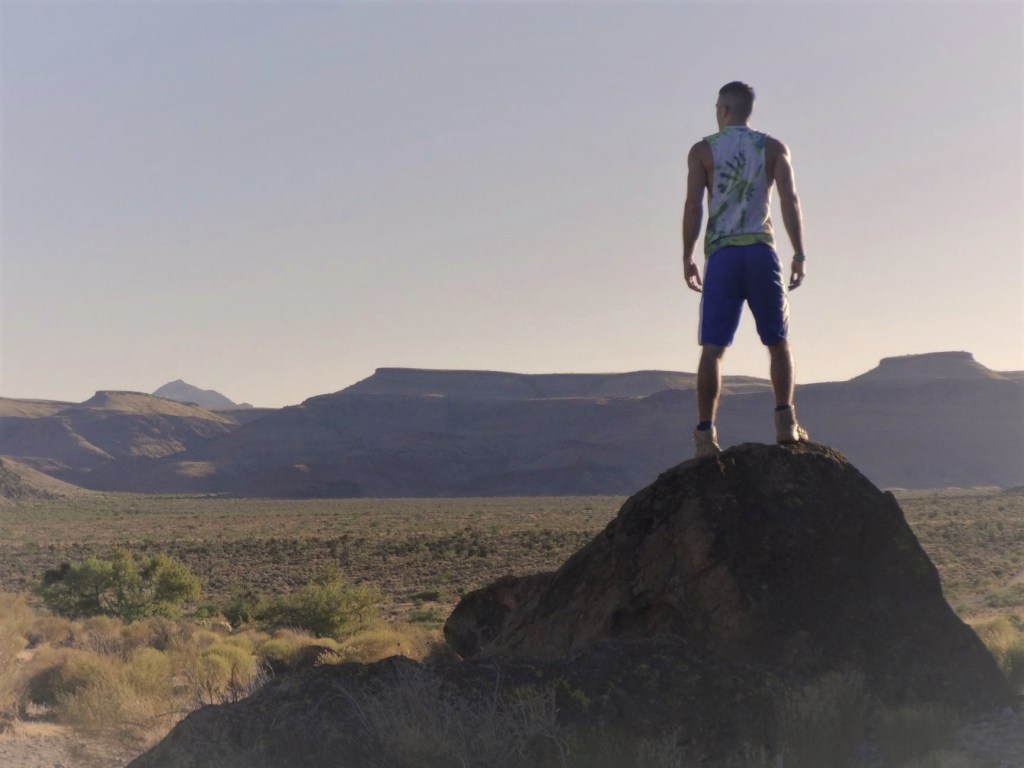
However, I found my trail head next to the visitor center. I then geared up. First off, I was certain to have water in my camelbak backpack. I brought a light hoodie, expecting that soon the temperature may drop, and I brought my headlamp, for I knew sunset was not far away. I made sure I had my car key securely in my backpack. I was not going to face the panic of last summer when I locked my key in the car at Chiricahua. To help avoid repeating that situation, I bought a short lanyard keychain at a gas station earlier in the day. Then, all ready to go, I hit the trail. It began with a stroll among the shrubbery and quiet meandering around some teddy bear cholla cacti. Then the path slithered between some boulders, and up to some rocks adorned with native American petroglyphs. At this point, the sun was just resting above the horizon, casting dark long shadows behind every protrusion in the desert, but laying gold upon anything its light touched. The path then led around some big rocks to a picturesque Southwest view. There were two large mesas, one laying in front of the other and the top of a mountain peeking up behind them. The air was warm and incredibly still. All around me was silence. I climbed up a rock, not taller than myself, and stood upon it, gazing out into the distant stretches of evening desert. I closed my eyes and quietly reveled in the moment, in my being, in the presence of God, in my arrival to a new adventure. I felt as if I had come back to an old friend. The desert: I know you. We have been separated for a while, by time and space. So much has happened. So much has changed, but yet you are the same, quiet and reserved, a library of adventures past, calling me to be grateful of the years gone by. The desert knows years gone by. It has been through them. The desert is well weathered by the ages, but yet calm and knows its place. 

As I pondered the desert, I thought about how in the desert, you don’t have to be up high, or in any particular overlook, to look out among the immensity of the land. In the desert there are no tall trees nor overgrowth hindering your view. Here it’s all laid open. One stands above and can see the great immensity of the land. And the desert here, in the Mojave, is not a barren plain, but it does have features: mesas, rocks, and distant mountains. The view just stretches on seemingly forever. It derives a similar feeling of a mountain top experience, when your life is sort of put into perspective, as you observe the immensity of that which is around you and are surrendered to a humbling comfort. Your problems seem diminished and are put in their place. 

The warmth of the desert also has a comforting feel to me, especially in the evening, when the sun isn’t harsh, but a dry warmth still blankets and comforts you. If the sun were to set, if I were to be lost for the night. I would be fine. The desert may cool some, but won’t freeze. The air is still. Bugs are absent. Any perils of the night are gone. Yes, some may find the desert to be harsh and univiting in the day, but in the night I find it very welcoming and suitable for the lone traveler. 

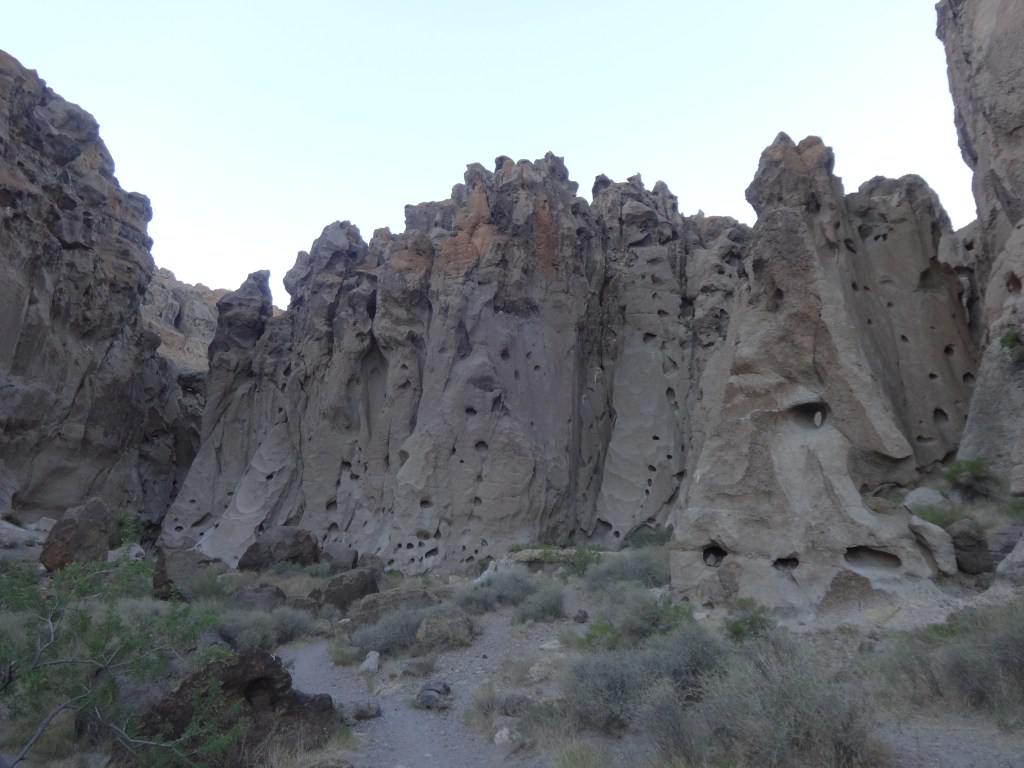
When I jumped down from the rock I was observing from, I turned around to a giant monolith in the desert: a massive rock feature just protruding solo and drastically from the desert floor. The trail wound around into a wide slot canyon that was somewhat narrow but then opened up in the middle of the monolith to a canyon wonder. Here I paused. Wow I could have never imagined something like this. I was taken away by the uniqueness of the scene. This was a new terrain, a new landscape I hadn’t experienced before. Here giant groupings of hoodoo-esque spires huddled together, right up against each other. They were together, yet individual, like you could pull or peel them apart. They stood as if flaunting their curvatures. And all of them were missing circular chunks, as if shot by enormous canyons, mimicking swiss cheese, or as if they had sunken eyes looking out at me. I had never seen any rock formations quite like this. It was unexpected. The desert just outside this canyon was not drastically different than what I’d seen before, but this short walk into the slot canyon displayed a whole hidden world, so unique. It was so nearly enclosed too, like it’s own hidden fortress. I paused and just looked around in amazement. It completely wiped away from me the thought that nothing I could see would be terribly new. This affirmed there was much more to see, and things can, and would, exceed what I could imagine.

This was only the first of two surprises on this short hike. The canyon grew narrower with each step until there was no canyon left at all, and it seemed I had been walled in, but upon observation I found a passageway of sorts. There were cracks in the jumbles of rock, just enough space to fit a body through, and they were steep, ony presenting a passage that went vertical. Affixed to the sides of the rocks were a series of steel rings. This was called the Rings Trail and I had read about it, but seeing it, I was well surprised. The rings portioned looked more challenging and more extensive than what I had imagined. This would be fun. Like a puzzle to solve. I had to figure out where to establish footing on the rock wall, and which rings to grab onto, as to establish grip which was conducive to a trip upward. The passage grew narrower, then curved. I was really immersed in this rock world all around me and the task at hand. 

I appreciate a trail that presents a challenge, a unique skill, or problem solving. There is one trail back home in the Big South Fork that requires one to rapel him or herself down a boulder’s face. In the Rocky Mountains I’ve hiked up a waterfall. Even a mere swinging bridge can add some fun and variety. This Rings Trail presented something new, and it was definitely one of a kind. 

When I finished making my way through the narrow rock passageways, I found the rock terrain to open up. I found myself not completely out of the canyon, for walls still surrounded me, but I was well above the portion I had just traversed. Now I was at an established viewpoint where I could look back down in the rock world beneath me. Up around me I noticed the curvatures of the rocks. They were not jagged nor harsh points, but rather the rocks seemed to flow and lump, as though melting chocolate. The rocks were plain gray although lumped into the mix were orange colored rocks as well. If I was handed five stars, I would rate this trail 5 out of 5. “Unique” is the most justifiable term to use to describe it. 

When I made it back to my campsite, a mere maybe quarter mile away, the sun was setting. I was walking around the campground, tracing its perimeters, trying to see if there were any trailheads from the campground. I had the intention of going on a nighttime hike. I would rest in my tent, and, when it got much darker and the stars came out, I would go for a night hike by flashlight. 

When I did get to resting in my tent, I was out. I slept long and deeply. At one point I did wake up, as a different aspect of nature was calling. Inside my tent it was very dark, as I reached for the side of the tent to unzip my way out. When I pulled the flap of my tent backward, I unwrapped the most beautiful night sky. Millions of stars decorated a huge desert sky. The milky way ran prominently and astonishingly through the middle of the expanse above. I was amazed. This was all visible with simply my glasses on, which I don’t see very well with. Right here, right now, in the middle of the night, well…after answering nature’s call, I put on my contacts so I could really see and take in the beauty above me. 

Looking out upon the desert alone is enough to make one feel small and shift one’s life into perspective. But take on top the desert the profundity and awesomeness of the night sky, and then one is really put into place. One of my favorite song writers, Matthew Parker, in his song Shadowlands writes “The moon and stars are the only light to tell us that we’re lost in the endless darkness of night.” This moment illustrated this perfectly. Observing the stars in such a glorious display in a remote area, does initially evoke a feeling of lostness. The universe becomes so immense. You seem so small. What you witness is so immense that you feel but nothing, lost in the great immensity of what is. But Matthew Parker, as well as myself, know that we don’t remain lost. What’s most reassuring and comforting is that, amidst feeling lost in the great order of things that exist in the universe, we are found! We have been sought out, we are accounted for, by the great Almighty God and Creator of the immensity before us.

It is no wonder early peoples and cultures, whether it be Native Americans or any group of people across the sea on this earth, spent such a great amount of time pondering the sky and trying to derive meaning from it. It is just so astounding when it is untouched by the light of civilization. It is no wonder early people and societies were so spiritual. I would find it a challenge to the human psyche to observe such wonder and not believe in a spiritual realm or a creator. Can you imagine living out in the desert and this being your view every night, or living out on the Great Plains and this being a constant entertainment for the mind? Think of the men out at sea, nothing but the ocean and these great heavens above you. 

Sadly, most of human society has lost reverence for the night sky. If you live in a city, you can’t see its wonders at all. It becomes easy to be consumed by you, yourself, and your own immediate surroundings. You fault the opportunity to put yourself into perspective. And you lack the beauty which calls you back to the Creator. Even those who live rurally may miss out on the powerful impact of the full night sky. Instead, people find themselves inside in front of their television sets, seeking entertainment, when really the night sky is the more noble form of entertainment, for it engages not only the senses, but the mind, and the spirit. 

But you know people are afraid of the dark. I don’t say this because of what we playfully think: of monsters, and bears, and things that go bump in the night. No, people are scared primarily of their own thoughts, the condition of their own souls, and the night sky is a reminder of the greatness and eternity we are all a part of. 

Get outside! Don’t be scared of the dark. Face your thoughts, face the eternity before you, and find your place in the order of things. 

This was night one of my camping road trip. Tomorrow I’d explore more of the Mojave National Preserve and return to my favorite National Park-  Death Valley!

Read my previous entry here: All My Friends: Reflections from the Desert

Check out my book Still, Calm, and Quiet, here: https://www.amazon.com/dp/B093RMBNCP

The Booming Sands of the Mojave

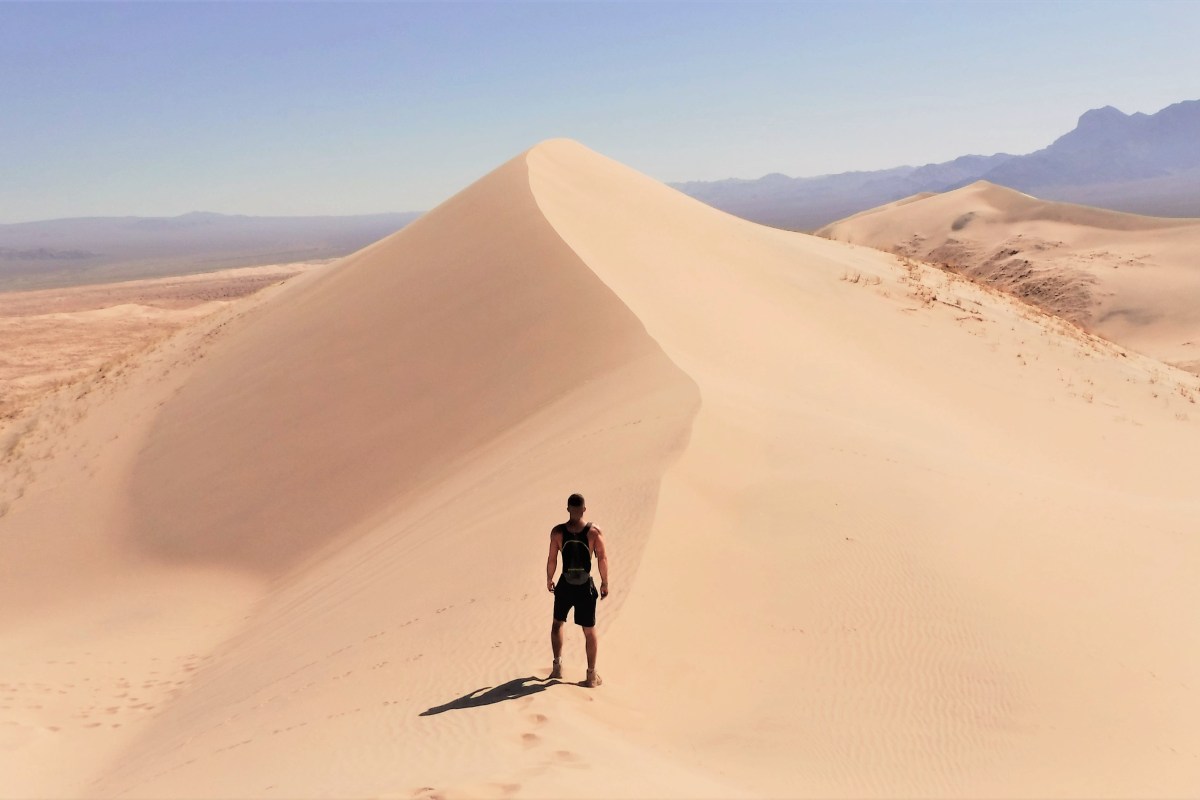
With each elongated step of sliding down the enormous sand dune, a reverberating booming sound escaped the sands from beneath me. This was remarkable! I had never met such a phenomenon before. I felt as though I was the one instigating such a feat, thus giving me feelings of a supernatural essence.

I was at Mojave National Preserve in southern California. This preserve was the first noted point of interest on my fourth great National Park adventure. The park features the largest Joshua tree forest in the world, canyons, mesas, volcanos, abandoned homesteads, military outposts, and “singing sand dunes.” During the entirety of my visit to the Kelso Dunes section of the park,  I was the only one there. It was early morning, and the desert sun was just starting to become quite fiery. I was excited to take on the sand dunes. As I looked out upon them, I determined, then and there, I had to make it to the top of the tallest dune. Learning from my mistakes in the past, and after having burnt my feet at the Great Sand Dunes National Park in Colorado, I made sure my footwear was solid. I filled up a water bottle, threw a Clif Bar in my backpack, lathered up and worked in my sunscreen, and took off running into the dunes. 

My fourth great National Park adventure was really starting to take off! I had embarked on such trips the past three summers, in which I’d camp and travel from National Park to National Park for the large majority of my summer break hiking and exploring the great outdoors. This trip, although starting in the Southwest, would eventually take me far up into the Northwest, an area I had yet to explore. This was my second day in the Mojave National Preserve, but the first one waking up in it. Already the park had impressed me. My expectations for it were quite low. I had been to other parks in the Mojave Desert before, such as Death Valley and Joshua Tree, how different could this be? And it was a “preserve,” such a title to me suggested less opportunity for recreation. However, I was surprised. This place was by far underrated in the National Park Service and filled with many hidden gems. I was in the midst of discovering one of said gems in this moment: the Kelso Dunes. They gave justice to the term sand dunes. But perhaps would be more justified by a term “sand mountains.” Enormous mounds of sand rose above the rest of the desert. On the lower sides of the dunes, desert grasses poked up sparsely from the wind combed sand and Mojave fringe-toed lizards scurried about. The creatures were quite nervous and incredibly fast, but stealthily, as if sneaking up upon my prey, I was able to approach one to capture a quite satisfying photograph. I also had to capture photos of myself in such an area. The shock value of such a contrasting landscape, from that which I was accustomed to in Kentucky, was striking upon me.


As I looked at that enormous sand dune in the distance, the one I resolved to climb to the top of, doubt began to creep in. It was hard to gauge exactly how tall the sand dune was. I wanted to be done in an hour or two, for although as exciting as this was, I also had other places to see and other things to do. Looking at the dune, I could not determine if this would fit nicely into my plans or would require a full day expedition, and if it was the latter, I was not prepared and rather ill-equipped. But I determined to press forward. If it proved too much I could always turn around. Then, not only was I considering the time factor, but I started to wonder if it was physically possible, for the rising of the sand looked quite steep. Would I be able to pull myself up that? There was no designated trail. This was a free for all, and quite obviously no one had been out here this morning, and perhaps not for a while, for the traces of any feet in the sand had been well swept away by the wind. The place looked untouched. It was just me and the desert. Graciously enough, this peak in the sand dune expanse, did not present any false summits, however dips and dives in the sandscape did surprise. 

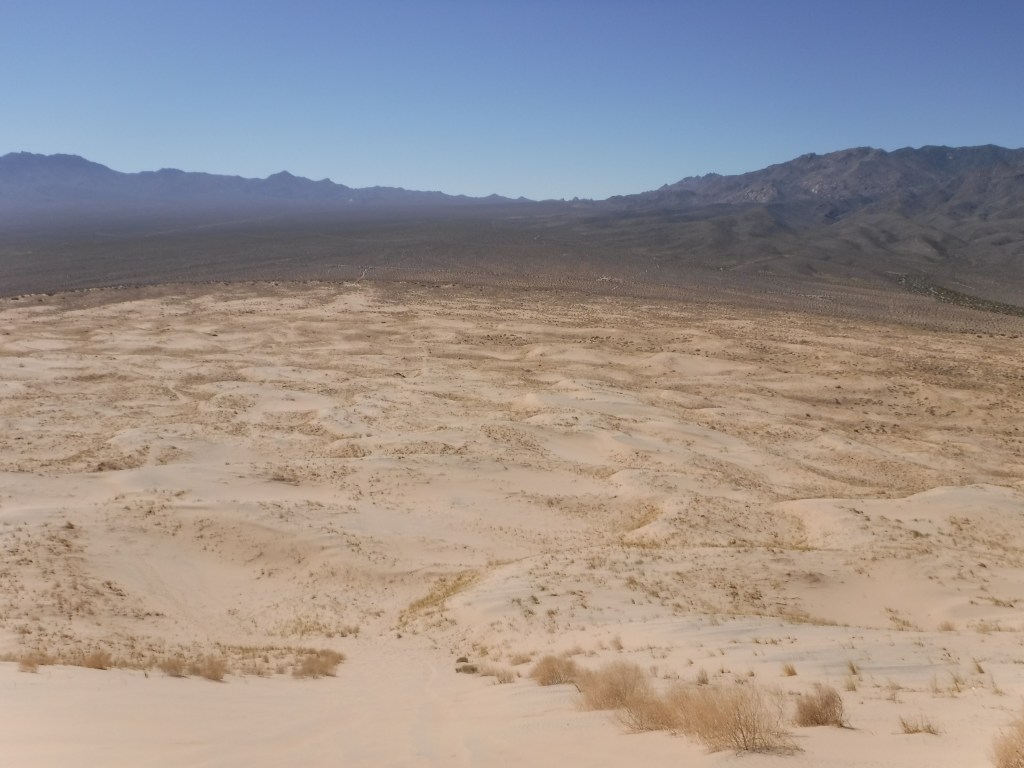
I didn’t try to dig my feet in the sand, but as I started to ascend the steepest stretch, my feet naturally sunk into the sand, and pressed further in as I tried to establish footing to push myself upwards. I paused to look around. The landscape was just so enormous. To my one side was the wall of sand, but out below me to the right spread, so immensely, the Mojave desert. The light-colored sand expanse spilled for just a mile or so into the desert, before the long stretches of valley filled with cactus and shrub took over, with the bright morning sun casting shadows, which not noticeable individually, but collectively, gave a dark brown hue to the landscape. Then as the mountains in the distance, bordering the immense valley, rose up, the higher they climbed, the bluer the tone they assumed, until, at their darkest summits, a crescendo of the breaking sky burst in a glorious white only to quickly transition to a spotless blue that covered the rest of the desert sky. 

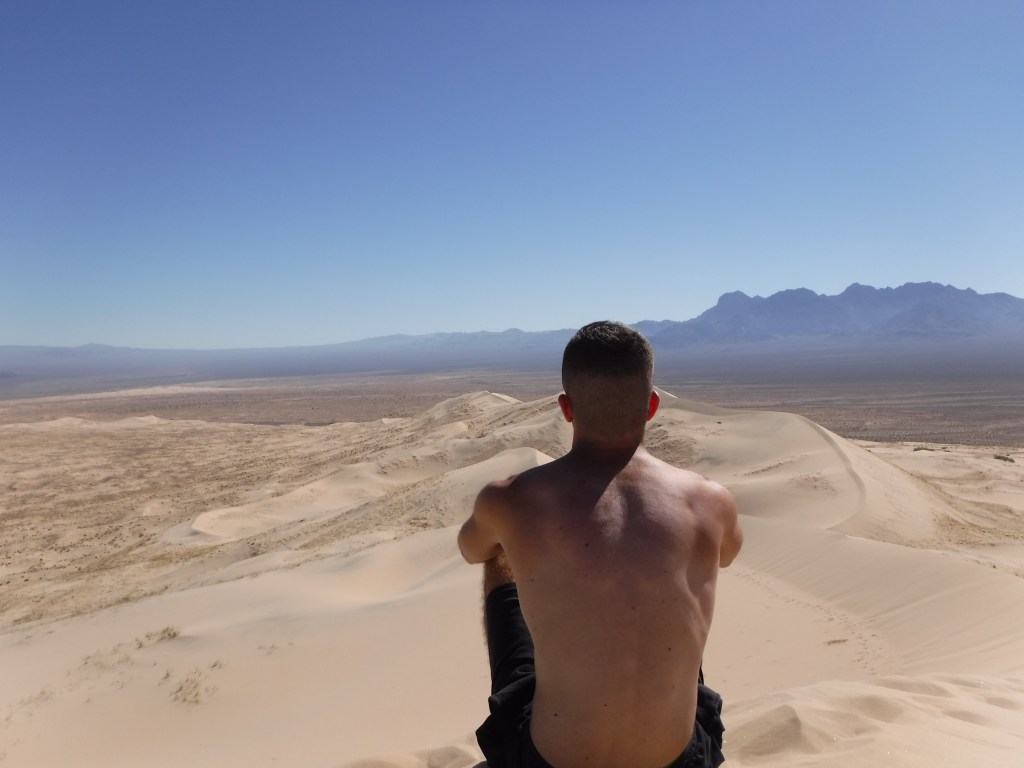
I continued on, elated, feeling as though I had really arrived upon adventure’s doorstep. Then, I reached the top, standing bold and accomplished, I looked over the other side of the dune and saw the same immensity of desert and mountain mimicked. Here at the pointed spine of the sand dune, on the Eastern side, the sand was finely combed into delicate rivets by the wind. On the Western slope the sand had been blown into one smooth, harmonious sheet of sand. The spine snaked up to a higher pinnacle. I crushed the delicate spine as I trampled my way to this final viewpoint. And there I stood in awe. I could assume, a great number of people, especially back East, couldn’t even imagine such a robust desert landscape existed in our country. I felt I was in such an exotic place, a place from fiction, and that I was the Prince of Persia.

I sat down, drank some water, ate my Clif bar, and sucked on a few electrolyte dummies. I reveled in the comforting and consuming sun. I took off my boots and sunk my feet into the soft sand. Here, from this pedestal, I looked down upon the Earth. It was one of those mountain-top experiences that puts life into perspective. The immensity of the view before me, and the diminutive nature of everything from such heights, put life into perspective. The canvas is much bigger than the small concerns we often get caught up in below.  

When I was done taking it all in, I began my descent, and the gravity of the Earth pulled me downward, and thus a single step slid well into the sloping sand before me, carrying me quite a distance. It was nothing more than a controlled falling glide into the sand, but it gave quite the superhuman sensation- a similar sensation one might get walking upon those conveyor belt  automated walkways at the airport. One stride takes you much farther than humanly possible alone, as the very ground beneath you moves in conjunction. Thus I was descending nothing short of a mountain in mere easily countable strides. The effort was minimal, so I held my head up and looked out upon the other more solid mountains parallel and at times below me. I felt as though I was descending upon the Earth in majestic style. And to top it all off, the sand beneath me boomed! That’s right, the sand beneath me sensationally responded to each of my steps! There’s a scientific explanation behind this. It has to do with the warm layers of sand meeting the cold layers beneath and sound waves getting trapped within the layers, but to me, I imagined as if it was I causing the sound, or as if the earth was shuddering to each of my steps, as if I was Zeus or some Greek god descending from the sky upon Olympus.

As supernatural musings took hold of my thoughts, I began to think of Heaven. How will man interact with the landscapes there? Will such enormous, satisfying, efficient strides be more commonplace? Distance and strenuity have a hold of man’s interaction with wild landscapes, but what if there they will be more easily traversed and enjoyed? 

I had a dream, just months prior, that I was in Heaven. I recently had read a book by David Murray titled the “Happy Christian: Ten Ways to Be a Joyful Believer in a Gloomy World.”  In it the author talks about how work is not a result of sin, but how work as we know it on Earth has been corrupted by sin. The author discusses how Adam and Eve, before the fall of man, worked in the Garden attending to it and naming the animals. They were designed, in part, for work. Eve was even created to help with said work. Thus work existed before sin, and so the author proposes that work will also exist in Heaven; that we will all have our own duties, but it will be joyous and fulfilling. I think this portion of the book was responsible for my dream, for in my dream I was at work in Heaven. I was a harvester, or scavenger, in the forests and jungles of Heaven. We went collecting exotic Heavenly fruits to bring back to the people in the Kingdom. And it was thrilling! Our feet were always bare, but they were never worn nor scratched. We would jump from mountain peak to mountain peak. We’d race through all the undergrowth of the forest, unscathed. We’d fall with the waterfalls in excitement to take us from one place to another. We were a team, such great comradery, and we were harmonious with the land. Toil was not there. The land never caused us harm. The way we interacted with it served our purpose. There was no strenuity, danger, or fatigue, such things were absent. Nature had no temperament. It agreed with us. Maybe we even had authority over it. 

It was just a dream, fun to entertain, but at the end of the day, a creation of my imagination. But here on the sand dunes in Mojave National Preserve, I felt a fragment of what I felt in that dream. The desert had no hold on me. I had power over it. It gave a shuttering boom with every step, and I could traverse it with ease. Thus I became flooded with the thoughts and awe of eternity.

I didn’t know it then, but I know it now, eternity would become a major theme of the summer. I would end up facing questions about life, death, and eternity here after. This would become a heavy but blessed summer. As I descended those sand dunes, along with the weight of gravity came the weightier questions of life: What is my purpose here in life? How do I relate to others in the time I’m given? Would I leave a legacy when I’m gone? Does that even matter? As the sand spilled down the dune, so these questions tumbled down upon me. The timing was orchestrated and perfect, although it wouldn’t be easy. I had traversed the Canyonlands, learned to be Still, Calm, and Quiet, and now it was time to face the prospect of Sunset. 

Check out my book Still, Calm, and Quiet, here: https://www.amazon.com/dp/B093RMBNCP

Visiting John Muir’s Home

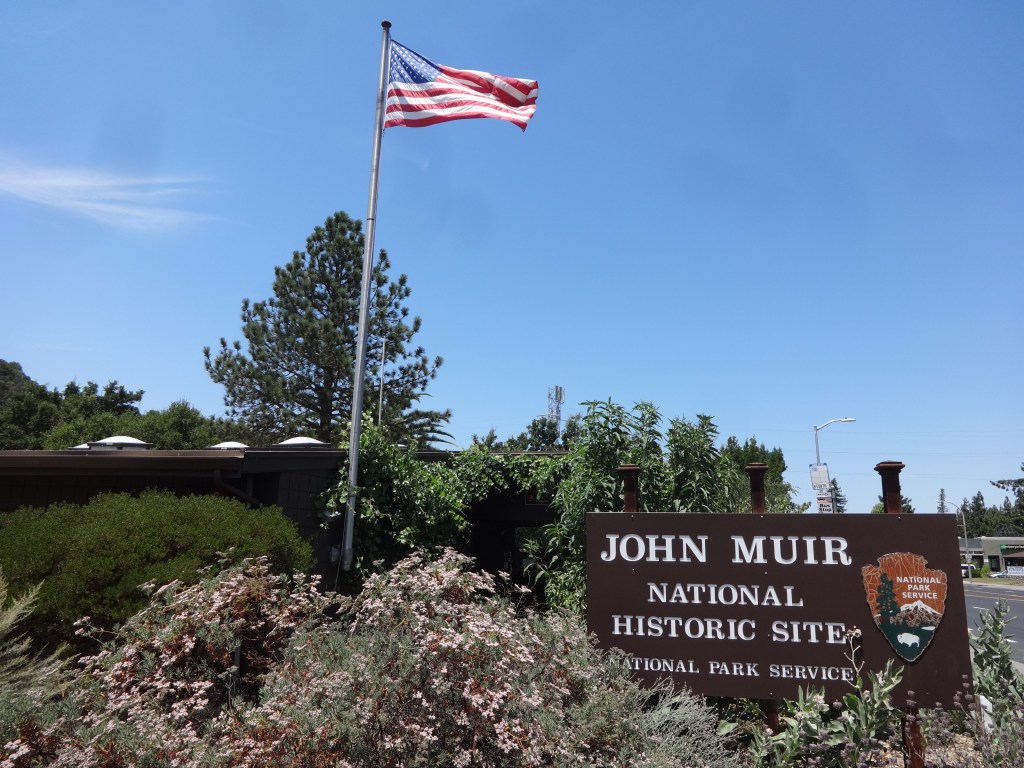
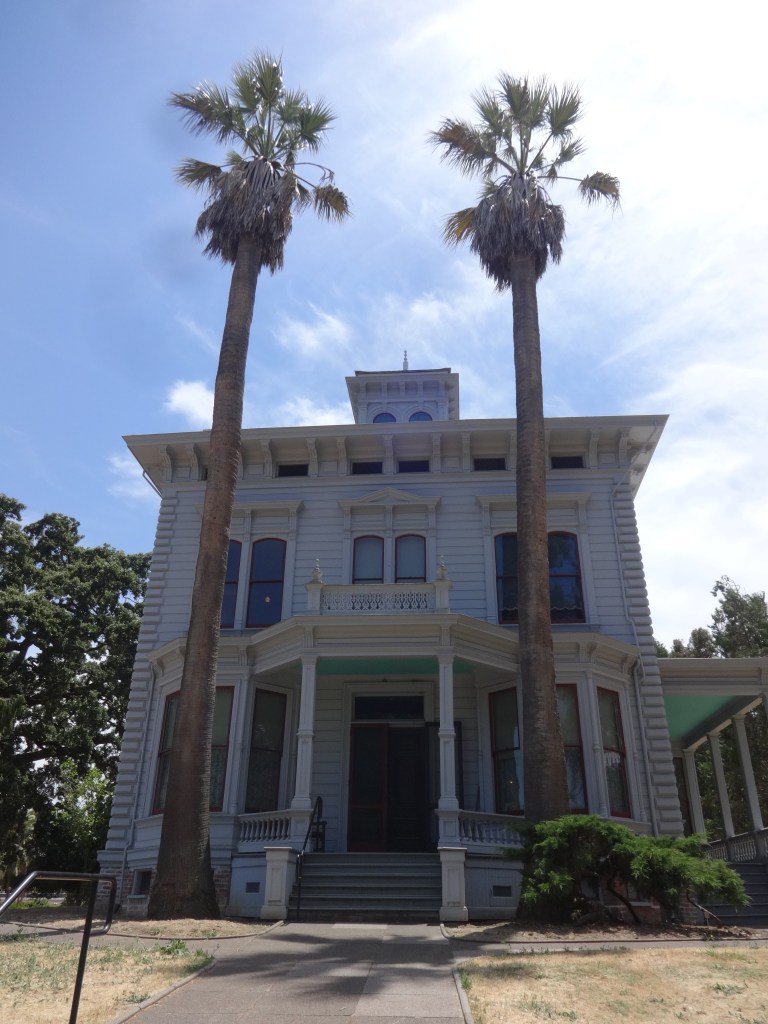
I was at the home of John Muir, one of my favorite modern historical figures whom I would file right next to Theodore Roosevelt. I was excited. Before me stood his Italiante Victorian mansion in the Alhambra Valley of Martinez, California. It was a tall boxy white house with palm trees in front. Behind it lay orchards and a giant sequoia. I thought I was coming to this National Park site the summer before, but I found myself at Muir Woods National Monument, a pocket of forest named after John Muir, instead. I was confused, for I couldn’t find his house, but now I was here. I made it!

I first came across the name John Muir on a small leather pocket-sized journal that had the overused quote on it, “The mountains are calling, and I must go.” I went on to learn a lot about him through the Ken Burns documentary: The National Parks. Later I couldn’t help but learn more about him at Yosemite National Park. My intrigue was sparked. I bought his book “A Thousand-Mile Walk to the Gulf,” at the visitor center of the Big South Fork in East Tennessee, and then listened to a number of his books in audio. His eloquent descriptions of nature and his ability to engulf the reader (or listener in this case) in his words, removed me from my troubles and lulled me to sleep pleasantly many nights. 

Upon reflection, I have found I esteem and value John Muir for primarily four reasons: his perspective, his contribution to conservation, his writings, and his simple intrigue. I thought before describing his home, it is worthwhile to explore what John Muir means to me, so I will unpack each of these reasons. 

In regard to perspective, John Muir viewed nature in such a meaningful and profound way. No other person has been able to influence my view of nature and add such unique meaningful perspective as John Muir. He beheld great wonders of nature as “cathedrals,” spiritual, soul enriching places crafted by God, direct artistry by Him. The Yosemite Valley was perhaps his favorite of cathedrals and he advocated tirelessly for its preservation. “No temple made with hands can compare to the Yosemite,” he’d write. He believed these sacred places were means of healing and restoration for man. “They will kill care, save you from deadly apathy, set you free…” His sacred view of nature has helped me to approach nature in such a manner as to silence myself, step lightly with wonder, and appreciate the brushstrokes of the Creator. 

In addition to his perspective on large areas as sacred temples and cathedrals, he also gave a great deal of thought to the small minor details in nature. He studied plants meticulously out of sheer joy and interest. He saw consistencies in design elements among even the most diverse of things, what he found to be trademarks of a common designer. He believed everything in nature was connected by this craftsmanship. His thrill of a small flower or treasure in a droplet of dew, has influenced my ability to find beauty, appreciate the small details, and look for those signatures of God even in the commonplace occurrences of nature. “Nowhere will you see the majestic operations of Nature more clearly revealed beside the frailest, most gentle and peaceful things.”

These perspectives of course are evident through his writing, and I value his writing beyond even these unique perspectives, for he writes intriguing and daring tales of adventure in all climates and terrains. He tells us about his thousand-mile walk from northern Kentucky to the Gulf of Mexico on foot, his days of pasturing in the Sierra Nevada, his trekking up glaciers in Alaska, and so much more. His writing is eloquent, clear, and descriptive. He is an excellent writer, a fine craftsman with his words. I also delight in his personification of the elements of nature. In a storm he once described trees as “excited, bowing to the roaring storm, waving, swirling, tossing their branches in glorious enthusiasm like worship… No wonder the hills and groves were God’s first temples.” And when describing the winds, they were “singing in wild accord playing on every tree and rock, surging against the huge brows and domes and outstanding battlements.”

It was largely through his writing he was able to persuade efforts toward conservation. Whether through direct plea or exhibiting the value of nature through his wondrous descriptions, his goal was to get people out in nature and discover its value for themselves. Although not founded until two years after his death, John Muir is considered the father of the National Park Service because the principals of the park service were so profoundly rooted in Muir’s ideals and advocacy. Although his legacy runs through the whole National Park Service, Muir is most largely connected with California and with Yosemite National Park. He once guided Theodore Roosevelt on a famous camping trip in Yosemite. Camping beneath a giant sequoia, he convinced Roosevelt to preserve this national treasure as federal land. Without Muir, many of our national park treasures may have been lost to industry and manufacturing. Muir set the stage and started the conversation for the conservation of our public lands. He did so with such fervent passion, often most exhibited behind the pen. 

Aside from his perspective, his writings, and his contributions to conservationism, I also am a fan of John Muir, because he is simply an intriguing individual. He once climbed up a tree in the middle of a storm to feel what the trees feel and write about it. He peered over Yosemite Falls to see what the waters see when they are about to fall. He camped in a graveyard on the moss, for there was nowhere else to go, and he tells us about it. I do not aspire to be like him in this regard. He is a little too much for my liking to model after. Even he himself advised people not to follow in his daring ways. He was self-aware and knew he was on the fringes of sanity, but this makes him all the more interesting to follow in writing. He takes people to places no one else will go.

So here I was at his home in California. How did such an eccentric man live at home? I thought. John Muir wasn’t always from California. His family was from Scotland. He immigrated with his family at age eleven and settled on a lot of land in northern Wisconsin. They toiled and formed that land into a farm. As a young man he moved to Indianapolis and was working in a factory until a metal blade punctured his cornea. Per doctor’s order, he remained blind-folded in a dark room for four weeks, dreaming and longing to see the beauty of the natural world. He thought his sight was gone, but it recovered, and Muir was a changed man. He adopted as he would call it, the life of a “tramp” traveling the nation from one pocket of wilderness to another. He wound up in California, and after extensive exploration, he married Luisa Strentzel. Together they started a family and inherited the house here in Martinez from her parents.

 At this home he’d fully engage in agriculture, planting and harvesting in his orchards. Here he’d also write many books and articles and embark on more explorations, and here he would live up until his death on Christmas eve 1914.

Given that Muir was such a nature loving, versatile man, who often was found camping out in the wild, it is peculiar to imagine him in such a fine Victorian style mansion. But the inside was not overly lavish nor pompous. The well-versed park ranger led a small group of us on a tour. On the main floor in the dining-room he explained how Muir would often tell whimsical and colorful stories to children at the dinner table. One in particular, remembered by his children, was about a kangaroo who would carry a leprechaun around in her pouch. Oh how I wish that story was written down! Muir did not write down his childrens stories, except one about their dog Stickeen in Alaska. 

When we proceeded to the second floor, there I saw the “Scribble Den,” his study, his desk where he penned all his famous works, and reached out to politicians and publishers and the public to save America’s wild lands. I nearly got goosebumps- knowing from this room came such influential writings. 

Despite how satisfying it was to see the “Scribble Den,” perhaps the highlight of my visit was the plum orchard out back. The park ranger said, feel free to pick any of the fruit off the trees.”

What?! These trees were planted by John Muir himself! I can eat an actual John Muir Plum?!  As I walked around the orchard, I read little placards about the plants. John Muir introduced us to new variations of fruit, cross bread and cultivated. I picked three plums and revelled in the novelty of such an experience. 

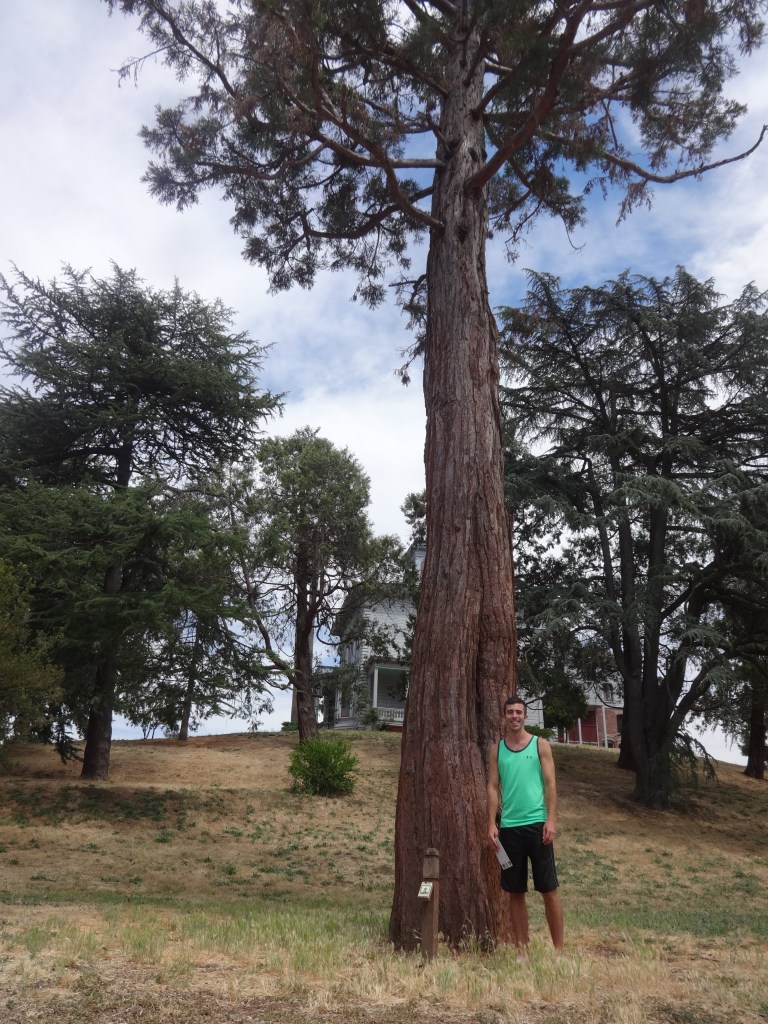
Upon leaving the yard I examined the sequoia tree. Muir planted it over a hundred years from a sapling of the Sierra Nevada. To this day it still stands. From there I returned to the visitor center where I browsed the John Muir books for sale. I bought “The Story of My Boyhood and Youth,” which is a great and surprisingly at times, comical read; and a copy of his children’s story “Stickeen.” I also bought two post cards, the ones featuring Muir and Roosevelt standing at heights in front of Yosemite Falls. I’d write my parents and older brother and sister-in-law about my experience.

I often wish more people knew about John Muir and could approach nature and wild places with his perspective. I despise obnoxious music being blasted by fellow hikers or camping in a park amongst loud and rowdy drunkards, or seeing people littering our forests and defacing our rocks. If more people would approach nature like Muir, with reverence, curiosity, and sacred wonder, I think it would do them and everyone an immeasurable good. I certainly owe a debt of gratitude to Muir for the way he has shaped my view and appreciation of nature.

Read the previous entry “Whiskeytown and Shasta” here: Whiskeytown and Shasta – on the verge (joshthehodge.com)

Check out my book Canyonlands: my adventures in the national parks and the beautiful wild here: https://www.amazon.com/Canyonlands-adventures-National-Parks-beautiful/dp/1711397873

Whiskeytown and Shasta

My weathered clothes spun in the washing machine as my mind spun with thoughts. I was at the KOA campground outside Lassen Volcanic National Park in Northern California. It had been a very full day, but I wasn’t reflecting on what the day had been. Instead, I was planning and looking forward to the next and final leg of my summer adventure. I had gone as south as I could and was now as north as I would go.

The day had taken me to many points of interest. Leaving the proper boundary of Lassen Volcanic National Park, I traveled about an hour over to Shasta State Historic Site on my way to Whiskeytown National Recreation Area. The historic site contained the preserved remains of one of California’s once busiest gold mining towns, “Shasta City.” Along with ruins and the facades of old buildings, there was a rustic blacksmith shop, a bakery (which was unfortunately closed), and the old restored town hall which featured the site’s museum and historic jail. I paid $3 to go in the museum. It was well put together and informative about the Gold Rush in Shasta City. Here I learned about the influx of Chinese immigrants that came to California searching for gold. I’d later come to find that this type of immigration was common in many California mining towns in the era. The Chinese immigrants, however, got second dibs to the earth, sifting through rock already mined by the American miners, searching for whatever may have been missed and remained. Here in the museum I also saw artifacts from this old Western town, including vintage gambling machines from one of the town’s past saloons. In the basement of the museum was the jail, the highlight of the site. Down in the cells, holographic prisoners appeared to tell their stories of what landed them in jail. It was pretty high-tech for a state park. Between the information presented, the artifacts shared, and the holograms in the basement, this little museum captivated my mind and took me back to the California Gold Rush. If in the area, I would not pass this site up. It is worth a stop.

After my visit at Shasta State Historic Site, I visited another National Park unit: Whiskeytown National Recreation Area. Approaching, I tuned into an AM radio station giving general advisory warnings for tourists. I stopped at the Visitor Center to get a park map, inquire about hikes, and purchase a sticker. The main attraction of the area, and center of the park, was the Whiskeytown Lake- not nature’s lake, but one created by a dam in 1962 which flooded and covered over most of the once mining town. Water sport and lake recreation is big in the area, but I also found there to be quite a few waterfalls on short hikes. I was going to have a full experience, so I needed to get on the water and see some waterfalls.

I drove on the park road, which wound around the deep blue lake, scooting into mixed forests of conifers and deciduous trees, then revealing, occasionally, short mountains. Along the water’s edge and the road’s side were beige rocks. Despite trees, there seemed to be little shade. The trees were young, short, and the bright day’s sun reached every angle in the park.

My first stop was at Oak Bottom Marina. Here I rented a kayak and got out on the lake. I asked the attendant in the marina where to paddle. She told me about a sunken road in the middle of the lake that’s close enough to the top of the lake that I could get out and stand atop the underwater road. I thought that sounded interesting, but when I started paddling, the water seemed choppier than what I expected and motorboats went zooming by, creating jolting waves. The water didn’t look inviting either. It was dark, appeared quite deep, and had a mysterious essence. I did not want to end up tipped over in the water, so I stayed a bit closer to the water’s edge and paddled over into the lagoon-like area of Grizzly Gulch. Here the water was green, shallow, and warm. Trees grew right alongside the water and even leaned over the water’s edge- giving it a more of a Floridian Jungle Cruise feel.

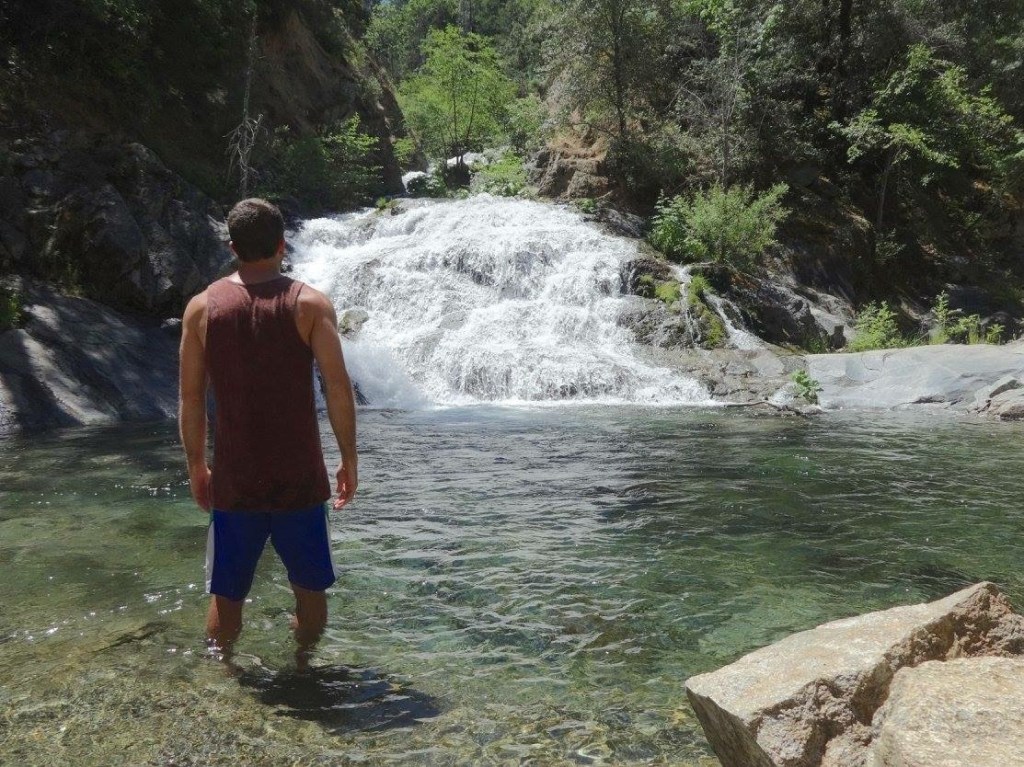
After an hour on the water, I proceeded on the park road to my first waterfall: Crystal Creek Falls. Here I noted the temperature. My car displayed 114 degrees. This would be the hottest temperature I had experienced thus far in all my journeys. I liked it, for it was dry and comforting.

This first waterfall was named correctly for the water flowing from it was crystal clear. It was a short, stubby, rocky cascade but pleasantly attractive despite its stature. I kicked off my shoes to get down into the clear swimming hole at the foot of the cascade. It was very cold, surprising so for such a hot day, but then not surprising considering the snow-covered volcanic peaks not far off. As I was taking pictures of the waterfall my toes grew numb. Then I decided to immerse my whole body into the water for a fraction of a second. It felt so refreshing. A family made its way down to the water, and I decided to leave it all to them.

I drove just a little way further to the trailhead for Whiskeytown Falls. This 1.7 mile one-way James K Carr Trail was a heavily wooded and shaded area, unexpectedly reminiscent of some of the Big South Fork trails in Tennessee. Whiskeytown Falls was a taller series of cascades. It was reported to be 220 feet tall, but I can confirm that only a portion of that footage was visible from the trail.

Before leaving Whiskeytown I stopped by East Beach. I had all intentions of relaxing on the beach, but it was crowded with both people and ducks, and the humans were blasting their ranchera music as they disregarded the serene qualities of nature. I decided to continue on.

I headed into downtown Redding specifically to see its modern Sundial Bridge. It was a sleek and pleasant spectacle with its enormous sundial reaching into the sky above the Sacramento River. I hadn’t been in an urban environment since Albuquerque, and so it felt strange. I drove around downtown Redding a bit, but nothing else caught my attention. I was excited at the time for the amenities of urbanization, and thus before I made my way back into the mountains to the KOA, I visited a rather large grocery store. I bought some Greek yogurt to have right away and some milk and cereal to enjoy at my cabin.

It was here in the KOA I finally made the decision to alter the remaining route of my adventure. The itinerary had me going to Yosemite. Although it would have been a fine destination, as I have been to Yosemite before, the California coast with its sand and beaches was calling my name. I wanted to reach the ocean. I could make this work. I knew I would lose money on my camping reservations at Yosemite, but I was willing to let that go. Given that cell phone service did not reach this KOA, I asked to borrow the phone in the campground office to call the KOA in Visilia. Success! They could reserve me a campsite. This would just be a stop on the road on my way to the Los Angeles area. I thought perhaps I could stay with my friend Ricky in Huntington Beach, just outside of LA, but I had no means of reaching him. I figured if I didn’t get a hold of him, or visiting so last minute didn’t work out, I could always camp up in the bluffs by Laguna Beach at Crystal Cove State Park. I had camped there two summers prior. The uncertainty and the veering off the itinerary were exciting. I had been on the road long enough now, and had worked through so many situations already, that I had grown accustomed to figuring things out as they arise and making my way around. I would make it work.

The kind people at the office in this Lassen KOA, after letting me borrow their phone, informed me they were getting ready to close their office, but they rang out a pack of laundry detergent for me, and guided me to their washing machines. “Just turn the lights off when you are done.” I love the friendly mom and pop nature of KOA campground (or “Kampground”) hosts.

As I waited for my laundry, I studied the maps. On my way tomorrow I could swing over by the outskirts of San Francisco and visit the John Muir National Historic Site- the once home of the famous man! I had intended to go there the summer before but accidently ended up at Muir Woods. Yes, I decided. I would pencil that in.

When I had all my clean clothes in hand, I made my way back to my camper cabin. This KOA was small and compact, but the owners took pride in it and paid attention to detail, and it was quaint, all nestled in the pine forest among volcanic peaks. In freshly laundered pajamas, I enjoyed a cup of cereal and milk. I turned off all the lights except the small reading lamp attached to the cabin wall behind the bed. I was warm and cozy. My tummy was happy and full of sugared grains. I had a full day and was excited for the final few days that remained of my summer adventure. 

Read the previous entry “Attack of the Squirrels” here: Attack of the Squirrels – on the verge (joshthehodge.com)

Check out my book Canyonlands: my adventures in the national parks and the beautiful wild here: https://www.amazon.com/Canyonlands-adventures-National-Parks-beautiful/dp/1711397873

Singing into a Volcanic Crater

“O say can you see, by the dawn’s early light…” I found myself singing into a volcanic crater in the high reaches of California. “…What so proudly we hailed at the twilight’s last gleaming…” What was it about this volcano that spurred on my patriotism and brought forth the anthem? I was in Lassen Volcanic National Park in Northern California. This active volcanic area is asleep, but it was only about a hundred years ago it experienced hundreds of volcanic eruptions in a three year span. In 1907 Theodore Roosevelt, noting the exceptional beauty of the area, designated it as two National Monuments: Lassen Peak National Monument and Cinder Cone National Monument. Nine years later in 1916 these monuments were established as one National Park. 

Lassen Volcanic is quite a wonder. Although “asleep,” it’s clearly alive. In the park museum I learned that early pioneers and homesteaders making their way across California noted the “fire in the sky” from the volcanos. Although this fire in the sky hasn’t been seen for a hundred years, there are still areas of the park with thermal springs and fumaroles boiling up from the earth’s fiery depths, reminding the visitor that beneath the earth’s thin crust much is in motion. Here all four types of volcanoes are present: cinder cone, composite, shield, and plug dome. The park features the world’s largest plug dome volcano: Lassen Peak and the last volcano in the Cascades mountain range. Although now monitored for seismic activity, Lassen Peak  will not be asleep forever and will erupt again, they say. It’s all in a matter of time. Comforting. 

I was very much looking forward to visiting this park. The pictures I had seen of it were just beautiful with pine forests, picturesque lakes, towering volcanic peaks, rich blue skies. It was even more beautiful than photographs could depict. It is certainly one of the underrated National Parks in my opinion. It is quite astounding and unique and doesn’t get the attention it deserves. It’s just so scenic, straight from magazines, and its volcanic landscape is so young and fascinating. 

When I first arrived, I visited the Loomis Museum which also doubled as a visitor center. It was constructed in 1927 by Benjamin Franklin Loomis who was a homesteader and photographer  instrumental in incorporating the area into a National Park. His museum displayed his photographs of the 1915 eruption, and he eventually donated the museum to the National Park Service. Here I soaked up some history and geology and to my dismay learned that the majority of the park was closed due to impassible snow. I was quite disappointed initially. I particularly wanted to see Bumpass Hell, the section of the park with the fumaroles and thermal springs, a mini Yellowstone-like area. Despite this closure, I’d still find plenty to explore and enjoy. I started off with a stroll along Reflection Lake, which was beside the museum. It was so tranquil. The ground was carpeted in large golden pine needles, beneath aromatic pines, and I beheld some pinecones as large as my head. This park reminded me in some aspects of Great Basin National Park in that it was this hidden little wonderland up in the mountains. 

I decided I’d spend the afternoon and evening going for a hike. One of the most popular hikes of the park was still accessible. That was the trail to Cinder Cone. The trail started into the sparse forest, proceeded to black sand, and spiraled up the cone to the crater atop. I trudged. It was quite challenging. Going uphill in sand took extra effort and strain on the leg muscles. I naturally tried to push myself up with each step but ended up partially digging my feet into the sand. My rate of progress was not adequate for the effort I was exerting, but this was the only way. This cone I was ascending was completely barren and I was so curious as to see what the crater way up there would look like. 

The air was hot, dry and thin, and there was a calm stillness to it. I was out here alone. At least I thought so, until a man started coming down the trail as I rounded a turn. I asked him something like “Is it worth it?” or “Am I almost there?” and then we got to talking. I told him I was from Kentucky. He told me he was from a city in California.

The question of “What brings you all the way out here from Kentucky?” led to me explaining how I was a teacher on a National Park road trip, and then we went right into talking about teaching. I came to find out he was also a teacher, a 5th grade math teacher. 

“You’re a Spanish teacher? In elementary school?” he questioned in surprise. “We don’t even have Spanish in elementary school here in California.”

 I wanted so badly to say: “Well, we’re just a bit more progressive in Kentucky,” but I bit my tongue. I thought it was a funny statement, but wasn’t sure if he would find it so. “Progressivism” is a hijacked political term, but California as a whole prides itself on being “progressive.” Kentucky isn’t often regarded as cutting edge, but in education, and particularly in the district in which I teach, I’d say it is- in a more classical sense of the term. Secretly, inside, I was proud Kentucky one-upped California in this regard.

When I got to the top of the volcano, a large crater was on display, uniform in appearance, of dark brown sand; and at the rim were fragments of red rock, so bright they almost looked bloody. I trailed a worn path padded into the malleable terrain around the rim of the crater. I was in awe of its size and magnitude. I found myself standing there at the rim singing the National Anthem into the crater. Maybe it was a ripple from the patriotism I felt at Roosevelt Arch in Yellowstone; maybe it was because I felt like I had really achieved something by climbing up to the top of this crater, like America has achieved so much in its young life through so much toil and effort; or maybe it was just simple appreciation for the marvelous natural wonders of my nation. Maybe it was the line “And the rocket’s red glare, the bombs bursting in air,” conjuring up images of a volcano erupting. I was sincere, but I also laughed at myself afterward. Who sings the National Anthem into a crater? Well, I do. Perhaps I’ve spent too much time out in the wild alone. Perhaps I’ve lost it. If I’ve lost it, I quite enjoy it. It’s not everyday I get to sing the National Anthem into a volcanic crater. 

On the opposite side of the crater from where I arrived at the time, I could look out and see the marvelous lava beds stretching across the landscape. Apparently marvelous is not the formal word for the lava beds. The official name is the “Fantastic Lava Beds”. And they certainly were fantastic! Unlike Craters of the Moon, where the entire landscape seems to be some volcanic wonderland, here, from up on the crater looking down, one can certainly see precisely where lava had once flowed alongside the forest, for the forest grove is still complete by the beds. Petrified waves of lava sprawled across the land, dark and ominous, and eventually spilled into a rich blue lake nestled at the foot of another volcano laden with snow. Aside this lava bed, and closer to the volcano I was upon, were pumice fields. These “fields” were very bumpy and rolled like waves frozen in time. On the tops of some of these mounds were spots of red, orange, and pink rock appearing almost like welts or blisters on the earth’s skin- a certainly unique natural wonder to behold. 

O say can you see, by the dawn’s early light,

What so proudly we hailed at the twilight’s last gleaming,

Whose broad stripes and bright stars through the perilous fight,

O’er the ramparts we watched, were so gallantly streaming?

And the rocket’s red glare, the bombs bursting in air,

Gave proof through the night that our flag was still there;

O say does that star-spangled banner yet wave

O’er the land of the free and the home of the brave?

Lost it? Not yet, but soon I was about to become genuinely lost as a mountain trail would disappear on me. 

Read the previous entry “Bruneau Dunes and the Kangaroo Rats” here: Bruneau Dunes and the Kangaroo Rats – on the verge (joshthehodge.com)

Check out my book Canyonlands: my adventures in the national parks and the beautiful wild here: https://www.amazon.com/Canyonlands-adventures-National-Parks-beautiful/dp/1711397873

Exploring Los Angeles

Los Angeles- there’s a certain energy about it that’s unique and always enticing. It’s about more than just the beautiful beaches which lay on its outskirts, it’s wide boulevards outlined with palm trees, the luxury of Beverly Hills that’s almost incomprehensible, and the grit and dust of the city which sprawls with seemingly unlimited people and opportunities. Los Angeles is a place that has made a name for itself, and I always want to experience that name and try and figure it out. It’s a hard place to figure out, because its just so diverse.

Here’s how I see it. It’s the land of surfers and skateboarders, of Hollywood trendsetters, and the social elite. It’s the land of the vain and self-obsessed, the die hard liberal, and the vegan gluten free soccer mom. It’s the land of graffiti, the burrito, towering palm trees, expansive beaches, and Mexican immigrants. It’s a land of new ideas, and lost dreams, of success and failure, high tops and flip flops, and sprawling poverty in the dusty dry air. It’s a land of struggle, of creativity, of bright neon colors… and traffic, horrible traffic.

This would be my second visit to the Los Angeles area. The summer before I visited downtown Los Angeles, Hollywood, and Disneyland for the first time, while I camped in Malibu and Laguna Beach. This year I was making a last minute decision to visit Los Angeles. I was arriving from Pinnacles National Park and would stay with my friend Ricky in Huntington Beach.

I had a hard time trying to get in contact with Ricky. My backup plan was to try and find a spot to camp in Crystal Cove State Park in Laguna Beach. I had camped there before, but the only campsites that would likely be vacant were the hike-in campsites, three miles removed from the beach up in the hills. Luckily contact was made, and I was able to invite myself to stay at Ricky’s with his welcome.

Ricky has been a long distance good friend of mine, who is just a couple years older than me. He is someone I find to be very smart, of sound judgement, and also adventurous. He can talk about and entertain just about any topic, which makes him interesting. Recently he has been investing in his future by studying and training to become a pilot. Originally from Ohio, he moved to Los Angeles alone, and after being followers of each other on social media, we were able to meet last summer, and we hit it off. Although sometimes hard to get a hold of, when I do get a hold of him, he is a good listener and always willing to help out. He advised me when I was looking to buy my car later that year, and that meant a lot to me.

Driving into Huntington Beach, traffic was horrendous. Traffic all throughout the greater L.A. region is always bad, but a accident had three lanes of traffic reduced to one. When I arrived Ricky had to do some grocery shopping. I accompanied him and was excited to finally, after nearly a month, be able to buy some cereal and milk, something that was typically a staple in my diet. Something that is usually so commonplace was now exciting.

Ricky owned a nice condominium which he was constantly renovating, with plans to increase its value, sell it, and move out of California. He had a guest room, where he blew up a giant air mattress for me. I felt like I was living the life of luxury. I had a comfortable and spacious mattress to sleep on, running water just steps away, and access to a hot shower and a bowl of cereal and milk. That evening, we caught up a little, and I inquired about places to visit in the city. I’d be here for two days. I wanted to spend the second at Disneyland, but I needed some recommendations for the first. Ricky had to work, but he provided some good recommendations, and we planned on meeting up at the end of the following day for dinner.

Ricky gave me a key to his condo so I could come and go as I pleased. The next morning I was up bright and early. My first stop of the day was at the Old Los Angeles Zoo in Griffith Park. Griffith Park is a massive park in Los Angeles that houses many different features and trails. The zoo that was once there was abandoned as a new zoo was constructed elsewhere in the park. Now the abandoned zoo cages and walkways can be explored. One can even go right inside the areas the animals used to dwell in. I climbed into one area and took this picture and posted in online with this caption:

13517544_10210327919454753_2627697168926187287_oVisit the old Los Angeles zoo and see the wild Josh in captivity. The Josh is a very adaptable amiable creature who can be found in prairies, temperate forests, alpine tundras, and dry deserts. The Josh is native to North America but it is believed to be an ancestor of those from the Iberia peninsula. The Josh is an omnivore and gatherer whose diet consists of meats, vegetables, nuts and berries, breakfast cereals, and tacos. When threatened the Josh is known to retreat and is rarely found to be aggressive.

Leaving the Old Zoo, I proceeded to the top of the park where the Griffith Observatory lies. I was there early enough that the place was very quiet. The observatory building itself is a beautiful white domed deco style planetarium, with a sculpture out front. It appears in many movies.

I wasn’t so much interested in that building as I was in the view of the Hollywood sign and L.A. down below in the distance from atop that hill. The view of the Hollywood sign was clear but the hazy dusty and polluted sky made Los Angeles difficult to see. Also, from the observatory,  a series of dusty trails ran down the hill. I was familiar with these trails, because a lot of celebrities and YouTubers from the area love to take pictures and videos from this place. I literally ran down a trail, for time’s sake, for there was much more to be seen. I wanted to experience it, but I didn’t want to spend a lot of time here. Running back up the sandy path was a very strenuous workout. When I got back to my car, I turned the air conditioning on full. The parking lot had grown crowded. I connected to the parking-lot’s wifi network to determine my next move.

I ended up at the Autry Museum of the American West, located right on the corner of Griffith Park. I had driven by it earlier and it looked interesting. Parking at the museum was ample and easy, and so I decided to give it a go. When I got inside I was fully enthralled. I had spent many nights of this trip, reading my book about the American West, as I traveled through the West. Paring that book and this whole trip together, made history come to life for me. And this museum was the grand finale. Numerous things I had read and learned about were now before my eyes. The museum told the history of the West and was filled with relics from the era of the cowboys, natives, and pioneers. There was one room with fancy old bars and slot machines taken out of saloons. Another was filled with old sheriff badges and elaborately designed revolvers that were fine pieces of art. There were also artifacts from the native people, a California stagecoach, paintings depicting many scenes and landscapes, sculptures of characters of the West, and a whole exhibit dedicated to the singing cowboy era of Hollywood. As a grand finale, I came to a room with a complete chuck wagon. As silly as it may sound, I was so excited by the chuck wagon. I read so much about it in my book and now  I was seeing one before me, every part explained. It made the strenuous life of the cowboy all the more real to me.

Leaving the museum, I was very satisfied. I stopped at a Del Taco near the park for a quick lunch, then I drove to the Glendale Transportation Center, which serves as an Amtrak station. I admired its Mission Revival and Spanish Colonial Revival Style architecture. I then searched my gps for a place to get a haircut, because I needed one, and I wanted to look good and on point for all my pictures with Disney characters the following day, truth be told. My attempt to find a barber was unsuccessful, but I ended up at the Goodwill Southern California Outlet. It was huge and on the edge of Hollywood. My thrifty mind knows that a Goodwill store is only as good as the wealth which surrounds it. Sure enough, I found a great find- a pair of Nike high-tops, which looked like it stepped right out of the 90s untouched, with bright green zig zag stripes on the sides, purple heels, and orange paint artistically splattered on the sides. This had to be my best thrift store find to date.

While I was standing in line, a middle aged latina woman, with her hands full of clothes, started talking to me.“Those are muy bien lindos,” she began speaking. “Make sure you take good care of them. Get the green soap they sell at the laundromat. That works really well on shoes, to keep them clean.”

“Oh, is that right?” I had to say something.

“Yes, use the green soap, it comes in the little packet. It’s like a miracle on shoes. They sell it for like 25 cents. You know what I’m talking about right?”

I nodded my head to pacify her enthusiasm. I loved how she assumed I knew what her laundromat was and the soap they sold there. Thanks for assuming I’m a local, that’s flattering I thought, but I know nothing about your laundromat and their soap.

I thanked her and walked out of there having bought the best L.A. souvenir I couldn’t have even imagined.

My final stop was at Downtown Disney, where I would purchase my Disneyland ticket for the following day. Downtown Disney at Disneyland is a very chill place, especially in comparison to Disney World. You can just sort of walk around leisurely in Downtown Disney in and out different stores and around restaurants, enjoying the bright colors and tasteful instrumental Disney music playing the background. I grabbed a sandwich at Earl of Sandwich, and then went into the World of Disney store, where I bought a Mickey Mouse tank top I would wear into the park the following day. I may not have gotten my haircut, but I got a pair of sweet kicks and a cool Mickey tank. I was gonna be a cool cat walking around the park.

Once I was back at Ricky’s, we went together to a casual Peruvian restaurant located in a nearby strip mall for dinner. Over some lomo saltado, we opened up to each other about our love interests. I told Ricky about a young lady I worked very close with whom I found really attractive and felt very hopeful with. She shared so many interests with me, was smart and with it, and seemed to have a similar upbringing. I admired her intelligence, her sense of adventure, her humor, her simple style, and most attractive of all, her interactions with others. My plan was to ask her out once I was back home. I was so excited about the prospect that during this trip, there were multiple occasions I would be driving, thinking about her, and in all the excitement of imagining a life together, my heart would start beating faster, and I would find myself going ninety miles per hour. I had to slow down.

Unfortunately, when the summer was over and the time had come to pursue her. She dismissed me, showing no interest. I had to move on, and so I suppose somewhere, amongst my grand map of life, there is a little ghost town with her name across it.

After our Peruvian food, Ricky drove me to another strip mall (It seems everything in the L.A. area is in a strip mall) where we had some ice cream. I had some Frosted Flakes flavored ice cream. Ricky talked to me about Instagram and this social media strategy he had. He asked me if I had a social media strategy. I had never even heard that term before. We proceeded deeper into the topic of the internet, and I asked him about where data on the internet is stored. He explained it in great detail.

Back at the condo, when we were both wrapping up the day, getting ready for bed, I was working on a strategy, not a social media strategy, but a Disneyland strategy. One should not walk into a Disney park without a strategy. A Disneyland strategy takes some fine skill and careful consideration. I plugged in my camera to charge, laid out my outfit for tomorrow, and secured my park ticket, which prominently displayed Olaf’s face on it, in my wallet. I was ready, Disneyland, here I come!

Read the previous entry,  “Pinnacles of Purpose,” here:  

 https://joshthehodge.wordpress.com/2018/04/06/pinnacles-of-purpose/

Facebook: http://facebook.com/joshua.hodge

Instagram: http://www.instagram.com/joshthehodge/

Pinnacles of Purpose

I was venturing out of Pinnacles National Park in a landscape that I still struggle to describe. There were trees, and there were plants, but everything was extremely weary and dry. Drought, and too many days like today, with 104 degrees, had taken a toll on the landscape. I was fortunate to get my hiking done very early in the morning, before the sun came out to scorch. Everything around me was so thirsty. Stream beds were dried up, bridges that once passed over water passed over rock and dust, and adorning all park structures were signs warning of extreme fire danger.

Despite its conditions, the park was fascinating with enormous volcanic boulders to crawl and climb under and around. Also, no one was there. The heat and threat of fire was probably enough to keep most visitors away and allow me to have the park to myself.

The plan now was to drive to Los Angeles, a seven hour journey to the great Pacific coast and the energy of the city. This was a change from my original plan. I had been set on visiting San Francisco, staying in a hostel, and visiting the Walt Disney Family Museum, but for the past four days I had been plagued with an uncanny feeling- a strange uncomfortableness with my plan. I would be out hiking, enjoying the wonders of nature, and then my mind would wander off to my San Francisco plan, and I would began to question if I should follow through. At night I would study my road atlas, trying to find good reason to change the course of my journey. I really found no legitimate reason to all my hesitancy, and that perhaps is what troubled me the most. I had done my research. I had made my plans and reservations. On the surface, everything was in order, but this hesitation would not leave me. So after four days of wrestling with my decisions, I changed my plan. My reason for this was not a very logical one, but rather based seemingly on intuition. Later I would discover there was something much greater behind these feelings than my own intuition.

Thirty miles removed from Pinnacles National Park I still hadn’t seen anything noteworthy, just the peculiar desert-like landscape and an occasional tumbleweed, but then finally the first sign of life-  a mother and what appeared to be her daughter waving on the side of the road next to their car. They obviously needed help, but I continued on driving. I had a new plan to follow, and I knew the trip to Los Angeles would be a long one. Then suddenly my mind was prompted to recall my canyons and my most sprawling canyon of all: selfishness. I knew in that moment I needed to let light into my canyon of selfishness. I needed to turn around and help these people. I felt convicted.

I turned around and drove back. I rolled down my window, and they immediately started speaking in Spanish. Not a problem. I speak Spanish. They told me that they ran out of gas. “Have you called anyone for help?” I asked. They informed me there was no phone service in the area. We were in the middle of nowhere. I had never run into this sort of situation before. How does it work? Are they trying to trick me into something? How do I help them?  Well, I guess I need to drive to the nearest town and bring them back some gas. “I’ll go and get you gas. Wait for me. I will return,” I told them.

I searched my gps for the nearest gas station and the screen displayed a forty mile distance to the nearest one. Forty miles there and back would certainly put me behind on my journey, but I knew that I needed to help these people. This moment was actually a pinnacle and pivotal moment in my summer.

On my way to the nearest gas station I was overcome with the most joyous and fulfilling emotions as I put the puzzles of the past few days together. There was a reason for everything. There was a reason I was plagued with uncanny feelings about going to San Francisco. There was a reason why I changed my plan. There was a reason why I decided to head to Los Angeles instead of San Francisco. If I didn’t have those feelings, if I didn’t change my plans, if I wasn’t on my way to Los Angeles, these people would be stranded and at the mercy of the desert in the 104 degrees. But random events and purposeless intuition were not the reasons for all of this coming together. I knew this was orchestrated and that’s what filled me with this joy.  We could say this all started weeks before in Canyonlands National Park, when God made me aware of the canyons in my own life. Being aware of my selfishness made me more sensitive to my actions and the need for change. The hesitation about going to San Francisco was not solely my intuition, but rather the Holy Spirit alive and at work in me, prompting me and guiding me to this moment.

While I could have felt burdened by my own obligation to goodwill, rather I felt extremely blessed. Because this moment was verification for me that God has been and is working in me. I felt so humbled yet empowered to be a part of God’s plan. I felt so purposeful.

After my drive, which was more like a rocket ship ride of emotions, my gps led me to an abandoned factory, but there was a gas station in front. I pulled up to the pump, only to notice that this gas station too was part of the ghost town. I drove a little further and rolled into a small McFarland style town with a gas station and people selling tacos on the side of the road. I went inside to the convenient store of the gas station to explain my situation. They informed me that they didn’t have gas cans. I left and found an auto body shop. I filled up a gas can and bought some water to take back to these stranded acquaintances.

On the drive back, I was at first concerned that these people wouldn’t be there, and all of these feelings of purpose and pieces coming together would actually prove false, but I came to the conclusion that this would still be very meaningful and worth my time. I knew that what I was doing was actually an act of worship. I was getting gas for God, considering him in the least of these. I’m entertained with the thought that the high church could list fanciful things to bring before the altar of God, but I would bring my gas can to God, and it would be very meaningful.

Despite my speculation, they were still there and extremely thankful when I poured gas into their car. “Muchisimas gracias,” they told me. It wasn’t just convenient that I could communicate to these people in Spanish. I knew this was on purpose, and there was something important I needed to communicate to them. I told them, in all sincerity, “don’t thank me, thank God, because He put me in your path.” They agreed with me and said in Spanish, “thanks be to God.” I gave them the bottles of water. They insisted on paying me, and then they took off, and that was that. I stood alone in the desert next to my car with a feeling of fulfillment and a smile on my face. Life is beautiful, I thought.

I know these people may feel blessed to have received my help, but really I feel more blessed to have helped them, knowing that God was working through me and brought meaning and fulfillment to all my feelings and changed plans.

I share this story not to brag on anything I have done, but rather to bring glory to God. I just find it so awesome how God coordinates to provide.  I also think this story serves as an example of how the Holy Spirit may work in one’s life. Next time you have hesitation about something without good reason, I say stop, pray, and be still. These feelings may not be plain intuition or a bothersome anxiety, maybe these feelings are not bad at all, but rather the Holy Spirit  prompting you. Listen. Just listen. Don’t get caught up in your emotions, but listen for purpose. Maybe God is trying to put you on the path of someone to help or is trying to help you out of your Canyon. If you haven’t invited God into your life and are struggling to find purpose and meaning, it is in Him that you find it. Reach out to him. His spirit wills and acts in his people to fulfill His purpose and fill your life with meaning, even in the simplest of things.

DSC06297

Read the next entry “Exploring Los Angeles,” here: https://joshthehodge.wordpress.com/2018/04/10/exploring-los-angeles/

Read the previous entry,  “The Golden Gate National Parks,” here: https://joshthehodge.wordpress.com/2018/04/06/golden-gate-national-parks/

Facebook: http://facebook.com/joshua.hodge

Instagram: http://www.instagram.com/joshthehodge/

The Plague at Lake Tahoe

“We just need to let you know that this is the last night the campground will be open for the season, due to the plague,” the host advised from her drive thru check in booth. She reached out her window, handing me a packet of papers. “We are required to give you this information about the plague.”

I’ll admit, I didn’t know what exactly the plague was. I thought it was just a very generic term used to describe a sickness that spread quickly, or that it was some sort of medieval illness. What was she doing talking about the plague here at Lake Tahoe?

“Just make sure you stay away from rodents, especially any dead ones.” My mind flashed back to the dead squirrel laying beside my tent in Great Basin National Park. After the first night camping there, it was gone. Some animal must have come for it in the night, when I was sound asleep.

“Is it still safe to camp here?” I inquired.

“Well, there haven’t been any cases of human infection yet, but as a precaution we are closing down tomorrow, and they will start treating the area.”

She proceeded to tell me where my campsite was, and I drove slowly to my site. The Lake Tahoe region was the most difficult place to secure a campsite of this entire trip. I spent a great deal of time searching online for a campground with vacancy. This was Fallen Leaf Campground at South Lake Tahoe, part of the U.S. Forest Service’s Tahoe Recreation Area. This campground was large, with many loops, but few campers remained. I pulled up to my site, and as first order of business, I read the handouts about the plague. I learned it was a bacterial infection transmitted by rodents and fleas. Although it can be fatal, it just starts with common flu like symptoms and can be treated successfully when detected early enough.

DSC06108I knew I wouldn’t be in contact with rodents. It’s not in my liking to approach them, unless we are talking about an adorable golden-mantled ground squirrel posing for a picture in Bryce Canyon. Apart from that I didn’t foresee rodents being a concern. But fleas, on the other hand, well, I didn’t know a lot about flees except that they were insects and insects get around. So I stepped out of my car and drenched myself in deet, and then I soon forgot that the Plague was even an issue. I set up my tent in the company of tall pines. In the distance between the pines I could see the snow capped mountains of the Sierra Nevada. When camp was set up, I walked across the smooth paved campground road to a general store on the grounds. I wanted to inquire about the coin showers. I exchanged my dollars for coins, enough for me to have two complete shower cycles.
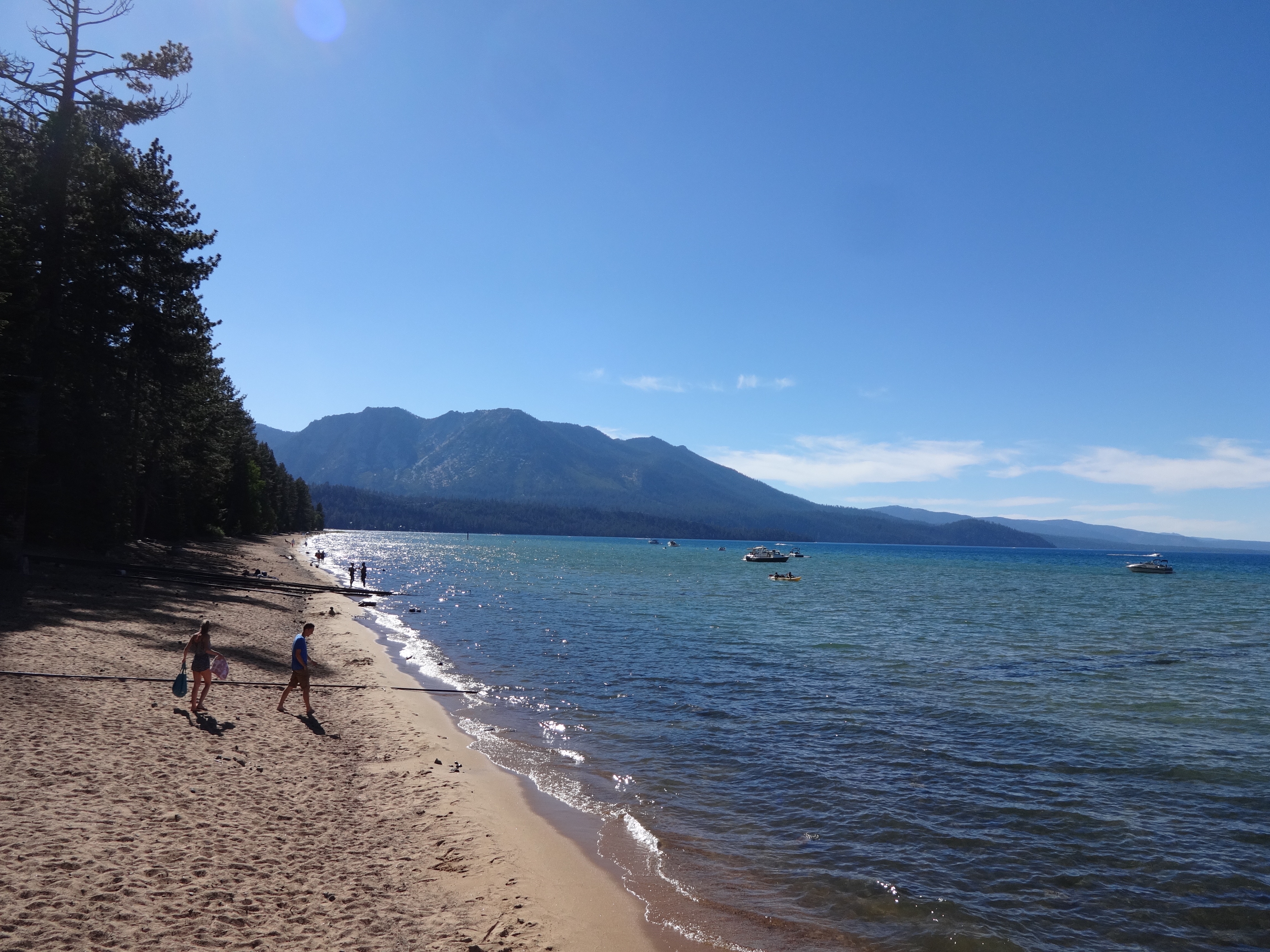
The campground shower facilities were very nice. Each shower was accessed from an outside door. Inside there was also a toilet, sink, mirror, and electrical outlets. Everything I could ask for in a bathroom was there. I was excited, for it had been a week since I last showered.

When I was all clean and feeling refreshed, I put on my swimsuit, tank top, and flip flops, and  I walked a paved pathway through the forest about a mile to Lake Tahoe. I arrived and the place was busy. There was some sort of open air restaurant and bar next to the water, and many families and couples walked about and lounged on the beach.

Lake Tahoe is refreshingly beautiful, especially after having spent the past few days in the dry desert expanse of Nevada. The tall pine forest led right up to the sand where the clearest water I’ve ever seen laped against the shore. Across the twenty-two miles of shimmering blue were the snow capped mountains of the northern Sierra Nevada. I never went out on a boat into Lake Tahoe but there are so many ways to enjoy Lake Tahoe from land. You can look down on it from an overlook of the road. There it is spread out underneath the tree line, and you can look down not just upon it, but straight through it, getting a preview of how deep it is. From here you can also observe all the coves and inlets where the lake turns to hide and rest.

DSC06139Another way to enjoy Lake Tahoe is what I was doing that evening from the sand of one of its many beaches, feeling like I’d made to the ocean and had become a beach bum while at the same time looking up at the snow capped mountains feeling like a northern mountaineer.
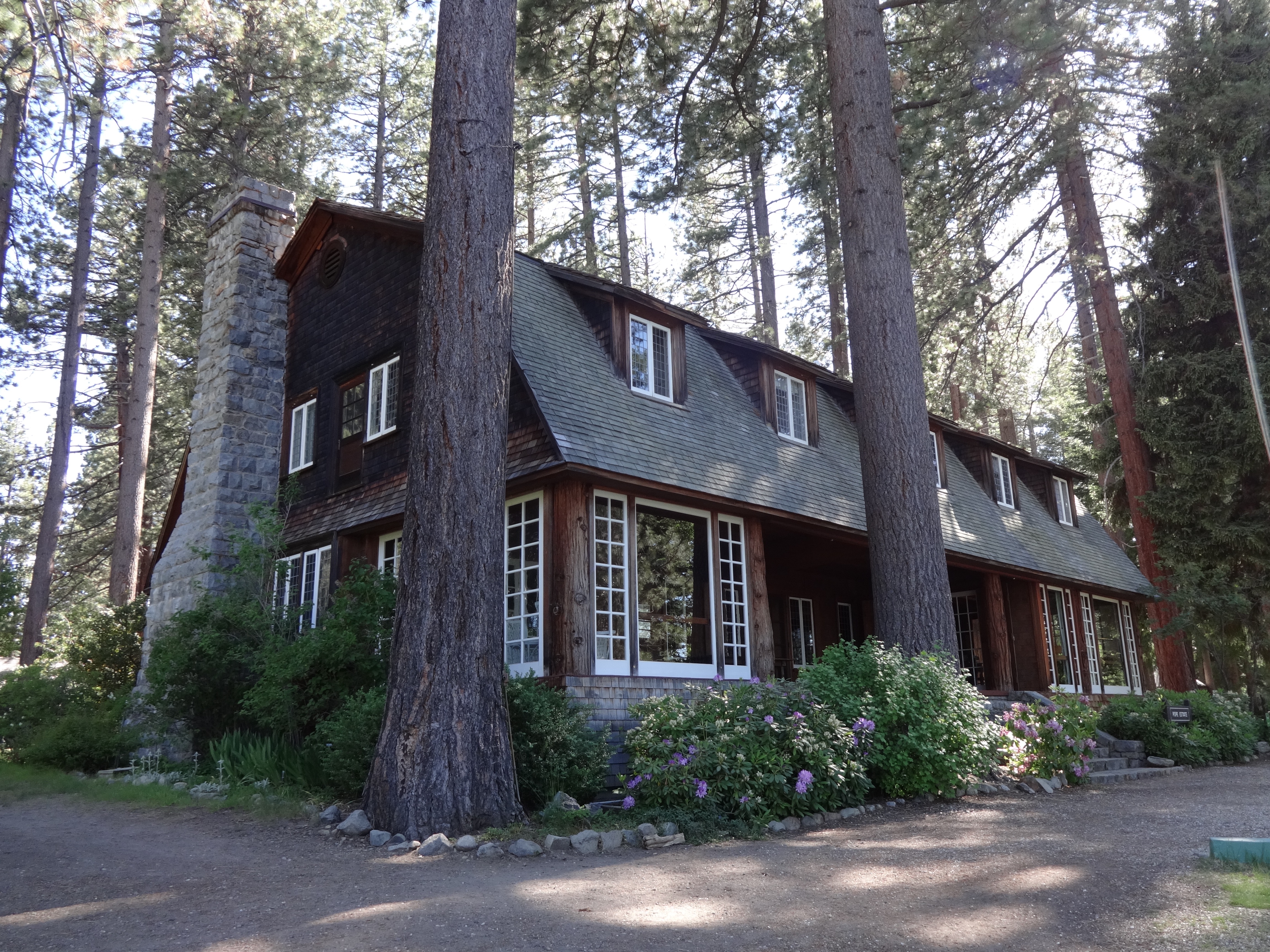
I went out on a dock, and looking down the crystal clear water gave me a sensation I’d never quite felt before, almost a sort of dizziness. I’ve never been able to look straight down a lake before, vision unobstructed, where I could see fish swimming around at different depths, and the sand and pebbles laying untouched at the bottom. I would not take someone out here who is afraid of heights, because even though you are nearly level to the water, you are actually high up from the ground underneath, and you can see that so clearly. Despite the peculiar sensation, at the same time, it was miraculously beautiful. Beauty like this is not happenstance. It’s created.

DSC06128DSC06129A final way I enjoyed Lake Tahoe was from one of the porches of the Baldwin and Pope Estates. There, just next to the trail I arrived on, and set up behind the beach, were these two estates, preserved as the Tallac Historic Site, managed by the U.S. Forest Service. The estates contained a collection of houses built in the late 1800s and early 1900s that were the private resorts for three social elite families of the San Francisco Bay Area. All of these buildings were composed of wood fashioned in one way or another, blending this rustic north woods style with tudor elements. The estates included the large summer cottages, accompanied with dark wooden shingles, and numerous guest houses and small log cabins for the tutor, groundskeepers, and servants. They were all tied together by well kept pathways and gardens. During the day, the buildings were open for tours, but I was there in the evening. They were all closed, but people were free to explore the grounds.
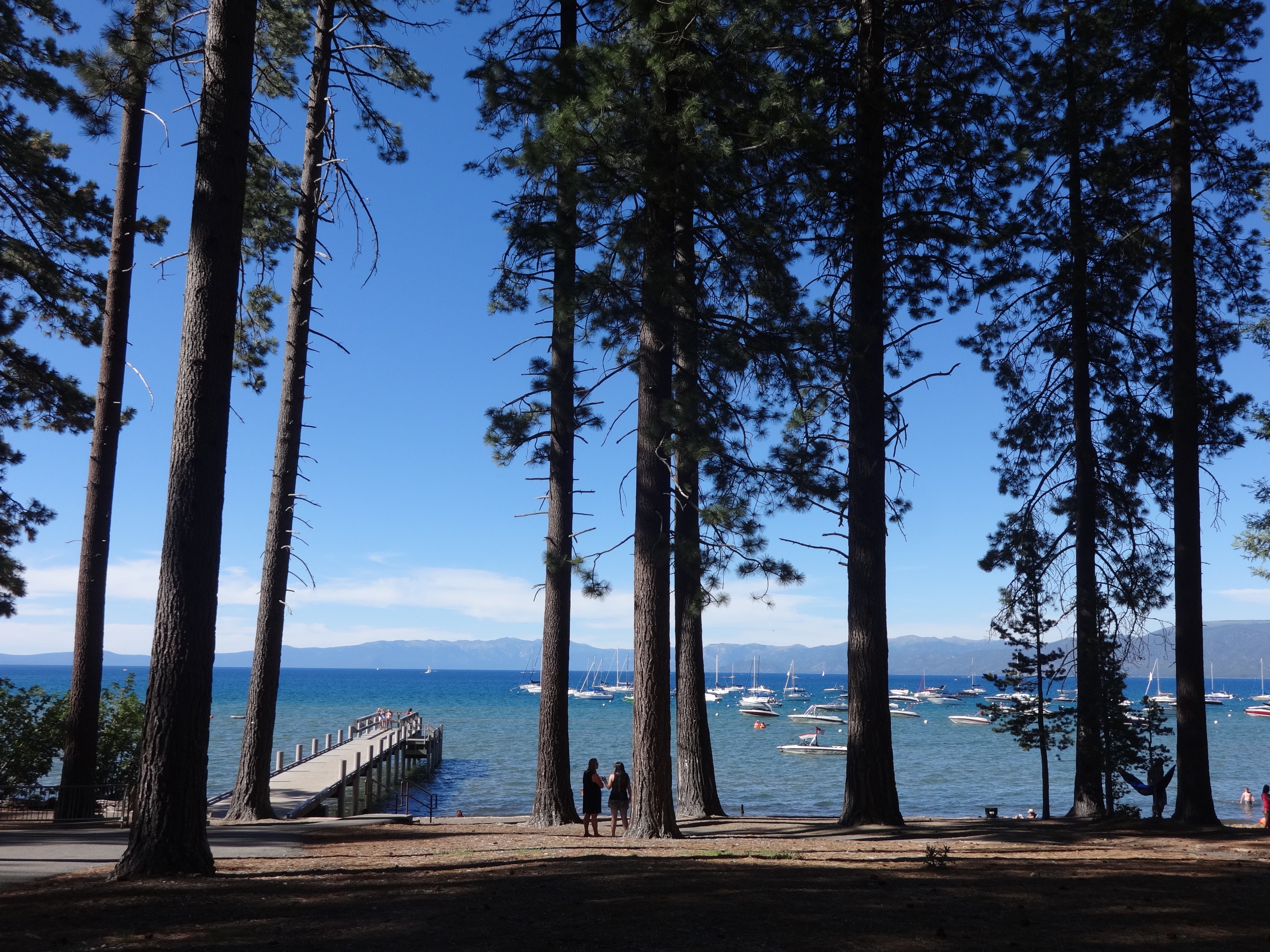
I sat on the porch of the main Pope cottage, in a  rocking chair. I looked out the frame of the porch structure through the dark pines to the bright blue of the lake and the mountains beyond. I imagined, just for a moment, that this was my house. I took it all in. Just a matter of hours ago, I was in a ghost town off Highway 50 in the relentless desert sun. Now, I was sitting on the porch of a wealthy estate, in the shade of the sweet pines, looking out at a marvelous view. It was very relaxing. And it was all a pleasant surprise. I didn’t know these estates of Tallac Historic Site existed, and I thought it was so novel and welcoming to be able to enjoy the elite life freely for a moment on this porch.

When the evening grew old, my wandering around Lake Tahoe for the day became complete, and my moment of an elitists life came to a screeching halt, as I decided to grab a bite to eat at Taco Bell and visit the local Kmart.

Driving into to Lake Tahoe on the southern end, I wasn’t impressed by the surrounding area. There were numerous casinos, tacky hotels, untasteful restaurants, and noisy traffic. Of course all things of the civilized world seem extra distasteful after having spent so much time out in the nature in the wild expanse of the Great Basin. My first impression of the area, was certainly, however, not favorable, but my campground, so nicely situated with a short walk from the beach and the beautiful estates, with the stunning and relaxing view of the lake, gave me a very favorable memory of Lake Tahoe. I would return the next morning to the lake, to lay in the sun, read from my book about the West, and enjoy the beautiful view of Tallac and Taylor Creeks flowing into the Lake as silver ribbons.

This is one of those places, that would have made a great National Park, but commerce and private ownership moved in too quickly and much of the surrounding area was lost to commercial tourist consumption and casino tycoons, but, as I discovered, the U.S. Forest service does have a hold on these pockets of beauty around the lake, and I was very fortunate to discover one and also fortunate to leave without contracting the plague.

Given the opportunity, I would definitely go back and visit Lake Tahoe again.

DSC06137

Read the next entry, “The Golden Gate National Parks,” here: https://joshthehodge.wordpress.com/2018/04/06/golden-gate-national-parks

Read the previous entry,  “How I relate to Ghost Towns,” here: https://joshthehodge.wordpress.com/2018/04/04/how-i-relate-to-ghost-towns/

Facebook: http://facebook.com/joshua.hodge

Instagram: http://www.instagram.com/joshthehodge/