Whiskeytown and Shasta

My weathered clothes spun in the washing machine as my mind spun with thoughts. I was at the KOA campground outside Lassen Volcanic National Park in Northern California. It had been a very full day, but I wasn’t reflecting on what the day had been. Instead, I was planning and looking forward to the next and final leg of my summer adventure. I had gone as south as I could and was now as north as I would go.

The day had taken me to many points of interest. Leaving the proper boundary of Lassen Volcanic National Park, I traveled about an hour over to Shasta State Historic Site on my way to Whiskeytown National Recreation Area. The historic site contained the preserved remains of one of California’s once busiest gold mining towns, “Shasta City.” Along with ruins and the facades of old buildings, there was a rustic blacksmith shop, a bakery (which was unfortunately closed), and the old restored town hall which featured the site’s museum and historic jail. I paid $3 to go in the museum. It was well put together and informative about the Gold Rush in Shasta City. Here I learned about the influx of Chinese immigrants that came to California searching for gold. I’d later come to find that this type of immigration was common in many California mining towns in the era. The Chinese immigrants, however, got second dibs to the earth, sifting through rock already mined by the American miners, searching for whatever may have been missed and remained. Here in the museum I also saw artifacts from this old Western town, including vintage gambling machines from one of the town’s past saloons. In the basement of the museum was the jail, the highlight of the site. Down in the cells, holographic prisoners appeared to tell their stories of what landed them in jail. It was pretty high-tech for a state park. Between the information presented, the artifacts shared, and the holograms in the basement, this little museum captivated my mind and took me back to the California Gold Rush. If in the area, I would not pass this site up. It is worth a stop.

After my visit at Shasta State Historic Site, I visited another National Park unit: Whiskeytown National Recreation Area. Approaching, I tuned into an AM radio station giving general advisory warnings for tourists. I stopped at the Visitor Center to get a park map, inquire about hikes, and purchase a sticker. The main attraction of the area, and center of the park, was the Whiskeytown Lake- not nature’s lake, but one created by a dam in 1962 which flooded and covered over most of the once mining town. Water sport and lake recreation is big in the area, but I also found there to be quite a few waterfalls on short hikes. I was going to have a full experience, so I needed to get on the water and see some waterfalls.

I drove on the park road, which wound around the deep blue lake, scooting into mixed forests of conifers and deciduous trees, then revealing, occasionally, short mountains. Along the water’s edge and the road’s side were beige rocks. Despite trees, there seemed to be little shade. The trees were young, short, and the bright day’s sun reached every angle in the park.

My first stop was at Oak Bottom Marina. Here I rented a kayak and got out on the lake. I asked the attendant in the marina where to paddle. She told me about a sunken road in the middle of the lake that’s close enough to the top of the lake that I could get out and stand atop the underwater road. I thought that sounded interesting, but when I started paddling, the water seemed choppier than what I expected and motorboats went zooming by, creating jolting waves. The water didn’t look inviting either. It was dark, appeared quite deep, and had a mysterious essence. I did not want to end up tipped over in the water, so I stayed a bit closer to the water’s edge and paddled over into the lagoon-like area of Grizzly Gulch. Here the water was green, shallow, and warm. Trees grew right alongside the water and even leaned over the water’s edge- giving it a more of a Floridian Jungle Cruise feel.

After an hour on the water, I proceeded on the park road to my first waterfall: Crystal Creek Falls. Here I noted the temperature. My car displayed 114 degrees. This would be the hottest temperature I had experienced thus far in all my journeys. I liked it, for it was dry and comforting.

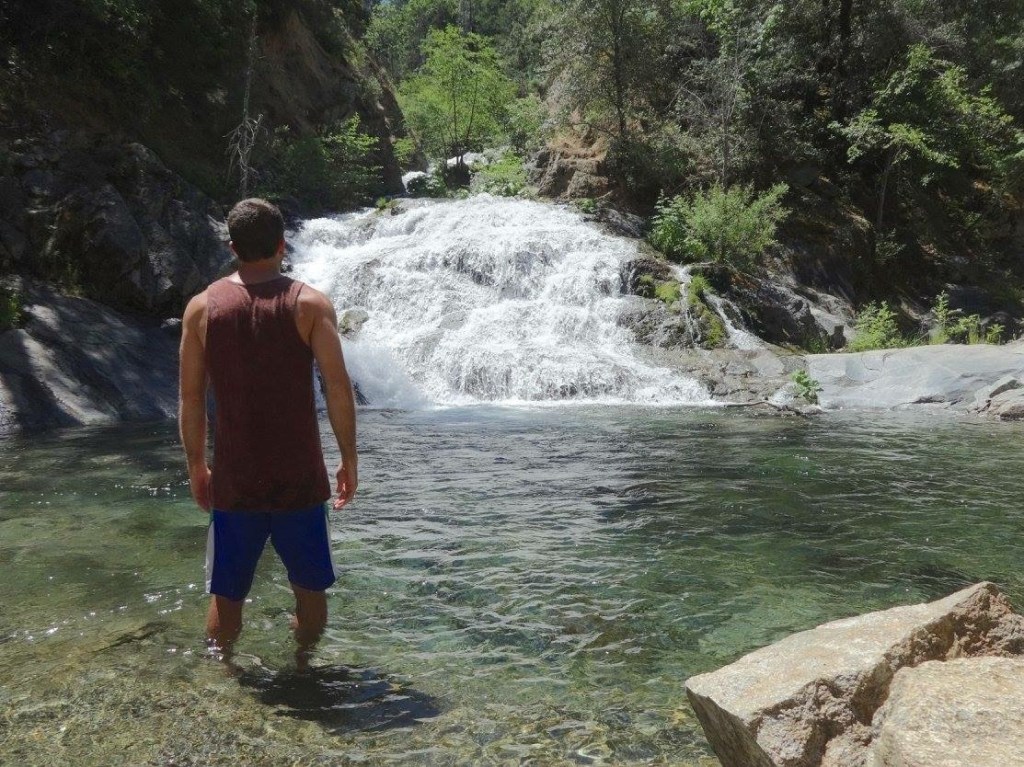
This first waterfall was named correctly for the water flowing from it was crystal clear. It was a short, stubby, rocky cascade but pleasantly attractive despite its stature. I kicked off my shoes to get down into the clear swimming hole at the foot of the cascade. It was very cold, surprising so for such a hot day, but then not surprising considering the snow-covered volcanic peaks not far off. As I was taking pictures of the waterfall my toes grew numb. Then I decided to immerse my whole body into the water for a fraction of a second. It felt so refreshing. A family made its way down to the water, and I decided to leave it all to them.

I drove just a little way further to the trailhead for Whiskeytown Falls. This 1.7 mile one-way James K Carr Trail was a heavily wooded and shaded area, unexpectedly reminiscent of some of the Big South Fork trails in Tennessee. Whiskeytown Falls was a taller series of cascades. It was reported to be 220 feet tall, but I can confirm that only a portion of that footage was visible from the trail.

Before leaving Whiskeytown I stopped by East Beach. I had all intentions of relaxing on the beach, but it was crowded with both people and ducks, and the humans were blasting their ranchera music as they disregarded the serene qualities of nature. I decided to continue on.

I headed into downtown Redding specifically to see its modern Sundial Bridge. It was a sleek and pleasant spectacle with its enormous sundial reaching into the sky above the Sacramento River. I hadn’t been in an urban environment since Albuquerque, and so it felt strange. I drove around downtown Redding a bit, but nothing else caught my attention. I was excited at the time for the amenities of urbanization, and thus before I made my way back into the mountains to the KOA, I visited a rather large grocery store. I bought some Greek yogurt to have right away and some milk and cereal to enjoy at my cabin.

It was here in the KOA I finally made the decision to alter the remaining route of my adventure. The itinerary had me going to Yosemite. Although it would have been a fine destination, as I have been to Yosemite before, the California coast with its sand and beaches was calling my name. I wanted to reach the ocean. I could make this work. I knew I would lose money on my camping reservations at Yosemite, but I was willing to let that go. Given that cell phone service did not reach this KOA, I asked to borrow the phone in the campground office to call the KOA in Visilia. Success! They could reserve me a campsite. This would just be a stop on the road on my way to the Los Angeles area. I thought perhaps I could stay with my friend Ricky in Huntington Beach, just outside of LA, but I had no means of reaching him. I figured if I didn’t get a hold of him, or visiting so last minute didn’t work out, I could always camp up in the bluffs by Laguna Beach at Crystal Cove State Park. I had camped there two summers prior. The uncertainty and the veering off the itinerary were exciting. I had been on the road long enough now, and had worked through so many situations already, that I had grown accustomed to figuring things out as they arise and making my way around. I would make it work.

The kind people at the office in this Lassen KOA, after letting me borrow their phone, informed me they were getting ready to close their office, but they rang out a pack of laundry detergent for me, and guided me to their washing machines. “Just turn the lights off when you are done.” I love the friendly mom and pop nature of KOA campground (or “Kampground”) hosts.

As I waited for my laundry, I studied the maps. On my way tomorrow I could swing over by the outskirts of San Francisco and visit the John Muir National Historic Site- the once home of the famous man! I had intended to go there the summer before but accidently ended up at Muir Woods. Yes, I decided. I would pencil that in.

When I had all my clean clothes in hand, I made my way back to my camper cabin. This KOA was small and compact, but the owners took pride in it and paid attention to detail, and it was quaint, all nestled in the pine forest among volcanic peaks. In freshly laundered pajamas, I enjoyed a cup of cereal and milk. I turned off all the lights except the small reading lamp attached to the cabin wall behind the bed. I was warm and cozy. My tummy was happy and full of sugared grains. I had a full day and was excited for the final few days that remained of my summer adventure. 
Read the previous entry “Attack of the Squirrels” here: Attack of the Squirrels – on the verge (joshthehodge.com)

Check out my book Canyonlands: my adventures in the national parks and the beautiful wild here: https://www.amazon.com/Canyonlands-adventures-National-Parks-beautiful/dp/1711397873

Lost in Lassen

I was lost on the mountainside on my way to Prospect Peak, and the prospect of finding the trail again seemed bleak. It had disappeared entirely right before my eyes. I tried to trace my steps to find the trail, but it was no use. The term “trail,” to begin with, was very gracious for I questioned about a dozen times which direction the trail led. I convinced myself for a while that I was on a trail, but it may have been my imagination more than anything. 

I was in Lassen Volcanic National Park in Northern California, along picturesque lakes, beautiful groves of pines, and volcanic peaks laden with snow. I had just descended from Cinder Cone volcano. Going up was strenuous, coming down, a breeze. Back at the trailhead I realized I still had quite a bit of sunlight to spare and thought I’d attempt a hike to a mountain peak. There was a trail for Prospect Peak. Not much was labeled, so I didn’t know how long it would take to reach the summit, but I thought I’d give it a try. If it became too much I could always turn around. 

As I ascended I was noting how barren the forest was. There were pine trees, the ground was covered in an endless bed of pine needles, and there were tree stubs and the remains of fallen trees scattered about, but aside from that, the forest was very bare. Unlike the forests of the East in which low growth crowds the forest into a rich jungle, here the forest was quite barren and open. As I ascended, mounds of snow laid here and there, but despite these piles of moisture, the place was dry and the air was hot and hollow. 

I was enjoying my hike up the mountain, but since the forest was naturally quite bare it contributed to the difficulty of not knowing where the trail led. Occasionally I would see where feet had trampled upon pine needles before, but the higher I got the more snow there was, and it looked like the snow had partially melted and refrozen, wiping away any footprints that might have been. I checked here, there, and everywhere. The trail cut me loose.

I figured there was no use turning around and giving up on reaching the mountaintop because I had no trail to lead me back. Afterall, in order to make it to the mountaintop, all I needed to do was travel upward, and so I did.

Now that I was just trudging through snow, apart from a trail, on my own, the forest became a little daunting, and I was becoming a bit concerned. The trail provided me company and security, but now I was alone. What’s that dark spot over there? Is that a bear? No, just a stump. It was like I felt the bears would know I was lost, and therefore I would become an easy target. 

Through the trudge of uncertainty, I reached the top. Snow, about a foot deep, spread all across the mountaintop. A few pines stood around, but for the most part it was bald. The view of Lassen Peak was unobstructed. I had never seen a mountain so snow-capped before. I found it so novel at the time to be amongst such snow in June. Later in my summers working in Montana, I learned that snow and the summer just coexist. Apart from the prominent Lassen Peak were other short mountains behind and around it, each with a sharp peak, not rounded like what I’m accustomed to seeing in Appalachia. One stood behind another, and the pattern continued until it faded into the blue sky. And then, there, where the mountains faded into the blue sky I lifted my eyes and to my utter amazement stood the fantastic, magnificent, incredible, Mount Shasta. Its majestic snow peak appeared sticking out in the blue of the sky. It diminished the grandeur of all the other mountains in the area. I had never beheld a mountain so towering and dominating, and here I was standing before it, still about sixty miles away.

When I first arrived at this point I was held in marvel by Lassen Peak, with all it’s snow, thinking it was quite a spectacle. I couldn’t have imagined a finer mountain in the moment, but  once my eyes caught sight of Mount Shasta, I was humbled, and Lassen Peak was humbled, and Prospect Peak was humbled. We were all humbled. The beauty and magnitude of Shasta was beyond our comparison.

A similar sentiment was delivered the following day in the park. I had rented a kayak and was making my way around Manzanita Lake. I was noticing the trees tightly packed together reaching and competing for the highest stance in the forest, to get the most of the sun giving light. Although beautiful and stately in their own being, the pine trees were nothing compared to the mountain just behind them. As my eyes were drawn up to the mountain, my view proceeded to the sky, and I observed the clouds, and how the clouds themselves create enormous rotundities, They formed heavenly mountains of their own, as well as canyons and valleys, with such depth and beauty. Suddenly the grandeur of the mountain was diminished by the wonder of the sky. 

This had me thinking that the beauty of nature has no end. It’s a path and always precursor to that which is more beautiful and closer to perfection. If we follow the pathway of beauty, it ultimately leads us to the Creator, whom none of us have seen. We only see His craftsmanship. Just like the majesty of Mount Shasta was unimaginable before it caught me off guard, so the perfected beauty of God is beyond our comprehension. When we see these marvels of nature, they are just fragments of God’s craftsmanship. His perfected beauty, unrevealed to us on earth, transcends all our minds can fathom. 

It is great to ponder the depths of beauty, but also there is the practical to take into account when pressing. At the moment, apart from knowing I was on a mountaintop, I was practically lost. I had to find my way back without a trail. I knew I could get down the mountain, but I needed more than just to get down the mountain. I needed to find my car. I needed to be pointed in the right direction. I was torn between whether I needed to bear more to the left or right. I had lost all sight of where I had come from. How symbolic: If we lose sight of where we come from, if we disregard our past, we end up lost. 

Focus! 

Is that a bear?! No, just another stump. 

Evening was upon me. Tonight the temperature will probably drop below freezing in these high reaches, I thought. I am unprepared to be lost in Lassen Volcanic National Park. My mind went right to the worst case scenario in which I couldn’t find my way back.

I had my hiker GPS on me. It was turned on, but I made the classic mistake of not creating a waypoint. This is an error I have made over and over again. I guess I start off my treks full of confidence and excitement, that I lack to even consider marking a coordinate on my GPS. This would have been helpful in a number of instances. 

I grasped the GPS in hand, and browsed through its features. Could there be anything to help me? I opened up the map feature. This was the bottom of the line model, and by maps, it only provided black and white outlines of state borders, nothing to be of any real use. But then I noticed lines all over the map of the U.S.. Could it be? Has this device been tracking my every movement since I purchased it?! Sure enough it had! Perhaps that’s a little creepy and invasive, but at the moment I was excited. I zoomed in as close as I could to a singular line on the screen which was my pathway. I could follow this line all the way back to my whereabouts in 2016, but all I needed was to get to the parking lot I was at a few hours ago. 

Sure enough the technology delivered!

Back at my tent I heated some canned goods over the fire for dinner and settled in my tent for a rejuvenating night’s rest. Here I was in the dry and cool forest, under the canopy of tall pines, beneath the star filled sky, with the company of the sleeping volcanoes. I was no longer lost but comforted in the luxuries of nature. I was so satisfied. 

Read the previous entry “Singing into a Volcanic Crater” here: Singing into a Volcanic Crater – on the verge (joshthehodge.com)

Check out my book Canyonlands: my adventures in the national parks and the beautiful wild here: https://www.amazon.com/Canyonlands-adventures-National-Parks-beautiful/dp/1711397873

Singing into a Volcanic Crater

“O say can you see, by the dawn’s early light…” I found myself singing into a volcanic crater in the high reaches of California. “…What so proudly we hailed at the twilight’s last gleaming…” What was it about this volcano that spurred on my patriotism and brought forth the anthem? I was in Lassen Volcanic National Park in Northern California. This active volcanic area is asleep, but it was only about a hundred years ago it experienced hundreds of volcanic eruptions in a three year span. In 1907 Theodore Roosevelt, noting the exceptional beauty of the area, designated it as two National Monuments: Lassen Peak National Monument and Cinder Cone National Monument. Nine years later in 1916 these monuments were established as one National Park. 

Lassen Volcanic is quite a wonder. Although “asleep,” it’s clearly alive. In the park museum I learned that early pioneers and homesteaders making their way across California noted the “fire in the sky” from the volcanos. Although this fire in the sky hasn’t been seen for a hundred years, there are still areas of the park with thermal springs and fumaroles boiling up from the earth’s fiery depths, reminding the visitor that beneath the earth’s thin crust much is in motion. Here all four types of volcanoes are present: cinder cone, composite, shield, and plug dome. The park features the world’s largest plug dome volcano: Lassen Peak and the last volcano in the Cascades mountain range. Although now monitored for seismic activity, Lassen Peak  will not be asleep forever and will erupt again, they say. It’s all in a matter of time. Comforting. 

I was very much looking forward to visiting this park. The pictures I had seen of it were just beautiful with pine forests, picturesque lakes, towering volcanic peaks, rich blue skies. It was even more beautiful than photographs could depict. It is certainly one of the underrated National Parks in my opinion. It is quite astounding and unique and doesn’t get the attention it deserves. It’s just so scenic, straight from magazines, and its volcanic landscape is so young and fascinating. 

When I first arrived, I visited the Loomis Museum which also doubled as a visitor center. It was constructed in 1927 by Benjamin Franklin Loomis who was a homesteader and photographer  instrumental in incorporating the area into a National Park. His museum displayed his photographs of the 1915 eruption, and he eventually donated the museum to the National Park Service. Here I soaked up some history and geology and to my dismay learned that the majority of the park was closed due to impassible snow. I was quite disappointed initially. I particularly wanted to see Bumpass Hell, the section of the park with the fumaroles and thermal springs, a mini Yellowstone-like area. Despite this closure, I’d still find plenty to explore and enjoy. I started off with a stroll along Reflection Lake, which was beside the museum. It was so tranquil. The ground was carpeted in large golden pine needles, beneath aromatic pines, and I beheld some pinecones as large as my head. This park reminded me in some aspects of Great Basin National Park in that it was this hidden little wonderland up in the mountains. 

I decided I’d spend the afternoon and evening going for a hike. One of the most popular hikes of the park was still accessible. That was the trail to Cinder Cone. The trail started into the sparse forest, proceeded to black sand, and spiraled up the cone to the crater atop. I trudged. It was quite challenging. Going uphill in sand took extra effort and strain on the leg muscles. I naturally tried to push myself up with each step but ended up partially digging my feet into the sand. My rate of progress was not adequate for the effort I was exerting, but this was the only way. This cone I was ascending was completely barren and I was so curious as to see what the crater way up there would look like. 

The air was hot, dry and thin, and there was a calm stillness to it. I was out here alone. At least I thought so, until a man started coming down the trail as I rounded a turn. I asked him something like “Is it worth it?” or “Am I almost there?” and then we got to talking. I told him I was from Kentucky. He told me he was from a city in California.

The question of “What brings you all the way out here from Kentucky?” led to me explaining how I was a teacher on a National Park road trip, and then we went right into talking about teaching. I came to find out he was also a teacher, a 5th grade math teacher. 

“You’re a Spanish teacher? In elementary school?” he questioned in surprise. “We don’t even have Spanish in elementary school here in California.”

 I wanted so badly to say: “Well, we’re just a bit more progressive in Kentucky,” but I bit my tongue. I thought it was a funny statement, but wasn’t sure if he would find it so. “Progressivism” is a hijacked political term, but California as a whole prides itself on being “progressive.” Kentucky isn’t often regarded as cutting edge, but in education, and particularly in the district in which I teach, I’d say it is- in a more classical sense of the term. Secretly, inside, I was proud Kentucky one-upped California in this regard.

When I got to the top of the volcano, a large crater was on display, uniform in appearance, of dark brown sand; and at the rim were fragments of red rock, so bright they almost looked bloody. I trailed a worn path padded into the malleable terrain around the rim of the crater. I was in awe of its size and magnitude. I found myself standing there at the rim singing the National Anthem into the crater. Maybe it was a ripple from the patriotism I felt at Roosevelt Arch in Yellowstone; maybe it was because I felt like I had really achieved something by climbing up to the top of this crater, like America has achieved so much in its young life through so much toil and effort; or maybe it was just simple appreciation for the marvelous natural wonders of my nation. Maybe it was the line “And the rocket’s red glare, the bombs bursting in air,” conjuring up images of a volcano erupting. I was sincere, but I also laughed at myself afterward. Who sings the National Anthem into a crater? Well, I do. Perhaps I’ve spent too much time out in the wild alone. Perhaps I’ve lost it. If I’ve lost it, I quite enjoy it. It’s not everyday I get to sing the National Anthem into a volcanic crater. 

On the opposite side of the crater from where I arrived at the time, I could look out and see the marvelous lava beds stretching across the landscape. Apparently marvelous is not the formal word for the lava beds. The official name is the “Fantastic Lava Beds”. And they certainly were fantastic! Unlike Craters of the Moon, where the entire landscape seems to be some volcanic wonderland, here, from up on the crater looking down, one can certainly see precisely where lava had once flowed alongside the forest, for the forest grove is still complete by the beds. Petrified waves of lava sprawled across the land, dark and ominous, and eventually spilled into a rich blue lake nestled at the foot of another volcano laden with snow. Aside this lava bed, and closer to the volcano I was upon, were pumice fields. These “fields” were very bumpy and rolled like waves frozen in time. On the tops of some of these mounds were spots of red, orange, and pink rock appearing almost like welts or blisters on the earth’s skin- a certainly unique natural wonder to behold. 

O say can you see, by the dawn’s early light,

What so proudly we hailed at the twilight’s last gleaming,

Whose broad stripes and bright stars through the perilous fight,

O’er the ramparts we watched, were so gallantly streaming?

And the rocket’s red glare, the bombs bursting in air,

Gave proof through the night that our flag was still there;

O say does that star-spangled banner yet wave

O’er the land of the free and the home of the brave?

Lost it? Not yet, but soon I was about to become genuinely lost as a mountain trail would disappear on me. 

Read the previous entry “Bruneau Dunes and the Kangaroo Rats” here: Bruneau Dunes and the Kangaroo Rats – on the verge (joshthehodge.com)

Check out my book Canyonlands: my adventures in the national parks and the beautiful wild here: https://www.amazon.com/Canyonlands-adventures-National-Parks-beautiful/dp/1711397873

Bruneau Dunes and the Kangaroo Rats

“Where ya goin’?” asked the young man at the Wendy’s who approached my table. I had my road atlas spread out, planning my route to Bruneau Dunes State Park in Idaho. I wanted to make sure I didn’t miss anything along the way. I had my hiking boots on, had my backpack with me  from which I pulled out my tablet to check the route, and was so intently focused on the task at hand. I certainly must have appeared as a character on a mission. 

“I’ve been on a National Park road trip,” I replied. “I came from Yellowstone and Craters of the Moon and I’m headed towards Bruneau Dunes State Park.” At the time I wasn’t sure how to pronounce Bruneau. I think I said something more like “Broo nay ah oo”

“Oh, ‘Bruno’ Dunes,” he corrected my pronunciation. “That’s a sick spot. You’ll like it.” His lanky arms accentuated his speech. “Where are you from? From here?”

“No, Kentucky,” I replied.

“Sick…”

He bid me safe travels and I was soon on my way. I was pleased to receive the stamp of approval from someone who had been there before. Traveling between National Parks, if there is a large distance, I try to find state parks to visit and stay at to split up the travel. This looked like it would be an interesting one on the way: giant sand dunes in Idaho, who would have thought?” The next National Park stop would be Lassen Volcanic, but I was certainly breaking up this 697 mile drive. 

Before my arrival at Bruneau Dunes State Park, I made a stop at a Walmart to restock the supply, and, as planned, buy a skateboard, skrewdriver and candle? Why? I was going to go sand boarding! I would use the screwdriver to take off the wheels and the candle to wax the board. Then I’d be good to go. I thought it was a genius plan. I’d been sandboarding in Huacachina, Peru in the summer of 2015 when I visited Peru with my older brother Nathan, the chocolatier, and my sister-in-law, Catherine. It was so much fun! I was going to recreate the thrills. At Walmart I found a stylish Kryptonic skateboard, back before plastic degraded their value and style.

When I arrived at Bruneau Dunes, I seemed to be in a deserted place. The park office was closed, and the parking lots and campsites were empty. My arrival was through some pretty rural areas with sparse population and wide-open plains of dry, mostly brown, grass with the occasional patches of green. It was a very hot summer day in the nineties, pushing on a hundred. My guess was that I was visiting this park off season. I pulled from my glove box the printed sheet I had of my reservation. I was going to live it up tonight in a camper cabin! Quite luxurious, given I’d been camping in my tent all thus far. My assigned cabin was called Andromeda. It was a one room log cabin with a green tin roof, very similar in nature to a KOA camper cabin.  It was situated at the end of the campground nestled with a few pine trees. It had a small porch with an overhang and swing facing flat plains and some sand dunes in the distance. Inside a key was on the table. I brought in my things from the car and got prepared for the dunes. I carefully disassembled the wheels and bearings from the skateboard, tied a wet bandana around my forehead to keep me from drying-up out in the sun, and headed out to the dunes. A short pullout from the park road yielded access to an enormous sand dune. I raced up. The sand was hot, soft, and malleable beneath my feet! I would not have expected to find this bonafide desert in Idaho. Astounding! 

When I reached the top, my heart was beating heavily from the swift trudge and the intensity of the heat. Here I feasted my eyes upon the landscape. A small lake sprawled out on the other side where deciduous trees hugged close to the water’s edge. On the other side of the lake more dunes laid across the land, and large plains of grass and shrubs blanketed the landscape. It was a place where the prairie and the desert collided. 

Here we go. I positioned my makeshift sandboard and took off, surfing down the sand dunes with great delight and thrill! Just kidding. My board didn’t go anywhere except dig into the sand. I tried again. Nope. This wasn’t going to work. That’s okay. I got a cool skateboard for $25. I did however pose for a picture with the board, which I must confess falsely portrays that my sandboarding attempt was a success. 

With board in hand, I walked along the spine of the sand dune, and it was quite a fascinating and usually scenic place. After so many days in the cool brisk Yellowstone, and camping in misty near-freezing nights, it felt comforting to be in the embracing heat of the dunes beneath the sun. The sun’s heat is always reassuring to me and I always enjoy intense dry heat. I descended the sand down to the body of water below. I’d later learn that these sand dunes are believed to have formed about 15,000 years ago in a giant flood. I didn’t stay down by the water long, because pestering flies were all up in my face. I followed the footprints of others in the sand back over to the road where I parked by car. 

Time for dinner! I decided to go into town, an eighteen mile drive into Mountain Home, Idaho. My GPS device told me there was a Taco John’s. I’d never been to one before. I’ve seen them here out West. I’d check it out. It was pretty much a straight shot into town on a flat road, but not an open road. It was extremely busy, but not with cars nor with average pedestrians, but rather with rodents. What were they exactly? I wasn’t sure. Mice? Chipmunks? Come to find out they were kangaroo rats. The word “rat” has a rather repulsive connotation, but these little guys were cute. Problem is they were dumb little kamikazes, running out in the road as I approached and then freezing and waiting to be flattened. I tried the best I could to evade their peril, steering in all directions, driving like a drunkard, but there were hundreds of them. I even laid on my horn and slowed down. They had surrounded me. There was no choice but to proceed one way or the other. Sadly a number of them reached their fate that hot evening in June. I wish it wasn’t so, but so it was.

I was fully aware that Napoleon Dynamite was from Idaho. The fictional character from the movie lived in rural idaho. I remember exclaiming “sweet” in my best Napoleon voice as I crossed the Wyoming/Idaho border the day before. When I was driving into Mountain Home, the layout and rural vibes of the area reminded me of the setting of that movie. There is a scene when Napoleon’s Grandma is out four-wheeling on the sand dunes! I had not made the connection until after I had left the area that Bruneau Sand Dunes was where his grandma was! Not far off was Preston, Idaho where the rest of the movie was filmed. If I would have known this, this leg of my trip to Idaho would have been very much Napoleon themed. 

In Mountain Home the Taco John’s was downtown. Inside I ordered my food, and sat down to eat. I noticed another customer, a lady, with tight yoga pants on, in which part of her posterior spilled out above the waistline. Her upper body had a few tacky, stale, and distastefully placed tattoos. Her hair was stained drug-addict black. A few more colorful characters came in. I was just simply making observations. I did not draw any conclusions, but was only observing the wildlife as I always do on my adventures. What I do know, is that once my tacos were devoured, I was ready to get back to the state park. 

It was dark by the time I got back. In my cozy little cabin, my oasis in the dunes, I had brought in my pillows and sleeping bag and had set them up on the bed. I studied my road atlas and reviewed the photos in my camera. Tomorrow I would dip down and travel West, covering a substantial portion of Nevada. I’d been to Nevada before, one of the most underrated states, full of hidden gems. I was ready to visit her again. 

Read the previous entry “A Lion on the Moon” here: A Lion on the Moon – on the verge (joshthehodge.com)

Check out my book Canyonlands: my adventures in the national parks and the beautiful wild here: https://www.amazon.com/Canyonlands-adventures-National-Parks-beautiful/dp/1711397873

Bears and Buffalos

Bears, they’re gonna get me! I have to keep making noise. “Hey bear!” I occasionally called out as a warning. I had learned you never want to surprise a bear. As I hiked up this mountain I intentionally made loud obnoxious steps, kicking the rocks beneath my feet when I had the opportunity. I was hiking solo up Mount Washburn in Yellowstone National Park, along a wide open gravel trail. 

It’s all quite ridiculous in retrospect, but this was my first substantial hike alone in grizzly bear country. I had no way to gage the threat of a bear attack other than by all the worrisome warnings from the National Park Service through all the trailhead signs and in the park newspaper. Also, just days prior in Grand Teton National Park, bear spray was selling like it was the latest craze. I thought I would buy bear spray, but when I found out it was $50, I guess my thrifty self decided my life wasn’t worth that much. But there also was a bit of doubt that bears were a viable threat to my safety. I once thought rattlesnakes would be much more of a problem in the Southwest than what they are, and then there were the mountain lions. I never had any trouble with these animals. Maybe bears were just one more to add to the list. And bear spray? Really? It sounded like quite a gimmick to me. Fear is a great way to make a buck. I wouldn’t put it past the greedy and sly to overhype the threat of bears and scare people into buying bear spray. Then again I’m prone to entertain conspiracy theories as distrust seems to be my default in what’s new. If bears were a really serious and substantial threat I was thinking the park service would provide bear spray with the price of admission into the park or require people to purchase it. 

Now, don’t take advice from me about your approach to such a situation. This was my very first solo hike in bear country, but in subsequent years, especially during my stays in Montana, I’d hike many times solo in bear country. Have I had bear encounters? Yes, quite a few. Have they ended ugly? No. Most bears just seem to loaf around without a care, but I’ve heard stories. I’ve met people who have been attacked. It’s real, but to what degree is this threat? I still have a hard time gaging it. I now do carry bear spray with me when I’m out hiking in Montana, but after dozens of hikes, I’ve never had to deploy it. 

But here in Yellowstone I was a newby, and although I convinced myself not to buy bear spray by holding onto my conspiracy theory and my $50, I still was cautious, and I became a bit paranoid on my way up Mount Washburn, thinking that the bears could be just about anywhere and were ripe and ready for attack at any moment. In retrospect, I don’t think this particular mountainscape in Yellowstone was prime bear habitat, but at the time, what did I know? I’ve told myself quite a few times when I’m out hiking and taking certain precautions, “better safe than dead.” I use that phrase to justify taking the extra safety measures I sometimes take, but I certainly don’t live by it always. Way too many people are held back by fear, and in being so, they miss out on the richness of life. We must face fears to truly live, but we need to do so with intelligence. Preparedness, strength, and knowhow are great, but the greatest of survival skills is intelligence along with some sense. 

Back to the hike at hand, Mount Washburn was named after Henry D. Washburn who led the Washburn Expedition in 1870 to explore Yellowstone and make detailed maps and observations which would eventually be used in designating it a National Park. The expedition is described in Nathaniel P. Langford’s book, “The Discovery of Yellowstone Park.” I chose this hike because I was craving a mountain top view, a manageable day hike, and the guide book I was following had it in the itinerary. At six miles round trip it was quite manageable. It was three miles up, reaching 10,243 feet and a quick three miles down. The hike was very much out in the open and trailed what looked like, at times, a road. It probably served so for the fire lookout at the top. The mountainside was mostly rock and grass, but there were also large stretches of dead trees, mostly light grey and barren like driftwood, others charred dark from forest fire. Across the landscape in the distance were many valleys, rolling hills, and wild planes with pockets of trees tucked in here and there. Further up the hike, large snow drifts spilled onto the trail. Then snow was everywhere. Alongside me a thick pine forest stretched out in the great expanse and climbed up other mountains ladened with snow. Fluffy rounded clouds contrasted the rich blue of the sky and cast shadows all over the wide landscape. Purple fringed gentian bloomed along the way, seeming to delight in the cold but sunny mountainside.

At the top a firetower stood and a sign marked the elevation. The view atop was nothing outstanding from the views all along the way up: rolling hill after rolling hill, pine forest, dark shadows cast by the clouds, and mountain peaks of snow in the distance. Most everything was painted a shade of blue from the sky’s reflection on the terrain. I satisfied my mountaintop craving, but realized Yellowstone is perhaps better explored by means of its geothermal features, rivers, and lakes below. 

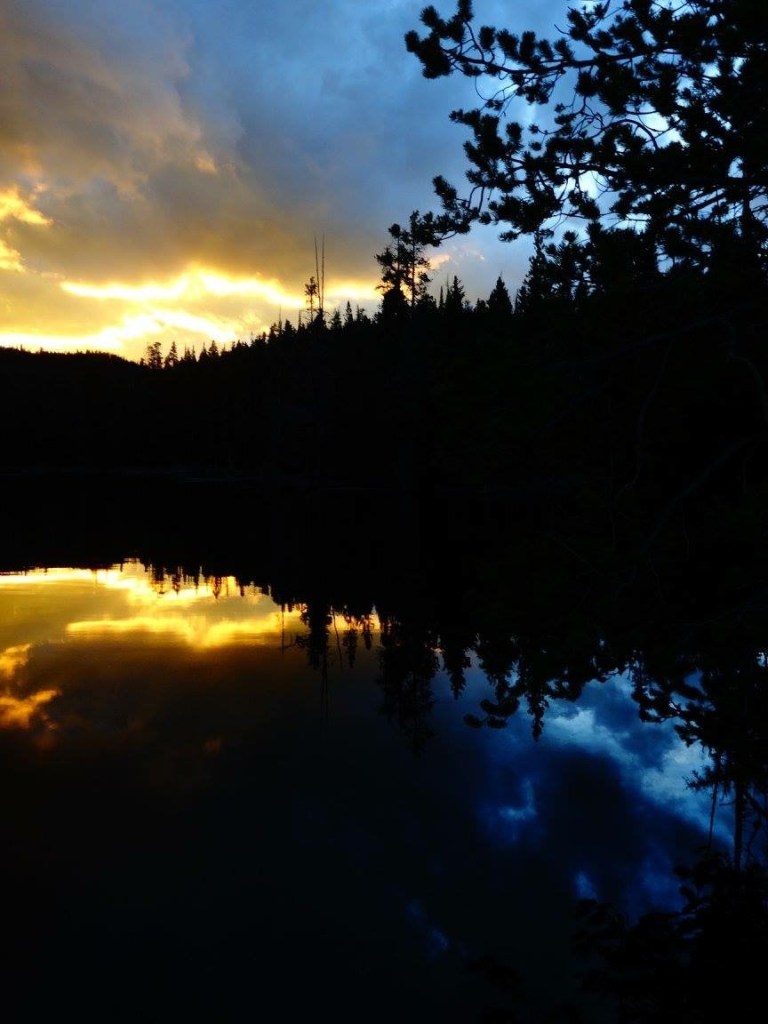
Once back at the car, and safe from all bear encounters, I’d drive over to the Grand Canyon Village once again for dinner, then I’d pass by Yellowstone Lake at sunset on the way back to my campground. On the side of the road opposite the lake, water flowed into a little pond. I pulled over as I observed the most stunning display of colors. Vibrant deep blue and orange, cast in the sky by the sunset, reflected into the pond with the dark silhouettes of trees. It was the most beautiful deep and rich display of colors. I really savored this view and the moment. 

This was not the only time I made a spontaneous pull off to the side of the road because beauty caught my eye. I had done it quite a few times throughout my stay in the park. Usually if one sees another car pulled over at a seemingly random spot, it’s because someone spotted some wildlife, and soon cars began to pile up. In this fashion, on a later trip to Yellowstone, I’d see my first wolf. At one point this day I pulled over because I noticed some beautiful flowers, and I wanted to take their picture. Then a number of cars slowed down, some pulled over. “What do you see? What do you see? Is there a bear, a buffalo?”

“No, I’m just taking a picture of some flowers,” I responded. They seemed disappointed, dismissed me and drove on. Oftentimes, in a quest to find the biggest or most shocking feature on the land, some people miss out on the exquisite detail of the smaller, finer things, like the flowers along the way, or the colors of the sunset reflected in the waters.

When I reached my campground I had completed a full day. Hiking up Mount Washburn was one of the final things I did. I had also visited the Mammoth Hot Springs area earlier and took in the unique stacks of thermal springs. I took a self guided tour of Fort Yellowstone at Mammoth Hot Springs where the U.S. Army was stationed to patrol the park in early days. Now the buildings which constitute the fort are ranger residences. My mind was captivated with the thought, and I daydreamed, of  what it would be like to call this place home. These buildings were homes. People lived here, had families here, had cookouts in the backyard as children played. Inside was their furniture, their things. This was their home, and it was in Yellowstone! How incredible! On a side note- something that rightfully needs to be documented, for it changed my life- here in the Mammoth Village I discovered huckleberry licorice, which would go on to become my favorite candy.

After visiting Mammoth Hot Springs, I visited Roosevelt Arch, and stepped foot into Montana for the first time. I then took Blacktail Drive, a scenic park drive on a gravel road. It was quite serene and I saw quite a number of buffalo there. I also took in the Calcite Springs Overlook. Midday I found myself sitting on a rocking chair on the porch at Roosevelt Lodge. This lodge and cabin complex was built in the 1920s at the site where Theodore Roosevelt once camped by llamar valley. It is rustic and has a lot of warm charm. I had already eaten and was not hungry, but I looked at the menu at the lodge. I saw a cozy dining room while a fireplace crackled. The buffalo burger on a corn bread roll really jumped out at me, and I kicked myself for not waiting to eat here. Someday on one of my journeys between Kentucky and Montana, I want to stop here and have the full Roosevelt Lodge experience. 

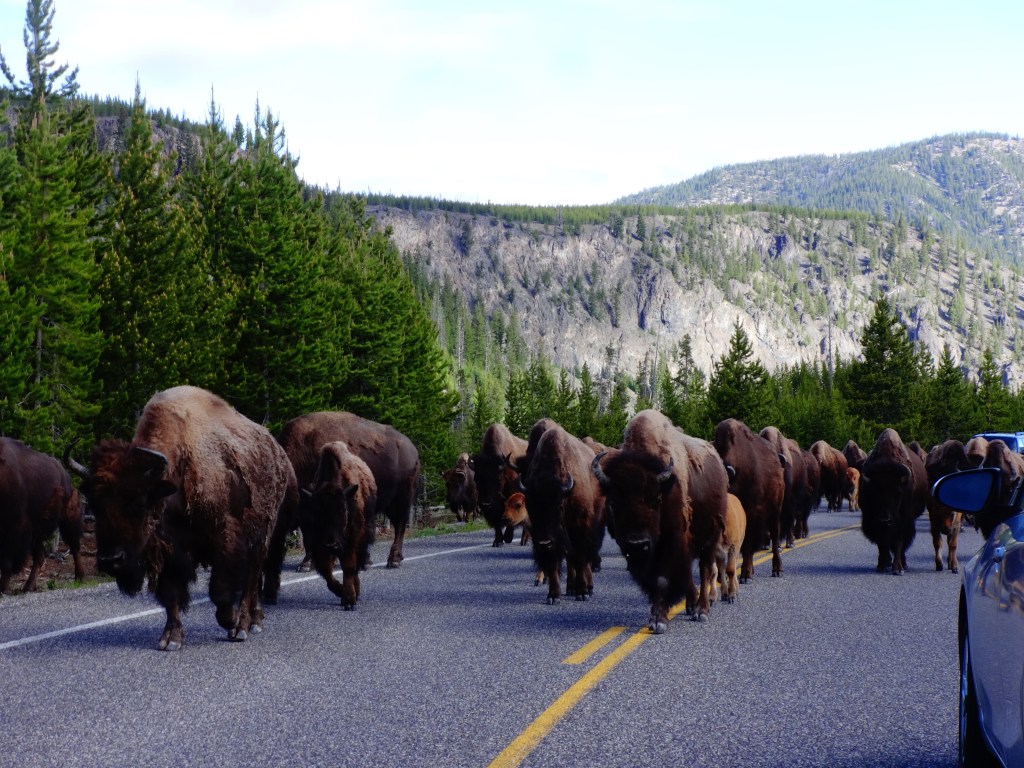
After my third full day in Yellowstone, I felt like I got to know the park, but knew there was much more to see and discover. I would come back and visit again. Next on my summer adventure plan was a stop at Craters of the Moon National Monument in Idaho, but before I left Yellowstone in the morning, I would find myself in a “buffalo jam,” as they call it. At least fifty buffalo overtook the road I was on. I came to a complete stop in my vehicle as buffalo of all sizes crowded around. They walked slowly around my vehicle. It was incredible. I saw buffalo calves for the first time. They look like strange deformed ponies, I thought. At one point a large buffalo stopped right in front of my car. He stared at me through the windshield. He nodded his head toward the right and then the left, and then looked back at me. It was as if he didn’t know he had to walk around the car. Oh No! I then became a bit concerned that the buffalo might try pushing my car or walking up upon it. After a few minutes it figured out the solution was to walk around. I could have lowered down my window and pet it’s back, it was so close. I was thrilled. This buffalo jam was perhaps the most unique and marvelous wildlife encounter I had ever had thus far. More kept coming and coming. I felt so fortunate to be here at just the right moment. I couldn’t have imagined a better crowd to wish me farewell on my journey.

Read the previous entry “Why I Cried at Roosevelt Arch- What Theodore Roosevelt and the National Parks Mean to Me” here: Why I Cried at Roosevelt Arch – What Theodore Roosevelt and the National Parks Mean to Me – on the verge (joshthehodge.com)

Check out my book Canyonlands: my adventures in the national parks and the beautiful wild here: https://www.amazon.com/Canyonlands-adventures-National-Parks-beautiful/dp/1711397873

Providence in Yellowstone

It was day two in Yellowstone National Park. I slept soundly in my tent, despite the campground being full, crowded, and not having much privacy at all. 

On my morning stroll to the bathroom I saw a buffalo walking between two campsites right alongside the picnic table and a RV. I hadn’t expected it. I suppose he wanted to wish all us visitors a “good morning.” It reminded me of one morning in Rocky Mountain National Park when an elk was grazing right alongside a camper’s tent.

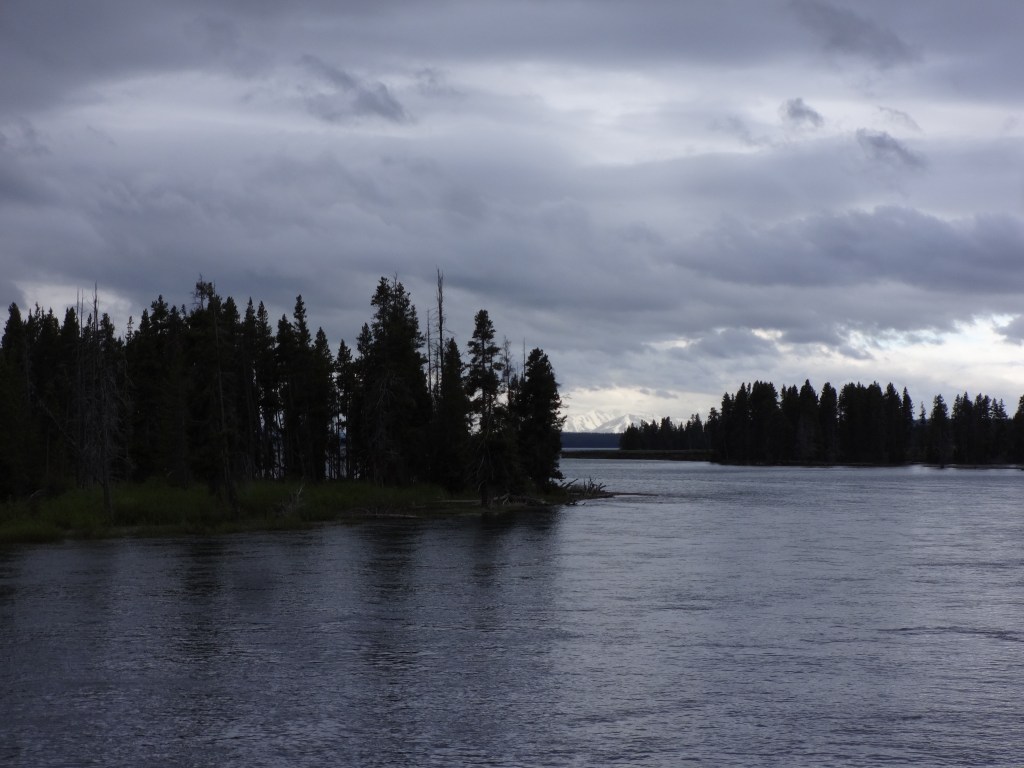
It was a cold and overcast morning. Wet clouds hung low overhead. I quickly disassembled my tent and threw it into the backseat of the car. I could only reserve this campsite for one night. Yellowstone in the summer is an extremely busy place. The next two nights I’d camp at the Grant Village Campground. Once in my car, I had some breakfast from my stash of dried foods and began my day’s itinerary as spelled out in my book. My first stop was at the Fishing Bridge. This long century-old log pole bridge stretched over the Yellowstone River just as it forms and flows northward from Yellowstone Lake. Pine trees stand snug at the water’s edge and some inlets give way to marsh. It was a quiet and peaceful place, especially at this time in the morning. I strolled quietly and contemplatively. Then a big bus came to a stop, hissed, opened its doors and a swarm of Chinese tourists poured onto the bridge, equipped for the misty weather with transparent ponchos and ready to take photograph selfies, nearly each one carrying a selfie-stick. 

More so than any other park, Yellowstone seems to be a favorite among Asian tourists. Tour busses full of these well-equipped tourists are found all over the park. In addition, signs in the bathrooms and outhouses instruct foreign visitors on how to use toilets in the United States; the general store at the Grand Canyon of the Yellowstone has an Asian food isle with a variety of noodles; and restaurants in the park seemingly cater to a certain tourist- namely with the noodle wok. Days prior in Grand Teton National Park, on my guided hike around Swan Lake, the Ranger brought this up, explaining how the influx of Chinese tourists is because of the current strong middle class in China. I also think it just must be in particular fashion in China to visit U.S. National Parks. Tour companies are designed for and are catering to this demographic, probably making quite a wealth for themselves. 

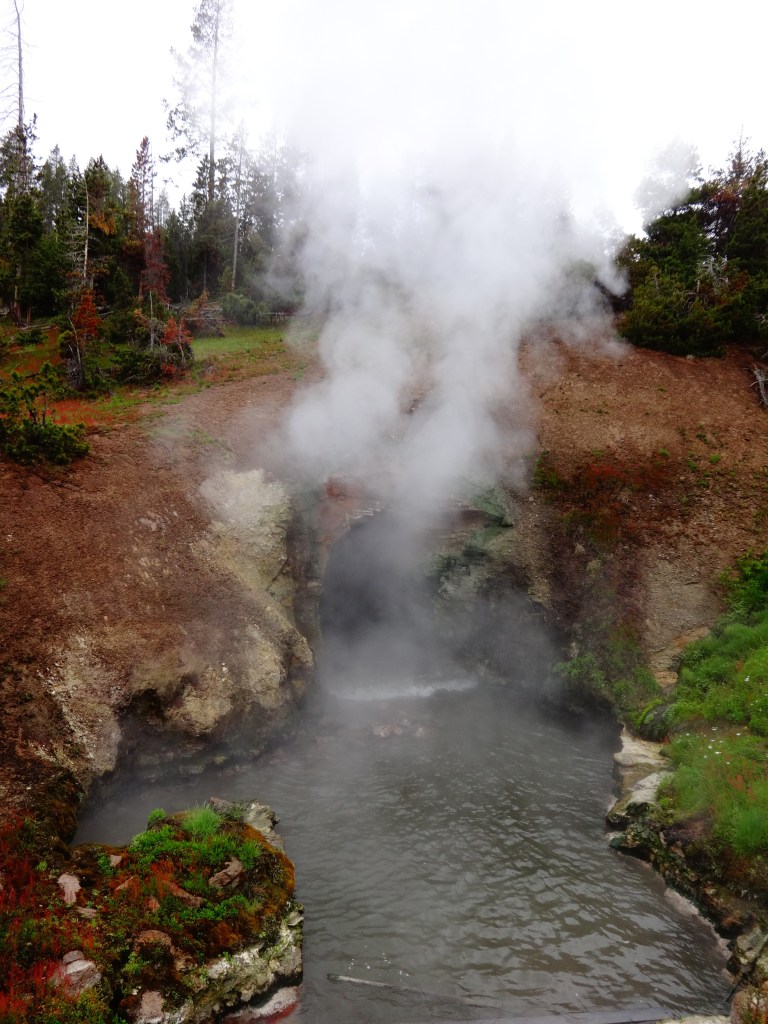
When I left the Fishing Bridge I proceeded Northward and drove a short distance to the Mud Volcano. On my way I saw another buffalo trailing the road. At the Mud Volcano area there was a short boardwalk around gurgling and burping mud pots of highly acidic water that erodes the volcanic rock and turns it into a sludgy thick ooze. The landscape here was very soupy with water sitting, boiling, slowly flowing, and burping up from the ground all around. The most impressive feature here was the Dragon’s Mouth. A hole in an embankment by a thermal pool hissed and gurgled as it constantly let out steam, resembling just what it’s title suggests. 

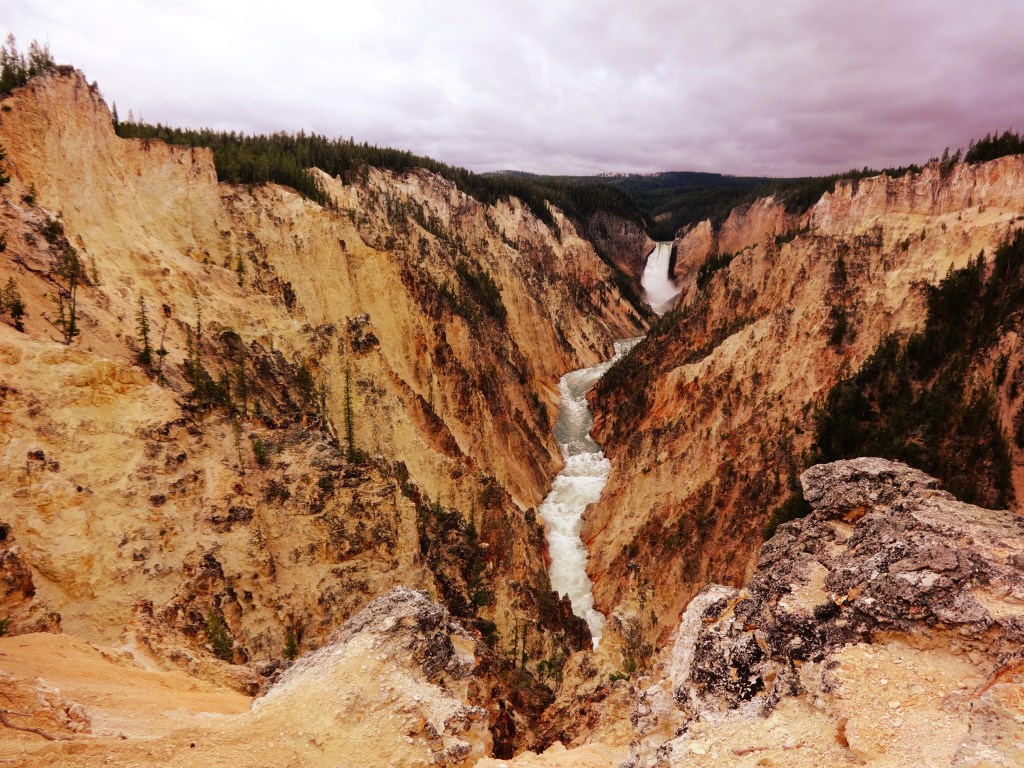
After making another couple brief stops I arrived at the Grand Canyon of the Yellowstone at Artist’s Point. There were crowds of Mandrian speaking tourists, posing in front of the viewspots once again with their selfie sticks. Behind them was one of the most magnificent views in the National Park Service: Lower Falls at the Grand Canyon of the Yellowstone. It is incredibly picturesque. A platform juts out at the edge of the canyon, where crumbling yellowstone is on display traveling down to the focal point of the perfectly flowing immensity of the Lower Falls which is so entirely uninhibited. This is one of those marvels of nature which is hard to take in and gain perspective of. The beauty before you is just astounding. You feel almost as if you are trapped in a painting trying to gain your bearings. Although I was surrounded by people, I tuned them out, and my mind and eyes became fixated at the wonder before me. Captivated would be the most appropriate word. All the sounds and clutter around me dispersed, and I was still, calm, and quiet to my perception. What a wonderful piece of artistry- truly striking- not happenstance but designed. 

Then… “Take photo?” asked the tourist in broken English. “Sure,” I replied. When I was done taking the photo I turned behind me to look off the other side of the observation platform to the peculiar display of the canyon walls which slid diagonally down towards the river from a definite abrupt edge of pine treeline. Colors were on strange display here in nature’s own pink and yellow drooping down in rock formation like melted crayons. 

While in the area I escaped onto a trail that followed the ridgeline. At one point it veered into a dark and moist forest, and at the time I thought this might have been a prime bear habitat. All alone with not much experience in bear country, I decided to head back towards the crowds. I  drove over to the trailhead for Uncle Tom’s Trail, where I descended 328 stairs to the base of the Lower Falls. It was cold and wet, and my stay was brief.

My next stop was at the commercial area of the Canyon Village. Sharing a parking-lot was a general store, an outdoor gear shop, a souvenir shop, and the Canyon Lodge, which is not exactly a lodge but a cafeteria. The cafeteria was very nice and newly renovated in a 1960s style. Something also about the design made me think of a lodge. It seemed like I was at a high elevation ski lodge, not that I had ever been to one before, but it gave off that vibe to me. Here there were two lanes, two sections: One they called “American food” and the other “Asian food.” I was surprised no one had thrown a fit about their terminology in this “woke” era. For me it was just fine. I thought most fitting for my visit to Yellowstone was some classic American cuisine. I had a pot roast with smashed potatoes and gravy with mixed vegetables and garlic sauce. I was surprised by the quality of the food- top notch for a National Park- so much so that I’d come back here to eat the following day. 

My first trip to a National Park in my adult life was in the fall of 2014 to the Great Smoky Mountains National Park in Tennessee. This was the fall after my summer trip to Disney World. Being a classic Disney fan, the trip was everything I hoped it could be, or “magical” I guess is what they say. I enjoyed hopping from one park to another, moving about from one attraction to another, and taking the buses around to visit the different resorts. The Great Smoky Mountains National Park, with all it’s different parts, whether the high reaches of Newfound Gap, the scenic valley of Cades Cove, or the hub of the Sugarland, it’s variety is similar to the different parks in Disney World; and all its different features like Alum Cave, Clingmans Dome, Laurel Falls, Charles Bunion, etc. are like all the rides and attractions in Disney World. I remember thinking the Great Smoky Mountains National Park is the Disney World for the nature lover. Not every park is like this. Not all parks have different sections and a plethora of varying attractions, but Yellowstone most certainly does more so than any other park. Yellowstone has an abundance of “attractions”, numerous villages, lodges, and restaurants. It is an enormous theme park. I’d say The Great Smoky Mountains is more like a Disneyland and Yellowstone is Disney World. It’s at a whole different level- or “a whole new world” as they say.  

After having lunch in the Canyon Lodge I proceeded on my journey. I stopped at the Museum of the National Park Ranger between the Canyon Village and Madison by the Gibbon River and Gibbon Falls, which I also admired. I tell my students back in Kentucky jokingly that when I grow up I am going to be a park ranger. I so admire park rangers and think it would be a most intriguing profession. So, without a doubt, a stop at this museum was necessary. The Museum of the National Park Ranger was located in an old building that used to house soldiers back when Yellowstone was patrolled by the U.S. Army in its early days. This museum gave a brief history of the National Park Ranger; showed a re-creation of an early ranger residential quarters; displayed old newspaper articles and photographs; showcased badges which signify different rankings and classifications within the ranger system; and most fascinating to me at the time, displayed a map from 1916 of the United States with all the National Parks labeled. Something on this map jumped right out at me: a number of the National Parks on the map were no more. What happened to them? There was a retired park ranger volunteering to answer questions in the museum. So naturally…

“What happened to these parks on this map that don’t exist anymore.”

He seemed pleased to have a question to answer. His grey mustache bounced up and down as he spoke. His passion for the National Parks was evident. “Well, some were given back to state and local supervision, and others were defaced so much that they lost their cultural value.” I found this to be quite an interesting bit of information. Later, in my days working in Montana, I’d get an original publication of the book Oh Ranger by Horace Albright. In this book there is a map with a number of National Parks and Monuments that also are no more. At Seven Islands State Birding Park in East Tennessee an exhibit on Tennessee State Parks explains how a number of National Park units in Tennessee were redesignated as state parks. 

When media outlets complain of a politician downsizing federal lands, I’ve come to find that really, in many instances, the public land is put back into the hands of state and local municipalities. This detail is left out in reporting as it doesn’t always fit the narrative. Mackinac National Park became Mackinac Island State Park. Lewis and Clark Cavern National Monument became Montana’s first state park, Father Millet Cross National Monument became Old Fort Niagara State Historic Site, and the proposed Pioneer National Monument became a series of state parks in Kentucky including Fort Boonesborough State Park, to name a few.

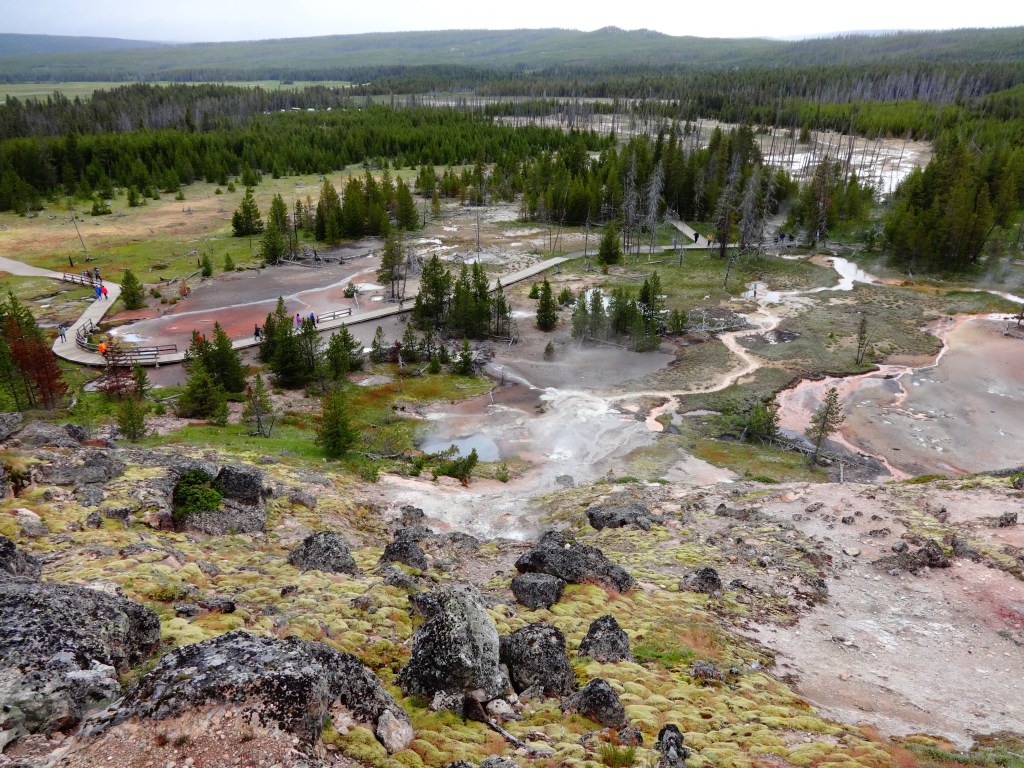
Once done at the museum and with my pleasant chat with the retired ranger, I continued on my journey and down the left side of my day’s loop. The main parkway is like a number “8.” I was on the left side of the lower loop. The upper loop of the “8” I had not seen at all yet and would be reserved for the following day. On my journey on the lower loop I stopped at the Artist’s Paintpots where a number of mudpots, fumaroles, and springs painted lavalike colors across the broken and soupy landscape of delicate earth. A boardwalk guided the tourists among the features. I had plans to stop at the Midway Geyser Basin to see the famous Grand Prismatic Spring. But the traffic was backed up to the road. I decided I’d come back early in the morning.

I proceeded to the bottom of the number “8” on the West Thumb of Lake Yellowstone where I had a campsite reserved at the Grant Village Campground. I checked in and set up my tent in the cold misty forest. It was very similar to the campground I stayed in at Grand Teton National Park. The Grant Village Campground provides visitors campsites within little nooks in the forest. It’s a quiet, recommended campground in the park. After setting up camp I went to the general store, which had a small cafe attached to it selling sandwiches and ice cream. I ordered a sandwich. When I held out my debit card to pay, the employee asked to see an ID. 

“Kentucky! We are from Kentucky!” the cashier exclaimed. “My wife and I are from Louisville. We are teachers. We just work the summer here in Yellowstone.”

This is an important moment in my life. My mind flashed back to the waitress in Jackson Lake Lodge talking about how she got a summer job online, and I remembered she wrote me the web address to find summer jobs in National Parks on a napkin. I briefly thought about pursuing it, but I had doubts as a teacher if I would have enough time and the capability to escape from my normal life for such a adventurous summer job. But then this couple were teachers here from my state! They were able to work around the education system in Kentucky to get away for the summer. If they could do it, I could do it! I would do it! They had inspired me. 

Trying to follow in their footsteps, a year later, in the winter, I applied and pursued vigorously the opportunity to work in Yellowstone. I was shot down. They wanted more of a time commitment than what I could offer as a teacher. This didn’t stop me. There had to be a way, for this couple did it. I tried other parks. I tried Big Bend National Park in Texas and Glacier National Park in Montana. I received job offers from both! A privately owned mercantile just outside of Glacier National Park won out. In the summer of 2019 I’d find myself working my first summer in what would become my most favorite place on earth. My heart would get lost in Montana, and my experiences in Montana would be some of the fondest and most meaningful in my life. The people I’d meet in Montana would become some of my most treasured. It was this moment in Yellowstone- this teacher couple from Kentucky- who would put all of this in motion. Coincidence? I think not. Coordinated? Definitely.  

Read the previous entry “Lands Alive: My First Day in Yellowstone” here: Lands Alive: My First Day in Yellowstone – on the verge (joshthehodge.com)

Check out my book Canyonlands: my adventures in the national parks and the beautiful wild here: https://www.amazon.com/Canyonlands-adventures-National-Parks-beautiful/dp/1711397873

The Mighty Tetons

“I’m going to need a venti latte with an extra shot and almond milk,” the lady spoke.

Where do you think you are? I’m asking quietly in my own mind with no anticipation of response. I knew exactly where I was, in Grand Teton National Park in northwestern Wyoming, a place where dramatic peaks of the Rocky Mountains strike up among pine forest and once cattle ranches are among mountain lakes, pristine rivers, and sprawling wild flowers. Specifically I was in the Coulter Bay Village in the general store. Apparently the lady had mistaken the canisters of drip coffee as a bonafide Starbucks establishment. She must not get out of the city very often, my thoughts proceeded. As they say in the South, “bless her heart.” After she resolved her order I got myself a nice cup of hot tea, perfect to thaw me out this cold morning. Although the temperature most likely dropped below freezing, layering up on clothes and burrowing under three layers of sleeping bags kept me warm and comfortable for the past two nights. I can’t think of a finer night’s sleep in my life than these nights in Grand Teton National Park. 

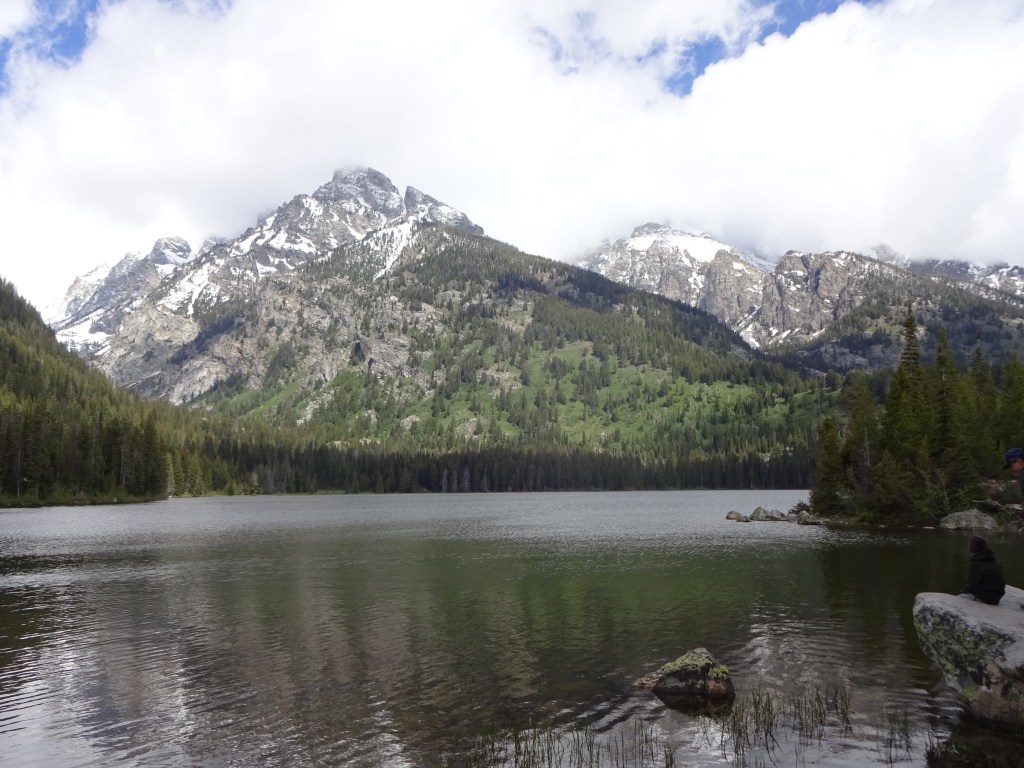
I was up rather early, eager to make my way to neighboring Yellowstone National Park. The previous morning I was also up early to make it to a ranger guided hike to Taggert Lake. I had given myself plenty of time to arrive, and I sat at the trailhead on a bench cold, wishing the sun would rise and warm up quickly. When the ranger arrived she led the small group of about twelve of us on a short 1.5 mile hike to the lake. Along the way she explained how one of the unique features of the Teton range is that there are no foothills, You can see the mountains begin at the valley floor and dramatically rise seven thousand feet. This is due to the sudden violent seismic activity that led to their creation. The Tetons are also unique in that they are believed to be the youngest mountains in the Rocky Mountain chain. Along with geology tidbits the ranger shared about plant life. She invited us to all rub our fingers on some sagebrush to smell its pleasant aroma. “This is what used to be called ‘cowboy cologne.’ Cowboys would spend long days, sweaty and dirty out on the range, sometimes without the resources to clean up, so if they were headed into town, maybe to a saloon, and wanted to smell nice for the ladies, they would rub sagebrush over their bodies, especially up around their necks.” 

A large section of the trail went through sagebrush and wildflower meadow, then swayed into the forest. We crossed the small rushing Taggert Creek on a bridge and ended at the small Taggert Lake. It looked rather dismal this morning, with a mostly cloudy sky up above, but surrounding it were narrow pines and the dramatic mountains with snow all up and down their sides adding quiet beauty. 

The ranger gave us the option of following her the same way back or continuing another 2.4 miles to complete the loop. I decided to complete the loop and took off solo. Although I really should have been enjoying the scenery around me and being present in the moment, I was troubled by the fact my camera was broken. It was a Sony Cybershot point-and-shoot camera. I had bought it brand new just before the trip. I did think it felt very light and cheap, and I came to find my questioning of its durability justified. This was my second Sony Cybershot. Prior I was using an older sturdier model. I thought for a small camera it really delivered and I became, if I do say, quite skilled at using the camera and all its features to their full potential, but dust, or some sort of particles, had gotten inside the camera and on the lens  casting dark spots over my pictures, so that’s when I bought the newer, more expensive, but overall cheaper model. 

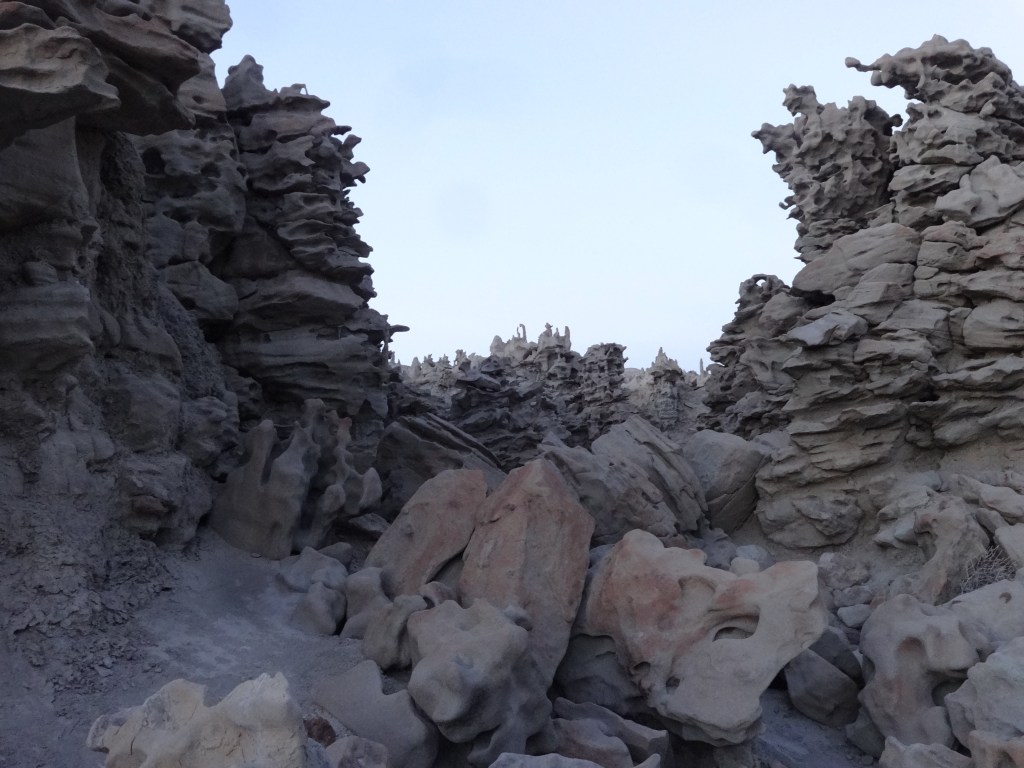
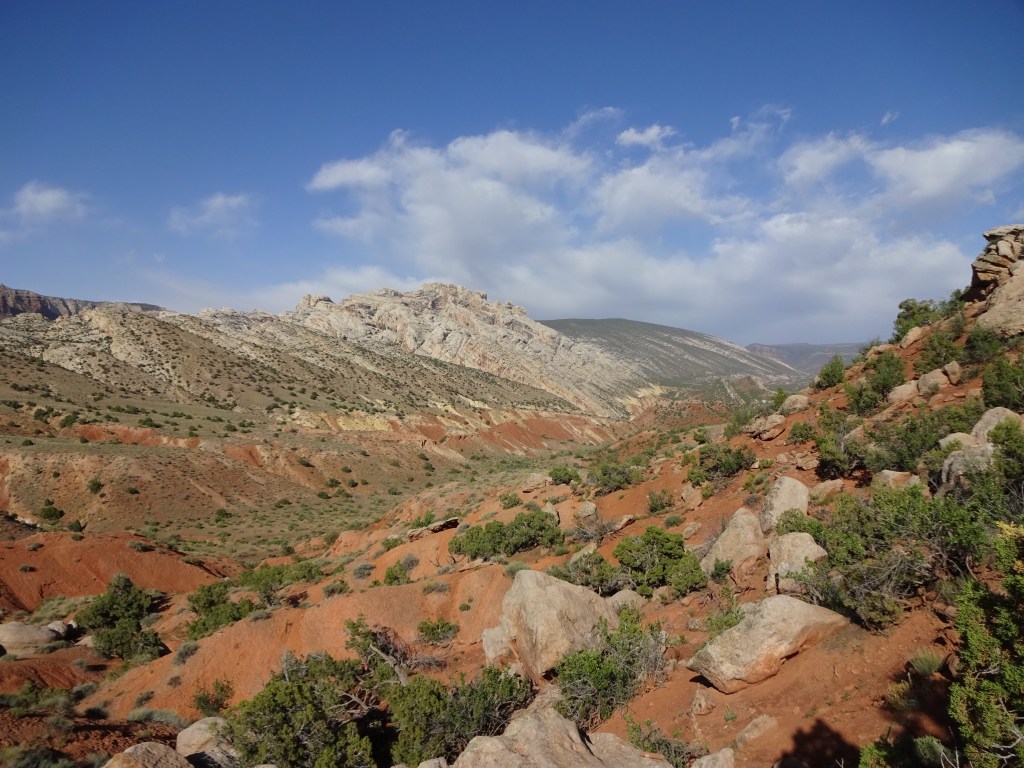
Days prior after I arrived at Dinosaur National Monument, I took the advice of Gzeivieur, the frenchman I met at Curecanti, to check out Fantasy Canyon. The name alone was intriguing but the road to this site was not the most inviting. I drove at least an hour and on at least twenty miles of dirt road into very remote stretches of desolate and dry Utah desert. I passed by no signs of life except the occasional oil fields and related small industrial complexes. The sun was also setting. The farther I drove into nowhere, the darker it became, not very comforting. When I arrived I was surprised at how miniature the landscape was. Despite being small, I  will admit it is very unique. The Bureau of Land Management on it’s website claims it holds “some of the most unique geological features in the world.” It also warns of the features being very fragile and calls it “nature’s china shop.” They describe it as “the east shore of what was once Lake Uinta, where the sediments eroded from the surrounding high lands. Sediments were deposited and the once loose sands, silts, and clays were forged into sandstone and shale. Because of different rates of weathering, the more durable sandstone remained while the more easily weathered siltstone and shale washed away, yielding this spectacular scenery.” Today it’s a collection of drooping, haphazard, fungal-looking rock hoodoos and shelves. I think I would perhaps best describe it as sharing the variety and visual make up of a coral reef, but it looks all petrified and painted in a pale clay beige. 

Here I screwed my camera to my trekking pole. I tried to drive that trekking pole into the ground, but when I set the timer to scurry into the picture, the trekking pole fell, smacking the camera on the ground. Since that moment the lens would not open nor adjust. I would only be faced with an error message. I eventually resorted back to my older camera which I still had in hand, and I would purposely try to frame my pictures in such a way that the dark spots on the lens would not show up in plain sight in the pictures. 

Now in Grand Teton National Park, after fretting over my camera situation for much of the morning, I came to terms with it and realized this could be a wake up call to really take in the scenery in the present moment and not live my life behind the camera, preoccupied with capturing the best shots. I also resolved to write more and draw. I could capture the beautiful scenery through my own pen and it would be uniquely mine. I could share the beautiful scenery but share it through my own perception. I was inspired in part by my Uncle Joe who while traveling routinely takes time to make his own postcard sized sketches of notable places of interest on his travels. Although he does take photographs too, his pictures I would say are more valuable because they capture the way he sees things. 

After completing the loop at Taggert Lake I went back to the Coulter Bay Village and went on another short ranger led hike which ended at the marshy Swan Lake with wispy grass and lily pads sticking up out of the water and the mountains towering in the back between and above the opening of pines. This looked like prime moose habitat but none were spotted during this visit. I recognized immediately the ranger leading this hike. He was the friendly guy from Chicago in the visitor center from the day before, the first person I met here in the park, the one who instructed me to sit in front of a fireplace in Jackson Lake Lodge, look at the park materials, and plan my visit from there. He had served me well. 

“I may not look like a park ranger,” he began his talk. “I am new here and am still waiting on my hat and uniform.” I give him points for effort. He had a green shirt and pants, trying to imitate the classic ranger look. He also remembered me. I am always impressed when people remember me. It happens quite frequently. After short, casual interactions, people are often able to recall me. I feel honored. 

This ranger conducted himself in a manner which made him very approachable, so in between his moments of interpretation I walked alongside him and asked some questions. I wanted to know the difference between a National Park and National Monument. Both are entities in the National Park Service and although Monuments get less publicity than the Parks, some Monuments, like Dinosaur National Monument for example are quite spectacular. He explained how Monuments are declared by presidents. A National Park is established by an act of Congress. He explained that many Monuments eventually become National Parks. Even Grand Teton National Park originated as Jackson Hole National Monument.

“Do National Parks get more federal funding? I asked. 

“No. It doesn’t have to do with funding. It mostly has to do with the name.”

“Well, why change the name to a National Park if there is already a National Monument.”

“Tourism,” he replied. “A National Park status brings in more tourists. Take Great Sand Dunes National Park in Colorado for example. In recent years it transitioned from a monument to a park, as a result it increased visitation and tourism. It’s great for the local economy.”

I’d later see the reason why Jefferson National Expansion Memorial and Indiana Dunes National Lakeshore acquired name change and status to National Parks. 

This ranger also spoke a lot about John D. Rockefeller, Jr., the son of the Standard Oil founder and one of the richest men in America at his time. He fell in love with the area after being escorted around by Horace Albright, the first director of the National Park Service. Albright persuaded Rockefeller to purchase the land and donate it to the federal government as Roosevelt would put it, “for the benefit and enjoyment of the people.” To acquire this land at fair price, Rockefeller created the Snake River Co. and used this name to purchase 33,000 acres to donate to the federal government, When news broke out that Rockefeller was behind the purchasing of all this land, there was such an uproar that the government wouldn’t accept the donation for fear of scandal. When president Theodore Roosevelt eventually accepted the donation and created Jackson Hole National Monument he was compared to Hitler annexing Austria. Name calling and scandal aside, I am grateful that Rockefeller used his wealth built up from capitalism to give this incredible area to the people of the United States and the world. I am glad that Horace Albright and Theodore Roosevelt shared the same vision. Without Rockefeller’s wealth and without his charity, the Tetons may have been leveled and mined to dust, the forest completely lumbered, and the valley may have become an industrial cattle farm. This is not to demean the value of these industries, but the beauty of Grand Teton National Park is truly a treasure worth preserving and sharing. 

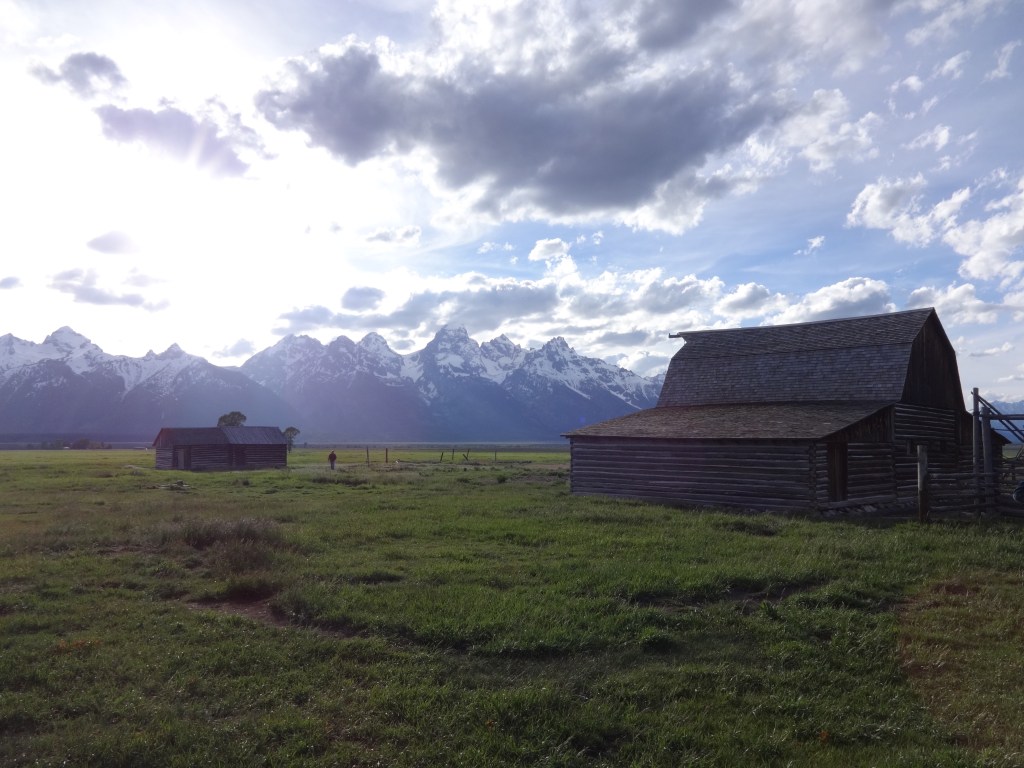
In the evening I made my way over to the Snake River and then to Morman Row Historic District. This part of the park preserves a late Morman settlement and features perhaps the most iconic view in the park and in Wyoming, the view of the Reed Mouton Barn on the open grassland and the Tetons rising up in the distance. 

I stood here initially with the desire to capture the perfect photo, but then I paused. No, let me just take it in. I gazed at the beauty of the mountains. What does this mean? I asked, for beauty is never wasted. My mind began to race. But then I stopped. Be still. Be Calm. Be quiet. As always, I was in the presence of the almighty God, and the beauty reminded me of that. I thought back to what God taught me out in the desert of Dinosaur National Monument. This was the first time apart from then, I really put this learning to practice.  I felt relief knowing there was nothing I needed to do with this beauty, and there was nothing that needed to be said. All I was called to in this moment was to enjoy it and be present and mindful in the moment with God. He again was calling on me to be still, calm, and quiet, and it was quite refreshing for the soul. I became aware that ultimately it’s not my actions that bring about healing and restoration, it’s God in these moments of stillness and quietude.

After pausing, breathing, and mindfully resting in God’s presence I sat down. I did open my journal and created a sketch of the mountains before me. I also accompanied it with a poem. I did not overthink my writing. I did not overanalyze it for meaning or plan it precisely. I looked at the mountains and was taken away by the strength and might they reflected, and I let it flow free and meander from me, just like the waters of the Snake River.

Jagged diagonals form peaks stretching to touch the clouds

Boldly rising, unreserved, coated in blue and fostered with snow, mimicking the sky above 

Sprawling across the canvas among wandering streams, pristine lakes, log pines, and wilderness

The voraciousness of the bear and the chase of the wolf below is only child’s play to your grandeur

You are old and display generations lined together for a family portrait, dominating the view with Grandfather in the center. 

Quiet, not a sound from you, but your stance tells everything and in you I see the reflection of strength and Might. 

Read the previous entry “My Cougar Encounter At Grand Teton National park” here: https://joshthehodge.com/2020/09/19/my-cougar-encounter-at-grand-teton-national-park/

Check out my book Canyonlands: my adventures in the national parks and the beautiful wild here: https://www.amazon.com/Canyonlands-adventures-National-Parks-beautiful/dp/1711397873

My Cougar Encounter at Grand Teton National Park

I wasn’t supposed to hear that. This much I knew. A middle-aged woman leaned over to another and whispered, “I feel like such a cougar.” I was sitting next to her here in the Pioneer Grill in Grand Teton National Park in Wyoming. This was a 1950s style diner on the lower level of the Jackson Lake Lodge. According to the Grand Teton Lodge Company’s website, “The Pioneer Grill at Jackson Lake Lodge is one of the oldest and rumored to be the longest continual counters at 200 ft. One counter snakes through the room, creating a friendly atmosphere where guests interact with travelers.” Yep, most certainly. I was seated at one of the corners of the counter. Adjacent to me sat my fellow conversationalists for the evening, two middle-aged women. One of them had blondish grey hair and the other had black. It was the lady with the black hair closest to me who had spoken these words to the waitress: “I’m going to pay for that young man’s dinner.” I also wasn’t supposed to hear that. 

I hid behind my menu. This was mildly awkward. Was I supposed to react to what I overheard or pretend I didn’t hear it? I decided to play the latter.  When the waitress took my order she also took my menu, and there I was. The cougars, if you will, were looking right at me.

“So where are you visiting from?” the black-haired lady asked with a pleasant smile and inquisitive eyes.

“I’m from Kentucky,” I claimed. “What about you?”

“We are visiting from Washington. I’m Judy and this is my sister Cheryl. We are visiting on a sisters get-away for the weekend. What brings you here all the way from Kentucky?” First off, I was surprised her sister’s name was Cheryl as her appearance reminded me of my aunt Cheryl. 

“I’m on a National Park adventure. I flew into Phoenix, got a rental car, and have been camping and visiting National Parks all month,” I explained.

“Oh, you’re a teacher! What do you teach?”

“I teach Spanish in elementary school.”

“Well, good for you. Good for you,” she repeated.

“What do you do?” I inquired unaware of how much information this simple question would unpack.

 “I am a retired police officer. Worked thirty years.” She then proceeded to tell me all about her retirement benefits, how much money she was getting in retirement, how much money she was making before retirement, how she decided to retire. I was surprised. She was making nearly a six figure salary in retirement or so she claimed.

Given the fact I heard her say she felt like a “cougar,” and now she was talking about money, one could be suspicious of her intentions. But at the moment I thought nothing of this. I really thought she was just being friendly. She may have provided way too much information in her conversation, for talking so in depth about her retirement finances to a stranger is just rather odd. But I also sensed she may have had a few drinks at the bar before coming to the diner.

When she mentioned being a police officer I could definitely picture her in uniform. She was the type and had the demeanor to be an officer: forward and assertive in conversation, bold, not the least bit hesitant. I think she was speaking very honestly about her life and retirement and although she may have been trying to impress me, I’m just not impressed with how much money a person makes unless it’s out of sheer ingenuity. I think she was just excited about her retirement as it was all new to her. Not impressed with her money, I was appreciative of her many years of service as an officer, and showed her attentiveness as a good listener. 

The waitress came back and delivered my meal. The ladies had already finished theirs. I just got a chicken wrap, but now that I knew a rich lady in retirement was paying for my meal, I thought I’d order a cup of tea,  some Tazo Zen. I usually would be very economical if someone was buying my meal, but first off, I wasn’t supposed to know she was buying my meal, and she was bragging about her income. I thought about ordering tea earlier but was being somewhat stingy with my finances.

It did cross my mind more than once the thought that this lady really was singling me out and had other intentions as a “cougar,” but then she started engaging in conversation with the waitress. “So where are you from?” the retired officer turned to the waitress.

“I’m from Michigan,” the young lady said. “I’m in college. This is just a summer job.” She then proceeded to give some details about how she lives for the summer in the park in an employee village in dormitory style housing. She was very easy going and down to earth. I could tell she was genuine in conversation and had a good head on her shoulders. 

“How did you end up finding a job way out here?” Judy asked. 

“You know, there’s a website.” She then proceeded to tell us all about this website of listings of summer jobs in and around National Parks.” I asked her a few questions about it myself. “I’ll write it down for you. She grabbed a napkin and wrote the website address. “You’ll get a job and you’ll remember it was all because a girl in Grand Teton wrote a website down on a napkin in a diner for you,” she joked. She was absolutely right. This is a very pivotal moment, for it was because of this waitress I ultimately ended up finding my subsequent summers’ job in Montana along the border of Glacier National Park. These summers in Montana would greatly enrich my life. I kept that napkin, for the remainder of the trip. She planted the idea in my mind and that website was the key to make this a reality. 

I cusped the white ceramic mug in my hand. The hot tea on this cold wintry night in June was perfect. 

“So are you camping tonight?” Judy asked me. 

“Yes.” I gave a look of uncertainty. Uncertain of how the situation would play out. There was a winter storm warning for the night. I had already seen snow and the wintry mix. “I had three sleeping bags. I’m going to just really bundle up.” I purposely adjusted my tone in an attempt to draw out pity for my situation.  In my mind I was hoping the ladies would feel bad for me and offer to buy me a room in the lodge. That was an extravagant wish, I know, and rather unrealistic, but one can dream. Plus she had all that retirement money!  But as expected, neither offered. 

When I was done eating, and our conversations had come to a close, I acted so surprised when Judy paid for my dinner. I thanked her. It was a very nice thing to do, and I sincerely appreciated it. I told them to follow my adventures in the National Parks on my blog, and wrote down the web address in a little booklet Cheryl had fished from her purse. 

Leaving the lodge it was completely dark. The wintery sky had blocked out any sign of the moon. I left the heat of the tall fireplaces, the welcome of the warm glowing lamps in the lobby, and the assurance of the hot cup of tea in my hand into the cold small droplets of piercing rain in the foreboding darkness of the great outdoors. 

Driving back to my campground, a number of cars got really close behind me with their high beams on. I was obeying the speed limit and was being extra cautious. It was dark and the roads were wet. I didn’t want to hit a deer or an elk, or bison, or slide right off the road. Then the cars would rev up their engines and in a display of perceived superiority and frustration, zoom around me reaching speeds of seventy in this forty-five miles per hour zone. I did not like this one bit. I put on my flashing emergency lights. This is what I have learned to do in Kentucky. When you’re stuck behind a piece of farm equipment, or driving slow in the rain or snow, it seems to be customary in Kentucky to put your emergency lights on. It sends a signal that you can’t or won’t be going any faster. 

Then behind me red and blue lights started to flash. I was being pulled over. 

“Do you realize your emergency lights were on?” the male law enforcement ranger asked.

“Yes. There have been so many cars getting right up behind me and speeding around me, I put them on to let others know I’m not going any faster and will be following the speed limit.”

“You know it’s unlawful to have your emergency lights on if there is no emergency?”

“In Kentucky we put them on to let others know we aren’t going any faster.”

“I didn’t know that. I learned something new. May I see your license.” I obliged. Inside I was flustered. Out of all the people pulled over it was me when it should have been the careless drivers speeding in the park. He came back shortly to reiterate what he already told me about emergency lights. “Have a good night.” he concluded. “Stay safe.”

Phew! I had been nervous I would be getting some sort of ticket. I didn’t receive one, just the overwhelming feeling of an outlaw which beset me. 

Back at camp these events left my mind as I focused on the most important task at hand: surviving a night of camping in the freezing cold. I put on my full set of long underwear, followed by sweat pants, a long sleeve shirt, and two hoodies. I doubled up on socks and even put a pair over my hands. I shimmied my legs and the core of my body within two layers of sleeping bag. I unzipped the third sleeping bag and laid it over my head and upper body. I felt pretty good, decent, like I’d survive. When I woke up in the morning, I remember saying to myself, “ I think that’s the best I’ve ever slept.” I was ready to explore Grand Teton National Park.

Read the previous entry “A Wintery Mix” here: https://joshthehodge.com/2020/09/17/a-wintery-mix/

Check out my book Canyonlands: my adventures in the national parks and the beautiful wild here: https://www.amazon.com/Canyonlands-adventures-National-Parks-beautiful/dp/1711397873
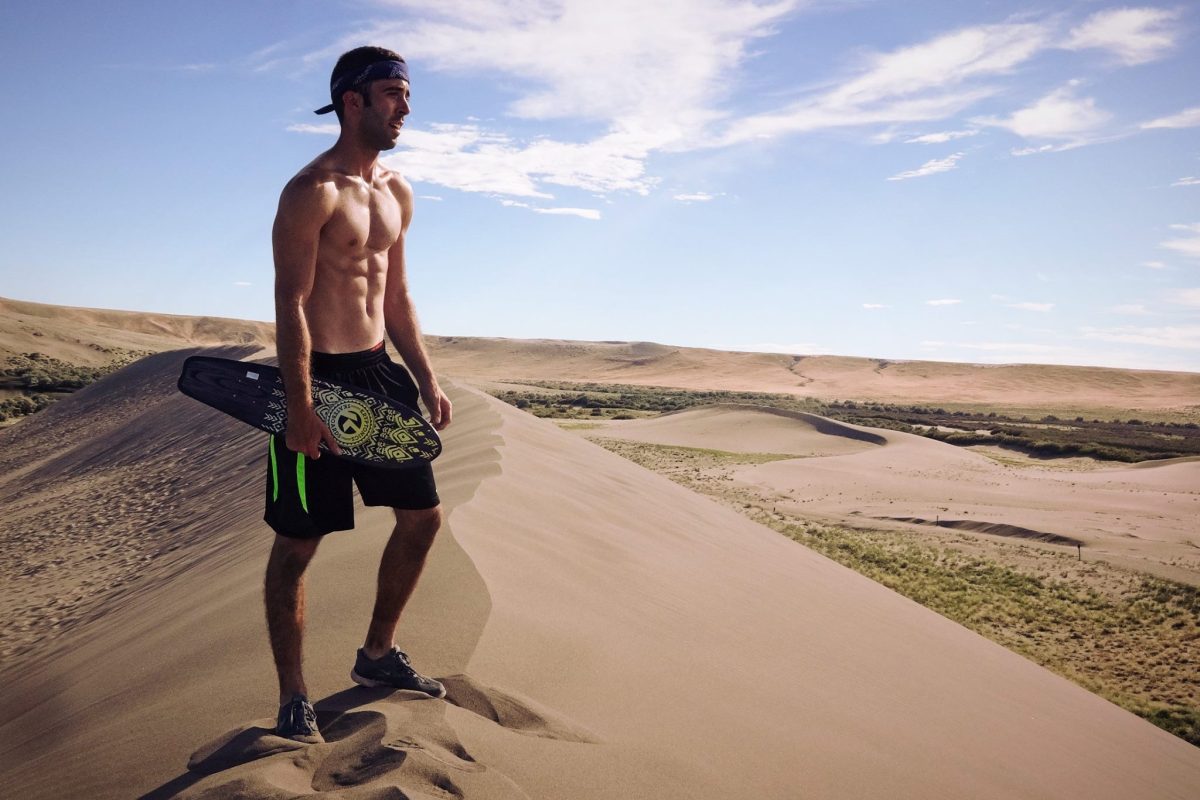
A Wintery Mix

The delicate snow gingerly descended upon the landscape. A family of deer paused in a clearing of cold green grass. They made eye contact and then trampled back into the aspen grove. I was climbing up the mountainside in my car under the blanket of white and grey sky above me, having left the arid canyons and valleys of Dinosaur National Monument and now moving into the rich wet forests approaching Grand Teton National Park.

The wind picked up, and the aspen rattled as the pines swayed side to side. I was thrilled by the sudden change in environment. I had partially expected this. I knew I’d be making my way into colder temperatures, but snow hadn’t crossed my mind. I had stopped days before in Grand Junction, Colorado to buy a pair of jeans, since I had no long pants and also another sleeping bag. This would make three sleeping bags to layer up and keep me warm. I had read the temperatures in this region, even in June, could still swoop down into the forties and even the thirties. For this trip in its entirety I had initially packed more for the desert, and couldn’t have imagined packing for snow, especially back in my sweltering apartment in Kentucky.

The snow picked up and the wind swirled it around. Here I was in a blizzard in June. This was novel, and I loved every minute of it. After my northward journey, and ascending about two thousand feet from where I started at Dinosaur National Monument. I arrived in Jackson Hole, Wyoming, a ski-resort town but also a tourist and outdoor adventure hub, and in that sense the Moab of the North. I didn’t know this place was such a destination but quickly learned it was the only remaining town before entering Grand Teton and Yellowstone National Parks from the south. Unsure of when or where my next meal might come from, I quickly slid out into the cold to run into a Mcdonalds for a chicken sandwich. Afterward I changed my attire in my car, from my shorts and tank top into my new jeans and flannel.

Cars started to line up on the roads through Jackson Hole. People were out and about on vacation, although given the weather it may have looked like people were out for last minute Christmas shopping. The crowded roadway added to the hype of reaching the park. This was not some place tucked away off the beaten path but this place was known. This was the place to be. You could feel the excitement in the air, wedged in between the falling snow.

I rolled into Coulter Bay Campground where I checked in and was assigned a campsite. The landscape was grey and green between the grey sky, the pavement and crushed rocks, and the grey of the tree limbs which stuck out skeletally among the forest of tightly packed conifers. This landscape was new to me. I’d never been to the northwest woods. The excitement of a new terrain beset me and the rich wet aroma of pines dampened any dry configuration for the desert I was affixed to. When I turned the car key and pulled it out from ignition, I had one goal in mind: to set up my tent as fast as possible getting the least wet possible. The snow had turned into a mixture of  sleet and rain, what one would call a “wintery mix,” but it seemed inappropriate to use the term in June. 

When I had purchased my additional sleeping bag and jeans, I had also purchased a new tent to replace True Blue which had been decimated in the monsoon at Guadalupe Mountain National Park. The good aspect of this was that all the components of the tent would be all neatly put together. The downside was that I was anticipating fumbling around, trying to learn to set up a new tent in this undesirable weather. However, it was a success. I set the tent up quickly despite my fingers growing slightly numb from the cold. Being so new, it was perfectly clean and had that new tent smell. I wasn’t sure how sleeping was going to be in the freezing cold, but I felt perhaps adequately prepared and realized only time would tell.  

I warmed back up in my car and made my way to the visitor center at Coulter Bay. Coulter Bay is the only named “village” of Grand Teton National Park. A National Park “village” is a location where services are congregated. Usually there is a campground, a general store, gas station, a restaurant, a visitor center, and lodging. Although Coulter Bay is the only one that formally bears “village” with its title, The Jenny Lake area of the park I would also classify as a village. Next door, Yellowstone National Park has many villages because of its immense size and popularity. 

Although I already had some trails planned. I wanted to consult a ranger to make sure I didn’t miss anything and also to inquire about what to do in the present state of rain, so I made my way up to the counter in the visitor center. A friendly gentleman handed me a park map and guide. “Here’s what you need to do. Go to the Jackson Lake Lodge, find yourself a nice seat in front of one of the big fireplaces, look through the guide I gave you, and plan some things for tomorrow.” I liked his friendly assertiveness and recognized his Chicago accent. He lifted the responsibility of having to plan my evening, and I liked the sound of what he was saying. I was thinking maybe the weather would clear. Maybe I could squeeze in a hike today, but taking some time to relax by a fire in a lodge while the weather did it’s wintery thing outside sounded very much appealing. I loaded up my backpack with my Chromebook, postcards, journal, and pens, and stepped into the most comforting of lodges. 

I’d seen Jackson Lake Lodge in pictures particularly its grand atrium perfectly framing the Tetons. At the cusp of Project 66, the largest construction program of the National Park Service in which many of the visitor centers and modern facilities were constructed, John D. Rockefeller had this lodge constructed in1955. It is modern, but tasteful. It’s most unpretentious on the outside and on the inside it’s sleek, warm, and dignified. In the corners on either side of the main room stood enormous fireplaces, big enough to walk into. They were blazing and crackling and it was the perfect comfort and contrast to the climate outside. I settled into a comfortable chair, a mound of chopped firewood stood against the wall to my left. At one point a lodge employee threw some more wood onto the fire and poked it with a stick. I began to write some postcards and tried to drown out the obnoxious clamor of the kids around me. Two ladies talked as their kids ran about the fireplace and furniture. One girl, probably around six years old or so approached me and asked what I was doing. I simply told her I was writing postcards.  They had ice cream in paper cups from somewhere. They spilled it across the coffee table and giggled. I decided to move. I found a seat further in the lobby where I could focus on writing my postcards. It then became a most peaceful and enjoyable experience. Given the weather, I really had no place to be, and here I was warm, in a beautiful lodge, with the welcoming glow of lamps and the fire contrasting the gloom outside. I could relax. It was astounding to consider how far my trip had taken me so far, from the sweltering heat of the West Texas desert  and straddling the U.S.-Mexico border to now in the wintery northern woods. 

I then opened up my park guide. I saw the listing of some ranger led hikes scheduled for the following day and I decided to scrap my plans. A ranger led hike seemed much more appealing. Also I was concerned about grizzly bears after reading all the warnings. This would pacify the concern. I’d read quite a bit about grizzly bears in preparation for this trip. This was my first visit in grizzly bear country. I learned that attacks, though rare, are nearly always on solo hikers. Hiking with others is exponentially safer. Usually I don’t learn about ranger led hikes enough in advance to participate, but here in this guide they were planned out for all summer at specific times.

Sitting here I also quickly hopped on the internet to check the weather, retrieve some addresses for postcards, and share this post:  “Here’s an update- Dinosaur National Monument in Utah was very colorful and beautiful. Today I traveled through a blizzard into Wyoming. I set up my new tent for the first time in Grand Teton National Park. It’s a new landscape and climate for me. The pine smell is amazing. It’s raining and there is a “winter” storm advisory- snow expected tonight, so right now I am at Jackson Lake Lodge sitting by a grand fireplace. I sort of feel like I am at a Disney Resort. Everything is perfect. I can’t see the Tetons because of the clouds and rain, but I spoke with a ranger, and tomorrow the weather will clear and I will do some hiking and see the Tetons in all their glory. I admit I do want to see a grizzly bear, but just at a safe distance.”

The rest of my evening would simply involve dinner in the lodge and returning to my camp for slumber, but first I would have my most memorable wildlife encounter in the park and would find myself in trouble once again with a park ranger.

Read the previous entry “Be Still. Be Calm. Be Quiet,” here: https://joshthehodge.com/2020/09/12/be-still-be-calm-be-quiet/

Check out my book Canyonlands: my adventures in the national parks and the beautiful wild here: https://www.amazon.com/Canyonlands-adventures-National-Parks-beautiful/dp/1711397873

Be Still. Be Calm. Be Quiet.

It was the thirteenth day of my summer adventure and God still hadn’t spoken to me in the way I wanted him to. Where was the big revelation? Where was the clarity on the direction of my life? Where was the reason for the unidentifiable aura of general discontentment which blanketed my life? Things were not horrible.  I was still having a great trip and seeing so many things to be thankful for, especially in retrospect, but I longed for God to speak to me in the ways He’s spoken to me in the past- direct, clear, affirming. 

Many days and many nights I’d gone for walks like this one, to pour out my soul to God, to wait for Him to speak, but nothing. Here I was again, this time literally wandering in the desert. I was at the Sound of Silence trail at Dinosaur National Monument. I wasn’t in the high stretches of the park anymore but was down in a dried up river bed. The trail didn’t start in a river bed, but somehow I found myself in one. I eventually came to notice no more trail markers. I had taken a wrong turn and lost the trail at some point. That’s okay, I’d turn around.

I made my way over broken shards of red and beige rock, passing by sagebrush and the occasional parched tree. Cloud coverage had moved in, rain threatened, but only let out a brief sprinkle. In my mind, I listed all the misfortunes of my trip so far: the stress of locking my keys in the car, getting reprimanded by a park ranger and being threatened with a ticket, being stuck in White Sands National Monument in a lightning storm, the rock at Indian Davis State Park falling onto my car and denting the hood, breaking my camera, my gum infection, accidently keying the car, my tent being destroyed in the monsoon at Guadalupe Mountains. In retrospect these were petty concerns, none of them had any lasting negative impact, but at the time, they troubled me. Why is misfortune making itself at home with me? I had planned this trip rather meticulously and it was supposed to be perfect. I wanted to be in control. These things were not a part of the plan, and furthermore where was the voice of God in all this? I had expected to hear from God, for Him to bring me to new meaningful realizations, but nothing. I was just left with a handful of misfortunes and the desert around me.

Eventually I found my way back to the trail. It ascended from the river bed to some badland formations, with their intricate sprawling rivets. I wasn’t sure at first If it was okay to climb up onto them, but there was no sign noting otherwise, and when I realized just how hard the rock actually was, I knew I wouldn’t be harming. At the top I sat down. Hills sprawled out before me, after the valley of red earth and spotted bushes. At one point the rounded hill broke open with sharp grey jagged rocks pointing upward, and further down the hilly chain opened to a wider valley. The clouds had mostly cleared except for a few wispy ones which now lingered on a perfectly rich blue sky.  I was intentional about stopping here. I’d had enough of my thoughts churning in my mind with not feeling connected with God. I wanted to bring these concerns before Him. 

Immediately when I sat down, God unloaded it on me: “Be still. Be calm. Be quiet.” How familiar. God spoke a very similar thing to me, back when I locked my keys in my car. I was quick to recognize the voice of God then, but after I thought it served its purpose I had dismissed it. Here it was again “Be still. Be calm. Be quiet.” It was the same message, except now “be quiet” replaced “don’t worry.” But this was it. This was the message. This is what God needed to speak to me this summer. It wasn’t what I had expected. I wanted conviction or call to action. This was rather the opposite. This was the call to stop, to pause, to heel. 

These three statements I would unpack continuously throughout the summer. They have many layers and applications to my life, but in this moment they most poignantly spoke one message to me: “rest.” You see, I had spent so much time coming to God presenting my sense of deficit, unloading my incompetence upon God as if I could humble myself before him to the point of favor, and I waited, almost in a pestering anxiety, for the response of God. I fretted over this. Where was the voice of God? Also, probably in my subconscious at the time, I thought I could praise God for his beauty in creation in an attempt to draw God closer to me, as If I could manipulate Him. Although prayer and praise is extremely important, it was here as if God was pointing out to me, it’s okay to not say anything. Rest in me. Don’t fret about where my voice is. I am here, and I’ve always been here, and you’ve always been with me. And because of me, you are enough. You’re words won’t make me love you more. My love for you is already complete and full. I know your heart, so don’t worry. Be still. Be calm. Be quiet. And just like this an enormous burden was lifted from me. It was this burden that I had in my relationship with God. This burden that my prayers did not suffice, that I wasn’t spiritual enough, that I wasn’t seeking God hard enough, as if my relationship with God was dependent solely on my own efforts. God was teaching me among many things, that silence was alright, and that He was in control.

It was okay to look at his beautiful landscape in nature and not feel burdened, as if I could compensate God for it with fancy rhetoric. More profoundly I learned it was okay to be in the presence of God, fully speechless. God didn’t need my words. He just desired me. He wanted me to find rest in His presence. As a writer I am always searching for the best words to describe things, and I take that word-work mindset before God. What are the best words to place before God to thank Him or praise Him? God was telling me to just be quiet, that He knows my heart, that my words in this moment were meaningless. 

So here I quieted my mind. I quieted my thoughts. God embraced me. Because Jesus had restored my relationship with God, and God is so deep in love, I could finally truly rest knowing I was enough in His presence. 

Before this evening, every moment of physical solitude, or every stunning vista, brought about a self-imposed pressure to connect God- to lavish on praise, or seek His voice. If I didn’t hear His voice, I felt that something was wrong in my spiritual life.  I learned in this moment that just because we don’t hear the voice of God in our lives does not mean God is stepping back from us or we have furthered ourselves from Him. God never leaves us. He is just as present in the silence as He is in the moments He speaks. And furthermore God’s voice is eternal, alive, and always present in his Scripture. In the Bible God speaks to us always. And here, reflecting on this instance in the desert, I’m reminded of how God had already spoken to me this same message in Matthew 11:28, “Come to me all who are weary and burdened and I will give you rest.” My prayers don’t bring about the favor of God. He knows my heart. I can rest in Him. 

During the remainder of the summer, and my life there after, when faced with immense beauty in nature, I didn’t feel the pressure to think, ponder, and praise, but instead recognize that in this beauty I was in the presence of God. I could truly be still, calm, and quiet, and rest in His presence. Do I need to continue to work on my relationship with God? Yes, most certainly. Do I need to be in communication with God and seek him in prayer and petition? Of course! But, does God want us to rest in him? Absolutely. If you have troubles, if you seek forgiveness, of course take it before God. If your heart is full of joy and praise in sincerity bring it before God. But when all has been said, does your fancy rhetoric bring about favor or instigate the voice or will of God? I’d venture to say no. Find rest. 

Sometimes it’s so hard to find rest because we want clarity in our situations. We want God to speak directly and instantaneously but we overlook that God wants us to trust Him. Our concerns aren’t always resolved in an instant. Clarity isn’t always before us, but here is what we know: God wants us to wait upon Him with patience and full trust. “Trust in the Lord always and lean not on your own understanding; in all your ways submit to Him and He will direct your paths.” – Proverbs 3:5-6. In that moment when you realize you aren’t in control, you place your concerns before God, and submit to trust, then you can have peace. You can find the will to be still, calm, and quiet. Your mind can put away it’s concerns and you have hope. The hope we have rooted in the Word of God, always proves true. “For those who hope in the Lord will renew their strength. They will soar on wings like eagles; they will run and not grow weary, they will walk and not be faint.” The strength that results from our hope in the Lord is a testament to the power and integrity of that very hope. 

As I sat up here on the badland mound in Dinosaur National Monument, on the trail appropriately named The Sound of Silence, peace overcame me. My mind did not need to wander through every thought in an attempt to find God’s voice. He was here. I could be still. All of my misfortunes were not to be sifted through for meaning or mourning. It was all on God’s watch. I could be calm. And I didn’t have to continue to wrack my brain for the right words to bring before God. He heard me. I could be quiet. For the first time I learned to rest in God’s presence. Will you find rest in him?

Be still. Be calm. Be quiet.

Read the previous entry “Wildfire at Dinosaur National Monument,” here: https://joshthehodge.com/2020/09/11/wildfire-at-dinosaur-national-monument/

Check out my book Canyonlands: my adventures in the national parks and the beautiful wild here: https://www.amazon.com/Canyonlands-adventures-National-Parks-beautiful/dp/1711397873

Wildfire at Dinosaur National Monument

“Hmm, wildfire,” I assumed as I looked before me as nature itself was being engulfed in flames. Billows of smoke stretched across the sky. “I should be fine,” I concluded and continued on my adventure. I was in Dinosaur National Monument, maybe the greatest underrated gem in the National Park Service. Straddling the border of northern Utah and Colorado among swirly canyon walls, Dinosaur National Monument boasts a landscape of twenty-three layers of red, grey, white, and beige rock, composing enormous formations looking like they bubbled up from the earth’s core. Along with that are gigantic plateaus overlooking the convergence of the Yuma and Green Rivers, along with forests, deserts, and savannah. Today it had the added feature of long stretches of traveling smoke from wildfire. 

The monument initially consisted of eighty acres set aside by president Woodrow Wilson in 1915 but then was expanded to 210,000 acres by Franklin D. Roosevelt in 1938. It preserves the habitat of a once dinosaur metropolis. The National Park Service informs in their visitor center that it is believed the dinosaurs of the Jurassic period died here in drought and then a great rapidly ascending flood jumbled up together the bones of over five hundred dinosaurs representing ten species. The abundance of congregated fossils remains preserved in the sandstone. Paleontologist Earl Douglass discovered the first fossil remains here in 1909 and soon it was recognized worldwide as one of the sites of the most complete assemblage of dinosaur fossils.

Before I encountered the wildfire first hand, I found myself standing in the visitor center learning such facts and marveling at the enormous rock wall in front of me preserving over 1,500 individual dinosaur fossils. This was the exact site of Earl Douglass’ first excavation and now it is enshrined and preserved in the visitor center for all to enjoy. 

I had arrived the previous night to a reserved campsite at the Green River Campground in the park, and this morning I got up early to begin my exploration of the park. My first stop was this Quarry Visitor Center. Outside of the sleek 1960s visitor center stands a sculpture of a stegosaurus, popularized by the 1964 World’s Fair (the same one where Walt Disney debuted “It’s a Small World”). After of course not passing up the opportunity to get my photo with a stegosaurus, I walked into the visitor center dressed suitably for the occasion. I had bought myself a tank top on Amazon, specifically for visiting this park, with dinosaurs all over the front of it in neon colors of a 1990s retro style. Throughout the day, nearly everyone I came across complimented me on my dinosaur attire. In the exhibit I had obtained a pamphlet guide which explained which dinosaurs many of the fossils were of. After touring the exhibits, I went back outside to explore this strange land.

I was on the Utah side but left the park to get on highway 40 and cross over into the Colorado side. I passed through the town appropriately named Dinosaur and then re-entered the park at it’s other entrance. I wanted to get the full overview of the park by driving Harper’s Corner Road, the main stretch that runs through the park and incorporates numerous lookout points as it ascends the  mountainous plateau and ends at the peninsula which the road is named after. At the Colorado entrance there is another visitor center along with the park headquarters. As I looked around I heard a ranger on a walkie talkie talking about a wildfire. I thought very little of it, since wildfires are commonplace in the West, but I’d later see exactly what he was referring to. When I reached the first overlook I looked out upon a burning expanse. Many thoughts were in my mind. First I was reveling in the novelty of being able to witness such a marvel of nature, second I considered my safety, but then I concluded that I was probably in safe hands with the National Park Service. If there was a threat, the rangers would have closed this road or forced evacuation. Furthermore I’d be traveling away from the fire. So I got back in my car, eager to take in the next view point. 

Next I arrived at Escalante Overlook where I looked out from the plateau to see it curving around in the distance. In the middle of it’s beige cliffside, a banner of red rock streaks across the landscape where shrubs and pines burst up. The slide of rocks eventually rolls down to the canyon floor, which is neither level nor consistent but clumsily squeezes itself into whatever crevice the immense landscape provides. 

From here the road ascends higher above the plateaus to the mountains, where the landscape opens up to some wild grassland where one can look below and see a valley of grassland among spotted buttes and can so vividly imagine dinosaurs trampling and traversing the land. We as humans are so far removed from Dinosaurs that they almost seem like science fiction. This landscape is the world that has escaped the imagination. To be immersed in it is almost to escape reality for a moment.

After thirty-one miles I reached Harper’s Corner, the highest point in the park at 7,580 feet. I got out of my car for a short and windy hike to the overlook. The view was unparalleled to any other view in any National Park. Strikingly unique, one can gaze down upon a landscape that swirls every which way around the canyon of the Green River. It almost looks alive, like you can imagine just how it would go about moving. Right in front of me was what looked like a giant rock wave frozen in time with ripple after ripple, color after color, and twenty three layers of history. It is undoubtedly an epic view, among the best in the nation. I know that is a bold statement.  

As usual, when I am faced with something strikingly unique, I asked, what does this mean? I believe beauty is not wasted. It is designed to speak to us truths about God and life. But nothing. I got nothing. I praised God for his beauty, but I felt him silent. There was a reason for this. The silence of God, the blankness of my thoughts would hold meaning. I would learn about this soon enough. 

When I returned to my car the wind was really whipping and I could see a storm brewing in the distance. Rain is what we needed to quench the fires. When I opened my car door, the wind ripped it from my hand, and with my keys still in my hand, I uncontrollably keyed the side of my drivers door. This was not good. Not only did I have the dented hood from the rock falling down at Davis Mountain, but now I’d keyed my car. I was concerned what these damages were going to cost me when I turned the rental back in. It was one more thing to add to my list of misfortunes. 

When I got back to my campsite, I noticed a kind neighbor had partially disassembled my tent to shield the top opening from the rain, for the rain had indeed come through the canyon. I was thankful the inside of my tent, sleeping bag, and air mattress were all still dry. 

After checking back in at the rained on camp, the thoughts of forest fires had left my mind.  I went for an evening hike, the most meaningful of my trip. God would speak to me, a paradigm would shift, a wildfire would be set in my soul that would spread throughout my life, and a great peace would find me because of it.

Read the previous entry “Valles Calderas and the Land of Enchatment,” here: https://joshthehodge.com/2020/09/10/valles-calderas-and-the-land-of-enchantment/

Check out my book Canyonlands: my adventures in the national parks and the beautiful wild here: https://www.amazon.com/Canyonlands-adventures-National-Parks-beautiful/dp/1711397873

From Carlsbad to Albuquerque

Pain— intense pain. I was clenching down upon a wad of paper towel in my mouth. Somehow overnight the gum surrounding a partially erupted wisdom tooth became inflamed. I could feel it swollen. Only the pressure from clenching down offered the slightest of relief, but that only addressed localized pain. The stress of the inflammation caused tension in all of my head, giving me a considerable headache.

I was on my way to Albuquerque to visit my cousin Rachel and her family after having visited Guadalupe Mountains National Park. Carlsbad, New Mexico was the closest significant town. There I went to a Walmart to buy some things to address this situation. I was determined to fight this infection. I bought a standard mouthwash, and then a hydrogen peroxide mouthwash. I also bought salt to swish around in my mouth with water as an antiseptic. I bought Emergen-C packets, thinking a boost of vitamins may benefit me. I then began to consider foods rich in antioxidants that could fight infection which I could easily take in the car. I bought some oranges and some sweet bell peppers. I also bought cherry juice which I believe to be well…pretty much magical in addition to its immune boosting properties. Here I also found myself a souvenir t-shirt bearing the title of the state.

The drive to Albuquerque was nothing notable. New Mexico for sure has some amazing and diverse sites, but it seems that in traveling from one place to another in much of New Mexico there is not much to see. I did pass, however, by Roswell New Mexico. I kick myself for not stopping for a brief moment. From what I’ve read, the place is adorned with UFO and spacecraft iconography and it is the home to the International UFO and Research Center. It’s fame largely comes from the crash site of an alleged UFO in 1947. Although it is a complete conspiracy theory and the United States Army Air Force claims it was one of their balloons, the UFO conspiracy has lived on and brought theme to the city. I, though, was anxious to get to Albuquerque, so I took the bypass around town.

At one point I found myself on old Route 66, I drove by numerous abandoned hotels, but found one notable stop at Clines Corners Travel Center circa 1934. This is one of those places hard to put into words. On their website they say “Clines Corners is committed to providing our travelers with the finest handmade Native American jewelry, amazing gifts, first class hospitality, and the best food in the Southwest.“ But now let me paint a picture, brown carpet, streams of white fluorescent lights. All the amenities of your average travel center plus a large selection of fudge, snow globes with aliens and chili peppers, Route 66 souvenirs of all sorts, t-shirts with your run of the mill snarky sayings on them, panchos, dream catchers probably made in China, taffy, jewelry, retired elderly couples on road trips, bison taxidermy, and a machine to get your fortune told for 50 cents. Oh, and not just one but, as advertised, “2 mini-marts”! Now don’t get me wrong, I am not criticizing the place by any means. At the time, I was unimpressed. I found it to be displeasing tacky and a tourist trap. But now I’ve become fond of the over-the-top tacky. I find it charming, and a part of the American road trip experience. You never know what “treasures” you can find in such places.

2550555056_50ce5a0a2a_o

Out in the parking lot I organized my car a bit. After having slept in my car the night before and then stocking up with supplies, my car had become a disaster. I wanted to be somewhat put together rolling up to my cousin’s house. I didn’t want to spend my time there organizing my car when I could be visiting, so I knocked it out ahead of time and took advantage of the trash receptacles at Clines Corners.

Two summers prior I was able to go camping and exploring Yosemite National Park with my cousin Jonathan. The following summer, I met Jonathan along with my cousin Paul, his wife Ines, and my Aunt Mary in Colorado for a hiking trip. My cousin Rachel in Albuquerque is part of that crew. She is Mary’s daughter and Paul and Jonathan’s sister. All of them originated in Illinois, as myself. I hadn’t seen Rachel in the longest time out of all of my cousins. I had seen her too long to remember when. I had not met her son Malcolm yet who would be starting kindergarten. I’d met her husband, Alex, a few times when I was much younger in Illinois. I have fond childhood memories with my cousin Rachel, but she is five years older than me and so as a child I was more often running around with her brothers when I was around, but nevertheless she is in that circle of dear family.

I was impressed by Rachel and Alex’s home and neighborhood. They lived up on a mesa in a planned new neighborhood called Mesa del Sol with nice walkways, a small park and playground, and even a center hub of the community with a cafe eatery. All of the homes were beautiful moderate sized multilevel adobe structures. Also located aside this mesa community was the Albuquerque Studios, a stretch of desert, and the Sandia Mountains in the distant.

After a friendly welcome from Rachel and Malcolm, I was shown to a nice guest room with my own bathroom, got a load of laundry started, and took out my rain-soaked sleeping bag, and pillow to dry on their back patio in the scorching sun. It was a relief to have somewhere comfortable to sleep after the monsoon the night before. Soon Alex came home from work with some Peruvian roasted chicken and fried yucca. We ate together and then I went for a walk around the neighborhood with Rachel and Malcolm learning about their life here in New Mexico.

The following day to my delight Rachel, Alex, and Malcolm would introduce me to the sites and tastes of Albuquerque.

DSC00278 (1)

Read my previous episode “Guadalupe Peak: The Top of Texas?” here: https://joshthehodge.com/2020/03/01/guadalupe-peak-the-top-of-texas/

Check out my new book “Canyonlands: My Adventures in the National Parks and the Beautiful Wild,” here: 

https://www.amazon.com/dp/1711397873/ref=cm_sw_em_r_mt_dp_U_UjGjEbYBGF4PR

Canyonlands Cover