Onward I’d Run

I was trying to catch my breath. I had run and sprinted, giving it all I got, putting all my strength and force into the end of this run. I was running along the creekside on the road just outside of the St. Mary KOA on the east side of Glacier National Park with the towering Rocky Mountains in the distance. Behind all this was not just the motive of wanting to take a morning run. It was a physical manifestation of my frustration, an outpouring of my emotion. I was so fed up with my body and this illness. Sometimes I’d feel fine. Then I’d be plagued with the most uncomfortable feelings in my gut, reminding me I was unwell, and this grave feeling of desperation would take over.  

So this early morning, I ran, faster, and faster, and gradually ran more and more onto the front of my feet. Soon I was sprinting. As I did so, my heart pounded forcefully in my chest, feeling as if it was about to burst out. My sides began to ache, naturally from the exertion and I wasn’t accustomed to running this fast. The exertion was painful as my lungs were desperate for more air than they could take in. Normally I’d slow down, or take a break, but I pushed onward, relentless to the pain. I was fueled by fierceness. I suppose maybe in some ways I felt, despite my will and desire, my body had control over me lately with this illness, and now through forcing it through such extreme exertion I was proving to myself I still had control over this vessel, or maybe I just wanted an outlet for all this build up burning frustration. 

The more I pushed myself, and the more I ached and desperately drew in breath, the more I realized it was pointless. I was sick. I could pour out all my efforts, all my strength, all my energy into this;  and my desire could be so strong, my efforts relentless, yet this wasn’t going away. I was still going to be sick. This wasn’t all on the forefront of my mind, but it was buried in there somewhere, and it explained how suddenly my legs and arms became limp, as I slowed down running. I hit a realization as tears of desperation and frustration ran down my face. I stopped running. The harsh reality fell upon me again. I could not not make this go away. Alone, I was helpless. I wanted to be in control. It was all out of my control. 

Just a few days before, I had my great moment of declaration upon the Highline Trail, in which I resolved I would not give into despair, and no matter my circumstance I’d bring glory to God through my illness. Often when we make ground spiritually and draw close to the heart of God, the devil has a counter attack. He did here I believe. Just moments after my heartfelt declaration of resolve, I experienced great cramping, desperation and urgency. Sparing you from unpleasant details, I was above the treeline, on tundra, exposed. There was nowhere to run away to, no privacy, and tourists were around me. With great anxiety I made do. But it happened over and over again, a persistent physical attack, leaving me exhausted. 

Exercising, especially running, I thought would be an outlet for this stress and inflammation in the body. After good exercise the body calms down and relaxes. I needed that. Ulcerative colitis also sometimes feels like there is a misplaced energy or fire within the body. The energy or fire was focused on attacking and burning my intestines. If I could, through physical exercise, displace the fire from the intestines and channel that energy into a more productive means, I’d be okay.  It’s an abstract feeling that I know is not exactly medically accurate, but it’s how it felt. There was also the feeling that I could force this all to go away, just as it came on so quickly, so too it could leave, like there was a switch in my body that needed to be flipped and it’d all be over. I felt I could flip this switch through exertion. I was trying so hard to displace this energy and flip the switch. After all, I felt there had to be something I could do to fix this problem. 

“Forgive me God, for putting my body before you…” I prayed “…for setting it up as an idol, for being so caught up in my health and physical strength and appearance that I failed to put my deepest value in you. I let myself become distracted from that which is most important” I knew this illness would be painful in any circumstance, but the fact I had idolized my body so much, made it all hit harder emotionally, now that I lost my health. I realized I needed this moment of repentance. “Help me focus on you and put you first.”

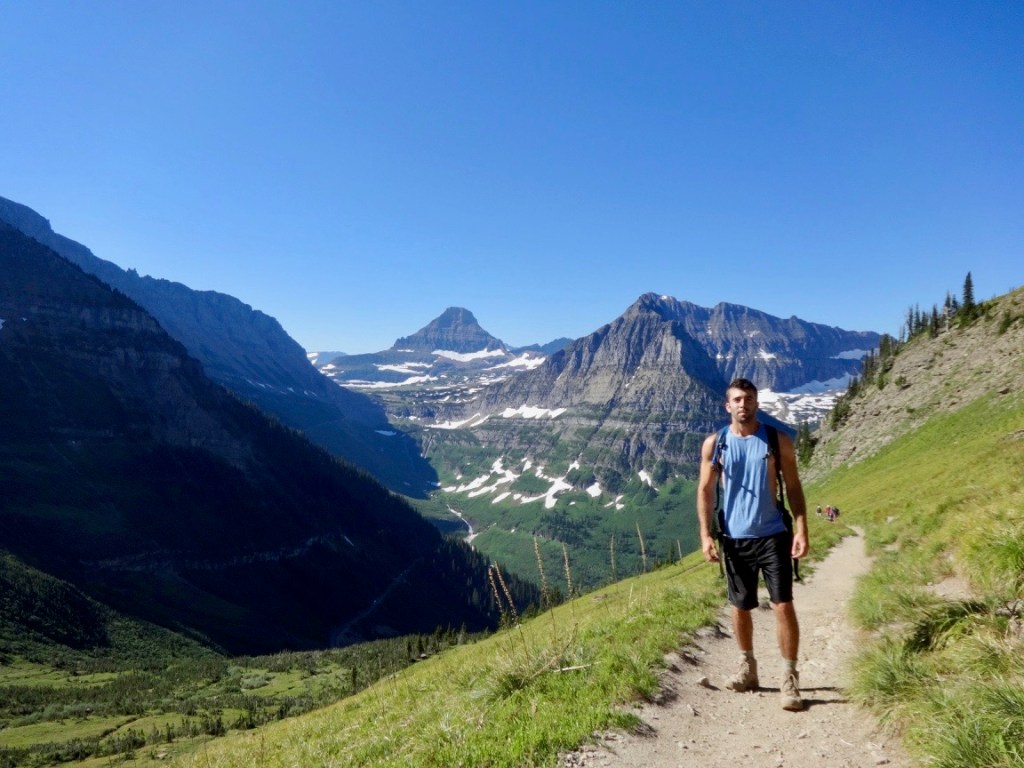
I continued onward calm and quiet in the presence of God on the Highline Trail among the majestic mountains and alpine meadows. For a while I escaped the turmoil of my condition. I had distractions.
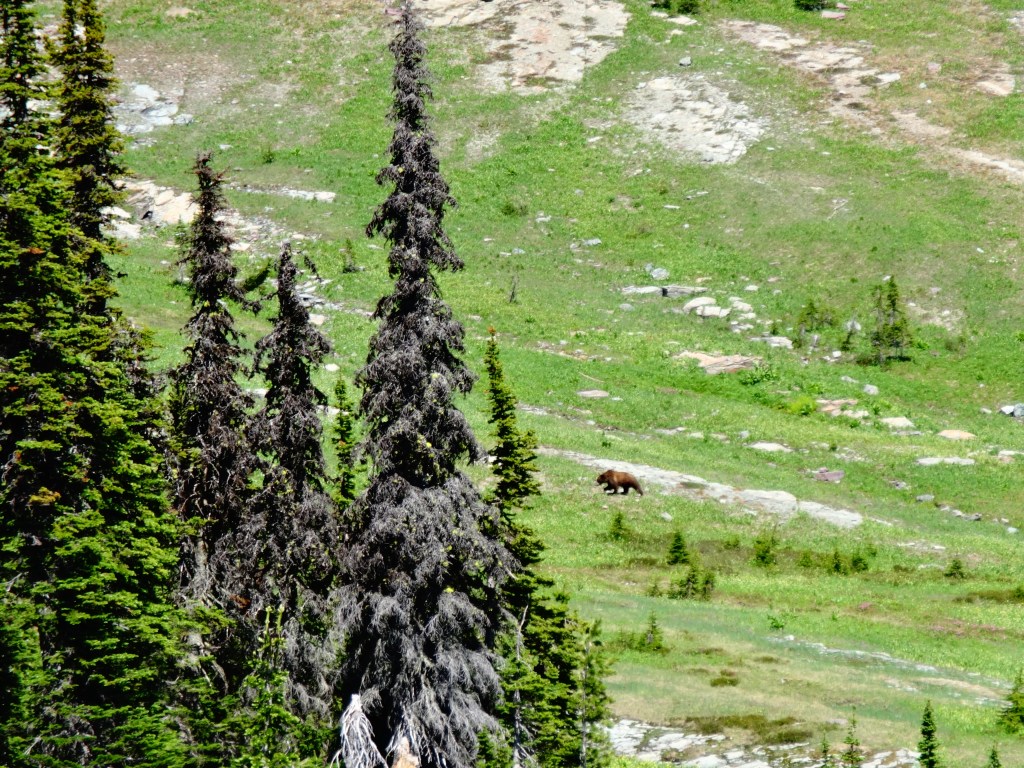
“Look there are two bears,” another hiker called out. Sure enough, pretty far in the distance, but still visible with the naked eye, two big grizzlies grazed on the mountainside. This was my first grizzly bear sighting!  I was approaching the Granite Park Chalet. Here hikers lucky enough to score a spot can stay in the rock chalet overnight. I was only there briefly, observing the bears and heading descending four miles to The Loop. 

Just in time I caught the last bus back down to the Apgar Village. I was the only one there at the bus stop. I didn’t realize it was the last bus until the bus driver told me how lucky I was. I was exhausted. I had hiked around 15 miles in total, and my legs were very heavy. Although I had completed it, I went through such physical desperation and anxiety with my colitis, that I in many ways felt defeated by this hike. I enjoyed it in some short spurts, but mostly I was in survival mode. I didn’t conquer this trail. It got the best of me.  

The rest of the evening was relatively relaxing. There were other great distractions from my illness and my body was for the most part at peace. One such distraction was my visit to  the Lake McDonald Lodge built in 1913. It’s a National Historic Landmark and built in the beautiful Swiss chalet-style. Inside it is composed of rustic National Park Style architecture, in which design elements mirror the natural surroundings. It featured exposed rough wooden logs as beams, and railings and fixtures carved of rough planks and tree branches. It had a coarse stone floor and taxidermied animals of all kinds all over, including elk, moose, and goat to name a few. Great big murals of mountain landscapes and native americans adorned the walls, and an enormous chandelier of Native American lanterns, painted on in a petroglyph manner, glowed warm in the otherwise dimly lit space.  
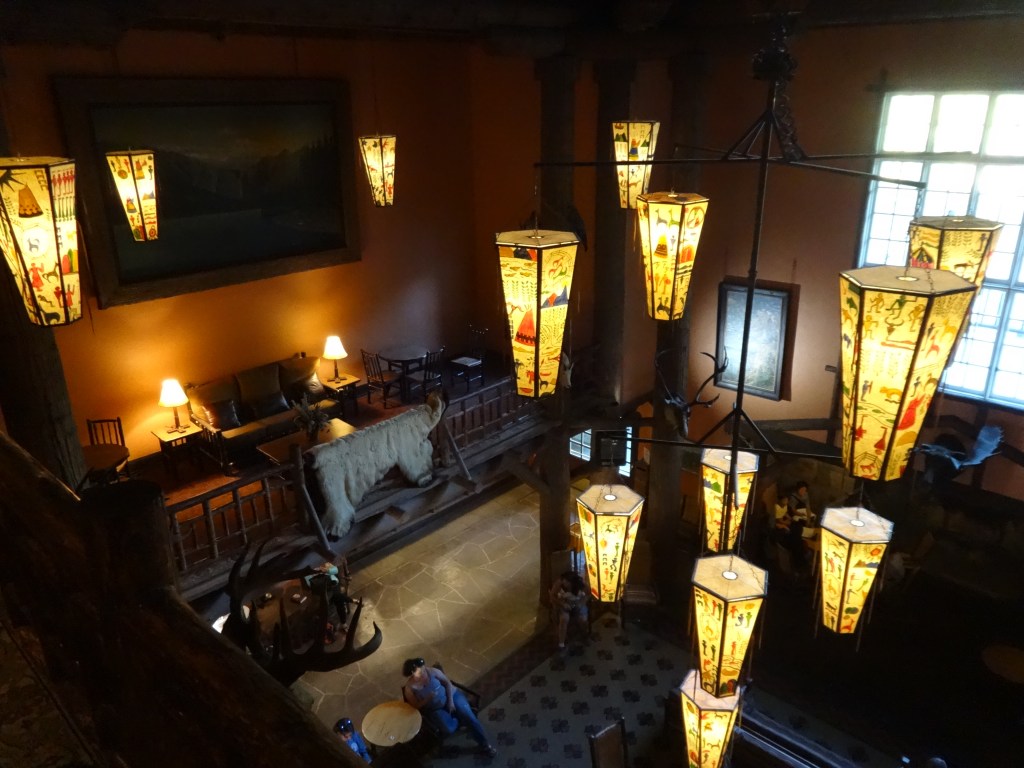
The focal point of the lodge was an enormous stone fireplace and chimney, so big there are benches within the mantle, like a foyer to the fire. The precise term I learned is called an “inglenook.” I’m a big fan.  There is nothing that says northwest North America greater than this lodge. I poked around its three different levels and balconies, observing the art and taking in the extraordinary ambiance. Around some chairs and leather couches, animal furs hung and coffee tables stood on Native American rugs.  Theodore Roosevelt would have absolutely loved this place. It was just his style, and although gentle and calm, it seemed to boastly proclaim such words as “hunter.” “taxidermist,” ”naturalist,” “America,” and “the great outdoors.” I thought about how I’d love to sit here and work on my writing. It would be the perfect cozy and inspiring place to write.   

After snooping around the lodge a bit, I returned to the East Glacier Village and had my first elk burger at Frieda’s. I decided to go full-on tourist and pay a pretty penny for the burger. Its lean and gamey meat was delicious.  It was also relaxing to be waited on and enjoy a full meal after such a rigorous day. Having multiple cups of water brimming with cold refreshing ice was also just what I needed. This evening I felt normal and at peace. The next few days I’d have other moments like this, in that for a while I escaped the reality of my illness, but then at times- something would shift within my body and the feelings of being unwell would kick in with the anxiety and desperation that accompanied it. Over and over again I’d shift from feeling well and carefree then slapped with reality that inside I wasn’t well. I had to come to terms with this reality not just once, but over and over again. In more ways than one, it was exhausting and frustrating, leading me to my fierce early morning run ending in a tearful mess and the feelings of defeat…but I’m not defeated, I’d remind myself. It’s only an emotion. I must live and lead a life above these emotions. Onward!

If you enjoyed reading this, check out my book Still, Calm, and Quiet“

Check out my previous entry here: “God’s Glory in my Suffering (victorious no matter what happens!)”

Visit www.joshhodge.com
Strange Faces, Strange Places

It was the hour to get organized, for it was time to head toward the airport and return Zach to Kentucky where he came from. So we began first-thing this morning. The trunk of the car was just a grand mess of all our things sort of mixed together: the boots, the backpacks, the flannel, flashlights, the park maps, the souvenirs.  We handed things back and forth as we got organized. “This is yours…..This is mine.” We also had to take down the tents and pack up the sleeping bags. It was quite an operation. I wasn’t sure how to feel about all this. Was I to be sad to send Zach off, continuing the adventure by myself? How would that feel after all this time together? Or should I feel happy and relieved to be able to have my solo freedom, to do everything as I wanted to and not have the stress of the complaining and the concern of trying to appease. I guess I sort of shrugged it off. I’ll find out when he’s gone, I concluded. 

Leaving Mount Rainier National Park, we stopped just outside at a little “backpacker lodge.” That’s how I described it in my journal. I didn’t bother to write down its name or provide any details, except that I bought a cup of hot tea and a scone for breakfast. I described it as a “backpacker lodge,” by the part-grungy, part-artsy nature of the place and the few patrons around sporting large backpacks. In writing about this place I’ve examined maps and have tried to locate this place, to give it a name here, but I simply cannot find it. Perhaps it doesn’t exist anymore, or perhaps it is just well hidden on the maps.

In recalling my adventures in the National Parks and the beautiful wild, this is not the only place I visited I haven’t been able to relocate. The very day I picked Zach up from the airport, and we were traveling our way up California on highway 101 in the semi-arid lands, passing by many a vineyard, I came to a sign boasting some sort of self-sustaining community. It was advertised as an all-natural farm working on renewable energy. Its signage read “visitors welcome.” I knew this was the kind of place Zach would like to see. So, I pulled off the road. This was for him. He seemed excited to see it. We pulled onto a dusty driveway. The land was dry and the sun was harsh. A box stood at a post with a suggested donation listed. We threw in a few dollars. I should have known better…Well, honestly I had no idea what was in store. 

So this was this little commune of various buildings and paths between them we could walk around on. We weren’t quite sure where we could go, or what we were to see. There was some interesting makeshift infrastructure, networks of homemade irrigation systems, green houses, lots of plants hanging around, buildings that were constructed…um…what’s the word… creatively. It was kind of intriguing, but then we came across a local. He was a middle-aged man, leathery, wrinkly skin from too much sun exposure. His hair was dirty and matted; his shirt only buttoned up halfway to show off his collection of hippie necklaces. He was super friendly and talkative…because he was drunk. The first piece of evidence was the smell on his breath. He welcomed us, and gave a slurred introduction to the grounds. He wanted to show us his home that he built himself. It was a hut, made of dirt clay and glass bottles. I’ll admit it was impressive. It even had some nice windows built into it. It had to have been a lot of work, but after I briefly saw it. I was done. I was done listening to him curse like a sailor so casually and I was ready to go! But he kept talking and talking. When we did get away, I made a comment to Zach about how drunk he was, “…and high,” Zach added. I hadn’t picked up on that, but it’s because I hadn’t been exposed to enough high people to know what that sort of behavior looks like. Then a notion started to dawned on me: I think we are on a marijuana farm. Again, I was done. I wanted to get out of here. Before we left we did go into a gift shop, which was surprisingly nice and put together, not very reflective of the jury-rigged nature of the rest of the place. By observing the type of merchandise my suspicion grew stronger.  

That was weird. We carried on. 

As I’ve gone back to maps and the internet to try and find this place, learn more about it, to confirm what exactly it was, and to give it a name, I can’t find anything. Perhaps that’s intentional, and that’s fine, because I really don’t care to know more. What I do know is that it was in California, and they can have it, and they can keep it. I suppose all I’ll ever know about it is what I remember. Just like the backpacker lodge outside Mount Rainier National Park, that’s all I got. 

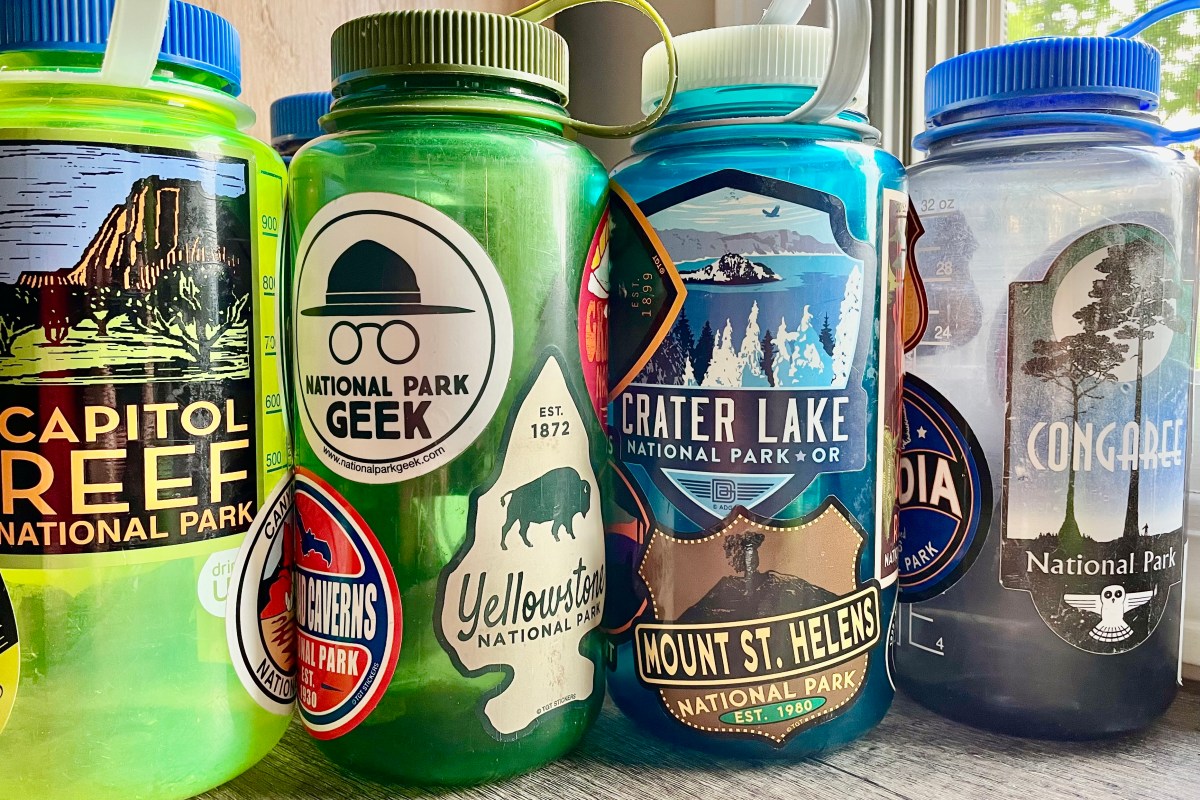
After our brief stop for breakfast we only had a couple hour drive to the Seattle-Tacoma airport, so as we got close we made a few stops. Zach wanted to visit a Target to return a Nalgene bottle he had bought toward the beginning of our ttrip together. I have a tradition on my summer-long vacations to get a Nalgene bottle and sticker it up with stickers from each park I visit. I had a neon yellow bottle for stickers for my Southwest adventures I write about in my book Canyonlands: My adventures in the National Parks and beautiful wild. I have a dark green one with stickers from the Still, Calm, and Quiet: More adventures in the National Parks and beautiful wild summer, and I have two classic blue ones from parks I’ve visited on various smaller trips back in the Eastern United States. For this trip I had a dark turquoise bottle sporting my stickers. Zach had learned of my ways and wanted to do the same. Imitation is the sincerest form of flattery, as they say, so I liked that he wanted to copy me, but the Nalgene he had bought earlier on the trip had a plastic casing around it that must have, at some point, melted onto the bottle and now could not be fully separated. So he wanted to exchange it.

I also let Zach pick where to have lunch since it was his last day on the trip, and he was always the one with the large and urgent appetite. It’s definitely telling that we were no longer in the wild when he chose ihop. We were in the city of Tacoma next to Seattle. It was my first time eating at an ihop. I was surprised to learn there was more on the menu than just pancakes. 

In the later afternoon it came time to take Zach to the Seattle-Tacoma International Airport. I parked and we went inside. He checked his bag, we said goodbye, and he quickly made it through the TSA security checkpoint. I did feel a poignant sadness. As much as he frustrated me, I felt this heavy aloness set in. It was the realization that I was so far away from home and now all alone. Why should this bother me? I’ve traveled so far away so alone so many times. But as I saw him move past security towards his gate, I knew deep within me, our friendship wouldn’t recover from this trip. Our friendship was built over a love for the outdoors and recreation. Those are great things, but they can also be superficial, especially when we view nature so differently. I view it as God’s design with purpose, intention, and messages which it beholds for mankind to draw closer to Him. Zach didn’t share that view. I also value human life so greatly much differently than Zach. We argued about this. He saw human life as too abundant and in need of being lessened. This sat so incredibly unwell with meI saw it all as sacred and designed by God with even greater purpose. Humanity is God’s most prized possession. Yes, possession. We are His. I felt I couldn’t bring up these deeply held views of mine. They would cause further arguments. Zach saw human life as too abundant and needed to be lessened. 

There also was no peace in this friendship. There was complaining and conflict and never a sense of security. We were not kindred spirits. We didn’t share any weightier values. At this time in my life I was too young and immature to realize that perhaps I could be an influence upon Zach’s life, but when it comes to forming friendships it takes a great deal of effort for me to form them. I also don’t throw the word friend around casually. I take the term friendship quite seriously. In recent years I’ve been very conscious of my use of the term “friend” versus “acquaintance.” I will only use that term friend for a true kindred spirit, for someone I can rely on, whom I share great values with, whom I am willing to get behind and advocate for in life, and someone who is willing to do the same for me.

I also believe friendship is a design of God for us to build each other up spiritually. The Bible has a lot to say about friendship. Take into account Proverbs 18:24, “One who has unreliable friends soon comes to ruin, but there is a friend who sticks closer than a brother. Then Proverbs 17:17 reads, “A friend loves at all times, and a brother is born for a time of adversity.”  Lastly, I’d like to mention Proverbs 27:17, which I also think has a lot to do with friendship. It reads, “As iron sharpens iron, so one person sharpens another”. What I thought was a friendship between Zach and I was not reflective of any of these verses. 

We are all wired differently. It takes a deal of effort for me to create friendships. There’s this effort of really putting myself out there and sharing of myself that doesn’t always come naturally. I do it and delightfully so when I see the potential for a fruitful and lasting friendship. In such instances it encourages me. I get a great deal of energy from it, and my life is enriched, but to put forth the effort for a friendship based over a mere superficial hobby for nothing of substance, is exhausting. I am not saying that the way I maneuver friendship is the best and that my views are even the best for me. I find myself often to be solitary, lonely quite often. I suppose if I didn’t take friendship building so seriously, but more casually, and I put forth effort to connect even over the shallow and superficial things in life, I may have more people around me. Maybe I’d be less lonely, but also being surrounded by people on a shallow level of commonality I think is exhausting. I would probably feel even more lonely to be surrounded by people who do not share my values and outlook. I do say, that because I do take friendship so seriously, that the people I do invest in that I truly call friends mean a lot to me. I am very rich because of that, and maybe I feel a richness of friendship that some people do not, and for that I am very thankful. 

As Zach was now gone on his way back to Kentucky, a whole different mindset had to set in. I had to shift from accommodating another traveler, to just looking out for myself. I was free! Not gonna lie, this is what I wanted. 

Leaving the airport, I was able to quickly adopt the new mindset of being alone and free! The next leg of my journey would take me to North Cascades National Park, but tonight all I had to do was drive two and a half hours to a KOA northwest of Seattle, so I didn’t have to be in a rush. Therefore in Marysville, Washington, a suburb of Seattle, I stopped at a Planet Fitness. The original plan was to take a shower there, but then I realized I could just shower at the KOA tonight, and so I just enjoyed a workout. Normally I focus on one certain muscle group per day at the gym, but since I hadn’t been to a gym in a while, I decided to just do a little bit of everything. 

At this point in my life, I still hadn’t made the switch from the flip phone to the smartphone. I had an iphone, a cheap one, just to take photos and connect to wifi when the opportunity allowed. I needed to take the iphone into Planet Fitness and connect to the wifi to make a payment through mobile banking. In between sets I was trying to remember a password, reset a password, select all the images of stop-lights, get a confirmation code through the flip phone, translate that over— all of those technicalities. 

Next to the gym was a local thrift store. It was pretty large, and I was excited to check it out. Maybe I can find some fun camping gear. I’d really like to find a skateboard. That isn’t something I could have packed in my suitcase. Maybe I can find some good CDs for some different travel tunes. Since I hadn’t made the migration from flip-phone to smartphone, I also hadn’t made the switch over to digital media. I had no such luck with any of these hopes, but I did find an Under Armour base layer that would come in handy during the cold nights and mornings up in Glacier National Park. Leaving the thrift store, I did notice a couple homeless people loitering around the parking lot, one pushing a shopping cart as if it was a caravan. The way they acted, their demeanor, made it evident they were drug abusers. It was nice to get a workout in, and to wander around the thrift store, but the druggies were a stark reminder I was in the city and I wanted to be back in the wild. 

I got in the car and made my few hour drive to the KOA campground. After zipping up interstate 5, I was on highway 20 heading east along the Skagit River. Urbanization waned, and gradually more forest set in. I knew the KOA wasn’t going to be anything fancy in terms of KOAs. It was just a basic one, but all my experience with KOAs thus far had been good. Making the turn into  the KOA I was surprised to find that it was gated, and I had to press a button to open the gate. I went to the office to check in. The host seemed a bit frustrated. She went over the usual rules and explained how the gate will be located after 10pm. I wondered why this KOA needed such a security measure as a locked gate. We seemed to be in a pretty rural area, and back in nature, which is generally a safer place to be. It’s not like we were in a city. She pointed on the map where my campsite was. It was the furthest away at a dead-end road. “There was a picnic table at your campsite, but we’ve been having a problem. Some people entered in from the woods and stole the picnic table, dragging it off into the forest.” This explained her frustration, and now I knew why there was a locked gate. But who comes from out of the woods and steals a picnic table? It seemed so odd. I wasn’t bothered by the fact I wouldn’t have a picnic table, but it was unsettling that people come from out of the woods and steal things. 

I drove down the gravel path where it dead-ended at my campsite. I was farthest away I could be from any other camper in this campground, isolated. I stood there at my site and looked into the forest imagining some strange forest people emerging and scoping out what they could glean. Where were they coming from? What’s in those forests? Not having made the smartphone migration, I wasn’t accustomed to using any digital maps to check out my surroundings, so I just looked at that forest with a mysterious wonder, imagining people dragging picnic tables into its depths. Those were unsettling thoughts.

I drove back to the “recreation center” as it was called. It was like a community center in the campground next to the pool. There was a water dispenser and plastic KOA cups. I was a KOA fan and had never seen a KOA cup before. They were obviously meant to be taken. Souvenir! There I sat at a folding table, cracked open my Chromebook, connected to the wifi, and began transferring some of the photos from my point-and-shoot camera’s SD card to the Chromebook for backup and also to share some photos online. What an adventure thus far, from the Mojave Desert to the North Cascades in the Pacific Northwest. It was very relaxing to sit there for a while, and I was at great peace while looking at all these beautiful photos I had taken on my journey. I also proceeded to take a shower and was all refreshed and reset. Then I hopped back in my car and drove back down the dead-end to my campsite.

It was dark now, so there was a certain mysterious ambiance in the air. I stood there on the tent pad in the silence, alone, looking at the forest again. The host’s words reverberated in my ears, “Some people came from out of the woods…and stole the picnic table, hauling it into the forest.” I imagined them now hauling a body into the forest. I did not saunter over a decision. There was an unsettling vibe here. It was not strange enough to cause me to leave, but I was going to sleep in my car, and so I did. 

If you enjoyed reading this, check out my book Still, Calm, and Quiet“

Check out my previous entry here: Really, What Kind of Mountain Are You?

Visit www.joshhodge.com

Gas Pump in the Wild

I wasn’t going to let this happen again– the stress of nearly running out of gas. We were still on our visit in Olympic National Park in Washington, but as access to the park was split up by various types of land allotments, now we were on a small piece of Indian reservation at a gas station in front of a casino. I noticed the price was $3.19 per gallon which seemed cheap after braving the gas prices elsewhere in the Pacific Northwest. I’d notice in a few days gas prices plummet leaving Washington into Idaho and Montana, which was not much of a curiosity considering the states’ politics and their effects on their economies. Here at the Indian reservation casino gas station I filled up. When I went inside the gas station convenience store, I was surprised by free coffee and tea. I got a cup of orange spice tea to calmly ease into the morning. Then we were back in the car for a short drive into the park to the Hurricane Ridge area.

A few days prior, leaving the Chateau at Oregon Caves National Monument, driving through the long expanse of national forest, we were low on gas. We were also in a very remote area, and when we finally reached an isolated gas station there was a sign that read “cash only.” We had the cash but perhaps were here too early, for no one was working. Zach couldn’t use his phone to look up the next nearest gas station either, because we were out of service range, but I was able to search in my GPS. The next nearest gas station was thirty miles away! I wasn’t sure if we would make it, or if it was even en route, but it was the only option unless we were to wait a few hours to see if someone would show up to work at this gas station. What if they didn’t? It would be a morning wasted.

So we journeyed on. There was an uncomfortable silence in the car. I probably wasn’t the only one questioning my judgment. Out the window was merely pine tree after pine tree- no people, no cars, no buildings, just the forest and us. Mile after mile, it was all in uniform, and the road was straight and unending in the dark morning forest. It made me wonder if we were getting deeper in the wild, further from any civilization. Normally I’d like this, but not without gas! There was more and more of the same drawing on, and according to the vehicle’s interface, we were out of gas. Yet we were still moving.  I was starting to feel the regret and dread of relying on this GPS. It seemed to be leading us astray, then…

“You have reached your destination,” the GPS sounded. As my journal details, I didn’t think this was in operation, but I pulled up to the singular pump. There was no store and no booth, but attached to the gas pump was a curly coiled wire phone. Zach pointed to the sign.

For gas dial 1,” it read. We looked at each other with probably the same thought. We were puzzled. What’s going to happen? We hadn’t seen anyone, just trees for dozens of miles. Was someone or something going to pop out of the forest and pump our gas? Is this sasquatch’s gas pump? I opened the car door and stepped out. The forest was silent. I lifted the phone and held it to my ear. To my surprise there was a dial tone. I punched in a “1.” It rang!

Hello,” The muffled voice came through the receiver.

“Hi. I was wondering if I could get some gas.” I believe I was too puzzled and confused to have even considered the pleasantry of bidding a “good morning.”

I’ll be right there.”

This might actually work.

We waited, looking around with suspicious anticipation in every direction.

After just a couple minutes, we saw a golf cart coming down the road- our rescue!

A pleasant older man in flannel and blue jean overalls asked how much gas we wanted. I handed him a $20. “Sorry about the wait,” he apologized, although it wasn’t much of a wait at all. “I had to find my keys at the lodge.”  I concluded there was some lodge I was unaware of, and this was their gas pump. The golf cart was used to travel around their property. 

“No problem,” I responded. “Thank you.” 

And we were on our merry way.

That was four days earlier, and I wasn’t going to find myself stuck in that sort of situation again, and that is why I filled up. In the far remote West, with distances so grand and gas stations so rare. Every opportunity to fill up should be carefully considered. Take advantage of any gas pump in the wild. 

We eventually reached the Hurricane Ridge section of the park. We were getting ready to hike about seven miles to Klahhane Ridge. There was a visitor center, and of course I had to go in. There wasn’t much to see for it was a small place. I was engrossed in the literature, the books for sale, while Zach found a binder on display with pictures and information to identify wild flowers. He studied up on the flora for the day. I ended up buying a book about wolves. The cover of the wolf’s piercing stare drew me in. Back at the car, we geared up for a beautiful hike on a trail loaded with wild flowers, majestic view, and lots of wildlife (but no wolves). 

And experience with the gas pump inspired me to write this song…

Ode to the Gas Pump in the Wild

Driving through the wild, beneath the towering trees,
Feeling the stress as the gasoline quickly depletes.
In Siskiyou National Forest, a land so vast and grand,
But stranded in the woods, was not what we had planned.
Miles of pine trees, stretching, nothing in sight,
Will anyone be our rescue, or will our day turn into night?

O gas pump in the wild, like a lifeboat in the sea,
Rescue us from drowning, would you pretty please?

Then a glimmer of hope, a steeple in the pines,
A chance to refuel? Hopeful as a child.
With a phone on the pole we dialed for our need,
And from the forest’s depths, came our lovely savior’s steed.
A golf cart in the distance, rolling into sight,
An old man with a smile, making everything alright.
In flannel and overalls, this man helped save the day,
He powered up the gas pump and sent us on our way.

O gas pump in the wild, like a lifeboat in the sea,
Rescue us from drowning, would you pretty please?

In the remote West, where gas is rare and few,
Seize every opportunity to safely see you through.
If it’s just a little gas pump, hidden in the trees,
It may be a lifeline, setting you at ease.
So now we hike the trails, where the wildflowers abound,
Learning of the animals of which us surround.
Here at Hurricane Ridge is where we will happily be
With gratitude to the gas pump forever endlessly.

O gas pump in the wild, like a lifeboat in the sea ,
Rescue us from drowning, would you pretty please?

Gas pump in the wild, a sanctuary found,
In the midst of nature’s bounty, you wear the crown
With this adventure’s end, there’s a story to compile,
Of a journey’s uncertain detour forever worthwhile.
So here’s to the gas pump, a tale to be told,
Along the Rogue River, where memories unfold.
Of a certain lonely gas pump, that will always be
In my adventurous heart forever endlessly.

If you enjoyed reading this, check out my book Still, Calm, and Quiet“

Check out my previous entry here: “The Rainforest and the Bear”

Visit www.joshhodge.com
Everything to Know About Joshua Hodge’s New National Park Book

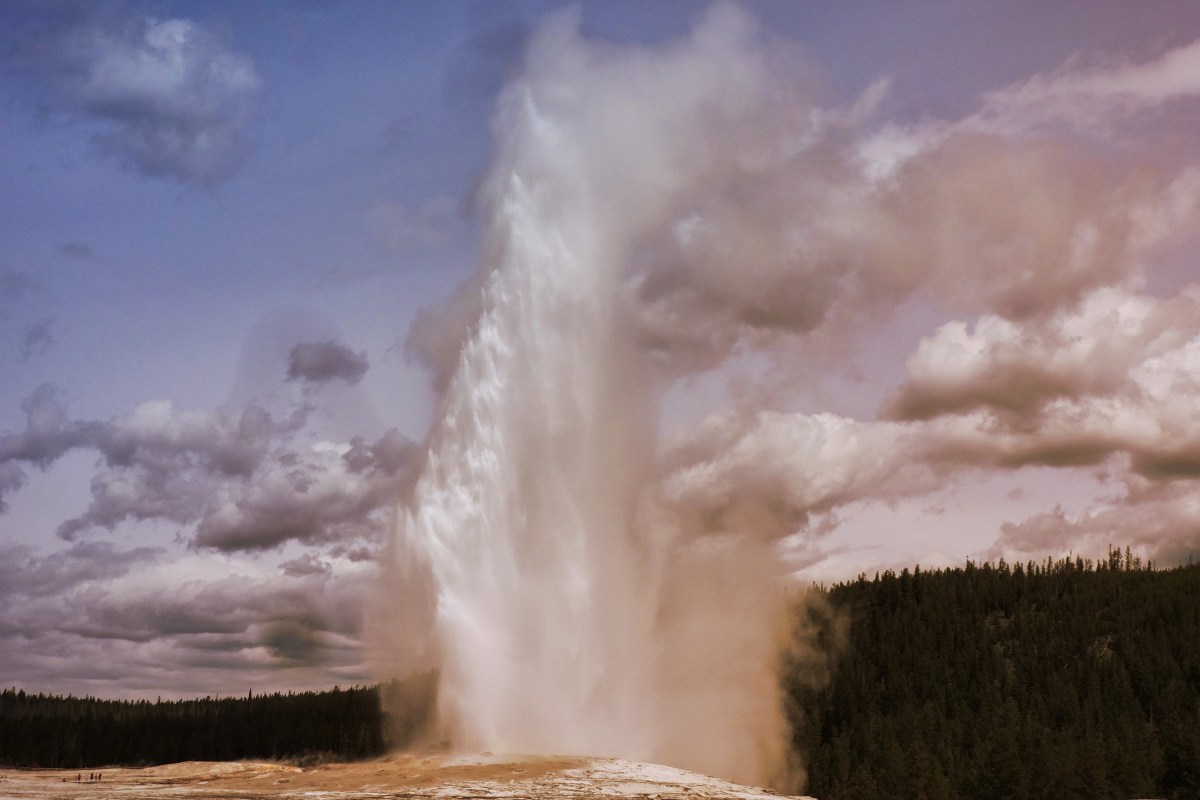
My new book is here! What is it about and why should you read it? I want to address this questions and more, so you really know what’s up with this book and why I’m so excited. 

What is this book about?

This book chronicles a month-long adventure of camping and hiking in the U.S. National Parks in the summer of 2017. It features humorous and adventurous accounts, and descriptions, of the natural world, and it explores the inspiration gleaned from such experiences. It also explores the question of, what should be our response to natural beauty and the craftsmanship of God? It is not only an account of the physical adventure, and the things learned along the way, but also a look into my mind and the thoughts I have as a solo adventurer.  

Why did you write this book?

Back in 2016, after another summer of adventure and being so inspired by my experiences,  I started blogging. I realized I had a lot I wanted to share from my past adventure. As a writer, I used to write more fiction, but I realized my real life adventures provide all the engagement and entertainment one seeks in a good story. I came to find an audience online that appreciated and was inspired by my writing. I also had things I learned that I really thought others could benefit from, and not only that, but I wanted to inspire people to get out and come to realizations on their own. I decided to refine and compile what I had written, as well as include additional pieces, to create my book, Canyonlands: My adventures in the National Parks and the beautiful wild. I knew from the very start this would not be a stand-alone work. Still Calm, and Quiet: More Adventures in the National parks and the beautiful wild is the second installment in this series. 

Should I read Canyonlands: My adventures in the National parks and the beautiful wild first?

I would love it if you read Canyonlands, but you don’t have to read it to enjoy Still, Calm, and Quiet. In its intro and opening chapters, Canyonlands gives a little bit more background and provides more of the logistical details of my travels.

Who published this book?

I am my own independent publisher and own all rights to my work. I design and format my publications. By meeting publishing standards, I am able to work with Amazon for printing and distribution. 

How long did it take to write this book?

I began writing this book in 2019, before Canyonlands was published. It has taken me about three years. I had some journal entries and writings written during the 2017 travels that were incorporated into chapters of the book. 

What makes this book unique?

This is very much a variety book. In addition to my adventurous accounts and exposé of inspiration, this book includes two biographical works, a fictional piece, a couple poems, over 100 black and white photos, and dozens of vintage illustrations. It has some great stories of me passing out, encountering a mountain lion, getting caught in a lightning storm, having my camp attacked by squirrels, being stuck in a buffalo jam, getting lost on a mountain, and much more! 

Where can I buy this book?

Currently this book is only available on Amazon and is eligible for regular and Prime 2 day shipping. In a few months it should be available from walmart.com and other online retailers. Buy here: https://www.amazon.com/dp/B093RMBNCP


Is this book the same collection of stories found on your blog?

Some of the stories are the same as the ones found on my blog, but they have been refined, reedited, and augmented. A number of them are not and are only found in the context of this book. As one of my blog readers, you will find this new and fresh.

What are the parks featured in this book?

Chiricahua National Monument (AZ)

Fort Davis State Park (TX)

Big Bend National Park (TX)

Rio Grande National Scenic River (TX)

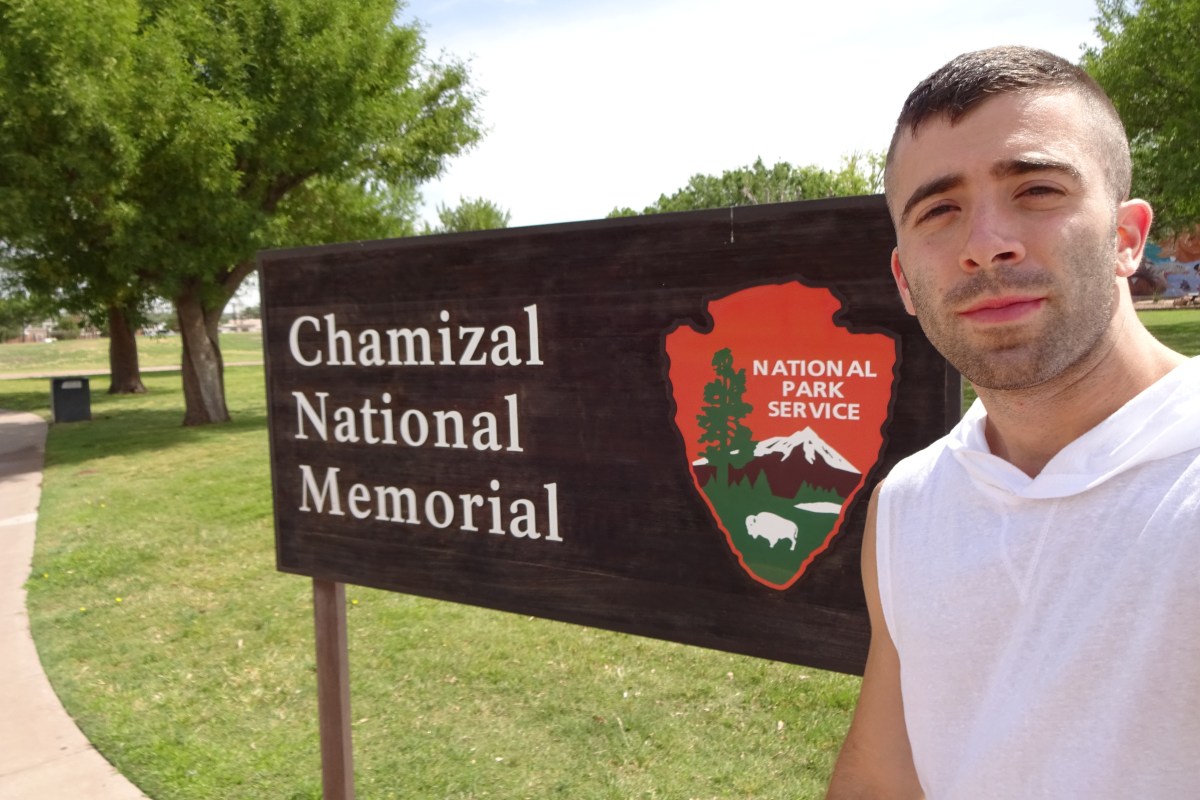
Chamizal National Memorial (TX)

White Sands National Park (NM)

Guadalupe Mountains National Park (TX)

Carlsbad Caverns National Park (NM)

Dinosaur National Monument (UT/CO)

Grand Teton National Park (WY)

Yellowstone National Park (WY/MT)

Bruneau Dunes State Park (ID)

Craters of the Moon National Monument (ID)

Wild Horse State Recreation Area (NV)

Rye Patch State Recreation Area (NV)

Lassen Volcanic National Park (CA)

Shasta State Historic Site (CA)

Whiskeytown National Recreation Area (CA)

John Muir National Historic Site (CA)

Is this book content appropriate for all readers?

Yes

What other books have you written?

Wild Christmas (2006)

Dakota Broken (2015)

Among Blue Smoke and Bluegrass (2018) 

Canyonlands: My adventures in the National Parks and the beautiful wild (2019)

Señor Hodge’s Casa de Mascotas (2020)

Theodore Roosevelt for the Holidays: Christmas and Thanksgiving with the Bull Moose (2020)

Buy Still Calm and Quiet here: https://www.amazon.com/dp/B093RMBNCP

www.joshhodge.com
Bears and Buffalos

Bears, they’re gonna get me! I have to keep making noise. “Hey bear!” I occasionally called out as a warning. I had learned you never want to surprise a bear. As I hiked up this mountain I intentionally made loud obnoxious steps, kicking the rocks beneath my feet when I had the opportunity. I was hiking solo up Mount Washburn in Yellowstone National Park, along a wide open gravel trail. 

It’s all quite ridiculous in retrospect, but this was my first substantial hike alone in grizzly bear country. I had no way to gage the threat of a bear attack other than by all the worrisome warnings from the National Park Service through all the trailhead signs and in the park newspaper. Also, just days prior in Grand Teton National Park, bear spray was selling like it was the latest craze. I thought I would buy bear spray, but when I found out it was $50, I guess my thrifty self decided my life wasn’t worth that much. But there also was a bit of doubt that bears were a viable threat to my safety. I once thought rattlesnakes would be much more of a problem in the Southwest than what they are, and then there were the mountain lions. I never had any trouble with these animals. Maybe bears were just one more to add to the list. And bear spray? Really? It sounded like quite a gimmick to me. Fear is a great way to make a buck. I wouldn’t put it past the greedy and sly to overhype the threat of bears and scare people into buying bear spray. Then again I’m prone to entertain conspiracy theories as distrust seems to be my default in what’s new. If bears were a really serious and substantial threat I was thinking the park service would provide bear spray with the price of admission into the park or require people to purchase it. 

Now, don’t take advice from me about your approach to such a situation. This was my very first solo hike in bear country, but in subsequent years, especially during my stays in Montana, I’d hike many times solo in bear country. Have I had bear encounters? Yes, quite a few. Have they ended ugly? No. Most bears just seem to loaf around without a care, but I’ve heard stories. I’ve met people who have been attacked. It’s real, but to what degree is this threat? I still have a hard time gaging it. I now do carry bear spray with me when I’m out hiking in Montana, but after dozens of hikes, I’ve never had to deploy it. 

But here in Yellowstone I was a newby, and although I convinced myself not to buy bear spray by holding onto my conspiracy theory and my $50, I still was cautious, and I became a bit paranoid on my way up Mount Washburn, thinking that the bears could be just about anywhere and were ripe and ready for attack at any moment. In retrospect, I don’t think this particular mountainscape in Yellowstone was prime bear habitat, but at the time, what did I know? I’ve told myself quite a few times when I’m out hiking and taking certain precautions, “better safe than dead.” I use that phrase to justify taking the extra safety measures I sometimes take, but I certainly don’t live by it always. Way too many people are held back by fear, and in being so, they miss out on the richness of life. We must face fears to truly live, but we need to do so with intelligence. Preparedness, strength, and knowhow are great, but the greatest of survival skills is intelligence along with some sense. 

Back to the hike at hand, Mount Washburn was named after Henry D. Washburn who led the Washburn Expedition in 1870 to explore Yellowstone and make detailed maps and observations which would eventually be used in designating it a National Park. The expedition is described in Nathaniel P. Langford’s book, “The Discovery of Yellowstone Park.” I chose this hike because I was craving a mountain top view, a manageable day hike, and the guide book I was following had it in the itinerary. At six miles round trip it was quite manageable. It was three miles up, reaching 10,243 feet and a quick three miles down. The hike was very much out in the open and trailed what looked like, at times, a road. It probably served so for the fire lookout at the top. The mountainside was mostly rock and grass, but there were also large stretches of dead trees, mostly light grey and barren like driftwood, others charred dark from forest fire. Across the landscape in the distance were many valleys, rolling hills, and wild planes with pockets of trees tucked in here and there. Further up the hike, large snow drifts spilled onto the trail. Then snow was everywhere. Alongside me a thick pine forest stretched out in the great expanse and climbed up other mountains ladened with snow. Fluffy rounded clouds contrasted the rich blue of the sky and cast shadows all over the wide landscape. Purple fringed gentian bloomed along the way, seeming to delight in the cold but sunny mountainside.

At the top a firetower stood and a sign marked the elevation. The view atop was nothing outstanding from the views all along the way up: rolling hill after rolling hill, pine forest, dark shadows cast by the clouds, and mountain peaks of snow in the distance. Most everything was painted a shade of blue from the sky’s reflection on the terrain. I satisfied my mountaintop craving, but realized Yellowstone is perhaps better explored by means of its geothermal features, rivers, and lakes below. 

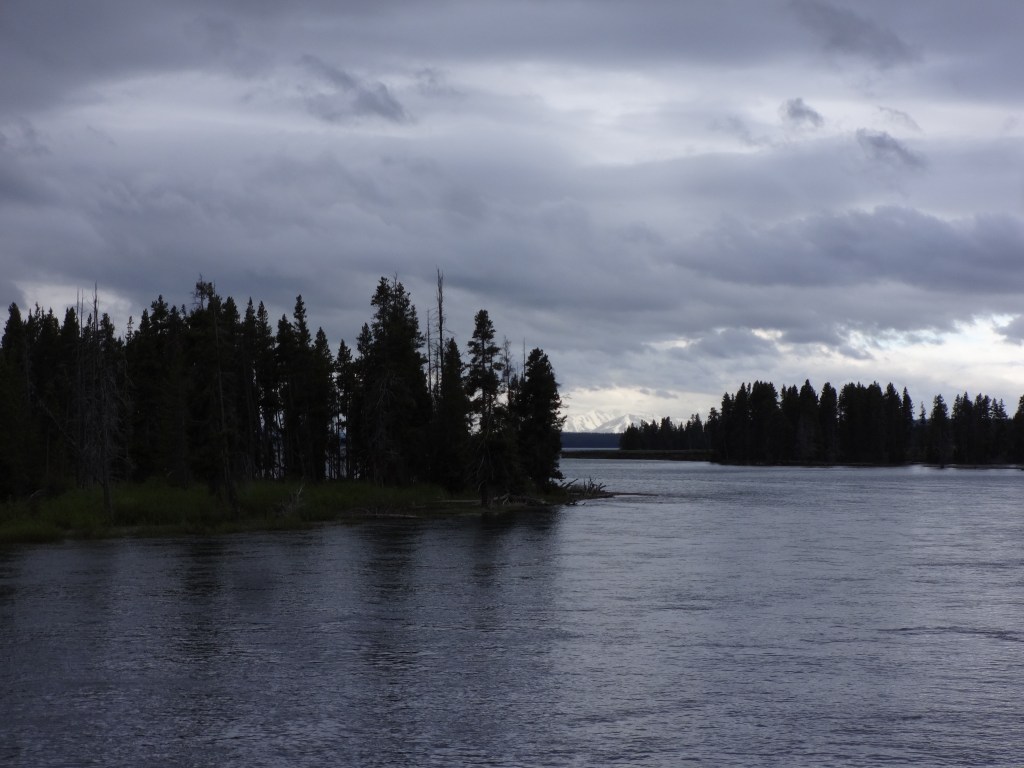
Once back at the car, and safe from all bear encounters, I’d drive over to the Grand Canyon Village once again for dinner, then I’d pass by Yellowstone Lake at sunset on the way back to my campground. On the side of the road opposite the lake, water flowed into a little pond. I pulled over as I observed the most stunning display of colors. Vibrant deep blue and orange, cast in the sky by the sunset, reflected into the pond with the dark silhouettes of trees. It was the most beautiful deep and rich display of colors. I really savored this view and the moment. 

This was not the only time I made a spontaneous pull off to the side of the road because beauty caught my eye. I had done it quite a few times throughout my stay in the park. Usually if one sees another car pulled over at a seemingly random spot, it’s because someone spotted some wildlife, and soon cars began to pile up. In this fashion, on a later trip to Yellowstone, I’d see my first wolf. At one point this day I pulled over because I noticed some beautiful flowers, and I wanted to take their picture. Then a number of cars slowed down, some pulled over. “What do you see? What do you see? Is there a bear, a buffalo?”

“No, I’m just taking a picture of some flowers,” I responded. They seemed disappointed, dismissed me and drove on. Oftentimes, in a quest to find the biggest or most shocking feature on the land, some people miss out on the exquisite detail of the smaller, finer things, like the flowers along the way, or the colors of the sunset reflected in the waters.

When I reached my campground I had completed a full day. Hiking up Mount Washburn was one of the final things I did. I had also visited the Mammoth Hot Springs area earlier and took in the unique stacks of thermal springs. I took a self guided tour of Fort Yellowstone at Mammoth Hot Springs where the U.S. Army was stationed to patrol the park in early days. Now the buildings which constitute the fort are ranger residences. My mind was captivated with the thought, and I daydreamed, of  what it would be like to call this place home. These buildings were homes. People lived here, had families here, had cookouts in the backyard as children played. Inside was their furniture, their things. This was their home, and it was in Yellowstone! How incredible! On a side note- something that rightfully needs to be documented, for it changed my life- here in the Mammoth Village I discovered huckleberry licorice, which would go on to become my favorite candy.

After visiting Mammoth Hot Springs, I visited Roosevelt Arch, and stepped foot into Montana for the first time. I then took Blacktail Drive, a scenic park drive on a gravel road. It was quite serene and I saw quite a number of buffalo there. I also took in the Calcite Springs Overlook. Midday I found myself sitting on a rocking chair on the porch at Roosevelt Lodge. This lodge and cabin complex was built in the 1920s at the site where Theodore Roosevelt once camped by llamar valley. It is rustic and has a lot of warm charm. I had already eaten and was not hungry, but I looked at the menu at the lodge. I saw a cozy dining room while a fireplace crackled. The buffalo burger on a corn bread roll really jumped out at me, and I kicked myself for not waiting to eat here. Someday on one of my journeys between Kentucky and Montana, I want to stop here and have the full Roosevelt Lodge experience. 

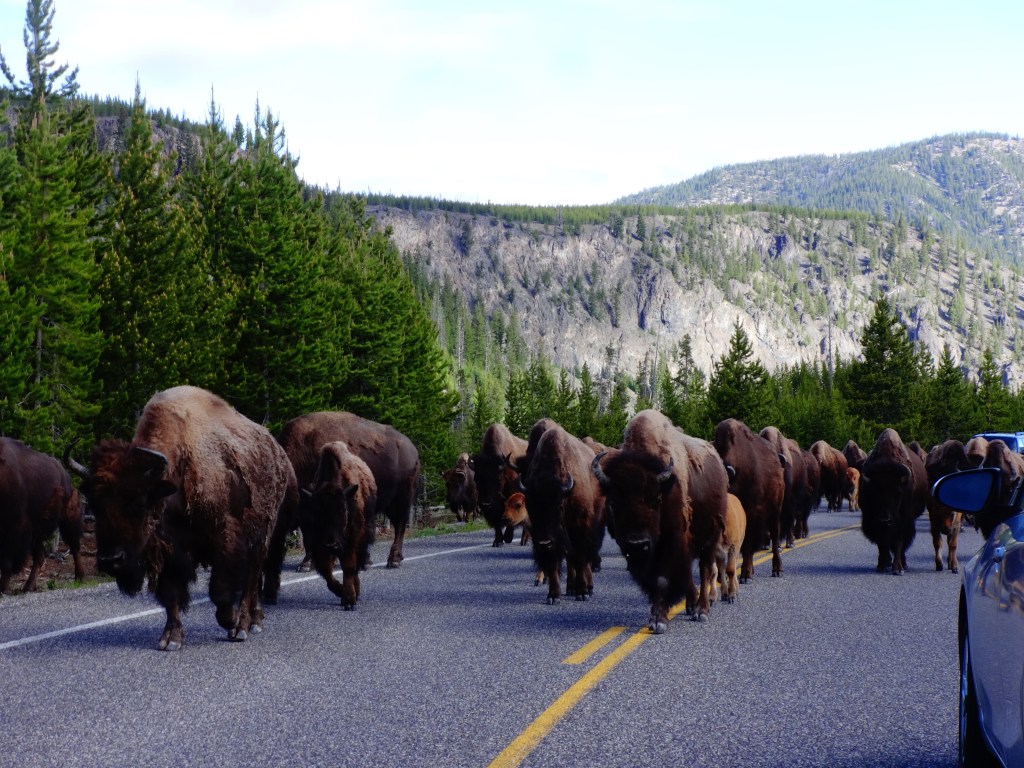
After my third full day in Yellowstone, I felt like I got to know the park, but knew there was much more to see and discover. I would come back and visit again. Next on my summer adventure plan was a stop at Craters of the Moon National Monument in Idaho, but before I left Yellowstone in the morning, I would find myself in a “buffalo jam,” as they call it. At least fifty buffalo overtook the road I was on. I came to a complete stop in my vehicle as buffalo of all sizes crowded around. They walked slowly around my vehicle. It was incredible. I saw buffalo calves for the first time. They look like strange deformed ponies, I thought. At one point a large buffalo stopped right in front of my car. He stared at me through the windshield. He nodded his head toward the right and then the left, and then looked back at me. It was as if he didn’t know he had to walk around the car. Oh No! I then became a bit concerned that the buffalo might try pushing my car or walking up upon it. After a few minutes it figured out the solution was to walk around. I could have lowered down my window and pet it’s back, it was so close. I was thrilled. This buffalo jam was perhaps the most unique and marvelous wildlife encounter I had ever had thus far. More kept coming and coming. I felt so fortunate to be here at just the right moment. I couldn’t have imagined a better crowd to wish me farewell on my journey.

Read the previous entry “Why I Cried at Roosevelt Arch- What Theodore Roosevelt and the National Parks Mean to Me” here: Why I Cried at Roosevelt Arch – What Theodore Roosevelt and the National Parks Mean to Me – on the verge (joshthehodge.com)

Check out my book Canyonlands: my adventures in the national parks and the beautiful wild here: https://www.amazon.com/Canyonlands-adventures-National-Parks-beautiful/dp/1711397873

Providence in Yellowstone

It was day two in Yellowstone National Park. I slept soundly in my tent, despite the campground being full, crowded, and not having much privacy at all. 

On my morning stroll to the bathroom I saw a buffalo walking between two campsites right alongside the picnic table and a RV. I hadn’t expected it. I suppose he wanted to wish all us visitors a “good morning.” It reminded me of one morning in Rocky Mountain National Park when an elk was grazing right alongside a camper’s tent.

It was a cold and overcast morning. Wet clouds hung low overhead. I quickly disassembled my tent and threw it into the backseat of the car. I could only reserve this campsite for one night. Yellowstone in the summer is an extremely busy place. The next two nights I’d camp at the Grant Village Campground. Once in my car, I had some breakfast from my stash of dried foods and began my day’s itinerary as spelled out in my book. My first stop was at the Fishing Bridge. This long century-old log pole bridge stretched over the Yellowstone River just as it forms and flows northward from Yellowstone Lake. Pine trees stand snug at the water’s edge and some inlets give way to marsh. It was a quiet and peaceful place, especially at this time in the morning. I strolled quietly and contemplatively. Then a big bus came to a stop, hissed, opened its doors and a swarm of Chinese tourists poured onto the bridge, equipped for the misty weather with transparent ponchos and ready to take photograph selfies, nearly each one carrying a selfie-stick. 

More so than any other park, Yellowstone seems to be a favorite among Asian tourists. Tour busses full of these well-equipped tourists are found all over the park. In addition, signs in the bathrooms and outhouses instruct foreign visitors on how to use toilets in the United States; the general store at the Grand Canyon of the Yellowstone has an Asian food isle with a variety of noodles; and restaurants in the park seemingly cater to a certain tourist- namely with the noodle wok. Days prior in Grand Teton National Park, on my guided hike around Swan Lake, the Ranger brought this up, explaining how the influx of Chinese tourists is because of the current strong middle class in China. I also think it just must be in particular fashion in China to visit U.S. National Parks. Tour companies are designed for and are catering to this demographic, probably making quite a wealth for themselves. 

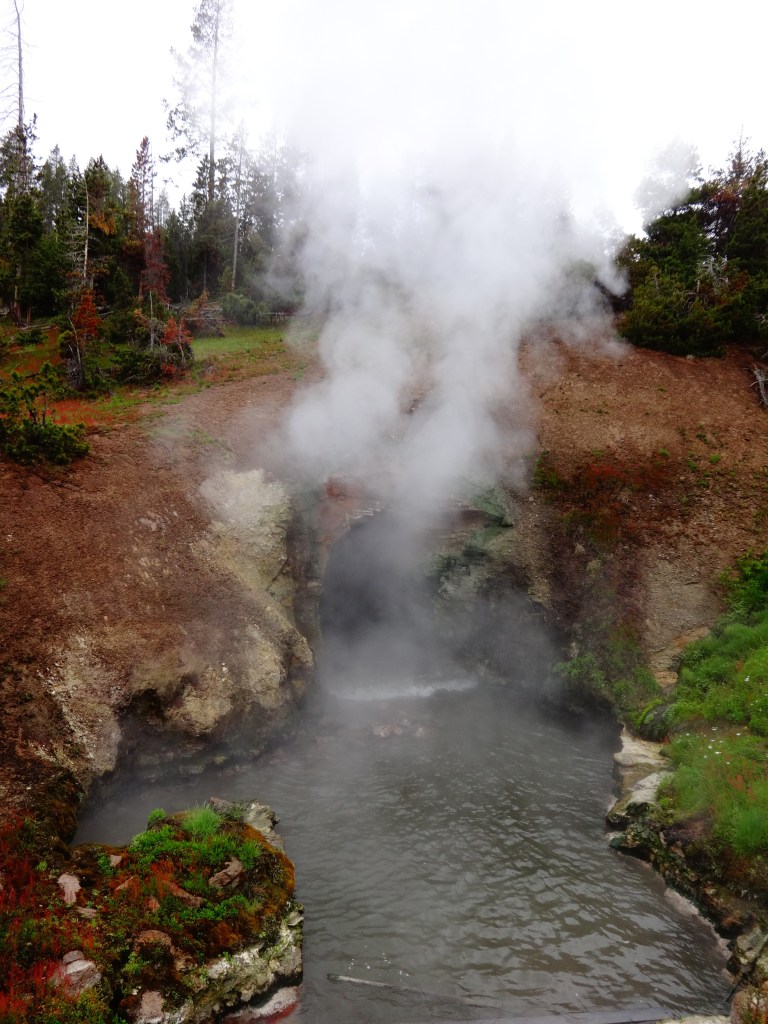
When I left the Fishing Bridge I proceeded Northward and drove a short distance to the Mud Volcano. On my way I saw another buffalo trailing the road. At the Mud Volcano area there was a short boardwalk around gurgling and burping mud pots of highly acidic water that erodes the volcanic rock and turns it into a sludgy thick ooze. The landscape here was very soupy with water sitting, boiling, slowly flowing, and burping up from the ground all around. The most impressive feature here was the Dragon’s Mouth. A hole in an embankment by a thermal pool hissed and gurgled as it constantly let out steam, resembling just what it’s title suggests. 

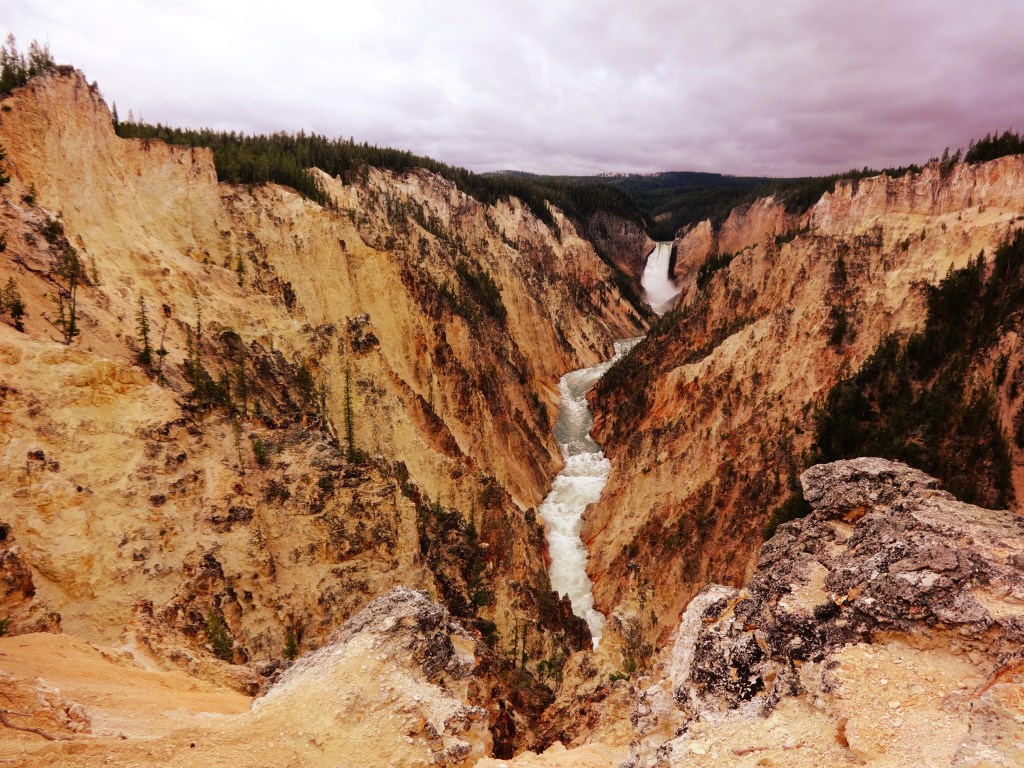
After making another couple brief stops I arrived at the Grand Canyon of the Yellowstone at Artist’s Point. There were crowds of Mandrian speaking tourists, posing in front of the viewspots once again with their selfie sticks. Behind them was one of the most magnificent views in the National Park Service: Lower Falls at the Grand Canyon of the Yellowstone. It is incredibly picturesque. A platform juts out at the edge of the canyon, where crumbling yellowstone is on display traveling down to the focal point of the perfectly flowing immensity of the Lower Falls which is so entirely uninhibited. This is one of those marvels of nature which is hard to take in and gain perspective of. The beauty before you is just astounding. You feel almost as if you are trapped in a painting trying to gain your bearings. Although I was surrounded by people, I tuned them out, and my mind and eyes became fixated at the wonder before me. Captivated would be the most appropriate word. All the sounds and clutter around me dispersed, and I was still, calm, and quiet to my perception. What a wonderful piece of artistry- truly striking- not happenstance but designed. 

Then… “Take photo?” asked the tourist in broken English. “Sure,” I replied. When I was done taking the photo I turned behind me to look off the other side of the observation platform to the peculiar display of the canyon walls which slid diagonally down towards the river from a definite abrupt edge of pine treeline. Colors were on strange display here in nature’s own pink and yellow drooping down in rock formation like melted crayons. 

While in the area I escaped onto a trail that followed the ridgeline. At one point it veered into a dark and moist forest, and at the time I thought this might have been a prime bear habitat. All alone with not much experience in bear country, I decided to head back towards the crowds. I  drove over to the trailhead for Uncle Tom’s Trail, where I descended 328 stairs to the base of the Lower Falls. It was cold and wet, and my stay was brief.

My next stop was at the commercial area of the Canyon Village. Sharing a parking-lot was a general store, an outdoor gear shop, a souvenir shop, and the Canyon Lodge, which is not exactly a lodge but a cafeteria. The cafeteria was very nice and newly renovated in a 1960s style. Something also about the design made me think of a lodge. It seemed like I was at a high elevation ski lodge, not that I had ever been to one before, but it gave off that vibe to me. Here there were two lanes, two sections: One they called “American food” and the other “Asian food.” I was surprised no one had thrown a fit about their terminology in this “woke” era. For me it was just fine. I thought most fitting for my visit to Yellowstone was some classic American cuisine. I had a pot roast with smashed potatoes and gravy with mixed vegetables and garlic sauce. I was surprised by the quality of the food- top notch for a National Park- so much so that I’d come back here to eat the following day. 

My first trip to a National Park in my adult life was in the fall of 2014 to the Great Smoky Mountains National Park in Tennessee. This was the fall after my summer trip to Disney World. Being a classic Disney fan, the trip was everything I hoped it could be, or “magical” I guess is what they say. I enjoyed hopping from one park to another, moving about from one attraction to another, and taking the buses around to visit the different resorts. The Great Smoky Mountains National Park, with all it’s different parts, whether the high reaches of Newfound Gap, the scenic valley of Cades Cove, or the hub of the Sugarland, it’s variety is similar to the different parks in Disney World; and all its different features like Alum Cave, Clingmans Dome, Laurel Falls, Charles Bunion, etc. are like all the rides and attractions in Disney World. I remember thinking the Great Smoky Mountains National Park is the Disney World for the nature lover. Not every park is like this. Not all parks have different sections and a plethora of varying attractions, but Yellowstone most certainly does more so than any other park. Yellowstone has an abundance of “attractions”, numerous villages, lodges, and restaurants. It is an enormous theme park. I’d say The Great Smoky Mountains is more like a Disneyland and Yellowstone is Disney World. It’s at a whole different level- or “a whole new world” as they say.  

After having lunch in the Canyon Lodge I proceeded on my journey. I stopped at the Museum of the National Park Ranger between the Canyon Village and Madison by the Gibbon River and Gibbon Falls, which I also admired. I tell my students back in Kentucky jokingly that when I grow up I am going to be a park ranger. I so admire park rangers and think it would be a most intriguing profession. So, without a doubt, a stop at this museum was necessary. The Museum of the National Park Ranger was located in an old building that used to house soldiers back when Yellowstone was patrolled by the U.S. Army in its early days. This museum gave a brief history of the National Park Ranger; showed a re-creation of an early ranger residential quarters; displayed old newspaper articles and photographs; showcased badges which signify different rankings and classifications within the ranger system; and most fascinating to me at the time, displayed a map from 1916 of the United States with all the National Parks labeled. Something on this map jumped right out at me: a number of the National Parks on the map were no more. What happened to them? There was a retired park ranger volunteering to answer questions in the museum. So naturally…

“What happened to these parks on this map that don’t exist anymore.”

He seemed pleased to have a question to answer. His grey mustache bounced up and down as he spoke. His passion for the National Parks was evident. “Well, some were given back to state and local supervision, and others were defaced so much that they lost their cultural value.” I found this to be quite an interesting bit of information. Later, in my days working in Montana, I’d get an original publication of the book Oh Ranger by Horace Albright. In this book there is a map with a number of National Parks and Monuments that also are no more. At Seven Islands State Birding Park in East Tennessee an exhibit on Tennessee State Parks explains how a number of National Park units in Tennessee were redesignated as state parks. 

When media outlets complain of a politician downsizing federal lands, I’ve come to find that really, in many instances, the public land is put back into the hands of state and local municipalities. This detail is left out in reporting as it doesn’t always fit the narrative. Mackinac National Park became Mackinac Island State Park. Lewis and Clark Cavern National Monument became Montana’s first state park, Father Millet Cross National Monument became Old Fort Niagara State Historic Site, and the proposed Pioneer National Monument became a series of state parks in Kentucky including Fort Boonesborough State Park, to name a few.

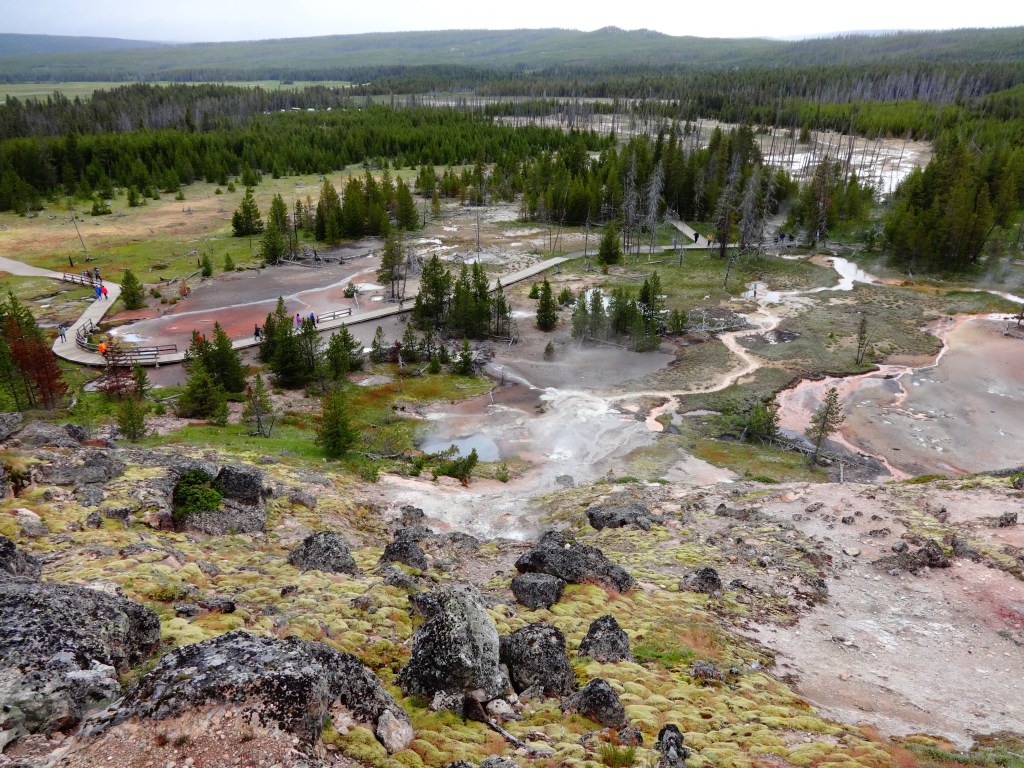
Once done at the museum and with my pleasant chat with the retired ranger, I continued on my journey and down the left side of my day’s loop. The main parkway is like a number “8.” I was on the left side of the lower loop. The upper loop of the “8” I had not seen at all yet and would be reserved for the following day. On my journey on the lower loop I stopped at the Artist’s Paintpots where a number of mudpots, fumaroles, and springs painted lavalike colors across the broken and soupy landscape of delicate earth. A boardwalk guided the tourists among the features. I had plans to stop at the Midway Geyser Basin to see the famous Grand Prismatic Spring. But the traffic was backed up to the road. I decided I’d come back early in the morning.

I proceeded to the bottom of the number “8” on the West Thumb of Lake Yellowstone where I had a campsite reserved at the Grant Village Campground. I checked in and set up my tent in the cold misty forest. It was very similar to the campground I stayed in at Grand Teton National Park. The Grant Village Campground provides visitors campsites within little nooks in the forest. It’s a quiet, recommended campground in the park. After setting up camp I went to the general store, which had a small cafe attached to it selling sandwiches and ice cream. I ordered a sandwich. When I held out my debit card to pay, the employee asked to see an ID. 

“Kentucky! We are from Kentucky!” the cashier exclaimed. “My wife and I are from Louisville. We are teachers. We just work the summer here in Yellowstone.”

This is an important moment in my life. My mind flashed back to the waitress in Jackson Lake Lodge talking about how she got a summer job online, and I remembered she wrote me the web address to find summer jobs in National Parks on a napkin. I briefly thought about pursuing it, but I had doubts as a teacher if I would have enough time and the capability to escape from my normal life for such a adventurous summer job. But then this couple were teachers here from my state! They were able to work around the education system in Kentucky to get away for the summer. If they could do it, I could do it! I would do it! They had inspired me. 

Trying to follow in their footsteps, a year later, in the winter, I applied and pursued vigorously the opportunity to work in Yellowstone. I was shot down. They wanted more of a time commitment than what I could offer as a teacher. This didn’t stop me. There had to be a way, for this couple did it. I tried other parks. I tried Big Bend National Park in Texas and Glacier National Park in Montana. I received job offers from both! A privately owned mercantile just outside of Glacier National Park won out. In the summer of 2019 I’d find myself working my first summer in what would become my most favorite place on earth. My heart would get lost in Montana, and my experiences in Montana would be some of the fondest and most meaningful in my life. The people I’d meet in Montana would become some of my most treasured. It was this moment in Yellowstone- this teacher couple from Kentucky- who would put all of this in motion. Coincidence? I think not. Coordinated? Definitely.  

Read the previous entry “Lands Alive: My First Day in Yellowstone” here: Lands Alive: My First Day in Yellowstone – on the verge (joshthehodge.com)

Check out my book Canyonlands: my adventures in the national parks and the beautiful wild here: https://www.amazon.com/Canyonlands-adventures-National-Parks-beautiful/dp/1711397873

Lands Alive: My First Day in Yellowstone

Yellowstone, with gurgling mud pots, colorful pools, hot springs, and geysers shooting into the air, it’s nature’s wonderland. Herds of bison, elk, the curious badger, and ravenous wolves call it home. Cascades and waterfalls, sprawling valleys, rivers, and lakes are pocketed in all corners. It’s so huge and magnificent that it’s daunting to even write about. It is the first National Park, founded in 1872, and among the larger ones at 3,471 square miles, larger than Rhode Island and Delaware combined. Central Park is to New York City as Yellowstone is to the United States of America. It is America’s park. 

I wanted to give myself plenty of time to make acquaintance, so I had given myself three days, but one could really spend a lifetime exploring its vast wonders. I had bought a book in the gift store at the visitor center of the neighboring Grand Teton National Park titled “Yellowstone in a Day,” published by the Yellowstone Association. It really spelled out an itinerary for Yellowstone in 3 days with optional additional days itineraries.. It was precisely what I needed, and so truly I visited Yellowstone by the book. It calmed my worry that I might miss something of importance. I knew assuredly, before all else, that I needed to see Old Faithful. That was a must, along with the Grand Canyon of the Yellowstone. I knew I wanted to see Grand Prismatic Spring, but at this point, arriving at the park, I didn’t even know its name nor if the images I had seen of a grandiose and colorful pool were of various springs around Yellowstone or one specific. I’d learn that Grand Prismatic is definitely that one that sticks out from the rest, boasting its own character, photographed many times. 

West Thumb Geyser Basin

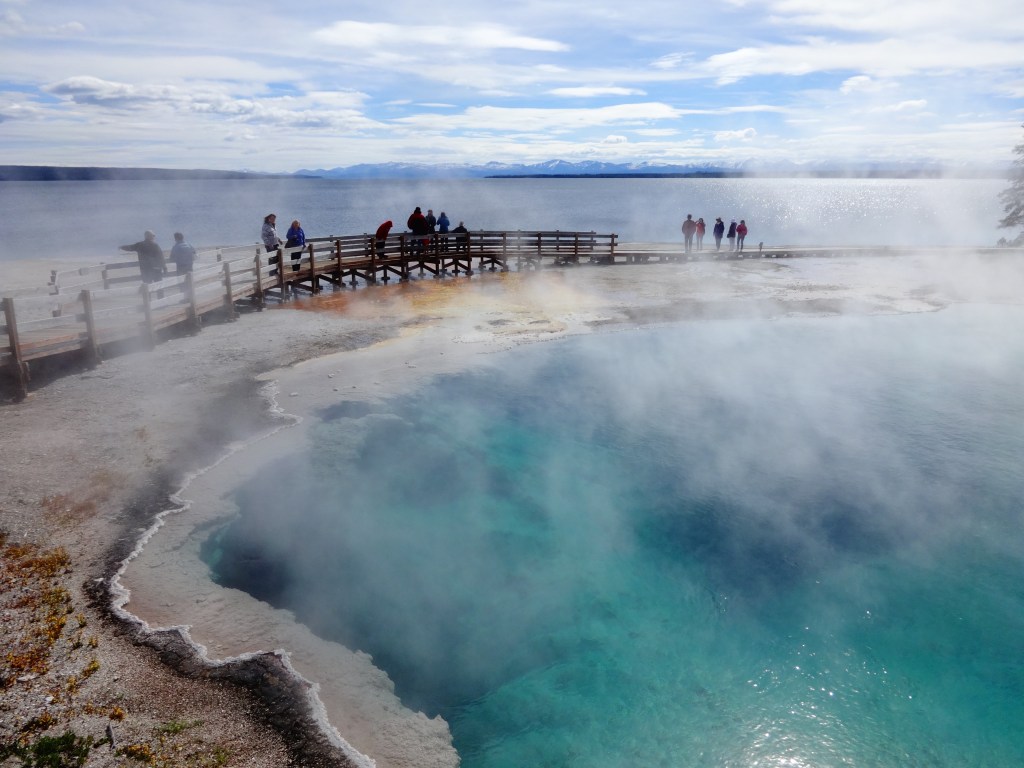
I entered Yellowstone from the south from Grand Teton National Park via the John D. Rockefeller Jr. Memorial Parkway which connects the two parks together. I beheld the entrance sign and took my photo by it and then proceeded to the West Thumb Geyser Basin. Here a half mile boardwalk meanders atop of a delicate landscape where a number of geothermal springs display extravagantly bright turquoise pools which steam into the cool air. Signs warn that the ground may be thin and advise visitors not to step on it but to stay on the boardwalk. Thus the ground appears to the eye like a thin pebbly and crispy crust just atop a earth that bubbles and steams, alive and breathing. The boardwalk descends down along the side of Yellowstone Lake, where one can see over three miles across to the snow capped mountains. Just aside the boardwalk are a few geothermal features within the lake water visible to the eye. There is one called the Fishing Hole. It is not more than a mound that pokes up in the lake with a couple-foot hole in the top where boiling water feeds into the lake. It got the name as the Fishing Hole because there is a tale of a man who would go fishing right here in Yellowstone Lake. Once he caught his fish he’d dip the line over in the hole and cook his fish right there and have himself a meal.

When I came near the completion of the West Thumb Geyser Basin Loop, a female elk popped out of the adjacent pine forest and stepped onto the boardwalk. She simply crossed over the boardwalk and meandered between the geothermal pools. People stopped and gathered to take pictures. I was surprised how unfazed the elk was with all the visitors- but most animals in Yellowstone are rather comfortable with visitors. It’s as if the animals are trying to say. “This is my home, I am quite comfortable here. You are on my turf.” As a visitor, I really do feel like I’ve come inside the animals’ home in Yellowstone. I truly am a visitor here- more so than in any other park. This is the animals’ park.

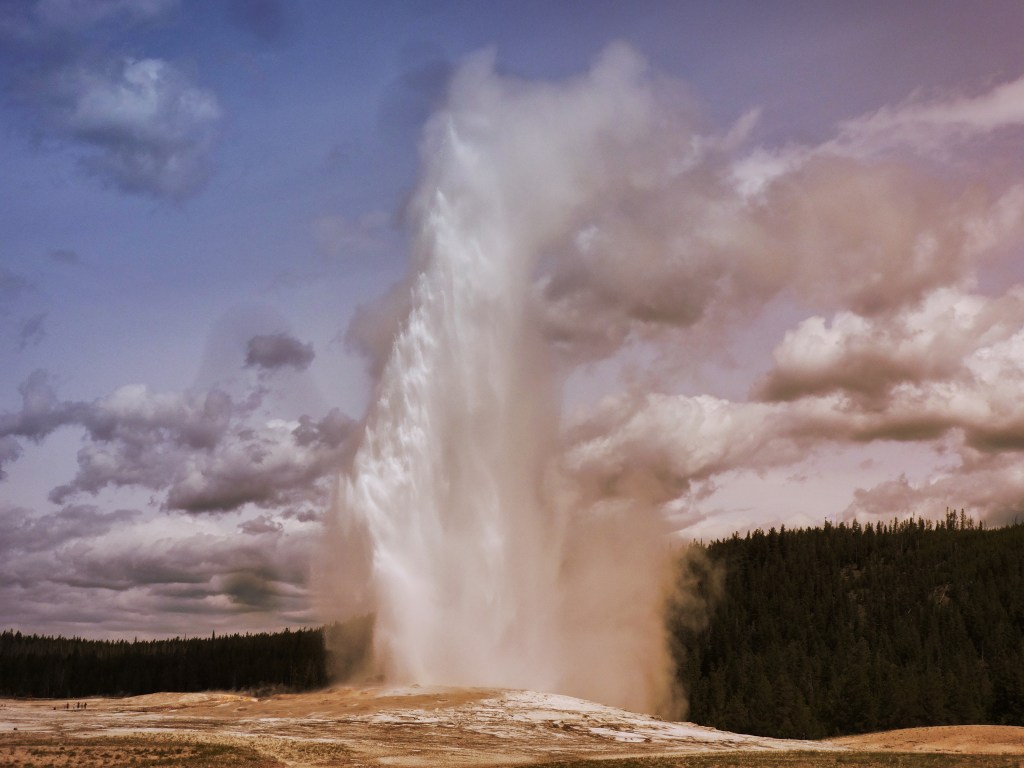
Leaving the West Thumb Geyser Basin in car, I traveled to the Upper Geyser Basin, the home of Old Faithful! This is perhaps the most prized feature of the National Park Service. The parking lot conveys so with its enormous size. Here a village sprawls horseshoe alongside this feature. Here in this park within a park, is the Old Faithful Inn, Old Faithful Lodge, main park visitor center, Snow Lodge Cafeteria, and a large gift shop and general store. I wanted to see it all, and so I did. When I left my car, I saw a number of noisy crows perched atop a few vehicles. Were they welcoming me, or was their pestering cry their attempt to tell me to go away? Probably they were just looking for handouts. I rushed into the village in excitement. I just had to see Old Faithful erupt! I learned she did so about every hour. Enormous crowds gathered around a boardwalk which outlined the site of the geyser. Some wood benches were built into the boardwalk, but they were already taken. Intently observing, before its eruption there were a few brief spurts, leaving me wondering is that it? Sometimes tourist attractions can be overhyped, but when Old Faithful did erupt, she DID erupt, unmistakably, shooting into the sky pillars of water. People oohed and aahed, and it was everything I hoped for. Water towered upon water, hissing and boiling. It was an overcast day so unfortunately Old Faithful didn’t contrast against a blue sky, but she was still visible with great billows of steam. When the tower of water sunk back into the ground, the tourist quickly disappeared. Many headed back to the parking lot or into the gift shop. I was hungry and ready for lunch. I ate in the Old Faithful Lodge cafeteria, which has an exposed log frame and overlooks the site of Old Faithful through its big windows. This was one of five choices for me to eat just in this village, but at the time I did not know. 

Upper Geyser Basin

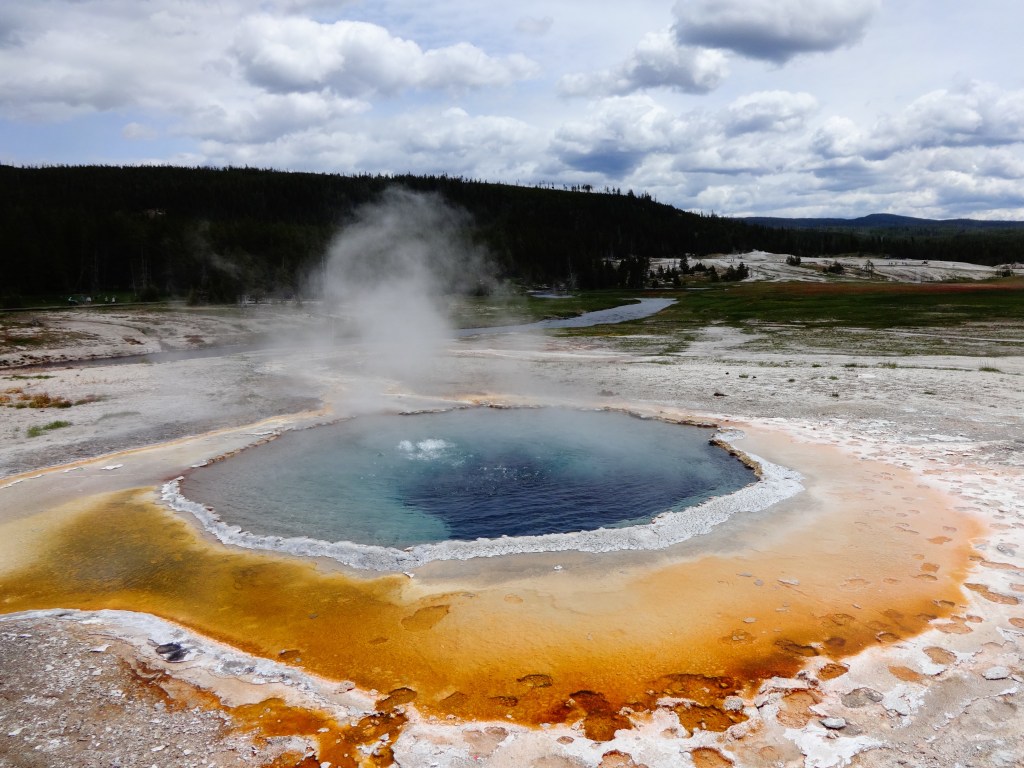
When I was done with lunch I took the couple mile boardwalk loop from Old Faithful along the Firehole River to the Upper Geyser Basin boardwalk. Here there were numerous geysers, the highest concentration in the world. There was lots of hissing and bubbling all around, and the air was filled with the repugnant smell of warm sulfuric acid evaporating into the cool mountain air. Seemingly at random, a geyser would erupt for a few minutes, tourists rushed to it, but then moments later elsewhere along the boardwalk, another would erupt and the tourists were drawn to another direction, each tourist reveling in the presumption that perhaps they were the first one to have seen the geyser erupt in maybe hundreds of years, but most of these geysers like Old Faithful are pretty consistent.

When I neared the farthest end of the path, I was desperate to go to the bathroom. The hissing and bubbling eruptions, and the flowing water taking place all around, did not help my predicament. There was a line for an outhouse of about a half-dozen people.  I couldn’t fathom having to wait so long with the urgency I was experiencing, but I did and in the meantime I helped a few tourists open a bear proof garbage can. They were struggling and did not know how to open it. I felt quite experienced. 

When my walk through the Upper Geyser Basin was complete, I was back next to Old Faithful and walked into the Old Faithful Inn. I get goosebumps on the verge of writing about this place, because it is the most impressive structure and most magical hotel in all of the National Park Service. It is the first “grand” lodge in all of the National Park Service. Shabby accommodations did exist beforehand, but this inn took everything to another level. This became the largest log hotel in the world. This inn was also the birth of the National Park Service Rustic architecture style, which sought to create buildings which harmonized and fit in with the natural surroundings. Imperfections and asymmetry, rebellious to the styles of the industrialized world, were welcomed. Hand labor contributed greatly to this style, and Robert Reamer who designed this hotel went on to create a number of other lodges in National Parks. When Theodore Roosevelt and naturalist John Burroughs toured Yellowstone in 1903 they saw plans for the lodge, and it’s been noted that Theodore Roosevelt praised the plans extensively.

Old Faithful Inn

When one walks into the lobby he or she is greeted by an enormous stone stacked fireplace in the middle of the atrium. Its chimney is extremely bold, larger than the rooms would be in many houses, and it extends six levels up through the rustic log roof. The logs which make up the whole building are not shiny and refined, but rough and rustic, unpolished and wild. Each level has a balcony which looks down into the main lobby. Just standing in the lobby looking around the place impressed me greatly. It truly looked handmade, and most of it was. It’s a mighty fortress of a structure and the epitome of a childhood dream of a fort in the woods. The top two levels in the lobby were small crows nests for musicians. Back in its earlier days, dances were held on this lobby floor to the live music above. 

I wanted to spend some time here and enjoy this building and its architecture, so I went to the small cafe adjacent to the lobby and bought an overpriced cinnamon scone and a cup of orange spice tea. I walked up the rugged uneven stairs, noticing families on vacation climbing the stairs causally, hauling their suitcases. I couldn’t even imagine the delight of spending a night in such a place. I’d be so elated you’d see it all over my face. On the third level I stopped and sat on a rocking chair which faced the railing before me and the lobby below. A violinist up in the crow’s nest began to play soothing and relaxing music. This moment was so perfect. I just reveled in and savored it. The sights, the sounds, and the comfort of my hot tea were all perfect. 

Resting here I imagined what it was like back in the day when the only way to this remote lodge was through the great wilderness on coach. There weren’t any roads nor the infrastructure of today. What a magnificent place to come upon in the wild after days of travel by horse, foot, or coach. The warm fireplace would have been so welcoming, and although rustic in style, this would have been luxurious. I imagined the visitors all dressed up dancing across the wooden floor below to the sound of the fiddle in the rafters. 

Kepler Cascades

Then, stop, I reminded myself: Be still. Be calm Be quite, and be ever present in this moment, savoring it completely for what it is. I so thoroughly enjoyed my break of peace and quietude here and often think back to it at the mention of Yellowstone. After sitting here for probably a good half hour, I resumed meandering around and found myself outside on a rooftop terrace facing Old Faithful. She was erupting again and I enjoyed it all a second time. This was a great vantage point of Old Faithful without the herds of people. It was cold outside so I didn’t loiter for too long. I went back in and went into the gift shop in the inn. I bought two post cards- one vintage one for my parents and another artistic one for my friend Ricky in California. I took them with me to the second floor where a few small old wooden desks outlined the walls. The desks had built in lamps and cozy wings for privacy. I filled out the postcards and then decided I better head to camp. I took a short stop by the Kepler Cascades, as the book instructed, on my way to my campsite at Bridge Bay, which I had reserved months in advance. 

I arrived at the campground just before dusk. The campsite was mostly an open field with no privacy and very few trees, but I didn’t mind. By the time I was done setting up camp, the sun had set and I could hear a ranger giving a talk over at the campground amphitheater. I thought about joining but felt my time was best spent getting reorganized in my car and off to bed. After cleaning out my car and getting organized, I made my trip to the campground bathroom to brush my teeth, and then I settled into my tent with my park map and my “Yellowstone in a Day” book to see what the plan would be for tomorrow. 

Read the previous entry “The Mighty Tetons” here: The Mighty Tetons – on the verge (joshthehodge.com)

Check out my book Canyonlands: my adventures in the national parks and the beautiful wild here: https://www.amazon.com/Canyonlands-adventures-National-Parks-beautiful/dp/1711397873

The Sandia Mountains and the Old Town

My visit to Albuquerque was a pleasant one despite the fact that my gum infection was raging on and I was in a continual nuisance of pain. The night before my day of Albuquerque exploration I had a hard time sleeping as the pain was throbbing and so bad that it was creating a vibration sensation in my ears. I took some Tylenol and was able to sleep a bit on-and-off. In addition to the pain was the anxiety that this infection could escalate to the point that it could hinder or even stop my summer adventure.

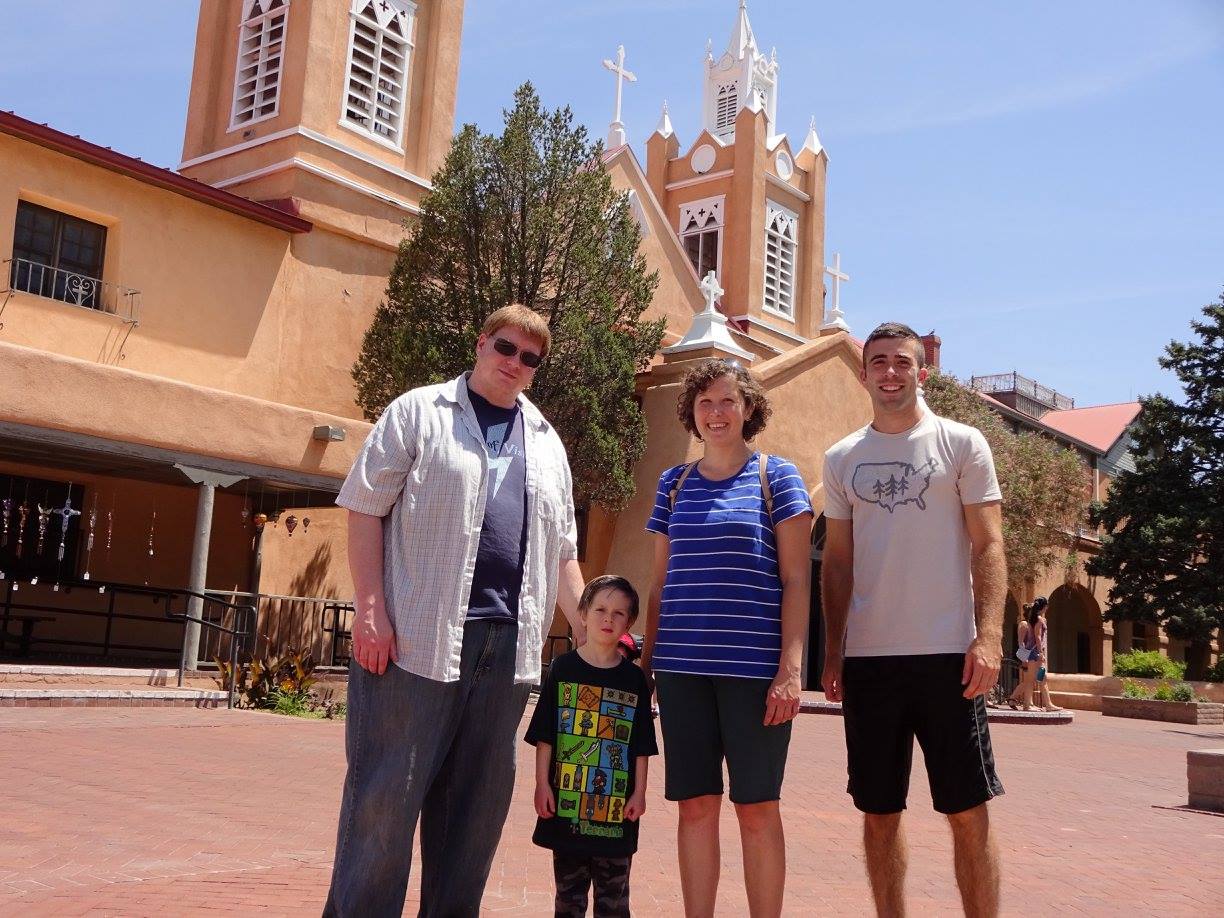
I was visiting my cousin Rachel, her husband Alex, and their four year old son Malcolm. They devoted the whole day to introducing me to the city and sites of Albuquerque. It was a brightly sunny day and we started with a visit to Old Albuquerque, the historic center of the city from its founding in 1706. Here the church of San Felipe de Neri stands overseeing Old Town Plaza, the birthplace of the city, which is very reminiscent of the zocalos I’d seen in the center of many Mexican cities. It had pathways, areas of green grass, benches, and a gazebo for occasional performances. Surrounding the square were narrow streets with adobe structures one after another boasting artisan shops and local eateries. After taking our picture together in front of the church we went into a few stores and I saw the touristy nick-knacks and patty-whacks. I did not buy anything except a sticker of the Sandia Mountains. I knew we’d soon be going up them. I found it humorous that Sandia is a Spanish term for watermelon. I thought it was a coincidence but Rachel explained how the mountains can look pink with the sunset cast upon them in the evenings. We also stopped by Old Barrel Tea Company where I bought myself a cup of iced tea.

19679222_10214200960438357_7966458747696600008_o

Here in the old town I also called my dentist’s office to see if they could prescribe any antibiotic for my gum infection. They informed me that they could not send a prescription to another state nor give me any recommendation except that the best thing I could do was to schedule an appointment to see a dentist in New Mexico. Given that the dentist would most likely be out of the insurance network and unreachable in a reasonable time frame, I realized I was on my own and was very disappointed in the healthcare system. This situation weighed heavy on me.

For lunch I enjoyed some New Mexican fare. I did not know that New Mexican cuisine is its own category. It’s a fusion of the cuisine of Pueblo Indians, Mexican, and Spanish and it incorporates a lot of local spice. I thought my experiences having studied and lived in Mexico would be enough to understand the menu, but I needed a little explanation. I had enchiladas de carne adovada with red pepper sauce. Carne Adovada? Pork slow-braised in a spicy red chile bath for hours.

After lunch the highlight of the day came, our trip up to the top of the Sandia Mountains on the Sandia Peak Tramway. Leaving the desert floor the tram glided above the Cibola National Forest. Below were a plethora of rock jumbles and desert shrubs hugging the sides of the mountain. Higher up pine trees started to make their appearance. The tram was very much like the one in New York City that travels between 59th and 60th street and over the East River onto Roosevelt Island but unlike that one, this one ascends 5,300 feet. In the winter this is also used as a ski lift but now in summer its a scenic tram ride. At the peak there are trails that venture off into the mountains and a platform to observe the city of Albuquerque so far below that it’s nearly unrecognizable.

19667550_10214200969158575_7233194904257373901_o

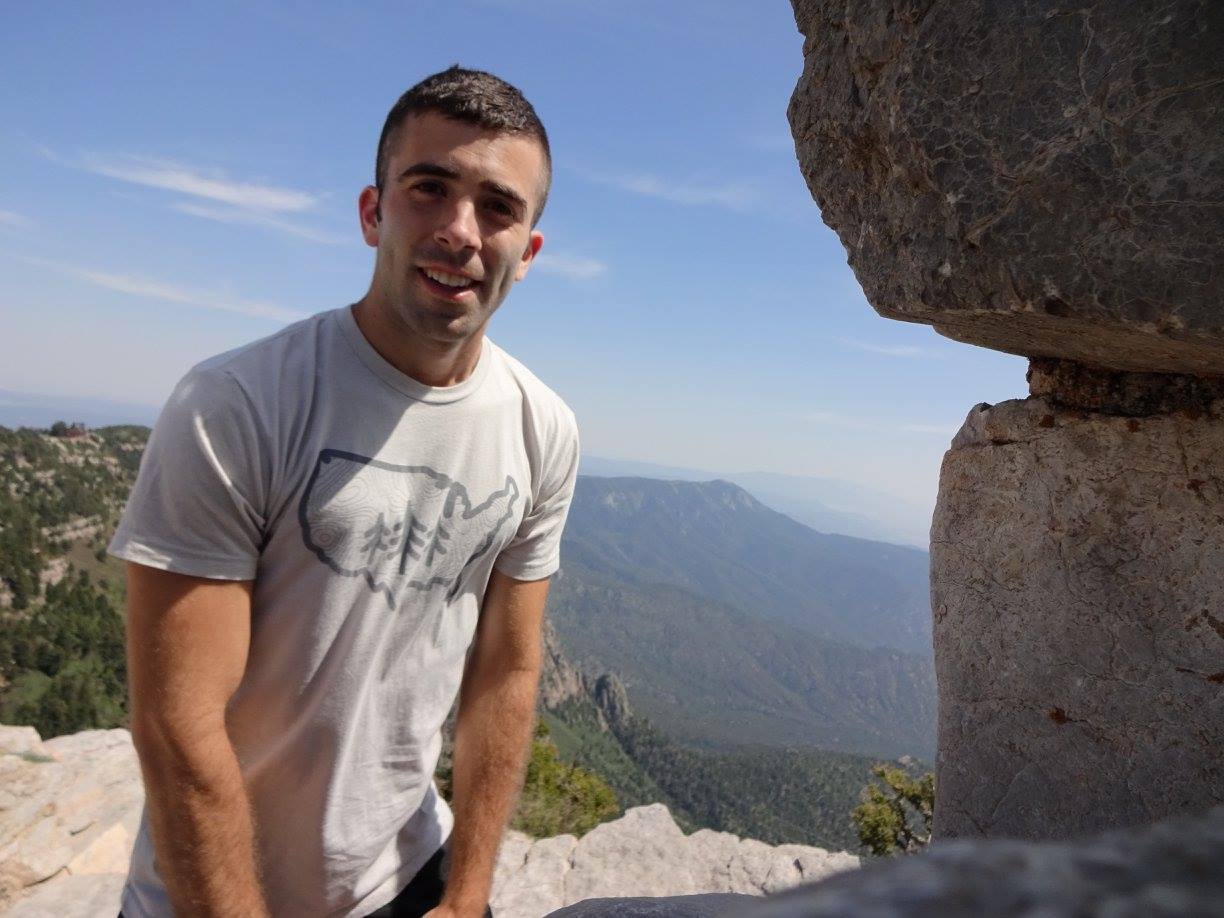
Up here in the mountains we all started off on a short trail together, but I traveled a bit further as the rest went back to the lift area. I didn’t want to keep them waiting for me long, so I ran the trail two miles to the Kiwanis Cabin. An old rock shelter built by the Civilian Conservation Corps in the 1930s. The work of the Civilian Conservation Corps pops up in various National Parks, National Forests, state parks, and other public lands. I enjoy coming across their work because the quality and rustic craftsmanship is to be appreciated. Not only have they built cabins and lodges but also park roads, bridges, and trails. They are no longer in existence but functioned as a voluntary work relief program for unemployed young men primarily in the 1930s. This was a part of Franklin D. Roosevelt’s New Deal, which I am very hesitant to praise, but I am grateful for this part of it. Up here by Kiwanis Cabin I was at a rock protrusion. I enjoyed the great unobstructed view of the world below.

19250505_10214200959118324_5416149805096962917_o

On my way back, on the narrow path between the trees, I began to pray to God about my gum infection and about this trip in general. I felt a great sense of peace come over me. All of my anxiety regarding my gum infection was hushed. Also up here in the mountains I felt way more in my element. I enjoyed Albuquerque below but something about the cooler mountain air was soothing. And amongst the pines and aspen I felt in the company of reassuring friends. The sweet smell of the western pines, brought back memories of prior summers, rekindled my spirit of adventure, and made me feel alive and vigorous.

After joining back with the others, we soon descended the mountain on the tram to the mainland. We stopped by a Bubble Tea cafe before heading to the house. 

Back at Mesa del Sol I was able to kick off my boots and relax. I brought together all the stickers I had accumulated on this trip so far and began to sticker up my new dark green Nalgene bottle. I have a new tradition that each summer I buy a Nalgene and place stickers all over it from the parks and destinations I visit. I use the water bottle all summer, and then I retire it to a display shelf. Sometimes I’ll pull off a bottle from the past and use it again, but mostly they are momentums from the summer trips, and as I look over the bottle in hand, with all its stickers, I’m reminded of all the memories. Malcolm even made me a sticker for my bottle of his house, and although the bottle did sport it for a long while, eventually it fell off. 

In the evening, nearing sunset, I went for another walk around the neighborhood. This time solo. I observed the Sandia or Watermelon Mountains in the distance and the pinkish color they reflected in the evening. I also walked by the Albuquerque movie studios. Out back they had the facades portraying an old Western main street for a Western sci-fi Netflix series in production. 

Back at the house I visited with Rachel over yet another cup of tea. I learned that both Rachel and I have an affinity for hot teas of all kinds. I then told Rachel how I thought Malcolm looked like the child and protagonist, Elliot, from the recent Disney movie Pete’s Dragon. We ended up watching the movie. It is one of my favorite Disney movies. It makes sense for me taking place in the Northern woods, having a park ranger as a major supporting actor, and symbolically tying in themes and messages about life and spiritual matters.  It’s soundtrack had been the background music for much of my traveling this summer. 

And like this my visit with my Cousin Rachel and family came to an end. The following morning, I would hit the road. Just as one of the songs from Pete’s Dragon repeats, I would “go north,” and make my way to Colorado. 

19702626_10214200949958095_5388290877768268093_o

Read my previous episode “From Carlsbad to Albuquerque?” here: https://joshthehodge.com/2020/03/05/from-carlsbad-to-albuquerque/

Check out my new book “Canyonlands: My Adventures in the National Parks and the Beautiful Wild,” here: 

https://www.amazon.com/dp/1711397873/ref=cm_sw_em_r_mt_dp_U_UjGjEbYBGF4PR

Canyonlands Cover


The Mystique of Carlsbad Caverns

The drive from Big Bend National Park to Carlsbad Caverns is not one to boast of. I most definitely found myself on a truck route, a sure minority in my small car, with flat land and oil fields all around me and little to see. But when I arrived at Carlsbad Caverns just across the state line from Texas in New Mexico, the destination would most certainly be worth the journey. 

National Parks that are formed around caves are hard to evaluate in comparison to other National Parks. There is such an immeasurable difference between a cave National Park and any other. Caves evoke different feelings. They are dark, dank, gloomy, yet wild pieces of nature’s artistry. I like them and they fascinate me, as do all wonders of nature. They can even inspire me, but hidden from the sun, beneath the surface of the land, they place themselves in their own category of mystique.

I had reserved a lantern tour of the Left Hand Tunnel portion of caverns online months in advance and was very much looking forward to it. This would be my first lantern tour in a cave. The following year I would get to go on a lantern tour in Mammoth Cave and Oregon Caves, but this was the first so I was very excited for it. Along with my excitement came a bit of frustration because I had trouble finding the park. The address I had led me to the park’s administrative offices in the town of Carlsbad. I began to consider that I might arrive late, miss my tour, and add this to my list of grievances: feeling burnt out, locking my keys in my car, having a rock fall and dent the hood of my vehicle, getting caught in a lightning storm at White Sands National Monument, and getting reprimanded from a park ranger. Of course I shouldn’t have been focusing on the bad and instead should have been grateful for being out here and being able to go to these parks in the first place, but this is where I was at mentally at this point in my trip.

After figuring my way and zipping around the five miles of road leading to the center of the park, I arrived with a few minutes to spare. I changed my clothes in my car for the cooler temperature in the cave, which stays at a consistent 56 degrees fahrenheit, and went into the visitor center to check in for my tour. There were ten people for the tour. We met inside the museum part of the visitor center and the ranger and guide, Josh from Maine, took us to a classroom to distribute lanterns. They were simple wood box lanterns with candles inside them. We then boarded the historic elevators which dropped us to 754 feet below ground level. At the time they were installed in 1932 they were the longest single-shaft elevators in the world. 

Image may contain: one or more people and nightDuring the tour, in which we made our way through the undeveloped section of the cave on a dirt path, the ranger presented the history of the discovery of the cave. According to the National Park Service “Our first credited cave exploration happened in the cave in 1898. Sixteen year-old cowboy, Jim White, was rounding up cattle one evening when he spotted smoke from a wildfire off in the distance. He went into high alert. Fires could be just as devastating then as they are now. He rode closer to gather information. How big was it? Was it moving quickly? What direction was it burning? These questions and more pushed Jim to ride to the fire so he could report back to camp with the most accurate information possible.

As Jim approached the smoke, he noticed something strange: he couldn’t smell the smoke, hear the crackling of flames, or feel the heat of fire. Jim realized he wasn’t seeing smoke. He was watching bats. Thousands-upon-thousands of Brazilian free-tailed bats. Jim finally stopped at the mouth of the cave completely mesmerized by the spectacle of flying mammals filling the air above him. He once said he watched the bats for nearly half an hour before the darkness fell so completely he had to return to camp.

Because he knew the other cowboys would mock him, Jim didn’t immediately describe what he’d seen to anyone. He thought it over for several days.The deep hole in the ground and its secrets continued to gnaw at him. He had to find out what was down in the dark recesses.” Jim went on to explore the cave more and introduce others to it. 

I loved this story and tried to put myself in Jim’s place, discovering such an immense marvel on my own at such a young age. On another note, an additional fascinating thing I learned on my tour was that microbes have recently been discovered in the far reaches of the cave that specifically attack cancerous tissue and that this discovery may have huge medical implications on the treatment of cancer.  

Image may contain: night and outdoor Although I very much enjoyed the tour, afterward things got increasingly fascinating. I was told that if I wanted to take the elevators back up to the visitor center I would have to soon, because they would be closing for the evening. If I chose not to, I’d have to hike my way out of the cave. Of course I opted for the latter choice. This gave me time to explore the Big Room of the cave and have a sandwich. I found it unique to order food and eat at the Underground Lunchroom. Back in the early days of the park there was an actual kitchen down in the cave, but because of food preparation causing damage to the cave, food started to be prepared outside of the cave and sent down.  

After my quick bite to eat I began my exploration. I cannot put into words the uniqueness, the massive scale, the variety of what is in this cave. It is its own underground world. This is a cave with massive rock formations. I pondered if up above some if these things would be considered mountains. The scale is just astounding. And unlike Mammoth Cave which is largely covered by a capstone, this cave is a true cavern meaning it is composed of soluble rock which permits entrance of mineral water which grows speleothems and therefore makes the most impressive display of stalactites, stalagmites, straws, draperies, cave popcorn and bacon, and a plethora of other cave features. At times it all looks elegant, other times eerie. With every turn there is something strangely unique to look at. In the Big Room the park service has a paved trail with railings that meander around, and many spotlights illuminate the most astounding of features. 

Image may contain: outdoorWith a burst of excitement I went from one feature to the next, but then made the same walk again to quietly savor the surroundings and be filled with a sense of wonder. I could easily imagine I was on another planet, a more desolate one. When I was done pondering and wandering I began my ascent to the cave entrance. It was all a gradual uphill hike, along a paved path. The passage narrows and widens from one set of switchbacks to another. I was the only person on this path. Despite other parts of the park and the visitor center being quite busy, I didn’t see a singular person for the entire ascent. I felt like I had Carlsbad Caverns to myself. As I got closer to the cave entrance I began to hear chirping overhead. I looked up and saw small dark creatures flying near the roof of the cave. Bats! I thought. They grew in number and in volume the more I ascended, swirling in flight above me. The cave was very tall so I couldn’t see them up close, but I reveled in the unique experience of hiking in the company of lively bats. 

Image may contain: outdoorBack at the visitor center I told a ranger what I experienced. I would be informed that they most likely weren’t bats but cave swallows. Also in the visitor center I watched the park film and bought a pin for my collection. Then after killing a bit of time, I went back outside to the amphitheater located right at the mouth and natural entrance of the cave. It was time for the nightly bat flight program. A ranger would talk about bats and then around sunset the bats would come flying out of the gave in a grand spectacle. So, as programmed, a ranger talked about bats feeding on bugs, especially mosquitos, and how the tendons in a bats hands are designed opposite of ours. To expand their fingers from their fist it requires strength, but a fist tightly clenched is in the nature relaxed position. This is how they are able to cling onto things and one another and hang upside down. The ranger talked about the immense size of the bat population between 200,000 and 500,000 in the cave and how bat, guano a.k.a. bat dung, was once harvested from Carlsbad Caverns for its value as a nutrient rich fertilizer. 
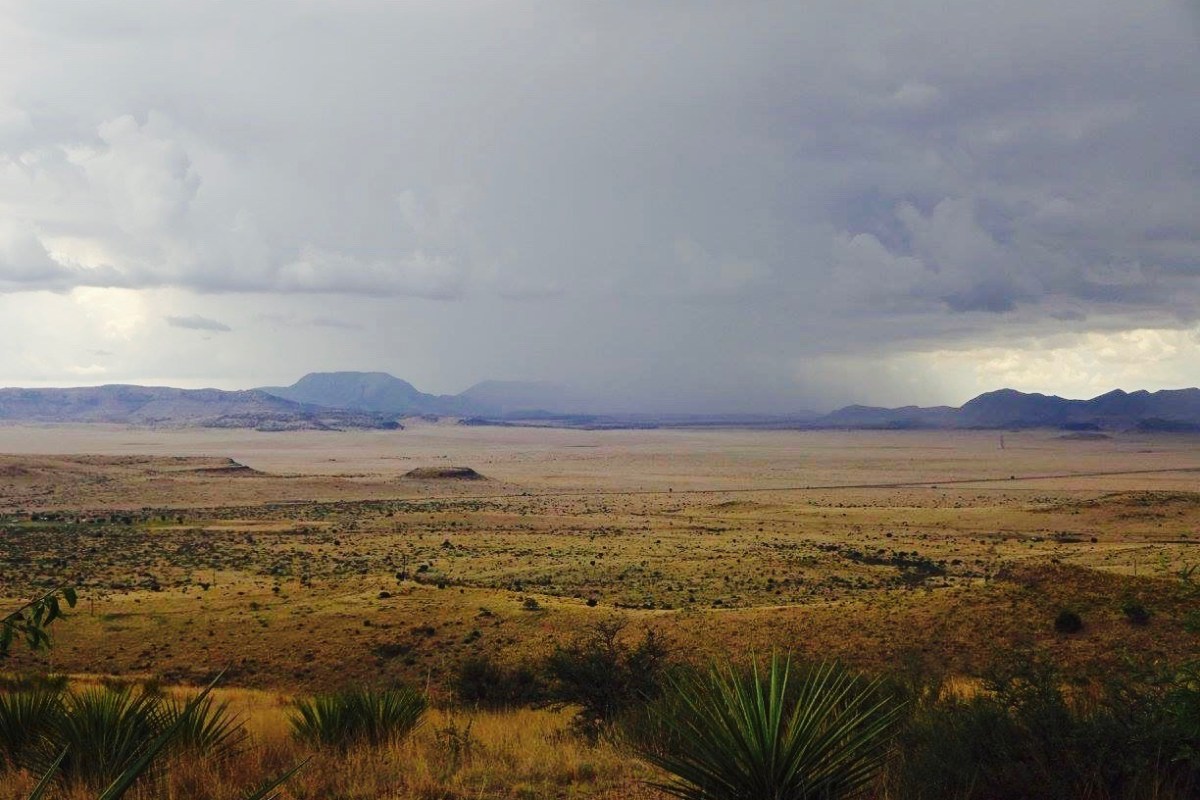
The ranger then presented some sad news: do to the nature of the weather, the bats may not be coming out of the caves. It was a gloomy evening, clouds hung low and the wind was strong. It seemed that a storm was just moments away. The bats would not come out in storms. But then as he was talking about such a predicament a bat flew out of the cave, followed by another. They flew around a group of trees and went back into the cave.

The ranger explained that these were the “scouts.” The bat colony sends out a scout to check the weather and report to the rest. If the report is good, the group then exits the cave. If the scout determines the weather to be threatening, the colony would stay in the cave for the night and postpone eating. Minutes later a swarm of bats exited the cave in the most spectacular, eerie, yet beautiful display. They came out in a spiral formation almost appearing like a tornado, Dark black silhouettes contrasted against the evening sky. They flew right above me in a beautiful display with the precise coordination of a school of fish. With Batman and Halloween and all the other references to bats in popular culture I am quite familiar with the silhouette of a bat with its wings extended, but there is something strictly exciting and beautiful to see thousands of these silhouettes moving, flapping, flying above me in the sky. 

Nowhere else have I seen such a display. It was breathtaking, and I was very fortunate to see it. Moments later it began to rain. The bats probably wouldn’t have exited the cave if the scouts had reported rain. I made it back to my car and opened up a can of soup and ate it for supper with the sound and display of rain water crashing against my windshield.

A trip to Carlsbad Caverns is worth every bit of time and travel to visit. It truly lives up to the title of National Park, for it is an extremely unique place to be treasured, with great stories, most impressive natural features, and a stunning show presented by it’s natural inhabitants. 


Read my previous episode “On the Rio Grande: a world between U.S. and Mexico,” here: https://joshthehodge.wordpress.com/2020/02/02/on-the-rio-grande-a-world-between-the-u-s-and-mexico/

Check out my new book “Canyonlands: My Adventures in the National Parks and the Beautiful Wild,” here: 

https://www.amazon.com/dp/1711397873/ref=cm_sw_em_r_mt_dp_U_UjGjEbYBGF4PR

Canyonlands Cover

Treasures of the Chihuahuan

I woke up in the Indian Lodge so well rested that it was one of those moments in which I looked up at the ceiling and then around the room, taking a moment to process and recall where I was. I well pleased with the recollection that I was at the Indian Lodge at Davis Mountains State Park in West Texas.I got up, and the floor beneath me was sturdy and firm. This was a fortress of a structure.

I threw on some presentable clothes and decided to go check out the Black Bear Restaurant, the resident eatery at the lodge. I sat next to the window and enjoyed breakfast from the buffet, satisfying my hunger with scrambled eggs, pancakes, sausage, and fruit with some cucumber and pineapple water. I looked outside at the desert hills and yucca plants of the Chihuahuan desert with the morning sun spreading its golden light into every sleepy crevice of the landscape.

On my way back to my room, I stopped by the front desk in the lodge office. I was hoping to see my first West Texan acquaintance, the friendly lady from check in. She wasn’t there, but her male counterpart was- a young, round, jovial man. I asked him about trails and what to see around the park. He kindly and pleasantly provided me with a map. I took a moment to browse the small gift shop and bought myself a Davis Mountains State Park sticker.

Back in my room I geared up to go on a short hike, 1.72 miles one way up into the mountain to the right of the lodge. The day started off bright and sunny, with only a few bright white clouds wisping through the blue above. The path slithered around sagebrush, curved around a valley and a tall pointed brown rock formation, and trailed around to the spine on the back of the mountain. Once I reached the plateau the Indian Lodge to my right was just a miniature below. To my left was a fence. Someone’s private property butted up to this State Park.

Also, up here the weather started to turn it’s back on me. First there was a whipping wind that violently flustered the desert grass, then deep, dark clouds rolled in. Once again, I found myself in a vulnerable position. I was exposed to potential lightning. I decided to play it safe and return promptly back on the trail from where I had ascended. My nearly 4 mile hike turned out to be a mere 1.4 miles. This wasn’t supposed to happen. Weather never got in my way. But this was the second time on this trip in which the weather won. Despite its apparent threat, a storm never did reach the area.

Back at my car I noticed a dent in the hood of my car. The trouble was this wasn’t “my” car. It was a rental. I began to be concerned about having to pay for damages. I looked at the indent from different angles. It wasn’t that obvious. It was slight, only very apparent at certain angles. I pondered this dent. How could this have happened? I never remember anything hitting my car. Then I considered where I had my car parked all night. It was at the bottom of a short cliff where a road wrapped around just above. A rock could have easily fallen from the road onto the hood of the car. In retrospect, this was really no big deal, but at the time it troubled me. This was not supposed to happen. This trip was supposed to be perfect. This was an unhealthy disposition that was only beginning to be challenged.

Back at the lodge, the sun returned to shine. I took a few minutes to swim small laps in the outdoor pool, so perfectly situated behind the lodge in the beautiful valley. I also sat poolside to write in my journal and enjoy the desert sun.

I checked out of the Indian Lodge hoping to one day return and eager to tell people about such a wonderful place it was. It’s a true treasure. Despite my hangup on the dented hood, my stop at the lodge was rejuvenating, a breath of fresh air, a truly remote hidden oasis, a place where anyone could find comfort and solace on the outermost reaches of the United States, in the fold of the Chihuahuan desert, armored and hidden between mountains.

19575160_10214158419814868_3297167524510951263_oLeaving the lodge I drove Park Road 3A, also known as the Skyline Drive- one of the park’s proud features. The road switchbacks to the top of the mountain opposite that of my hike. The road ends at an old rock shelter, built by the Civilian Conservation Corps. From here I could see out on some of the wide plains of Texas with blue mesas standing in the far distance. Here I could also see the rainstorm that had threatened my hike earlier, pouring down across the plains. I encountered a family of travelers that asked me to take their picture. I took their picture and carried on.

19466485_10214193955823246_3398140235645297518_oFour miles from the State Park is Fort Davis National Historic Site- a unit of the National Park Service. It actually attaches to the State Park by a trail, but I didn’t have the time to hike there and back. I didn’t know why there would need to be a fort out here in seemingly the middle of nowhere Texas, but I would learn, and I was excited. Any unit of the National Park Service interests and excites me. All of the National Park Service’s sites tell one big story, the narrative of the United States of America. At each one I see my eyes opened to moments in history I didn’t know, and not only do I obtain the knowledge, but being in the actual place where these events took place, and seeing them with my own eyes, helps me imagine and obtain a greater depth of relation to the events. I love it!
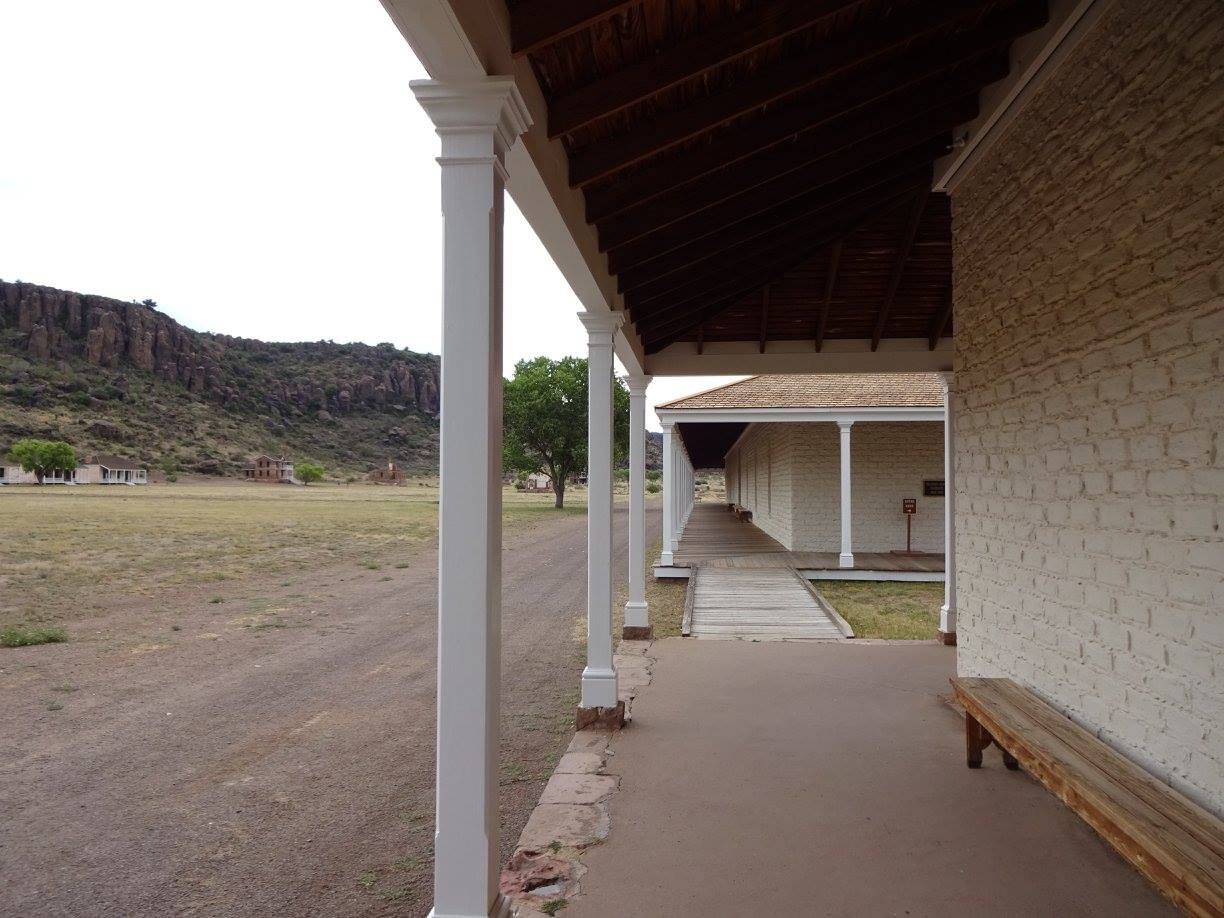
In the visitor center, the park ranger offered me a park map. I asked what to see. She opened the map and with her Sharpie highlighter she began highlighting buildings within the complex. By the time she was done, she had highlighted every single thing within the map. I wondered if that was necessary. I think she really just loved using her highlighter.

Leaving the Visitor Center, I explored the history. I learned that Fort Davis was a United States Army fort built to protect emigrants, mail coaches, and travelers along the San Antonio- El Paso Trail, many of whom were on route to the rich goldfields of California during the Rush. The Buffalo Soldiers stationed here protected these travelers from the threat primarily of Apaches and Comanches. They escorted them through the area, as well as repaired roads and telegraph lines. During the Civil War, the federal government withdrew troops from the fort which was taken over by the Confederacy later to be claimed back by the Union. In the late 1800s the fort had outlived its worth. A park ranger explained how it had been sold to a Hollywood filmmaker to film western movies. Then a few buildings of the fort were partitioned off into separate pieces of private land, only be reclaimed by the federal government as a National Park Unit in 1960.

19243325_10214193960943374_2738043865480521184_oToday exploring the park is really stepping back in time to a unique era. The Park Service has preserved and restored many of the buildings. This fort is not what we typically think of as a fort. There is no man made barrier of a wall with artillery and cannons sticking out. Rather it is a series of buildings aligned in a giant rectangle around a common green. The fort is in a large canyon, protected naturally by wide canyon walls and Limpia Creek.
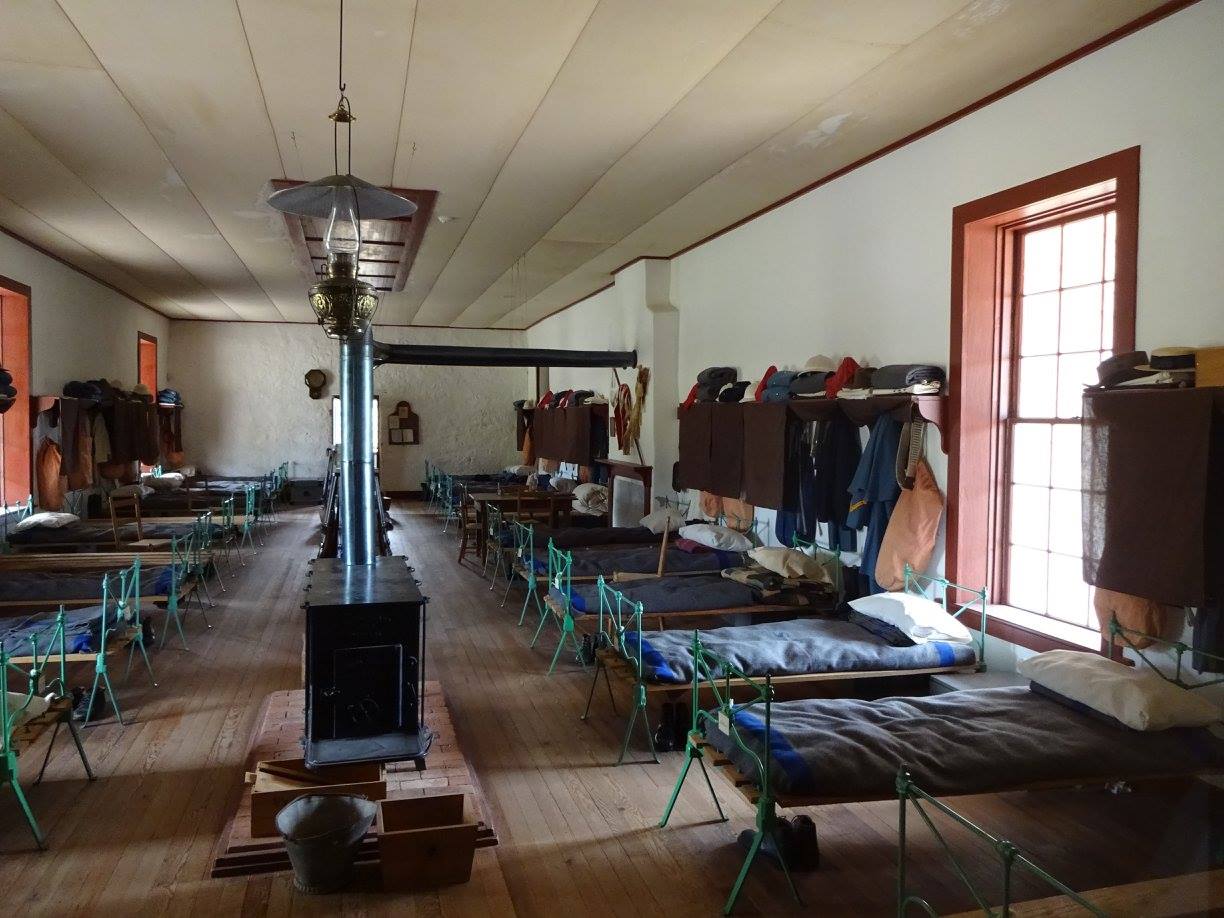
19679023_10214193960663367_2858045640103199091_oThe main attraction of the park is walking in and out of many of the buildings which are furnished to the era. I walked into the barracks. Fourteen beds lined the walls one after another. Apart from a bed, the soldiers were only allowed a few hooks to hang their clothes and a small shelf situated above their beds. In the middle of the building stood a series of coal furnaces. This was very simple. I tried to put myself in the place of the soldiers and imagine what they came “home” to at night.

On the other side of the green were the homes of the lieutenants and commanders. They had fully furnished houses, with beautiful fireplaces and artistic mantels, wardrobes, chairs of varying sizes and style, mirrors, musical instruments, decorations, and all the basic comforts of lavish living. It was such a stark contrast to the lives of the soldiers. I might as well have assumed I was in Manhattan in these homes. Here in the middle of nowhere Texas these commanders had created, perhaps at the cost of the comfort of their soldiers, luxury of modern living. In addition to these places of living, there was a fort commissary, where soldiers were quite limited in supply, and the hospital, which was fascinating and disturbing.

Before entering the hospital I read the background on some real people who once lived here. The plaque told about their ailments, and by touring the old hospital I learned whether these people survived their illness or not. Many did not. Showcased in this hospital museum were medical tools of the 1800s and explanations of how they were used. There were saws used for amputations, drills for digging into the skulls to relieve pressure, gnarly contraptions that looked like more tools for torture than anything else, created with such misunderstanding of the human illness. I forgot most of what I saw. Gruesome as they were, my mind found them not pleasant to remember.

Like nearly all National Park units, there was also a main museum at the Visitor Center with overall history of the fort and a park film. A small area of the Visitor Center was dedicated to books, postcards, and the usual National Park purchasable treasures. I found some stickers that said “National Park Geek” which had an outline of Theodore Roosevelt’s face in a ranger hat. I had to get one. I also got one for my friend and coworker, Jamie, who is also a National Park geek. The ranger who rang up my items said how these stickers were really popular. I told her how I loved the National Parks and how I actually volunteer as a Trail Keeper in the Big South Fork back on the Kentucky and Tennessee border. She told me how she loved that park and was looking for land or a home to purchase in Oneida, Tennessee- one of the main gateways to the Big South Fork. This surprised me. First off, no one ever knows about the Big South Fork, let alone Oneida, a rural small town in East Tennessee. But then again, I was in Fort Davis, Texas a place probably just as famous and well known as Oneida, Tennessee.

19620602_10214193958303308_7501458365493546060_oLeaving Fort Davis National Historic Park, I was well pleased. I learned a lot of history. I had no idea such forts existed. This was one of many which served the same purpose. Also the way the fort was restored and the plaques and markers provided, facilitated imagination, making me feel as if I had really stepped back in time. This place is high on my list of National Historic Sites. When I pulled out of the park drive I thought I’d do a little exploration around the town of Fort Davis. Affording the title “town’ is generous, because technically it’s an “unincorporated community.” The community had one main paved street. All the side streets were gravel and scenic, situated in the canyon outlined with hoodoos and rock spires like those of Chiricahua. In “town” I observed an old western hotel and drug store, a post office, a family practice located in an old adobe structure, a bank completely pieces together from rock pieces, and a courthouse situated in the middle of a green. Everything was closed, as it was Sunday. I was ravenously hungry. It had been a long time since my breakfast at the Indian Lodge. There wasn’t much to choose from. But I saw a decent amount of cars parked out of a shack of a place titled Cueva de Leon. Here’s goes nothing, I thought. I went inside. Mexican restaurant. Okay. Sweet. This could be the real deal, considering how close I was to Mexico. I sat down and ordered some fajitas. I was served a glass of ice cold water and it was perfect for my parched mouth and lips.

19577458_10214193962183405_8825385596625865428_oAs I waited for my food, I couldn’t help but observe those around me. A group of ladies were in a booth eating together and talking back and forth. They switched from Spanish to English constantly, replacing with seemingly no notable method, certain words with their other language counterpart. A middle-aged man with a cowboy hat, flannel patterned shirt, boots and a grey mustache (everything stereotypical of a cowboy) sat down to order his food. To my surprise he ordered his food perfectly and casually in Spanish. Keepin’ it truly real, from my perspective, a middle-aged white man with a cowboy hat back home in Kentucky would be the least suspected of speaking Spanish. This was not the case here. Spanish and English were truly blended together, and latino rancheros and caucasian cowboys came together with no barrier of language nor culture, no ill-will towards one another, just neighborly friendliness. They were simply gathering over good food.

I liked this scene. I liked it a lot. Much of mainstream media tries to divide people over appearance and racial heritage. Here in West Texas, it just doesn’t matter. Everyone seems to be at the same level. Everyone is a neighbor. Perhaps it is the Texas identity. Texans are Texans above all else. It doesn’t matter what you look like, what language you speak. If you are a Texan, you’re a Texan. This doesn’t hold true though in metropolitan areas. I know from my experience living in Houston, where race places a huge factor in everything. But here  and in rural west Texas there is a unique bond of culture that transcends any trivial division that the over civilized parts of the U.S. have concocted. It’s all the more reason why I am in love with West Texas.19221761_10214193961263382_6100642550502333465_o 

Check back next Wednesday for the next “episode” in the adventure.

Click here for the previous entry “Falling in Love With West Texas”: https://joshthehodge.wordpress.com/2019/03/28/falling-in-love-with-west-texas/ 

Check out my book “Among Blue Smoke and Bluegrass” on Amazon: https://www.amazon.com/Among-Blue-Smoke-Bluegrass-Tennessee/dp/1790631297

Falling in Love with West Texas

A billion thoughts spun through my head. That was amazing!. Was it beautiful? No. Was it safe? No. Was it inspiring? No. But my perspective and insight had grown immensely.

I had just gotten back into El Paso, Texas from walking across the Mexico-U.S. border into Ciudad Juárez. I was hesitant to make the journey, but a kind elderly woman who worked with the National Park Service at the Chamizal National Memorial, whom I have nicknamed “Mi Abuelita” encouraged me to go. When I followed up with her after my visit to Juárez, I could tell all her encouragement was a ploy to broaden my perspective. She was sneaky. I wrote in my journal that she gave me “the gusto and self-confidence” to go.

Was their validity in all the warnings from my friends and acquaintances in Mexico City about visiting the Mexican border? Most certainly. Diverse cultural biases and political views began to make all the more sense after my visit to Ciudad Juárez. I got it. I understood it. So many things people said and why they said them came to light during this short but insightful visit.

I was only in Ciudad Juárez a few hours. The whole time I was there an anxiety ran through me. I thought I had accidentally bypassed a border security checkpoint. I walked into Mexico unaccounted for. This made me especially nervous on the way back into the United States, because I thought I would be caught. And, mind you, I was singled out.

Everyone else could simply scan their Texas IDs for self service reentry into the U.S.. I was fumbling around with my passport and the scanner wouldn’t accept it. I didn’t know what I was doing. A border agent called me over.

“What was the purpose of your visit,” the U.S. Border Patrol Agent asked me.

“Tourism,” I replied.

“Tourism?” he questioned, with a look that told me, people do not go to Juárez as tourists.

Although I was grilled heavily by the agent, I was appreciative of his thoroughness and I came to find out that Mexico does not keep track nor require identification of foreigners walking across their northern border, at least not at El Paso.

Screen Shot 2019-03-27 at 10.21.40 PMIt was a new, peculiar, and patriot moment for me to read the sign above the highway stating “Welcome to the United States.” My visit to Ciudad Juárez is a tale to be further unpacked at another time. I was glad I went, but I was so grateful to be back home and ready to continue on with my U.S. National Park adventure.
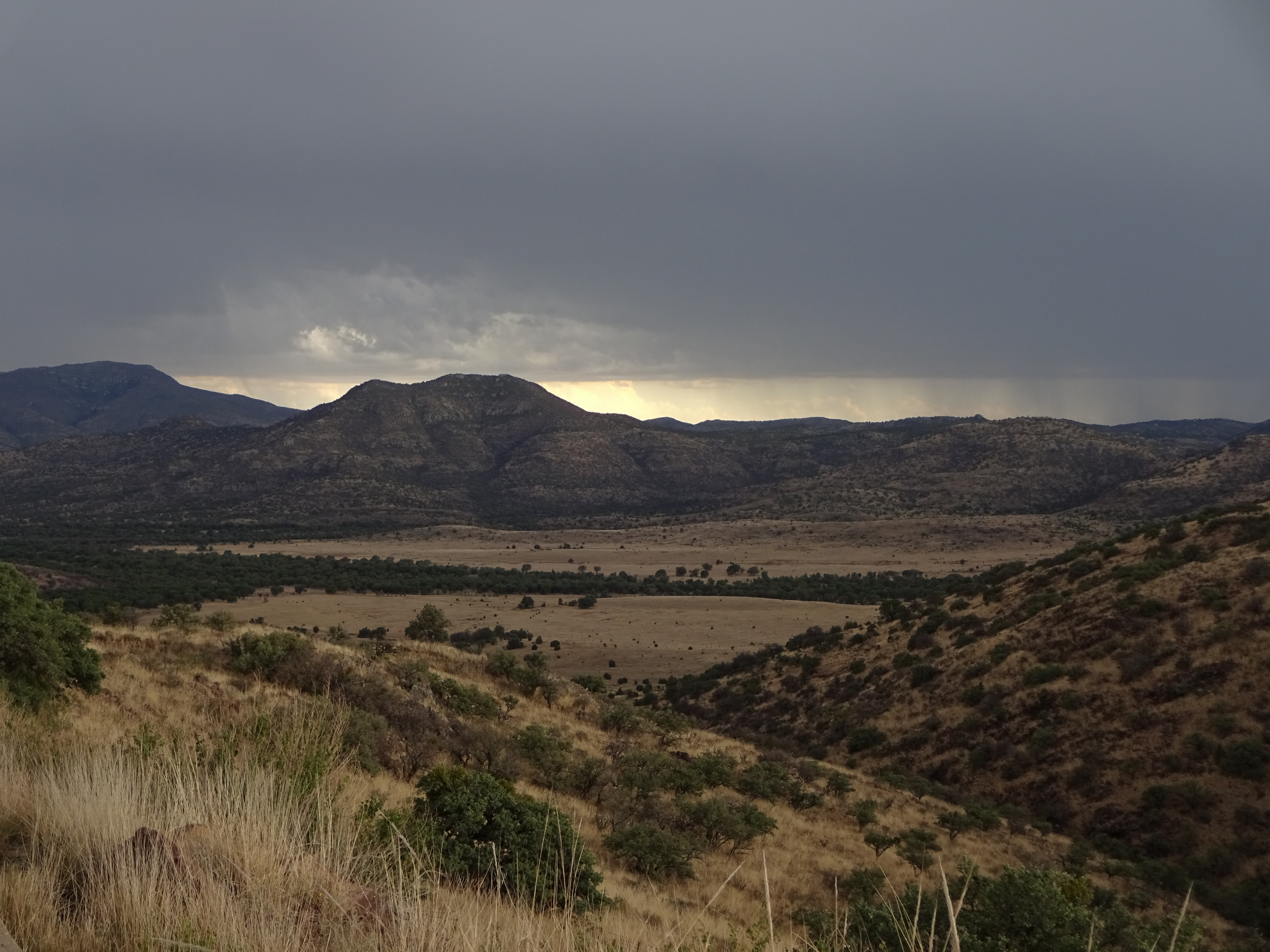
This day would not only broaden my perspective of Mexico, but my understanding of Texas would also be augmented. I have lived both in Mexico and Texas. But living in solely Mexico City and Houston, my perspective was limited. Visiting Juárez taught me that Mexico City is by no means the same as a border city. And my next stop in Texas, at the Indian Lodge at Davis Mountains State Park, would be my introduction to a different type of Texan than those I had been previously exposed to. This would be the extremely rural, isolated, overly friendly, and hospitable West Texan, which I became very fond of.

The drive from El Paso into remote West Texas and the Davis Mountains was beautiful and very unique. It took a while of driving past lots of semi’s and oil fields, but a turn in the road led me to a long stretch of two lanes which flowed among mountains. I had never quite been to this type of landscape. It seemed part forest but park desert. What I came to learn is that it indeed was a new landscape for me. It was the Texas savanna.

DSC09651The road wound through countryside and slithered among mountains. At one point I came to a overlook where I looked down across the grasslands and the mountains. In the distance, over the mountains, it was storming. I could see the dark clouds and rain contrasting with a golden sun that was peeking out from the corner of the sky. The contrast in the sky, brought about contrast in the land between the deep greens of the scattered trees to the accents of golden grass.

DSC09657I could sense the arid land giving off a sigh of relief for the rain that would soon arrive. A could feel the tension released in the air. As I continued on my drive, a parade of javelinas jumped a stone wall, scurried across the road, and leaped into the wild grass and brush. These creatures look like wild boar, and although javelina is the same name given to a wild boar in Spanish, these javelinas are peccaries, and unlike boars are native to the Americas. But combine the savanna with a javelina, and the fact I hadn’t seen a business for hundreds of miles, and you could have fooled me to thinking I was out and about somewhere in the African savanna and I’d be prone to see a zebra, or a lion.
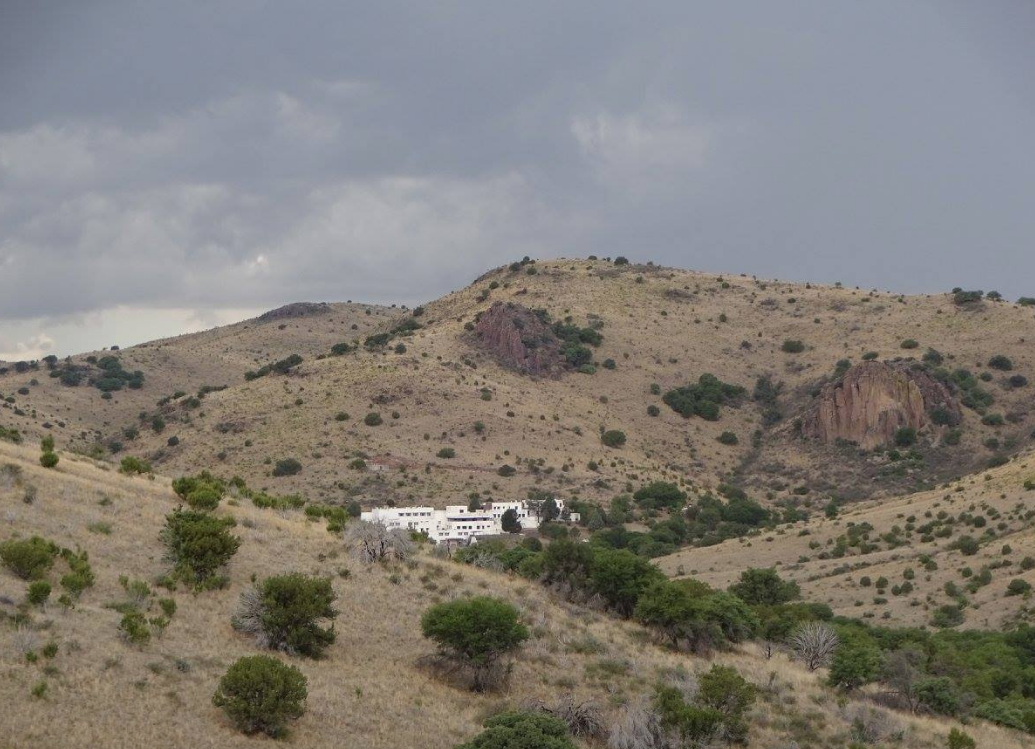
Wait! What’s that? I arrived at Davis Mountain State Park and bright pink a sign warned- “Mountains Lions have been sighted…please use caution and do not leave your children unattended.”

I really was in a different world.

I paid an entry fee at a self-service drop box, although i realized later, as an lodge guest, I didn’t need to, and I proceeded down the road towards the lodge. It was late evening now, the sun was getting lazy, and the surrounding storm clouds darkened areas of the sky, shadowing the landscape and giving an eerie ambience, almost like there was a solar eclipse.

Screen Shot 2019-03-27 at 10.13.40 PMExcept for the one elderly couple who asked me for directions at the drop box, whom I couldn’t assist with any knowledge, I didn’t see any other people on my way to the lodge. This place was very quiet. Am I in the right park? Is there a lodge here? Or is there another Davis Mountains Park? Then rounding the bend I saw, nestled between two mountains, a picturesque oasis. I had arrived.

Driving up to it, I was very excited. This looked perfect. It looked like it had jumped right out of Southwest history to be at my service. It was a white adobe structure, resembling a multi level pueblo village, with immense Southwest charm and historic aura. I learned in was built in the 1930s by the Civilian Conservation Corps. It was not just any CCC project, but I would say an achievement of art.

I walked up to the counter.  

“Why hello, darlin’. Welcome to the Indian Lodge.” I could tell from her initial address she was going to be a character well appreciated in my story. “We are just so happy to have you here.” She had blond curly hair, was middle-aged, and had a life-loving and sincere essence.

She asked me my name, had me sign myself in, and handed me the key. She was extremely friendly in the warmest and most genuine and unexpecting way. She told me the hours of the restaurant, the pool, and check out, and then proceeded with: “Cell phone service is spotty, and there is wifi, but you know what we say? If you catch the wifi, take a picture cuz it won’t be here for long.” She explained how they were off the grid as far as land-based internet service concerns, and internet had to be channeled through satellite, but with the mountains surrounding, the signal didn’t always make it down to the lodge.

“Have you eaten?” she asked, only to proceed to tell me everywhere to eat was closed. And trust me, there wasn’t much option out here in the middle of nowhere.

“It’s ok, I have some food in my car,” I explained.

She smiled.

“Alright, here’s how you get to your room…”

Wait, what? I thought. That was a lot of directions, I didn’t ask her to repeat. How hard could it be? Fifteen minutes later, I still couldn’t find my room. It was some sort of maze. This adobe village had various levels that didn’t always match up with one another, with stairs here and there, landings, and random courtyards spread out in between. I knew I had to enter an inside common room, go out the other end, and go up some stairs, but I couldn’t tell exactly what was a  “passageway” and what was private patios and landings belonging to other guests. I came back to the common room, there were other guests gathered. “Can we help you,” one asked.

“I am just trying to find my room. I’ll find it.” And I did.

My room was isolated at the very top of the adobe structure. It stood up like it’s own tower, with its own set of stairs and its own private patio. It was almost like I had my own private building. And uhhhhh– a sigh of disbelief and then embracing perfection. The view was stunning. My room looked out into the valley of the two mountains, the sun dipped down in the middle of the valley, creating a quintessential sunset pristinely visible from the patio and windows of my room.

I went inside.

Screen Shot 2019-03-27 at 10.13.14 PMRustic, beautiful, charming. An old stone fireplace stood with an extending stone hearth. The walls were white abode, the ceiling wooden logs, the furniture hand made of cedar, some original historic pieces from the 1930s. The lamps here and there gave off a warm and homey glow. A rocking chair stood next to the fireplace and in front of the wood framed window with the bright orange sunset. The window on the opposite side was tucked into its own nook where a desk and chair stood, as if looking out intrigued by the view of a tree reaching out its branches. And the bed in the middle was adorned with a beautiful lacework comforter and a blanket depicting running horses and geometric designs, looking like a true piece of native craftsmanship of the area.
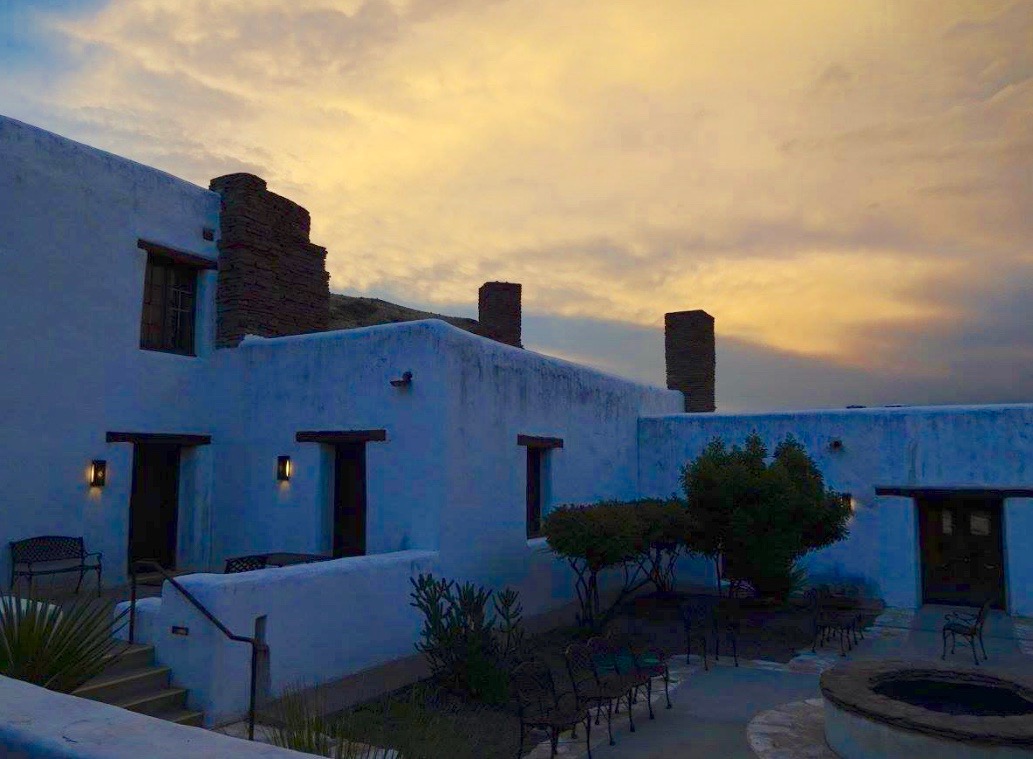
Hands down, in all of my travels, this is my favorite place I have spent the night. I felt like I had walked right into a Zane Grey novel.

It wasn’t just the historic charm and visual appeal that made me love this place so much. It was also this incredibly friendly and homey vibe. To unpack it, I later came to find out that nearly everyone I encounter in West Texas is very friendly and it makes sense after reading the book Beneath the Window about West Texas. Historically speaking, West Texas was so extremely rural, that the people living out in this area, fighting desperately with the land to create homesteads, found other humans such a rarity, that when they did encounter other humans it was an exciting event, so much so that these other humans were greeted with such warm hospitality and delight. I believe this aspect of West Texas pioneer culture is still strongly evident today. It has been passed down, and even still, this area is very rural. Seeing others I’m sure is still exciting and novel. I’ve been to many places I understand, but try explain this to a native New York City dweller and it might be a little more difficult to understand.

Screen Shot 2019-03-27 at 10.13.28 PMAlso pertaining this this vibe was this true lodge feel. Back in the early days of park lodges, arriving at a lodge was sometimes an accomplishment in and of itself. Long horseback rides or wagon trips through challenging terrains would finally lead one to a lodge of comfort and peace. Same situation today. A long and isolated journey through very remote roads to the middle of nowhere, brought me to the Indian Lodge, and the lodge was the only thing here. There was nowhere else to go this evening. This was it. The lodge was its own oasis. Everyone staying at the lodge had nowhere to be but at the lodge. We all had to make comfort and do with our own limited amenities and food. And without distraction, we all shared the sunset together, the maze of the abode structure, and each other’s own company. Although this place was isolated, and it was quiet, I was not the only one here. I believe there was a wedding party staying at the lodge. Clues of confetti, signs, and gatherings of multi-aged people, led me to this assumption.
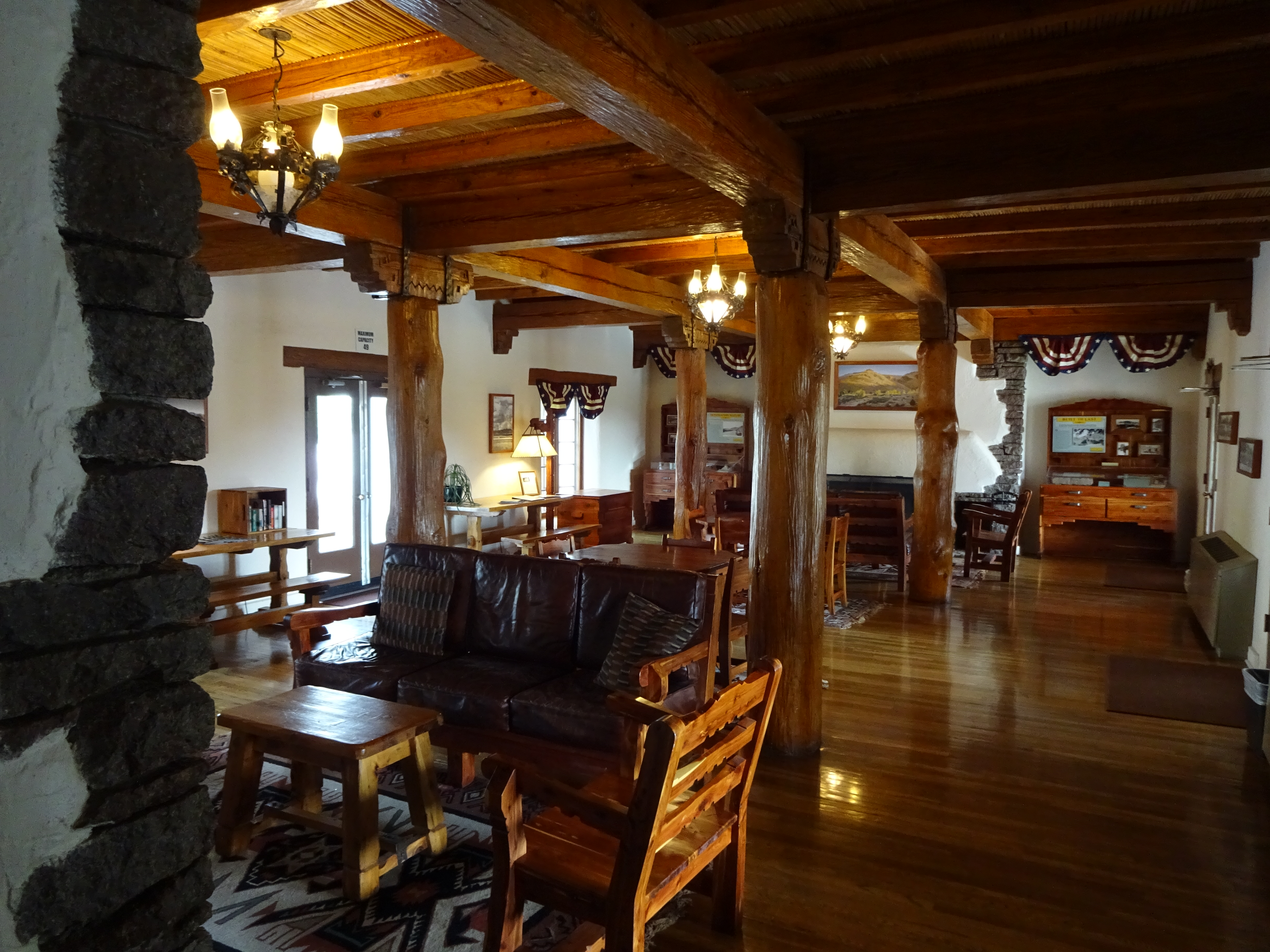
DSC09699 (1)After dropping off my bags in my room, I peacefully explored this village of a structure. The clouds had melted away and the sky above was a calm darkening blue. Going from one adobe island to another from and one terrace and courtyard to another, I sat and enjoyed the remainder of the sunset and listened to the water trickling at a courtyard fountain. I also explored inside. The common indoor area was constructed with beautiful woodwork, old western chandeliers, nooks and crannies to sit and relax, and a small statue and area honoring the work on the Civilian Conservation Corps. I. Loved. This. Place.
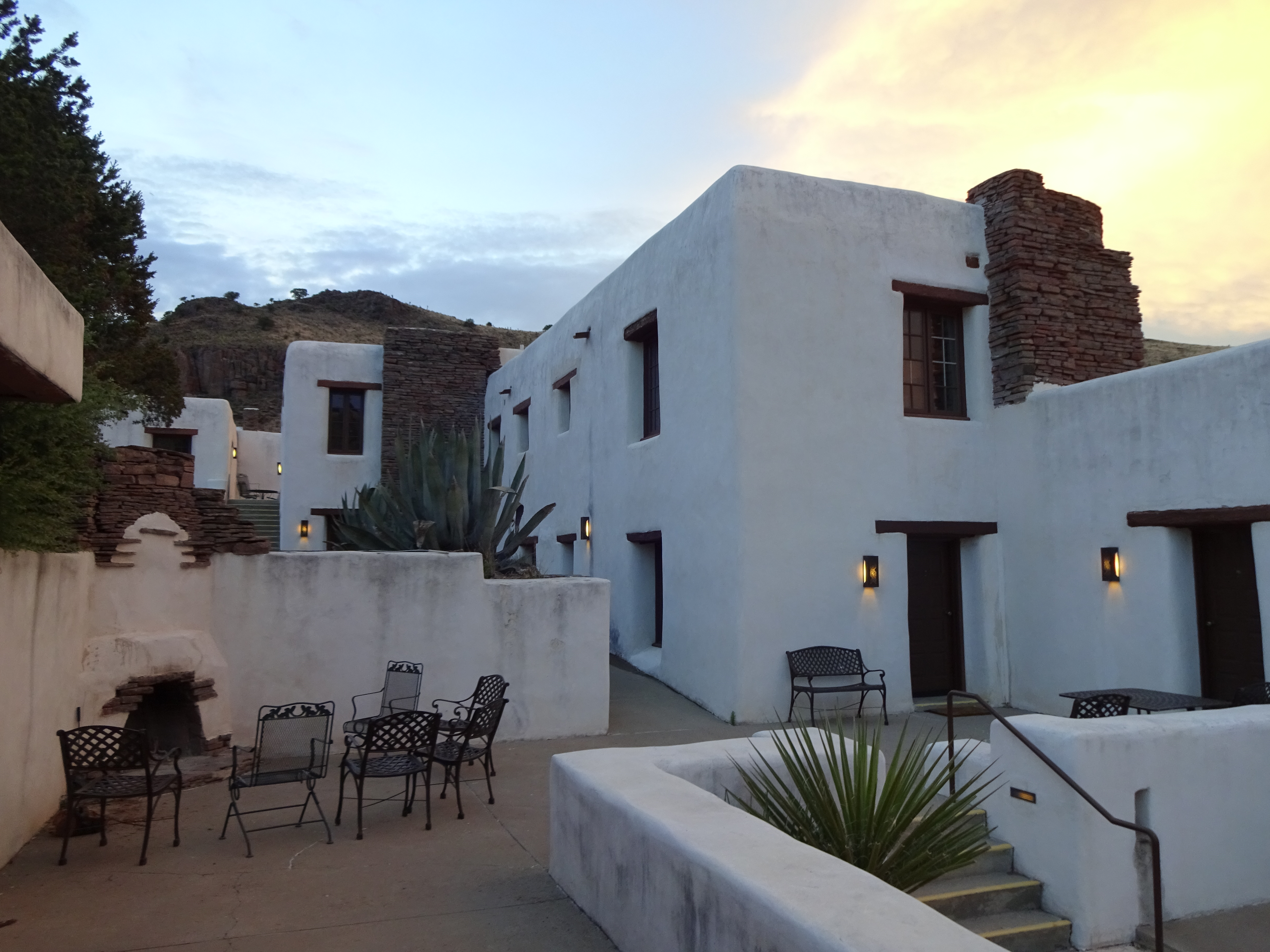
I went back into the room that housed the front desk and asked the hostess if i could use a microwave to heat up some soup and oatmeal. That would be my dinner. I took them up to my room, kicked off my shoes and went over to the little desk nestled aside the inlet window.

I reflected on the day and journaled. My journal entry starts off “What a difference a day makes!” The previous night I was dodging lightning on the white sand and found myself sleeping scrunched up in my compact car with a ticket from a park ranger. Now I had the most unimaginable perfect, peace place to stay, and I had had a full and exciting day of crossing the U.S-Mexico border, learning new history, and opening my eyes to new perspectives.

This day would be the start of my falling in love with West Texas.

DSC09688

Check back next Wednesday for the next “episode” in the adventure.

Click here for the previous entry “Texas, Mexico, and the Experience at Chamizal National Memorial”: https://joshthehodge.wordpress.com/2019/03/21/texas-mexico-and-the-experience-at-chamizal-national-memorial/ 

Check out my book “Among Blue Smoke and Bluegrass” on Amazon: https://www.amazon.com/Among-Blue-Smoke-Bluegrass-Tennessee/dp/1790631297

Texas, Mexico, and the Experience at Chamizal National Memorial

I was hesitant to go in the first place. Chamizal National Memorial could be one more National Park site to check off my list, and it pretty much was in route, but it would require a slight detour right into the heart of El Paso, Texas.

On a definitive burst of whimsy, I decided I’d do it. I would go to Chamizal. First I decided to stock up on a few food supplies at an El Paso Walmart. In the parking lot, just as I was about to turn the car on, a man came tapping on my window. He motioned me to roll down my window. Nuh uh, not doing it, I spoke in my mind. It sounds like a great way to be mugged. I didn’t move and kept my composure. He held a receipt up to the window. “Return for me, this. I have receipt.” His English was broken. He proceeded to showcase a pair of shoes. Does this even require an explanation? There was no need for me to return an item for him. Something smelled fishy in the hot Texas air.

Being back in Southern Texas brought back poignant sensations. I was accustomed to this type of environment and behavior. I had lived in Houston, Texas for a year. It was my first year out of college. When I stop to remember this time, it seems like some vague dream, and I often do have dreams about Houston drawn from the catacombs of my memory.  But I had lost acquaintance with the true Southern Texas vibes until I arrived here in El Paso. It was here in was assured will all certainty that my experiences in Houston were but a breath away. Cities of Southern Texas have their own unique identity, feeling like their own entity- a foreign place to the rest of the United States.

I was fortunate to live in a nice part of Houston, although in a humble apartment tucked in between towers of luxury. But I worked south of the city in the rundown poverty stricken area in which I served in a charter high school funded in part by the Federal government as a school of choice but also a school to send juveniles who were kicked out of public school and  were on probation. A number of students were in gangs, working for the Mexican drug cartels, and on judicial trial.

Among this population I learned where some immigrants bought pirated social security cards, how they worked around the legal immigration system,  and how they took advantage of the welfare system. It was a very rough environment. It was gritty, but I loved it. Things went downhill, however, when both our principals resigned and things became dangerous. I decided to pack my bags, leave, and head back to the Bluegrass. But now 5 years later, I was getting reacquainted with Texas.

It was midday and the southern Texas sun was bright and hot. My memory has everything painted over in a pale brown, with a bit of desert dust and barb wire. Businesses I’d seen had steal bars over the windows. Signs advertised Mexican auto insurance and money transfers. I had found myself on Highway 85, the CanAm Highway.

When the road was clear and afforded me the opportunity, I looked out the window to my right at the houses so tightly packed, square and simple, made of cinderblocks flowing up and down the hills. It reminded me a lot of the poorer parts of Mexico, like on the outskirts of Mexico City in the Estado de Mexico. Then I took a double take. No Way! This was Mexico right to my left. Nearly an arms reach away was the border fence. I had mistook it for a common highway barrier, but this was it. There was a ravine in between the fence and these houses. It was the Rio Grande River! I knew I was getting close to Mexico. I could sense it. I didn’t know I was this close.

These houses literally had their front windows pointing into the United States. They could look upon the modern developing city of El Paso, upon its malls, museums, and universities, but for many this place would be unreachable. Some would have to look at it, but could never go. It would be out their window, perhaps for their whole life, so close but never attainable. Looking at it day after day, stuck in a neighborhood of narrow dirty streets and cinder block houses, is just profound to think about. I can’t even begin to imagine the desire and curiosity that builds up in these people to want to see what is on the other side so close, yet in so many cases, forbidden.  

Within moments I was pulling off the highway into Chamizal National Memorial. I knew little about this place, but I was here to learn, perhaps this could further my perspective which was already beginning to grow. I have for a long time, taken a great interest in Mexico. Although my allegiance is pledged to the United States, I also have a deep admiration for Mexico. I completed some of my undergraduate education in Mexico City as an international student. I spent some of my most formative years there and really felt like I came of age while living in Mexico. It is there where I developed my own personal independence and sense of self. I have visited Mexico many summers, applied for many jobs there and even for a visa to work and live more permanently in Mexico. I’ve explored much of central Mexico, made many friend there, and identified with the culture and people as I lived there. I knew this memorial would speak to the relationship between Mexico and the U.S., and now I had arrived.

DSC09641I was greeted with a colorful mural depicting important moments in Mexican-American history and aspects of Mexican culture.  Upon opening the door I was welcomed in Spanish by a National Park Service employee. It was an elderly Latina lady with grey hair, a friendly smile,  and an aura of a traditional abuelita. She didn’t reveal that she spoke English, so we just continued in Spanish. I explained this was my first time visiting the memorial. She got up from here chair, enthused yet composed, and explained that there was a museum and film. She guided me over to a rack of brochures where she proceeded to fill my hands with brochures of other National Park units in Texas and neighboring New Mexico. She was funny. I liked her. She authoritatively but sweetly was telling me what I needed to see and what I needed to do. She was a culmination of Mexican hospitality and West Texas friendliness. I thanked her and proceeded to take in the museum. I was fascinated.
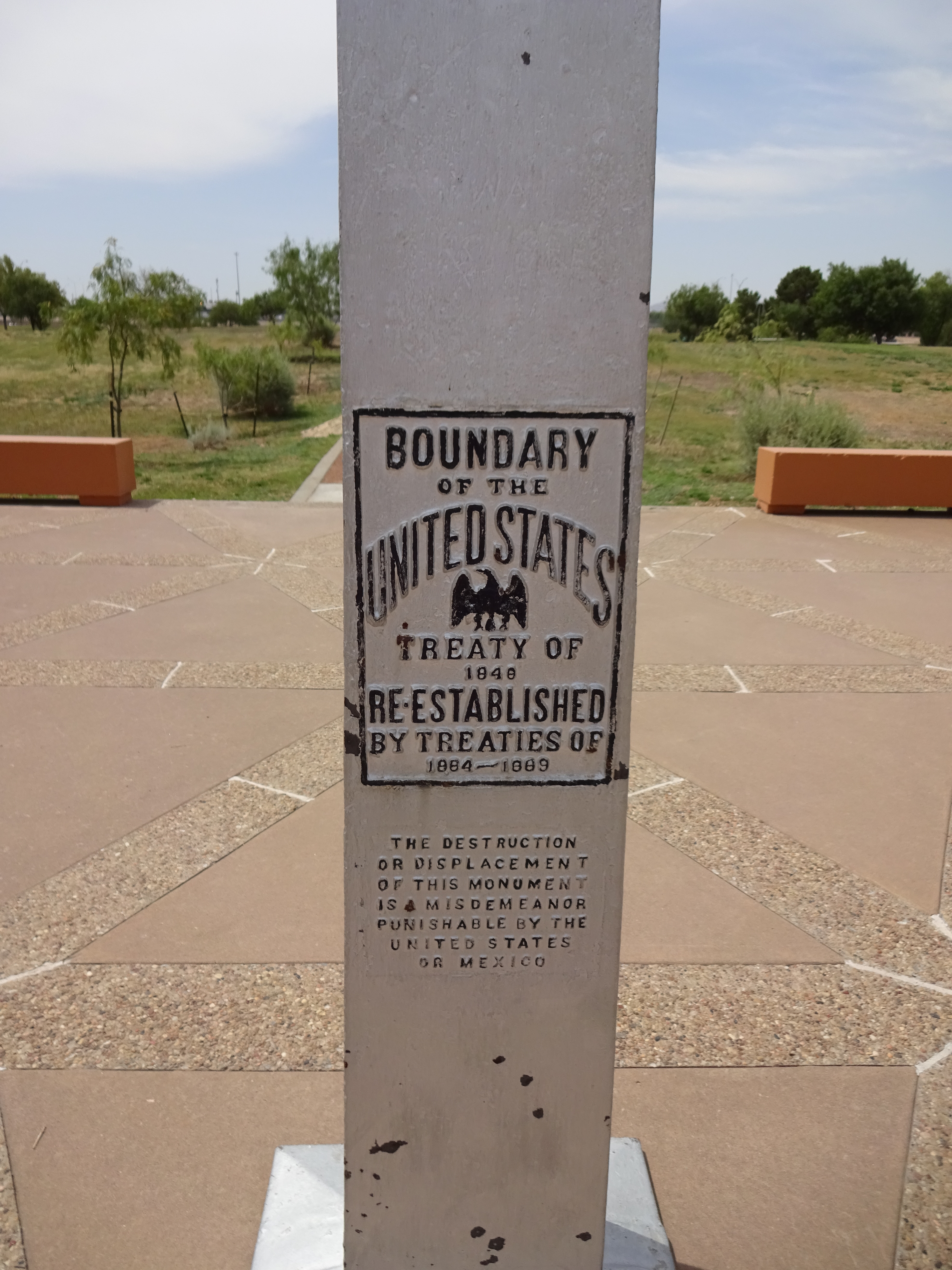
I learned through the museum, that this place commemorates the peaceful agreement between Mexico and the U.S. over a land dispute. Two Mexican presidents and two U.S. presidents, JFK and Lyndon B. Johnson, created a peaceful agreement.The issue had been that the Rio Grande river marked the boundary between the two countries, but there was an island on the river after the course of the river changed routes. It was long disputed whom it belonged to. Conclusively the route of the river was solidified in a canal and Mexico gave up its claim of Chamizal. People had to give up their land and that was sad, but overall the museum had a very positive spin on the whole Chamizal agreement

“The Chamizal is a very small tract of land. But the principle is a very great one. Let a troubled world take note that here, on this border, between the United States and Mexico, two free nations, unafraid, have resolved their differences with honor, with dignity, and with justice to the people of both nations.” – President Lyndon B. Johnson, September 25, 1964

DSC09645I left the museum to check out the small city park out back. There was a group of students perhaps on a field trip. I sought the post marking the prior land border between the two nations. I took a picture of it and then fixed my eyes on my surroundings. There was a bridge encased in fencing. A sign stuck up in the center of it declaring “Bienvenidos a Mexico.” I watched the vehicles flow and back up at the border. Then i noticed the business men walking across the border with their briefcases, returning home from a day in the office in another nation. Then I noticed others so informally coming across the bridge. Was is this easy? My curiosity was sparked. This was supposed to be an all-American National Park road trip, but maybe a side trip to Mexico could add a little spice to the slice. I had to go back in the museum and inquire. I found my little abuelita.
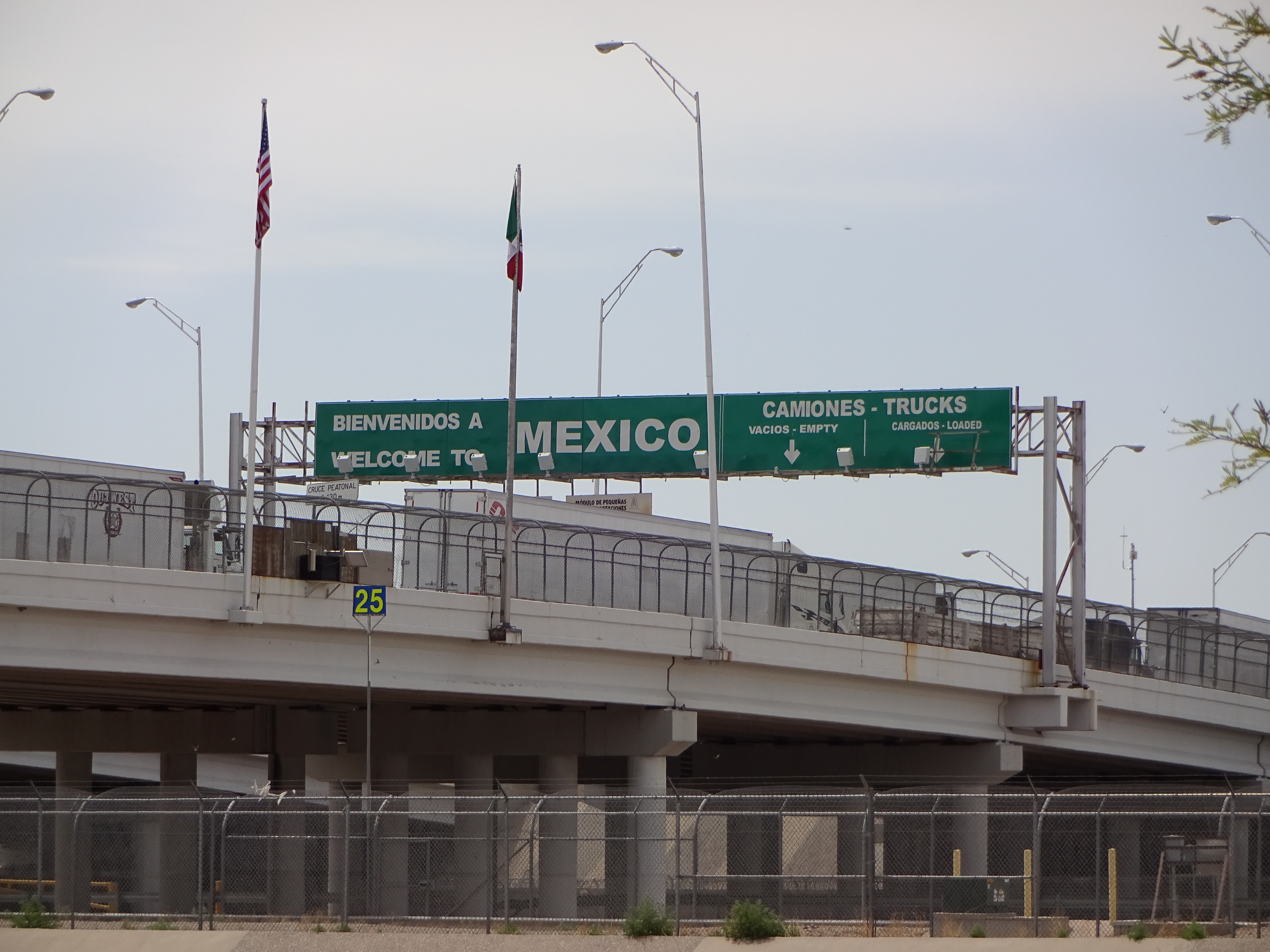
“I noticed people walking across the border, is it really that easy?” I asked

“Oh yes, you just need a passport.”

“What is on the other side?”

“Mexico,” she replied Of course I knew this. I hope abuelita wasn’t trying to be sarcastic with me.

“I know that, but is there a park or something on the other side.”

“Oh, si, hay un parque Chamizal de Mexico y tambien el museo Chamizal Mexicano.”

A Mexican Chamizal museum? I was intrigued. I wondered how Mexico’s museum would portray the whole Chamizal land dispute and agreement. Would they paint it in the same positive light as the U.S., or would it have a more bitter aftertaste after the land loss. I wanted to know and I also wanted a good excuse to cross the bridge to Ciudad Juarez, the city often deemed as one of Mexico’s roughest and most dangerous.

“Is it safe for someone like me?” i didn’t specify exactly what I was referring to, but I thought it obvious: tall, white and gringo… especially in this moment. I was dressed and prepared for my all-American road trip, not a stroll through the streets of Ciudad Juarez. I know how to blend into my environment, but this was going to be tricky given my circumstances.

“In this time of day, you’ll be fine,” Abuelita informed. “You should go, and then come back and tell me what you think.”

She was the final push. I was gonna do it.

I went back to my car, located my passport, and utilized some methods I learned when i used to explore the streets of Mexico City. I hid some cash in my shoes along with a photocopy of my passport. I emptied my wallet to the bare essentials. I strapped my camera string to by belt loop and let it hang on the inside of my pants. I changed from a sleeveless shirt and shorts to a t-shirt and jeans. I took all my typical safety measures. I was excited. Moments ago I had been beginning to question if I had lost my sense of adventure. Certainly not! This was proving it. Curiosity and daring ambition was driving me, and I took off on my journey to Mexico on foot.

This visit to Mexico would be unlike any other I’ve ever had before. It would be eye-opening and informative. In Mexico City they always say never go to the border because it’s really dangerous there. Why did they always say this? Was there validity to it? I would certainly find out.

DSC09647

Check back next Wednesday for the next “episode” in the adventure.

Click here for the previous entry “A Nightmare at White Sands”:  https://joshthehodge.wordpress.com/2019/03/13/a-nightmare-at-white-sands/

Check out my book “Among Blue Smoke and Bluegrass” on Amazon: https://www.amazon.com/Among-Blue-Smoke-Bluegrass-Tennessee/dp/1790631297