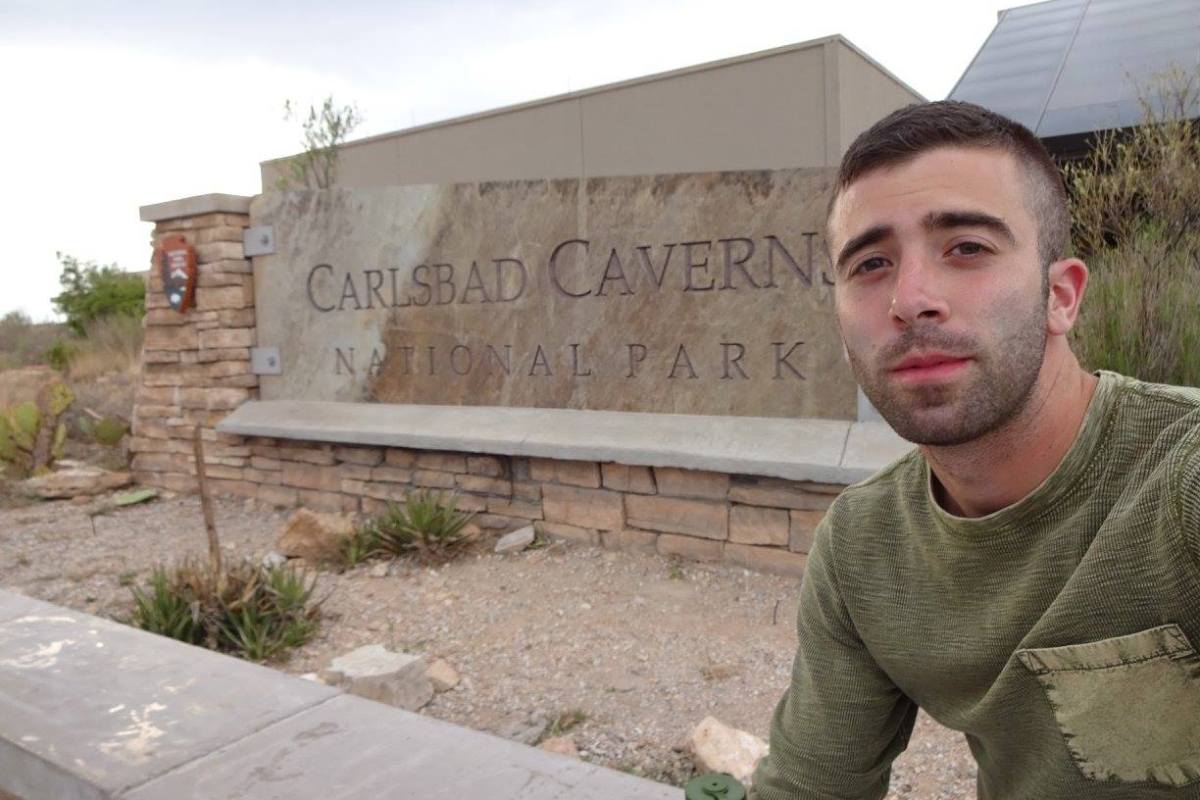
The drive from Big Bend National Park to Carlsbad Caverns is not one to boast of. I most definitely found myself on a truck route, a sure minority in my small car, with flat land and oil fields all around me and little to see. But when I arrived at Carlsbad Caverns just across the state line from Texas in New Mexico, the destination would most certainly be worth the journey.
National Parks that are formed around caves are hard to evaluate in comparison to other National Parks. There is such an immeasurable difference between a cave National Park and any other. Caves evoke different feelings. They are dark, dank, gloomy, yet wild pieces of nature’s artistry. I like them and they fascinate me, as do all wonders of nature. They can even inspire me, but hidden from the sun, beneath the surface of the land, they place themselves in their own category of mystique.
I had reserved a lantern tour of the Left Hand Tunnel portion of caverns online months in advance and was very much looking forward to it. This would be my first lantern tour in a cave. The following year I would get to go on a lantern tour in Mammoth Cave and Oregon Caves, but this was the first so I was very excited for it. Along with my excitement came a bit of frustration because I had trouble finding the park. The address I had led me to the park’s administrative offices in the town of Carlsbad. I began to consider that I might arrive late, miss my tour, and add this to my list of grievances: feeling burnt out, locking my keys in my car, having a rock fall and dent the hood of my vehicle, getting caught in a lightning storm at White Sands National Monument, and getting reprimanded from a park ranger. Of course I shouldn’t have been focusing on the bad and instead should have been grateful for being out here and being able to go to these parks in the first place, but this is where I was at mentally at this point in my trip.
After figuring my way and zipping around the five miles of road leading to the center of the park, I arrived with a few minutes to spare. I changed my clothes in my car for the cooler temperature in the cave, which stays at a consistent 56 degrees fahrenheit, and went into the visitor center to check in for my tour. There were ten people for the tour. We met inside the museum part of the visitor center and the ranger and guide, Josh from Maine, took us to a classroom to distribute lanterns. They were simple wood box lanterns with candles inside them. We then boarded the historic elevators which dropped us to 754 feet below ground level. At the time they were installed in 1932 they were the longest single-shaft elevators in the world.
 During the tour, in which we made our way through the undeveloped section of the cave on a dirt path, the ranger presented the history of the discovery of the cave. According to the National Park Service “Our first credited cave exploration happened in the cave in 1898. Sixteen year-old cowboy, Jim White, was rounding up cattle one evening when he spotted smoke from a wildfire off in the distance. He went into high alert. Fires could be just as devastating then as they are now. He rode closer to gather information. How big was it? Was it moving quickly? What direction was it burning? These questions and more pushed Jim to ride to the fire so he could report back to camp with the most accurate information possible.
As Jim approached the smoke, he noticed something strange: he couldn’t smell the smoke, hear the crackling of flames, or feel the heat of fire. Jim realized he wasn’t seeing smoke. He was watching bats. Thousands-upon-thousands of Brazilian free-tailed bats. Jim finally stopped at the mouth of the cave completely mesmerized by the spectacle of flying mammals filling the air above him. He once said he watched the bats for nearly half an hour before the darkness fell so completely he had to return to camp.
Because he knew the other cowboys would mock him, Jim didn’t immediately describe what he’d seen to anyone. He thought it over for several days.The deep hole in the ground and its secrets continued to gnaw at him. He had to find out what was down in the dark recesses.” Jim went on to explore the cave more and introduce others to it.
I loved this story and tried to put myself in Jim’s place, discovering such an immense marvel on my own at such a young age. On another note, an additional fascinating thing I learned on my tour was that microbes have recently been discovered in the far reaches of the cave that specifically attack cancerous tissue and that this discovery may have huge medical implications on the treatment of cancer.
 Although I very much enjoyed the tour, afterward things got increasingly fascinating. I was told that if I wanted to take the elevators back up to the visitor center I would have to soon, because they would be closing for the evening. If I chose not to, I’d have to hike my way out of the cave. Of course I opted for the latter choice. This gave me time to explore the Big Room of the cave and have a sandwich. I found it unique to order food and eat at the Underground Lunchroom. Back in the early days of the park there was an actual kitchen down in the cave, but because of food preparation causing damage to the cave, food started to be prepared outside of the cave and sent down.
After my quick bite to eat I began my exploration. I cannot put into words the uniqueness, the massive scale, the variety of what is in this cave. It is its own underground world. This is a cave with massive rock formations. I pondered if up above some if these things would be considered mountains. The scale is just astounding. And unlike Mammoth Cave which is largely covered by a capstone, this cave is a true cavern meaning it is composed of soluble rock which permits entrance of mineral water which grows speleothems and therefore makes the most impressive display of stalactites, stalagmites, straws, draperies, cave popcorn and bacon, and a plethora of other cave features. At times it all looks elegant, other times eerie. With every turn there is something strangely unique to look at. In the Big Room the park service has a paved trail with railings that meander around, and many spotlights illuminate the most astounding of features.
 With a burst of excitement I went from one feature to the next, but then made the same walk again to quietly savor the surroundings and be filled with a sense of wonder. I could easily imagine I was on another planet, a more desolate one. When I was done pondering and wandering I began my ascent to the cave entrance. It was all a gradual uphill hike, along a paved path. The passage narrows and widens from one set of switchbacks to another. I was the only person on this path. Despite other parts of the park and the visitor center being quite busy, I didn’t see a singular person for the entire ascent. I felt like I had Carlsbad Caverns to myself. As I got closer to the cave entrance I began to hear chirping overhead. I looked up and saw small dark creatures flying near the roof of the cave. Bats! I thought. They grew in number and in volume the more I ascended, swirling in flight above me. The cave was very tall so I couldn’t see them up close, but I reveled in the unique experience of hiking in the company of lively bats.
 Back at the visitor center I told a ranger what I experienced. I would be informed that they most likely weren’t bats but cave swallows. Also in the visitor center I watched the park film and bought a pin for my collection. Then after killing a bit of time, I went back outside to the amphitheater located right at the mouth and natural entrance of the cave. It was time for the nightly bat flight program. A ranger would talk about bats and then around sunset the bats would come flying out of the gave in a grand spectacle. So, as programmed, a ranger talked about bats feeding on bugs, especially mosquitos, and how the tendons in a bats hands are designed opposite of ours. To expand their fingers from their fist it requires strength, but a fist tightly clenched is in the nature relaxed position. This is how they are able to cling onto things and one another and hang upside down. The ranger talked about the immense size of the bat population between 200,000 and 500,000 in the cave and how bat, guano a.k.a. bat dung, was once harvested from Carlsbad Caverns for its value as a nutrient rich fertilizer.
The ranger then presented some sad news: do to the nature of the weather, the bats may not be coming out of the caves. It was a gloomy evening, clouds hung low and the wind was strong. It seemed that a storm was just moments away. The bats would not come out in storms. But then as he was talking about such a predicament a bat flew out of the cave, followed by another. They flew around a group of trees and went back into the cave.
The ranger explained that these were the “scouts.” The bat colony sends out a scout to check the weather and report to the rest. If the report is good, the group then exits the cave. If the scout determines the weather to be threatening, the colony would stay in the cave for the night and postpone eating. Minutes later a swarm of bats exited the cave in the most spectacular, eerie, yet beautiful display. They came out in a spiral formation almost appearing like a tornado, Dark black silhouettes contrasted against the evening sky. They flew right above me in a beautiful display with the precise coordination of a school of fish. With Batman and Halloween and all the other references to bats in popular culture I am quite familiar with the silhouette of a bat with its wings extended, but there is something strictly exciting and beautiful to see thousands of these silhouettes moving, flapping, flying above me in the sky.
Nowhere else have I seen such a display. It was breathtaking, and I was very fortunate to see it. Moments later it began to rain. The bats probably wouldn’t have exited the cave if the scouts had reported rain. I made it back to my car and opened up a can of soup and ate it for supper with the sound and display of rain water crashing against my windshield.
A trip to Carlsbad Caverns is worth every bit of time and travel to visit. It truly lives up to the title of National Park, for it is an extremely unique place to be treasured, with great stories, most impressive natural features, and a stunning show presented by it’s natural inhabitants.
Read my previous episode “On the Rio Grande: a world between U.S. and Mexico,” here: https://joshthehodge.wordpress.com/2020/02/02/on-the-rio-grande-a-world-between-the-u-s-and-mexico/
Check out my new book “Canyonlands: My Adventures in the National Parks and the Beautiful Wild,” here:
https://www.amazon.com/dp/1711397873/ref=cm_sw_em_r_mt_dp_U_UjGjEbYBGF4PR




 Josh Hodge blog