On the Rio Grande: a world between the U.S. and Mexico

“Is there a trail over there?” I asked. 

“No, but you can bushwhack,” the man replied. I was looking at Terlingua Creek in Big Bend National Park as it poured into the Rio Grande and the water flowed into Santa Elena Canyon. I had parked at the trailhead. There was supposed to be a trail into Santa Elena Canyon. It didn’t look promising, but if this man and his three small children could do it, I could too. How did they do it, really? Did he carry all his children on his shoulders? Because the Terlingua Creek was not by any means a dainty waterflow easy to cross. It appeared as a rushing river. As I put my feet in to start my “creek” crossing, the water rushed around me, and as I carefully stepped forward the water got increasingly deep. Water flowed waist up, and I nearly lost my footing. I was unsure that this was a good idea, but after crossing the deepest part, with a lunge, I met ground on the other side. Well soft silky terrain that oozed between my toes and sucked my feet down into it. 

Trudging my was through a forest of underbrush, ducking my head under curving branches and pulling others aside with my handle, I was following the footsteps of prior travelers trying to find my way to the actual established trail. I knew the level of water was to blame for the covering of the actual starting point of the trail. While I was exploring my way through this jungle-like environment I got caught up in the novelty of the scenery and moment and so lost track of footprints in the mud. I tried to backtrack, but I couldn’t make sense of the footprints anymore especially combined with mine. I was barefoot, shirtless, ankle deep in mud, and bushwhacking my way through riverside growth. I felt perhaps the most primitive and truly explorative I have ever felt before.
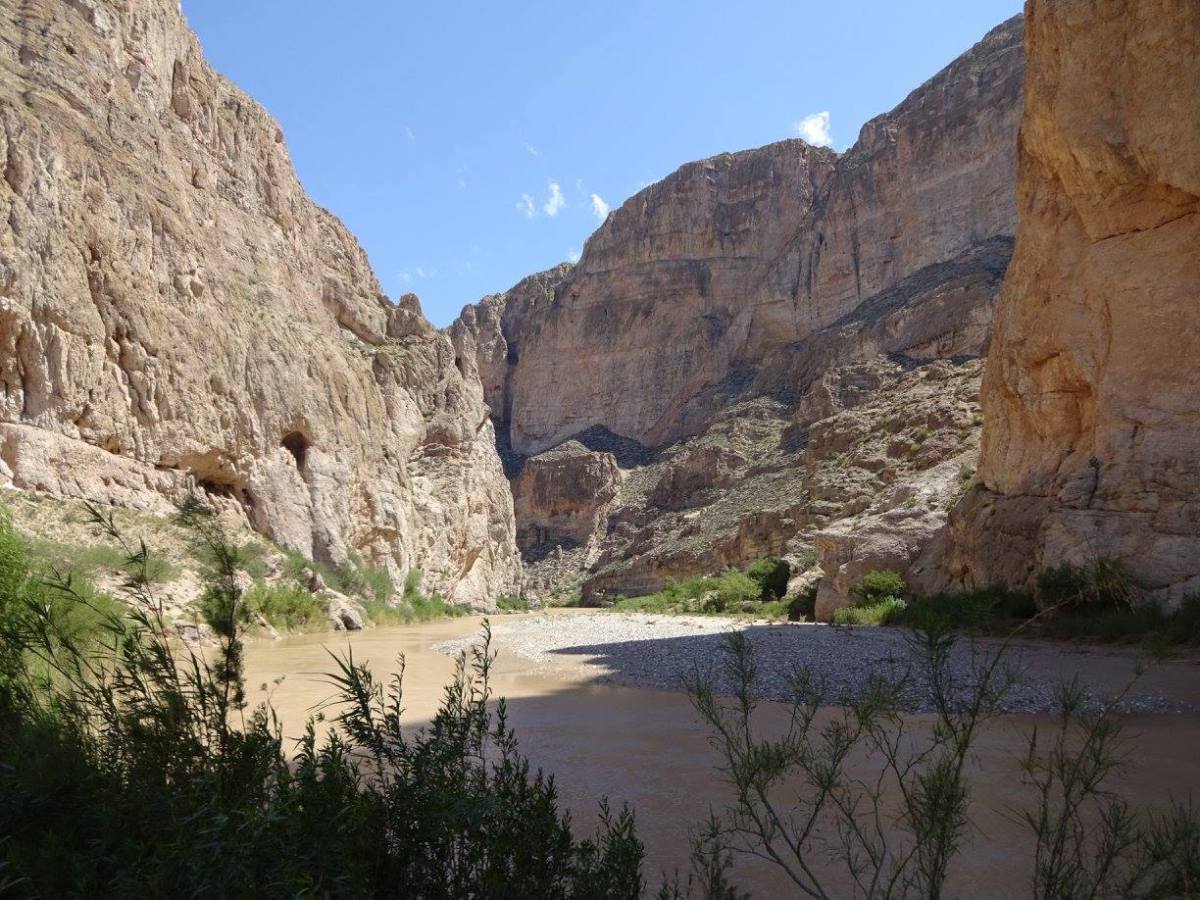
19575372_10214182240610373_3847752781553718953_oEventually, after a brief moment of uncertainty, I arrived in Santa Elena Canyon where giant cliffs forming the canyon walls measure 1,500 feet. Here one cliffside is Mexico and the other is the United States of America, and the Rio Grande flows in a murky pale brown in between. On the U.S. side, about halfway down the cliff faces, rock erodes leaving piles and a bar alongside the river where trees and other plant life grow. This is where the established trail is found. 

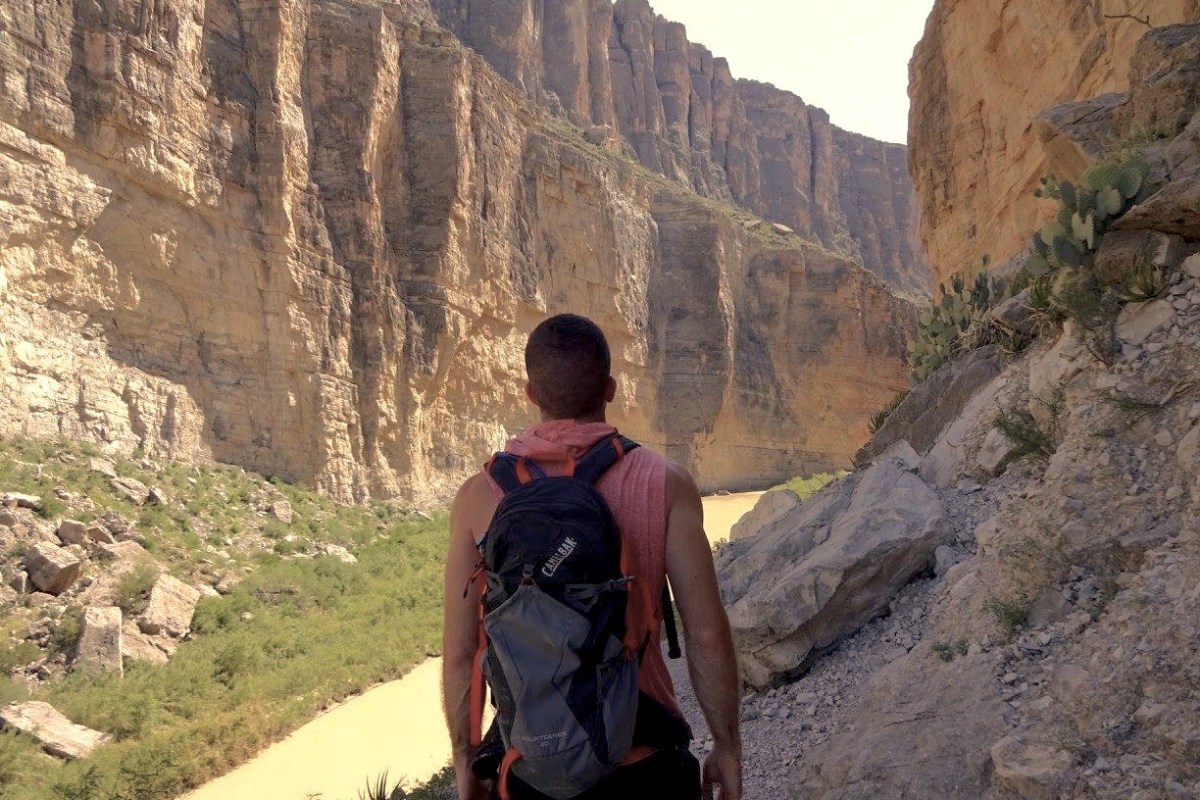
As I walked through the canyon, I was met with a sense of wonder at the immense bold rock walls and the knowledge that the two countries come together at this exact location. Here I was far down below in the eroded expanse created by the river. Up above on the plateaus is where the two countries exist with all their problems and all their dealings. Here in Elena Canyon I felt like I was in some secret fortress or a hidden world, protected, encased by the walls of the canyon. I walked slowly, my eyes focusing at the majestic walls and back down to the quiet river. 

I took the trail as it flowed up and down alongside the canyon wall. At one point I came across a large fish that the river must have left ashore, which had begun to dry out and be reclaimed by the earth. I took the trail until I could no longer, until it sort of disappeared and the rocks became more jagged and gave way to the river. Everyone that comes to Big Bend National Park should not miss out on this short hike. The views are among the most astounding in the park. The only word of caution would be crossing the creek.
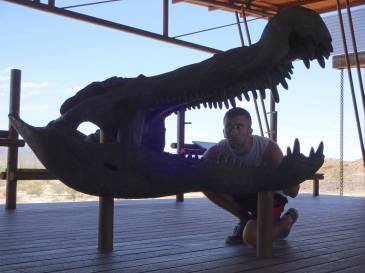
19575197_10214182232690175_5523220705420299641_oThe visit to Santa Elena Canyon was near the end of my day’s adventure. This morning I ventured out in my car to travel the whole expanse of the park and get a sampling of all it has to offer. I first stopped at the Fossil Discovery Exhibit. I learned all about the terrain and dinosaurs that used to live in this shallow sea. I even got my picture with a cask of the Deinosuchus skull. I then proceeded southward in the park on my way to the southeast corner to visit the Hot Springs. I’d read about this and was very interested I had never been in a hot spring. I stopped at the Panther Junction Visitor Center to inquire about the hot springs. New to hot springs, I just didn’t know if there were any safety precautions I should take. The park ranger said “I can tell you this:  It’s about 100 degrees outside right now, and the water is also about 100 degrees. You can decide if you want to go in or not.” 

I drove the 20 miles to Hot Springs.

The final few miles were on a remote dirt road. When I arrived in the small parking area a sign read “Vehicle Theft is common in this area.” That was not comforting. I got out of my car and very cautiously observed my surroundings, alert at all moments. I was near a part of the Rio Grande where the water was shallow and the girth of the river was small, where crossings from Mexico on foot were very possible and so frequent. 
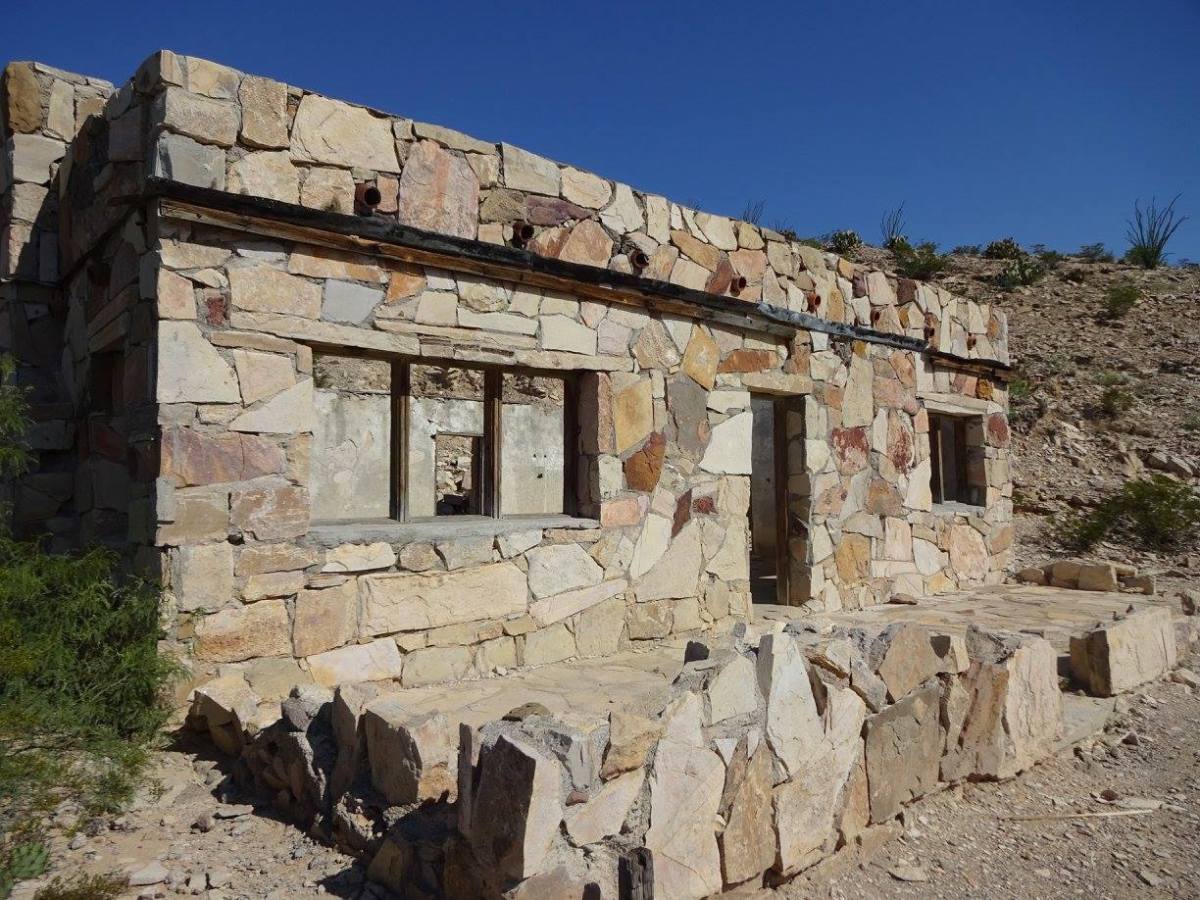
19620250_10214182241930406_2607112815732533876_oI observed the remnants of the old post office and bath house that used to stand on site. On the half mile hike to the hot spring, I got hit with an overwhelming sense of insecurity and uneasiness. I felt like I was being watched. Something was not right. Then, next to the trail, I came upon a grouping of small Mexican animal figurines “alebrijes” standing on the ground by a plastic jar with a slit cut in the top for money collection. Someone had crossed the river to place this and may be hiding somewhere at this moment, keeping an eye on the money jar. In retrospect, this seems silly, but this was the final bad omen. These figurines probably belonged to someone impoverished from across the border who was rather innocently trying to make some money. However a criminal is a criminal. This person broke laws by crossing into the U.S. this way and selling items in a National Park. Considering this, along with the sign warning of vehicle theft, I could almost hear the little figures saying “we are watching you,” and in the moment it scared me a lot. I came upon them but it seemed like they found me, and suddenly jumped out, unexpectedly. They seem like menaces of a Goosebumps novel. It sounds ridiculous, but such a negative energy surrounded those little figurines that I started running back to my car. I don’t know exactly what danger was there, but I could sense it. I knew it wasn’t worth it to see the hot springs. 

Back on the main road I took a short stop at the Rio Grande Village which was closed for the summer, except for its store. There were very few people out and about the park but here a group of about a dozen teenagers and few adults formed a line in front of the checkout counter. They were all together. I bought some Check Mix and a Vitamin Water as well as a pair of fancy socks with an image of a bear and the words “Big Bend” sewn into them. I then proceeded to the Boquillas Canyon Overlook. I parked my car and walked the short path to the river overlook. There, on the banks of Rio Grande on the U.S. side, a short Mexican man wearing a sombrero was singing Cielito Lindo “Ay, ay, ay, ay Canta y no llores.”

There were a few other tourists at this spot as well. One man asked this singer questions about where he was from This man shared. “I’ve been crossing the river for about 20 years to sing songs, any requests.” He too had a money jar for tips. 

I wanted to cross the river as well. Near this location was the port of entry to Boquillas, Mexico. One can take a short boat ride across the river, present his/her passport, and enter the small town of Boquillas for a visit and most typically a meal. Today the port of entry was closed. This man, however, did not let that stop him. 

19488749_10214182239610348_5766597606567636851_oWhen I crossed the expanse of the park and was nearing the West end to visit Santa Elena Canyon I stopped at Mule Ears Viewpoint where one can see the two giant rock formations peaking up like ears. I also stopped alongside the road to view the enormous ocotillo plants, a native to the Sonoran and Chihuahuan deserts with their skinny stems creeping well over twelve feet tall. 
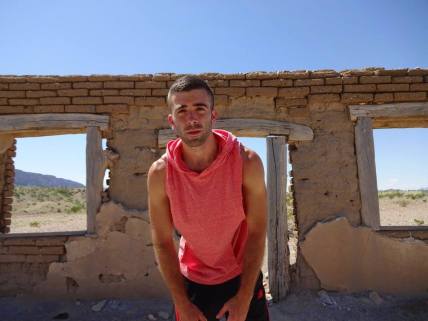
19620485_10214182231130136_1345322192240845248_oMy final stop before venturing into the canyon was at the Dorgan House Trail which leads to the remnants of an old homestead called Coyote Ranch. There were interpretive signs telling a brief history of the place. Settlers had to give up their homesteads when the government seized control of the land. The remnants of the buildings at Coyote Ranch are rusticly beautiful. There were clay bricks falling down from once fully constructed walls and door frames and window beams constructed of what looked to be driftwood. The homestead was up on a bit of the hill. I paused and looked out at Santa Elena Canyon in the distance and the expanse of savannah and rock formations in the distance. The place was so extremely quiet and remote. It fascinated my imagination to entertain that this was once home for people and they somehow raised animals and grew crops on this near barren land. 

When my day was nearing its end, I headed back to the Chisos Basin in the center of the park where I was staying in the campground. I went to the lodge and bought a book titled Beneath the Window: Early Ranch Life in Big Bend National Park Before it was a National Park. The author Patricia Wilson Clothier recounts here childhood living in the region and the difficulties of trying to farm a land so harsh and uninviting. She mentioned how during her childhood in Big Bend, other people were rare, and those who did live nearby in the Big Bend region were a journey away. When they weren’t at their ranch, like others they would always leave doors unlocked and open for weary travelers passing by. It was expected that people passing through may need a place to stay or food to eat, so the door was always open. I found that information very insightful. Maybe this goes to explain the very apparent friendliness of West Texans. A culture was established in the past of excitement for people and visitors, because “new” people were a sure rarity in this rural land. I thought to myself, I don’t need to be in West Texas to be a rarity. You’ll find me a rarity wherever I am, for better or for worse.

I ate dinner at the Chisos Basin Lodge restaurant. I enjoyed some pork tacos with kale wand a great views of the rock pinnacles before me out the window. After dinner I bought some yogurt from the general store I fainted in the evening before, and I read my new book on the back porch of the lodge to another amazing West Texan Sunset. 

The following day I would head north to the border of New Mexico and Texas to visit Gualalupe Mountains and Carlsbad Caverns National Parks.

Read my previous episode “Passing Out in Big Bend National Park,” here: https://joshthehodge.wordpress.com/2020/01/20/passing-out-in-big-bend/04/11/treasures-of-the-chihuahuan/

Check out my new book “Canyonlands: My Adventures in the National Parks and the Beautiful Wild,” here: 

https://www.amazon.com/dp/1711397873/ref=cm_sw_em_r_mt_dp_U_UjGjEbYBGF4PR

Canyonlands Cover

Advertisements

Occasionally, some of your visitors may see an advertisement here,
as well as a Privacy & Cookies banner at the bottom of the page.
You can hide ads completely by upgrading to one of our paid plans.

UPGRADE NOW DISMISS MESSAGE

LEAVE A REPLY

POST NAVIGATION


Passing Out in Big Bend National Park

My vision faded to a nauseous blue and the voices around me turned into muffled echoes drowned out by anxious buzzing. My eyes were open yet soon I couldn’t see. The control of my faculties was fading. The beating of my heart was spinning out of control in a desperation. I was slipping into unconsciousness. To date, this is the one and only time I’ve fainted in a National Park.

Despite what might seem most unpleasant, don’t get me wrong. This day was a great one. It just ended with a flopping crescendo. I was in Big Bend National Park in West Texas where one of the nations most magnificent National Parks hugs the Rio Grande River bordering Mexico. This wonderland in the heart of the Chihuahuan Desert ranks on the lower end of visitation when it comes to National Parks but it’s towards the top of my list of most impressive National Parks. 

19693384_10214182230570122_6254901748591647210_o

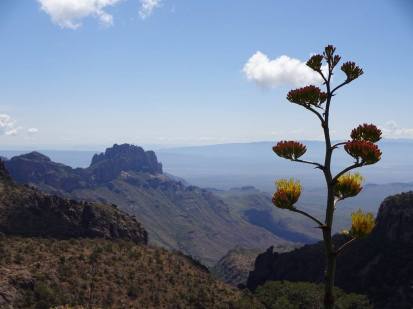
I would venture to say that for anyone not from this area this place would seem otherworldly, like a completely different planet. Plant life is so unique with giant agave plants of all varieties and orange twisted naked indian trees. Reading up about this park afterward, I learned one of the reasons why the plant life is so unique in this are of the Chihuahuan desert is because it is the biome developed from what is believed to have once been rainforest before land masses separated, the gulf of Mexico was formed, and the sea that covered much of the park dried out. This was also the land where dinosaurs roamed and swam. Deinosuchus, an enormous genus of crocodile swam in the shallow sea that covered the lower levels of this park where now tarantulas scurry. Looking around, the age of dinosaurs doesn’t seem so distant. The peculiarity of the landscape, the enormous rock pinnacles busting up from grasslands, and the oversized plants, like the aloe vera growing stalks up to forty feet high with giant insects feasting and pollinating, make it seem like a flashback to the jurassic or cretaceous.

19667576_10214182234850229_2593713154650568465_o

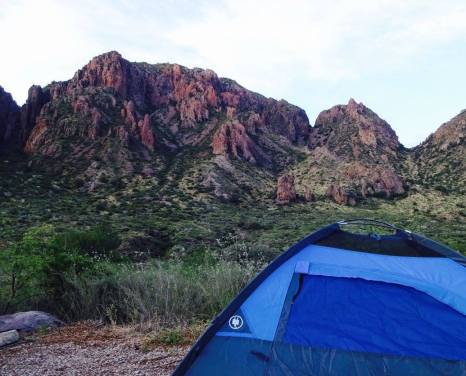
The previous night I had camped in the Chisos Basin Campground located in one of the four villages in the park. Yes, Big Bend is quite big indeed. Some of the other hubs close down for the summer but this one remains the most popular one in this season. The campground was tight and crowded. Many people were packed in, but it was situated in a beautiful basin surrounded nearly completely by rock pinnacles except for a gap looking down upon the desert. Up here at the higher elevation the landscape is greener, more trees are able to grow, and the temperature usually remains about twenty degrees cooler than in the lower reaches of the park.

Today I had a significant hike planned up in the Chisos Mountains. The trailhead was conveniently accessible from a footpath leading from the campground. The footpath climbs stairs and turns left to a visitor center, general store, and the lodge but proceeds forward to join the Chisos Basin trailhead climbing upward and gaining two thousand feet into the mountains. 

The sun had risen, but I was still getting a pretty early start. As I hiked around the campground I came upon a very friendly and pleasant young couple bidding me “good morning.” It looked like they were getting set up for something. Then I remember reading a sign by the bathroom about a campground worship service on Sunday mornings. I put two and two together. This had to be the “campground chaplain,” if such a term exists. I would assume they were the campground host, whom also led a worship service. I thought about stopping and joining them, but I also considered the many miles ahead of me. Regretfully, I did not stop. But the prospect of coming together with other Christians in the beauty of nature in a National Park seemed purely wonderful. John Muir himself often referred to beautiful spots in nature as “temples.”

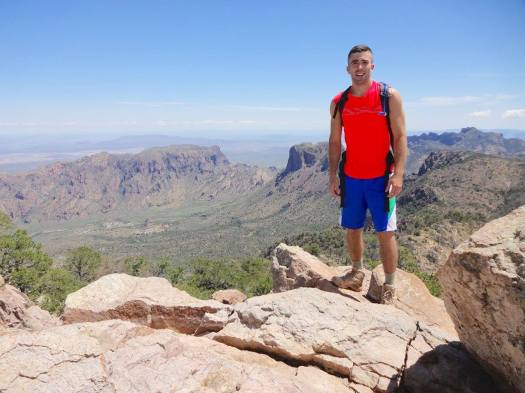
Before I reached the trailhead, along the path was a sign titled “Lion Warning.” It went on to explain what to do in a lion encounter. It did not once mention the term “mountain lion” but simply “lion,” making it all the more intimidating. “A lion has been frequenting the area and could be aggressive towards humans,” it read. Mountain lions are a concerning creature, because unlike a bear which will make its presence known, a mountain lion stalks, unseen, unheard, and then pounces. It can break a neck instantly. Mountain lion attacks are rare, and it would be especially rare to encounter one during the day, but I had read that a mountain lion is less likely to attack a human if the human looks unnatural. So a good deterrent is to wear bright neon colors that make yourself look artificial and not like a tasty treat of nature. 

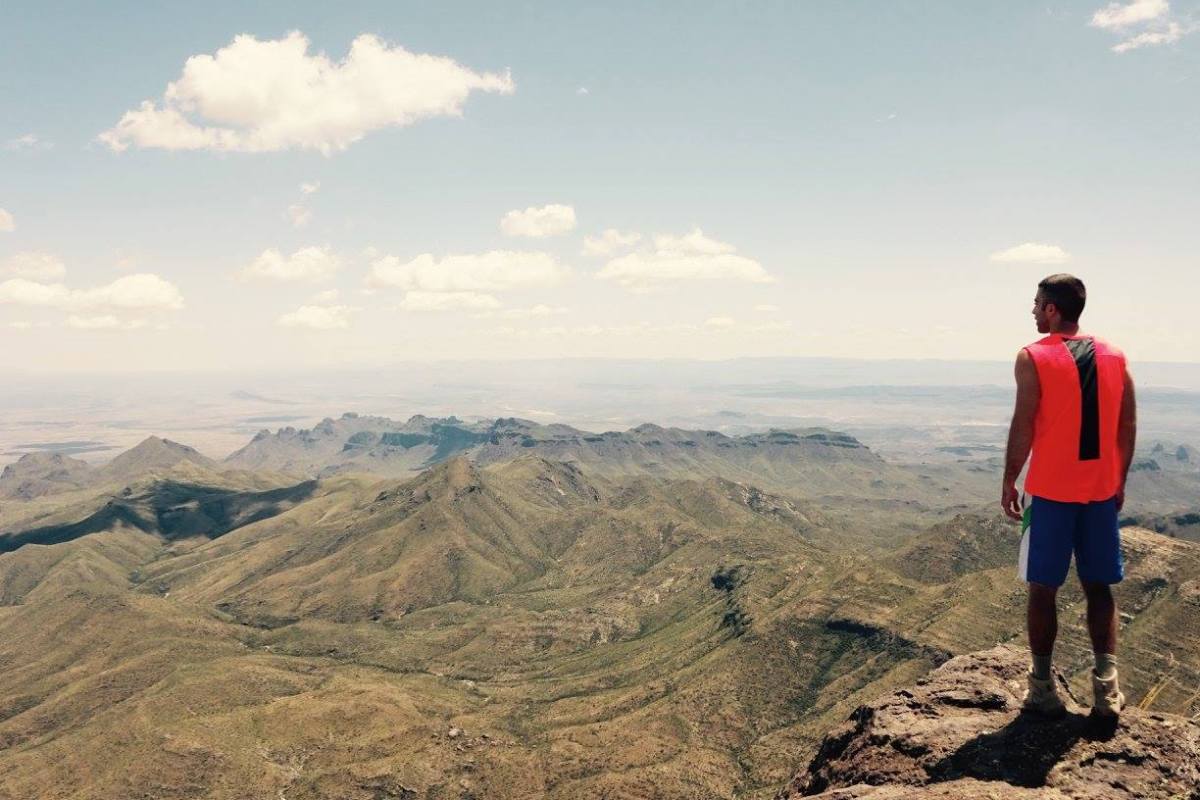
The Chisos Basin trailhead was rather steep, quickly gaining elevation, passing by shrubbery, agave, and more naked indian trees. The first point of interest was Boulder Meadow where the land leveled and displayed a hidden meadow surrounded by boulder peaks. I had almost camped here, but I hadn’t arrived in the park the evening before with enough time to pack and get to this area before dark. Setting up camp alone, in an unfamiliar place, with the presence of mountain lions, just didn’t seem appealing. But seeing it in the daytime, I certainly acknowledge it would have been a great place to camp. This trail I was on led to a network of trails up in the Chisos Mountains to various areas, remote campsites, and natural features. I wasn’t exactly sure all I was going to hike. I did know I wanted to get to the South Rim. I had seen a brochure advertising the area with a man sitting on the edge of the South Rim. I wanted to be in that exact spot, but apart from that, I had an open mind, which ended with me hiking around sixteen miles.

19621310_10214182250650624_7332457310714695452_o

I enjoyed the hike greatly. Nothing compares to the landscape of desert, grasslands, and forest all converging together, but at times remaining distinct, separated in patches up in the mountains.

For most of my hike I was alone, and I felt very alone too, always conscious of it, slightly concerned for my own safety. No one would be out here to aid me in the event of an emergency. The climate was very hot and very dry, and the sun was very powerful. I knew, not properly equipped, the climate could dehydrate me and claim my life. So i was very diligent to stay hydrated and calorie equipped. The one place where I saw others was at by Emory Peak. It was a mile and a half deviance from the main trail.  Emory peak is the highest reach in Big Bend National Park at 7,825 ft. The trail to Emory Peak slowly dissipated, to the point where any resemblance of a trail was gone. There were two peaks of ragged rock spires, like two towers sticking up on the mountain. One of these two had to be the peak. Other hikers were there. questioning which was Emory Peak. The two peaks looked to be about the same height and there were only a mere thirty feet or so apart. In urban terms they were maybe four stories high. I chose the one that looked the most manageable to climb. There was clearly no established route, but I found places for my feet and natural steps to grab hold of and pull myself upward. At the top I sat on a small plateau viewing out upon the rock pinnacles below me and all the valleys and crevices of the landscape. I enjoyed it, and it was great no doubt, but perhaps it wasn’t the most memorable of summits, because I remember more about the climb up than the view itself. From up here I was able to look over at the other rock peak where a few climbers maneuvered their way down. Just the sight made me on edge because between these two spires was a cavity, a long and dramatic fall to any solid ground.

19577192_10214182248770577_4211565750514315038_o

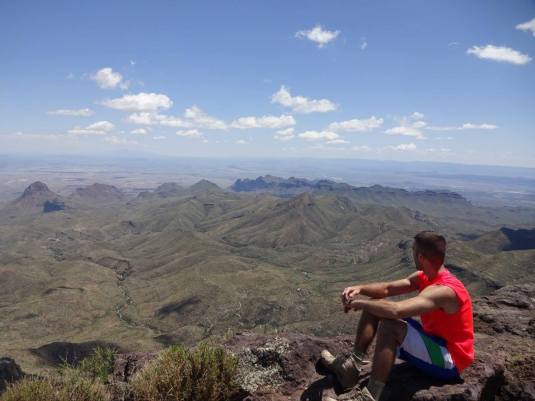
Back on the main trail I continued past the Pinnacles area to Boot Canyon- a very arid forest, which at one point the trail passed by a cabin which I assumed was a ranger residence. At one point the forest gave way to grassland where tall whispy brittle golden grass closed in upon the trail. Miles later I reached the East Rim, which traveled around to the South Rim. I had arrived! I found the place on the brochure and it was well worth it. I sat there by a prickly pear cactus looking down upon the sharp triangular mountains I was well above. They were all dark pale green or brown, reflective of the arid feel of the terrain. Far below I spotted a dried up river bed meandering among the hills, and nearing the horizon the plains of even dryer desert. While I was observing the landscape, I begin to hear a terrible buzz. It grew louder. The sound was approaching rapidly. From up above I began to see a cloud wisping through the air below growing bigger with every fraction of a second. I was very confused and did not know what this was, but it scared me. It caused me to crawl back from the canyon rim and stand up. I realized it was a swarm of insects. It seemed like it was heading right for me, and its sharp atrocious sound was piercing to my ears. I was prepared to drop to the ground and shield my head with my arms, when the swarm swopped to the right and zoomed off into the distance.

19620127_10214182236970282_1769647602224283401_o

What exactly was that? I questioned. I have never in my life experienced a swarm of insects like this before. The sound of it made me think they were a type of fly or bee. The only thing in my life experience to relate it to is the Winnie the Pooh cartoons when the silly old bear is chased by bees after disturbing their hive. It might have been terrifying in the moment, but soon after I couldn’t help but revel in the unique experience it was, and the rather stunning visual display of thousands of insects flying in a coordinated manner with such rage. I wanted to ask a ranger about this, but the visitor center was closed by the time I got back. 

This South Rim was the highlight of the hike with its stunning view. From here I looped back down to the Chisos Basin passing by the Laguna Meadows and Blue Creek which was largely dried up. Everything in my hike looked so desperately thirsty that it was strangely eerie. A bountiful forest is comforting boasting so much life, even a forest in the winter with it barren trees has its own charm, but a forested area so painfully thirsty comes across as hostile and desperate. But I wasn’t. I could certainly sense the dryness, but I wasn’t short on water. At one point I could even afford to poor some of my water supply on my head for a brief cool off. 

During the last few miles of nearing my accomplishment of sixteen miles my feet became very heavy. I thought maybe I had bitten off more than I could chew. The final steps down to the Chisos Basin village were some of the most heavy steps I have ever taken. I felt like my feet could just pop right of, or my legs would fall off from the pelvis. It was evening now. Around 7pm, I had hiked at least over 10 hours continuously up, around, and down a mountain range with only a couple of brief stops. I was more than ready to sit down.I wanted to stop by the general store in the Chisos Basin village first and then relax for a bit at the lodge.

As I was in line at the store to buy a sandwich and a Gatorade, there was a family in front of me, foreign, seemingly from India. With broken English they were trying to ask questions about purchasing a camping tent. I was so desperate to sit down that I wanted to make my purchase and be done with it. With my legs extremely sore, I began to feel a bit agitated when there was a problem reading their credit card. When I realized this might not be a quick in-and-out a is when I began to lose my senses. I began to faint. Then, it was my turn. I set the Gateorade and sandwich on the counter, but my vision left me. I felt myself falling towards the group, so I tried with all the control I had left to squat down in front of the counter. Consciousness left me, but a moment later I stood back up. 

“Sign this,” I heard. I must have given him my credit card too, but I scarcely remember. 

“I’m sorry. I just feel like I’m gonna faint,” I said. I still couldn’t see. 

“Please don’t,” said the young man behind the counter. I already had for a moment. 

I intensely tried to regain vision. It was faint and disrupted but I could see just enough to sign my name on the receipt. 

The young man behind the counter seemed to have no idea how to react. He didn’t offer to help or provide any advice. I’m sure by this point I probably looked like a ghost. In the aftermath, I felt sorry for him. He was probably just a college student with a summer job, inexperienced with the outdoors and first aid, just trying to earn some money. The sight of me fainting probably scared him. As we would say in the South, “bless his heart,” and bless mine too after what I’d been through. 

Right outside the store was a bench, where I collapsed. I unscrewed the Gatorade and drowned myself in its cold electrolyte bliss. 

A young man- the hiker junky, hippy-free spirited type came beside me. “Are you alright?”

“I just came back from a 16 mile hike, but I have gatorade and food. I should be all right.” I informed.

“A similar thing happened to me earlier. I drank some whisky. It really helped. I have some. Would you like it.”

“No, but thank you,” I replied.

He left, and I doubted for a second if I really would be okay. I still felt very weak. I was concerned to stand up and move with the prospect of passing out again. It might not have hurt to ask him to stay for a moment. But whisky? Really? Drinking whisky when dehydrated did not seem like a good idea to me. 

I hadn’t considered it before, but then it dawned on me. I wasn’t dehydrated. I had plenty to drink, and I actually had plenty to eat. I had nuts, dried fruits, and cliff bars, amongst other dehydrated snacks, but then it dawned on me: I had little to no salt. I was salt deprived. This is why I fainted. 

I carefully went back to my car, self monitoring for all signs of faintness. I had a can of chicken noodle soup cooking in the heat of the car all day. I took it with me to the patio at the back of the lodge. I enjoyed it along with an orange. 

And there in perfect view from the patio the sunset was framed between the rock pinnacles of the Chisos Basin. A bright and warm orange spread across the sky. It was beautiful and a wondrous work of artistry, but as sunsets often do, it caused me to reflect inwardly. I wasn’t as invincible and strong of a hiker as I thought I was. This was very humbling. My body was not adequately equipped for today’s hike, and I hadn’t considered salt intake. What else might I be missing? My confidence with the wild had been slashed. I couldn’t trust myself as much as I thought I could. 

I locked my keys in the car days before, been stuck out in the lighting in White Sands, got reprimanded by a park ranger, and passed out in Big Bend. I was keeping track of misfortunes. What was wrong? Was it me?


Read my previous episode “Treasures of the Chihuahuan,” here: https://joshthehodge.wordpress.com/2019/04/11/treasures-of-the-chihuahuan/

Check out my new book “Canyonlands: My Adventures in the National Parks and the Beautiful Wild,” here: 

https://www.amazon.com/dp/1711397873/ref=cm_sw_em_r_mt_dp_U_UjGjEbYBGF4PR

Canyonlands Cover

Treasures of the Chihuahuan

I woke up in the Indian Lodge so well rested that it was one of those moments in which I looked up at the ceiling and then around the room, taking a moment to process and recall where I was. I well pleased with the recollection that I was at the Indian Lodge at Davis Mountains State Park in West Texas.I got up, and the floor beneath me was sturdy and firm. This was a fortress of a structure.

I threw on some presentable clothes and decided to go check out the Black Bear Restaurant, the resident eatery at the lodge. I sat next to the window and enjoyed breakfast from the buffet, satisfying my hunger with scrambled eggs, pancakes, sausage, and fruit with some cucumber and pineapple water. I looked outside at the desert hills and yucca plants of the Chihuahuan desert with the morning sun spreading its golden light into every sleepy crevice of the landscape.

On my way back to my room, I stopped by the front desk in the lodge office. I was hoping to see my first West Texan acquaintance, the friendly lady from check in. She wasn’t there, but her male counterpart was- a young, round, jovial man. I asked him about trails and what to see around the park. He kindly and pleasantly provided me with a map. I took a moment to browse the small gift shop and bought myself a Davis Mountains State Park sticker.

Back in my room I geared up to go on a short hike, 1.72 miles one way up into the mountain to the right of the lodge. The day started off bright and sunny, with only a few bright white clouds wisping through the blue above. The path slithered around sagebrush, curved around a valley and a tall pointed brown rock formation, and trailed around to the spine on the back of the mountain. Once I reached the plateau the Indian Lodge to my right was just a miniature below. To my left was a fence. Someone’s private property butted up to this State Park.

Also, up here the weather started to turn it’s back on me. First there was a whipping wind that violently flustered the desert grass, then deep, dark clouds rolled in. Once again, I found myself in a vulnerable position. I was exposed to potential lightning. I decided to play it safe and return promptly back on the trail from where I had ascended. My nearly 4 mile hike turned out to be a mere 1.4 miles. This wasn’t supposed to happen. Weather never got in my way. But this was the second time on this trip in which the weather won. Despite its apparent threat, a storm never did reach the area.

Back at my car I noticed a dent in the hood of my car. The trouble was this wasn’t “my” car. It was a rental. I began to be concerned about having to pay for damages. I looked at the indent from different angles. It wasn’t that obvious. It was slight, only very apparent at certain angles. I pondered this dent. How could this have happened? I never remember anything hitting my car. Then I considered where I had my car parked all night. It was at the bottom of a short cliff where a road wrapped around just above. A rock could have easily fallen from the road onto the hood of the car. In retrospect, this was really no big deal, but at the time it troubled me. This was not supposed to happen. This trip was supposed to be perfect. This was an unhealthy disposition that was only beginning to be challenged.

Back at the lodge, the sun returned to shine. I took a few minutes to swim small laps in the outdoor pool, so perfectly situated behind the lodge in the beautiful valley. I also sat poolside to write in my journal and enjoy the desert sun.

I checked out of the Indian Lodge hoping to one day return and eager to tell people about such a wonderful place it was. It’s a true treasure. Despite my hangup on the dented hood, my stop at the lodge was rejuvenating, a breath of fresh air, a truly remote hidden oasis, a place where anyone could find comfort and solace on the outermost reaches of the United States, in the fold of the Chihuahuan desert, armored and hidden between mountains.

19575160_10214158419814868_3297167524510951263_oLeaving the lodge I drove Park Road 3A, also known as the Skyline Drive- one of the park’s proud features. The road switchbacks to the top of the mountain opposite that of my hike. The road ends at an old rock shelter, built by the Civilian Conservation Corps. From here I could see out on some of the wide plains of Texas with blue mesas standing in the far distance. Here I could also see the rainstorm that had threatened my hike earlier, pouring down across the plains. I encountered a family of travelers that asked me to take their picture. I took their picture and carried on.
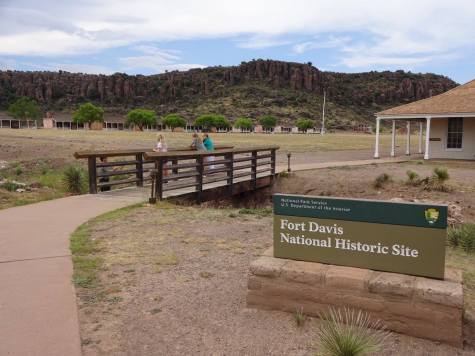
19466485_10214193955823246_3398140235645297518_oFour miles from the State Park is Fort Davis National Historic Site- a unit of the National Park Service. It actually attaches to the State Park by a trail, but I didn’t have the time to hike there and back. I didn’t know why there would need to be a fort out here in seemingly the middle of nowhere Texas, but I would learn, and I was excited. Any unit of the National Park Service interests and excites me. All of the National Park Service’s sites tell one big story, the narrative of the United States of America. At each one I see my eyes opened to moments in history I didn’t know, and not only do I obtain the knowledge, but being in the actual place where these events took place, and seeing them with my own eyes, helps me imagine and obtain a greater depth of relation to the events. I love it!

In the visitor center, the park ranger offered me a park map. I asked what to see. She opened the map and with her Sharpie highlighter she began highlighting buildings within the complex. By the time she was done, she had highlighted every single thing within the map. I wondered if that was necessary. I think she really just loved using her highlighter.

Leaving the Visitor Center, I explored the history. I learned that Fort Davis was a United States Army fort built to protect emigrants, mail coaches, and travelers along the San Antonio- El Paso Trail, many of whom were on route to the rich goldfields of California during the Rush. The Buffalo Soldiers stationed here protected these travelers from the threat primarily of Apaches and Comanches. They escorted them through the area, as well as repaired roads and telegraph lines. During the Civil War, the federal government withdrew troops from the fort which was taken over by the Confederacy later to be claimed back by the Union. In the late 1800s the fort had outlived its worth. A park ranger explained how it had been sold to a Hollywood filmmaker to film western movies. Then a few buildings of the fort were partitioned off into separate pieces of private land, only be reclaimed by the federal government as a National Park Unit in 1960.

19243325_10214193960943374_2738043865480521184_oToday exploring the park is really stepping back in time to a unique era. The Park Service has preserved and restored many of the buildings. This fort is not what we typically think of as a fort. There is no man made barrier of a wall with artillery and cannons sticking out. Rather it is a series of buildings aligned in a giant rectangle around a common green. The fort is in a large canyon, protected naturally by wide canyon walls and Limpia Creek.
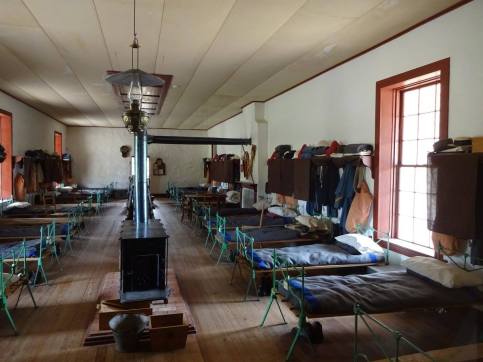
19679023_10214193960663367_2858045640103199091_oThe main attraction of the park is walking in and out of many of the buildings which are furnished to the era. I walked into the barracks. Fourteen beds lined the walls one after another. Apart from a bed, the soldiers were only allowed a few hooks to hang their clothes and a small shelf situated above their beds. In the middle of the building stood a series of coal furnaces. This was very simple. I tried to put myself in the place of the soldiers and imagine what they came “home” to at night.
On the other side of the green were the homes of the lieutenants and commanders. They had fully furnished houses, with beautiful fireplaces and artistic mantels, wardrobes, chairs of varying sizes and style, mirrors, musical instruments, decorations, and all the basic comforts of lavish living. It was such a stark contrast to the lives of the soldiers. I might as well have assumed I was in Manhattan in these homes. Here in the middle of nowhere Texas these commanders had created, perhaps at the cost of the comfort of their soldiers, luxury of modern living. In addition to these places of living, there was a fort commissary, where soldiers were quite limited in supply, and the hospital, which was fascinating and disturbing.

Before entering the hospital I read the background on some real people who once lived here. The plaque told about their ailments, and by touring the old hospital I learned whether these people survived their illness or not. Many did not. Showcased in this hospital museum were medical tools of the 1800s and explanations of how they were used. There were saws used for amputations, drills for digging into the skulls to relieve pressure, gnarly contraptions that looked like more tools for torture than anything else, created with such misunderstanding of the human illness. I forgot most of what I saw. Gruesome as they were, my mind found them not pleasant to remember.

Like nearly all National Park units, there was also a main museum at the Visitor Center with overall history of the fort and a park film. A small area of the Visitor Center was dedicated to books, postcards, and the usual National Park purchasable treasures. I found some stickers that said “National Park Geek” which had an outline of Theodore Roosevelt’s face in a ranger hat. I had to get one. I also got one for my friend and coworker, Jamie, who is also a National Park geek. The ranger who rang up my items said how these stickers were really popular. I told her how I loved the National Parks and how I actually volunteer as a Trail Keeper in the Big South Fork back on the Kentucky and Tennessee border. She told me how she loved that park and was looking for land or a home to purchase in Oneida, Tennessee- one of the main gateways to the Big South Fork. This surprised me. First off, no one ever knows about the Big South Fork, let alone Oneida, a rural small town in East Tennessee. But then again, I was in Fort Davis, Texas a place probably just as famous and well known as Oneida, Tennessee.

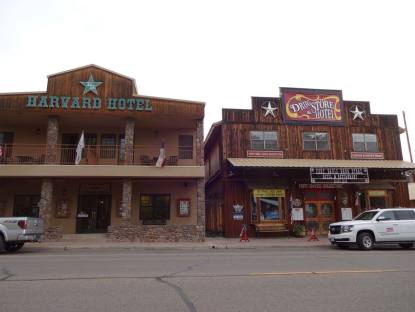
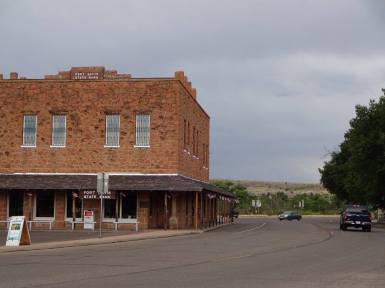
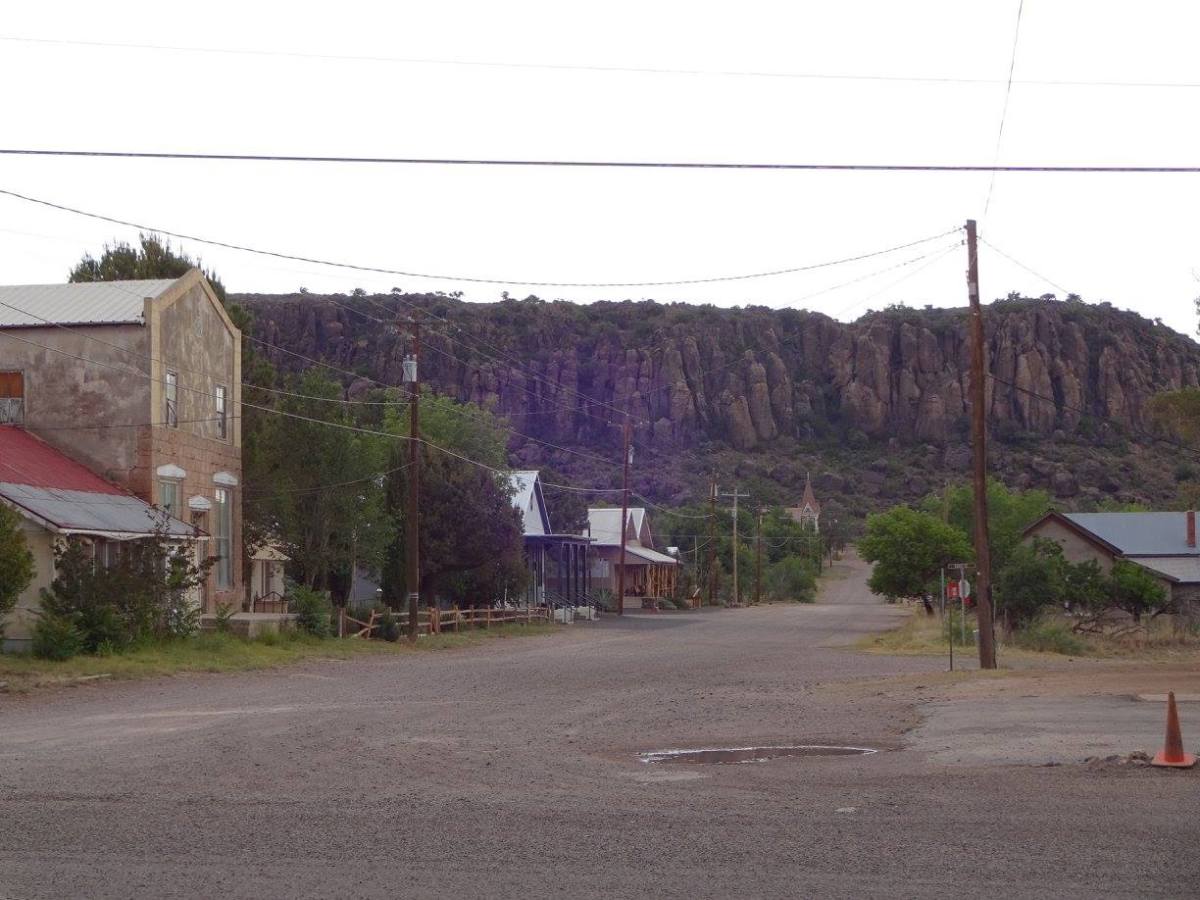
19620602_10214193958303308_7501458365493546060_oLeaving Fort Davis National Historic Park, I was well pleased. I learned a lot of history. I had no idea such forts existed. This was one of many which served the same purpose. Also the way the fort was restored and the plaques and markers provided, facilitated imagination, making me feel as if I had really stepped back in time. This place is high on my list of National Historic Sites. When I pulled out of the park drive I thought I’d do a little exploration around the town of Fort Davis. Affording the title “town’ is generous, because technically it’s an “unincorporated community.” The community had one main paved street. All the side streets were gravel and scenic, situated in the canyon outlined with hoodoos and rock spires like those of Chiricahua. In “town” I observed an old western hotel and drug store, a post office, a family practice located in an old adobe structure, a bank completely pieces together from rock pieces, and a courthouse situated in the middle of a green. Everything was closed, as it was Sunday. I was ravenously hungry. It had been a long time since my breakfast at the Indian Lodge. There wasn’t much to choose from. But I saw a decent amount of cars parked out of a shack of a place titled Cueva de Leon. Here’s goes nothing, I thought. I went inside. Mexican restaurant. Okay. Sweet. This could be the real deal, considering how close I was to Mexico. I sat down and ordered some fajitas. I was served a glass of ice cold water and it was perfect for my parched mouth and lips.
19577458_10214193962183405_8825385596625865428_oAs I waited for my food, I couldn’t help but observe those around me. A group of ladies were in a booth eating together and talking back and forth. They switched from Spanish to English constantly, replacing with seemingly no notable method, certain words with their other language counterpart. A middle-aged man with a cowboy hat, flannel patterned shirt, boots and a grey mustache (everything stereotypical of a cowboy) sat down to order his food. To my surprise he ordered his food perfectly and casually in Spanish. Keepin’ it truly real, from my perspective, a middle-aged white man with a cowboy hat back home in Kentucky would be the least suspected of speaking Spanish. This was not the case here. Spanish and English were truly blended together, and latino rancheros and caucasian cowboys came together with no barrier of language nor culture, no ill-will towards one another, just neighborly friendliness. They were simply gathering over good food.
I liked this scene. I liked it a lot. Much of mainstream media tries to divide people over appearance and racial heritage. Here in West Texas, it just doesn’t matter. Everyone seems to be at the same level. Everyone is a neighbor. Perhaps it is the Texas identity. Texans are Texans above all else. It doesn’t matter what you look like, what language you speak. If you are a Texan, you’re a Texan. This doesn’t hold true though in metropolitan areas. I know from my experience living in Houston, where race places a huge factor in everything. But here  and in rural west Texas there is a unique bond of culture that transcends any trivial division that the over civilized parts of the U.S. have concocted. It’s all the more reason why I am in love with West Texas.19221761_10214193961263382_6100642550502333465_o 

Check back next Wednesday for the next “episode” in the adventure.

Click here for the previous entry “Falling in Love With West Texas”: https://joshthehodge.wordpress.com/2019/03/28/falling-in-love-with-west-texas/ 

Check out my book “Among Blue Smoke and Bluegrass” on Amazon: https://www.amazon.com/Among-Blue-Smoke-Bluegrass-Tennessee/dp/1790631297

Falling in Love with West Texas

A billion thoughts spun through my head. That was amazing!. Was it beautiful? No. Was it safe? No. Was it inspiring? No. But my perspective and insight had grown immensely.

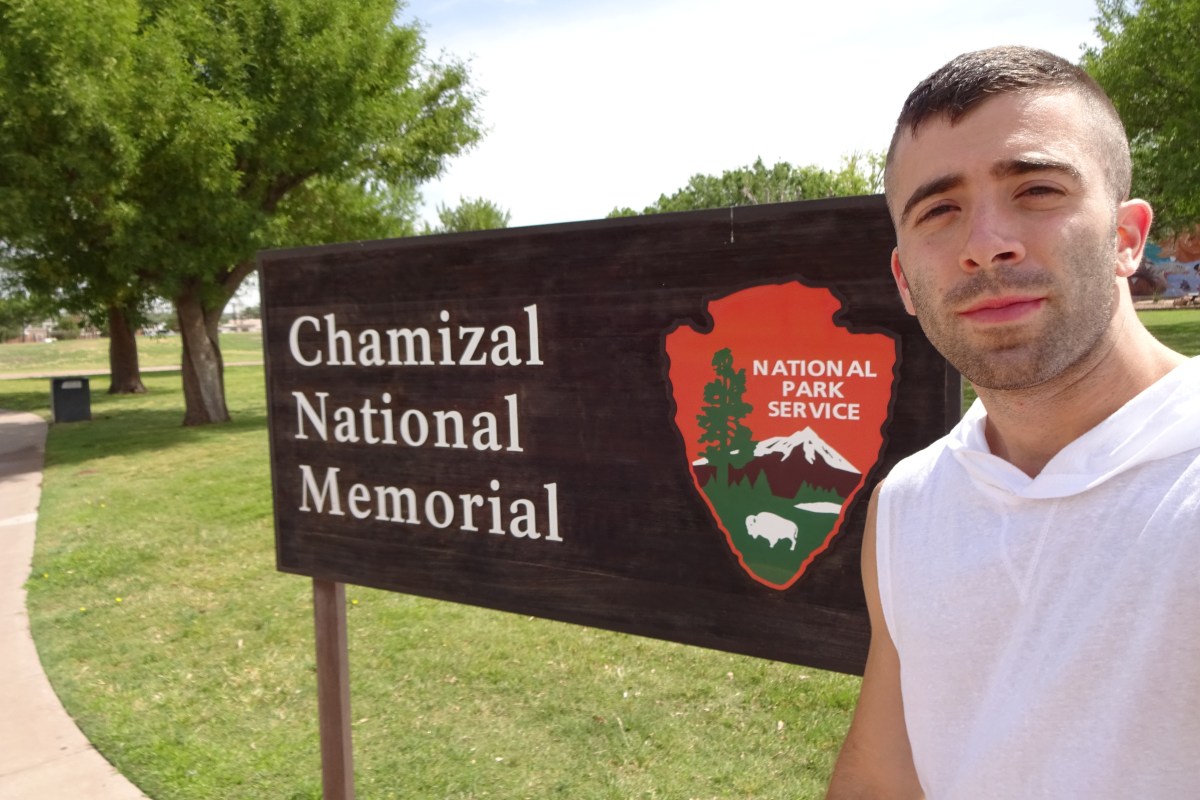
I had just gotten back into El Paso, Texas from walking across the Mexico-U.S. border into Ciudad Juárez. I was hesitant to make the journey, but a kind elderly woman who worked with the National Park Service at the Chamizal National Memorial, whom I have nicknamed “Mi Abuelita” encouraged me to go. When I followed up with her after my visit to Juárez, I could tell all her encouragement was a ploy to broaden my perspective. She was sneaky. I wrote in my journal that she gave me “the gusto and self-confidence” to go.

Was their validity in all the warnings from my friends and acquaintances in Mexico City about visiting the Mexican border? Most certainly. Diverse cultural biases and political views began to make all the more sense after my visit to Ciudad Juárez. I got it. I understood it. So many things people said and why they said them came to light during this short but insightful visit.

I was only in Ciudad Juárez a few hours. The whole time I was there an anxiety ran through me. I thought I had accidentally bypassed a border security checkpoint. I walked into Mexico unaccounted for. This made me especially nervous on the way back into the United States, because I thought I would be caught. And, mind you, I was singled out.

Everyone else could simply scan their Texas IDs for self service reentry into the U.S.. I was fumbling around with my passport and the scanner wouldn’t accept it. I didn’t know what I was doing. A border agent called me over.

“What was the purpose of your visit,” the U.S. Border Patrol Agent asked me.

“Tourism,” I replied.

“Tourism?” he questioned, with a look that told me, people do not go to Juárez as tourists.

Although I was grilled heavily by the agent, I was appreciative of his thoroughness and I came to find out that Mexico does not keep track nor require identification of foreigners walking across their northern border, at least not at El Paso.

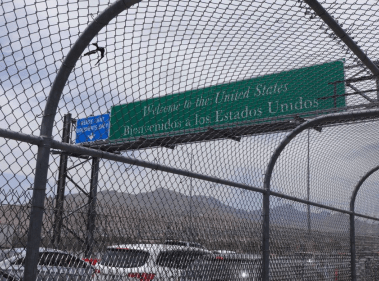
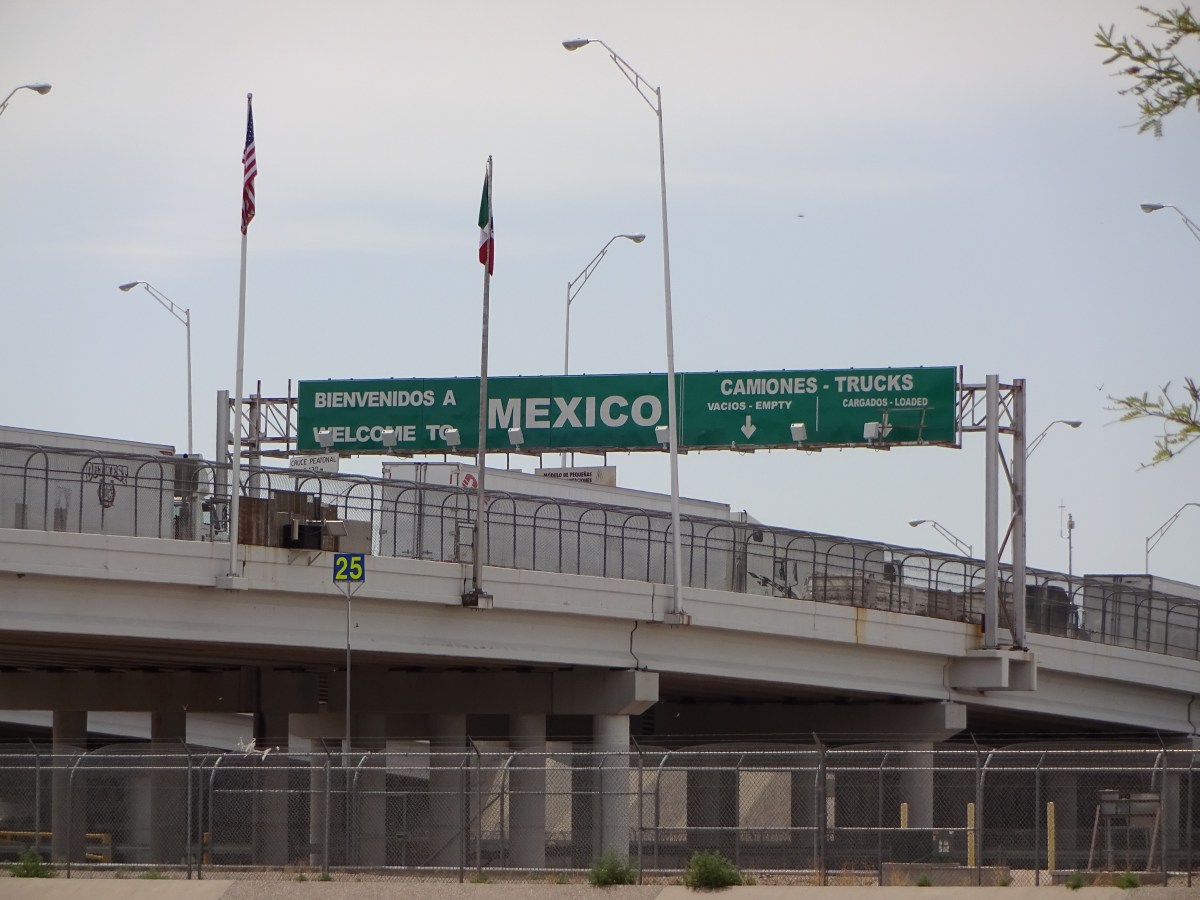
Screen Shot 2019-03-27 at 10.21.40 PMIt was a new, peculiar, and patriot moment for me to read the sign above the highway stating “Welcome to the United States.” My visit to Ciudad Juárez is a tale to be further unpacked at another time. I was glad I went, but I was so grateful to be back home and ready to continue on with my U.S. National Park adventure.
This day would not only broaden my perspective of Mexico, but my understanding of Texas would also be augmented. I have lived both in Mexico and Texas. But living in solely Mexico City and Houston, my perspective was limited. Visiting Juárez taught me that Mexico City is by no means the same as a border city. And my next stop in Texas, at the Indian Lodge at Davis Mountains State Park, would be my introduction to a different type of Texan than those I had been previously exposed to. This would be the extremely rural, isolated, overly friendly, and hospitable West Texan, which I became very fond of.

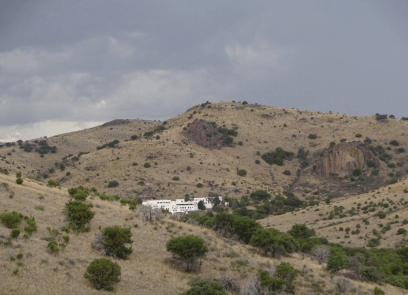
The drive from El Paso into remote West Texas and the Davis Mountains was beautiful and very unique. It took a while of driving past lots of semi’s and oil fields, but a turn in the road led me to a long stretch of two lanes which flowed among mountains. I had never quite been to this type of landscape. It seemed part forest but park desert. What I came to learn is that it indeed was a new landscape for me. It was the Texas savanna.

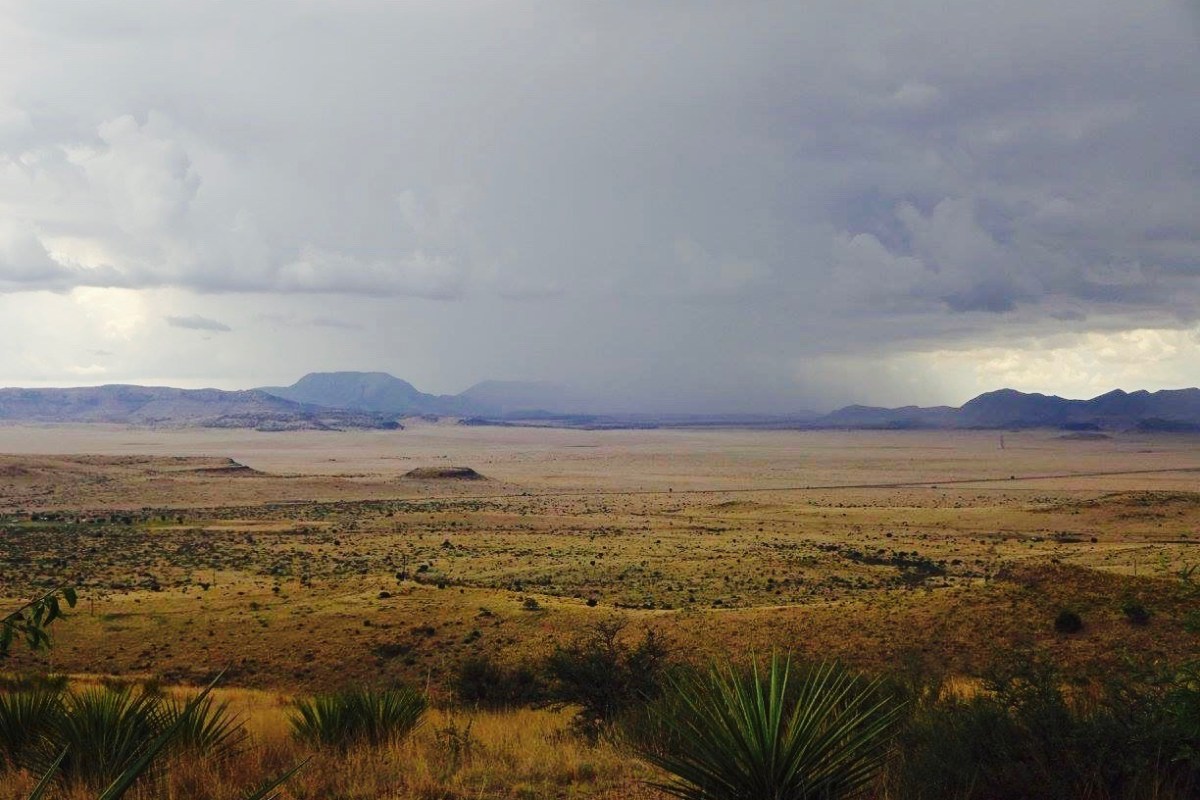
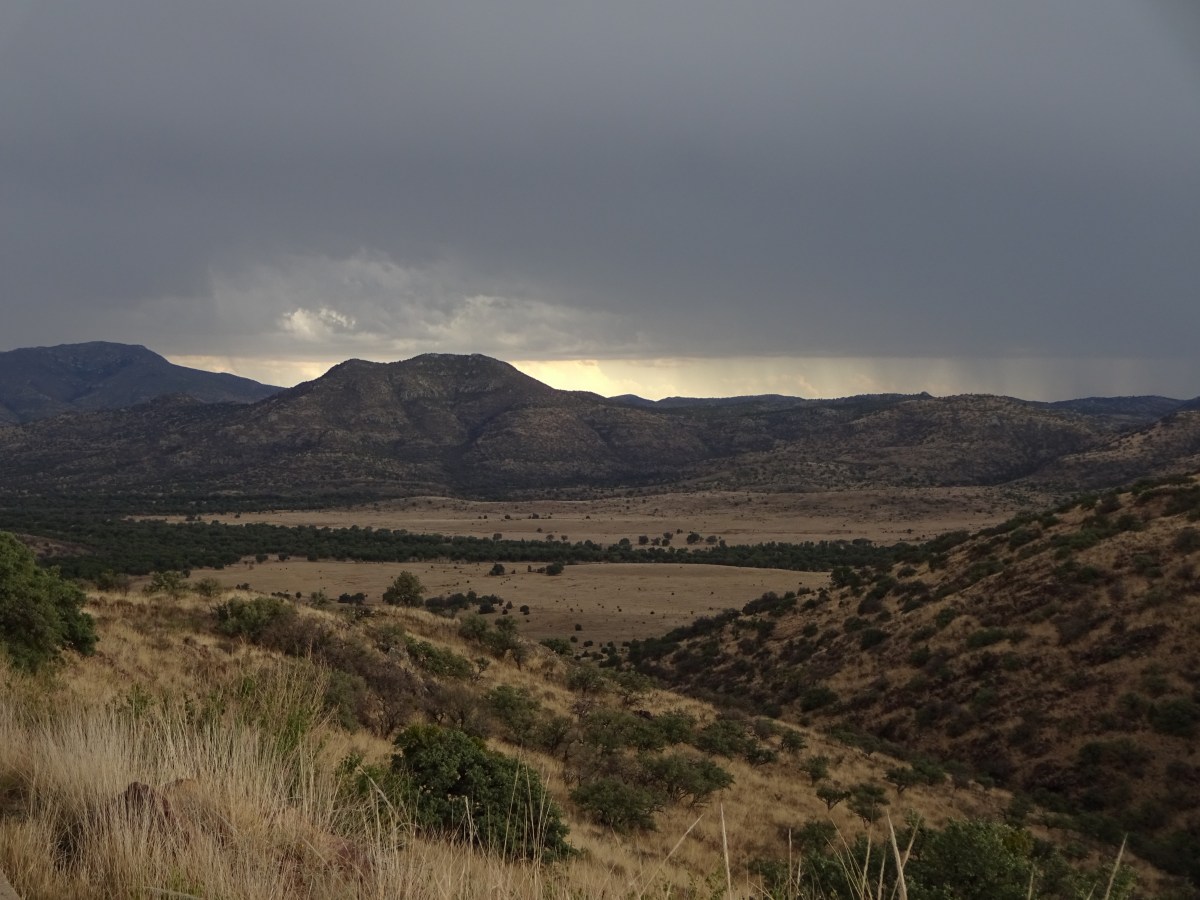
DSC09651The road wound through countryside and slithered among mountains. At one point I came to a overlook where I looked down across the grasslands and the mountains. In the distance, over the mountains, it was storming. I could see the dark clouds and rain contrasting with a golden sun that was peeking out from the corner of the sky. The contrast in the sky, brought about contrast in the land between the deep greens of the scattered trees to the accents of golden grass.
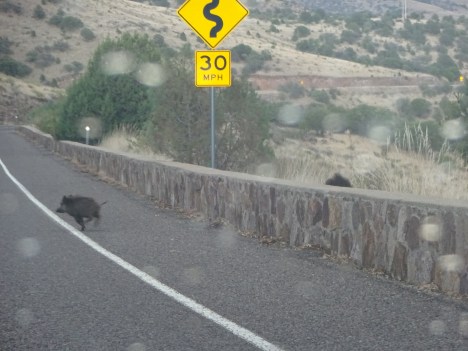
DSC09657I could sense the arid land giving off a sigh of relief for the rain that would soon arrive. A could feel the tension released in the air. As I continued on my drive, a parade of javelinas jumped a stone wall, scurried across the road, and leaped into the wild grass and brush. These creatures look like wild boar, and although javelina is the same name given to a wild boar in Spanish, these javelinas are peccaries, and unlike boars are native to the Americas. But combine the savanna with a javelina, and the fact I hadn’t seen a business for hundreds of miles, and you could have fooled me to thinking I was out and about somewhere in the African savanna and I’d be prone to see a zebra, or a lion.
Wait! What’s that? I arrived at Davis Mountain State Park and bright pink a sign warned- “Mountains Lions have been sighted…please use caution and do not leave your children unattended.”

I really was in a different world.

I paid an entry fee at a self-service drop box, although i realized later, as an lodge guest, I didn’t need to, and I proceeded down the road towards the lodge. It was late evening now, the sun was getting lazy, and the surrounding storm clouds darkened areas of the sky, shadowing the landscape and giving an eerie ambience, almost like there was a solar eclipse.

Screen Shot 2019-03-27 at 10.13.40 PMExcept for the one elderly couple who asked me for directions at the drop box, whom I couldn’t assist with any knowledge, I didn’t see any other people on my way to the lodge. This place was very quiet. Am I in the right park? Is there a lodge here? Or is there another Davis Mountains Park? Then rounding the bend I saw, nestled between two mountains, a picturesque oasis. I had arrived.
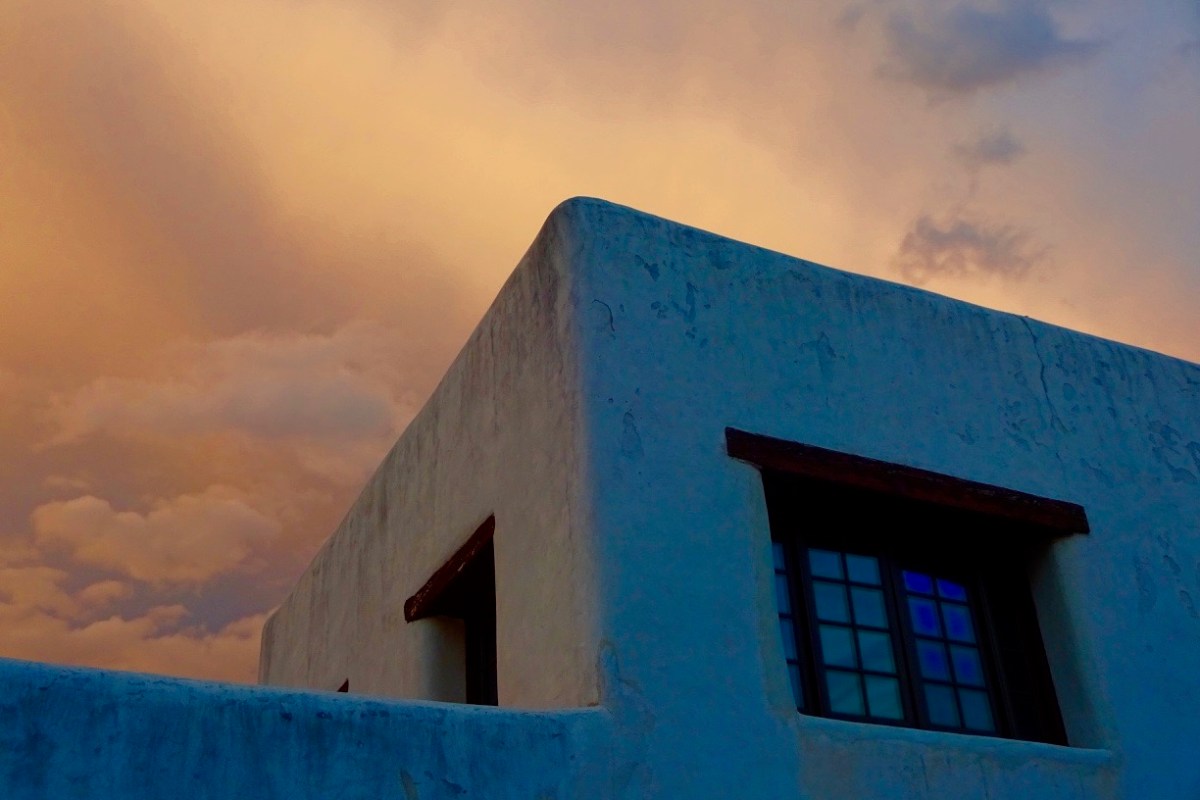
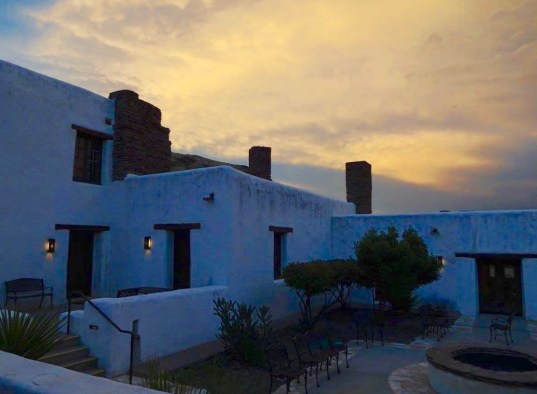
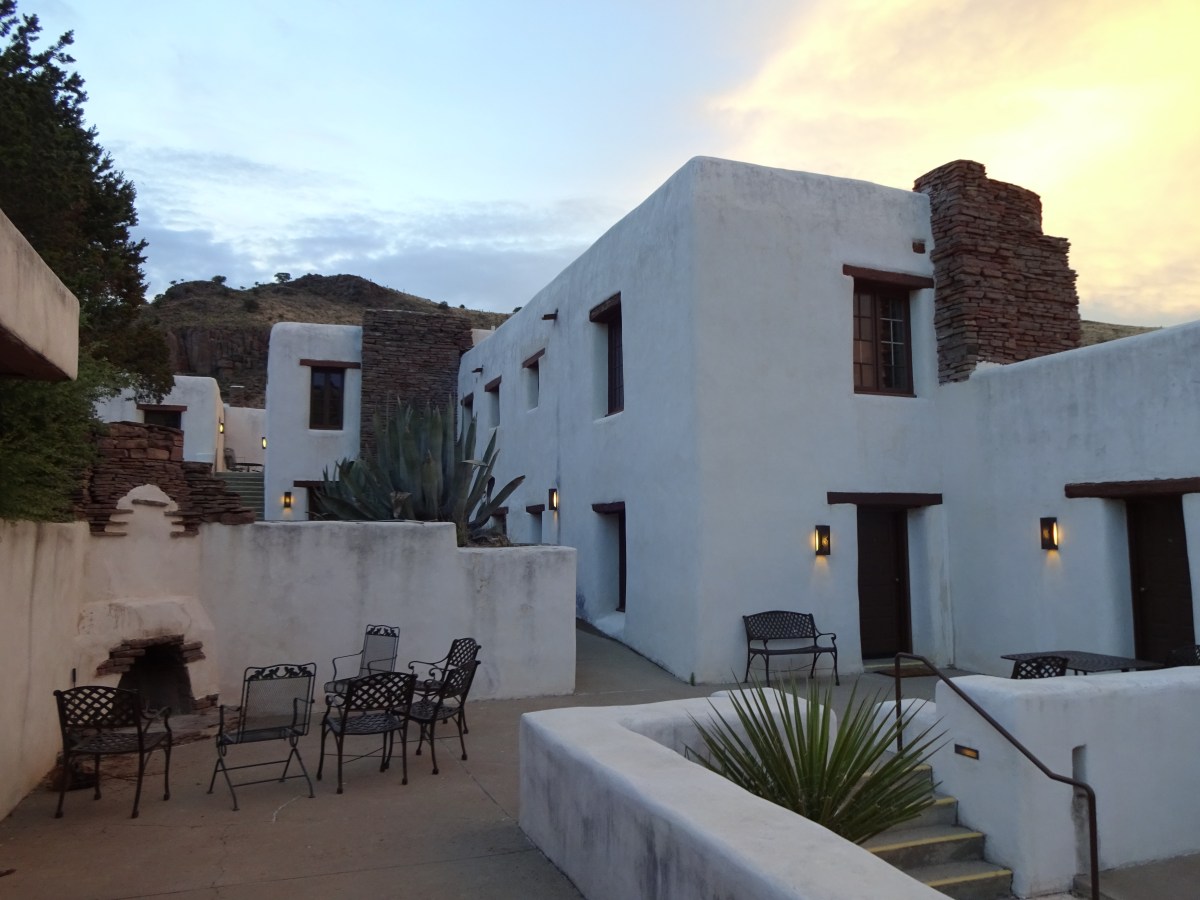
Driving up to it, I was very excited. This looked perfect. It looked like it had jumped right out of Southwest history to be at my service. It was a white adobe structure, resembling a multi level pueblo village, with immense Southwest charm and historic aura. I learned in was built in the 1930s by the Civilian Conservation Corps. It was not just any CCC project, but I would say an achievement of art.

I walked up to the counter.  

“Why hello, darlin’. Welcome to the Indian Lodge.” I could tell from her initial address she was going to be a character well appreciated in my story. “We are just so happy to have you here.” She had blond curly hair, was middle-aged, and had a life-loving and sincere essence.

She asked me my name, had me sign myself in, and handed me the key. She was extremely friendly in the warmest and most genuine and unexpecting way. She told me the hours of the restaurant, the pool, and check out, and then proceeded with: “Cell phone service is spotty, and there is wifi, but you know what we say? If you catch the wifi, take a picture cuz it won’t be here for long.” She explained how they were off the grid as far as land-based internet service concerns, and internet had to be channeled through satellite, but with the mountains surrounding, the signal didn’t always make it down to the lodge.

“Have you eaten?” she asked, only to proceed to tell me everywhere to eat was closed. And trust me, there wasn’t much option out here in the middle of nowhere.

“It’s ok, I have some food in my car,” I explained.

She smiled.

“Alright, here’s how you get to your room…”

Wait, what? I thought. That was a lot of directions, I didn’t ask her to repeat. How hard could it be? Fifteen minutes later, I still couldn’t find my room. It was some sort of maze. This adobe village had various levels that didn’t always match up with one another, with stairs here and there, landings, and random courtyards spread out in between. I knew I had to enter an inside common room, go out the other end, and go up some stairs, but I couldn’t tell exactly what was a  “passageway” and what was private patios and landings belonging to other guests. I came back to the common room, there were other guests gathered. “Can we help you,” one asked.

“I am just trying to find my room. I’ll find it.” And I did.

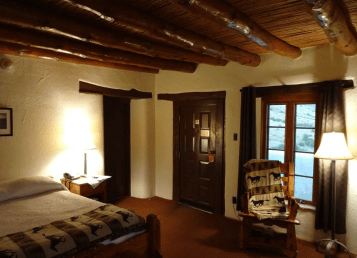
My room was isolated at the very top of the adobe structure. It stood up like it’s own tower, with its own set of stairs and its own private patio. It was almost like I had my own private building. And uhhhhh– a sigh of disbelief and then embracing perfection. The view was stunning. My room looked out into the valley of the two mountains, the sun dipped down in the middle of the valley, creating a quintessential sunset pristinely visible from the patio and windows of my room.

I went inside.

Screen Shot 2019-03-27 at 10.13.14 PMRustic, beautiful, charming. An old stone fireplace stood with an extending stone hearth. The walls were white abode, the ceiling wooden logs, the furniture hand made of cedar, some original historic pieces from the 1930s. The lamps here and there gave off a warm and homey glow. A rocking chair stood next to the fireplace and in front of the wood framed window with the bright orange sunset. The window on the opposite side was tucked into its own nook where a desk and chair stood, as if looking out intrigued by the view of a tree reaching out its branches. And the bed in the middle was adorned with a beautiful lacework comforter and a blanket depicting running horses and geometric designs, looking like a true piece of native craftsmanship of the area.
Hands down, in all of my travels, this is my favorite place I have spent the night. I felt like I had walked right into a Zane Grey novel.

It wasn’t just the historic charm and visual appeal that made me love this place so much. It was also this incredibly friendly and homey vibe. To unpack it, I later came to find out that nearly everyone I encounter in West Texas is very friendly and it makes sense after reading the book Beneath the Window about West Texas. Historically speaking, West Texas was so extremely rural, that the people living out in this area, fighting desperately with the land to create homesteads, found other humans such a rarity, that when they did encounter other humans it was an exciting event, so much so that these other humans were greeted with such warm hospitality and delight. I believe this aspect of West Texas pioneer culture is still strongly evident today. It has been passed down, and even still, this area is very rural. Seeing others I’m sure is still exciting and novel. I’ve been to many places I understand, but try explain this to a native New York City dweller and it might be a little more difficult to understand.

Screen Shot 2019-03-27 at 10.13.28 PMAlso pertaining this this vibe was this true lodge feel. Back in the early days of park lodges, arriving at a lodge was sometimes an accomplishment in and of itself. Long horseback rides or wagon trips through challenging terrains would finally lead one to a lodge of comfort and peace. Same situation today. A long and isolated journey through very remote roads to the middle of nowhere, brought me to the Indian Lodge, and the lodge was the only thing here. There was nowhere else to go this evening. This was it. The lodge was its own oasis. Everyone staying at the lodge had nowhere to be but at the lodge. We all had to make comfort and do with our own limited amenities and food. And without distraction, we all shared the sunset together, the maze of the abode structure, and each other’s own company. Although this place was isolated, and it was quiet, I was not the only one here. I believe there was a wedding party staying at the lodge. Clues of confetti, signs, and gatherings of multi-aged people, led me to this assumption.
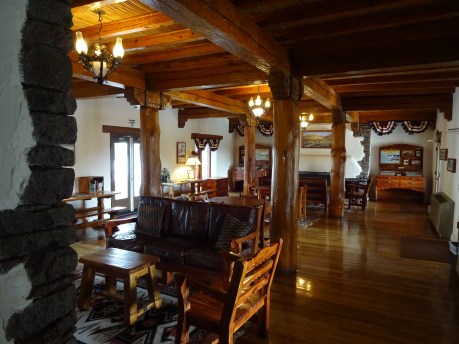
DSC09699 (1)After dropping off my bags in my room, I peacefully explored this village of a structure. The clouds had melted away and the sky above was a calm darkening blue. Going from one adobe island to another from and one terrace and courtyard to another, I sat and enjoyed the remainder of the sunset and listened to the water trickling at a courtyard fountain. I also explored inside. The common indoor area was constructed with beautiful woodwork, old western chandeliers, nooks and crannies to sit and relax, and a small statue and area honoring the work on the Civilian Conservation Corps. I. Loved. This. Place.
I went back into the room that housed the front desk and asked the hostess if i could use a microwave to heat up some soup and oatmeal. That would be my dinner. I took them up to my room, kicked off my shoes and went over to the little desk nestled aside the inlet window.

I reflected on the day and journaled. My journal entry starts off “What a difference a day makes!” The previous night I was dodging lightning on the white sand and found myself sleeping scrunched up in my compact car with a ticket from a park ranger. Now I had the most unimaginable perfect, peace place to stay, and I had had a full and exciting day of crossing the U.S-Mexico border, learning new history, and opening my eyes to new perspectives.

This day would be the start of my falling in love with West Texas.

DSC09688

Check back next Wednesday for the next “episode” in the adventure.

Click here for the previous entry “Texas, Mexico, and the Experience at Chamizal National Memorial”: https://joshthehodge.wordpress.com/2019/03/21/texas-mexico-and-the-experience-at-chamizal-national-memorial/ 

Check out my book “Among Blue Smoke and Bluegrass” on Amazon: https://www.amazon.com/Among-Blue-Smoke-Bluegrass-Tennessee/dp/1790631297

Texas, Mexico, and the Experience at Chamizal National Memorial

I was hesitant to go in the first place. Chamizal National Memorial could be one more National Park site to check off my list, and it pretty much was in route, but it would require a slight detour right into the heart of El Paso, Texas.

On a definitive burst of whimsy, I decided I’d do it. I would go to Chamizal. First I decided to stock up on a few food supplies at an El Paso Walmart. In the parking lot, just as I was about to turn the car on, a man came tapping on my window. He motioned me to roll down my window. Nuh uh, not doing it, I spoke in my mind. It sounds like a great way to be mugged. I didn’t move and kept my composure. He held a receipt up to the window. “Return for me, this. I have receipt.” His English was broken. He proceeded to showcase a pair of shoes. Does this even require an explanation? There was no need for me to return an item for him. Something smelled fishy in the hot Texas air.

Being back in Southern Texas brought back poignant sensations. I was accustomed to this type of environment and behavior. I had lived in Houston, Texas for a year. It was my first year out of college. When I stop to remember this time, it seems like some vague dream, and I often do have dreams about Houston drawn from the catacombs of my memory.  But I had lost acquaintance with the true Southern Texas vibes until I arrived here in El Paso. It was here in was assured will all certainty that my experiences in Houston were but a breath away. Cities of Southern Texas have their own unique identity, feeling like their own entity- a foreign place to the rest of the United States.

I was fortunate to live in a nice part of Houston, although in a humble apartment tucked in between towers of luxury. But I worked south of the city in the rundown poverty stricken area in which I served in a charter high school funded in part by the Federal government as a school of choice but also a school to send juveniles who were kicked out of public school and  were on probation. A number of students were in gangs, working for the Mexican drug cartels, and on judicial trial.

Among this population I learned where some immigrants bought pirated social security cards, how they worked around the legal immigration system,  and how they took advantage of the welfare system. It was a very rough environment. It was gritty, but I loved it. Things went downhill, however, when both our principals resigned and things became dangerous. I decided to pack my bags, leave, and head back to the Bluegrass. But now 5 years later, I was getting reacquainted with Texas.

It was midday and the southern Texas sun was bright and hot. My memory has everything painted over in a pale brown, with a bit of desert dust and barb wire. Businesses I’d seen had steal bars over the windows. Signs advertised Mexican auto insurance and money transfers. I had found myself on Highway 85, the CanAm Highway.

When the road was clear and afforded me the opportunity, I looked out the window to my right at the houses so tightly packed, square and simple, made of cinderblocks flowing up and down the hills. It reminded me a lot of the poorer parts of Mexico, like on the outskirts of Mexico City in the Estado de Mexico. Then I took a double take. No Way! This was Mexico right to my left. Nearly an arms reach away was the border fence. I had mistook it for a common highway barrier, but this was it. There was a ravine in between the fence and these houses. It was the Rio Grande River! I knew I was getting close to Mexico. I could sense it. I didn’t know I was this close.

These houses literally had their front windows pointing into the United States. They could look upon the modern developing city of El Paso, upon its malls, museums, and universities, but for many this place would be unreachable. Some would have to look at it, but could never go. It would be out their window, perhaps for their whole life, so close but never attainable. Looking at it day after day, stuck in a neighborhood of narrow dirty streets and cinder block houses, is just profound to think about. I can’t even begin to imagine the desire and curiosity that builds up in these people to want to see what is on the other side so close, yet in so many cases, forbidden.  

Within moments I was pulling off the highway into Chamizal National Memorial. I knew little about this place, but I was here to learn, perhaps this could further my perspective which was already beginning to grow. I have for a long time, taken a great interest in Mexico. Although my allegiance is pledged to the United States, I also have a deep admiration for Mexico. I completed some of my undergraduate education in Mexico City as an international student. I spent some of my most formative years there and really felt like I came of age while living in Mexico. It is there where I developed my own personal independence and sense of self. I have visited Mexico many summers, applied for many jobs there and even for a visa to work and live more permanently in Mexico. I’ve explored much of central Mexico, made many friend there, and identified with the culture and people as I lived there. I knew this memorial would speak to the relationship between Mexico and the U.S., and now I had arrived.

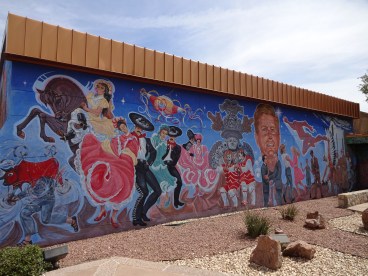
DSC09641I was greeted with a colorful mural depicting important moments in Mexican-American history and aspects of Mexican culture.  Upon opening the door I was welcomed in Spanish by a National Park Service employee. It was an elderly Latina lady with grey hair, a friendly smile,  and an aura of a traditional abuelita. She didn’t reveal that she spoke English, so we just continued in Spanish. I explained this was my first time visiting the memorial. She got up from here chair, enthused yet composed, and explained that there was a museum and film. She guided me over to a rack of brochures where she proceeded to fill my hands with brochures of other National Park units in Texas and neighboring New Mexico. She was funny. I liked her. She authoritatively but sweetly was telling me what I needed to see and what I needed to do. She was a culmination of Mexican hospitality and West Texas friendliness. I thanked her and proceeded to take in the museum. I was fascinated.
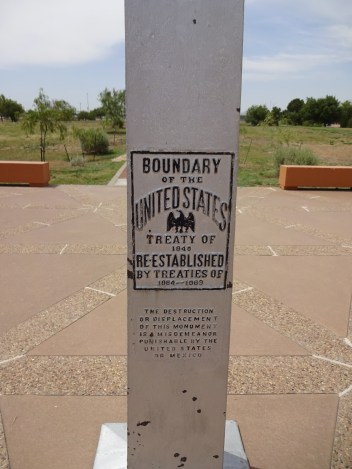
I learned through the museum, that this place commemorates the peaceful agreement between Mexico and the U.S. over a land dispute. Two Mexican presidents and two U.S. presidents, JFK and Lyndon B. Johnson, created a peaceful agreement.The issue had been that the Rio Grande river marked the boundary between the two countries, but there was an island on the river after the course of the river changed routes. It was long disputed whom it belonged to. Conclusively the route of the river was solidified in a canal and Mexico gave up its claim of Chamizal. People had to give up their land and that was sad, but overall the museum had a very positive spin on the whole Chamizal agreement

“The Chamizal is a very small tract of land. But the principle is a very great one. Let a troubled world take note that here, on this border, between the United States and Mexico, two free nations, unafraid, have resolved their differences with honor, with dignity, and with justice to the people of both nations.” – President Lyndon B. Johnson, September 25, 1964

DSC09645I left the museum to check out the small city park out back. There was a group of students perhaps on a field trip. I sought the post marking the prior land border between the two nations. I took a picture of it and then fixed my eyes on my surroundings. There was a bridge encased in fencing. A sign stuck up in the center of it declaring “Bienvenidos a Mexico.” I watched the vehicles flow and back up at the border. Then i noticed the business men walking across the border with their briefcases, returning home from a day in the office in another nation. Then I noticed others so informally coming across the bridge. Was is this easy? My curiosity was sparked. This was supposed to be an all-American National Park road trip, but maybe a side trip to Mexico could add a little spice to the slice. I had to go back in the museum and inquire. I found my little abuelita.
“I noticed people walking across the border, is it really that easy?” I asked

“Oh yes, you just need a passport.”

“What is on the other side?”

“Mexico,” she replied Of course I knew this. I hope abuelita wasn’t trying to be sarcastic with me.

“I know that, but is there a park or something on the other side.”

“Oh, si, hay un parque Chamizal de Mexico y tambien el museo Chamizal Mexicano.”

A Mexican Chamizal museum? I was intrigued. I wondered how Mexico’s museum would portray the whole Chamizal land dispute and agreement. Would they paint it in the same positive light as the U.S., or would it have a more bitter aftertaste after the land loss. I wanted to know and I also wanted a good excuse to cross the bridge to Ciudad Juarez, the city often deemed as one of Mexico’s roughest and most dangerous.

“Is it safe for someone like me?” i didn’t specify exactly what I was referring to, but I thought it obvious: tall, white and gringo… especially in this moment. I was dressed and prepared for my all-American road trip, not a stroll through the streets of Ciudad Juarez. I know how to blend into my environment, but this was going to be tricky given my circumstances.

“In this time of day, you’ll be fine,” Abuelita informed. “You should go, and then come back and tell me what you think.”

She was the final push. I was gonna do it.

I went back to my car, located my passport, and utilized some methods I learned when i used to explore the streets of Mexico City. I hid some cash in my shoes along with a photocopy of my passport. I emptied my wallet to the bare essentials. I strapped my camera string to by belt loop and let it hang on the inside of my pants. I changed from a sleeveless shirt and shorts to a t-shirt and jeans. I took all my typical safety measures. I was excited. Moments ago I had been beginning to question if I had lost my sense of adventure. Certainly not! This was proving it. Curiosity and daring ambition was driving me, and I took off on my journey to Mexico on foot.

This visit to Mexico would be unlike any other I’ve ever had before. It would be eye-opening and informative. In Mexico City they always say never go to the border because it’s really dangerous there. Why did they always say this? Was there validity to it? I would certainly find out.

DSC09647

Check back next Wednesday for the next “episode” in the adventure.

Click here for the previous entry “A Nightmare at White Sands”:  https://joshthehodge.wordpress.com/2019/03/13/a-nightmare-at-white-sands/

Check out my book “Among Blue Smoke and Bluegrass” on Amazon: https://www.amazon.com/Among-Blue-Smoke-Bluegrass-Tennessee/dp/1790631297

A Nightmare at White Sands

I made it past the Border Patrol checkpoints, through the various safety corridors, past the federal prisons with signs warning me not to stop nor pick up any hitchhikers, across the plains, past the tornado, through a torrential rainstorm, and finally I was in the mountains. On the other side I would arrive at White Sands National Monument.

My first perception of New Mexico was not the most welcoming. Danger and warnings seemed to be all around and on every highway and byway. This state would redeem itself later, showing me its true enchantment.  But right now, after a long day’s journey, I was just hoping for a relaxing evening camping out under the stars amidst white sand dunes.

Little did I know my night would not be relaxing nor star filled. I had my suspicions of this though. A storm had lingered ahead of me most of the day, preventing me from fully buying into the prospect of a beautiful night. Once I had passed over the mountains by Las Cruces, I had outpaced the storm. It was behind me. I knew mountains create weather, and weather on one side of a mountain can be entirely different than the weather on the other.

Maybe, by crossing the mountain, the storm would truly stay behind me. I had some unrooted hope. I rolled into the visitor center at White Sand National Monument and wasted no time in getting inside and securing a backpacking permit. It had been a race, me against the clock, all day to get here and secure a permit. When I had it in my hand it was a sure sign of relief.

The young lady, who issued the permit to me in the visitor center, went over a few basic rules. She told me that once I drove into the park, I would not be coming out until the next day. I would have to commit to camp all night, because the park road is gated and locked at night.

I inquired “What am I supposed to do if it starts to lightning.” She replied, commenting how she was aware of a pending storm, and assured me I could sleep in my car if lightning became an issue.

Prior to setting out on this trip, I read an account, from a fellow adventure blogger, Tricia, from Road Trip the World. In her piece “An Amazing (And Absolutely Terrifying) Night Backpacking White Sands,” She shares the true life story of her family encountering a lightning storm while trying to camp out in White Sands and racing back to their car only to get lost and becoming extremely vulnerable to the weather. It was a great read, and seemed like such a crazy and unlikely occurrence. That would never happen to me, right? I could never have imagined that the words I read in their blog would jump right off the world wide web, manifest themselves again here in New Mexico, and formulate the same story with me as the new protagonist. What was this? Some sort of Disney reboot. I would have begged to just stick with the original classic. This new story added in some details I could have done without.

So here’s how this new rendition begins: I was in the park. It was astounding. The sand, formed from gypsum, is truly white, and it gives the appearance of snow. If I staged my photos correctly- threw on a serious coat and hat- I could have fooled you into thinking I was in some sort of arctic tundra. But it was rather warm. I was in shorts and a sleeveless shirt. The drive into the park, was, for a lack of better terms, magical. I think somewhere beneath my car was a road, but white sand had blown, fallen,  and leisurely hung out all over the road, giving the perception that I was off road somewhere braving the snow covered landscape.

I parked my car, in the designated lot for backpacking campers. There were a few other vehicles, maybe five at the max. Daylight was slipping away, so I wanted to get packed and out on the dunes. Two miles, I believe is the distance I needed to travel, to where I was assigned a “campsite.” The only way to identify a campsite would be by a metal stick stuck in the ground with a number affixed to it. As I was packing my backpack with everything I’d need for the night, I overheard a pitiful, yet entertaining, conversation between some fresh college graduates who just met. There were two boys and two girls.

“We just graduated,” The college frat boy type spoke as he was gathering things from his Jeep along with his buddy.

“No way! Oh my gosh, we did to!” the tall slender girl flirtatiously twirled her fingers through her hair, aside her female companion.

“You girls are hot. What are you doing out here alone?”

“Oh, we are just celebrating graduation and are going to go backpacking”

“We’re gonna get drunk.” He pulled a cooler from the Jeep. “Come by our camp for some drinks.”

“Oh my gosh, like, yes!

I had to pause, was this conversation really happening? I did not have the most conventional college experience. I wasn’t accustomed to this sort of exchange. Is this how the world works? Part of me internally was saying please, just stop and go home, and the other part was entertained and begging, tell me more. And they did.

“We have weed,” one boy continued “Come smoke some weed with us at our camp.”

“For sure,” the girls accepted.

Whoa! Overload. Here’s what was spinning through my mind. First off, this conversation was so easy and so blatantly straight-forward. If I were to be flirtatious, which is not much in my character, I would be more clever and cunning about it. “You’re hot”? Really? We can do better. Secondly, going out on the sand dunes, in God’s beautiful nature to get drunk, to me, seems like an abomination. I go out in the wild to seek beauty, to savor the vistas, to listen to the subtle sounds, to commune with my Creator. I think John Muir and dear Teddy Roosevelt would be rolling in their graves to hear this horrendous conversation. Thirdly, you are going to smoke weed on federal property? That only seems like a good idea if you want to spend some time in prison. Hearing the way these guys and girls responded to each other, only proved that they deserved each other. And in conclusion, although their night may be filled with “experiences” for sure, they would miss the true value of the solitude and inspiration to be found in such a beautiful place.

But whatever, Tally Ho! Onward I went into the sandscape. I, now a proven champion of beating the clock, decided I could save some time by punching in the GPS coordinates to my “site” Instead of following the trail, which was a series of stakes in the group. The GPS device would take me a more direct route. I thought this was a good plan. It was mistake number 1.

The story just goes downhill from here, but in all due credit, White Sands National Monument is  beautiful. The smooth white sandy expanse contrasts the dark blue and purples of the mountains in the distance creating a view of prime artistry.

I arrived at my site, just as the sun turned  in for the night. You’ve heard of a “hole-in-the-wall,” well this was nothing more than a stick-in-the-sand. I set up my tent took off my boots, crawled into my tent, laid my head down, and then…

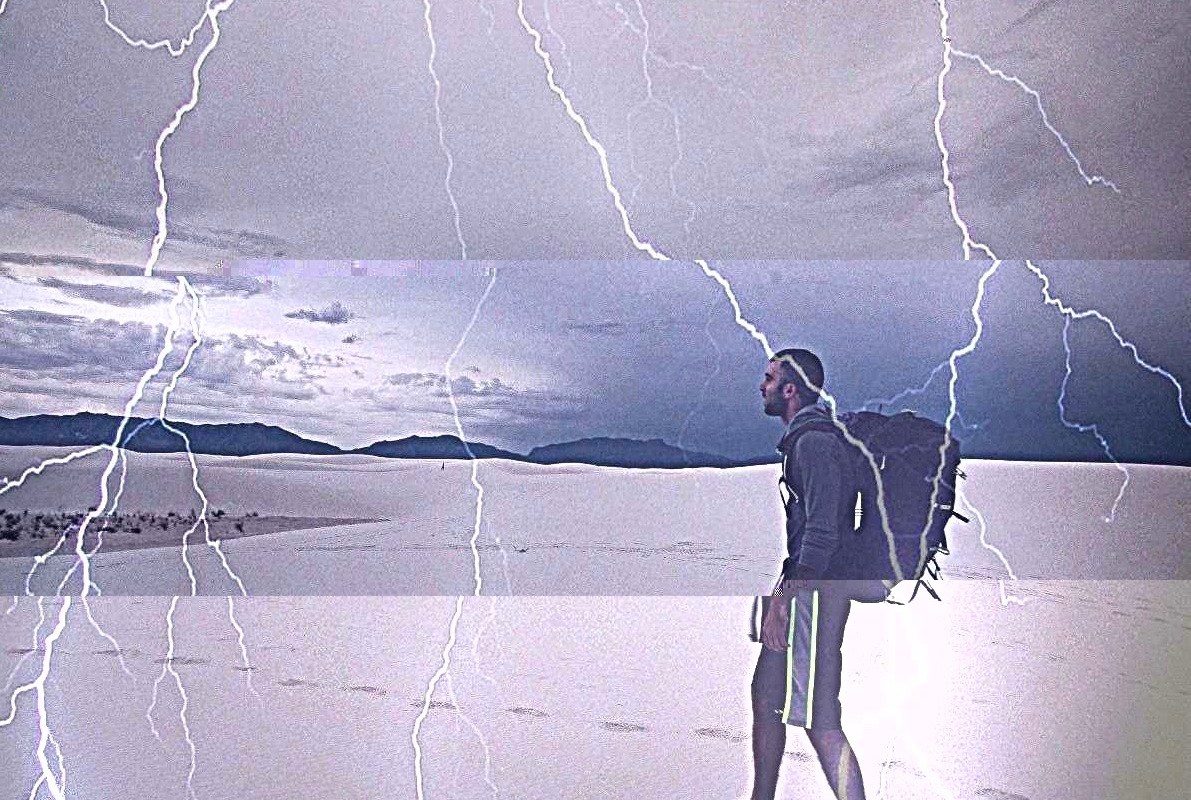
“BOOM!” a thunderous cry ran free in the distance and light flashed across the sky. I propped myself up to further examine the sky. The storm was on descending from the mountains. It was on its way.  My initial reaction was to ignore it, but five minutes later I decided I needed to do something. I don’t know if this has any sliver of intellect or potential at all, but I was considering how my tent and I were the only things sticking up on this white expanse. We were undoubtedly the one and only lightning target. I know lightning is prone to strike the tallest object and is partial to metal. So I took my trekking pole, extended it, walked a few feet away, and erected my personal lightning rod. Back in my tent I went. The wind started to pick up, and the sides of my tent nervously flapped. The storm inched its way forward becoming more boisterous.

Should I stay or should I go, my mind when back and forth and back and forth, ping-ponging from one side to another, until I settled, on I gotta make it back to the car. I quickly packed up and started on my way. But which way? It was dark now, and I had become disoriented. Everything out here looked the same. I didn’t know which way to go. I started, and about ten minutes in, I realized I had no idea where I was headed. For my own psychological well-being, if this storm was going to be upon me, I figured I’d rather be inside my tent than standing up on the sand completely exposed. I made my way back to my tent and set up my tent once again. I was going to be stubborn. I was going to stay. But my stubbornness only lasted for about another ten minutes, until doubt crept back in.

Then I attuned my ears to the sounds of some other campers somewhere in the distance. I couldn’t see them, but I could hear them laughing and being all giddy-like. I entertained, for a while, the idea that if there was really danger I would wait until that party packed up and started heading back to the cars. But the storm grew closer and closer and these people seemed so unfazed. Then the responsible and reasonable me considered that I was  waiting to take lead from people who were probably drunk and high. I need to take matters into my own hands. Better safe than dead, I concluded. I packed up my tent once again and headed out. Mistake number 2 was that I failed to make a waypoint on my GPS when I started my journey from the parking lot. I would have to follow the system of numbered stakes back. It would take longer. I went from one number to another, and they didn’t match up. How did I go from 2 to 11 and then from 11 to 5. I was not following the sequence. My feet were racing and stumbling over themselves in the soft sand. It was uncomfortable, I was struggling and far from being collected or stoic, but I was determined to get back to my car before the lightning reached the area.

About twenty minutes later I thought I had found my way, until I read the number. I was back at my site. The realization that I just walked in a circle hit me in a very unsettling way. It was like the sandscape was playing tricks on me and mocking me. I felt like I was in one of those terrible nightmares, where you realize you are dreaming, but no matter how hard you try you just can’t wake up and snap out of it. Panic really began to set it. I was about ready to throw it all on the ground, lay down, bury my face in the sand, and face my horrible fate of being struck and fried by lightning, but I don’t give up that easily.

Just when so much sand collected in my shoes, that it forced my feet out of my boots and I stumbled around barefoot, I reached what seemed to be the pearly gates of the roads paved with gold. It was simply the parking lot, ever so comforting and reliving.

BOOM! Light flashed in the darkness.

The storm was very near. I was very glad I made the decision to come back to my car.

Never in my adult life have I camped in my car. It was against my rules. I would always take the time to set up a tent and enjoy the night air and stretch out my legs. I would break my rules tonight. I am tall, my car was compact. I was crutched up. I cracked the windows, but it was stuffy. This was not how it was supposed to be. Here I was feeling pitiful. My White Sands camping experience was ruined. This was supposed to be a trip of peace and rejuvenation. That same morning I had locked my keys in the car, and now I had just escaped a lightning storm and was crunched up in a compact car in the blustery sand plains of New Mexico.

Then…

Bright lights shown in my window. Someone had their vehicle high beams pointed at me. It was a law enforcement park ranger. He informed me I was not allowed to camp in my car. I told him I came back because of the storm, and in the visitor center, I was told I could do so. He asked for my license, permit, and fee receipt. Wait? What? Receipt? I didn’t have a receipt. I didn’t pay anything for my permit. Was I supposed to? I was.

I was trying to figure out how could I possibly be at fault. Shouldn’t the permit issuers have collected my fee?

The officer wrote me a ticket for $150. “Pay your $3 camping fee on the way out in the morning, or you will be stuck with this fine.

I explained to him how I would never intentionally break a rule in a National Park, and I explained how I actually volunteer with the National Park Service in the Big South Fork. He was friendly and understanding, but still stern. He pulled out a piece of paper, which I had never previously been presented with, that stated “no sleeping in vehicles.” After giving me the run around I asked: “Well where am I supposed to sleep tonight?”

“You can just sleep in your car,” he replied.

Feeling like a convicted criminal, I slept in my car. I felt like I had betrayed my beloved National Park Service. My pride had taken a fall. I always felt like I was a part of the NPS now I felt like a foe. And I was the one seeking peace and solitude. It’s not like I was hooking up on the sandscape with booze and marijuana. I felt like the law enforcement officer painted me as someone I wasn’t.

Feeling pitiful and exhausted, I fell asleep.


I woke up in the middle of the night to the car rocking back and forth from the wind. I pushed myself up to look out the window. I couldn’t see anything. The storm indeed was here, and it had picked up the sand and violently tossed it about in a complete white out.

Well, this was the safest I was going to get. I laid back down. I may have broken rules, my night might have been a messy escape from danger, but I felt I had made the right decision. The turmoil outside put my mind at ease for the decisions I had made, and I went to sleep again to the sound of the roaring wind.

Screen Shot 2019-03-13 at 6.24.00 PM

Check back next Wednesday for the next “episode” in the adventure.

Click here for the previous entry:  https://joshthehodge.wordpress.com/2019/03/06/3-rattlesnakes-and-a-frenchman/

Check out my book “Among Blue Smoke and Bluegrass” on Amazon: https://www.amazon.com/Among-Blue-Smoke-Bluegrass-Tennessee/dp/1790631297

Read Tricia’s White Sands experience here: http://roadtriptheworld.com/2015/08/backpacking-white-sands/

3 Rattlesnakes and a Frenchman

Although I was running short on time, my adventure in Chiricahua National Monument was not complete. I really wanted to hike to the top of Sugarloaf Mountain. The only competing circumstance was that I had a four-hour drive ahead of me to White Sands National Monument, and I needed to get there before 6pm to secure a camping permit. It was already noon. I would save time, I concluded,  by running the trail to the top of the mountain. After all, it was only a 1.9 miles hike round trip.

I pulled into the parking area. I was already up in the mountains, but this cylinder-like peak jutted up from the mountain as its own entity. I  had to see the view from atop. I grabbed my backpack and hydration pack, made sure I had my car keys, and was off. I started running up the narrow path which hugged the mountainside and spiraled DSC09539around the peak. There was one part with a narrow tunnel carved or blasted out by the Civilian Conservation Corps and another section where the rock and trail became smooth and bright white, appearing almost as if it was a part of a bobsled track. Apart from that, the rest of the trail was of typical rock and dust, with prickly plants all around and the summer sun in full exposure. Yes, it was strenuous, DSC09552going uphill the entire length of the trail, but it wouldn’t be long. I was pushing myself, taking on my machine mentality in which I concentrate on keeping mechanical movements and consistent speed, imagining I am nothing but a machine operating in a programmable mode. I was finally picking up speed and getting past my mechanical groove into a free-spirited free run until…..
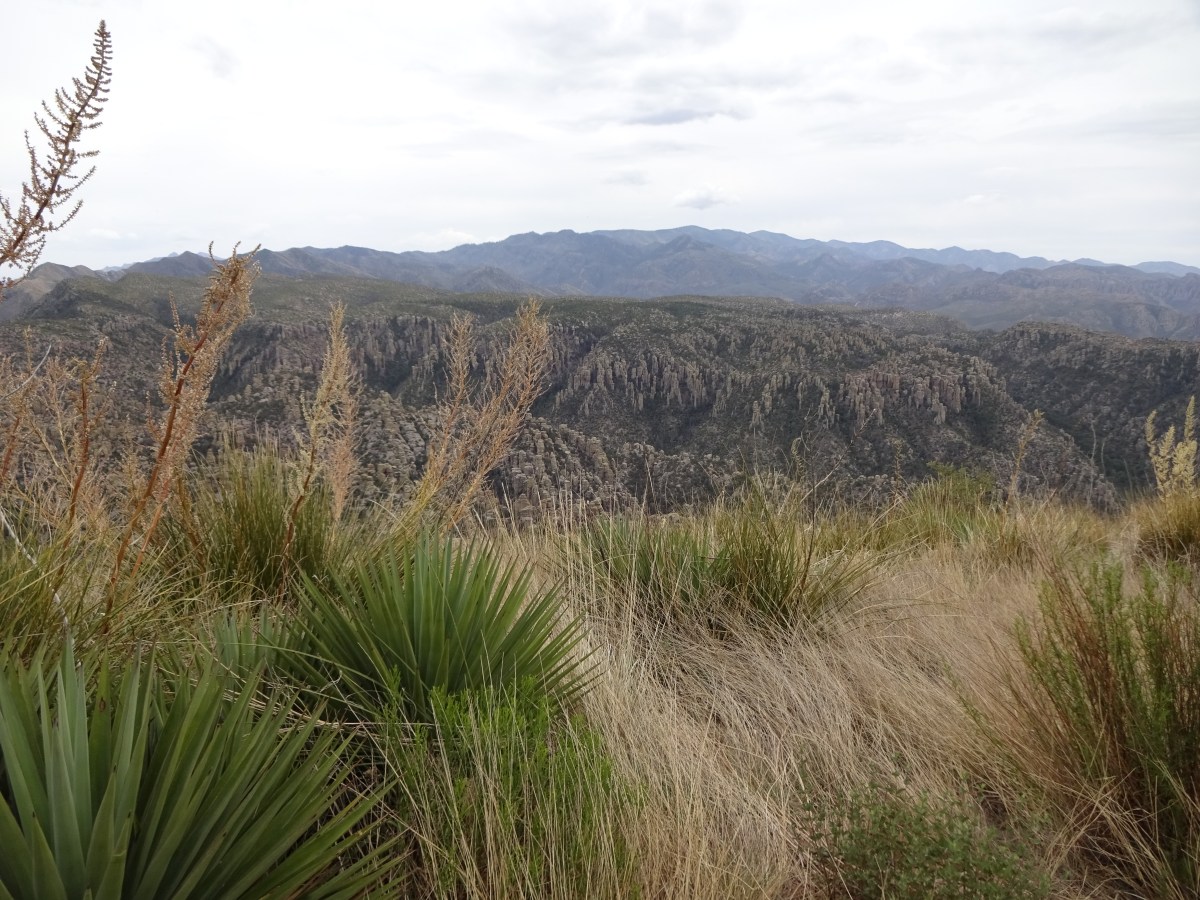
“Tststststsssss” ( That’s how I spell the sound a rattlesnake makes). That noise was coming from behind me.

I ran right over a rattlesnake. My heart instinctively jumped at the sound. My feet must have barely missed stepping on it. Offended, it cringed and rattled its way off the trail. That was a close one!

Preparing for my first trip out West, I was very concerned about rattlesnakes. I read up about them. I thought they were going to be everywhere and would be a real issue for me. I was overly cautious to the point that now it is only humous to think back. My rattlesnake encounters ended up being so few that the threat of rattlesnakes had worn off and they weren’t even on my mind, until suddenly in this moment. Although it through me for a surprise I took this situation very pragmatically. I started building a small rock cairn as an indicator for myself on the way back that I would need to be cautious of a snake in the area.

Then I drew on what I new about rattlesnakes. They are mostly blind and rely heavily on vibrations on the ground to sense what’s going on around them. They aren’t aggressive until threatened. They will move out of the way if they sense someone coming. So I decided I would tread heavily and every-so-often throw a handful of stones out on the path in front of me to startle any snakes into a rattling mode.The plan seemed good to me, so I pressed forward.

Then, unexpectedly, around the bend appeared….a man- a young man- a fellow hiker. After a friendly smile and acknowledging “hello,” I proceeded to warn him: “I just passed a rattlesnake on the trail back there around the bend. I built a cairn. So when you see the cairn, just know there is a rattlesnake in the area.”

“I just saw too more rattle snakes.” He had an accent. He didn’t sound like he was from around here.

“Did you make it to the top?” I asked.

“No, I turned around. There are too many snakes.”

Turning around because of too many snakes, hadn’t even crossed my mind as an option. It troubled me that this guy was going to give up on the hike and a potential amazing view. When you face as many hardships as I have in life, what is a rattlesnake really? It’s got nothing on me.

“Well, I’m going to the top,” I informed. “You can follow behind me if you’d like. I’ll scare away the snakes.” My ego got an espresso shot right about here. I was the brave one. I was the daring one. I had suddenly become a leader.

And just like that I had a hiking companion. His name was Gzeivieur, and he was from France. He told me how he liked to vacation in the United States and visit our National Parks. It’s a perfect topic! I love to indulge in talking about the Parks, so naturally we proceeded to talk about our National Park experiences. We had been to many of the same ones. His favorite was Yosemite. Mine was Death Valley. On his present trip, he had already been to many of the places I was headed. We got on the topic of Dinosaur National Monument, a park I would become a big fan of. He recommended I visit a place near the park called Fantasy Canyon. The name alone sounded very intriguing. He told of rock formations unlike anything he had ever seen elsewhere.

We also reined in the conversation to our most immediate happenings. I told him I camped here in the Monument. He told me he stayed in a hotel in Wilcox. My mind flashed back to those abandoned and sketchy hotels I passed by on my way here.

“Tststststsssss” My stone throwing method had worked. I had been causally tossing stones every once in awhile and I had alarmed another rattlesnake, which scooted off our path.

The trail was soon leveling off and we were nearing the end when Gzeivieur warned of another rattlesnake. This little guy was snug up against a rock right aside the trail. To continue walking on the trail would put us in teritorial risk, so we maneuvered ourselves off the trail on the opposite side, skillfully fumbling over some rocks.

And then…

DSC09570

We were there! We made it! Gzeivieur had been so close on his first attempt.

There at the top was a lookout building. I’m not sure if it was intended to be a fire tower sort of building, or a weather station at some point, but it was paneled with windows which looked out into the spectacular landscape. DSC09574

Clouds had rolled in bringing out a dark richness in the landscape. Here golden wild grass carpeted the mountaintop. Just below us was the valley spread, now so miniature, speckled with trees and hoodoos, and just level with the eyes were dark blue and grey mountains. I am so glad neither of us gave up on reaching a view like this. There was a 360 degree view. We walked around all sides a few times before we began our descent.

DSC09561Despite all our snake encounters on the way up, there wasn’t a single encounter on the way down, but I did see a short-horned lizard. As we descended, my hiking pal and I continued talking all about our National Park adventures. I might have shared with him a story or two of some of my wild happenings.
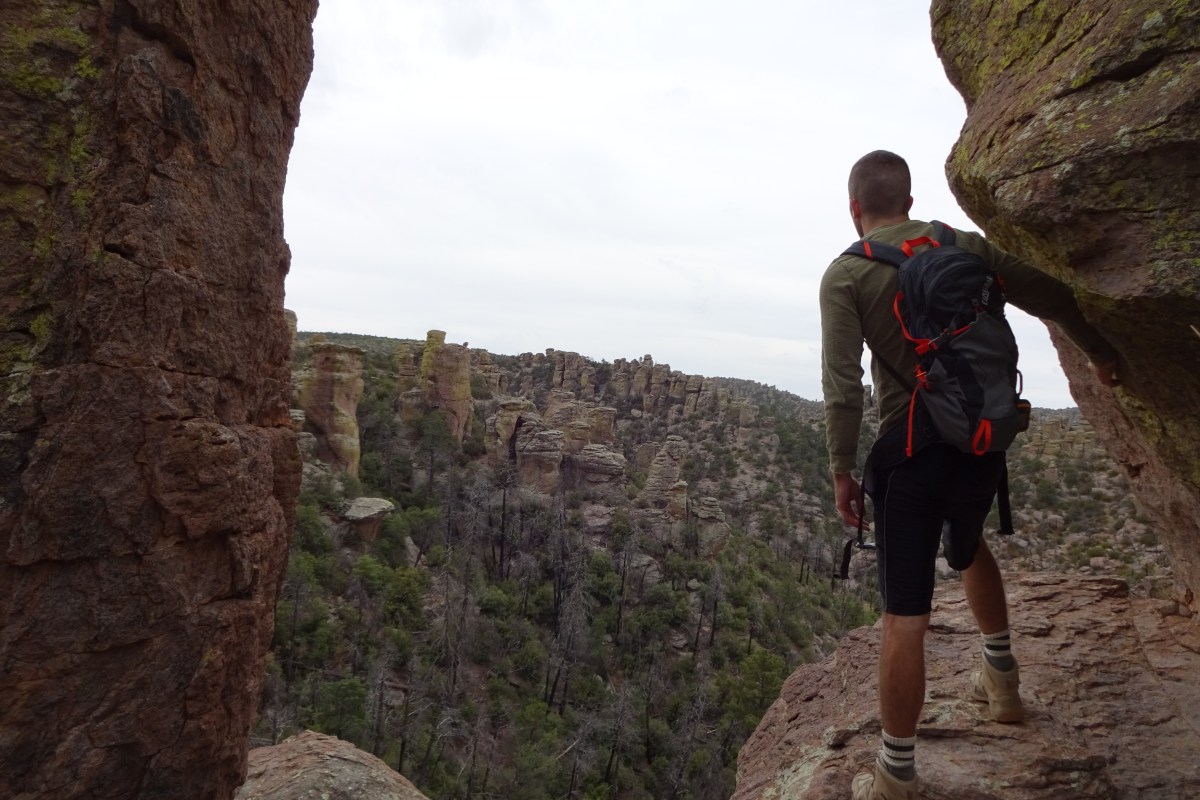
I will say some of the most interesting and genuine people I’ve met have been out on the trails or at different sites in the National Parks. I’ve made a list of them to ponder, remember, and appreciate these people. All of these people I’ve met from the across the National Parks are rich in experiences. They are like books, full of adventures and tales to tell, and our paths meeting end up enriching our own stories.

It’s one thing for a solo traveler like myself to venture across my country. But here was Gzeivieur, doing the same but as a foreigner. That’s some pretty “bad a**ery,” but hey, he still wasn’t going to finish this trail because of the rattlesnakes, so I one-upped him this time. But it’s all in good humor. I was glad to meet Gzeivieur. Before we parted ways, we exchanged social media information. I continue to follow his adventures as he does mine.

Back in my car. I strapped myself in. Chiricahua National Monument provided a full and robust beginning to my summer odyssey. I was now ready for the next leg of the adventure. It was time to head into New Mexico to White Sands National Monument.

Check back next Wednesday, as the adventures continue. 

Click here for the previous entry: https://joshthehodge.wordpress.com/2019/02/28/my-crisis-at-chiricahua/

Check out my book “Among Blue Smoke and Bluegrass” on Amazon: https://www.amazon.com/Among-Blue-Smoke-Bluegrass-Tennessee/dp/1790631297

My Crisis at Chiricahua

I was done. I didn’t want to get out of bed, or off the ground rather. Life had knocked me down and I didn’t have the energy to get back up. The sunlight woke me to numerous birds singing and chirping all around me. I was amidst a bizarre and new landscape here at Chiricahua National Monument in Southeastern Arizona on the first full day of my new adventure. Visually, it was a beautiful morning. There was much to see and explore, but life had knocked me down and here I remained.

Prior to this trip I had experienced a series of difficulties in life. There were new challenges and unwanted changes at work, drama with my living situation, and most heavy and lingering of all, a health struggle with Drug-Induced Lupus. I’m very open with the fact that apart from the Lupus I had, I have a chronic hereditary autoimmune disorder called Ulcerative Colitis. It  keeps my intestines from functioning properly and causes an array of physical challenges. I was fortunate to be on an infusion medicine which kept me at prime health for six years, but then my body negatively reacted to a final dose of the medicine, gifting me a battle with Lupus. Numerous organs in my body ceased normal function, I became extremely weak, and had a hard time standing up for more than a few minutes. During the whole course of the disease, no doctor knew what was happening. It was only revealed after the fact. This left me with lots of uncertainty and questions. My last scheduled doctor’s appointment was with a cancer specialist.

Needless to say, despite all the uncertainty, symptoms started to wear off. I started to regain my health. I worked hard to remain fit and bring myself back to life. But I had not fully recovered, and lingering inflammation was spread throughout my body, making me feel weak and unwell, and so I was tired and worn out.

I lay there in the sleeping bag in my tent thinking about the person I used to be— full of life and energy, always eager for adventure. I missed him. I missed being flooded with so much excitement and adrenaline, that I’d be up before the sunrise seeking the next new vista.

And then there were the nightmares I had, which tainted my mood. I couldn’t remember them. They were fragmented and all over the place but they also drained me. Life just left me sore inside and out. I was waiting for the next tragedy or unforeseeable event to happen. It was as if I could sense it around the corner. Deanna Favre in her book, The Cure for the Chronic Life, describes this condition of survival in which we learn to live chronically in crisis. She says “these patterns give birth to worries that permeate every corner of our lives. Soon, we become less about becoming all that God has in store and instead spend most of our time enduring what the world throws our way…When we are living in chronic crisis, we are never quite breathing in the fullness of life, but instead holding our breaths, afraid of what might come around the corner” This is where I was.

After an hour, I brought myself to resolution. I knew Chiricahua National Monument deserved my time and attention. I had done just a little exploring the previous night. The landscape was unlike anything I had ever experienced before. It was part desert, part jungle, part grassland, part temperate forest. It is a very unique location because it is where the Sonoran Desert gives way to the Chihuahua Desert at the base of the Rocky Mountain chain. This leads to a wide diversity of animals and plant life, including wild boar, fox, short-horned lizards, and sometimes, although rarely, jaguars. But most fascinating of all is the coatimundi, a relative of the raccoon which looks and behaves more like a monkey. I wanted to see one.

I got myself out of my tent and packed up. I had stayed in the one and only campground in the park, Bonita Canyon. It was a nice shaded campground with a series of small bridges. I then drove through the canyon and up the mountain to Massai Point where I would begin a hike. This park road was one constructed by the Civilian Conservation Corps in the 1930s. It begins in the dry woodlands shaded and adored with impressive hoodoos and canyon walls. The road, ascending, hugs the mountain very closely and barely evades a cliff on the other side. It seems miniature too, like not quite full two lanes. In addition there were fragments of rock strewn across the pavement which had simply eroded and fallen on the road. I strategically swerved around them, as to not damage my car nor its tires. This road was an endeavor itself.

Once parked, I began to gather my belongings for the hike. The hike would be at least 5.5 miles in a sun-exposed, rocky, dry climate. I needed to make sure I had adequate water and calories. I needed my camera, my hiking GPS, my park map, and a change of clothes. I knew when the sun rose higher into the sky, I would shed my long sleeves. Trying to pack my bag was a little hectic, because I hadn’t had time to organize my car yet. Everything was sort of just thrown haphazardly into the trunk. Somehow, in the shuffle, unbeknownst to me at the time, I dropped my keys in the trunk. Then, when I thought I had everything I needed, I closed the trunk, locking myself out of the vehicle.

I felt geared up and finally ready to go. Hiking across the parking-lot to the trailhead, I peered into my backpack to check where I put my keys and realized I did not have them. My heart began to race. This was one of my nightmares. I plopped my bag on the ground and quickly removed everything with frantic haste. There were no keys.

This can’t be happening, I thought. I raced back over to the car. I looked in the window to see if the keys were on a seat. Nope. I tried opening every door and the trunk. They were all locked. I emptied my backpack again, carelessly scratching the screen of my GPS on the jagged pavement. I did not have the keys. I looked around me on the ground. No keys.

I was alone. There was no one up here. Besides the family camping next to me way down in the canyon, loudly speaking Chinese into the wee hours of the night, I hadn’t seen anyone else in this park. Plus, the visitor center would be a very long day’s hike away, and when I passed it, it looked closed for the season.  I wouldn’t have enough water to make it there anyway. In a panic, I ran over to the NPS sign by the trailhead, to see if there was any notice about emergencies. Nothing. I checked the park map. No emergency information.

I couldn’t call anyone either. There was no cell phone service here, and I had also left my phone in the car. My head began to feel lightheaded in the angst of the moment. With denial, I went back over to the vehicle and tried the doors again. In a retrospectively rather humorous manner, I laid my hands on the car and made my plea: “God, I don’t know what to do. I just need a miracle. Just one miracle. Please unlock the door.”

I tried.

Nope. Still locked.

My resolution: Pretend like this didn’t happen. I’ll go on this hike anyway. Maybe someone else will be here by the time I get back, and maybe I’ll find a water source during my hike.

I turned my head away from the car, to begin my hike, and there laying right on the pavement were my keys.

They looked so beautiful, like some rare prized possession. It was like I was Indiana Jones coming upon the Ark of the Covenant, or the Fountain of Youth, or something.

It was right here in this location I had searched my bag over and over again. There were no keys here just moments ago.

Now, we could say I overlooked them, but I truly believe more was at work here. After I found the keys, the voice of God spoke to my soul brief and direct to the point, “Be still. Be calm. Don’t worry.” That came over me like a wave of peace, extinguishing all my anxiety, not just in this situation, but everything I had been feeling lately from my health, to my self-complacency, and the subtle anxiety which ran in the background all day and night.

It had been a long time since I heard God’s voice in my life. During my entire recent illness, though so many questions were put on the table, God felt distant to me. I felt alone. But here He was reminding me that He has me in the palm of His hand. He is looking out for me, and He cares. Yes, He is big enough to care about the world and eternity, but He also cares about me and my keys getting locked in the car. I also find it worth pointing out that in my prayer I had an idea of how this could be resolved. In a plea to solve my dilemma, my petition was for God to open the doors. God did resolve the issue, but in an unexpected perhaps even more miraculous way. In life, in the midst of my difficulties, great and small, I often often pray with my already thought out resolutions in mind. Sometimes God is on the brink of solving our problems in unexpected ways. Keep this in mind when your plans seem hopeless.

This moment of God speaking to me would be the foundation for everything I would learn and everything that would build within me this summer. This voice and this message would comfort and guide me as I would face an amazing summer of extremely cherished unfortunate and inconvenient events. Although I would continue to  seek out the voice of God during this trip, these few words would be all He would leave me with for a long while:

“Be still. Be calm. Don’t worry.”

After this incident with my car keys, my backpack seemed to carry much lighter and my body suddenly possessed more energy. Worry had been weighing me down, but God tamed that wild beast and took it away. I was ready to explore.

DSC09476 (2)As intended I hiked Ed Riggs Trail to Mushroom Rock Trail to Inspiration Point Trail to Inspiration Point itself. The first trail began by descending into a valley of trees and shrubbery. All around me stood tall dark hoodoos, clustered together at various heights. They looked alive, almost as if they were in the process of growing. In some aspects the view was reminiscent of Bryce Canyon, but here the hoodoos took on a more stalky, weightier form, and their color was a sandy grey. Here these geological features were the result of an ancient volcanic eruption. Also, though arid, lichen adorned the rocks, and greenery was draped over the landscape. At one point I came to a window in the rocks, and could look out into the valley.
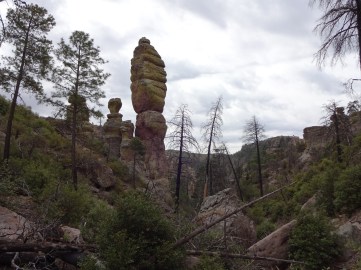
DSC09462I had never beheld a landscape like this before. To me, it looked like what I might imagine one of China’s stone forests to look like. I’ve never been to China, so this is purely out of speculation and comparison to photographs. Nowhere in the United States have I been in any environment quite like this. There was such a combination of environments that it became confusing to identify and best to consider Chiricahua its own entity.  
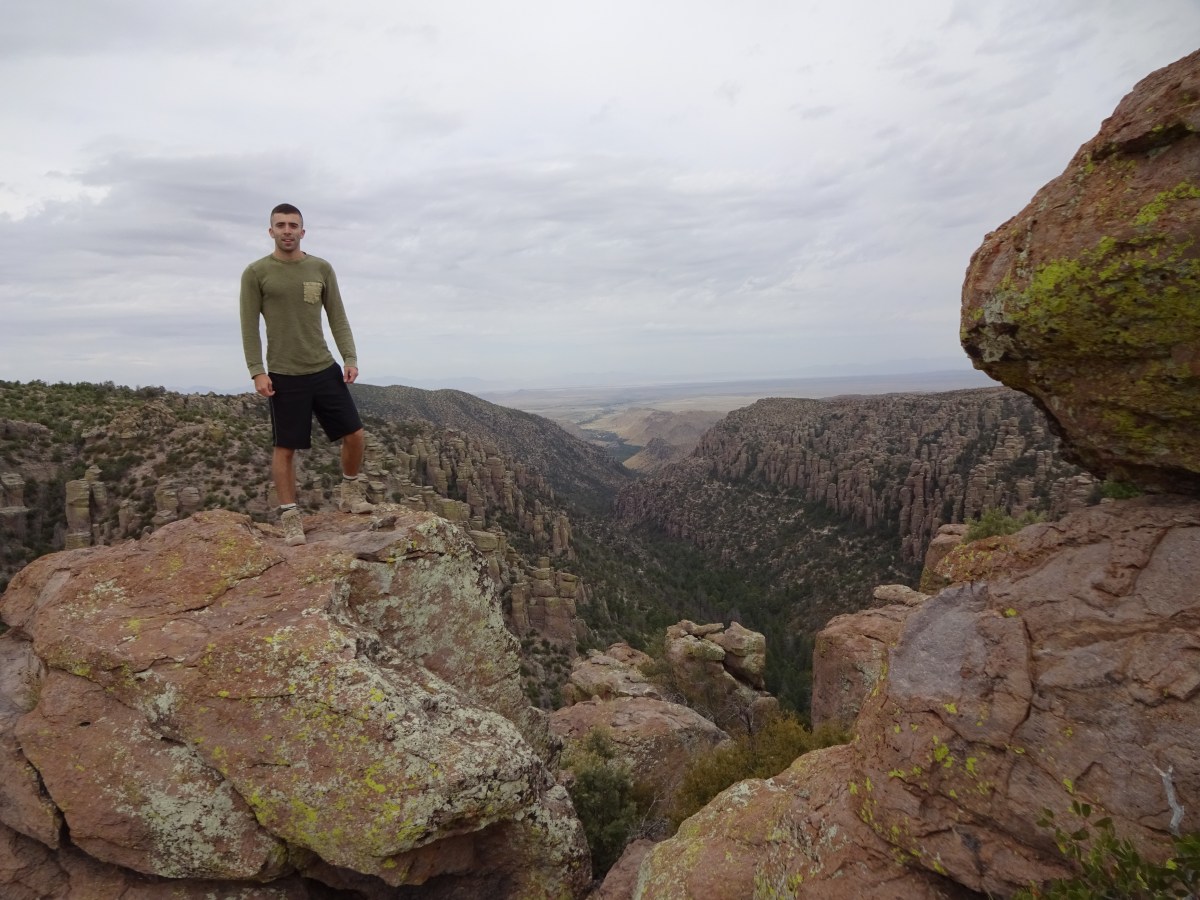
After venturing through the forest, I ascended to arid grasslands, and then onto rock faces where lizards scurried.  The reach of my hike ended at a peninsula looking down into the canyon. It was stunning, hoodoos climbed up and down the mountains, and in the distance the canyons spilled and became level with the desert plains, showing that Chiricahua is its own location, an island in the desert. When driving to the park, I ascended from the desert into the mountains where this secret canyon lay. This unique biome and hidden world l above the desert plains was the stronghold of the Chiricahua Apache Indians.  

Back near the trailhead was a lookout tower with a plaque stating how the Apache had a secret hideout in the mountains across from the monument on the other side of the valley. One important leader and warrior was buried there. He wanted to be buried where no white man would ever tread. No one has been able to find this secret location and grave. I love mysteries in the National Parks.

I can say, without reservation, that Chiricahua National Monument is one of the top five underrated gems of the National Park Service. It is also special to me because of what happened here. Whenever I look at my hiking GPS and see the scratches across its screen, I remember my panic and God delivering me from my situation. It reminds me of his ever-presence.

I would love to someday return to Chiricahua National Monument, reimagine its history, explore its stories, revel in its landscape, and find a coatimundi. I never did see one.

DSC09522 (2)

Check back next Wednesday for the next episode in the adventure.

Click here for the previous entry: https://joshthehodge.wordpress.com/2019/02/23/a-new-adventure-an-expedition-of-being-lost/

Check out my book “Among Blue Smoke and Bluegrass” on Amazon: https://www.amazon.com/Among-Blue-Smoke-Bluegrass-Tennessee/dp/1790631297

A New Adventure: An Expedition of Being Lost

This adventure starts with blood, droplets to be precise, running down my arm. I was not sure what to do. I was prepared for many circumstances. I knew how to best handle a bear encounter. I was accustomed to venomous snakes by now. I knew how to avoid hypothermia, and I may have learned a thing or two about sandstorms, but I was not prepared for the angry TSA agent at Chicago’s O’hare International Airport.

Somehow in the midst of things, while taking off my backpack, one of the sharp edges of a National Park pin I had adorned on my backpack, latched into the skin of my thumb and ripped, providing a slender stream of blood running down my arm towards my elbow. I wasn’t aware there was even a wound, until I saw the alarming bright red color cascading down my arm. I grasped my thumb with the rest of my fingers in the palm of my hand, adding pressure to stop the bleeding, and prevent the blood from dripping onto anything.

“Hurry up! Keep moving!” The TSA agent called out in a passionate and bothered tone.

I was trying— trying to get my belt off, remove my laptop from it’s case, put my shoes up on the conveyor belt, and empty my pockets while not losing location of my plane ticket nor wallet. And trying not to bleed on everything. If anything was an omen or foreshadowing of the rest of this year’s summer adventure. This was it.

In a clumsy sort of juggling act, I got all my parts and pieces up onto the conveyor and walked into the tubular cylinder for my body scan. Nobody knew of my bloody situation. I passed through, my belongings were delivered back to me, and I was trying to put myself back together and manage my wound before I’d be reprimanded for holding up the line.

Phew! I made it. First order of business: find a bandaid. I went from gate to gate. Either there was no employee or the agents were too swamped with passengers boarding flights. After adequate effort, I found a kind lady at a gate who disappeared and came back with three bandaids “just in case.” I was all set.

Here I was, on the verge of a new adventure. I had prepared months in advance for this. This would be my third great National Park adventure and road trip. Two years prior I had ventured out West, primarily to California, and hiked and camped in Yosemite, Sequoia, Death Valley, and other National Parks. That was the prelude, the falling in love with the National Parks, that spurred my month long National Park adventure the following year, in which I pondered the Canyonlands and reached my highest summits. This summer would be the grand sequel, a continuation, the ongoing romance of me and the natural world.

Reading my accounts, one might think I am sort of a freespirit, and although that title does sound appealing, I do like my adventures to be planned out. I do make elaborate itineraries. I may not always stick to them, and I adjust when needed, but the underlying fear is to miss out on something, so I want to make sure all major points of interests possible are considered.

My plan was to fly from Chicago to Phoenix Sky Harbor, get a rental car I had secured months prior, and venture from Arizona into New Mexico, down through West Texas to the border of Mexico, back through New Mexico, up through Utah, Colorado, Wyoming, California and finally conclude in Las Vegas. The focus of the trip: visiting as many National Parks sights as possible and seek beauty and inspiration.

By now, I knew what I was doing, I was well experienced. I was only tired. A number of life’s circumstances had worn me out. I was hoping that this trip would rejuvenate me and provide me new perspective. I seek God when I am out in the wild. I believe he designs the natural world to point us to him. When we lose ourselves in it, God uses the beauty and symbols of nature to speak to us. When we seek, God opens the door. He honors that.

During my plane ride from Chicago to Phoenix there were no interesting characters to chat with, no painted young lady heading off to a tattoo convention nor a ditsy girl asking me if two bottles of water is enough for an overnight trip into the Grand Canyon. Nothing like that. I was alone to my thoughts. I knew I would be making many more memories, and it would be important to not forget any of the experiences I’ve had thus far, so I cracked open my journal and made a long outline of everything I remembered from my previous epic summer adventure. I would use that outline to start my blog, write a book, and recollect that entire summer experience. With that behind me, I would feel free to soak up new experiences, savor them, and write about them.

When I got to Phoenix, I picked up my rental car. My sweetest deal yet: $450 total for one month. I hit the road and stopped at a familiar Chipotle in Casa Grande, which I had eaten at the summer before. It was a good place to stock up on calories, and it was also right across from a Walmart to stock up on supplies. I’ve gone into great detail of how this works in the record of my previous adventure, but essentially, I have figured it cheaper to buy much of my camping gear after arriving, instead of paying for extra luggage. As quick as I could, trying to save daylight, I stocked up and hit the road southeastward to Chiricahua National Monument. I had entertained the idea of heading west to Organ Pipe Cactus National Monument, but after being bombarded with warnings online about safety; reading about a murder taking place in this National Park; and the National Park Service posting:  “Illegal border crossings and activities, including drug smuggling, occur daily,” and what to do when encountering people in distress, I decided I didn’t need any of that in my life. Hence southeastward to Chicachua I went. I knew very little about this National Monument, and hadn’t heard about it until planning this trip, but its landscape looked out of this world.

The last encounter with civilization on my way to Chiricahua National Monument, was the town of Wilcox, Arizona, a half-dead, barely-clinging-on sort of place. With abandoned gas stations and hotels here and there. I was thinking, I’m really in the sticks now, but not so much sticks as much as prickly cacti. The next thirty five miles of the journey would be desolate but stunningly beautiful. My car swooped down a long stretched of two lane road surrounded by fields of amber waves and majestic purple mountains on all sides in the far distance, bringing to life to me a line from our National Anthem. I had to stop my car to step outside and take it all in. When I turned my car off, I was greeted with a profound quietude and peace. There were no other cars, no other sounds, just a rich and warmly golden glowing landscape, great distances for my eyes to see, an overwhelming sense of appreciation, and a keen sense of patriotism.

I took some photos and continued on my way. As I was driving, I was reflecting on all the diverse landscapes I have seen, from the tropical islands of Florida, the thick forests of Tennessee and Kentucky, the rounded reaches of the Sierra Nevada, the odd beauty of the Death Valley, the rocky cliffs of Maine, the red earth and pine forests of Utah, the beaches of California, and the prairies of the Midwest, even the high forests of Mexico, the deserts of Peru, and the jungle of Panama. I have seen many places, and I know they come from the same artist. The more landscapes I see, the more I get to know God in a grander sense. I see the extent of his artistry. The creativity and diversity is abundant, showing just how magnificent, wide, and expansive God is. Who is God? Take a moment, hike a trail, climb a rock, watch the sunset, observe everything and consider it purposeful, designed with meaning: God revealing truth about himself to you.

That is one of the main appeals of nature to me— the intimacy I find with God. Surely in this trip God would speak to me like he has done in the past. Formulaic, I thought: Get away, spend time alone, surely God will meet me here again. I do, I truly do believe God finds the soul out seeking him in the wilderness. But at the beginning of this trip, to an extent, I thought I had God figured out. I had put him in a box. I thought I found a way to hear from him on demand. Need God to speak to my soul? Simple. Get out in the wild alone. This would prove to be a humbling experience. Literally and figuratively I first would have to spend some time wandering in the desert.


Check back every Wednesday for new “episodes.” Next: https://joshthehodge.wordpress.com/2019/02/28/my-crisis-at-chiricahua/

Check out my book “Among Blue Smoke and Bluegrass” on Amazon:

https://www.amazon.com/Among-Blue-Smoke-Bluegrass-Tennessee/dp/1790631297