Traveling Across North Cascades National Park

I got an early start because I had slept in the car. There was no deconstructing the tent and packing up. I was ready to go. I went from sleep to the turn of the car key and I was on the road. Now it was time to pay a visit to another National Park: North Cascades National Park, which was only about an hour away. When people refer to the North Cascades, it’s similar to when referring to the Redwoods. As the Redwoods constitute a collection of state parks, North Cascades too is a collection. There are three major entities: Ross Lake National Recreation Area, Lake Chelan National Recreation Area and North Cascades National Park proper, though the latter name is just used to refer to all in the trio collectively. 

I had big plans for this visit: an overnight backpacking adventure the following day in the Lake Chelan area. Today I would just be traversing the heart of the parks on highway 20, stopping at the visitor center, all the overlooks, and seeing what I could see. I had noticed in my investigation that all the iconic views of North Cascades were roadside viewpoints, so I figured I wouldn’t be missing anything essential.When visiting parks I’ve got to make sure I don’t miss out on the essential views. What a shame it would be to go to Yosemite and never see Tunnel View, or go to Yellowstone and fail to see Old Faithful.

My first stop was at the visitor center by the west entrance of the park. There I watched the park film, and a series of other films on smaller screens throughout the visitor center. The three National Park units that make up this area were all created in 1968. This park has glacial mountains, consisting of over 300 glaciers. Although it’s famous for its sharp mountainous peaks, called the Cascades, it got its name North Cascades, and I suppose the mountains too,  from all the water cascading from the peaks, forming many streams and rivers. The water sources of the area were used for hydroelectric power, but the development of the National Park stopped the further industrial development. The park’s two most famous lakes, Diablo Lake and Lake Ross, are the result of man-made dams. Both lakes are extravagant in their bright turquoise color, which is created from rock particles. The National Park Service describes it best: “the distinctive turquoise color of the lake is the result of suspended fine rock particles refracting sunlight. These rock particles, called glacial flour, enter the lake when rock from the surrounding mountains is eroded by ice and flows into the water through glacial streams.”

After learning about everything in the visitor center, it was time to experience it all first hand. About ten minutes up the road I made my first stop. Nestled closely by mountains on either side, within a gorge, and right along the Skagit River,  was this little town with modest homes and a few small businesses. It was strange to see manicured lawns, and intentional landscaping around buildings in a National Park. The only other thing it reminded me of was the town of Mammoth Hot Springs in Yellowstone, where many park rangers and staff take residence. But this town looks rather industrial with lots of electrical wires and utility infrastructure. I know this had to do with the dams and hydroelectric power, but it didn’t even cross my mind that the waterways in this park were still being used to generate electricity. I had assumed this was all a relic of the past, that it was a company town of a hydroelectric power company but the homes left over from that bygone era were now ranger residences. I thought this was a little ranger and park employee village. I’d soon learn I was wrong. The town of New Haven is surrounded by federal National Park land, but this mile long community is owned by Seattle City Light, and all the residents of the town are exclusively employees of Seattle City Light, working on the Skagit River Hydroelectric Project, a series of dams and hydroelectric stations. Altogether this operation provides about 90% of Seattle’s electricity.  I was surprised to find a currently operating utility company stationed within a National Park. Operations of the hydroelectric project began in 1924 with president Calvin Coolidge formally initiating it all. With The National Park designation coming more than forty years later. I suppose the value of the hydroelectric power was too valuable to eliminate. I’m sure there is quite an interesting and complex relationship between Seattle City Light and the National Park Service. 

In town I wandered around a bit, reading a few historical placards. Prior to World War II this town was quite a tourist destination. The tourists would come in on a twenty-three mile train ride, stay in the Gorge Inn, and go on tours of the Hydroelectric Project on boats. It was quite a thing to see. But after the war it lost its status as a tourist destination. 

There in town I saw an old steam engine on display, and crossed a suspension bridge, and I bought a brown sack lunch at Skagit General Store. This town wasn’t particularly charming or quaint. It wasn’t rustic, and it lacked any defining character. The proximity of the mountains and river were its most prominent features, but it wasn’t trying to be a tourist destination anymore, for it was only a functioning company town. The city dwellers need their electricity. I wasn’t expecting this but I learned that hydroelectricity is a part of the experience when visiting North Cascades National Park. 
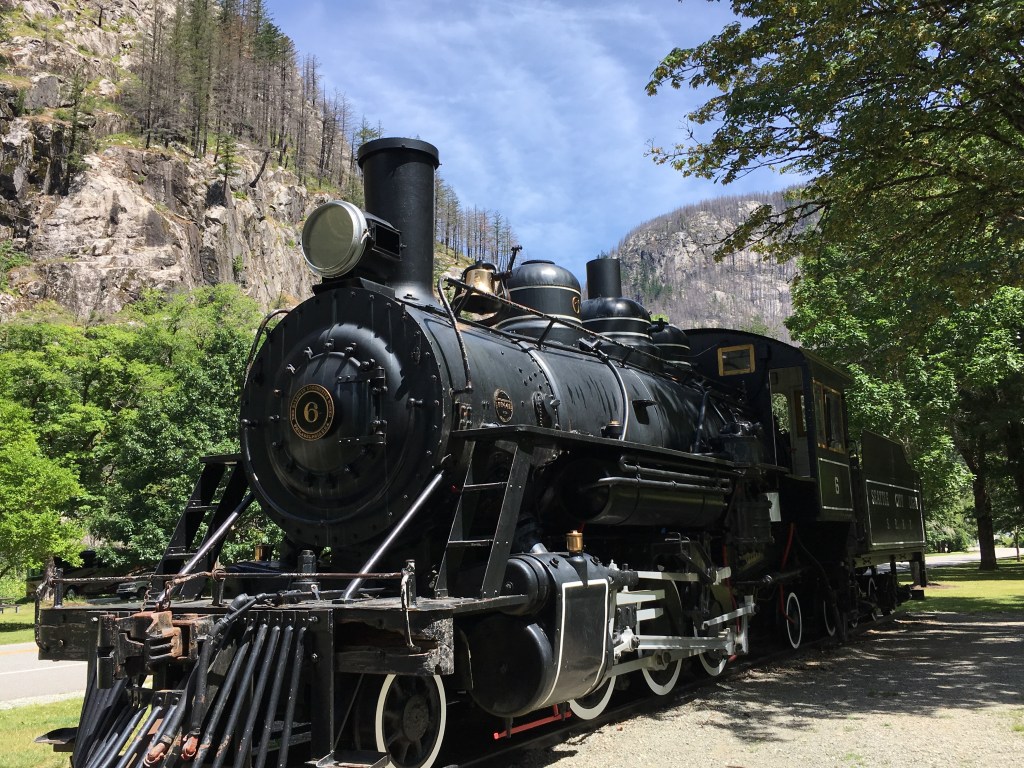
Just a little bit up the road I passed a dam, one of a series, but this one was the most visible and creatively named “The Gorge Dam”. It had to be old. Observing the architectural design of the powerhouse, you could say, “they just don’t make them like that anymore.” It was designed with attention to the image it would portray. It was a work of art. Not knowing much about architectural terminology, I would say it was a fusion of Roman and Art Deco design. It had long rectangular windows and boxy features with a regal boldness and pillars. 

Suddenly everything changed past the dam. I was back in the National Park, and back in nature’s beauty. I was a little disappointed, at the time, to learn that the lakes of the National Park were not natural but were the result of dams. Don’t get me wrong, I love a good dam, and I admire human ingenuity to harness power through water, but to know the National Park was not all natural just kind of tainted it a bit in my mind. The only dam I wanted to see here was a beaver dam. Of course if a beaver dam is a part of nature, then isn’t a human dam a part of nature too? Is man himself not a part of nature? 

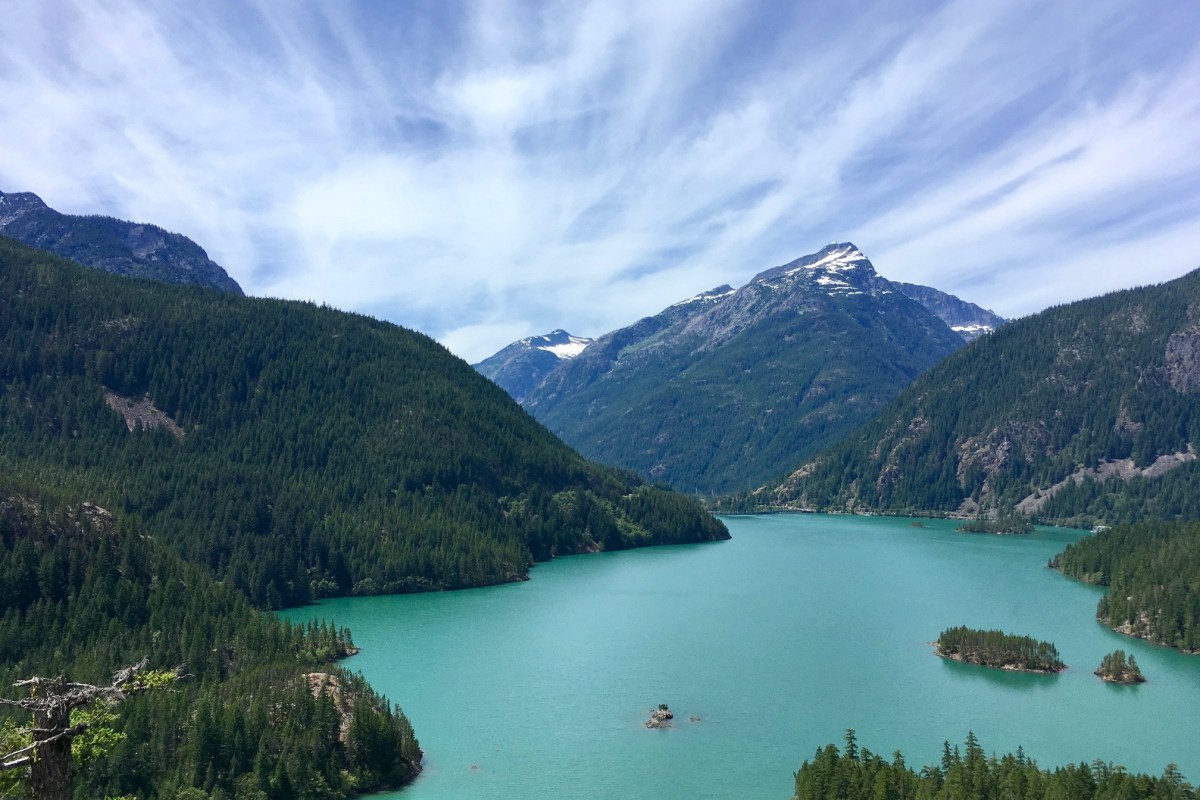
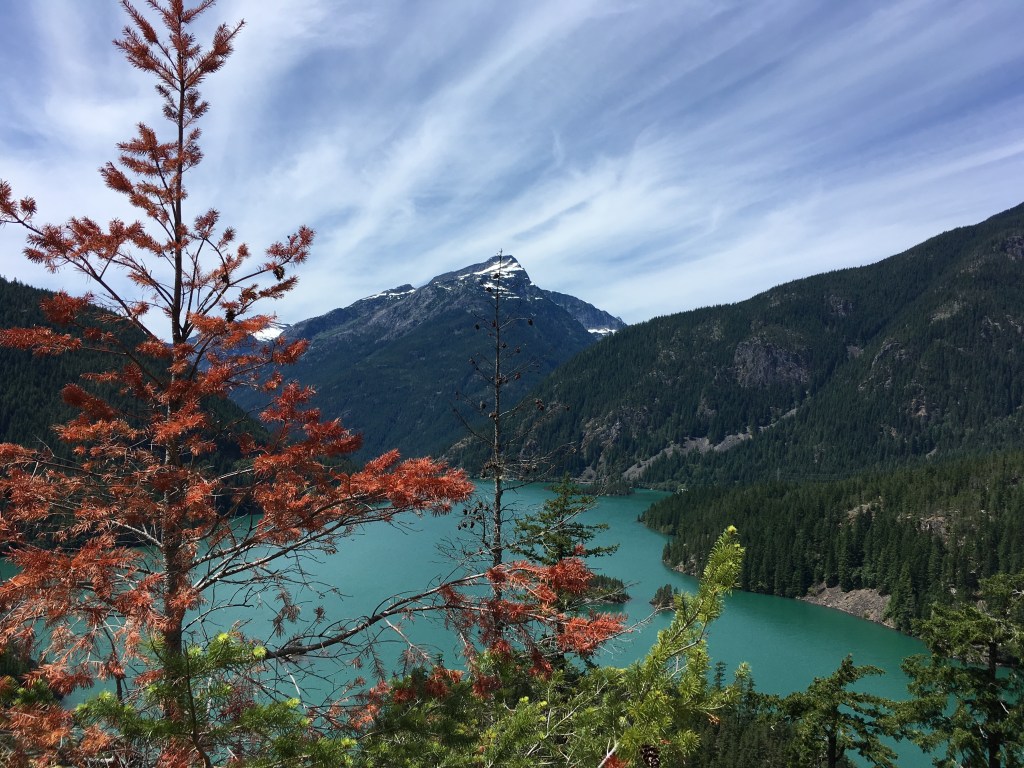
As I continued my journey on the park road, climbing upward in the mountain reaches, I made my next stop at the overlook of Diablo Lake, and oh my! What a sight! Pristine! I was surprised to see that such a vibrant turquoise color could even exist in nature. It was such a bright and vibrant color. Although perplexing, in its surrealness, it yet looked so natural and believable. Mountains dramatically sloped down into the milky turquoise water, which curved around into many bays. To the right side of the lake, before the inlet of a bay, stood two small little islands. The middle of the lake spread up to the foot of Davis Peak, a jagged snow-capped mountain. From behind the mountainscape delicate clouds wisped forward, as if imitating beams of sunlight. The dark richness of the pine forests on the mountainsides, contrasted with the turquoise lake and the blue sky created a unique pacific northwest color scheme. There at the overlook I also noticed a pine tree whose needles were turning red. It was probably a sickly tree, but in my photos I was able to add a splash of red, creating such a colorful capture. From here the mountains were dramatic and tall, but there were only a few to behold. Mountains didn’t stretch on in layers in the distance. Only the immediate ones were seen, giving the accurate impression that I was up very high. All other peaks were below and hidden. Only here could I see the highest reaches and I did feel on top of the world. 
Just a few miles up the road I also came to an overlook for Ross Lake. It too was stunning. It was similar in color and nature to Diablo Lake, but much longer, and the way the mountains were situated and the lesser number of immediate bays, made it just the slightest bit less picturesque, but still beautiful and magnificent nevertheless.

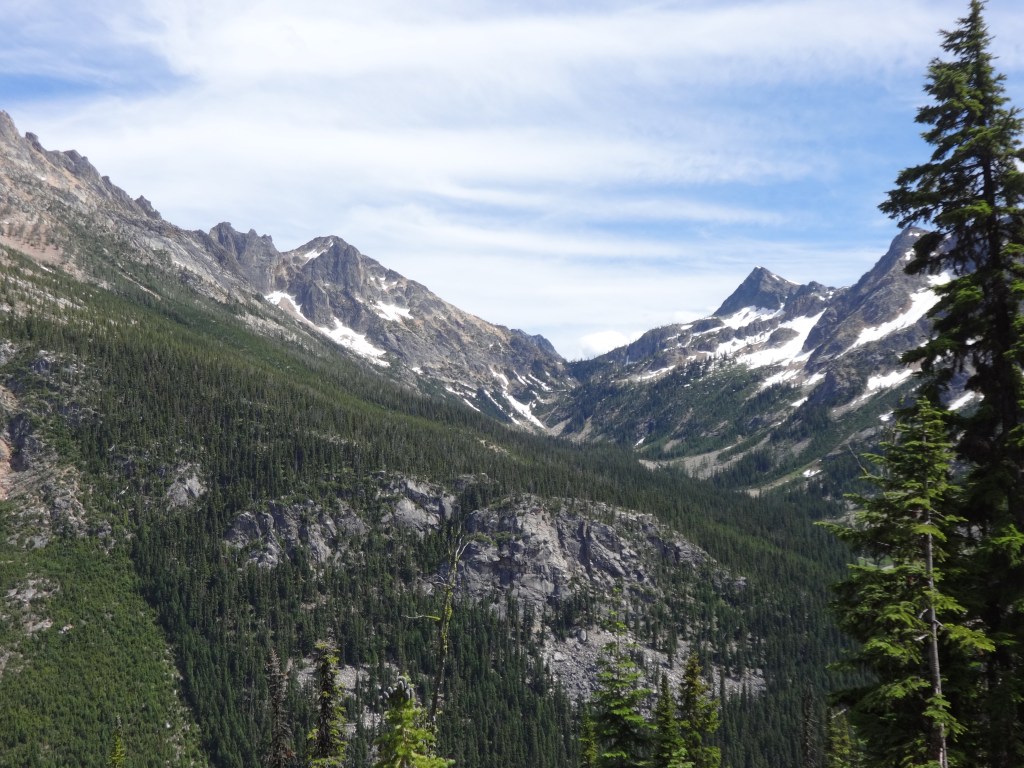
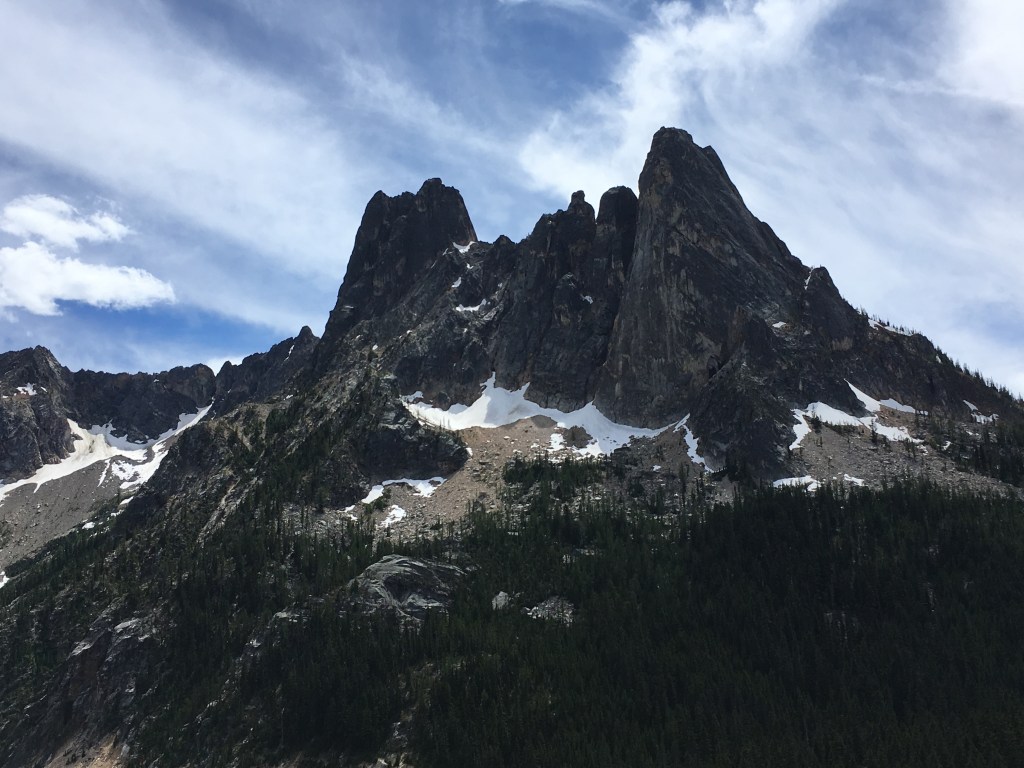
The rest of my drive provided great views of sharp craggy peaks, jutting up from the mountains, as if mountains were upon mountains. These weren’t rounded or flowing mountains but dramatic sudden reaches. And they were immediate reaches, right there, with snow caught in their veiny rivets. There was a definite character to these mountains, and if these mountains were music, they’d be crescendoing cymbals of a regal nature. It’s was if I could hear the mountains. I stopped at one overlook of the mountain valley and beheld the mountain peaks beside me, so tall. It was truly a moment of awe, and I thought, I’m back. I’m in my element. The awesome wonder that beset me my first great summer adventures is here to recapture my spirit. The sense of adventure was on fire again, a blazing campfire, with sparks igniting the night sky. I was coming back in my spirit to a place I so longed to be. 

About twenty miles outside of the park I arrived into the town of Winthrop, Washington. None of the campsites in the National Park were reservable online, and planning my trip I wanted to have the security of a place to stay. I wasn’t sure how busy North Cascades would be. It didn’t prove to be very busy at all. Arriving in Winthrop, I was surprised. The land was very arid. There were hillsides surrounding that were very dry and barren. I could have been fooled that I was in a desert of the Southwest. I had never before associated the desert with Washington. On the way to the KOA I drove through the little downtown. It was a quintessential Wild West downtown of not just Western facades, but the real deal. Nothing was too bold or boisterous but rather small and charming. The businesses beheld names such as “General Merchandise,” “Emporium,” and “Saloon.” A vintage but functional gas station with two pumps sat next to the road where people walked on the sidewalks. I realized this place was a tourist draw, but not overly so. It wasn’t crowded. It wasn’t flashy. It was just right. After being in the remote, brisky north reaches of the Cascades, it was comforting to be in this warm little welcoming Western frontier town. I’d later learn that Owen Wister, the Harvard roommate of one of the original settlers in the area, Guy Winthrop, wrote his famous Western novel, “The Virginian”, after a visit to Wintrhop. 

The KOA was only a mile from the downtown stretch. I drove across Chewach River, noticing a bike path parallel to the road and also crossing over the river which was shimmering in the evening sun. Everything around here looked well taken care of. Right next to the entrance to the KOA was a long wooden western style building named “Winthrop Dry-Goods.” Perfect! I went inside the small grocery store and bought some yogurt, Frosted Flakes, and milk. 

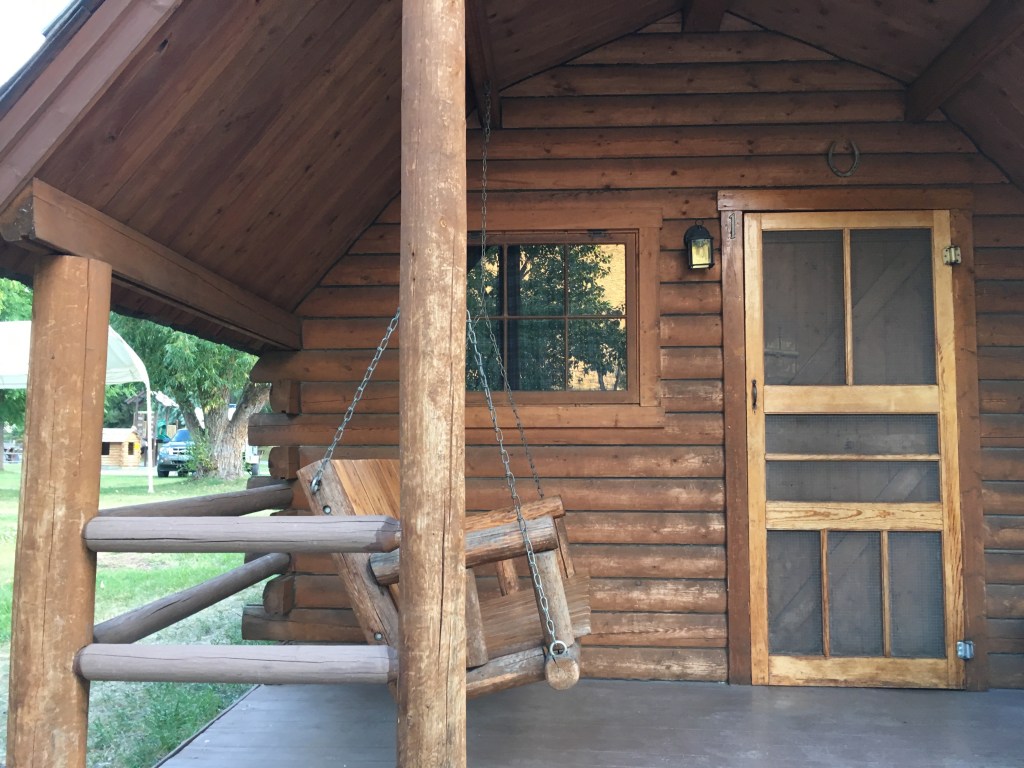
I checked into the KOA, and it was so nice. It sat right at the Methow River at the foot of a desert hill. I had reserved a camping cabin, which had plenty of space around it, and I felt like I had so much space to breathe in this nice dry, warm, and welcoming place. I took off my boots and trod around barefoot. Relaxed, I organized the trunk of my car. Now that Zach was not here, I had full reign. I also did a load of laundry, and packed for my upcoming backpacking trip to Stehieken. While the clothes were spinning I took a warm shower in the nicest KOA bathroom I have ever experienced. When I checked in, the hosts even bragged about how new it was. It was a log cabin style building and inside there were about a half dozen little individual private bathrooms. Each had their own shower and little changing area separate from the sink, mirror, and the rest of the bathroom. They also each had their own skylight, letting in warm sunlight. They all had that nice new building smell, but not just any new building, but a fresh-wood log cabin smell about them. 

When I gathered my laundry and went back to the cabin, I noticed a few items hadn’t dried completely, so I laid them out on the railing of the porch. I then poured myself a cup of Frosted Flakes into my KOA cup from the night before and reveled in the sweet crunch, as I sat on the porch swing, updated my journal, and read a little bit of John Muir. This was a simple yet blissful moment. 
I then drove back into town, first stopping at the cable bridge alongside the bike path to cross over and look down into the river. In downtown I parked my car and walked down the mainstreet. There wasn’t as much to see as I expected from the initial perception driving in, but it was all pleasant. I ate dinner in an old turn of the century schoolhouse, rightly named “Old Schoolhouse Brewery.” I had a chicken sandwich on the back porch overlooking the river. 

Back at my little cabin, at great peace for a quite a productive evening, and after having a day full of great vistas and travel, I slept soundly, anticipating the adventure that lay ahead: backpacking into Steheiken. 

If you enjoyed reading this, check out my book Still, Calm, and Quiet“

Check out my previous entry here: Strange Faces, Strange Places

Visit www.joshhodge.com

Strange Faces, Strange Places

It was the hour to get organized, for it was time to head toward the airport and return Zach to Kentucky where he came from. So we began first-thing this morning. The trunk of the car was just a grand mess of all our things sort of mixed together: the boots, the backpacks, the flannel, flashlights, the park maps, the souvenirs.  We handed things back and forth as we got organized. “This is yours…..This is mine.” We also had to take down the tents and pack up the sleeping bags. It was quite an operation. I wasn’t sure how to feel about all this. Was I to be sad to send Zach off, continuing the adventure by myself? How would that feel after all this time together? Or should I feel happy and relieved to be able to have my solo freedom, to do everything as I wanted to and not have the stress of the complaining and the concern of trying to appease. I guess I sort of shrugged it off. I’ll find out when he’s gone, I concluded. 

Leaving Mount Rainier National Park, we stopped just outside at a little “backpacker lodge.” That’s how I described it in my journal. I didn’t bother to write down its name or provide any details, except that I bought a cup of hot tea and a scone for breakfast. I described it as a “backpacker lodge,” by the part-grungy, part-artsy nature of the place and the few patrons around sporting large backpacks. In writing about this place I’ve examined maps and have tried to locate this place, to give it a name here, but I simply cannot find it. Perhaps it doesn’t exist anymore, or perhaps it is just well hidden on the maps.

In recalling my adventures in the National Parks and the beautiful wild, this is not the only place I visited I haven’t been able to relocate. The very day I picked Zach up from the airport, and we were traveling our way up California on highway 101 in the semi-arid lands, passing by many a vineyard, I came to a sign boasting some sort of self-sustaining community. It was advertised as an all-natural farm working on renewable energy. Its signage read “visitors welcome.” I knew this was the kind of place Zach would like to see. So, I pulled off the road. This was for him. He seemed excited to see it. We pulled onto a dusty driveway. The land was dry and the sun was harsh. A box stood at a post with a suggested donation listed. We threw in a few dollars. I should have known better…Well, honestly I had no idea what was in store. 

So this was this little commune of various buildings and paths between them we could walk around on. We weren’t quite sure where we could go, or what we were to see. There was some interesting makeshift infrastructure, networks of homemade irrigation systems, green houses, lots of plants hanging around, buildings that were constructed…um…what’s the word… creatively. It was kind of intriguing, but then we came across a local. He was a middle-aged man, leathery, wrinkly skin from too much sun exposure. His hair was dirty and matted; his shirt only buttoned up halfway to show off his collection of hippie necklaces. He was super friendly and talkative…because he was drunk. The first piece of evidence was the smell on his breath. He welcomed us, and gave a slurred introduction to the grounds. He wanted to show us his home that he built himself. It was a hut, made of dirt clay and glass bottles. I’ll admit it was impressive. It even had some nice windows built into it. It had to have been a lot of work, but after I briefly saw it. I was done. I was done listening to him curse like a sailor so casually and I was ready to go! But he kept talking and talking. When we did get away, I made a comment to Zach about how drunk he was, “…and high,” Zach added. I hadn’t picked up on that, but it’s because I hadn’t been exposed to enough high people to know what that sort of behavior looks like. Then a notion started to dawned on me: I think we are on a marijuana farm. Again, I was done. I wanted to get out of here. Before we left we did go into a gift shop, which was surprisingly nice and put together, not very reflective of the jury-rigged nature of the rest of the place. By observing the type of merchandise my suspicion grew stronger.  

That was weird. We carried on. 

As I’ve gone back to maps and the internet to try and find this place, learn more about it, to confirm what exactly it was, and to give it a name, I can’t find anything. Perhaps that’s intentional, and that’s fine, because I really don’t care to know more. What I do know is that it was in California, and they can have it, and they can keep it. I suppose all I’ll ever know about it is what I remember. Just like the backpacker lodge outside Mount Rainier National Park, that’s all I got. 

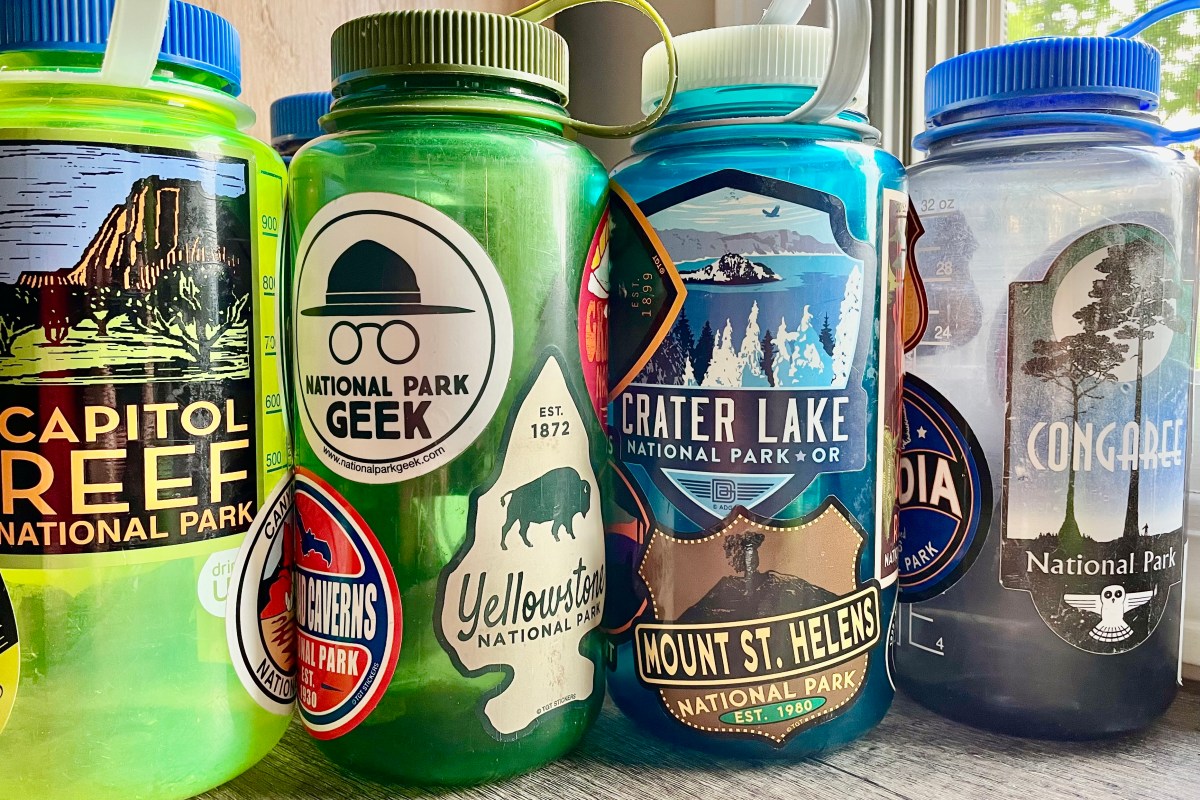
After our brief stop for breakfast we only had a couple hour drive to the Seattle-Tacoma airport, so as we got close we made a few stops. Zach wanted to visit a Target to return a Nalgene bottle he had bought toward the beginning of our ttrip together. I have a tradition on my summer-long vacations to get a Nalgene bottle and sticker it up with stickers from each park I visit. I had a neon yellow bottle for stickers for my Southwest adventures I write about in my book Canyonlands: My adventures in the National Parks and beautiful wild. I have a dark green one with stickers from the Still, Calm, and Quiet: More adventures in the National Parks and beautiful wild summer, and I have two classic blue ones from parks I’ve visited on various smaller trips back in the Eastern United States. For this trip I had a dark turquoise bottle sporting my stickers. Zach had learned of my ways and wanted to do the same. Imitation is the sincerest form of flattery, as they say, so I liked that he wanted to copy me, but the Nalgene he had bought earlier on the trip had a plastic casing around it that must have, at some point, melted onto the bottle and now could not be fully separated. So he wanted to exchange it.

I also let Zach pick where to have lunch since it was his last day on the trip, and he was always the one with the large and urgent appetite. It’s definitely telling that we were no longer in the wild when he chose ihop. We were in the city of Tacoma next to Seattle. It was my first time eating at an ihop. I was surprised to learn there was more on the menu than just pancakes. 

In the later afternoon it came time to take Zach to the Seattle-Tacoma International Airport. I parked and we went inside. He checked his bag, we said goodbye, and he quickly made it through the TSA security checkpoint. I did feel a poignant sadness. As much as he frustrated me, I felt this heavy aloness set in. It was the realization that I was so far away from home and now all alone. Why should this bother me? I’ve traveled so far away so alone so many times. But as I saw him move past security towards his gate, I knew deep within me, our friendship wouldn’t recover from this trip. Our friendship was built over a love for the outdoors and recreation. Those are great things, but they can also be superficial, especially when we view nature so differently. I view it as God’s design with purpose, intention, and messages which it beholds for mankind to draw closer to Him. Zach didn’t share that view. I also value human life so greatly much differently than Zach. We argued about this. He saw human life as too abundant and in need of being lessened. This sat so incredibly unwell with meI saw it all as sacred and designed by God with even greater purpose. Humanity is God’s most prized possession. Yes, possession. We are His. I felt I couldn’t bring up these deeply held views of mine. They would cause further arguments. Zach saw human life as too abundant and needed to be lessened. 

There also was no peace in this friendship. There was complaining and conflict and never a sense of security. We were not kindred spirits. We didn’t share any weightier values. At this time in my life I was too young and immature to realize that perhaps I could be an influence upon Zach’s life, but when it comes to forming friendships it takes a great deal of effort for me to form them. I also don’t throw the word friend around casually. I take the term friendship quite seriously. In recent years I’ve been very conscious of my use of the term “friend” versus “acquaintance.” I will only use that term friend for a true kindred spirit, for someone I can rely on, whom I share great values with, whom I am willing to get behind and advocate for in life, and someone who is willing to do the same for me.

I also believe friendship is a design of God for us to build each other up spiritually. The Bible has a lot to say about friendship. Take into account Proverbs 18:24, “One who has unreliable friends soon comes to ruin, but there is a friend who sticks closer than a brother. Then Proverbs 17:17 reads, “A friend loves at all times, and a brother is born for a time of adversity.”  Lastly, I’d like to mention Proverbs 27:17, which I also think has a lot to do with friendship. It reads, “As iron sharpens iron, so one person sharpens another”. What I thought was a friendship between Zach and I was not reflective of any of these verses. 

We are all wired differently. It takes a deal of effort for me to create friendships. There’s this effort of really putting myself out there and sharing of myself that doesn’t always come naturally. I do it and delightfully so when I see the potential for a fruitful and lasting friendship. In such instances it encourages me. I get a great deal of energy from it, and my life is enriched, but to put forth the effort for a friendship based over a mere superficial hobby for nothing of substance, is exhausting. I am not saying that the way I maneuver friendship is the best and that my views are even the best for me. I find myself often to be solitary, lonely quite often. I suppose if I didn’t take friendship building so seriously, but more casually, and I put forth effort to connect even over the shallow and superficial things in life, I may have more people around me. Maybe I’d be less lonely, but also being surrounded by people on a shallow level of commonality I think is exhausting. I would probably feel even more lonely to be surrounded by people who do not share my values and outlook. I do say, that because I do take friendship so seriously, that the people I do invest in that I truly call friends mean a lot to me. I am very rich because of that, and maybe I feel a richness of friendship that some people do not, and for that I am very thankful. 

As Zach was now gone on his way back to Kentucky, a whole different mindset had to set in. I had to shift from accommodating another traveler, to just looking out for myself. I was free! Not gonna lie, this is what I wanted. 

Leaving the airport, I was able to quickly adopt the new mindset of being alone and free! The next leg of my journey would take me to North Cascades National Park, but tonight all I had to do was drive two and a half hours to a KOA northwest of Seattle, so I didn’t have to be in a rush. Therefore in Marysville, Washington, a suburb of Seattle, I stopped at a Planet Fitness. The original plan was to take a shower there, but then I realized I could just shower at the KOA tonight, and so I just enjoyed a workout. Normally I focus on one certain muscle group per day at the gym, but since I hadn’t been to a gym in a while, I decided to just do a little bit of everything. 

At this point in my life, I still hadn’t made the switch from the flip phone to the smartphone. I had an iphone, a cheap one, just to take photos and connect to wifi when the opportunity allowed. I needed to take the iphone into Planet Fitness and connect to the wifi to make a payment through mobile banking. In between sets I was trying to remember a password, reset a password, select all the images of stop-lights, get a confirmation code through the flip phone, translate that over— all of those technicalities. 

Next to the gym was a local thrift store. It was pretty large, and I was excited to check it out. Maybe I can find some fun camping gear. I’d really like to find a skateboard. That isn’t something I could have packed in my suitcase. Maybe I can find some good CDs for some different travel tunes. Since I hadn’t made the migration from flip-phone to smartphone, I also hadn’t made the switch over to digital media. I had no such luck with any of these hopes, but I did find an Under Armour base layer that would come in handy during the cold nights and mornings up in Glacier National Park. Leaving the thrift store, I did notice a couple homeless people loitering around the parking lot, one pushing a shopping cart as if it was a caravan. The way they acted, their demeanor, made it evident they were drug abusers. It was nice to get a workout in, and to wander around the thrift store, but the druggies were a stark reminder I was in the city and I wanted to be back in the wild. 

I got in the car and made my few hour drive to the KOA campground. After zipping up interstate 5, I was on highway 20 heading east along the Skagit River. Urbanization waned, and gradually more forest set in. I knew the KOA wasn’t going to be anything fancy in terms of KOAs. It was just a basic one, but all my experience with KOAs thus far had been good. Making the turn into  the KOA I was surprised to find that it was gated, and I had to press a button to open the gate. I went to the office to check in. The host seemed a bit frustrated. She went over the usual rules and explained how the gate will be located after 10pm. I wondered why this KOA needed such a security measure as a locked gate. We seemed to be in a pretty rural area, and back in nature, which is generally a safer place to be. It’s not like we were in a city. She pointed on the map where my campsite was. It was the furthest away at a dead-end road. “There was a picnic table at your campsite, but we’ve been having a problem. Some people entered in from the woods and stole the picnic table, dragging it off into the forest.” This explained her frustration, and now I knew why there was a locked gate. But who comes from out of the woods and steals a picnic table? It seemed so odd. I wasn’t bothered by the fact I wouldn’t have a picnic table, but it was unsettling that people come from out of the woods and steal things. 

I drove down the gravel path where it dead-ended at my campsite. I was farthest away I could be from any other camper in this campground, isolated. I stood there at my site and looked into the forest imagining some strange forest people emerging and scoping out what they could glean. Where were they coming from? What’s in those forests? Not having made the smartphone migration, I wasn’t accustomed to using any digital maps to check out my surroundings, so I just looked at that forest with a mysterious wonder, imagining people dragging picnic tables into its depths. Those were unsettling thoughts.

I drove back to the “recreation center” as it was called. It was like a community center in the campground next to the pool. There was a water dispenser and plastic KOA cups. I was a KOA fan and had never seen a KOA cup before. They were obviously meant to be taken. Souvenir! There I sat at a folding table, cracked open my Chromebook, connected to the wifi, and began transferring some of the photos from my point-and-shoot camera’s SD card to the Chromebook for backup and also to share some photos online. What an adventure thus far, from the Mojave Desert to the North Cascades in the Pacific Northwest. It was very relaxing to sit there for a while, and I was at great peace while looking at all these beautiful photos I had taken on my journey. I also proceeded to take a shower and was all refreshed and reset. Then I hopped back in my car and drove back down the dead-end to my campsite.

It was dark now, so there was a certain mysterious ambiance in the air. I stood there on the tent pad in the silence, alone, looking at the forest again. The host’s words reverberated in my ears, “Some people came from out of the woods…and stole the picnic table, hauling it into the forest.” I imagined them now hauling a body into the forest. I did not saunter over a decision. There was an unsettling vibe here. It was not strange enough to cause me to leave, but I was going to sleep in my car, and so I did. 

If you enjoyed reading this, check out my book Still, Calm, and Quiet“

Check out my previous entry here: Really, What Kind of Mountain Are You?

Visit www.joshhodge.com

Mount Rainier: the noblest of peaks

“Of all the fine mountains which like beacons, once blazed along the Pacific Coast, Mount Rainier is the noblest.” – John Muir

Cars were backed up to get into this park. I could see just a little bit up the forested road to the entrance gate. There a large wooden sign hung down from a rustic pine log which laying there, propped up by other pines on either side, had constructed an archway- a portal into the park. Its letters were all upper-case, bold, and carved simply into the sign. The grooves painted white displayed “MT. RAINIER NATIONAL PARK.” 

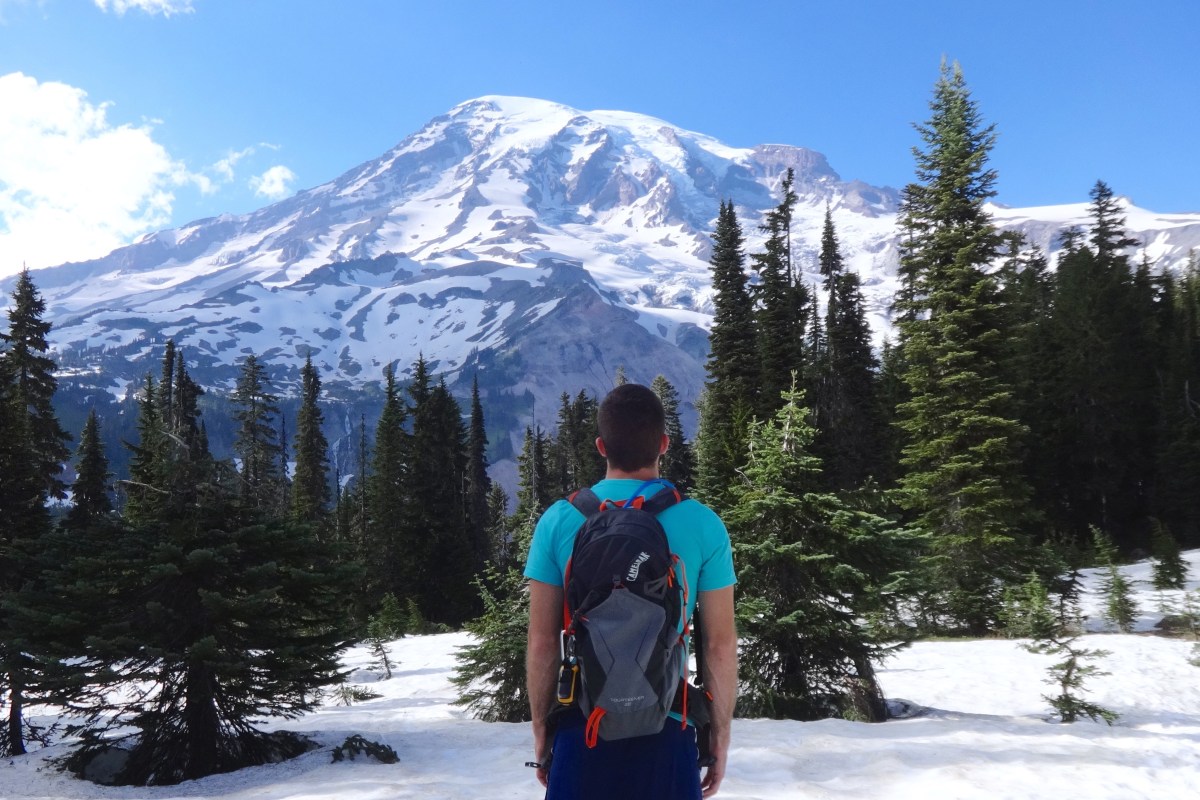
This was a top tier national park, our nation’s third behind Yellowstone and Yosemite, created in 1899 by President William McKinley signing a bill passed by Congress. This park is named and centered around one mountain peak, but deservingly so. MountRainier is a giant at 14,411 ft. It is  visible throughout most of the state of Washington and has the most glaciers than any other peak in the contiguous United States with a whopping total of 26 glaciers. We had seen this mountain much earlier in the day, traveling from the Olympic peninsula around Tacoma. It was a magnificent bold giant standing in the distance. Over the course of hours we noticed it growing bigger as we drew closer to it. Now we were at the mountain’s base about to enter the National Park!

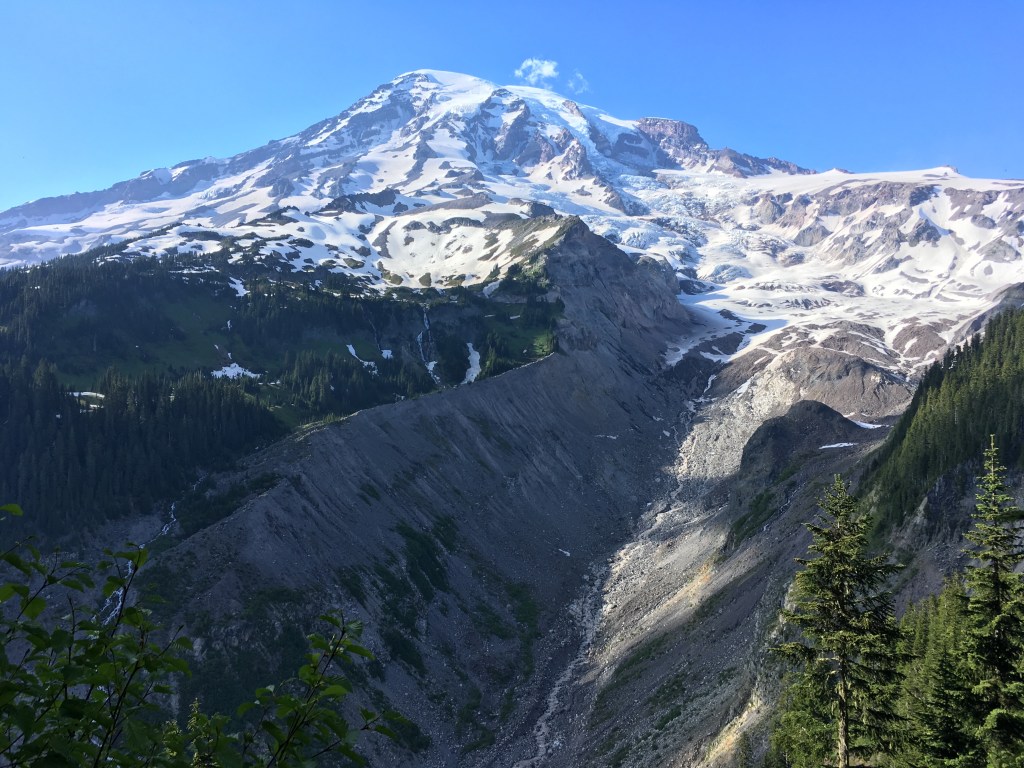
Once officially inside, passing beneath the enormous sign and log beams, flashing my park pass and getting my park map, the road immediately began to gradually ascend. We were on our way to the Paradise village area of the park on the side of the mountain.  There in Paradise was a visitor center, a lodge, and a network of trails. On our ascent through the thick rich forest, I stopped at one point to hop out onto a short path to a platform overlook nestled between the dark pines. There at the platform’s edge I beheld the amazing wonder of Nisqually Glacier tearing down the mountainside. Up until this point this was one, if perhaps not the most, impressive view in nature. It was my first time observing a glacier- the breaking ripples of ice, deep grooves, sharp edges rolling over and tearing down the mountainside, but all seemingly still. It was action frozen in time to my eyes. I observed a depth of snow and ice I had never witnessed before, and as the glacier spread down the mountains I saw the enormous gorge it had created over many years, carving away at the mountainside. Although there was a plaque labeling Nisqually Glacier, I believe, after considering the park map, I was also looking at two other glaciers in the same view: Wilson Glacier and Von Trump Glacier. It’s hard to differentiate between all the glaciers as they run so close to each other and at times converge. 

Van Trump Glacier was named after Philemon Beacher Van Trump, an American pioneering mountaineer who made the first recorded summit of Mount Rainier. He wrote: “That first true vision of the mountain, revealing so much of its glorious beauty and grandeur, its mighty and sublime form filling up nearly all of the field of direct vision, swelling up from the plain and out of the green forest till its lofty triple summit towered immeasurably above the picturesque foothills, the westering sun flooding with golden light and softening tints its lofty summit, rugged sides and far-sweeping flanks – all this impressed me so indescribably, enthused me so thoroughly, that I then and there vowed, almost with fervency, that I would some day stand upon its glorious summit, if that feat were possible to human effort and endurance.”

Unlike P.B. Van Trump, I would not be summiting Mount Rainier, but I shared in his admonishment of the mountain, and around its base and on its mountainside I would experience many of its rich wonders. With just one up-close and unobstructed view, it was love at first sight! 

“Let’s go!”

We got back in the car and continued on our way to Paradise. It was about twenty miles of meandering parkway that climbed and switch-backed up to 5,400 feet. At Paradise the mountain peak was on full display. The terrain had leveled to an extent to allow the construction of the large visitor center, lodge, and ample parking. I was anxious to get outside. Breaking my usual protocol, I took to a trail before even watching the park film. We’d do that later. 

 Zach and I started on Nisqually Vista Loop. It’s supposed to be a casual paved loop, but pavement was only visible for a few yards, the rest was buried under multiple feet of snow. We slid, ran, trudged, fell, and laughed our way around the loop. The mountain peak with its great and scarring glaciers came into view every once in a while through the lodge-pole pine trees, and at the trail’s furthest reach we had an unobstructed view of the mountain while on enormous continuous icescape that stretched up the mountainside connecting to the glacier’s ripples. Although it was summer, and I was wearing gym shorts, this place had so much ice and so much snow, that I felt so far in the North, in an extreme arctic landscape. The one thing I had to overlook, however, was the air temperature, as it wasn’t very cold out at all. 

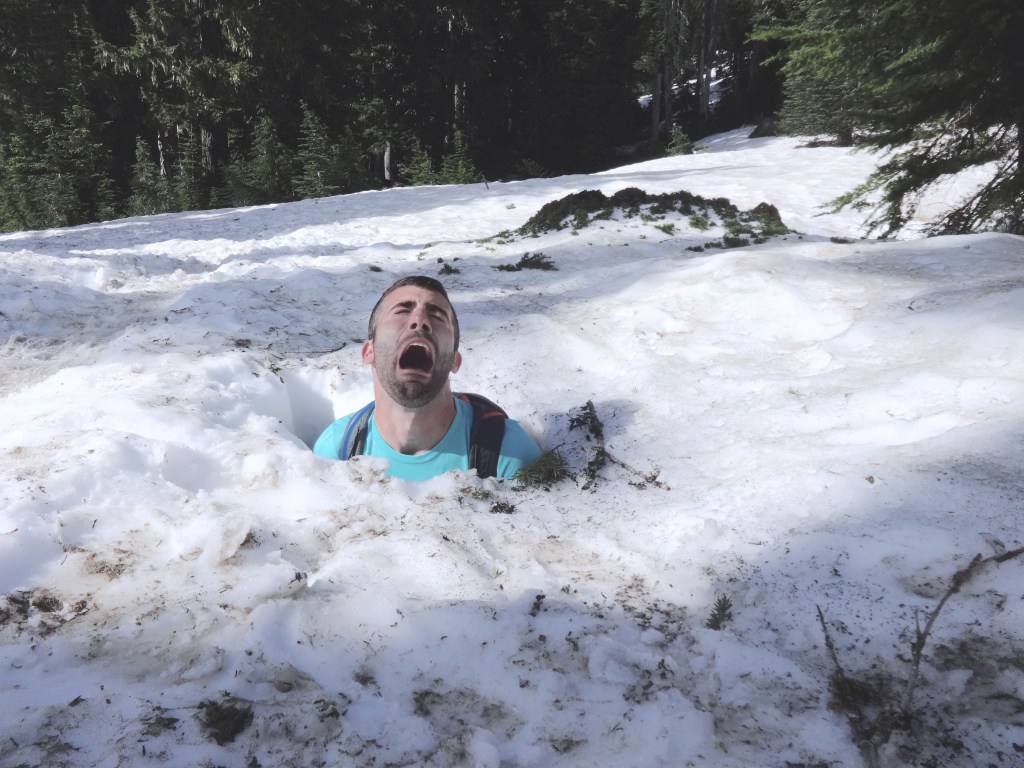
At one point on our hike we heard water rushing. We paused and tried to figure out where it was coming from, just  to come to the realization that it was beneath us. A mountain stream was flowing beneath the snow. We then encountered a few cavities in the snow just wide enough to fit a body. So taking turns we both hopped down, our boots landing in the shallow stream, and we raised our hands up out of the hole, taking each other’s photo trying for the illusion that we had been buried in snow. 

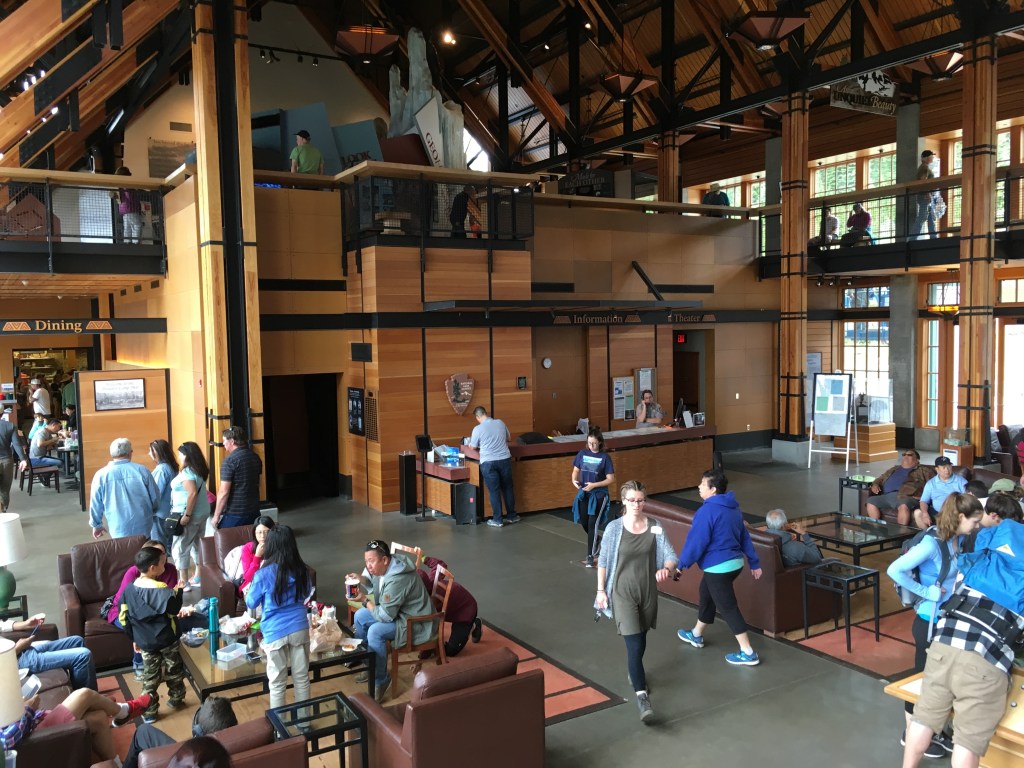
When we completed the loop, we went into the visitor center. It was quite large, with lots of ample space for sitting in its spacious lobby beneath a combination of timber and iron framework that supported a pointed ceiling. Its walls were almost entirely glass, giving way to much light, especially with all the sun reflecting off the snowy landscape outside. The visitor center had museum exhibits on the park on its second floor which was a combination of loft and balcony. We went into the theater to see the park film, of which I remember nothing, probably because this mountain did not need a film to speak for it. It was so grandiose and commanding of attention, that any measly park film was greatly overshadowed. After the park film, we had a quick bite to eat in the cafeteria there in the visitor center, and then we were back on the trails to visit Myrtle Falls. 

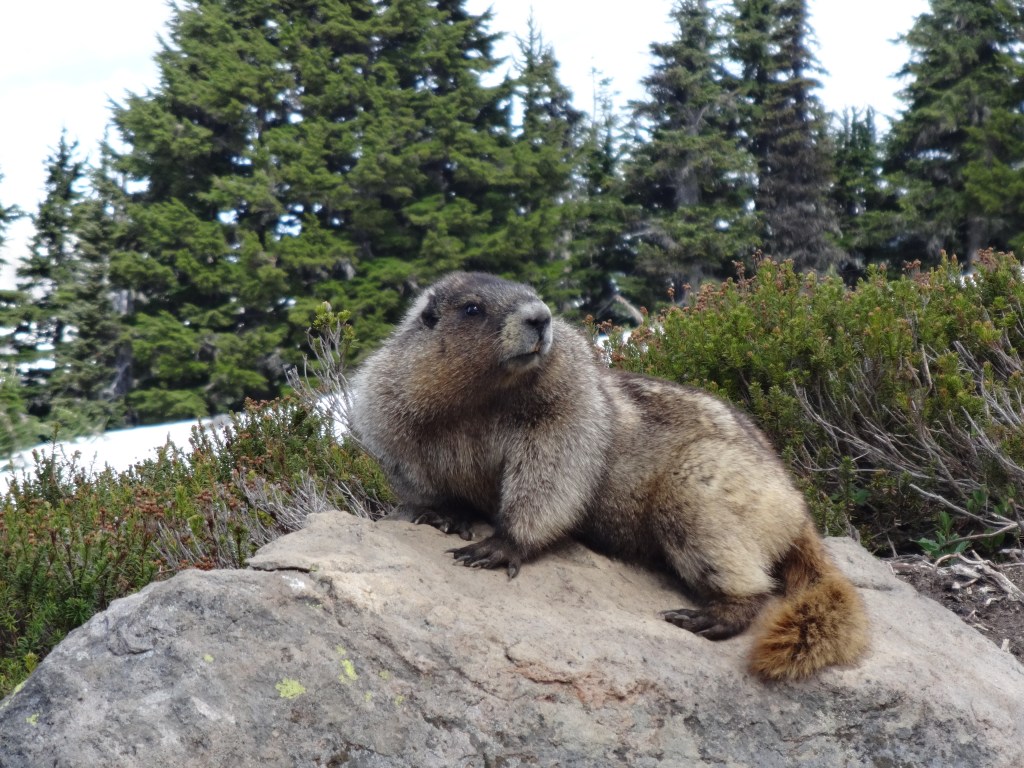
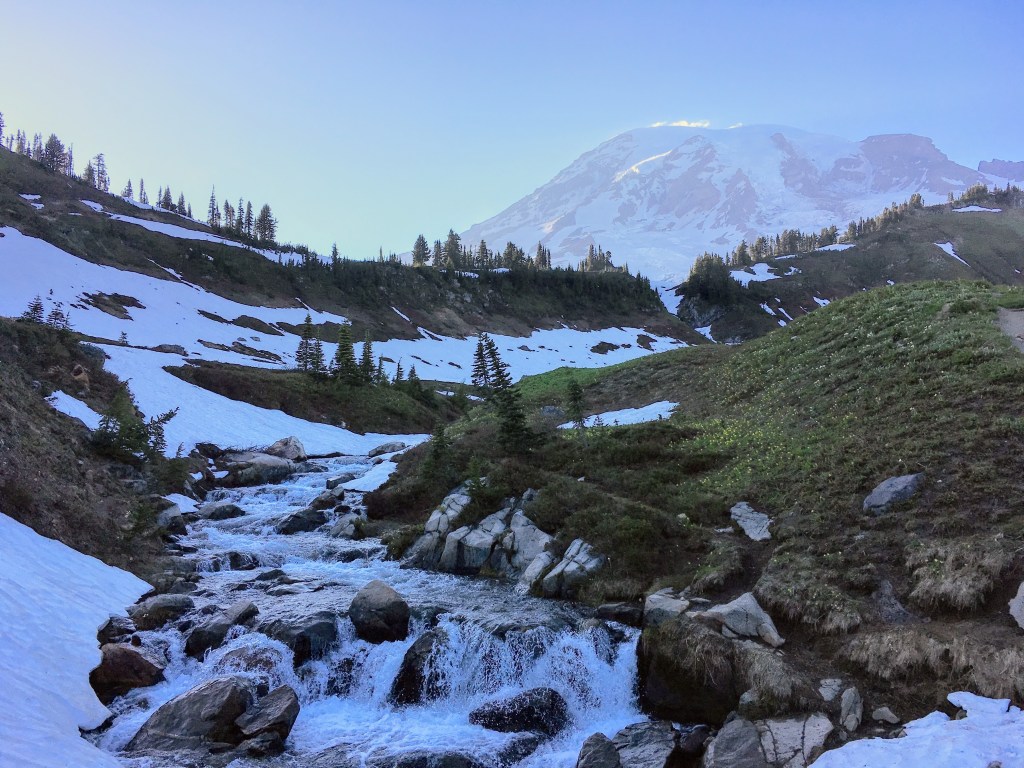
Our short hike to Myrtle Falls was lovely. I think typically it’s only about a half mile walk one way on pavement, but it was a bit more of hike for use trudging over snow banks, perhaps wandering off the official route at times, observing the many marmots lounging and flopping around, and admiring the alpine meadows full of blooming glacier lilies. We concluded our hike at around two miles. Here we weren’t exactly above the tree line, for small groupings of pines could be seen at the fringe edges of the meadows, but largely we were above the trees in rolling meadows of the mountainside. Despite it being a sunny day with a nice rich blue sky, we were cast in the shadow of a foothill, a ridge on the mountainside. As we approached the falls, we saw it sprawling down into a Edith Creek Gorge, chillingly cold in the shadows, water falling and tumbling over water, streams cascading upon protruding rocks behind the many paths of the water falling. It was a rather simple, but beautiful water fall, as from the creek it sort of bloomed as it fell, branching out in many streams down into the gorge. Just above the falls was where the trail led to a pedestrian polebridge perhaps about thirty feet long, made of timber from the forest. Behind the view of the falls, the bridge, the creek, the snow banks, and the flower laden meadows, was the towering Mount Rainier. Its highest reaches were adorned with the silver lining from the sun peeking out from behind some adjoining ridge with a cast stretching just far enough to barely reach the top of the mountain. 

With all the movement of water sprawling in every which way, falling, and cascading; and glacier lilies feeding off the melting snow, the marmots flopping around, the tourists delighting on meandering paths and trudging through snow, I thought about how rich of a place this was. I also considered how we were up high on the mountainside, and below was a rich forest, full of more  waterfalls and streams, thick pines, and forest growth; with bears, mountain lions, bobcats, foxes, minks, and all the other wild animals and tweeting birds of the forest. This mountain provided so much life! It was truly rich. I’ve written about how we can liken mountains to people. There are so many different types of mountains which exhibit the different kinds of influence and character of which a person can behold. 

I started this summer’s journey in the Mojave desert where the mountains surrounding are largely dry, harsh, and bare. They lack the richness of a place like this. They do not support an abundance of life. There is no richness of the forest like on this mountainside. 

Mount Rainier with its glaciers melting feeds the forest around it. Not only can I liken this mountain to Wheeler Peak, being bold and unwavering, but this mountain is also very life-giving. Like a nurse log, it provides rich nutrients, giving life to the forest around it through its supply of melting ice, and its delicate balance of sunlight and shade. However, unlike a nurse log, this mountain is not dead. It’s alive. I say it’s alive on the basis that it is an active volcano. Thus here lies the message: though nurse logs provide great insight showing us how even when we are dead, we can provide life to future generations, we provide life to others while still alive as well, just like Mount Rainier. I know this may seem maybe even more obvious than the nurse log analogy, but I think we ought to be aware that we should not over focus on our efforts of what we can leave behind while ignoring who we are and what we can do in the present. We have the immeasurable benefit and advantage of our present life. We can use it to take hold of the life books of others and write into them powerful influence, whether it be in the form of  encouragement, instruction, giving… Whatever it is we do, we do not do it alone, as to do so would be in vain. We do everything through the power of Christ in our lives. We may be the mountains that provide for the richness of life around us, but who provides the weather to bring snow upon our mountains? Who causes the sun to shine on our side? Who causes the water to melt and fall? Who brings the flowers to bloom? This makes me think of Scripture, of all the mentions of bearing fruit spiritually. To bear fruit spiritually is to be like Mount Rainier. Look at the life flourishing around it. There is evidence of God at work here, and there would be much more to consider and write about here in regards to the powerful symbolism of Mount Rainier. 

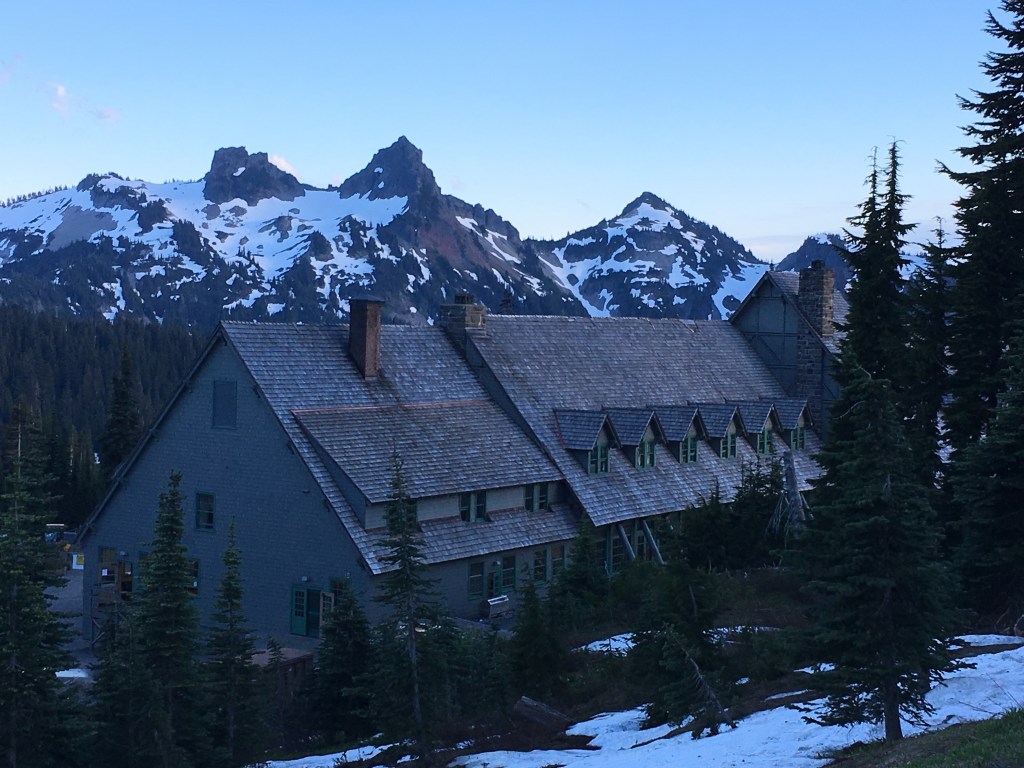
When we were done with our hike we went back to Paradise Inn next to the visitor center. It was an inn of beautiful rustic National Park architecture style, cozy and woodsy, with wood logs beams stretching in every direction, an “A frame” roof, dangling native american style lanterns, a blazing fireplace, and inviting little nooks to relax in. It was a great sanctuary from he snow and he evening cold outside. There I bought some tea and wrote some postcards. 

Leaving the lodge, getting ready to head down the mountainside to our site at Cougar Rock Campground, a beautiful sunset was on display with deep rich pinks and purples. The sunset reflected off the snow on the mountain peaks, providing colorful stretches of snow. Wow! It was a sunset so perfectly reflective of a mountain so rich in life. Its colors were so vibrant and deep. Most of the tourists were gone. The area was silent and serene. I had to pause a moment to take it in. John Muir knew what he was saying when he said Mount Rainier was the noblest of peaks. 

What Kind of Mountain are you?

If you enjoyed reading this, check out my book Still, Calm, and Quiet“

Check out my previous entry here: “The Mountain Goats of Hurricane Ridge”

Visit www.joshhodge.com

The Mountain Goats of Hurricane Ridge

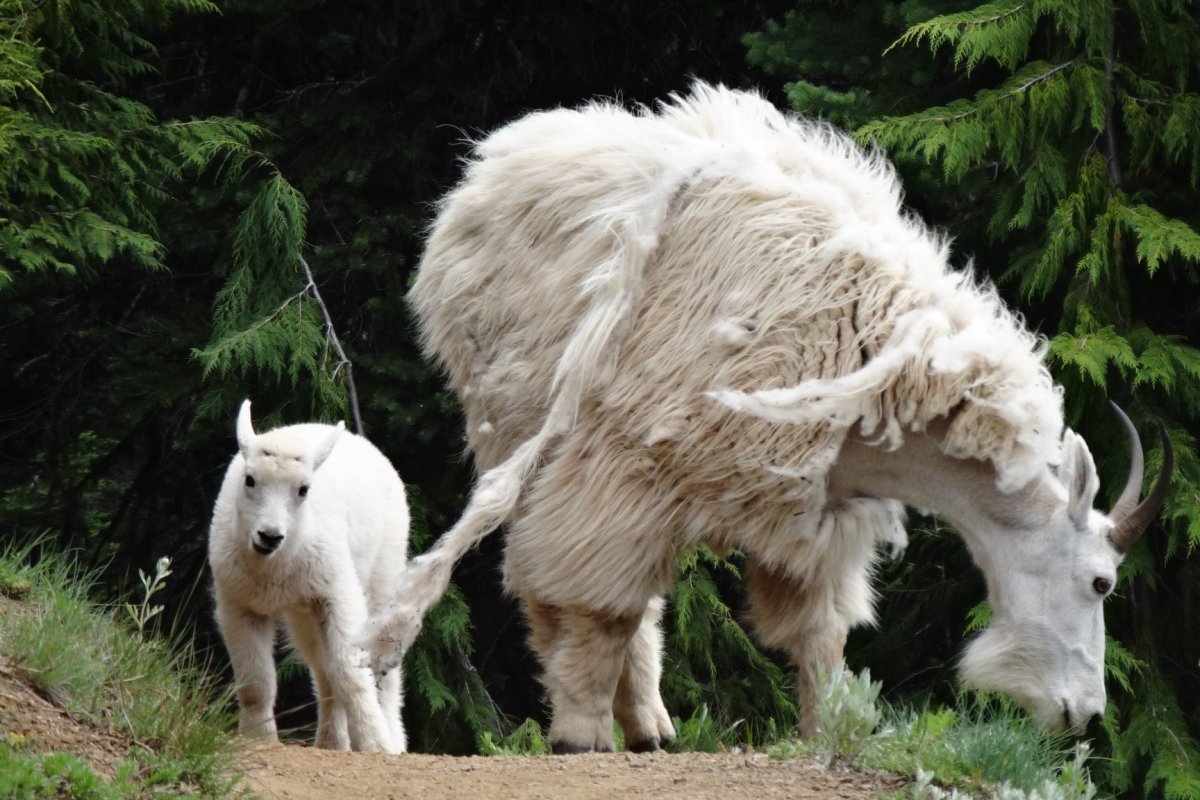
When their procession was over there were nineteen mountain goats in total just a stone’s throw away. We were on the trail to Klahhane Ridge in Olympic National Park. The path was just a small one trodden into the side of the mountainous ridge. To detour left from the trail would be dangerous as the mountainside was sloped so steeply, and to the right it would be perilous as well. Although it was pretty and ladened in wild grasses and flowers, it too was steep and plummeted down into the valley. The truth is, this path was probably the mountain’s goats’ path before it ever was a trail in the national park. The mountain goats were loyal to this path. One by one they rounded the bend and emerged from a pocket of pine forest to this open mountainside. I’ve heard they can be aggressive when approached, and I noticed a few patriarchs of the band with tall sharp black daggers for horns. Behind them were the women and children, or I guess technically the “nannies” and their “kids”. They were all so beautiful with long coats of fur. Some of the more mature goats had strands of fur dangling from them, like the moss laid on the trees. Some of the strands of fur caught in the breeze and wisped around. It was summer shedding season, and it was obvious these goats had been carrying fur to the max. They were drenched in it, except for the young kids. Their fur was short, fluffy, and perfectly white and pure. 

Enough observing, a decision had to be made on the part of Zach and myself. The mountain goats were not the least bit inhibited by our presence, and continued walking toward us, potentially posing a threat. They had to have noticed us, but they didn’t acknowledge us. They continued about their parade, walking along their path, although not with a prideful march. They were certainly not pompous, nor were they timid. They seemed to not have a care and continued on with a quiet and steady confidence. 

I had learned from the Rock the Park show that making spitting noises can deter mountain goats. I didn’t know at the time why, but later I looked into it and learned that it’s the sound male mountain goats make to warn aggressors to retreat. So, per my lead, Zach and I started making spitting noises. The goats showed no alarm, but it did work perhaps, for casually they climbed off the trail and down onto the steep grassy slope, an area Zach and I could not have gone down for we don’t have that sort of mountain goat balance and maneuvering ability. Here they were on full display as a band. I was thrilled at the spectacle of mature mountain goats, in white shaggy fur, on a steep mountainside, contrasting the dark rich blue of the forested mountains behind them capped with snow; and the innocent little kids, taking careful steps in the wild grasses alongside wild mountain flowers. Once we felt at ease seeing the goats travel off the path, Zach and I paused to revel in the moment, exclaim to each other how cool it was, and take photos. 

This wasn’t our first wildlife encounter on this hike. When I parked the car at the Hurricane Ridge Visitor Center, right along the parking lot were four deer grazing in the grass. One was a buck with its young rack of fuzzy antlers. He was laying down but had his head propped up, alert, as if looking out for the female’s feasting in the grass nearby who came very close to us as we were observing them. I suppose this event was foreshadowing of the richness of wildlife and close proximity to it we’d encounter on this trail. 

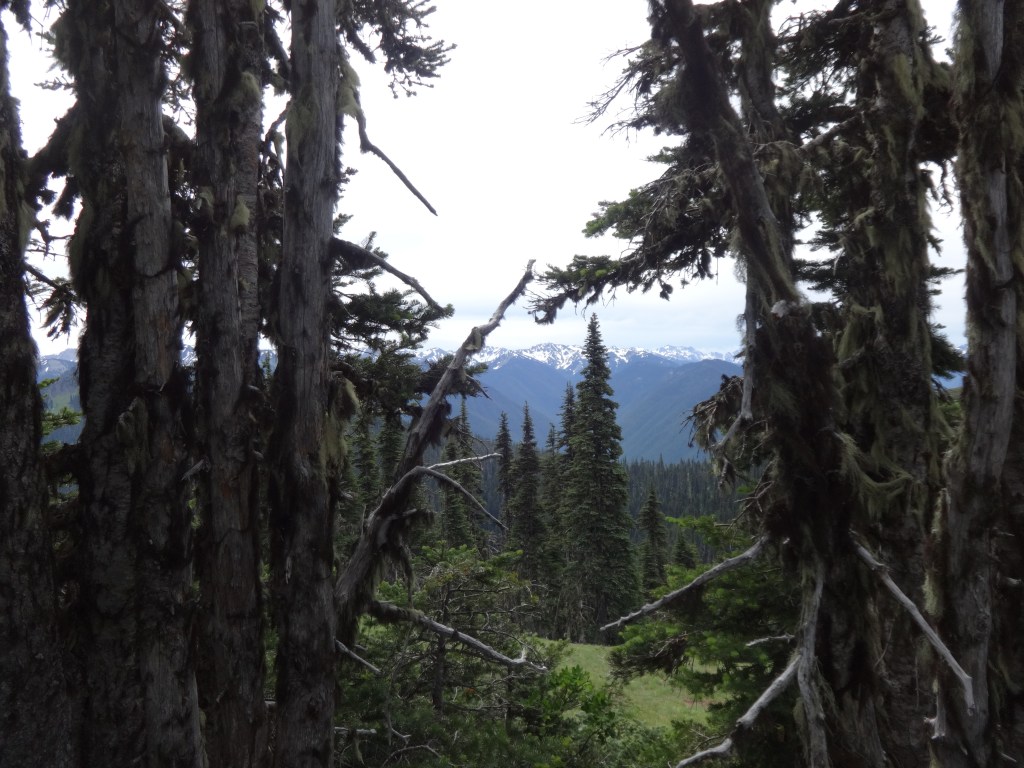
The trail was 7.6 miles in total, starting from the visitor center and ending for us at Klahhane Ridge, although this was just a segment of a much larger network of trails. The path held snug to the side of the mountain nearly the whole time, not on a ridge but close to one. It meandered through open grassy slopes and patches of pines. Some of the pines had very shaggy bark and were ladened with moss, especially as we gradually climbed higher. 

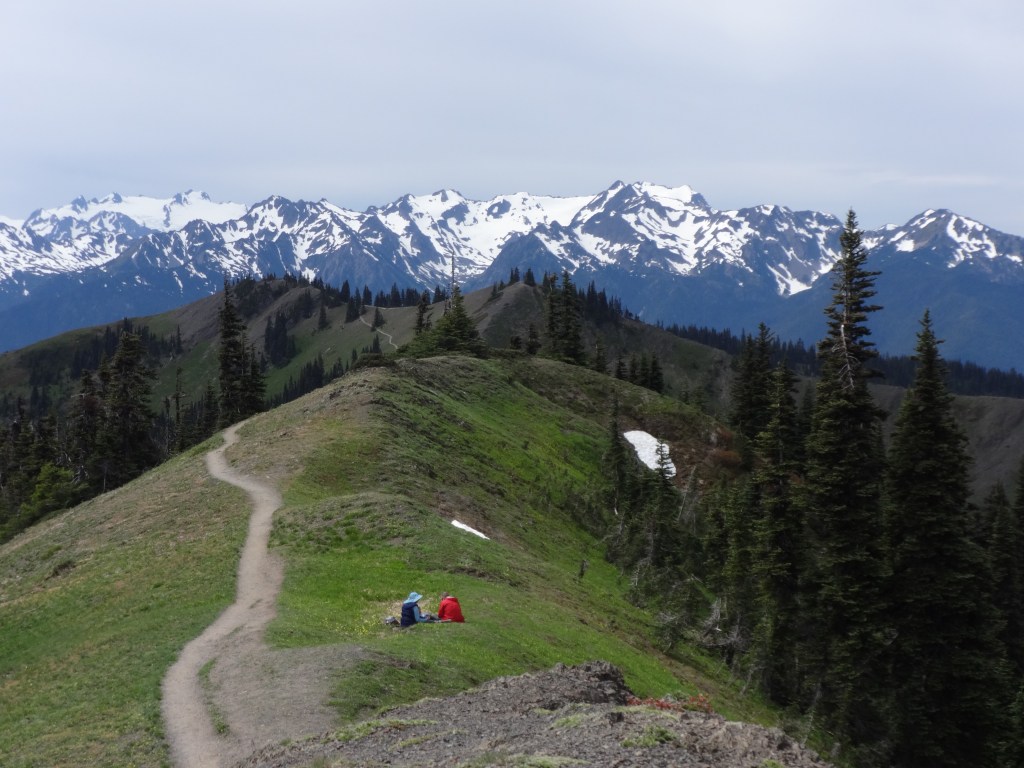
In the open grassy areas, we would see the trail ahead snake among the mountain side. To see it slither along added great perspective to the mountainous scene. To our right, in the distance, the Cascade Mountain range sprawled. It was an overcast day, but the clouds were high enough that even the tallest mountain peaks were not covered. What the clouds did do was darken the forest, making the mountains a deep navy blue with their snowy peaks really popping out. No mountain really stood out from another. Instead it was one after another, rather uniformly, with short divots and valleys between them, and each mountain plateauing at about the same height. They stood tall like soldiers in uniform, guarding the way eastward.

Alongside our path and down the grassy mountainside were a plethora of wildflowers. As Zach had studied up on them in the visitor center, he was able to identify and call some out by name. There was one with many delicate little white petals that were brushed with pink at their veins and fine edges. Its leaves were stringy pale yellow and green, and they sprawled out like spaghetti. They were a region specific plant called Olympic Onion, actually producing a bulb that is edible and produced commercially. Another wildflower spotted was White Avalanche Lily with its bursting star bloom and dotted with yellow at its pistil. Each one stood in its own space, seeming very independent, spaced out from its counterparts. They weren’t like some wild flowers that seem more like city-dwellers, crammed into a small space together. These lilies were country folk. They had their own space, their own plot of land, their own hardy independence. At one point we came across patches of a stalky plant bearing multiple tubular bright purple blooms. They are called Penstemon and remind me a lot of Blue Bells. These were all subalpine flowers.

This hike really made me aware of how far north we were and not just in terms of the nation’s edge and proximity to Canada, but also in terms of elevation too with mountains, goats, patches of snow, deep mountainous ravines, subalpine blooms, and an arctic touch in the breeze every once in a while.  As were climbed in elevation on our windy path, we at one point ascended a series of switchbacks, and there at the higher elevation were marmots, those funny whistling flopping, nervous little guys, those beavers of the mountain, as I call them for their flabby appearance and prominent two front incisors. They smile and run, call out in a loud beeping sort of whistle, or lounge around in the sun. To me they are just simply a funny animal in appearance and behavior. They are delightful. 

When we reached our journey’s farthest peak we beheld an incredible vista. We could see out to the ocean, an inlet of the Pacific called the Salish Sea which gives way to numerous straits around Vancouver and the San Juan islands. Also boldly and majestically stood Mt. Baker on the edge of North Cascades National Park, between Seattle and Vancouver, although neither city was visible. The mountain was still around 150 miles away, but it was clearly visible with one enormous rounded peak covered in snow and another jutting peak down its side. We sat down and beheld the vista. What an enormous view! We could see so far and even see the ocean yet feeling nowhere near it.

As we were sitting there, enjoying the view and pointing things out, out of the corner of my eye I spotted something moving. I looked down to see a chipmunk getting a little too close to my backpack laying on the ground by my feet. I grabbed the backpack up, knowing the critter probably wouldn’t think twice of going inside in search of food. This chipmunk was familiar with humans. I could tell. I had no plans of carrying a chipmunk down off Klahhane Ridge. No one should feed wildlife, and there are rules and even laws against it, but before I had time to say anything, Zach had a piece of a Clif Bar in his hand which the chipmunk was eating from. Zach then reached down with his other hand to pet the little rodent’s back. After one swift swoop down the back of its coat with his finger, the chipmunk took off. 

I planned to stay here a while. I had no rush to get away from this great view, so I settled in the spot I was sitting, clearing away some small uncomfortable rocks beneath me. From my backpack I was guarding from the chipmunk, I took out my new book: The Wisdom of Wolves. “Storytime?” I proposed. I proceeded to read the introduction of the book out loud and Zach listened. 

On our hike back down Klahhane Ridge we saw more marmots, deer, and wildflowers. When we reached the car, we could agree we had completed a truly satisfying and rewarding hike. It had some of the greatest elements that make for a good hike: great wildlife spotting, diversity of plants to observe, mountainous views the entire way, and a majestic overlook at its furthest reach. Although the day was a great one, night was soon coming, and things would take another turn. Things were about to get rocky.

If you enjoyed reading this, check out my book Still, Calm, and Quiet“

Check out my previous entry here: “Gas Pump in the Wild”

Visit www.joshhodge.com

Gas Pump in the Wild

I wasn’t going to let this happen again– the stress of nearly running out of gas. We were still on our visit in Olympic National Park in Washington, but as access to the park was split up by various types of land allotments, now we were on a small piece of Indian reservation at a gas station in front of a casino. I noticed the price was $3.19 per gallon which seemed cheap after braving the gas prices elsewhere in the Pacific Northwest. I’d notice in a few days gas prices plummet leaving Washington into Idaho and Montana, which was not much of a curiosity considering the states’ politics and their effects on their economies. Here at the Indian reservation casino gas station I filled up. When I went inside the gas station convenience store, I was surprised by free coffee and tea. I got a cup of orange spice tea to calmly ease into the morning. Then we were back in the car for a short drive into the park to the Hurricane Ridge area.

A few days prior, leaving the Chateau at Oregon Caves National Monument, driving through the long expanse of national forest, we were low on gas. We were also in a very remote area, and when we finally reached an isolated gas station there was a sign that read “cash only.” We had the cash but perhaps were here too early, for no one was working. Zach couldn’t use his phone to look up the next nearest gas station either, because we were out of service range, but I was able to search in my GPS. The next nearest gas station was thirty miles away! I wasn’t sure if we would make it, or if it was even en route, but it was the only option unless we were to wait a few hours to see if someone would show up to work at this gas station. What if they didn’t? It would be a morning wasted.

So we journeyed on. There was an uncomfortable silence in the car. I probably wasn’t the only one questioning my judgment. Out the window was merely pine tree after pine tree- no people, no cars, no buildings, just the forest and us. Mile after mile, it was all in uniform, and the road was straight and unending in the dark morning forest. It made me wonder if we were getting deeper in the wild, further from any civilization. Normally I’d like this, but not without gas! There was more and more of the same drawing on, and according to the vehicle’s interface, we were out of gas. Yet we were still moving.  I was starting to feel the regret and dread of relying on this GPS. It seemed to be leading us astray, then…

“You have reached your destination,” the GPS sounded. As my journal details, I didn’t think this was in operation, but I pulled up to the singular pump. There was no store and no booth, but attached to the gas pump was a curly coiled wire phone. Zach pointed to the sign.

For gas dial 1,” it read. We looked at each other with probably the same thought. We were puzzled. What’s going to happen? We hadn’t seen anyone, just trees for dozens of miles. Was someone or something going to pop out of the forest and pump our gas? Is this sasquatch’s gas pump? I opened the car door and stepped out. The forest was silent. I lifted the phone and held it to my ear. To my surprise there was a dial tone. I punched in a “1.” It rang!

Hello,” The muffled voice came through the receiver.

“Hi. I was wondering if I could get some gas.” I believe I was too puzzled and confused to have even considered the pleasantry of bidding a “good morning.”

I’ll be right there.”

This might actually work.

We waited, looking around with suspicious anticipation in every direction.

After just a couple minutes, we saw a golf cart coming down the road- our rescue!

A pleasant older man in flannel and blue jean overalls asked how much gas we wanted. I handed him a $20. “Sorry about the wait,” he apologized, although it wasn’t much of a wait at all. “I had to find my keys at the lodge.”  I concluded there was some lodge I was unaware of, and this was their gas pump. The golf cart was used to travel around their property. 

“No problem,” I responded. “Thank you.” 

And we were on our merry way.

That was four days earlier, and I wasn’t going to find myself stuck in that sort of situation again, and that is why I filled up. In the far remote West, with distances so grand and gas stations so rare. Every opportunity to fill up should be carefully considered. Take advantage of any gas pump in the wild. 

We eventually reached the Hurricane Ridge section of the park. We were getting ready to hike about seven miles to Klahhane Ridge. There was a visitor center, and of course I had to go in. There wasn’t much to see for it was a small place. I was engrossed in the literature, the books for sale, while Zach found a binder on display with pictures and information to identify wild flowers. He studied up on the flora for the day. I ended up buying a book about wolves. The cover of the wolf’s piercing stare drew me in. Back at the car, we geared up for a beautiful hike on a trail loaded with wild flowers, majestic view, and lots of wildlife (but no wolves). 

And experience with the gas pump inspired me to write this song…

Ode to the Gas Pump in the Wild

Driving through the wild, beneath the towering trees,
Feeling the stress as the gasoline quickly depletes.
In Siskiyou National Forest, a land so vast and grand,
But stranded in the woods, was not what we had planned.
Miles of pine trees, stretching, nothing in sight,
Will anyone be our rescue, or will our day turn into night?

O gas pump in the wild, like a lifeboat in the sea,
Rescue us from drowning, would you pretty please?

Then a glimmer of hope, a steeple in the pines,
A chance to refuel? Hopeful as a child.
With a phone on the pole we dialed for our need,
And from the forest’s depths, came our lovely savior’s steed.
A golf cart in the distance, rolling into sight,
An old man with a smile, making everything alright.
In flannel and overalls, this man helped save the day,
He powered up the gas pump and sent us on our way.

O gas pump in the wild, like a lifeboat in the sea,
Rescue us from drowning, would you pretty please?

In the remote West, where gas is rare and few,
Seize every opportunity to safely see you through.
If it’s just a little gas pump, hidden in the trees,
It may be a lifeline, setting you at ease.
So now we hike the trails, where the wildflowers abound,
Learning of the animals of which us surround.
Here at Hurricane Ridge is where we will happily be
With gratitude to the gas pump forever endlessly.

O gas pump in the wild, like a lifeboat in the sea ,
Rescue us from drowning, would you pretty please?

Gas pump in the wild, a sanctuary found,
In the midst of nature’s bounty, you wear the crown
With this adventure’s end, there’s a story to compile,
Of a journey’s uncertain detour forever worthwhile.
So here’s to the gas pump, a tale to be told,
Along the Rogue River, where memories unfold.
Of a certain lonely gas pump, that will always be
In my adventurous heart forever endlessly.

If you enjoyed reading this, check out my book Still, Calm, and Quiet“

Check out my previous entry here: “The Rainforest and the Bear”

Visit www.joshhodge.com
The Rainforest and the Bear

It was right there, a bear, not more than twenty feet in front of me! I had been strolling along a trail in the Hoh rainforest of Olympic National Park. Bears were not on my mind. Then suddenly, rounding a bend in the path, came the bear. I was headed towards it. It was headed towards me! It all happened so quickly. There wasn’t time for keen observation, just reaction…and a photo. The bear seemed not the least bit inhibited by my presence. It just kept walking on the path towards me in the mere seconds this all went down. I, on the other hand, had fear struck into me. I was that tourist taken off guard. 

Now this bear was only a black bear, with much less potential of danger than a grizzly bear, but a bear is still a bear, and the visual of a pitch black coat rounding a bend, contrasting with the greenery of the rainforest, was anything but subtle. Unless a domestic pet, animals with no fear towards humans usually should be of concern. This part of the rainforest was thick with ferns, thus there was no space to get out of its way alongside the path, except by braving the wild undergrowth of the rainforest and whatever lurked in there. So I turned and ran. My own human instinct kicked in. When I look back at the photo I managed to capture in the midst of my quick escape, I find this bear to be quite small. Having much more experiences with bears since, I find myself near ready to mock my former self for my own startlement by this bear, but it was a quick matter of instinct and reaction. I had not been expecting to see a bear at all because I had associated bears with thick pine forests, but I was in a rainforest, and in my mind bears were just not associated with rainforests. 

Also, despite hiking, I had also been relaxing. I guess you could say I had let my guard down. Recently I found myself to be rushing too much and allowing myself to be stressed by trying to make this adventure experience worthwhile for my travel companion, Zach. Today I thought I’d seize any opportunities to relax, and this trail would afford one such opportunity to really do so. We started the hike from the Hoh Rainforest visitor center on the Hall of Mosses, surrounded by not just tourists, but trees dripping with mosses. It hung on their sprawling branches like drapery, reminding me of some photos I’ve seen of the humid deep South and the trees that rest on some former plantations. Their trunks were also covered from the forest floor to their highest reaches in moss. Among these moss-ladened trees were other deciduous trees in the forest, and a forest floor nearly covered in ferns. In any area there weren’t ferns, there were other green plants stretching out to fill the voids. The humidity, the hanging moss, the lack of pine trees, wasn’t something I’d associate with the far North. It’d be more appropriate from my own experiences to believe I was in the United States’ deep South or the jungles of South America, but no, I was in the far reaches of the U.S. on the Olympic peninsula. 

After we completed the 1.1 mile loop of the Hall of Mosses, Zach and I took off down the Hoh River trail. It was very similar in nature to the Hall of Mosses, except instead of a loop, it was a rather straight path parallel to the river. After a few miles on that trail, I saw a small breakaway from the path, an outlet down to the banks of the Hoh River. It was nice to get a break from the thick forest in an area where the river created a natural clearing where we could see the sky, the mountains, and look out upon a larger landscape, but our attention was also focused downward because in a still pool alongside the river was an utterly bustling cloud of tadpoles. They were thick, chunky tadpoles with well-rounded bodies, and quickly moving tales, storming around each other in sheer chaos. It was really quite a grotesque display of nature, an unsettling visual, but terribly unique of an experience and fascinating in that. The size of these tadpoles spoke of the large frogs or toads they’d become. 

After observing those creatures, I noticed the warmth of the sun on my skin and the peacefulness of the river. Its nearby ruffle was soothing to the ears. There were patches of sand amidst the rocks, and in one I set down my backpack as a pillow. “Let’s take a few minutes and just relax,” I proposed. I laid down and closed my eyes. I knew the healing power of the sun when it comes to body inflammation, and I wanted the sun to just envelop me in its healing power. I closed my eyes and breathed deeply. This is what I believed I was lacking. I needed more time like this to relax in nature instead of always being on the move. I prayed for my health, and I wanted to fall asleep to wake up with a refreshed feeling of renewal. I didn’t fall asleep, but I took time, with my eyes closed, to focus intently on the sounds around me, trying to distinguish each sound, focusing on each one at a time. First I tuned into a bird’s call, then a frog’s ribbit, then the ruffling of the river. This practice is something I’ve found very relaxing. After about twenty minutes of laying there on the river’s shore, we were back on the trail. I was slow-moving purposely, trying to have a relaxing stroll through the rainforest, keeping my body down from its recently normal state of intensity to that of peace and calm…then…. suddenly… a bear! 

I was the first to spot the bear. I turned around, pushing Zach who was behind me and urging him to run. “There’s a bear!” I pointed my camera behind me as I ran to capture a photo. Eventually the trail opened up where the rainforest floor stood barren around some trees, an obvious place where people have stopped to take breaks. There was also a couple there, hauling their own backpacks. We stopped. “There’s a bear just up ahead,” we warned. ”It’s right on the trail.” They were going the other way, so it wasn’t of much concern to them. 

Zach and I assessed the situation, and decided, since the bear did not make its appearance to us again, and it had plenty of time to catch up to us, it must have ventured off into the forest. So we decided to turn back around and continue on our hike cautiously. We concluded our journey at a beautiful waterfall. It was maybe forty feet tall and was a double fall in that the water fell into one pool and shortly after down into another. Some limbless fallen tree trunks covered in moss laid at its base, adding size perspective to the scene. Moss also snuggly held onto all the surrounding rocks of the falls as well, making the scene very green. We had seen the falls from the trail, and following Zach’s off-trail lead, we bushwhacked through the ferns and rainforest undergrowth close enough to shake the falls hand. 

When I think back to this day and I consider the encounter with the bear, I think there must be a message here, a purpose for this encounter. Maybe the message wasn’t evident then, but the purpose could be found now in reflecting back upon the event. As I’ve sauntered over this thought, I’ve come to some great parallels.

Now, first off, I am a big fan of bears. Visually they are stunning. They are such an intelligent creature, and one of God’s greatest beasts. I respect their strength, their space, and existence, but for the sake of this analogy, I’m going to liken the bear to the enemy. I’m imagining bears as spiritual beasts, things dark, dangerous, and destructive to our spiritual lives. 

Now, as for us, we are on a journey through the jungle of life. Some people wander aimlessly in the jungle, lost. They have no direction. They are riddled with fear, anxiety, and hopelessness. Spiritually they are hungry and desperate for they haven’t found the spirit sustaining substance of God’s Word. Others don’t think they are lost, for they are on a path, a very wide and well traveled path. It lures with the prospect of encountering great treasure buried deep in the jungle. The travelers think wealth and prosperity is their destination, but they are lost too, for this wide path leads really to nowhere of good consequence but rather to destruction. It leads off a cliff edge, down a waterfall, and into a mountain lion den, but little do they know this. Then there is the God fearing man who follows a path that is narrow through the jungle. Its tightly accompanied by flora and fauna of all kinds which can cause great distraction, but the man sticks to the straight and narrow along the River of Life, the flow of God’s grace and mercy (or in this case, the Hoh River). Others have been on this path before. Great spiritual leaders and people of incredible faith, great “Nurse Logs” and “Wheeler Peaks,” led by God himself, have helped clear this path with wisdom and knowledge. With their great machetes, spiritual fortitude, and grit, they have helped clear the path for us. This spiritual path, though leading to the very physical presence of God and the safest place to be in the jungle, is not isolated from trouble. It exists yet in a spiritual realm of all forces, good and evil. There are the creatures of darkness that try to disrupt our journey, our progress. Unexpectedly they come onto the path with the intent to kill, steal, and destroy. They threaten to take us off the path, or send us backward, running away from the pursuit of God.

Now not all these spiritual creatures are the same. Just as not all bears are the same. Black bears are generally fearful of humans. Of course there are exceptions, like the one I encountered this day, but typically they instinctively fear what man can do to them. They run off in the presence of man, and man can run off from them, as I’ve done a few times, but then there are grizzly’s which are much more territorial. Although their threat is overhyped they have been known to attack on occasion, and grizzly bears are not to be run away from. When presented with a running human, it is of their nature to chase the human. A grizzly bear must be handled differently from a black bear, and if all strategies fail, you have to fight it. 

So first let’s examine the spiritual black bears. They are spiritual beasts that cower. They usually get out of the way in fear. Sometimes we don’t even know these beasts were just up ahead on the trail. They are those animals we never knew were there on trail, because the animals heard or smelled our presence first, and in fear, ran away. There are beasts of the spiritual world that are in great fear of the presence of the Christian who beholds the Holy Spirit. When we behold the Holy Spirit, these spiritual creatures are truly mortified. They simply cannot encounter the presence of God or be touched at all by the light of his glory. They run away. With God’s Spirit dwelling in the Christian, so many encounters with spiritual beasts are avoided. 

This gives me, and should give you, a great deal of confidence. For example, I’m not one who believes in ghosts, but I most certainly believe in demons and think the two are often confused. I have been in places that are supposedly “haunted” before, but I disregarded these stories as any danger to myself. Because even if people did have chilling encounters with the spiritual in these places, I know I wouldn’t because of God living in me. The powers of darkness flee in my presence, but not because of my actual presence, but of His presence in me. Hence, I have not a single  “ghost” story to tell. This also explains why sometimes people say my presence emits a peacefulness and sense of safety. That is not of me. Sometimes my human mind is fraught with concern, but despite that, there is God’s presence dwelling in me. The mere presence of a Christian in whom the Spirit of God dwells is very powerful and influential to the spiritual forces at work in the world.

Then, there is another form of spiritual beast. We can call it the grizzly. It’s a specifically tailored one. It does not flinch. It is concocted by the devil himself and released on our path strategically. Sometimes it tries to avoid the Christian for it too is fearful, but when it is encountered, it usually will not flee in our presence but it will approach. It’s also very territorial. The territory it wants, that it thinks it is entitled to, is you!  It’s a stalking creature, and thus, in this aspect, more like a mountain lion than a bear. It also strategically strikes in time of peace. Here’s the thing, we are not to fear these creatures either. God has equipped us with the power and tools to defeat them, but sometimes we are not prepared. We are taken off guard. 

In times of peace and security, when we have taken a relaxing break by the riverside, enjoying the sunlight, and strolling pleasantly through life, watching the tadpoles, sometimes we can become very relaxed in our spiritual lives. We become complacent. We drift away from the Word, from daily prayer and devotion to God. We stop asking questions of faith and pursuing the knowledge of God. Subconsciously we default to, we don’t need any of that now because we are traveling along this path just fine. Then the spiritual beast appears, the bear comes right out of the jungle. It comes near us and we are unprepared. We are not armed up with the spiritual armor of God. Our Shield of Faith is in the backpack, we left the Sword of the Spirit at home, and the Belt of Truth is in the car. It’s not to say we are hopeless. We are not, but we face a lot more turmoil trying to pull ourselves together, and in the meantime we may experience a lot more headache and heartache that we would not have if we had been equipped. The lesson here is that in times of peace and comfort, when the sun is shining and the river is just ruffling, we need to work out our faith, to sharpen the sword, to affix that armor. In practical terms, these are times we need to be really delving into His Word, meditating on it day and night, to pray without ceasing, to ask God questions and pursue His truth, to continue to grow and fortify our faith. Imagine a fully armored Christian encountering a spiritual grizzly on the trail. It approaches the Christian, attempting to bring chaos and destruction into His life, but there’s not even a match here. Nothing is a threat to a Christian in the fully affixed Armor of God. 

This is not all to say that even the fortified devoted Christian is not met with great challenges and pain. Remember this second kind of beast is tailored specifically for its assaultant. The stronger the Christian, the greater the beast. Even the strongest Christians sometimes go through immense heartache and headache, but rooted in Christ, they are standing on a solid rock out in the tumultuous  waves of the Pacific. They know the battle is already one. They are able to endure the pain with peace and resolve that is deeper than human understanding, because it is of God and not themselves. In my own life I have a specific tailored beast. It is that of ulcerative colitis. Although some may dismiss it as a purely physical ailment, the physical and spiritual and intertwined. When I am sick, it does affect me spiritually. For someone who is so active and tries to be so healthy, when I lose my health, I feel like my life is ripped from me. It can be devastating. It has the potential to take a serious spiritual toll. I certainly view my sickness as an attack from the enemy. However, during this summer’s adventure I’d soon come to the realization that even if I’m not physically healed, I can win the battle spiritually. No physical ailment needs to have dominion over my life. 

Oftentimes when we are strolling along the path in the jungle, at peace, we lose sight that we are in spiritual war. All of life is a spiritual war. There are moments of peace between battles, which we are to enjoy, but just because we are not engaged in a battle at the moment, does not mean the war itself is over and we have the luxury of letting our guard down. In any war, you use the in-between time to train, fortify, plan, and strategize for the next move. 

To liken all of life to spiritual war may sound pessimistic, but I don’t think it is so. Even if it sounds so, it’s an unavoidable reality that I’ve come to terms with. But I don’t view it as pessimistic because there is a great Hope. It is knowing through Christ Jesus the battle is already won and we have the presence of God with us! When we engage in spiritual battle, we participate in this victory. What an incredible honor and responsibility. It also brings us back to Scripture and prayer. We should never take such things merely casually or as ineffective. Our sincere time in Scripture and our prayers are never wasted. God is using them to fulfill His will. It is all a part of His plan, the same victorious plan of Christ Jesus! We also know that one day, in His eternal presence, not only will all our battles be over, but we will be on the other side of the war, on the other side of eternity, living in complete peace in His presence in His new Heaven and new Earth. Thus we run forward with perseverance on a path that is marked for us (Heb. 12:1). We press on toward the goal to win the prize for which God has called us heavenward in Christ Jesus ( Phil. 3:14).

During the in-between times of peace on the trail, it’s so important we don’t let our guards down, that we don’t become too comfortable with the numbing narcotics of life’s pleasures and distractions. When considering the war, I also think about our spiritual storerooms. In Matthew 12:35, Jesus says, “ A good man produces good things from his storeroom of good, and an evil man produces evil things from his storeroom of evil.” This begs the question: What is in my storeroom? We place in our storerooms our own amusements, distractions, our selfish thoughts and pursuits, and just flat out a lot of junk. Many of us need some serious spring cleaning, and we shouldn’t take these things to the Goodwill either. Much just needs to be burned.

So what needs to be in our storerooms? The things of God, what He values, what He loves, and chiefly, His Scripture. His Word is the most powerful of our weapons. A dear friend and pastor of mine, Steve, in his teachings has called this our “arsenal of Scripture.” I like this analogy because so much of Scripture is like ammunition. Immediately it paralyzes fear and stops the enemy. When true pessimism does sneak into my life, often connected with my own health, one of my very effective weapons is the truth of a two verse harmony of 1 Peter 5:10 and Phillippians 4:7,  “After you have suffered a while, the God of grace Himself, whose knowledge surpasses all understanding, will restore you and make you strong in Christ Jesus.” I say it, sometimes out loud. It lifts my own spirit, as the assaulting beast of pessimism and hopelessness is paralyzed when the promises of God are declared and the name of Jesus is invoked. Yes, sometimes it is that simple. We are all in a war. We fight battles that look very different for each of us, but we are all in the same spiritual war and we all reach victory by the same means. So I raise the same question Steve does, “What do you have in your arsenal of Scripture?” and as Jesus evokes, “What is in your storeroom?”  

Next time a spiritual beast approaches me on the path of life, I don’t want to run away backwards in fear, like I did with the bear in the Hoh Rainforest. Instead I want to be so fortified with the Word of God and His presence that I can approach that beast confidently and leave it behind victoriously. I can rebuke it with Scripture and the name of Jesus. God gives us the power to slay whatever comes in our path, but we must fortify ourselves in Faith and knowledge of His Word. Do not let your guard down in times of peace. God warns in Hosea 4:6, “My people perish for lack of knowledge.” Instead, be in His Word, build that arsenal, polish the armor. The more ready you are, the more beasts will also just stay off your path. When they smell that blood of Christ they stay away, but be ready, for despite His protection, a next battle is always inevitable until He calls us home.

If you enjoyed reading this, check out my book Still, Calm, and Quiet“

Check out my previous entry here: “The Mystical Beaches of Olympic”

Visit www.joshhodge.com

She Tried to Kill Me: Death Valley’s Claim on My Life

Hold on Josh. Hold on. You’ve got to, or you’re going to die. I could feel myself beginning to slip from consciousness. I was in a desert canyon in Death Valley National Park in southern California. It was 122 degrees outside this summer day without a single cloud in the sky. The sun beat down harshly. I was out for a hike, not a long one, just a few miles, but I was competing with nature. I thought it wasn’t going to be a challenging match, but Death Valley was winning. I began to experience lightheadedness. My hearing began to sound muffled. Then there was the dreaded fading of colors. Hold on. Don’t let yourself go. If I were to pass out, it would only be a matter of minutes before Death Valley would dry me out and bake me in its inferno. I was hiking uphill on jagged triangular rock and badland formations on the Badlands Loops Trail, trying to make it out of the canyon. Normally this would be easy, for I’m fit and capable, and this wasn’t even very steep, but here in the harshness of the desert, with the oppressive heat, my body was giving up. Am I dehydrated? Or am I lacking salt? Or is it heat stroke? The body could be overheated, no longer having the ability to cool down to a life sustaining temperature. Maybe my body just could not keep up with the extreme heat of Death Valley. 
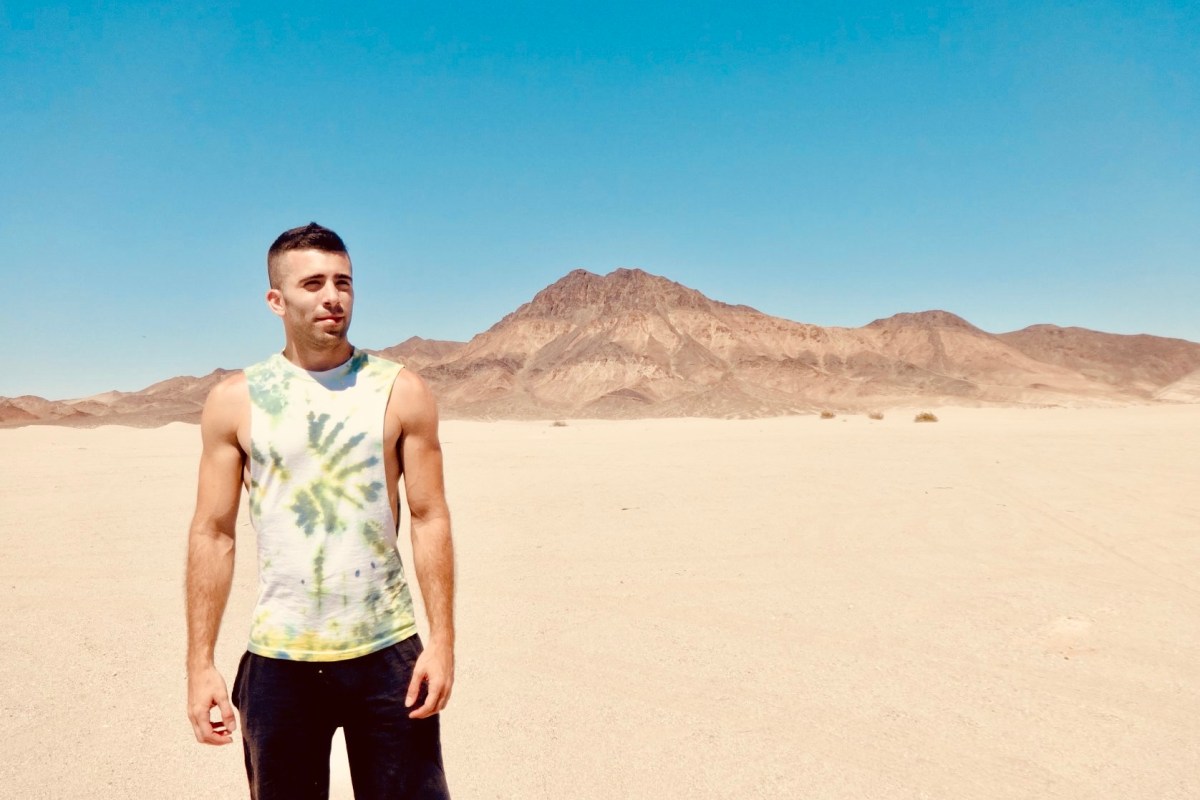
My heart began to race rapidly. Oh no, I know how this goes. Soon it could beat out of control, bringing me to the ground. I’ve fainted before, at Big Bend National Park, but luckily I was inside around other people. Here I was completely alone, except for with her, Death Valley. We had met before. She caught me in a sand storm summers before. 

The Badlands Loop

There was a little bit of shade just up against the short canyon wall. There were fragments of broken rock down by my feet, which seemed, in my present state, so far away and unreachable, but there was one big enough for me to sit upon. I lowered myself slowly and cautiously. Any quick movements, any exertion whatsoever, could cause me to black out. I crossed my legs, the most comfortable position to keep myself up from complete collapse. My vision went blurry for a moment, but I still had a grasp on it. I focused on breathing slow, deep breaths.  

I had water, but I wasn’t sure if that’s what I needed. If I was salt deprived, this would worsen my symptoms. However, it could be life-saving as well. I took a sip of my water which had turned hot from the all-consuming heat. I poured the rest on my head. Although hot, it was not as hot as the air around me. It could cool me off just a bit. And if salt was what I needed, there was one thing I could do. Sweat contains salt. I began to lick my arms. It’s not that I was particularly sweaty, for one doesn’t sweat in Death Valley, as sweat immediately evaporates in the extremely dry climate. But even this being the case, there should still be leftover salt deposits on the skin, I thought.

I had overestimated my strength in the desert. It didn’t help that I did this hike shirtless. I like the feeling of the desert sun on my skin, and I thought that in the heat the less clothes the better, but actually if I had worn something to cover my torso it could have provided shade for the body and maybe I wouldn’t have overheated as quickly. 

I had not yet cried for help. I was only about a mile from Zabriskie Point, a popular lookout point, where people would be present, marveling over nature’s artistic display of giant jagged rock formations, but I was so far down in a canyon with a sea of rock formations before me that I could not hear any of them, and I don’t think they would hear me. If I were to exert my voice loudly, this might take too much energy and cause me to lose my consciousness. I could not make a phone call. My phone was in the car. I left it there, for there was no service out here anyway. It was just me and her, Death Valley. I’ve always said she is my favorite park. She is so different and unique from all the others. Her views are so astounding, Her mountains are so tall. Her valley is so wide. She is rich in history of gold, silver, and borax mining. She’s the keeper of abandoned mines and ghost towns. She’s so strong and so dramatic, and this was one of the many features I liked about her, but she was also ruthless. She lures people in with beauty and mystique, as in the past she tempted with her riches of gold and silver. She’s a masterful artist, skillful at manipulation, luring man in to choke and turn him back to the very sand from which formed him. 

She caught me. She had me right where she wanted me. Though a lover turned hostile, I had done her no wrong, but merciless she pursued me. I focused on breathing and said a prayer. After a few minutes my heart returned to a normal pace, colors in my vision returned, and my hearing was sharp. I was okay. I had to get up and continue. Time was of the essence. I needed to get back to the car. I stood up slowly, and I walked carefully. A peace had brushed over me, despite concern still guiding me. I was able to be calm yet knowing the urgency. I made progress, slowly, calmly, not letting my heart rate spike. 

The trail wound up and down and around wavey rocks and canyon walls, until I could see up ahead the sharp pointed rocks of Zambriski Point. I could see people on the rim taking pictures, and it was a sign of relief. Slowly and methodically, I made it back to the lookout point among the other tourists. They were nonchalantly posing for photos in front of the jagged points spiking up from the canyon. I then was assumed to be another one of them, but no one knew what I had just experienced. I got back to the car and turned the air conditioning on high. I had some hot gatorade, and dry snacks. They seemed to help. I longed for something cold and refreshing, but nothing here would be cold. It was all hot. 

Zambriski Point

I’m done with hikes for the day, I concluded. After resting in my car for a few minutes, I was ready to check out the Furnace Creek Inn, one of the two accommodations in Death Valley National Park. I wasn’t going to stay. I just wanted to see it. I had learned about this historic inn from a documentary about National Park lodges. It was built in 1927 by the Pacific Coast Borax Company before the area was declared a national monument and later a National Park. This inn was once a desert oasis for Hollywood elites, and to this day, it says on its website that it “still pampers every guest.” I had to see it for myself. 

Its a structure that very much fits in with the landscape. Its foundation and lower level walls are constructed with rocks from the very desert. It’s building blocks were formed from the very sand of Death Valley. After I parked my car I walked up the drive. On one side there was a lawn with a tall fountain. Yes, there was a lawn in Death Valley! I could scarcely believe my eyes. On the other side of me was a wall skillfully crafted out of rocks and above it a patio for guests. Up above was the main level of the establishment. To get there there was a rounded tunnel that cut through the rock wall and seemingly went back to a staircase. Lights were affixed in the tunnel to light the way. How unique of an entryway, I thought. It seemed sort of like I was approaching some passageway in a medieval castle, but as soon as I entered the tunnel, a large aggressive wasp darted towards my face. I abruptly moved my head, evading its assault. It buzzed around me loudly and invasively. I ran back out of the tunnel to the drive. I had thought I was alone, but then I saw a lady walking her way around the front of the inn. I must have looked ridiculous, running away erratically from a wasp. I immediately regained composure, stood upright, and walked moderately. I smiled and nodded my head politely. “Hello,” I said, as if nothing unusual had just happened. 

I walked around the rock wall to another staircase that led up to the main lobby of the inn. Inside I was quite impressed. I beheld a beautiful lobby of simple elegance. Intricate tilework spread through the lobby and into the halls. Big rounded windows looked out into palms and the desert mountains in the distance. Oritenal rugs sprawled out beneath wingback chairs and floor lamps. I did feel out of place, however, and began to wonder if this was alright, that I, a mere vagabond of the desert, was welcome in such an establishment. If I knew it was so nice, I would have dressed a bit differently from my gym shorts, cut-off, and hiking boots. But I decided to ignore my attire and just walk about the place as if I belonged. No one had to know I was a foolish young man who nearly died in the desert, who really is not sure where he is spending the night, and could no way afford this place. I could pretend and carry myself as if I knew exactly where I was and what I was doing. Some National Park lodges encourage visitors and are quite welcoming. This seemed just a little bit prestigious and more intimate to me, but I pretended like I belonged the best I could, given the circumstances. I wanted to appreciate its architecture, elegance, air conditioning….and pool?!

I walked out into the oasis garden behind the inn. I was so completely surprised that such a place existed in Death Valley. Here was a forest of palm trees on a hillside blanketed in green grass. Small winding stone pathways and stairs meandered around it and over a bubbling brook and rippling pond. Little stone walls held up the hillsides of tasteful landscaping. This place looked so cared for and so astounding to exist in such a barren place as Death Valley. Between the palms, in the distance, I could see the large expanse of the desert and its mountains standing tall. What a contrast! More immediately before me I was faced with a large natural spring fed swimming pool. Its poolside was encased by beautiful stone architecture with arches resting on cornerstones, and it was all in the shade. After being so exhausted in the desert, and strolling now still in the oppressive heat, the thought of being engulfed beneath the water of a swimming pool seemed so perfect and just what I most wanted. I had been successful thus far in pretending as if I belonged at the inn, walking around the lobby and garden oasis. What if I just took it one step further and helped myself to a little swim? I was very close to letting myself walk through the gate and into the pool, but I first noted that it would be quite obvious if anyone was watching, for no one else was at the pool. Then my moral conscience kicked in. This was not for me. It was desirable. It would be so nice, but it was not mine. 

the garden oasis

Back at my car I noted cell service here by the inn and sent a text to my mom telling her about the 122 degree temperature. She responded “You are not going to camp in that!” She knew that was my plan, and it still was my plan. 

I drove thirty minutes to the Stovepipe Wells Village. I remembered the general store here from my previous visit. I bought a Death Valley Black Cherry soda in a long-neck glass bottle here back on my first National Park adventure. Inside I was greeted by a self-serve soda fountain. I got myself the mega jumbo cup, nearly filled it with small nuggets of ice from the dispenser, then poured over it cold refreshing blue Powerade. When I left the store and took the first sip through the straw, it was the most heavenly experience. My body was crying for this so badly: the sugar, the sodium, the electrolytes, and most welcome of all, the cold. I couldn’t take it in fast enough. I may not have made it into the pool at Furnace Creek, but this ice-filled cup of Powerade drowning me was the most perfect thing at the moment. Death Valley had tried to take me, I survived, still weary and war torn, but now I’d just powered up. It was going to be a good night. 

Next order of business: finding a site and setting up camp. There were a number of first-come -first-serve campgrounds in Death Valley. In accordance with my itinerary, I was on my way to the Emigrant Campground when I discovered, along the way, a large sandy lot where others had parked and pitched tents. It sat a little bit elevated on a plain that sloped down into the valley. It displayed a beautiful open expansive view. The sun was setting, and I preferred not to set up camp in the dark. I figured this area would be fine. There were no numbered sites, no bathroom, but I could do without. I pitched my tent, and then went for a walk. 

I passed by a ranger station or some park service building in the middle of the road that looked closed for the summer. Just past it I paused. I deviated from the road and stood up upon a rock looking out. The sun had set. The mountains were a rich dark blue, and the sky a vibrant pink. This beauty was enough to give shiver with goosebumps, even in the extreme heat. Out in the valley there appeared to be a lake, but I knew it was just the giant salt flats contrasting the surroundings. Everything was so giant, so huge- the mountains, the expanse of the valley, the salt flats. Everything seemed to flow smoothly from the Artist’s brush. Even with such an incredibly huge view, the desert was so still, calm, and quiet. This confirmed all the more that Death Valley remained my favorite National Park. She has a unique overwhelming effect on my soul. I love her, despite the fact she tried to kill me. 

With a calmness of the late evening desert seeping through my being, I walked slowly and relaxed back to my tent and shed a few tears in response to such beauty. This was also my first stop of my very first grand National Park adventure back in 2015. I was coming back to where it all started, my following in love with the Parks, where excitement and wonder was so fresh and new. The desert reminded me of all I had seen and experienced since, and I felt extremely grateful. 

Back at my car I brushed my teeth and didn’t bother changing clothes for the night. It would all be coming off in this heat. I checked the temperature from the car before I locked it up for the night. It displayed an even 100 degrees. I noticed I had cell service and decided to respond to my mom’s text over her concern about me camping in the heat when I told her it was 122 degrees earlier. I responded “No worries. It has cooled off…it’s only 100 degrees now.”

I crawled into my tent. Death Valley had spared me and now was as beautiful and captivating as ever.

Read my previous entry here: Monoliths and Stars: Wonders of the Mojave
Check out my book Still, Calm, and Quiet, here: https://www.amazon.com/dp/B093RMBNCP

Attack of the Squirrels

This was no ordinary enemy. It was smart, effective, and ruthless. I came back to my camp to find it had been violated.

In the morning I woke up early to go for a hike, having slept so peacefully in the quiet pine-filled forest of Lassen Volcanic National Park in Northern California. The campground was comfortable. A bed of pine needles was spread everywhere giving it a naturally soft and cushioned surface. At night I could look through the pines and see the star filled skies. This morning, as the sun filtered through the trees, it made the ground like gold.

I changed into some suitable clothes for hiking and threw my backpack and everything I had with me in my tent into the car for safety. I left behind, of course, my sleeping bag and pillow. I zipped and locked everything and was off for a hike. I was in the Manzanita Campground and there was a trailhead for the Manzanita Creek Trail at the edge of the campground. I made my way from Loop C to Loop D  and then along the path in the forest. During my hike I saw scores of pinecones just strewn all about the forest floor. They were of that enormous type I’d seen the days before, some as big as my head. They were from the sugar pine tree. I’d read that some of these pinecones can reach a length of two feet.

The hike was rather uneventful and un-notable- no striking characteristics of features to set it apart from any stretch of forest in the park. I hiked for maybe a couple miles until the snow banks became so dense and tall that the trail was entirely lost. Just the day before I had gone on a hike up Prospect Peak and had gotten lost in a similar fashion. Of course I found my way back eventually, but I wasn’t ready to get lost again today. There were other things to see and do This hike was just a bonus to kick start the day, so I decided to turn around and head back toward camp. On my return I passed by two older men also out for a morning hike. “How’s the trail up ahead?” one of them asked.

“It kind of just disappears with the snow. I didn’t know where to go,” I replied

As I strolled back into camp I rounded the loop and came to my site. I could feel my blood pressure rise. Something was not right. The side of my tent was flailing. It had been ripped and was dangling and floating in the quiet breeze. My initial thought was that my camp has been attacked by a bear. A bear must have ripped into my tent! How could this be? I raced up to my tent and looked around. I didn’t leave any food nor anything with any odor in my tent, just the air mattress, sleeping bag, and pillow. As I observed the rip, I noted it  was peculiarly neat, almost as if it was carefully unwoven at the tent seam. A bear would have been more vicious and careless, I thought. Something doesn’t add up.

 Just at this moment the campground host was making his morning rounds in his golf cart. I ran over to him. “Can you come over and check out what happened to my tent?” I asked

 He followed me over, took one glance, and without hesitation declared “squirrels”

“I beg your pardon?” I asked. Just kidding. I never talk like that, instead: “What?!” I exclaimed.  Was he joking? How am I supposed to respond?

“That’s right, squirrels. They were after the stuffin’ in your sleepin’ bag. I betcha they used it to make their nests all nice and warm.”

I had never heard of such a thing. I considered myself pretty intelligent and well-versed in the ways of camping, and I was responsible and cautious. I knew not to leave anything of odor in my tent. All my food was in the bear box and I even made sure nothing valuable was left out, because you can never have the assurance of trust with strange humans. But squirrels? I had never thought that squirrels would be a threat.

“Oh yeah, they are a real problem ‘round here. There was a couple here with motorcycles- real nice ones. They woke up in the morning  to find the squirrels had chewed right through the leather seats of their motorcycles and pulled out the stuffin’. We even have to be careful with the tires on the RVs. Sometimes they’re after the rubber and can tear those things up. That’s why we have tire covers.”

I never would have imagined such a thing.

“It’s definitely the squirrels,” the man said as he reached his hand into my tent and pointed out some squirrel droppings sprinkled across my air mattress. How indecent! How corrupt! I was not happy. This was Kelty, my expensive tent. Since the weather was really nice and the temperatures quite comfortable, I wanted to sleep in my airy tent, where I could look up and see the sugar pines and the night sky. I thought this was going to be a safe place for my tent. But squirrels? How dare they! I took pictures of them the day before. I thought they were cute and friendly little woodland creatures, not vandals and thieves, taking stuffing from the very pillow I lay my head to rest on.

At the campsite next to me was a man packing up his things. I went over and I asked if he had any tape. He lent me his roll of classic duct tape, and so I taped my tent together. Take that squirrels!

This time I did not add this incident to my list of misfortunes. Instead, I laughed it off. This was quite funny and would make a story, I thought. Never before did I have a tale to tell of my camp being systematically invaded by squirrels and my tent chewed into by these rodents. 

This was the second tent destroyed on this trip. The first one was True Blue with it’s tent pole snapped in a monsoon at Guadalupe Mountains National Park. Despite the misfortune, somehow my paradigm had shifted. I wasn’t focused on the negativity. I accepted this moment as part of the adventure. It is what it is, and there is nothing I could have done to have prevented this, for I did not have the knowledge to know about the threatening squirrels, and I didn’t even know to seek such knowledge. This had to happen for me to learn, and it had to happen for me to write this episode of my adventure.

When I reflect upon it, I think of how the forests out East are so lush and rich and full of plant life, so much so that the animals usually don’t care about the camper and his set up. Occasionally you’ll have a curious raccoon come by the campground at night, maybe a skunk (that’s another story), but as for the bears and the squirrels, they have a whole lush forest to enjoy. They don’t care about people’s riches.

Here in California where the forest is so dry, where drought has ravaged the land for so many years, where the plant life is scarce, these squirrels are desperate. They will go to the extremes of chewing into people’s tents and ripping the stuffing out of their pillows to make nests. And the bears too warrant concern for personal property. I remember at Sequoia National Park. in the visitor center, watching a film of bears ripping off doors of automobiles to get inside and consume whatever smelled edible. They even went to the extremes of eating car seats if they smelled appetizing.

Many of us not from California look upon California and say it is full of crazies. Like with any place, and any such statement, it can’t be applied to everyone, but here it certainly can be applied to the animals. Guard your pillows!

Read the previous entry “Lost in Lassen” here: Lost in Lassen – on the verge (joshthehodge.com)

Check out my book Canyonlands: my adventures in the national parks and the beautiful wild here: https://www.amazon.com/Canyonlands-adventures-National-Parks-beautiful/dp/1711397873

Singing into a Volcanic Crater

“O say can you see, by the dawn’s early light…” I found myself singing into a volcanic crater in the high reaches of California. “…What so proudly we hailed at the twilight’s last gleaming…” What was it about this volcano that spurred on my patriotism and brought forth the anthem? I was in Lassen Volcanic National Park in Northern California. This active volcanic area is asleep, but it was only about a hundred years ago it experienced hundreds of volcanic eruptions in a three year span. In 1907 Theodore Roosevelt, noting the exceptional beauty of the area, designated it as two National Monuments: Lassen Peak National Monument and Cinder Cone National Monument. Nine years later in 1916 these monuments were established as one National Park. 

Lassen Volcanic is quite a wonder. Although “asleep,” it’s clearly alive. In the park museum I learned that early pioneers and homesteaders making their way across California noted the “fire in the sky” from the volcanos. Although this fire in the sky hasn’t been seen for a hundred years, there are still areas of the park with thermal springs and fumaroles boiling up from the earth’s fiery depths, reminding the visitor that beneath the earth’s thin crust much is in motion. Here all four types of volcanoes are present: cinder cone, composite, shield, and plug dome. The park features the world’s largest plug dome volcano: Lassen Peak and the last volcano in the Cascades mountain range. Although now monitored for seismic activity, Lassen Peak  will not be asleep forever and will erupt again, they say. It’s all in a matter of time. Comforting. 

I was very much looking forward to visiting this park. The pictures I had seen of it were just beautiful with pine forests, picturesque lakes, towering volcanic peaks, rich blue skies. It was even more beautiful than photographs could depict. It is certainly one of the underrated National Parks in my opinion. It is quite astounding and unique and doesn’t get the attention it deserves. It’s just so scenic, straight from magazines, and its volcanic landscape is so young and fascinating. 

When I first arrived, I visited the Loomis Museum which also doubled as a visitor center. It was constructed in 1927 by Benjamin Franklin Loomis who was a homesteader and photographer  instrumental in incorporating the area into a National Park. His museum displayed his photographs of the 1915 eruption, and he eventually donated the museum to the National Park Service. Here I soaked up some history and geology and to my dismay learned that the majority of the park was closed due to impassible snow. I was quite disappointed initially. I particularly wanted to see Bumpass Hell, the section of the park with the fumaroles and thermal springs, a mini Yellowstone-like area. Despite this closure, I’d still find plenty to explore and enjoy. I started off with a stroll along Reflection Lake, which was beside the museum. It was so tranquil. The ground was carpeted in large golden pine needles, beneath aromatic pines, and I beheld some pinecones as large as my head. This park reminded me in some aspects of Great Basin National Park in that it was this hidden little wonderland up in the mountains. 

I decided I’d spend the afternoon and evening going for a hike. One of the most popular hikes of the park was still accessible. That was the trail to Cinder Cone. The trail started into the sparse forest, proceeded to black sand, and spiraled up the cone to the crater atop. I trudged. It was quite challenging. Going uphill in sand took extra effort and strain on the leg muscles. I naturally tried to push myself up with each step but ended up partially digging my feet into the sand. My rate of progress was not adequate for the effort I was exerting, but this was the only way. This cone I was ascending was completely barren and I was so curious as to see what the crater way up there would look like. 

The air was hot, dry and thin, and there was a calm stillness to it. I was out here alone. At least I thought so, until a man started coming down the trail as I rounded a turn. I asked him something like “Is it worth it?” or “Am I almost there?” and then we got to talking. I told him I was from Kentucky. He told me he was from a city in California.

The question of “What brings you all the way out here from Kentucky?” led to me explaining how I was a teacher on a National Park road trip, and then we went right into talking about teaching. I came to find out he was also a teacher, a 5th grade math teacher. 

“You’re a Spanish teacher? In elementary school?” he questioned in surprise. “We don’t even have Spanish in elementary school here in California.”

 I wanted so badly to say: “Well, we’re just a bit more progressive in Kentucky,” but I bit my tongue. I thought it was a funny statement, but wasn’t sure if he would find it so. “Progressivism” is a hijacked political term, but California as a whole prides itself on being “progressive.” Kentucky isn’t often regarded as cutting edge, but in education, and particularly in the district in which I teach, I’d say it is- in a more classical sense of the term. Secretly, inside, I was proud Kentucky one-upped California in this regard.

When I got to the top of the volcano, a large crater was on display, uniform in appearance, of dark brown sand; and at the rim were fragments of red rock, so bright they almost looked bloody. I trailed a worn path padded into the malleable terrain around the rim of the crater. I was in awe of its size and magnitude. I found myself standing there at the rim singing the National Anthem into the crater. Maybe it was a ripple from the patriotism I felt at Roosevelt Arch in Yellowstone; maybe it was because I felt like I had really achieved something by climbing up to the top of this crater, like America has achieved so much in its young life through so much toil and effort; or maybe it was just simple appreciation for the marvelous natural wonders of my nation. Maybe it was the line “And the rocket’s red glare, the bombs bursting in air,” conjuring up images of a volcano erupting. I was sincere, but I also laughed at myself afterward. Who sings the National Anthem into a crater? Well, I do. Perhaps I’ve spent too much time out in the wild alone. Perhaps I’ve lost it. If I’ve lost it, I quite enjoy it. It’s not everyday I get to sing the National Anthem into a volcanic crater. 

On the opposite side of the crater from where I arrived at the time, I could look out and see the marvelous lava beds stretching across the landscape. Apparently marvelous is not the formal word for the lava beds. The official name is the “Fantastic Lava Beds”. And they certainly were fantastic! Unlike Craters of the Moon, where the entire landscape seems to be some volcanic wonderland, here, from up on the crater looking down, one can certainly see precisely where lava had once flowed alongside the forest, for the forest grove is still complete by the beds. Petrified waves of lava sprawled across the land, dark and ominous, and eventually spilled into a rich blue lake nestled at the foot of another volcano laden with snow. Aside this lava bed, and closer to the volcano I was upon, were pumice fields. These “fields” were very bumpy and rolled like waves frozen in time. On the tops of some of these mounds were spots of red, orange, and pink rock appearing almost like welts or blisters on the earth’s skin- a certainly unique natural wonder to behold. 

O say can you see, by the dawn’s early light,

What so proudly we hailed at the twilight’s last gleaming,

Whose broad stripes and bright stars through the perilous fight,

O’er the ramparts we watched, were so gallantly streaming?

And the rocket’s red glare, the bombs bursting in air,

Gave proof through the night that our flag was still there;

O say does that star-spangled banner yet wave

O’er the land of the free and the home of the brave?

Lost it? Not yet, but soon I was about to become genuinely lost as a mountain trail would disappear on me. 

Read the previous entry “Bruneau Dunes and the Kangaroo Rats” here: Bruneau Dunes and the Kangaroo Rats – on the verge (joshthehodge.com)

Check out my book Canyonlands: my adventures in the national parks and the beautiful wild here: https://www.amazon.com/Canyonlands-adventures-National-Parks-beautiful/dp/1711397873

A Lion on the Moon

Perhaps I was wrong about mountain lions. Maybe they would be more of a problem after all. That growl was unlike anything I had ever heard before. Suddenly I was flooded with goosebumps. The park ranger at the visitor center was not kidding. 

I was now at Craters of the Moon National Monument and Preserve in southern Idaho. At the visitor center a blond female park ranger, with abundant curls that towered upon her head like she was straight out of the 80s, made a child declare the Oath of Service as a Junior Ranger. She spoke with her “r”s quite accentuated. “As a Junior Ranger I promise to teach others about what I learned today, explore other parks…” 

Then it was my turn. I wanted to secure a wilderness permit to camp out in the volcanic black sand wilderness of the monument. The ranger was kind and helpful, and she highlighted a place on the map I should camp at: Echo Crater. She proceeded to indicate the route and gave me a permit to hang on my backpack. She said the trail wasn’t always visible, but pointed out some landmarks to guide me on my way. I asked her to repeat them. After all, I didn’t want to end up lost like at White Sands National Monument. I asked her if there was any wildlife I needed to be aware of. “Squirrels,” she said. “We have squirrels.”  Okay, I thought, you don’t need to advise me about squirrels. Then, just when I was about to move on, she informed me: “Now, there has been a mountain lion spotted a few times recently out by Echo Crater.”

“Oh?” Perhaps this is more important information than that of the squirrels

“Just be cautious, and you should be fine.”

Do I ask her more about this? I thought. She already issued me a wilderness permit and asked me if I was prepared for safety in the backcountry. I didn’t want her to lose confidence in me or doubt her decision in issuing me a permit. So, “Thank you,” I replied. Plus I was running short on time. I wanted to set up camp before the sunset. It was already evening. The day flew past me as I had driven in from Yellowstone and even experienced my first buffalo jam.

So I quickly got myself together. I was able to pack quite lightly and use my new serious backpacking backpack I had gotten at a Bass Pro Shops at the beginning of the summer. I had my Kelty tent, long underwear, sleeping bag, Vitamin Water, bandana, compact pillow, a Clif Bars, a protein fortified crispy rice bar, electrolyte gummies, miniature toothbrush, flashlight, water, and a book. I was ready, or at least close enough, so I hit the trail. The terrain was quite unique in that it primarily consisted of black and dark brown sand and rocks, which was the lava field remains of a series of underwater volcanoes that defined the area and gave it all its buttes, cones, and craters. As I made my way along volcanic remains there was the occasional shrubbery or pines that adorned the landscape, but it was mostly barren and dry like the surface of the moon. There wasn’t much of a trail other than footprints in the black sand. At one point I passed by some lava flow caves. I’d read about these. These hallowed out tubular caves underground were where lava once flowed. The tops of these caves pressed upon the surface and gave the terrain a rounded, and, at some locations, a cracked surface. I’d read somewhere in the monument you can explore these caves. 

Then suddenly I heard an abrupt growl or roar, not any ordinary sound, but a heinous malicious sound, like something had just been attacked violently! It seemed to come from the ground, from the lava tube caves just beside me. I was flooded with goosebumps, a chill went down my spine, and I ran down the trail, but with my oversized backpack, running was not sustainable. The sun was setting beneath the horizon and any remaining shrubbery had taken on a golden hue from the sun, bidding farewell to the day, and here I was alone and vulnerable. Well not exactly alone- with a mountain lion in my midst!

I became extrordinarily vigilant, every few seconds looking behind me, hoping I didn’t find a lion stalking me. My actions express my concern, but at the same time, how cool, I thought. I just heard a mountain lion attack something. It seemed almost unreal. I couldn’t wait to return back to the visitor center in the morning and tell the rangers about my experience. 

Eventually the trail of footprints dissipated into nothing. I had been counting buttes, for the ranger told me that after a number of buttes I’d find Echo Crater. I wasn’t sure what the visual difference of butte and crater was. At the time I thought it was pronounced “butts.” I was just counting butts at sunset with a mountain lion. Wait, how am I supposed to know if I’ve been counting “butts” or craters? What about cones? I was uncertain of where I was supposed to be. At one point I backtracked a little bit to reassess the lay of the land. Then I had to assess my situation. I could keep going, or I could call it a night. After all, the daylight would soon be gone. I think it’s probably better to get set up and in my tent, regardless of whether I am in the right location or not, because there is probably a mountain lion on my tail. I concluded that I would consider this big mound of a volcanic feature Echo Butte, whether it really was or not.

I also had another burning question: Am I to camp in the crater or beside the crater? The ranger just said “at the crater.” “At” is a vague term in such a circumstance. I thought I’d try and camp in the crater, so I made my way up the side of the hill leading into the crater. Then it dawned on me: Do I really want to be trapped inside a crater with a mountain lion? I remembered when I was in Death Valley years prior. I ventured down in a crater, and then had a bit of trouble getting back out, and I recalled a coyote down in that crater. Perhaps the mountain lion lives in the crater and I’ll get trapped in there with him. No thank you. I felt better camping out on the lava flow. Aside the mound of the crater was a flat barren field of black rock and sand. While I was setting up my tent there, I tried not to bend or kneel down much, after all, that would put me in such a vulnerable position for the mountain lion to pounce and break my neck. Then I threw my backpack in my tent and hopped in. As I was unpacking my bag and getting situated, some rocks tumbled down from the crater mound and I heard steps. It’s found me! I shrieked in my soul and my heart jumped. What to do? Then I saw out the window of my tent, it was no mountain lion. It was a deer. It walked right past my tent. Phew! That was a close one! I thought. 

As daylight left, I had my snacks, brushed my teeth, and pulled out the book I had purchased in the visitor center. It was a middle school mystery reader, one in a series, each one taking place in a National Park. This was the Yellowstone installment called “Wolf Stalker.” More appropriate for the occasion would have been “Lion Stalker.”  As I began to read the book, I found no allusion to imminent peril, and it captivated my attention. I had calmed down. I felt fine, at ease, and quite at peace. I found the same great lonely freedom I found when I went backpacking in the wilderness area of the Petrified Forest. I slept quite well, despite brushing waking consciousness a few times from the cold. 

In the morning, as I woke with the sun, I began to thaw out. I thought I’d explore more of the area this morning and have a look inside the crater. I tore down my tent and packed my bag. I felt quite alone, but I loved it. As Theodore Roosevelt once said, “The further one gets into the wilderness the greater is the attraction of it’s lonely freedom.” I was removed from the troubles of the world, and my featured accomplishment was surviving the night without being eaten by a mountain lion. The danger of a lion now seemed so distant. 

But then…what was that sound? It was something more than the chirping of birds. Voices? People? Around the bend of the crater mound came a couple of beings. I’d learn they were a park biologist, the older man, and his apprentice, a college student doing an internship. I thought I would ask them more specifics on where I was and what I could see. Pleasantly, they introduced themselves and told me they were out here studying birds, particularly taking a bird inventory. They set a timer for five minutes and then counted bird calls they heard in specific areas. It told them what birds were in the area and how healthy the population was. They had finished their work for the morning and were doing just a bit of sightseeing, the older man showing his intern around. 

“Come follow me,” the biologist invited. “I’ll show you how to get into the crater. He guided us around to the other side of the mound where vegetation was more abundant. We did quite a bit of bushwhacking. I engaged in conversation with both of them about my trip, about the park, about their lives and where they were from. I felt so fortunate to have my own private biologist to guide and interpret the park for me. Once we reached the edge of the crater we had climbed quite high. I was struck with an awesome view into the crater. It was like its own little biome, its own island. Trees and shrubs grew down in it. How cool it would have been to camp down in that sheltered world, but then again who knows how safe. I looked out upon the expanse of the preserve here and saw snow capped mountains in the distance. The biologist guided us down into the crater. I marveled at the rocks, and the trees, and the crater walls. I saw where other people had camped before, and my question of where I was intended to camp had thus been answered. 

When we trekked our way out of the crater we parted ways, and then rejoined by happenstance again. At one point I veered to check out a cave. I poked my head in cautiously. Because of what I heard the evening before, that was quite enough. I thought about telling the biologist about what I heard and my experience the night before, but when I contemplated sharing it, I felt like I sounded crazy. I thought then about telling the ranger back in the visitor center, but when I got there, it was still very early and it was closed. I left my wilderness permit at the door. I didn’t share my experience with anyone at the park, but I treasured it as one of my greatest souvenir experiences of the summer. With that in my pocket, onward I’d proceed to Bruneau Sand Dunes State Park.

Read the previous entry “Why I Cried at Roosevelt Arch- What Theodore Roosevelt and the National Parks Mean to Me” here: Bears and Buffalos – on the verge (joshthehodge.com)

Check out my book Canyonlands: my adventures in the national parks and the beautiful wild here: https://www.amazon.com/Canyonlands-adventures-National-Parks-beautiful/dp/1711397873

Why I Cried at Roosevelt Arch – What Theodore Roosevelt and the National Parks Mean to Me

When I saw Roosevelt Arch I cried. It churned up an emotional response in me. This gateway to Yellowstone National Park, situated near the Northwest corner of the park, tugged at my heartstrings. To understand why, I must reflect on it and consider myself in the moment, for the emotions brought up were so deeply entrenched. It’s not something to skim off the surface of my being. 

I think to best understand the reason for my emotions I must consider Roosevelt Arch in three aspects. First, I must consider its symbolic meaning, what does Roosevelt Arch mean? Next, I must consider it’s visual appeal, why does this visual provoke this feeling? And thirdly, I must reflect upon the man whose name is inscribed upon it: Theodore Roosevelt. 

It is certainly not without evidence the measure of significance the National Parks means to me. I have visited so many and have written extensively about them. The National Parks are places I go to restore my soul. When life is burdensome, and I’m weighed down by the heaviness it entails, when I lose perspective and get caught in the rush and concerns of the moment, the National Parks with their magnitude, beauty, and remoteness have become places I go to step out of my troubles and find perspective. The immensity of the mountains, the richness of the forest, the profoundness of the canyons humble me and diminish the concerns in my own life as I gain perspective of the bigger canvas of life. 

As I am inspired by the grandiosity of things I also find such beauty in the smaller things- in the wildlife, in the design of plants, the way water flows and sits, and in the beautiful way the sun filters through the trees or paints across the plains. Everything big or small is so near perfectly balanced, beautiful and unique, reminding me of the awesome expansive creativity of God. And here, as I am surrounded by God’s artwork, I am reassured knowing the same wonderful Maker who crafted these lands and natural wonders is the Architect and Orchestrator of my own life. I see that the fingerprints in nature are the same fingerprints in my own design. It is such a humbling yet reassuring feeling to know the awesome Creator and Coordinator of nature has His hands on my life. 

Here in the remoteness and solitude of so many parks I am ushered into a place where I can focus in on this masterful Creator, to pray, to reflect, to enjoy His company in the still, calm, and quiet. Man has constructed temples, churches, and cathedrals, all of which can serve so much good, but God has also gifted us, in his own incredible design, temples in nature that point us back to him in a unique way. Whether it’s the stunning Yosemite Valley, the wide openings of the Rio Grande, the mountain peak in Appalachia, the spread of glaciers in the Rockies, or beneath a giant sequoia, these places of quietude and beauty are here for us to draw us back to the Creator. 

In addition to these spiritual aspects, there are other more broadly understood terms in which the parks have been meaningful to me. They have been places that have put me up to challenges, physically and mentally- taking on long strenuous hikes, pulling my weight up cliff sides, overcoming fear in turbulent water, and problem solving when things have gone awry. The experiences in the parks have strengthened me physically and mentally and in return have been good for my soul. In the same regard they have instilled in myself a greater confidence in my own abilities, and have given me a passion to which I identify. My experiences in the parks have molded me into the outdoorsman I am, have spurred in me the desire and necessity to learn new skills, and have kindled the appreciation and thirst for beauty and adventure. 

So here I was at Roosevelt Arch, this manmade structure was the first and primary entrance to Yellowstone National Park for many years. Montana was the main means of entry into the park as support for the exploration of Yellowstone primarily came out of the Montana Territory through the Washburn Expedition. When the railroad was brought to Yellowstone it came through Gardiner, Montana, and thus a grand entryway to Yellowstone was constructed in 1903 with the inscription above it “For the benefit and enjoyment of the people.” This phrase comes out of the Organic Act which established Yellowstone as a National Park, but it is unofficially a slogan used throughout the National Park Service. Standing here in front of the arch I see how it greatly contrasts the wild remote landscape around it of mountain and field. And this structure is bold and tall, a mighty gateway to Yellowstone. It was evident to me that this was the entrance not simply to Yellowstone but to the first National Park. Thus this arch, this portal, is where it all began. This is the doorway to all the National Parks and a monument to one of America’s best ideas. 

In this moment, before the arch, I was also swept away with patriotism. My country has chosen to preserve such treasures and honor such beauty. The heroes, the fathers of the National Parks- now long gone- made this possible, people such as John Muir, Theodore Roosevelt, Stephen Mather, Nathaniel Langford- all outstanding Americans. Just the fall before, a turbulent election took place. Some people became very vocal about their thoughts on the United States. Some citizens renounced patriotism and attacked the country with boisterous and repetitive rhetoric, and many in higher education proudly slandered our nation. When I was in New York City visiting my brother and sister-in-law, walking down Fifth Avenue, a group of young people chanted and pleaded for the abolishment of the United States. How infuriating that was, but how refreshing and restorative to be here at Roosevelt Arch to celebrate the natural wonders my country has chosen to preserve for the ‘benefit and enjoyment” of all people and recognize the patriots that made this possible. People need to get out of the cities every once and while and enjoy the wonders of nature and the diversity of the country. 

It is without question that my knowledge of Theodore Roosevelt himself is part responsible for this emotional response to seeing this arch. Theodore Roosevelt, more so than any modern historical figure, has had the greatest influence upon my character. It is largely due to the difficulties he endured and the principles by which he stood. This man knew pain, physical and emotional, to great profundities. Some may see him as privileged, and although he was in some regards, he also was a man of great misfortune. Life was not nice to him in many ways. He lost his father as a young man and both his mom and wife died soon after on the same day- a day in which in his journal he’d remark solely: “the light has gone out of my life,” with an X. This was a man who felt like he lost everything. Before, he spent much of his younger youth physically Ill. Severe asthma and intestinal issues plagued him. I have not experienced nearly as much hardship as Roosevelt, but I, like so many people, have faced my own hardships in life. I’ve had my own extensive and grave health issues, have lost dreams, and have been in emotional distress. How inspiring it is to see Roosevelt not allow himself to be beaten down by life, not to wallow in self pity, but rather do the most unexpected thing and learn to embrace the difficulties of life, to accept life for what it is, to find value in challenge and hardships. He grabbed difficulty by the horns and called it for what it is: “the strenuous life,” something he preached about. Although his lot in life initially dealt him misfortune, he did not let that hinder him. Roosevelt loved life. He had a passion for it in all regards, and lived it to the fullest, courageously and vigorously. 

This wimpy, sickly child, not expected to survive past childhood, would go on to occupy the bully pulpit. He’d clean up sin loving New York City as police commissioner and governor, charge up San Juan Hill as a commander, see that the Panama Canal was constructed under his presidency, attack corruption in Washington, author more than forty-five books, raise six children, and work to preserve more federal land than any other president, creating a culture of natural preservation. Although so accomplished as president, being one was not always in his plans. He once said he never wanted to become president, but he became one by destiny. When president Mckinley was assassinated in 1901, Roosevelt had to assume office. Although, expectedly so, he rose to the occasion and preserved the dignity of the office, he made light of the frivolity among the Washington political elite, for Roosevelt, despite his status, was a common man. He may have been born into the New York elite, but this man was relatable to the ordinary American. He’d camped with them, hunted with them, ate with them. He left the comforts of high-class New York City and became a rough and tumble cowboy and rancheman in the Dakota Territory. He did not simply identify with a class of people, he identified as American. 

Along with his firm sense of nationalism, Roosevelt also defined in his own terms what it meant to be a man. Having read many books by and about Roosevelt, this is a motif I’ve found that spans his life and story. Always to some extent he was preoccupied with thoughts of manhood and how to live up to and fulfill his duty as a man. He’d observe characteristics in others, then write about them and speak about them. He would come to define manhood by four principles: courage, hardiness, integrity, and independence. I think presently, our nation, as a whole, lacks strong male role models. Modern attacks on masculinity, and fatherless homes, have left a generation confused and lost in society. Media has watered down or redefined manhood in physical and lustful terms. The youth more than ever need men like Roosevelt to lead them and teach by his legacy. 

I suppose on a more uniquely personal level, I identify so strongly with Roosevelt because of his passions: America, history, reading, recreation, nature, and writing. Although hunting and fatherhood are two huge parts of the Roosevelt experience that I am not yet personally acquainted with, we have such similar interests and worldview, that an overwhelming majority of things Roosevelt said are relatable to me in some regard. Thus he has become quite intriguing to me. 

So with all these characteristics in mind, here I was at Roosevelt Arch. Theodore Roosevelt had laid the cornerstone for this magnificent construction that would be dedicated to him. With all the symbolic meaning, as a gateway to America’s National Parks, bearing the name of Roosevelt and the slogan, “For the benefit and enjoyment of the people,” how could I not get emotional? This place appealed to me on so many levels. This was the door that unlocked all the National Parks which would mean so much to me and to so many.

“Everybody needs beauty as well as bread, places to play in and pray in, where Nature may heal and cheer and give strength to body and soul alike” – John Muir, The Yosemite. 

Read the previous entry “Providence in Yellowstone” here: https://joshthehodge.com/2021/01/15/providence-in-yellowstone/

Check out my book Canyonlands: my adventures in the national parks and the beautiful wild here: https://www.amazon.com/Canyonlands-adventures-National-Parks-beautiful/dp/1711397873

Check out my book Theodore Roosevelt for the Holidays: Christmas and Thanksgiving with the Bull Moose here: https://www.amazon.com/dp/B08M8Y5P29

Providence in Yellowstone

It was day two in Yellowstone National Park. I slept soundly in my tent, despite the campground being full, crowded, and not having much privacy at all. 

On my morning stroll to the bathroom I saw a buffalo walking between two campsites right alongside the picnic table and a RV. I hadn’t expected it. I suppose he wanted to wish all us visitors a “good morning.” It reminded me of one morning in Rocky Mountain National Park when an elk was grazing right alongside a camper’s tent.

It was a cold and overcast morning. Wet clouds hung low overhead. I quickly disassembled my tent and threw it into the backseat of the car. I could only reserve this campsite for one night. Yellowstone in the summer is an extremely busy place. The next two nights I’d camp at the Grant Village Campground. Once in my car, I had some breakfast from my stash of dried foods and began my day’s itinerary as spelled out in my book. My first stop was at the Fishing Bridge. This long century-old log pole bridge stretched over the Yellowstone River just as it forms and flows northward from Yellowstone Lake. Pine trees stand snug at the water’s edge and some inlets give way to marsh. It was a quiet and peaceful place, especially at this time in the morning. I strolled quietly and contemplatively. Then a big bus came to a stop, hissed, opened its doors and a swarm of Chinese tourists poured onto the bridge, equipped for the misty weather with transparent ponchos and ready to take photograph selfies, nearly each one carrying a selfie-stick. 

More so than any other park, Yellowstone seems to be a favorite among Asian tourists. Tour busses full of these well-equipped tourists are found all over the park. In addition, signs in the bathrooms and outhouses instruct foreign visitors on how to use toilets in the United States; the general store at the Grand Canyon of the Yellowstone has an Asian food isle with a variety of noodles; and restaurants in the park seemingly cater to a certain tourist- namely with the noodle wok. Days prior in Grand Teton National Park, on my guided hike around Swan Lake, the Ranger brought this up, explaining how the influx of Chinese tourists is because of the current strong middle class in China. I also think it just must be in particular fashion in China to visit U.S. National Parks. Tour companies are designed for and are catering to this demographic, probably making quite a wealth for themselves. 

When I left the Fishing Bridge I proceeded Northward and drove a short distance to the Mud Volcano. On my way I saw another buffalo trailing the road. At the Mud Volcano area there was a short boardwalk around gurgling and burping mud pots of highly acidic water that erodes the volcanic rock and turns it into a sludgy thick ooze. The landscape here was very soupy with water sitting, boiling, slowly flowing, and burping up from the ground all around. The most impressive feature here was the Dragon’s Mouth. A hole in an embankment by a thermal pool hissed and gurgled as it constantly let out steam, resembling just what it’s title suggests. 

After making another couple brief stops I arrived at the Grand Canyon of the Yellowstone at Artist’s Point. There were crowds of Mandrian speaking tourists, posing in front of the viewspots once again with their selfie sticks. Behind them was one of the most magnificent views in the National Park Service: Lower Falls at the Grand Canyon of the Yellowstone. It is incredibly picturesque. A platform juts out at the edge of the canyon, where crumbling yellowstone is on display traveling down to the focal point of the perfectly flowing immensity of the Lower Falls which is so entirely uninhibited. This is one of those marvels of nature which is hard to take in and gain perspective of. The beauty before you is just astounding. You feel almost as if you are trapped in a painting trying to gain your bearings. Although I was surrounded by people, I tuned them out, and my mind and eyes became fixated at the wonder before me. Captivated would be the most appropriate word. All the sounds and clutter around me dispersed, and I was still, calm, and quiet to my perception. What a wonderful piece of artistry- truly striking- not happenstance but designed. 

Then… “Take photo?” asked the tourist in broken English. “Sure,” I replied. When I was done taking the photo I turned behind me to look off the other side of the observation platform to the peculiar display of the canyon walls which slid diagonally down towards the river from a definite abrupt edge of pine treeline. Colors were on strange display here in nature’s own pink and yellow drooping down in rock formation like melted crayons. 

While in the area I escaped onto a trail that followed the ridgeline. At one point it veered into a dark and moist forest, and at the time I thought this might have been a prime bear habitat. All alone with not much experience in bear country, I decided to head back towards the crowds. I  drove over to the trailhead for Uncle Tom’s Trail, where I descended 328 stairs to the base of the Lower Falls. It was cold and wet, and my stay was brief.

My next stop was at the commercial area of the Canyon Village. Sharing a parking-lot was a general store, an outdoor gear shop, a souvenir shop, and the Canyon Lodge, which is not exactly a lodge but a cafeteria. The cafeteria was very nice and newly renovated in a 1960s style. Something also about the design made me think of a lodge. It seemed like I was at a high elevation ski lodge, not that I had ever been to one before, but it gave off that vibe to me. Here there were two lanes, two sections: One they called “American food” and the other “Asian food.” I was surprised no one had thrown a fit about their terminology in this “woke” era. For me it was just fine. I thought most fitting for my visit to Yellowstone was some classic American cuisine. I had a pot roast with smashed potatoes and gravy with mixed vegetables and garlic sauce. I was surprised by the quality of the food- top notch for a National Park- so much so that I’d come back here to eat the following day. 

My first trip to a National Park in my adult life was in the fall of 2014 to the Great Smoky Mountains National Park in Tennessee. This was the fall after my summer trip to Disney World. Being a classic Disney fan, the trip was everything I hoped it could be, or “magical” I guess is what they say. I enjoyed hopping from one park to another, moving about from one attraction to another, and taking the buses around to visit the different resorts. The Great Smoky Mountains National Park, with all it’s different parts, whether the high reaches of Newfound Gap, the scenic valley of Cades Cove, or the hub of the Sugarland, it’s variety is similar to the different parks in Disney World; and all its different features like Alum Cave, Clingmans Dome, Laurel Falls, Charles Bunion, etc. are like all the rides and attractions in Disney World. I remember thinking the Great Smoky Mountains National Park is the Disney World for the nature lover. Not every park is like this. Not all parks have different sections and a plethora of varying attractions, but Yellowstone most certainly does more so than any other park. Yellowstone has an abundance of “attractions”, numerous villages, lodges, and restaurants. It is an enormous theme park. I’d say The Great Smoky Mountains is more like a Disneyland and Yellowstone is Disney World. It’s at a whole different level- or “a whole new world” as they say.  

After having lunch in the Canyon Lodge I proceeded on my journey. I stopped at the Museum of the National Park Ranger between the Canyon Village and Madison by the Gibbon River and Gibbon Falls, which I also admired. I tell my students back in Kentucky jokingly that when I grow up I am going to be a park ranger. I so admire park rangers and think it would be a most intriguing profession. So, without a doubt, a stop at this museum was necessary. The Museum of the National Park Ranger was located in an old building that used to house soldiers back when Yellowstone was patrolled by the U.S. Army in its early days. This museum gave a brief history of the National Park Ranger; showed a re-creation of an early ranger residential quarters; displayed old newspaper articles and photographs; showcased badges which signify different rankings and classifications within the ranger system; and most fascinating to me at the time, displayed a map from 1916 of the United States with all the National Parks labeled. Something on this map jumped right out at me: a number of the National Parks on the map were no more. What happened to them? There was a retired park ranger volunteering to answer questions in the museum. So naturally…

“What happened to these parks on this map that don’t exist anymore.”

He seemed pleased to have a question to answer. His grey mustache bounced up and down as he spoke. His passion for the National Parks was evident. “Well, some were given back to state and local supervision, and others were defaced so much that they lost their cultural value.” I found this to be quite an interesting bit of information. Later, in my days working in Montana, I’d get an original publication of the book Oh Ranger by Horace Albright. In this book there is a map with a number of National Parks and Monuments that also are no more. At Seven Islands State Birding Park in East Tennessee an exhibit on Tennessee State Parks explains how a number of National Park units in Tennessee were redesignated as state parks. 

When media outlets complain of a politician downsizing federal lands, I’ve come to find that really, in many instances, the public land is put back into the hands of state and local municipalities. This detail is left out in reporting as it doesn’t always fit the narrative. Mackinac National Park became Mackinac Island State Park. Lewis and Clark Cavern National Monument became Montana’s first state park, Father Millet Cross National Monument became Old Fort Niagara State Historic Site, and the proposed Pioneer National Monument became a series of state parks in Kentucky including Fort Boonesborough State Park, to name a few.

Once done at the museum and with my pleasant chat with the retired ranger, I continued on my journey and down the left side of my day’s loop. The main parkway is like a number “8.” I was on the left side of the lower loop. The upper loop of the “8” I had not seen at all yet and would be reserved for the following day. On my journey on the lower loop I stopped at the Artist’s Paintpots where a number of mudpots, fumaroles, and springs painted lavalike colors across the broken and soupy landscape of delicate earth. A boardwalk guided the tourists among the features. I had plans to stop at the Midway Geyser Basin to see the famous Grand Prismatic Spring. But the traffic was backed up to the road. I decided I’d come back early in the morning.

I proceeded to the bottom of the number “8” on the West Thumb of Lake Yellowstone where I had a campsite reserved at the Grant Village Campground. I checked in and set up my tent in the cold misty forest. It was very similar to the campground I stayed in at Grand Teton National Park. The Grant Village Campground provides visitors campsites within little nooks in the forest. It’s a quiet, recommended campground in the park. After setting up camp I went to the general store, which had a small cafe attached to it selling sandwiches and ice cream. I ordered a sandwich. When I held out my debit card to pay, the employee asked to see an ID. 

“Kentucky! We are from Kentucky!” the cashier exclaimed. “My wife and I are from Louisville. We are teachers. We just work the summer here in Yellowstone.”

This is an important moment in my life. My mind flashed back to the waitress in Jackson Lake Lodge talking about how she got a summer job online, and I remembered she wrote me the web address to find summer jobs in National Parks on a napkin. I briefly thought about pursuing it, but I had doubts as a teacher if I would have enough time and the capability to escape from my normal life for such a adventurous summer job. But then this couple were teachers here from my state! They were able to work around the education system in Kentucky to get away for the summer. If they could do it, I could do it! I would do it! They had inspired me. 

Trying to follow in their footsteps, a year later, in the winter, I applied and pursued vigorously the opportunity to work in Yellowstone. I was shot down. They wanted more of a time commitment than what I could offer as a teacher. This didn’t stop me. There had to be a way, for this couple did it. I tried other parks. I tried Big Bend National Park in Texas and Glacier National Park in Montana. I received job offers from both! A privately owned mercantile just outside of Glacier National Park won out. In the summer of 2019 I’d find myself working my first summer in what would become my most favorite place on earth. My heart would get lost in Montana, and my experiences in Montana would be some of the fondest and most meaningful in my life. The people I’d meet in Montana would become some of my most treasured. It was this moment in Yellowstone- this teacher couple from Kentucky- who would put all of this in motion. Coincidence? I think not. Coordinated? Definitely.  

Read the previous entry “Lands Alive: My First Day in Yellowstone” here: Lands Alive: My First Day in Yellowstone – on the verge (joshthehodge.com)

Check out my book Canyonlands: my adventures in the national parks and the beautiful wild here: https://www.amazon.com/Canyonlands-adventures-National-Parks-beautiful/dp/1711397873