Bears and Buffalos

Bears, they’re gonna get me! I have to keep making noise. “Hey bear!” I occasionally called out as a warning. I had learned you never want to surprise a bear. As I hiked up this mountain I intentionally made loud obnoxious steps, kicking the rocks beneath my feet when I had the opportunity. I was hiking solo up Mount Washburn in Yellowstone National Park, along a wide open gravel trail. 

It’s all quite ridiculous in retrospect, but this was my first substantial hike alone in grizzly bear country. I had no way to gage the threat of a bear attack other than by all the worrisome warnings from the National Park Service through all the trailhead signs and in the park newspaper. Also, just days prior in Grand Teton National Park, bear spray was selling like it was the latest craze. I thought I would buy bear spray, but when I found out it was $50, I guess my thrifty self decided my life wasn’t worth that much. But there also was a bit of doubt that bears were a viable threat to my safety. I once thought rattlesnakes would be much more of a problem in the Southwest than what they are, and then there were the mountain lions. I never had any trouble with these animals. Maybe bears were just one more to add to the list. And bear spray? Really? It sounded like quite a gimmick to me. Fear is a great way to make a buck. I wouldn’t put it past the greedy and sly to overhype the threat of bears and scare people into buying bear spray. Then again I’m prone to entertain conspiracy theories as distrust seems to be my default in what’s new. If bears were a really serious and substantial threat I was thinking the park service would provide bear spray with the price of admission into the park or require people to purchase it. 

Now, don’t take advice from me about your approach to such a situation. This was my very first solo hike in bear country, but in subsequent years, especially during my stays in Montana, I’d hike many times solo in bear country. Have I had bear encounters? Yes, quite a few. Have they ended ugly? No. Most bears just seem to loaf around without a care, but I’ve heard stories. I’ve met people who have been attacked. It’s real, but to what degree is this threat? I still have a hard time gaging it. I now do carry bear spray with me when I’m out hiking in Montana, but after dozens of hikes, I’ve never had to deploy it. 

But here in Yellowstone I was a newby, and although I convinced myself not to buy bear spray by holding onto my conspiracy theory and my $50, I still was cautious, and I became a bit paranoid on my way up Mount Washburn, thinking that the bears could be just about anywhere and were ripe and ready for attack at any moment. In retrospect, I don’t think this particular mountainscape in Yellowstone was prime bear habitat, but at the time, what did I know? I’ve told myself quite a few times when I’m out hiking and taking certain precautions, “better safe than dead.” I use that phrase to justify taking the extra safety measures I sometimes take, but I certainly don’t live by it always. Way too many people are held back by fear, and in being so, they miss out on the richness of life. We must face fears to truly live, but we need to do so with intelligence. Preparedness, strength, and knowhow are great, but the greatest of survival skills is intelligence along with some sense. 

Back to the hike at hand, Mount Washburn was named after Henry D. Washburn who led the Washburn Expedition in 1870 to explore Yellowstone and make detailed maps and observations which would eventually be used in designating it a National Park. The expedition is described in Nathaniel P. Langford’s book, “The Discovery of Yellowstone Park.” I chose this hike because I was craving a mountain top view, a manageable day hike, and the guide book I was following had it in the itinerary. At six miles round trip it was quite manageable. It was three miles up, reaching 10,243 feet and a quick three miles down. The hike was very much out in the open and trailed what looked like, at times, a road. It probably served so for the fire lookout at the top. The mountainside was mostly rock and grass, but there were also large stretches of dead trees, mostly light grey and barren like driftwood, others charred dark from forest fire. Across the landscape in the distance were many valleys, rolling hills, and wild planes with pockets of trees tucked in here and there. Further up the hike, large snow drifts spilled onto the trail. Then snow was everywhere. Alongside me a thick pine forest stretched out in the great expanse and climbed up other mountains ladened with snow. Fluffy rounded clouds contrasted the rich blue of the sky and cast shadows all over the wide landscape. Purple fringed gentian bloomed along the way, seeming to delight in the cold but sunny mountainside.

At the top a firetower stood and a sign marked the elevation. The view atop was nothing outstanding from the views all along the way up: rolling hill after rolling hill, pine forest, dark shadows cast by the clouds, and mountain peaks of snow in the distance. Most everything was painted a shade of blue from the sky’s reflection on the terrain. I satisfied my mountaintop craving, but realized Yellowstone is perhaps better explored by means of its geothermal features, rivers, and lakes below. 

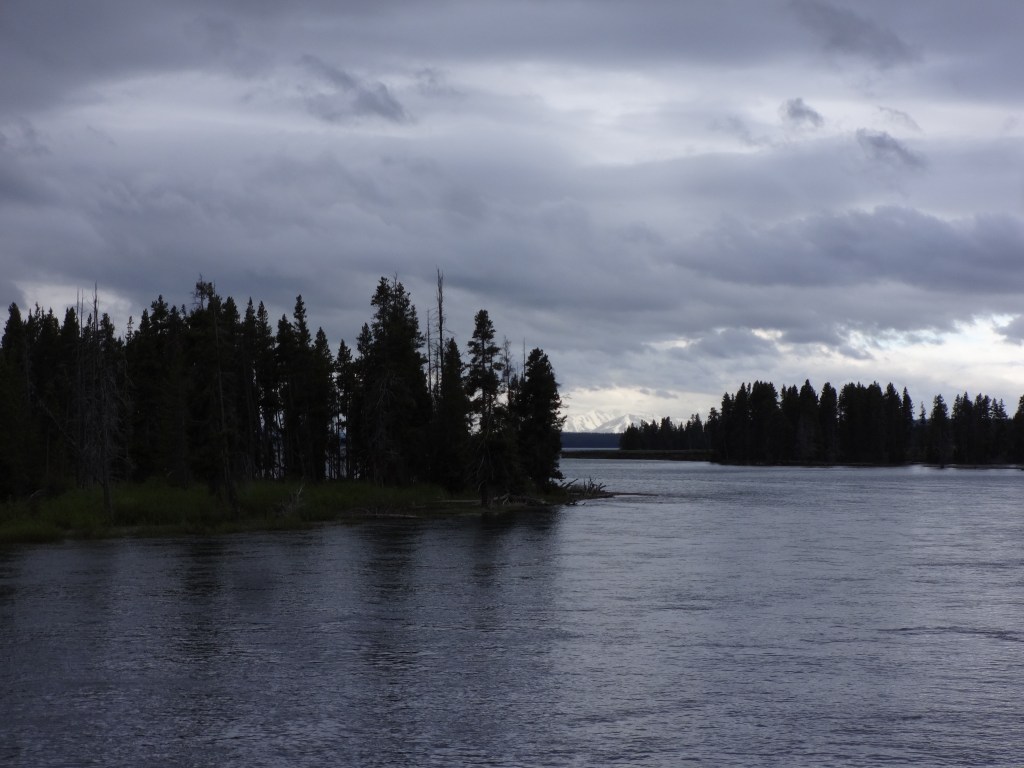
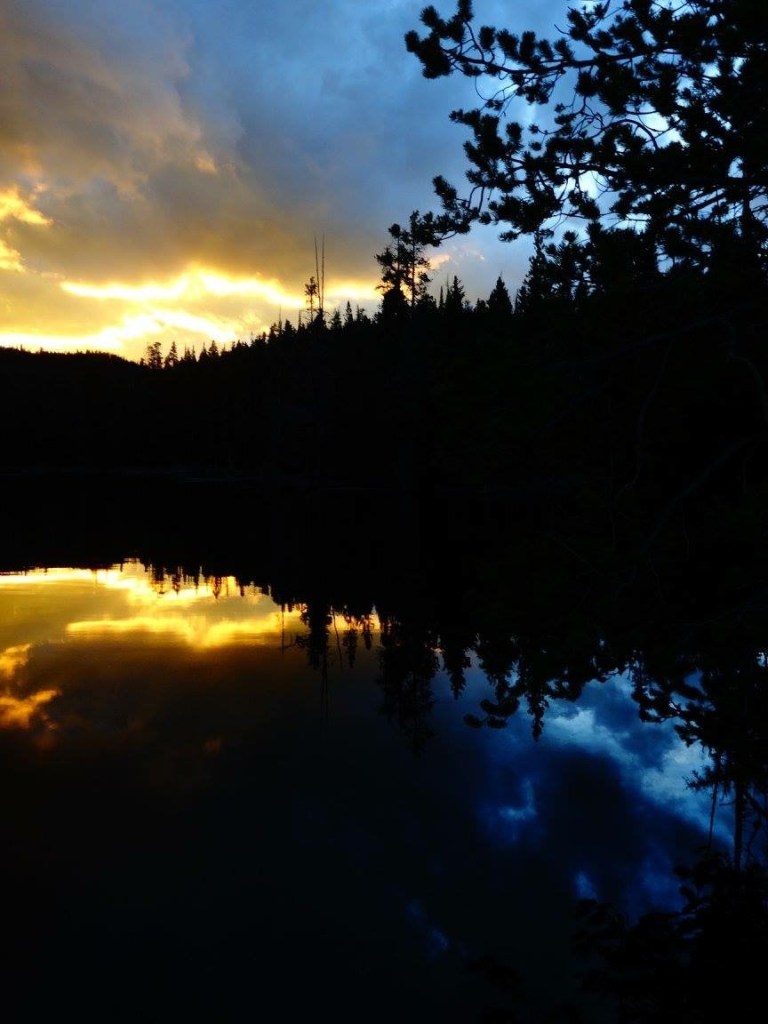
Once back at the car, and safe from all bear encounters, I’d drive over to the Grand Canyon Village once again for dinner, then I’d pass by Yellowstone Lake at sunset on the way back to my campground. On the side of the road opposite the lake, water flowed into a little pond. I pulled over as I observed the most stunning display of colors. Vibrant deep blue and orange, cast in the sky by the sunset, reflected into the pond with the dark silhouettes of trees. It was the most beautiful deep and rich display of colors. I really savored this view and the moment. 

This was not the only time I made a spontaneous pull off to the side of the road because beauty caught my eye. I had done it quite a few times throughout my stay in the park. Usually if one sees another car pulled over at a seemingly random spot, it’s because someone spotted some wildlife, and soon cars began to pile up. In this fashion, on a later trip to Yellowstone, I’d see my first wolf. At one point this day I pulled over because I noticed some beautiful flowers, and I wanted to take their picture. Then a number of cars slowed down, some pulled over. “What do you see? What do you see? Is there a bear, a buffalo?”

“No, I’m just taking a picture of some flowers,” I responded. They seemed disappointed, dismissed me and drove on. Oftentimes, in a quest to find the biggest or most shocking feature on the land, some people miss out on the exquisite detail of the smaller, finer things, like the flowers along the way, or the colors of the sunset reflected in the waters.
When I reached my campground I had completed a full day. Hiking up Mount Washburn was one of the final things I did. I had also visited the Mammoth Hot Springs area earlier and took in the unique stacks of thermal springs. I took a self guided tour of Fort Yellowstone at Mammoth Hot Springs where the U.S. Army was stationed to patrol the park in early days. Now the buildings which constitute the fort are ranger residences. My mind was captivated with the thought, and I daydreamed, of  what it would be like to call this place home. These buildings were homes. People lived here, had families here, had cookouts in the backyard as children played. Inside was their furniture, their things. This was their home, and it was in Yellowstone! How incredible! On a side note- something that rightfully needs to be documented, for it changed my life- here in the Mammoth Village I discovered huckleberry licorice, which would go on to become my favorite candy.

After visiting Mammoth Hot Springs, I visited Roosevelt Arch, and stepped foot into Montana for the first time. I then took Blacktail Drive, a scenic park drive on a gravel road. It was quite serene and I saw quite a number of buffalo there. I also took in the Calcite Springs Overlook. Midday I found myself sitting on a rocking chair on the porch at Roosevelt Lodge. This lodge and cabin complex was built in the 1920s at the site where Theodore Roosevelt once camped by llamar valley. It is rustic and has a lot of warm charm. I had already eaten and was not hungry, but I looked at the menu at the lodge. I saw a cozy dining room while a fireplace crackled. The buffalo burger on a corn bread roll really jumped out at me, and I kicked myself for not waiting to eat here. Someday on one of my journeys between Kentucky and Montana, I want to stop here and have the full Roosevelt Lodge experience. 
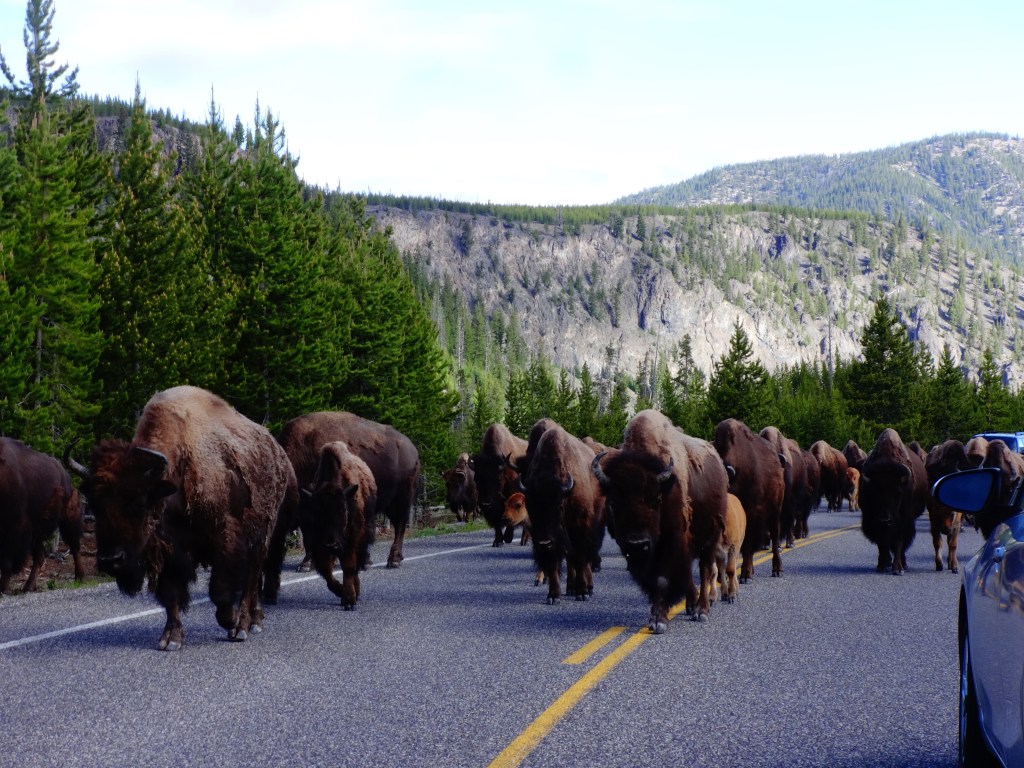
After my third full day in Yellowstone, I felt like I got to know the park, but knew there was much more to see and discover. I would come back and visit again. Next on my summer adventure plan was a stop at Craters of the Moon National Monument in Idaho, but before I left Yellowstone in the morning, I would find myself in a “buffalo jam,” as they call it. At least fifty buffalo overtook the road I was on. I came to a complete stop in my vehicle as buffalo of all sizes crowded around. They walked slowly around my vehicle. It was incredible. I saw buffalo calves for the first time. They look like strange deformed ponies, I thought. At one point a large buffalo stopped right in front of my car. He stared at me through the windshield. He nodded his head toward the right and then the left, and then looked back at me. It was as if he didn’t know he had to walk around the car. Oh No! I then became a bit concerned that the buffalo might try pushing my car or walking up upon it. After a few minutes it figured out the solution was to walk around. I could have lowered down my window and pet it’s back, it was so close. I was thrilled. This buffalo jam was perhaps the most unique and marvelous wildlife encounter I had ever had thus far. More kept coming and coming. I felt so fortunate to be here at just the right moment. I couldn’t have imagined a better crowd to wish me farewell on my journey.

Read the previous entry “Why I Cried at Roosevelt Arch- What Theodore Roosevelt and the National Parks Mean to Me” here: Why I Cried at Roosevelt Arch – What Theodore Roosevelt and the National Parks Mean to Me – on the verge (joshthehodge.com)

Check out my book Canyonlands: my adventures in the national parks and the beautiful wild here: https://www.amazon.com/Canyonlands-adventures-National-Parks-beautiful/dp/1711397873
Why I Cried at Roosevelt Arch – What Theodore Roosevelt and the National Parks Mean to Me

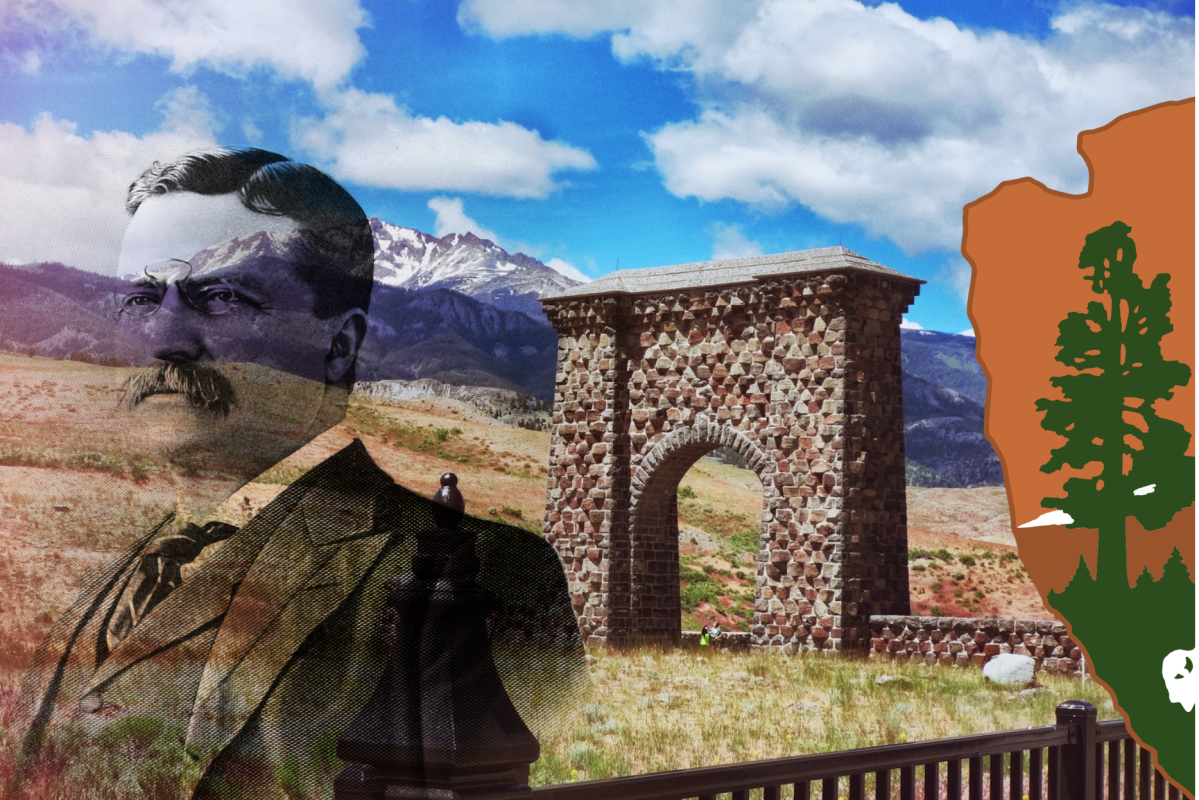
When I saw Roosevelt Arch I cried. It churned up an emotional response in me. This gateway to Yellowstone National Park, situated near the Northwest corner of the park, tugged at my heartstrings. To understand why, I must reflect on it and consider myself in the moment, for the emotions brought up were so deeply entrenched. It’s not something to skim off the surface of my being. 

I think to best understand the reason for my emotions I must consider Roosevelt Arch in three aspects. First, I must consider its symbolic meaning, what does Roosevelt Arch mean? Next, I must consider it’s visual appeal, why does this visual provoke this feeling? And thirdly, I must reflect upon the man whose name is inscribed upon it: Theodore Roosevelt. 

It is certainly not without evidence the measure of significance the National Parks means to me. I have visited so many and have written extensively about them. The National Parks are places I go to restore my soul. When life is burdensome, and I’m weighed down by the heaviness it entails, when I lose perspective and get caught in the rush and concerns of the moment, the National Parks with their magnitude, beauty, and remoteness have become places I go to step out of my troubles and find perspective. The immensity of the mountains, the richness of the forest, the profoundness of the canyons humble me and diminish the concerns in my own life as I gain perspective of the bigger canvas of life. 

As I am inspired by the grandiosity of things I also find such beauty in the smaller things- in the wildlife, in the design of plants, the way water flows and sits, and in the beautiful way the sun filters through the trees or paints across the plains. Everything big or small is so near perfectly balanced, beautiful and unique, reminding me of the awesome expansive creativity of God. And here, as I am surrounded by God’s artwork, I am reassured knowing the same wonderful Maker who crafted these lands and natural wonders is the Architect and Orchestrator of my own life. I see that the fingerprints in nature are the same fingerprints in my own design. It is such a humbling yet reassuring feeling to know the awesome Creator and Coordinator of nature has His hands on my life. 

Here in the remoteness and solitude of so many parks I am ushered into a place where I can focus in on this masterful Creator, to pray, to reflect, to enjoy His company in the still, calm, and quiet. Man has constructed temples, churches, and cathedrals, all of which can serve so much good, but God has also gifted us, in his own incredible design, temples in nature that point us back to him in a unique way. Whether it’s the stunning Yosemite Valley, the wide openings of the Rio Grande, the mountain peak in Appalachia, the spread of glaciers in the Rockies, or beneath a giant sequoia, these places of quietude and beauty are here for us to draw us back to the Creator. 

In addition to these spiritual aspects, there are other more broadly understood terms in which the parks have been meaningful to me. They have been places that have put me up to challenges, physically and mentally- taking on long strenuous hikes, pulling my weight up cliff sides, overcoming fear in turbulent water, and problem solving when things have gone awry. The experiences in the parks have strengthened me physically and mentally and in return have been good for my soul. In the same regard they have instilled in myself a greater confidence in my own abilities, and have given me a passion to which I identify. My experiences in the parks have molded me into the outdoorsman I am, have spurred in me the desire and necessity to learn new skills, and have kindled the appreciation and thirst for beauty and adventure. 

So here I was at Roosevelt Arch, this manmade structure was the first and primary entrance to Yellowstone National Park for many years. Montana was the main means of entry into the park as support for the exploration of Yellowstone primarily came out of the Montana Territory through the Washburn Expedition. When the railroad was brought to Yellowstone it came through Gardiner, Montana, and thus a grand entryway to Yellowstone was constructed in 1903 with the inscription above it “For the benefit and enjoyment of the people.” This phrase comes out of the Organic Act which established Yellowstone as a National Park, but it is unofficially a slogan used throughout the National Park Service. Standing here in front of the arch I see how it greatly contrasts the wild remote landscape around it of mountain and field. And this structure is bold and tall, a mighty gateway to Yellowstone. It was evident to me that this was the entrance not simply to Yellowstone but to the first National Park. Thus this arch, this portal, is where it all began. This is the doorway to all the National Parks and a monument to one of America’s best ideas. 

In this moment, before the arch, I was also swept away with patriotism. My country has chosen to preserve such treasures and honor such beauty. The heroes, the fathers of the National Parks- now long gone- made this possible, people such as John Muir, Theodore Roosevelt, Stephen Mather, Nathaniel Langford- all outstanding Americans. Just the fall before, a turbulent election took place. Some people became very vocal about their thoughts on the United States. Some citizens renounced patriotism and attacked the country with boisterous and repetitive rhetoric, and many in higher education proudly slandered our nation. When I was in New York City visiting my brother and sister-in-law, walking down Fifth Avenue, a group of young people chanted and pleaded for the abolishment of the United States. How infuriating that was, but how refreshing and restorative to be here at Roosevelt Arch to celebrate the natural wonders my country has chosen to preserve for the ‘benefit and enjoyment” of all people and recognize the patriots that made this possible. People need to get out of the cities every once and while and enjoy the wonders of nature and the diversity of the country. 

It is without question that my knowledge of Theodore Roosevelt himself is part responsible for this emotional response to seeing this arch. Theodore Roosevelt, more so than any modern historical figure, has had the greatest influence upon my character. It is largely due to the difficulties he endured and the principles by which he stood. This man knew pain, physical and emotional, to great profundities. Some may see him as privileged, and although he was in some regards, he also was a man of great misfortune. Life was not nice to him in many ways. He lost his father as a young man and both his mom and wife died soon after on the same day- a day in which in his journal he’d remark solely: “the light has gone out of my life,” with an X. This was a man who felt like he lost everything. Before, he spent much of his younger youth physically Ill. Severe asthma and intestinal issues plagued him. I have not experienced nearly as much hardship as Roosevelt, but I, like so many people, have faced my own hardships in life. I’ve had my own extensive and grave health issues, have lost dreams, and have been in emotional distress. How inspiring it is to see Roosevelt not allow himself to be beaten down by life, not to wallow in self pity, but rather do the most unexpected thing and learn to embrace the difficulties of life, to accept life for what it is, to find value in challenge and hardships. He grabbed difficulty by the horns and called it for what it is: “the strenuous life,” something he preached about. Although his lot in life initially dealt him misfortune, he did not let that hinder him. Roosevelt loved life. He had a passion for it in all regards, and lived it to the fullest, courageously and vigorously. 

This wimpy, sickly child, not expected to survive past childhood, would go on to occupy the bully pulpit. He’d clean up sin loving New York City as police commissioner and governor, charge up San Juan Hill as a commander, see that the Panama Canal was constructed under his presidency, attack corruption in Washington, author more than forty-five books, raise six children, and work to preserve more federal land than any other president, creating a culture of natural preservation. Although so accomplished as president, being one was not always in his plans. He once said he never wanted to become president, but he became one by destiny. When president Mckinley was assassinated in 1901, Roosevelt had to assume office. Although, expectedly so, he rose to the occasion and preserved the dignity of the office, he made light of the frivolity among the Washington political elite, for Roosevelt, despite his status, was a common man. He may have been born into the New York elite, but this man was relatable to the ordinary American. He’d camped with them, hunted with them, ate with them. He left the comforts of high-class New York City and became a rough and tumble cowboy and rancheman in the Dakota Territory. He did not simply identify with a class of people, he identified as American. 

Along with his firm sense of nationalism, Roosevelt also defined in his own terms what it meant to be a man. Having read many books by and about Roosevelt, this is a motif I’ve found that spans his life and story. Always to some extent he was preoccupied with thoughts of manhood and how to live up to and fulfill his duty as a man. He’d observe characteristics in others, then write about them and speak about them. He would come to define manhood by four principles: courage, hardiness, integrity, and independence. I think presently, our nation, as a whole, lacks strong male role models. Modern attacks on masculinity, and fatherless homes, have left a generation confused and lost in society. Media has watered down or redefined manhood in physical and lustful terms. The youth more than ever need men like Roosevelt to lead them and teach by his legacy. 

I suppose on a more uniquely personal level, I identify so strongly with Roosevelt because of his passions: America, history, reading, recreation, nature, and writing. Although hunting and fatherhood are two huge parts of the Roosevelt experience that I am not yet personally acquainted with, we have such similar interests and worldview, that an overwhelming majority of things Roosevelt said are relatable to me in some regard. Thus he has become quite intriguing to me. 

So with all these characteristics in mind, here I was at Roosevelt Arch. Theodore Roosevelt had laid the cornerstone for this magnificent construction that would be dedicated to him. With all the symbolic meaning, as a gateway to America’s National Parks, bearing the name of Roosevelt and the slogan, “For the benefit and enjoyment of the people,” how could I not get emotional? This place appealed to me on so many levels. This was the door that unlocked all the National Parks which would mean so much to me and to so many.

“Everybody needs beauty as well as bread, places to play in and pray in, where Nature may heal and cheer and give strength to body and soul alike” – John Muir, The Yosemite. 

Read the previous entry “Providence in Yellowstone” here: https://joshthehodge.com/2021/01/15/providence-in-yellowstone/

Check out my book Canyonlands: my adventures in the national parks and the beautiful wild here: https://www.amazon.com/Canyonlands-adventures-National-Parks-beautiful/dp/1711397873

Check out my book Theodore Roosevelt for the Holidays: Christmas and Thanksgiving with the Bull Moose here: https://www.amazon.com/dp/B08M8Y5P29

Providence in Yellowstone

It was day two in Yellowstone National Park. I slept soundly in my tent, despite the campground being full, crowded, and not having much privacy at all. 

On my morning stroll to the bathroom I saw a buffalo walking between two campsites right alongside the picnic table and a RV. I hadn’t expected it. I suppose he wanted to wish all us visitors a “good morning.” It reminded me of one morning in Rocky Mountain National Park when an elk was grazing right alongside a camper’s tent.

It was a cold and overcast morning. Wet clouds hung low overhead. I quickly disassembled my tent and threw it into the backseat of the car. I could only reserve this campsite for one night. Yellowstone in the summer is an extremely busy place. The next two nights I’d camp at the Grant Village Campground. Once in my car, I had some breakfast from my stash of dried foods and began my day’s itinerary as spelled out in my book. My first stop was at the Fishing Bridge. This long century-old log pole bridge stretched over the Yellowstone River just as it forms and flows northward from Yellowstone Lake. Pine trees stand snug at the water’s edge and some inlets give way to marsh. It was a quiet and peaceful place, especially at this time in the morning. I strolled quietly and contemplatively. Then a big bus came to a stop, hissed, opened its doors and a swarm of Chinese tourists poured onto the bridge, equipped for the misty weather with transparent ponchos and ready to take photograph selfies, nearly each one carrying a selfie-stick. 

More so than any other park, Yellowstone seems to be a favorite among Asian tourists. Tour busses full of these well-equipped tourists are found all over the park. In addition, signs in the bathrooms and outhouses instruct foreign visitors on how to use toilets in the United States; the general store at the Grand Canyon of the Yellowstone has an Asian food isle with a variety of noodles; and restaurants in the park seemingly cater to a certain tourist- namely with the noodle wok. Days prior in Grand Teton National Park, on my guided hike around Swan Lake, the Ranger brought this up, explaining how the influx of Chinese tourists is because of the current strong middle class in China. I also think it just must be in particular fashion in China to visit U.S. National Parks. Tour companies are designed for and are catering to this demographic, probably making quite a wealth for themselves. 

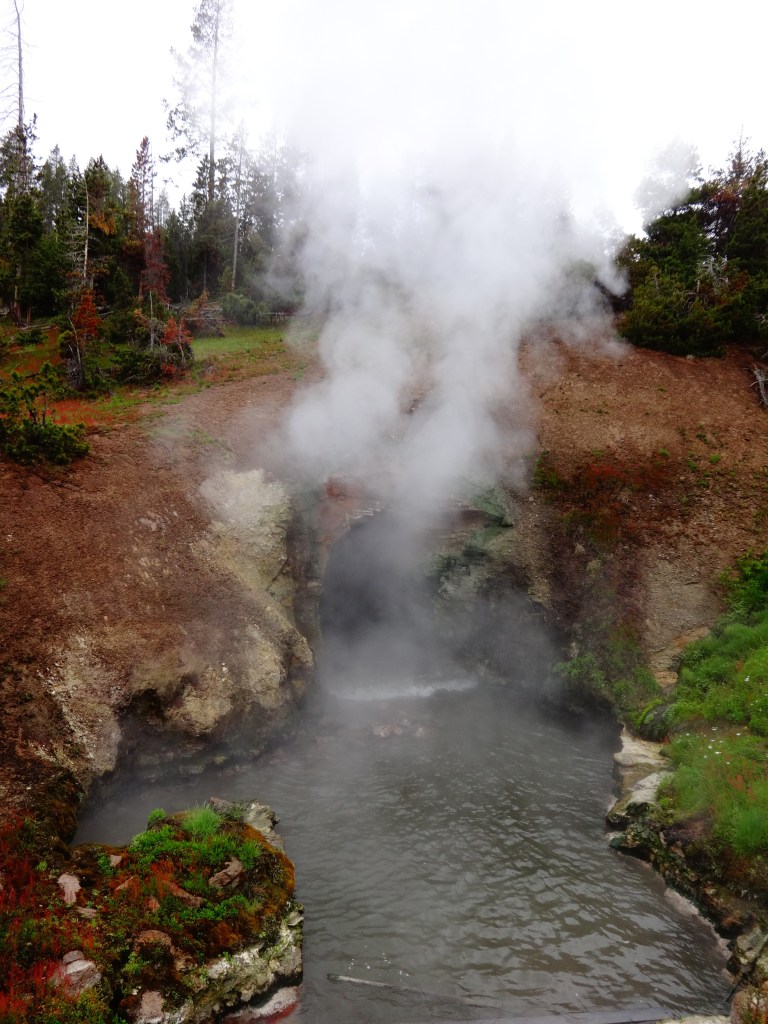
When I left the Fishing Bridge I proceeded Northward and drove a short distance to the Mud Volcano. On my way I saw another buffalo trailing the road. At the Mud Volcano area there was a short boardwalk around gurgling and burping mud pots of highly acidic water that erodes the volcanic rock and turns it into a sludgy thick ooze. The landscape here was very soupy with water sitting, boiling, slowly flowing, and burping up from the ground all around. The most impressive feature here was the Dragon’s Mouth. A hole in an embankment by a thermal pool hissed and gurgled as it constantly let out steam, resembling just what it’s title suggests. 

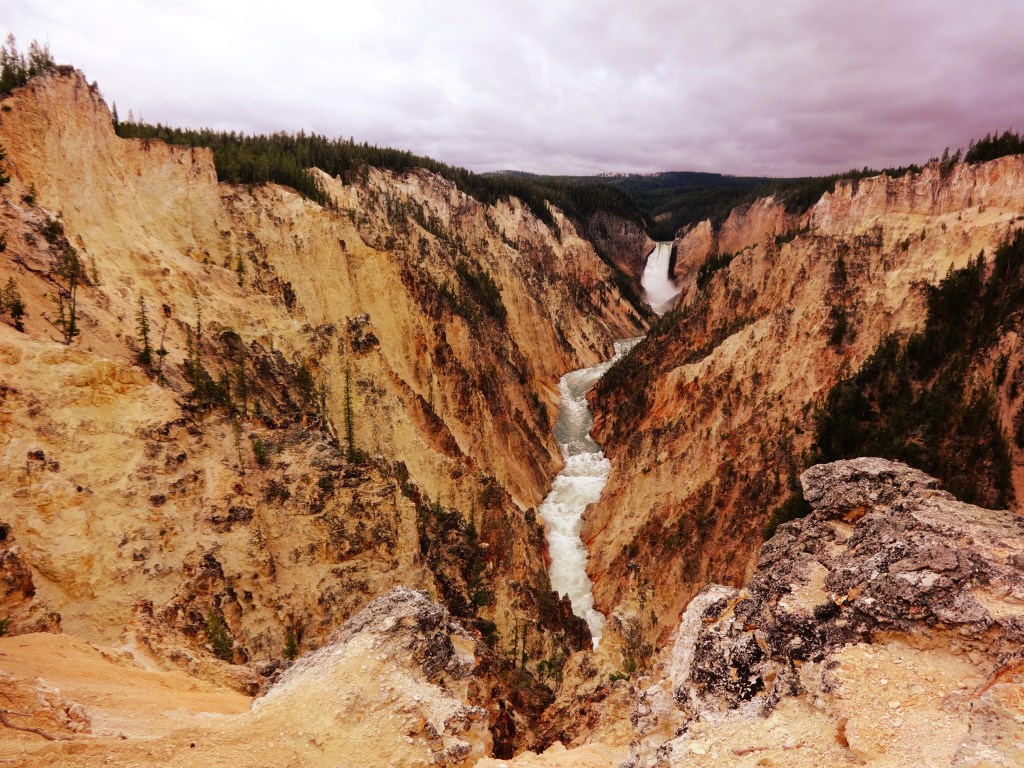
After making another couple brief stops I arrived at the Grand Canyon of the Yellowstone at Artist’s Point. There were crowds of Mandrian speaking tourists, posing in front of the viewspots once again with their selfie sticks. Behind them was one of the most magnificent views in the National Park Service: Lower Falls at the Grand Canyon of the Yellowstone. It is incredibly picturesque. A platform juts out at the edge of the canyon, where crumbling yellowstone is on display traveling down to the focal point of the perfectly flowing immensity of the Lower Falls which is so entirely uninhibited. This is one of those marvels of nature which is hard to take in and gain perspective of. The beauty before you is just astounding. You feel almost as if you are trapped in a painting trying to gain your bearings. Although I was surrounded by people, I tuned them out, and my mind and eyes became fixated at the wonder before me. Captivated would be the most appropriate word. All the sounds and clutter around me dispersed, and I was still, calm, and quiet to my perception. What a wonderful piece of artistry- truly striking- not happenstance but designed. 

Then… “Take photo?” asked the tourist in broken English. “Sure,” I replied. When I was done taking the photo I turned behind me to look off the other side of the observation platform to the peculiar display of the canyon walls which slid diagonally down towards the river from a definite abrupt edge of pine treeline. Colors were on strange display here in nature’s own pink and yellow drooping down in rock formation like melted crayons. 

While in the area I escaped onto a trail that followed the ridgeline. At one point it veered into a dark and moist forest, and at the time I thought this might have been a prime bear habitat. All alone with not much experience in bear country, I decided to head back towards the crowds. I  drove over to the trailhead for Uncle Tom’s Trail, where I descended 328 stairs to the base of the Lower Falls. It was cold and wet, and my stay was brief.

My next stop was at the commercial area of the Canyon Village. Sharing a parking-lot was a general store, an outdoor gear shop, a souvenir shop, and the Canyon Lodge, which is not exactly a lodge but a cafeteria. The cafeteria was very nice and newly renovated in a 1960s style. Something also about the design made me think of a lodge. It seemed like I was at a high elevation ski lodge, not that I had ever been to one before, but it gave off that vibe to me. Here there were two lanes, two sections: One they called “American food” and the other “Asian food.” I was surprised no one had thrown a fit about their terminology in this “woke” era. For me it was just fine. I thought most fitting for my visit to Yellowstone was some classic American cuisine. I had a pot roast with smashed potatoes and gravy with mixed vegetables and garlic sauce. I was surprised by the quality of the food- top notch for a National Park- so much so that I’d come back here to eat the following day. 

My first trip to a National Park in my adult life was in the fall of 2014 to the Great Smoky Mountains National Park in Tennessee. This was the fall after my summer trip to Disney World. Being a classic Disney fan, the trip was everything I hoped it could be, or “magical” I guess is what they say. I enjoyed hopping from one park to another, moving about from one attraction to another, and taking the buses around to visit the different resorts. The Great Smoky Mountains National Park, with all it’s different parts, whether the high reaches of Newfound Gap, the scenic valley of Cades Cove, or the hub of the Sugarland, it’s variety is similar to the different parks in Disney World; and all its different features like Alum Cave, Clingmans Dome, Laurel Falls, Charles Bunion, etc. are like all the rides and attractions in Disney World. I remember thinking the Great Smoky Mountains National Park is the Disney World for the nature lover. Not every park is like this. Not all parks have different sections and a plethora of varying attractions, but Yellowstone most certainly does more so than any other park. Yellowstone has an abundance of “attractions”, numerous villages, lodges, and restaurants. It is an enormous theme park. I’d say The Great Smoky Mountains is more like a Disneyland and Yellowstone is Disney World. It’s at a whole different level- or “a whole new world” as they say.  

After having lunch in the Canyon Lodge I proceeded on my journey. I stopped at the Museum of the National Park Ranger between the Canyon Village and Madison by the Gibbon River and Gibbon Falls, which I also admired. I tell my students back in Kentucky jokingly that when I grow up I am going to be a park ranger. I so admire park rangers and think it would be a most intriguing profession. So, without a doubt, a stop at this museum was necessary. The Museum of the National Park Ranger was located in an old building that used to house soldiers back when Yellowstone was patrolled by the U.S. Army in its early days. This museum gave a brief history of the National Park Ranger; showed a re-creation of an early ranger residential quarters; displayed old newspaper articles and photographs; showcased badges which signify different rankings and classifications within the ranger system; and most fascinating to me at the time, displayed a map from 1916 of the United States with all the National Parks labeled. Something on this map jumped right out at me: a number of the National Parks on the map were no more. What happened to them? There was a retired park ranger volunteering to answer questions in the museum. So naturally…

“What happened to these parks on this map that don’t exist anymore.”

He seemed pleased to have a question to answer. His grey mustache bounced up and down as he spoke. His passion for the National Parks was evident. “Well, some were given back to state and local supervision, and others were defaced so much that they lost their cultural value.” I found this to be quite an interesting bit of information. Later, in my days working in Montana, I’d get an original publication of the book Oh Ranger by Horace Albright. In this book there is a map with a number of National Parks and Monuments that also are no more. At Seven Islands State Birding Park in East Tennessee an exhibit on Tennessee State Parks explains how a number of National Park units in Tennessee were redesignated as state parks. 

When media outlets complain of a politician downsizing federal lands, I’ve come to find that really, in many instances, the public land is put back into the hands of state and local municipalities. This detail is left out in reporting as it doesn’t always fit the narrative. Mackinac National Park became Mackinac Island State Park. Lewis and Clark Cavern National Monument became Montana’s first state park, Father Millet Cross National Monument became Old Fort Niagara State Historic Site, and the proposed Pioneer National Monument became a series of state parks in Kentucky including Fort Boonesborough State Park, to name a few.

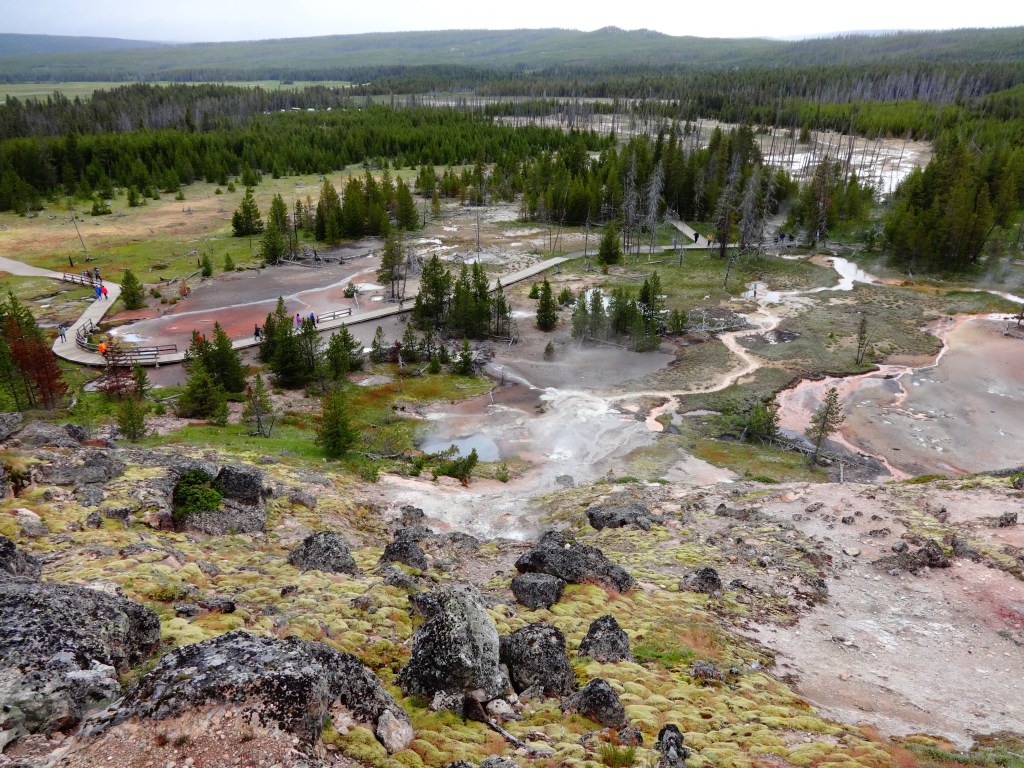
Once done at the museum and with my pleasant chat with the retired ranger, I continued on my journey and down the left side of my day’s loop. The main parkway is like a number “8.” I was on the left side of the lower loop. The upper loop of the “8” I had not seen at all yet and would be reserved for the following day. On my journey on the lower loop I stopped at the Artist’s Paintpots where a number of mudpots, fumaroles, and springs painted lavalike colors across the broken and soupy landscape of delicate earth. A boardwalk guided the tourists among the features. I had plans to stop at the Midway Geyser Basin to see the famous Grand Prismatic Spring. But the traffic was backed up to the road. I decided I’d come back early in the morning.

I proceeded to the bottom of the number “8” on the West Thumb of Lake Yellowstone where I had a campsite reserved at the Grant Village Campground. I checked in and set up my tent in the cold misty forest. It was very similar to the campground I stayed in at Grand Teton National Park. The Grant Village Campground provides visitors campsites within little nooks in the forest. It’s a quiet, recommended campground in the park. After setting up camp I went to the general store, which had a small cafe attached to it selling sandwiches and ice cream. I ordered a sandwich. When I held out my debit card to pay, the employee asked to see an ID. 

“Kentucky! We are from Kentucky!” the cashier exclaimed. “My wife and I are from Louisville. We are teachers. We just work the summer here in Yellowstone.”

This is an important moment in my life. My mind flashed back to the waitress in Jackson Lake Lodge talking about how she got a summer job online, and I remembered she wrote me the web address to find summer jobs in National Parks on a napkin. I briefly thought about pursuing it, but I had doubts as a teacher if I would have enough time and the capability to escape from my normal life for such a adventurous summer job. But then this couple were teachers here from my state! They were able to work around the education system in Kentucky to get away for the summer. If they could do it, I could do it! I would do it! They had inspired me. 

Trying to follow in their footsteps, a year later, in the winter, I applied and pursued vigorously the opportunity to work in Yellowstone. I was shot down. They wanted more of a time commitment than what I could offer as a teacher. This didn’t stop me. There had to be a way, for this couple did it. I tried other parks. I tried Big Bend National Park in Texas and Glacier National Park in Montana. I received job offers from both! A privately owned mercantile just outside of Glacier National Park won out. In the summer of 2019 I’d find myself working my first summer in what would become my most favorite place on earth. My heart would get lost in Montana, and my experiences in Montana would be some of the fondest and most meaningful in my life. The people I’d meet in Montana would become some of my most treasured. It was this moment in Yellowstone- this teacher couple from Kentucky- who would put all of this in motion. Coincidence? I think not. Coordinated? Definitely.  

Read the previous entry “Lands Alive: My First Day in Yellowstone” here: Lands Alive: My First Day in Yellowstone – on the verge (joshthehodge.com)

Check out my book Canyonlands: my adventures in the national parks and the beautiful wild here: https://www.amazon.com/Canyonlands-adventures-National-Parks-beautiful/dp/1711397873

Lands Alive: My First Day in Yellowstone

Yellowstone, with gurgling mud pots, colorful pools, hot springs, and geysers shooting into the air, it’s nature’s wonderland. Herds of bison, elk, the curious badger, and ravenous wolves call it home. Cascades and waterfalls, sprawling valleys, rivers, and lakes are pocketed in all corners. It’s so huge and magnificent that it’s daunting to even write about. It is the first National Park, founded in 1872, and among the larger ones at 3,471 square miles, larger than Rhode Island and Delaware combined. Central Park is to New York City as Yellowstone is to the United States of America. It is America’s park. 

I wanted to give myself plenty of time to make acquaintance, so I had given myself three days, but one could really spend a lifetime exploring its vast wonders. I had bought a book in the gift store at the visitor center of the neighboring Grand Teton National Park titled “Yellowstone in a Day,” published by the Yellowstone Association. It really spelled out an itinerary for Yellowstone in 3 days with optional additional days itineraries.. It was precisely what I needed, and so truly I visited Yellowstone by the book. It calmed my worry that I might miss something of importance. I knew assuredly, before all else, that I needed to see Old Faithful. That was a must, along with the Grand Canyon of the Yellowstone. I knew I wanted to see Grand Prismatic Spring, but at this point, arriving at the park, I didn’t even know its name nor if the images I had seen of a grandiose and colorful pool were of various springs around Yellowstone or one specific. I’d learn that Grand Prismatic is definitely that one that sticks out from the rest, boasting its own character, photographed many times. 

West Thumb Geyser Basin

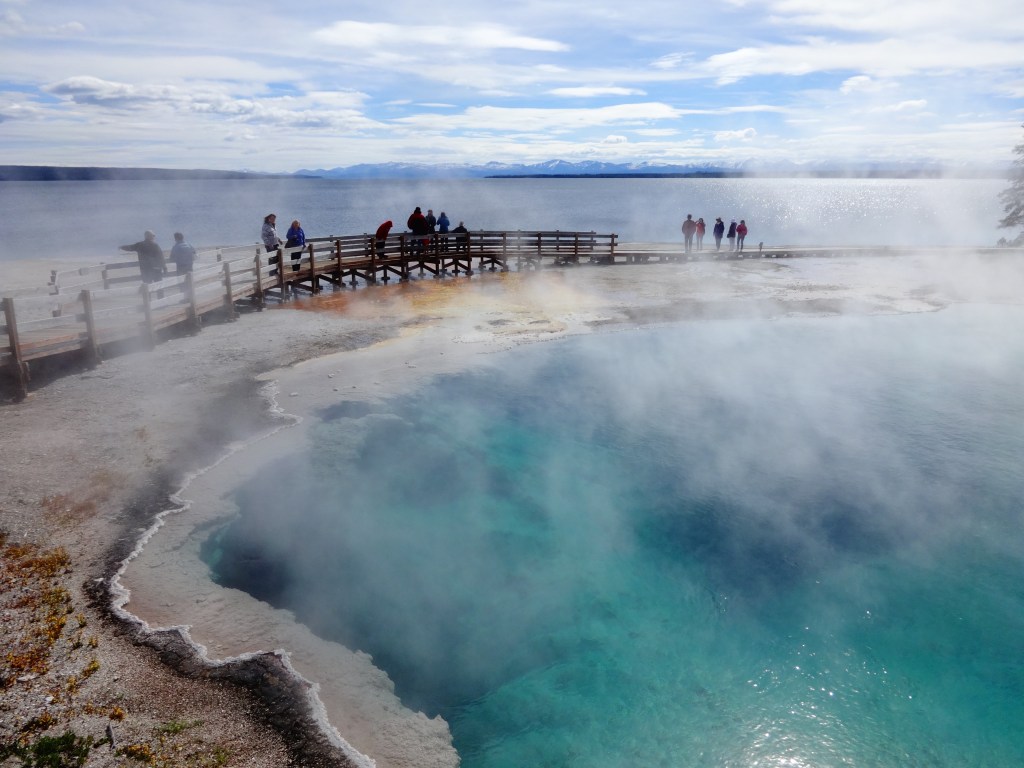
I entered Yellowstone from the south from Grand Teton National Park via the John D. Rockefeller Jr. Memorial Parkway which connects the two parks together. I beheld the entrance sign and took my photo by it and then proceeded to the West Thumb Geyser Basin. Here a half mile boardwalk meanders atop of a delicate landscape where a number of geothermal springs display extravagantly bright turquoise pools which steam into the cool air. Signs warn that the ground may be thin and advise visitors not to step on it but to stay on the boardwalk. Thus the ground appears to the eye like a thin pebbly and crispy crust just atop a earth that bubbles and steams, alive and breathing. The boardwalk descends down along the side of Yellowstone Lake, where one can see over three miles across to the snow capped mountains. Just aside the boardwalk are a few geothermal features within the lake water visible to the eye. There is one called the Fishing Hole. It is not more than a mound that pokes up in the lake with a couple-foot hole in the top where boiling water feeds into the lake. It got the name as the Fishing Hole because there is a tale of a man who would go fishing right here in Yellowstone Lake. Once he caught his fish he’d dip the line over in the hole and cook his fish right there and have himself a meal.

When I came near the completion of the West Thumb Geyser Basin Loop, a female elk popped out of the adjacent pine forest and stepped onto the boardwalk. She simply crossed over the boardwalk and meandered between the geothermal pools. People stopped and gathered to take pictures. I was surprised how unfazed the elk was with all the visitors- but most animals in Yellowstone are rather comfortable with visitors. It’s as if the animals are trying to say. “This is my home, I am quite comfortable here. You are on my turf.” As a visitor, I really do feel like I’ve come inside the animals’ home in Yellowstone. I truly am a visitor here- more so than in any other park. This is the animals’ park.

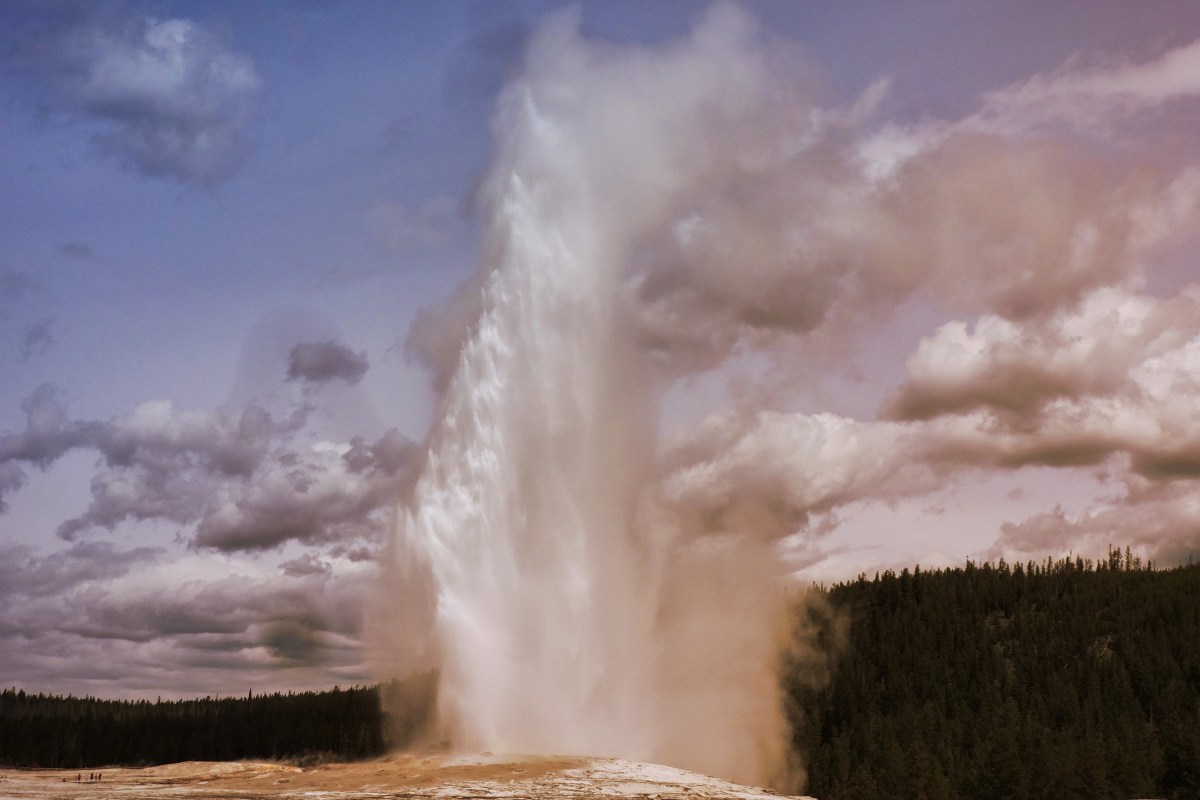
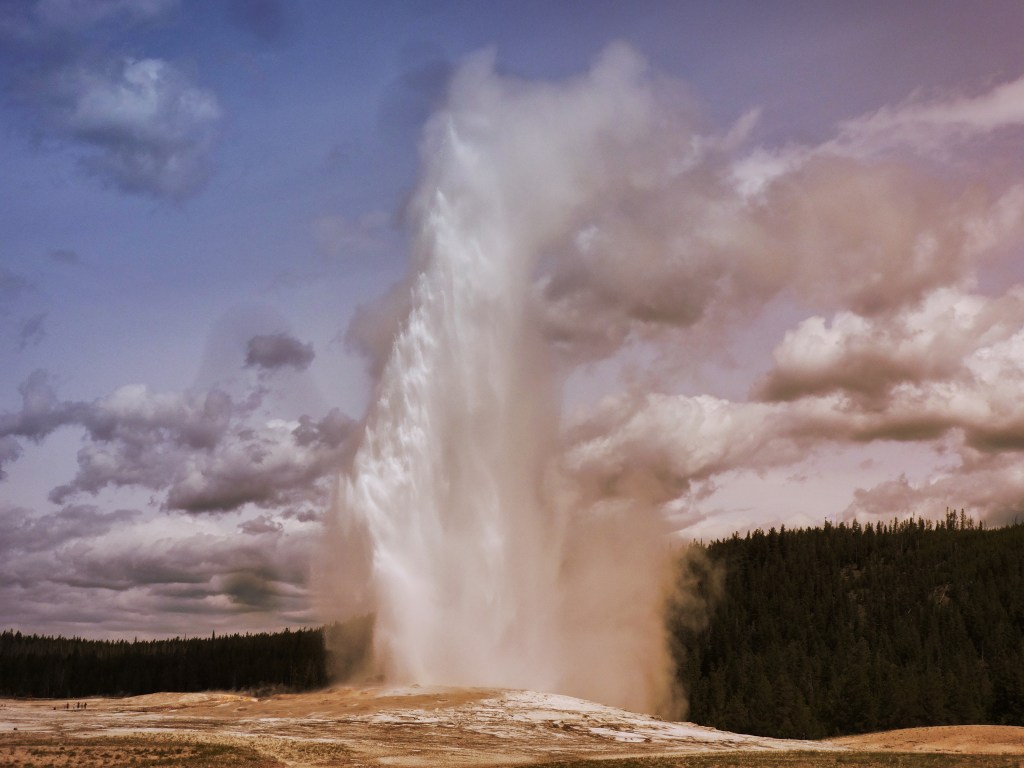
Leaving the West Thumb Geyser Basin in car, I traveled to the Upper Geyser Basin, the home of Old Faithful! This is perhaps the most prized feature of the National Park Service. The parking lot conveys so with its enormous size. Here a village sprawls horseshoe alongside this feature. Here in this park within a park, is the Old Faithful Inn, Old Faithful Lodge, main park visitor center, Snow Lodge Cafeteria, and a large gift shop and general store. I wanted to see it all, and so I did. When I left my car, I saw a number of noisy crows perched atop a few vehicles. Were they welcoming me, or was their pestering cry their attempt to tell me to go away? Probably they were just looking for handouts. I rushed into the village in excitement. I just had to see Old Faithful erupt! I learned she did so about every hour. Enormous crowds gathered around a boardwalk which outlined the site of the geyser. Some wood benches were built into the boardwalk, but they were already taken. Intently observing, before its eruption there were a few brief spurts, leaving me wondering is that it? Sometimes tourist attractions can be overhyped, but when Old Faithful did erupt, she DID erupt, unmistakably, shooting into the sky pillars of water. People oohed and aahed, and it was everything I hoped for. Water towered upon water, hissing and boiling. It was an overcast day so unfortunately Old Faithful didn’t contrast against a blue sky, but she was still visible with great billows of steam. When the tower of water sunk back into the ground, the tourist quickly disappeared. Many headed back to the parking lot or into the gift shop. I was hungry and ready for lunch. I ate in the Old Faithful Lodge cafeteria, which has an exposed log frame and overlooks the site of Old Faithful through its big windows. This was one of five choices for me to eat just in this village, but at the time I did not know. 

Upper Geyser Basin

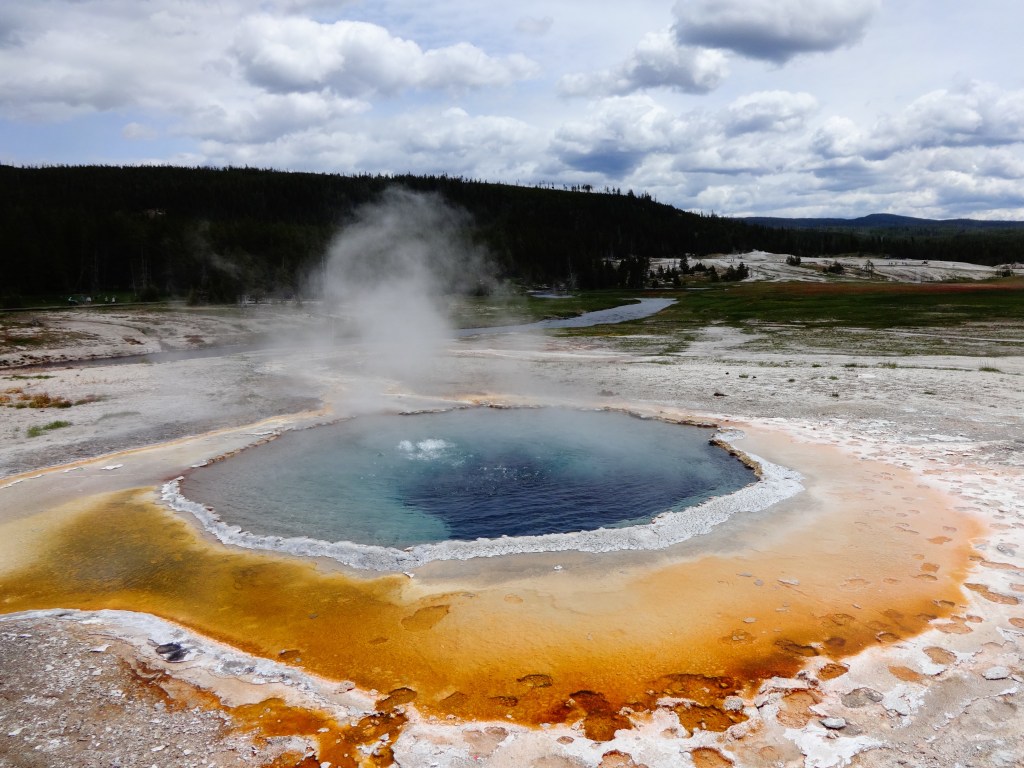
When I was done with lunch I took the couple mile boardwalk loop from Old Faithful along the Firehole River to the Upper Geyser Basin boardwalk. Here there were numerous geysers, the highest concentration in the world. There was lots of hissing and bubbling all around, and the air was filled with the repugnant smell of warm sulfuric acid evaporating into the cool mountain air. Seemingly at random, a geyser would erupt for a few minutes, tourists rushed to it, but then moments later elsewhere along the boardwalk, another would erupt and the tourists were drawn to another direction, each tourist reveling in the presumption that perhaps they were the first one to have seen the geyser erupt in maybe hundreds of years, but most of these geysers like Old Faithful are pretty consistent.

When I neared the farthest end of the path, I was desperate to go to the bathroom. The hissing and bubbling eruptions, and the flowing water taking place all around, did not help my predicament. There was a line for an outhouse of about a half-dozen people.  I couldn’t fathom having to wait so long with the urgency I was experiencing, but I did and in the meantime I helped a few tourists open a bear proof garbage can. They were struggling and did not know how to open it. I felt quite experienced. 

When my walk through the Upper Geyser Basin was complete, I was back next to Old Faithful and walked into the Old Faithful Inn. I get goosebumps on the verge of writing about this place, because it is the most impressive structure and most magical hotel in all of the National Park Service. It is the first “grand” lodge in all of the National Park Service. Shabby accommodations did exist beforehand, but this inn took everything to another level. This became the largest log hotel in the world. This inn was also the birth of the National Park Service Rustic architecture style, which sought to create buildings which harmonized and fit in with the natural surroundings. Imperfections and asymmetry, rebellious to the styles of the industrialized world, were welcomed. Hand labor contributed greatly to this style, and Robert Reamer who designed this hotel went on to create a number of other lodges in National Parks. When Theodore Roosevelt and naturalist John Burroughs toured Yellowstone in 1903 they saw plans for the lodge, and it’s been noted that Theodore Roosevelt praised the plans extensively.

Old Faithful Inn

When one walks into the lobby he or she is greeted by an enormous stone stacked fireplace in the middle of the atrium. Its chimney is extremely bold, larger than the rooms would be in many houses, and it extends six levels up through the rustic log roof. The logs which make up the whole building are not shiny and refined, but rough and rustic, unpolished and wild. Each level has a balcony which looks down into the main lobby. Just standing in the lobby looking around the place impressed me greatly. It truly looked handmade, and most of it was. It’s a mighty fortress of a structure and the epitome of a childhood dream of a fort in the woods. The top two levels in the lobby were small crows nests for musicians. Back in its earlier days, dances were held on this lobby floor to the live music above. 

I wanted to spend some time here and enjoy this building and its architecture, so I went to the small cafe adjacent to the lobby and bought an overpriced cinnamon scone and a cup of orange spice tea. I walked up the rugged uneven stairs, noticing families on vacation climbing the stairs causally, hauling their suitcases. I couldn’t even imagine the delight of spending a night in such a place. I’d be so elated you’d see it all over my face. On the third level I stopped and sat on a rocking chair which faced the railing before me and the lobby below. A violinist up in the crow’s nest began to play soothing and relaxing music. This moment was so perfect. I just reveled in and savored it. The sights, the sounds, and the comfort of my hot tea were all perfect. 

Resting here I imagined what it was like back in the day when the only way to this remote lodge was through the great wilderness on coach. There weren’t any roads nor the infrastructure of today. What a magnificent place to come upon in the wild after days of travel by horse, foot, or coach. The warm fireplace would have been so welcoming, and although rustic in style, this would have been luxurious. I imagined the visitors all dressed up dancing across the wooden floor below to the sound of the fiddle in the rafters. 

Kepler Cascades

Then, stop, I reminded myself: Be still. Be calm Be quite, and be ever present in this moment, savoring it completely for what it is. I so thoroughly enjoyed my break of peace and quietude here and often think back to it at the mention of Yellowstone. After sitting here for probably a good half hour, I resumed meandering around and found myself outside on a rooftop terrace facing Old Faithful. She was erupting again and I enjoyed it all a second time. This was a great vantage point of Old Faithful without the herds of people. It was cold outside so I didn’t loiter for too long. I went back in and went into the gift shop in the inn. I bought two post cards- one vintage one for my parents and another artistic one for my friend Ricky in California. I took them with me to the second floor where a few small old wooden desks outlined the walls. The desks had built in lamps and cozy wings for privacy. I filled out the postcards and then decided I better head to camp. I took a short stop by the Kepler Cascades, as the book instructed, on my way to my campsite at Bridge Bay, which I had reserved months in advance. 

I arrived at the campground just before dusk. The campsite was mostly an open field with no privacy and very few trees, but I didn’t mind. By the time I was done setting up camp, the sun had set and I could hear a ranger giving a talk over at the campground amphitheater. I thought about joining but felt my time was best spent getting reorganized in my car and off to bed. After cleaning out my car and getting organized, I made my trip to the campground bathroom to brush my teeth, and then I settled into my tent with my park map and my “Yellowstone in a Day” book to see what the plan would be for tomorrow. 

Read the previous entry “The Mighty Tetons” here: The Mighty Tetons – on the verge (joshthehodge.com)

Check out my book Canyonlands: my adventures in the national parks and the beautiful wild here: https://www.amazon.com/Canyonlands-adventures-National-Parks-beautiful/dp/1711397873