What Kind of Mountain Are You?

Finally we arrived at Mount Saint Helens National Volcanic Monument. I was in awe of the immensity of the landscape and baffled that something so grandiose and impressive didn’t get more attention. I hadn’t heard much about this place, and I only came across it while looking at a map of Washington state. Perhaps if I was alive when the volcano erupted in 1980 I may have known more about this place. 

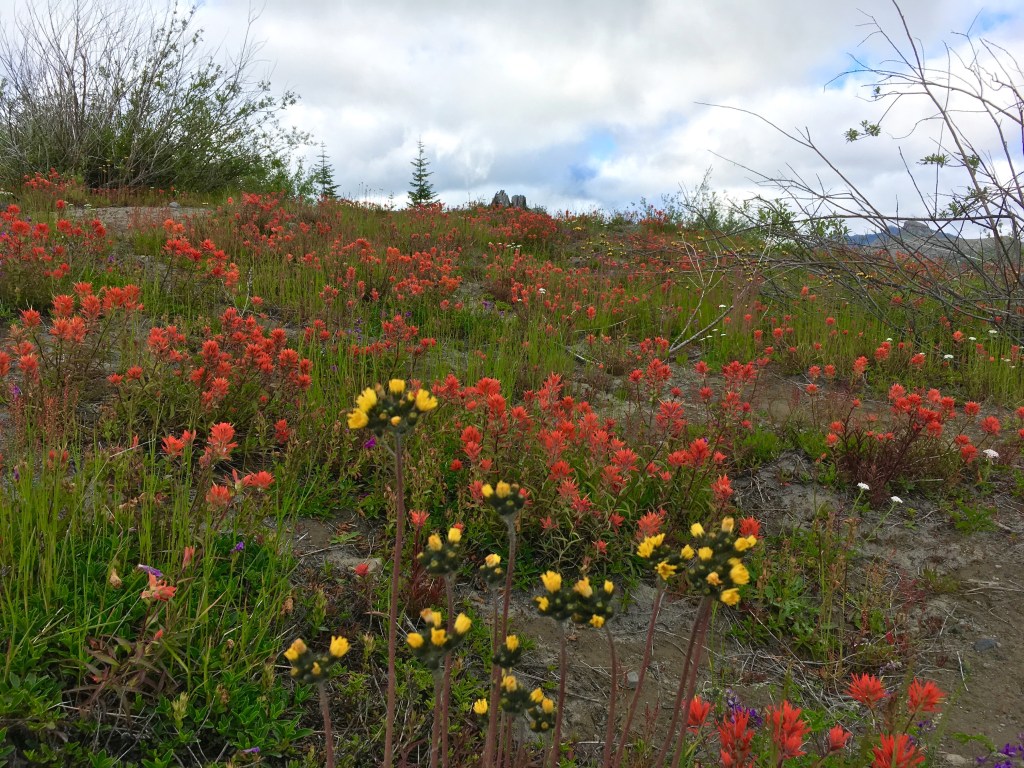
After learning about the volcanic eruption in the visitor center, Zach and I were chasing down even greater views on a small path that led from the Johnston Ridge Observatory on the foothills of the behemoth of a mountain base before us. We were free after being held captive by the journey in the car for much of the day. We were about four miles from the mouth of the beast, when I sat down alongside the path next to some Indian paintbrush and other small mountainous blooms snugly grasping onto the sides of the path between jumbled rocks. There I beheld what would have been, less than forty years ago, Washington’s fifth tallest peak, but now it was just the base of a mountain. It was still tall, nevertheless, slanting upwards to 8,363 feet, but it was missing its peak which would have topped it off at an additional 1,400 feet. Now instead of a peak it prominently displayed a giant volcanic crater. Looking at Mount Saint Helens, I knew I wasn’t looking at any ordinary mountain. It proclaimed volcano loud and clear for despite its enormous crater, it displayed its sprawling avenues and canyon ruts where lava once flowed, and much of the mountainside had been ripped barren and replaced by volcanic rocks. In some small crevices, plant life had resumed, but the sprawling directions in which its destruction spread was still very evident. 

Adding to the volcanic ambience, this evening a spread of clouds hung just below the crown of the crater, giving the illusion of smoke and adding great perspective. It also made the mountain look very regal with the pointed rocks edges spiking up like the palisades of a king’s crown, and the clouds added an element of fantasy, really elevating the scene. Although Washington is a very mountainous state, here no other mountain stood in the background of this one, at least nowhere near her height. Mount Saint Helens stood alone, bold and royally, popping out against the rich blue sky. 

I was particularly fascinated by the avenues, ruts, or canyons surrounding and sprawling from the creature like veins. They were prominently displayed with the evening sun lower in the sky, casting sharp contrast against the land and allowing the canyons to cast their own dark shadows within. These were “canyonlands” not illuminated by light, as I’ve discussed before, but ones trapped in darkness. I wondered what animals roamed down there. I wondered how enormous these places would seem on foot. Have people even explored all of them? It was fascinating to think that only a handful of decades ago, these divots didn’t exist. This was once Washington’s fifth tallest mountain, but then in 1980, instigated by an earthquake, Mount Saint Helens erupted. It was the deadliest volcanic eruption in the United States, spewing ash in a 250 square mile range and sending billows up to sixteen miles into the sky. Before then, this landscape would have been so different. It had been drastically remolded. As John Muir would see it, it was God at work, still designing his earth, molding the land through natural phenomenons. 

I was still fixated on the massiveness of this area and how its present landscape was relatively new. Even the divots aside, I was wondering if the whole mountainside in general had been fully explored in its current state. What was hiding out in all of nature’s rubble? What fantastical rock formations and marvels surround this thing in its new design. It was such an enormous space, that I imagined other National Parks I’ve visited fitting entirely in the space this mountain base encompasses. I thought how even some cities could fit within the crater alone. I wish I had time to roam freely and explore this land without a care. It would be fun to disappear into this thing, getting lost in its immensity and wonder. But I couldn’t. I had responsibilities and an itinerary.

As I sat there, I did what I like to do in front of beautiful vistas: I closed my eyes, took a deep breath, and opened my eyes to be re-amazed by what was in front of me. Then the wind started to roll in, and I was getting cold. I crossed my arms, hugging myself in my flannel. Before having to leave, I had to get into the important thoughts. Observing the volcanic mountain, I posed the question, What does this mean? What is the message of Mount Saint Helens? 

I was looking towards a crater, as I had done just the day prior at Crater Lake National Park, but Crater Lake seemed entirely different from this place. Crater Lake was distinct in appearance and messaging. But there was one commonality. They both started with a volcano, meaning what they are today was birthed by a violent natural event. What made the places so distinct from each other were their outcomes after the explosion. Crater Lake was a place of serenity, of beauty, tranquility and peace. It gave the message that despite pain, loss, suffering, there is peace and beauty. Mount Saint Helens today could be described as beautiful by some too, but it’s for sure a different beauty from Crater Lake. It’s impressive and awesome, but beauty is actually not the word I’d use for it at all. It looked very much still like the aftermath of destruction. The rubble was in clear view, the paths of destruction evident. It was like a scab was ripped from a wound not fully healed. It was a raw landscape, not replacing the destruction with the serene, but blatantly announcing its story of violence. The crater was not filled with rich, pure, calming blue waters but was empty, vacant, and void. Where forest once spread across its mountainside was barren rock and pumice. 

I then had to think about what I’ve already concluded about mountains. Two summers prior, when I was at Great Basin National Park in Nevada, I was standing below Wheeler Peak thinking about how solid and strong the mountain was, and I started to think about the word unwavering.  I wrote: “I observed how the mountain is very bold despite erosion and the rock glacier. It’s still not going anywhere. The mountain is firm, steady, resolute, and then I began unpacking the word that would last and linger with me– unwavering. It’s been my observation in life that consistency in a person is hard to find. People come and go. They change, they disappoint, and the slightest variation in weather can even disrupt a person.  I do not want to be this type of person. I want to stand strong. I want to be a person others can rely on– a constant, a non-variable, dependable, and above all unwavering.” 

Mount Saint Helens was not unwavering like Wheeler Peak. This mountain had betrayed its surrounding landscape and all the life that had put trust in it. It left damage, took lives, and left voids, and its said it may eventually erupt again. This mountain did not produce the beauty of Crater Lake nor the security of Wheeler Peak. I began to adopt the notion that there are different types of mountains, and they have different meanings, but that all mountains are representative of different kinds of people. There are the bold unwavering mountains like Wheeler Peak and the majority of mountains I’ve seen, but few people I’ve met. Then there are those volcanic mountains, like people who have gone through pain, suffering, and trauma. Some volcanic mountains return from those dark moments in life with a new found peace, beauty, they are born again into something greater like Crater Lake. But other volcanic mountains, like Mount Saint Helens, are like people who have been badly hurt, but they haven’t gone through the powerful process of redemption. Instead, they have built up resentment and anger to then spew hateful words and actions. They are abusive. Their anger is not controlled, and thus they are explosive, wielding destruction around them. They abuse their children, snap at their coworkers, fight with their spouses. Their anger and discontentment change the life and environment around them. They take the books of others and scribble into them or rip out pages. They also have unfruitful mountainsides, not rich in life, but barred and covered by mistakes, leaving no fertile ground for anything to take root. I know some of these people, and we all have potential to become such volcanic mountains. It is in our nature to be ruled by our human emotions, to become heated in anger and inflict unjust punishment on others. Mount Saint Helens therefore has a message of warning and shows us the weight of our influence, even when destructive. 

I never want to be a Mount Saint Helens, but do I relate to her? Yes I do. I have my moments of anger and frustration, and in the moment I want everyone to feel the agony that I feel. I spew the lava. It’s not right, but I’ll own it. This is not to say all anger is bad. Some anger is justified. God in his love, beholds justified anger. What really matters for us as humans is the outcome of our anger. Is it productive and justified, or impulsive and destructive like the volcano? I also relate to Crater Lake. I see peace in beauty in my life from where there was pain and destruction before. Despite whatever mountain best reflects me, I aspire to be like Wheeler Peak, consistent, unwavering, unmoveable, dependable. However, there were yet other mountains to become acquainted with and this wouldn’t be the last mountain on this adventure that would hold a message for me. I was just beginning to explore this analogy of mountains and people. I’d come to find that every mountain indeed is a reflection of our own human potential. Some inspire, some challenge, some warn, some seem foreign, some truly are characteristic of our own selves. 

I was energized by this growing perspective on mountains. I was ready to explore it further and open to see what else God wanted to teach me through his creation. As I’d learn about more types of mountains, the wonder would lead me to pose the question to others: What type of mountain are you? But before I could consider mountains any further, a moment of intensity beheld the situation. Something happened that had me desperately running opposite from the volcanic mountain. This was an emergency… 

If you enjoyed reading this, check out my book Still, Calm, and Quiet“

Check out my previous entry here: How God’s Story is Written Everywhere

Visit www.joshhodge.com

On the Great Sand Dunes

I could see them from seventy miles away, the Great Sand Dunes of Colorado. I was intrigued by this park well before arriving. It was another park I heard very little about. It was founded as a National Monument in 1932 by Herbert Hoover but gained the title National Park and Preserve in 2004 by an act of Congress. Sand dunes have always fascinated me, just because they are so different than anything I’m used to. This would be my fourth trip to desert sand dunes. The first was my harrowing plight for survival in a sand storm in Death Valley. The second was in Coral Pink Sand Dunes State Park in southern Utah, where I peacefully watched the sunset over the pink sand. My third experience was in Huacachina, Peru where I went sand-boarding with my brother and sister-in-law.

I had driven about five hours from Rocky Mountain National Park to Great Sand Dunes National Park and Preserve. It was now the middle of the day. Just like my arrival at all National Parks, I had picked out some accompanying music. Since I would be greeted with large sand dunes, it was time again for some more Star Wars music. This time it was Rey’s Theme from The Force Awakens. That song is heard when Rey is traveling about and sliding down the sand dunes on her home planet of Jakku. That’s the connection. That’s why it was chosen.

While I was approaching the park, I was again draining my battery from my Chromebook into my cell phone. I had tried plugging the charging cord from my phone directly into the USB port in the car. I thought it was charging, but all along it was wasting battery. I had on and off communication with my cousin, Jonathan, days prior. I knew him and other family were in Colorado, but I didn’t know their exact whereabouts nor plans. I was trying to connect with them. I assumed draining a Chromebook battery into a cell phone was not good for the life of the Chromebook battery, but I remembered the purpose of buying this Chromebook in the first place. I had purchased it super cheap the summer before, just outside of McFarland, California simply to back up photos from my travels. This device was meant to be an emergency travel device, and connecting with my cousins and aunt would be far more valuable than this piece of technology.  Arriving at Great Sand Dunes National Park and Preserve I still had no plans with my cousins. I didn’t know why reaching them was so difficult, but later I would learn why.

Great Sand Dunes National Park and Preserve is a very isolated park. I drove many miles in wide open space with very little civilization in sight. I had spoken to a Park Ranger about this park the following summer in Grand Teton National Park. He told me that this park was petitioned to transition from a National Monument to a National Park in efforts to increase tourism in the area.

When I arrived at the park my first stop was the campground. Plan A was to set up camp in the park campground. Plan B was to obtain a wilderness permit and camp out in the sand dunes. I was able to pursue Plan A, as there were still a few sites left. I thought arriving mid-day I would have no luck, but perhaps because this place was so very hot, maybe it wasn’t quite appealing for the general camper.

The campsite I chose faced the sand dunes but I could only see one large dune which served as a wall, hiding all the curves and waves of the other dunes behind it.DSC05324

I quickly set up Kelty, hopped in my car, and drove to the visitor center. Then I was off to the dunes. There are no trails on the dunes. There is simply a large parking lot and the great sand expanse. I applied sunscreen in plenty, filled up my hydration pack, and then needed to make a decision about footwear. I thought I had come up with a brilliant idea. I didn’t want to wear my boots because I thought they would be too heavy in the sand. I didn’t want to wear my tennis shoes, because I knew they would collect sand, especially since one of my shoes had caught on fire from campfire embers and had a nice hole burnt through on top. I was imagining the sand collecting in my shoes and making the trek uncomfortable. I knew I couldn’t go barefoot, because there were many warning signs about that. The park warned that in the summer afternoon the sand can reach temperatures up to 150 degrees. My genius idea was to go in socks.

A group of young adventurers from a vehicle next to me approached “Do you know what we should wear out there,” one of them asked as I was getting myself together.

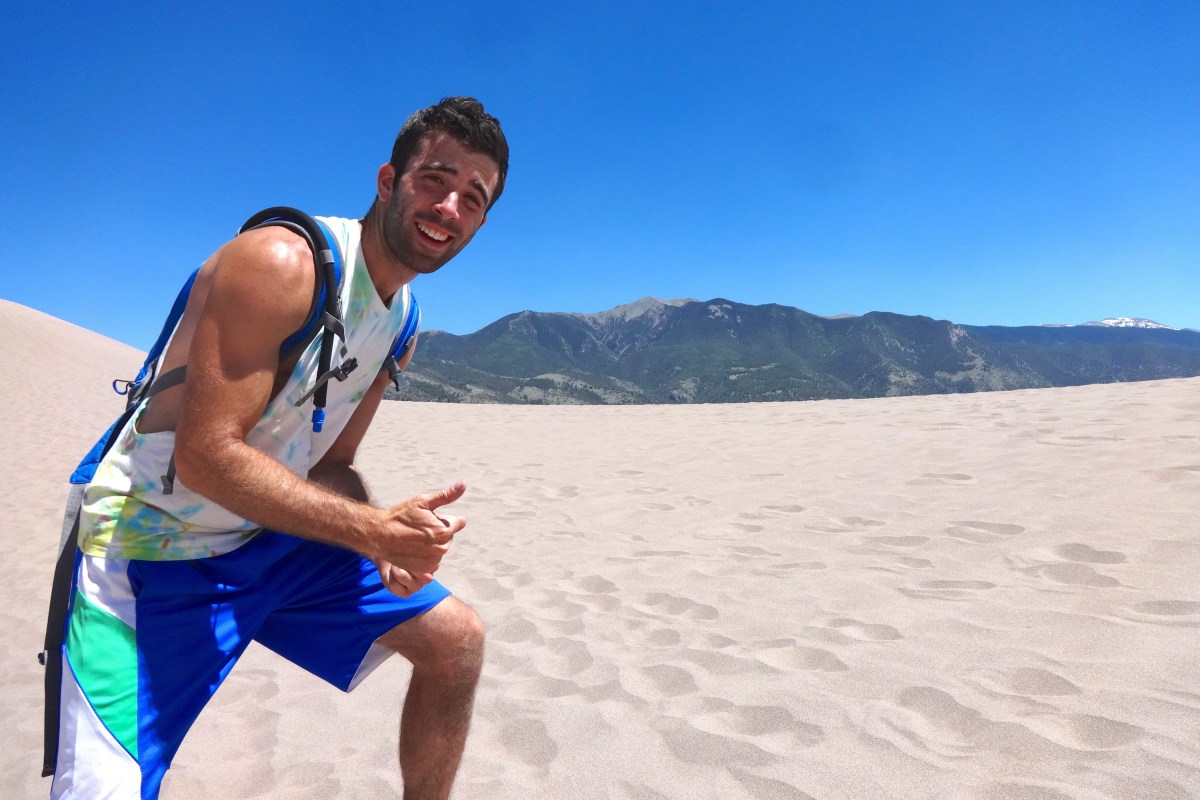
“I am just going like this “I replied, standing shirtless in a pair of blue gym shorts and socks.

“Have you been here before.”

“No I haven’t” I replied

“What should we wear on our feet.”

“I don’t know, but I’m just wearing socks.”

“That’s a good idea,” he replied. I thought so to. I was glad to share my wisdom.

I began my trek barefoot, because at first there was a stretch of water trickling down from snow melt in the the mountains far away, that created a very shallow river on top the sand. Many people were congregated in this area, wading their feet. Children ran about splashing in the water and playing with the sand, as if at the beach.

After crossing the water, the incline began, and the expanse of dry hot desert dunes stretched on for miles. Socks were on, and traveling was great. Although the area of sand dunes was very expansive, it was not endless. In all directions were the tall rocky mountains of Colorado with pine trees and snow melt creating stripes down their sides. It was an interesting contrast to be in stifling hot sand dunes, looking around at mountains with snow. It was also interesting to think that just yesterday I was venturing through deep snow drifts on my attempt to make it to Mount Ida. Colorado is definitely a place of contrasts.

The sand dunes were relatively busy. People were following each others footprints to dune peaks. As typical, I wanted to to go farther than anyone else. So I trudged further and further up and down sand dunes, which is not easy. It takes maybe five times the effort than hiking on solid ground, because with each step your feet sink, and there is not stable ground to push yourself off of. Hiking downward is fun though, because you can descend inclines too steep and perilous for solid ground. On sand there’s no harm done when you fall, tumble, and slide. The sand is a giant encompassing cushion.

Here the color of the sand was uniformly a typical beige color. No plants grew. It was everything you might imagine sand dunes to be. Nothing out of the ordinary like pink sand, or black sand, or wild scary-looking desert shrubs. It was just a giant sand box of a place.

I had reached the highest dune I could see from when I began my quest. Standing on top, DSC05337I could see there were more mighty dunes in the distance, which were temping to pursue. But at the moment, my feet felt like they were on fire. Wearing socks was not a bright idea. Hot sand found its way into the socks over and over again, and was burning my feet. The hot sand mixed with coarse friction had also burned and ripped a giant hole in one of my socks. It appeared as if part of the sock had disintegrated.  I was about a mile and a half in, but my feet couldn’t endure anymore hiking, so I turned around. I wasn’t disappointed the least bit. I felt like I got a true Great Sand Dunes experience, greater than the rest of the tourists who gave up much sooner than me.
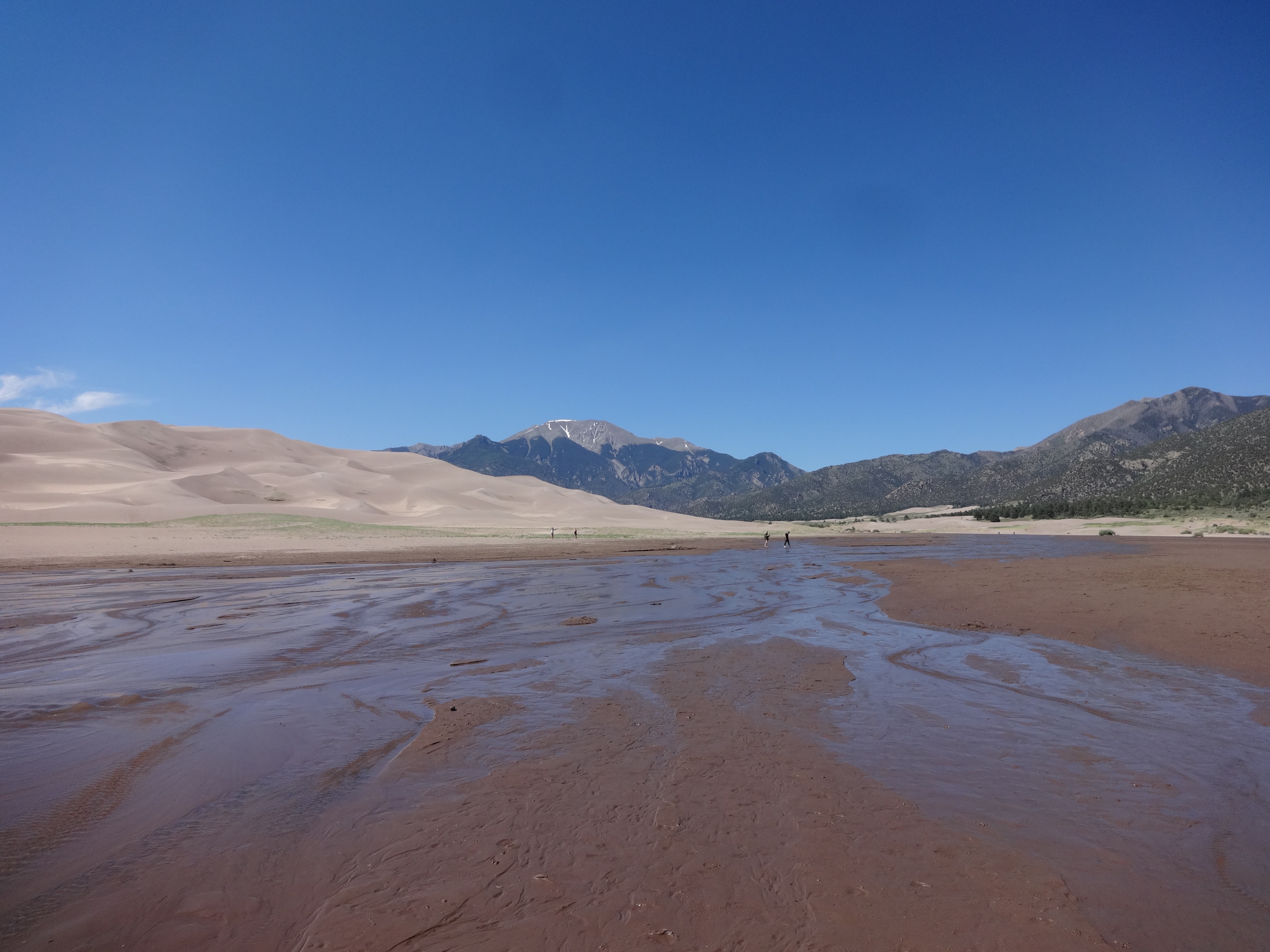
On the way back, I remember sitting down for a moment and looking around, at the sand, the mountains, and the people way below. I remember thinking, how in the world did I get here? Although I knew the answer, it was all sort of a marvel to me that I found myself in such a unique and different place than where I typically live my life. This sort of moment had happened more than once on my trip. In these pauses I try to take it all in. My life sort of replays summatively through my mind. It’s a summary of my weaknesses that I conjure up. I think back to when I was a teenager, being so depressed that I didn’t care to be alive anymore. At that time self-doubt and insecurity ripped me apart inside, and my world was so small. It didn’t extend beyond my own feelings.

I also think back to college when I was incredibly sick and weak, plagued with complicated Ulcerative Colitis and Pancreatitis. I grew tired climbing just one flight of stairs. Then I was hospitalized. I remember when I was able to walk again. I went out into the hospital courtyard with my walker, and just being able to stand on my feet, clinging onto my walker in that little landscape patch between cement buildings, was enough for me to find hope.

Now, here I was sitting on top of a giant sand dune, in the beating sun, thousands of miles removed from home, alive, strong, full of spirit. I’d come from the Sonoran Desert, seeing Saguaro cactus, through the Petrified Forest, across the plains of the Navajo Nation, around the canyons of Utah, up to aspen forests and alpine tundra of Colorado, and now here I was on a giant sand dune. I’d climbed higher than everyone else. They tired before me. I looked down at them as little ants. I realized my past was marked by canyons of illness that kept me trapped in low places, but now I was on a mountain, not by my own doing, but by the force of restoration and strength attributed to God.

In addition to marveling at how far I’d come, I was also struck in wonder by the diverse beauty of the United States. A few years ago I would have never even imagined that such a place as Great Sand Dunes National Park and Preserve existed in the United States. The more and more I travel to National Parks, the more I fall in love with this country. It is so full and rich in natural beauty. I remember, when I was younger I thought that the United States was just sort of uniform place with varying degrees in temperature. I couldn’t have been more wrong. The United States in amazingly rich in geological diversity. The National Park service does a great job at preserving all of these wonders and surprises.

After trying to take it all in, I began my hike down the sand dunes back to my car, tumbling and sliding down, despite my feet were in much pain. I had to arch my feet, trying to keep contact with sand limited to the tips of my toes and my heels. I had to pause at times and raise one foot up in the air to give it a chance to cool off, cooling down from the 150 degrees of the sand to the 105 degrees of the air. It was such a relief when I got back to the shallow river, and placed my feet in the ice melt water. I hoped the other young travelers from the parking lot hadn’t followed my example in footwear.DSC05389

I would have stayed longer in the river if it weren’t for some intrusive ranchera music blaring and ruining the serenity. A group of people had set up a canopy by the river where they had a picnic and enjoyed their choice music. I would have been happy listening to the water trickle and the wind wisp across the sand. It’s okay. I let it go. I wanted to go relax at my campsite and figure out a plan for the evening from there.

Back at my site I had received a text from my cousin, Jonathan. He and his family had been busy white water rafting most of the day, but now they were done and staying at an Airbnb in Durango, Colorado. I was welcomed to come spend the night there and visit Mesa Verde the following day, and then backpack overnight in the San Juan Mountains to the Ice Lakes the next day.

I plugged in the address into my GPS. They were about 160 miles away, which would equal roughly 3 hours of travel. I would arrive at night, but it wouldn’t be a problem. Sign me up!

I tore down my tent and threw my it back into my car. I found the campground host to inquire about a refund. She said refunds are never issued but I could sell my campsite. So I peddled around and sold my site to a couple at a slightly discounted price. Then I was out of there.

Durango, here I come! I was excited to see family. I had seen my cousin Jonathan the summer before when we adventured around Yosemite National Park together. It was a memorable time, and he was great company.  That was the last time I’d seen him. I would have liked to have seen him more, but I lived in Kentucky and he was stationed in California with the Airforce. As kids, we were decently close, although I would only  see him in the summer when my family would travel back to Princeton, Illinois. I thought we had a pretty good cousin bond, given our limited time together, but then the expanse of time grew larger between us and we grew up. When we met up in Yosemite, it had been years since I’d spent any time with him. I wasn’t sure how our interactions would go, but I couldn’t have asked for a better adventure buddy and a better time. Sure, we had grown and time brought change, but we were family and we were able to reconnect effortlessly and have a great time.

I also hadn’t seen my cousin Paul and his wife, Ines, in a few years. They had been living in Germany and their lives would be very different from what I last knew. And then there was my aunt Mary who lived in Illinois, whom I hadn’t seen in even a longer period of time. I knew she had endured heavy challenges and changes in life, and I admired her for her strength and raising my cousins, whom I respect so greatly, in the midst of it. I was so excited to see all of them and go on adventures together.

When I arrived, Paul and Mary were still awake. I spoke with them for a while, filling them in on my adventures and them filling me in on theirs. Their white water rafting trip was seriously legit. They rode some high class rapids and took the famous Durango and Silverton Railroad to their launching point. After visiting with them, I got laundry started, took a much needed shower, shaved, and retired to the living-room floor where they all had kindly left the comforters from their beds. I had a plush island of comfiness to myself, luxurious compared to the weeks of tent camping I had grown used to.

I was happy. Although I hadn’t seem these family members together in a long time, there was comfort in being with them. I had found a little piece of home way out in Colorado.


Read the next entry “Mesa Verde with My Cousins,” here:

https://joshthehodge.wordpress.com/2018/02/04/mesa-verde-with-my-cousins/

Read the previous entry “Chillin’ Like a Moose,” here:

https://joshthehodge.wordpress.com/2018/01/21/chillin-like-a-moose/

Facebook: http://facebook.com/joshua.hodge

Instagram: http://www.instagram.com/joshthehodge/