Before we arrived at Crater Lake National Park, the day had started off waking up at the Oregon Caves Chateau, tucked away in the woods, in our secret little attic space high up in the Chateau. There was no central air system in the Chateau, so I undid the latch and swung open up one of the rustic windows in our attic. to let the cool night air in. The room was pretty warm during the day but by the next morning it had certainly cooled off.
We made our way down a few flights of stairs to the diner-style cafe on the main level. It too had its own vintage charm. It had probably not been touched much since the 1930s when the lodge was built, but maybe it was tweaked a bit in the 1960s or 70s to give it its distinct color palette of yellows, browns, yellowish-browns, and oranges. It had a dining counter with swivelling stools that snaked around. It was smaller but very similar to the one in Jackson Lake Lodge in Grand Teton National Park, the one in which the “cougars” bought me dinner. Here I feasted upon some buckwheat pancakes and bacon, with a cup of coffee. This was the more economical dining option at the Chateau. Last night, feeling fancy, and knowing this was probably the only time I’d be out this way, I splurged, and Zach joined me. We ate at the lower level dining room in which the bubbling brook from outside flowed into the dining room in an inlet of rocks.
I’ll admit part of me felt guilty for spending so much on a meal, and dining on tablecloths and placemats, while camping and trying to be economical. but I also felt like for such an experience, it was worth it. I had also planned on eating here, so the cost wasn’t unexpected. At the time this was the most expensive meal I had ever purchased at around $30. I had braised pork with sauteed carrots, asparagus, mashed potatoes, and a side salad with dinner rolls. It was very savory and done right.
Before we left the Chateau in the morning, I hopped on the piano bench in the lobby, and I left a tune for the old place, a song I had written on the piano as a teenager. The piano had been calling out to me everytime I passed by, and so I finally responded.
Leaving the Chateau we uneventfully traveled through the forests of Oregon, and as we neared the small city of Grants Pass, I decided to browse the radio stations and see If I could get an idea of the local flair. In southeastern Kentucky, I can tune into some bluegrass and Southern gospel stations with local news of who died and who has married. When I drove across the Navajo Nation, I listened to traditional Navajo music in native tongue. When approaching Chicagoland, there is a wealth of Spanish language stations with a lot of ranchera music, indicative of its large Hispanic population.
The number of country music stations, I believe, is also very telling about the overall culture of a place. There are a lot of values embedded in most types of music. In the country genre there largely is a love for country, family, nature, the land, sentimentality, hard work and blue collar grit. Rap music is another example, very telling about values. It overwhelmingly values pimping and prostituting, debauchery, carnal desires, stealing, raping, disrespecting authority, and killing. The prevalence of such stations in a particular region is a small glimpse into the overall and dominating culture. So what did I find in Oregon? Well, I landed on a yodeling station. What does yodeling tell me about the people? What values are embedded in the yodeling genre? I couldn’t tell you, but my ears were fixated and pleased. What talent! How does one even do that? Is yodeling a part of Oreganian culture? Are there little mountain yodelers atop the Cascades? I still hadn’t figured out Oregon and wasn’t sure if this was an essential part of it.
After departing Grants Pass, we were traveling along Oregon’s Rogue RIver, which flows western to the sea from its headwaters in the Cascades just next to Crater Lake. We were zipping along highway 5, the Pacific Highway. We could see mountains ahead and heavy greenery and foliage along the highway, with a glance every once in a while of the river with its craggy natural embankments. When we split from highway 5, we started to ascend, and pine trees took over. They were not giant Redwoods from days prior, but thick groves of moderate size pines standing perfectly straight and pointed on a dry, barren, and at times dusty ground.
When we arrived at the park, our first order of business was setting up camp. Crater Lake has two park villages, Mazama Village and the Rim Village. We were staying at Mazama, and we were not going to do any backtracking. We had a lot to see for we only had one day to experience Crater Lake National Park. Mazama Village comes right after the park’s entrance station, thus it was our first stop. The campground was average, nothing remarkable, with large flat pine-laded tent pads under pine trees. After we set up camp we went to the visitor center, and from there we had our first glimpse at the remarkable Crater Lake, but I didn’t want to give it too much attention right away. There is an order of events for visiting a National Park, at least in my book(s), quite literally. First I had to orient myself with the park film to be able to better appreciate and understand the vista before me. The visitor center was a small cabin, half built of large chunks of rock, the other half of wood. Next to the main room was a little side room with an ad hoc set up with a television playing the film. I learned just how Crater Lake was created by a volcano. To put it simply, much simpler than the film’s details, a large and powerful eruption caused a crater, and then over time rain water and melted snow filled the crater, creating the lake. One of the many unique characteristics of Crater Lake is that it has no water flowing into it, making it one of the most pure natural bodies of water in the world. I was really fascinated how something so destructive and violent, such as a volcano, created a place now so beautiful and serene. There was a message here to unpack. There is a universal truth to be explored. I’d get back to that thought later.
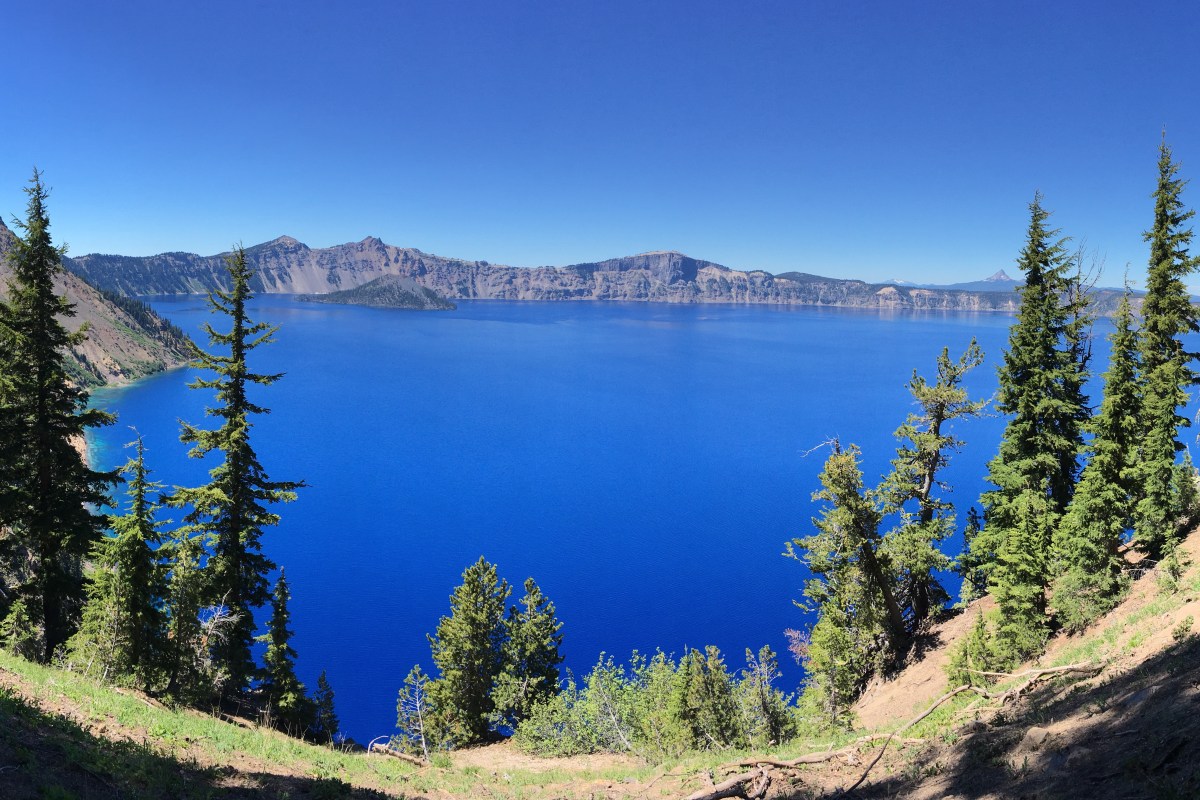
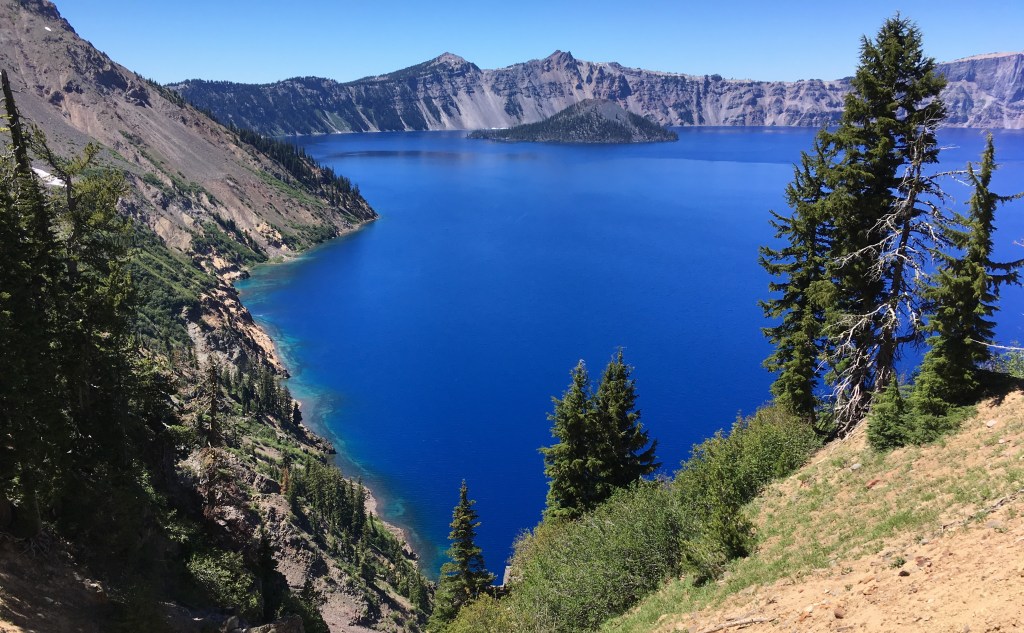
From the visitor center we began the thirty-three mile Rim Drive around Crater Lake. We stopped at just about every wayside overlook. The lake is enormous, with a six-mile diameter and about twenty miles of shore line. It is quite serene, and truly is just a giant bowl. One can see the rocky and steep rim of the bowl all around and always look at the lake from a great distance above on the rim’s tall cliff edges. The most striking feature of the lake is its color. It has the richest blue water I’ve ever seen. It’s so bright, vibrant, deep and royal. Such a particular and unique color almost makes it look artificial, as if the water was dyed, like the color of those faux waterfalls of a mini-golf course of the 1990s. But of course I knew better than to think it was fake, and it wasn’t tacky but beautiful in its surreal display.
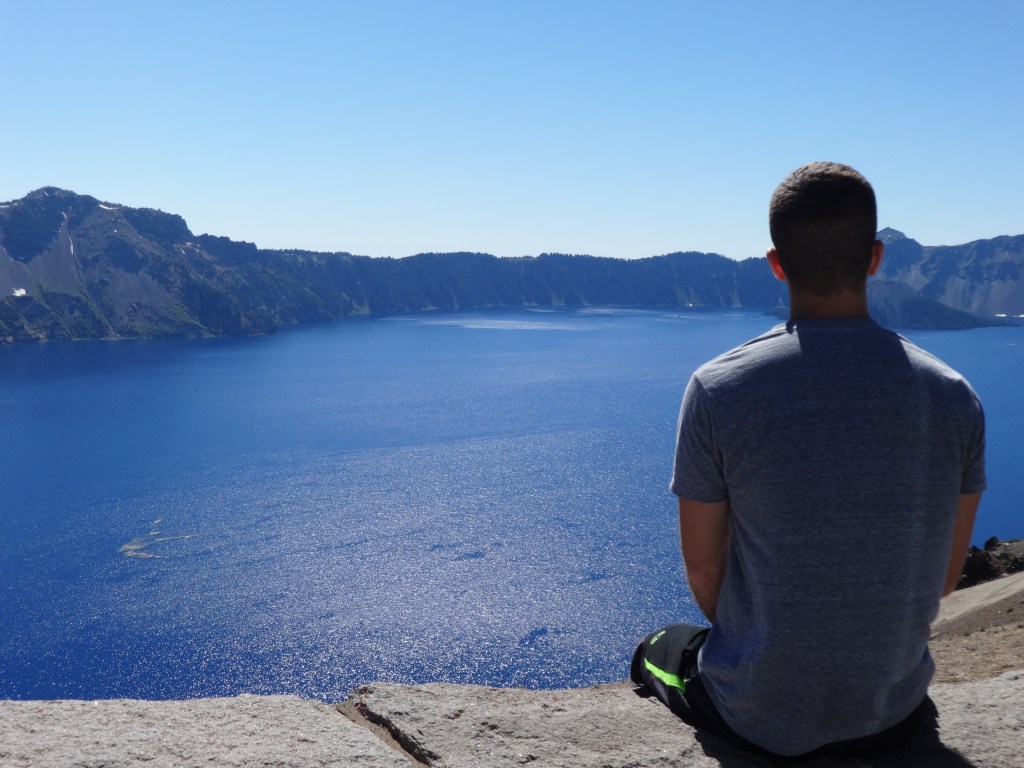
Surreal is a word I’ve landed on to describe the place, for to be surreal something incorporates characteristics of reality combined with fantasy. Crater Lake, though very real, seems to incorporate elements of sheer fantasy. Even apart from simple visual observation, there are names given to the places in the park which give way to fantasy, such as Wizard Island, Phantom Ship, Castle Point, and Wineglass. Even the visitor center and village buildings look rather fairy-tale-like, reminding me very much of Snow White’s cottage.
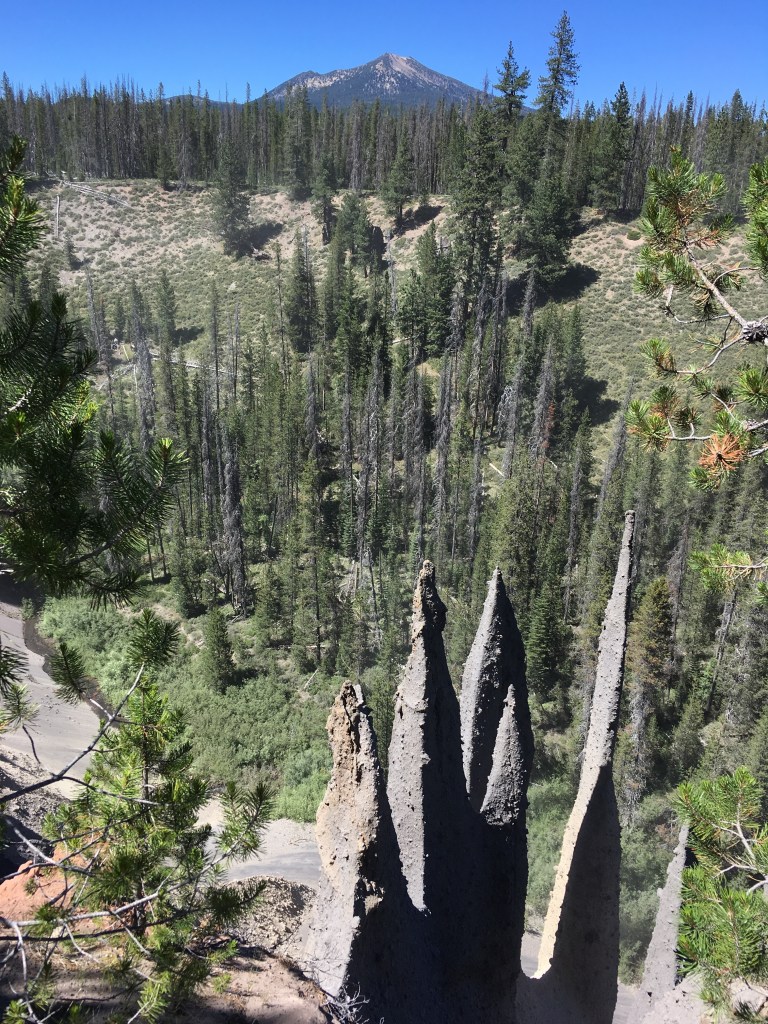
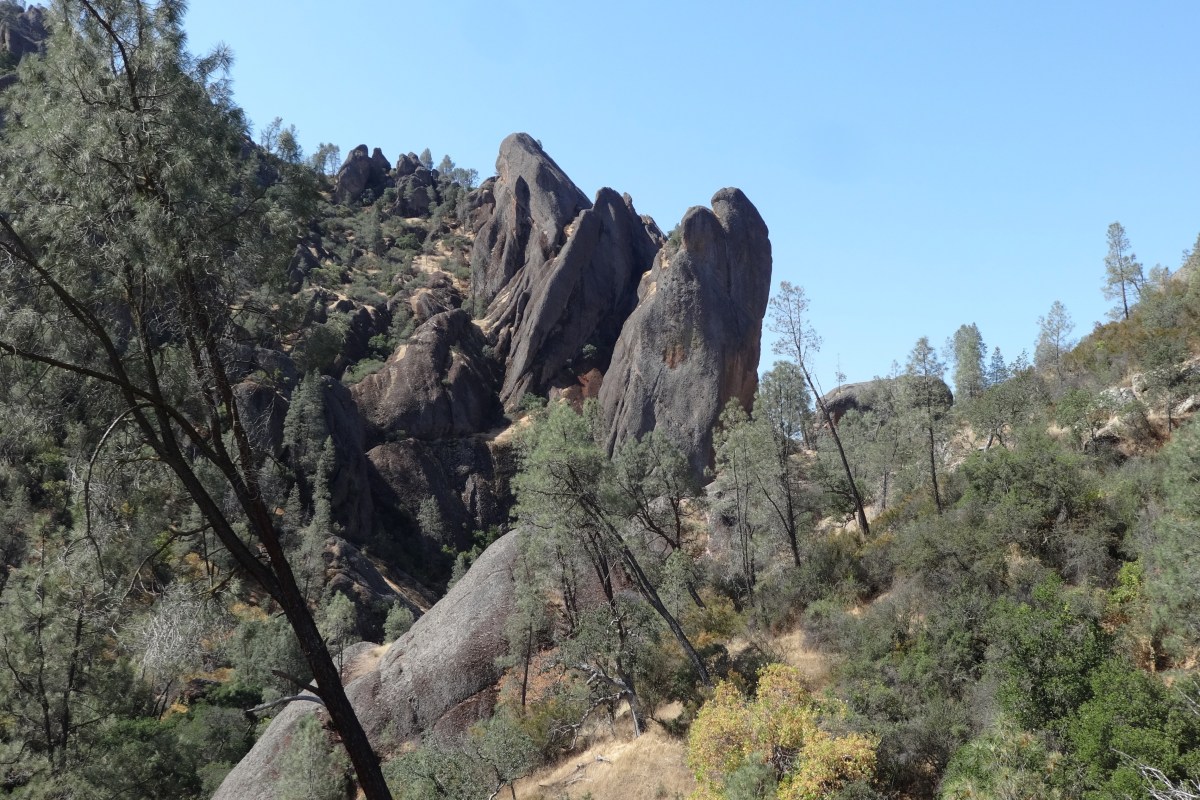
We took a five-mile side trip from the rim driving down Pinnacle Valley to an area simply called “The Pinnacles,” where large sharp, pointed piles of gray and brown volcanic pumice stick up from the ground, like the fingers of a giant beast reaching up to emerge from the depths of the earth. I had never seen anything quite like this before, although they did remind me a little bit of the hoodoos of Bryce Canyon. These did not, however, have the flat capstones as hoodoos. Rather these were pointed, like smooth delicate giant stalagmites. They also didn’t have the warm orange and red colors of Bryce Canyon, but rather they were mostly a ghostly pale gray and actually not beautiful at all. They were rather ugly, but in nature’s most intriguing of ways.

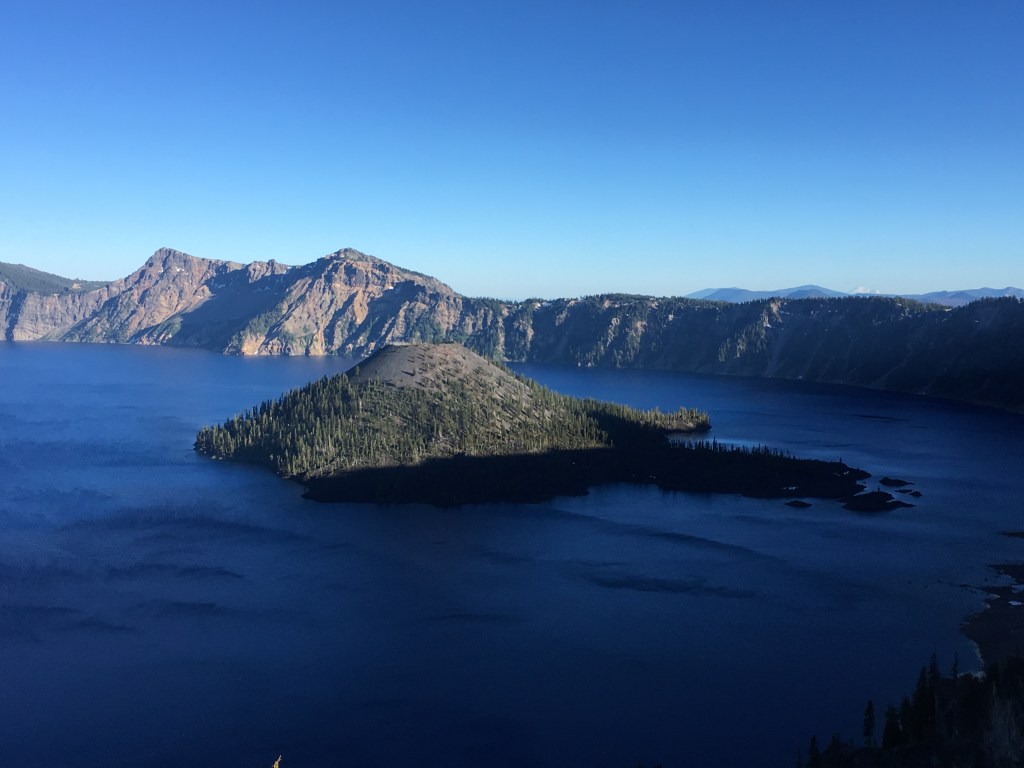
Back on the Rim Drive, a very notable stop was at the Phantom Ship Overlook. From here we looked out at the lake at just the right angle to see a small island that looked like an abandoned pirate ship. It had craggy rocks that pointed like the masts of a ship, and a few pines and shrubs adorning it, looking like seaweed or barnacles, as if it had been some sunken ship summoned up from the depths of Davy Jones’ locker by some dark magic.
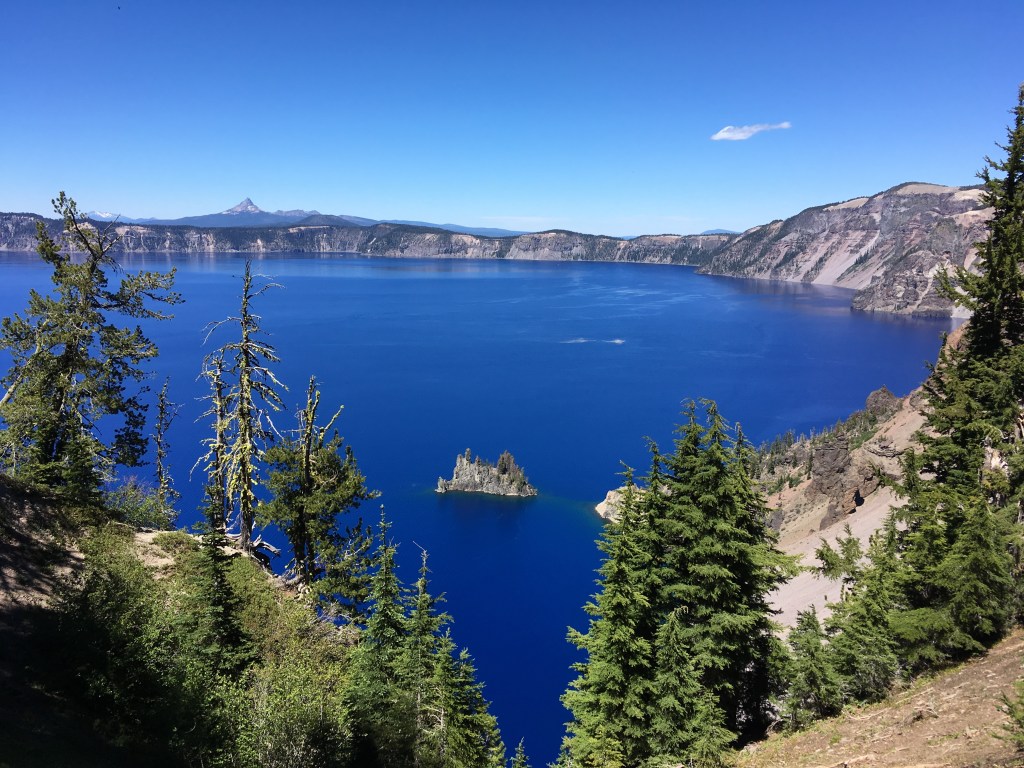
Along the drive we also stopped at the Cleetwood Cove Trail, a one-mile, very steep trail of dramatic switchbacks which led down to the cliff in which I jumped into the lake. I was excited to get down to the lake and see this fantastical water up close. So far I had only seen it from high above the lake on the rim. So in excitement I suppose I was walking quickly down the trail. Zach complained I was walking too fast and then brought to my attention that he thought I always walked too fast and that I should be waiting for him. Initially I felt sorry and was more conscious of trying to walk with him instead of getting ahead, though this was nothing I was doing consciously, and by no means an indicator of me trying to put myself first, elevating myself to a position of superiority. It was just my sheer excitement propelling me forward and putting me ahead of him. This may seem like an unimportant detail, but I only note this because it was the first in a series of complaints, or at least the first I recollect in a pattern that started to develop. This pattern of complaining would eventually really get to me, but with that detail aside…
Crater Lake is by all means beautiful, but there is a very similar view from whatever side of the rim one is at. The terrain surrounding the lake is very uniform with its display of pine trees, rock and arid ground. Minus the novelty of the ghostly Pinnacles, this park doesn’t provide the diversity which some of the units of the National Park Service do with varying views, flora, and fauna. The attraction here is not much else than Crater Lake itself. However, alone the lake is a great treasure and worthy of the National Park title. I suppose if I had given us more time to spend in this park, we may have discovered more, and thus this view would change, but from my one day visit to the park, this is my impression.
The conclusion of our self-directed tour ended back, full-circle, at the Rim Village. I was looking forward to eating at the Rim Village Cafe. Some National Parks offer great food services, such as the Grand Canyon and Yosemite which have great cafeterias in giant scenic halls. Yellowstone has some really good options as well. Even Oregon Caves National Monument surprised with its Chateau. But at this point, I hadn’t fully understood how food service works in the National Parks. Different parks have different contracted concessionaires. Some are small businesses, most are parts of giant conglomerates, and some are certainly better than others. Some are dedicated to the guest experience and quality. They have integrity. Others solely value profit and how to trick and trap the tourists to empty their wallets. This was one of the latter. In my first two National Park adventure books I was very careful not to criticize anything in relation to our beloved National Parks, but I have changed my approach. I believe through honesty and sincere critique about how these parks are managed, we can bring about improvement or preserve that which is good. The National Parks are our great treasures as American citizens. We should not let them become exploited and degraded, and therefore I speak honestly only out of my deep love for, and interest in, these places.
After Zach and I disappointedly purchased some highly-priced cheap food, we went snooping around to find a place to sit down. We made our way to the second level, which was probably used only for special events. It was largely an open space, but at the end of the room there was a couch and coffee table in front of a big window pristinely displaying before us Crater Lake. We found quite a scenic place to dine on our less than desirable food, thus our dinner experience was redeemed by the view alone.
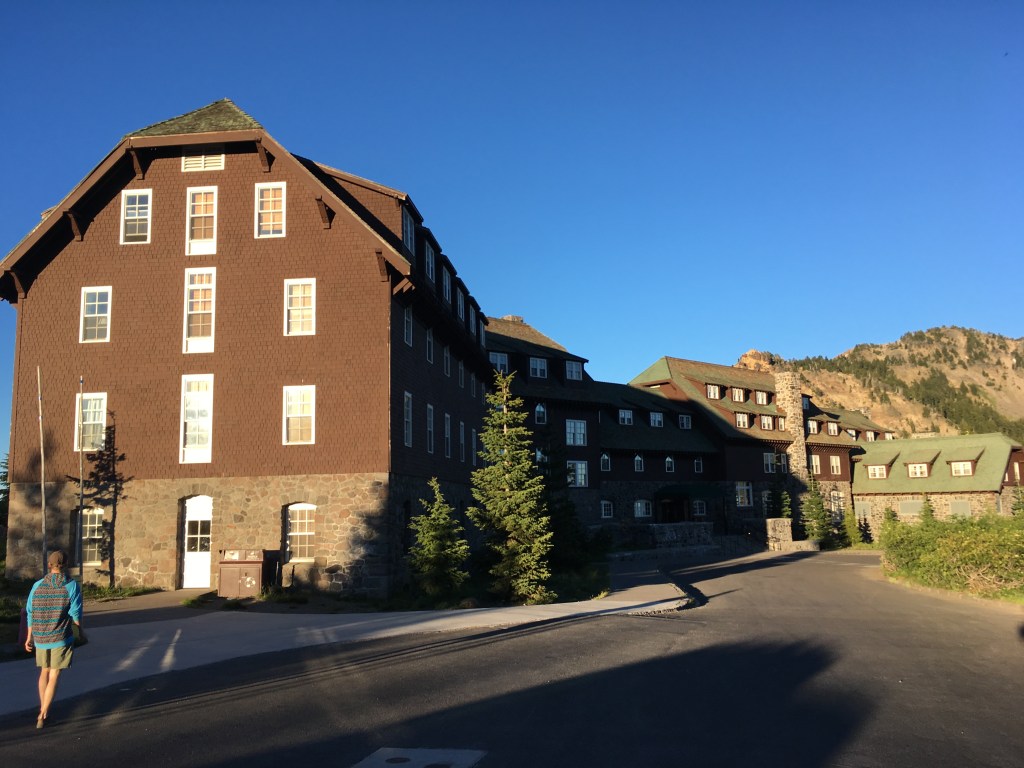
After we ate and enjoyed the view, we went to Crater Lake Lodge, another lodge on the National Register of Historic Places. It opened in 1915 and was similar in style to the outside of the Oregon Cave Chateau, except maybe three times bigger. Inside there was a lot of wood, giving a very cabin-like feel, especially with its exposed timber frames, and large stone fireplace. But its lobby was small and not very notable otherwise. There we sat and rested for about an hour. I used the time to write a postcard to my parents, enter some of the day’s events into my journal, and revel in the fact that I did overcome a fear and jumped into Crater Lake. We then went back to our campsite in Mazama campground, and just like that our visit to Crater Lake National Park was coming to an end. The next day we would get up very early and make our way northwards to Washington State to Mount Saint Helens, another volcanic wonderland.
If you enjoyed reading this, check out my book “Still, Calm, and Quiet“
Check out my previous entry here: “Jumping Into Crater Lake”
Visit www.joshhodge.com
 Josh Hodge blog