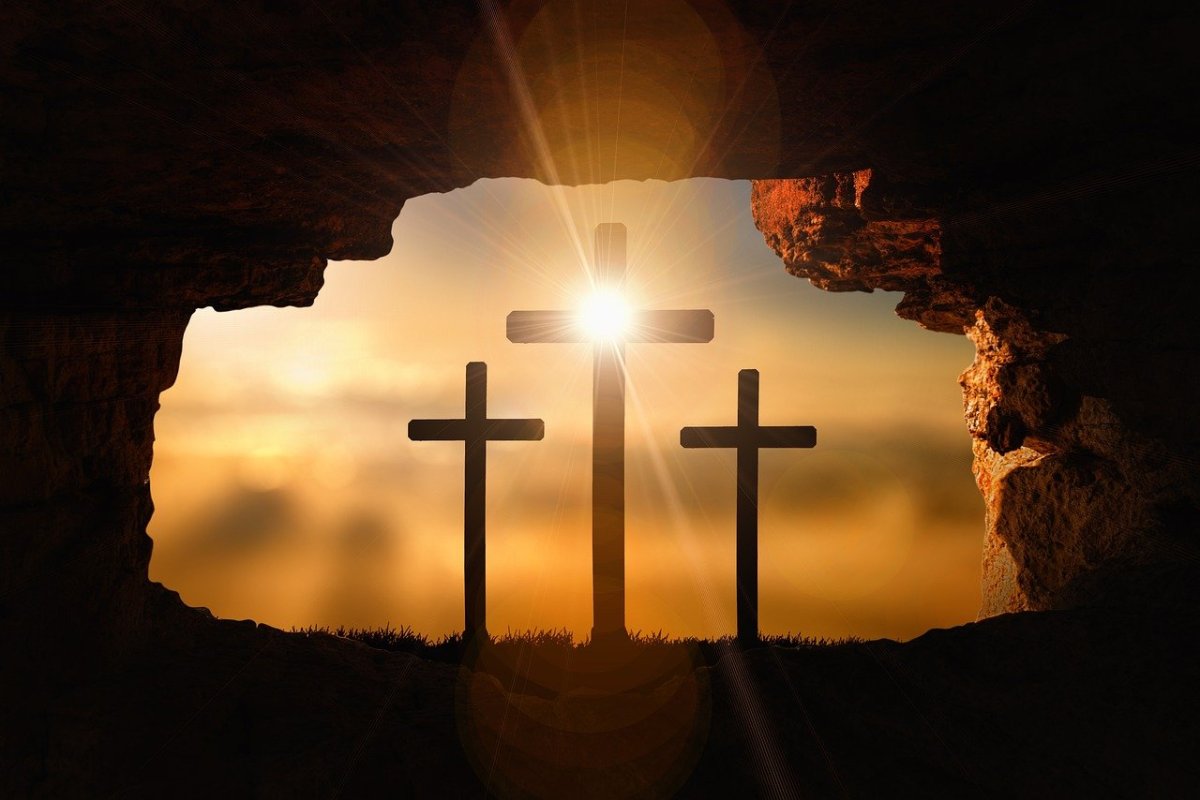
What is Light?: God, Science, and Emerging from the Cave

What is the light? Many people are familiar with the famous Hank Williams song, “I Saw the Light.” As the first stanza goes, “ I wandered so aimless, life filled with sin, I wouldn’t let my dear Savior in, Then Jesus came like a stranger in the night, Praise the Lord, I saw the light.” A subsequent verse talks about coming to Jesus like a blind man regaining sight. There are countless songs of faith that have reference to light. Those of us who grew up in Sunday school are probably familiar with the classic song,“This Little Light of Mine” and how we are gonna let it shine. Referencing to seeing the light, and shining that light, are intertwined in not only American culture but universally in regards to God and faith. 

I was at Oregon Caves National Monument and Preserve and had just finished up a lantern cave tour where an extremely unsettling park ranger who was equating emerging from a cave into the light of day, like mankind leaving behind religious faith and walking into the eye-opening light of Science. I had to challenge this, as for a while, I had entertained the thought that emerging from a cave into the light of day is best an analogy of coming to Jesus and realizing there is so much more to life and existence than the darkness we often toil around in. 

The BIble is full of passages in reference to light. In John 8:12, Jesus calls himself the “light of the world” and says how his followers will “not walk in darkness.” I think this is telling not only of God’s character but of our own nature as well.  Without Him we are left with nothing but to walk in darkness. Like Hank Williams we wander aimless, chasing the wrong things. We are lost in that dark cave of existence. Then comes God as light, providing us clarity, direction, and vision. We can see purpose in life, as he leads us out of the cave into an existence so rich in meaning and abundant in spirit, more than we could have ever have imagined. When Jesus also says we will,  “have the light of life,”  I also believe that is not only a reference to clarity, direction, and vision, but also great joy. Light is one thing and life is another. When combined together joy is an outstanding byproduct. 

In 1 John when we read, “God is light: in him there is no darkness at all,” I think the Scripture also uses light to show the great contrast between the perfectness of God and depravity in His absence. He is the direct opposite of the darkness, of the evil so persistent in the world. He is unblemished, without a shadow of sin, incapable of it. It is Him, His truth that brings forth the distinction of good and evil. Anything antithetical to God is darkness. Anything of God is of the light. He is the source of all truth and meaning in the world. Darkness is chaos and lostness, a void and emptiness. God reveals meaning, purpose, direction, fulfillment, and wholeness. His light also helps us grow in spiritual maturity, just as a plant needs light to grow, so our spirit needs God’s light. If there was an absence of light in our universe, there would be no life on earth, just as without God so too our souls would not be. He is the source of life. 

Another very important aspect of the light of God is that it helps us understand sin and our independent hopelessness. Without God revealing himself, giving us his light, we would not know of our darkness, of our sorry state. We would not know there was salvation to be had. We would be blind slaves of the darkness. But God, who in no way is obligated to reveal Himself to us, through love and the blood of Jesus Christ, revealed his light, thus creating a contrast, allowing us to see we need a savior. Not only does He create this contrast,  illuminating our path to salvation, but he also gives us that light to carry as well.   

As Christians we believe God’s Holy Spirit dwells in God’s true followers, and that the Holy Spirit is of the light of God. That’s why we read in the Gospel of Matthew, when Jesus is talking to his followers during the Sermon on the Mount,  “You are the light of the world. A town built on a hill cannot be hidden. Neither do people light a lamp and put it under a bowl. Instead they put it on its stand, and it gives light to everyone in the house. In the same way, let your light shine before others, so that they may see your good deeds and glorify your Father in heaven.” (Matthew 5:14-16)

This light is God, is of God, and is in his followers. This light serves many purposes, and different parts of Scripture focus on different aspects. Some may attribute one specific belief to light, whether it be God the Father, Jesus, the Holy Spirit, the Christian, truth, or salvation. I believe, informed by Scripture, that the light is actually only one thing with many aspects. God is light, and in Him are all these things. In Him is the truth, salvation, and the Holy Trinity with whom the Christian partners with to carry that light. 

When Jesus calls his followers “the light of the world,”  I see it as the Christian channeling God’s light, serving as a beacon in a dark world to draw others to the Salvation of Jesus Christ. The man in search of truth, or even one whose heart remains open, will naturally be drawn to the light of God’s people. He will see this light in others, be drawn to it, only to learn that the light is the light of God beaming through the Christian. The light is not a product of the Christian, but the Christian merely serving as a conduit for God’s powerful light.  

We are also warned in Scripture that not everyone comprehends this light. No one is too far from the redeeming power of Christ, but those who succumb to darkness, subscribe to it, and are ruled by it, cannot understand the light. Secularism certainly does not have an understanding of it. Those consumed by their own selfish desires and lusts of this world don’t get it, for it is written, “In Him was life, and the life was the light of men. And the light shines in the darkness, and the darkness did not comprehend it.” – John 1:5. 

We live in a world where many have become hostile to God, have elevated themselves to the center of focus, and have replaced God with other gods. Man himself, too, wants to be his own god. This is a characteristic of humanity’s own nature.  When man follows that path, putting himself first or false gods first, he sells himself immeasurably short and lives a life depraved and in darkness, whether he fully realizes this or not. Some surely don’t realize this at all. They have lived in a cave all their life, unaware of the existence beyond the cave. Others wander in the cave, and their soul does not rest, because they know there is more. They are in search. They know there is something beyond the cave. 

I am so blessed to understand this light, to have this light. I know the light of God is so radiant. The clarity, the truth, the guidance, the salvation, the joy is so real, so powerful, so convicting, so life-giving.  It makes any sapling on a nurse log become the strong unwavering tree in the forest. It casts beautiful, rich, wonderful colors in one’s sunset. It illuminates a path out of the forest in the darkness of night, out of the cave into the full light of His glory. 

 I do not boast of myself at all when I say this, for this is not of me. No, rather I boast in Him. It is all God, and I desire for his light to be stronger in my life. I want His light in my life to guide people to Him. I know by my own efforts I always fall short from being the light God so desires for me. His desire for me is bigger than I could ever imagine, but I live by His mercy.  I must strive to draw closer to Him, to let His Spirit dwell more richly within me, for He is the light alone. 

I feel sorry for the man who replaces God with science. I am not anti-science, but I do warn of making science a God. Science does not have all the answers for life and the human condition. Science does not fulfill man’s spirit. Man’s ability to perform science is a great gift and a great tool. It has done so much good for humanity, clearly myself included. But, science is also a human study, a set of procedures made by man to serve his purposes. To rob the analogy of light from God and place it on science, is just not justified nor appropriate by any means. Science can’t but scratch the surface of the questions we have about what is true. And we must always approach science critically and skeptically, because it has also contributed to a lot of evil in the world. Science proves itself to be wrong time and time again.

 A hot button issue in the world today is race, especially in terms of racial injustices of the past. What’s often not discussed is that it was a scientific “fact” that degraded some humans over others. In the 1800s it was science that had “proven” superiority and inferiority of races. Harvard’s own Louis Agassiz was a great proponent of polygenism, using science and the then “scientific” study of craniology to claim human races were distinct species. Carolus Linnaeus of Sweden, was a naturalist, who was the father of such studies. His ideas were also propelled by Petrus Camper, a Dutch professor of anatomy. Johann Friedrich Blumenbach, a German scientist, also carried these studies on and invented the term “caucasian,” which was one of the many “scientific” terms used to distinguish the different species of humans. These scientists were no fringe individuals, but authoritative voices of the scientific community at distinguished schools. Of course their science has been invalidated today but we must acknowledge those once “scientific facts”’ as a root of racism. Notice I said “a root” and not “the root” for there are many roots on the plant of racism, including pride, fear, and power…  I acknowledge all of these, but science was also a major root and a driving justifier behind slavery. Few will ever discuss and acknowledge this, because to reveal this great flaw of the past, tarnishes the god of science whom many worship. 

Unlike the light of science,  the light of the true God never changes its facts. It has and is always consistent. It reveals to all men that they are all made in His image. We are equally inherently valuable and loved. There is no other “light” in this world that has done more to bring people out of oppression and injustice than the light we find in the Christian faith. 

Yes, science when executed rightly can shed some light on some of our questions, and I am grateful for that, but even what science gets right is pointing us to the truth of God’s light. He is the source and Creator of that truth. Sadly, the park ranger who emerged from the cave thinking he was walking into the light because of science, I believe sadly was just walking into another spiritual cave chamber. May one day he truly walk into “the light of life.”

Just the spring prior to this visit to Oregon Caves, I was exploring an unmarked cave with Zach back in western Kentucky. We were there for hours. We had grown accustomed to its cool darkness, the cold water rushing through it, and its gloom. It was fun exploring. I quite enjoyed being there, but finally emerging from the cave to the bright richness of spring, to the blooming trees and blossoming flowers, and the radiant sun, my senses had never been so incredibly overwhelmed! At that moment I thought, this is what it’s like coming to know God. 

So many people live life in the cave, unaware there is more, so much more! It also reminds me of a baby in the womb. It lives in that dark place. The womb is its world and existence, but then it’s born and awesomely emerges into a whole new consciousness and greatness. It’s from that concept Jesus talks about being spiritually born again. Whether it’s emerging from a cave into the light of day, from a womb into the world, or from one door into another place, as John Muir taught me, these are all concepts reflective of a common Creator, designed to teach us truth and bring us to Him. May you find and walk into that Light. 

If you enjoyed reading this, check out my book Still, Calm, and Quiet“

Check out my previous entry here: “Oregon Caves and the Creepiest Park Ranger”
Oregon Caves and the Creepiest Park Ranger

He’s going to kill us. This is it. Who? This park ranger. He is sick, unhinged. 

We were in the pitch black underground of Oregon Caves National Monument. He made the small group of us on his tour extinguish the candles in our lanterns, and now he was talking about the ills of humanity and death. I didn’t think he was trying to be playfully spooky at all, for it seemed no conscious effort was pointed in that direction. His gloom seemed to emit so naturally from some deep-seated bitterness and hatred within his soul. 

I didn’t trust him from the start. There was something impersonal and antisocial about him. He couldn’t relate to the guests. He didn’t know how to interact with the common pleasantry of any ordinary human, and my spirit was not at ease. I could sense discontentment within him and a resentment towards humanity. It was so evident, and now at the end of this tour, I felt things had really built to a climax. This would be a sick man’s ideal moment to take his disdain for humanity out upon us all, brandishing his weapon of choice.

Let’s backtrack. How did I end up in such a situation? Well, in the morning,my travel buddy Zach and I packed up camp at Mill Creek Campground in the Redwood Forest in northern California. Zach was not mad I had made s’mores after he went to sleep so early the evening before. It was a new day. Today’s car trip was only about sixty miles, so we had time to piddle and peruse. We started our day briefly by visiting the Tolowa Dunes State Park next to Crescent City. Essentially it was more beach access and nothing too distinct from what we had already seen, that it doesn’t even reside much in my memory. After visiting the dunes, we stopped for some breakfast at Jack-In-the-Box to appease Zach’s wild hunger. Though a small, skinny guy, he always was the hungry one. Then, after a quick breakfast,  we were on our drive into the forests of Oregon on our way to Oregon Caves National Monument and Preserve.

This would be my first trip to Oregon, and I really did not have any preconceived notions about the state other than I just imagined it as a lot of moist pine forests mysterious and deep. I was right. I had no judgment on the people. No stereotypes had ever presented themselves to me. I didn’t and still don’t know what it means to be an Oreganian. The only place in Oregon I had heard of prior was Portland. It had recently become the epicenter for Millennial hipster culture and the Leftist’s ideal progressive city. It had received much attention by the media as the place to be. I didn’t pay close attention to all that, but I heard the buzz in passing, and I learned of the city eventually showing its true colors. I have learned through my travels that you should never judge a state by its big cities. Chicago is not a reflection of the rest of Illinois, Louisville is antithetical to the rest of Kentucky, and I feel the pain of rural and small town Californians whose reputation is so tarnished by the state’s big cities.

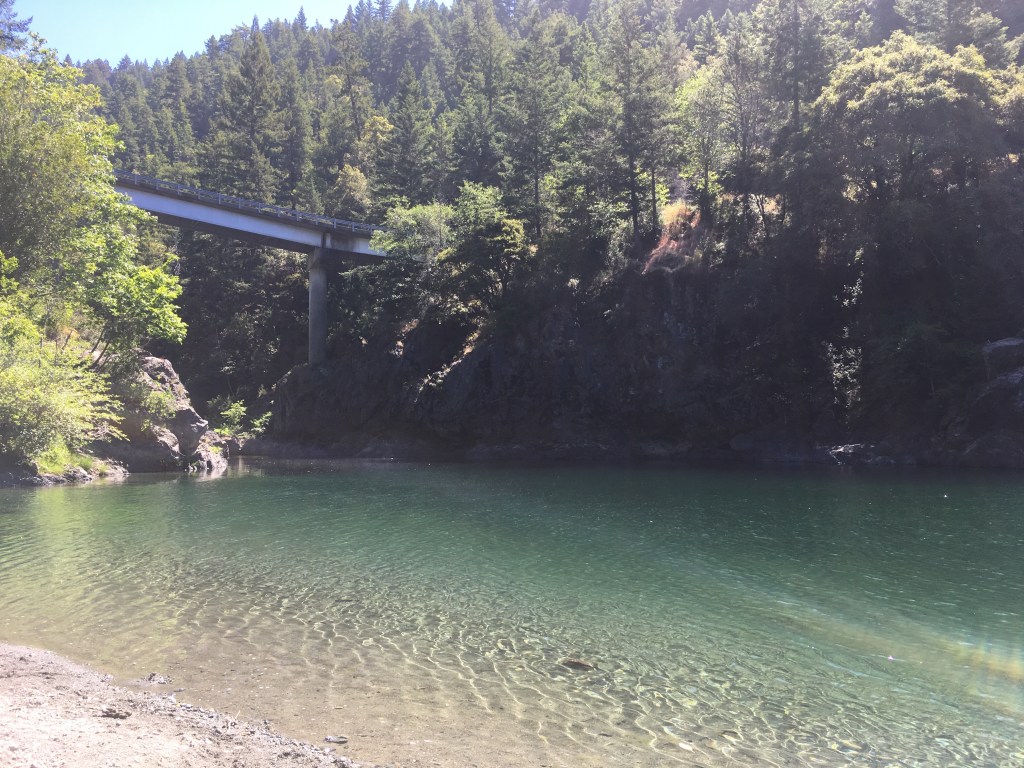
Anyhow, we were nowhere near a big city. We were in the wilds, driving through Klamath National Forest along the border of California and Oregon. I did feel the need to stop and take my picture by the “Welcome to Oregon ” sign to add to my ever-growing collection of state welcome signs. At one point we stopped at a wayside National Forest river access called Myrtle Beach. There were some big boulders on which people were climbing up and jumping off into cold water. Zach wanted to partake. I knew I would not. It was way too cold for me, and cold water is just something my body doesn’t handle well at all. It has no appeal to me, for I turn white and blue and shiver to the greatest extremes. In contrast, I love the heat. Stick me in the scorching desert sun at 120 degrees and I’ll revel in it, well at least for a while, until I pass out, but we know that’s another story.

It was pleasant and peaceful to sit on the rocky shore of the river within this grand forest this young morning. Its water was super clear and pure. There were little cares this morning, and no pressure on time, so I simply watched the others do flips and dive into the water from the tall rocks. 

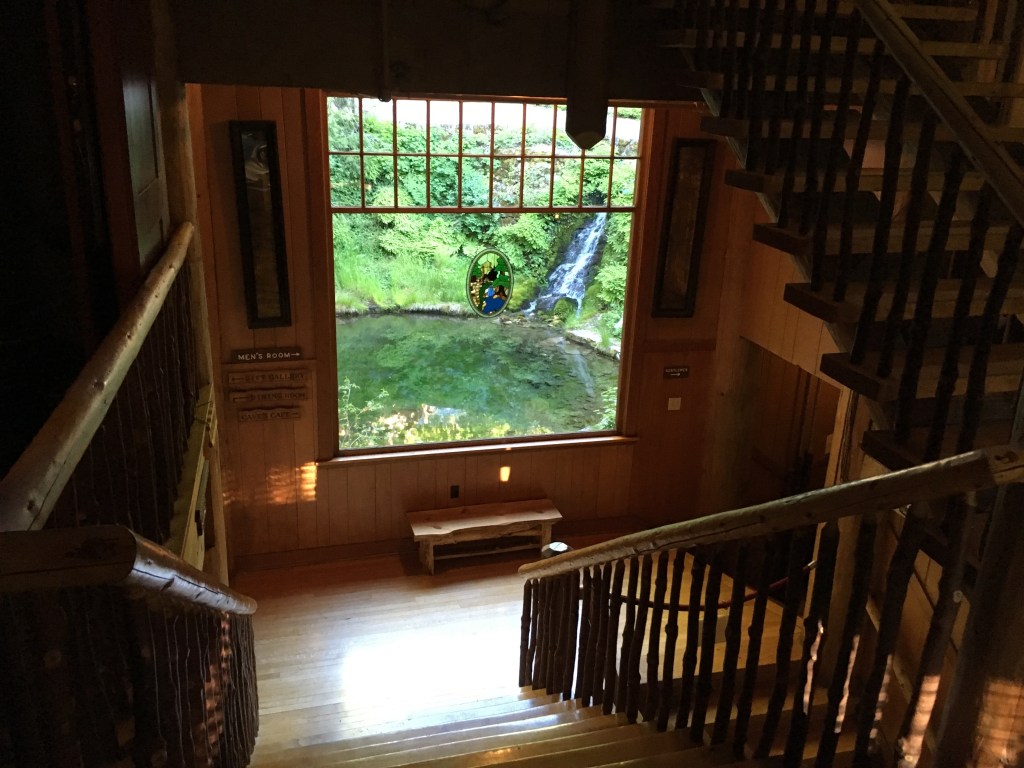
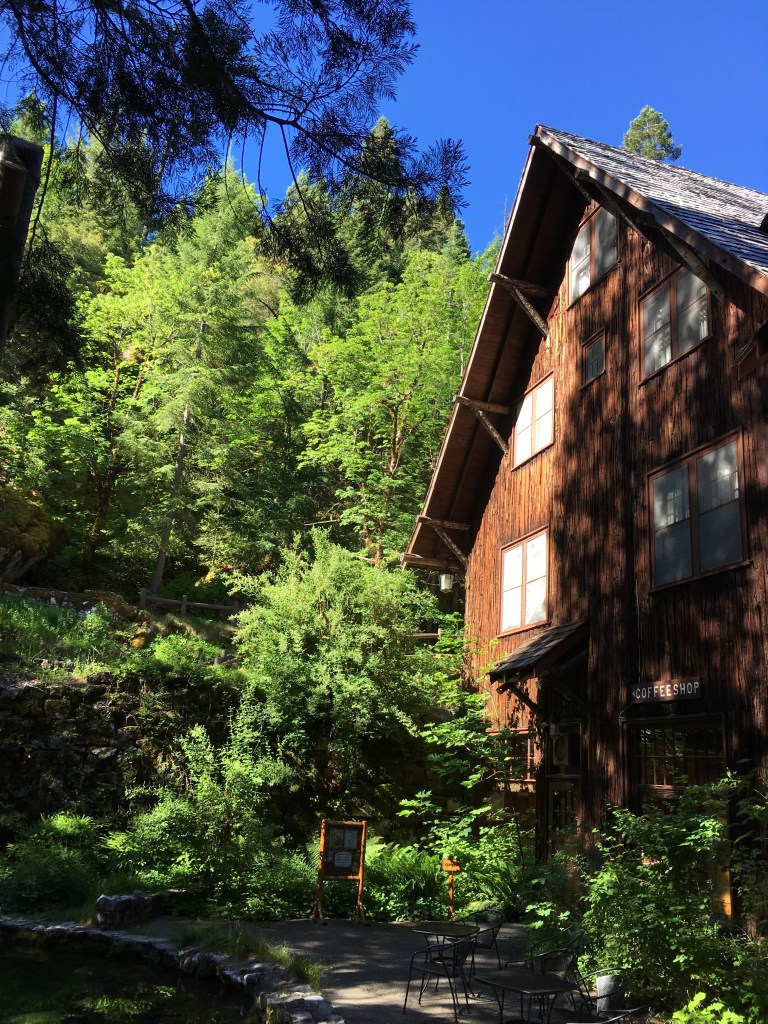
When we departed and finally reached the turn off to Oregon Caves National Monument, the road narrowed into a winding, slithering little thing, going upwards. One big feature of the monument is the historic Oregon Caves Chateau circa 1934. I had booked a room there far in advance, before I knew Zach was even coming on this trip. Luckily this room, although small,  would be just big enough to accommodate us both. From the outside I admired this dark, elegantly rustic gable roofed masterpiece. It was tucked in the forest alongside a small waterfall and babbling brook which actually ran inside the building. We followed the small wood-railed path that led to the lobby. I loved it. It was so picturesque. 

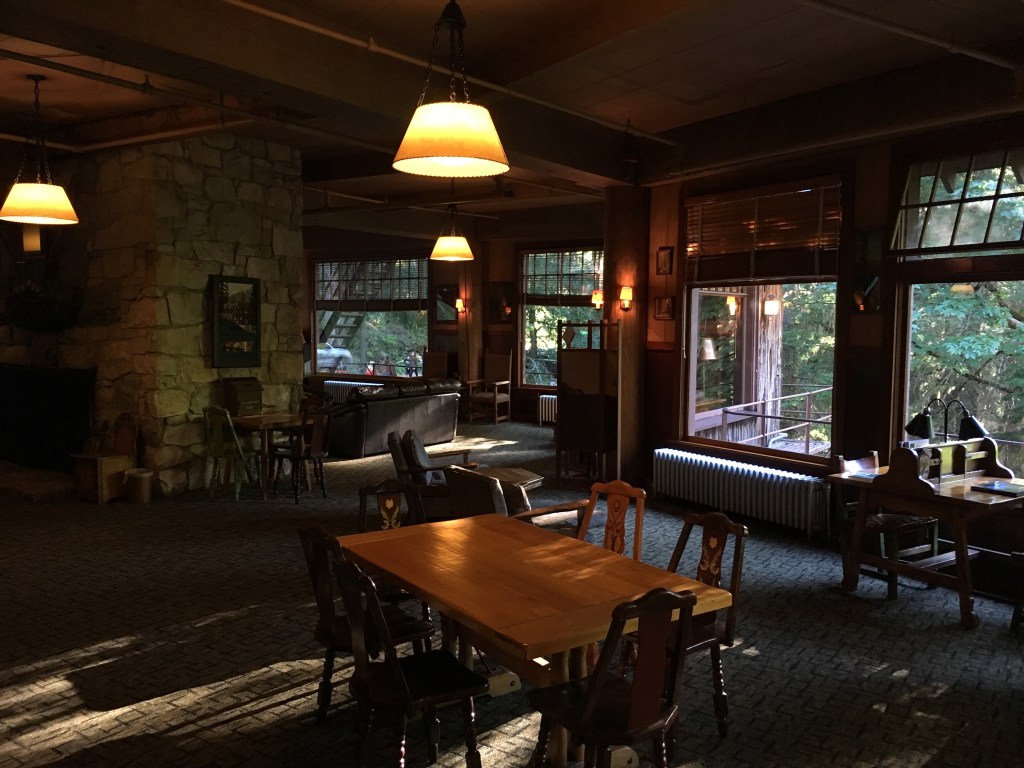
I very much favor the idea of being in a place and leaving the car behind, and this was one of those places. Here we had our accommodations, dinner, trailhead, and the cave all at our disposal. The lobby, though quite large, felt quite intimate in its very inviting aura. It was “L” shaped. Towards the front was a big stone fireplace with a large pile of chopped wood next to it. Placed throughout the lobby were leather couches, floor lamps, and rustic end tables. An old brown piano stood on dated forest green textured carpet. Through the large old windows, light filtered through the pine trees and into the lodge. The place certainly fit the classic style of the National Park architecture movement which I’ve written about before, in which the design aims to blend into the natural environment. Everything about this lodge fit its surrounding forest just perfectly. It’s character was just right. At the front desk, a friendly attendant checked us into the room, reaching into the old-fashioned wooden cubbies behind the desk for a skeleton key.


When we set out to locate the room, it was quite an interesting maneuver. The room was on the very top floor of the Chateau. It required going up the main grand staircase but then up an additional few flights up stairs, walking to the end of a hallway, making our way across a sitting area and game room, and there at the far end of that common space was a small door, which looked to be just a closet. Any casual visitor would never have known there was a staircase here which led to a room, but we opened the door and found our own private small staircase which wound up to this attic room.  We had this secret nook high above the Chateau. It felt very much like something out of a book and would be a great break from sleeping in the cold damp northern woods.

The attendant at the desk said this was the last summer to stay in the Chateau in its present state before it would undergo a major renovation and remodeling. The room was certainly dated but in the most charming of ways. Its bathroom features and lighting seemed to be straight out of the 1930s. I felt privileged to be able to be among one of the final people to see the place in its original state and also sad that it wouldn’t ever be the same. I like old things, such as decor and amenities, as long as they are kept up. It may be the historian in me that loves the novelty of being passed back in time. Sadly, I learned later that the Chateau closed indefinitely after this summer. Funds and gumption never surfaced to keep it running, despite it being on the Register of National Historic Places. It still could one day open again. 

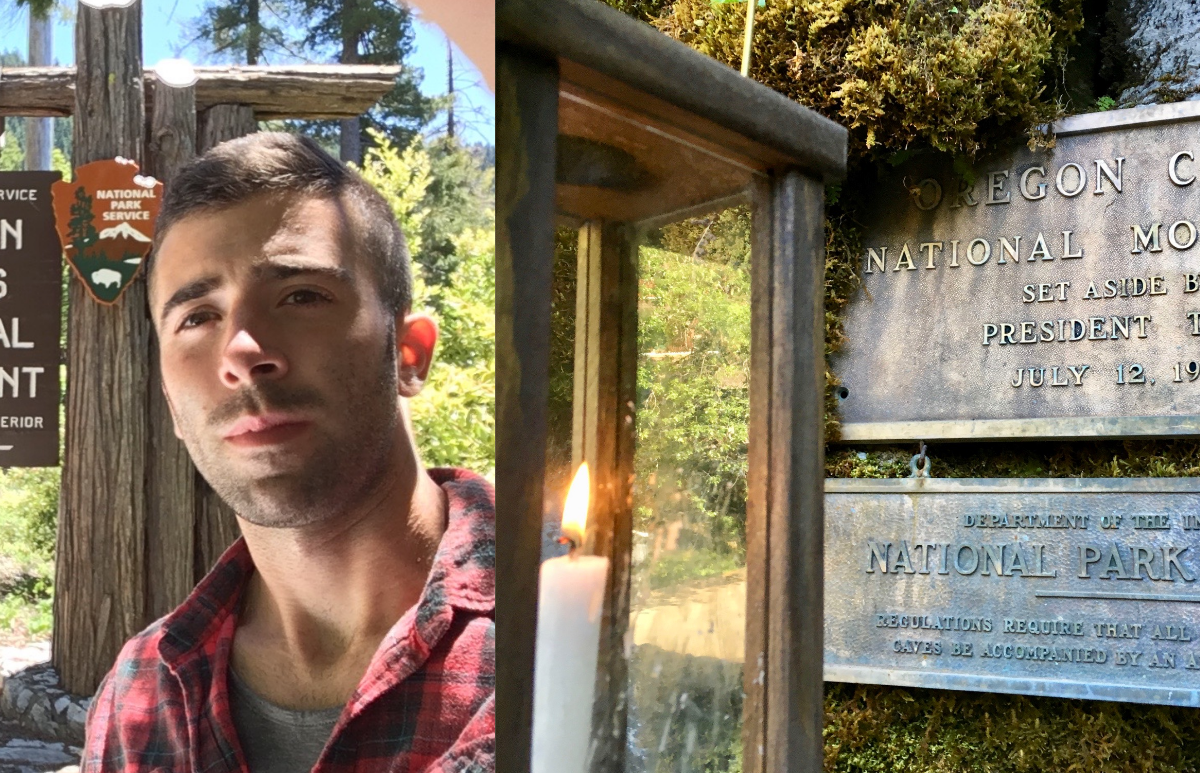
Zach and I were in the room briefly, enough to drop off our bags, use the bathroom, and scarf down some cherries we had bought the evening before. Then we were off to our first cave tour. We simply walked a few yards outside the front of the Chateau to the small entrance to the cave. I enjoyed the plaque that read “Oregon Caves National Monument set aside by President Taft July 12, 1909.” The fall before I visited Taft’s home in Cincinnati, Ohio and later learned he was a distant relative of mine. I like being able to connect the dots and locations of people in American history.  

The tour was the standard “Discovery Tour.” It was very pleasant. The cave was not enormous like Carlsbad Caverns, but had way more character than something like Mammoth Cave, which is very uniform in appearance. Oregon Caves, is more miniature in size, and wanders and winds through a labyrinth full of a plethora of cave formations and glistening flowstones. When we finished the tour we had a quick turnaround before our second cave tour. I had booked the Lantern Cavern Tour for the novelty of such an experience. Between the two tours I thought to squeeze in a short hike. It became more of a run, however. We completed the paved Cliff Nature Trail. It led to a beautiful lookout point which presented the pine forest stretching out over the Siskiyou Mountains. It actually resembled the Smoky Mountains in the Appalachian chain in terms of the height of the mountains and how the pine forest just rolls over them. On the way back to the cave there was a friendly dear walking right on the path in front of us. It was not startled but actually turned around and started to approach us. I suppose it was looking for a handout. I’m sure it would have eaten out of our hands. 


After our quick run of a hike, we were back in the cave on the Lantern Cave Tour guided by the creepiest of park rangers. There was something so unsettling about this rangers persona from the beginning. Something was not right. He told dark tales of people dying in caves and  about numerous wars that went on in the world, while here this cave sat in silence untouched. He talked about how people during the Revolutionary War and Civil War hid out in caves. I’m not going to question the validity or the extensiveness of that, for it’s irrelevant. However, he spoke about how people remained in caves because of fear of the world. He talked about how the cave is quiet and peaceful, but the world outside is full of hate and war. He talked about God, and for ages how people were disillusioned by a belief in him. “God is not real,” he claimed. It’s a tale to control the masses and keep them living in darkness, he explained. To summarize things, in his beliefs there was no God, no good in humanity, and we were all trapped in the darkness. “There is no light. There is no hope in the world,” he said. My heart began to race. He’s going to pull out a gun and murder us all right about now, I thought. 

Then…there was an intense moment of silence. Panic was setting in…

He opened the cave door. “…Then there came the light of science,” he said. “Science takes us from darkness to light. Science illuminates our misunderstandings of the world and our fear about life. So as we walk out of this cave, walk into the light of science.”

Phew! Get me out of here! I will gladly walk into the light after being in this dark cave with this creep! Get me out into the Chateau or out into the forest. I rushed out of there and took a deep breath. That was a stressful fight or flight moment, and I had a lot of thoughts and feelings to express. 

First off, I found it extremely audacious to take this analogy of light amidst darkness and apply it to science, while denouncing and attempting to demean the religious faith of so many. It would be one thing to simply use an analogy of light and darkness with science, but to take it a step further and walk on the religious faith of others, is grossly disrespectful especially given that the analogy is so prevalent in the Bible and engrossed in religious faith. 

I would expect someone representing the United States as a U.S. Park Service ranger, preserving the nation’s natural and cultural treasures, to have a bit more sensitivity than to  flippantly disregard the deeply held religious beliefs of so many people of the country he serves.

Going back to the 8th century B.C., the prophet Isaiah, in reference to Jesus’ coming, wrote, “The people walking in darkness have seen a great light; on those living in the land of deep darkness a light has dawned.” (Isaiah 9:2). Then when the prophecy of Isaiah was fulfilled and Jesus walked this earth, Jesus is quoted in the Gospel of John saying, “I am the light of the world. Whoever follows me will never walk in darkness, but will have the light of life.” (John 8:12). Also in Scripture we read, This is the message we have heard from him and declare to you: God is light; in him there is no darkness at all. If we claim to have fellowship with him and yet walk in the darkness, we lie and do not live out the truth. But if we walk in the light, as he is in the light, we have fellowship with one another, and the blood of Jesus, his Son, purifies us from all[a] sin.” (1 John 1:5-10) . These are just a few of the Bible’s references to light. 

 The religious analogy of light is certainly deeply entrenched in religious faith, and it does raise a lot more questions than the scientific one. It’s multifaceted.  What does the Scripture mean by light? And why is Jesus described as light? And at a more personal level, how is Jesus light to me?  I did not appreciate this ranger’s assault on faith, but I will take it as a challenge to examine my own beliefs. I would conclude, God is light, the source of all clarity and Truth. Science can be a search for Truth, but is a human operation, and can get things wrong, and even when science gets things right, it points to God.

Freed from the cave and the most worrisome of rangers, I enjoyed the rest of my time at Oregon Caves National Monument and Preserve and the delightful stay at the Chateau, and I’d have some food for thought and the impetus to unpack some of my beliefs about what is light in the philosophical and spiritual sense. 

If you enjoyed reading this, check out my book Still, Calm, and Quiet“

Check out my previous entry here: “Crescent City: Tide Pools and Tsunamis”