Gas Pump in the Wild

I wasn’t going to let this happen again– the stress of nearly running out of gas. We were still on our visit in Olympic National Park in Washington, but as access to the park was split up by various types of land allotments, now we were on a small piece of Indian reservation at a gas station in front of a casino. I noticed the price was $3.19 per gallon which seemed cheap after braving the gas prices elsewhere in the Pacific Northwest. I’d notice in a few days gas prices plummet leaving Washington into Idaho and Montana, which was not much of a curiosity considering the states’ politics and their effects on their economies. Here at the Indian reservation casino gas station I filled up. When I went inside the gas station convenience store, I was surprised by free coffee and tea. I got a cup of orange spice tea to calmly ease into the morning. Then we were back in the car for a short drive into the park to the Hurricane Ridge area.

A few days prior, leaving the Chateau at Oregon Caves National Monument, driving through the long expanse of national forest, we were low on gas. We were also in a very remote area, and when we finally reached an isolated gas station there was a sign that read “cash only.” We had the cash but perhaps were here too early, for no one was working. Zach couldn’t use his phone to look up the next nearest gas station either, because we were out of service range, but I was able to search in my GPS. The next nearest gas station was thirty miles away! I wasn’t sure if we would make it, or if it was even en route, but it was the only option unless we were to wait a few hours to see if someone would show up to work at this gas station. What if they didn’t? It would be a morning wasted.

So we journeyed on. There was an uncomfortable silence in the car. I probably wasn’t the only one questioning my judgment. Out the window was merely pine tree after pine tree- no people, no cars, no buildings, just the forest and us. Mile after mile, it was all in uniform, and the road was straight and unending in the dark morning forest. It made me wonder if we were getting deeper in the wild, further from any civilization. Normally I’d like this, but not without gas! There was more and more of the same drawing on, and according to the vehicle’s interface, we were out of gas. Yet we were still moving.  I was starting to feel the regret and dread of relying on this GPS. It seemed to be leading us astray, then…

“You have reached your destination,” the GPS sounded. As my journal details, I didn’t think this was in operation, but I pulled up to the singular pump. There was no store and no booth, but attached to the gas pump was a curly coiled wire phone. Zach pointed to the sign.

For gas dial 1,” it read. We looked at each other with probably the same thought. We were puzzled. What’s going to happen? We hadn’t seen anyone, just trees for dozens of miles. Was someone or something going to pop out of the forest and pump our gas? Is this sasquatch’s gas pump? I opened the car door and stepped out. The forest was silent. I lifted the phone and held it to my ear. To my surprise there was a dial tone. I punched in a “1.” It rang!

Hello,” The muffled voice came through the receiver.

“Hi. I was wondering if I could get some gas.” I believe I was too puzzled and confused to have even considered the pleasantry of bidding a “good morning.”

I’ll be right there.”

This might actually work.

We waited, looking around with suspicious anticipation in every direction.

After just a couple minutes, we saw a golf cart coming down the road- our rescue!

A pleasant older man in flannel and blue jean overalls asked how much gas we wanted. I handed him a $20. “Sorry about the wait,” he apologized, although it wasn’t much of a wait at all. “I had to find my keys at the lodge.”  I concluded there was some lodge I was unaware of, and this was their gas pump. The golf cart was used to travel around their property. 

“No problem,” I responded. “Thank you.” 

And we were on our merry way.

That was four days earlier, and I wasn’t going to find myself stuck in that sort of situation again, and that is why I filled up. In the far remote West, with distances so grand and gas stations so rare. Every opportunity to fill up should be carefully considered. Take advantage of any gas pump in the wild. 

We eventually reached the Hurricane Ridge section of the park. We were getting ready to hike about seven miles to Klahhane Ridge. There was a visitor center, and of course I had to go in. There wasn’t much to see for it was a small place. I was engrossed in the literature, the books for sale, while Zach found a binder on display with pictures and information to identify wild flowers. He studied up on the flora for the day. I ended up buying a book about wolves. The cover of the wolf’s piercing stare drew me in. Back at the car, we geared up for a beautiful hike on a trail loaded with wild flowers, majestic view, and lots of wildlife (but no wolves). 

And experience with the gas pump inspired me to write this song…

Ode to the Gas Pump in the Wild

Driving through the wild, beneath the towering trees,
Feeling the stress as the gasoline quickly depletes.
In Siskiyou National Forest, a land so vast and grand,
But stranded in the woods, was not what we had planned.
Miles of pine trees, stretching, nothing in sight,
Will anyone be our rescue, or will our day turn into night?

O gas pump in the wild, like a lifeboat in the sea,
Rescue us from drowning, would you pretty please?

Then a glimmer of hope, a steeple in the pines,
A chance to refuel? Hopeful as a child.
With a phone on the pole we dialed for our need,
And from the forest’s depths, came our lovely savior’s steed.
A golf cart in the distance, rolling into sight,
An old man with a smile, making everything alright.
In flannel and overalls, this man helped save the day,
He powered up the gas pump and sent us on our way.

O gas pump in the wild, like a lifeboat in the sea,
Rescue us from drowning, would you pretty please?

In the remote West, where gas is rare and few,
Seize every opportunity to safely see you through.
If it’s just a little gas pump, hidden in the trees,
It may be a lifeline, setting you at ease.
So now we hike the trails, where the wildflowers abound,
Learning of the animals of which us surround.
Here at Hurricane Ridge is where we will happily be
With gratitude to the gas pump forever endlessly.

O gas pump in the wild, like a lifeboat in the sea ,
Rescue us from drowning, would you pretty please?

Gas pump in the wild, a sanctuary found,
In the midst of nature’s bounty, you wear the crown
With this adventure’s end, there’s a story to compile,
Of a journey’s uncertain detour forever worthwhile.
So here’s to the gas pump, a tale to be told,
Along the Rogue River, where memories unfold.
Of a certain lonely gas pump, that will always be
In my adventurous heart forever endlessly.

If you enjoyed reading this, check out my book Still, Calm, and Quiet“

Check out my previous entry here: “The Rainforest and the Bear”

Visit www.joshhodge.com

How God’s Story is Written Everywhere

The most meaningful takeaway from my visit to Crater Lake National Park was not the memory of jumping into the lake itself, although that was a great moment of overcoming fear, nor was it the beautiful vistas now imprinted in my mind and in my photographs. Rather it was what I learned about the creation of the lake in the park film in the visitor center and how it relates to spiritual life.

Typically I’m not captivated with geological presentations of layers of rock, seismic activity, tectonic plates shifting, volcanic eruptions eons ago, etc. On some occasions those things can be interesting, but usually, right off the bat, I’m questioning the validity of the information presented when it all starts off talking about millions and billions of years ago. To the contrary I believe the earth to be rather young  and that God designed it with the appearance of age. Also I believe the earth was so violently shaken during the Great Flood in Genesis, that so many processes that would have taken, under normal conditions, millions of years, happened quickly in all the trauma.

Surely during the Flood volcanic activity was abundant. The earth, while covered in stormy waters, shifted rocks dramatically, and sedimentary layers formed quickly, burying things rapidly. Nearly every National Park in the Southwest references a time when the earth was covered in water or a massive flood. This should influence our understanding of rock layers, geology, and the earth’s age.

Anyhow, the geological park film about the physical creation of Crater Lake spurred fascination in other ways. The events that created the lake are believed to have taken place only 7,700 years ago, which would place it at right about the time of the Great Flood. I also learned that Crater Lake was actually Mount Mazama once upon a time. It is believed it stood as tall as 12,000 feet. Then it had a violent eruption spewing over nineteen miles of lava and sending ashes over one thousand miles, some landing in Alberta, Canada. When the volcano erupted it left a giant cavity in the earth, a crater, which over time filled with melted snow and rain water to a depth of 1,943 feet, making it the nation’s deepest lake. The National Park Service in their park brochure describe the volcano which created the lake as “catastrophic.”

After learning about such a “catastrophic” event, now one can step outside the visitor center and see a serene, beautiful, mountain gem of a lake. It’s pristine, vibrant blue, and so enjoyed by many. I was captivated  with the notion that something so violent and destructive resulted in something so peaceful and beautiful. There’s a deeper message here, I knew. I had to channel my inner John Muir first to examine how this concept of peace and beauty after destruction is exhibited across creation. Is it a design element consistent across existence or an isolated event? Then I could question what God is teaching or revealing to us about Himself in all this.

The preliminary probing question I had to ask was, what other destructive things result in beauty? I was immediately taken back to my days of being very sick with a trifecta of intestinal and digestive system destruction. I was battling ulcerative pan-colitis, pancreatitis, and a bacterial infection. At the time my body was withering away and wasn’t even breaking down food. I was malnourished and in extreme pain, losing blood in large amounts. My plans for the future were ripped away from me. The havoc it created in my life was real, and as the National Park Service might say, “catastrophic.” But during this whole time of sickness God was doing immense work on me, putting me through the refiners fire, creating who I am, and teaching me reliance on Him and trust in His goodness. I emerged stronger in every way, physically, emotionally, and spiritually. I was also given a new gratefulness for my life, my body, and the world around me. After being confined to a hospital room, bed, or exam table, too weak to move, I was now able to climb mountains, summit scorching  sand dunes in the Mojave, jump into Crater Lake, and take in a deep breath of fresh mountain air without pain. This all brought me great joy. 

I was able to see profound meaning and beauty in life after the painful time of destructive sickness. Some struggle with coming to terms of the coexistence of God and suffering. After having been through much pain and grappling with the question myself of why does God allow suffering?  I don’t. I do not believe God brought about the pain or suffering in my life at all, but I believed he used it. He redeemed it to bring about goodness and peace in my life. As Romans 8:28 says, “God uses all things for good for those who love Him and are called according to His purpose.” I truly believe God can redeem anything to bring about goodness and spiritual growth, ultimately bringing Him glory. The overall message of Crater Lake was becoming clearer. It is one of the redemptive nature of God. 

I then began to think about war, how terrible a thing it is, and how timeless it is in our fallen state of humanity. But then I considered how after war there always comes peace. We see this repeated through the ages. When right prevails there is good that follows. The destruction of war is not a good thing. It is never desired by the righteous, but eventually it results in, or is redeemed for, peace. 

We too, as followers of Christ, wage war in our own spiritual lives. We equip with the spiritual Armor of God as talked about in the book of Ephesians. We take down strongholds and defeat principalities’ weight in our lives. As it says in the book of Ephesians, “For our struggle is not against flesh and blood, but against the rulers, against the authorities, against the powers of this dark world and against the spiritual forces of evil in the heavenly realms.” These battles are fought violently through prayer, scripture, obedience, reliance on God, and with the name of Jesus. One may question my word choice of “violently” when referring to such things as Scripture and prayer, but yes, I mean it. I believe these are violent and effective weapons in the spiritual realm against the forces of evil. Spiritual war can be ugly. It’s sacrifice. It’s a shaking up and reordering of one’s life, but it ultimately leads to peace and a right relationship with God. 

In my thoughts I then came back to the natural world. I looked towards the mountains and thought how, per the words of the experts, all mountains are created by earthquakes and volcanoes, both destructive acts of nature. Now these mountains stand tall, unwavering, and at peace. Forest fires, too, are another thing that seemingly, on the surface, are all bad, but those destructive events are redeemed as well. The aftermath is a nutrient-dense soil and room in the forest for the next generation of plant life to grow. I have seen many-a-forest both on fire and recovering from a fire. A forest fire is ugly and can be scary but recovering from a fire, the forest floor is always decorated with flowers. There are sprouting berries and mushrooms, and new saplings starting to really take root. It’s a beautiful thing. There is peace after a ravaging fire. 

I also began to think about birth and how it is such a painful and laborious process for the mother, but out of such a mess of pain comes the beauty of new life and the peacefulness of a resting baby. Then I thought of death itself. No one wants to face the process of death. Some will die tragically. Some will fight to cling onto this world. People will grow old and suffer ailments before death, but through death God reaches down and reclaims the life of his follower. Out of the end-of-life turmoil, suffering, and human-instinctive fear, He brings about ultimate peace, as he fully restores one’s spirit in his very presence. 

Ultimately this great design element from a volcano to a serene crater lake, from a forest fire to a flowering grove, from labor pains to a baby’s sigh, from war to peace, and from death to life, all show the redemptive nature of God. The message was becoming even clearer as I realized it was then pointing us to Jesus- the ultimate redeemer. Jesus felt pain on this earth. He asked for the “cup to pass” from Him when considering his approaching crucifixion, but He then went on to endure the most gruesome of deaths and the most momentous event in all of human existence. His great sacrifice, and his own redemptive rising from the grave, conquering death, brought about the possibility for salvation and the redemption of the human soul. He paid the ultimate price for our sin, making us just and acceptable, forgiven and presentable to a pure and perfect God.  This event is so great, so important, that God has painted it across his creation. The volcanos, the forest fires, the wars, the labor pains, they all point us back to the redemptive story of Jesus and salvation. 

It’s so great because and worthy to be written in the fabric of all creation because it is only through the blood of Jesus that  we can be redeemed from the destructive forces of sin in the world and in our lives. God wants to save us eternally, but eternity starts in the present, and God is here to wage war with us, from the dark spiritual powers which have a hold on us, from our self-destructive habits, from our mental and spiritual turmoil. God saves. He will deliver and redeem. As he promises, the battle is  already won through Him.Through turning to God, accepting his forgiveness, and waging war God is helping us to be “born again.” To do so is not easy, there can be labor pains as one must leave behind his old self, but ultimately we have peace knowing God is fighting our battles with us and will redeem. I think about the violent volcano spewing lava like blood, but then I look at the beauty and peacefulness of Crater Lake and I find hope. Here God reminds me of who He is and what He does. None of the wonders of nature are without meaning. God has placed his story everywhere and wastes nothing. 

If you have not called out to God and sought his forgiveness through Jesus, I hope you do, and I urge you to. If you have not waged spiritual war,  arm up! The stakes are high. Your soul and eternity is on the line. May you feel the transformative redemptive power of His love as you come to personally know God,  and may one day your pains and trouble be replaced by beautiful crater lakes and alpine streams. 

“And he who was seated on the throne said, ‘Behold, I am making all things new.’ Also he said, ‘Write this down, for these words are trustworthy and true. ‘” Revelation 21:5

If you enjoyed reading this, check out my book Still, Calm, and Quiet“

Check out my previous entry here: A Day’s Journey Around Crater Lake

Visit www.joshhodge.com

A Day’s Journey Around Crater Lake

Before we arrived at Crater Lake National Park, the day had started off waking up at the Oregon Caves Chateau, tucked away in the woods, in our secret little attic space high up in the Chateau. There was no central air system in the Chateau, so I undid the latch and swung open up one of the rustic windows in our attic. to let the cool night air in. The room was pretty warm during the day but by the next morning it had certainly cooled off. 

We made our way down a few flights of stairs to the diner-style cafe on the main level. It too had its own vintage charm. It had probably not been touched much since the 1930s when the lodge was built, but maybe it was tweaked a bit in the 1960s or 70s to give it its distinct color palette of yellows, browns, yellowish-browns, and oranges. It had a dining counter with swivelling stools that snaked around. It was smaller but very similar to the one in Jackson Lake Lodge in Grand Teton National Park, the one in which the “cougars” bought me dinner. Here I feasted upon some buckwheat pancakes and bacon, with a cup of coffee. This was the more economical dining option at the Chateau. Last night, feeling fancy, and knowing this was probably the only time I’d be out this way, I splurged, and Zach joined me. We ate at the lower level dining room in which the bubbling brook from outside flowed into the dining room in an inlet of rocks. 

I’ll admit part of me felt guilty for spending so much on a meal, and dining on tablecloths and placemats, while camping and trying to be economical. but I also felt like for such an experience, it was worth it. I had also planned on eating here, so the cost wasn’t unexpected. At the time this was the most expensive meal I had ever purchased at around $30. I had braised pork with sauteed carrots, asparagus, mashed potatoes, and a side salad with dinner rolls. It was very savory and done right. 

Before we left the Chateau in the morning, I hopped on the piano bench in the lobby, and I left a tune for the old place, a song I had written on the piano as a teenager. The piano had been calling out to me everytime I passed by, and so I finally responded.

Leaving the Chateau we uneventfully traveled through the forests of Oregon, and as we neared the small city of Grants Pass, I decided to browse the radio stations and see If I could get an idea of the local flair. In southeastern Kentucky, I can tune into some bluegrass and Southern gospel stations with local news of who died and who has married. When I drove across the Navajo Nation, I listened to traditional Navajo music in native tongue. When approaching Chicagoland, there is a wealth of Spanish language stations with a lot of ranchera music, indicative of its large Hispanic population. 

The number of country music stations, I believe, is also very telling about the overall culture of a place. There are a lot of values embedded in most types of music. In the country genre there largely is a love for country, family, nature, the land, sentimentality, hard work and blue collar grit. Rap music is another example, very telling about values. It overwhelmingly values pimping and prostituting, debauchery, carnal desires, stealing, raping, disrespecting authority, and killing. The prevalence of such stations in a particular region is a small glimpse into the overall and dominating culture. So what did I find in Oregon? Well, I landed on a yodeling station. What does yodeling tell me about the people? What values are embedded in the yodeling genre? I couldn’t tell you, but my ears were fixated and pleased. What talent! How does one even do that? Is yodeling a part of Oreganian culture? Are there little mountain yodelers atop the Cascades? I still hadn’t figured out Oregon and wasn’t sure if this was an essential part of it. 

After departing Grants Pass, we were traveling along Oregon’s Rogue RIver, which flows western to the sea from its headwaters in the Cascades just next to Crater Lake. We were zipping along highway 5, the Pacific Highway. We could see mountains ahead and heavy greenery and foliage along the highway, with a glance every once in a while of the river with its craggy natural embankments. When we split from highway 5, we started to ascend, and  pine trees took over. They were not giant Redwoods from days prior, but thick groves of moderate size pines standing perfectly straight and pointed on a dry, barren, and at times dusty ground. 

When we arrived at the park, our first order of business was setting up camp. Crater Lake has two park villages, Mazama Village and the Rim Village. We were staying at Mazama, and we were not going to do any backtracking. We had a lot to see for we only had one day to experience Crater Lake National Park. Mazama Village comes right after the park’s entrance station, thus it was our first stop. The campground was average, nothing remarkable, with large flat pine-laded tent pads under pine trees. After we set up camp we went to the visitor center, and from there we had our first glimpse at the remarkable Crater Lake, but I didn’t want to give it too much attention right away. There is an order of events for visiting a National Park, at least in my book(s), quite literally. First I had to orient myself with the park film to be able to better appreciate and understand the vista before me. The visitor center was a small cabin, half built of large chunks of rock, the other half of wood. Next to the main room was a little side room with an ad hoc set up with a television playing the film. I learned just how Crater Lake was created by a volcano. To put it simply, much simpler than the film’s details, a large and powerful eruption caused a crater, and then over time rain water and melted snow filled the crater, creating the lake. One of the many unique characteristics of Crater Lake is that it has no water flowing into it, making it one of the most pure natural bodies of water in the world. I was really fascinated how something so destructive and violent, such as a volcano, created a place now so beautiful and serene. There was a message here to unpack. There is a universal truth to be explored. I’d get back to that thought later. 

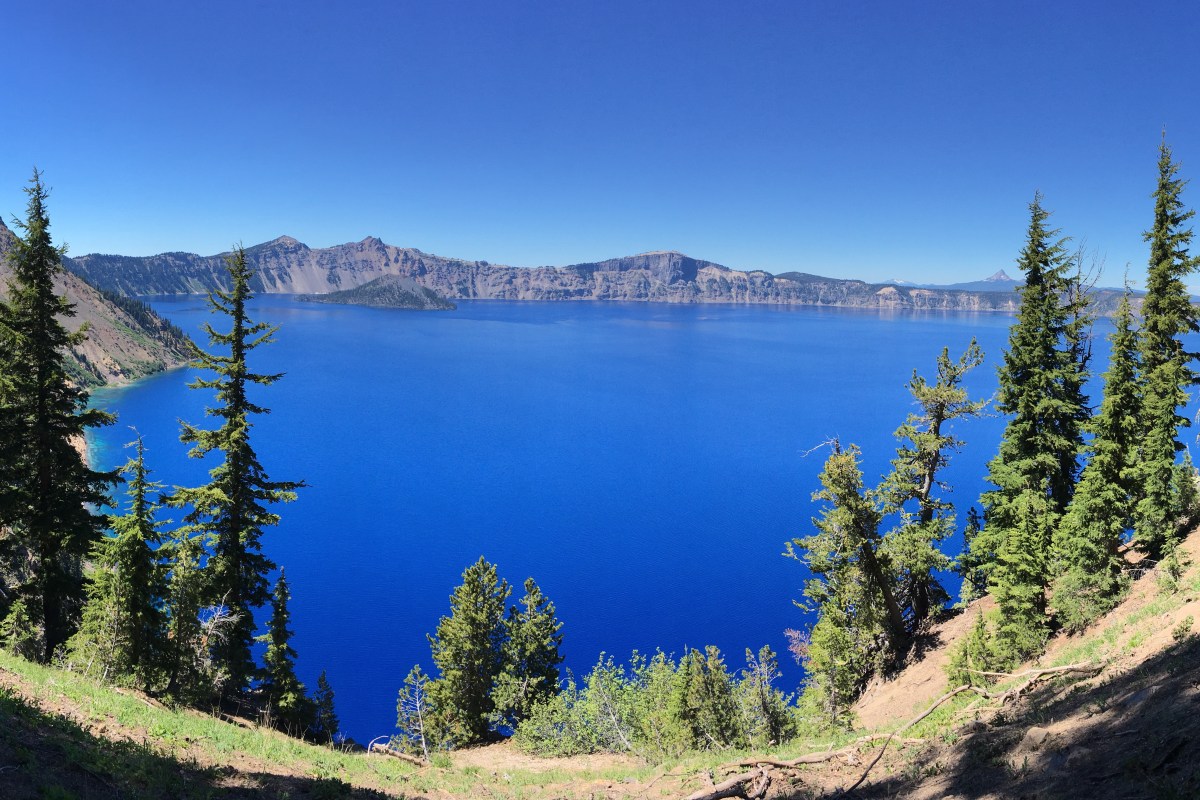
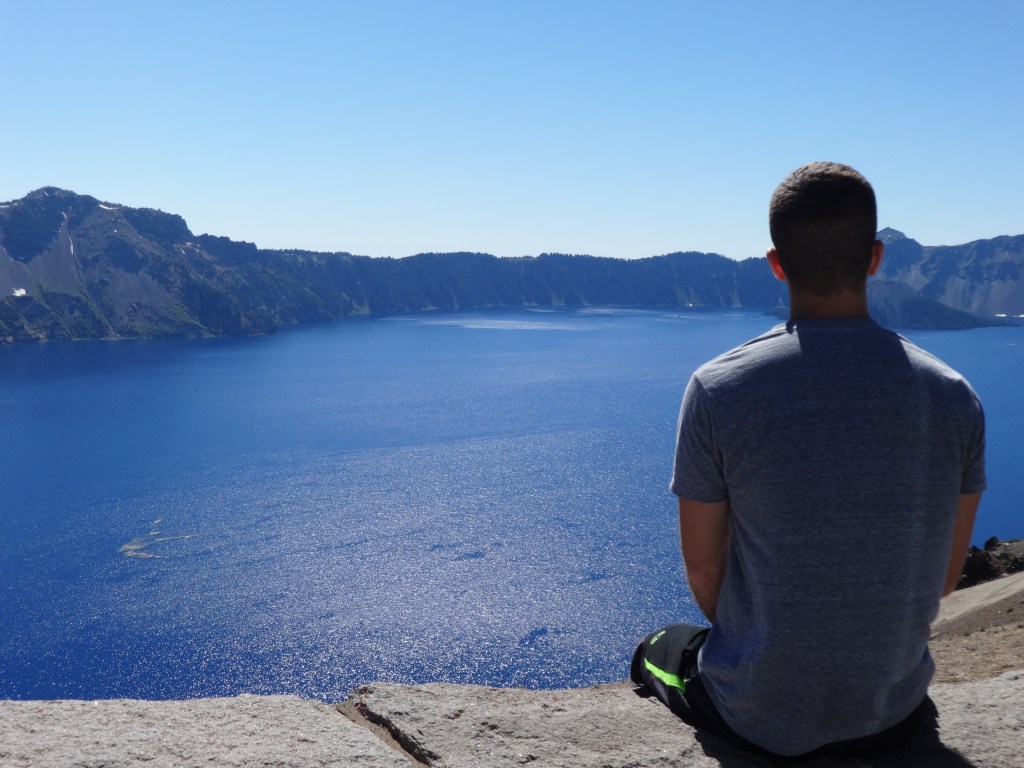
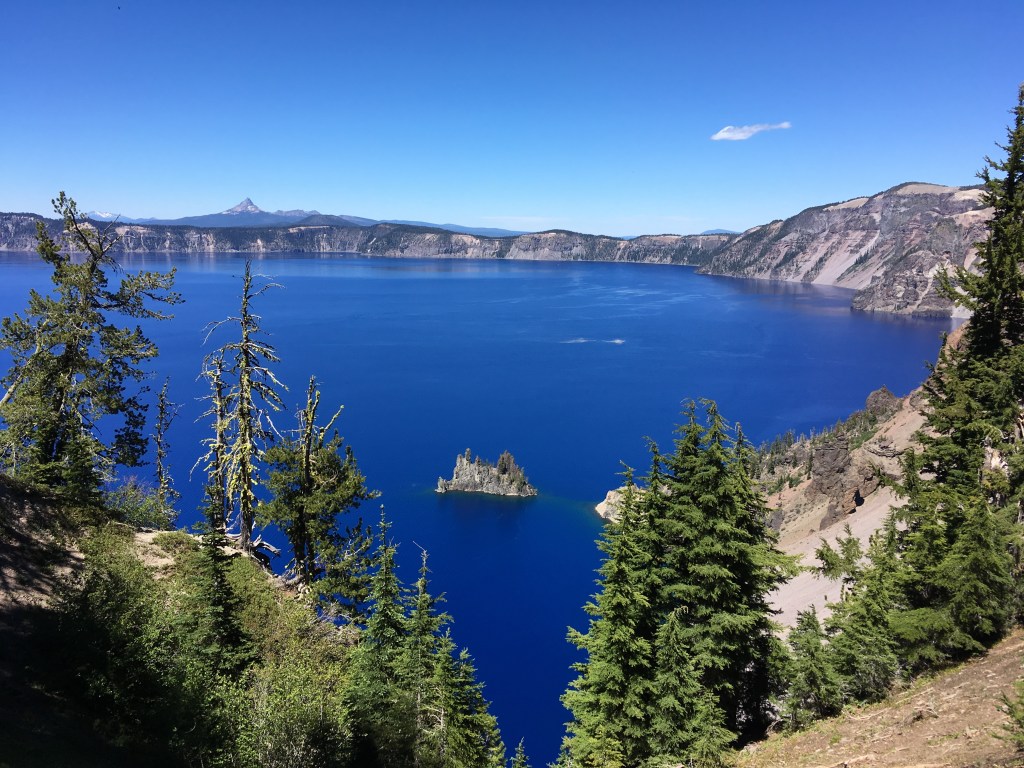
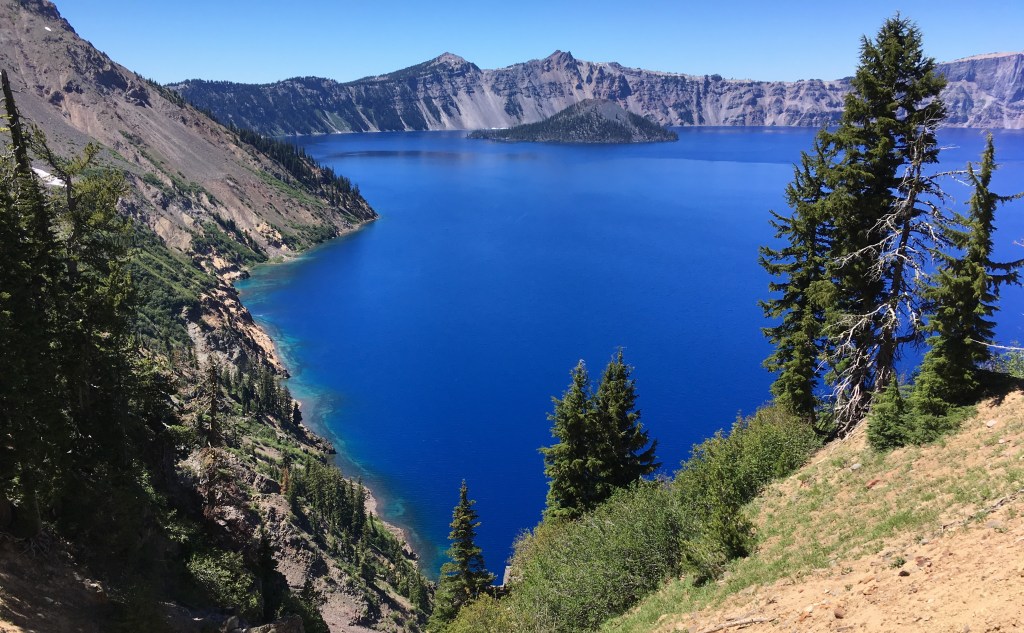
From the visitor center we began the thirty-three mile Rim Drive around Crater Lake. We stopped at just about every wayside overlook. The lake is enormous, with a six-mile diameter and about twenty miles of shore line. It is quite serene, and truly is just a giant bowl. One can see the rocky and steep rim of the bowl all around and always look at the lake from a great distance above on the rim’s tall cliff edges. The most striking feature of the lake is its color. It has the richest blue water I’ve ever seen. It’s so bright, vibrant, deep and royal. Such a particular and unique color almost makes it look artificial, as if the water was dyed, like the color of those faux waterfalls of a mini-golf course of the 1990s. But of course I knew better than to think it was fake, and it wasn’t tacky but beautiful in its surreal display. 

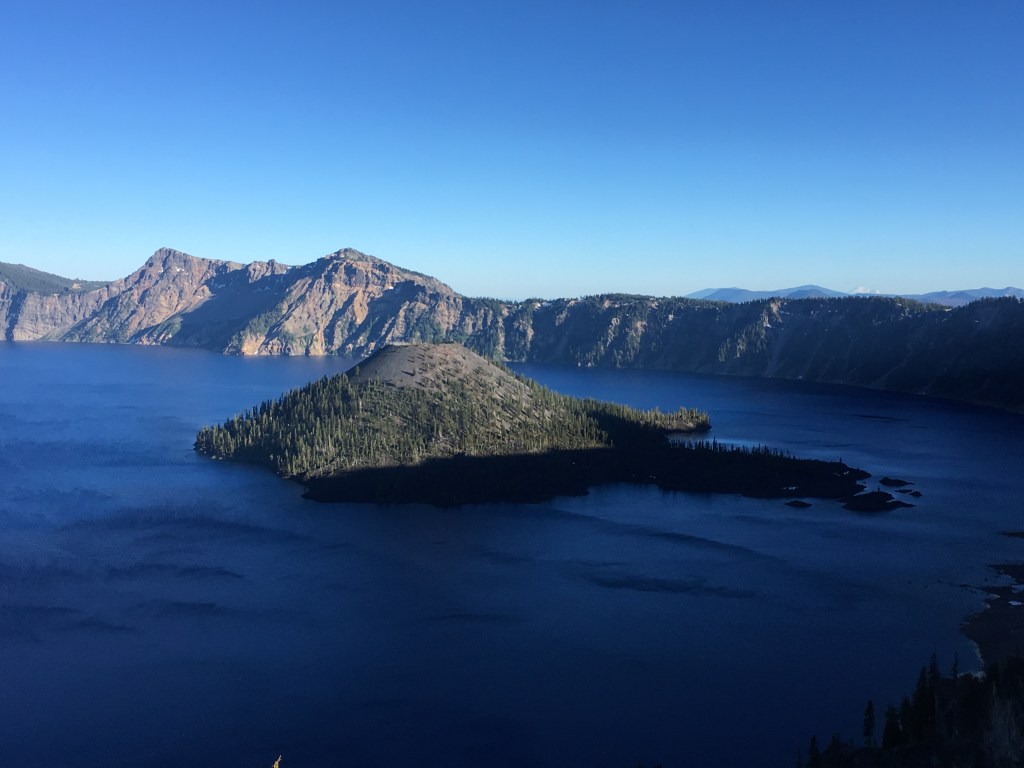
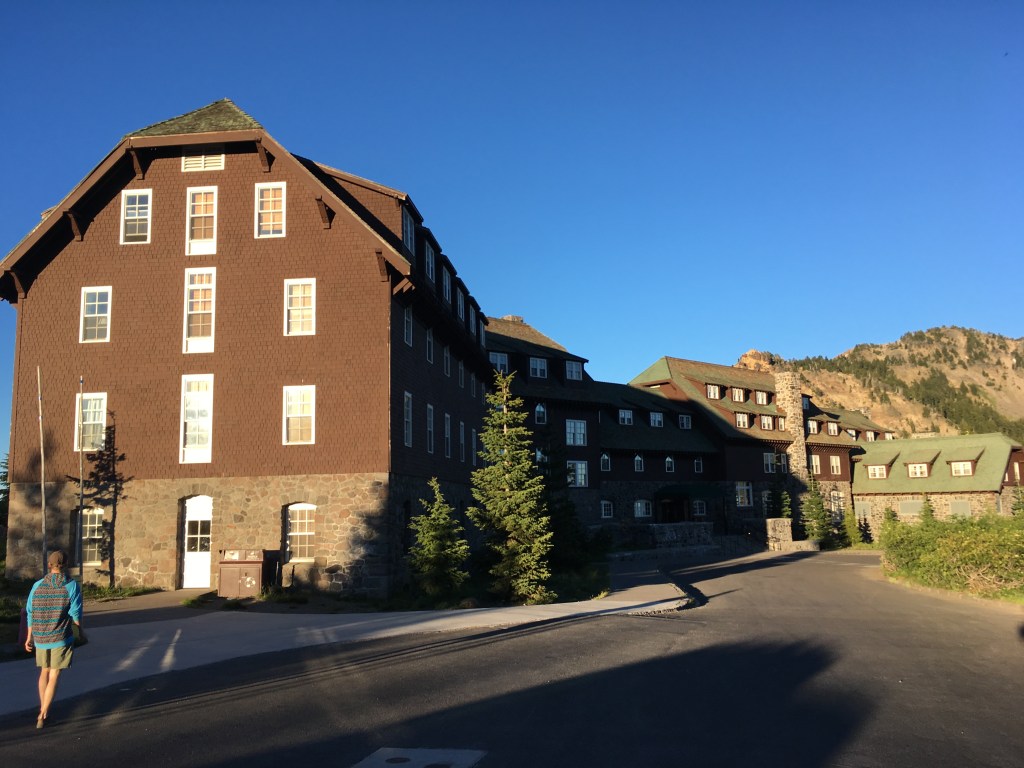
Surreal is a word I’ve landed on to describe the place, for to be surreal something incorporates characteristics of reality combined with fantasy.  Crater Lake, though very real,  seems to incorporate elements of sheer fantasy. Even apart from simple visual observation, there are names given to the places in the park which give way to fantasy, such as Wizard Island, Phantom Ship, Castle Point, and Wineglass. Even the visitor center and village buildings look rather fairy-tale-like, reminding me very much of Snow White’s cottage. 

Wizard Island

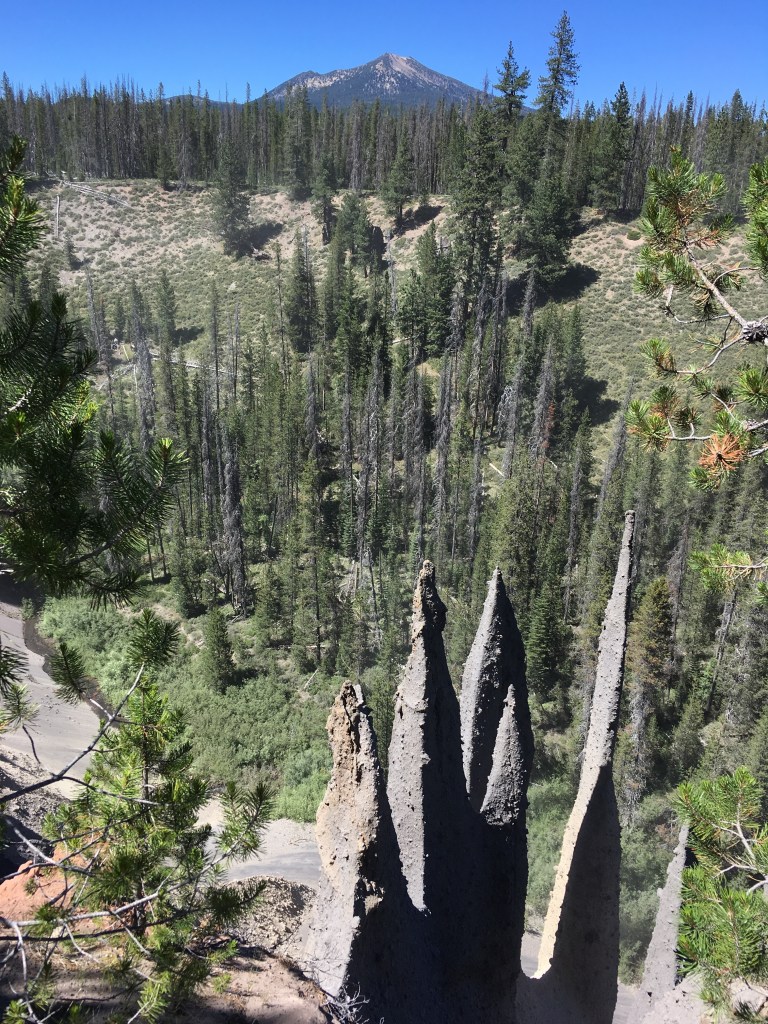
We took a five-mile side trip from the rim driving down Pinnacle Valley to an area simply called “The Pinnacles,” where large sharp, pointed piles of gray and brown volcanic pumice stick up from the ground, like the fingers of a giant beast reaching up to emerge from the depths of the earth. I had never seen anything quite like this before, although they did remind me a little bit of the hoodoos of Bryce Canyon. These did not, however, have the flat capstones as hoodoos. Rather these were pointed, like smooth delicate giant stalagmites. They also didn’t have the warm orange and red colors of Bryce Canyon, but rather they were mostly a ghostly pale gray and actually not beautiful at all. They were rather ugly, but in nature’s most intriguing of ways. 

Back on the Rim Drive, a very notable stop was at the Phantom Ship Overlook. From here we looked out at the lake at just the right angle to see a small island that looked like an abandoned pirate ship. It had craggy rocks that pointed like the masts of a ship, and a few pines and shrubs adorning it, looking like seaweed or barnacles, as if it had been some sunken ship summoned up from the depths of Davy Jones’ locker by some dark magic. 

Phantom Ship

Along the drive we also stopped at the Cleetwood Cove Trail, a one-mile, very steep trail of dramatic switchbacks which led down to the cliff in which I jumped into the lake. I was excited to get down to the lake and see this fantastical water up close. So far I had only seen it from high above the lake on the rim. So in excitement I suppose I was walking quickly down the trail. Zach complained I was walking too fast and then brought to my attention that he thought I always walked too fast and that I should be waiting for him. Initially I felt sorry and was more conscious of trying to walk with him instead of getting ahead, though this was nothing I was doing consciously, and by no means an indicator of me trying to put myself first, elevating myself to a position of superiority. It was just my sheer excitement propelling me forward and putting me ahead of him. This may seem like an unimportant detail, but I only note this because it was the first in a series of complaints, or at least the first I recollect in a pattern that started to develop. This pattern of complaining would eventually really get to me, but with that detail aside…

Crater Lake is by all means beautiful, but there is a very similar view from whatever side of the rim one is at. The terrain surrounding the lake is very uniform with its display of pine trees, rock and arid ground. Minus the novelty of the ghostly Pinnacles, this park doesn’t provide the diversity which some of the units of the National Park Service do  with varying views, flora, and fauna. The attraction here is not much else than Crater Lake itself. However, alone the lake is a great treasure and worthy of the National Park title. I suppose if I had given us more time to spend in this park, we may have discovered more, and thus this view would change, but from my one day visit to the park, this is my impression. 

The conclusion of our self-directed tour ended back, full-circle, at the Rim Village. I was looking forward to eating at the Rim Village Cafe. Some National Parks offer great food services, such as the Grand Canyon and Yosemite which have great cafeterias in giant scenic halls. Yellowstone has some really good options as well. Even Oregon Caves National Monument surprised with its Chateau. But at this point, I hadn’t fully understood how food service works in the National Parks. Different parks have different contracted concessionaires. Some are small businesses, most are parts of giant conglomerates, and some are certainly better than others. Some are dedicated to the guest experience and quality. They have integrity.  Others solely value profit and how to trick and trap the tourists to empty their wallets. This was one of the latter. In my first two National Park adventure books I was very careful not to criticize anything in relation to our beloved National Parks, but I have changed my approach. I believe through honesty and sincere critique about how these parks are managed, we can bring about improvement or preserve that which is good. The National Parks are our great treasures as American citizens. We should not let them become exploited and degraded, and therefore I speak honestly only out of my deep love for, and interest in, these places. 

After Zach and I disappointedly purchased some highly-priced cheap food, we went snooping around to find a place to sit down. We made our way to the second level, which was probably used only for special events. It was largely an open space, but at the end of the room there was a couch and coffee table in front of a big window pristinely displaying before us Crater Lake. We found quite a scenic place to dine on our less than desirable food, thus our dinner experience was redeemed by the view alone. 

After we ate and enjoyed the view, we went to Crater Lake Lodge, another lodge on the National Register of Historic Places. It opened in 1915 and was similar in style to the outside of  the Oregon Cave Chateau, except maybe three times bigger. Inside there was a lot of wood, giving a very cabin-like feel, especially with its exposed timber frames, and large stone fireplace. But its lobby was small and not very notable otherwise. There we sat and rested for about an hour. I used the time to write a postcard to my parents, enter some of the day’s events into my journal, and revel in the fact that I did overcome a fear and jumped into Crater Lake. We then went back to our campsite in Mazama campground, and just like that our visit to Crater Lake National Park was coming to an end. The next day we would get up very early and make our way northwards to Washington State to Mount Saint Helens, another volcanic wonderland. 

If you enjoyed reading this, check out my book Still, Calm, and Quiet“

Check out my previous entry here: Jumping Into Crater Lake

Visit www.joshhodge.com

Jumping into Crater Lake

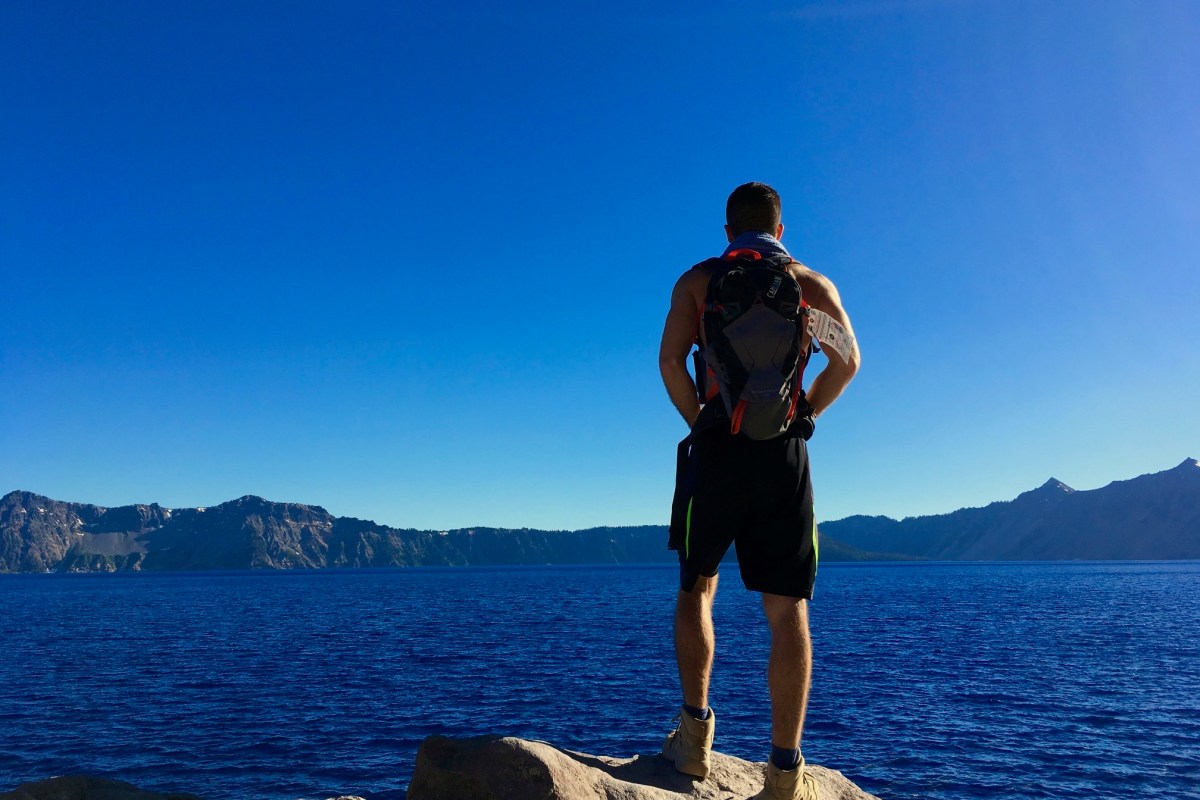
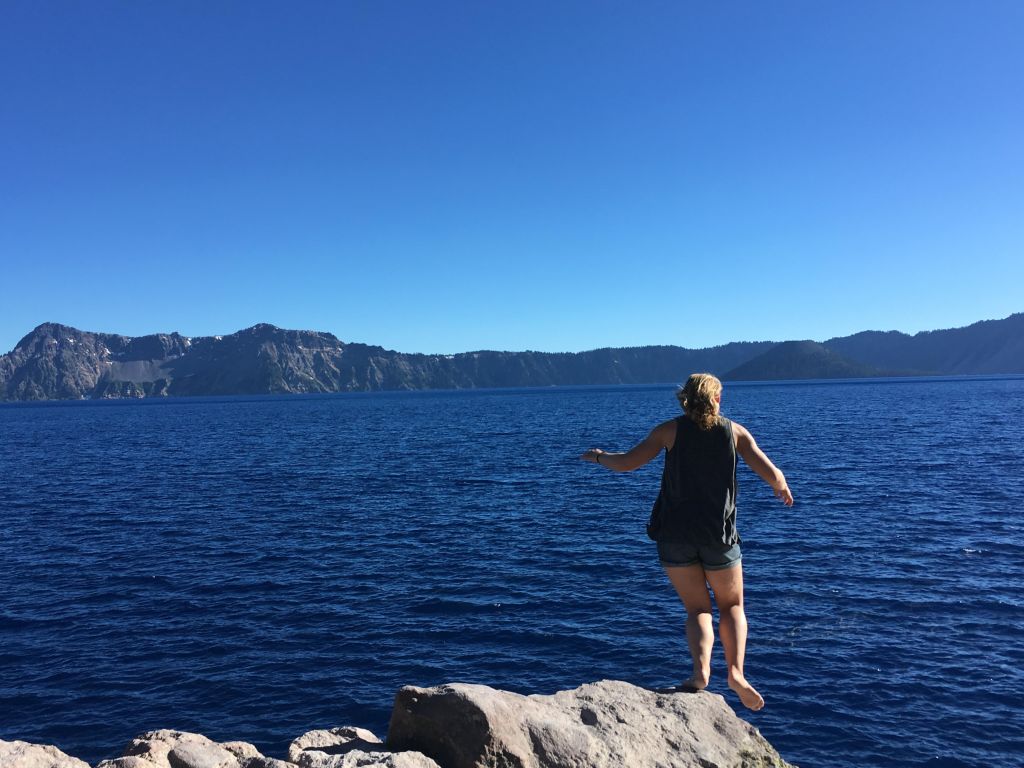
I have to do this, I thought. I felt I just had to jump into Crater Lake. I had come this far,  but I was full of so much fear. I was staring down off a cliff into Crater Lake, into a seemingly endless abyss. Crater Lake has some of the clearest and purest water in the world. It’s a massive lake at about five miles in diameter. With a casual glance the lake is a vibrant bright royal blue, but at the right angle, looking straight down into it, I could see the blue gradually grow deeper in transparency reaching an eternal darkness. The truth is it reaches about two thousand feet in depth. From up here, that seemed like an eternity. My eyes could follow little bubbles that traveled up from the depth, growing bigger as they wobbled and floated up to the surface. I have never in my life been able to see so deep into water. These little bubbles helped show the profundity of what I was looking into. It was unsettling.

I was certainly not alone on jumping into Crater Lake. This was the thing to do. There were dozens of other young people who were doing it, each one taking his or her own turn, and just about everyone reached the rim with hesitation. It wasn’t a terribly high cliff, only thirty five feet. That’s a little over two stories, but it was the shock of looking into it and seeing an endless depth that caused just about everyone to rethink matters.

What if I don’t come back up? I questioned. The thought was irrational, I know, but it is what seeing such deep waters provoked. If I couldn’t see into the water, if it was just murky, like most of the water out east, I would just have trusted the water to propel me back up. There never would have been a question, but here, something about seeing the depth of the water, conjured up this incredible fear. 

This one irrational thought wasn’t the only fear. There were also two more aspects. Secondly, the temperature of the water was very cold. At the visitor center I learned it was about forty degrees today. That’s very cold for water. Also, I had lost trust in myself as a swimmer. The summer prior, while visiting my brother Nathan in New York City, I visited Rockaway Beach at Gateway National Recreation Area on Long Island. I had seen some people jumping around on a sandbar out in the ocean. It didn’t look far. I could swim out there too. I did and just barely made it. That was strenuous. When I lived in Houston, Texas, I went swimming everyday for exercise, and I had really built up my confidence as a swimmer, but it had been a while. My lungs were no longer in quite the swimming shape. 

After a fun time of jumping around on the sand bar, it came time to swim back to the mainland, and that’s when things got hairy. I felt as if my efforts were fruitless. I kept swimming but wasn’t going anywhere. I didn’t seem to be making progress. The ocean was just pulling me backward, and I began to panic. In my panic my limbs grew stiff. I didn’t think I was going to make it. It was quite an intense moment. At one point I decided to just give in and see how far it was to the ocean floor. I sank, and I hit rock bottom. It was not far off. So my strategy was to sink, hit the bottom, jump up for air, and gradually progress my way to the mainland. This seemed to be more effective and require less energy than trying to rotate my panic stricken limbs. When I made it to the shore, I collapsed on the sand in relief. This experience was traumatic. When I’d go swimming shortly thereafter in subsequent months, I’d find my heart racing as my mind took me back to that moment. 

Now at Crater Lake National Park in Oregon, I knew this jump wouldn’t involve much swimming afterward, maybe only fifteen feet back to the rocky shore line aside the cliff, but I was still traumatized by my incident in New York. What if I freeze up in shock of hitting such cold water? I’m sure I wasn’t the only one with such questions. There was one teenage girl, who stood there for a good fifteen minutes. She’d inch her way closer to the rim, peer off it slowly, and cower back, taking a deep breath. Very few people approached the jump with boldness. A number of people, all young guys and girls, regularly offered for each other to cut in front of themselves and go first. I was one of them. “Oh, are you ready? Go ahead….You can go first…please.” When someone did cut to the front, that person would often look off the cliff edge and motion for the next person to go ahead. It was a bit of a pile up. When someone finally mustered up enough confidence to jump in, the rest of us cheered in great applause, for we understood it was a big deal and just what it took to do it. It was a great emotional feat of conquering a fear. We all felt it. We knew how strong that fear could be. It was encouraging, fun, and genuinely so pleasing to cheer each other on. There seemed to grow an instant camaraderie among the people here on this cliff on this June evening. 

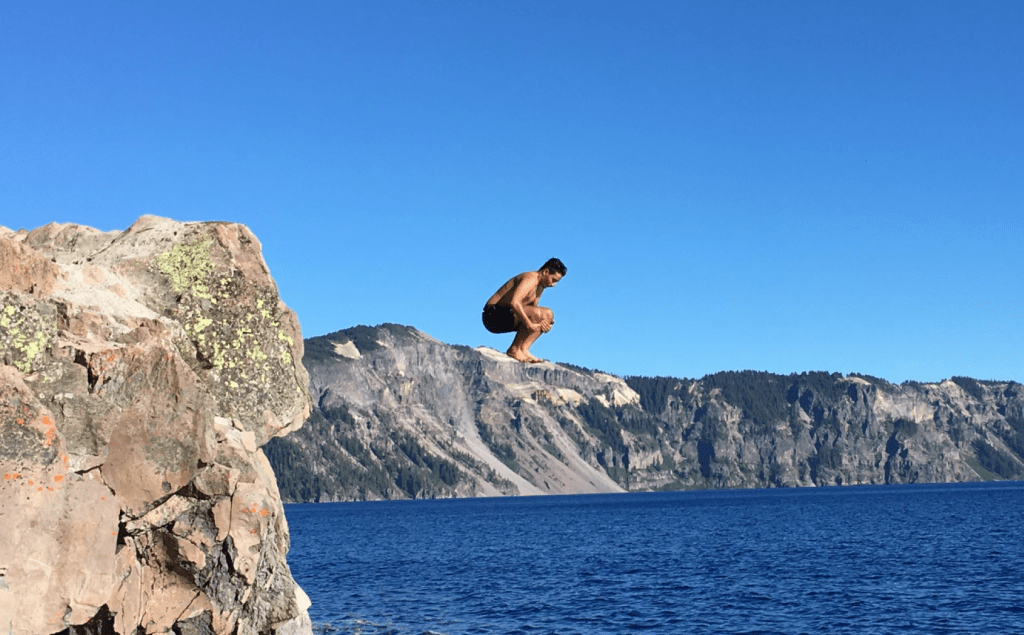
At one point I decided to just get out of the way. My nerves were only growing. I climbed down alongside the cliff to the water’s edge and captured pictures of others jumping in. I captured Zach’s jump on video, and there was another young man whose picture I caught mid-air. His feet looked like they were resting on the mountains across the otherside of the lake in the photo. I showed him the photo when he got out of the water. He really liked it and wanted a copy. He introduced me to AirDrop, which is something I never knew was possible before. 

I just had to jump in the lake too. There were a few reasons. First, I knew this was a rare opportunity to overcome a fear, and every fear I overcome will make me a stronger person. There is nothing inherently dangerous about this. In all rational observation, deep down I knew I’d be fine. It was my own human instincts and irrational fear getting in the way. I was fully aware of this. Secondly, I admit, I wanted bragging rights to say I jumped into Crater Lake. Thirdly, how could I ever live with myself knowing I was up there on the cliff’s edge set out to jump into the lake but chickened out? I had to do this. I climbed back up there. I gave myself just a brief moment of hesitation, in which a man said to me, “If you start to drown I’ll come rescue you, I promise.” I guess that little bit of assurance was enough to greenlight this endeavor, and I jumped.

Crater Lake seemed so wide and huge from my freefall into it. It was too big, too intimidating. What am I doing?! I closed my eyes and hid behind the darkness of my eyelids. The cold mountain air ripped between my feet. I felt so exposed, my little half-bare body exposed to the elements, engulfed in the air. I felt the strange sensation of having lost control. There was nothing I could do to stop that which was before me. There was absolutely no way to stop the fall, no turning back. I was at the mercy of gravity and the forces of nature, exposed and vulnerable. I thought by this point I should have reached the water, but I was still falling. It was taking a while…but I was doing it! I was already proud of myself for facing my fear and already felt accomplished. I had launched myself off that cliff despite the most paralyzing of fears. If there ever is a chance to face a fear, do it. It’s what we all must do to keep growing. Theodore Roosevelt when talking about being a fearful child once said, “There were all kinds of things I was afraid of at first, ranging from grizzly bears to ‘mean’ horses and gun-fighters, but by acting as if I was not afraid I gradually ceased to be afraid.” He also added, “The worst of all fears is the fear of living.” I was living, jumping into Crater Lake!

  Okay, where is the water? Surely I should have hit the water by now, I thought. I guess I’m still falling. I wondered just how cold this water was going to feel, and how deep I would fall  into it. What is it going to feel like? Will Zach get a good picture of this? I’m glad I could share that one guy’s photo with AirDrop. After this we will finish our drive and go check out the lodge. It’ll be nice to rest there a bit, before we go back to camp. Should we make a fire tonight, or just go to sleep? Tomorrow we’ll make our way to Mount Saint Helen and stay at a KOA. There are so many cool places left to visit on this trip. I’m hungry. I wonder what kind of food we can find around here.  I wonder what kind of fish and creatures live in this lake. I wonder what lurks in its deepest depths. Is there something like the Loch Ness Monster in these waters?  One day this will all be…

KAPLUNK!

I was in Crater Lake. 

Water was gurgling, bubbling, and ripping around my ears. I felt gravity suck me downward, pressure pound at my skull, and then I began to rise. Surface, come quickly, I begged. Don’t take as long as that fall. 

Gasp! I made it. I opened my eyes and….

I panicked. 

My knees locked up. 

It was so cold. Too cold. I was numb. 

I instantly knew I was not going to make it back to the shoreline. My presupposition was correct. Time for plan B. I didn’t have one, but I was going to make one. I was not going to make a scene as to call over the man who promised to rescue me. How embarrassing that would be. Instead I flailed my way over to the craggy cliffside just below the jump-off. There was no real rock ledge or anything to provide footing, but somehow, with the greatest of Spiderman-like moves, I fasted my grasp and curled my toes onto that rock’s face. I will wait here until I catch my breath, and so I did, and I survived. I was white, blue, shivering cold, slightly traumatized, exhausted, yet adrenaline racing, and I was a heck of a warrior, I guess you could say. I’m glad I did it. It’s a story to tell, but…never again! 

If you enjoyed reading this, check out my book Still, Calm, and Quiet“

Check out my previous entry here: What is Light? God, Science, and Emerging from the Cave

Visit www.joshhodge.com