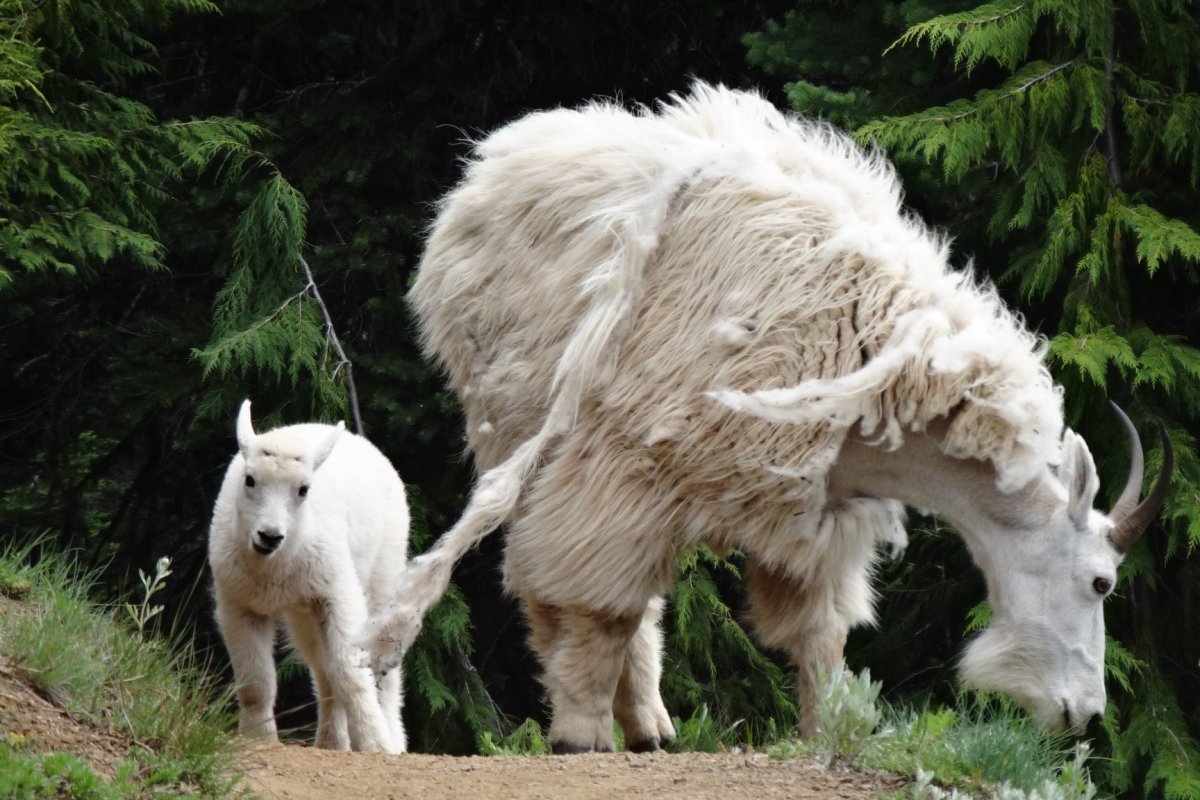
When their procession was over there were nineteen mountain goats in total just a stone’s throw away. We were on the trail to Klahhane Ridge in Olympic National Park. The path was just a small one trodden into the side of the mountainous ridge. To detour left from the trail would be dangerous as the mountainside was sloped so steeply, and to the right it would be perilous as well. Although it was pretty and ladened in wild grasses and flowers, it too was steep and plummeted down into the valley. The truth is, this path was probably the mountain’s goats’ path before it ever was a trail in the national park. The mountain goats were loyal to this path. One by one they rounded the bend and emerged from a pocket of pine forest to this open mountainside. I’ve heard they can be aggressive when approached, and I noticed a few patriarchs of the band with tall sharp black daggers for horns. Behind them were the women and children, or I guess technically the “nannies” and their “kids”. They were all so beautiful with long coats of fur. Some of the more mature goats had strands of fur dangling from them, like the moss laid on the trees. Some of the strands of fur caught in the breeze and wisped around. It was summer shedding season, and it was obvious these goats had been carrying fur to the max. They were drenched in it, except for the young kids. Their fur was short, fluffy, and perfectly white and pure.
Enough observing, a decision had to be made on the part of Zach and myself. The mountain goats were not the least bit inhibited by our presence, and continued walking toward us, potentially posing a threat. They had to have noticed us, but they didn’t acknowledge us. They continued about their parade, walking along their path, although not with a prideful march. They were certainly not pompous, nor were they timid. They seemed to not have a care and continued on with a quiet and steady confidence.
I had learned from the Rock the Park show that making spitting noises can deter mountain goats. I didn’t know at the time why, but later I looked into it and learned that it’s the sound male mountain goats make to warn aggressors to retreat. So, per my lead, Zach and I started making spitting noises. The goats showed no alarm, but it did work perhaps, for casually they climbed off the trail and down onto the steep grassy slope, an area Zach and I could not have gone down for we don’t have that sort of mountain goat balance and maneuvering ability. Here they were on full display as a band. I was thrilled at the spectacle of mature mountain goats, in white shaggy fur, on a steep mountainside, contrasting the dark rich blue of the forested mountains behind them capped with snow; and the innocent little kids, taking careful steps in the wild grasses alongside wild mountain flowers. Once we felt at ease seeing the goats travel off the path, Zach and I paused to revel in the moment, exclaim to each other how cool it was, and take photos.
This wasn’t our first wildlife encounter on this hike. When I parked the car at the Hurricane Ridge Visitor Center, right along the parking lot were four deer grazing in the grass. One was a buck with its young rack of fuzzy antlers. He was laying down but had his head propped up, alert, as if looking out for the female’s feasting in the grass nearby who came very close to us as we were observing them. I suppose this event was foreshadowing of the richness of wildlife and close proximity to it we’d encounter on this trail.
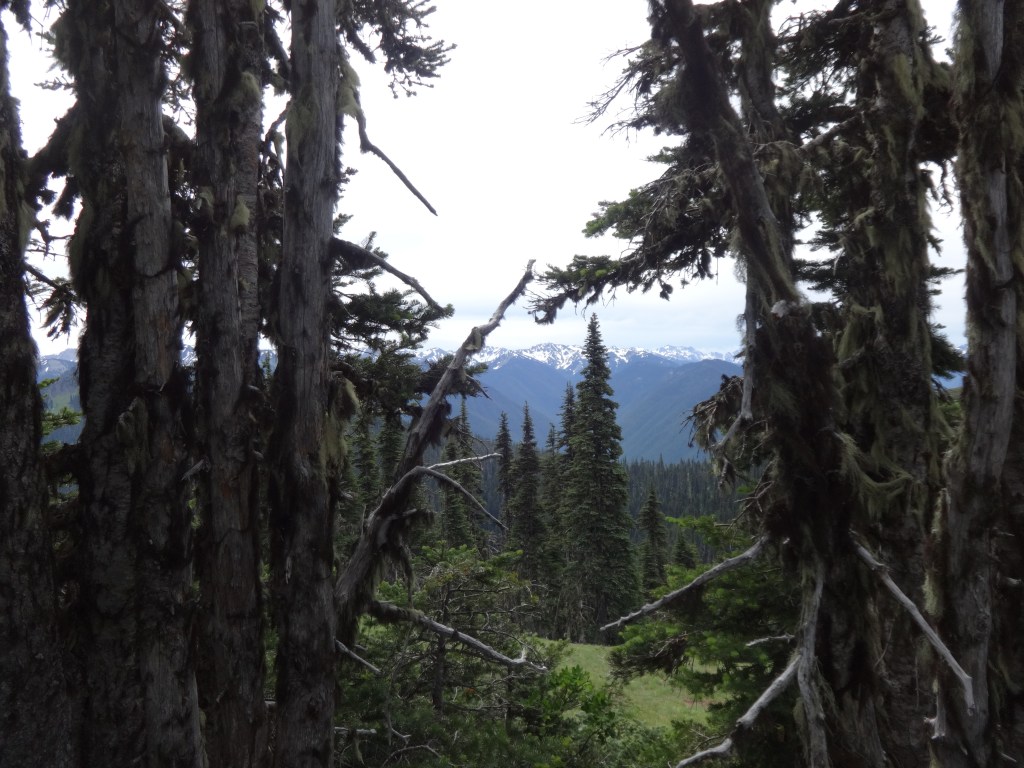
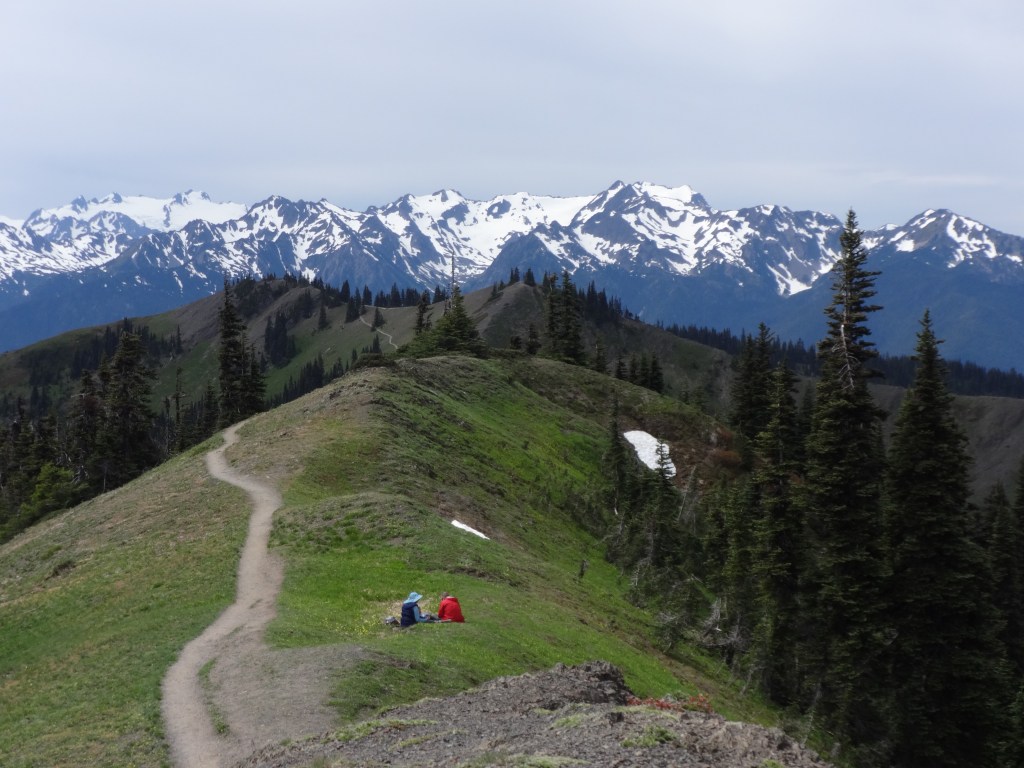
The trail was 7.6 miles in total, starting from the visitor center and ending for us at Klahhane Ridge, although this was just a segment of a much larger network of trails. The path held snug to the side of the mountain nearly the whole time, not on a ridge but close to one. It meandered through open grassy slopes and patches of pines. Some of the pines had very shaggy bark and were ladened with moss, especially as we gradually climbed higher.
In the open grassy areas, we would see the trail ahead snake among the mountain side. To see it slither along added great perspective to the mountainous scene. To our right, in the distance, the Cascade Mountain range sprawled. It was an overcast day, but the clouds were high enough that even the tallest mountain peaks were not covered. What the clouds did do was darken the forest, making the mountains a deep navy blue with their snowy peaks really popping out. No mountain really stood out from another. Instead it was one after another, rather uniformly, with short divots and valleys between them, and each mountain plateauing at about the same height. They stood tall like soldiers in uniform, guarding the way eastward.
Alongside our path and down the grassy mountainside were a plethora of wildflowers. As Zach had studied up on them in the visitor center, he was able to identify and call some out by name. There was one with many delicate little white petals that were brushed with pink at their veins and fine edges. Its leaves were stringy pale yellow and green, and they sprawled out like spaghetti. They were a region specific plant called Olympic Onion, actually producing a bulb that is edible and produced commercially. Another wildflower spotted was White Avalanche Lily with its bursting star bloom and dotted with yellow at its pistil. Each one stood in its own space, seeming very independent, spaced out from its counterparts. They weren’t like some wild flowers that seem more like city-dwellers, crammed into a small space together. These lilies were country folk. They had their own space, their own plot of land, their own hardy independence. At one point we came across patches of a stalky plant bearing multiple tubular bright purple blooms. They are called Penstemon and remind me a lot of Blue Bells. These were all subalpine flowers.
This hike really made me aware of how far north we were and not just in terms of the nation’s edge and proximity to Canada, but also in terms of elevation too with mountains, goats, patches of snow, deep mountainous ravines, subalpine blooms, and an arctic touch in the breeze every once in a while. As were climbed in elevation on our windy path, we at one point ascended a series of switchbacks, and there at the higher elevation were marmots, those funny whistling flopping, nervous little guys, those beavers of the mountain, as I call them for their flabby appearance and prominent two front incisors. They smile and run, call out in a loud beeping sort of whistle, or lounge around in the sun. To me they are just simply a funny animal in appearance and behavior. They are delightful.
When we reached our journey’s farthest peak we beheld an incredible vista. We could see out to the ocean, an inlet of the Pacific called the Salish Sea which gives way to numerous straits around Vancouver and the San Juan islands. Also boldly and majestically stood Mt. Baker on the edge of North Cascades National Park, between Seattle and Vancouver, although neither city was visible. The mountain was still around 150 miles away, but it was clearly visible with one enormous rounded peak covered in snow and another jutting peak down its side. We sat down and beheld the vista. What an enormous view! We could see so far and even see the ocean yet feeling nowhere near it.
As we were sitting there, enjoying the view and pointing things out, out of the corner of my eye I spotted something moving. I looked down to see a chipmunk getting a little too close to my backpack laying on the ground by my feet. I grabbed the backpack up, knowing the critter probably wouldn’t think twice of going inside in search of food. This chipmunk was familiar with humans. I could tell. I had no plans of carrying a chipmunk down off Klahhane Ridge. No one should feed wildlife, and there are rules and even laws against it, but before I had time to say anything, Zach had a piece of a Clif Bar in his hand which the chipmunk was eating from. Zach then reached down with his other hand to pet the little rodent’s back. After one swift swoop down the back of its coat with his finger, the chipmunk took off.
I planned to stay here a while. I had no rush to get away from this great view, so I settled in the spot I was sitting, clearing away some small uncomfortable rocks beneath me. From my backpack I was guarding from the chipmunk, I took out my new book: The Wisdom of Wolves. “Storytime?” I proposed. I proceeded to read the introduction of the book out loud and Zach listened.
On our hike back down Klahhane Ridge we saw more marmots, deer, and wildflowers. When we reached the car, we could agree we had completed a truly satisfying and rewarding hike. It had some of the greatest elements that make for a good hike: great wildlife spotting, diversity of plants to observe, mountainous views the entire way, and a majestic overlook at its furthest reach. Although the day was a great one, night was soon coming, and things would take another turn. Things were about to get rocky.
I wasn’t going to let this happen again– the stress of nearly running out of gas. We were still on our visit in Olympic National Park in Washington, but as access to the park was split up by various types of land allotments, now we were on a small piece of Indian reservation at a gas station in front of a casino. I noticed the price was $3.19 per gallon which seemed cheap after braving the gas prices elsewhere in the Pacific Northwest. I’d notice in a few days gas prices plummet leaving Washington into Idaho and Montana, which was not much of a curiosity considering the states’ politics and their effects on their economies. Here at the Indian reservation casino gas station I filled up. When I went inside the gas station convenience store, I was surprised by free coffee and tea. I got a cup of orange spice tea to calmly ease into the morning. Then we were back in the car for a short drive into the park to the Hurricane Ridge area.
A few days prior, leaving the Chateau at Oregon Caves National Monument, driving through the long expanse of national forest, we were low on gas. We were also in a very remote area, and when we finally reached an isolated gas station there was a sign that read “cash only.” We had the cash but perhaps were here too early, for no one was working. Zach couldn’t use his phone to look up the next nearest gas station either, because we were out of service range, but I was able to search in my GPS. The next nearest gas station was thirty miles away! I wasn’t sure if we would make it, or if it was even en route, but it was the only option unless we were to wait a few hours to see if someone would show up to work at this gas station. What if they didn’t? It would be a morning wasted.
So we journeyed on. There was an uncomfortable silence in the car. I probably wasn’t the only one questioning my judgment. Out the window was merely pine tree after pine tree- no people, no cars, no buildings, just the forest and us. Mile after mile, it was all in uniform, and the road was straight and unending in the dark morning forest. It made me wonder if we were getting deeper in the wild, further from any civilization. Normally I’d like this, but not without gas! There was more and more of the same drawing on, and according to the vehicle’s interface, we were out of gas. Yet we were still moving. I was starting to feel the regret and dread of relying on this GPS. It seemed to be leading us astray, then…
“You have reached your destination,” the GPS sounded. As my journal details, I didn’t think this was in operation, but I pulled up to the singular pump. There was no store and no booth, but attached to the gas pump was a curly coiled wire phone. Zach pointed to the sign.
“For gas dial 1,” it read. We looked at each other with probably the same thought. We were puzzled. What’s going to happen? We hadn’t seen anyone, just trees for dozens of miles. Was someone or something going to pop out of the forest and pump our gas? Is this sasquatch’s gas pump? I opened the car door and stepped out. The forest was silent. I lifted the phone and held it to my ear. To my surprise there was a dial tone. I punched in a “1.” It rang!
“Hello,” The muffled voice came through the receiver.
“Hi. I was wondering if I could get some gas.” I believe I was too puzzled and confused to have even considered the pleasantry of bidding a “good morning.”
“I’ll be right there.”
This might actually work.
We waited, looking around with suspicious anticipation in every direction.
After just a couple minutes, we saw a golf cart coming down the road- our rescue!
A pleasant older man in flannel and blue jean overalls asked how much gas we wanted. I handed him a $20. “Sorry about the wait,” he apologized, although it wasn’t much of a wait at all. “I had to find my keys at the lodge.” I concluded there was some lodge I was unaware of, and this was their gas pump. The golf cart was used to travel around their property.
“No problem,” I responded. “Thank you.”
And we were on our merry way.
That was four days earlier, and I wasn’t going to find myself stuck in that sort of situation again, and that is why I filled up. In the far remote West, with distances so grand and gas stations so rare. Every opportunity to fill up should be carefully considered. Take advantage of any gas pump in the wild.
We eventually reached the Hurricane Ridge section of the park. We were getting ready to hike about seven miles to Klahhane Ridge. There was a visitor center, and of course I had to go in. There wasn’t much to see for it was a small place. I was engrossed in the literature, the books for sale, while Zach found a binder on display with pictures and information to identify wild flowers. He studied up on the flora for the day. I ended up buying a book about wolves. The cover of the wolf’s piercing stare drew me in. Back at the car, we geared up for a beautiful hike on a trail loaded with wild flowers, majestic view, and lots of wildlife (but no wolves).
And experience with the gas pump inspired me to write this song…
Ode to the Gas Pump in the Wild
Driving through the wild, beneath the towering trees, Feeling the stress as the gasoline quickly depletes. In Siskiyou National Forest, a land so vast and grand, But stranded in the woods, was not what we had planned. Miles of pine trees, stretching, nothing in sight, Will anyone be our rescue, or will our day turn into night?
O gas pump in the wild, like a lifeboat in the sea, Rescue us from drowning, would you pretty please?
Then a glimmer of hope, a steeple in the pines, A chance to refuel? Hopeful as a child. With a phone on the pole we dialed for our need, And from the forest’s depths, came our lovely savior’s steed. A golf cart in the distance, rolling into sight, An old man with a smile, making everything alright. In flannel and overalls, this man helped save the day, He powered up the gas pump and sent us on our way.
O gas pump in the wild, like a lifeboat in the sea, Rescue us from drowning, would you pretty please?
In the remote West, where gas is rare and few, Seize every opportunity to safely see you through. If it’s just a little gas pump, hidden in the trees, It may be a lifeline, setting you at ease. So now we hike the trails, where the wildflowers abound, Learning of the animals of which us surround. Here at Hurricane Ridge is where we will happily be With gratitude to the gas pump forever endlessly.
O gas pump in the wild, like a lifeboat in the sea , Rescue us from drowning, would you pretty please?
Gas pump in the wild, a sanctuary found, In the midst of nature’s bounty, you wear the crown With this adventure’s end, there’s a story to compile, Of a journey’s uncertain detour forever worthwhile. So here’s to the gas pump, a tale to be told, Along the Rogue River, where memories unfold. Of a certain lonely gas pump, that will always be In my adventurous heart forever endlessly.
It was right there, a bear, not more than twenty feet in front of me! I had been strolling along a trail in the Hoh rainforest of Olympic National Park. Bears were not on my mind. Then suddenly, rounding a bend in the path, came the bear. I was headed towards it. It was headed towards me! It all happened so quickly. There wasn’t time for keen observation, just reaction…and a photo. The bear seemed not the least bit inhibited by my presence. It just kept walking on the path towards me in the mere seconds this all went down. I, on the other hand, had fear struck into me. I was that tourist taken off guard.
Now this bear was only a black bear, with much less potential of danger than a grizzly bear, but a bear is still a bear, and the visual of a pitch black coat rounding a bend, contrasting with the greenery of the rainforest, was anything but subtle. Unless a domestic pet, animals with no fear towards humans usually should be of concern. This part of the rainforest was thick with ferns, thus there was no space to get out of its way alongside the path, except by braving the wild undergrowth of the rainforest and whatever lurked in there. So I turned and ran. My own human instinct kicked in. When I look back at the photo I managed to capture in the midst of my quick escape, I find this bear to be quite small. Having much more experiences with bears since, I find myself near ready to mock my former self for my own startlement by this bear, but it was a quick matter of instinct and reaction. I had not been expecting to see a bear at all because I had associated bears with thick pine forests, but I was in a rainforest, and in my mind bears were just not associated with rainforests.
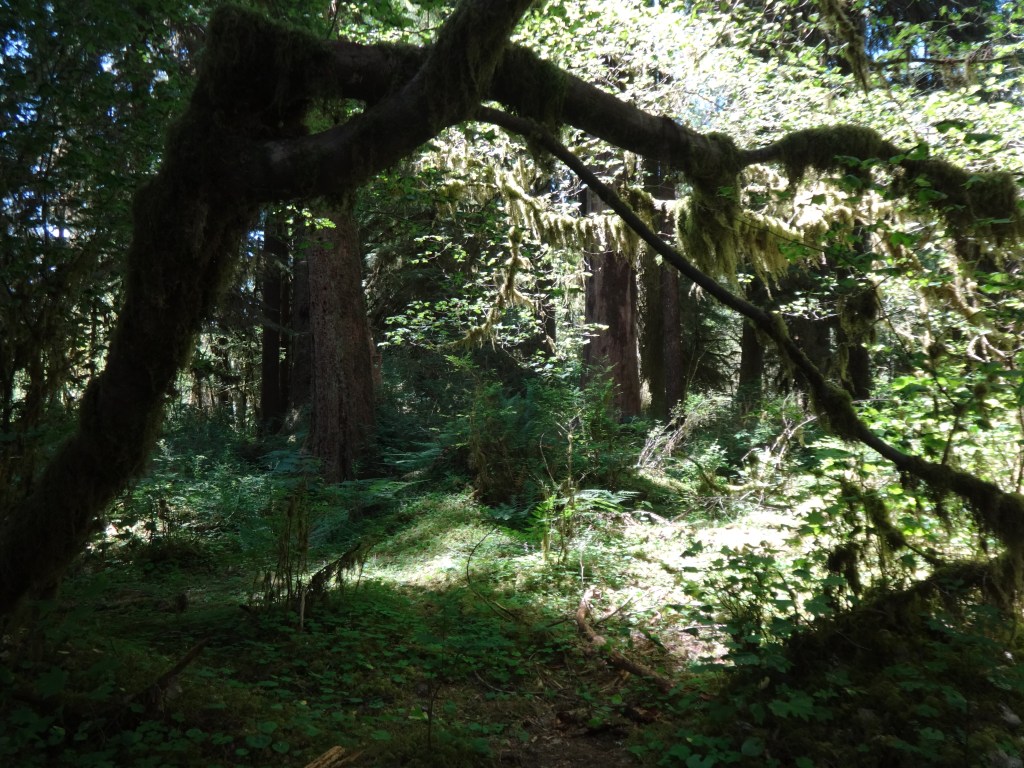
Also, despite hiking, I had also been relaxing. I guess you could say I had let my guard down. Recently I found myself to be rushing too much and allowing myself to be stressed by trying to make this adventure experience worthwhile for my travel companion, Zach. Today I thought I’d seize any opportunities to relax, and this trail would afford one such opportunity to really do so. We started the hike from the Hoh Rainforest visitor center on the Hall of Mosses, surrounded by not just tourists, but trees dripping with mosses. It hung on their sprawling branches like drapery, reminding me of some photos I’ve seen of the humid deep South and the trees that rest on some former plantations. Their trunks were also covered from the forest floor to their highest reaches in moss. Among these moss-ladened trees were other deciduous trees in the forest, and a forest floor nearly covered in ferns. In any area there weren’t ferns, there were other green plants stretching out to fill the voids. The humidity, the hanging moss, the lack of pine trees, wasn’t something I’d associate with the far North. It’d be more appropriate from my own experiences to believe I was in the United States’ deep South or the jungles of South America, but no, I was in the far reaches of the U.S. on the Olympic peninsula.
After we completed the 1.1 mile loop of the Hall of Mosses, Zach and I took off down the Hoh River trail. It was very similar in nature to the Hall of Mosses, except instead of a loop, it was a rather straight path parallel to the river. After a few miles on that trail, I saw a small breakaway from the path, an outlet down to the banks of the Hoh River. It was nice to get a break from the thick forest in an area where the river created a natural clearing where we could see the sky, the mountains, and look out upon a larger landscape, but our attention was also focused downward because in a still pool alongside the river was an utterly bustling cloud of tadpoles. They were thick, chunky tadpoles with well-rounded bodies, and quickly moving tales, storming around each other in sheer chaos. It was really quite a grotesque display of nature, an unsettling visual, but terribly unique of an experience and fascinating in that. The size of these tadpoles spoke of the large frogs or toads they’d become.
After observing those creatures, I noticed the warmth of the sun on my skin and the peacefulness of the river. Its nearby ruffle was soothing to the ears. There were patches of sand amidst the rocks, and in one I set down my backpack as a pillow. “Let’s take a few minutes and just relax,” I proposed. I laid down and closed my eyes. I knew the healing power of the sun when it comes to body inflammation, and I wanted the sun to just envelop me in its healing power. I closed my eyes and breathed deeply. This is what I believed I was lacking. I needed more time like this to relax in nature instead of always being on the move. I prayed for my health, and I wanted to fall asleep to wake up with a refreshed feeling of renewal. I didn’t fall asleep, but I took time, with my eyes closed, to focus intently on the sounds around me, trying to distinguish each sound, focusing on each one at a time. First I tuned into a bird’s call, then a frog’s ribbit, then the ruffling of the river. This practice is something I’ve found very relaxing. After about twenty minutes of laying there on the river’s shore, we were back on the trail. I was slow-moving purposely, trying to have a relaxing stroll through the rainforest, keeping my body down from its recently normal state of intensity to that of peace and calm…then…. suddenly… a bear!
I was the first to spot the bear. I turned around, pushing Zach who was behind me and urging him to run. “There’s a bear!” I pointed my camera behind me as I ran to capture a photo. Eventually the trail opened up where the rainforest floor stood barren around some trees, an obvious place where people have stopped to take breaks. There was also a couple there, hauling their own backpacks. We stopped. “There’s a bear just up ahead,” we warned. ”It’s right on the trail.” They were going the other way, so it wasn’t of much concern to them.
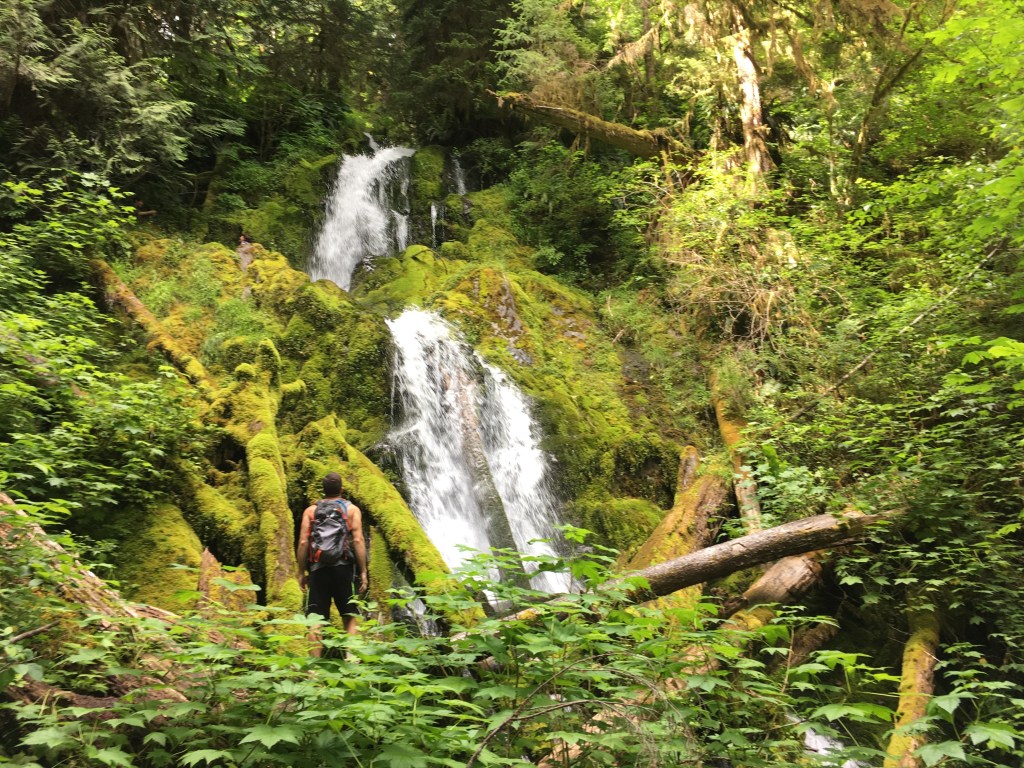
Zach and I assessed the situation, and decided, since the bear did not make its appearance to us again, and it had plenty of time to catch up to us, it must have ventured off into the forest. So we decided to turn back around and continue on our hike cautiously. We concluded our journey at a beautiful waterfall. It was maybe forty feet tall and was a double fall in that the water fell into one pool and shortly after down into another. Some limbless fallen tree trunks covered in moss laid at its base, adding size perspective to the scene. Moss also snuggly held onto all the surrounding rocks of the falls as well, making the scene very green. We had seen the falls from the trail, and following Zach’s off-trail lead, we bushwhacked through the ferns and rainforest undergrowth close enough to shake the falls hand.
When I think back to this day and I consider the encounter with the bear, I think there must be a message here, a purpose for this encounter. Maybe the message wasn’t evident then, but the purpose could be found now in reflecting back upon the event. As I’ve sauntered over this thought, I’ve come to some great parallels.
Now, first off, I am a big fan of bears. Visually they are stunning. They are such an intelligent creature, and one of God’s greatest beasts. I respect their strength, their space, and existence, but for the sake of this analogy, I’m going to liken the bear to the enemy. I’m imagining bears as spiritual beasts, things dark, dangerous, and destructive to our spiritual lives.
Now, as for us, we are on a journey through the jungle of life. Some people wander aimlessly in the jungle, lost. They have no direction. They are riddled with fear, anxiety, and hopelessness. Spiritually they are hungry and desperate for they haven’t found the spirit sustaining substance of God’s Word. Others don’t think they are lost, for they are on a path, a very wide and well traveled path. It lures with the prospect of encountering great treasure buried deep in the jungle. The travelers think wealth and prosperity is their destination, but they are lost too, for this wide path leads really to nowhere of good consequence but rather to destruction. It leads off a cliff edge, down a waterfall, and into a mountain lion den, but little do they know this. Then there is the God fearing man who follows a path that is narrow through the jungle. Its tightly accompanied by flora and fauna of all kinds which can cause great distraction, but the man sticks to the straight and narrow along the River of Life, the flow of God’s grace and mercy (or in this case, the Hoh River). Others have been on this path before. Great spiritual leaders and people of incredible faith, great “Nurse Logs” and “Wheeler Peaks,” led by God himself, have helped clear this path with wisdom and knowledge. With their great machetes, spiritual fortitude, and grit, they have helped clear the path for us. This spiritual path, though leading to the very physical presence of God and the safest place to be in the jungle, is not isolated from trouble. It exists yet in a spiritual realm of all forces, good and evil. There are the creatures of darkness that try to disrupt our journey, our progress. Unexpectedly they come onto the path with the intent to kill, steal, and destroy. They threaten to take us off the path, or send us backward, running away from the pursuit of God.
Now not all these spiritual creatures are the same. Just as not all bears are the same. Black bears are generally fearful of humans. Of course there are exceptions, like the one I encountered this day, but typically they instinctively fear what man can do to them. They run off in the presence of man, and man can run off from them, as I’ve done a few times, but then there are grizzly’s which are much more territorial. Although their threat is overhyped they have been known to attack on occasion, and grizzly bears are not to be run away from. When presented with a running human, it is of their nature to chase the human. A grizzly bear must be handled differently from a black bear, and if all strategies fail, you have to fight it.
So first let’s examine the spiritual black bears. They are spiritual beasts that cower. They usually get out of the way in fear. Sometimes we don’t even know these beasts were just up ahead on the trail. They are those animals we never knew were there on trail, because the animals heard or smelled our presence first, and in fear, ran away. There are beasts of the spiritual world that are in great fear of the presence of the Christian who beholds the Holy Spirit. When we behold the Holy Spirit, these spiritual creatures are truly mortified. They simply cannot encounter the presence of God or be touched at all by the light of his glory. They run away. With God’s Spirit dwelling in the Christian, so many encounters with spiritual beasts are avoided.
This gives me, and should give you, a great deal of confidence. For example, I’m not one who believes in ghosts, but I most certainly believe in demons and think the two are often confused. I have been in places that are supposedly “haunted” before, but I disregarded these stories as any danger to myself. Because even if people did have chilling encounters with the spiritual in these places, I know I wouldn’t because of God living in me. The powers of darkness flee in my presence, but not because of my actual presence, but of His presence in me. Hence, I have not a single “ghost” story to tell. This also explains why sometimes people say my presence emits a peacefulness and sense of safety. That is not of me. Sometimes my human mind is fraught with concern, but despite that, there is God’s presence dwelling in me. The mere presence of a Christian in whom the Spirit of God dwells is very powerful and influential to the spiritual forces at work in the world.
Then, there is another form of spiritual beast. We can call it the grizzly. It’s a specifically tailored one. It does not flinch. It is concocted by the devil himself and released on our path strategically. Sometimes it tries to avoid the Christian for it too is fearful, but when it is encountered, it usually will not flee in our presence but it will approach. It’s also very territorial. The territory it wants, that it thinks it is entitled to, is you! It’s a stalking creature, and thus, in this aspect, more like a mountain lion than a bear. It also strategically strikes in time of peace. Here’s the thing, we are not to fear these creatures either. God has equipped us with the power and tools to defeat them, but sometimes we are not prepared. We are taken off guard.
In times of peace and security, when we have taken a relaxing break by the riverside, enjoying the sunlight, and strolling pleasantly through life, watching the tadpoles, sometimes we can become very relaxed in our spiritual lives. We become complacent. We drift away from the Word, from daily prayer and devotion to God. We stop asking questions of faith and pursuing the knowledge of God. Subconsciously we default to, we don’t need any of that now because we are traveling along this path just fine. Then the spiritual beast appears, the bear comes right out of the jungle. It comes near us and we are unprepared. We are not armed up with the spiritual armor of God. Our Shield of Faith is in the backpack, we left the Sword of the Spirit at home, and the Belt of Truth is in the car. It’s not to say we are hopeless. We are not, but we face a lot more turmoil trying to pull ourselves together, and in the meantime we may experience a lot more headache and heartache that we would not have if we had been equipped. The lesson here is that in times of peace and comfort, when the sun is shining and the river is just ruffling, we need to work out our faith, to sharpen the sword, to affix that armor. In practical terms, these are times we need to be really delving into His Word, meditating on it day and night, to pray without ceasing, to ask God questions and pursue His truth, to continue to grow and fortify our faith. Imagine a fully armored Christian encountering a spiritual grizzly on the trail. It approaches the Christian, attempting to bring chaos and destruction into His life, but there’s not even a match here. Nothing is a threat to a Christian in the fully affixed Armor of God.
This is not all to say that even the fortified devoted Christian is not met with great challenges and pain. Remember this second kind of beast is tailored specifically for its assaultant. The stronger the Christian, the greater the beast. Even the strongest Christians sometimes go through immense heartache and headache, but rooted in Christ, they are standing on a solid rock out in the tumultuous waves of the Pacific. They know the battle is already one. They are able to endure the pain with peace and resolve that is deeper than human understanding, because it is of God and not themselves. In my own life I have a specific tailored beast. It is that of ulcerative colitis. Although some may dismiss it as a purely physical ailment, the physical and spiritual and intertwined. When I am sick, it does affect me spiritually. For someone who is so active and tries to be so healthy, when I lose my health, I feel like my life is ripped from me. It can be devastating. It has the potential to take a serious spiritual toll. I certainly view my sickness as an attack from the enemy. However, during this summer’s adventure I’d soon come to the realization that even if I’m not physically healed, I can win the battle spiritually. No physical ailment needs to have dominion over my life.
Oftentimes when we are strolling along the path in the jungle, at peace, we lose sight that we are in spiritual war. All of life is a spiritual war. There are moments of peace between battles, which we are to enjoy, but just because we are not engaged in a battle at the moment, does not mean the war itself is over and we have the luxury of letting our guard down. In any war, you use the in-between time to train, fortify, plan, and strategize for the next move.
To liken all of life to spiritual war may sound pessimistic, but I don’t think it is so. Even if it sounds so, it’s an unavoidable reality that I’ve come to terms with. But I don’t view it as pessimistic because there is a great Hope. It is knowing through Christ Jesus the battle is already won and we have the presence of God with us! When we engage in spiritual battle, we participate in this victory. What an incredible honor and responsibility. It also brings us back to Scripture and prayer. We should never take such things merely casually or as ineffective. Our sincere time in Scripture and our prayers are never wasted. God is using them to fulfill His will. It is all a part of His plan, the same victorious plan of Christ Jesus! We also know that one day, in His eternal presence, not only will all our battles be over, but we will be on the other side of the war, on the other side of eternity, living in complete peace in His presence in His new Heaven and new Earth. Thus we run forward with perseverance on a path that is marked for us (Heb. 12:1). We press on toward the goal to win the prize for which God has called us heavenward in Christ Jesus ( Phil. 3:14).
During the in-between times of peace on the trail, it’s so important we don’t let our guards down, that we don’t become too comfortable with the numbing narcotics of life’s pleasures and distractions. When considering the war, I also think about our spiritual storerooms. In Matthew 12:35, Jesus says, “ A good man produces good things from his storeroom of good, and an evil man produces evil things from his storeroom of evil.” This begs the question: What is in my storeroom? We place in our storerooms our own amusements, distractions, our selfish thoughts and pursuits, and just flat out a lot of junk. Many of us need some serious spring cleaning, and we shouldn’t take these things to the Goodwill either. Much just needs to be burned.
So what needs to be in our storerooms? The things of God, what He values, what He loves, and chiefly, His Scripture. His Word is the most powerful of our weapons. A dear friend and pastor of mine, Steve, in his teachings has called this our “arsenal of Scripture.” I like this analogy because so much of Scripture is like ammunition. Immediately it paralyzes fear and stops the enemy. When true pessimism does sneak into my life, often connected with my own health, one of my very effective weapons is the truth of a two verse harmony of 1 Peter 5:10 and Phillippians 4:7, “After you have suffered a while, the God of grace Himself, whose knowledge surpasses all understanding, will restore you and make you strong in Christ Jesus.” I say it, sometimes out loud. It lifts my own spirit, as the assaulting beast of pessimism and hopelessness is paralyzed when the promises of God are declared and the name of Jesus is invoked. Yes, sometimes it is that simple. We are all in a war. We fight battles that look very different for each of us, but we are all in the same spiritual war and we all reach victory by the same means. So I raise the same question Steve does, “What do you have in your arsenal of Scripture?” and as Jesus evokes, “What is in your storeroom?”
Next time a spiritual beast approaches me on the path of life, I don’t want to run away backwards in fear, like I did with the bear in the Hoh Rainforest. Instead I want to be so fortified with the Word of God and His presence that I can approach that beast confidently and leave it behind victoriously. I can rebuke it with Scripture and the name of Jesus. God gives us the power to slay whatever comes in our path, but we must fortify ourselves in Faith and knowledge of His Word. Do not let your guard down in times of peace. God warns in Hosea 4:6, “My people perish for lack of knowledge.” Instead, be in His Word, build that arsenal, polish the armor. The more ready you are, the more beasts will also just stay off your path. When they smell that blood of Christ they stay away, but be ready, for despite His protection, a next battle is always inevitable until He calls us home.
It was the morning after visiting Mount Saint Helens, and needless to say, it wasn’t a very wild and back-to-nature morning. We had camped at a KOA just outside the park in the town of Castle Rock, Washington. I am a big fan of Kampgrounds of America, but this one just didn’t have much to offer in terms of the great outdoors. It wasn’t very wooded, was rather crowded, and pavement spread throughout. However it did provide us a tent pad and shower, and that’s all we needed.
After we packed up camp we headed to McDonalds for a quick McMuffin for breakfast- maybe not the best choice considering my deteriorating gut health at the time. I would have been fine with my nuts and berries for breakfast, but I had to keep Zach fed. About a half hour drive later we stopped at a Walmart. There I purchased glutamine and cherry juice, two things I thought would be good for my gut. So after KOA, McDonalds, and Walmart, we were back on our way to pursuing wild things and were on our two and a half hour drive to Olympic National Park.
Planning to visit this park took a long time. The park map is very intimidating. Although it’s all one peninsula, the road that goes around the peninsula swerves between National Park Boundary and private land frequently. The shoreline is mostly National Park but between the shoreline and the center of the peninsula is a lot of private land and inconsistent pockets of it. Sprawling from these private lands towards the center of the peninsula are roads that reach and dead-end like branches within the park boundary. Because the Olympic peninsula is a hodgepodge of land designations with many sprawling roads it was quite time consuming to figure out how to tackle it. It didn’t have one main park road like many National Parks nor did it have any outstanding features. There was no Old Faithful, Yosemite Falls, Mount LeConte, or Going-to-the-Sun Road. Instead there were dozens of “must-sees” depending on who you talked to. I was most excited to visit the rainforest, for it’d be a new terrain and biome for me. I also wanted to see the iconic shorelines with their large protruding rocks from the ocean. I just wasn’t sure which beach was “the one” for there were perhaps a dozen.
When we reached Chehalis, Washington we were nearing the peninsula. There was essentially a “T” in the road. It was a right on highway 207 to Seattle and a left on highway 12 towards Olympic. If I was ever spontaneously presented with those options, I like to think my decision would be pretty obvious.
Our first stop on the peninsula was on the Quinault Reservation at a fish hatchery. Driving along I noticed the sign which read, “Quinault National Fish Hatchery Visitor Center.” It was the two words “visitor center” that grabbed my attention. I am a real sucker for visitor centers. It turned out to be a very small, unstaffed, one room exhibit. There was a dated film playing on an analog TV. Of course I watched it. I learned that this hatchery was a cooperation between the U.S. Department of Fish and Wildlife and the Quinault Reservation and hatches and releases about three million fish a year, mostly salmon. What I didn’t know is that we were free to explore the actual hatchery and “raceways.” This is standard policy at U.S. national fish hatcheries. I didn’t know, but it would have been interesting to see all the Pacific salmon in their different stages, especially since I like to eat them, and you can’t find salmon in the wild in Kentucky.
Leaving the fish hatchery, we traveled further up the peninsula. It was very wooded and rather monotone in appearance. There was nothing of which to take particular note, and being so close to the ocean, the terrain was quite level. It was a bit of a mundane drive. I was getting very travel weary, although today I hadn’t driven that much. It was the collective mileage of the past few days adding up. Then I saw, peeking through the trees, the Pacific Ocean! It was so beautifully framed by the trees, and I could quickly catch a glimpse at the long sandy beach and the crashing waves. Impulsively I quickly pulled into a small pull-out along the road. This beach was not on my day’s itinerary, but I wanted to stop and was excited that the pull off was just at the right moment, when the desire beset me.
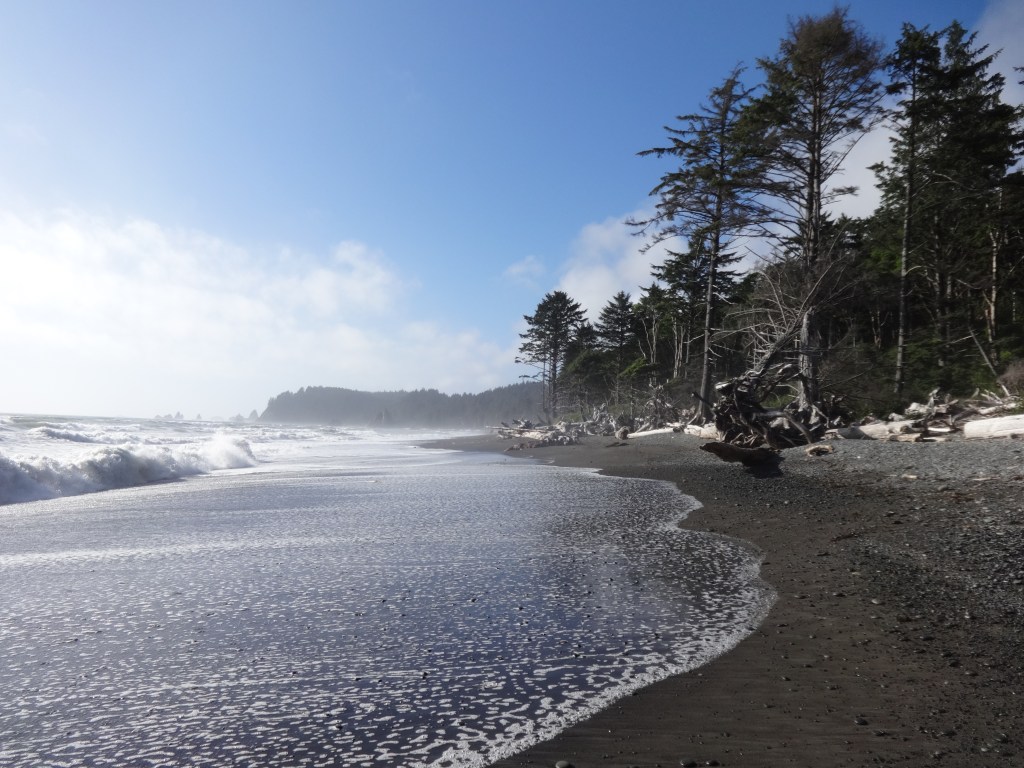
On the park map the beach is creatively labeled “Beach 2.” I parked the car and ran out onto the shore. I was glad to be out of the car and in a natural space. It felt very freeing. I had been released into the open after having been in the car driving through snuggly gathered forests. The beach was very much like the beaches alongside the Redwoods. The gradient was low, the water shallow. When the waves weren’t crashing, the water spilled across the dark sand causing natural white foam. The big difference between here and the beaches of the Redwood was that here a flat thick pine forest stood right beside the beach’s edge instead of large green bluffs. Also littered close to the tree line was an enormous amount of driftwood, but not little odds and ends, but huge tree trunks and entire barren sun-bleached trees.
After our brief visit to this beach I drove us a mile and a half up the road to Kalaloch Campground within the park boundary. Although the campground backs right up to the ocean, the only site I had scored online was one right after the entrance to the campground. The ocean was not in sight. But after we quickly set up camp, I was excitedly-anxious to return to the ocean. On the itinerary we were supposed to go directly to the Hoh rainforest today, but realizing how close we were already to all these beaches, I decided it would be a beach day. We would visit the rainforest tomorrow.
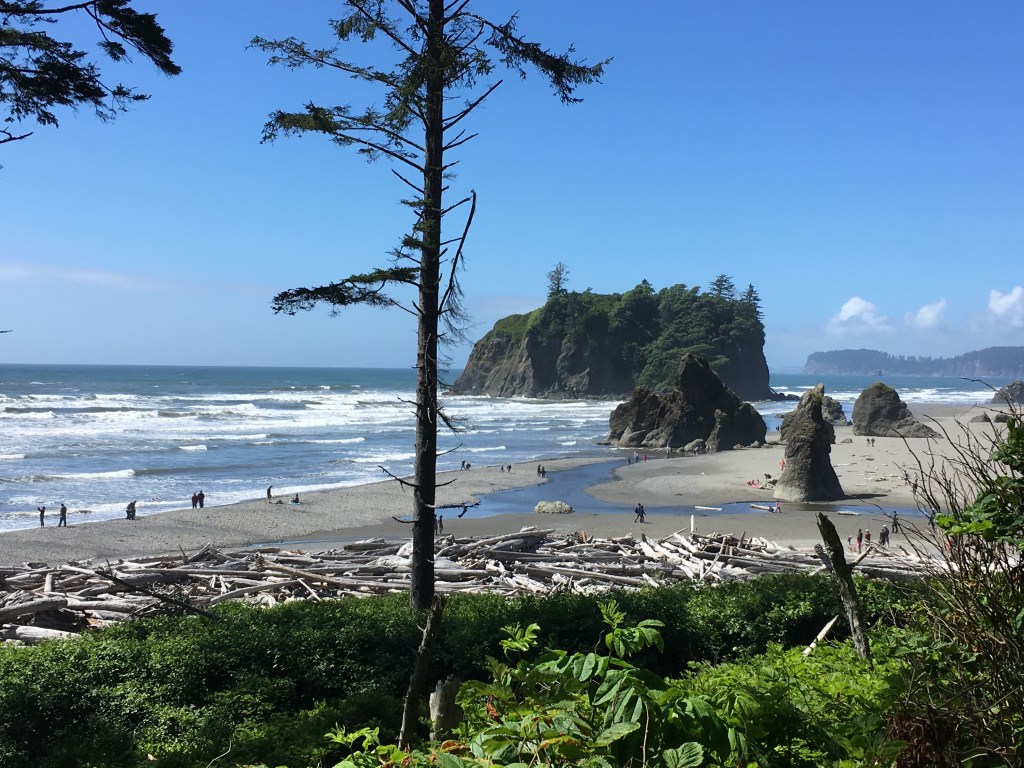
The next beach we visited was Ruby Beach. It was just seven miles up the road. Again, approaching the beach, the small path led to a beach perfectly framed by the trees. With this view I really felt like I had arrived somewhere. I’d seen this place before, and so I felt like I was somewhere famous. Although it does not have name recognition of many places in the National Parks, many people have seen this beach before on calendars, computer backgrounds, and the like. It is iconic in this sense with its tall rocks, not far out in the ocean, pointing upward like shark fins. These rocks were dark and contrasted against the white ocean foam, gray sand, and blue sky. A number of these ginormous rocks rested and stood on the sandy shore as well, apart from the water, at least for the moment. They look very epic, as if there should be great stories surrounding them: as if a pirate ship on a great voyage should go passing by; or a group of brave men on an grand odyssey finally reach the ocean after weeks of searching; or some mystic message in a bottle will wash up showing us how to find exquisite treasure. It’s exactly that kind of beach. Although the sky was blue, it was also misty and cool, adding a sense of chilling mystery.
I could not help but smile with the joy of being here, and we weren’t the only people enjoying this place. There were many others too. I wouldn’t call it crowded, but certainly not isolated either. Zach had bottled up energy and wanted to climb up the giant rocks with maneuvers that made me nervous. I watched him for a few minutes, wondering, would he or could he really do that? Then I decided to just let him be. I didn’t need the stress of watching him risk his life. I took off my sweatshirt to make a little pillow and I laid down on the sand. I closed my eyes, took in the ocean air, and relaxed. I felt my body really needed to relax with my current deteriorating health. This would be good. When Zach found me after climbing around, we went on to the next beach.
It was about an hour drive with an exit from the park into the town of Forks. I started to see a few signs referencing the book and movie saga Twilight. I learned this was the home of Twilight, meaning the town in which the protagonist Bella is from. Although this is apparently directly referenced in the books, and the town’s welcome sign is shown in the movies, no other parts of the movies were filmed here. However, some of the townspeople are proud of their mention in the series and have really capitalized on it, housing the world’s largest collection of Twilight set props and costumes, and an annual Forever Twilight Festival. I also ran into a little general store and noted the extensive offering of Twilight nick-nacks and pattywhacks. I had not followed this series, but could not avoid its mention in Forks, Washington.
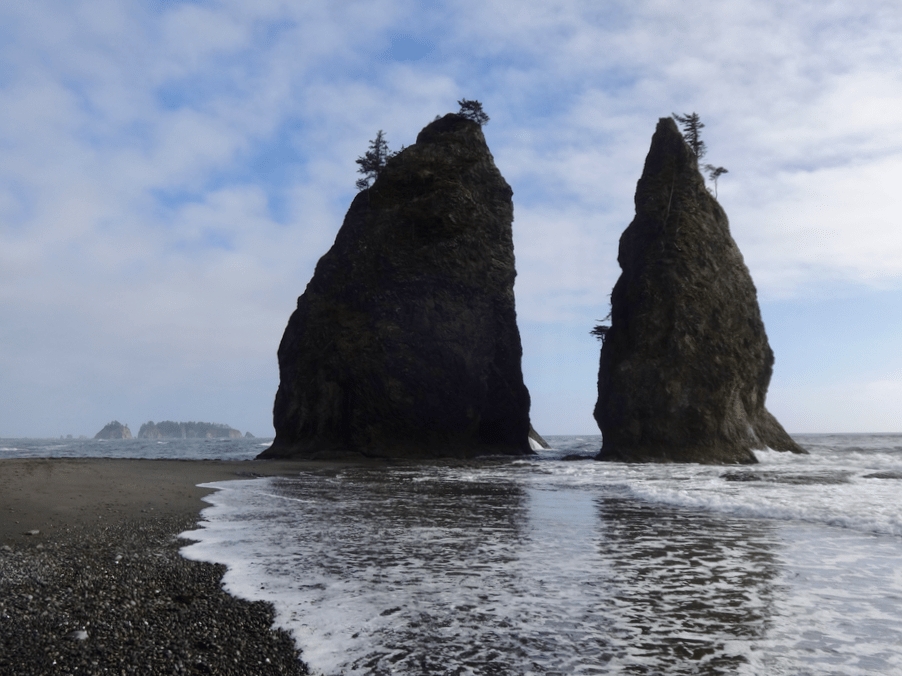
When the road led back into the park, I made our final stop in the park for the day. We were at Rialto Beach and the highlight of the day! It was similar to Ruby Beach, with its large jutting rocks, and it was like Beach 2 in that it had a lot of enormous pieces of driftwood. It was different from the others in that no one else was here. It was ours, and Rialto Beach had two distinct features to offer. One is informally known as “Split Rock” The best way to describe it is like a giant arrow head was stuck in the ground, but then a bolt of lightning struck it and separated it perfectly in the center, creating two symmetrical pieces of rock, pointing towards the sky and just the slightest bit towards each other. It was another iconic vista. Something I knew I had seen in photos, before, and to now see it in person was indeed exhilarating.
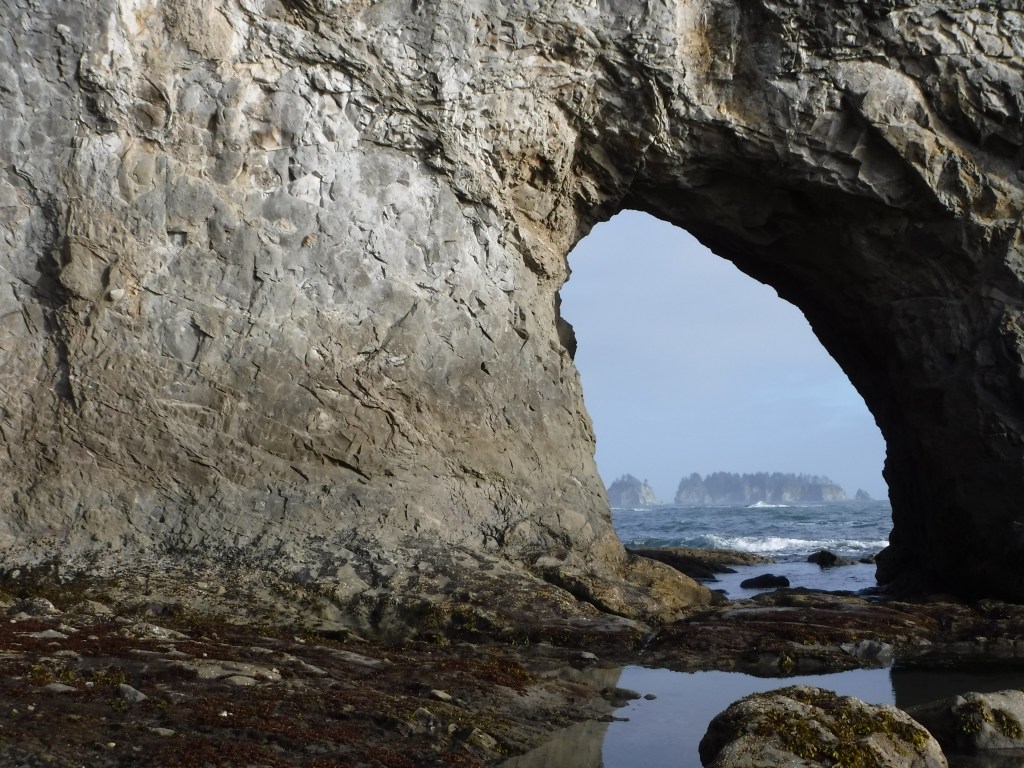
I had also done my research well for this trip, and I knew 1.7 miles up the beach was another iconic spot called “Hole-In-Wall, where the ocean carved out a hole in a rock about a story tall right at ocean level. Although it may be remembered as a hole in a giant rock out in the ocean, the rock actually is attached to the mainland. It is a peninsula, and I guess technically it can be considered a narrow rock arch. However, to the layman’s eye, and memory, it’s a hole in a rock in the ocean. What makes it particularly beautiful is that it is just at sea level and frames an ocean view perfectly.
It wasn’t enough to see if from the sand. I had to go out and walk through that hole. The place was only accessible by foot at low tide, I read. During high tide it’s straight up out in the ocean. Right now, we were somewhere between low tide and high tide, but where there’s a will there’s a way …or a concussion. We abandoned the sand, and started carefully placing our feet around tide pools filled with all sorts of strange sea growing things, urchins and the like. Some were bright green, others were dark blood-stained red and growing tightly to the rocks, looking almost like some strangely colored sea moss. The sharp things concerned me. I didn’t want to misstep and have one impale my sole. Thus it was a challenge and fun game, I suppose. Eventually we were done with tide pools and moved onto rock jumping and scrambling in the ocean. I stood hunched, perched atop one rock I had just jumped to when a rogue ocean wave forcefully crashed against my rock spraying my face in bitter salt water- in a very Little Mermaid-esque moment. The assault caused my body to jolt in surprise. I wasn’t sure if this was a good idea at the time. I wasn’t sure if getting to Hole-In-Wall was achievable, but it was and was worth it. We took some photos and marveled at nature’s wonder. The hole in the rock in the ocean was now also, to us, an island of dark wet rocks serving as a window to the sea. The musings and observing all the fine details could have gone on, but we figured we better get on our way before the tide climbs any higher leaving us stranded on the Pacific Ocean.
Before we left the beach, we had to hike up to the top of the landmass that eventually juts out to provide Hole-In-Wall. Back on the sand, we brushed through some sea grass and shrubs, and found a very narrow informal path that led upward very steeply, making the whole body lean forward and made using the hands necessary at some moment. Alongside this path, the plant life was very jungle-like with long, large, lanky, sprawling ferns and other foreign plants to me. Atop the views were even better than from the Hole. From here we could see the shoreline spread and the large rock formation now below us. It fit all of the immense landscape into one view.
On our walk back down the beach, I did not see any sea lions, as I was hoping for, but the sun was setting, adding slivers of silver and gold here and there, on a piece of driftwood of a certain wave. When we got back to the car we had to drive back through “Twilightville” and a quick stop for some styrofoam packaged burger and fries for Zach’s ravenous hunger. Back in the National Park, at our campsite, I noted in my journal that I was very tired of driving. I had seen some great things today, but it involved too much time in the car traveling from one place to another. I desired to be in one place and leave the card behind. That just wouldn’t be the case in this park. The car would have to take us from one place to another, but ahead of us were a lot of impressive things to yet see that would make it all worth it. There were epic vistas awaiting and first time wildlife encounters to be had!












 Josh Hodge blog