Traveling Across North Cascades National Park

I got an early start because I had slept in the car. There was no deconstructing the tent and packing up. I was ready to go. I went from sleep to the turn of the car key and I was on the road. Now it was time to pay a visit to another National Park: North Cascades National Park, which was only about an hour away. When people refer to the North Cascades, it’s similar to when referring to the Redwoods. As the Redwoods constitute a collection of state parks, North Cascades too is a collection. There are three major entities: Ross Lake National Recreation Area, Lake Chelan National Recreation Area and North Cascades National Park proper, though the latter name is just used to refer to all in the trio collectively. 

I had big plans for this visit: an overnight backpacking adventure the following day in the Lake Chelan area. Today I would just be traversing the heart of the parks on highway 20, stopping at the visitor center, all the overlooks, and seeing what I could see. I had noticed in my investigation that all the iconic views of North Cascades were roadside viewpoints, so I figured I wouldn’t be missing anything essential.When visiting parks I’ve got to make sure I don’t miss out on the essential views. What a shame it would be to go to Yosemite and never see Tunnel View, or go to Yellowstone and fail to see Old Faithful.

My first stop was at the visitor center by the west entrance of the park. There I watched the park film, and a series of other films on smaller screens throughout the visitor center. The three National Park units that make up this area were all created in 1968. This park has glacial mountains, consisting of over 300 glaciers. Although it’s famous for its sharp mountainous peaks, called the Cascades, it got its name North Cascades, and I suppose the mountains too,  from all the water cascading from the peaks, forming many streams and rivers. The water sources of the area were used for hydroelectric power, but the development of the National Park stopped the further industrial development. The park’s two most famous lakes, Diablo Lake and Lake Ross, are the result of man-made dams. Both lakes are extravagant in their bright turquoise color, which is created from rock particles. The National Park Service describes it best: “the distinctive turquoise color of the lake is the result of suspended fine rock particles refracting sunlight. These rock particles, called glacial flour, enter the lake when rock from the surrounding mountains is eroded by ice and flows into the water through glacial streams.”

After learning about everything in the visitor center, it was time to experience it all first hand. About ten minutes up the road I made my first stop. Nestled closely by mountains on either side, within a gorge, and right along the Skagit River,  was this little town with modest homes and a few small businesses. It was strange to see manicured lawns, and intentional landscaping around buildings in a National Park. The only other thing it reminded me of was the town of Mammoth Hot Springs in Yellowstone, where many park rangers and staff take residence. But this town looks rather industrial with lots of electrical wires and utility infrastructure. I know this had to do with the dams and hydroelectric power, but it didn’t even cross my mind that the waterways in this park were still being used to generate electricity. I had assumed this was all a relic of the past, that it was a company town of a hydroelectric power company but the homes left over from that bygone era were now ranger residences. I thought this was a little ranger and park employee village. I’d soon learn I was wrong. The town of New Haven is surrounded by federal National Park land, but this mile long community is owned by Seattle City Light, and all the residents of the town are exclusively employees of Seattle City Light, working on the Skagit River Hydroelectric Project, a series of dams and hydroelectric stations. Altogether this operation provides about 90% of Seattle’s electricity.  I was surprised to find a currently operating utility company stationed within a National Park. Operations of the hydroelectric project began in 1924 with president Calvin Coolidge formally initiating it all. With The National Park designation coming more than forty years later. I suppose the value of the hydroelectric power was too valuable to eliminate. I’m sure there is quite an interesting and complex relationship between Seattle City Light and the National Park Service. 

In town I wandered around a bit, reading a few historical placards. Prior to World War II this town was quite a tourist destination. The tourists would come in on a twenty-three mile train ride, stay in the Gorge Inn, and go on tours of the Hydroelectric Project on boats. It was quite a thing to see. But after the war it lost its status as a tourist destination. 

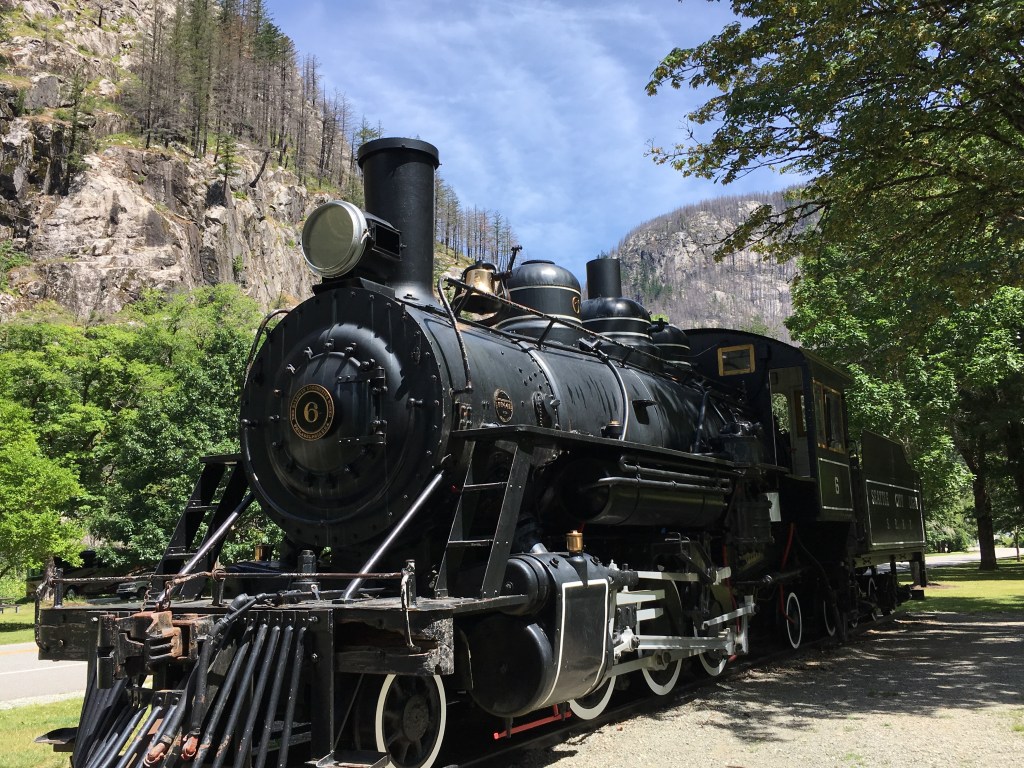
There in town I saw an old steam engine on display, and crossed a suspension bridge, and I bought a brown sack lunch at Skagit General Store. This town wasn’t particularly charming or quaint. It wasn’t rustic, and it lacked any defining character. The proximity of the mountains and river were its most prominent features, but it wasn’t trying to be a tourist destination anymore, for it was only a functioning company town. The city dwellers need their electricity. I wasn’t expecting this but I learned that hydroelectricity is a part of the experience when visiting North Cascades National Park. 
Just a little bit up the road I passed a dam, one of a series, but this one was the most visible and creatively named “The Gorge Dam”. It had to be old. Observing the architectural design of the powerhouse, you could say, “they just don’t make them like that anymore.” It was designed with attention to the image it would portray. It was a work of art. Not knowing much about architectural terminology, I would say it was a fusion of Roman and Art Deco design. It had long rectangular windows and boxy features with a regal boldness and pillars. 

Suddenly everything changed past the dam. I was back in the National Park, and back in nature’s beauty. I was a little disappointed, at the time, to learn that the lakes of the National Park were not natural but were the result of dams. Don’t get me wrong, I love a good dam, and I admire human ingenuity to harness power through water, but to know the National Park was not all natural just kind of tainted it a bit in my mind. The only dam I wanted to see here was a beaver dam. Of course if a beaver dam is a part of nature, then isn’t a human dam a part of nature too? Is man himself not a part of nature? 

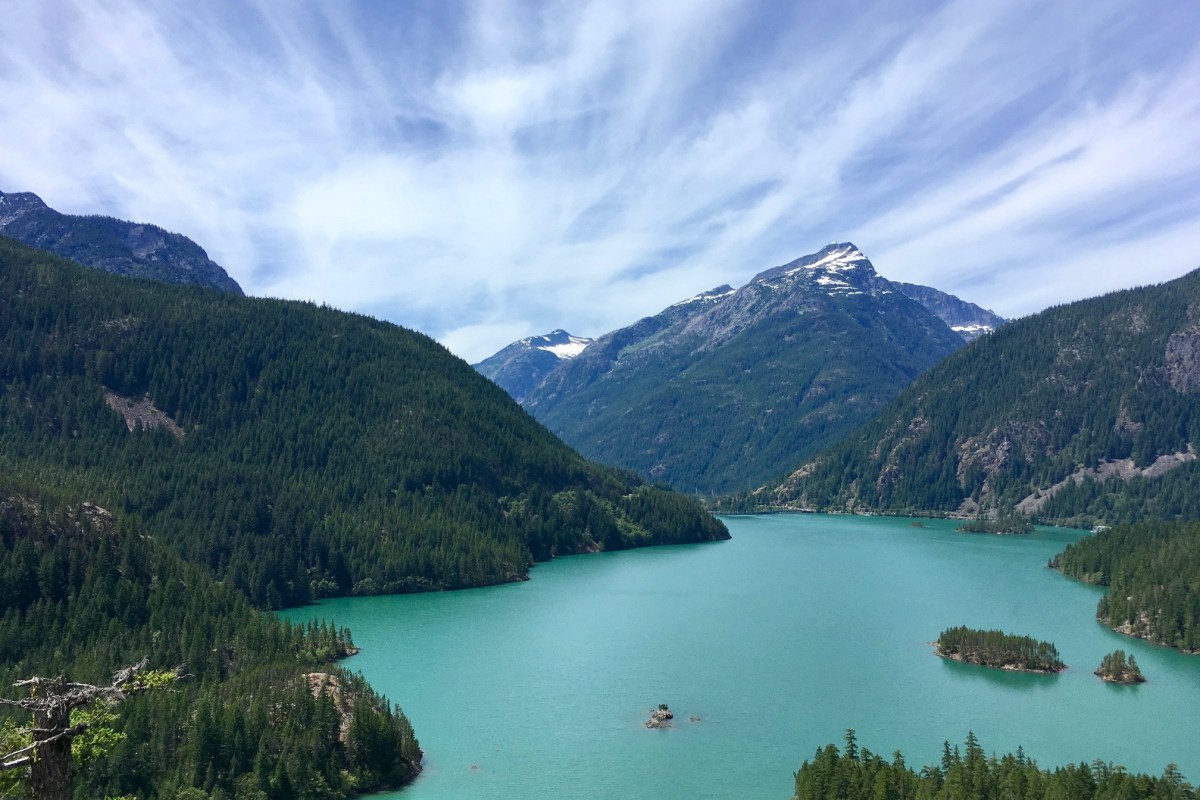
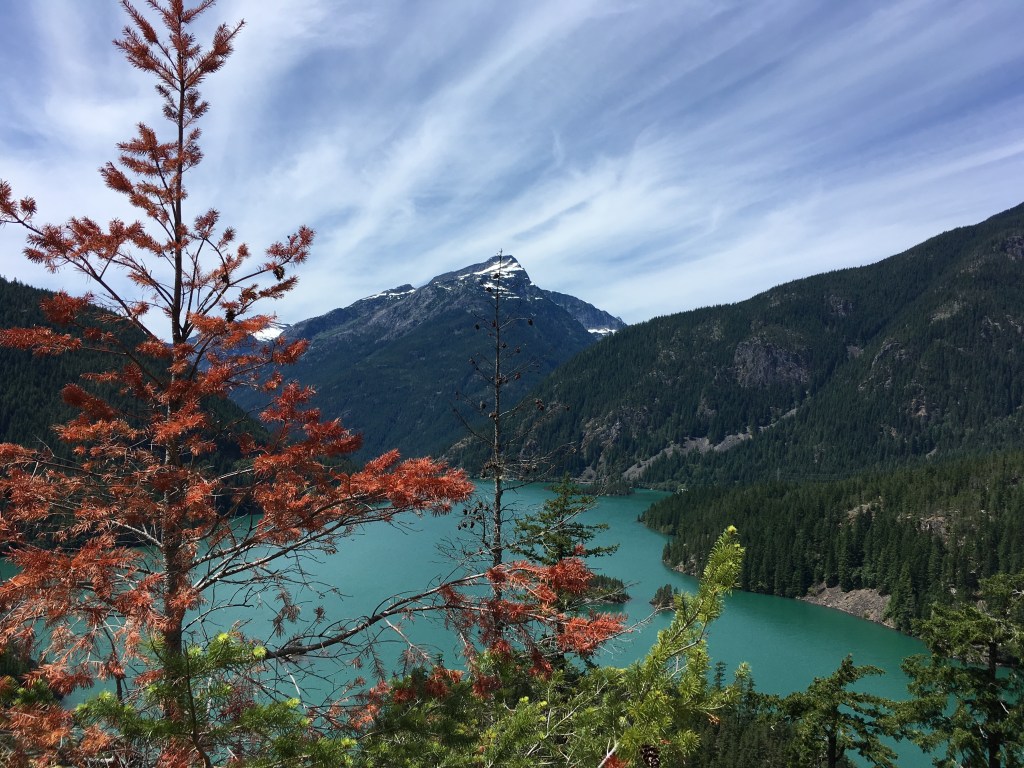
As I continued my journey on the park road, climbing upward in the mountain reaches, I made my next stop at the overlook of Diablo Lake, and oh my! What a sight! Pristine! I was surprised to see that such a vibrant turquoise color could even exist in nature. It was such a bright and vibrant color. Although perplexing, in its surrealness, it yet looked so natural and believable. Mountains dramatically sloped down into the milky turquoise water, which curved around into many bays. To the right side of the lake, before the inlet of a bay, stood two small little islands. The middle of the lake spread up to the foot of Davis Peak, a jagged snow-capped mountain. From behind the mountainscape delicate clouds wisped forward, as if imitating beams of sunlight. The dark richness of the pine forests on the mountainsides, contrasted with the turquoise lake and the blue sky created a unique pacific northwest color scheme. There at the overlook I also noticed a pine tree whose needles were turning red. It was probably a sickly tree, but in my photos I was able to add a splash of red, creating such a colorful capture. From here the mountains were dramatic and tall, but there were only a few to behold. Mountains didn’t stretch on in layers in the distance. Only the immediate ones were seen, giving the accurate impression that I was up very high. All other peaks were below and hidden. Only here could I see the highest reaches and I did feel on top of the world. 
Just a few miles up the road I also came to an overlook for Ross Lake. It too was stunning. It was similar in color and nature to Diablo Lake, but much longer, and the way the mountains were situated and the lesser number of immediate bays, made it just the slightest bit less picturesque, but still beautiful and magnificent nevertheless.

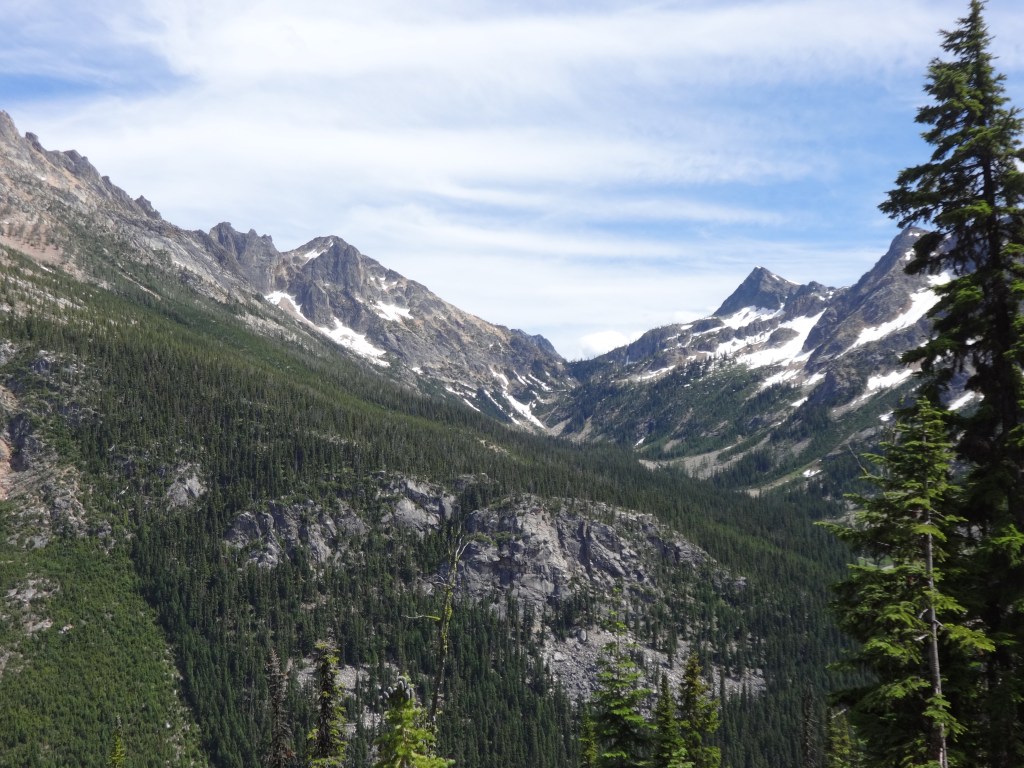
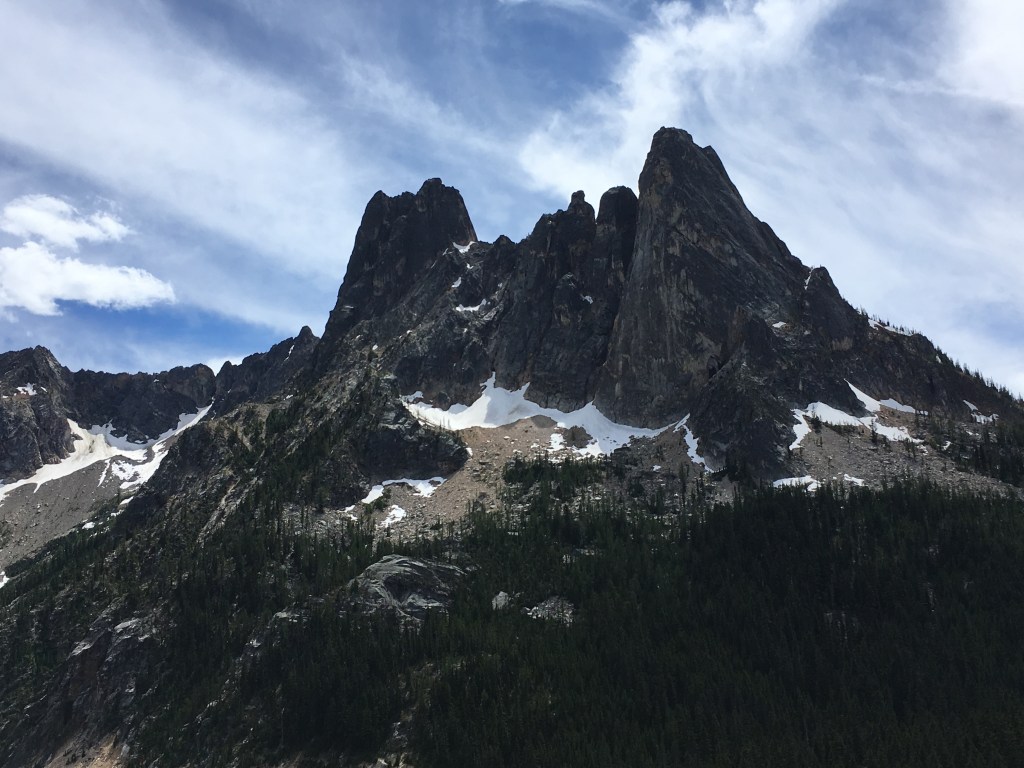
The rest of my drive provided great views of sharp craggy peaks, jutting up from the mountains, as if mountains were upon mountains. These weren’t rounded or flowing mountains but dramatic sudden reaches. And they were immediate reaches, right there, with snow caught in their veiny rivets. There was a definite character to these mountains, and if these mountains were music, they’d be crescendoing cymbals of a regal nature. It’s was if I could hear the mountains. I stopped at one overlook of the mountain valley and beheld the mountain peaks beside me, so tall. It was truly a moment of awe, and I thought, I’m back. I’m in my element. The awesome wonder that beset me my first great summer adventures is here to recapture my spirit. The sense of adventure was on fire again, a blazing campfire, with sparks igniting the night sky. I was coming back in my spirit to a place I so longed to be. 

About twenty miles outside of the park I arrived into the town of Winthrop, Washington. None of the campsites in the National Park were reservable online, and planning my trip I wanted to have the security of a place to stay. I wasn’t sure how busy North Cascades would be. It didn’t prove to be very busy at all. Arriving in Winthrop, I was surprised. The land was very arid. There were hillsides surrounding that were very dry and barren. I could have been fooled that I was in a desert of the Southwest. I had never before associated the desert with Washington. On the way to the KOA I drove through the little downtown. It was a quintessential Wild West downtown of not just Western facades, but the real deal. Nothing was too bold or boisterous but rather small and charming. The businesses beheld names such as “General Merchandise,” “Emporium,” and “Saloon.” A vintage but functional gas station with two pumps sat next to the road where people walked on the sidewalks. I realized this place was a tourist draw, but not overly so. It wasn’t crowded. It wasn’t flashy. It was just right. After being in the remote, brisky north reaches of the Cascades, it was comforting to be in this warm little welcoming Western frontier town. I’d later learn that Owen Wister, the Harvard roommate of one of the original settlers in the area, Guy Winthrop, wrote his famous Western novel, “The Virginian”, after a visit to Wintrhop. 

The KOA was only a mile from the downtown stretch. I drove across Chewach River, noticing a bike path parallel to the road and also crossing over the river which was shimmering in the evening sun. Everything around here looked well taken care of. Right next to the entrance to the KOA was a long wooden western style building named “Winthrop Dry-Goods.” Perfect! I went inside the small grocery store and bought some yogurt, Frosted Flakes, and milk. 

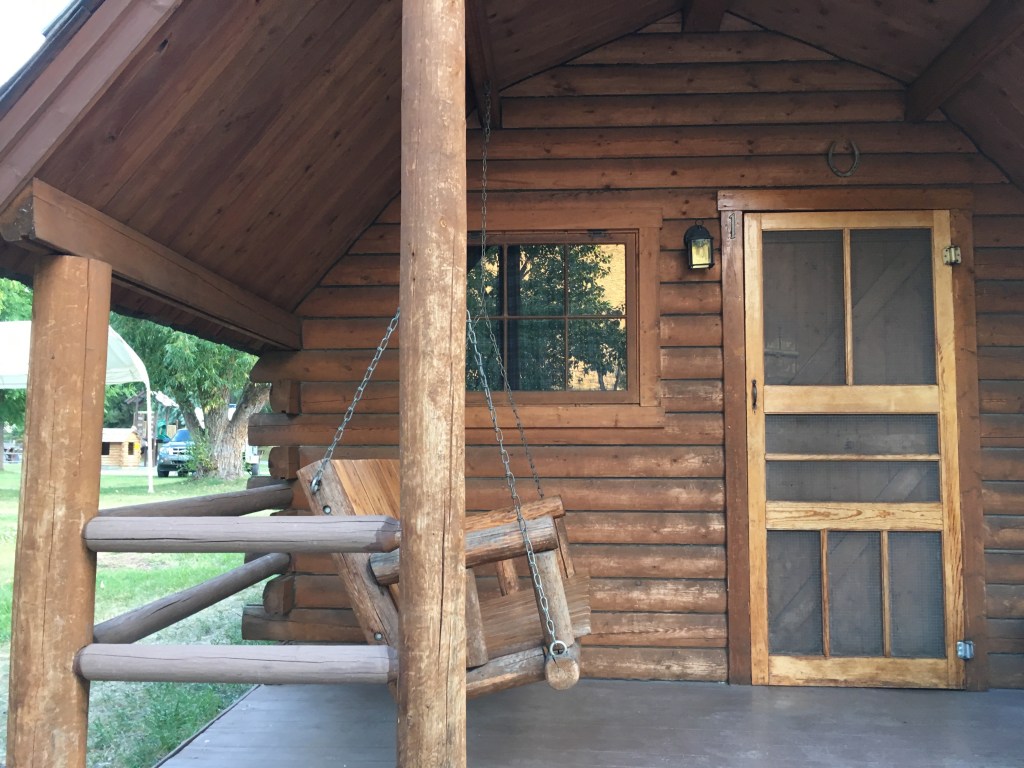
I checked into the KOA, and it was so nice. It sat right at the Methow River at the foot of a desert hill. I had reserved a camping cabin, which had plenty of space around it, and I felt like I had so much space to breathe in this nice dry, warm, and welcoming place. I took off my boots and trod around barefoot. Relaxed, I organized the trunk of my car. Now that Zach was not here, I had full reign. I also did a load of laundry, and packed for my upcoming backpacking trip to Stehieken. While the clothes were spinning I took a warm shower in the nicest KOA bathroom I have ever experienced. When I checked in, the hosts even bragged about how new it was. It was a log cabin style building and inside there were about a half dozen little individual private bathrooms. Each had their own shower and little changing area separate from the sink, mirror, and the rest of the bathroom. They also each had their own skylight, letting in warm sunlight. They all had that nice new building smell, but not just any new building, but a fresh-wood log cabin smell about them. 

When I gathered my laundry and went back to the cabin, I noticed a few items hadn’t dried completely, so I laid them out on the railing of the porch. I then poured myself a cup of Frosted Flakes into my KOA cup from the night before and reveled in the sweet crunch, as I sat on the porch swing, updated my journal, and read a little bit of John Muir. This was a simple yet blissful moment. 
I then drove back into town, first stopping at the cable bridge alongside the bike path to cross over and look down into the river. In downtown I parked my car and walked down the mainstreet. There wasn’t as much to see as I expected from the initial perception driving in, but it was all pleasant. I ate dinner in an old turn of the century schoolhouse, rightly named “Old Schoolhouse Brewery.” I had a chicken sandwich on the back porch overlooking the river. 

Back at my little cabin, at great peace for a quite a productive evening, and after having a day full of great vistas and travel, I slept soundly, anticipating the adventure that lay ahead: backpacking into Steheiken. 

If you enjoyed reading this, check out my book Still, Calm, and Quiet“

Check out my previous entry here: Strange Faces, Strange Places

Visit www.joshhodge.com

Strange Faces, Strange Places

It was the hour to get organized, for it was time to head toward the airport and return Zach to Kentucky where he came from. So we began first-thing this morning. The trunk of the car was just a grand mess of all our things sort of mixed together: the boots, the backpacks, the flannel, flashlights, the park maps, the souvenirs.  We handed things back and forth as we got organized. “This is yours…..This is mine.” We also had to take down the tents and pack up the sleeping bags. It was quite an operation. I wasn’t sure how to feel about all this. Was I to be sad to send Zach off, continuing the adventure by myself? How would that feel after all this time together? Or should I feel happy and relieved to be able to have my solo freedom, to do everything as I wanted to and not have the stress of the complaining and the concern of trying to appease. I guess I sort of shrugged it off. I’ll find out when he’s gone, I concluded. 

Leaving Mount Rainier National Park, we stopped just outside at a little “backpacker lodge.” That’s how I described it in my journal. I didn’t bother to write down its name or provide any details, except that I bought a cup of hot tea and a scone for breakfast. I described it as a “backpacker lodge,” by the part-grungy, part-artsy nature of the place and the few patrons around sporting large backpacks. In writing about this place I’ve examined maps and have tried to locate this place, to give it a name here, but I simply cannot find it. Perhaps it doesn’t exist anymore, or perhaps it is just well hidden on the maps.

In recalling my adventures in the National Parks and the beautiful wild, this is not the only place I visited I haven’t been able to relocate. The very day I picked Zach up from the airport, and we were traveling our way up California on highway 101 in the semi-arid lands, passing by many a vineyard, I came to a sign boasting some sort of self-sustaining community. It was advertised as an all-natural farm working on renewable energy. Its signage read “visitors welcome.” I knew this was the kind of place Zach would like to see. So, I pulled off the road. This was for him. He seemed excited to see it. We pulled onto a dusty driveway. The land was dry and the sun was harsh. A box stood at a post with a suggested donation listed. We threw in a few dollars. I should have known better…Well, honestly I had no idea what was in store. 

So this was this little commune of various buildings and paths between them we could walk around on. We weren’t quite sure where we could go, or what we were to see. There was some interesting makeshift infrastructure, networks of homemade irrigation systems, green houses, lots of plants hanging around, buildings that were constructed…um…what’s the word… creatively. It was kind of intriguing, but then we came across a local. He was a middle-aged man, leathery, wrinkly skin from too much sun exposure. His hair was dirty and matted; his shirt only buttoned up halfway to show off his collection of hippie necklaces. He was super friendly and talkative…because he was drunk. The first piece of evidence was the smell on his breath. He welcomed us, and gave a slurred introduction to the grounds. He wanted to show us his home that he built himself. It was a hut, made of dirt clay and glass bottles. I’ll admit it was impressive. It even had some nice windows built into it. It had to have been a lot of work, but after I briefly saw it. I was done. I was done listening to him curse like a sailor so casually and I was ready to go! But he kept talking and talking. When we did get away, I made a comment to Zach about how drunk he was, “…and high,” Zach added. I hadn’t picked up on that, but it’s because I hadn’t been exposed to enough high people to know what that sort of behavior looks like. Then a notion started to dawned on me: I think we are on a marijuana farm. Again, I was done. I wanted to get out of here. Before we left we did go into a gift shop, which was surprisingly nice and put together, not very reflective of the jury-rigged nature of the rest of the place. By observing the type of merchandise my suspicion grew stronger.  

That was weird. We carried on. 

As I’ve gone back to maps and the internet to try and find this place, learn more about it, to confirm what exactly it was, and to give it a name, I can’t find anything. Perhaps that’s intentional, and that’s fine, because I really don’t care to know more. What I do know is that it was in California, and they can have it, and they can keep it. I suppose all I’ll ever know about it is what I remember. Just like the backpacker lodge outside Mount Rainier National Park, that’s all I got. 

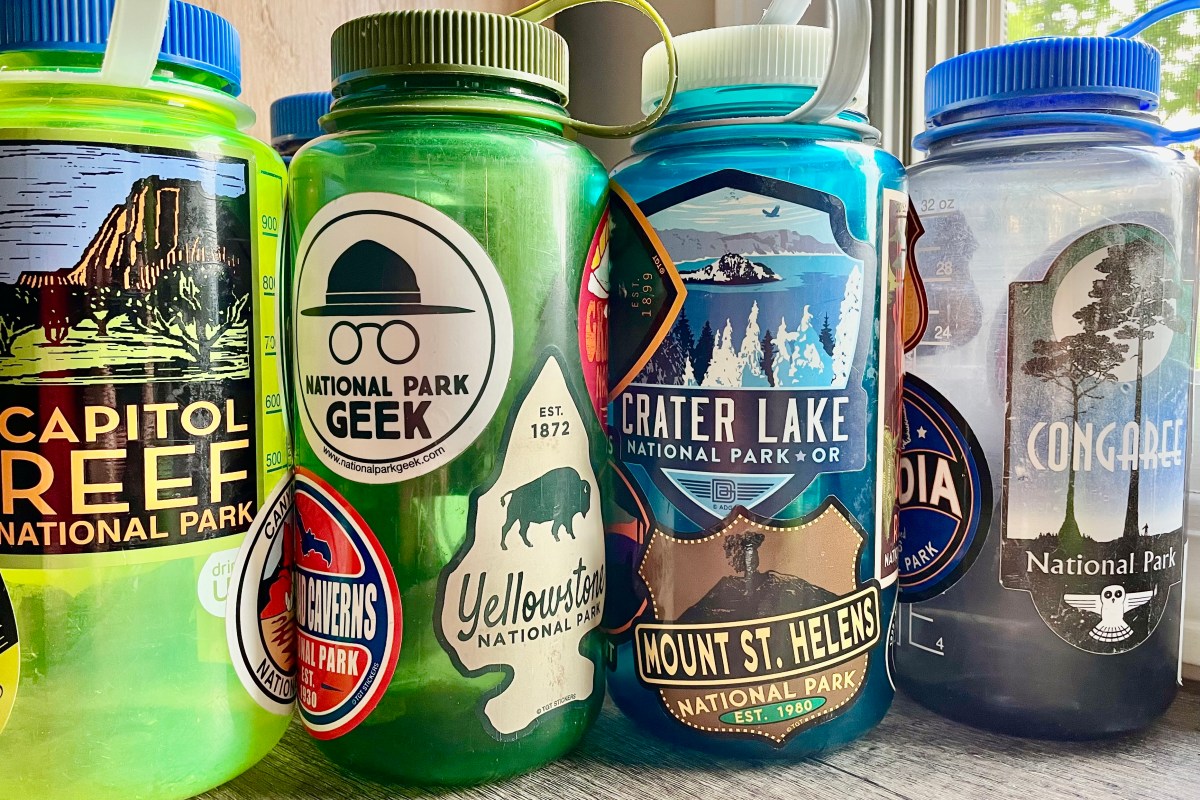
After our brief stop for breakfast we only had a couple hour drive to the Seattle-Tacoma airport, so as we got close we made a few stops. Zach wanted to visit a Target to return a Nalgene bottle he had bought toward the beginning of our ttrip together. I have a tradition on my summer-long vacations to get a Nalgene bottle and sticker it up with stickers from each park I visit. I had a neon yellow bottle for stickers for my Southwest adventures I write about in my book Canyonlands: My adventures in the National Parks and beautiful wild. I have a dark green one with stickers from the Still, Calm, and Quiet: More adventures in the National Parks and beautiful wild summer, and I have two classic blue ones from parks I’ve visited on various smaller trips back in the Eastern United States. For this trip I had a dark turquoise bottle sporting my stickers. Zach had learned of my ways and wanted to do the same. Imitation is the sincerest form of flattery, as they say, so I liked that he wanted to copy me, but the Nalgene he had bought earlier on the trip had a plastic casing around it that must have, at some point, melted onto the bottle and now could not be fully separated. So he wanted to exchange it.

I also let Zach pick where to have lunch since it was his last day on the trip, and he was always the one with the large and urgent appetite. It’s definitely telling that we were no longer in the wild when he chose ihop. We were in the city of Tacoma next to Seattle. It was my first time eating at an ihop. I was surprised to learn there was more on the menu than just pancakes. 

In the later afternoon it came time to take Zach to the Seattle-Tacoma International Airport. I parked and we went inside. He checked his bag, we said goodbye, and he quickly made it through the TSA security checkpoint. I did feel a poignant sadness. As much as he frustrated me, I felt this heavy aloness set in. It was the realization that I was so far away from home and now all alone. Why should this bother me? I’ve traveled so far away so alone so many times. But as I saw him move past security towards his gate, I knew deep within me, our friendship wouldn’t recover from this trip. Our friendship was built over a love for the outdoors and recreation. Those are great things, but they can also be superficial, especially when we view nature so differently. I view it as God’s design with purpose, intention, and messages which it beholds for mankind to draw closer to Him. Zach didn’t share that view. I also value human life so greatly much differently than Zach. We argued about this. He saw human life as too abundant and in need of being lessened. This sat so incredibly unwell with meI saw it all as sacred and designed by God with even greater purpose. Humanity is God’s most prized possession. Yes, possession. We are His. I felt I couldn’t bring up these deeply held views of mine. They would cause further arguments. Zach saw human life as too abundant and needed to be lessened. 

There also was no peace in this friendship. There was complaining and conflict and never a sense of security. We were not kindred spirits. We didn’t share any weightier values. At this time in my life I was too young and immature to realize that perhaps I could be an influence upon Zach’s life, but when it comes to forming friendships it takes a great deal of effort for me to form them. I also don’t throw the word friend around casually. I take the term friendship quite seriously. In recent years I’ve been very conscious of my use of the term “friend” versus “acquaintance.” I will only use that term friend for a true kindred spirit, for someone I can rely on, whom I share great values with, whom I am willing to get behind and advocate for in life, and someone who is willing to do the same for me.

I also believe friendship is a design of God for us to build each other up spiritually. The Bible has a lot to say about friendship. Take into account Proverbs 18:24, “One who has unreliable friends soon comes to ruin, but there is a friend who sticks closer than a brother. Then Proverbs 17:17 reads, “A friend loves at all times, and a brother is born for a time of adversity.”  Lastly, I’d like to mention Proverbs 27:17, which I also think has a lot to do with friendship. It reads, “As iron sharpens iron, so one person sharpens another”. What I thought was a friendship between Zach and I was not reflective of any of these verses. 

We are all wired differently. It takes a deal of effort for me to create friendships. There’s this effort of really putting myself out there and sharing of myself that doesn’t always come naturally. I do it and delightfully so when I see the potential for a fruitful and lasting friendship. In such instances it encourages me. I get a great deal of energy from it, and my life is enriched, but to put forth the effort for a friendship based over a mere superficial hobby for nothing of substance, is exhausting. I am not saying that the way I maneuver friendship is the best and that my views are even the best for me. I find myself often to be solitary, lonely quite often. I suppose if I didn’t take friendship building so seriously, but more casually, and I put forth effort to connect even over the shallow and superficial things in life, I may have more people around me. Maybe I’d be less lonely, but also being surrounded by people on a shallow level of commonality I think is exhausting. I would probably feel even more lonely to be surrounded by people who do not share my values and outlook. I do say, that because I do take friendship so seriously, that the people I do invest in that I truly call friends mean a lot to me. I am very rich because of that, and maybe I feel a richness of friendship that some people do not, and for that I am very thankful. 

As Zach was now gone on his way back to Kentucky, a whole different mindset had to set in. I had to shift from accommodating another traveler, to just looking out for myself. I was free! Not gonna lie, this is what I wanted. 

Leaving the airport, I was able to quickly adopt the new mindset of being alone and free! The next leg of my journey would take me to North Cascades National Park, but tonight all I had to do was drive two and a half hours to a KOA northwest of Seattle, so I didn’t have to be in a rush. Therefore in Marysville, Washington, a suburb of Seattle, I stopped at a Planet Fitness. The original plan was to take a shower there, but then I realized I could just shower at the KOA tonight, and so I just enjoyed a workout. Normally I focus on one certain muscle group per day at the gym, but since I hadn’t been to a gym in a while, I decided to just do a little bit of everything. 

At this point in my life, I still hadn’t made the switch from the flip phone to the smartphone. I had an iphone, a cheap one, just to take photos and connect to wifi when the opportunity allowed. I needed to take the iphone into Planet Fitness and connect to the wifi to make a payment through mobile banking. In between sets I was trying to remember a password, reset a password, select all the images of stop-lights, get a confirmation code through the flip phone, translate that over— all of those technicalities. 

Next to the gym was a local thrift store. It was pretty large, and I was excited to check it out. Maybe I can find some fun camping gear. I’d really like to find a skateboard. That isn’t something I could have packed in my suitcase. Maybe I can find some good CDs for some different travel tunes. Since I hadn’t made the migration from flip-phone to smartphone, I also hadn’t made the switch over to digital media. I had no such luck with any of these hopes, but I did find an Under Armour base layer that would come in handy during the cold nights and mornings up in Glacier National Park. Leaving the thrift store, I did notice a couple homeless people loitering around the parking lot, one pushing a shopping cart as if it was a caravan. The way they acted, their demeanor, made it evident they were drug abusers. It was nice to get a workout in, and to wander around the thrift store, but the druggies were a stark reminder I was in the city and I wanted to be back in the wild. 

I got in the car and made my few hour drive to the KOA campground. After zipping up interstate 5, I was on highway 20 heading east along the Skagit River. Urbanization waned, and gradually more forest set in. I knew the KOA wasn’t going to be anything fancy in terms of KOAs. It was just a basic one, but all my experience with KOAs thus far had been good. Making the turn into  the KOA I was surprised to find that it was gated, and I had to press a button to open the gate. I went to the office to check in. The host seemed a bit frustrated. She went over the usual rules and explained how the gate will be located after 10pm. I wondered why this KOA needed such a security measure as a locked gate. We seemed to be in a pretty rural area, and back in nature, which is generally a safer place to be. It’s not like we were in a city. She pointed on the map where my campsite was. It was the furthest away at a dead-end road. “There was a picnic table at your campsite, but we’ve been having a problem. Some people entered in from the woods and stole the picnic table, dragging it off into the forest.” This explained her frustration, and now I knew why there was a locked gate. But who comes from out of the woods and steals a picnic table? It seemed so odd. I wasn’t bothered by the fact I wouldn’t have a picnic table, but it was unsettling that people come from out of the woods and steal things. 

I drove down the gravel path where it dead-ended at my campsite. I was farthest away I could be from any other camper in this campground, isolated. I stood there at my site and looked into the forest imagining some strange forest people emerging and scoping out what they could glean. Where were they coming from? What’s in those forests? Not having made the smartphone migration, I wasn’t accustomed to using any digital maps to check out my surroundings, so I just looked at that forest with a mysterious wonder, imagining people dragging picnic tables into its depths. Those were unsettling thoughts.

I drove back to the “recreation center” as it was called. It was like a community center in the campground next to the pool. There was a water dispenser and plastic KOA cups. I was a KOA fan and had never seen a KOA cup before. They were obviously meant to be taken. Souvenir! There I sat at a folding table, cracked open my Chromebook, connected to the wifi, and began transferring some of the photos from my point-and-shoot camera’s SD card to the Chromebook for backup and also to share some photos online. What an adventure thus far, from the Mojave Desert to the North Cascades in the Pacific Northwest. It was very relaxing to sit there for a while, and I was at great peace while looking at all these beautiful photos I had taken on my journey. I also proceeded to take a shower and was all refreshed and reset. Then I hopped back in my car and drove back down the dead-end to my campsite.

It was dark now, so there was a certain mysterious ambiance in the air. I stood there on the tent pad in the silence, alone, looking at the forest again. The host’s words reverberated in my ears, “Some people came from out of the woods…and stole the picnic table, hauling it into the forest.” I imagined them now hauling a body into the forest. I did not saunter over a decision. There was an unsettling vibe here. It was not strange enough to cause me to leave, but I was going to sleep in my car, and so I did. 

If you enjoyed reading this, check out my book Still, Calm, and Quiet“

Check out my previous entry here: Really, What Kind of Mountain Are You?

Visit www.joshhodge.com