Mount Rainier: the noblest of peaks

“Of all the fine mountains which like beacons, once blazed along the Pacific Coast, Mount Rainier is the noblest.” – John Muir

Cars were backed up to get into this park. I could see just a little bit up the forested road to the entrance gate. There a large wooden sign hung down from a rustic pine log which laying there, propped up by other pines on either side, had constructed an archway- a portal into the park. Its letters were all upper-case, bold, and carved simply into the sign. The grooves painted white displayed “MT. RAINIER NATIONAL PARK.” 

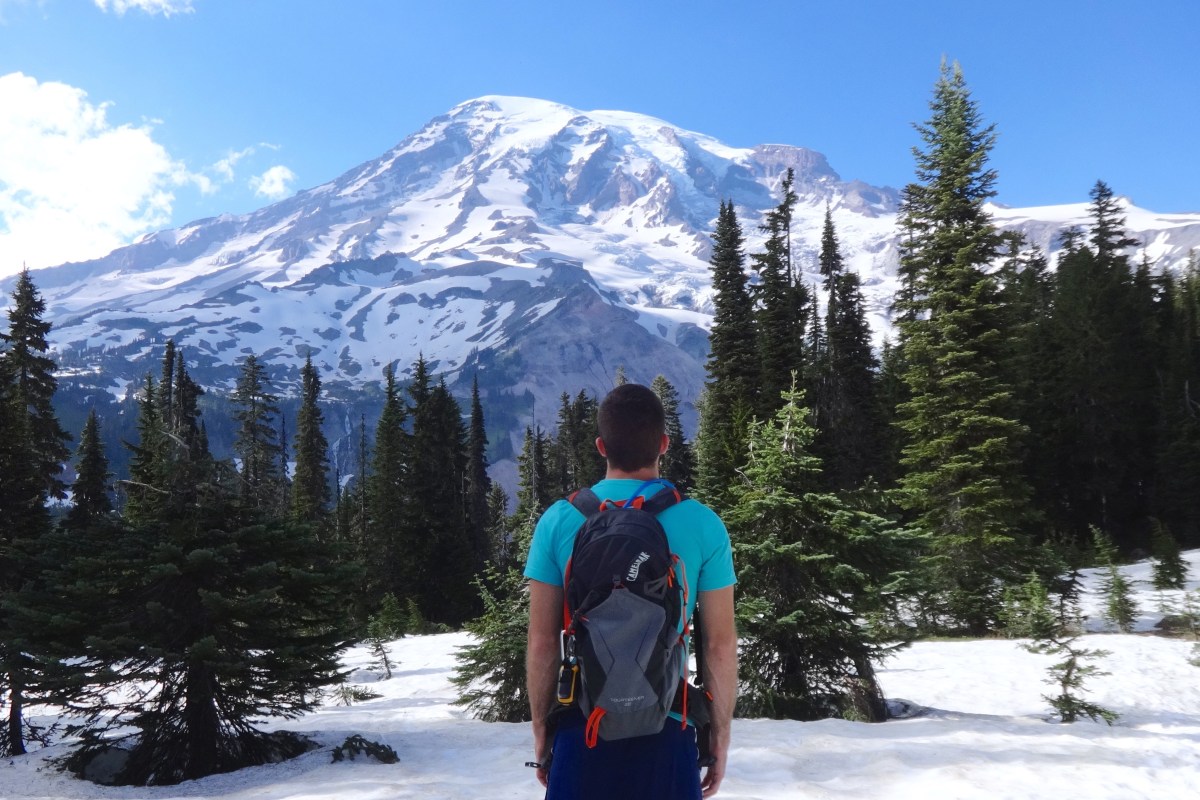
This was a top tier national park, our nation’s third behind Yellowstone and Yosemite, created in 1899 by President William McKinley signing a bill passed by Congress. This park is named and centered around one mountain peak, but deservingly so. MountRainier is a giant at 14,411 ft. It is  visible throughout most of the state of Washington and has the most glaciers than any other peak in the contiguous United States with a whopping total of 26 glaciers. We had seen this mountain much earlier in the day, traveling from the Olympic peninsula around Tacoma. It was a magnificent bold giant standing in the distance. Over the course of hours we noticed it growing bigger as we drew closer to it. Now we were at the mountain’s base about to enter the National Park!

Once officially inside, passing beneath the enormous sign and log beams, flashing my park pass and getting my park map, the road immediately began to gradually ascend. We were on our way to the Paradise village area of the park on the side of the mountain.  There in Paradise was a visitor center, a lodge, and a network of trails. On our ascent through the thick rich forest, I stopped at one point to hop out onto a short path to a platform overlook nestled between the dark pines. There at the platform’s edge I beheld the amazing wonder of Nisqually Glacier tearing down the mountainside. Up until this point this was one, if perhaps not the most, impressive view in nature. It was my first time observing a glacier- the breaking ripples of ice, deep grooves, sharp edges rolling over and tearing down the mountainside, but all seemingly still. It was action frozen in time to my eyes. I observed a depth of snow and ice I had never witnessed before, and as the glacier spread down the mountains I saw the enormous gorge it had created over many years, carving away at the mountainside. Although there was a plaque labeling Nisqually Glacier, I believe, after considering the park map, I was also looking at two other glaciers in the same view: Wilson Glacier and Von Trump Glacier. It’s hard to differentiate between all the glaciers as they run so close to each other and at times converge. 
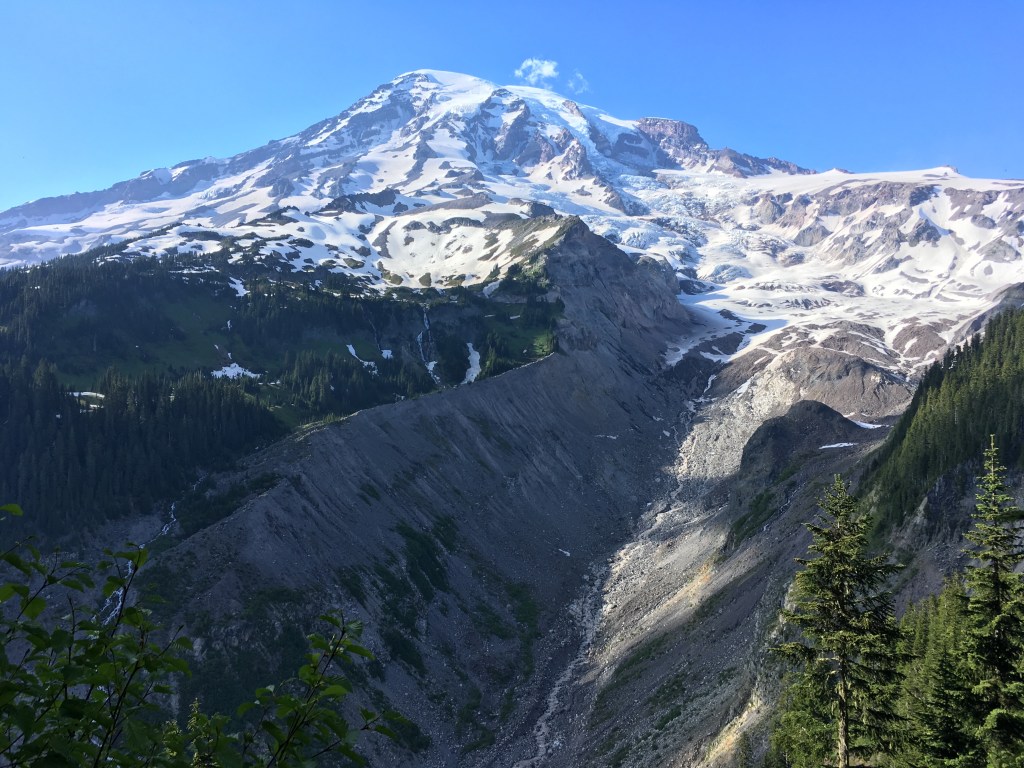
Van Trump Glacier was named after Philemon Beacher Van Trump, an American pioneering mountaineer who made the first recorded summit of Mount Rainier. He wrote: “That first true vision of the mountain, revealing so much of its glorious beauty and grandeur, its mighty and sublime form filling up nearly all of the field of direct vision, swelling up from the plain and out of the green forest till its lofty triple summit towered immeasurably above the picturesque foothills, the westering sun flooding with golden light and softening tints its lofty summit, rugged sides and far-sweeping flanks – all this impressed me so indescribably, enthused me so thoroughly, that I then and there vowed, almost with fervency, that I would some day stand upon its glorious summit, if that feat were possible to human effort and endurance.”

Unlike P.B. Van Trump, I would not be summiting Mount Rainier, but I shared in his admonishment of the mountain, and around its base and on its mountainside I would experience many of its rich wonders. With just one up-close and unobstructed view, it was love at first sight! 

“Let’s go!”

We got back in the car and continued on our way to Paradise. It was about twenty miles of meandering parkway that climbed and switch-backed up to 5,400 feet. At Paradise the mountain peak was on full display. The terrain had leveled to an extent to allow the construction of the large visitor center, lodge, and ample parking. I was anxious to get outside. Breaking my usual protocol, I took to a trail before even watching the park film. We’d do that later. 

 Zach and I started on Nisqually Vista Loop. It’s supposed to be a casual paved loop, but pavement was only visible for a few yards, the rest was buried under multiple feet of snow. We slid, ran, trudged, fell, and laughed our way around the loop. The mountain peak with its great and scarring glaciers came into view every once in a while through the lodge-pole pine trees, and at the trail’s furthest reach we had an unobstructed view of the mountain while on enormous continuous icescape that stretched up the mountainside connecting to the glacier’s ripples. Although it was summer, and I was wearing gym shorts, this place had so much ice and so much snow, that I felt so far in the North, in an extreme arctic landscape. The one thing I had to overlook, however, was the air temperature, as it wasn’t very cold out at all. 

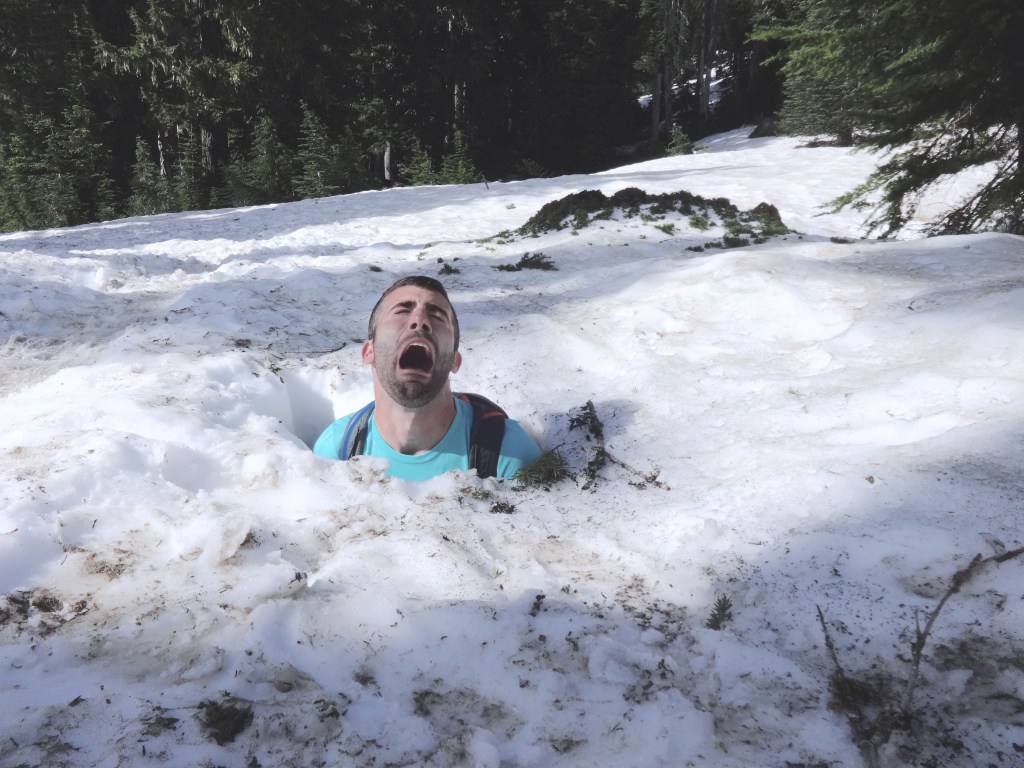
At one point on our hike we heard water rushing. We paused and tried to figure out where it was coming from, just  to come to the realization that it was beneath us. A mountain stream was flowing beneath the snow. We then encountered a few cavities in the snow just wide enough to fit a body. So taking turns we both hopped down, our boots landing in the shallow stream, and we raised our hands up out of the hole, taking each other’s photo trying for the illusion that we had been buried in snow. 

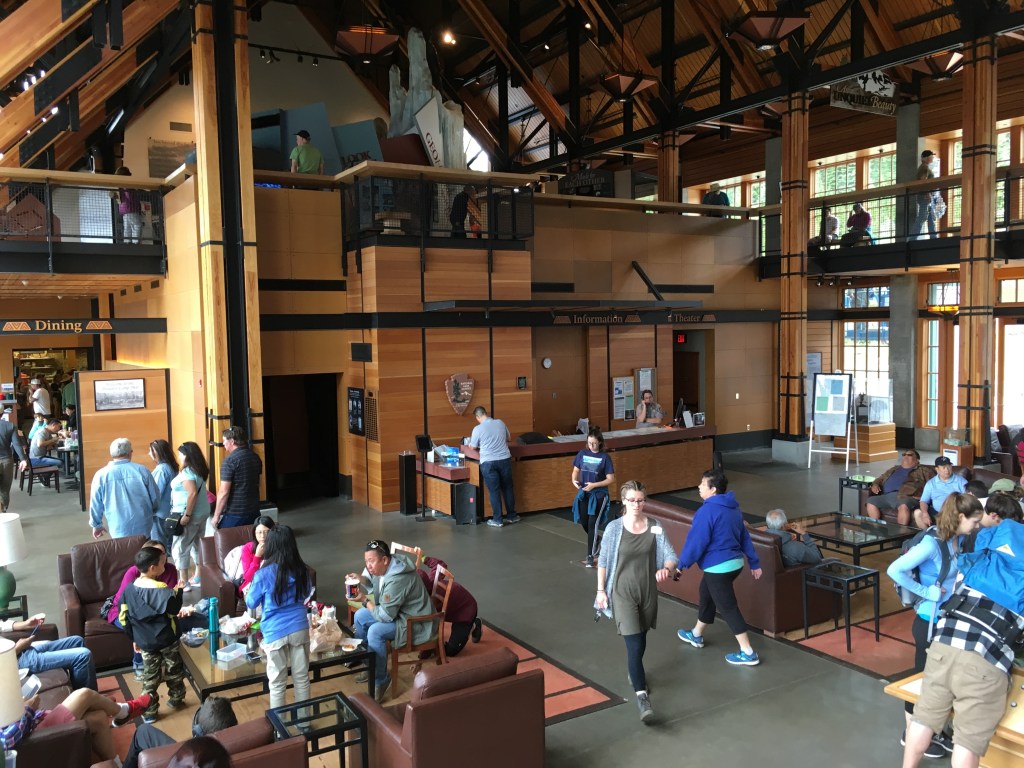
When we completed the loop, we went into the visitor center. It was quite large, with lots of ample space for sitting in its spacious lobby beneath a combination of timber and iron framework that supported a pointed ceiling. Its walls were almost entirely glass, giving way to much light, especially with all the sun reflecting off the snowy landscape outside. The visitor center had museum exhibits on the park on its second floor which was a combination of loft and balcony. We went into the theater to see the park film, of which I remember nothing, probably because this mountain did not need a film to speak for it. It was so grandiose and commanding of attention, that any measly park film was greatly overshadowed. After the park film, we had a quick bite to eat in the cafeteria there in the visitor center, and then we were back on the trails to visit Myrtle Falls. 
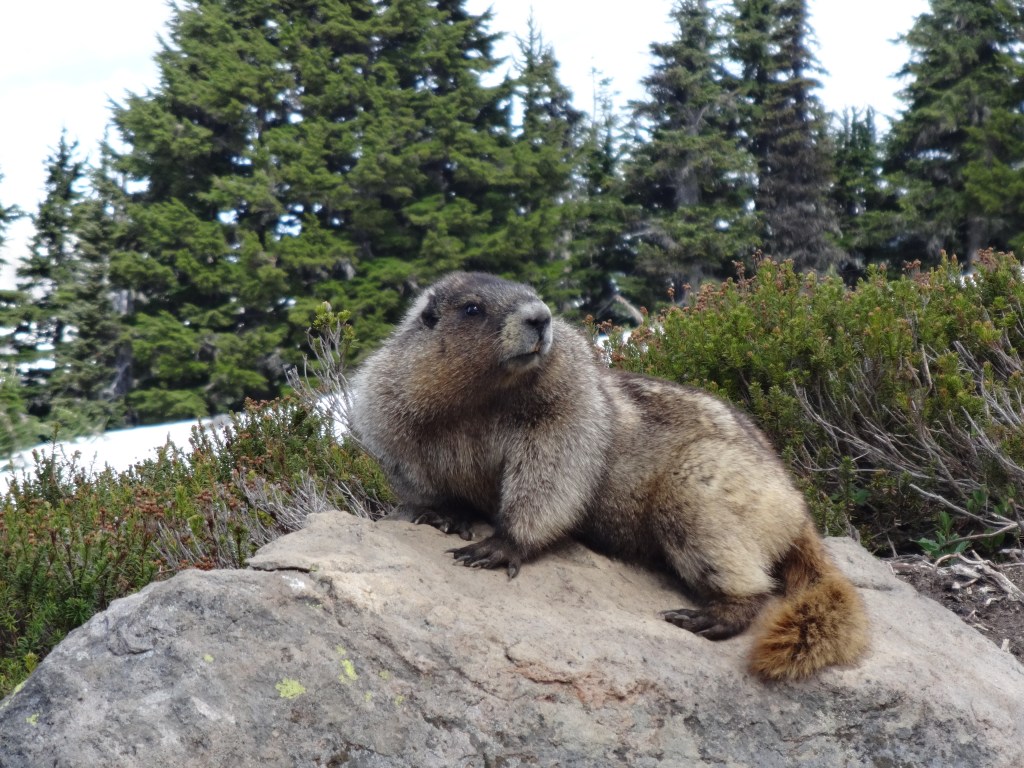
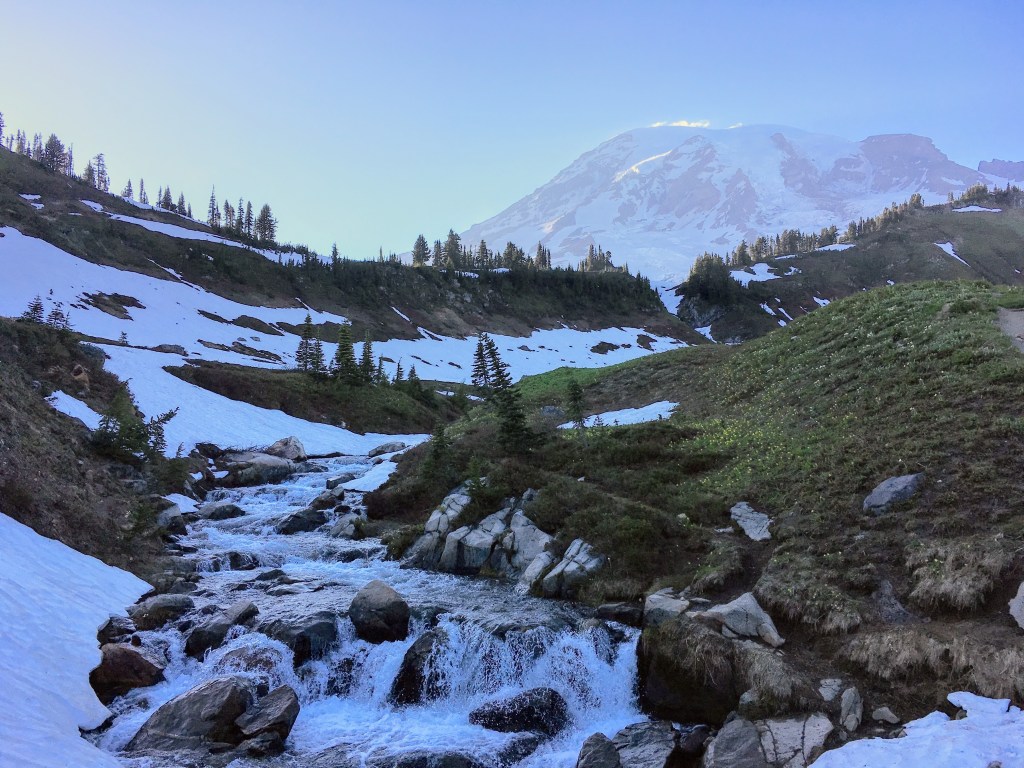
Our short hike to Myrtle Falls was lovely. I think typically it’s only about a half mile walk one way on pavement, but it was a bit more of hike for use trudging over snow banks, perhaps wandering off the official route at times, observing the many marmots lounging and flopping around, and admiring the alpine meadows full of blooming glacier lilies. We concluded our hike at around two miles. Here we weren’t exactly above the tree line, for small groupings of pines could be seen at the fringe edges of the meadows, but largely we were above the trees in rolling meadows of the mountainside. Despite it being a sunny day with a nice rich blue sky, we were cast in the shadow of a foothill, a ridge on the mountainside. As we approached the falls, we saw it sprawling down into a Edith Creek Gorge, chillingly cold in the shadows, water falling and tumbling over water, streams cascading upon protruding rocks behind the many paths of the water falling. It was a rather simple, but beautiful water fall, as from the creek it sort of bloomed as it fell, branching out in many streams down into the gorge. Just above the falls was where the trail led to a pedestrian polebridge perhaps about thirty feet long, made of timber from the forest. Behind the view of the falls, the bridge, the creek, the snow banks, and the flower laden meadows, was the towering Mount Rainier. Its highest reaches were adorned with the silver lining from the sun peeking out from behind some adjoining ridge with a cast stretching just far enough to barely reach the top of the mountain. 

With all the movement of water sprawling in every which way, falling, and cascading; and glacier lilies feeding off the melting snow, the marmots flopping around, the tourists delighting on meandering paths and trudging through snow, I thought about how rich of a place this was. I also considered how we were up high on the mountainside, and below was a rich forest, full of more  waterfalls and streams, thick pines, and forest growth; with bears, mountain lions, bobcats, foxes, minks, and all the other wild animals and tweeting birds of the forest. This mountain provided so much life! It was truly rich. I’ve written about how we can liken mountains to people. There are so many different types of mountains which exhibit the different kinds of influence and character of which a person can behold. 
I started this summer’s journey in the Mojave desert where the mountains surrounding are largely dry, harsh, and bare. They lack the richness of a place like this. They do not support an abundance of life. There is no richness of the forest like on this mountainside. 

Mount Rainier with its glaciers melting feeds the forest around it. Not only can I liken this mountain to Wheeler Peak, being bold and unwavering, but this mountain is also very life-giving. Like a nurse log, it provides rich nutrients, giving life to the forest around it through its supply of melting ice, and its delicate balance of sunlight and shade. However, unlike a nurse log, this mountain is not dead. It’s alive. I say it’s alive on the basis that it is an active volcano. Thus here lies the message: though nurse logs provide great insight showing us how even when we are dead, we can provide life to future generations, we provide life to others while still alive as well, just like Mount Rainier. I know this may seem maybe even more obvious than the nurse log analogy, but I think we ought to be aware that we should not over focus on our efforts of what we can leave behind while ignoring who we are and what we can do in the present. We have the immeasurable benefit and advantage of our present life. We can use it to take hold of the life books of others and write into them powerful influence, whether it be in the form of  encouragement, instruction, giving… Whatever it is we do, we do not do it alone, as to do so would be in vain. We do everything through the power of Christ in our lives. We may be the mountains that provide for the richness of life around us, but who provides the weather to bring snow upon our mountains? Who causes the sun to shine on our side? Who causes the water to melt and fall? Who brings the flowers to bloom? This makes me think of Scripture, of all the mentions of bearing fruit spiritually. To bear fruit spiritually is to be like Mount Rainier. Look at the life flourishing around it. There is evidence of God at work here, and there would be much more to consider and write about here in regards to the powerful symbolism of Mount Rainier. 

When we were done with our hike we went back to Paradise Inn next to the visitor center. It was an inn of beautiful rustic National Park architecture style, cozy and woodsy, with wood logs beams stretching in every direction, an “A frame” roof, dangling native american style lanterns, a blazing fireplace, and inviting little nooks to relax in. It was a great sanctuary from he snow and he evening cold outside. There I bought some tea and wrote some postcards. 
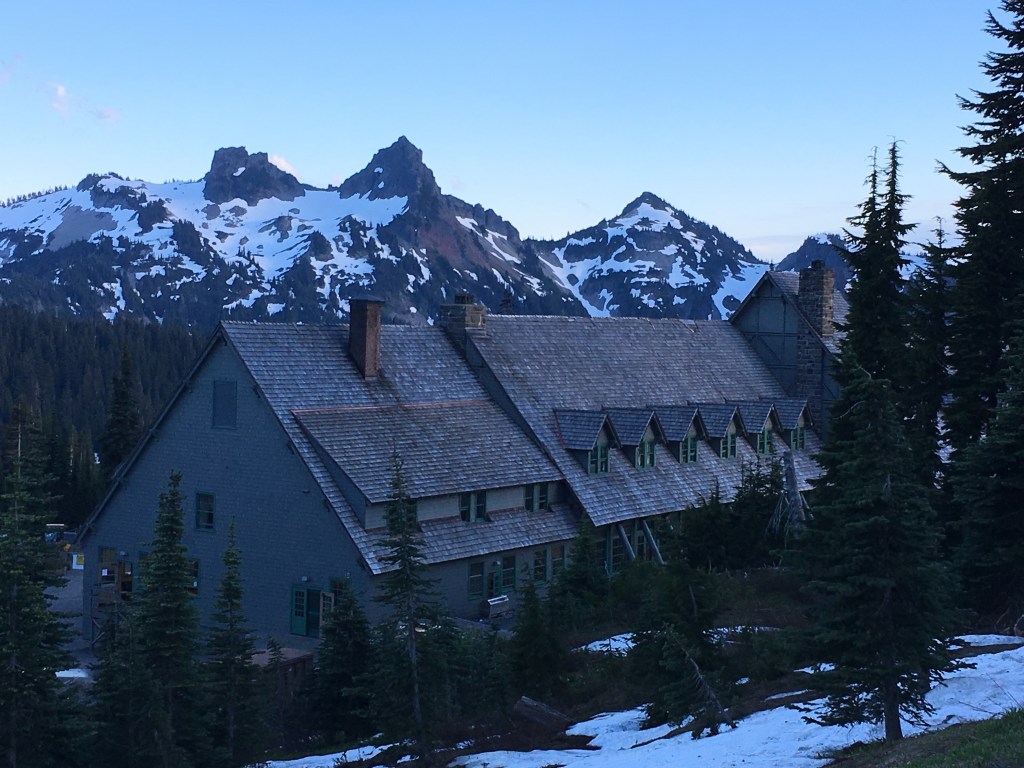
Leaving the lodge, getting ready to head down the mountainside to our site at Cougar Rock Campground, a beautiful sunset was on display with deep rich pinks and purples. The sunset reflected off the snow on the mountain peaks, providing colorful stretches of snow. Wow! It was a sunset so perfectly reflective of a mountain so rich in life. Its colors were so vibrant and deep. Most of the tourists were gone. The area was silent and serene. I had to pause a moment to take it in. John Muir knew what he was saying when he said Mount Rainier was the noblest of peaks. 

What Kind of Mountain are you?

If you enjoyed reading this, check out my book Still, Calm, and Quiet“

Check out my previous entry here: “The Mountain Goats of Hurricane Ridge”

Visit www.joshhodge.com

How God’s Story is Written Everywhere

The most meaningful takeaway from my visit to Crater Lake National Park was not the memory of jumping into the lake itself, although that was a great moment of overcoming fear, nor was it the beautiful vistas now imprinted in my mind and in my photographs. Rather it was what I learned about the creation of the lake in the park film in the visitor center and how it relates to spiritual life.

Typically I’m not captivated with geological presentations of layers of rock, seismic activity, tectonic plates shifting, volcanic eruptions eons ago, etc. On some occasions those things can be interesting, but usually, right off the bat, I’m questioning the validity of the information presented when it all starts off talking about millions and billions of years ago. To the contrary I believe the earth to be rather young  and that God designed it with the appearance of age. Also I believe the earth was so violently shaken during the Great Flood in Genesis, that so many processes that would have taken, under normal conditions, millions of years, happened quickly in all the trauma.

Surely during the Flood volcanic activity was abundant. The earth, while covered in stormy waters, shifted rocks dramatically, and sedimentary layers formed quickly, burying things rapidly. Nearly every National Park in the Southwest references a time when the earth was covered in water or a massive flood. This should influence our understanding of rock layers, geology, and the earth’s age.

Anyhow, the geological park film about the physical creation of Crater Lake spurred fascination in other ways. The events that created the lake are believed to have taken place only 7,700 years ago, which would place it at right about the time of the Great Flood. I also learned that Crater Lake was actually Mount Mazama once upon a time. It is believed it stood as tall as 12,000 feet. Then it had a violent eruption spewing over nineteen miles of lava and sending ashes over one thousand miles, some landing in Alberta, Canada. When the volcano erupted it left a giant cavity in the earth, a crater, which over time filled with melted snow and rain water to a depth of 1,943 feet, making it the nation’s deepest lake. The National Park Service in their park brochure describe the volcano which created the lake as “catastrophic.”

After learning about such a “catastrophic” event, now one can step outside the visitor center and see a serene, beautiful, mountain gem of a lake. It’s pristine, vibrant blue, and so enjoyed by many. I was captivated  with the notion that something so violent and destructive resulted in something so peaceful and beautiful. There’s a deeper message here, I knew. I had to channel my inner John Muir first to examine how this concept of peace and beauty after destruction is exhibited across creation. Is it a design element consistent across existence or an isolated event? Then I could question what God is teaching or revealing to us about Himself in all this.

The preliminary probing question I had to ask was, what other destructive things result in beauty? I was immediately taken back to my days of being very sick with a trifecta of intestinal and digestive system destruction. I was battling ulcerative pan-colitis, pancreatitis, and a bacterial infection. At the time my body was withering away and wasn’t even breaking down food. I was malnourished and in extreme pain, losing blood in large amounts. My plans for the future were ripped away from me. The havoc it created in my life was real, and as the National Park Service might say, “catastrophic.” But during this whole time of sickness God was doing immense work on me, putting me through the refiners fire, creating who I am, and teaching me reliance on Him and trust in His goodness. I emerged stronger in every way, physically, emotionally, and spiritually. I was also given a new gratefulness for my life, my body, and the world around me. After being confined to a hospital room, bed, or exam table, too weak to move, I was now able to climb mountains, summit scorching  sand dunes in the Mojave, jump into Crater Lake, and take in a deep breath of fresh mountain air without pain. This all brought me great joy. 

I was able to see profound meaning and beauty in life after the painful time of destructive sickness. Some struggle with coming to terms of the coexistence of God and suffering. After having been through much pain and grappling with the question myself of why does God allow suffering?  I don’t. I do not believe God brought about the pain or suffering in my life at all, but I believed he used it. He redeemed it to bring about goodness and peace in my life. As Romans 8:28 says, “God uses all things for good for those who love Him and are called according to His purpose.” I truly believe God can redeem anything to bring about goodness and spiritual growth, ultimately bringing Him glory. The overall message of Crater Lake was becoming clearer. It is one of the redemptive nature of God. 

I then began to think about war, how terrible a thing it is, and how timeless it is in our fallen state of humanity. But then I considered how after war there always comes peace. We see this repeated through the ages. When right prevails there is good that follows. The destruction of war is not a good thing. It is never desired by the righteous, but eventually it results in, or is redeemed for, peace. 

We too, as followers of Christ, wage war in our own spiritual lives. We equip with the spiritual Armor of God as talked about in the book of Ephesians. We take down strongholds and defeat principalities’ weight in our lives. As it says in the book of Ephesians, “For our struggle is not against flesh and blood, but against the rulers, against the authorities, against the powers of this dark world and against the spiritual forces of evil in the heavenly realms.” These battles are fought violently through prayer, scripture, obedience, reliance on God, and with the name of Jesus. One may question my word choice of “violently” when referring to such things as Scripture and prayer, but yes, I mean it. I believe these are violent and effective weapons in the spiritual realm against the forces of evil. Spiritual war can be ugly. It’s sacrifice. It’s a shaking up and reordering of one’s life, but it ultimately leads to peace and a right relationship with God. 

In my thoughts I then came back to the natural world. I looked towards the mountains and thought how, per the words of the experts, all mountains are created by earthquakes and volcanoes, both destructive acts of nature. Now these mountains stand tall, unwavering, and at peace. Forest fires, too, are another thing that seemingly, on the surface, are all bad, but those destructive events are redeemed as well. The aftermath is a nutrient-dense soil and room in the forest for the next generation of plant life to grow. I have seen many-a-forest both on fire and recovering from a fire. A forest fire is ugly and can be scary but recovering from a fire, the forest floor is always decorated with flowers. There are sprouting berries and mushrooms, and new saplings starting to really take root. It’s a beautiful thing. There is peace after a ravaging fire. 

I also began to think about birth and how it is such a painful and laborious process for the mother, but out of such a mess of pain comes the beauty of new life and the peacefulness of a resting baby. Then I thought of death itself. No one wants to face the process of death. Some will die tragically. Some will fight to cling onto this world. People will grow old and suffer ailments before death, but through death God reaches down and reclaims the life of his follower. Out of the end-of-life turmoil, suffering, and human-instinctive fear, He brings about ultimate peace, as he fully restores one’s spirit in his very presence. 

Ultimately this great design element from a volcano to a serene crater lake, from a forest fire to a flowering grove, from labor pains to a baby’s sigh, from war to peace, and from death to life, all show the redemptive nature of God. The message was becoming even clearer as I realized it was then pointing us to Jesus- the ultimate redeemer. Jesus felt pain on this earth. He asked for the “cup to pass” from Him when considering his approaching crucifixion, but He then went on to endure the most gruesome of deaths and the most momentous event in all of human existence. His great sacrifice, and his own redemptive rising from the grave, conquering death, brought about the possibility for salvation and the redemption of the human soul. He paid the ultimate price for our sin, making us just and acceptable, forgiven and presentable to a pure and perfect God.  This event is so great, so important, that God has painted it across his creation. The volcanos, the forest fires, the wars, the labor pains, they all point us back to the redemptive story of Jesus and salvation. 

It’s so great because and worthy to be written in the fabric of all creation because it is only through the blood of Jesus that  we can be redeemed from the destructive forces of sin in the world and in our lives. God wants to save us eternally, but eternity starts in the present, and God is here to wage war with us, from the dark spiritual powers which have a hold on us, from our self-destructive habits, from our mental and spiritual turmoil. God saves. He will deliver and redeem. As he promises, the battle is  already won through Him.Through turning to God, accepting his forgiveness, and waging war God is helping us to be “born again.” To do so is not easy, there can be labor pains as one must leave behind his old self, but ultimately we have peace knowing God is fighting our battles with us and will redeem. I think about the violent volcano spewing lava like blood, but then I look at the beauty and peacefulness of Crater Lake and I find hope. Here God reminds me of who He is and what He does. None of the wonders of nature are without meaning. God has placed his story everywhere and wastes nothing. 

If you have not called out to God and sought his forgiveness through Jesus, I hope you do, and I urge you to. If you have not waged spiritual war,  arm up! The stakes are high. Your soul and eternity is on the line. May you feel the transformative redemptive power of His love as you come to personally know God,  and may one day your pains and trouble be replaced by beautiful crater lakes and alpine streams. 

“And he who was seated on the throne said, ‘Behold, I am making all things new.’ Also he said, ‘Write this down, for these words are trustworthy and true. ‘” Revelation 21:5

If you enjoyed reading this, check out my book Still, Calm, and Quiet“

Check out my previous entry here: A Day’s Journey Around Crater Lake

Visit www.joshhodge.com

Crescent City: Tide Pools and Tsunamis

We had survived a cold night on the sands of the Pacific coast, and I was ready to start moving and get out of here. When I emerged from my cocoon, unzipped my tent, and peeled back the fly, I saw none other than our resident elk here to grace us with his presence once again. I suppose he liked to come around meal times, although we certainly did not feed him. 

At the picnic table both Zach and I were sitting wrapped in our sleeping bags, shivering and pitifully sneaking our hands out from under our sleeping bags to pinch off a bit of Clif Bar or down a gulp of Muscle Milk. That was our breakfast. 

It was a cold gray misty morning at Golden Bluffs. The wind was whipping, the ocean waves were fiercely crashing, and nothing was quite golden this morning. The place was rather hostile to our presence, so I did not want to waste any time in getting packed up and back on the trail. We had taken a different route back through the Redwoods. It was the official “Tsunami Evacuation Route,” as one sign proclaimed, but also known as the Miner’s Ridge trail on the park map. We hiked it for 4.1 miles out to the car at Prairie Creek Redwood State Park. The trail was rather unnotable, especially after the experiences and observations of the day prior. My mind was set on the objective: get to the car and onto the next leg of the adventure. While we were hiking we came across a young couple on the trail. Zach knew them! They were from Auburn, the small town of about 1,600 that Zach’s family is from in southwestern Kentucky. They chatted for a few minutes. 

When we reached the car we drove twelve miles south to the Kuchel Visitor Center. We had already been to one visitor center the day prior, but I like to visit all the visitor centers at a given park. I suppose it’s the fear of missing out on something that drives me. Plus this was the visitor center with the park film, which is a staple in my visitation of a National Park. I also needed to get a pin to add to my collection and a park sticker for my summer’s Nalgene bottle. There Zach bought himself a brown Redwood cap. I was glad, for it was a sign he enjoyed the adventure enough to buy a souvenir. I was very concerned about Zach having a good time. I had convinced him to come on this trip and spend the money to fly to California, and I wanted to make sure it was well worth it for him. Also all my previous National Park adventures were so special and sacred to me. I wanted him to find that joy and fulfillment which I found in my park adventures. 

I admit, after finding it very difficult to connect with people after moving to Kentucky, I gave up at trying to include others. I was an outsider, with no real family connections. Everyone around me was already established in their familiar and social circIes. I could not break in. I will go do things by myself and enjoy things by myself, and I did. I had many valuable experiences at the time, but I had been convicted recently to try and share my life again. I found my life to be very rich in experiences which I so desired to share. If I was married I’d naturally share these experiences with my wife, but, being single, more effort was needed. 

One day I was listening to the song “Better Get to Livin,’” by Dolly Parton, and it really spoke to me on the topic of sharing my life. It was a pivotal moment in which a paradigm shifted. I was going to intentionally try and share my life again. This resolve was very uplifting for me. My revelation in the desert days prior confirmed this. I can open the book of another and write into his or her story tales of cherished adventures, rich in meaning. I also had the successful experience of sharing a portion of another trip, which I discuss in my first book, with my friend Dom in Bryce Canyon. I hoped I could help provide Zach with such a rich experience, but to some extent I was very naive, for much of this ability was out of my control. I should not have carried this weight. Everyone experiences everything different. Nothing is quite the same for everyone. It was all so well-intentioned, but I was carrying a self-imposed expectation that became a burden to me which in return became harmful. It would soon become increasingly apparent. 

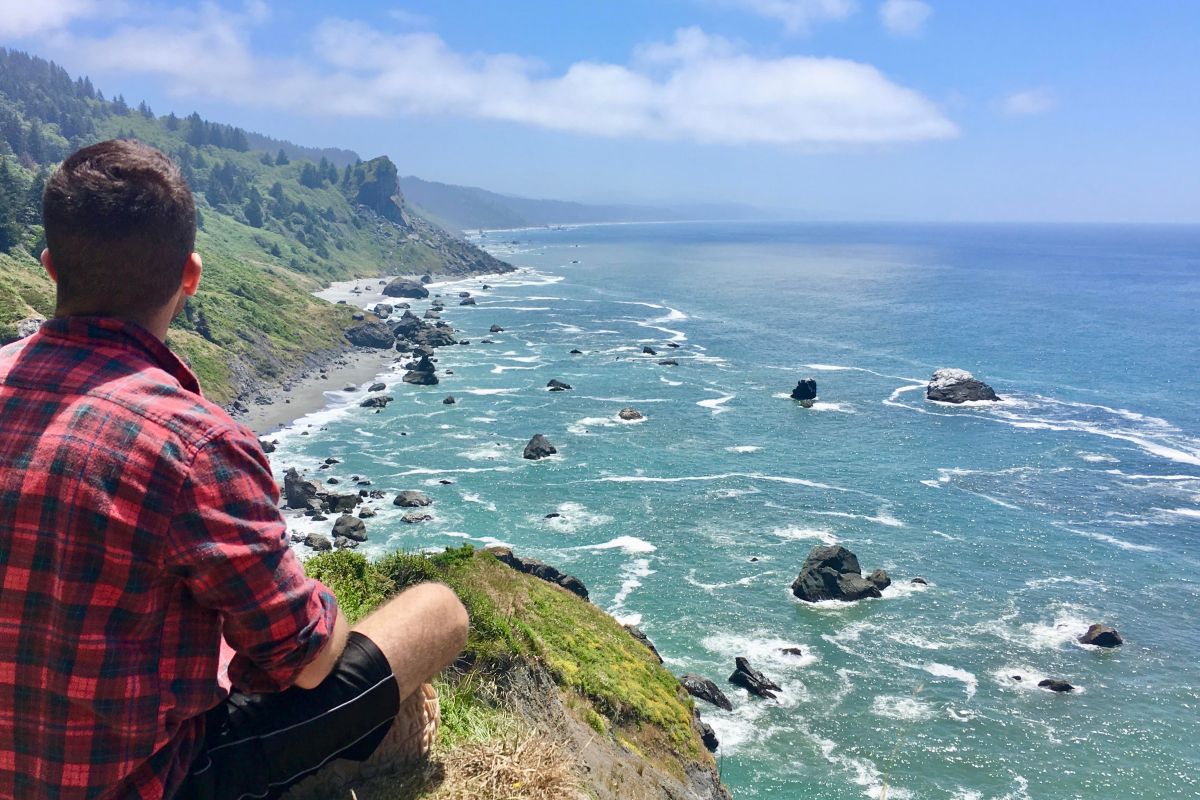
After our detour to the visitor center, we headed northward in the Redwoods by vehicle, parallel to the ocean, on our way to Crescent City and the Northernmost unit of the Redwood National and State Parks: Jedediah Smith Redwoods State Park. There we would camp at Mill Creek Campground. Of course there were places on the way to see. One of the first stops was at High Bluff Overlook. It was one of the most memorable views of this whole summer’s trip. As the name suggests, we were high up on a rocky craggy bluff, which used to be part of an old mine quarry. We were 307 feet above the ocean looking down and around at a truly expansive view of the ocean. We could see the small sandy shore lines winding around the Redwood Forest and rough rocks sticking up from the ocean, some as quite enormous boulders but miniaturized by how high up we were. We could also see breaking waves all over, not just against the shore but out in the blue expanse and against the protruding rocks. The ocean was very much alive and busy in all corners. To add to the beauty, the sky had turned a rich blue, except for the condensation lifting from the forest behind us. With a mostly clear sky, the ocean reflected an array of blues from a light turquoise to a shallow royal. I was really taken away with all the movement of the ocean and all the hundreds of independent waves crashing. I took out my camera to capture a video of the display. I was still using a point-and-shoot. I had not fully graduated to a smartphone. 


I then sat there in silence, trying to be still, calm, and quiet for a moment, really taking in the scenery. I had quite an unusual vacancy of thought and would close my eyes, listening to the sounds of the ocean and feeling the warm sun on my face, and then open them every once-in-a-while to be surprised by the view again. 

It’s not any fault of his own, but with Zach there was just a different dynamic than what I was used to in such beautiful moments. Typically I’d find myself in places like this of such beauty alone with God, communing with Him, speaking with Him. Maybe it was simply Zach’s presence, and adding to the fact that he didn’t share the same faith, or that he was talking on the phone with his mom, interrupting the serene, but I was not connecting spiritually as I so desired. I suppose I wanted to be alone. 

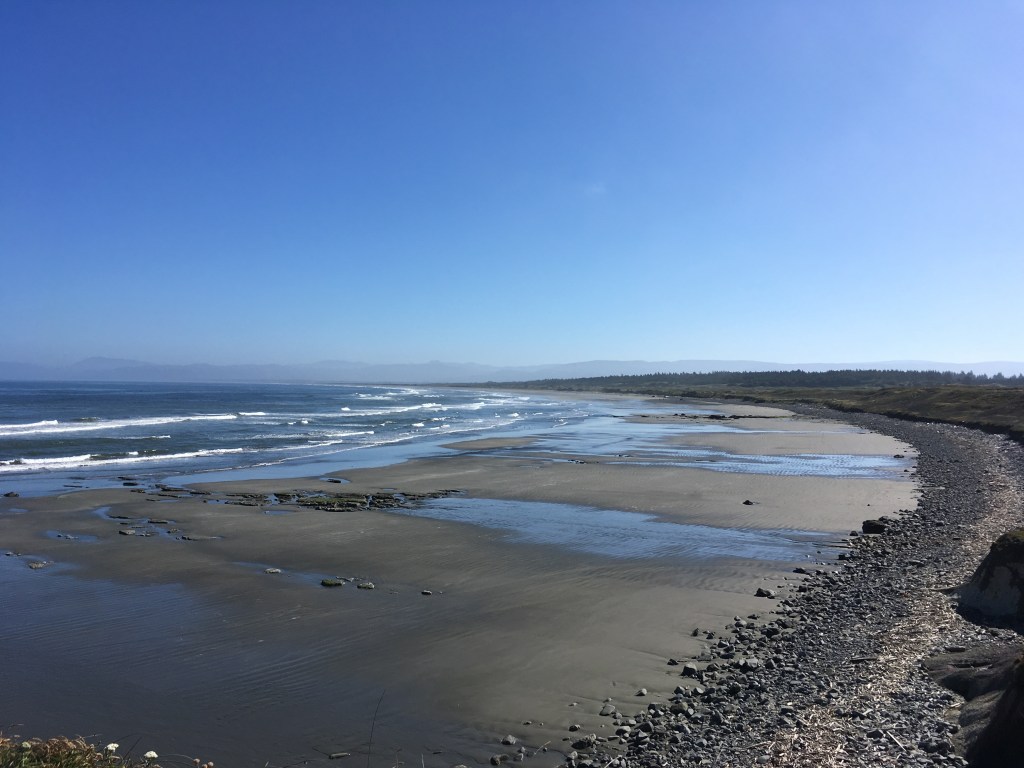
We continued in the car down to Crescent Beach which was beautiful but not too different from the beach we had camped on, minus a much busier road just behind us. We were there only briefly before we made our way into the town harbor. By description it may not sound charming, but in my memory it is held as just that. There was a simplicity and sincerity about the place that added a great ease. It was not trying to be anything other than what it was. It was a blue-collar harbor and small shipping port. There were lots of small boats in the bay, next to a bunch of fishing crates, a U.S. Coast Guard Station, and a small lighthouse. Just across from all that, inland, was a trailer park next to a Super 8 hotel and a local seafood restaurant. That was all on one side. On the other side of Highway 101 was purely the Redwood Forest, which was boxed in on the other side by the Indian Reservation.  

We were both very hungry, and  although I would have just been fine breaking open the snack box in the trunk, Zach wanted a full proper meal at the restaurant, “The Fisherman’s,” and so we went. It was nice to sit down and have a full meal. Zach got some oysters, and I got Salmon. Our booth was next to a cold window where we could look out and see all the boats in the harbor. There were also dozens of tiny little ants on the windowsill which kept creeping onto the table as we ate. 

Zach bought my dinner which was very nice of him. It was a bit of relief as I did start to get concerned about money, and through some instances I was learning it was going to cost more to travel with Zach, just based on his traveling style. I was used to traveling very economically. I’d survive on Clif Bars, jerky, and dried nuts and berries for days. I would rarely pay for a sit down restaurant on an adventure like this, especially if I wasn’t really in between parks, but really still situated around one locale.

 I think it may be interesting for the record to note how much my trips have cost in the past. My last three summers of National Park adventures, each a month long, cost about $700 each. That includes plane tickets, a rental car, accommodations, gas, food, camping gear, souvenirs, and everything else.That gives a picture of how I travel. It may not sound like a lot for a month of travel, but that actually was a lot of money for me at the time. I had an excellent credit score, and so each summer I opened a credit card with introductory 0% interest for one year. I’d charge everything to that card, and then over the course of about four to five months, I’d pay it off. In the process I’d make some money by receiving cash back rewards. My $700 big summer adventures may sound quite surprising, but it goes to illustrate a few things. First it shows the state of the economy just a few years ago, prior to our grand inflation per Democrat leadership and policies. Then it hints at the salary by which public school teachers live on in Kentucky. Lastly, perhaps it shows how economical of a traveler I was. I have wanted to explain this and be transparent, because I have heard on more than one occasion, “I don’t know how you afford to travel so much.” Well, it takes planning, roughing it, skipping meals, and sleeping outside. The years of these first four National Park adventures were also lean financial times for me. I was paying off student loan debt from undergrad, paying for mandatory graduate school to keep my job, and paying off medical bills. But where there is a will, there is a way.  I digress. 

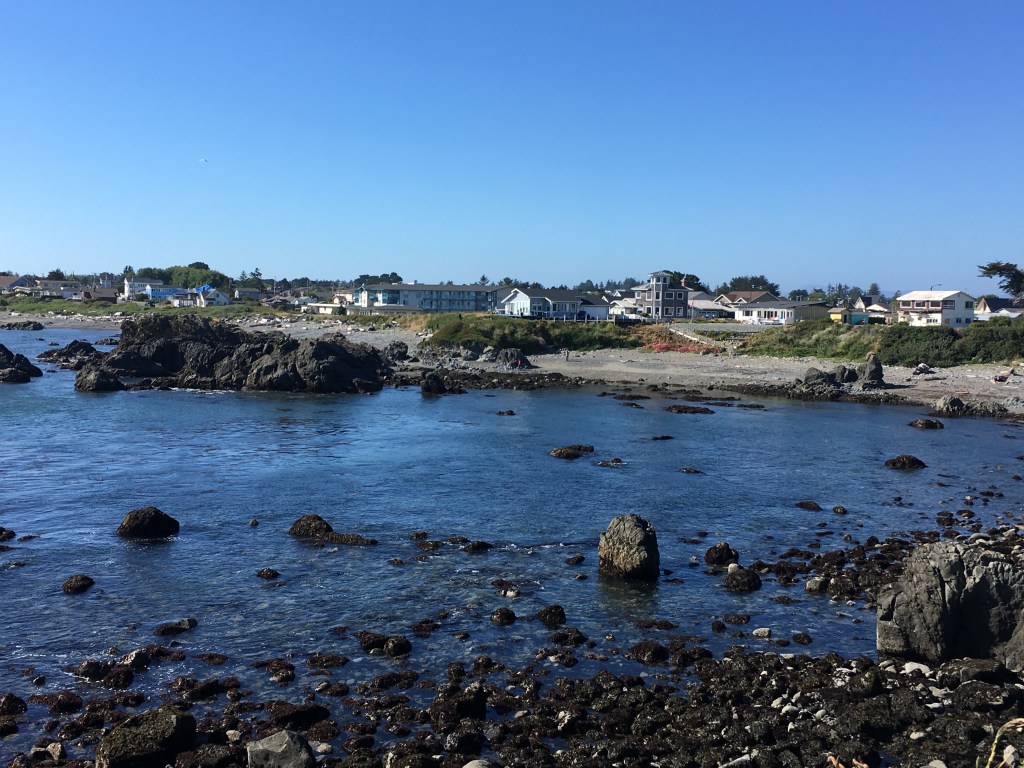
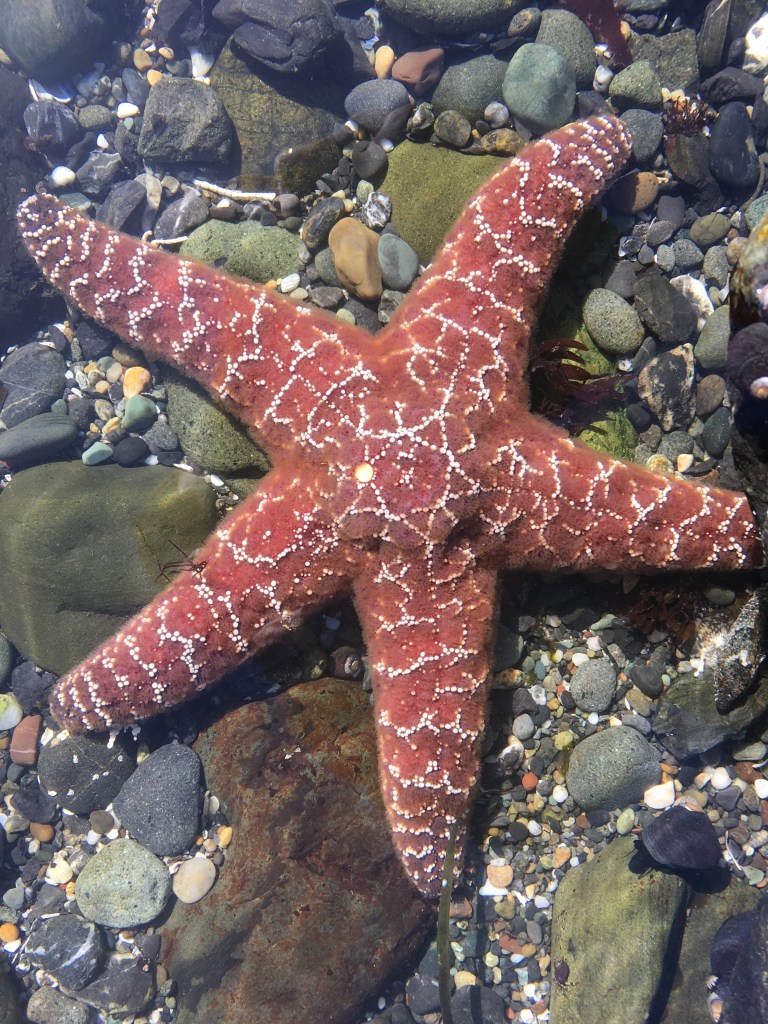
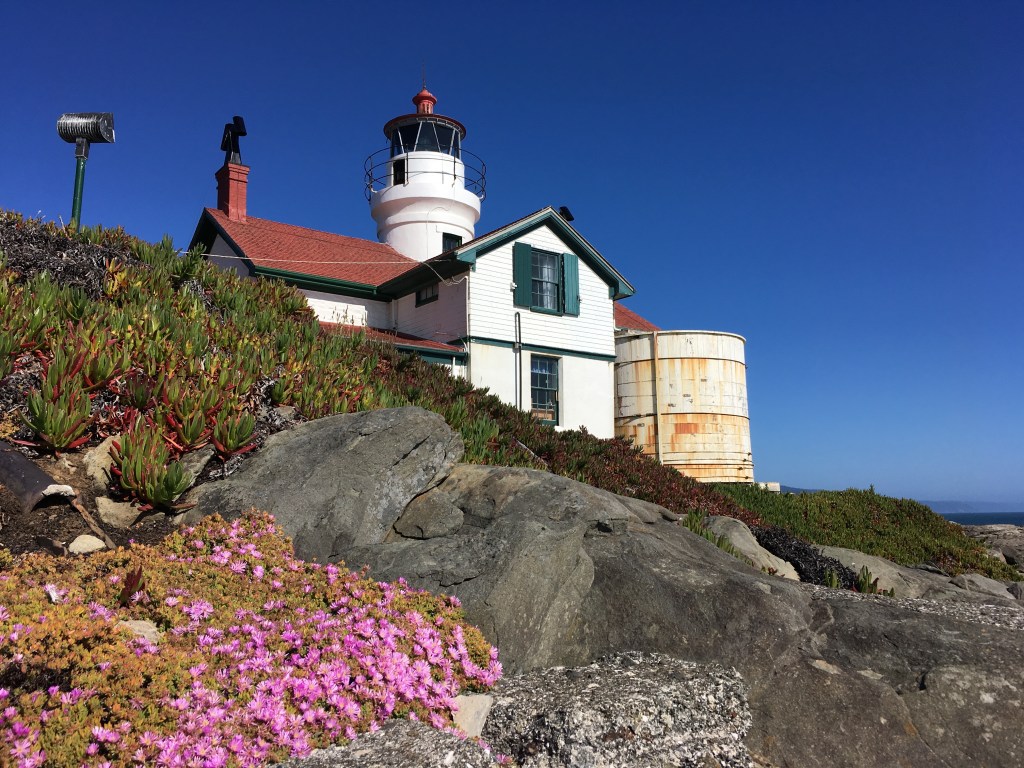
After dinner we parked further in the harbor and walked around in the tide pools. It was quite fun and just fascinating to the curious childhood marine biologist that evidently lived in both of us. We carefully moved from rock to rock, looking down in shallow pools of all sorts of sea urchins, crustaceans, and occasional rich pink and white-laced sea stars. We also walked a peninsula to Battery Point Lighthouse. It was a short stubby little thing, but quaint nevertheless with its little red roof and stout appearance. Around the lighthouse were some rocky cliffs adorned with patches of short pink wildflowers, which had to be rather tough.. We climbed around the small rocks cliffs and at one point stopped to observe some pelicans and another seabird, the murre, which was feeding and  would nose dive into the water, emerging a few seconds later to do it all again. It was quite entertaining to watch, and its maneuvers were somewhat comical, brandishing a few laughs.


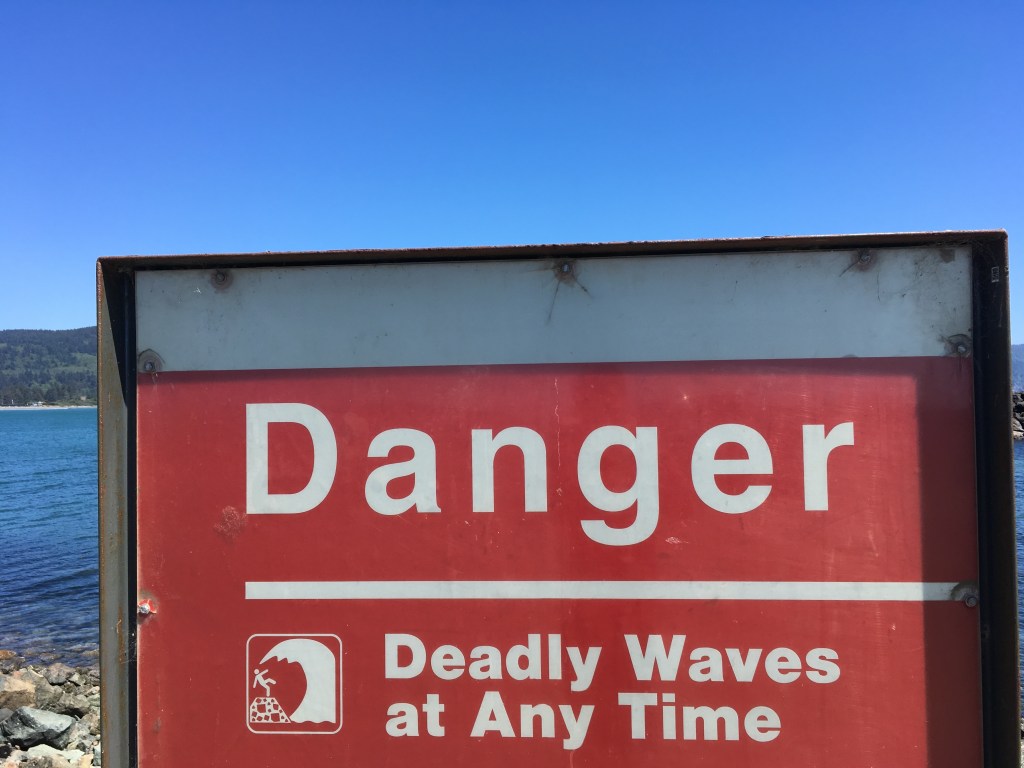
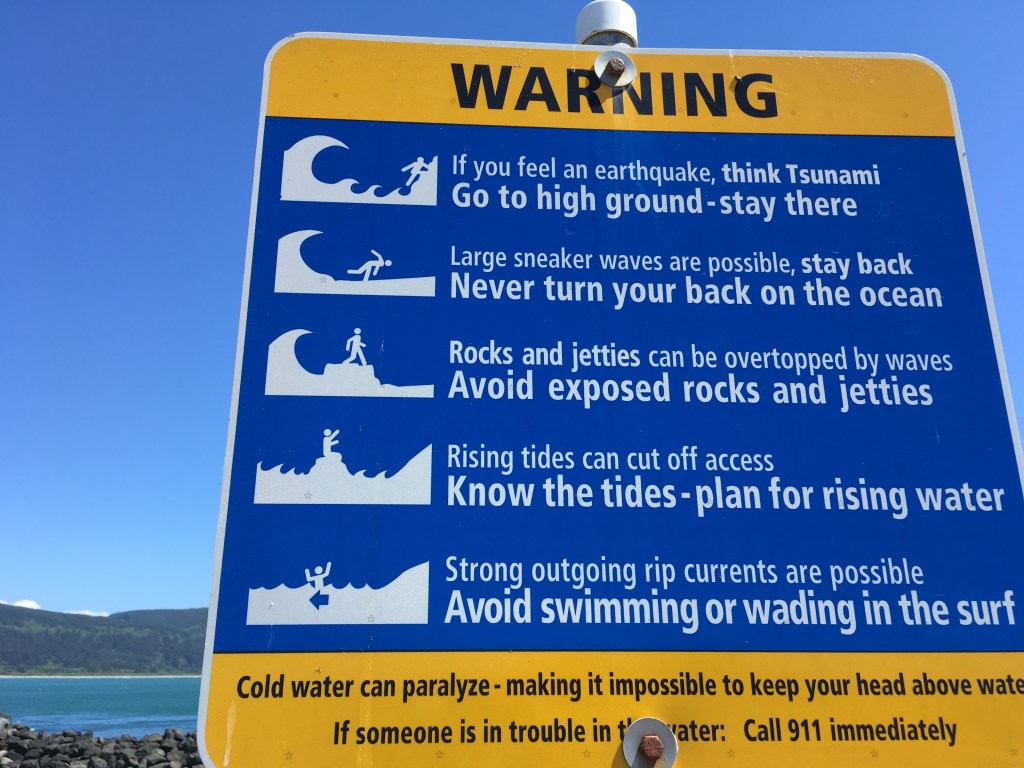
As we walked back to the car, I noticed two dramatic government issued signs. One was bright red and displayed, “Danger, Deadly Waves at Any Time.” Another had five tips for surviving a Tsunami, complete diagrams and a footnote stating that “cold water can paralyze.” Warning signs for Tsunamis were new to me. That’s not something we see in Kentucky or anywhere in the Midwest. We do have some signs labeling tornado shelters however, and I remember the signs about earthquakes from my time in Mexico City but never Tsunamis.

After our enjoyable and chill evening in the harbor we stopped at a local Safeway supermarket to buy a few snacks. We purchased some cherries. This was starting to become a thing here on the fringes of the Pacific Northwest. Cherries would become increasingly popular and prevalent in Washington. We also bought the goods to treat ourselves with s’mores over a campfire tonight.

Mill Creek was a nice wooded campground. As we were setting up camp, Zach became frustrated trying to blow up his air mattress. I had bought these cheap eight dollar air mattresses at Walmart when I got out West, but I didn’t bother buying a pump. I’m always just used to using my lungs. Yes, it’s an inconvenience, but as already evidenced, I was a cheapskate. I’ll admit it does take a long while to pump up an air mattress with the power of one’s own lungs, and it does make me light-headed. I have to take frequent breaks, but it saves money. I don’t think Zach was quite ready for this, and I hadn’t evolved in person and character to the point where I could afford and pay for the convenience of an air pump. 

So when Zach was done setting up his part of camp, he was done with it all! He was done with the air mattress, done with me, and done with the day. A tsunami of sueño came over him, and he went right to sleep. It was still early in the evening, and I wanted to maybe go explore a trail near the campground, build a fire, tell stories, and make s’mores. I let him sleep for a while, then I tried to wake him. I documented in my journal that I tried to wake him six times. He would not get up. In retrospect, I understand that he was probably just very tired, especially after our two days of backpacking in the Redwood Forest, and it was likely didn’t sleep too well on the brisk Pacific coast. However, I internally was starting to become frustrated with him. Rest is important, but at the moment I viewed it as him wasting an entire evening. To strengthen my case against him, I started thinking how difficult it was to get him moving in the mornings. The poor guy was tired, but I was full of energy. These sort of trips energize me, and I’m always about packing in as many experiences as I can and seeing as much as I can.   Anyhow, I resolved that I wouldn’t wait for him any longer. I built a campfire solo, and I made s’mores by myself and then went into my tent. I documented that I had hiked 41.2 miles so far on this summer’s adventure including  a total of 12.5 miles with Zach. I then turned off my headlamp, let my head sink into my pillow and drifted off to sleep. I had a good evening at the ocean but had a pestering thought that Zach would probably be somewhat upset with me making the s’mores without him, but what could I do? He wouldn’t respond. I still hoped he was having a good trip.  

If you enjoyed reading this, check out my book Still, Calm, and Quiet“

Check out my previous entry here: “Camping at Golden Bluffs with an Unexpected Visitor”

My Crisis at Chiricahua

I was done. I didn’t want to get out of bed, or off the ground rather. Life had knocked me down and I didn’t have the energy to get back up. The sunlight woke me to numerous birds singing and chirping all around me. I was amidst a bizarre and new landscape here at Chiricahua National Monument in Southeastern Arizona on the first full day of my new adventure. Visually, it was a beautiful morning. There was much to see and explore, but life had knocked me down and here I remained.

Prior to this trip I had experienced a series of difficulties in life. There were new challenges and unwanted changes at work, drama with my living situation, and most heavy and lingering of all, a health struggle with Drug-Induced Lupus. I’m very open with the fact that apart from the Lupus I had, I have a chronic hereditary autoimmune disorder called Ulcerative Colitis. It  keeps my intestines from functioning properly and causes an array of physical challenges. I was fortunate to be on an infusion medicine which kept me at prime health for six years, but then my body negatively reacted to a final dose of the medicine, gifting me a battle with Lupus. Numerous organs in my body ceased normal function, I became extremely weak, and had a hard time standing up for more than a few minutes. During the whole course of the disease, no doctor knew what was happening. It was only revealed after the fact. This left me with lots of uncertainty and questions. My last scheduled doctor’s appointment was with a cancer specialist.

Needless to say, despite all the uncertainty, symptoms started to wear off. I started to regain my health. I worked hard to remain fit and bring myself back to life. But I had not fully recovered, and lingering inflammation was spread throughout my body, making me feel weak and unwell, and so I was tired and worn out.

I lay there in the sleeping bag in my tent thinking about the person I used to be— full of life and energy, always eager for adventure. I missed him. I missed being flooded with so much excitement and adrenaline, that I’d be up before the sunrise seeking the next new vista.

And then there were the nightmares I had, which tainted my mood. I couldn’t remember them. They were fragmented and all over the place but they also drained me. Life just left me sore inside and out. I was waiting for the next tragedy or unforeseeable event to happen. It was as if I could sense it around the corner. Deanna Favre in her book, The Cure for the Chronic Life, describes this condition of survival in which we learn to live chronically in crisis. She says “these patterns give birth to worries that permeate every corner of our lives. Soon, we become less about becoming all that God has in store and instead spend most of our time enduring what the world throws our way…When we are living in chronic crisis, we are never quite breathing in the fullness of life, but instead holding our breaths, afraid of what might come around the corner” This is where I was.

After an hour, I brought myself to resolution. I knew Chiricahua National Monument deserved my time and attention. I had done just a little exploring the previous night. The landscape was unlike anything I had ever experienced before. It was part desert, part jungle, part grassland, part temperate forest. It is a very unique location because it is where the Sonoran Desert gives way to the Chihuahua Desert at the base of the Rocky Mountain chain. This leads to a wide diversity of animals and plant life, including wild boar, fox, short-horned lizards, and sometimes, although rarely, jaguars. But most fascinating of all is the coatimundi, a relative of the raccoon which looks and behaves more like a monkey. I wanted to see one.

I got myself out of my tent and packed up. I had stayed in the one and only campground in the park, Bonita Canyon. It was a nice shaded campground with a series of small bridges. I then drove through the canyon and up the mountain to Massai Point where I would begin a hike. This park road was one constructed by the Civilian Conservation Corps in the 1930s. It begins in the dry woodlands shaded and adored with impressive hoodoos and canyon walls. The road, ascending, hugs the mountain very closely and barely evades a cliff on the other side. It seems miniature too, like not quite full two lanes. In addition there were fragments of rock strewn across the pavement which had simply eroded and fallen on the road. I strategically swerved around them, as to not damage my car nor its tires. This road was an endeavor itself.

Once parked, I began to gather my belongings for the hike. The hike would be at least 5.5 miles in a sun-exposed, rocky, dry climate. I needed to make sure I had adequate water and calories. I needed my camera, my hiking GPS, my park map, and a change of clothes. I knew when the sun rose higher into the sky, I would shed my long sleeves. Trying to pack my bag was a little hectic, because I hadn’t had time to organize my car yet. Everything was sort of just thrown haphazardly into the trunk. Somehow, in the shuffle, unbeknownst to me at the time, I dropped my keys in the trunk. Then, when I thought I had everything I needed, I closed the trunk, locking myself out of the vehicle.

I felt geared up and finally ready to go. Hiking across the parking-lot to the trailhead, I peered into my backpack to check where I put my keys and realized I did not have them. My heart began to race. This was one of my nightmares. I plopped my bag on the ground and quickly removed everything with frantic haste. There were no keys.

This can’t be happening, I thought. I raced back over to the car. I looked in the window to see if the keys were on a seat. Nope. I tried opening every door and the trunk. They were all locked. I emptied my backpack again, carelessly scratching the screen of my GPS on the jagged pavement. I did not have the keys. I looked around me on the ground. No keys.

I was alone. There was no one up here. Besides the family camping next to me way down in the canyon, loudly speaking Chinese into the wee hours of the night, I hadn’t seen anyone else in this park. Plus, the visitor center would be a very long day’s hike away, and when I passed it, it looked closed for the season.  I wouldn’t have enough water to make it there anyway. In a panic, I ran over to the NPS sign by the trailhead, to see if there was any notice about emergencies. Nothing. I checked the park map. No emergency information.

I couldn’t call anyone either. There was no cell phone service here, and I had also left my phone in the car. My head began to feel lightheaded in the angst of the moment. With denial, I went back over to the vehicle and tried the doors again. In a retrospectively rather humorous manner, I laid my hands on the car and made my plea: “God, I don’t know what to do. I just need a miracle. Just one miracle. Please unlock the door.”

I tried.

Nope. Still locked.

My resolution: Pretend like this didn’t happen. I’ll go on this hike anyway. Maybe someone else will be here by the time I get back, and maybe I’ll find a water source during my hike.

I turned my head away from the car, to begin my hike, and there laying right on the pavement were my keys.

They looked so beautiful, like some rare prized possession. It was like I was Indiana Jones coming upon the Ark of the Covenant, or the Fountain of Youth, or something.

It was right here in this location I had searched my bag over and over again. There were no keys here just moments ago.

Now, we could say I overlooked them, but I truly believe more was at work here. After I found the keys, the voice of God spoke to my soul brief and direct to the point, “Be still. Be calm. Don’t worry.” That came over me like a wave of peace, extinguishing all my anxiety, not just in this situation, but everything I had been feeling lately from my health, to my self-complacency, and the subtle anxiety which ran in the background all day and night.

It had been a long time since I heard God’s voice in my life. During my entire recent illness, though so many questions were put on the table, God felt distant to me. I felt alone. But here He was reminding me that He has me in the palm of His hand. He is looking out for me, and He cares. Yes, He is big enough to care about the world and eternity, but He also cares about me and my keys getting locked in the car. I also find it worth pointing out that in my prayer I had an idea of how this could be resolved. In a plea to solve my dilemma, my petition was for God to open the doors. God did resolve the issue, but in an unexpected perhaps even more miraculous way. In life, in the midst of my difficulties, great and small, I often often pray with my already thought out resolutions in mind. Sometimes God is on the brink of solving our problems in unexpected ways. Keep this in mind when your plans seem hopeless.

This moment of God speaking to me would be the foundation for everything I would learn and everything that would build within me this summer. This voice and this message would comfort and guide me as I would face an amazing summer of extremely cherished unfortunate and inconvenient events. Although I would continue to  seek out the voice of God during this trip, these few words would be all He would leave me with for a long while:

“Be still. Be calm. Don’t worry.”

After this incident with my car keys, my backpack seemed to carry much lighter and my body suddenly possessed more energy. Worry had been weighing me down, but God tamed that wild beast and took it away. I was ready to explore.

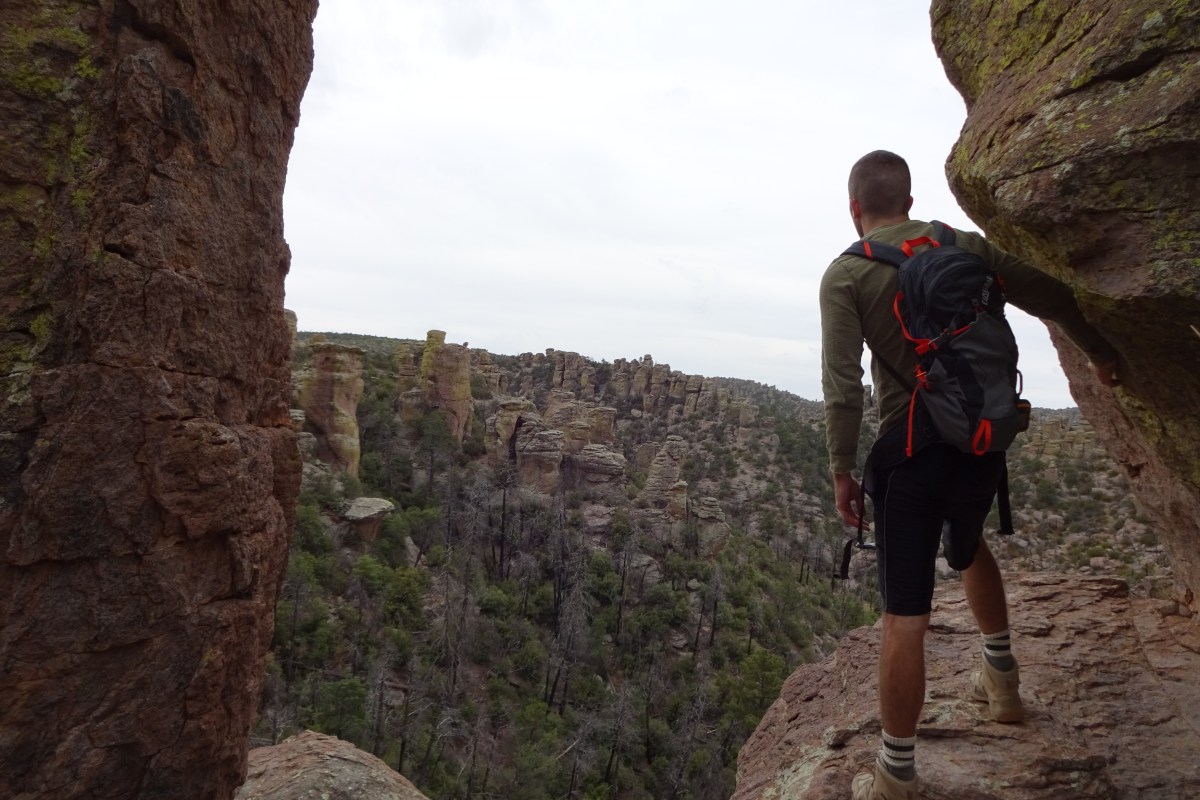
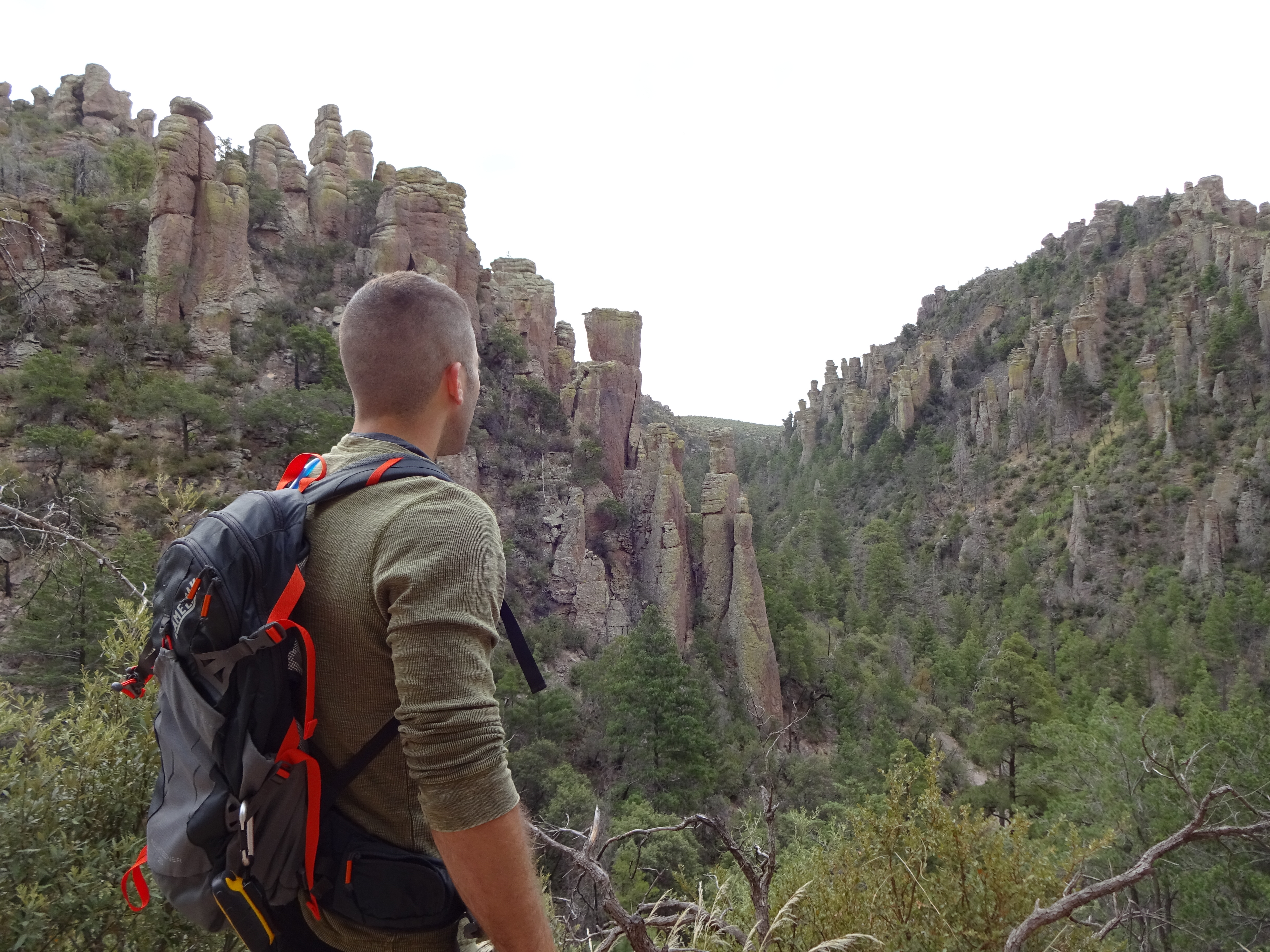
DSC09476 (2)As intended I hiked Ed Riggs Trail to Mushroom Rock Trail to Inspiration Point Trail to Inspiration Point itself. The first trail began by descending into a valley of trees and shrubbery. All around me stood tall dark hoodoos, clustered together at various heights. They looked alive, almost as if they were in the process of growing. In some aspects the view was reminiscent of Bryce Canyon, but here the hoodoos took on a more stalky, weightier form, and their color was a sandy grey. Here these geological features were the result of an ancient volcanic eruption. Also, though arid, lichen adorned the rocks, and greenery was draped over the landscape. At one point I came to a window in the rocks, and could look out into the valley.
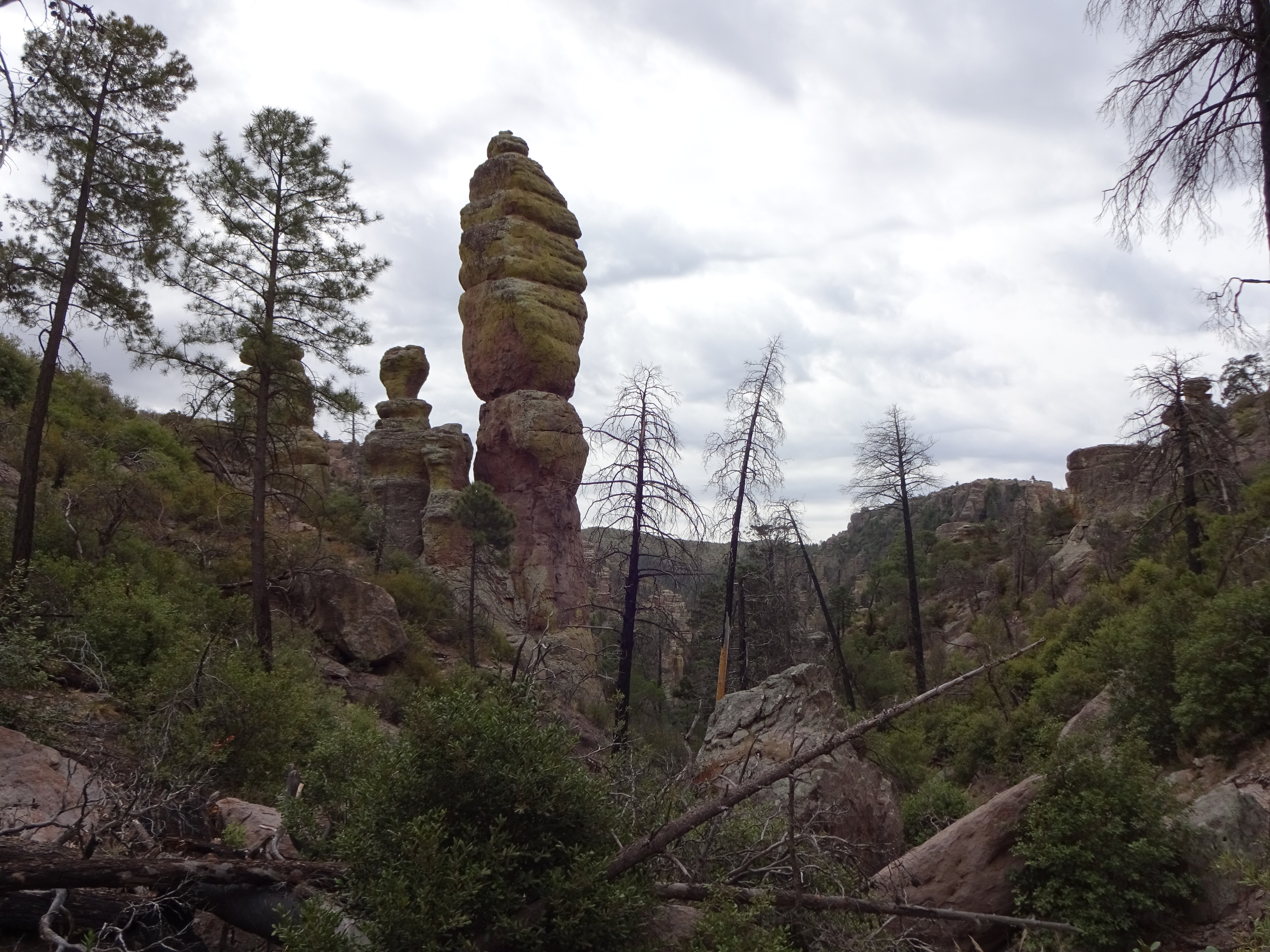
DSC09462I had never beheld a landscape like this before. To me, it looked like what I might imagine one of China’s stone forests to look like. I’ve never been to China, so this is purely out of speculation and comparison to photographs. Nowhere in the United States have I been in any environment quite like this. There was such a combination of environments that it became confusing to identify and best to consider Chiricahua its own entity.  
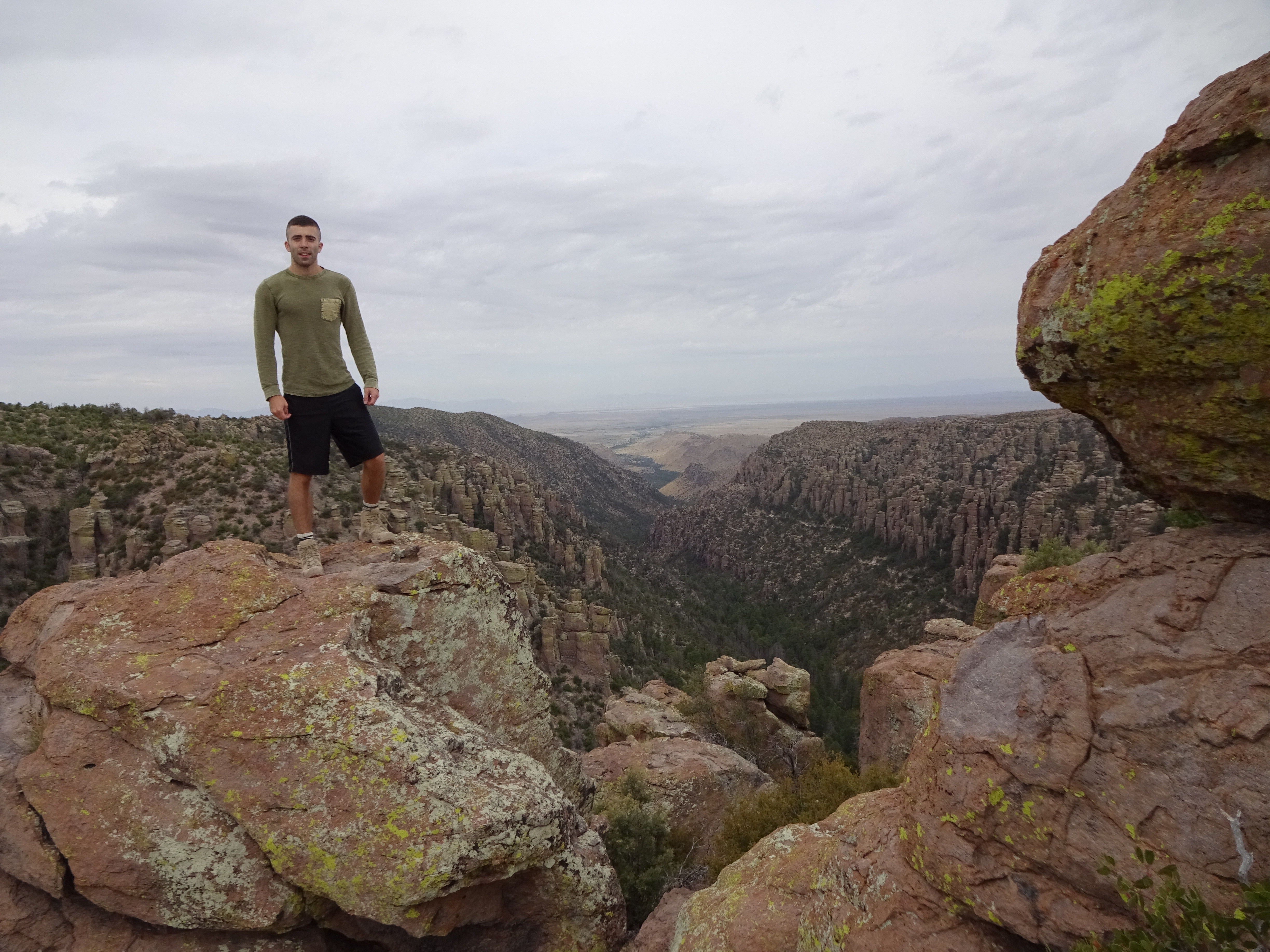
After venturing through the forest, I ascended to arid grasslands, and then onto rock faces where lizards scurried.  The reach of my hike ended at a peninsula looking down into the canyon. It was stunning, hoodoos climbed up and down the mountains, and in the distance the canyons spilled and became level with the desert plains, showing that Chiricahua is its own location, an island in the desert. When driving to the park, I ascended from the desert into the mountains where this secret canyon lay. This unique biome and hidden world l above the desert plains was the stronghold of the Chiricahua Apache Indians.  

Back near the trailhead was a lookout tower with a plaque stating how the Apache had a secret hideout in the mountains across from the monument on the other side of the valley. One important leader and warrior was buried there. He wanted to be buried where no white man would ever tread. No one has been able to find this secret location and grave. I love mysteries in the National Parks.

I can say, without reservation, that Chiricahua National Monument is one of the top five underrated gems of the National Park Service. It is also special to me because of what happened here. Whenever I look at my hiking GPS and see the scratches across its screen, I remember my panic and God delivering me from my situation. It reminds me of his ever-presence.

I would love to someday return to Chiricahua National Monument, reimagine its history, explore its stories, revel in its landscape, and find a coatimundi. I never did see one.

DSC09522 (2)

Check back next Wednesday for the next episode in the adventure.

Click here for the previous entry: https://joshthehodge.wordpress.com/2019/02/23/a-new-adventure-an-expedition-of-being-lost/

Check out my book “Among Blue Smoke and Bluegrass” on Amazon: https://www.amazon.com/Among-Blue-Smoke-Bluegrass-Tennessee/dp/1790631297