My Personal Devastation: The horrific reality for me at Mount Saint Helens

I’m not gonna make it, I thought. The moment was intense. I was running down the little path back to the visitor center at Mount Saint Helens National Volcanic Monument. The situation was urgent. I had the strength. I could do this. I made it in the nick of time. It was there, in the visitor center, where I had my own volcanic explosion…in the bathroom. It may seem like I’m trying to be funny, or just acting immature, but there is a sincerity and solemnity here. This moment was pivotal and not anything to take lightly. As lava spews from a volcano, blood was spewing from me. I was horrified. I can’t even say it was a nightmare, because it was unimaginable. I didn’t fear this moment, because I never thought I’d have this moment again. I had been through this before, and I thought it was all behind me. The suffering through ulcerative colitis was done, a thing of the past. I outgrew it, I thought, but it was back. In that moment emotionally I felt I had taken a stab to the gut and the wind knocked out of me. I was devastated. This in no way had been on my mind. It was unimaginable, but the blood was dark, and it was real.

Two years ago I was at the gastroenterologist. I had been in remission for six years from ulcerative colitis, but the infusion therapy which had saved me and gave me back my health eventually caused drug-induced lupus. I had to stop it. The gastroenterologist wanted to quickly put me on another new infusion therapy. I didn’t want to. When ulcerative colitis made its grand debut in my life, I didn’t know how to handle stress. I internalized all of it. I didn’t get enough sleep. I struggled with depression. I didn’t get regular exercise, and I didn’t know enough to eat healthy. I was still growing and developing physically as well. Through losing my health I learned a lot about taking care of myself. I had come to cherish moments of calm, moments to relax. I learned to let many things go. I had conquered depression. I was eating very healthy, and exercising regularly every day. I was strict on my sleeping habits, and physically my body had grown and matured. So I told the doctor I didn’t want to go on any new medication. I wanted to come off all medication, because I believed my body would hold up, and that I’d be just fine. At first I was hesitant when considering this decision, but over the course of a few weeks of prayer,  I came to a great peace about it. The doctor didn’t like my decision. “You don’t want to lose your colon, do you?” He tried to scare me, intimidate me into taking this new drug. He was obstinate in his opinion and I was just as much so in mine. I was giving up drug therapy whether he liked it or not. He closed out our appointment with “I’ll give you two months and you’ll be back in my office.” The truth is I never went back to that doctor. I fired him, but actually it was two years in which my body retained remission naturally before I was back in a doctor’s office. I proved him wrong. I thought my two years would turn into a lifetime, but now I was discovering that just wasn’t the case. 

I had become so healthy and almost obsessive about regular exercise, sleep ,and what I ate. I came to really love the body and valued my health greatly. So to learn that despite all my efforts everything was out of my control, was devastating. I had come to idolize my health so much, and now it was ripped away suddenly from me. Because I’d been through this illness before and knew how quickly it escalated, I knew my energy, my physique, my ability to eat and retain nutrients, to build muscle, to sustain myself, was all on the line. And in addition to that great sense of loss and the fear of what was to come, came memories of pain of the past. 

Ulcerative Colitis first beset me in college and the pain was persistent and at times very intense. It kept me up at night. I’d toss and turn in bed, unable to make myself comfortable, my stomach felt as if it was burning. One thing that seemed to help me a little bit was moving. To stay in bed, felt like I was letting the pain swelter and build up. I needed movement. I needed an outlet, if for anything, to distract me. I always had to distract myself from pain. So I’d card out of my dormitory at night, and I’d wander the streets for hours. When everyone else was asleep, I kept moving. Some nights, especially those leading up to being hospitalized, I was in too much pain to walk, instead I rolled around on the floor, back and form, like a crazy caged animal. The night before I was hospitalized, I was in so much pain, I wanted to pray, but my mind was so tortured by the physical pain  it couldn’t even formulate the words for prayer, so I literally just moaned and wept out to God.  In the hospital I was on a morphine pump, every two minutes morphine was pumped into my blood. So much so that I couldn’t even raise my eyelids. Even after my time in the hospital, nothing was truly resolved for a long while. The disease festered. At my 6ft 3in stature I weighed only 130 lbs. It took great effort to walk up the three flights of stairs to my dorm room, and one morning, losing a large amount of blood, I passed out in the shower. 

I could not go back to this. I just couldn’t. It had taken everything out of me, and to go through it again seemed unbearable. 

Then along with the horror came blame. I never expressed this blame to anyone at the time, but inside I was blaming the family vacation the month prior in New York. At the time the family dynamic was just a bit stressful, and I wasn’t able to follow my strict eating, exercise, and sleeping schedule. I believed it was the stress and irregularity of those events which put a toll on my body and flipped this switch from remission to active disease. Then there was Zach and myself to blame. It had been a strange dynamic between us. I was stressed about trying to make this adventure just as amazing for him as my previou adventures were for myself, but he wasn’t having that experience. He was complaining a lot and that really bothered me to the core. Also the fast few days, I felt like I was rushing around too much. I wasn’t taking the time to really relax and let nature’s restorative properties work on me. I needed to prioritize relaxing. I was convinced this return of ulcerative colitis was due to stress and not being on my regular schedule, but naturally I thought this at the time, because I had idolized my health. Looking back, maybe there are bits and pieces of these situations that are responsible, but I really don’t blame anyone or anything except the fallen state of humanity. I have learned since that yes, stress makes the active disease worse, but it will rear its ugly head provoked by stress or not. 

Earlier in the day, when I had stopped for gas, I remember getting out of the car. I felt light-headed for a moment, and something within me was not right. There was no way to explain it. I just knew intrinsically something was happening to me. I had no idea what, but looking back it was as if immediately, in that moment, my body flipped a switch and came out of remission. 

How was I going to tell Zach? I knew I had to. This was going to change the dynamic of this trip.  He had never even known this was something I dealt with in the past. We never talked about it, and it can be uncomfortable to talk about. A disease that affects the intestines and bowel with lots of blood, just isn’t pleasant. There was no casual way to bring it into conversation;  it was so deeply personal; and it wasn’t easy to bring up such deep pain. I’m going to have to modify my diet. I’m going to have to relax more. I’m going to have to try and not stress out about any details, and I am potentially going to be making much more frequent trips to the bathroom. I needed to tell him.

Leaving the visitor center, Zach bought a key chain which his dad requested as a souvenir. He remembered when the eruption of Mount Saint Helens occurred and had some connection or special fascination with it. Then we got in the car. We had a twenty mile car ride down the mountainous slopes and through the pine valleys. I was awkwardly quiet at first, and then I had to let the dam break. I told Zach what had happened, my loss of blood. I told him about my past pains and experience with dealing with the disease and all the horrible things it entailed. I knew, in my very gut, that this was not an isolated event, but the beginning of another long period of struggle, and so I wanted him to know why I felt so devastated.

I made a big mistake at this moment. I left God out. I knew Zach didn’t have a relationship with God, and so I thought I just shouldn’t bring Him up. I was shamefully weak in this regard. I had not developed the spiritual boldness which I now possess. I had some growing to do, and I was still clinging onto some sort of youthful notion that convinced me I needed to mold in with the audience at hand. 

God’s work in my life through my first episode of this illness in college was immense. It is my Crater Lake:  beautiful now, but painful at the time. God had taught me reliance on Him, dependence on His strength. He also taught me about faithfulness and gratefulness. He had me wrestle with questions of suffering, pain, and death. He also gave me healing and hope. To leave God out of my story of ulcerative colitis is basically lying by omission, and I was guilty of it. Zach, however, was a good listener, and sympathized with my pain, although I don’t think he understood how grave of a situation this was for me. I, though,  missed a great opportunity to give God glory and share of my relationship with Him. Now looking back, perhaps there was more than a lack of spiritual boldness. Maybe there was anger already boiling under the surface, a question arising in the subconscious that would come forth in a matter of weeks. I was mad, God, how can you let this happen to me again?

If you enjoyed reading this, check out my book Still, Calm, and Quiet“

Check out my previous entry here: What Kind of Mountain Are You?

Visit www.joshhodge.com

What Kind of Mountain Are You?

Finally we arrived at Mount Saint Helens National Volcanic Monument. I was in awe of the immensity of the landscape and baffled that something so grandiose and impressive didn’t get more attention. I hadn’t heard much about this place, and I only came across it while looking at a map of Washington state. Perhaps if I was alive when the volcano erupted in 1980 I may have known more about this place. 

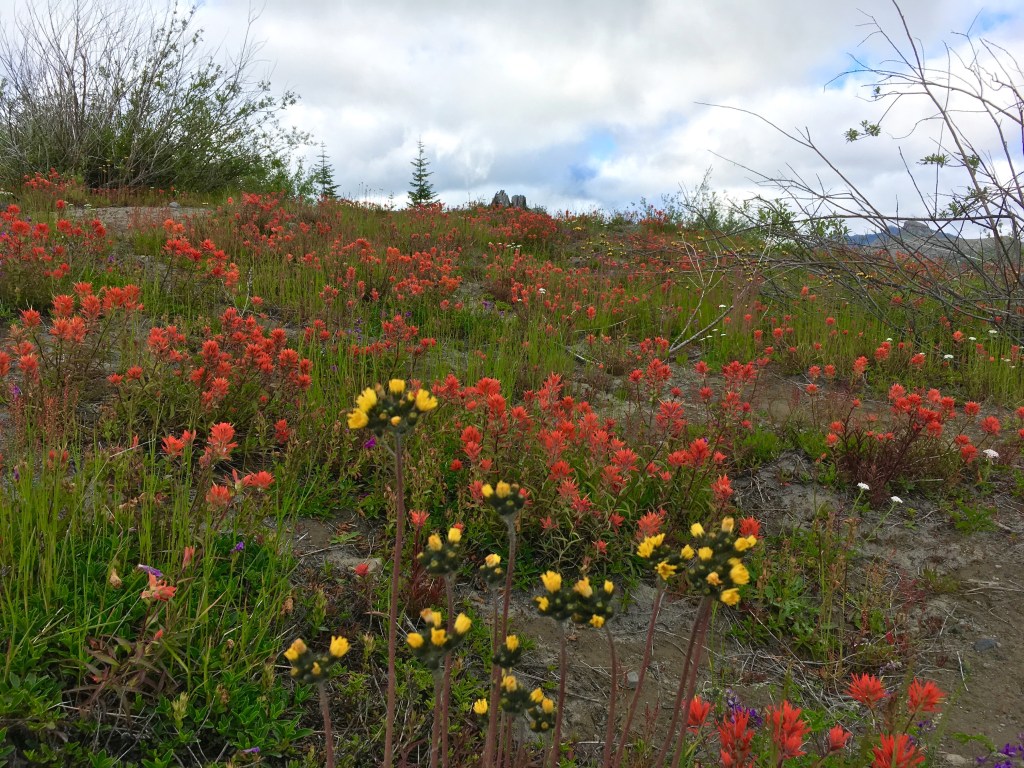
After learning about the volcanic eruption in the visitor center, Zach and I were chasing down even greater views on a small path that led from the Johnston Ridge Observatory on the foothills of the behemoth of a mountain base before us. We were free after being held captive by the journey in the car for much of the day. We were about four miles from the mouth of the beast, when I sat down alongside the path next to some Indian paintbrush and other small mountainous blooms snugly grasping onto the sides of the path between jumbled rocks. There I beheld what would have been, less than forty years ago, Washington’s fifth tallest peak, but now it was just the base of a mountain. It was still tall, nevertheless, slanting upwards to 8,363 feet, but it was missing its peak which would have topped it off at an additional 1,400 feet. Now instead of a peak it prominently displayed a giant volcanic crater. Looking at Mount Saint Helens, I knew I wasn’t looking at any ordinary mountain. It proclaimed volcano loud and clear for despite its enormous crater, it displayed its sprawling avenues and canyon ruts where lava once flowed, and much of the mountainside had been ripped barren and replaced by volcanic rocks. In some small crevices, plant life had resumed, but the sprawling directions in which its destruction spread was still very evident. 

Adding to the volcanic ambience, this evening a spread of clouds hung just below the crown of the crater, giving the illusion of smoke and adding great perspective. It also made the mountain look very regal with the pointed rocks edges spiking up like the palisades of a king’s crown, and the clouds added an element of fantasy, really elevating the scene. Although Washington is a very mountainous state, here no other mountain stood in the background of this one, at least nowhere near her height. Mount Saint Helens stood alone, bold and royally, popping out against the rich blue sky. 

I was particularly fascinated by the avenues, ruts, or canyons surrounding and sprawling from the creature like veins. They were prominently displayed with the evening sun lower in the sky, casting sharp contrast against the land and allowing the canyons to cast their own dark shadows within. These were “canyonlands” not illuminated by light, as I’ve discussed before, but ones trapped in darkness. I wondered what animals roamed down there. I wondered how enormous these places would seem on foot. Have people even explored all of them? It was fascinating to think that only a handful of decades ago, these divots didn’t exist. This was once Washington’s fifth tallest mountain, but then in 1980, instigated by an earthquake, Mount Saint Helens erupted. It was the deadliest volcanic eruption in the United States, spewing ash in a 250 square mile range and sending billows up to sixteen miles into the sky. Before then, this landscape would have been so different. It had been drastically remolded. As John Muir would see it, it was God at work, still designing his earth, molding the land through natural phenomenons. 

I was still fixated on the massiveness of this area and how its present landscape was relatively new. Even the divots aside, I was wondering if the whole mountainside in general had been fully explored in its current state. What was hiding out in all of nature’s rubble? What fantastical rock formations and marvels surround this thing in its new design. It was such an enormous space, that I imagined other National Parks I’ve visited fitting entirely in the space this mountain base encompasses. I thought how even some cities could fit within the crater alone. I wish I had time to roam freely and explore this land without a care. It would be fun to disappear into this thing, getting lost in its immensity and wonder. But I couldn’t. I had responsibilities and an itinerary.

As I sat there, I did what I like to do in front of beautiful vistas: I closed my eyes, took a deep breath, and opened my eyes to be re-amazed by what was in front of me. Then the wind started to roll in, and I was getting cold. I crossed my arms, hugging myself in my flannel. Before having to leave, I had to get into the important thoughts. Observing the volcanic mountain, I posed the question, What does this mean? What is the message of Mount Saint Helens? 

I was looking towards a crater, as I had done just the day prior at Crater Lake National Park, but Crater Lake seemed entirely different from this place. Crater Lake was distinct in appearance and messaging. But there was one commonality. They both started with a volcano, meaning what they are today was birthed by a violent natural event. What made the places so distinct from each other were their outcomes after the explosion. Crater Lake was a place of serenity, of beauty, tranquility and peace. It gave the message that despite pain, loss, suffering, there is peace and beauty. Mount Saint Helens today could be described as beautiful by some too, but it’s for sure a different beauty from Crater Lake. It’s impressive and awesome, but beauty is actually not the word I’d use for it at all. It looked very much still like the aftermath of destruction. The rubble was in clear view, the paths of destruction evident. It was like a scab was ripped from a wound not fully healed. It was a raw landscape, not replacing the destruction with the serene, but blatantly announcing its story of violence. The crater was not filled with rich, pure, calming blue waters but was empty, vacant, and void. Where forest once spread across its mountainside was barren rock and pumice. 

I then had to think about what I’ve already concluded about mountains. Two summers prior, when I was at Great Basin National Park in Nevada, I was standing below Wheeler Peak thinking about how solid and strong the mountain was, and I started to think about the word unwavering.  I wrote: “I observed how the mountain is very bold despite erosion and the rock glacier. It’s still not going anywhere. The mountain is firm, steady, resolute, and then I began unpacking the word that would last and linger with me– unwavering. It’s been my observation in life that consistency in a person is hard to find. People come and go. They change, they disappoint, and the slightest variation in weather can even disrupt a person.  I do not want to be this type of person. I want to stand strong. I want to be a person others can rely on– a constant, a non-variable, dependable, and above all unwavering.” 

Mount Saint Helens was not unwavering like Wheeler Peak. This mountain had betrayed its surrounding landscape and all the life that had put trust in it. It left damage, took lives, and left voids, and its said it may eventually erupt again. This mountain did not produce the beauty of Crater Lake nor the security of Wheeler Peak. I began to adopt the notion that there are different types of mountains, and they have different meanings, but that all mountains are representative of different kinds of people. There are the bold unwavering mountains like Wheeler Peak and the majority of mountains I’ve seen, but few people I’ve met. Then there are those volcanic mountains, like people who have gone through pain, suffering, and trauma. Some volcanic mountains return from those dark moments in life with a new found peace, beauty, they are born again into something greater like Crater Lake. But other volcanic mountains, like Mount Saint Helens, are like people who have been badly hurt, but they haven’t gone through the powerful process of redemption. Instead, they have built up resentment and anger to then spew hateful words and actions. They are abusive. Their anger is not controlled, and thus they are explosive, wielding destruction around them. They abuse their children, snap at their coworkers, fight with their spouses. Their anger and discontentment change the life and environment around them. They take the books of others and scribble into them or rip out pages. They also have unfruitful mountainsides, not rich in life, but barred and covered by mistakes, leaving no fertile ground for anything to take root. I know some of these people, and we all have potential to become such volcanic mountains. It is in our nature to be ruled by our human emotions, to become heated in anger and inflict unjust punishment on others. Mount Saint Helens therefore has a message of warning and shows us the weight of our influence, even when destructive. 

I never want to be a Mount Saint Helens, but do I relate to her? Yes I do. I have my moments of anger and frustration, and in the moment I want everyone to feel the agony that I feel. I spew the lava. It’s not right, but I’ll own it. This is not to say all anger is bad. Some anger is justified. God in his love, beholds justified anger. What really matters for us as humans is the outcome of our anger. Is it productive and justified, or impulsive and destructive like the volcano? I also relate to Crater Lake. I see peace in beauty in my life from where there was pain and destruction before. Despite whatever mountain best reflects me, I aspire to be like Wheeler Peak, consistent, unwavering, unmoveable, dependable. However, there were yet other mountains to become acquainted with and this wouldn’t be the last mountain on this adventure that would hold a message for me. I was just beginning to explore this analogy of mountains and people. I’d come to find that every mountain indeed is a reflection of our own human potential. Some inspire, some challenge, some warn, some seem foreign, some truly are characteristic of our own selves. 

I was energized by this growing perspective on mountains. I was ready to explore it further and open to see what else God wanted to teach me through his creation. As I’d learn about more types of mountains, the wonder would lead me to pose the question to others: What type of mountain are you? But before I could consider mountains any further, a moment of intensity beheld the situation. Something happened that had me desperately running opposite from the volcanic mountain. This was an emergency… 

If you enjoyed reading this, check out my book Still, Calm, and Quiet“

Check out my previous entry here: How God’s Story is Written Everywhere

Visit www.joshhodge.com