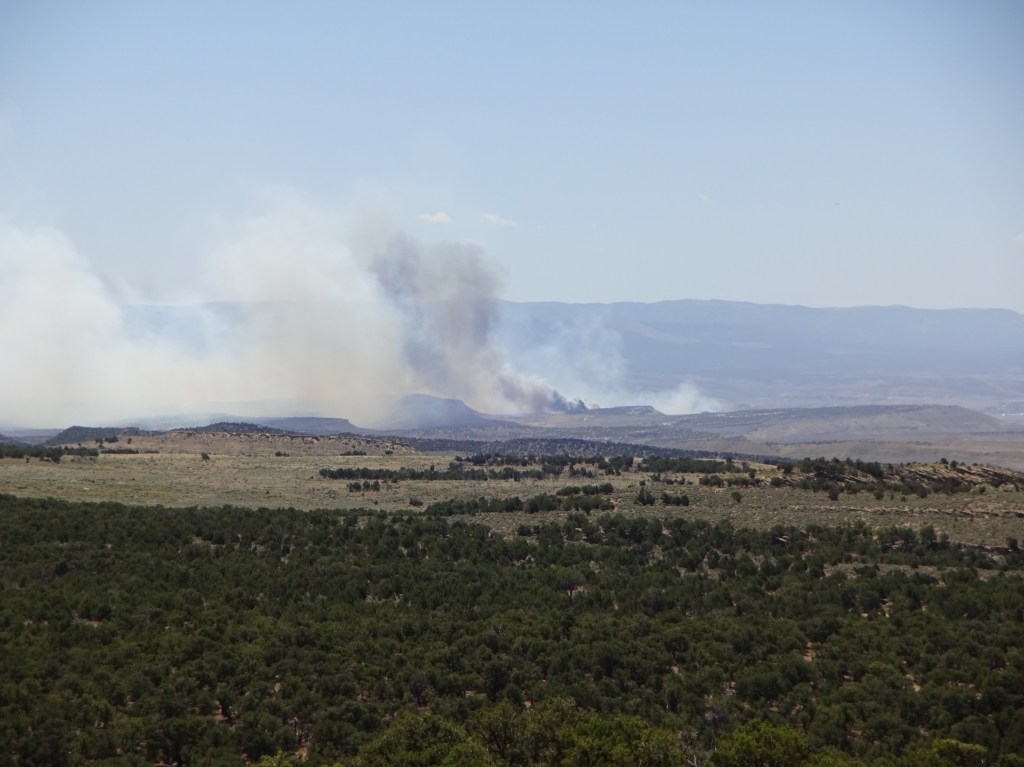
Wildfire at Dinosaur National Monument

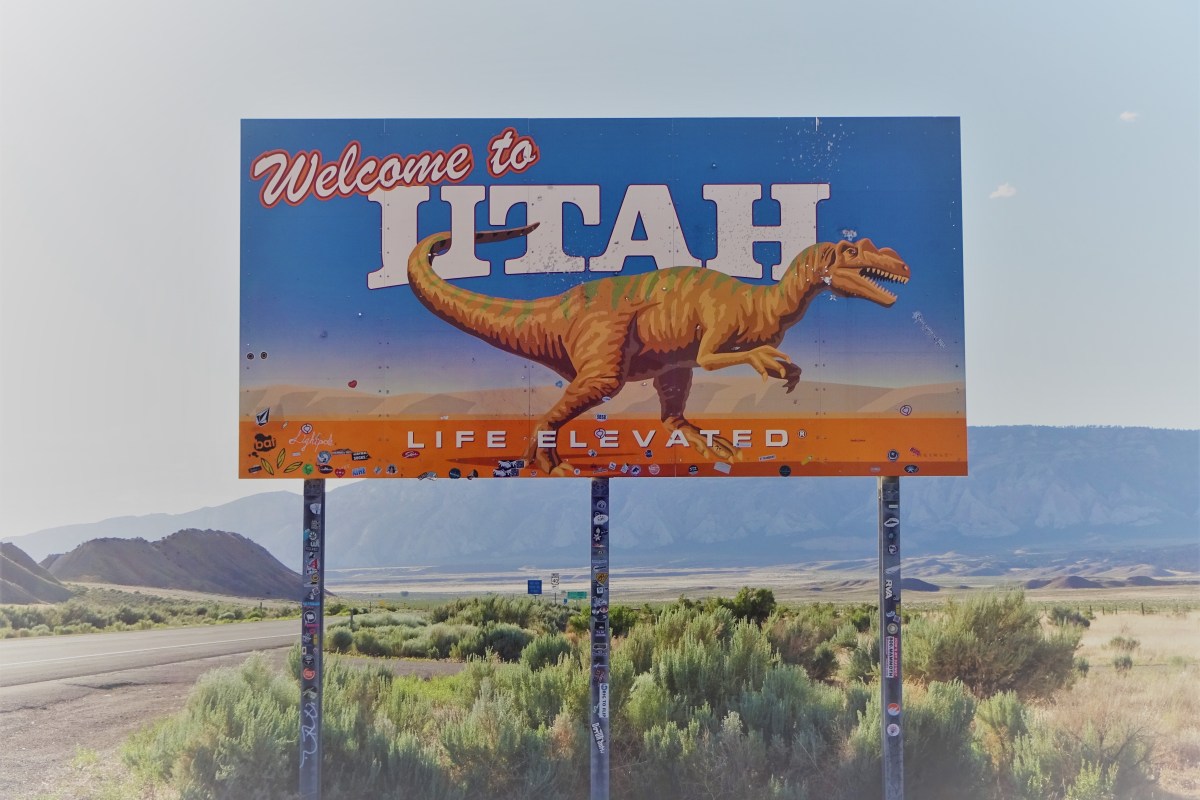
“Hmm, wildfire,” I assumed as I looked before me as nature itself was being engulfed in flames. Billows of smoke stretched across the sky. “I should be fine,” I concluded and continued on my adventure. I was in Dinosaur National Monument, maybe the greatest underrated gem in the National Park Service. Straddling the border of northern Utah and Colorado among swirly canyon walls, Dinosaur National Monument boasts a landscape of twenty-three layers of red, grey, white, and beige rock, composing enormous formations looking like they bubbled up from the earth’s core. Along with that are gigantic plateaus overlooking the convergence of the Yuma and Green Rivers, along with forests, deserts, and savannah. Today it had the added feature of long stretches of traveling smoke from wildfire. 

The monument initially consisted of eighty acres set aside by president Woodrow Wilson in 1915 but then was expanded to 210,000 acres by Franklin D. Roosevelt in 1938. It preserves the habitat of a once dinosaur metropolis. The National Park Service informs in their visitor center that it is believed the dinosaurs of the Jurassic period died here in drought and then a great rapidly ascending flood jumbled up together the bones of over five hundred dinosaurs representing ten species. The abundance of congregated fossils remains preserved in the sandstone. Paleontologist Earl Douglass discovered the first fossil remains here in 1909 and soon it was recognized worldwide as one of the sites of the most complete assemblage of dinosaur fossils.

Before I encountered the wildfire first hand, I found myself standing in the visitor center learning such facts and marveling at the enormous rock wall in front of me preserving over 1,500 individual dinosaur fossils. This was the exact site of Earl Douglass’ first excavation and now it is enshrined and preserved in the visitor center for all to enjoy. 

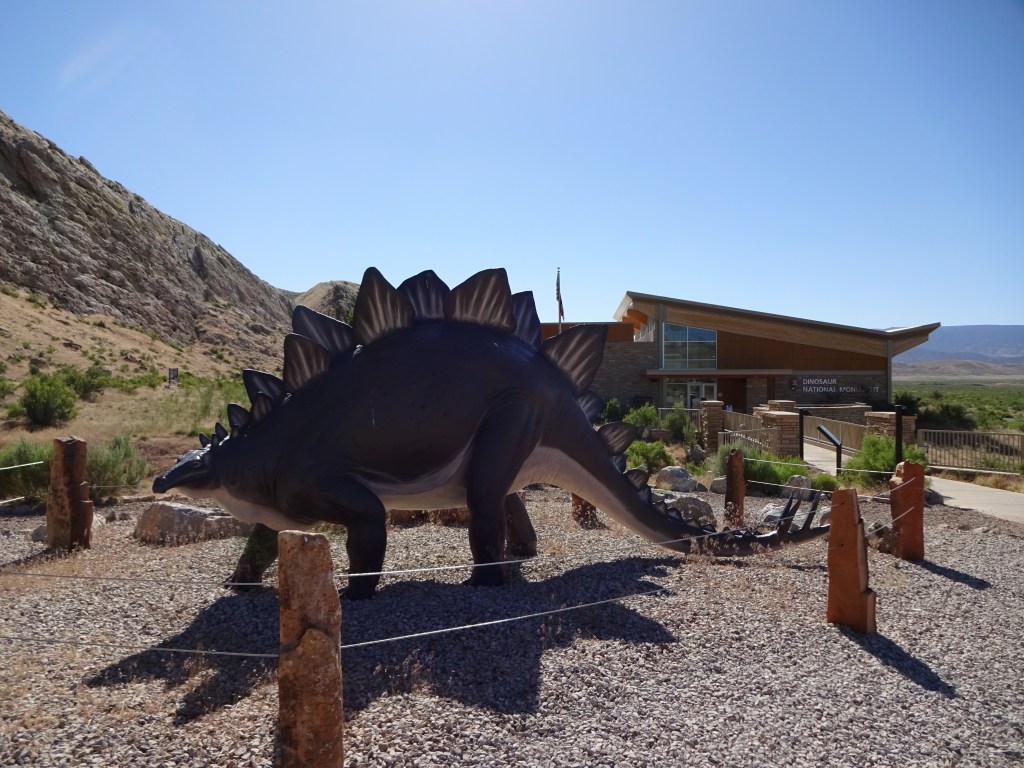
I had arrived the previous night to a reserved campsite at the Green River Campground in the park, and this morning I got up early to begin my exploration of the park. My first stop was this Quarry Visitor Center. Outside of the sleek 1960s visitor center stands a sculpture of a stegosaurus, popularized by the 1964 World’s Fair (the same one where Walt Disney debuted “It’s a Small World”). After of course not passing up the opportunity to get my photo with a stegosaurus, I walked into the visitor center dressed suitably for the occasion. I had bought myself a tank top on Amazon, specifically for visiting this park, with dinosaurs all over the front of it in neon colors of a 1990s retro style. Throughout the day, nearly everyone I came across complimented me on my dinosaur attire. In the exhibit I had obtained a pamphlet guide which explained which dinosaurs many of the fossils were of. After touring the exhibits, I went back outside to explore this strange land.
I was on the Utah side but left the park to get on highway 40 and cross over into the Colorado side. I passed through the town appropriately named Dinosaur and then re-entered the park at it’s other entrance. I wanted to get the full overview of the park by driving Harper’s Corner Road, the main stretch that runs through the park and incorporates numerous lookout points as it ascends the  mountainous plateau and ends at the peninsula which the road is named after. At the Colorado entrance there is another visitor center along with the park headquarters. As I looked around I heard a ranger on a walkie talkie talking about a wildfire. I thought very little of it, since wildfires are commonplace in the West, but I’d later see exactly what he was referring to. When I reached the first overlook I looked out upon a burning expanse. Many thoughts were in my mind. First I was reveling in the novelty of being able to witness such a marvel of nature, second I considered my safety, but then I concluded that I was probably in safe hands with the National Park Service. If there was a threat, the rangers would have closed this road or forced evacuation. Furthermore I’d be traveling away from the fire. So I got back in my car, eager to take in the next view point. 
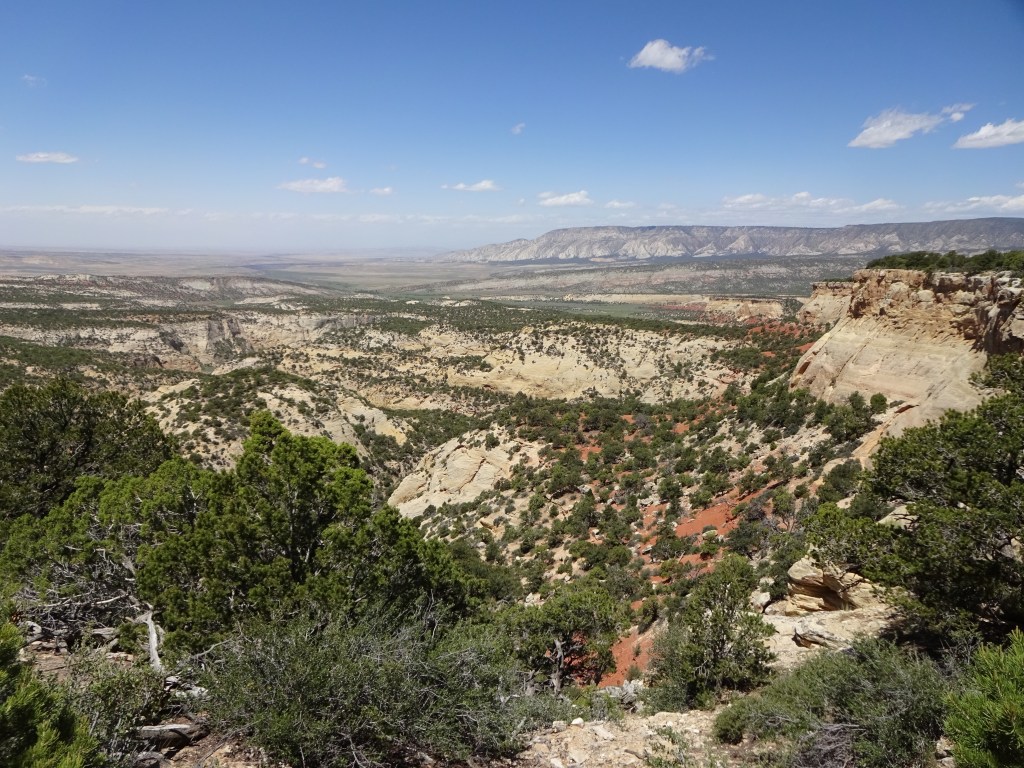
Next I arrived at Escalante Overlook where I looked out from the plateau to see it curving around in the distance. In the middle of it’s beige cliffside, a banner of red rock streaks across the landscape where shrubs and pines burst up. The slide of rocks eventually rolls down to the canyon floor, which is neither level nor consistent but clumsily squeezes itself into whatever crevice the immense landscape provides. 
From here the road ascends higher above the plateaus to the mountains, where the landscape opens up to some wild grassland where one can look below and see a valley of grassland among spotted buttes and can so vividly imagine dinosaurs trampling and traversing the land. We as humans are so far removed from Dinosaurs that they almost seem like science fiction. This landscape is the world that has escaped the imagination. To be immersed in it is almost to escape reality for a moment.
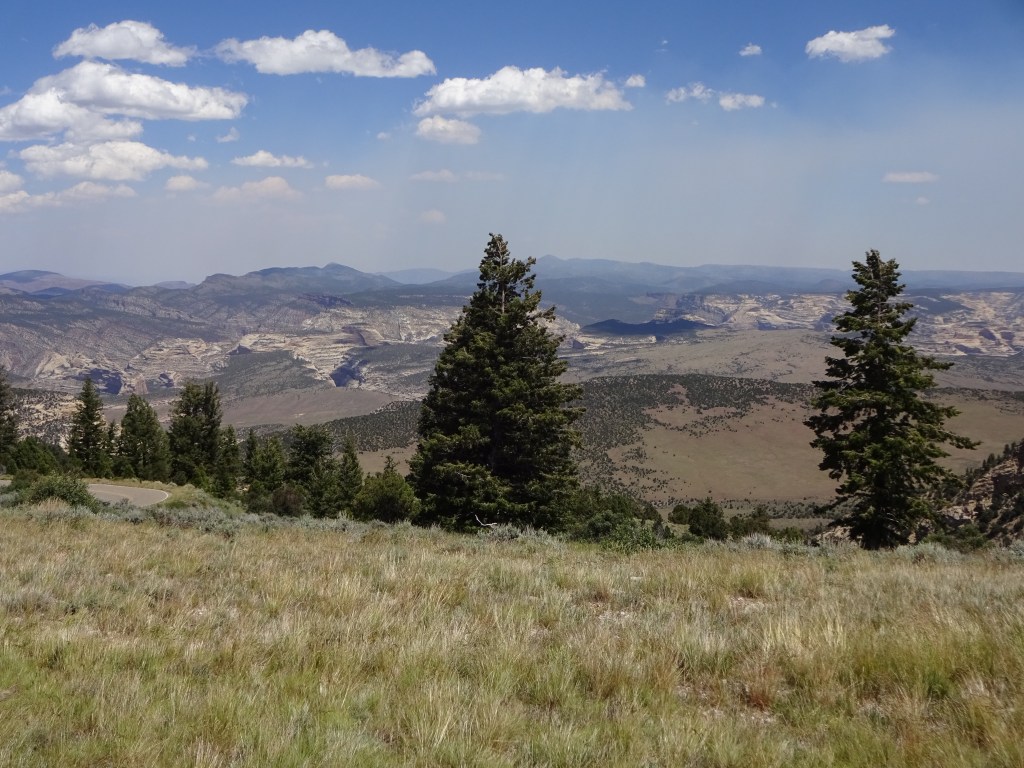
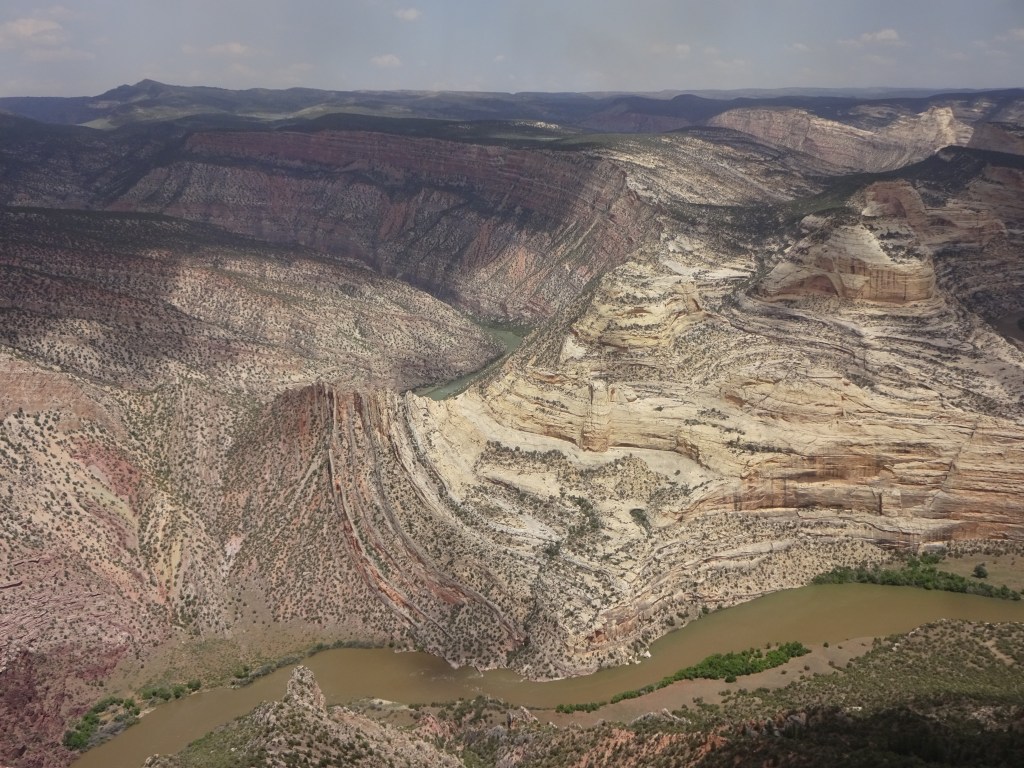
After thirty-one miles I reached Harper’s Corner, the highest point in the park at 7,580 feet. I got out of my car for a short and windy hike to the overlook. The view was unparalleled to any other view in any National Park. Strikingly unique, one can gaze down upon a landscape that swirls every which way around the canyon of the Green River. It almost looks alive, like you can imagine just how it would go about moving. Right in front of me was what looked like a giant rock wave frozen in time with ripple after ripple, color after color, and twenty three layers of history. It is undoubtedly an epic view, among the best in the nation. I know that is a bold statement.  
As usual, when I am faced with something strikingly unique, I asked, what does this mean? I believe beauty is not wasted. It is designed to speak to us truths about God and life. But nothing. I got nothing. I praised God for his beauty, but I felt him silent. There was a reason for this. The silence of God, the blankness of my thoughts would hold meaning. I would learn about this soon enough. 

When I returned to my car the wind was really whipping and I could see a storm brewing in the distance. Rain is what we needed to quench the fires. When I opened my car door, the wind ripped it from my hand, and with my keys still in my hand, I uncontrollably keyed the side of my drivers door. This was not good. Not only did I have the dented hood from the rock falling down at Davis Mountain, but now I’d keyed my car. I was concerned what these damages were going to cost me when I turned the rental back in. It was one more thing to add to my list of misfortunes. 

When I got back to my campsite, I noticed a kind neighbor had partially disassembled my tent to shield the top opening from the rain, for the rain had indeed come through the canyon. I was thankful the inside of my tent, sleeping bag, and air mattress were all still dry. 

After checking back in at the rained on camp, the thoughts of forest fires had left my mind.  I went for an evening hike, the most meaningful of my trip. God would speak to me, a paradigm would shift, a wildfire would be set in my soul that would spread throughout my life, and a great peace would find me because of it.

Read the previous entry “Valles Calderas and the Land of Enchatment,” here: https://joshthehodge.com/2020/09/10/valles-calderas-and-the-land-of-enchantment/

Check out my book Canyonlands: my adventures in the national parks and the beautiful wild here: https://www.amazon.com/Canyonlands-adventures-National-Parks-beautiful/dp/1711397873
The Canyons in my Life

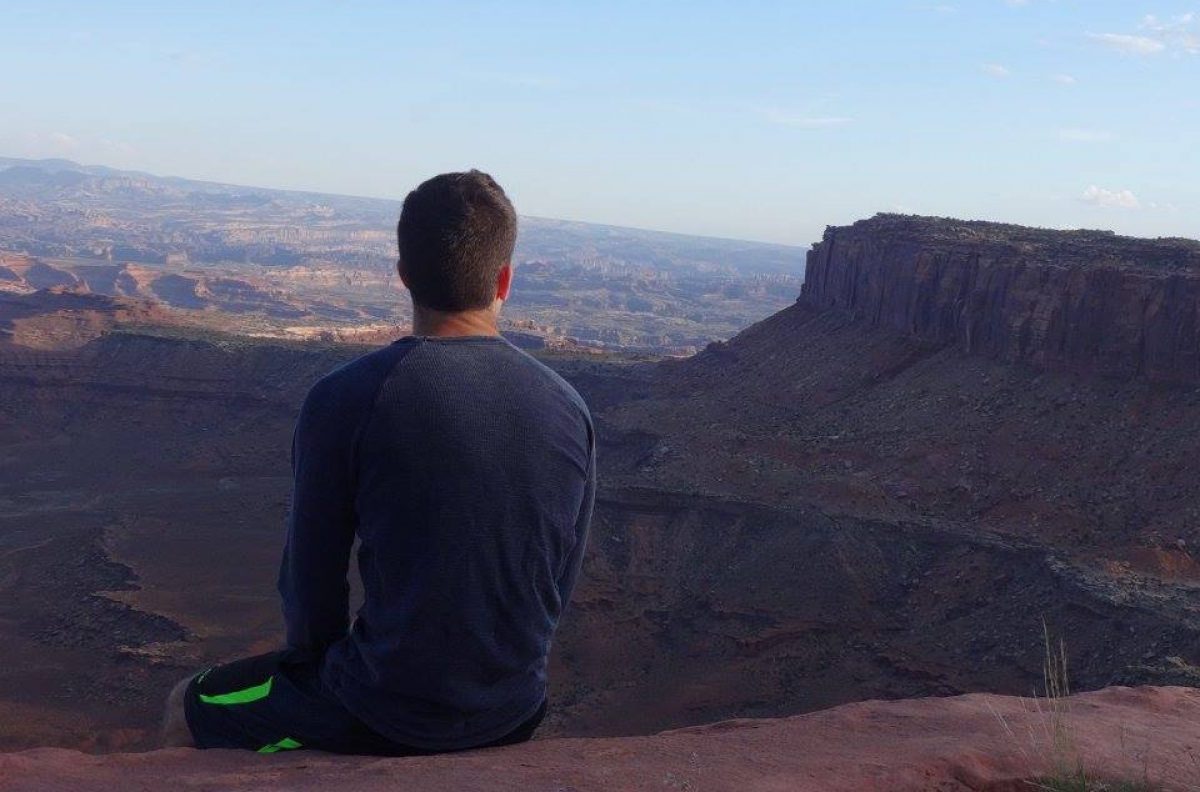
I looked down over an expanse and saw a whole different world. Perched on its edge, I knew that it would only be a matter of time before I would explore its grand expanse and profound depths. For now, the vista in front of me was so massive and colorful that my mind couldn’t take it all in, but I could admire the thousand shades of color, from rich red, to golden orange, pale brown, and deep purple. I entertained thoughts concerning the world below me, all the different nooks and crannies, all the different riverways, and the solitary towers of rock leaving islands in the sky. I could conjure up stories of adventure in the depths and speculate the history of people living in and passing through the narrows. Canyons are rich for the imagination and profound for inspiration.

At just around sunset I started this hike along the canyon rim at Canyonlands National Park. It had been a full day of hiking many trails and covering many miles. I felt accomplished, but I was getting tired and I wanted time to wind down, so just a leisurely stroll along the canyon rim at sunset seemed perfect.

When I go hiking I always end up taking away more than I can imagine, nothing physical, but rather inspiration, reassurance, and healing. Nature has a way of bringing about these things, and I’ve lived enough life to know that nature itself is not some mystical magical entity, but rather I believe nature is a creation designed purposefully to appeal to man and take him to depths of self-actualization and to intimacy with God.  Often times when I go hiking alone, I find it to be the perfect time to pause, reflect, and just be in the presence of God. Out in the solace of His natural beauty, it’s sometimes easier to hear God speak. I have seen this evident in my own life in many instances, God uses natural beauty to speak to me. The rocks, the trees, the towering mountains, and canyon depths are designed to have meaning. They are symbols.

As I was hiking along that rim, I was reflecting on my life, trying to pinpoint where exactly in my life I was feeling a corrosive emptiness and deficit, despite my fleeting feelings of accomplishment. I was pouring out to God this discontentment and feeling of inadequacy. This was something that had plagued me for a while. I felt I was just not doing something right, that I wasn’t living up to my potential, and that my character was lacking something.

While I was feeling these heavy emotions, the sun was hidden behind a cloud and therefore the countless canyons of Canyonlands were dark, mysterious, and seemingly bottomless. Lines separating the sections of the canyon were blurred from lack of sunlight. In this moment, suddenly it hit me, the realization that my own life has a number of canyons- deep and dark places where light just doesn’t shine, where the lines are blurred. I wasn’t sure exactly what those canyons were and what was the cause of them, but I knew there were dark places in my life where lines that separate truth from lies had been blurred, places that were corrosive that continued to grow deeper and darker. I asked God to show me the canyons in my life.

Canyons are very interesting things in relation to life. They are cavities in the earth’s surface caused by erosion over time. They are huge but can begin forming by something so simple as just a crack. Water eats away and erodes the trivial into something massive. However other times the impetus for formation is the land itself shifting as plates collide and move. And so the dark places in our lives can form very much like canyons. They may start as something trivial on the surface, a seemingly harmless sin, which over time can erode a person’s life. Sometimes those cracks we aren’t even responsible for, but they are caused by the abuse of others which start to erode our very being. Other times these canyons are formed by major life events, with loss or dramatic changes, when we feel the earth is pulled right out from under us.

As I was reflecting on canyons and their relevance to life, inspired by all the metaphors I could apply to life, suddenly the sun broke through an opening in the clouds. Beams of warm yellow light shot down and reached a number of canyons. The beams of light were situated at just the right angles that they illuminated the deepest canyons. And just like that a number of dark and dreary canyons became strikingly beautiful and awesome, no longer dreary and dark but rich in color and light.

At this moment God spoke to me, not in any audible voice but rather more directly, right to my soul. He told me that he can take the canyons in my life and turn them into something beautiful. Tears began to roll down my face in response to the beautiful parallels God was making and hearing His voice, which had seemed absent in my life for quite some time.

My first response was thankfulness, thankful that God met me here, literally out wandering in the desert. Secondly, I began searching my life for canyons. That evening I wasn’t sure of the canyons in my life, but I was ready to face them. I was inspired to seek change in my life and let God illuminate those dark places in my life.

Since this evening I have been able to identify some canyons in my life. I know one of my most profound canyons is selfishness, which is a complex and sprawling canyon.  I am still on a quest to find the rest of my canyons, confront them, and let God’s light transform them into something beautiful. I love how God is transformative and resourceful. He doesn’t let bad experiences and choices in life exist without redemption. God uses the dark places in our lives and illuminates them to bring him glory and fulfill his purpose.

If you are reading this I encourage you to take a hike out in nature and talk to God and ask him to show you your own canyons. I am uncertain of all my canyons, but I know God will lead me to them, and he can lead you to yours too.

I encourage you to try this whether you have faith in God or not. Just go out in nature and reflect on the places in life you need to work on to be a better you- the “canyons”. I pray that on your quest to find your canyons that you encounter God, because I’m telling you, there’s nothing more powerful.

Read the next entry “Exploring the Uncharted,” here: https://joshthehodge.wordpress.com/2017/12/27/exploring-the-uncharted/

Read the previous entry “Canyonlands and Dead Horses,” here: https://joshthehodge.wordpress.com/2017/12/27/canyonlands-and-dead-horses/

Facebook: http://facebook.com/joshua.hodge

Instagram: http://www.instagram.com/joshthehodge/

Canyonlands and Dead Horses

One of the reasons why Canyonlands National Park is recollected with such fond memory is that the history here is real and apparent, exceptionally believable and imaginable, as if you can reach out and touch it and bring it back to life. History is something that intrigues me, especially history of the West, of the Cowboys out on the plains with chuckwagons and cattle, pushing themselves to extremes, kicking up dust, and taking with every quench of thirst a side of desert grit- also the natives connecting with the land, battling their rivals in bloody encounters, carving their tales into the rocks around them, forming, creating, and leaving mysteries of their existence. Just days prior to visiting Canyonlands, I began reading the book “The American West,” and here in Canyonlands everything was put in its place, in scene, in context. I was here in the midst of what I was reading. These lands held the routes of the early cowboys, the homes of the Utes and Navajos. They ventured through this rough terrain and endured the harshness of the desert. Still to this day, surrounding the park on many sides are pastures of cattle, modern day cowboys, and Native Americans blending tradition and culture.

When you’re traveling from point A to point B, outside of the park, and pass over many cattle gates and plains stretching with herds, the west of Cowboys and Indians, which has often been elevated to the point of near folklore, is true, embraceable, and able to be seen.

In my wanderings around Canyonlands, I took a short hike long a trail that passed by a rock overhang. In the shelter of the overhang was equipment and items left by cowboys of the past, including tables, trunks, saddles, cups and cans. I remember in that moment, I paused and I tried to imagine the transient life of the cowboy out in these harsh canyonlands of intense heat and dryness. The amount of bravery and perseverance of the cowboys is incredible. 

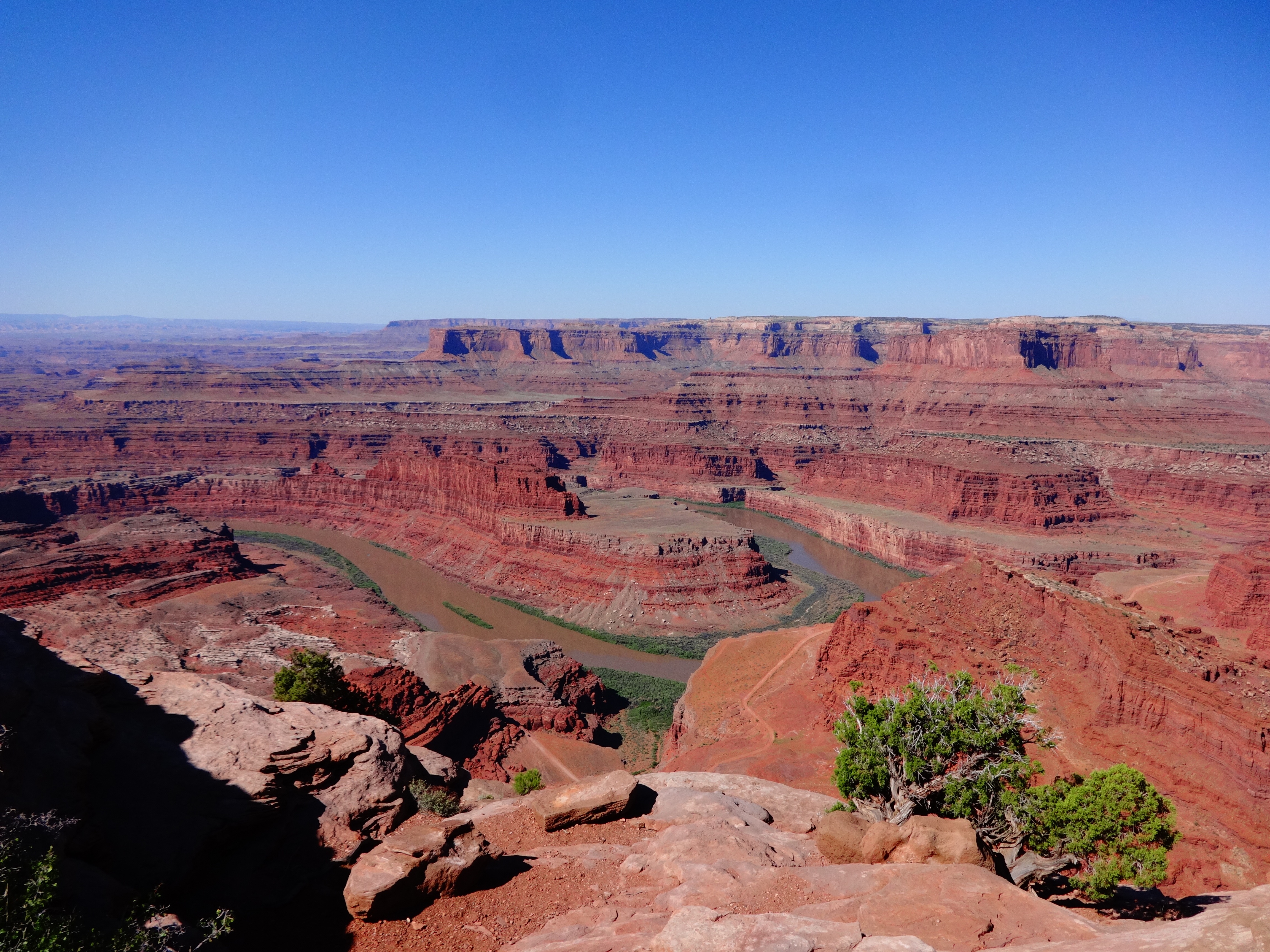
Just next to the boundary of Canyonlands National Park is Dead Horse Point State Park. Here I took a morning jog along the canyon rim, which ended right at the overlook of the Dead Horse Point itself. In front of me was a wild expanse of canyons and an elevated peninsula which the Green River dramatically curves around. The air was dry but the desert was not yet sweltering. Everything around me was painted in vibrant shades or orange, red, and pink. When I was done admiring the scene, I went into the visitor center. “So tell me, what’s with the name Dead Horse?” I asked.DSC04660

The park employee gladly explained, “cowboys traveled long distances out in the desert with little water. They were very thirsty and their horses even more so. They followed the sound of the river to the outcropping of land you see at the bend of the river. When they arrived There they stood right next to the river but far above it. They could see it and hear it,  but had no way to get down to it, and so their horses died, thirsty, looking at the unreachable river.”

In the gift shop I bought a book called “Down the Great Unknown: John Wesley Powell’s 1869 Journey of Discovery and Tragedy Through the Grand Canyon. The employee informed me that there was the John Wesley Powell River History Museum not far away, unfortunately I didn’t have the time to visit.

Although I had debated even stopping at Dead Horse Point State Park, I am glad I did. It compliments Canyonlands National Park and the views of the Canyonlands and Dead Horse Point were alluring and picturesque views. Something very unique about this region is you have Arches National Park, Canyonlands National Park, Dead Horse State Park, and numerous other parks and natural features all within close distance, with Moab, Utah being the central town, the hub, in the middle.

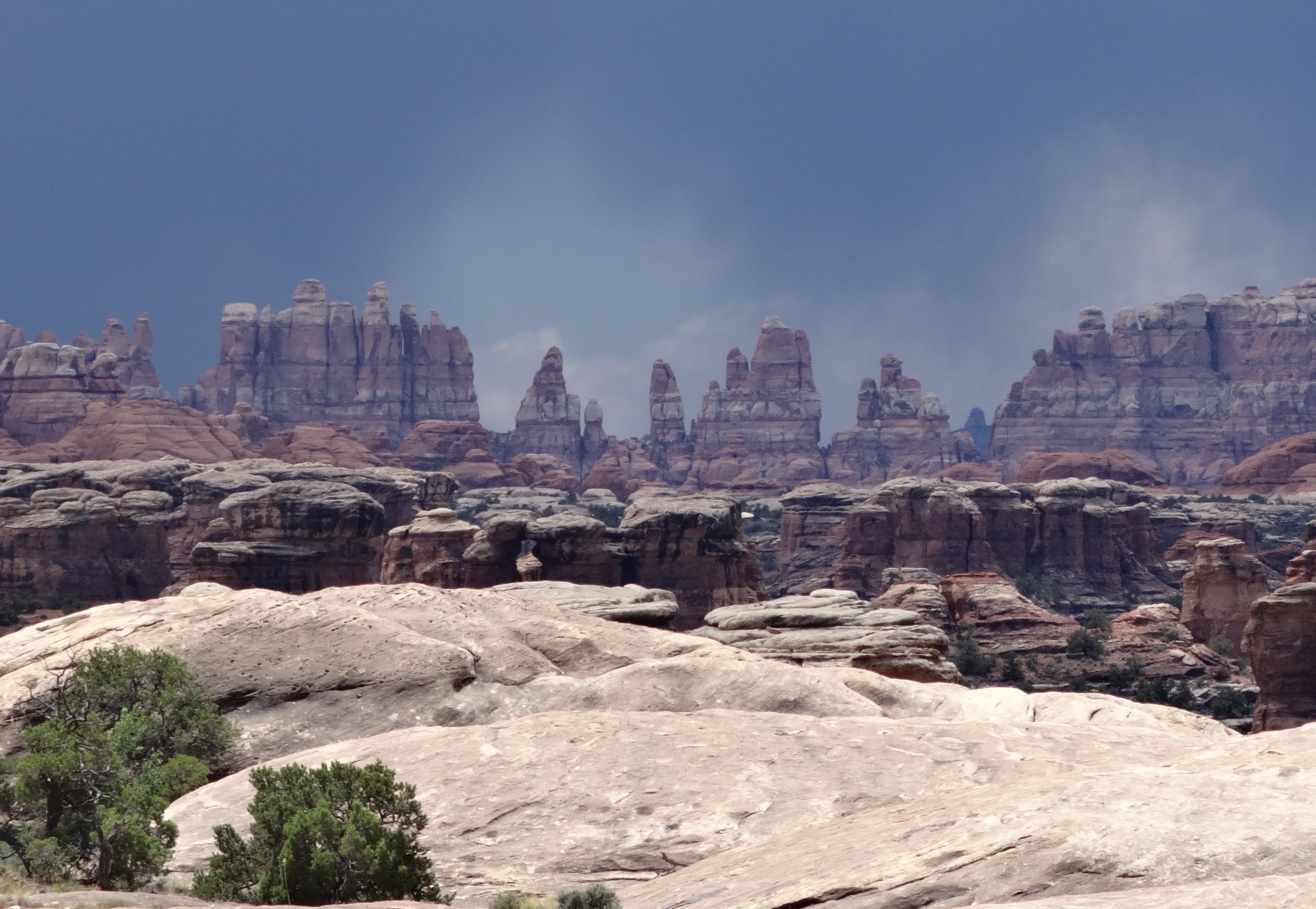
Back in the National Park I didn’t see much during the day. I was out on a small trail of barren rock faces taking photos over at the beautiful spiky rock formations in the Needles District when an angry looking storm came rolling it. I could see it moving, and see the sheets of rain it carried and the bolts of lightning it send snapping to the ground. In this moment the sky and scenery were perfect for photo taking, but some dust was stuck in my camera lens and I realized the approaching danger of the storm. I quickly satisfied my need to take photos with a few good shots and returned to my car just in time before the downpour. In the West storms are much more frightening, with the knowledge that water is not soaked into the land but rather travels across it, and also because in the desert there is rarely anything taller than your vehicle. So you and your car stand out, exposed, and are in plain site for the storms and all its bouts of lightning. With what I’m used to, a car provides adequate shelter from a storm, but not in these parts. I took more trustworthy shelter in the visitor center.DSC04533

When I was at Arches National Park, just days prior, I had heard about the Summer storms in the park film, which endangered some of the arches in the park, but I had no way to fully understand them. The land seemed so dry and the sky unyieling to any clouds. Trying to imagine a storm in these parts was difficult. Now, in the midst of one, It was completely understood. This storm just wasn’t any storm. It needed a modifier in front of it. This was a “Summer storm.” But like all Summer storms on these barren planes and canyonlands, it didn’t last long. It came and went, in a quick heated tantrum.

Canyonlands National Park is composed of three districts, each with unique lands features. There is Island in the Sky District, the Needles District, and the Maze District. In the visitor center in the Island in the Sky District  I inquired about hiking down into the Needles District I had seen from my hike. The park ranger took out a white binder with photos slid into plastic sleeves. He turned to a specific page and pointed to it. “Well this is the Needles District.” He paused for a moment, as if the photo itself would be a deterrent. It wasn’t. It looked amazing. “There is no cell phone service out there…” Fine with me. He proceeded, “…and GPS devices won’t work in that area from the rocks blocking the signals.” His last piece of information successfully deterred me from exploring the area. I had read online that it was ill-advised to go alone, as all the rock formations which stick up like needles create a maze-like environment, and it’s very easy to get lost. It was advised that you take pictures at turning points in your trail to be able to navigate backs to your starting point. That knowledge paired with the fact that my GPS would not work, resulted in the decisions to not explore the Needles District. I had already been hiking in the area enough to know the heat and dryness was a serious thing. Being lost here could be deadly, and I didn’t want to end up like the horses of Dead Horse Point.

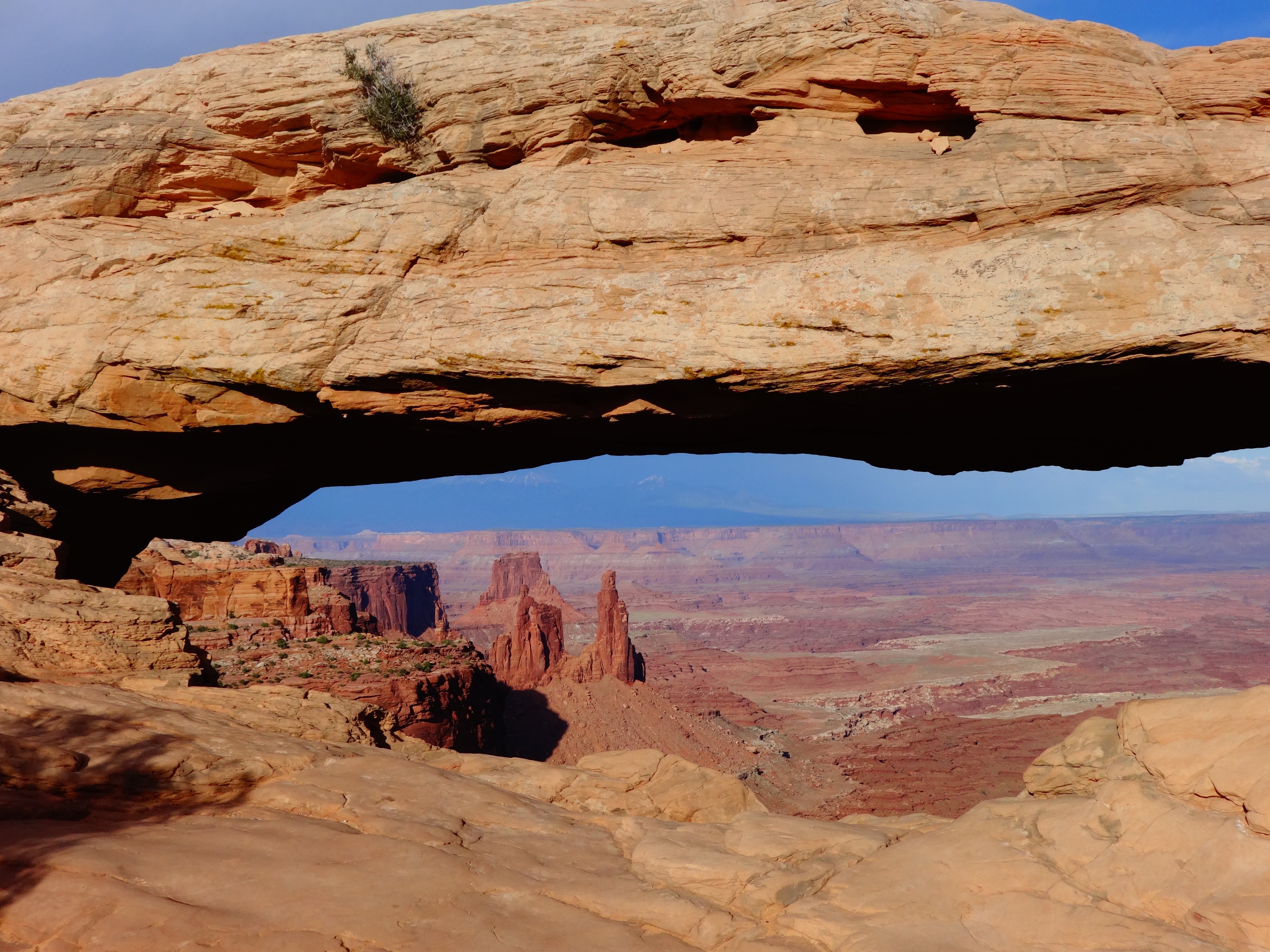
When the rain had resided I made it to Mesa Arch- the most iconic feature in the park. It’s a small rock arch right on the edge of a canyon cliff. It’s not much taller than myself but what makes it so appealing is that it frames the canyonlands behind it perfectly and is positioned at just the right angle that sunlight always brings out color in the landscape, making this location an exceptionally good photo spot at sunrise and sunset. Now, after having visited Mesa Arch, I notice it frequently in screensavers, calendars, and different pieces of publicity.  While I was there, a group of young adults from France asked me to take their picture. I had seen them the day before in Arches National Park. There was a small crowd of people gathering, but everyone was very respectful, stepping aside for each other to take their pictures of the arch.DSC04581

At one point in my day I took a break and went into Moab for lunch. I ate at the Moab Diner, which was a very pleasant experience. I would recommend it to anyone in the area. Not only was the food delicious but the service was unparalleled to anything else. The waiters were extremely attentive, and I must have had my glass of water refilled at least five times without any wait. I had gotten the Kokopelli Chicken Sandwich. It was here I was also able to make the association that Kokopelli is the flute player in the petroglyphs. His image is reproduced all over merchandise and signage in the area. He is a fertility deity and represents the spirit of music. I don’t know much else about Kokopelli, except his chicken sandwich was delectable.

Nearing the end of the day, I returned to Canyonlands to walk to Grand View Point at sunset. This walk would prove to be a pinnacle of self-actualization and discovery on this trip, and will be outlined in my next chapter, but after my hike along the rim, I began driving back to my hideout in the mountains of Manti Lasal. Shortly outside the park I drove by a Bureau of Land Management sign for Horse Thief Campground. Weary from a full days adventure I thought I would check it out and entertain the idea of camping here instead. Sure enough there were campsites available. I decided I’d rather dish out fifteen dollars then drive 60 more miles in the dark back to Manti Lasal. Although my tent was all set up in Manti Lasal, I had my spar tent, Kelty, and an extra sleeping bag in my car. I also had one of my compact camping pillows. I would be alright. I sent up camp there in the flat exposed plain. The sky above me was extremely huge. Clouds were long gone now, and stars filled the sky. I was able to purchase some firewood on the grounds and quickly had a small fire blazing. I was camping, like the cowboys I read about, out on the expansive plains, with the whole sky above me.

I realized here that I could position a flashlight underneed my glow-in-the-dark Nalgeen bottle, and the bottle would disperse the light, creating a calm but sufficient glow by which I could eat a snack and write a few postcards. When my writing was complete, and the air grew cool and hollow, I crawled into my airy tent, pulled out my book on the West, and read to the sound and glow of the fire next to me and the brightness of the unhindered moon and stars above me. I was at peace.

Read the next entry “The Canyons in My Life,” here: https://joshthehodge.wordpress.com/2017/12/27/the-canyons-in-my-life/

Read the previous entry “Camping in Strange Woods,” here: https://joshthehodge.wordpress.com/2017/11/12/camping-in-strange-woods/

Facebook: http://facebook.com/joshua.hodge

Instagram: http://www.instagram.com/joshthehodge/

Utah, My Love

Utah is an incredible place. Although it’s a popular place for hikers, in my travels it has often seemed like I’ve had the whole place to myself. On my way to Capitol Reef National Park I hadn’t passed another car in a long time. Civilization was becoming sparse. I was filled with excitement to go to this lesser known National Park.

I first learned about Capitol Reef from the Rock the Park show in which Jack Steward described it as a “gem.” It was an intriguing episode, because the park was portrayed with such a unique balance of history and nature. Jack also described it as “The real wild West.” Growing up in, and always being confined to, the Northeast and Midwest, the wild West always seemed so unreachable and too legendary to bother with making my acquaintance, but here we were, about to meet!

Prior to my arrival, I knew some basics about Capitol Reef. It was a supposed hideout for outlaws, including the infamous Butch Cassidy. It also included a commonly traveled pioneer wagon route and the restored Mormon ghost town of Fruita, situated in an oasis tucked down between the giant rock walls. It was named Capitol Reef after a giant rock feature on top of the Reef, which pioneers thought resembled the U.S. capitol building. I wanted to see it all for myself and was very curious what the “Reef” itself would look like- a 100 mile outcropping of earth pointing to the sky.

The two hour drive from Bryce Canyon to Capitol Reef was very peaceful and marked by tranquility, yet unbridled anticipation. I was driving down the long wavy landscape, swooping down and rolling up to see new marvels at each crest. I had gotten another early start as to be able to secure a campsite in Fruita. As I was traveling down the open roads, the morning sun was still waking up, slowly peering over mountainous deserts and lush fields of the remote Utah farmland. The temperature was brisk and in the lower fifties. The sun didn’t seem to be in a hurry but stretched casually, illuminating the beauty around it, turning dark grey areas to vibrant oranges and greens. As I approached the park, red giants stood up all around me. They announced their existence boldly and reached dramatically into the sky- some layered with colors, others monotone. Between the road and these giants were just fields of sand and rocks mixed with typical desert shrubs. It very much reminded me of the landscape in Disney Pixar’s original Cars movie. It felt like in any minute I’d be pulling up to Radiator Springs.

The Reef itself jutted diagonally up into the skype, as an immense rock ledge. In the park film, I learned that it is believe it was formed by plates of land colliding, pushing one plate up into the air, creating this massive wrinkle in the earth’s crust.

I was traveling alone. Dom had taken off in a different direction. He had forgotten to pack his camera battery and had found a place online in Moab, Utah that sold it. He was going to seek that out. When I rolled into the park, I passed the small visitor center and headed straight to Fruita. I didn’t have much pick of a site, because the campground was small and many sites were taken.

The whole campground was flat and had a mix of green grass and desert dust. It was all fenced in, so it did not have much of a wild feel. Roads were paved, sites plainly arranged. It was a very civilized campground, yet very scenic, because it was tucked away between giant red walls situated in small and picturesque Fruita. I chose a site in the front left corner of the campground. I quickly set up camp. Knowing I would stay a few days, I decided I would rest spaciously in True Blue. I then purchased some firewood from the campground host and headed back to the visitor center, as always to watch the park film, purchase a pin and sticker, and ask a ranger for hiking recommendations, despite already having an agenda. I then hit the park road.

The first hike on the agenda was to Cassidy Arch. It was a 6.6 mile round-trip hike. The trail arrived at a place believed to be a hideout spot for the infamous criminal it’s named after. To get there I drove on a extremely scenic dusty dirt road in an expansive area between enormous rock walls where my little rental car kicked up a large trail of dusty clouds. I stopped at numerous spots to take pictures. The giants walls, and bold rock formations around me, made me feel so small and as if my car was just a spec of dust. I had never seen anything like this. I carefully maneuvered my car around some sharp turns, paying attention to the location of my tires, making sure they didn’t fall into any ruts or run over any sharply protruding rocks.

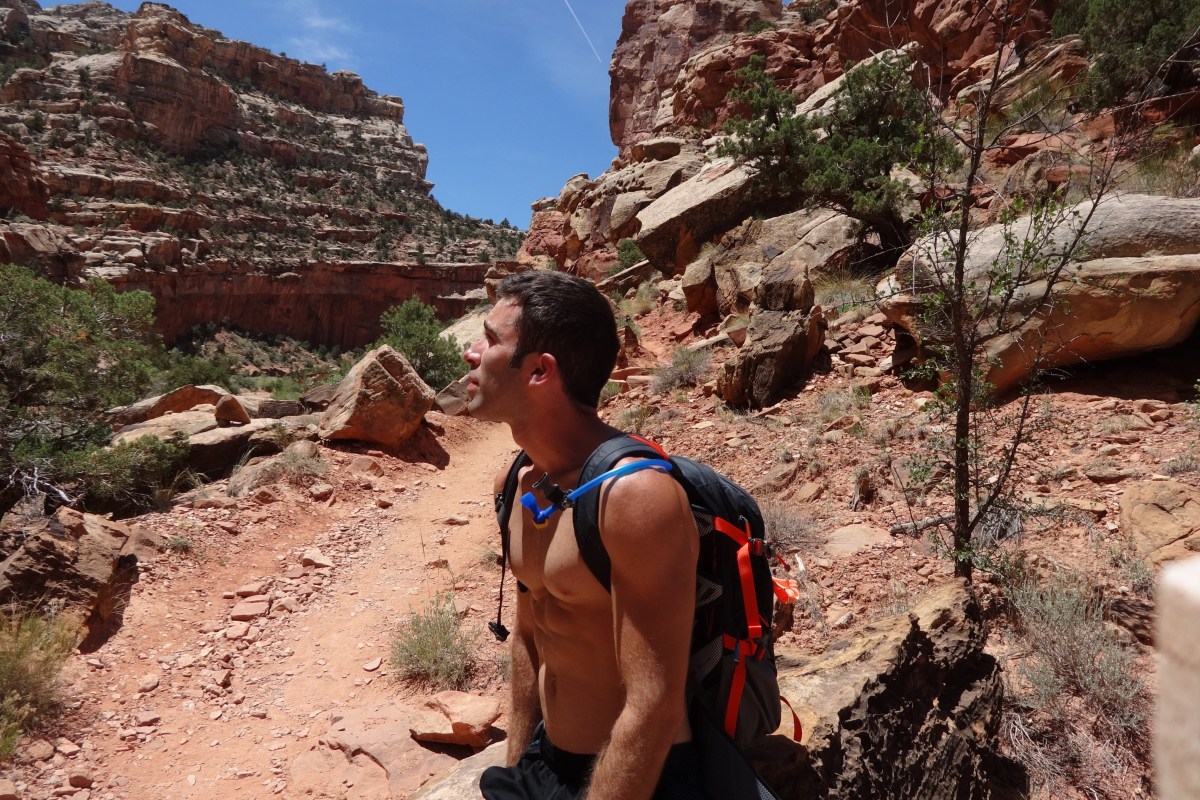
I came to a dirt parking-lot. There were maybe a dozen other vehicles that had ventured out here. I got out of my car, took off my shirt to cover myself in sunscreen, and made sure my Camelbak was at its water holding capacity. The sun now was fully awake and wasn’t holding anything back. It was raw, sharp, and felt closeby, without any filter. I began my hike on a river wash, and shortly took a turn left to start ascending, hiking between a multitude of fallen rocks and desert shrubs. I remember looking up in amazement, wondering why I had not heard more about this place. It reminded me of the awe and grandeur of looking over Yosemite Valley, just in a different color. Mountains rolled around in every direction and rocks abruptly and strikingly reached up into the sky. The reds, oranges, browns, and even whites were layered, and at other times they swirled around.

I remember looking across the distance in awe and thanking God for the adventure and acknowledging his awesome creativity. The more places I visit and new landscapes I see, the more I get to know God, as I observe the creative expressions He has poured himself into.

As I was ascending from the canyon along this path, which hugs and meanders around cliff edges, a group of three young teenage boys passed me…and then I passed them. This became a pattern until it started to become a bit awkward. I decided to let them establish a lead, as I knew I’d be stopping many times to take pictures.

As the trail reached higher ground, much of it was on open exposed rock face, and the only way to know where I was going was to look for cairns. Some were small and inconspicuous, so my eyes were constantly scanning in all directions, and a few times I had to trace my steps backward to find the cairn.

After 3.3 miles, I reached Cassidy Arch. There was one family there, and separate from them a group of about 10 boys and a couple of men. I quickly figured out that it was a Boy Scout group that had beat me here. How cool it would be to take a Boy Scout excursion to Capitol Reef! Anyone that lives in Utah is spoiled with exquisite landscapes. Utah is my wonderland and favorite state. I was able to recruit a Boy Scout leader to take my photo with Cassidy Arch behind me.  I then sat down and rested there at the end of the trail, on the open rock face, facing the arch. Here I was having already seen Saguaro, the Navajo Nation, Horseshoe Bend, and Bryce Canyon, yet my adventure was still young. I already felt accomplished, yet there was much more to see and adventure to be had. Here in Capitol Reef, tucked away in Utah, I truly felt off the grid, away from it all, hidden, just like the outlaws. I had escaped the troubles of my world and was free. As always Utah makes me feel at home. Although some may dread the heat of the desert, Utah to me has always felt comforting.

I have noticed many times, hiking in Utah, that my skin, after being exposed to the summer sun, takes on the same color of much of the rock. Utah is a place in which I could go camouflaged.  It reminds me of the piece of scripture that says God formed man out of the dust of the earth. If God were to have formed me out of the dust of this earth, he picked up a scoop of Utah and molded me, and maybe that is why I love the Utah landscape so much- maybe coming to Utah is in some ways, coming home.

I let this sink in, as I sat there facing Cassidy Arch. I felt that making acquaintance with Capitol Reef was more than a mere polite gesture. Capitol Reef had spoken. “Welcome…” it said, “…just make yourself at home.” And so I did.


Check back for my account of hiking to the Pioneer Register in Capitol Reef!

Read the previous entry “Recollection and Wonder,” here: https://joshthehodge.wordpress.com/2017/10/14/recollection-and-wonder

Facebook: http://facebook.com/joshua.hodge

Instagram: http://www.instagram.com/joshthehodge/