I woke up to the strangest, most intrusive sound in my campsite just aside my tent. I could not place this sound. I was so perplexed. It sounded like a drumming, but too soft and coming from too low-down to the ground to be that of a human. A gnome? An alien? That’s ridiculous! It was so close, approaching my tent. This is bizarre. I rolled over and pushed myself up quickly to unzip my tent. There stood the funniest looking bird. I would describe it as looking like some sort of wild chicken, but it was strutting with its feathers on full display and its chest puffed out, like a miniature turkey. It looked so proud and pompous, yet it was so small and ridiculous, especially with its little feather tufts sticking up on the top of its head like some punk-rock motorcyclist. It was trying to be tough, but had big curious infant-like eyes. My initial thought: What the heck is that? Upon locking eyes, his feathers shrank close to his body, in what I perceived as a reaction of embarrassment, and then he scurried off into the forest in fright.
I had never seen this type of bird before, and I don’t know how I knew, but somehow it’s name was on the tip of my tongue. As I excited my tent and slipped on my boots, I kept trying to fish this word out of my memory. I was so close. I gathered my water bottle and my new book on Stehekin and threw them into my backpack. I began walking down the hill and it hit me: It’s a Grouse!…then, Is the plural form of grouse, grease?

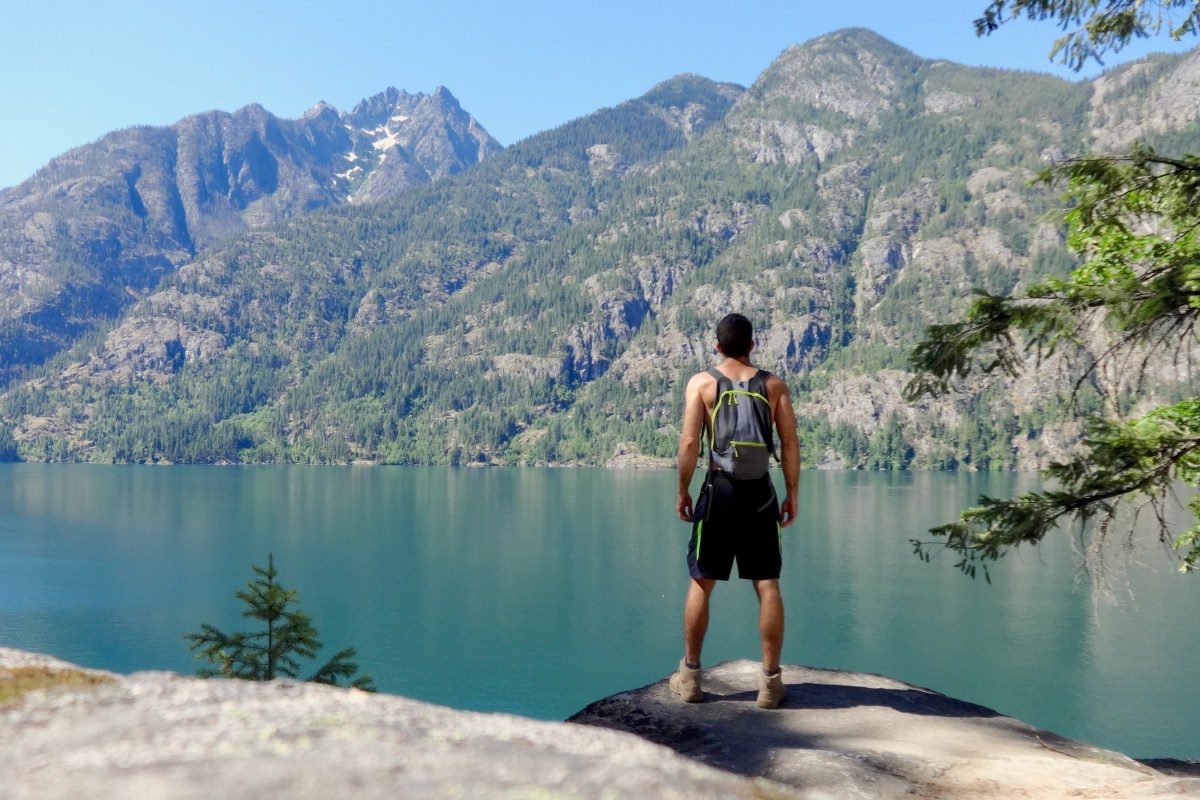
This was day two of camping in Stehekin, the most remote community in Washington. My encounter with the grouse was midday. When I woke up and unzipped my tent for the first time of the day, I was greeted by the tall pines, the serene lake below, and the mountains standing mightily on the other side of the lake. My camping neighbor Luna Luu was already up as well, fixing things about her camp.
“Good morning,” I greeted. “Did you get some pictures of the Milky Way?” I asked.
“No. I didn’t end up going. It was cloudy last night,” she explained.
It’s what I had suspected.
This morning my first order of business was to go to the bakery for some breakfast. I invited her to come along, but she had her own hiking plans. After quickly throwing myself together, I hopped on my bike and took off down the road toward the bakery: Stehekin Pastry Company. The mountain morning air was brisk and refreshing, and there was no morning bustle about this place, as is common in so many places. Here the few people that were around eased into their morning. It was relaxing, moving at the gradual pace of the rising sun, slowly, growing with every passing moment gradually more alive.
Opening the bakery door, I was bombarded with the enticing smells of cinnamon and coffee blended with all the other aromas of the fine craftsmanship of the Pastry Company. After camping outside in the cold northern night, biking through the brisk mountain air, I knew it was going to be so relaxing and perfect to sit down with a cup of something hot to drink and a great big fresh cinnamon roll dripping with house-made icing, while sitting by a window, glancing outside to watch the forest slowly wake up and be illuminated by the morning light. I sat there in peaceful bliss doing just so.
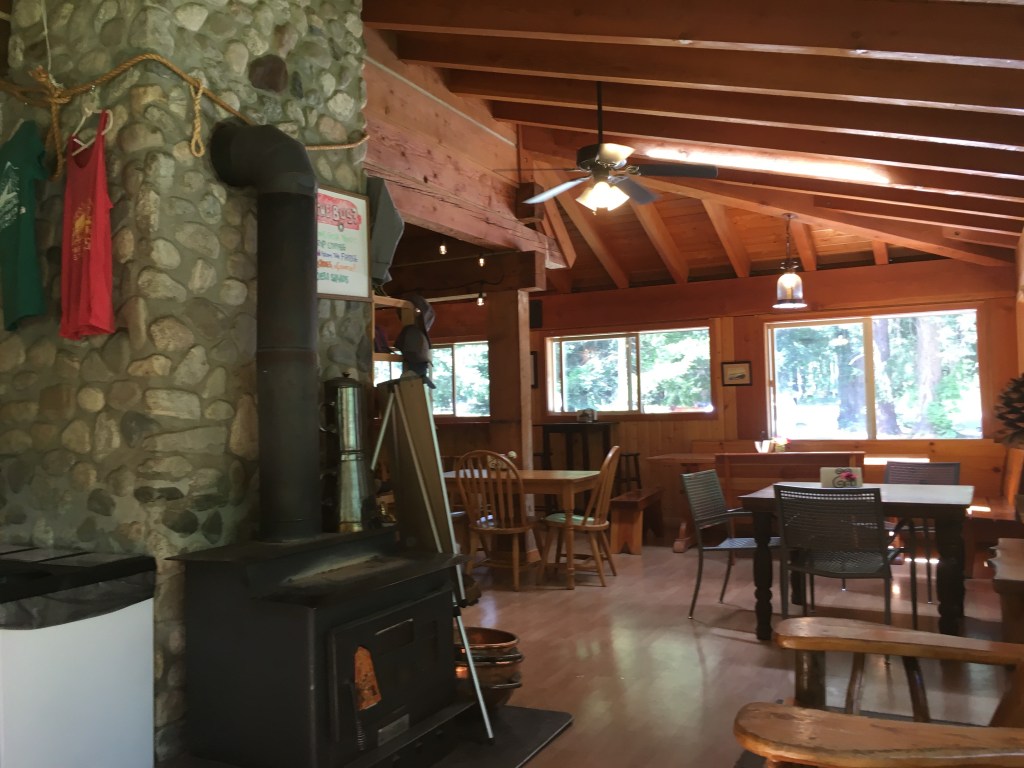
After a while I got up to browse the nearby shelf of merchandise. There were hats, stickers, and books. A particular book caught my attention Stehekin: A Valley in Time, the true story of the valley through the eyes of Grant McConnel, a man who lived here from the 1940s until the 1990s. I bought it, along with a sticker. I wanted to learn more about this place, and this book seemed perfect. I also noticed a number of other books, all by local authors. I realized this was somewhat of an author community. I understood why. The place was ripe for inspiration with its natural beauty, and its remoteness and solitude eliminates all the distractions for the writer. I would love to live in such a place and dedicate my time to writing. So far I’d imagined myself living here as a baker, then a teacher, and now an author. I had no idea that in less than a year I’d find myself spending my whole summer on the edge of Glacier National Park, in the remote community of Polebridge, sandwiched in between parkland and national forest in the wildest river valley in the lower forty-eight states. There I’d live and work amidst the beautiful Rocky Mountains, off the grid, in the beloved Polebridge Mercantile and Bakery. I guess we could say it was a dream come true, looking at the dreams occupying my mind during my time in Stehekin. When I was interviewing for the job in Polebridge over the phone in the winter- the owner told me how he wanted to place me at the front of the store as a closing cashier. In that moment, and in fact all-through the interview, in my mind I kept seeing the Stehekin Pastry Company. It was my only point of reference to such a job. I recalled seeing the bakers back in the kitchen with their mounds of dough, working so diligently but seeming to have fun. “What about putting me in the role of a baker?” I asked. The owner, Will, explained how he believed that with my skill set as a teacher I’d be best suited for the front of the house. He was right. He told me that if things work out he’d like for me to keep a relationship with the business and return for more than just a summer. I worked there for many summers and continue to do so. My time working at the Polebridge Mercantile and Bakery are some of the richest of my life. Although oftentimes rustic and primitive, it’s my summer paradise. I love it!
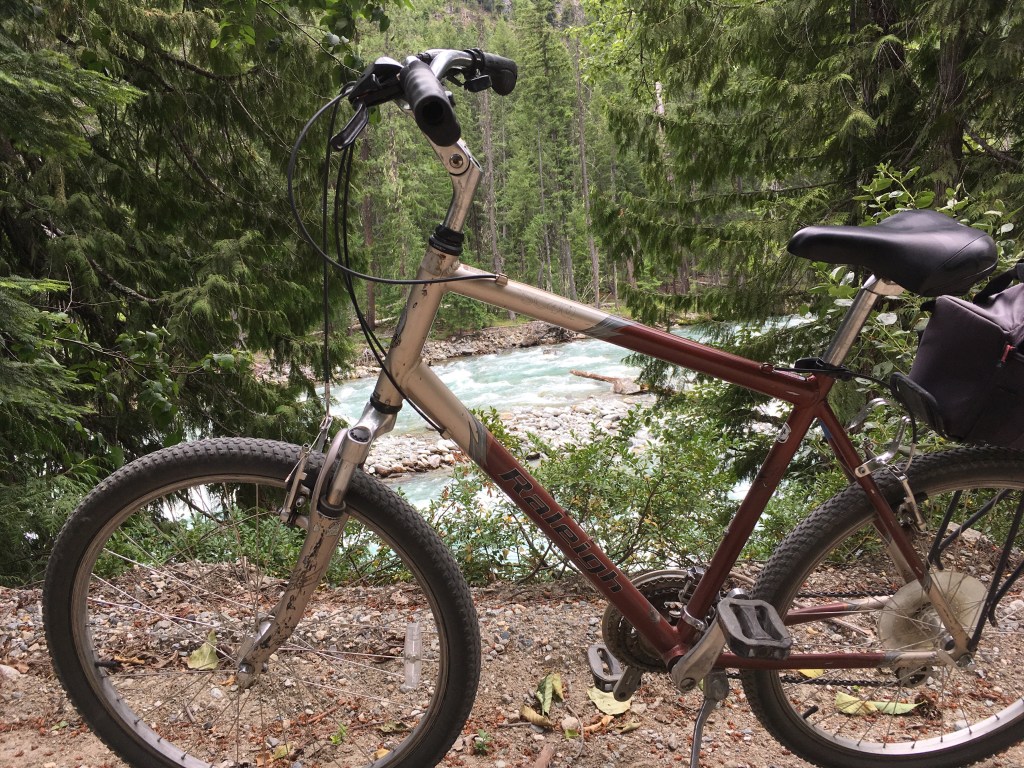
After my morning cinnamon bun I got back on my bike and traveled non-stop to the other end of the road, past all the sites I had stopped at the day before: the one-room schoolhouse, the two-room schoolhouse, Rainbow Falls, Stehekin Ranch, and then bearing off the main road I rolled down a path to the Stehekin Airstrip, a field amidst the pines. Is this really an airstrip?…I guess it would do. I could imagine a little private plane landing and rattling atop this field. I supposed boat access wasn’t the only way to arrive at Stehekin but plane access had to be private. There were no commercial or charter flights. Biking past the “airstrip” I sought out “The River Trail,” from my map. When I parked my bike against a tree and started on the trail I realized it was not a very frequently trafficked area, for it was mostly overgrown and had just a narrow space barely big enough for my feet. My ankles were brushing up against the growth of the forest floor. This was a rich lush forest, more characteristic of those back East. At one point the path came close enough to the river I could see the water. At this location I’d call it more of a creek than a river. I veered off the path and stepped down onto the river bed. It was so shallow the water didn’t even reach as tall as the top of my boots. The water was also not high enough to cover all of the riverbed. The middle of the river was dry, so it was there I sat down. With my eyes closed and listening to the trickling water around me, I prayed a prayer of thankfulness for being here. I also prayed about my health. I had enough distractions from all I was seeing and experiencing in Stehekin that I hadn’t been focusing on it, but it was still, in its own aching way, always present on my mind and felt in my weakening body.
This is good for me, I thought, to relax by the river, to take in the soothing sounds of the water and the lights beaming through between the tree branches. This was a gift from God. I had been feeling that my body was caught in this state of high tension and if I could get it to calm down, escape this state of being, I’d be okay, but it felt like a lot to do. I was up against my very self. I concluded every moment should be used to help bring my body out of this state of tension. This was one such moment. Relaxing was now a priority of mine. In my relaxed state I broke open my journal and began to write.
When I got back on my bike, calmed, settled, grounded into this time and space, I leisurely began biking back to the other end of the road. Of course I had to pass by the bakery again, and it was time for lunch. I was hungry and there were many great things on the menu for lunch. I couldn’t make up my mind of what to order so I just decided to buy two lunches, a salad with salmon and a roast beef sandwich. They were delectable- especially the salmon. I thought it was fitting to eat salmon in the Pacific Northwest. Once back in “town” I realized it had been about twenty four hours since I had rented my bike, so it was time to turn it in. Then feeling mildly handicapped without my wheels, I walked back up to my campsite. It was time for a nap. It was only afternoon, yet I had already covered great ground this morning and felt it was fine to give up some of my day to sleep. After all, relaxing was now a priority. I fell into a deep sleep in my tent, wrapped in this fold of nature, and then I woke up to the drumming grouse just outside my tent.
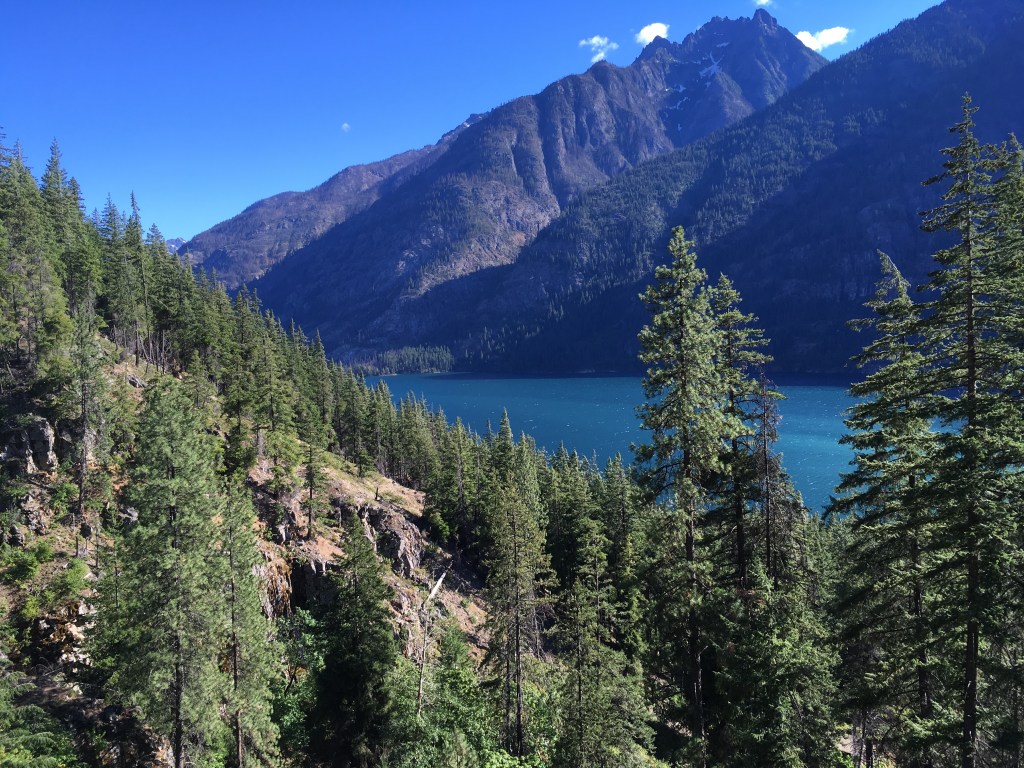
I ended up spending a large portion of the evening sitting on a rock up on the mountainside behind the campground, looking down at the lake. There I read the book I had bought about Stehekin. It was a very entertaining read. Between this evening and the following morning I read the whole book. That’s very fast for me. It was that good. I especially enjoyed learning about the community back in earlier times. I read how delivering mail along the stretch of road was a shared responsibility. People took turns. In the winter, the author delivered the mail on skis. It was customary for him to stop by and visit with everyone along route. It sounded kind of nice, skiing out in the cold of winter, stopping occasionally every few miles, stepping into a warm house with a warm fire in the hearth, greeted with a cup of coffee or tea, and engaging in conversation about the latest news of the valley. It also stuck out to me the part discussing how there was only one phone in Stehekin in the post office brought in by the National Forest Service. That was the only immediate communication to the outside world, and it wasn’t very reliable. It also struck me as comical, the part about the aftermath of a plane crash up in the woods, and how the locals, given they had very limited resources, stripped that plane and used it for building materials in their homes, and even parts of it was used for dinnerware. Remnants of the plain could be seen popping up all over the community in people’s houses.
The author talked about how for so long Stehekin was frozen in time, and a unique and very personal community. Whenever someone had to take the boat down the valley into Chelan, people were often repulsed by the chaos and lifestyle of those “down lake.” Reading this book, everything seemed like such a far-off, foreign, yet intriguing concept. However, later in my own time working at the Polebridge Mercantile and Bakery in Montana, I would live through similar experiences. It too is, at this time, a one phone community. The contrast between our life up the North Fork River valley couldn’t be more stark against the developing society down stream.
The following morning, day three in Stehekin, it was time for me to go “down lake” back into the real world, but I wouldn’t be spending much time in society. It was time for the next leg of my adventure and off to other wild places, soon approaching the behemoth of National Parks: Glacier National Park. Before I boarded the boat I walked to “The Garden.” This morning the gardener was there. From my understanding this was all his. I bought from him some sugar snap peas and cherries. I stood there in the garden and spoke with him for a few minutes. He told me some of his story and how he ended up here. To me, at the time, it struck me as sort of weak, running away from society and life’s problems to live up here in remoteness. I had perceived it as a negative thing, but with the evolution of society “down lake” and after my own experience living in a similar remote community, I have grown in perspective thinking back on his story. There is a healthier way of living that is lost in the bustle of growing society. I get it.
Back on the boat, I was munching on my delicious sugar snap peas, so sweet and crisp, mixing things up every-so-often with a nice tart juicy cherry. This is going to be good for me, I was thinking, for my body and fighting the inflammation I was feeling. Some nice fresh produce, a few days in Stehekin with moments of great relaxation, and now sitting in the sunlight on the open water is going to make me just fine, I thought. My ulcerative colitis was just some strange nightmare. I’m going to put this illness behind me. It’s over. I’m okay now.
I was wrong, very wrong. This was only the beginning. Things were going to get much worse… and much more beautiful.
If you enjoyed reading this, check out my book “Still, Calm, and Quiet“
Check out my previous entry here: “Stehekin: The Most Remote Community in Washington”
Visit www.joshhodge.com
 Josh Hodge blog