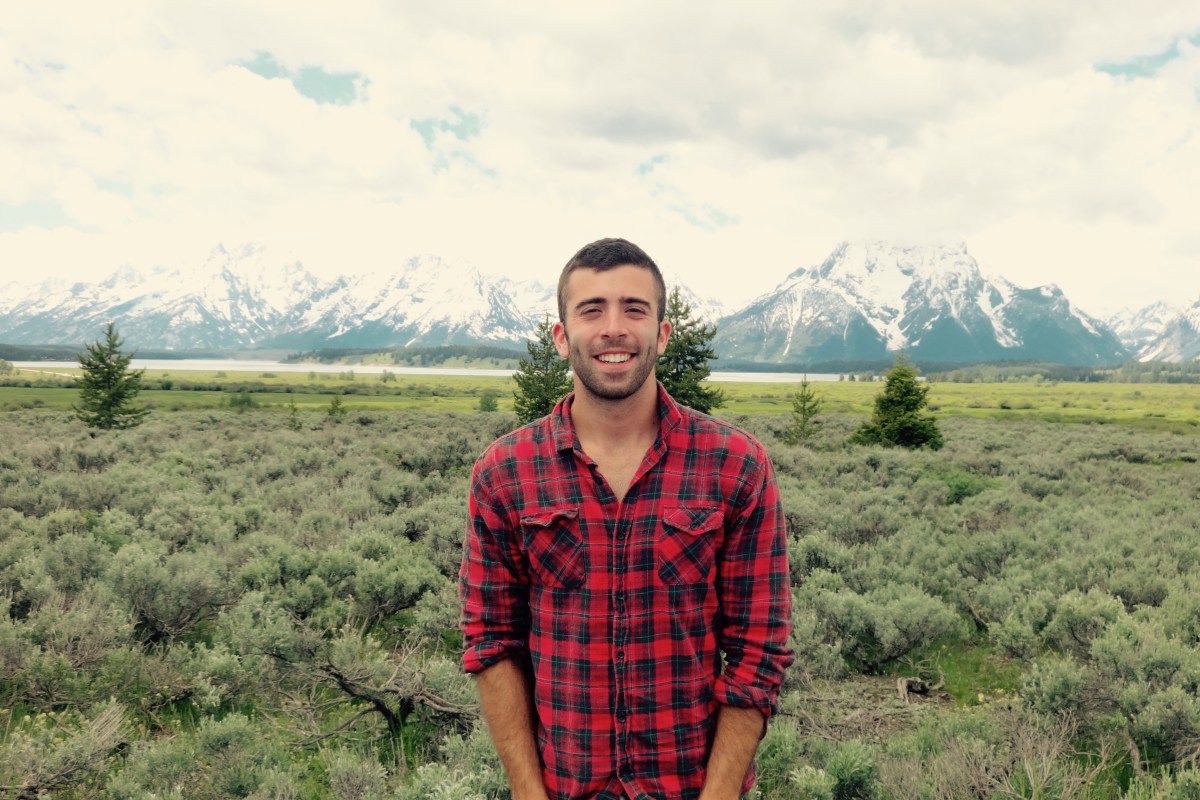
The Mighty Tetons

“I’m going to need a venti latte with an extra shot and almond milk,” the lady spoke.

Where do you think you are? I’m asking quietly in my own mind with no anticipation of response. I knew exactly where I was, in Grand Teton National Park in northwestern Wyoming, a place where dramatic peaks of the Rocky Mountains strike up among pine forest and once cattle ranches are among mountain lakes, pristine rivers, and sprawling wild flowers. Specifically I was in the Coulter Bay Village in the general store. Apparently the lady had mistaken the canisters of drip coffee as a bonafide Starbucks establishment. She must not get out of the city very often, my thoughts proceeded. As they say in the South, “bless her heart.” After she resolved her order I got myself a nice cup of hot tea, perfect to thaw me out this cold morning. Although the temperature most likely dropped below freezing, layering up on clothes and burrowing under three layers of sleeping bags kept me warm and comfortable for the past two nights. I can’t think of a finer night’s sleep in my life than these nights in Grand Teton National Park. 

I was up rather early, eager to make my way to neighboring Yellowstone National Park. The previous morning I was also up early to make it to a ranger guided hike to Taggert Lake. I had given myself plenty of time to arrive, and I sat at the trailhead on a bench cold, wishing the sun would rise and warm up quickly. When the ranger arrived she led the small group of about twelve of us on a short 1.5 mile hike to the lake. Along the way she explained how one of the unique features of the Teton range is that there are no foothills, You can see the mountains begin at the valley floor and dramatically rise seven thousand feet. This is due to the sudden violent seismic activity that led to their creation. The Tetons are also unique in that they are believed to be the youngest mountains in the Rocky Mountain chain. Along with geology tidbits the ranger shared about plant life. She invited us to all rub our fingers on some sagebrush to smell its pleasant aroma. “This is what used to be called ‘cowboy cologne.’ Cowboys would spend long days, sweaty and dirty out on the range, sometimes without the resources to clean up, so if they were headed into town, maybe to a saloon, and wanted to smell nice for the ladies, they would rub sagebrush over their bodies, especially up around their necks.” 

A large section of the trail went through sagebrush and wildflower meadow, then swayed into the forest. We crossed the small rushing Taggert Creek on a bridge and ended at the small Taggert Lake. It looked rather dismal this morning, with a mostly cloudy sky up above, but surrounding it were narrow pines and the dramatic mountains with snow all up and down their sides adding quiet beauty. 
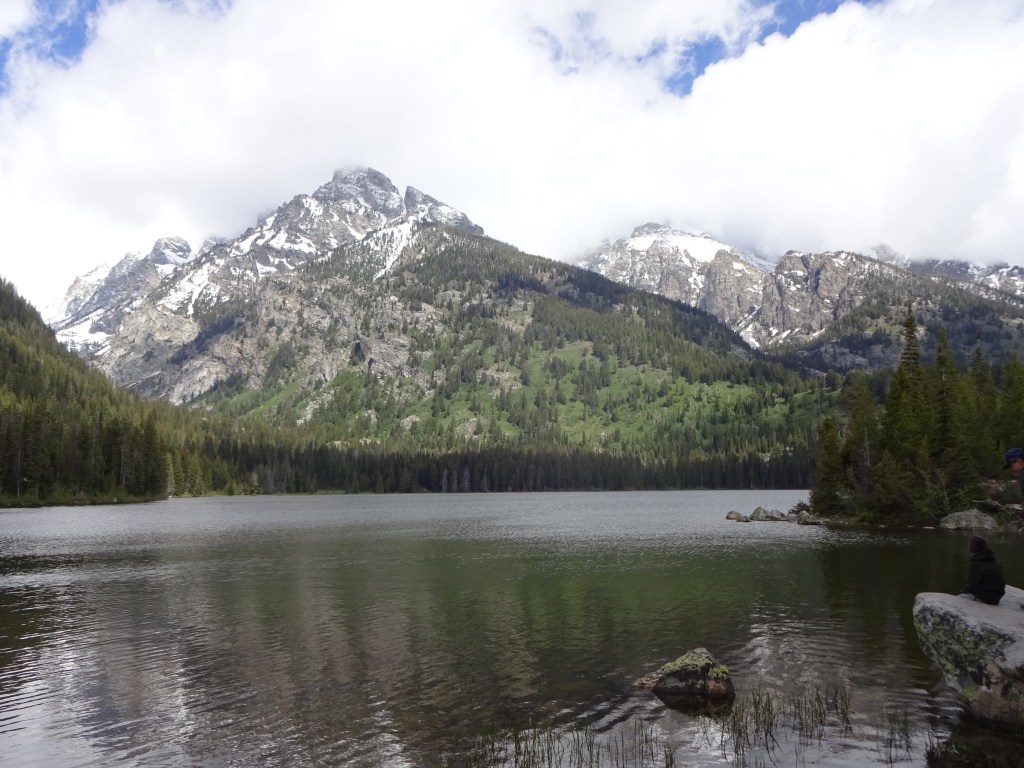
The ranger gave us the option of following her the same way back or continuing another 2.4 miles to complete the loop. I decided to complete the loop and took off solo. Although I really should have been enjoying the scenery around me and being present in the moment, I was troubled by the fact my camera was broken. It was a Sony Cybershot point-and-shoot camera. I had bought it brand new just before the trip. I did think it felt very light and cheap, and I came to find my questioning of its durability justified. This was my second Sony Cybershot. Prior I was using an older sturdier model. I thought for a small camera it really delivered and I became, if I do say, quite skilled at using the camera and all its features to their full potential, but dust, or some sort of particles, had gotten inside the camera and on the lens  casting dark spots over my pictures, so that’s when I bought the newer, more expensive, but overall cheaper model. 

Days prior after I arrived at Dinosaur National Monument, I took the advice of Gzeivieur, the frenchman I met at Curecanti, to check out Fantasy Canyon. The name alone was intriguing but the road to this site was not the most inviting. I drove at least an hour and on at least twenty miles of dirt road into very remote stretches of desolate and dry Utah desert. I passed by no signs of life except the occasional oil fields and related small industrial complexes. The sun was also setting. The farther I drove into nowhere, the darker it became, not very comforting. When I arrived I was surprised at how miniature the landscape was. Despite being small, I  will admit it is very unique. The Bureau of Land Management on it’s website claims it holds “some of the most unique geological features in the world.” It also warns of the features being very fragile and calls it “nature’s china shop.” They describe it as “the east shore of what was once Lake Uinta, where the sediments eroded from the surrounding high lands. Sediments were deposited and the once loose sands, silts, and clays were forged into sandstone and shale. Because of different rates of weathering, the more durable sandstone remained while the more easily weathered siltstone and shale washed away, yielding this spectacular scenery.” Today it’s a collection of drooping, haphazard, fungal-looking rock hoodoos and shelves. I think I would perhaps best describe it as sharing the variety and visual make up of a coral reef, but it looks all petrified and painted in a pale clay beige. 
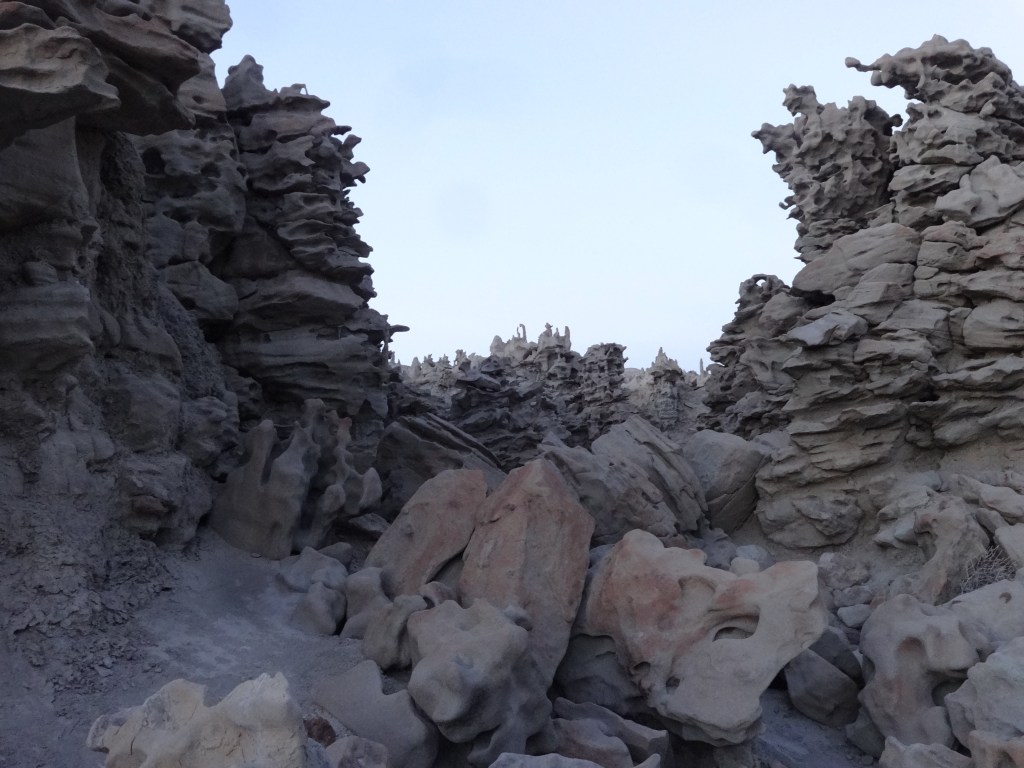
Here I screwed my camera to my trekking pole. I tried to drive that trekking pole into the ground, but when I set the timer to scurry into the picture, the trekking pole fell, smacking the camera on the ground. Since that moment the lens would not open nor adjust. I would only be faced with an error message. I eventually resorted back to my older camera which I still had in hand, and I would purposely try to frame my pictures in such a way that the dark spots on the lens would not show up in plain sight in the pictures. 

Now in Grand Teton National Park, after fretting over my camera situation for much of the morning, I came to terms with it and realized this could be a wake up call to really take in the scenery in the present moment and not live my life behind the camera, preoccupied with capturing the best shots. I also resolved to write more and draw. I could capture the beautiful scenery through my own pen and it would be uniquely mine. I could share the beautiful scenery but share it through my own perception. I was inspired in part by my Uncle Joe who while traveling routinely takes time to make his own postcard sized sketches of notable places of interest on his travels. Although he does take photographs too, his pictures I would say are more valuable because they capture the way he sees things. 

After completing the loop at Taggert Lake I went back to the Coulter Bay Village and went on another short ranger led hike which ended at the marshy Swan Lake with wispy grass and lily pads sticking up out of the water and the mountains towering in the back between and above the opening of pines. This looked like prime moose habitat but none were spotted during this visit. I recognized immediately the ranger leading this hike. He was the friendly guy from Chicago in the visitor center from the day before, the first person I met here in the park, the one who instructed me to sit in front of a fireplace in Jackson Lake Lodge, look at the park materials, and plan my visit from there. He had served me well. 

“I may not look like a park ranger,” he began his talk. “I am new here and am still waiting on my hat and uniform.” I give him points for effort. He had a green shirt and pants, trying to imitate the classic ranger look. He also remembered me. I am always impressed when people remember me. It happens quite frequently. After short, casual interactions, people are often able to recall me. I feel honored. 

This ranger conducted himself in a manner which made him very approachable, so in between his moments of interpretation I walked alongside him and asked some questions. I wanted to know the difference between a National Park and National Monument. Both are entities in the National Park Service and although Monuments get less publicity than the Parks, some Monuments, like Dinosaur National Monument for example are quite spectacular. He explained how Monuments are declared by presidents. A National Park is established by an act of Congress. He explained that many Monuments eventually become National Parks. Even Grand Teton National Park originated as Jackson Hole National Monument.

“Do National Parks get more federal funding? I asked. 

“No. It doesn’t have to do with funding. It mostly has to do with the name.”

“Well, why change the name to a National Park if there is already a National Monument.”

“Tourism,” he replied. “A National Park status brings in more tourists. Take Great Sand Dunes National Park in Colorado for example. In recent years it transitioned from a monument to a park, as a result it increased visitation and tourism. It’s great for the local economy.”

I’d later see the reason why Jefferson National Expansion Memorial and Indiana Dunes National Lakeshore acquired name change and status to National Parks. 

This ranger also spoke a lot about John D. Rockefeller, Jr., the son of the Standard Oil founder and one of the richest men in America at his time. He fell in love with the area after being escorted around by Horace Albright, the first director of the National Park Service. Albright persuaded Rockefeller to purchase the land and donate it to the federal government as Roosevelt would put it, “for the benefit and enjoyment of the people.” To acquire this land at fair price, Rockefeller created the Snake River Co. and used this name to purchase 33,000 acres to donate to the federal government, When news broke out that Rockefeller was behind the purchasing of all this land, there was such an uproar that the government wouldn’t accept the donation for fear of scandal. When president Theodore Roosevelt eventually accepted the donation and created Jackson Hole National Monument he was compared to Hitler annexing Austria. Name calling and scandal aside, I am grateful that Rockefeller used his wealth built up from capitalism to give this incredible area to the people of the United States and the world. I am glad that Horace Albright and Theodore Roosevelt shared the same vision. Without Rockefeller’s wealth and without his charity, the Tetons may have been leveled and mined to dust, the forest completely lumbered, and the valley may have become an industrial cattle farm. This is not to demean the value of these industries, but the beauty of Grand Teton National Park is truly a treasure worth preserving and sharing. 

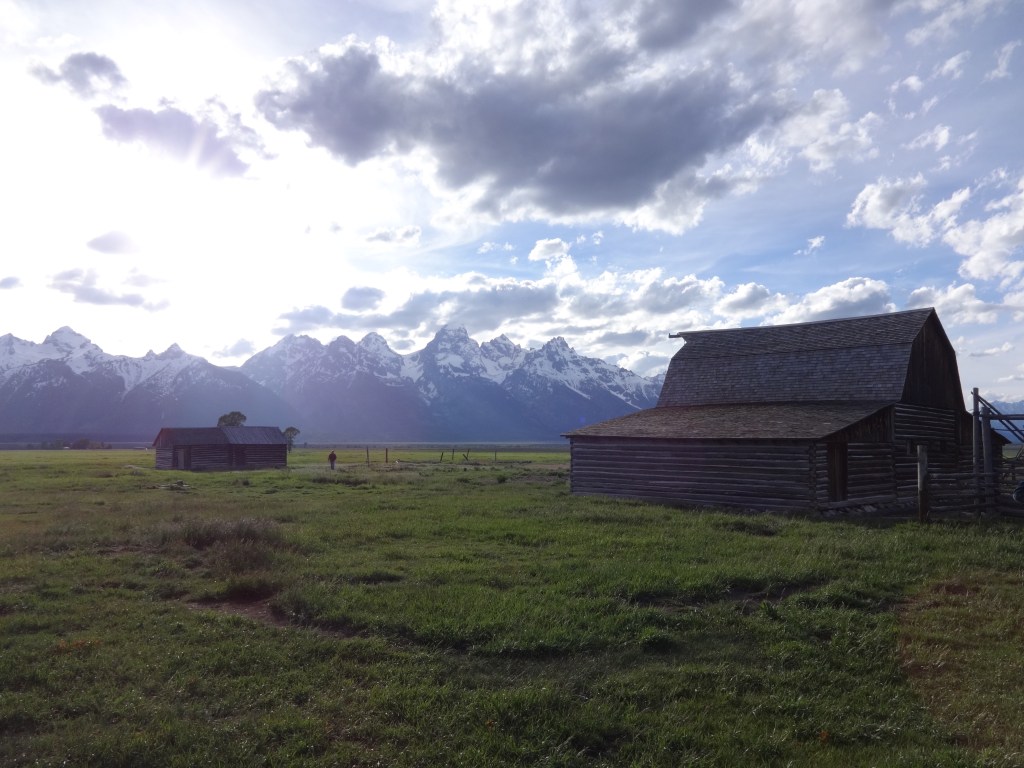
In the evening I made my way over to the Snake River and then to Morman Row Historic District. This part of the park preserves a late Morman settlement and features perhaps the most iconic view in the park and in Wyoming, the view of the Reed Mouton Barn on the open grassland and the Tetons rising up in the distance. 

I stood here initially with the desire to capture the perfect photo, but then I paused. No, let me just take it in. I gazed at the beauty of the mountains. What does this mean? I asked, for beauty is never wasted. My mind began to race. But then I stopped. Be still. Be Calm. Be quiet. As always, I was in the presence of the almighty God, and the beauty reminded me of that. I thought back to what God taught me out in the desert of Dinosaur National Monument. This was the first time apart from then, I really put this learning to practice.  I felt relief knowing there was nothing I needed to do with this beauty, and there was nothing that needed to be said. All I was called to in this moment was to enjoy it and be present and mindful in the moment with God. He again was calling on me to be still, calm, and quiet, and it was quite refreshing for the soul. I became aware that ultimately it’s not my actions that bring about healing and restoration, it’s God in these moments of stillness and quietude.

After pausing, breathing, and mindfully resting in God’s presence I sat down. I did open my journal and created a sketch of the mountains before me. I also accompanied it with a poem. I did not overthink my writing. I did not overanalyze it for meaning or plan it precisely. I looked at the mountains and was taken away by the strength and might they reflected, and I let it flow free and meander from me, just like the waters of the Snake River.

Jagged diagonals form peaks stretching to touch the clouds

Boldly rising, unreserved, coated in blue and fostered with snow, mimicking the sky above 

Sprawling across the canvas among wandering streams, pristine lakes, log pines, and wilderness

The voraciousness of the bear and the chase of the wolf below is only child’s play to your grandeur

You are old and display generations lined together for a family portrait, dominating the view with Grandfather in the center. 

Quiet, not a sound from you, but your stance tells everything and in you I see the reflection of strength and Might. 
Read the previous entry “My Cougar Encounter At Grand Teton National park” here: https://joshthehodge.com/2020/09/19/my-cougar-encounter-at-grand-teton-national-park/

Check out my book Canyonlands: my adventures in the national parks and the beautiful wild here: https://www.amazon.com/Canyonlands-adventures-National-Parks-beautiful/dp/1711397873

My Cougar Encounter at Grand Teton National Park

I wasn’t supposed to hear that. This much I knew. A middle-aged woman leaned over to another and whispered, “I feel like such a cougar.” I was sitting next to her here in the Pioneer Grill in Grand Teton National Park in Wyoming. This was a 1950s style diner on the lower level of the Jackson Lake Lodge. According to the Grand Teton Lodge Company’s website, “The Pioneer Grill at Jackson Lake Lodge is one of the oldest and rumored to be the longest continual counters at 200 ft. One counter snakes through the room, creating a friendly atmosphere where guests interact with travelers.” Yep, most certainly. I was seated at one of the corners of the counter. Adjacent to me sat my fellow conversationalists for the evening, two middle-aged women. One of them had blondish grey hair and the other had black. It was the lady with the black hair closest to me who had spoken these words to the waitress: “I’m going to pay for that young man’s dinner.” I also wasn’t supposed to hear that. 

I hid behind my menu. This was mildly awkward. Was I supposed to react to what I overheard or pretend I didn’t hear it? I decided to play the latter.  When the waitress took my order she also took my menu, and there I was. The cougars, if you will, were looking right at me.

“So where are you visiting from?” the black-haired lady asked with a pleasant smile and inquisitive eyes.

“I’m from Kentucky,” I claimed. “What about you?”

“We are visiting from Washington. I’m Judy and this is my sister Cheryl. We are visiting on a sisters get-away for the weekend. What brings you here all the way from Kentucky?” First off, I was surprised her sister’s name was Cheryl as her appearance reminded me of my aunt Cheryl. 

“I’m on a National Park adventure. I flew into Phoenix, got a rental car, and have been camping and visiting National Parks all month,” I explained.

“Oh, you’re a teacher! What do you teach?”

“I teach Spanish in elementary school.”

“Well, good for you. Good for you,” she repeated.

“What do you do?” I inquired unaware of how much information this simple question would unpack.

 “I am a retired police officer. Worked thirty years.” She then proceeded to tell me all about her retirement benefits, how much money she was getting in retirement, how much money she was making before retirement, how she decided to retire. I was surprised. She was making nearly a six figure salary in retirement or so she claimed.

Given the fact I heard her say she felt like a “cougar,” and now she was talking about money, one could be suspicious of her intentions. But at the moment I thought nothing of this. I really thought she was just being friendly. She may have provided way too much information in her conversation, for talking so in depth about her retirement finances to a stranger is just rather odd. But I also sensed she may have had a few drinks at the bar before coming to the diner.

When she mentioned being a police officer I could definitely picture her in uniform. She was the type and had the demeanor to be an officer: forward and assertive in conversation, bold, not the least bit hesitant. I think she was speaking very honestly about her life and retirement and although she may have been trying to impress me, I’m just not impressed with how much money a person makes unless it’s out of sheer ingenuity. I think she was just excited about her retirement as it was all new to her. Not impressed with her money, I was appreciative of her many years of service as an officer, and showed her attentiveness as a good listener. 

The waitress came back and delivered my meal. The ladies had already finished theirs. I just got a chicken wrap, but now that I knew a rich lady in retirement was paying for my meal, I thought I’d order a cup of tea,  some Tazo Zen. I usually would be very economical if someone was buying my meal, but first off, I wasn’t supposed to know she was buying my meal, and she was bragging about her income. I thought about ordering tea earlier but was being somewhat stingy with my finances.

It did cross my mind more than once the thought that this lady really was singling me out and had other intentions as a “cougar,” but then she started engaging in conversation with the waitress. “So where are you from?” the retired officer turned to the waitress.

“I’m from Michigan,” the young lady said. “I’m in college. This is just a summer job.” She then proceeded to give some details about how she lives for the summer in the park in an employee village in dormitory style housing. She was very easy going and down to earth. I could tell she was genuine in conversation and had a good head on her shoulders. 

“How did you end up finding a job way out here?” Judy asked. 

“You know, there’s a website.” She then proceeded to tell us all about this website of listings of summer jobs in and around National Parks.” I asked her a few questions about it myself. “I’ll write it down for you. She grabbed a napkin and wrote the website address. “You’ll get a job and you’ll remember it was all because a girl in Grand Teton wrote a website down on a napkin in a diner for you,” she joked. She was absolutely right. This is a very pivotal moment, for it was because of this waitress I ultimately ended up finding my subsequent summers’ job in Montana along the border of Glacier National Park. These summers in Montana would greatly enrich my life. I kept that napkin, for the remainder of the trip. She planted the idea in my mind and that website was the key to make this a reality. 

I cusped the white ceramic mug in my hand. The hot tea on this cold wintry night in June was perfect. 

“So are you camping tonight?” Judy asked me. 

“Yes.” I gave a look of uncertainty. Uncertain of how the situation would play out. There was a winter storm warning for the night. I had already seen snow and the wintry mix. “I had three sleeping bags. I’m going to just really bundle up.” I purposely adjusted my tone in an attempt to draw out pity for my situation.  In my mind I was hoping the ladies would feel bad for me and offer to buy me a room in the lodge. That was an extravagant wish, I know, and rather unrealistic, but one can dream. Plus she had all that retirement money!  But as expected, neither offered. 

When I was done eating, and our conversations had come to a close, I acted so surprised when Judy paid for my dinner. I thanked her. It was a very nice thing to do, and I sincerely appreciated it. I told them to follow my adventures in the National Parks on my blog, and wrote down the web address in a little booklet Cheryl had fished from her purse. 

Leaving the lodge it was completely dark. The wintery sky had blocked out any sign of the moon. I left the heat of the tall fireplaces, the welcome of the warm glowing lamps in the lobby, and the assurance of the hot cup of tea in my hand into the cold small droplets of piercing rain in the foreboding darkness of the great outdoors. 

Driving back to my campground, a number of cars got really close behind me with their high beams on. I was obeying the speed limit and was being extra cautious. It was dark and the roads were wet. I didn’t want to hit a deer or an elk, or bison, or slide right off the road. Then the cars would rev up their engines and in a display of perceived superiority and frustration, zoom around me reaching speeds of seventy in this forty-five miles per hour zone. I did not like this one bit. I put on my flashing emergency lights. This is what I have learned to do in Kentucky. When you’re stuck behind a piece of farm equipment, or driving slow in the rain or snow, it seems to be customary in Kentucky to put your emergency lights on. It sends a signal that you can’t or won’t be going any faster. 

Then behind me red and blue lights started to flash. I was being pulled over. 

“Do you realize your emergency lights were on?” the male law enforcement ranger asked.

“Yes. There have been so many cars getting right up behind me and speeding around me, I put them on to let others know I’m not going any faster and will be following the speed limit.”

“You know it’s unlawful to have your emergency lights on if there is no emergency?”

“In Kentucky we put them on to let others know we aren’t going any faster.”

“I didn’t know that. I learned something new. May I see your license.” I obliged. Inside I was flustered. Out of all the people pulled over it was me when it should have been the careless drivers speeding in the park. He came back shortly to reiterate what he already told me about emergency lights. “Have a good night.” he concluded. “Stay safe.”

Phew! I had been nervous I would be getting some sort of ticket. I didn’t receive one, just the overwhelming feeling of an outlaw which beset me. 

Back at camp these events left my mind as I focused on the most important task at hand: surviving a night of camping in the freezing cold. I put on my full set of long underwear, followed by sweat pants, a long sleeve shirt, and two hoodies. I doubled up on socks and even put a pair over my hands. I shimmied my legs and the core of my body within two layers of sleeping bag. I unzipped the third sleeping bag and laid it over my head and upper body. I felt pretty good, decent, like I’d survive. When I woke up in the morning, I remember saying to myself, “ I think that’s the best I’ve ever slept.” I was ready to explore Grand Teton National Park.

Read the previous entry “A Wintery Mix” here: https://joshthehodge.com/2020/09/17/a-wintery-mix/

Check out my book Canyonlands: my adventures in the national parks and the beautiful wild here: https://www.amazon.com/Canyonlands-adventures-National-Parks-beautiful/dp/1711397873
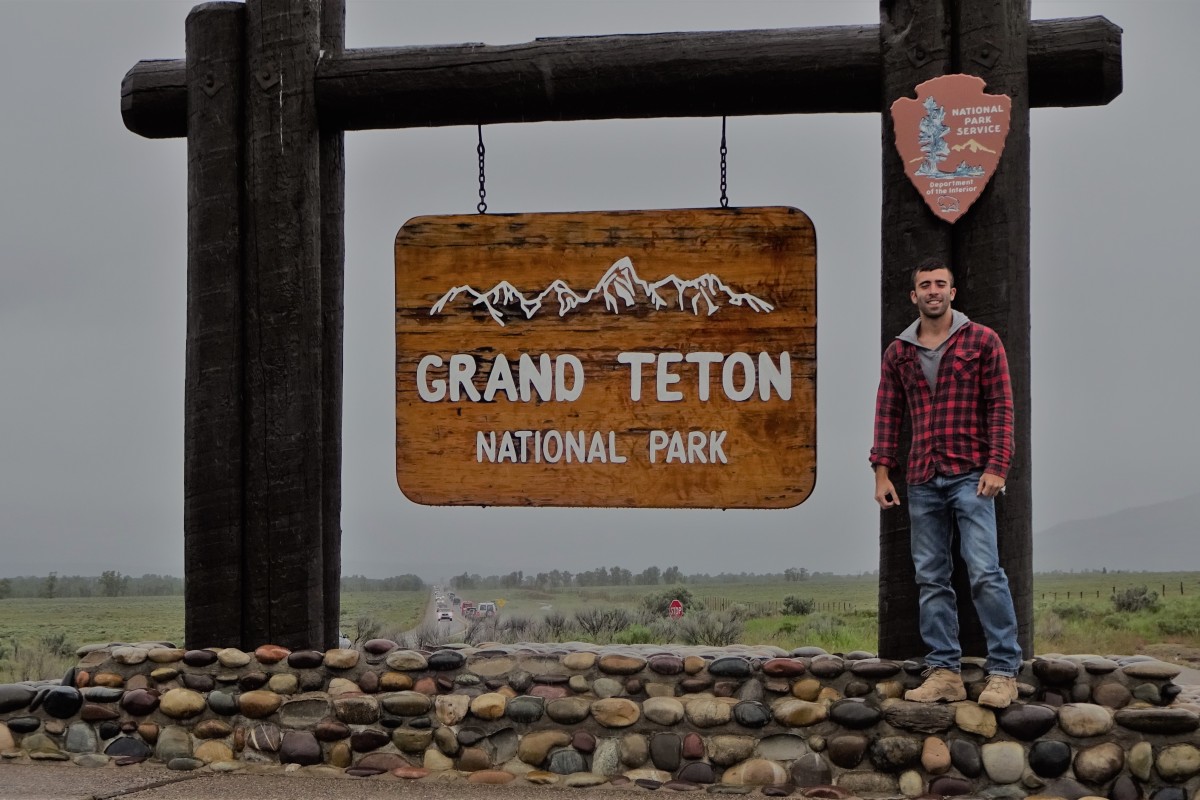
A Wintery Mix

The delicate snow gingerly descended upon the landscape. A family of deer paused in a clearing of cold green grass. They made eye contact and then trampled back into the aspen grove. I was climbing up the mountainside in my car under the blanket of white and grey sky above me, having left the arid canyons and valleys of Dinosaur National Monument and now moving into the rich wet forests approaching Grand Teton National Park.

The wind picked up, and the aspen rattled as the pines swayed side to side. I was thrilled by the sudden change in environment. I had partially expected this. I knew I’d be making my way into colder temperatures, but snow hadn’t crossed my mind. I had stopped days before in Grand Junction, Colorado to buy a pair of jeans, since I had no long pants and also another sleeping bag. This would make three sleeping bags to layer up and keep me warm. I had read the temperatures in this region, even in June, could still swoop down into the forties and even the thirties. For this trip in its entirety I had initially packed more for the desert, and couldn’t have imagined packing for snow, especially back in my sweltering apartment in Kentucky.

The snow picked up and the wind swirled it around. Here I was in a blizzard in June. This was novel, and I loved every minute of it. After my northward journey, and ascending about two thousand feet from where I started at Dinosaur National Monument. I arrived in Jackson Hole, Wyoming, a ski-resort town but also a tourist and outdoor adventure hub, and in that sense the Moab of the North. I didn’t know this place was such a destination but quickly learned it was the only remaining town before entering Grand Teton and Yellowstone National Parks from the south. Unsure of when or where my next meal might come from, I quickly slid out into the cold to run into a Mcdonalds for a chicken sandwich. Afterward I changed my attire in my car, from my shorts and tank top into my new jeans and flannel.

Cars started to line up on the roads through Jackson Hole. People were out and about on vacation, although given the weather it may have looked like people were out for last minute Christmas shopping. The crowded roadway added to the hype of reaching the park. This was not some place tucked away off the beaten path but this place was known. This was the place to be. You could feel the excitement in the air, wedged in between the falling snow.

I rolled into Coulter Bay Campground where I checked in and was assigned a campsite. The landscape was grey and green between the grey sky, the pavement and crushed rocks, and the grey of the tree limbs which stuck out skeletally among the forest of tightly packed conifers. This landscape was new to me. I’d never been to the northwest woods. The excitement of a new terrain beset me and the rich wet aroma of pines dampened any dry configuration for the desert I was affixed to. When I turned the car key and pulled it out from ignition, I had one goal in mind: to set up my tent as fast as possible getting the least wet possible. The snow had turned into a mixture of  sleet and rain, what one would call a “wintery mix,” but it seemed inappropriate to use the term in June. 

When I had purchased my additional sleeping bag and jeans, I had also purchased a new tent to replace True Blue which had been decimated in the monsoon at Guadalupe Mountain National Park. The good aspect of this was that all the components of the tent would be all neatly put together. The downside was that I was anticipating fumbling around, trying to learn to set up a new tent in this undesirable weather. However, it was a success. I set the tent up quickly despite my fingers growing slightly numb from the cold. Being so new, it was perfectly clean and had that new tent smell. I wasn’t sure how sleeping was going to be in the freezing cold, but I felt perhaps adequately prepared and realized only time would tell.  

I warmed back up in my car and made my way to the visitor center at Coulter Bay. Coulter Bay is the only named “village” of Grand Teton National Park. A National Park “village” is a location where services are congregated. Usually there is a campground, a general store, gas station, a restaurant, a visitor center, and lodging. Although Coulter Bay is the only one that formally bears “village” with its title, The Jenny Lake area of the park I would also classify as a village. Next door, Yellowstone National Park has many villages because of its immense size and popularity. 

Although I already had some trails planned. I wanted to consult a ranger to make sure I didn’t miss anything and also to inquire about what to do in the present state of rain, so I made my way up to the counter in the visitor center. A friendly gentleman handed me a park map and guide. “Here’s what you need to do. Go to the Jackson Lake Lodge, find yourself a nice seat in front of one of the big fireplaces, look through the guide I gave you, and plan some things for tomorrow.” I liked his friendly assertiveness and recognized his Chicago accent. He lifted the responsibility of having to plan my evening, and I liked the sound of what he was saying. I was thinking maybe the weather would clear. Maybe I could squeeze in a hike today, but taking some time to relax by a fire in a lodge while the weather did it’s wintery thing outside sounded very much appealing. I loaded up my backpack with my Chromebook, postcards, journal, and pens, and stepped into the most comforting of lodges. 

I’d seen Jackson Lake Lodge in pictures particularly its grand atrium perfectly framing the Tetons. At the cusp of Project 66, the largest construction program of the National Park Service in which many of the visitor centers and modern facilities were constructed, John D. Rockefeller had this lodge constructed in1955. It is modern, but tasteful. It’s most unpretentious on the outside and on the inside it’s sleek, warm, and dignified. In the corners on either side of the main room stood enormous fireplaces, big enough to walk into. They were blazing and crackling and it was the perfect comfort and contrast to the climate outside. I settled into a comfortable chair, a mound of chopped firewood stood against the wall to my left. At one point a lodge employee threw some more wood onto the fire and poked it with a stick. I began to write some postcards and tried to drown out the obnoxious clamor of the kids around me. Two ladies talked as their kids ran about the fireplace and furniture. One girl, probably around six years old or so approached me and asked what I was doing. I simply told her I was writing postcards.  They had ice cream in paper cups from somewhere. They spilled it across the coffee table and giggled. I decided to move. I found a seat further in the lobby where I could focus on writing my postcards. It then became a most peaceful and enjoyable experience. Given the weather, I really had no place to be, and here I was warm, in a beautiful lodge, with the welcoming glow of lamps and the fire contrasting the gloom outside. I could relax. It was astounding to consider how far my trip had taken me so far, from the sweltering heat of the West Texas desert  and straddling the U.S.-Mexico border to now in the wintery northern woods. 

I then opened up my park guide. I saw the listing of some ranger led hikes scheduled for the following day and I decided to scrap my plans. A ranger led hike seemed much more appealing. Also I was concerned about grizzly bears after reading all the warnings. This would pacify the concern. I’d read quite a bit about grizzly bears in preparation for this trip. This was my first visit in grizzly bear country. I learned that attacks, though rare, are nearly always on solo hikers. Hiking with others is exponentially safer. Usually I don’t learn about ranger led hikes enough in advance to participate, but here in this guide they were planned out for all summer at specific times.

Sitting here I also quickly hopped on the internet to check the weather, retrieve some addresses for postcards, and share this post:  “Here’s an update- Dinosaur National Monument in Utah was very colorful and beautiful. Today I traveled through a blizzard into Wyoming. I set up my new tent for the first time in Grand Teton National Park. It’s a new landscape and climate for me. The pine smell is amazing. It’s raining and there is a “winter” storm advisory- snow expected tonight, so right now I am at Jackson Lake Lodge sitting by a grand fireplace. I sort of feel like I am at a Disney Resort. Everything is perfect. I can’t see the Tetons because of the clouds and rain, but I spoke with a ranger, and tomorrow the weather will clear and I will do some hiking and see the Tetons in all their glory. I admit I do want to see a grizzly bear, but just at a safe distance.”

The rest of my evening would simply involve dinner in the lodge and returning to my camp for slumber, but first I would have my most memorable wildlife encounter in the park and would find myself in trouble once again with a park ranger.

Read the previous entry “Be Still. Be Calm. Be Quiet,” here: https://joshthehodge.com/2020/09/12/be-still-be-calm-be-quiet/

Check out my book Canyonlands: my adventures in the national parks and the beautiful wild here: https://www.amazon.com/Canyonlands-adventures-National-Parks-beautiful/dp/1711397873