Going-to-the-Sun and Grinnell Glacier

In my mind Glacier National Park was the National Parks of National Parks, like a next level experience only conquered by the very bold and adventurous, or something like that. I made it! I had seen pictures of course and was astounded by the unbelievable views, and now I was here! I turned left off Highway 2, through a little tunnel under the railway, and into the little tourist village of West Glacier. I passed by a visitor center for Alberta, Canada. Although I was not in Canada, I was so close. I also passed by a few little tourists shops, Glacier Raft Company, and a little restaurant and ice cream shop called Friedas. 

The pines hugged in closer after I crossed the bridge over the Middle Fork of the Flathead River, and there in the shade of the dark rich pines was the National Park sign. Bold and beautiful it read, Glacier National Park. I admit it’s now commonplace for me, after having spent many summers in Glacier, but at the moment this was a big deal. It was my first time here. This was an accomplishment. This was one of the more out-of-the-way National Parks I’d been to. Its mountains were extreme with moving Glaciers, and its forests held grizzly bears and wolves! This was no ordinary place to be. I was swept with a sense of accomplishment, gratitude, and wonder being here. 

Nearby I parked at the Apgar Visitor Center. It was early and it was still closed, but there was a National Park bus stop on site. The plan was to take the bus up to Logan Pass, the highest point on the famous Going-to-the-Sun Road. From there I’d hike the Skyline Trail one way about fourteen miles up to the Garden Wall to catch a view of Grinnell Glacier, then I’d continue north to the Granite Park Chalet where I’d take the Granite Park Trail down to “The Loop,” another spot on the Going-to-the-Sun Road. There I’d catch the bus back down to my car. This would be a full day endeavor hence the getting started so early. 

As I stood there waiting for the bus, I was cold. I needed the sun to rise and warm things up. I had a few layers on, including my new Under Armour base layer I bought at the thrift store outside Seattle, yet I was still just wearing shorts. I knew it would warm up. I double checked all I had in my backpack: a map, snacks, water, flashlight… just in case. I was prepared. My boot laces were pulled tight. I was ready! Anxiously I walked around, reading all the signs, observing what other tourists were doing, and checking messages on my cell phone. I had caught a wifi signal from the visitor center. 

I chose to take the bus as opposed to driving for a few reasons. I was nervous about driving the Going-To-The-Sun Road. It seemed intimidating. The road is known as the most scenic drive in America but was also snug against dramatic cliff edges gaining 2,560 feet in elevation. I knew I would have to drive it to carry through with my next few days’ itinerary, but I wanted to size it up first and just observe it with someone else behind the wheel. I didn’t have to drive it until the following day. I also read that parking can be difficult to find at Logan Pass where my trailhead was, so I didn’t want to risk not being able to park. Lastly, I like the energy in the air on a bus in a national park with everyone geared up for adventure. It’s a unique culture that I find to be part of the park experience. 

The bus ride was terrifying! I sat on the right side near the front of the bus. I swear this bus was too big for the road. Around every bend I felt as if my side of the bus was jutting off the cliffside. The first few miles of the road were easy, relaxing, just through the mysterious, dark, wet, mossy forest with light peaking through in the most intriguing and mystifying ways. The bus took us alongside Lake McDonald, the long-stretching wonder. Then we were along the beautiful McDonald Creek, where the water runs clear if not in a surreal turquoise. But then the real ascension began and things got hairy. It wasn’t so bad until rounding a place called “The Loop,”  where the road makes a dramatic turn and narrows. There’s supposed to be two lanes, but it seems more like one by any other comparison. 

The trees lessened and boulders became more prominent. I began to notice the forest below, no longer aside us. We were up in the mountains. The views were astounding, more magnificent and boisterous than anything I’d seen before, as if the mountains were calling for attention. However, I would appreciate them more the next day. Right now I was distracted by the thousands of feet expanse just beside me to which I felt I’d be plummeting down at any moment if for some reason I didn’t cling hard enough to my bus seat. The tension was real.

We proceeded through a few tunnels of which we were too big for; and a few bridges, built into the rock walls, better suited as foot paths in a Vanderbilt garden. I have never been more nervous on a ride in my life. Around each wind in the road, I felt I was just swinging out over valleys on my corner of the bus, dangling over great heights.

I could not understand how the bus driver was just so casual and relaxed, making friendly conversation with another passenger. She was loudly talking about how she was a school bus driver and this was just a summer job. I was carefully watching her in case I had to spring into emergency assistance, I suppose.  At one point she grabbed her water bottle for a sip. Two hands on the wheel! I wished to telepathically impart. 

I would be gripping that steering wheel so tight, head tilted forward, focused on the road. I wouldn’t be talking to anyone. I would have to be totally focused on the road. In fact I couldn’t even drive a bus on this road. We would already be plummeting down to McDonald Creek. Maybe if she is so relaxed I should be too. I tried to, but I was so tense. I couldn’t wait to get off this bus safely.

The bus stopped for some mountain goats crossing the road. We were getting close! We were now near the tundra. Water flowed around in many different directions and spread everywhere from the melting snow. Tight shrubs and alpine grasses hugged the rocks, and the tops of mountain peaks stood as monuments around us.

I survived! I got off at Logan Pass on top of the world. Here is the Continental Divide. Water flows east to the Atlantic, west to the Pacific, and north to the Hudson Bay. There’s a real feeling of being at the pinnacle of North America. There’s also a big parking lot where a visitor center sits along with two big flags, one of the U.S. and the other of Canada. Glacier National Park shares a boundary with Waterton National Park in Canada. Together they form what is called an “International Peace Park.”

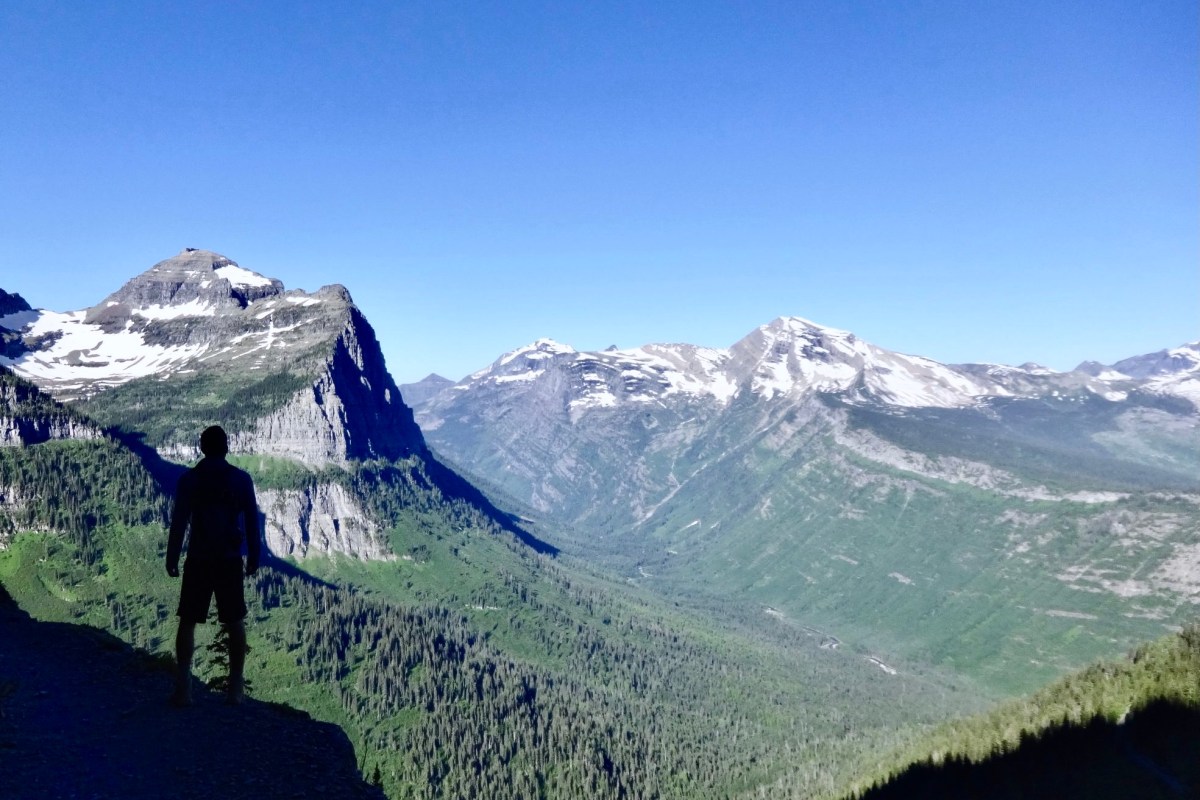
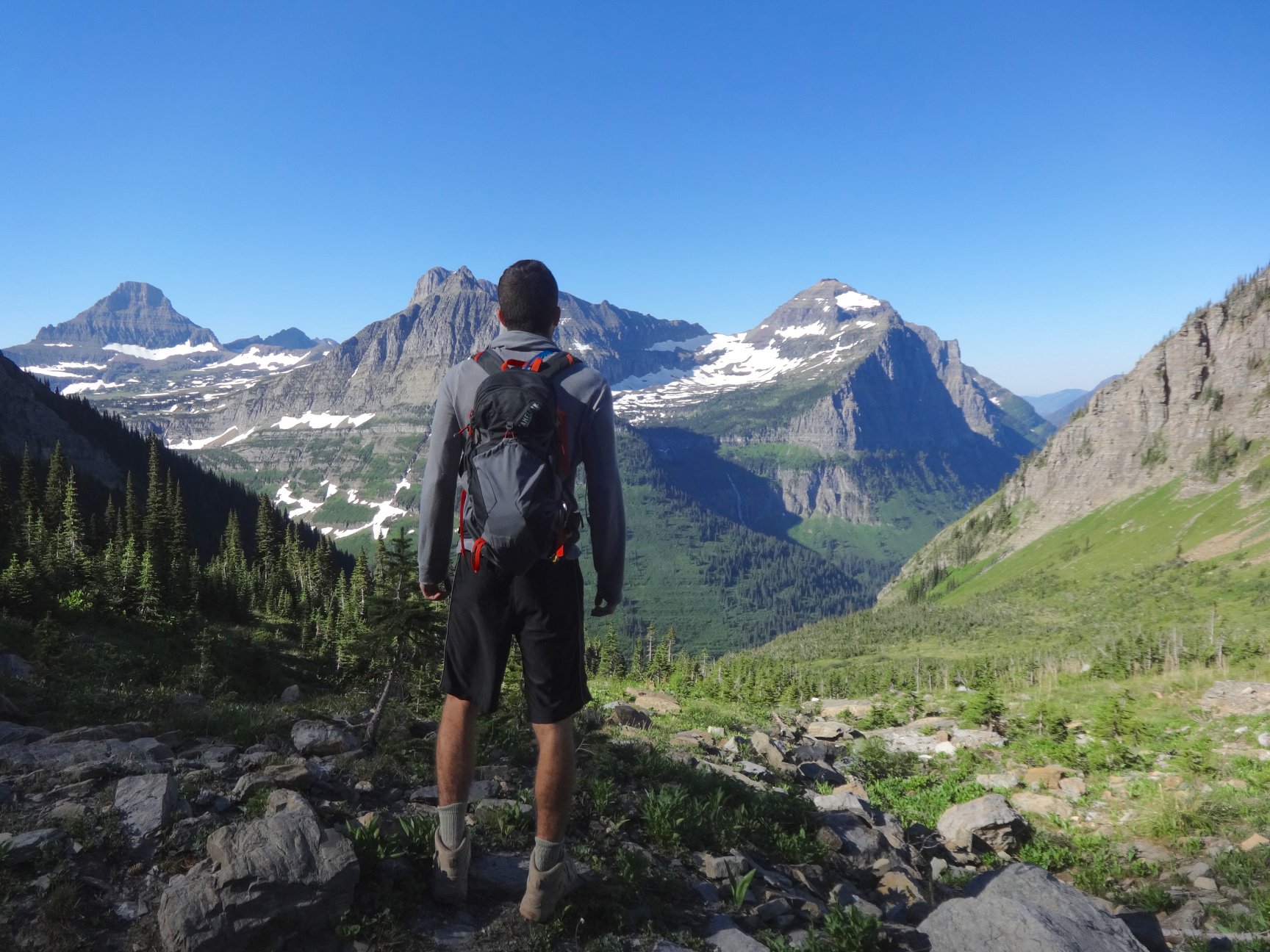
A short distance from the parking lot at Logan Pass is the trailhead for the Highline Trail, often touted as the best hike in the park by many visitors. It begins at such an elevation that the mountain peaks around it are obviously bald, exposed to the wind and sun, reminding me of some of the rock formations of the Southwest in Arizona or Utah. The trail starts just off the Going-to-the-Sun road, and goes down a shallow decline with rich green grasses and a few pines. Then it snugs up close to a cliffside. The trail is just a couple feet wide, right up against a rock wall. The other side is a sheer cliff, plummeting hundreds, maybe thousands, of feet down. This did not bother me at all. The difference: I was in control of my body but wasn’t of the bus. This was an experience to marvel at. I loved it! The trail was already pretty busy this morning. There were other hikers right in front of me and others trailing up behind. “Be careful,” they told one another as they carefully maneuvered the small path. 
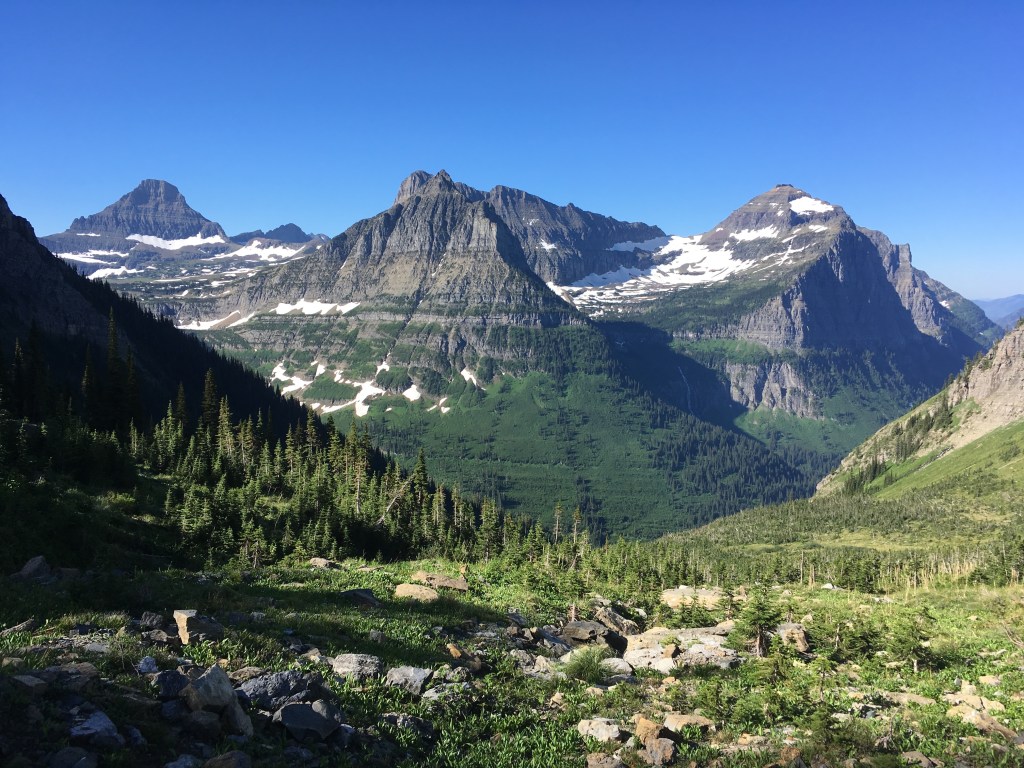
This trail lives up to its hype. It was extravagant. At times it opened up to just enormous views atop these mountainous meadows spread with yellow blooming glacier lilies and patches of snow stretching before dramatic mountain peaks carved by glaciers. Each mountain valley was framing another stunning view in the distance. There was forest too, a grand immensity of it, but I was mostly above it. The descending display of each little triangular pine tree top spoke of the grandeur of the landscape before me. The sky was rich blue, the snow bright white, the mountains gray with skirts of dark green pines around their bases, and just before me was the vibrant green and yellow of the glacier lilies. I was right in calling this a next level National Park. These were the most immense, grandiose, dramatic, and beautiful views I had seen out of any National Park. This was the cream of the crop, or as they say, “”the crown of the continent.” Each dramatic mountain peak was like the palisades on a crown, the landscape adorned with the finest things of nature: glaciers, waterfalls, forested basins, the crown jewels of God’s creation. 

This morning the sun was also very bright and positioned at just the right angle to illuminate these jewels, reaching into every little crevice and wrinkle on the mountainside, adding to the depth and detail of everything. 
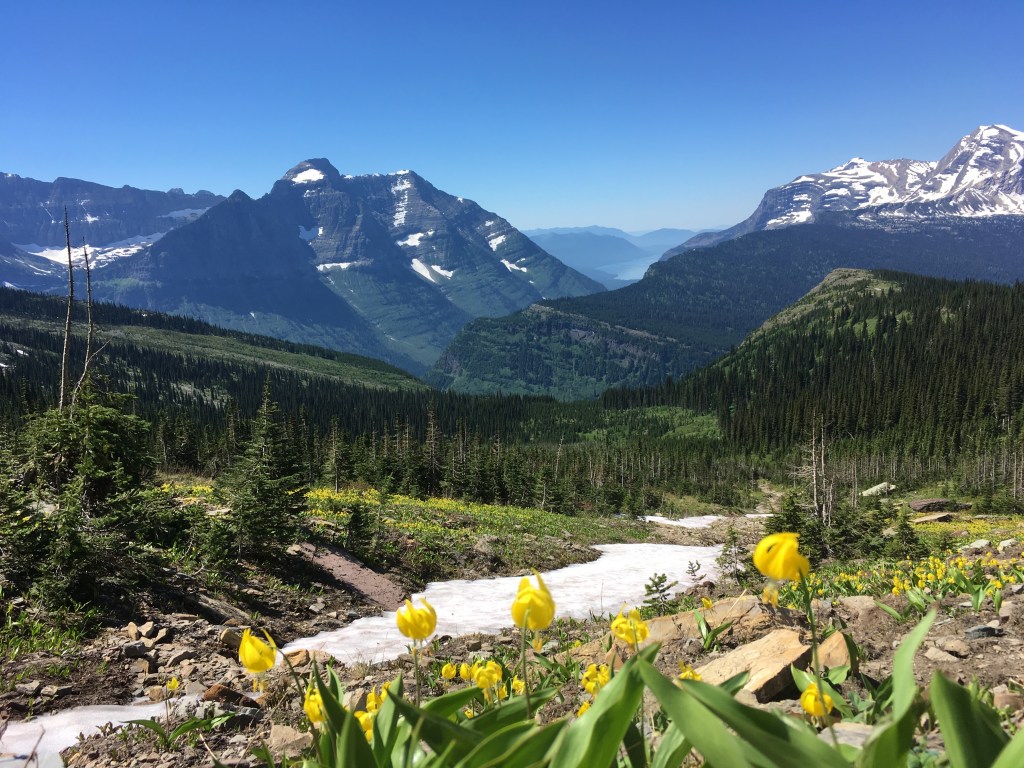
After about an hour in, I stopped at one majestic meadow to shed a few layers and eat some electrolyte gummies. I was getting quite warm in the morning sun. The trail was still busy, and hikers continually passed me. I found a rock to first set my backpack on and then to sit down on for a moment and behold the landscape. Although warm from the sun, the air was cool, and I took in a deep refreshing breath of rich snow-chilled mountain air. Then I carried on. 

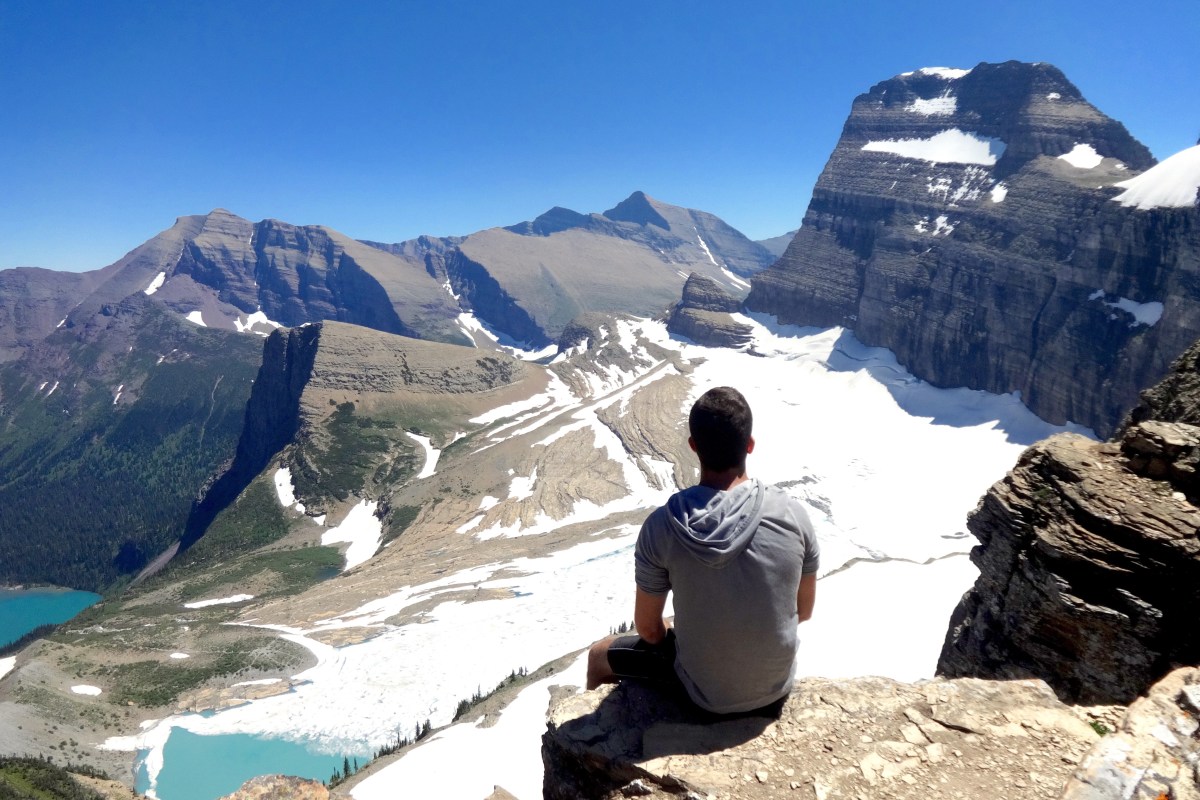
About seven miles in I came to the Grinnell Glacier Overlook spur trail. It was just a half mile and would lead up to the feature called the Garden Wall, which is a natural rock wall that is a definitive line of the east side of the park and the west side. It’s like a great narrow spine of the park. From here I could look down and see Grinnell Glacier. The spur trail was completely exposed above the treeline and very steep, gaining one thousand feet in a half mile distance. Sometimes when going uphill, I try to go fast and just get the exertion over with. I tried here, but the air was very thin on top of the world. My whole body felt so heavy and gravity felt extra strong. When I got there I was utterly amazed! I didn’t know what to expect. I hadn’t looked up any images prior. I was stunned. I hadn’t seen anything like this.

This may be a strange comparison, but it kind of was like when someone reveals a bloody wound, and you’re shocked by the look of it. You weren’t expecting to see something so abnormal on the skin’s surface which is usually smooth and predictable. It’s a grand abnormality on the skin and in the flesh. This glacier view was that grand abnormality on the earth’s surface and in the earth’s crust. But replace the disgust with awe, and replace the red of blood with rich turquoise blue and a white so bright and so angelic it burns.
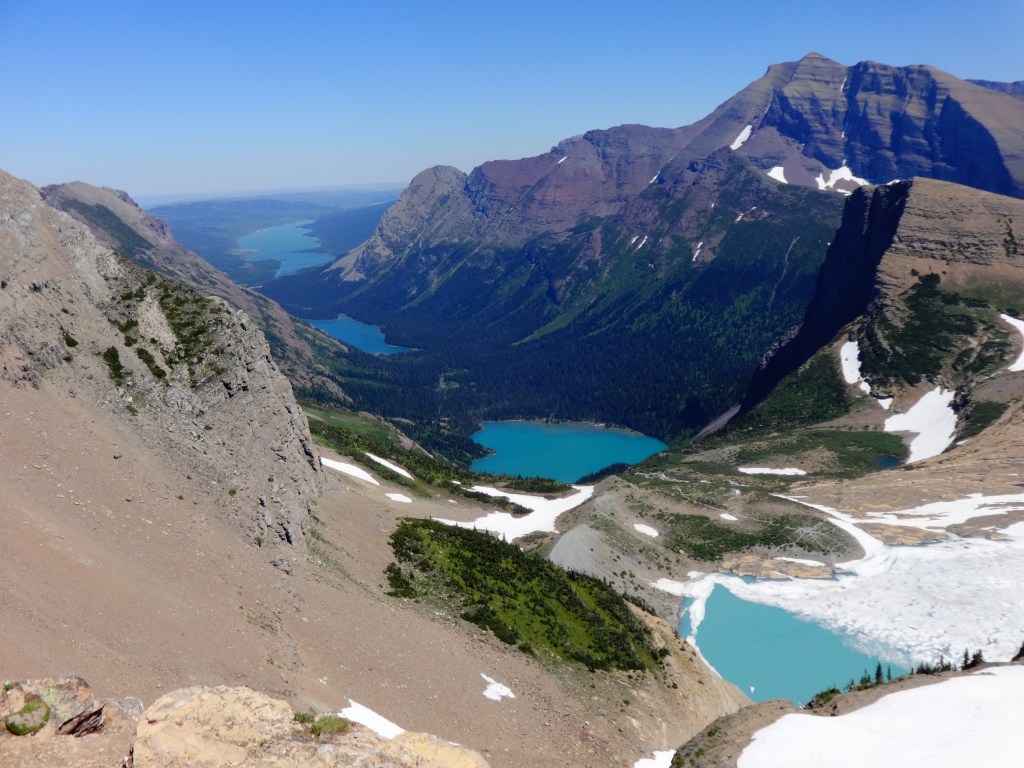
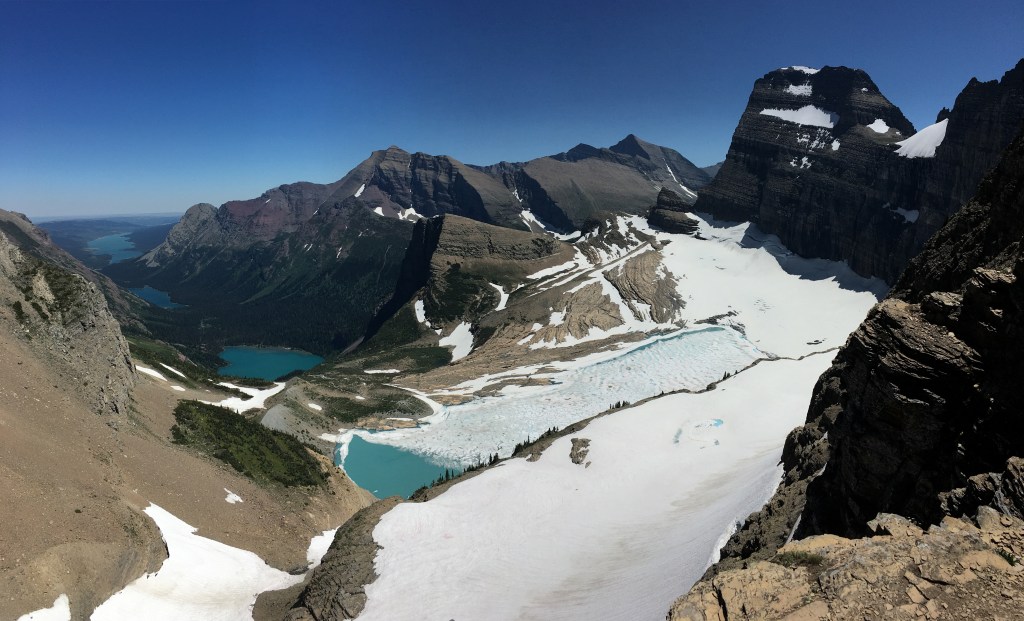
Wow!  I had never felt so high up. I was way on top of the world. I thought I was on top of the world at Logan Pass. I was wrong. This was even next level! I sat on a rock’s edge, below me rocks crumbled down, slanting into a blanket of snow which then spread over Grinnell Glacier. Then hundreds of feet below, I could see the ice rippling with white and turquoise blue. It was the glacier descending and melting into a bright opaque turquoise glacial lake. The lake fed into another lake and then into another lake in a chain of glacial lakes spread out immensely in the forest below. I was on top of everything and looked across at the other gray mountains tops up here above the treeline, rippled through the ages with rock layers. There were blankets of snow littered amidst these mountains, drooping in every which way. It was also clear here to see the carving power of a glacier. It’s where a whole mountainous valley began. This was. and stands to be, one of the greatest sights I have ever beheld. 
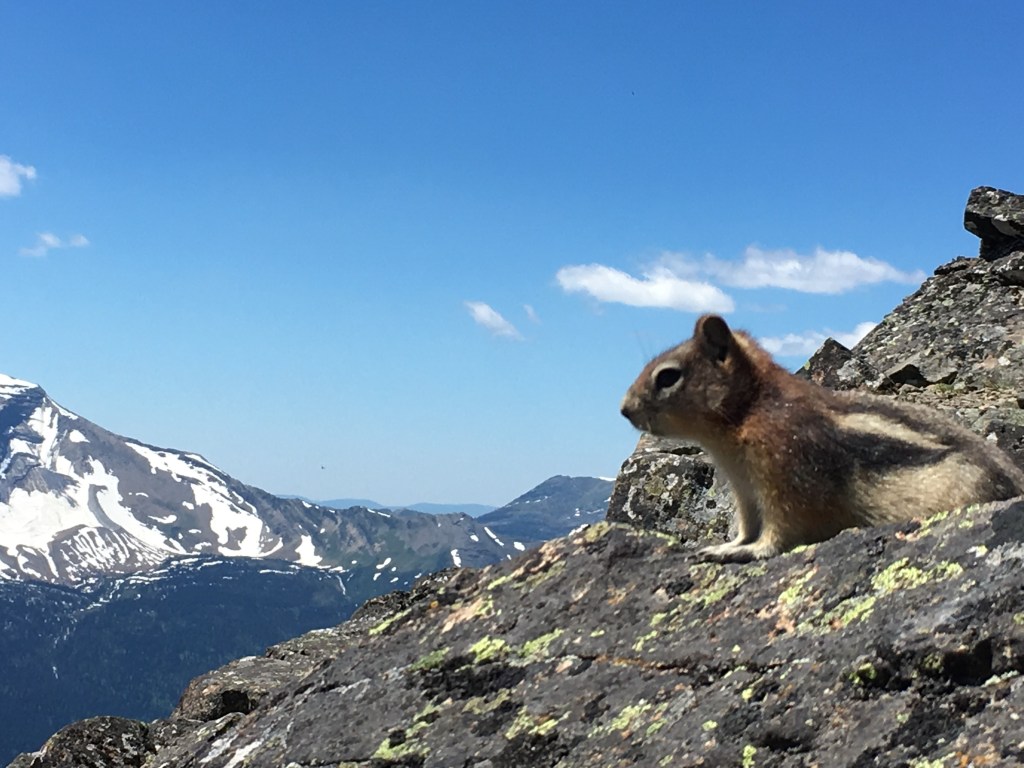
I sat to snack on a Clif Bar and enjoy the view for a spell. A little chipmunk came very close. I’m sure he was hoping for a bite or two. That wasn’t going to happen, but I did take his photo, which he couldn’t have cared less about. Then shortly after, a group of Chinese tourists arrived all wearing the same off-white sun hat. They were all oohing and aahing and talking in their sharp-sounding language. 

This place was unbelievable. I had really arrived somewhere!  I couldn’t have conjured up such a view in my mind. Now it was resident in my mind. So satisfied, I began my descent to carry on back on the Highline Trail.
If you enjoyed reading this, check out my book Still, Calm, and Quiet“

Check out my previous entry here: My First Day Ever In Montana and Wresting with God’s Promise

Visit www.joshhodge.com

My First Day Ever in Montana and Wrestling with God’s Promise

Something inside of me is dying, and I feel like death. These were the exact thoughts, exact words running through my mind. I was restless in my tent at night, rolling around on my sleeping bag. I had never felt quite like this before. I wasn’t in pain, for there wasn’t any sharpness of feeling. But there was this subtle aching, and even more so than a feeling, it was a knowledge that stirred within me. I was not well. I couldn’t get comfortable. My body was in utter forthright rebellion. Inflammation was raging on. The body was winning in this battle despite my will. I wanted to be well. I wanted to relax. The body wasn’t having it. Therefore my sleep was interrupted, shallow, brief, and before I knew it was morning.

The day before I had traveled from Lake Roosevelt National Recreation Area in Washington here to West Glacier, Montana. I had traveled nearly six hours, around Spokane, through the panhandle of Idaho, past St. Regis, Montana, and up the west side of Flathead Lake. In St. Regis I made one of my more notable stops of the day at the St. Regis Travel Center. Right off highway 90, just across the Idaho border in Montana. This gas station establishment boasts “restaurant, casino, Montana’s largest gift shop, expresso” and “free live trout aquarium.” I just pulled over to go to the bathroom. I didn’t need all this, but I’ll take it! (minus the casino). ! It was like the Montana version of Buccees. Here I was greeted by a bag of free popcorn and a near endless supply of Montana t-shirts, huckleberry everything; and every Montana, grizzly bear, and Western knick-knack and patty whack you could imagine. Many items were boasting common Montana mottos and phrases: “The Treasure State,” “Big-Sky Country,” “The Montana way,” “Grab life by the horns”…  I browsed around and didn’t purchase anything but was impressed by the inventory. In later summers working in Montana, I’d be back here a couple of times. 

Shortly I found myself traveling upside Flathead Lake. I didn’t know that was its name. All the places I’d see in the next few days I’d have much more experience, knowledge, and memories with in the future with my subsequent summers working in Montana, but now it was all new. When I write about my adventures I like to talk about my experiences and observations at that time. As difficult as it is, I make a conscious effort to restrict myself from injecting later knowledge and experiences of these places. So although now I know it was Flathead Lake, then it was just some big lake I was traveling by. I was impressed by such an immense lake. Why hadn’t I heard of this before? It is the largest lake in the U.S. outside of the Great Lakes. I stopped in the community of Lakeside. I was very hungry and found a little cafe right off the road. I went inside, but after seeing the prices, I decided to continue on. I wasn’t used to the tourist prices in the Flathead Valley.

Atop the lake lies the biggest city in the valley, Kalispell. My hunger was so ravenous. I stopped at a Kentucky Fried Chicken. It genuinely sounded so good to me. I know it was not the best choice for my gut, but I was in need of some comfort food. This solo traveler from Kentucky, a little bit weary and beaten down by health issues, needed a bit of comfort from back home. Now it is humorous, because I know of way better and nourishing choices in the valley for food. 

Leaving Kalispell, more and more tall pines filled in the landscape, and the road just seemed to roll along these wooded hills, swooping up and down with the great Rocky Mountains of Glacier National Park standing in the distance. Although the woods were everywhere, I did not feel nestled in the woods because the road was wide and beside it was a path for bikers and snowmobiles. Everything around me just seemed so big with the land and forest just so immense. I passed by a few tourist traps: “The Huckleberry Patch” and “Huckleberry Haven” boasting their huckleberry pie, and a western ranch style building called “ The Montana Fur Company” with a tipi and Native American relics outfront. Most prominent was this place called the “Ten Commandments Park,” with a dozen or so billboards situated together in a half circle, each loudly displaying a religious or political message. This seemed like something I’d see in Texas. Is Montana the Texas of the North? This I certainly thought.

Some National Parks have no real build up, not much of a tourist economy around it. Others, such as the Great Smoky Mountains, have an extreme excess. Glacier seemed to have a moderate amount of tourist build-up. The place seemed touristy, but not in an obnoxious way. Its quantity and quality was of such a way that it served the park well in building up just the right level of excitement and anticipation without being obnoxious or tacky. 

I wouldn’t make it into the park this evening but according to plan I would stay at the West Glacier KOA. I had read this was the flagship KOA. I’d stayed at many Kampgrounds Of America and had become a big fan, so to stay at the allegedly best of all KOAs was an exciting thing for me. I had noticed, while booking my stay online, that this KOA was also the one featured on the front cover of the KOA directory. This was big stuff! Rolling along wide wooded highway 2, suddenly to my right stood the big bold beautiful KOA sign made of rich dark wood with black letter insignia, and it didn’t say “Kampground” as most are identified, It read “KOA Resort.” Oooh, fancy!

I checked in at the office, where I also was given a free KOA koozie. I don’t drink, but I was still glad to have a KOA souvenir. The campground was enormous. I had a standard tent pad which backed up to some woods at the junction between where the cabin guests stayed and the RV area. I quickly set up my tent, because I was on a mission: I wanted to enjoy the hot tub, which I did. It was small and busy, but I enjoyed a nice warm soak. I then finished setting up my camp, blowing up my air mattress, and throwing my pillow and sleeping bags in the tent. I felt calm and relaxed walking around the campground and getting familiar with the place. There was a vibrant energy, a positive one of happy families on vacation and kids on their bicycles. I kept having to make frequent trips to the bathroom. Although I felt relaxed in many ways, my gut was not happy. 

I noticed on the resort map there were some little hiking trails in the woods just behind my site. I went on a stroll through the woods and there I decided to call my parents and let them know of my sickness. I had procrastinated telling them. I guess I was hopeful it’d just go away as suddenly as it seemed to come upon me, and therefore be a non issue. But I felt like now I was in for a long haul. I should let them know. Just talking about it and my experience with it so far was draining. I didn’t want to really talk about it. I wanted to ignore it, but I couldn’t.

Soon, after I settled in my tent for the night, and this was the night things took a major turn for the worse: Something inside of me is dying, and I feel like death. These feelings. After tonight, the illness would not just bother me but rage on. 

In the morning I ate at the KOA resort. It had a restaurant, with a nice outdoor patio. I ordered the Montana Breakfast of eggs, potatoes, and thick sausage patties. I was impressed by the quality here. In the subsequent days I’d learn this trio is the standard Montana breakfast almost everywhere. After breakfast, I was driving, for the first time ever, into Glacier National Park with great excitement. I was going to hike the famous Skyline Trail, which in my present state of health, would not be easy.  

As I was driving I thought back to what I would consider my greatest thoughts and reflections on this trip so far. I thought about Nurse Logs and the life-enriching ability one leaves behind after they have died. I considered  my previous thoughts on the colors of my sunset and the qualities of one’s life that can be evident and seen when a life comes to completion, or to put it more bluntly, one dies. There was so much thought about death, but not in any dark way, but in an inspiring way, thinking more about the quality of a life truly lived before time naturally runs out. I was only twenty-eight, not an age one normally contemplates what they leave behind upon their passing, but these were my thoughts. It was curious to me that shortly after these thoughts came to me unexpectedly my health had been taken from me to the point my mind spoke: “I feel like death.” 

Were my deepest thoughts and personal revelations preparing me for this, preparing for the end? It sounds very dramatic in retrospect, but in the moment it was quite sincere. The only other time my body was under this attack with ulcerative colitis brutally flaring was when I was in college and it was severe. There were the restless nights of rolling around the floor in pain, the hospitalization, the intense pain, the blood loss, the anemia, my body not digesting food, the malabsorption, the withering away, the affected eyes, the suffering teeth, the weakness, the fatigue, the fainting, the crying. The option of surgically taking out my colon wasn’t on the table, because the doctor believed I was too weak to survive the surgery. I look back and marvel how despite everything I continued onward. 

At that time of the first onset I was a student in education, and I was due for student teaching the next semester. With my current state of health I felt I just couldn’t do it. I informed my parents I was coming home. I notified the education department at my school, telling them I had to postpone my student teaching because of my health. Then, this decision sat horribly with me. I didn’t feel at peace about it at all. Although now officially unenrolled, I called a meeting with the dean of education. I knew how rigid and firm to policies and procedures the whole institution was. I felt embarrassed, but I was going to plead and beg them to let me back in the program. I wanted  to proceed with student teaching despite my health and weakness. I told the dean “I am very sick, but I may not get better. I may be like this for the rest of my life, so I don’t want to let this sickness stop me. I must learn to live with it.” 

I’ll never forget what the dean told me. Somewhat surprised looking at me square in the eyes, she said “Well, that says an awful lot about your character.” I was back in!  God gave me an inner strength and fierce resistance to face my illness while moving forward in life. . 

In the struggle I clung on with a tight grip to a harmony of Bible verses I felt God spoke directly to me, 1 Peter 5:10 and Phillipians 4:7 together: “After you have suffered a while, the God of grace Himself, whose knowledge surpasses all understanding, will restore you and make you strong in Christ Jesus.” 

It’s just for, “a while,” I thought. That helped me persevere. God will “restore” me and make me “strong.” That gave me hope. However, I was struggling with this. I wanted to believe it. I held the word of God to be true. It had proved itself over and over again to be so, but this night was exceptionally long, and there was no improvement in my health whatsoever. I felt myself slowly dying. What does this promise and these verses really mean?

One evening in my quiet time, alone in a little study nook in my university, in my sickly state with increasing complexity of illness, I was journaling and thinking over this promise of God. Then it dawned on me: I think I know what it means. The first part about “suffering a while,” well I was there, no doubt. I knew that to be true. The second part, “I will restore you and make you strong.” I struggled with that because I was not seeing it as I expected it to be, in this life. Maybe, that is the part God will accomplish when he calls me home. When I die. In his eternal presence I will be restored and he will make me strong. So maybe God is telling me, “After you have suffered a while, I will bring you home to restore you and make you strong.”

 It was profound to me and haunting in some ways. I didn’t want to die so young, but at the same time the notion was comforting in knowing that whether it be in life or be in death God restores me and makes me strong. I am victorious through Him, either way! I took a deep breath as though accepting my fate, not sure I felt ready for the responsibility set before me, to proceed into death with faith, resting on His promise. I zipped up my backpack, tucked away my journal and Bible, and carried on with life’s demand. Live strong and fiercely to the end. But oh what an ache it was still to my soul! This was a silent disease. Few would know. I’d be here and then I wouldn’t. 

God’s promise did hold entirely true, as it always does, and to my own heart’s desire, for God is good! I was restored and made strong in this life shortly after. 

When I look back at this period of sickness in my life, it doesn’t seem so dark, and actually never felt dark in the moment either, though it may seem so from the casual observer. Actually, I am extremely grateful for that time of sickness and for the wrestles with faith. These were times of some of the greatest spiritual intimacy and dependency on God in my life. His promise held so much more, too, than what I even thought at the time. When God promised to restore me and make me strong, I considered that just in the physical sense. God did mean that, but He also meant it in a spiritual sense. God would strengthen me spiritually beyond what I could see in the moment. To go through such an experience of facing a prospect of death so young and doing so walking hand in hand with God, I think produces a level of wisdom and maturity that I am eternally grateful for and has become an integral part of my character and outlook on life and death. I would never want to go back and relive those days, but I’d also never wish they didn’t happen. Dolly Parton captures the sentiment in her song The Good Olde Days When Times Were Bad: “No amount of money could buy from me, the memories that I have of then, No amount of money could pay me, To go back and live through it again.”


But now, what was happening to my body here on this journey out West, here at Glacier, with the return of this great grave sickness? My thoughts went back to this previous era of life, to the promises, to the pain, to the prospects. I didn’t want to have to face and reconsider everything, but here it was again, in my face (or in my gut rather). There was a bit of initial panic and I felt overwhelmed. What do I believe again? I saw how God’s promises applied back then, but how do they apply now? I thought I had closed that chapter and had moved on, but it was back. Was it the same chapter of life? No. This was chapter 2. I was more prepared in the spiritual sense. Something was about to go down (or come down rather).  That would soon become evident.

If you enjoyed reading this, check out my book Still, Calm, and Quiet“

Check out my previous entry here: Lake Roosevelt and the Conservationist vs. the Preservationist

Visit www.joshhodge.com