I woke up in the Indian Lodge so well rested that it was one of those moments in which I looked up at the ceiling and then around the room, taking a moment to process and recall where I was. I well pleased with the recollection that I was at the Indian Lodge at Davis Mountains State Park in West Texas.I got up, and the floor beneath me was sturdy and firm. This was a fortress of a structure.
I threw on some presentable clothes and decided to go check out the Black Bear Restaurant, the resident eatery at the lodge. I sat next to the window and enjoyed breakfast from the buffet, satisfying my hunger with scrambled eggs, pancakes, sausage, and fruit with some cucumber and pineapple water. I looked outside at the desert hills and yucca plants of the Chihuahuan desert with the morning sun spreading its golden light into every sleepy crevice of the landscape.
On my way back to my room, I stopped by the front desk in the lodge office. I was hoping to see my first West Texan acquaintance, the friendly lady from check in. She wasn’t there, but her male counterpart was- a young, round, jovial man. I asked him about trails and what to see around the park. He kindly and pleasantly provided me with a map. I took a moment to browse the small gift shop and bought myself a Davis Mountains State Park sticker.
Back in my room I geared up to go on a short hike, 1.72 miles one way up into the mountain to the right of the lodge. The day started off bright and sunny, with only a few bright white clouds wisping through the blue above. The path slithered around sagebrush, curved around a valley and a tall pointed brown rock formation, and trailed around to the spine on the back of the mountain. Once I reached the plateau the Indian Lodge to my right was just a miniature below. To my left was a fence. Someone’s private property butted up to this State Park.
Also, up here the weather started to turn it’s back on me. First there was a whipping wind that violently flustered the desert grass, then deep, dark clouds rolled in. Once again, I found myself in a vulnerable position. I was exposed to potential lightning. I decided to play it safe and return promptly back on the trail from where I had ascended. My nearly 4 mile hike turned out to be a mere 1.4 miles. This wasn’t supposed to happen. Weather never got in my way. But this was the second time on this trip in which the weather won. Despite its apparent threat, a storm never did reach the area.
Back at my car I noticed a dent in the hood of my car. The trouble was this wasn’t “my” car. It was a rental. I began to be concerned about having to pay for damages. I looked at the indent from different angles. It wasn’t that obvious. It was slight, only very apparent at certain angles. I pondered this dent. How could this have happened? I never remember anything hitting my car. Then I considered where I had my car parked all night. It was at the bottom of a short cliff where a road wrapped around just above. A rock could have easily fallen from the road onto the hood of the car. In retrospect, this was really no big deal, but at the time it troubled me. This was not supposed to happen. This trip was supposed to be perfect. This was an unhealthy disposition that was only beginning to be challenged.
Back at the lodge, the sun returned to shine. I took a few minutes to swim small laps in the outdoor pool, so perfectly situated behind the lodge in the beautiful valley. I also sat poolside to write in my journal and enjoy the desert sun.
I checked out of the Indian Lodge hoping to one day return and eager to tell people about such a wonderful place it was. It’s a true treasure. Despite my hangup on the dented hood, my stop at the lodge was rejuvenating, a breath of fresh air, a truly remote hidden oasis, a place where anyone could find comfort and solace on the outermost reaches of the United States, in the fold of the Chihuahuan desert, armored and hidden between mountains.
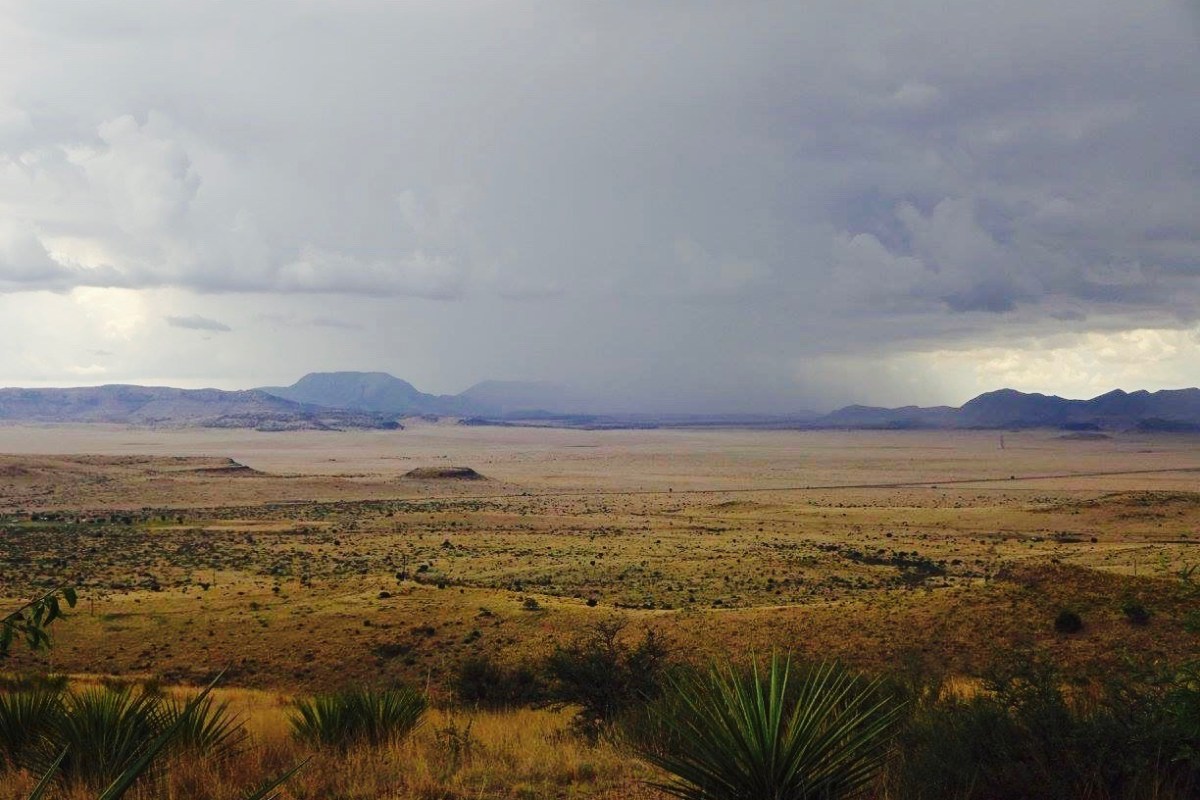
 Leaving the lodge I drove Park Road 3A, also known as the Skyline Drive- one of the park’s proud features. The road switchbacks to the top of the mountain opposite that of my hike. The road ends at an old rock shelter, built by the Civilian Conservation Corps. From here I could see out on some of the wide plains of Texas with blue mesas standing in the far distance. Here I could also see the rainstorm that had threatened my hike earlier, pouring down across the plains. I encountered a family of travelers that asked me to take their picture. I took their picture and carried on.
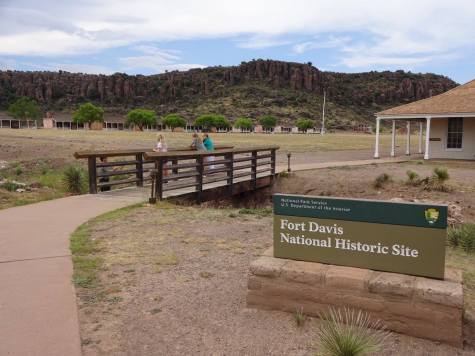 Four miles from the State Park is Fort Davis National Historic Site- a unit of the National Park Service. It actually attaches to the State Park by a trail, but I didn’t have the time to hike there and back. I didn’t know why there would need to be a fort out here in seemingly the middle of nowhere Texas, but I would learn, and I was excited. Any unit of the National Park Service interests and excites me. All of the National Park Service’s sites tell one big story, the narrative of the United States of America. At each one I see my eyes opened to moments in history I didn’t know, and not only do I obtain the knowledge, but being in the actual place where these events took place, and seeing them with my own eyes, helps me imagine and obtain a greater depth of relation to the events. I love it!
In the visitor center, the park ranger offered me a park map. I asked what to see. She opened the map and with her Sharpie highlighter she began highlighting buildings within the complex. By the time she was done, she had highlighted every single thing within the map. I wondered if that was necessary. I think she really just loved using her highlighter.
Leaving the Visitor Center, I explored the history. I learned that Fort Davis was a United States Army fort built to protect emigrants, mail coaches, and travelers along the San Antonio- El Paso Trail, many of whom were on route to the rich goldfields of California during the Rush. The Buffalo Soldiers stationed here protected these travelers from the threat primarily of Apaches and Comanches. They escorted them through the area, as well as repaired roads and telegraph lines. During the Civil War, the federal government withdrew troops from the fort which was taken over by the Confederacy later to be claimed back by the Union. In the late 1800s the fort had outlived its worth. A park ranger explained how it had been sold to a Hollywood filmmaker to film western movies. Then a few buildings of the fort were partitioned off into separate pieces of private land, only be reclaimed by the federal government as a National Park Unit in 1960.
 Today exploring the park is really stepping back in time to a unique era. The Park Service has preserved and restored many of the buildings. This fort is not what we typically think of as a fort. There is no man made barrier of a wall with artillery and cannons sticking out. Rather it is a series of buildings aligned in a giant rectangle around a common green. The fort is in a large canyon, protected naturally by wide canyon walls and Limpia Creek.
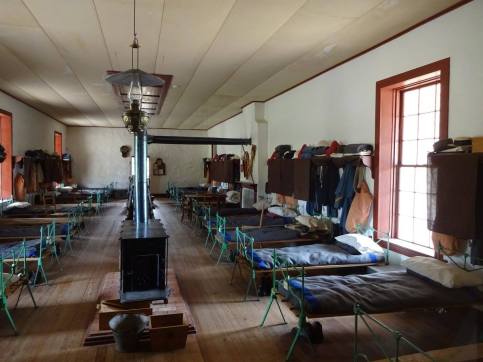 The main attraction of the park is walking in and out of many of the buildings which are furnished to the era. I walked into the barracks. Fourteen beds lined the walls one after another. Apart from a bed, the soldiers were only allowed a few hooks to hang their clothes and a small shelf situated above their beds. In the middle of the building stood a series of coal furnaces. This was very simple. I tried to put myself in the place of the soldiers and imagine what they came “home” to at night.
On the other side of the green were the homes of the lieutenants and commanders. They had fully furnished houses, with beautiful fireplaces and artistic mantels, wardrobes, chairs of varying sizes and style, mirrors, musical instruments, decorations, and all the basic comforts of lavish living. It was such a stark contrast to the lives of the soldiers. I might as well have assumed I was in Manhattan in these homes. Here in the middle of nowhere Texas these commanders had created, perhaps at the cost of the comfort of their soldiers, luxury of modern living. In addition to these places of living, there was a fort commissary, where soldiers were quite limited in supply, and the hospital, which was fascinating and disturbing.
Before entering the hospital I read the background on some real people who once lived here. The plaque told about their ailments, and by touring the old hospital I learned whether these people survived their illness or not. Many did not. Showcased in this hospital museum were medical tools of the 1800s and explanations of how they were used. There were saws used for amputations, drills for digging into the skulls to relieve pressure, gnarly contraptions that looked like more tools for torture than anything else, created with such misunderstanding of the human illness. I forgot most of what I saw. Gruesome as they were, my mind found them not pleasant to remember.
Like nearly all National Park units, there was also a main museum at the Visitor Center with overall history of the fort and a park film. A small area of the Visitor Center was dedicated to books, postcards, and the usual National Park purchasable treasures. I found some stickers that said “National Park Geek” which had an outline of Theodore Roosevelt’s face in a ranger hat. I had to get one. I also got one for my friend and coworker, Jamie, who is also a National Park geek. The ranger who rang up my items said how these stickers were really popular. I told her how I loved the National Parks and how I actually volunteer as a Trail Keeper in the Big South Fork back on the Kentucky and Tennessee border. She told me how she loved that park and was looking for land or a home to purchase in Oneida, Tennessee- one of the main gateways to the Big South Fork. This surprised me. First off, no one ever knows about the Big South Fork, let alone Oneida, a rural small town in East Tennessee. But then again, I was in Fort Davis, Texas a place probably just as famous and well known as Oneida, Tennessee.
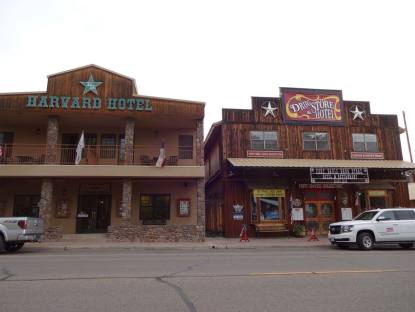 Leaving Fort Davis National Historic Park, I was well pleased. I learned a lot of history. I had no idea such forts existed. This was one of many which served the same purpose. Also the way the fort was restored and the plaques and markers provided, facilitated imagination, making me feel as if I had really stepped back in time. This place is high on my list of National Historic Sites. When I pulled out of the park drive I thought I’d do a little exploration around the town of Fort Davis. Affording the title “town’ is generous, because technically it’s an “unincorporated community.” The community had one main paved street. All the side streets were gravel and scenic, situated in the canyon outlined with hoodoos and rock spires like those of Chiricahua. In “town” I observed an old western hotel and drug store, a post office, a family practice located in an old adobe structure, a bank completely pieces together from rock pieces, and a courthouse situated in the middle of a green. Everything was closed, as it was Sunday. I was ravenously hungry. It had been a long time since my breakfast at the Indian Lodge. There wasn’t much to choose from. But I saw a decent amount of cars parked out of a shack of a place titled Cueva de Leon. Here’s goes nothing, I thought. I went inside. Mexican restaurant. Okay. Sweet. This could be the real deal, considering how close I was to Mexico. I sat down and ordered some fajitas. I was served a glass of ice cold water and it was perfect for my parched mouth and lips.
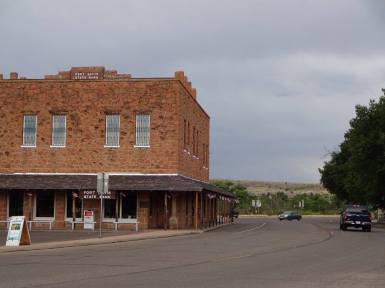 As I waited for my food, I couldn’t help but observe those around me. A group of ladies were in a booth eating together and talking back and forth. They switched from Spanish to English constantly, replacing with seemingly no notable method, certain words with their other language counterpart. A middle-aged man with a cowboy hat, flannel patterned shirt, boots and a grey mustache (everything stereotypical of a cowboy) sat down to order his food. To my surprise he ordered his food perfectly and casually in Spanish. Keepin’ it truly real, from my perspective, a middle-aged white man with a cowboy hat back home in Kentucky would be the least suspected of speaking Spanish. This was not the case here. Spanish and English were truly blended together, and latino rancheros and caucasian cowboys came together with no barrier of language nor culture, no ill-will towards one another, just neighborly friendliness. They were simply gathering over good food.
I liked this scene. I liked it a lot. Much of mainstream media tries to divide people over appearance and racial heritage. Here in West Texas, it just doesn’t matter. Everyone seems to be at the same level. Everyone is a neighbor. Perhaps it is the Texas identity. Texans are Texans above all else. It doesn’t matter what you look like, what language you speak. If you are a Texan, you’re a Texan. This doesn’t hold true though in metropolitan areas. I know from my experience living in Houston, where race places a huge factor in everything. But here and in rural west Texas there is a unique bond of culture that transcends any trivial division that the over civilized parts of the U.S. have concocted. It’s all the more reason why I am in love with West Texas.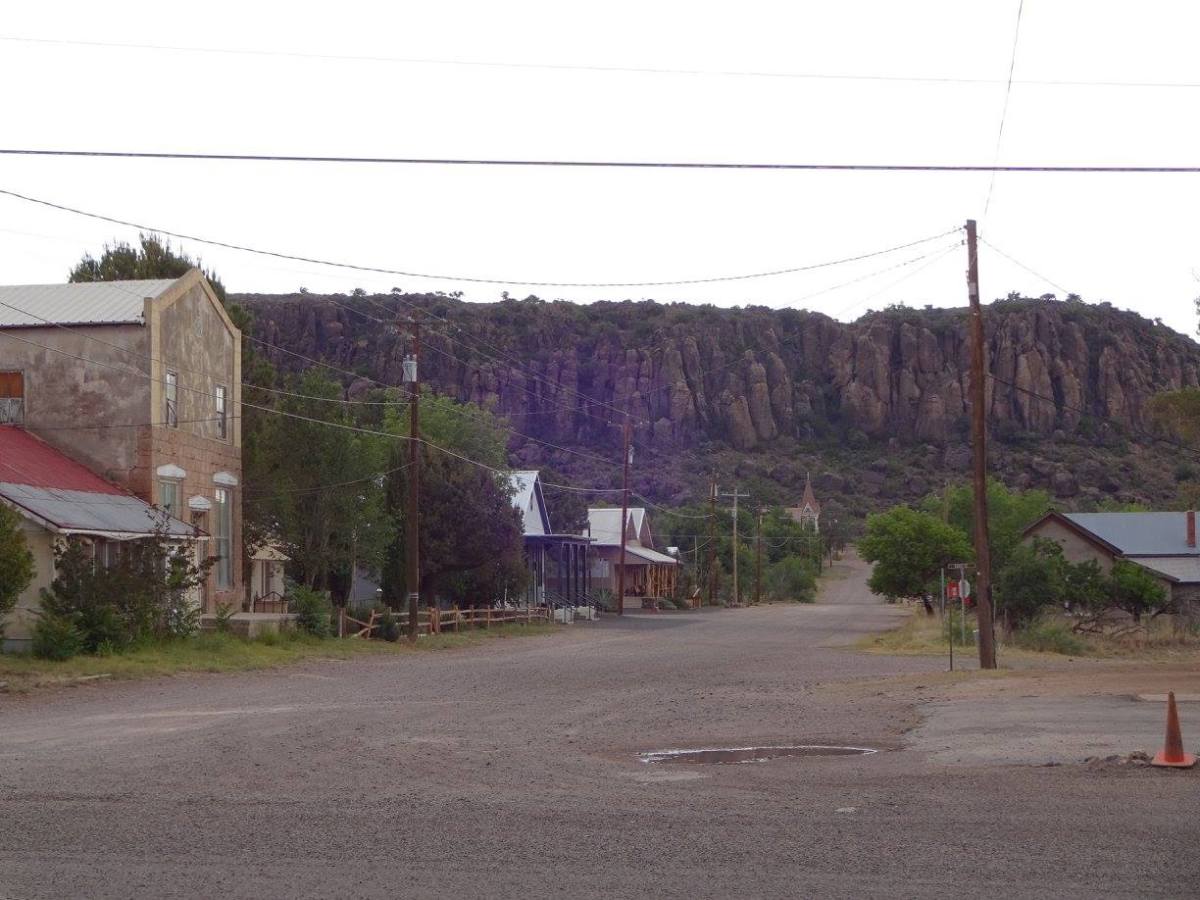
Check back next Wednesday for the next “episode” in the adventure.
Click here for the previous entry “Falling in Love With West Texas”: https://joshthehodge.wordpress.com/2019/03/28/falling-in-love-with-west-texas/
Check out my book “Among Blue Smoke and Bluegrass” on Amazon: https://www.amazon.com/Among-Blue-Smoke-Bluegrass-Tennessee/dp/1790631297
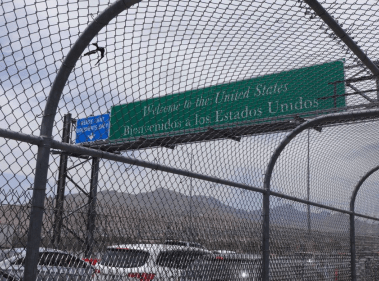 It was a new, peculiar, and patriot moment for me to read the sign above the highway stating “Welcome to the United States.” My visit to Ciudad Juárez is a tale to be further unpacked at another time. I was glad I went, but I was so grateful to be back home and ready to continue on with my U.S. National Park adventure.
 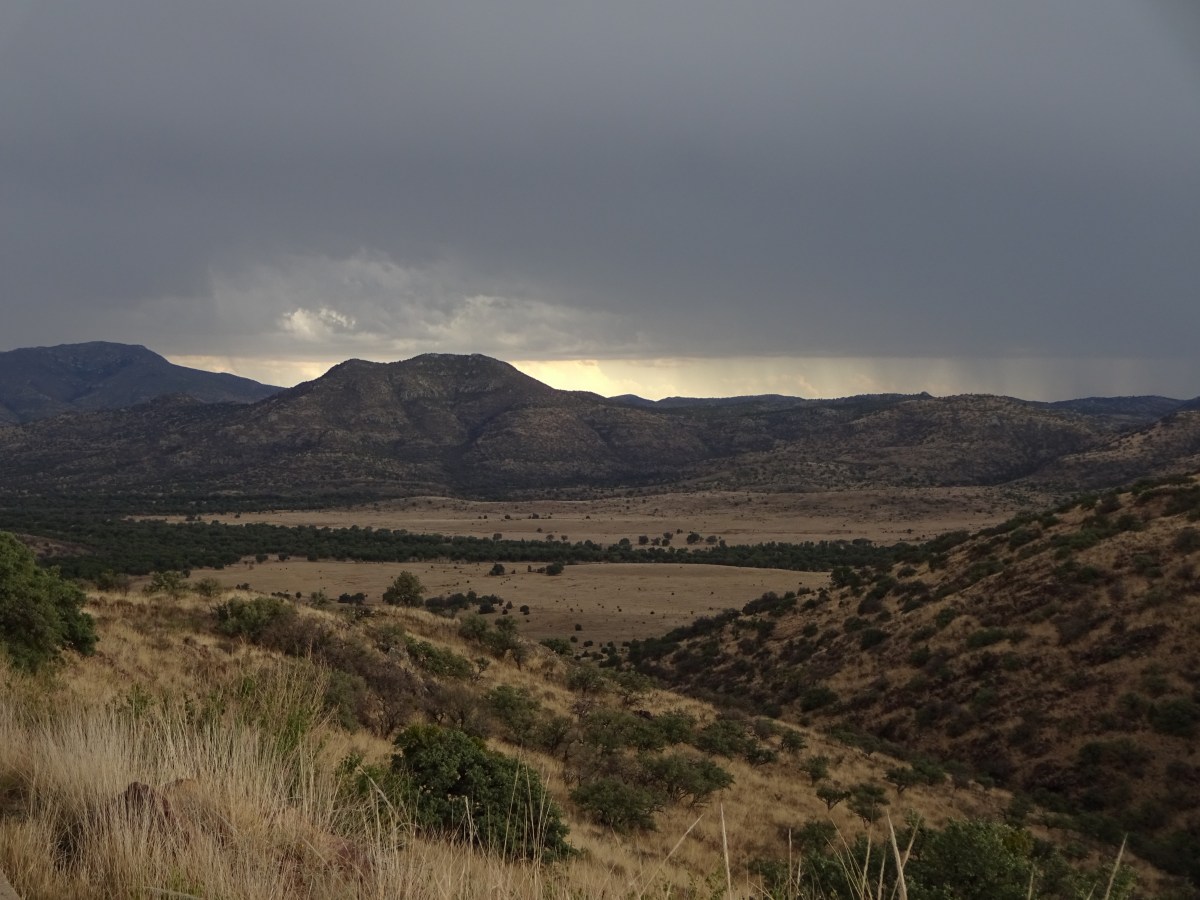 The road wound through countryside and slithered among mountains. At one point I came to a overlook where I looked down across the grasslands and the mountains. In the distance, over the mountains, it was storming. I could see the dark clouds and rain contrasting with a golden sun that was peeking out from the corner of the sky. The contrast in the sky, brought about contrast in the land between the deep greens of the scattered trees to the accents of golden grass.
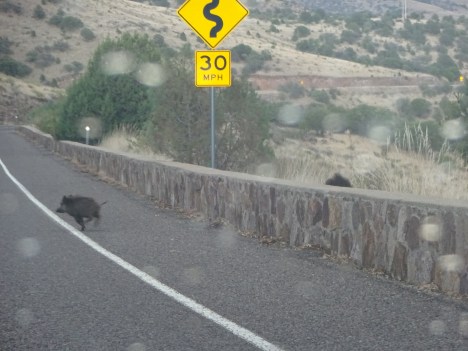 I could sense the arid land giving off a sigh of relief for the rain that would soon arrive. A could feel the tension released in the air. As I continued on my drive, a parade of javelinas jumped a stone wall, scurried across the road, and leaped into the wild grass and brush. These creatures look like wild boar, and although javelina is the same name given to a wild boar in Spanish, these javelinas are peccaries, and unlike boars are native to the Americas. But combine the savanna with a javelina, and the fact I hadn’t seen a business for hundreds of miles, and you could have fooled me to thinking I was out and about somewhere in the African savanna and I’d be prone to see a zebra, or a lion.
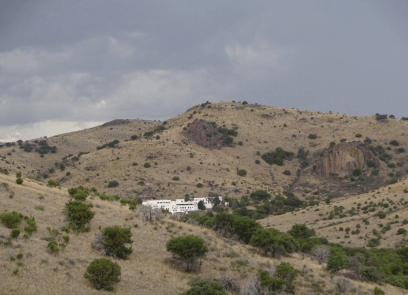 Except for the one elderly couple who asked me for directions at the drop box, whom I couldn’t assist with any knowledge, I didn’t see any other people on my way to the lodge. This place was very quiet.
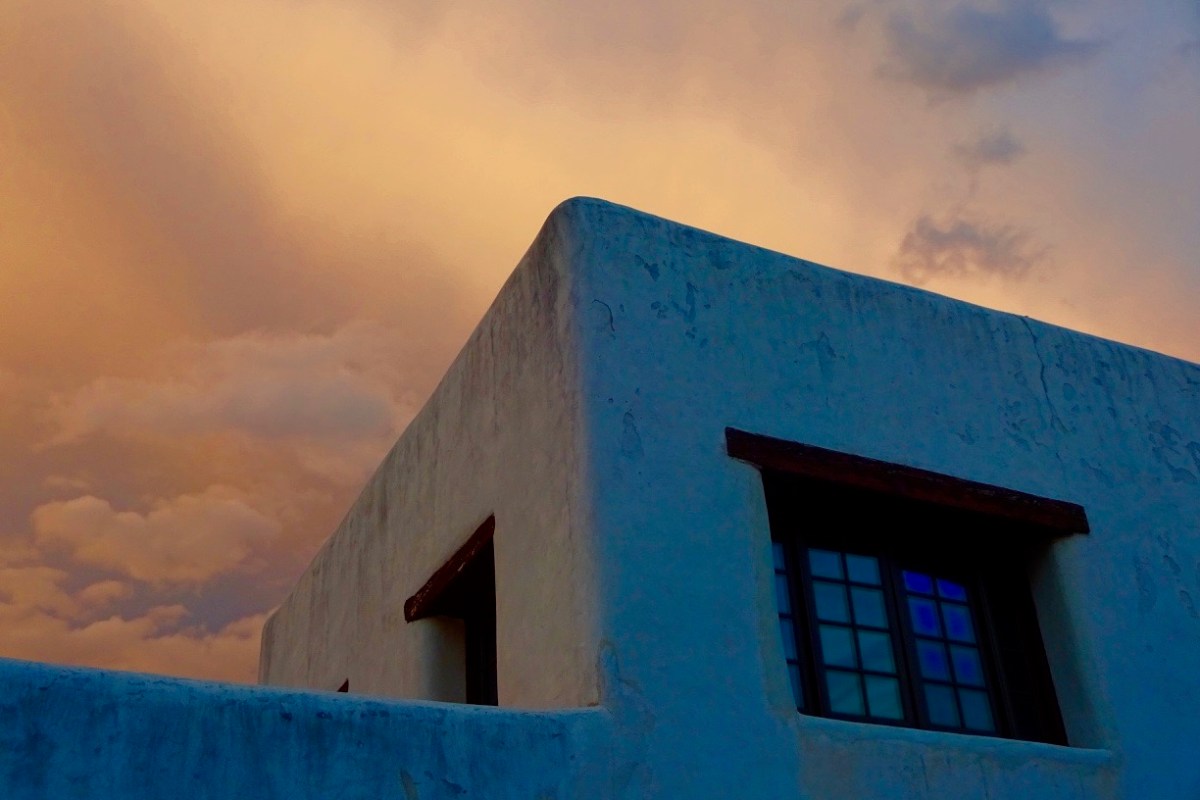
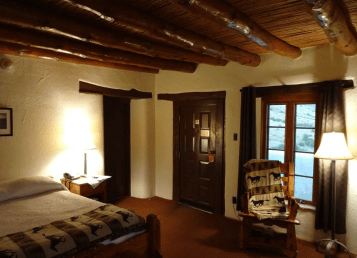 Rustic, beautiful, charming. An old stone fireplace stood with an extending stone hearth. The walls were white abode, the ceiling wooden logs, the furniture hand made of cedar, some original historic pieces from the 1930s. The lamps here and there gave off a warm and homey glow. A rocking chair stood next to the fireplace and in front of the wood framed window with the bright orange sunset. The window on the opposite side was tucked into its own nook where a desk and chair stood, as if looking out intrigued by the view of a tree reaching out its branches. And the bed in the middle was adorned with a beautiful lacework comforter and a blanket depicting running horses and geometric designs, looking like a true piece of native craftsmanship of the area.
 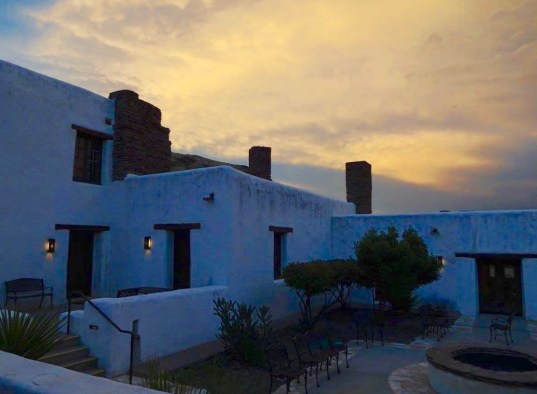 Also pertaining this this vibe was this true lodge feel. Back in the early days of park lodges, arriving at a lodge was sometimes an accomplishment in and of itself. Long horseback rides or wagon trips through challenging terrains would finally lead one to a lodge of comfort and peace. Same situation today. A long and isolated journey through very remote roads to the middle of nowhere, brought me to the Indian Lodge, and the lodge was the only thing here. There was nowhere else to go this evening. This was it. The lodge was its own oasis. Everyone staying at the lodge had nowhere to be but at the lodge. We all had to make comfort and do with our own limited amenities and food. And without distraction, we all shared the sunset together, the maze of the abode structure, and each other’s own company. Although this place was isolated, and it was quiet, I was not the only one here. I believe there was a wedding party staying at the lodge. Clues of confetti, signs, and gatherings of multi-aged people, led me to this assumption.
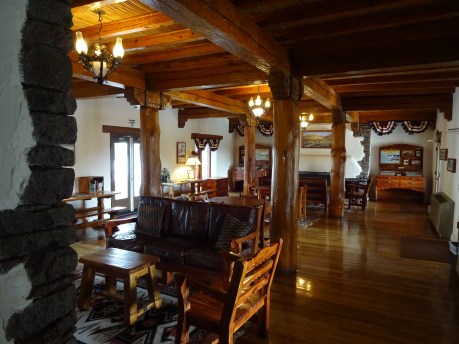 After dropping off my bags in my room, I peacefully explored this village of a structure. The clouds had melted away and the sky above was a calm darkening blue. Going from one adobe island to another from and one terrace and courtyard to another, I sat and enjoyed the remainder of the sunset and listened to the water trickling at a courtyard fountain. I also explored inside. The common indoor area was constructed with beautiful woodwork, old western chandeliers, nooks and crannies to sit and relax, and a small statue and area honoring the work on the Civilian Conservation Corps. I. Loved. This. Place.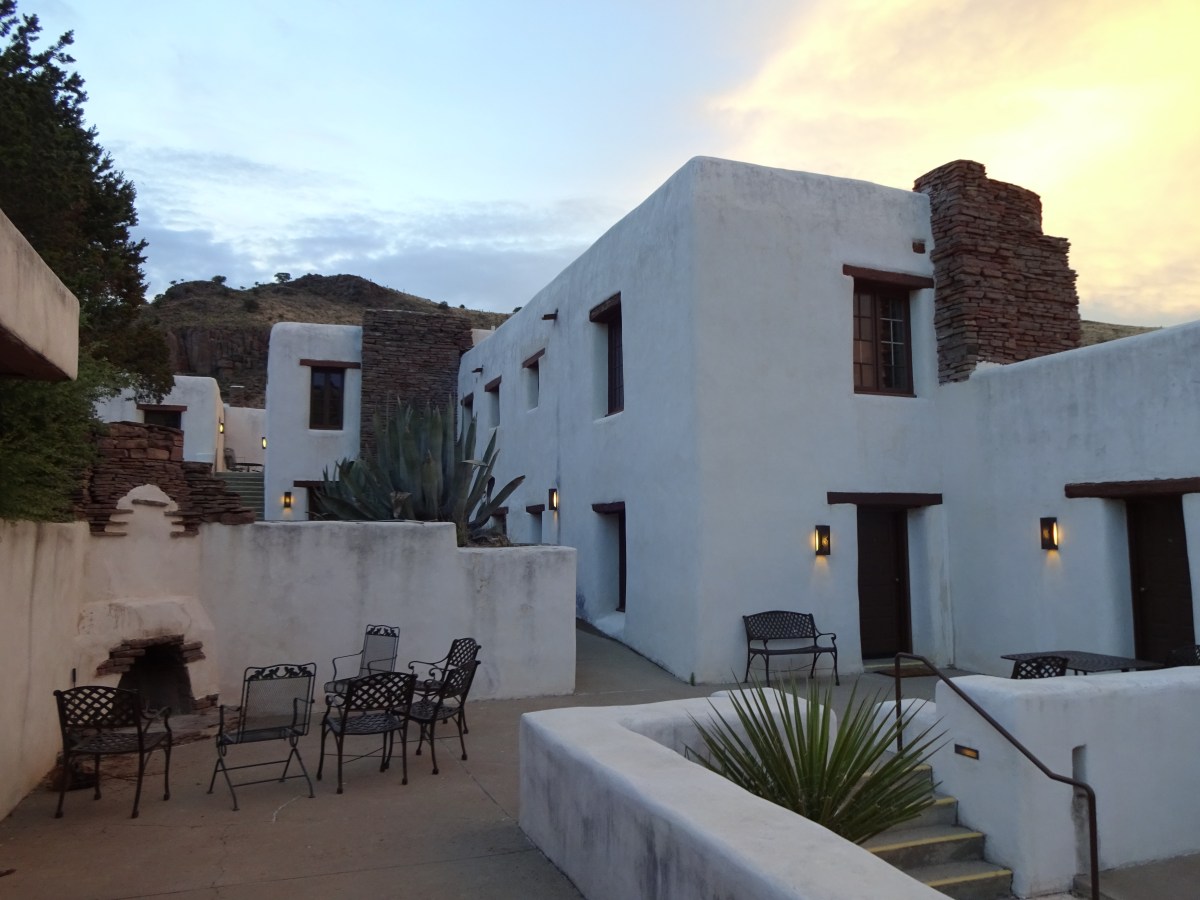
 Josh Hodge blog