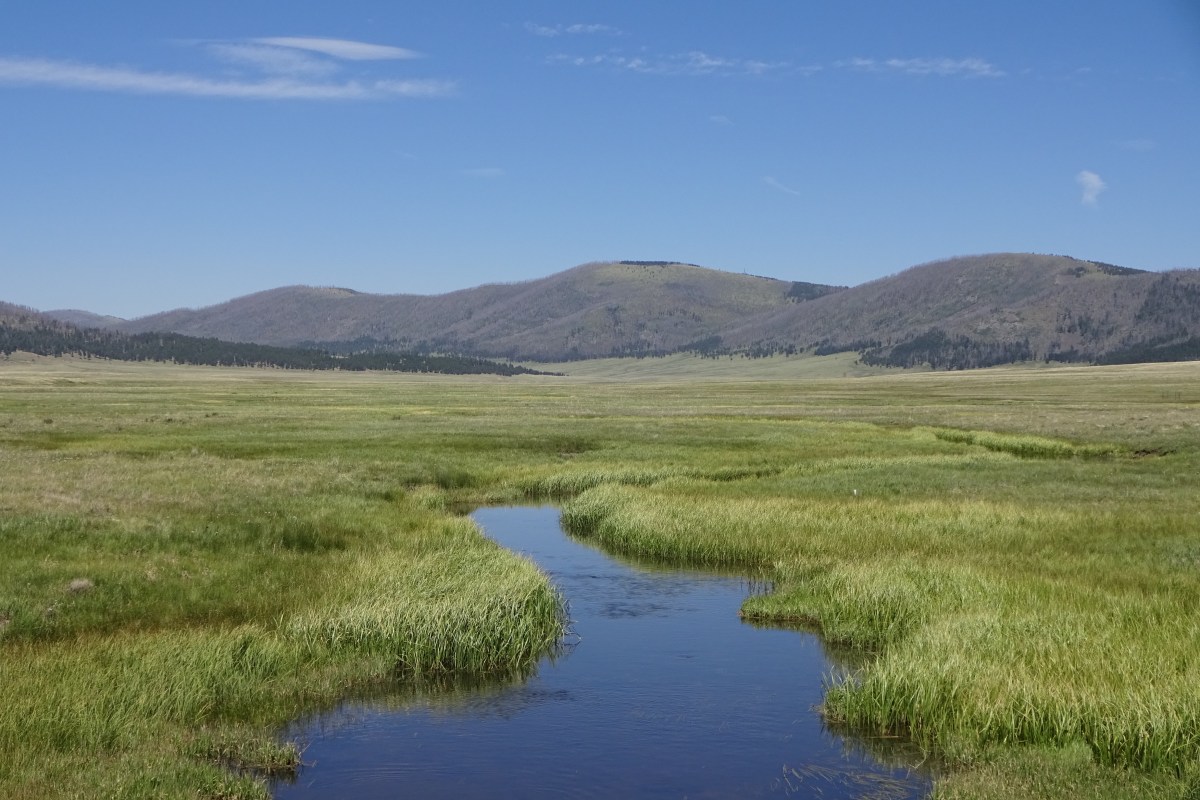
Valles Calderas and the Land of Enchantment

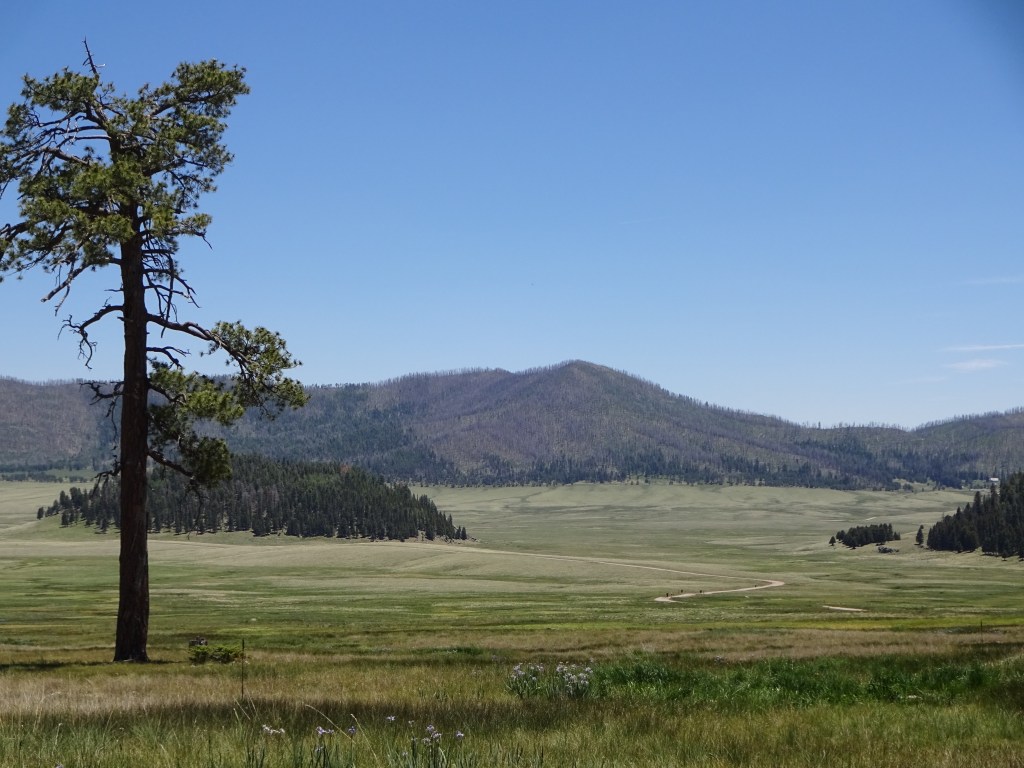
Valles Calderas is some sort of a dreamland. You don’t find it on Earth. You find it in fantasy, but it so happens to also be within the state of New Mexico. This place really makes the New Mexican state motto “Land of Enchantment ” come to life, and it’s a stark contrast from the dry desert stretches of southern New Mexico. According to geologists, long ago a giant volcano erupted creating a thirteen mile wide depression in the ground which now is rolling meadows and streams surrounded by rounded coniferous mountains. It’s not enormously epic in presentation but surprisingly comforts and charms the visitor. Wide open expanses of bright green grass contrasted with the dark green of the conifers splashed out under the cloudless blue sky create the perfect artistry. The small streams meander around the landscape, waters reflecting the rich blue of the sky.

The visitor center was a small, seemingly temporary building. Little information was provided about this National Park unit. It was designated a National Natural Landmark by the National Park Service in 1975 but then gained the designation of a National Preserve in 2000. I had assumed it was an even more recently established National Park unit since it didn’t have its own uniform National Park brochure like all the other National Park sites. 

When I arrived I was unsure of what to see or what to do. Uncharacteristic of the usual very friendly and informative National Park rangers and employees, it seemed like the employee here was just not eager to share information. After explaining that it was my first time here, and not getting much response, I decided I’d just ask about the park drive. I remember my friend and coworker, Jamie Hamblin, had been here the summer before with her parents and she shared enthusiastically how breathtaking the park drive was. I got instructions from the employee to drive up to the gate, get out of my car, open it, and close it when leaving. I came to think that perhaps being a preserve this place was not intended for recreation but more of just a place to protect wildlife. Therefore I did not get out of my car. I simply drove the road. I’d later find out that this is a recreation destination with hiking, biking, camping, horseback riding, and even hunting opportunities. I drove around for about an hour on the dirt road that meanders through the meadows. I did not see any remarkable wildlife, only deer, but I’ve been told at times one can see herds of elk here. I just enjoyed the peacefulness of the drive and the beautiful scenery.
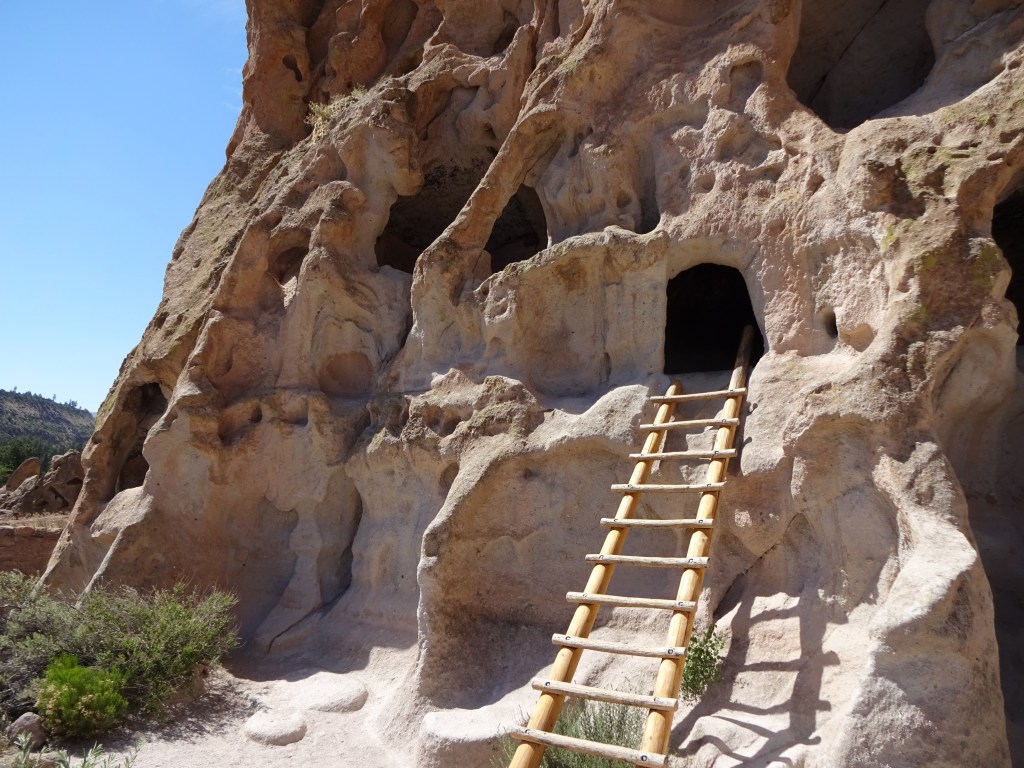
When I left, I made the scenic half hour drive through the Santa Fe National Forest alongside Los Alamos among the sweet smelling pines to Bandelier National Monument. Here much green was replaced by arid red rock. Seventy percent of the nearly 34,000 acres is designated wilderness. I only had about an hour to spare. Although National Monuments can sometimes be even more impressive and worthwhile than some of our designated National Parks, my trips give time priority to National Parks, and along the way I try to stop and visit as many National Monuments and other National Park Service sites as I can. Given my time constraints I hiked along the 1.2 mile loop from the visitor center to see the cliff dwellings and rock houses of the early pueblo people. A series of ladders adjoined rock faces, where small rock homes were formed often into the natural cavities and indents of the jumbled red rock formations. These were unique from the dwellings seen at places like Mesa Verde or Canyonlands where they are often constructed under cliff overhangs. 
As I walked across the parking lot to my car, I passed by another solo traveler just getting out of his vehicle. He had a jeep adorned with stickers of many parks, many that I’d been to. By his appearance it looked like he may have been camping for days as well. As I’ve mentioned before, people to me are like books. I am fascinated by people’s stories. Where do they come from? Where is their story headed? Solo travelers intrigue me the most. Those are the books I most want to read. Maybe it’s simply because I relate, or also because I know that traveling solo, especially on cross country road trips, takes a lot of character. It can be lonely and challenging at first and others may question, but then one resolves these predicaments and learns to carry on and enjoy the adventure, solitude and all. At least this is my experience. I want to know the stories of others.

Leaving Bandelier National Monument, I drove through some remote stretches of northern New Mexico and southern Colorado. Crossing into Colorado I passed by many open fields with the backdrops of mountains behind them. This was very much the ranching part of Colorado, a side I hadn’t seen much of before. This was the backbone of the continent. This was the place I’d read about, of ranchers with grit along the continental divide. The further I drove into Colorado the more green and welcoming the environment became especially after having been in the desert for many days. I stopped for dinner at a Subway and got out of my car into a cooler and slightly less arid climate. I remember thinking how this was not the tourist route, and here I was a young man from Kentucky out in the rural stretches of Colorado. I felt out of place, far from home, but that didn’t bother me one bit. I felt accomplished to be so out of my ordinary. I stopped at a gas station for some Muddy Buddy Chex mix and I then carried on with my four hour drive.
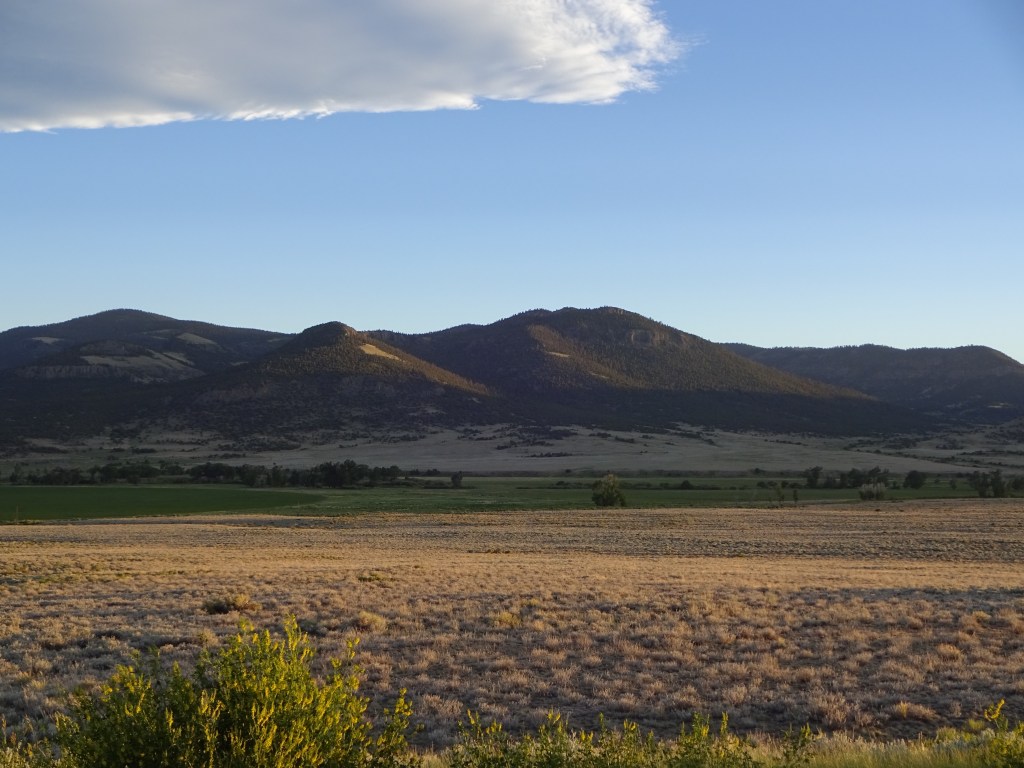
The sun making it’s late evening descent among the mountains and fields of cattle was beautiful and peaceful. The road took me into Rio Grande National Forest alongside the East Pass Creek. This calming scenery reminded me of why I take these trips and it filled me with a renewed sense of excitement for the travels ahead of me. But I was also travel weary from spending so much of the day in the car. I realized I still had at least an hour drive left, I was not looking forward to finding my campsite and setting up in the dark in Curecanti National Recreation Area, my intended destination. While considering the predicament I came to a National Forest Service sign labeled Buffalo Pass Campground off to the side of the road. Perhaps I’d abandon my plan and stay here.

I pulled off the main road onto a gravel one and found a simple but beautiful campground sitting alone in solidarity amongst pine trees with a field to one side outlined with a rustic split rail snake fence. No one else was here, but this campground really spoke to me. It’s one of my favorite campgrounds I’ve ever stayed in. It’s difficult to put my finger on exactly why. There was something very attractive about it, being so remote, being an unexpected find, very quiet and peaceful, not crowded with growth, but open and spacious but still in the forest. It was a place of good vibes, or as in Mexican Spanish, “buena onda.” I set up camp here at dusk, changed into some comfortable pajamas, and made a campfire as the sun slowly began to rest casting a sleepy blue all over the campground. When my fire died down I laid in my tent and fell asleep while reading a book about early pioneer life in West Texas. The following day I’d check out Curecanti National Recreation Area and arrive at the most intriguing and Jurassic Dinosaur National Monument.

Read the previous entry “The Sandia Mountains and the Old Town,” here: https://joshthehodge.com/2020/03/11/the-sandia-mountains-and-the-old-town/

Check out my book Canyonlands: my adventures in the national parks and the beautiful wild here: https://www.amazon.com/Canyonlands-adventures-National-Parks-beautiful/dp/1711397873
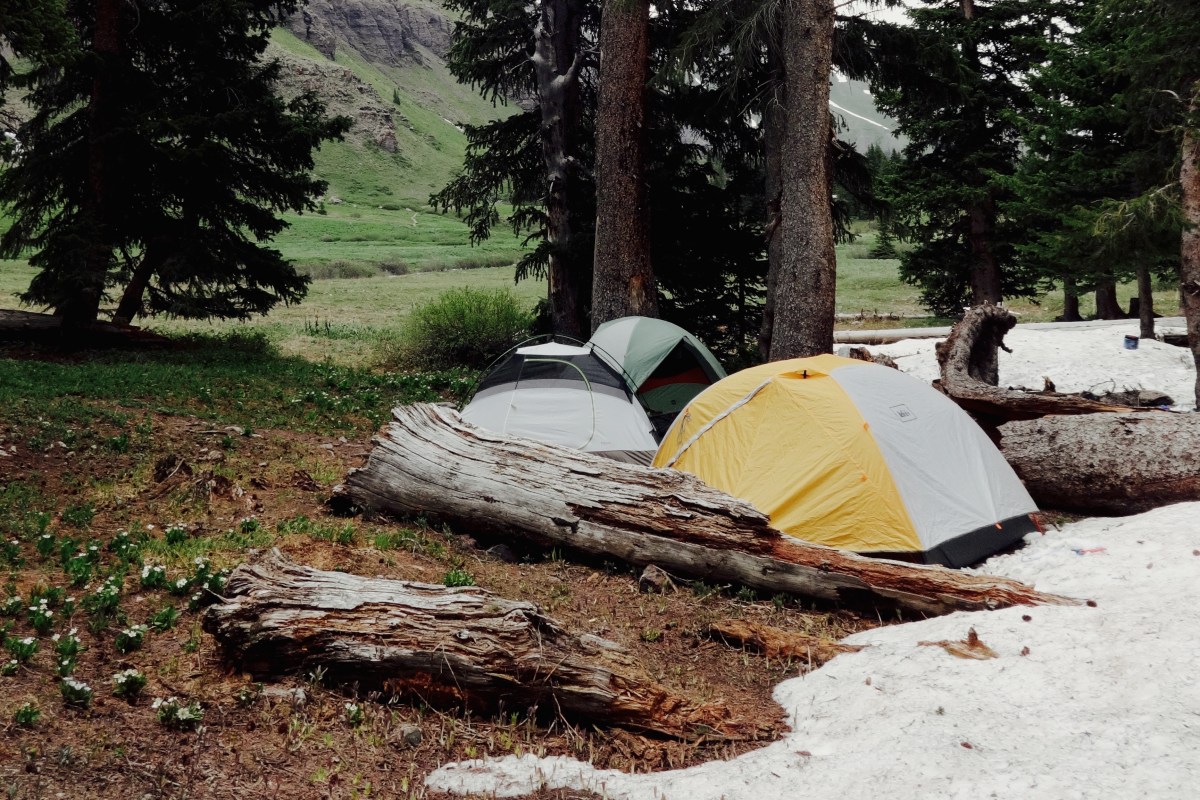
A Night in the Ice Lake Basin

“Whatcha doin’?” I asked my cousin Paul, as I sat down by the fire.

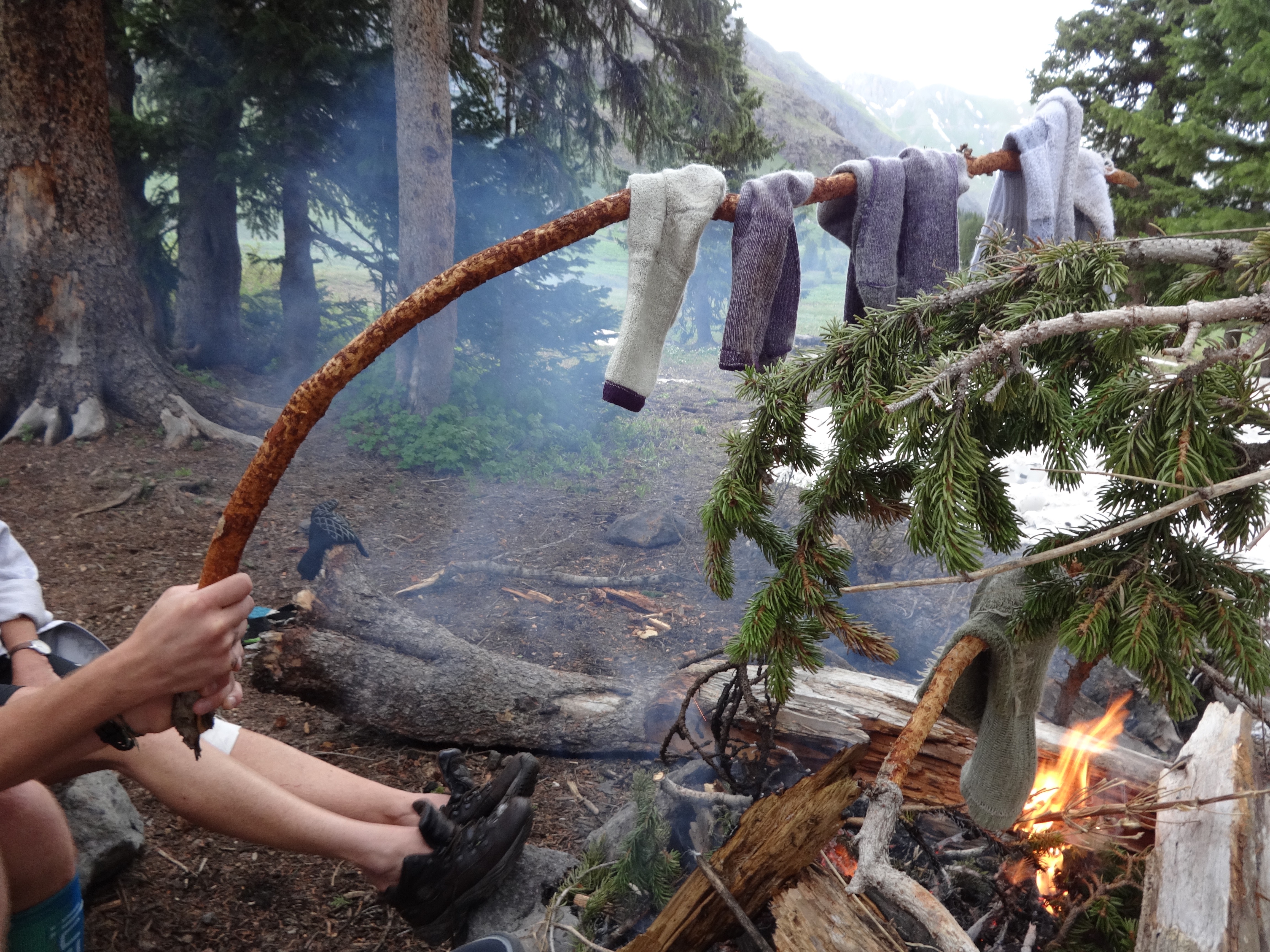
“Cookin’ socks,” he replied.

Some people roast marshmallows, or cook hot dogs, but Paul was holding our socks over the fire, cooking socks, in attempt to dry them. The trek up to the Ice Lakes had involved lots of snow getting into our boots. Paul had a found a tree branch laying around which curved in such a manner that it was perfect for laying our socks across and holding over the fire.DSC05587

Everyone had volunteered their socks including myself. We also set our boots next to the fire to try and dry them. Sadly Mary’s boots were a little too close and got singed.

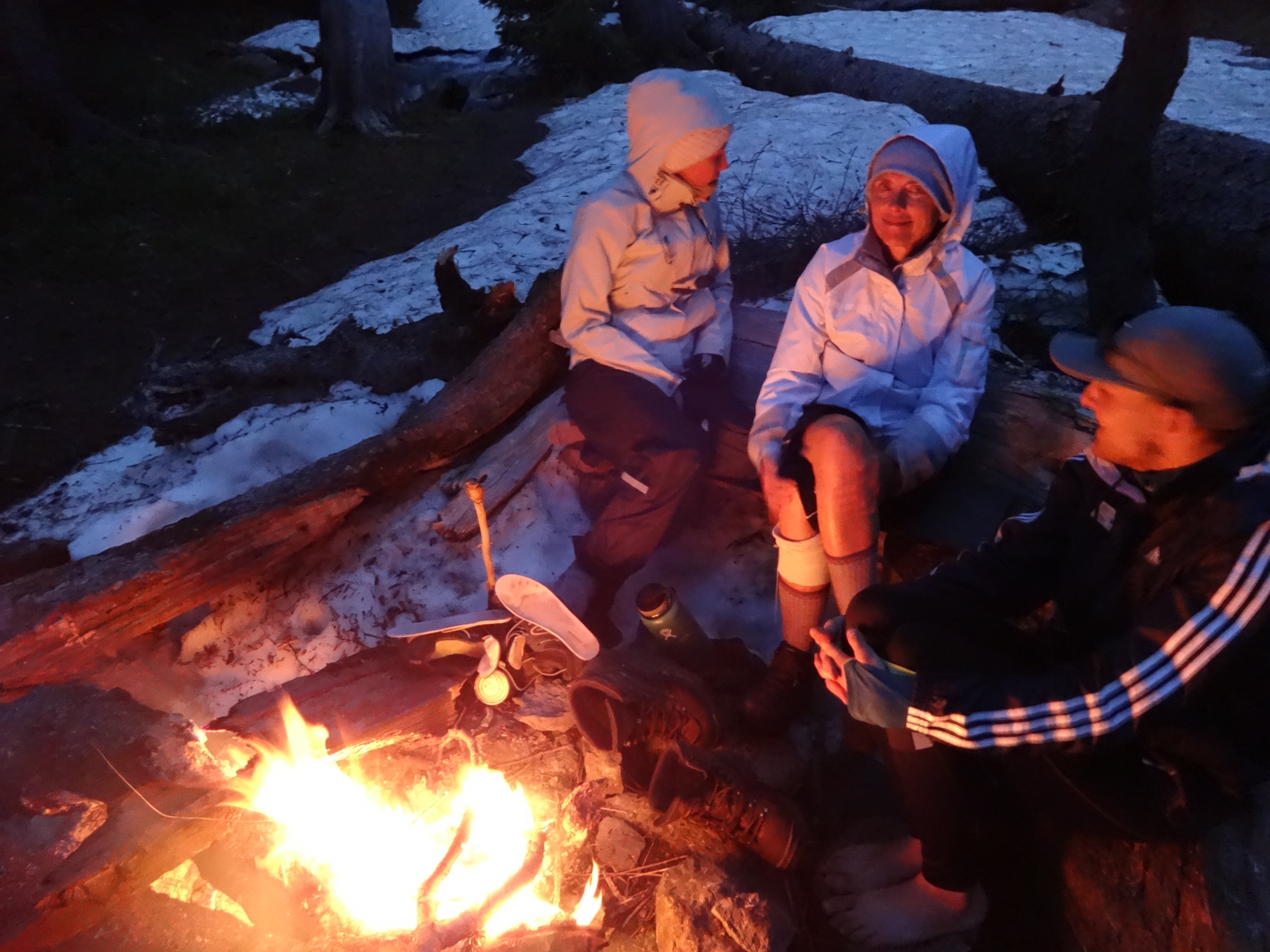
It was early evening, but the temperature had already dropped greatly. We were all in our hoodies and jackets and had our bare feet propped up against rocks next to the fire, inviting the soothing heat to keep them warm.  

Paul handed off the sock roasting responsibility to me and went in search of more wood for the fire. It was a very hungry fire, burning things up quickly. I found a place to prop up the sock drying branch so I could be hands free.

DSC05592We all had contributed to finding firewood and kindling, but Paul won the prize for this.  There was a pattern. He’d disappear. We would carry on conversation, and, after a while, he would return with arms full of wood and kindling. At one point I remember we all laughed. Paul had found an enormous piece of tree trunk and was carrying it to camp over his head, seemingly effortlessly, like an experienced woodsman. He had a grin on his face seeping from his sense of personal accomplishment,  I would assume. The question on all our minds was where did he find that, and how did he resolve to lift it?
“That’s so Paul,” Jonathan commented.

There had clearly been a place set up to have a fire prior to our arrival. Paul had taken the lead in renovating the area. He found logs and rocks and assembled them to create a bench with a backrest and armrests. We had our own living room set. Eventually everyone discovered they could put rocks close to the fire to heat them up and then remove them from the fires edge to warm their feet. I initially had the best seat. I was tucked in the corner of the constructed bench, sitting on the log, my back resting against a broken piece of timber, and my feet on a smooth rock warmed to the perfect temperature by the fire. In due time I rotated out from my comfortable corner to let someone else enjoy the prime sitting spot.

There was still quite a bit of day left, but no one had plans to leave the fire. The air around us was just too cold and wet, and some of us were sore from the hikes of carrying all our supplies for camping up the mountains and then trekking up snow to the Ice Lakes.

As we sat there poking around the fire a Marmot probably thirty feet away would crawl up out of its burrow, take a few steps forward, shout at us, and then run back into his hole. It happened a few times. Sometimes he wouldn’t make a noise but would just watch us. He was probably trying to figure out what we were and what we were doing here.

Jonathan had brought some sort of soup to cook by the fire for himself, but the rest of us just snacked on dry goods. Jonathan also heated a Clif Bar over the fire, which is a tactic I’ve now adopted. The bars become pleasantly soft and warm. However, they do absorb really well a smoky flavor which takes some getting used to.

DSC05597After we were by the fire for many hours, the conversation died down, and I decided to open a round of Would You Rather, something I learned from my younger brother, Timothy. You go around in a circle taking turns, posing ridiculous questions like “Would you rather jump out of an airplane or plummet down Yosemite Falls?”
When night had fallen and the fire turned to glowing embers, we checked into our tents for the night. I was unprepared, not knowing this would be the coldest night of my existence.

I had fallen asleep okay, but in the middle of the night I awoke freezing. I was very uncomfortable. I had only packed one sleeping bag, a small lightweight one that’s packaging stated it was good for temperatures down to forty degrees. It was for sure below forty degrees. I would assume the temperature had plummeted below freezing. The sweatshirt I was wearing and my lightweight sleeping bag was not enough. I should have known better. On top of that, my head had no warmth to sink into. I had only brought my very small trunk pillow which seemed to absorb the cool air. And here I was in Kelty, my lightweight and airy tent. I should have been more prepared, but, aside from the Rocky Mountains, I had spent weeks in the desert and temperatures like this were unimaginable.

There were a couple things I could do. First, I took the nylon bag which the sleeping bag is stored in and I put it over my head, trying to capture the heat of my breath. Secondly, I put my hands in my pants, for they were growing numb. There was a third option too. I could climb into another tent, but there were questions on my mind:, First, would that be socially acceptable? Even if it’s not, isn’t it okay in dire situations like this? Is this an emergency? Will I be ok? Which tent would be the less awkward one to climb into, the tent with my Aunt Mary and Jonathan or the tent with Paul and Ines? I unzipped my tent and looked outside contemplating going over to one of their tents. I couldn’t pull myself to do it. I’ll suffer, I concluded. So with my head in a bag and my hands in my pants, I slept on and off, waking up cold and uncomfortable, and reminding myself that the night will end. Warmth will come in the morning. Never before was I more glad for the morning’s arrival.

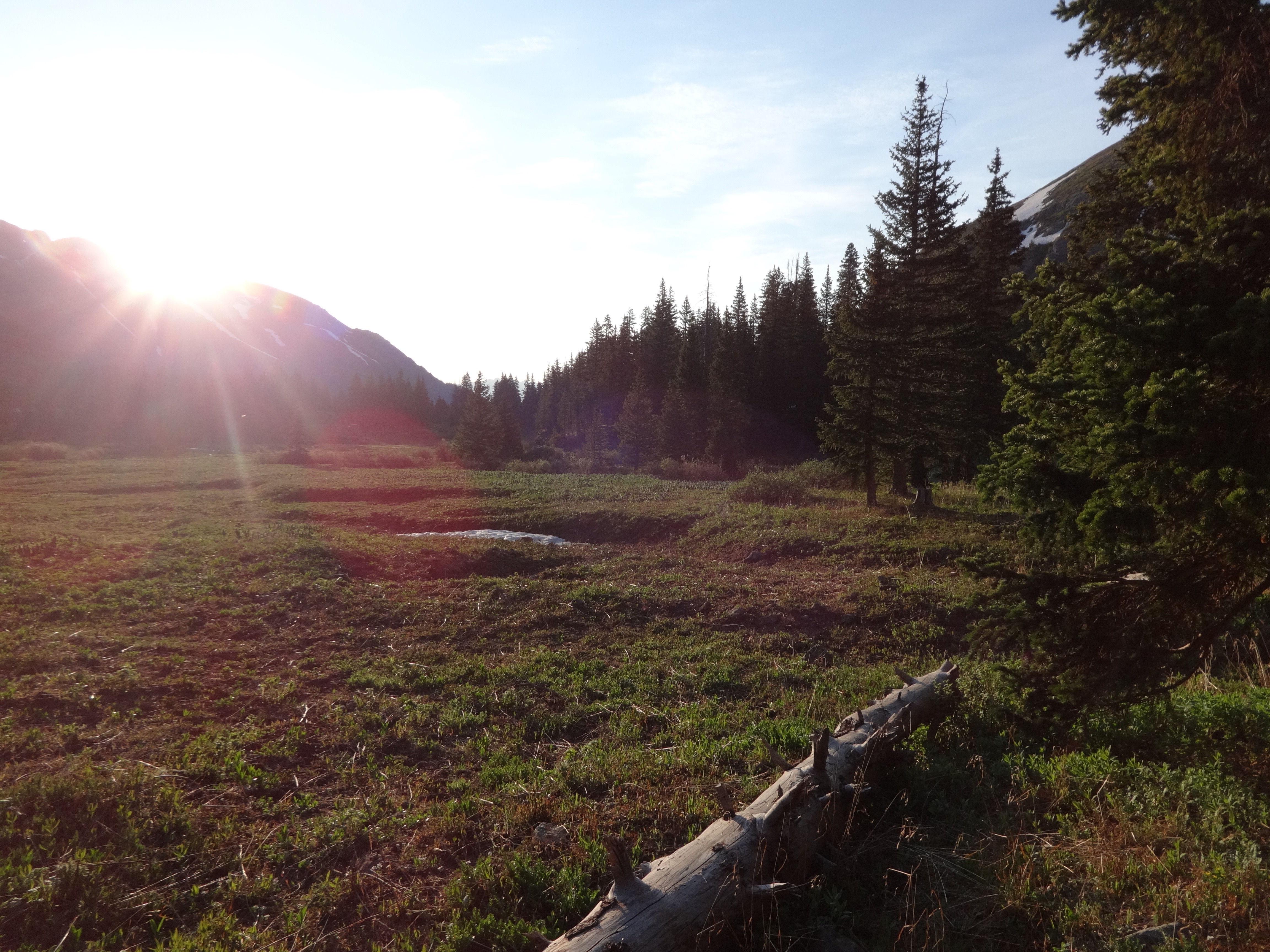
DSC05598That morning we didn’t stay long in the basin. We were all cold and hungry. As the others were slowly waking up and putting themselves together, I walked around camp, admiring the expanse of the basin waking up. It was beautiful. The sun was golden and caused everything that was wet and frozen to shimmer in its light. Paul and Ines also walked around and sat together on a fallen tree trunk, looking out into the basin. No one said anything. I suppose we were all taking in the awe of our surroundings and trying to thaw out. I walked out from the shade to feel the slightest bit of warmth falling from the sun. It wasn’t much, but I’d take it.
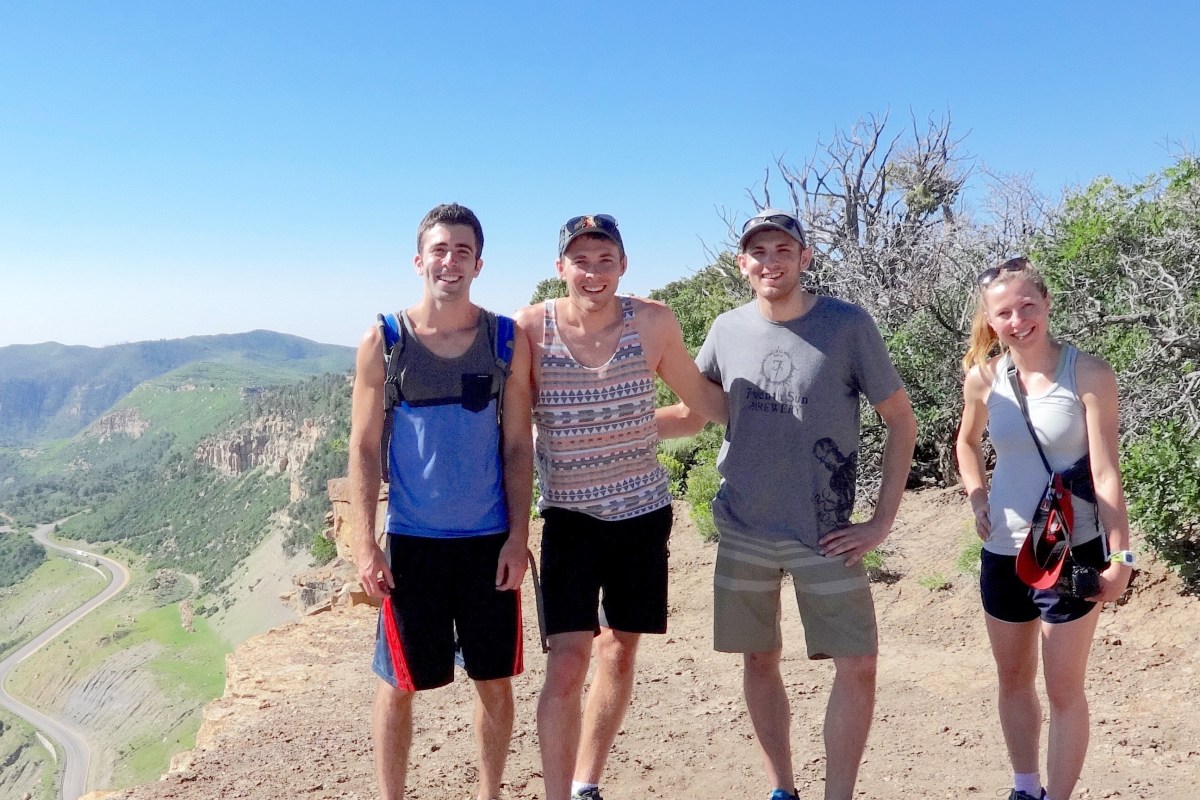
I remember when we were packing up, Jonathan was shaking off the morning due from his tent, neatly folding it, making sure every corner matched. I, on the other hand, am much more haphazard when packing my tent. I live in the fine line between the type A and type B personalities. Tent packing, just not on the top of my priorities. To each his own, and I should learn to keep better care of some of my things.

When we were all packed up, we hiked back across the basin, crossed over the streams and rivers, down the forests and prairies, and made it back to the car. I talked with Ines a lot on the hike down. I didn’t know her very well. I had only met her briefly in a couple of family occasions. I was very pleased to get to know her. We got to talking about life in Germany, and I was extended the offer to come visit.

Back at the cars, there was talk by my cousins of bathing in the river, but I knew I didn’t have much time to spare and needed to get on my way. My goal was to drive 7 hours to the western side of Utah, to Yuba Lake State Park. Aunt Mary and my cousins would continue their adventure on to Arches National Park. I brought out my map and spread it across the top of my car and explained some of the features worth seeing, and recommended a stop at the Moab diner.

Then it was time to part ways. It was sad, to leave, but I felt so thankful for the experiences shared together. From Mesa Verde to the Ice Lakes, the adventures with this bunch are truly unique and special. They will last with me forever.

Read the next entry, “Assaulted at Yuba Lake,” here:

https://joshthehodge.wordpress.com/2018/03/14/assaulted-at-yuba-lake/

Read the previous entry “When Life’s Path is Frozen Over,” here:

https://joshthehodge.wordpress.com/2018/03/10/when-lifes-path-is-frozen-over/

Facebook: http://facebook.com/joshua.hodge

Instagram: http://www.instagram.com/joshthehodge/

Mesa Verde with My Cousins

The living room floor was covered in gear and supplies all laid out and organized in piles and distinct sections. We were prepping for our overnight backpacking journey up into the San Juan Mountains to camp in a valley by the Ice Lakes. We had to divy up supplies and see whose pack could carry which things. We hadn’t even begun our journey, but I was excited. The spirit of adventure was alive and thriving.

I had never backpacked overnight with anyone and here we were, this was actually going to happen! And for once, I didn’t have to take the lead. My cousin Paul had sought this trail and plan. He had seen it online while in Germany and had been waiting to do it next time he was in the U.S.. I was relieved to be a follower. All I needed to do was make sure I packed what I needed for the adventure. My aunt Mary, cousin Jonathan, cousin Paul and his wife Ines were all packing at the same time, asking each other questions, trading off supplies, helping each other come to decisions about what was best. I loaned Paul an inflatable pillow, and I volunteered to carry the majority of the water supply. Jonathan, volunteered his pack to carry our bear canister with most of our food supply. We weren’t sure if there were even bears in the mountains, but better safe than sorry. Food, however, wasn’t our strongest of priorities, but we packed what would sustain us. We had apples, peanut butter and jelly sandwiches, jerky, Clif bars, and trail mix. I had also tucked away in my backpack some electrolyte gummies. I had noticed how useful they had been on other hikes.

A couple of us had hiking backpacks, but some of the others had standard back-to-school type backpacks bulging with supplies. So we got creative, tying things to packs with ropes and miscellaneous straps. We didn’t have the most expensive backpacking gear, but we were going to make this work.

When we finished packing, I went out on the terrace of the abode-like apartment Airbnb we were staying in, and sat there with Paul and Ines. We were relaxing and snacking on some vegetables and cherries, enjoying the summer heat slowly fade in the late evening, and writing in the guest book for the Airbnb. The host lived in an apartment on the bottom floor of the building. I had never met her, but the others had been there for a couple days and apparently she had been very friendly and had even brought a homemade breakfast bread to them. I was able to sample it. It was delicious. Although I do not remember exactly what the note we wrote in her guest book was, I’m sure there was appreciation expressed for her bread.

Sometimes it’s the most simple things that stick out more apparent in our memories. Sitting here on this terrace with my cousins is just such a fond memory of mine. Three things about it made it special to me. First off, it was a conclusion of such a fine day. We had spent the day touring around Mesa Verde National Park. It was also the eve of a grand adventure into the San Juan Mountains, and it was also the joy and comfort of reconnecting and resting in the company of family after having been alone for weeks.

In the morning, we had arrived at Mesa Verde early, shortly after the park opened. We wanted to make sure we could secure tickets for a tour of the Cliff Palace. It was a success, and my Aunt Mary kindly purchased the tickets for all of us. I then made sure we all stopped to see the park film, because personally, we know, for me, a National Park visit is not complete without seeing the park film. After that, we went on a short hike up to the top of the mesa where we took some nice cousinly photos and looked down at the windy road we had ascended in the park.

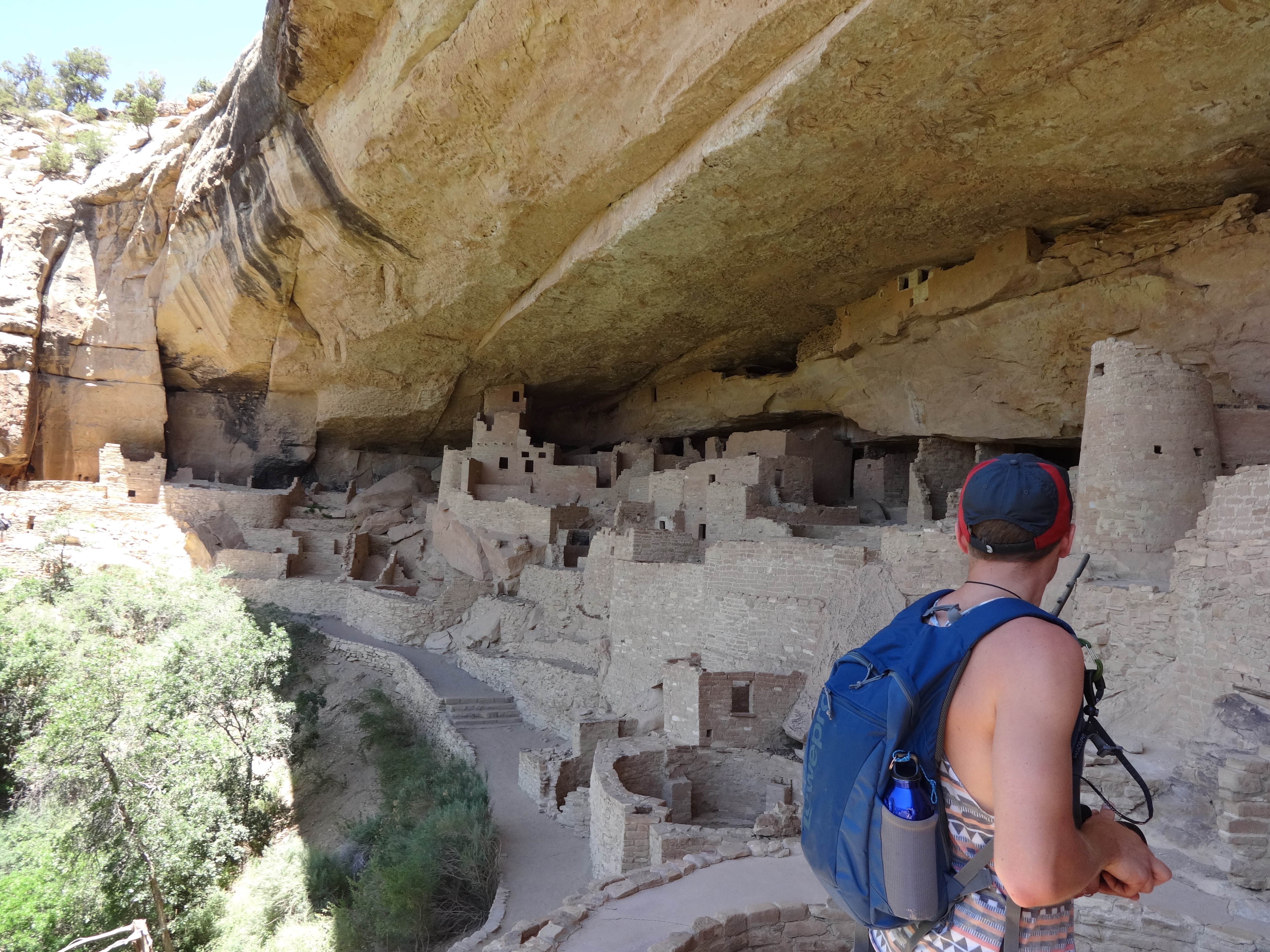
Our tour of the Grand Palace went well. The tour took us down around and inside the famous rock houses that comes to most minds when Mesa Verde is mentioned. The large and intricate rock house city hidden under the overhang of the mesa was impressive. There were about fifteen of us on the tour.  We were guided and informed by a round native american park ranger, with a black braided ponytail sticking out behind his ranger hat. He carried with him a spray bottle, and along the tour he asked us tourists trivia questions. If any of us were correct we earned a spray from his bottle. It sounds silly, and I thought it was a little much at first, but the second time I answered a question correctly I gladly accepted a spray. The dry summer heat of southern Colorado is oppressive, any relief should always be accepted.

What’s most fascinating to me about Mesa Verde is how the inhabitants of this place seemingly suddenly disappeared. No one knows what happened to them. It’s believed that at its prime 22,000 people lived here. There is speculation that drought led them to other places where they assimilated into other native cultures. To me that doesn’t make sense. How could a civilization build an entire city like this and have the resolve to abandon it and move to another location? Furthermore how could there be no history of this migration and assimilation of one people group into another. Let’s imagine for a moment they migrated and into the  Navajo or Ute society. Wouldn’t their certainly be history, or at least legends, of such a large invasion of another people group. It doesn’t add up to me. These people literally disappeared from Mesa Verde, leaving no trace nor evidence, which leads me to certainly not yet believe but still entertain the thought of some sort of extraterrestrial intervention. Call me crazy, but it’s also the wild imagination I have that allows to me speculate and entertain the thought. It’s fun to conjure up your own theories to the matter.

Mesa Verde, unlike many National Parks, doesn’t have an abundance of recreational opportunities. There are not a lot of hiking trails, and the terrain is not terribly unique in my opinion. The main attraction are these rock houses, and they are justly deserve all the attention they get, but, in all my experiences, this part seems more like a National Historic Site. However, curious enough, how could it be a Historic Site, if we really don’t know that much about the people who lived here nor a timeline of their events. It could be something new: a National Mystery Park.

Leaving Mesa Verde, we headed into Durango, Colorado. A classic railroad town turned tourist hub. We walked around Main Avenue, which is lively with numerous restaurants, cafes, and shops. Most of the buildings were made of brick with arched windows, and tasteful facades that were true to the architecture of the buildings the represented. We were looking for a place to have a mid day meal.

The downtown had a classic small town feel to it. We got distracted from seeking food to looking at t-shirts. Aunt Mary wanted a Durango t-shirt, and so we went into a few t-shirt shops. Durango had been a special place for the her, because here is where they got on the historic Durango and Silverton Train and took it out to go white water rafting. Also Aunt Mary rarely gets to see her kids, as they all live so far away. I also purchased a t-shirt, because although I didn’t  get to see much of Durango, it is where I got reunited with my aunt and cousins. That held significance.

Our mid day meal proved to be tasty. We ate at a local brewery with very atypical and delicious burgers. I believed mine included avocado and mango. I remember my cousins had asked me how my brothers were doing. I told them about Timothy graduating from college and seeking his place in the world, and telling them about my older brother, Nathan. They hadn’t heard all the details of how Nathan’s chocolate company, Raaka Chocolate,  in Brooklyn had grown into a new factory and how my brother has really become a leader in the connoisseur chocolate world.

After our meal, we ran a few errands, popped into Dairy Queen for a treat, and headed back to the Airbnb, where we began our package and assembly party, getting ready for the adventure the following day. We also had to clean up the place, as we were checking out early the next morning and wouldn’t be back. The day ended with me sitting out on the terrace with my cousins munching on the fruit and vegetable tray we had put together. The day had been full and rich, and so I relaxed in the peace of a day well spent and the anticipation of the adventure ahead.

DSC05442
Cousin Paul at the Cliff Palace

Read the next entry “Backpacking in the San Juan Mountains,” here: 

https://joshthehodge.wordpress.com/2018/03/10/backpacking-in-the-san-juan-mountains/

Read the previous entry “On the Great Sand Dunes,” here:

https://joshthehodge.wordpress.com/2018/01/27/on-the-great-sand-dunes/

Facebook: http://facebook.com/joshua.hodge

Instagram: http://www.instagram.com/joshthehodge/


On the Great Sand Dunes

I could see them from seventy miles away, the Great Sand Dunes of Colorado. I was intrigued by this park well before arriving. It was another park I heard very little about. It was founded as a National Monument in 1932 by Herbert Hoover but gained the title National Park and Preserve in 2004 by an act of Congress. Sand dunes have always fascinated me, just because they are so different than anything I’m used to. This would be my fourth trip to desert sand dunes. The first was my harrowing plight for survival in a sand storm in Death Valley. The second was in Coral Pink Sand Dunes State Park in southern Utah, where I peacefully watched the sunset over the pink sand. My third experience was in Huacachina, Peru where I went sand-boarding with my brother and sister-in-law.

I had driven about five hours from Rocky Mountain National Park to Great Sand Dunes National Park and Preserve. It was now the middle of the day. Just like my arrival at all National Parks, I had picked out some accompanying music. Since I would be greeted with large sand dunes, it was time again for some more Star Wars music. This time it was Rey’s Theme from The Force Awakens. That song is heard when Rey is traveling about and sliding down the sand dunes on her home planet of Jakku. That’s the connection. That’s why it was chosen.

While I was approaching the park, I was again draining my battery from my Chromebook into my cell phone. I had tried plugging the charging cord from my phone directly into the USB port in the car. I thought it was charging, but all along it was wasting battery. I had on and off communication with my cousin, Jonathan, days prior. I knew him and other family were in Colorado, but I didn’t know their exact whereabouts nor plans. I was trying to connect with them. I assumed draining a Chromebook battery into a cell phone was not good for the life of the Chromebook battery, but I remembered the purpose of buying this Chromebook in the first place. I had purchased it super cheap the summer before, just outside of McFarland, California simply to back up photos from my travels. This device was meant to be an emergency travel device, and connecting with my cousins and aunt would be far more valuable than this piece of technology.  Arriving at Great Sand Dunes National Park and Preserve I still had no plans with my cousins. I didn’t know why reaching them was so difficult, but later I would learn why.

Great Sand Dunes National Park and Preserve is a very isolated park. I drove many miles in wide open space with very little civilization in sight. I had spoken to a Park Ranger about this park the following summer in Grand Teton National Park. He told me that this park was petitioned to transition from a National Monument to a National Park in efforts to increase tourism in the area.

When I arrived at the park my first stop was the campground. Plan A was to set up camp in the park campground. Plan B was to obtain a wilderness permit and camp out in the sand dunes. I was able to pursue Plan A, as there were still a few sites left. I thought arriving mid-day I would have no luck, but perhaps because this place was so very hot, maybe it wasn’t quite appealing for the general camper.

The campsite I chose faced the sand dunes but I could only see one large dune which served as a wall, hiding all the curves and waves of the other dunes behind it.DSC05324

I quickly set up Kelty, hopped in my car, and drove to the visitor center. Then I was off to the dunes. There are no trails on the dunes. There is simply a large parking lot and the great sand expanse. I applied sunscreen in plenty, filled up my hydration pack, and then needed to make a decision about footwear. I thought I had come up with a brilliant idea. I didn’t want to wear my boots because I thought they would be too heavy in the sand. I didn’t want to wear my tennis shoes, because I knew they would collect sand, especially since one of my shoes had caught on fire from campfire embers and had a nice hole burnt through on top. I was imagining the sand collecting in my shoes and making the trek uncomfortable. I knew I couldn’t go barefoot, because there were many warning signs about that. The park warned that in the summer afternoon the sand can reach temperatures up to 150 degrees. My genius idea was to go in socks.

A group of young adventurers from a vehicle next to me approached “Do you know what we should wear out there,” one of them asked as I was getting myself together.

“I am just going like this “I replied, standing shirtless in a pair of blue gym shorts and socks.

“Have you been here before.”

“No I haven’t” I replied

“What should we wear on our feet.”

“I don’t know, but I’m just wearing socks.”

“That’s a good idea,” he replied. I thought so to. I was glad to share my wisdom.

I began my trek barefoot, because at first there was a stretch of water trickling down from snow melt in the the mountains far away, that created a very shallow river on top the sand. Many people were congregated in this area, wading their feet. Children ran about splashing in the water and playing with the sand, as if at the beach.

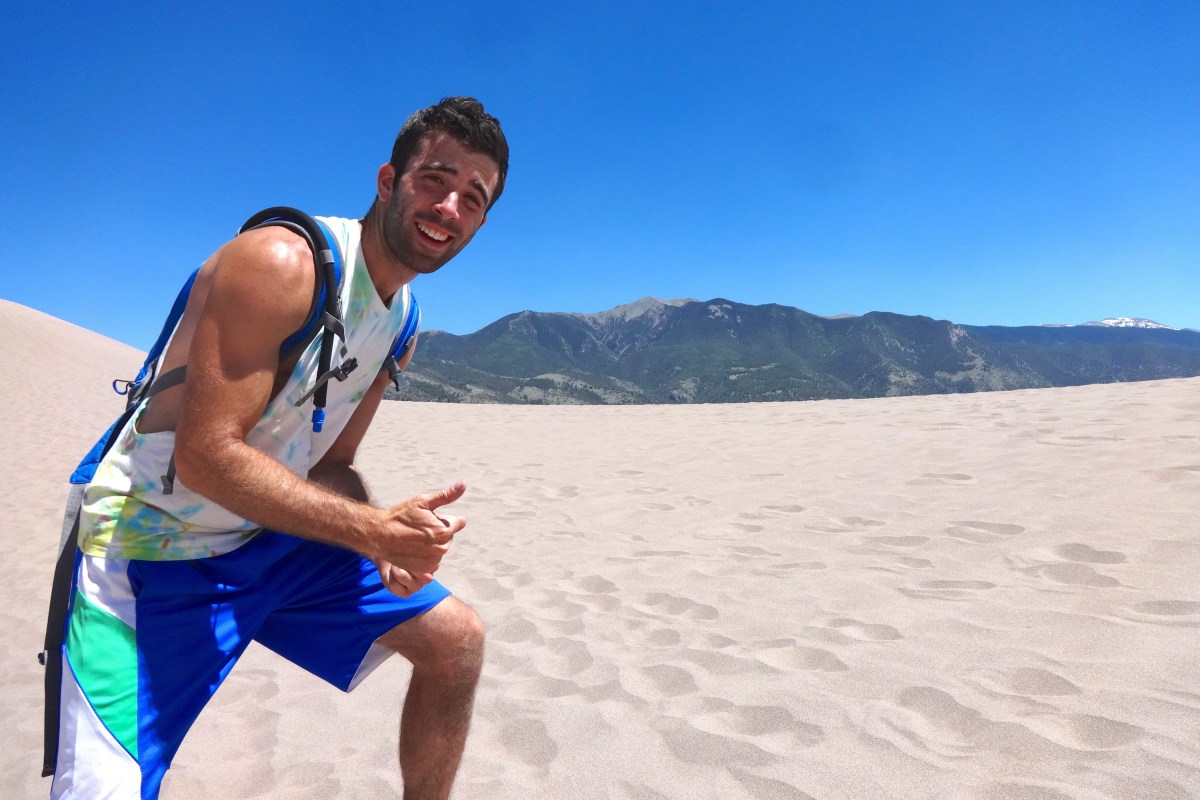
After crossing the water, the incline began, and the expanse of dry hot desert dunes stretched on for miles. Socks were on, and traveling was great. Although the area of sand dunes was very expansive, it was not endless. In all directions were the tall rocky mountains of Colorado with pine trees and snow melt creating stripes down their sides. It was an interesting contrast to be in stifling hot sand dunes, looking around at mountains with snow. It was also interesting to think that just yesterday I was venturing through deep snow drifts on my attempt to make it to Mount Ida. Colorado is definitely a place of contrasts.

The sand dunes were relatively busy. People were following each others footprints to dune peaks. As typical, I wanted to to go farther than anyone else. So I trudged further and further up and down sand dunes, which is not easy. It takes maybe five times the effort than hiking on solid ground, because with each step your feet sink, and there is not stable ground to push yourself off of. Hiking downward is fun though, because you can descend inclines too steep and perilous for solid ground. On sand there’s no harm done when you fall, tumble, and slide. The sand is a giant encompassing cushion.

Here the color of the sand was uniformly a typical beige color. No plants grew. It was everything you might imagine sand dunes to be. Nothing out of the ordinary like pink sand, or black sand, or wild scary-looking desert shrubs. It was just a giant sand box of a place.

I had reached the highest dune I could see from when I began my quest. Standing on top, DSC05337I could see there were more mighty dunes in the distance, which were temping to pursue. But at the moment, my feet felt like they were on fire. Wearing socks was not a bright idea. Hot sand found its way into the socks over and over again, and was burning my feet. The hot sand mixed with coarse friction had also burned and ripped a giant hole in one of my socks. It appeared as if part of the sock had disintegrated.  I was about a mile and a half in, but my feet couldn’t endure anymore hiking, so I turned around. I wasn’t disappointed the least bit. I felt like I got a true Great Sand Dunes experience, greater than the rest of the tourists who gave up much sooner than me.
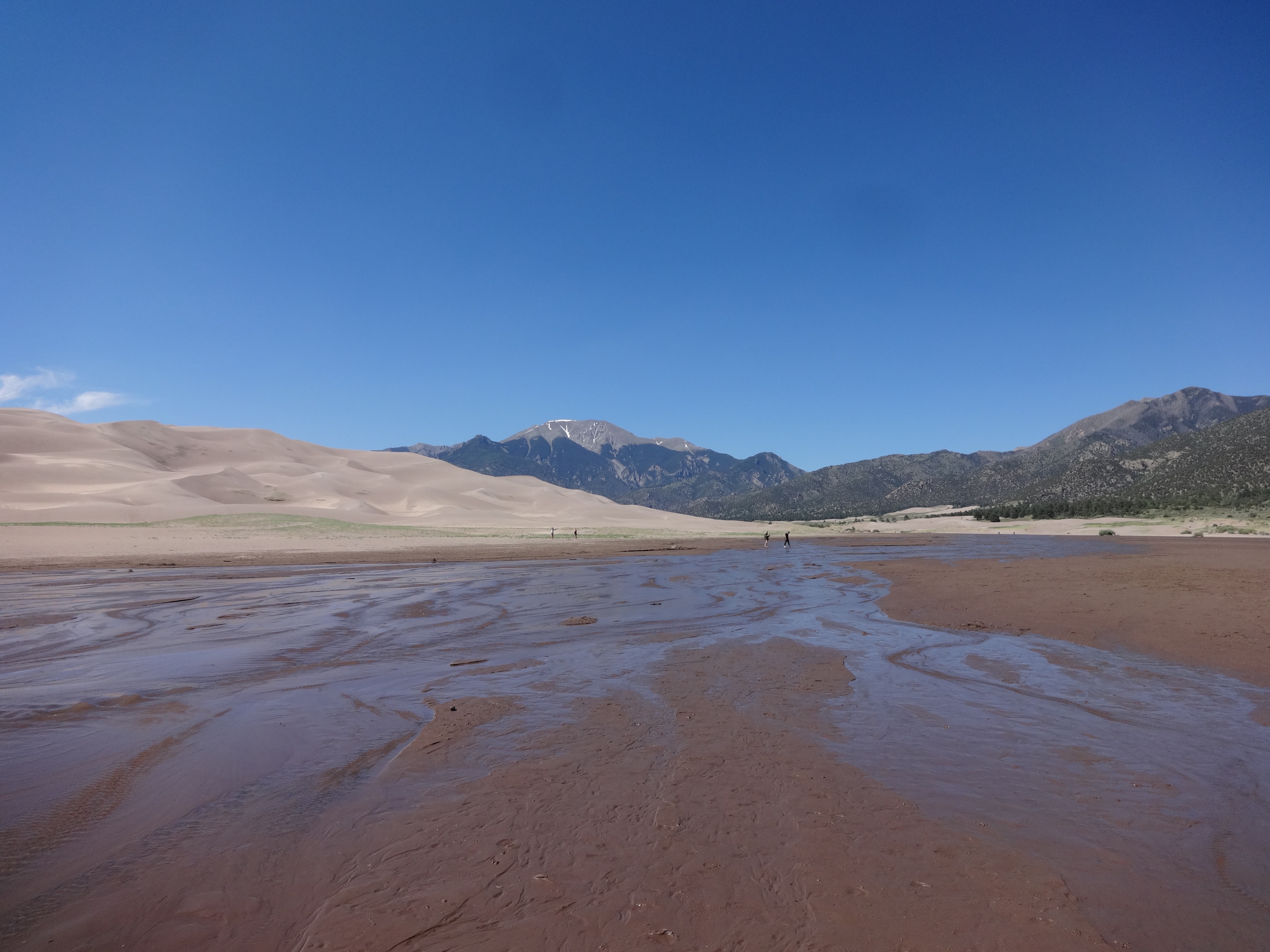
On the way back, I remember sitting down for a moment and looking around, at the sand, the mountains, and the people way below. I remember thinking, how in the world did I get here? Although I knew the answer, it was all sort of a marvel to me that I found myself in such a unique and different place than where I typically live my life. This sort of moment had happened more than once on my trip. In these pauses I try to take it all in. My life sort of replays summatively through my mind. It’s a summary of my weaknesses that I conjure up. I think back to when I was a teenager, being so depressed that I didn’t care to be alive anymore. At that time self-doubt and insecurity ripped me apart inside, and my world was so small. It didn’t extend beyond my own feelings.

I also think back to college when I was incredibly sick and weak, plagued with complicated Ulcerative Colitis and Pancreatitis. I grew tired climbing just one flight of stairs. Then I was hospitalized. I remember when I was able to walk again. I went out into the hospital courtyard with my walker, and just being able to stand on my feet, clinging onto my walker in that little landscape patch between cement buildings, was enough for me to find hope.

Now, here I was sitting on top of a giant sand dune, in the beating sun, thousands of miles removed from home, alive, strong, full of spirit. I’d come from the Sonoran Desert, seeing Saguaro cactus, through the Petrified Forest, across the plains of the Navajo Nation, around the canyons of Utah, up to aspen forests and alpine tundra of Colorado, and now here I was on a giant sand dune. I’d climbed higher than everyone else. They tired before me. I looked down at them as little ants. I realized my past was marked by canyons of illness that kept me trapped in low places, but now I was on a mountain, not by my own doing, but by the force of restoration and strength attributed to God.

In addition to marveling at how far I’d come, I was also struck in wonder by the diverse beauty of the United States. A few years ago I would have never even imagined that such a place as Great Sand Dunes National Park and Preserve existed in the United States. The more and more I travel to National Parks, the more I fall in love with this country. It is so full and rich in natural beauty. I remember, when I was younger I thought that the United States was just sort of uniform place with varying degrees in temperature. I couldn’t have been more wrong. The United States in amazingly rich in geological diversity. The National Park service does a great job at preserving all of these wonders and surprises.

After trying to take it all in, I began my hike down the sand dunes back to my car, tumbling and sliding down, despite my feet were in much pain. I had to arch my feet, trying to keep contact with sand limited to the tips of my toes and my heels. I had to pause at times and raise one foot up in the air to give it a chance to cool off, cooling down from the 150 degrees of the sand to the 105 degrees of the air. It was such a relief when I got back to the shallow river, and placed my feet in the ice melt water. I hoped the other young travelers from the parking lot hadn’t followed my example in footwear.DSC05389

I would have stayed longer in the river if it weren’t for some intrusive ranchera music blaring and ruining the serenity. A group of people had set up a canopy by the river where they had a picnic and enjoyed their choice music. I would have been happy listening to the water trickle and the wind wisp across the sand. It’s okay. I let it go. I wanted to go relax at my campsite and figure out a plan for the evening from there.

Back at my site I had received a text from my cousin, Jonathan. He and his family had been busy white water rafting most of the day, but now they were done and staying at an Airbnb in Durango, Colorado. I was welcomed to come spend the night there and visit Mesa Verde the following day, and then backpack overnight in the San Juan Mountains to the Ice Lakes the next day.

I plugged in the address into my GPS. They were about 160 miles away, which would equal roughly 3 hours of travel. I would arrive at night, but it wouldn’t be a problem. Sign me up!

I tore down my tent and threw my it back into my car. I found the campground host to inquire about a refund. She said refunds are never issued but I could sell my campsite. So I peddled around and sold my site to a couple at a slightly discounted price. Then I was out of there.

Durango, here I come! I was excited to see family. I had seen my cousin Jonathan the summer before when we adventured around Yosemite National Park together. It was a memorable time, and he was great company.  That was the last time I’d seen him. I would have liked to have seen him more, but I lived in Kentucky and he was stationed in California with the Airforce. As kids, we were decently close, although I would only  see him in the summer when my family would travel back to Princeton, Illinois. I thought we had a pretty good cousin bond, given our limited time together, but then the expanse of time grew larger between us and we grew up. When we met up in Yosemite, it had been years since I’d spent any time with him. I wasn’t sure how our interactions would go, but I couldn’t have asked for a better adventure buddy and a better time. Sure, we had grown and time brought change, but we were family and we were able to reconnect effortlessly and have a great time.

I also hadn’t seen my cousin Paul and his wife, Ines, in a few years. They had been living in Germany and their lives would be very different from what I last knew. And then there was my aunt Mary who lived in Illinois, whom I hadn’t seen in even a longer period of time. I knew she had endured heavy challenges and changes in life, and I admired her for her strength and raising my cousins, whom I respect so greatly, in the midst of it. I was so excited to see all of them and go on adventures together.

When I arrived, Paul and Mary were still awake. I spoke with them for a while, filling them in on my adventures and them filling me in on theirs. Their white water rafting trip was seriously legit. They rode some high class rapids and took the famous Durango and Silverton Railroad to their launching point. After visiting with them, I got laundry started, took a much needed shower, shaved, and retired to the living-room floor where they all had kindly left the comforters from their beds. I had a plush island of comfiness to myself, luxurious compared to the weeks of tent camping I had grown used to.

I was happy. Although I hadn’t seem these family members together in a long time, there was comfort in being with them. I had found a little piece of home way out in Colorado.


Read the next entry “Mesa Verde with My Cousins,” here:

https://joshthehodge.wordpress.com/2018/02/04/mesa-verde-with-my-cousins/

Read the previous entry “Chillin’ Like a Moose,” here:

https://joshthehodge.wordpress.com/2018/01/21/chillin-like-a-moose/

Facebook: http://facebook.com/joshua.hodge

Instagram: http://www.instagram.com/joshthehodge/

Starstruck in Rocky Mountain National Park

“There’s a moose on the road!” the lady exclaimed.

There are no moose in the Rocky Mountains of Colorado, I thought.

“Just up ahead on the road you’ll see him.”

Poor lady, I thought. She doesn’t know the difference between a moose and an elk.

However, in my ignorance, I was wrong. She was right.

I had just gotten out of my car at the Kawuneeche Visitor Center in Rocky Mountain National Park. I had been arriving from the West via Grand Lake. She had been arriving from the East. Apparently there was a moose to look forward on the road up ahead, but I missed it and stopped in the visitor center. I didn’t bother asking about hiking trails. I had done my research online, and I knew what I wanted to do, and I was very excited about it. This was the Rocky Mountain National Park! It’s one of those rare places you hear so much about and can’t believe you are actually there when you arrive.

For me Rocky Mountain National Park stands in a prestige collection of National Parks. Some National Parks just certainly have more fame than others. This was one of the big ones. I’d file it along with Yosemite, Yellowstone, Glacier, and the Great Smoky Mountains. I had made sure before arriving I had planned out this visit. I needed to be assured that my Rocky Mountain experience would be full and complete. I didn’t want to miss anything. I felt my plan was solid. And here, meeting Rocky Mountain National Park was like meeting a very famous celebrity. There was sure excitement, a bit of nervousness, and the whole fascination from being starstruck.

Leaving the visitor center I made my way on the park road to the alpine summit. Along the way I made a few stops. I had gotten out of my car at Coyote Valley to gaze across the Kawuneeche Valley, where meadows of green grass were adorned with clusters of pine.  Along the valley edges, the terrain gradually rises and stretches. It grows with thickening dark pine forest until it can reach no further and mountaintops peak with bald rocky tops capped with snow.

Next to me, just meandering right through the meadow grass, at level with the rest of the ground, was the Colorado River. It looked like nothing but a stream. It was quiet, humble, unannounced- except for a small sign labeling it. I stood there in astonishment. This little river is the same one that carves the immense depth and grandeur of the Grand Canyon. Incredible! It all begins with ice melt from the Rocky Mountains. This took me back to my parallels I had made while in Canyonlands about how in our lives there can be canyons, dark areas of sin that can be corrosive. I had previously concluded that canyons sometimes are formed by something so small and seemingly insignificant and sometimes in our lives small it’s those little things which over time can eat away and corrupt a person. Here this was super evident. This dainty little stream, meandering so carefree through the sunny meadow, would become extremely powerful and corrosive, tearing away the land, creating profound depths and forming one of the greatest natural wonders of the world. This realization was a lot to take in.

I continued on my drive up Highway 34, Trail Ridge Road, through the pine forest. The drive took me over the Continental Divide and into altitudes well into the 11,000s which turned the landscape into alpine tundra. Here no trees nor shrubbery grew. The ground was either blanketed with short grass or covered in snow. I was up amongst mountain peaks, looking down into massive pine forests and valleys.

As I reached higher altitude, the road became something of a challenge, because it narrowed and hugged nothing. From the edge of the road dropped dramatic distances down into valleys. On top of it, it was a busy road, with cars in sight in front of me, cars lined up behind me, and cars passing by very closely on my left. I needed complete focus. I was uneasy, clenching my steering wheel tightly. This road just didn’t seem, by any means, safe. However I had no regrets. This was part of the adventure.

The climax to the drive was arriving at the Alpine Visitor Center. It was a break, a place to breathe at ease. It was also very busy. I drove around the parking lot several times, before I found an open space. On one side of the parking lot was a snowbank reaching well over 20 feet tall. Snow also blinded half of the windows at the visitor center. Getting outside my car, I noticed everything was kind of wet and dripping. It was a bright sunny June day, and temperatures had to be in the 60s. It was surprising to see that such an enormous snow bank still remained. It was telling of what the snowfall must have been like here in the winter.

From the parking lot I walked up a short trail to a mountain summit where many tourist stood around in shorts, taking photos of themselves and the great distances around them. I could feel the altitude. Breathing up here was not as effortless as it typically is in the world below. I then went into the visitor center which was joined with a large gift shop and a cafeteria. I checked things out briefly and then walked across the road to the Ute Trail. I began my first planned hike and started it off running. It was a great feeling to be running on top of a mountain, but snow was becoming deeper, slowing me down. Also, the temperature was dropping, out on the frozen expanse. I then realized with the snow how long this would take me, and how I could easily lose the trail. I reevaluated the situation and decided it was a little too ambitious for the moment. I returned to the Alpine Visitor Center. I found a Rocky Mountain National Park t-shirt tye dyed in the design of the Colorado flag. I bought along with it a hat and a book about the first 100 years of the National Park Service. Then it was off to find my campsite.

On the drive up in the alpine tundra I saw lot of wildlife. I saw mountain goats, elk, and many marmots. I had gotten off at one overlook, and a half dozen marmots were crawling and flopping around. This was my first ever time seeing a marmot. Frankly, I didn’t know what a marmot was but had just learned to identify one in the visitor center. To me, they look like a cross between a beaver and a woodchuck. In the eastern United States  we don’t have marmots, and it’s not a very popular animal, thus its not built into our vocabulary. However, I love marmots. They are such goofy-looking animals with a cute charm about them and a high pitch short squeal that sounds like a smoke alarm when the battery needs to be changed. At this particular overlook, the marmots came very close to the tourists, perhaps looking for handouts. It led way to me being able to get some great Marmot pictures, not only capturing the image of the animals, but the beautiful landscape in the background as well. I took one of the marmot stately posing on a rock with the most majestic valley and mountain view behind him. It was quite a photo.

I had descended the heights to Moraine Park Campground. My particular site, which I had reserved online, was one of my favorite campsites to date. From the car, I had to walk a short distance to the edge of the forest where the trees led out into a prairie with a view of a mountain on the other side. The campsite was very private. I felt as if I had the whole prairie and mountain view to myself. I set up camp and, while doing so, made acquaintance with my  neighboring campers. It was an elderly couple camping out of a small fancy lookin retro camper connected to their vehicle by a hitch. They were from California and cleary had experience doing this. They were preparing dinner out of a kitchenette accessible from the outside on the back of their camper. I inquired if there were bear boxes or any food storage instructions I needed to be aware of. They assured me that bears wouldn’t be a problem and nothing was out of the ordinary.

After camp was set up, I drove a short distance to the small Bierstadt Lake. I took a peaceful walk around it on the trail loop. I observed a few men fly fishing, sporting their rubber waders and standing in water up to their waists. The late evening sky was clear and crisp and I admired the pristine reflection, in deep rich colors, of the mountains in the lake.

I felt a feeling of accomplished arrival. I knew I would be staying here for a few days, so I felt like I had fully checked in. I was successfully making my acquaintance and was at ease, knowing this would be a good stay in Rocky Mountain National Park.

I returned to my camp, to my secluded little hideout at the prairie’s edge. I heated a can of  soup and cooked oatmeal over the fire, while writing a few postcards. I watched the moon and stars come out and enjoyed the heat and crackle of my campfire next to me. I then retired to my tent where I had a relaxing readathon, reading over the park newspaper, another chapter in my book about the West, and the intro to my new history book about the National Park Service. All during this my campfire continued to subtly crack and send flickering warm glows across the side of my tent. This was a quintessential end of a day and included what I love most about camping- the beauty, the quiet, the simple comfort of nature, and the prospect of adventure in the day to come.

Read the previous entry “Arriving at Black Canyon,” here: https://joshthehodge.wordpress.com/2017/12/31/arriving-at-black-canyon/

Facebook: http://facebook.com/joshua.hodge

Instagram: http://www.instagram.com/joshthehodge/

Arriving at Black Canyon

Something was wrong, and I wasn’t quite sure what it was. I noticed the hubcaps on my rental car looked warped and out of place. I shouldn’t have gone on those rough roads in Saguaro and Capitol Reef, I thought. I’ve knocked the hubcaps out of place. This had been on my mind for a few days, but there was nothing I could do about it until now. I was finally amidst real civilization. I was in Grand Junction, Colorado with all the amenities of corporate America at my fingertips. I pulled up to a Walmart Auto Care Center to inquire about my hubcaps.

“Can you just have a look and tell me what’s wrong.” I guided the mechanic across the parking lot to my car.

“Oh, well they were put on wrong in the first place.” He informed. He peeled the hubcaps away from the rims of the wheels. “You should be fine now.” I was relieved that it was an easy fix and to see normal looking hubcaps again. I thanked the man and went into the Wal Mart to stock up on supplies. I felt I owed them a purchase. Just prior I had eaten at a Del Taco, one of my go-to places when venturing out West. Those in the rest of the country wouldn’t know that a Del Taco is like a step above a Taco Bell, with fresher ingredients and more healthy and filling options, with fresh avocados and tomatoes. I sound like an advertising spokesperson when I talk about them, but I’m just a fan.

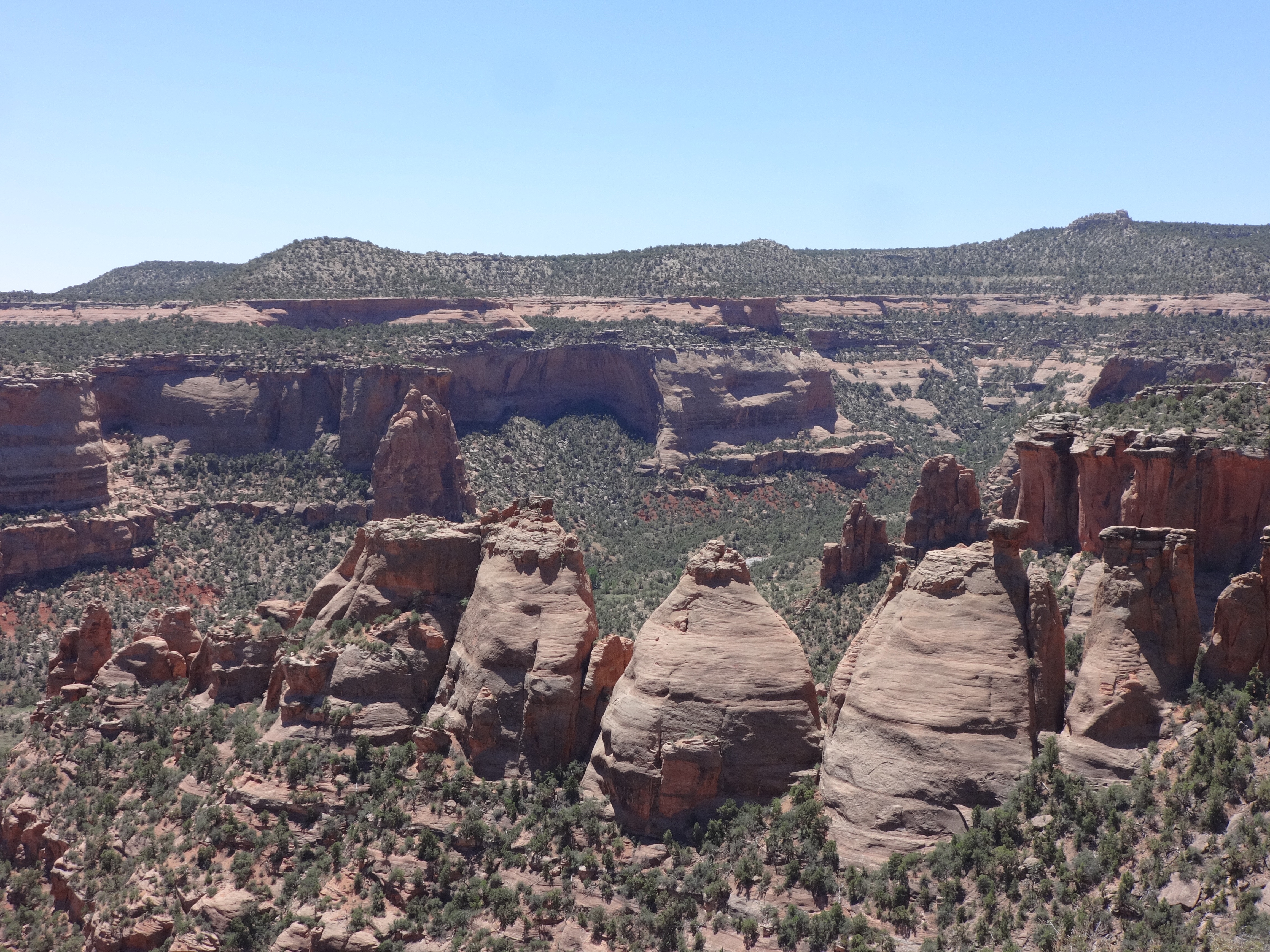
Prior to rolling into Grand Junction I had left Manti Lasal National Forest in Utah and had driven about two hours from Utah into Colorado. I had stopped to visit Colorado National Monument which largely sits high on a mountainous plateau of red rock, looking down across flatlands of colorado. I didn’t have much time to spare, but checked out a few view spots, including the popular Coke Ovens, which are large rounded rock formations that stick up in a row in a canyon.DSC04842

In my planning of these summer adventures I recall being first confused about what a National Monument was. In my mind a monument was a statue or some mounted object in honor of a specific event. This is not what a National Monument is. Rather they are very similar to National Parks. Most National Parks first start out as National Monuments. I once inquired about this to a park ranger. He explained that really the only difference is that a National Monument is a park unit created by a president, and a National Park is a unit created by an act of Congress. The major difference between the two is that National Parks tend to gain more tourism simply because of the title.

Colorado National Monument was my first ever impression of Colorado. I had seen photos of the Rocky Mountains and the Maroon Bells of Colorado, and I was heavily influenced by the pine trees, grey rocks, and snow-capped mountains. I was surprised to find so much red rock in Colorado. However being here, it just made sense, given that it lies right next to the red rock wonderland of Utah. Despite seeing beautiful photos of Colorado online, I had read several negative things about Colorado in the wake of it being the first state to legalize recreational marijuana use. 

Despite my preconceived notions, Colorado was surprising all around. It borrows from that which is beautiful in Utah, but adds in its own unique natural beauty. It has more people that Utah, with more frequent towns and cities and less feelings of isolation, with a population at 5.54 million, nearly doubling that of Utah. After visiting Colorado National Monument I descended into the city of Grand Junction, Colorado, with population around 61,000. The part of the city I saw appeared new and clean with wide and smooth properly constructed streets.

After spending days in remote areas, I always become so very appreciative of places like Grand Junction. Although in the course of typical life-living, supermarkets, fast food, restaurants, air conditioning, and all the amenities of modern America, become common place and stale, when I’ve been isolated from them for days and I come upon them again, it is genuinely exciting. In the moment there seems to be nothing better than the feeling the brisk  air conditioning, to feel the refreshing coldness of ice in my beverage and an unlimited supply of cold water, to find food already prepared and available in bounty. The ease and accessibility of all of these goods is make possible by corporate America, which is something to be grateful for. These businesses, despite recently being attacked, labeled, and stereotyped, provide incredible service, and are only possible in this great nation. Getting away and spending time in nature helps me become more appreciative of the simplicities of modern life that we enjoy and are so fortunate to have in the United States.

After having the hubcaps on the car adjusted, dining at Del Taco, and restocking on food at Walmart, I was ready to proceed as planned with the day’s agenda- to shower and workout in Montrose, set up camp, and do a little sightseeing in Black Canyon of the Gunnison National Park.

The drive took me through the small town of Delta, which to me felt like stepping back in time to an era I wasn’t even alive to witness. Although it was a quiet place, its mainstreet had many businesses, not for tourism, but simply placed ordinarily with vintage looking facades. There was a general store, a fabric store, a jewelry shop, a small grocery store, and numerous little Mexican restaurants. Here I felt far away. The uniqueness and old timey feel made me aware of the distance I had traveled.

I proceeded into Montrose where I purchased a day pass to the Gold’s Gym. I was surprised that such a large and nice gym was located in such a small town. As I was working out, doing a little bit of everything, I observed the locals around me, wondering what life might be like for them, and wondering what they might do for work. I’m sure I didn’t stick out and that I blended in as just another guy at the gym. As they were doing their typical gym routines, going about ordinary life, here I was on an epic adventure, just paused for a moment in this small seemingly insignificant town, which really drew me to it for only one reason- a gym with a shower. How peculiar my situation was but well planned and executed.

After my workout and shower, I dug into my food supply in my trunk and enjoyed a cinnamon raisin bagel and a Muscle Milk. I followed it up with a grilled chicken wrap at the nearby McDonalds. I sat there in McDonalds and for a moment, I did feel a bit of loneliness. I remembered the lost opportunity to connect with the other solo adventurer at the McDonalds in Moab. I saw a family on the other side of the restaurant eating together. I wasn’t in some major touristy spot where I could relate to the gamut of people around me on adventures. I was in a small town. People were about ordinary life. I thought of many times I had tried to form friendships and relationships with people, but how they always bailed out on me. I thought about how long I had waited for people to go on adventures with and the reason I found myself out here alone was because I became tired of waiting and decided to move on alone. I thought about how all the incredible memories made would be mine and no one else could recollect them with me. I also thought about how all efforts to connect with people were not completely lost. There were my postcard buddies I had been writing. My two postcard buddies were new people to me. I wondered would this effort to connect with them be fruitful or was it all done in vain?  

Then I came back to my senses. I didn’t come all the way out to Colorado to sit in a McDonalds and feel sorry for myself. To make it out here alone, seeing so many beautiful places, and finding my way so effortlessly was an accomplishment of independence and something to be proud of. I picked myself off of that plastic McDonalds booth, emptied my tray into the trash and then it was onward to Black Canyon of the Gunnison.

Approaching the park it was really hard to anticipate anything, because the terrain and the small town surrounding it were just so typical. But rather suddenly I came upon a giant break in the terrain, an enormous open wound in the landscape. A dark ominous gap dug sharply into the ground. I realized Colorado has surprises.

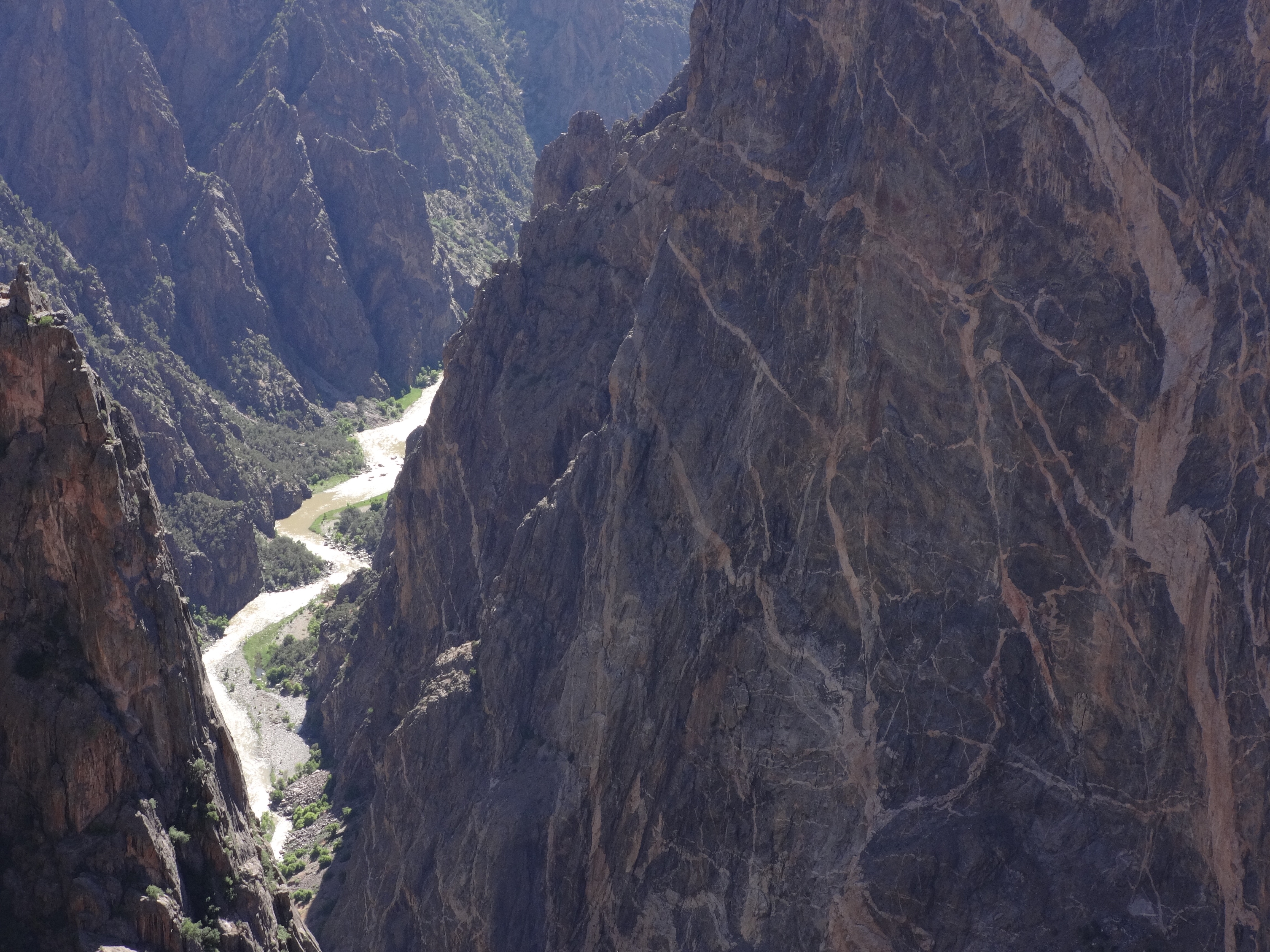
I have mixed feelings about this National Park. The canyon itself is surely impressive.  There is nothing I have seen quite like it. It is a very dramatic canyon with very sharp edges and rocks pointing and jutting up from it. The rock looked as if it had been violently chopped to carve the canyon. Standing by it, looking into it, I received the kind of awe I might encounter if i were to gaze upon the fictitious castle of a vile king. It is beautiful if you take the time to admire all its special peculiarities, but at first glance it looks rather uninviting. It’s not inspiring to me. It’s not like looking up at a mountain and losing yourself in the beauty of the moment. Black Canyon seems more like a warning from the forces of nature, a display of its violent ability. It’s dark, sharp, gaping, and hollow.

Prior to my trip I had entertained the idea of hiking down into the canyon to greet the Gunnison River, but I had read too many warnings of poison ivy overgrowth and how the descent is not much of a trail but a free for all which at parts require the hiker to lower himself by holding onto ropes and traversing the steep slopes of the canyon. I had not ruled out the possibility of descending into the canyon, but when I looked at it, I came to a conclusion. Sometimes I’ll see a mountain and have the nagging desire to summit it, like in Manti Lasal, but there was little to no desire to put myself at risk to place myself into a dark and ominous abyss.

“Will you take our photo,” a man asked me while I was looking over the edge into the depths.

“Sure,” I snapped the photo.

“Let me do the same for you,” the man offered to return the favor.

“No, it’s okay.” I replied.

“Oh come on, you need a picture,” He insisted. He struck me as very friendly. He took my photo, and it came out really well. I noticed his hat sported an Indiana school. I had to ask him where he came from. I met a couple from Indiana. When he asked me where I was from, I claimed Kentucky.

I proceeded further into the park to the visitor center. The park film was chock full of lots of interesting history about the canyon. This provided much more richness to my Black Canyon experience. I learned how the canyon was largely avoided until the 1900s. It’s river waters were so violent that wooden boats were turned to splinters by explorers. One successful survey of the canyon was done by a couple of men floating on a mattress.  Also the history of a railroad stretching along the sides of the canyon and the effort that went into constructing it was incredible.

History here is rich, but I was surprised to find that this place beared the title National Park. National Parks to me usually boast numerous features and plenty of opportunity for recreation. This park is small. There aren’t many trails, and the different features seem to be limited to view spots at just various angles of the same canyon and river. It seems unjust to place it in the same category as places like Yosemite or the Great Smoky Mountains or any National Park I had visited up until this point.

After squeezing in my stop to the visitor center before it closed, I backtracked a little bit on the road to set up camp at the South Rim campground. The terrain was part woodsy, part deserty. I wasn’t sure what animals might be around at night. Ever since I visited Sequoia National Park and was warned about black bears breaking into cars, I have become extra careful not to leave food items out in my vehicle. My campsite, which I had reserved online, was very private. The fire ring and picnic tables were in an open exposed area, but behind a row of tall shrubbery, was a place to set up the tent, completely shielded on all sides by growth. I quickly pitched True Blue and continued on the park drive, stopping at numerous viewpoints.

The two most notable view spots for me were Pulpit Rock, where long ago a minister
used this rock to deliver sermons to his congregation, also Painted Wall, which is a section of dark rock with bright white stripes running through it. This is another geological landmark I hadn’t noticed before, but afterward have seen it in ads and billboards. I had all intentions of being at Warner Point for sunset, seeing that right next to it on the map is labeled “Sunset View,” but again I was moments late for the sunset arriving at the point. It was okay. I was tired, and what I wanted most of all at this moment was a good night’s sleep.

I returned to my campsite in the dark, got ready for bed, and without reading, without thoughts to ponder, I flipped my switch and fell asleep.

DSC04877

Read the next entry “Starstruck in Rocky Mountain National Park, ” here:

https://joshthehodge.wordpress.com/2018/01/05/starstruck-in-rocky-mountain-national-park/

Read the previous entry “Exploring the Uncharted,” here:

https://joshthehodge.wordpress.com/2017/12/27/exploring-the-uncharted/

Facebook: http://facebook.com/joshua.hodge

Instagram: http://www.instagram.com/joshthehodge/