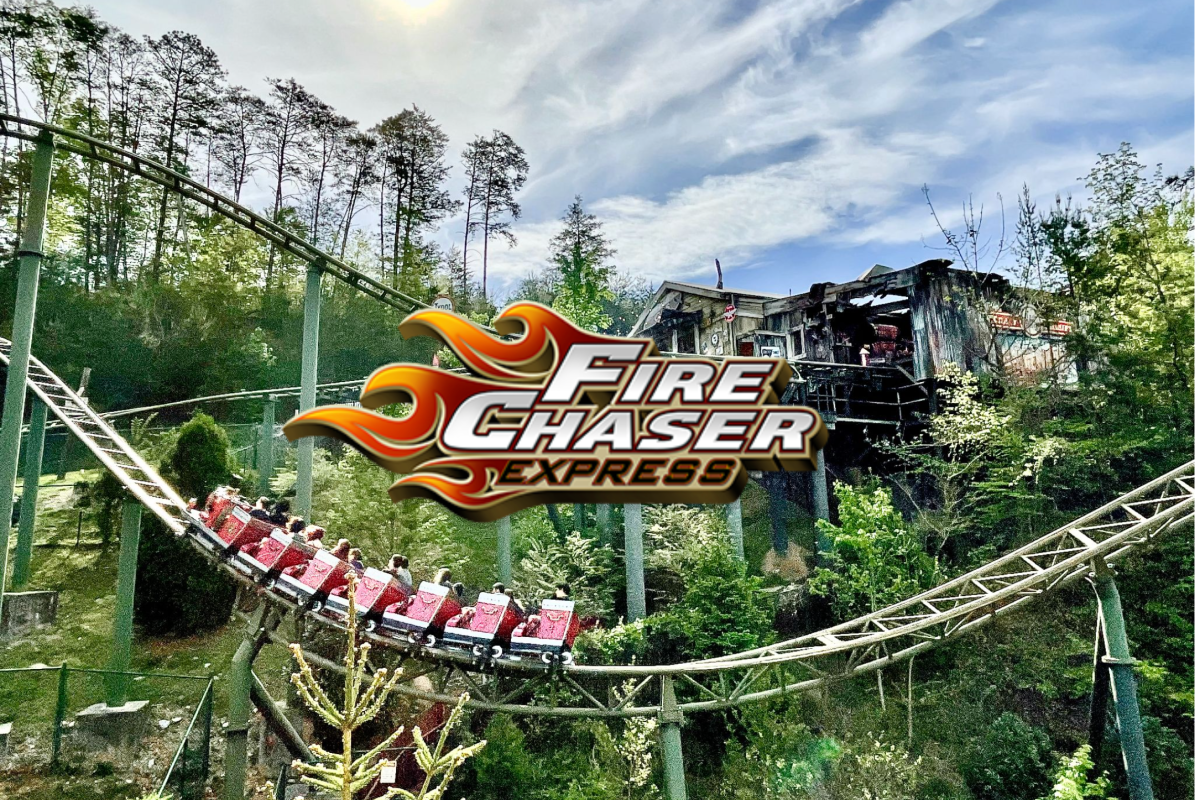
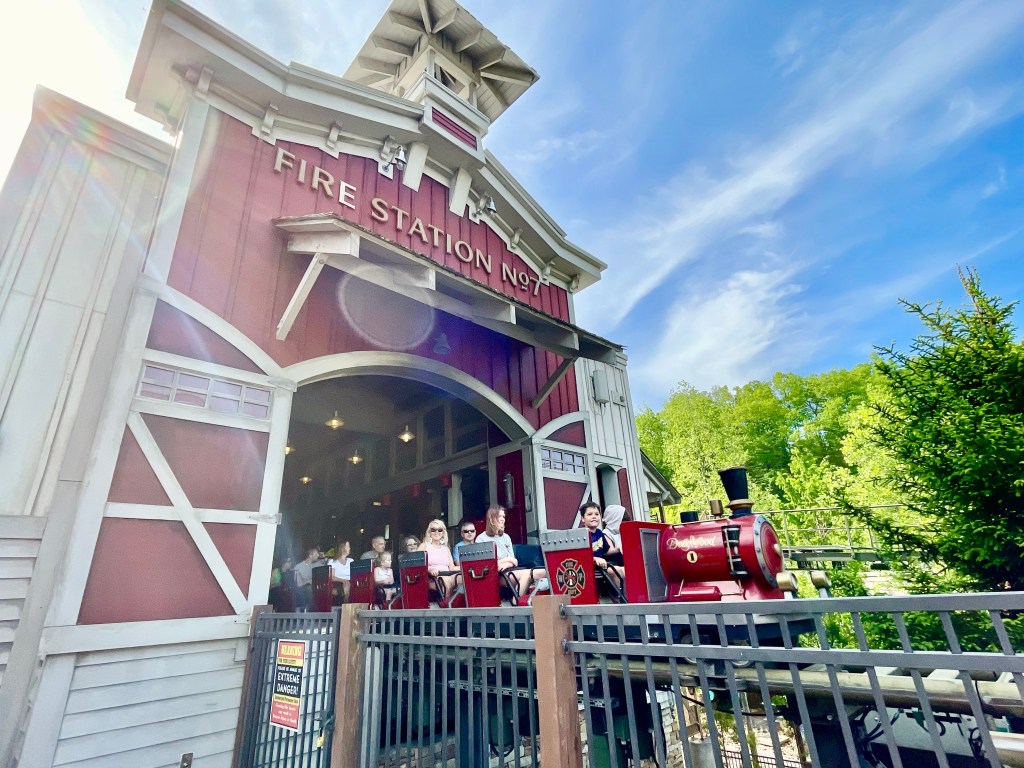
One of my biggest Insider tips that can really improve your experience in Dollywood, is to take the time to learn the backstories behind the prominent attractions. It takes the whole experience to the next level as you realize you are participating in a story. Right now there’s a lot of buzz surrounding Dollywood’s newest attraction: Big Bear Mountain. Deservingly so, but don’t let the excitement overshadow the other excellent coasters in Dollywood. I want to showcase here another one of my favorites, FireChaser Express, and enlighten you on the story surrounding this ride.
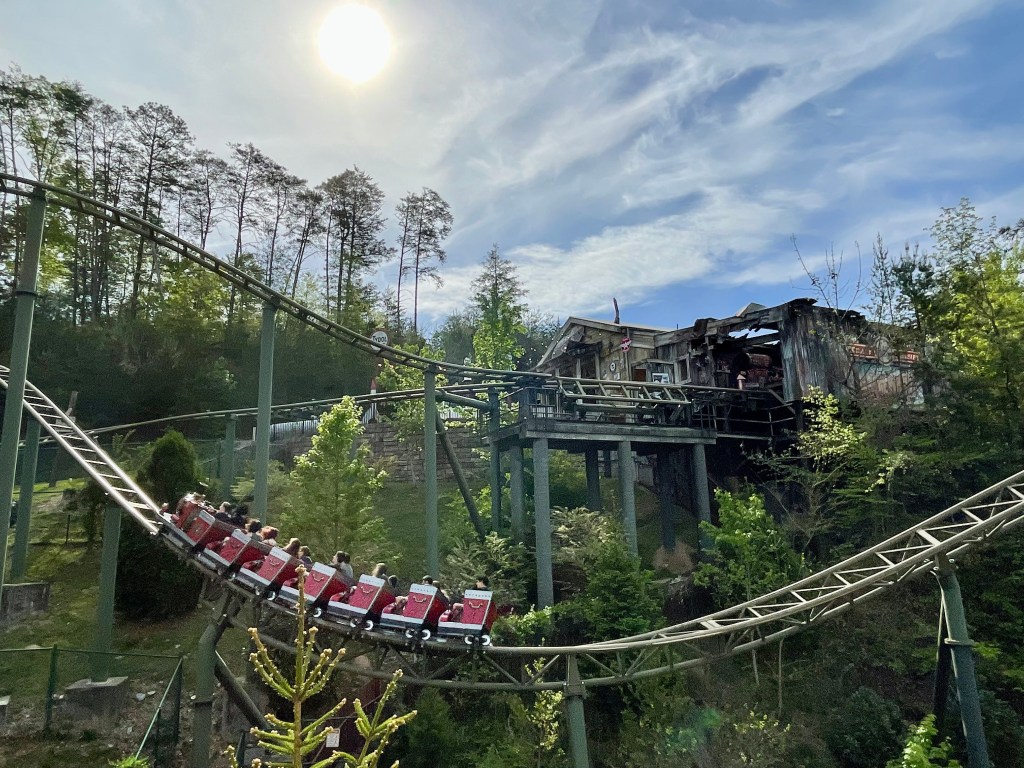
When you pass by this thrilling family coaster, you see it towering above Wilderness Pass and hear its own unique soundtrack. You hear the siren of the fire truck coaster bursting out of the station. If you’ve ridden it before, you remember its thrill, the exquisite view of the park from atop, and how after you think you may have completed the circuit, the coaster launches you backwards on the track to the fire station.
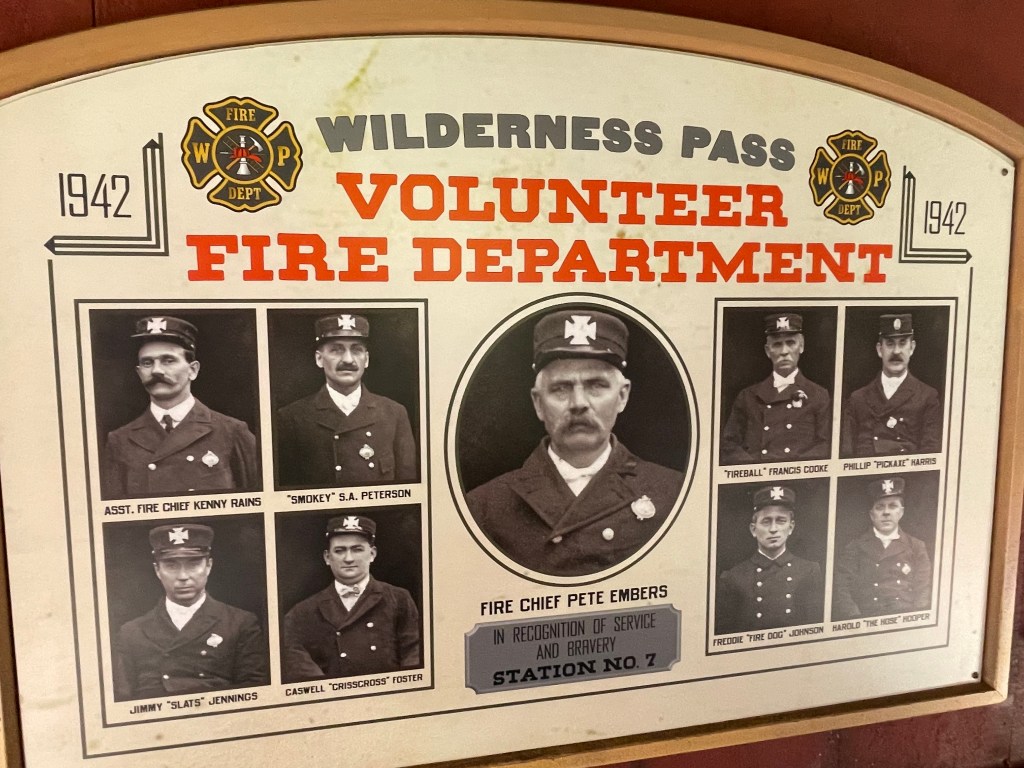
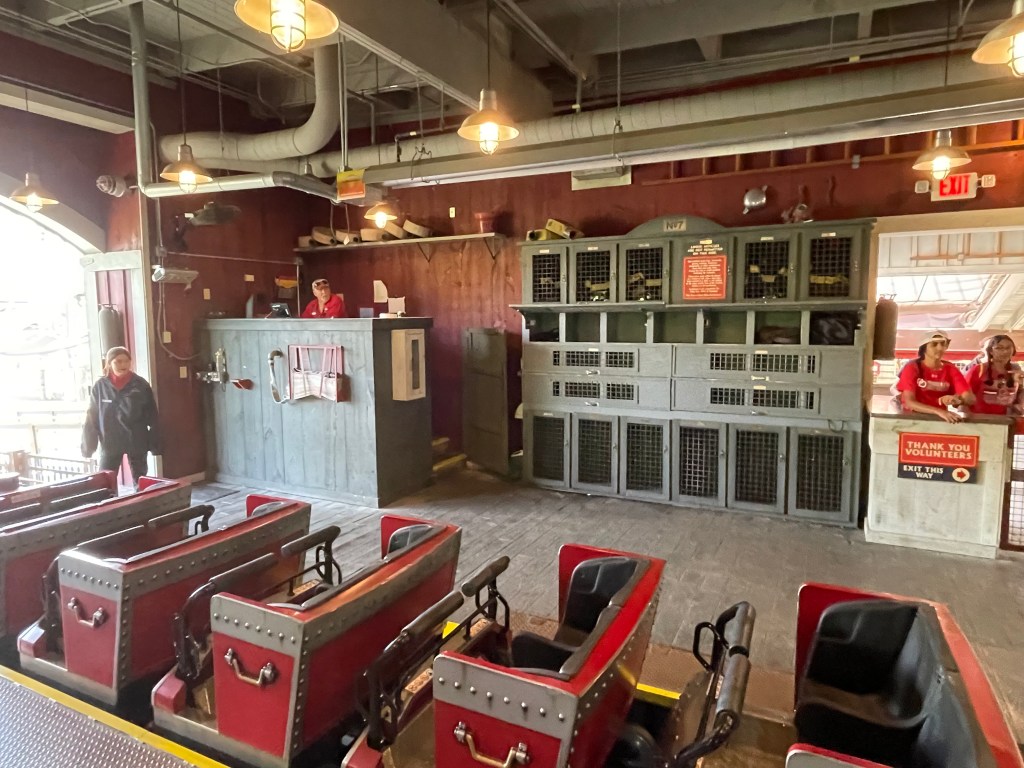
What all is going on here? Well, FireChaser Express is housed in Fire Station 7. Fire Chief Pete Embers is the character who oversees this station. You’ll see his desk at the station as you enter the line queue. You’ll see his hats, maps, books and a poster of Smokey the Bear, but you won’t see Chief Embers. He’s very busy and takes post at a fire lookout tower, keeping an eye out for fires in the Smoky Mountains.
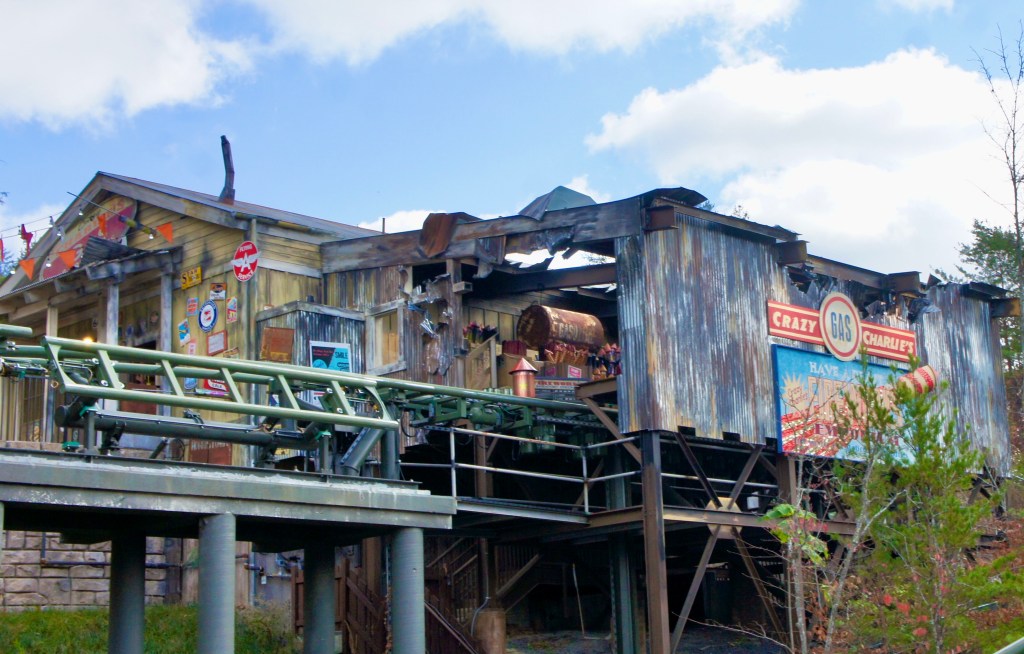
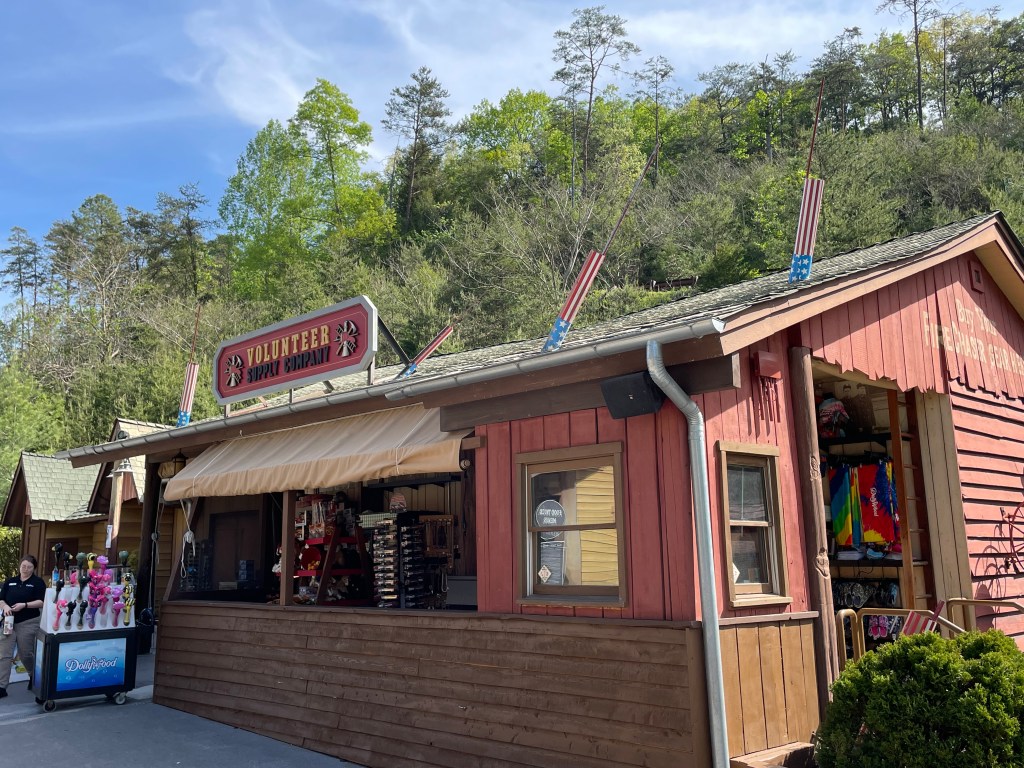
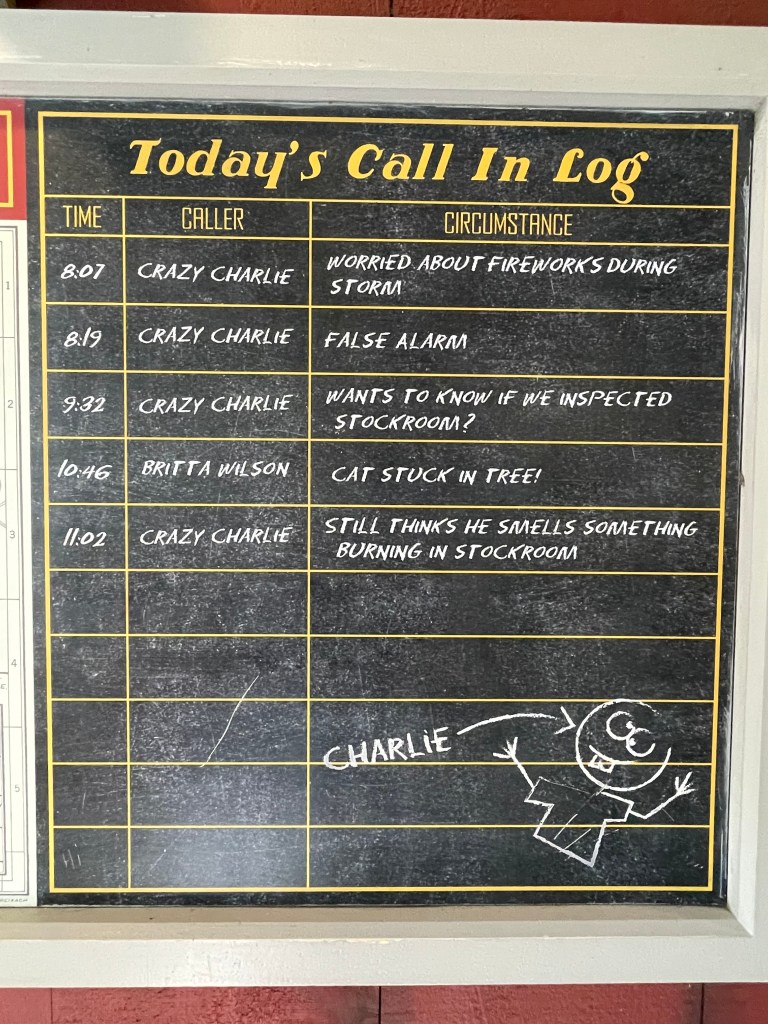
Another character essential to this attraction is Crazy Charlie. He owns Crazy Charlie’s Gas and Fireworks Emporium. It’s quite a dangerous combination one may conclude. His name is befitting, as he is quite eccentric and a bit of a nuisance, always calling Chief Embers at Fire Station 7 to report on some perceived danger. He’ll smell something or suspect something when there’s never a real issue. He’s also always test-launching fireworks which end up littered all around Fire Station 7. Even some have landed on the roof of the Volunteer Supply (the attraction’s souvenir shop). Chief Embers has had enough of dealing with Crazy Charlie, but just as he’s about to wrap things up, he gets hold of a rumor that Crazy Charlie is working on a giant firework to break all his records called “Big Bertha.” This time there really might be a legitimate concern.
Now, this is where you, the park guest enters. Chief Embers is looking for volunteer firefighters to serve in Fire Station 7 and keep an eye on Crazy Charlie. As a guest, or volunteer firefighter, as you board the coaster, or firetruck, you are on duty. You’ll hear in the station a call of emergency. Sirens will sound and Chief Embers will say, “This is not a drill”. The firetruck coaster will launch out of the station, zipping along Crazy Charlie’s firework testing zone. When you reach the top of the hill you will have arrived at Crazy Charlie’s Gas and Fireworks Emporium. Committed to safety, the coaster will take you and your fellow volunteer firefighters into the store’s stockroom where you will see dozens of fireworks, and you’ll find the rumor is true! You’ll see the massive Big Bertha. After some back and forth you’ll hear Crazy Charlie say, “This doesn’t look good.” Birth Bertha is accidentally ignited, rocketing you out of the store, on your firetruck, backwards to the station. Or so the story goes…
After learning this story, I was excited to ride this coaster again and really pay attention to the details. It made my experience all the more immersive. There are a lot of items and signs that relate to this story in the attraction. In addition to seeing Chief Ember’s desk, there also is a chalkboard on the wall in the station logging all of Crazy Charlie’s calls. In the line queue I took the time to look up at Crazy Charlie’s Gas and Fireworks Emporium and notice the gas pump, and the eccentricity of the place, which I never really noticed before. I also noticed there in the line queue, photos of all the firefighters on the wall including a photo of Chief Embers.
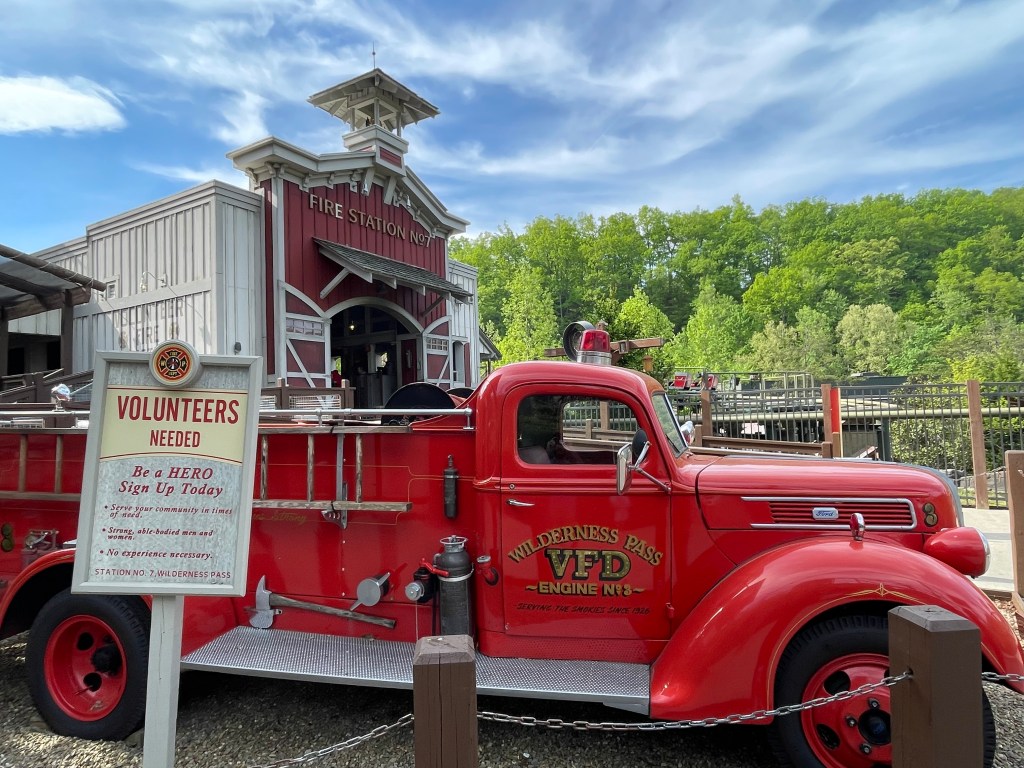
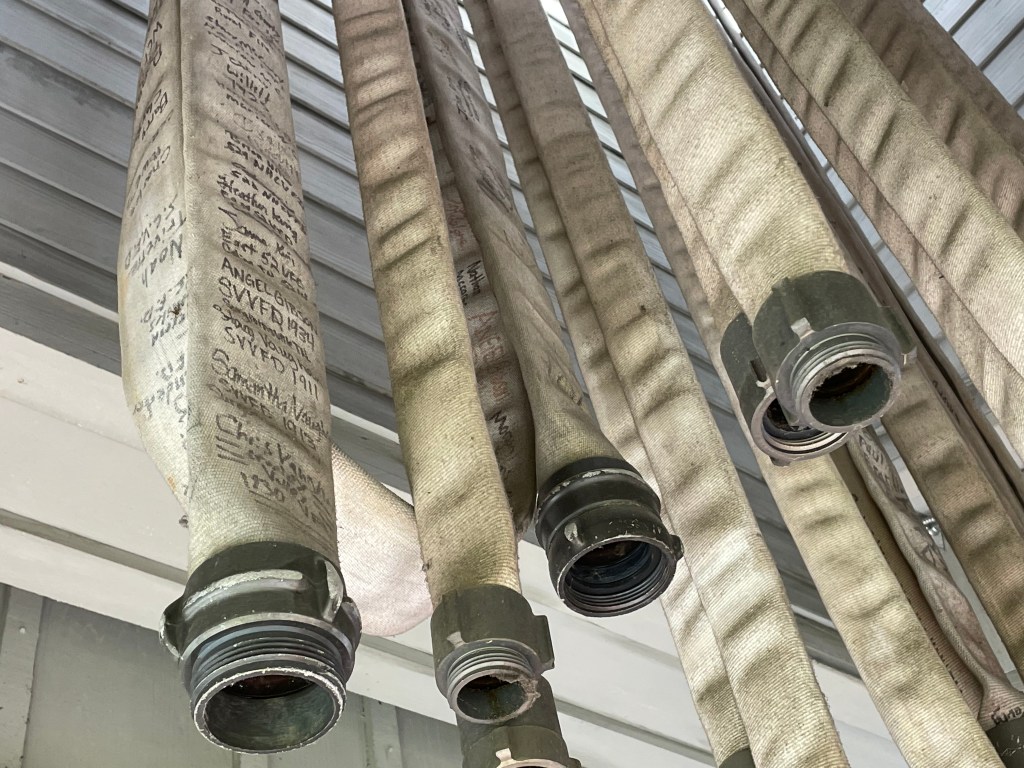
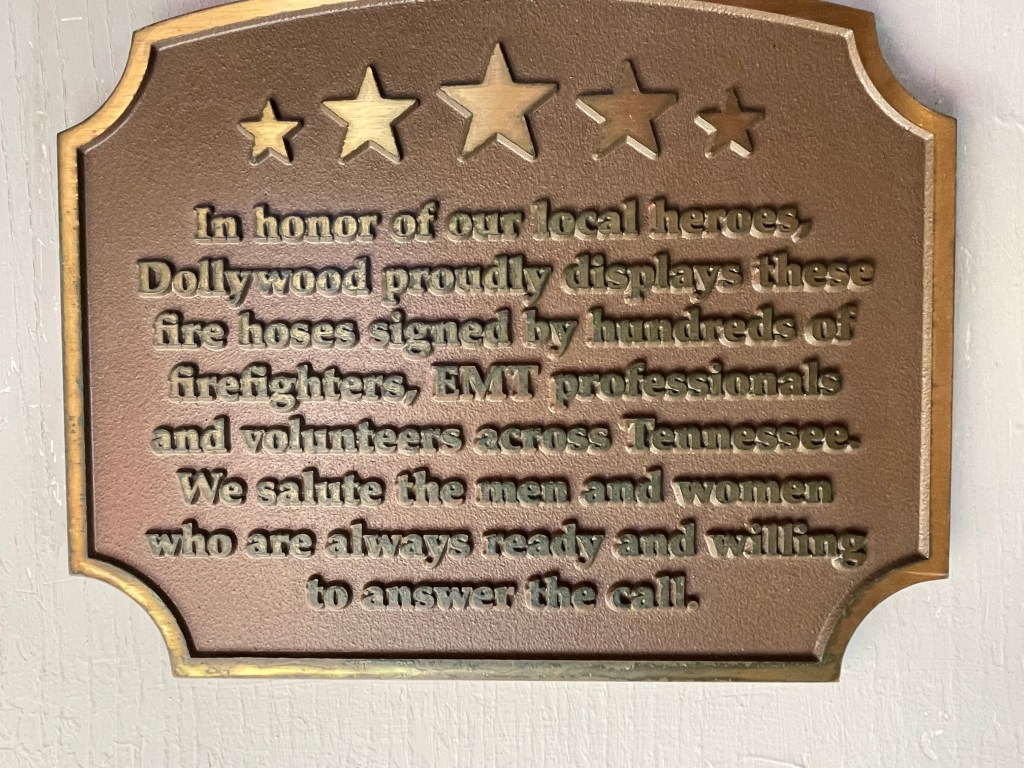
Apart from the items directly pertaining to the story, there are also a few other unique gems to point out. All throughout the line queue are vintage firefighting equipment. One of the most notable is a restored 1941 Ford fire truck. Just inside Fire Station 7’s main building one will find dozens of fire hoses dangling down. These are from real fire stations throughout Tennessee and are signed by real firemen. A plaque accompanies them, reading, “In honor of our local heroes…We salute the men and women who are always ready and willing to answer the call.” These hoses are one of a few tributes to firefighters. At the entrance of the attraction is a statue of a firemen and a large plaque labeled “Saluting Our Firemen,” which is worth taking the time to read. As Dolly Parton explained at the ride’s grand opening in 2014, this ride seeks to honor everyday the brave service of firefighters.
Next time you go to Dollywood, take the time to observe all these tributes, relics, and story elements. Board FireChaser Express with the mindset you are participating in the story of Pete Embers and Crazy Charlie. It also helps children who may have hesitancy to ride some of the more thrilling rides, to explain to them the story. Pretending, imagining and participating in the story can ease the nerves of the younger park guests and help them really enjoy the experience.
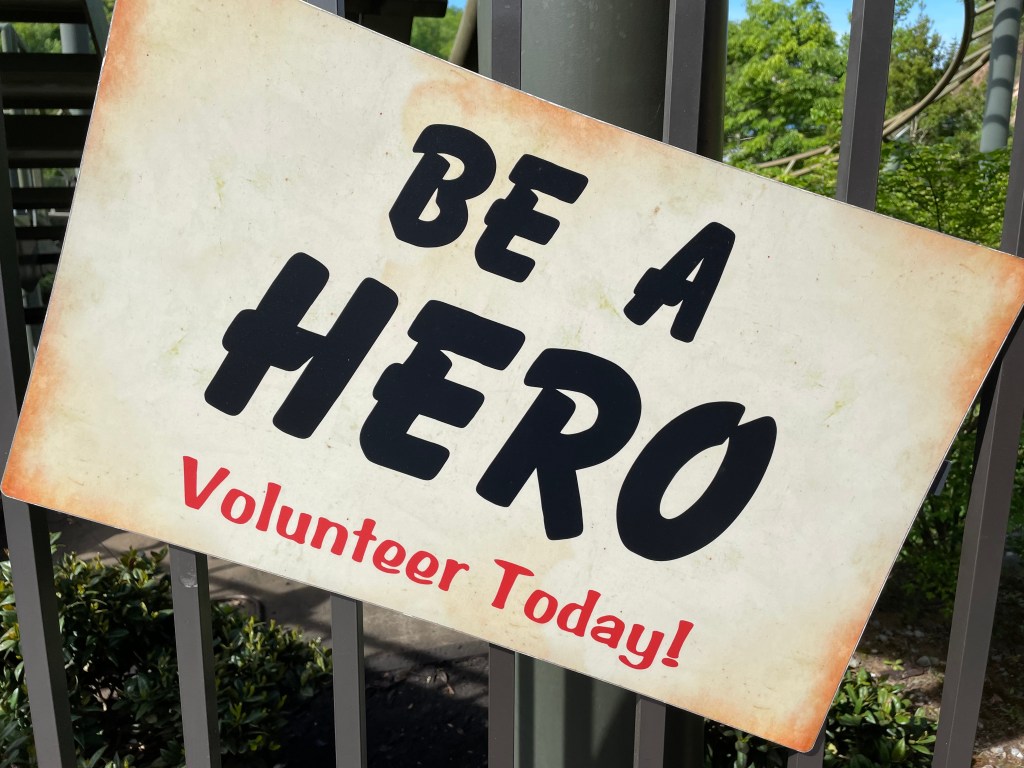
So, what are you waiting for? Fire Station 7 is still looking for volunteer recruits!
If you enjoyed this “Deep Dive” you may also enjoy my in-depth looks at Dollywood’s Mystery Mine here:
I was up on the highlands early in the morning, pulling over to take a photo of the hundreds of sheep grazing in the pasture. I had never seen so many before. It reminded me of John Muir’s summer in the Sierra as a shepherd. Maybe this was a familiar view he saw: little fleecy clouds grazing up and down the hillside and the sky a cloudless blue. I was on my way to a ghost town: Bodie State Historic Site. This one had been on the radar for a while. It is the ghost town of all ghost towns. I say this because of it being the largest intact ghost town, boasting over two hundred remaining structures. The citizens once claimed it was the largest city in California with a population of around 10,000, when it peaked in 1880.
Today it is a thirteen mile drive off the highway to this ghosted metropolis in the heights. The last three miles were dirt and rock, and there was a car before me obstructing my view by spinning up clouds of dust. I was doing the same for the car behind me. I certainly wasn’t visiting this place alone like when visiting many of the other ghost towns throughout my travels. The dusty road finally curved around and spilled into a flat sandy parking lot. There were dozens of other cars. I popped my trunk to get my backpack and gear up for exploration. The car that had been trailing me pulled up beside me and a husband and wife stepped out. “That was quite a drive,” the man said.
“It sure was,” I agreed. Was he referring to the scenery of treeless pastures, the rocky road, or the hundreds of sheep? I didn’t know, but I appreciated his friendliness and no apparent resentment for the clouds of dust I sent billowing his way.
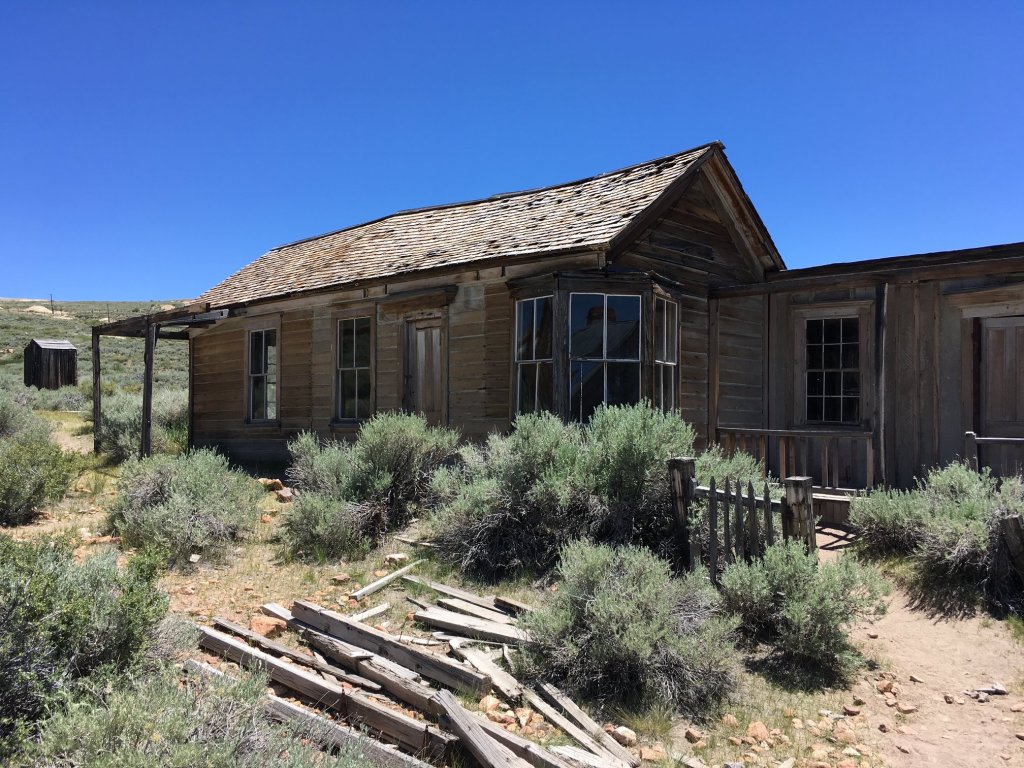
I was enthralled when I stepped foot into the dusty streets of Bodie. It was more than I could have imagined, and by “more,” I mean it in the literal sense- so many structures and pathways to explore! The pictures of the place online were quite intriguing, but in reality this place was on the next level, and it was so quintessentially old Wild West. I felt as if I was upon some movie set or propelled back in time. However, the buildings were rightfully weathered by time telling me this was a rare relic of the past.
I was excited to explore it all, but as disciplined as I am in such matters, I first had to watch the park film. What did I learn? This was a place rich in multiple ways. It mined about $34 million in gold and silver in its time, adjusted to about $100 million today. It is also rich in the history and stories it holds. I felt one must spend a lot of time here to really get to know Bodie. I would only get to brush upon the knowledge of its rich history.
I learned that the gold and silver mines in Bodie were once owned by the Standard Mining Company, and atypical of many other mining towns, the Standard Mining Company did not own the town. All the other businesses in town were private. When Bodie was booming, it even had its own town within its town. The influx of Chinese immigrants who worked on the railroad and in lumbering, to support the town, sought to keep their own customs and traditions in their own community within Bodie. Yes, this is a ghost town with a Chinatown that once had its own general store, saloon, and Taoist temple. I would learn many more interesting facts about Bodie later on a tour. But to set the scene, and frame things in context, Bodie went through many fluxes in population in part due to fires, assumed mineral depletion, and eventual unprofitability of the mines. It stayed alive until 1942, when the U.S. government’s War Production Board passed an order which shut down all non-essential gold mines in the country. Bodie’s last remaining mine was closed and mining never resumed. The Cain family, who owned much of the land, was conscious of its historical significance and hired a caretaker to look after the place in the 1940s, until they transferred it over to the state of California in 1962, after it was named a National Historic Landmark.
I looked out. Streets intersected with streets everywhere. There were flat lanes, and hilly neighborhoods. All the buildings were in uniform, composed of dark vertical wooden boards. Out in the distance, forming the Bodie skyline, was the Standard Stamp Mill, which I would get to tour later.
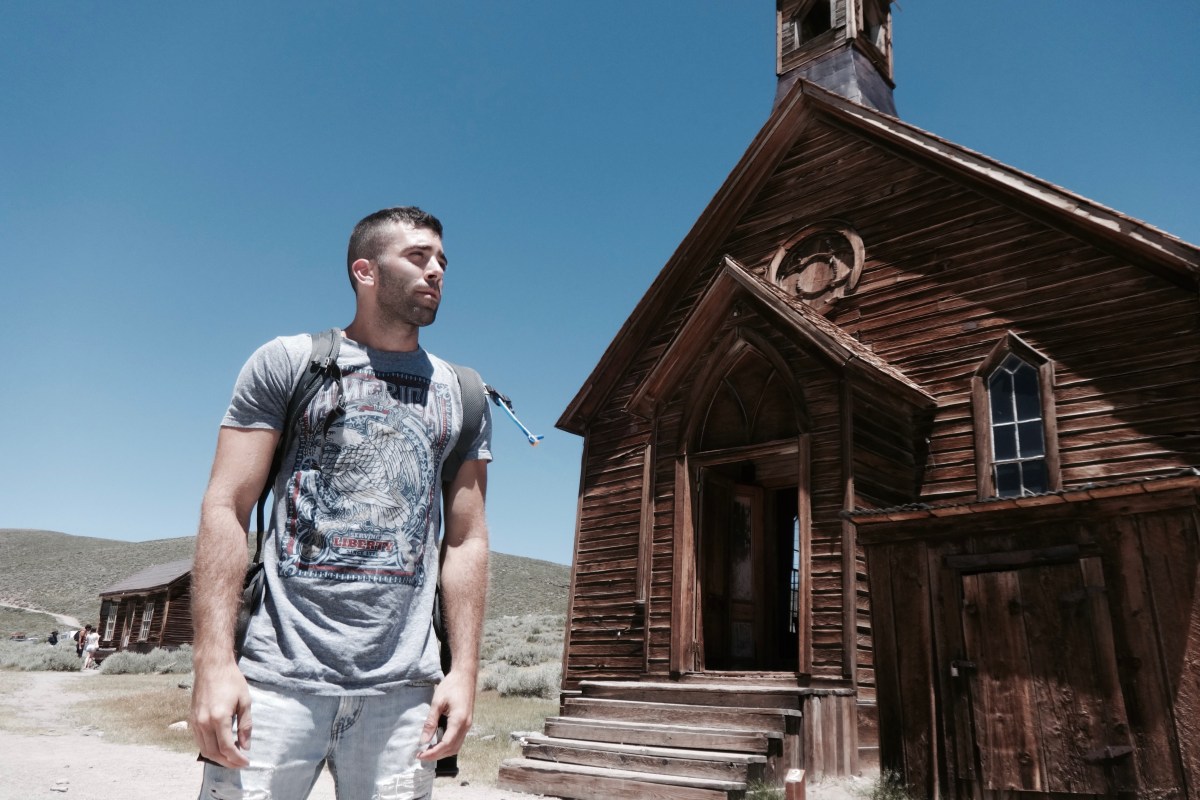
The first structure I saw entering Bodie was the Methodist church. It is perhaps the most iconic feature of the town despite it wearing the uniform dark wooden boards and not doing much to stick out. It was modest. Along with its simple gable roof were its triangular window peaks, short rising steeple, and protruding foyer. I learned that Bodie was booming for over a full year without a church. It was a lawless place. One of its ministers, Reverend F.M. Warrington, described it as “…a sea of sin, lashed by the tempest of lust and passion.” I can’t imagine how difficult it must have been to minister and feel a sense of obligation to a congregation in such a place.
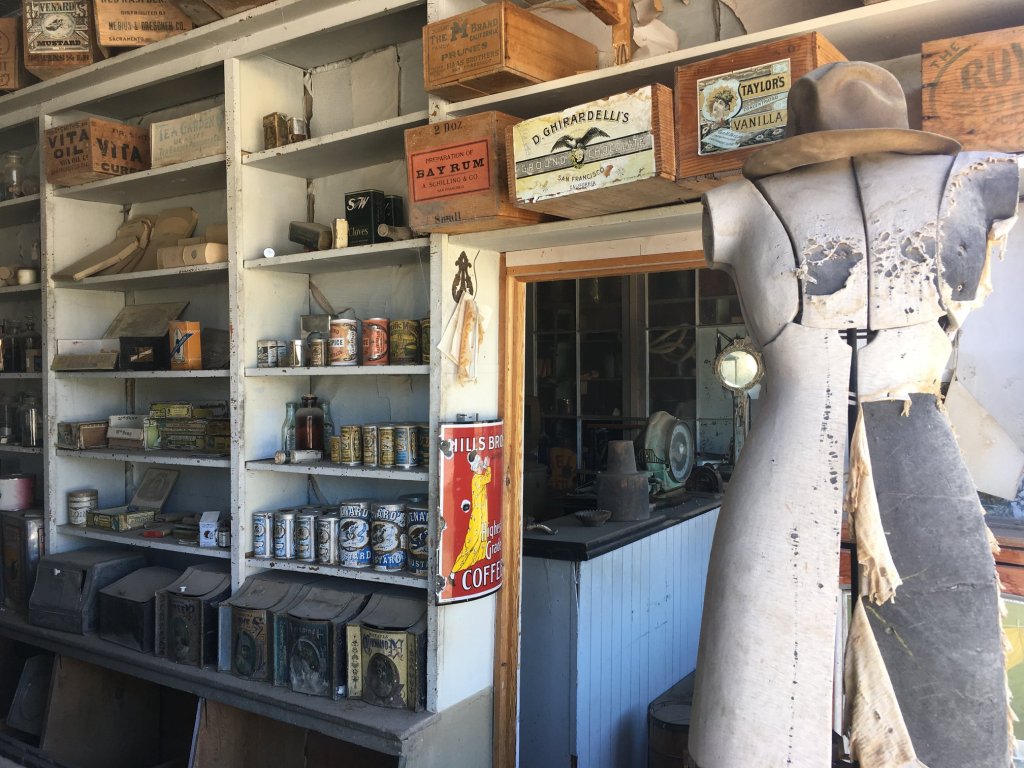
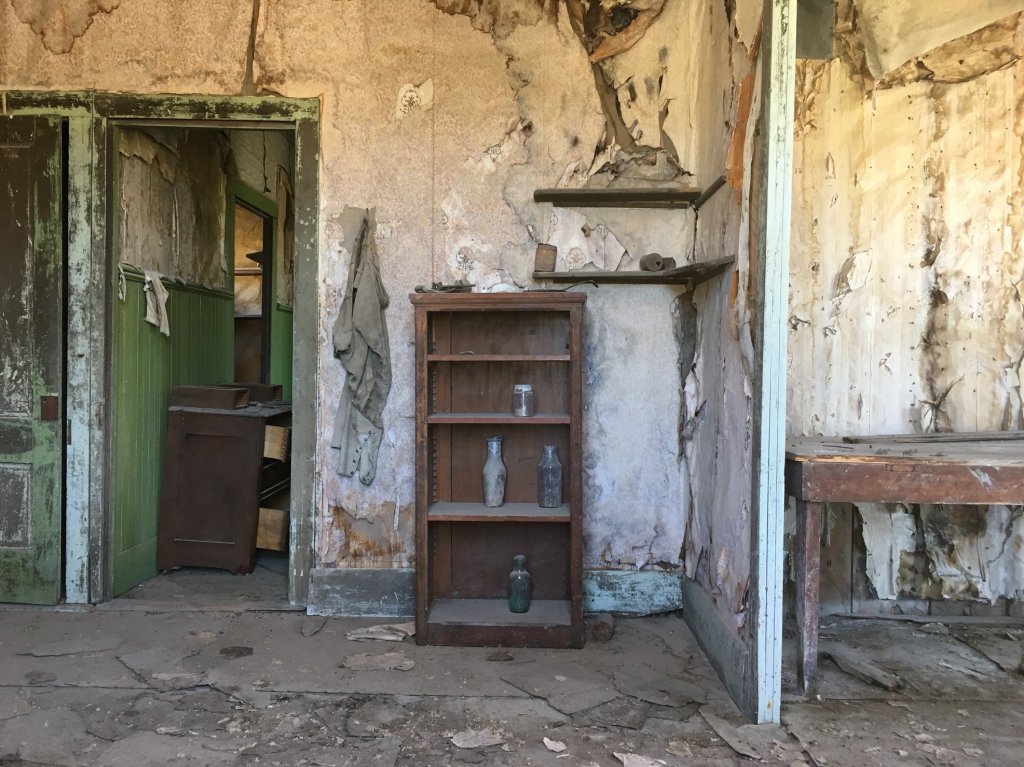
Traveling down the main streets, most of the buildings were closed and locked but I could go up to the windows and cup my hands around my eyes against the glass to peek in. Nearly every building was furnished. In the homes I saw tables and chairs, vanities, sewing machines, beds, rotten mattresses, wallpaper peeling off, canteens, and bottles and hats sitting about. One building was a pool hall, and the pool table still lay next to a furnace and a bar. One of the general stores was well stocked with just about everything you could imagine a general store to have back then, but everything was just about everywhere, in such a state of disarray and decay, that just that disorder and abandonment gave it a haunting sort of feel.
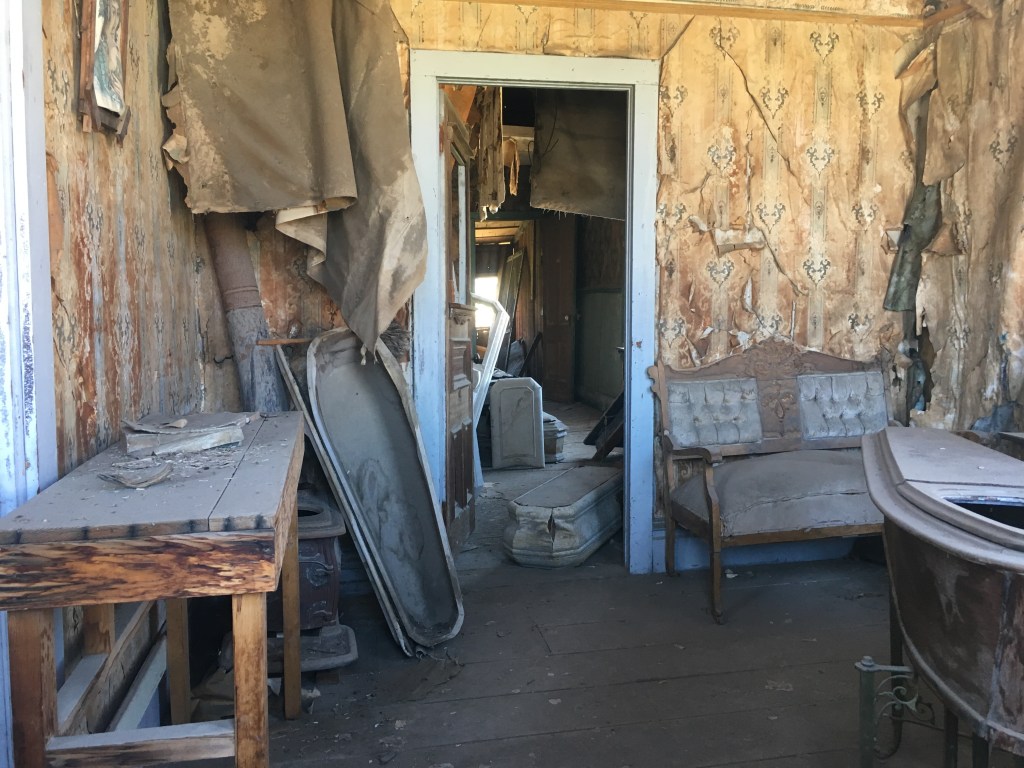
Ghost towns are not named so because of the supernatural, but simply the term refers to a place that has been abandoned. However, seeing so many things so shamelessly abandoned and rotting away certainly gave me a sort of spooked aura. It was especially evident in one building with the way the light filtered in the window, dispersed through a laced curtain, and crept across the warped floorboard, casting natural shadows. If anyplace here was to be truly haunted, though, it would have to be the mortuary. It looked just like one of the many other houses, but I cupped my hands around my eyes and against the window to peek inside. A large coffin lay horizontal in the room, and up against the wall leaned two infant caskets. I felt something distinctly unique about being at a mortuary in a ghost town looking at infant coffins. Perhaps it was just a sure reminder of the fallen state of humanity. Here I was in a place left abandoned, rotting away, where life once lived, fixing eyes upon caskets, a reminder of the finite nature of our existence on this earth, and I was looking at infant caskets, symbolic of lives sadly taken prematurely.
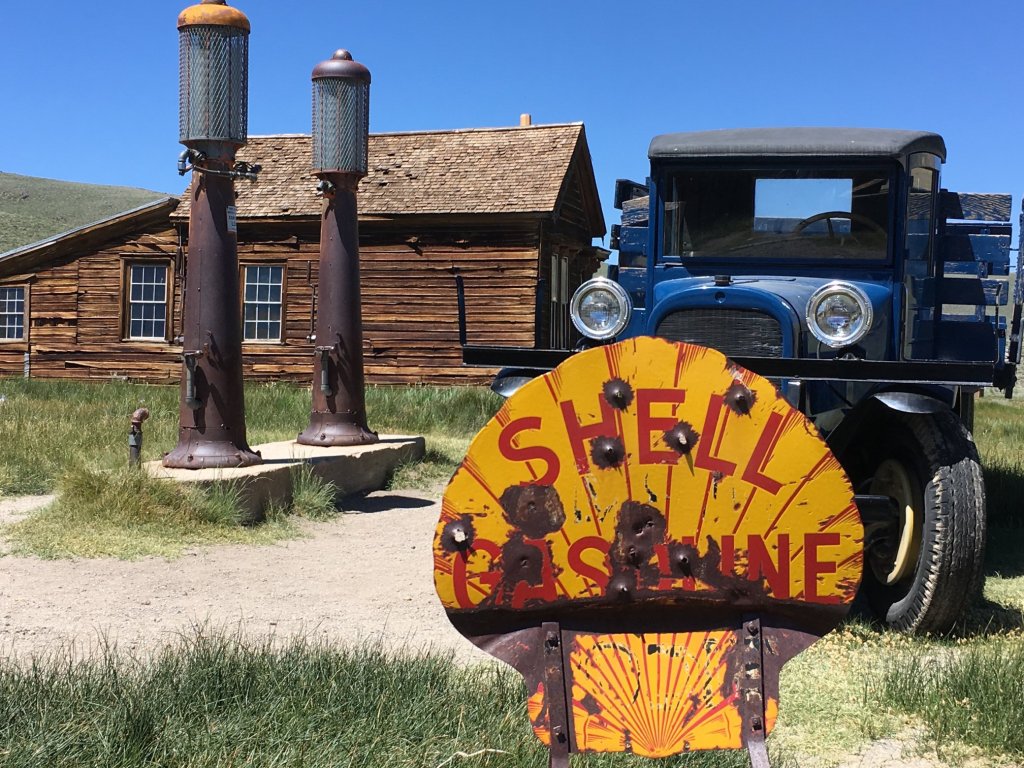
I did a bit more wandering myself, peeking in the windows of the school house, which was in near mint condition, and an old gas station with the oldest shell sign I’ve ever seen. I stopped for a moment at the old two story hotel which had me imagining people coming to this place and checking into a room. Why were they here? Was it for business or just visiting? Would they check into their rooms and then maybe head out on the street to find a place to have dinner or stir up ruckus in a saloon? What sort of men would wander over to “Virgin Alley”? This place once had a lot going on. Now its buildings were void of life and silent.
After a bit of wandering, I went on a guided tour up to the Standard Stamp Mill. The ranger led a group of about fifteen of us up the dusty streets of Bodie. Before coming to the Mill we walked by the once home of Theodore Hoover, older brother of president Herbert Hoover. I was fascinated that this place had a connection with Herbert Hoover through his brother. I visited Herbert Hoover National Historic Site in Iowa the previous fall and learned all about him. It was there in the old quaker meeting house in the Herbert Hoover family’s village that I took time to ponder and reflect upon my last summer’s lesson to “be still, calm and quiet.” I love how in visiting National and State Parks, there are so many connections between people and events across the country. In the earlier days of our Republic, the people of influence had broad sweeping connections across the nation. One thing that happened here had another effect that happened there. These commonly occurring characters and connections help tie everything together and paint one grand story of the United States.
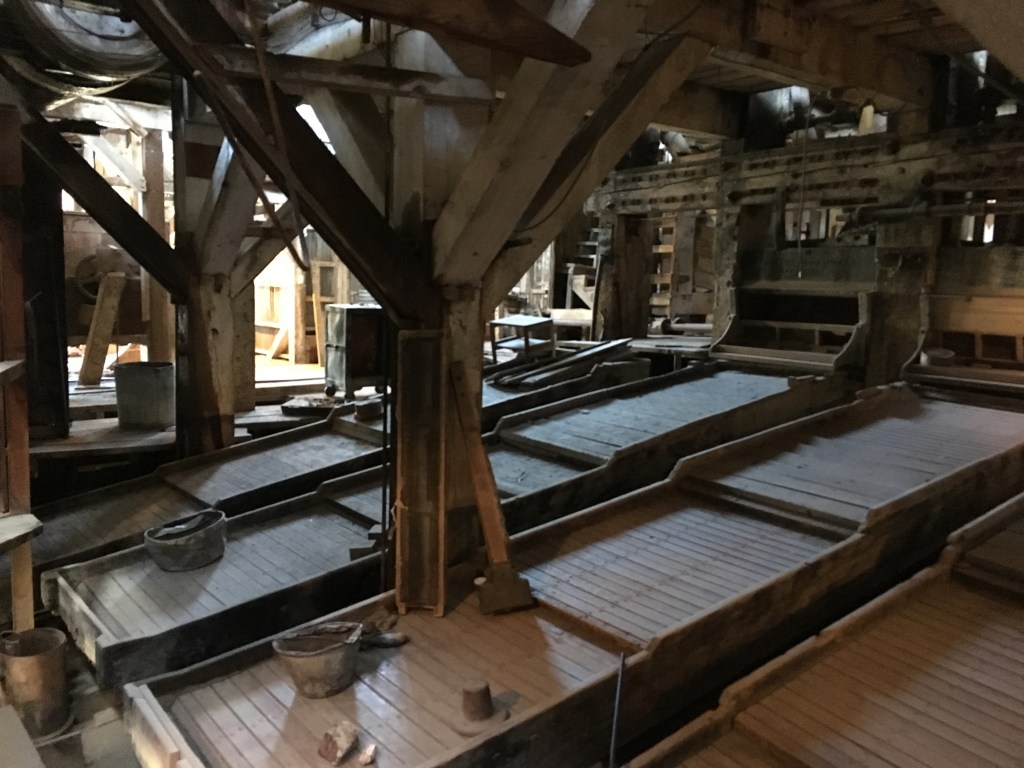
Once inside the Standard Mill we saw all the powerful mechanics, giant gears, and heavy equipment. The ranger explained the stamping process of this mill, how these giant stamps would literally crash down upon rocks and break the mineral deposits. Then a series of magnets and mesh beds would sort out the gold and silver. The most interesting thing the ranger shared with us here was how early employees in this mill were known for trying to steal gold from the mill. They would hide it in their pockets, so Theodore Hoover, who was manager of the mine, established uniform outfits- jumpsuits with no pockets. These thieving employees found other ways to steal, however. In the hot mine a man may stage a wiping of his brow or a hand comb through the hair, leaving behind gold dust to later be collected from his hair, eyebrows, or eye lashes.
Here in the mine, the ranger also gave a super fascinating fact: In recent years, a Canadian mining company surveyed the land, finding about $2 trillion worth of gold still deposited in the hills around Bodie. The U.S. government stripped the mining permit from the Canadian company and now the state of California just sits on 2 trillion dollars of gold beneath its land. At first mention, I thought, California needs to mine that to pay off its debt, but the more I’ve thought about it, I’ve realized it’s better kept reserved, for I don’t think the California government is by any means fiscally responsible to handle such a sum of wealth.
History and gold mining aside, I think there is a lot to learn from ghost towns about life. I’ve written about this before in my book, Canyonlands: My adventures in the National Parks and beautiful wild, but Bodie, I find, taught me something different. You see, the park ranger explained how Bodie was in a state of “arrested decay.” Meaning, the place is in a state of decay, but they are trying to arrest that decay, so nothing is to be changed, restored, revitalized, or repurposed. The place is simply to be arrested in its state of abandonment and decay. The only intervention is to occasionally add a support to a building to keep it standing. So, because of “arrested decay,” in every building dust is collected, walls are rotting, items are unprotected and weathered by age. Many of the buildings are even left messy inside. Old cans, cartridges, bottles, hats, and books lay about, left abandoned, in the same location, untouched for ages. This had me thinking about life.
As we age, we are prone to find our own lives in a state of arrested decay. I look at all these physical objects left abandoned in Bodie and I see them as metaphors for the non-physical, but rather spiritual, things we have accumulated in life. We each have an array of experiences, stories, lessons learned, and passions which we have collected over the years. These are all valuable things, gained for many purposes. But I think, as we age, apathy has a way of arresting some of these things and causing us to abandon them despite their value. We no longer put them to use. We get old and we move past these things, and instead of seeking action and influence, we make excuses. But did you not have these experiences for a purpose, and did you not learn these lessons in life to share them? Did you not develop passion to let it stay dormant, collecting dust? Many have places in their lives that are in arrested decay, and it truly is a great loss. We need to exercise the abilities we’ve been given, nourish the passions that have been instilled, and share what we have learned in life to build up others.
Dennis Rainey in his book Stepping Up: A call to courageous manhood, explains how, as we get older, we are fed a series of lies which rob us of the perception of our own value and worth. We rely on excuses which deem us irrelevant and rob us of our dignity. He talks about the final years of life as some of the most influential. It is here one has accumulated the most experience, wisdom, and lessons learned. All of these things are great riches to be passed on, but many men keep them to themselves. Rainey writes, “What an opportunity we have as we enter into the final years of life to use the wisdom and influence we’ve accumulated and reach out to the next generation.” He also goes on to say, “God created men not to rust out but to wear out as they stretch toward the finish line.” We are to be utilitarian with all we have been given, and, with age, our toolbelt is much more hardy than when we were younger. As written in Job 12:12, “Wisdom belongs to the aged, and understanding to the old.”
I’d regret for anyone to cup their hands around your life and peek into your soul finding all the valuable spiritual things of life collected, laying abandoned. It’s not an easy question to ask but it is one Bodie beckons: Is your life but a ghost town in arrested decay? It doesn’t have to be. Take a look inside. What do you have there in your spiritual storeroom? What can you share? Think about it like this: You are not a state park but a city full of spiritual investments. There are no ghost towns in the kingdom of God, so dust yourself off and get on with life!
And also, maybe like in Bodie, there’s so much more treasure still to be mined from life. Don’t just sit on it. Fire up the stamp mill!
The drive up and out of Death Valley to the west is perhaps the most harrowing drive I have ever been on. The narrow road hugs sheer cliffs, and at times with no guard rail, leaving not even an inch to mechanical error. The road is windy and bends quickly and dramatically, and on the opposite side of the road from the cliffs are the hard rock faces of the Panamint Mountains, stern, not the least bit comforting. There better not be a car coming from the other direction, because I doubt we could both round the curve at the same time successfully.
Everything was sandy beige, rocky, and dry. Before I climbed this mountain in my vehicle, I was driving across the long low flats of Death Valley. The road zips across the desert of barren rocks, shrubs, and occasional salt flats. This area is nicknamed the “Devil’s Golf Course.” The road then gradually ascends the base of the mountains, where it takes on another character. There in the valley, beginning this drive, one can see an enormously long stretch of road. It doesn’t fade from view in the distance, but you see it traversing the full route of the valley perfectly straight and then finally, just barely, it escapes into the mountains, like the mining bandits of old bee-lining and then hiding out in the heights.
Up here in the mountains, my hands were tight on the steering wheel and my moves well calculated. Every once in a while I would steal a glance to the right and see the immensity of Death Valley now way down below me, its white salt flats now so prominent. Just the sight of it looked piping hot and desolate, and for a moment I wondered how I survived down there.
I’ve often told people the mountains surrounding Death Valley are some of the most impressive and enormous. It’s not that they are the tallest in our nation, but when you view some of the nation’s tallest mountains in the lower 48 states, in places like Washington and Colorado, you’re already viewing them from thousands of feet above sea level. In Death Valley the mountains stand much taller because you see them from a starting point of 200 feet below sea level Thus you see much more mountain, and they are breathtakingly enormous.
Driving these curvy mountainous roads, I was reminded of the old Wile E. Coyote and Road Runner cartoons, where the Coyote is running so fast, trying to chase the Road Runner, but then runs off the cliffside and only falls when he eventually notices there is no more road underneath him. I felt like if I wasn’t careful, I’d find myself right off the cliff just like Wile E. Coyote.
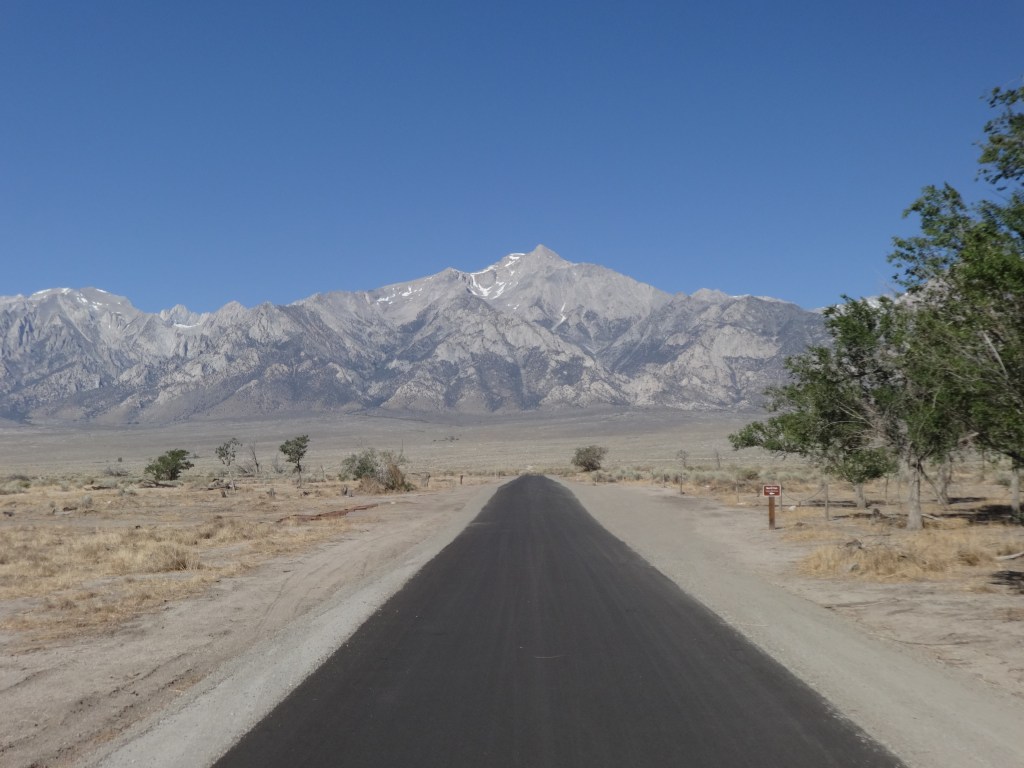
There was a great deal of relief after I made it up and over the Panamint Mountains and slithered between the Inyo Mountain range, finding myself now in another valley- the Owens Valley. Now I could rest and take a breath at around 3,700 feet. Here there was the comfort from natural greenery and wide open flat spaces. To my right I could see the dry desolate brown peaks of the Inyo and Panamint Mountains which border Death Valley and to my left stood the tall snowcapped, pine-ladened, granite peaks of the Sierra Nevada. It is a place of wild contrast, with mountains of such different character on either side in prime view.
The Owens ValleyManzanar
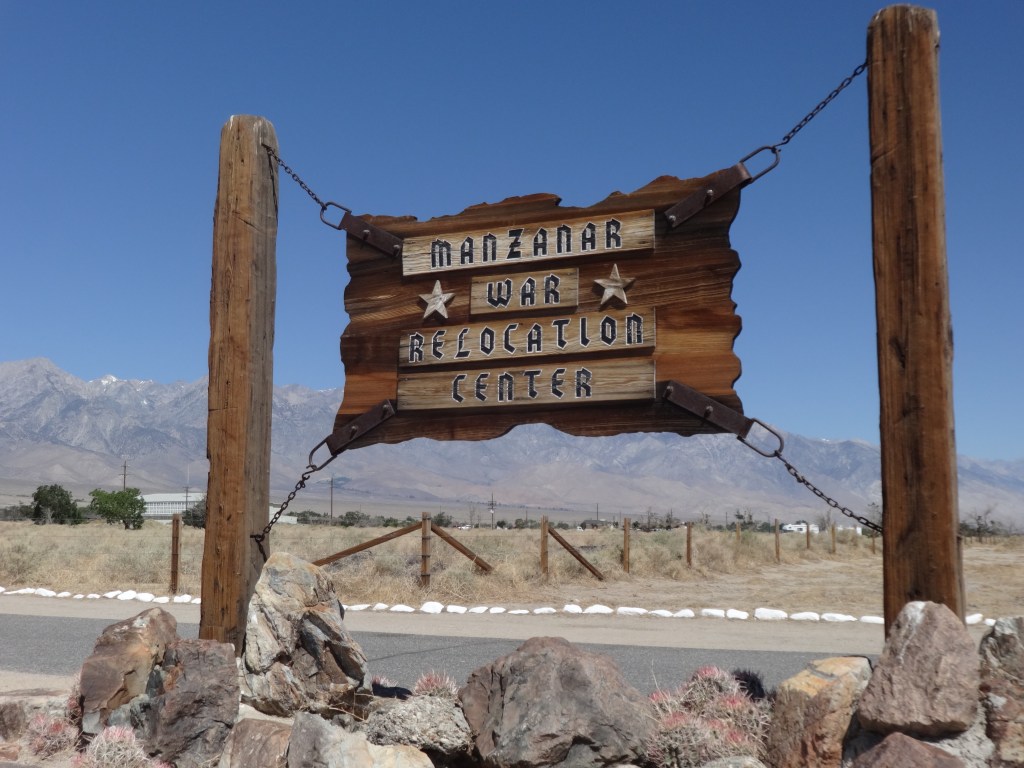
The road up here definitely had me wide-awake this early morning, but now in the quiet, tranquil valley my mind could rest again, and I could gracefully, and mindlessly, zoom across the road. Not far in my journey I saw a sign that immediately grabbed my attention: Manzanar National Historic Site. This was a unit of the National Park Service. I had seen it on my map. In 2016 the National Park Service, in honor of their centennial, released a free pamphlet map of the United States with every national park unit listed. I had seen Manzanar on the map but hadn’t figured that it was actually en route. Knowing little about it, I was still excited to visit, learn, and check it off my list.
I pulled into the parking lot, and no one else was here. I had gotten such an early start down in Death Valley that It was now only 8:00am, and I had an hour before the visitor center and museum would open. I walked up to the door and found a slot full of park maps and brochures. Almost as important as watching the park film is reading the park brochure. Because I couldn’t go inside and watch the film, I went back to my car to read the brochure. Later I would get to watch the film and tour the museum. What did I learn? In simplified terms, during World War II Manzanar was a war relocation camp for Japanese-Americans. There was a broad distrust in the U.S. of those of Japanese ancestry, especially following the bombing of Pearl Harbor on December 7th, 1941. There was suspicion of who was a spy or secret operative of the Japanese government, and Democrat president Franklin D. Roosevelt, acting out of caution for “public safety,” signed Executive Order 9066, which enabled Lieutenant John L Dewitt of the U.S. Army to use the military to remove everyone of Japanese ancestry from the West Coast. Dewitt said, “you can’t tell one Jap from another…They all look the same…A Jap’s a Jap.” Describing the incarcerated Japanese-Americans, the National Park Service in its brochure states, “They were from cities and farms, young and old, rich and poor. They had only days or weeks to prepare. Businesses closed, classrooms emptied, families and friends separated. Ultimately the government deprived over 120,000 people of their freedom.” Manzanar held 10,000 of these people.
To me this seemed like such a tragedy and stain on American history- a grave mistake or perhaps a willful wrong. I looked across the camp, the Sierra Nevadas stood tall and magnificent behind the camp, dramatically rising up from this dry valley. This was a beautiful place, but to think a place of such beauty was also a place where people were so wrongfully deprived of their freedoms was quite the combination. Something so good was contrasted with something so wrong. It was a place where beauty was paired with melancholy.
I began walking down the pathways. Manzanar was organized into 36 blocks, each once holding about 16 barracks. Now only a few restored barracks remained. Nearly all the structures were gone, but looking at the map, tucked between some barracks once were communal spaces. There were mess halls, a theater, high school, elementary school, catholic church, protestant church, Buddist church, baseball field, hospital, park, and orchard. I walked around with a sort of sacred reverence for this place. This was a place where human freedom was taken, where people really grappled with life, living, and its meaning. It was a place where people suffered and sought purpose, or lost purpose, in confinement. It was also a place where people sought faith to see them through. With such things in play, this was ground zero of a spiritual battle zone. I could feel it. I could sense it, and it wasn’t all bad. It wasn’t oppressive. There was both physical and spiritual beauty here.
I came to what was labeled Merritt Park on the map. Here were the small decorative dried up pond basins, riverways, and bridges which once helped compose beautiful Japanese gardens. I saw some pictures on the interpretive plaques of this place back in the early 1940s. The incarcerated constructed these gardens. I paused in contemplative surprise. Why bother? I thought. You’ve lost your freedom, you’ve lost everything you had, yet in the midst of a place of such oppression and darkness you’ve chosen to make something so beautiful? It was once so beautiful that even famous photographer Ansel Adams, made a trip to Manzanar to photograph these gardens.
Model of ManzanarRemains of Japanese Garden
Throughout my wandering of the camp, I also learned how the incarcerated organized community events, such as community dances, plays, and sporting events. They also planted and harvested crops in the orchard and attended church and school. There was a very distinct beauty to be seen here. Despite their circumstances, many of these people chose to live their lives to fullest, making the most of their given situations. And that was inspiring. To lose so much but to carry on living, exhibits a great and inspiring fortitude.
I came to the back of the grounds, the edge of the map, and there were a few flat headstones on the ground marking graves of people who had passed away in the camp and one tall standing obelisk monument inscribed with Japanese Kanji characters reading “soul consoling tower.” The National Park Service states, “today the monument is a focal point of the annual pilgrimage, serving as a symbol of solace and hope.” This area was ladened with paper cranes- a Japanese symbol of peace, hope, love, and healing in troubled times. There was a Japanese lady kneeling down by the headstones, leaving either paper cranes or flowers herself. I do not know if there is a certain season or pilgrimage which calls for these paper cranes, or if it was a routine gesture.
ObeliskPaper Cranes
I eventually made my way back to the visitor center. I toured the museum full of photos and artifacts and watched the park film. It struck me as quite interesting that these people were not forced into this camp. They came willingly without any sort of Due Process. They were convinced it would be a place of safety and security and something they needed to do as a duty to their country. Video footage showed people giddily boarding trains, ready to come to this camp. I think these people were grossly misled, but I also found their sense of loyalty to their country quite profound. I gathered that their coming here was realized to be a sacrifice for a greater good. Some saw themselves as taking one for the team. At the time I thought, what patriotism! Later, as I reflected upon this, I wouldn’t find it quite as patriotic but rather concerning that these people so blindly followed their government. But, also, in regard to patriotism, I saw a photo and read of the students in camp pledging allegiance to the flag of the United States. The incarcerated children would do this every morning. Despite their situation, these people believed in the principles of America, what it stood for. Even if they were being deprived of the American values in the moment, they still believed in them, and did not abandon them nor their allegiance to them.
What I learned and saw at Manzanar would roominate in my mind for quite some time. Reflecting on what I saw, I have been reminded of how important history is to the present. Learning about what we have done as a nation, and considering the motives behind our actions, can help us immensely in our decision making and discernment in the present and future.
It’s quite important to note that the removal of all these people, which included the closings of their business, the loss of their homes, their isolation and ejection from society, was all done in the name of “public safety.” Those exact words were uttered by our leaders. Certainly all Japanese-Americans were not infected with disloyalty to their country. Not all Japanese-Americans were spies, but just to play it safe, a blanketed act of repression was spread out among a whole population. It’s become evident throughout history that it’s easy for people to abandon their moral conscience and fall in line of obedience when it comes to matters of safety. “Whatever you say, I will do,” can easily become a mentality towards the government when the term “safety” is thrown around. In my own lifetime I’ve seen safety propped up, become a deeply ingrained value, and then elevated to an idol status. Creation and destruction is conducted in its name. A family’s need to put food on the table, to keep the business running, to pay the mortgage, or even to see each other across state and national lines, has in recent times become irrelevant, frivolous, trivial in comparison to the greatness of the idol of safety. Safety is a carnivorous beast demanding much sacrifice. I am not advocating recklessness, being safe to a measure is wise, but there is a great distinction from exercising safety with prudence versus idolizing safety to a god-like status that dictates all of one’s actions.
These Japanese-American’s gave up their freedoms and came to these camps willfully in the name of “public safety” in an unquestionable trust in the government. One may look back and think these people were just naive and assume the government would never do something like that today. I would not be so quick to jump to such conclusions. I think people and governments have the same faults in character and the same potential for corruption as they always have had. What is different today, however, is that we are informed by the past to think more critically of the present and future. We all need to question the sacrifices we make to “public safety,” and to other idols in our government and society. As we do we will be faced with moral questions of what is right and what is wrong. It is easier to not grapple with such philosophical questions and to just go along. It is also more natural to want to be taken care of, giving up freedom little by little to the god of “public safety,” than to take lead and be free. Freedom is gutsy. It takes toiling through hard questions and taking action backed by principles, even when it goes against the grain of society.
Some, in the study of history, may conclude these relocation camps were needed, that they served their purpose in isolating and deactivating Japanese spies, and the sacrifice of some was worth it for the greater good. I can respect that opinion, and likely there is evidence to it’s favor, but I still find the whole incarceration of innocent people to be a moral wrong. However, if one is strongly convinced in their conclusion that this all was ultimately good in the grand scope of things, I ask him or her to fully own it and attribute it to its source. Give credit where credit is due. The incarceration of all these Japanese-Americans was not a pure American act, for it does not align with American principles or values at all, including equality, freedom, and Due Process. Rather it was an act of the Democrat party and thus needs to be filed next to the other accolades of members of the Democrat party, including the prolongation of slavery, and the creation of the Klu Klux Klan and the Jim Crow Laws.
Another thought I’ve had as I’ve reflected on Manzanar is related to the press. It’s evident that racism towards the Japanese was prevalent in the times leading up to Executive Order 9066. Photos and artifacts clearly demonstrate this. However, most of these artifacts are out of the press. I find it particularly telling that this racism was propagated, perhaps even created on a large scale, by the press. All this racism doubtfully seems organic, like it just sprang up in the varying communities throughout the Nation. I find it hard to believe. It is more believable that it was sold, planted, and propagated by the news media. Read the newspaper headlines of the time. It was clearly an agenda, and this all served the government’s purpose. The press was and is a tool of the government, which makes me question, was there really a sweeping racism in the United States towards Japanese, or was that the narrative of the press? or did the press exploit existing racism for greater division to achieve the government’s goals? This all leads me to my next questions for our present time: What messages are the press trying to instill in us today? and What agenda ,present or future, might these messages align with? If we can train ourselves to routinely ask this question and be skeptical of the purposes of the media, we won’t be so blindly manipulated and divided for political purposes.
Eventually two Republican presidents sought to address this wrong committed by our country. Ronald Reagan signed the Civil Liberties Act of 1988, giving an apology and financial reparation for those who had been detained in these camps. This was my first time ever learning about such a concept as a government reparation. Later, George H. W. Bush amended this act to ensure every case was addressed and again gave another apology on behalf of the U.S. government.
Ultimately Manzanar National Historic Site taught me that the corruption we see in our government and news media is not entirely new. We’ve been down this road before. We must question our government and media. And equally important, let us wake up and realize that when we pledge allegiance to the United States of America, as the schoolchildren did in Manzanar, we should not be pledging blind allegiance to the government, but rather an allegiance to the principles that constitute America and an allegiance to our fellow Americans.
Manzanar is a scar on American history, but it can teach us much. Let’s not lose sight of our history- the good and the bad.
Before I left Manzanar, I toured the simple barracks and took a few photos. Some barracks had beds lined up one after another in a military fort alignment. Other barracks housed small family-style apartments. I thought about getting a book in the visitor center to read more about life in Manzanar, because this history intrigued me, but I knew I wouldn’t be dwelling too much on this chapter of American history during my trip. I would be moving on to another. Next stop was further back in time to the era of the California Gold rush as I would visit Bodie, a mining town, turned ghost town and then a state historic site.
I finally mustered up enough courage to ride the Mystery Mine at Dollywood. Walking by it, and seeing the mine carts dash out of the old themed abandoned coal mine and loop and twist upside down, made me queasy at just the sight. I admit I like my coasters on the tamer side, but the Mystery Mine would surprise me and become one of my favorite attractions in the park.
It was opening day in March of this year. The night before a surprise snow blanketed the region. It was mostly melted now, except for white clinging onto the trees in the shaded divots of these Smoky Mountain foothills.
Seemingly one-by-one, coasters warmed up and started to make their runs. Just as the snow surprisingly fell the night before, today for some strange reason, my reluctancy had melted away and the desire to ride the Mystery Mine suddenly came upon me.
Despite the fear that always gripped me, the attraction had intrigued me for a while. It is a prominent feature in the park, towering over Timber Canyon in its own dark ominous way, and the inside portion of the ride was always unknown and mysterious to me. Numerous times, outside the attraction, I had walked by the animatronic vulture which tells stories and warns of the dangers inside the Mystery Mine. It must be quite an attraction to have such a feature next to its entrance, I thought. No other Dollywood ride has this.
As I waited in the queue line with my friends, we were doing some serious people watching from the rocky platforms which lead up to the ride. I also noticed the old rustic signs and fictitious newspaper articles posted along the walls recounting tragedies in the mine long ago and the condemnation of the now abandoned mine. An announcement about keeping your boots on and not losing them made my friends and I laugh, because we had just all bought cowboy boots the evening before in Pigeon Forge and talked about wearing them to the park but quickly decided they were not quite practical for the occasion.
Nervously, I boarded the minecart with my friends. One of the first things that stuck out to me was a canary in a small cage falling from its perch to the bottom of its cage. I remember going on a tour of an old abandoned coal mine in Alberta, Canada and learning about how miners would hang up canaries in cages throughout the mine. If a canary stopped singing and dropped from its perch, it was a sign that miners needed to evacuate as the air was becoming noxious from mine gas. This is smart theming, I thought. Someone knew this small detail to include it in the mine. As the ride progressed, there were a few other themed moments that stuck out to me, including those with vultures, a lightning storm and dynamite.
I was intrigued by these clues. There obviously was a story going on, and I wanted to know the full story. Between the animatronic vulture, the signs and newspaper articles posted outside and the elements within, there was some real thought going on behind all this, but I couldn’t quite piece it all together. I decided it was time to investigate.
The Story of Old Grandpa Jack:
I started my quest by studying point-of-view videos of the ride online, then watching all the videos and studying the animatronic vulture out front. I gathered the story of Old Grandpa Jack told by the vulture. He was a trapper who lived in a cave in the Smoky Mountains. As folklore goes, you’re not supposed to whistle in a cave, because its vibrations can cause rocks to shift, but Grandpa Jack whistled in his cave causing the earth to tremble and the ground to open up revealing an abandoned mine. Then Grandpa Jack wandered in the cave never to return. Because of this legend, the Mystery Mine also informally became known as the “Whistle Mine.” Despite its colloquial name, guests of the attraction know it’s formally the unlucky Mine 13. Just as your ride in the Mystery Mine begins, you hear a heinous life. Could it be the ghost of Grandpa Jack?
Wrong Way Joe:
Another character related to the mine, or at least to the themed area of the attraction is Wong Way Joe. The vulture outside the ride, recounts his story: “Back in the logging days, it was Joey’s job to determine the natural lean of a tree so they would know exactly where it would fall. Well, Joe had a knack for doing things the wrong way. So if Joe called the tree in one direction, ya’ll could stand in that same spot and live to tell about it. Some say a huge tree nearly fell on the potato shack, but Joe, with the help of his head, broke the fall. Ever since then, Joe has been twenty mules short of a mule team. If Joe ever spoke his mind he’d be speechless. Truth be told, Joe has been doing things the wrong way ever since he has been knee-high to a bark beetle.”
What does twenty mules short of a mule team mean? In the mining days of old, what was referred to as a twenty-mule team, was actually composed of eighteen mules and two horses. If Wrong Way Joe was twenty mules short of eighteen mules, he was certainly in bad shape, and bad luck must permeate from this mine.
Mine Superstitions:
In my quest for more information about the Mystery Mine and to see how all these pieces tie together, during the Dollywood Influencer week, I was able to meet with Pete Owens, vice president of marketing and public relations at Dollywood. I was told he was the man that would provide the answers. He explained that Dollywood “does not do scary,” but that it does entertain mystery and superstition, and the Mystery Mine is themed after traditional mine superstitions. According to mining lore, there are three great superstitions related to mines:
Never take your boots off in a mine. It’s bad luck, for there’s only one way a man comes out of a mine without boots. Mr. Owens went on to explain that at one part in the ride, if you look carefully, you’ll see boots hanging in the mine. Also, this makes sense in the queue line when we are warned to keep our boots on.
Don’t whistle in a mine. This can bring about danger. We hear the warning not to whistle in the mystery mine in the theme song that plays in the line queue: “Don’t whistle in the Mystery Mine or danger you will meet.” This brings us back to the story of Old Grandpa Jack. As a park guest, you should be warned, as whistling is also heard accompanying the music of the ride.
Birds in a mine are bad luck. This explains all the vultures and ravens in and surrounding the mine. The one exception is you want your canaries with you in the cave, but if they drop dead or pass out, you better get out fast. Guests are warned “If the canary ain’t tweetin’, you’ll be sleepin’.”
Mr. Owens went on to explain that each lift and drop in the ride is related to one of these bad omens. At the beginning of the ride, you see the red beady eyes of vultures and ravens, at the second lift you see the canary dropping dead in its cage, and the third lift is where you find the boots hanging. All of these bad omens foreshadow the danger which is to come— the storm, in which lightning strikes the mine, which causes the mine shaft tower to collapse and the dynamite to ignite, exploding, and blasting you out of the cave in your mining cart.
I was fascinated by this theming. It was very smart, based off of real historic mine superstitions, and it fits perfectly with Dollywood’s larger Appalachian theme.
The Mystery Mine Movie:
Perhaps the most interesting tidbit Mr. Owens shared with me was that in 2006, to promote the forthcoming Mystery Mine, Dollywood employees produced a short film explaining the backstory of the Mystery Mine. It was uploaded to YouTube in five short segments. It features a young brother and sister happening upon the mine and finding a man in the forest that tells them about the mine’s mysterious past. “Is it still there on Youtube?” I asked.
“Oh I’m sure it is.” Both Mr. Owens and I got out our phones while standing there in Dollywood searching for these promo videos. In my ignorance, I was searching on the official Dollywood YouTube page. “You won’t find it there,” Mr. Owens explained. Deep in the tunnels of Youtube we mined out these old gems. He said they filmed it all in one evening, that the girl in the video was his own daughter and all the small cast were regular Dollywood employees and relatives. As I watched and saw all I learned come to life.
Other Fun Mystery Mine Facts:
In my talking with Mr. Owens and my own investigation, I learned quite a few other interesting facts about the Mystery Mine:
At the time of its opening, it was the first coaster with a complete vertical lift and beyond vertical 95 degree drop.
The Mystery Mine theme song was written by a composer who has written songs for another well known theme park and entertainment company.
At its time of construction, Mystery Mine was Dollywood’s single biggest investment in the park at $17.5 million.
Mystery Mine is award winning. It gained the title of Best New Theme Park Attraction in 2007 by Theme Park Insider and gained second place the same year from Amusement Today.
Mystery Mine went under some refurbishment in 2021, receiving some new track.
During its first year in operation, the vulture out front was voiced live and could interact personally and in real-time with the guests. There also was Old Grandpa Jack there. Jack was eventually removed and the vulture was later switched to a recording.
The Mystery Mine is manufactured by Gerstlauer, a German rollercoaster company, known for rides in many well-known parks.
Insider Tips:
Now that you know the story, and hopefully I’ve built up your curiosity of the ride, here are a few practical insider tips for your visit:
This is one of those rides that can have a long wait time, or no wait time at all. It fluctuates greatly at different times during the day. So if it’s crowded, just check back later.
In my opinion it has some of the best t-shirts and themed merchandise in the park. Check them out!
This ride is thrilling, but it’s not too much. I don’t like to go upside-down on my rollercoasters, but trust me, this one is not bad. Don’t be scared. Just keep your boots on… and don’t whistle…and watch out for those vultures!
If you are on a vacation in the Southeast, and are interested in the mining theme, consider checking out the real coal mines tucked away in the beautiful natural parks of the Big South Fork National River and Recreation Area in Kentucky and the New River Gorge National Park in West Virginia.
My spirit sighed in relief, accomplishment, and comfort. It had been a full day of adventuring, and now I was done for the day. I finished setting up camp, getting my car reorganized, equipping my tent with what I needed for the night, and putting on sweatpants and loose comfortable layers for the evening. Everything that needed to be done was done, and now I could soak in the beauty around me. My feet rejoiced as I forced off my hiking boots and slid my feet into my warm soft sandals which had been baking all day in the heat of the car. It was time to quiet my soul and be wholly present in the natural beauty around me, relinquishing action for the comforting silence of creation.
I sat on top the picnic table at my campsite to look out upon Lake Tahoe on the most eastern edges of California. I had lucked out and scored a campsite just atop the rounded slope that spilled down into Emerald Bay. Just days prior I was in the heat and desolation of the Mojave desert and its Death Valley. Although it has its own appeal, it was now so comforting to be aside water, in an air that grew increasingly cool with each passing minute. I felt like I had really arrived somewhere and felt accomplished for again having survived the harshness of the desert.
I took a deep breath of the cool pine-filled air with the knowledge and awareness that I didn’t deserve any of this, yet it was lavished upon me. The most striking and comforting feature of the moment was the sunset my eyes beheld. The sun had dipped behind the piney bluffs sending an arsenal of colors: warm oranges, vibrant pinks, rich purples and blues, to jab into the soul and evoke awe.
By this point, in all my travels and wanderings, I had pondered and written quite a bit about natural beauty and the spiritual truths hidden within. Features and phenomenons in nature, although they serve their own selfish purposes, also are symbolic and reveal truths about God and man. I had come to adopt a philosophy summed up in a phrase that repeated in my mind: “beauty is never wasted,” meaning that behind every beautiful feature or event in nature there is a message God planted to be found. It was all intentional.
So here I sat in front of a rich sunset above an angelic lake, framed by dark sweet pines. I’ve learned a lot from streams and rivers. The moon and sky tell truth, the rainbow holds promise, and even a majestic tree speaks power. What is the meaning behind a sunset? Such beauty is so exquisitely extravagant, it must hold a powerful and prized message. Its display is so moving. I began to think of how some things are universally beautiful. Many differ in opinion, but I do believe beauty is objective. I have never met someone who would deny the beauty of a sunset. It’s these things which are universally beautiful that are all the more compelling to me in that they carry a message.
I had to pause and start at surface level. A sunset marks the ending of a day, the closure, the wrapping up. If I were to relate that to human life, well the closure and wrapping up of life is death. But death? Really? Death has so often a negative connotation, and a sunset is beautiful. Does a sunset, something so beautiful, really hold a message about death? Two summers prior I had lost my Grandpa Hodge. It was his time to die. It was his sunset. He was the first family member I lost as an adult, and, at that time, I was thinking of how death, although often viewed as a loss, is really the completion of something. It is the race fully finished. If you live a life in accordance with God’s will, everything that you were meant to do in life, all your purpose, your calling, is complete at death. It is the most glorious of accomplishments! It is the most relieving, freeing, and beautiful of things. There are no more questions to be had, no more searching for purpose, no more toil and pain. There is a richness and completeness. The beauty of a life fully and rightly lived coming to its closure can parallel both the melancholy and celebratory beauty of a sunset.
Then I started thinking of the different colors of the sunset. Why does a sunset have an array of colors? What is the purpose behind this? Why are some sunsets more beautiful than others? Why do some have more colors than others, and how come sometimes we can’t see the sunset?
I started attributing the colors of the sunset to the overarching qualities of a person’s life. When a life comes to an end, we can see the summation of a person. We can look at a life in its entirety and identify the qualities that person beheld. As a sunset can be rich in red, orange, pink, blue, purple, so a man’s sunset can be marked by his own colors, whether it be kindness, generosity, love, bravery… When a life comes to an end, and we reflect upon the person, these attributes become brightly evident on display.
Some sunsets are more monotone, as some lives are marked by one outstanding attribute or quality. Other, perhaps more beautiful sunsets, are marked by many colors. Many attributes are on display for the lives appealed and touched a multitude of people in a multitude of ways. Then, there are the sunsets that, well, aren’t. We don’t see a beautiful display. Instead there are clouds or storms. There is no beauty to be seen, but just a gradual fading into abysmal darkness. This is the life not rightly lived, the life pursued apart from God. The life that lacked forgiveness; the life that turned cold; the one that was troubled and overcast by its own selfish ambition; the one in which goodness did not take root; and there, in that, death is not a completion nor fullness. There is no beauty to be seen. The palette is dismal and downcast.
When it is my time to go, or to put it frankly, when I die, what will be the colors of my sunset? Will there be a richness and beauty on display? Will my life be complete? Yes, through God’s grace, I will work to make it so. But if I were to pass today, what would my sunset look like? What qualities will summate my life?
At this point in my musings, my mind was on fire and delighted by the richness of thought. I was inspired. I broke open my journal. I could make a list of favorable qualities and consider the evidences in my life that point to each. I wanted to pause and consider the colors of my sunset. I began to think of positive qualities, and then my mind was steered to scripture: Galatians 5:22-23 says “The fruit of the Spirit is love, joy, peace, patience, kindness, goodness, faithfulness, gentleness, self-control.” Perhaps these were the things exhibitable in life, things worth nurturing, the ingredients of the most spectacular and beautiful of sunsets. I realized that in these nine things which constitute “the fruit of the Spirit,” all other good qualities stem. From Love we get self-sacrifice, endurance, forgiveness, trust, humility, and bravery. In Joy we find happiness, charm, and hope. In Peace we find resolve, resilience, calmness, comfort, acceptance, security, confidence, and unity. In Patience there is perseverance, maturity, and knowledge. In Kindness there is selflessness, consideration, giving, charity, and thoughtfulness. In Goodness there is integrity and trustworthiness. In Faithfulness there is loyalty, bravery, and the unwavering. In Gentleness there is calm, patience, even-temperament, nurturing, and respect. In Self-Control there is wisdom, intention, and perspective. All of these constitute beauty.
If my sun were to set, in all honest and sincere reflection, I think my colors on display would be honesty, integrity, trustworthiness, bravery, comfort, resilience, and intention. These are the positive qualities I most identify with. I do not share this to boast. After all, these all come from the fruit of the Spirit. They are found under the umbrella qualities of love, peace, goodness, and faithfulness. And these are not products of my own being. They are from the Spirit of God, which is a gift. In identifying these colors of my sunset, I’ve also come to find that I am lacking in the display of others. I want my sunset to display the full array of colors, and what I most need to work on is nurturing more joy and kindness in my life. My life can at times be plagued by pessimism, unjustified negativity, and unrighteous reflexive acts of self-preservation.
Through this reflection, I was very much intrigued to read up and study the “fruit of the Spirit.” When my travels were over and I was home, I did just that. To my surprise I realized these nine things were packaged together in a singular Spirit. There are not separate fruits. They come together. The singular word “fruit” is used with the singular indicative verb of “is,” not “are”. The spirit of God, living in his people, endows us with all these qualities as one gift. They don’t need to be planted or harvested individually. They are in every redeemed believer, at our disposal to employ in our lives, to transform this world and point others to Christ. The only thing that keeps some attributes from being more apparent than others in my own life, is my own faulty human nature. As Jesus says in Luke 9:23, we have to “deny” ourselves daily and follow him. Then the Spirit of God can really shine through, bringing fruit to life and eventually color to sunset.
When I consider the colors of my sunset and become preoccupied with all that would entail, I am not just thinking of a display. I am not here thinking of just how I want people to be thinking about me upon my passing. That is missing the point. As we reflect upon the colors of our sunsets, it is really a time to take moral inventory, to examine our lives and see if they align with all the potential we have in the Spirit of God. Then, as we are more aware, we can take action steps to remove more of our selfish being, to weed out the clutter and clean the storeroom of our lives, to allow more colors to shine through in our life and become evident in our sunsets. This is achievable only through an active relationship with God and ceaseless pursuit of Him. These attributes, these colors, don’t develop individually or by our own will. Rather, quite contrary, and astounding, they become bright and richer the more we know and yield to God. The more we come to know God, the more He will be made known in our lives, evident in the fruit throughout. Thus, when the time has come, and our mortal life is passing, there too, beauty can be found in the colors of our sunsets.
There aside Lake Tahoe, as all the color faded in the night sky, the sunset complete, I zipped up my tent, shimmied into my sleeping bag, and rested my head on my pillow. It is true, I said to myself, beauty is never wasted.
I know this lady, I said to myself but my mind needed a moment to place her. “Is it you?” I questioned.
“Is it you?” she returned the question with a rather stunned expression.
“Susan?” At this point I knew it was her, and I was utterly surprised. I knew there was purpose in coming here for breakfast after all. Waking up in my tent, I was debating whether to just hit the road or seek breakfast here at Red Meadow, the small village in the Inyo National Forest, adjoining Devil’s Postpile National Monument. After much back and forth, I decided to take the short drive from my campground to the Mule House Cafe. Here in the village I noticed a little general store, cabins, showers, a lot of backpackers from the Pacific Crest Trail, and the Cafe.
I opened the door on the small cabin of a restaurant, and immediately I was greeted with this familiar face, but it was only familiar from the internet. In real life, face-to-face, it was all new. Susan was one of my most devoted social media followers. She, whether she knew it or not, had been a great encouragement to me as a writer.
In the Spring of 2017 I decided to start sharing my adventures in the National Parks and the beautiful wild in a blog online. I took matters quite seriously and strategically at the time. I created blog entries regularly. The earliest of ambitions was to post every day. I shared my writing not only on my pages but I joined the largest National Park and hiking fan groups online. I considered these my networks that “aired” my “episodes.” My posts would always need to be approved by administrators of the groups, and they always were, up until winter 2020 when the administrator of the largest group of hiking enthusiasts banned me from their group. Perhaps it was something I said in my writing that the administrator took issue with, among my open, honest recollections on the trails involving both the physical and the spiritual. It was also very popular at the time, and remains quite common today, for people of certain ideologies, who assume power, to silence opposing viewpoints and completely reject and attempt to isolate those whom differ.
Despite the unfortunate event of being banned from this group, it is here I came in contact with Susan, a fellow group member. She would always read and comment on things I posted, and not just on the group page, but on the other snippets of thought I shared on my own personal pages. We were very different yet at the same time so much alike. For starters, I am young enough to be Susan’s son. A substantial age gap lies between us. We grew up in different times and different places. She has experienced a lot more out of life than I. Although I had not yet met her until this moment, I had such high esteem for her and there seemed to be a distinct connection between us that would take some time and study to understand fully.
Susan was my waitress in this little Mule House Cafe in the Red Meadow village. We shared our pleasantries and surprise and she led me over to the counter on the far end of the small cafe. The term “far” is gracious for it was quite a little place. There I sat on one of the brown leather backed stools that swiveled, and I rested my elbows up on the shiny faux wooden counter. Before me stood a wood paneled wall with a shelf of cups, a clock, a few framed photographs of mountain vistas, and taxidermied heads of a buck and black bear.
It was such a surprise to meet Susan here for more than one reason. I knew she was living in rural middle Nevada, so I was by no means even considering she would be here. Despite that, she had also been on my mind recently, for as I was planning my trip I was thinking that if I ever were to drive across Nevada again, I would want to stop and meet her.
Why did such a gal, that one would perceive so different than I, command so much thought from me? The simple answer is that it was Susan’s authenticity, but let me explain further. We had messaged a bit back and forth and found we shared some great things in common, our Faith in God, our belief in the power of prayer, our sense of adventure, and our eye for natural beauty. Radio talk show host and author Dennis Prager on his Happiness Hour has talked quite a bit about the value in finding “kindred spirits.” He describes them as people that share the same values as you in life. He claims it’s kindred spirits that bring mental well-being and contribute greatly to happiness to our lives. I knew quite early on that Susan was a kindred spirit of mine. That was a way to describe our connection.
I ordered my breakfast of pancakes, eggs, and sausage, along with a coffee. Every once in a while, as Susan checked up on me, or had a moment, she stopped by the counter to tell me more about herself and feed my inquisitive nature. I thought she was born and raised in Nevada but learned she was originally from North Carolina and had spent most of her life out West in some of the states where only the strong and well-suited survive such as Alaska and Montana. She worked among hearty, productive, and laborious jobs in mining, lumbering, and construction, even helping with the building of the enormous Libby Dam in Montana! She worked secretarial jobs and drove haul trucks. She worked for the National Forest Service and seven years as deputy of a jail. As I learned the whereabouts and general overview of her life, she said something that in the moment both broke and resonated with my heart. On the topic of family, she said, “I got married forever. He just forgot to tell me he didn’t.”
I could see such strength but also sadness in her eyes. Although I never have been married, what Susan said resonated so deeply with me, in regard to relationships with others, largely in terms of friendship. I, by nature, tend to be a very private and reserved person in public, but when I befriend someone, it’s quite a meaningful thing for me. I only let people in my life, into my inner circle, that I plan to keep forever. My sense of loyalty is strong, and I can be quite particular as to whom I invest my own life in. Sadly many of whom I have considered friends have blown away with the wind, or I’ve been lost, forgotten, abandoned. It leaves a lasting ache upon my heart, and an ever haunting question of is it a fault within my own character that is the cause of this?
We would not get deep into conversation, for Susan was working, and this was our first meeting in person. I would go on to meet up with her one summer a few years later in Montana. I was there working at Glacier National Park, and she had moved back to her old stomping grounds of Libby, Montana, so we met up for a meal. In the meantime we had shared more, sending messages back and forth online. She asked for prayer as she struggled with her vision and eye problems. I did the same as I became quite sick with ulcerative colitis. There was a simplicity to Susan’s life that seemed refreshing. She faced many hardships, but always found a way through with God’s grace. Susan also is quite portable, meaning she moves quite frequently and can make for herself a home and a place to rest her head in whatever situation life throws at her. There is always a way forward in every situation for Susan. I could sense in some regard that Susan was a lover of life but also a loner such as myself. She wrote to me about loneliness, about how both of her parents were deceased, how some of her remaining family had been mistreating her. In all this I believe Susan’s independent nature was forged even stronger. I too possessed that independent spirit. I too had learned to get by alone in life. Yes, it can build character, but it’s overall not a desired thing. It was simply a card we were both dealt, and we had both learned to adapt to it.
C.S. Lewis in his book, The Four Loves, writes “Friendship arises out of mere companionship where two or more of the companions discover that they have in common some insight or interest or even taste which the others do not share and which, till that moment, each believed to be his own unique treasure (or burden).” This resonates with me in the way I relate to Susan. Though so different, we are friends because we share common interests with our love for the outdoor recreation and god, yet we also share burdens, our solitude and our health struggles. Lewis explains how true friends, whether intended or not, find themselves on the other side of the barrier from the “herd,” for they have found common interests that distinguish themselves from the herd. So many people try to “fit in” and be like the rest in the herd, but by compromising their own unique individuality, these people miss out on finding true friendship. But being her true self, Susan found a friend in me. We may not see each other but for a few times, given the great physical distance between us, and our communication may be inconsistent at times, but I know she is a kindred spirit and friend, and in that there is comfort and blessing.
Before I left the cafe, I told Susan of my great adventure plans and how my next big stops would be at the ghost town in Bodie State Historic Site and Lake Tahoe in California. Before we left I asked if we could take a picture together. We found someone to snap one for us. I was delighted and filled with joy for having met Susan, and I was so excited to tell my friend Zach, who would be joining me in a few days, about how I met the one and only Susan. I had once told him that she was my biggest fan!
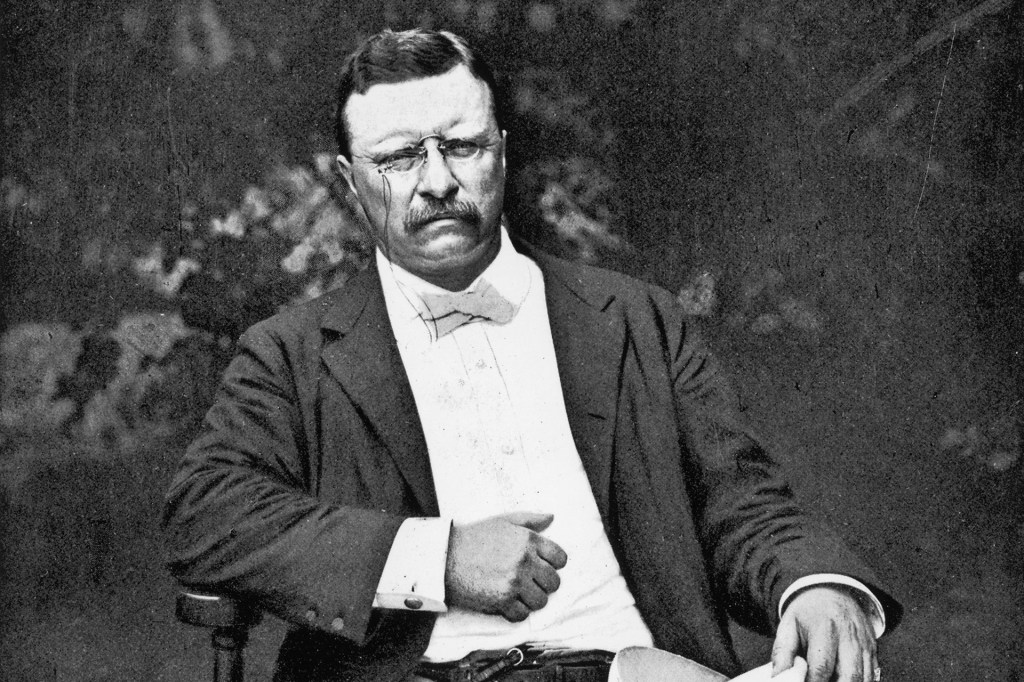
“All the extraordinary material development, our wonderful industrial growth will go for nothing unless with that growth goes hand in hand the moral, the spiritual growth that will enable us to use aright the other as an instrument.” – Theodore Roosevelt
I am reading through Theodore Roosevelt’s “Realizable Ideals,” one of the works of Roosevelt which has been, by and large, lost in the crevices of history. It is a book first published in 1911, which regrettably in the present time is not receiving its due attention.
I came upon this book by simply observing the bibliography of Roosevelt and being drawn to its title “Realizable Ideals,”- a combination of words that deserves themselves an unpacking, for “realizable ideals” are not the lofty utopian crafted ideals which are nowhere near practical nor possible, but they are achievable ones. Upon commencing this read, I was greeted with, and stopped to muse upon the words which I presented above in quotes. Here we have “material development” and “industrial growth” tied to “moral” and “spiritual growth.”
I paused to closely examine what Roosevelt was saying. I know Roosevelt is not Gospel, but he was a very wise man- an avid thinker and intellectual with strong moral character. His words are supported by much thought and study. So I wanted to examine how what he said relates to our world today and see if the statement above holds truth and relevance. Here he is saying that Material Development and Industrial Growth is useless without Moral and Spiritual Growth. Why? Well, he goes on to say that Material Development and Industrial Growth is merely an instrument used by Moral and Spiritual Growth? Objectively speaking, an instrument is useless if it is not employed. A piano does not produce music without a pianist, or I suppose could make quite the rattle if it was dropped or abused. A hammer has no pounding force without the manpower behind it. Being an instrument in and up itself is subservient to the instrumentalist. Moral and Spiritual Growth is the employer here of the subservient instrument of Material Development and Industrial Growth. This implies that Moral and Spiritual Growth is a more valuable, more commanding force than Material Development and Industrial Growth which ought to be subservient to these higher means of development.
So in what ways are Material Development and Industrial Growth merely an instrument of Moral and Spiritual Growth? Well let’s examine the products of Material Development and Industrial Growth within a nation. It produces, in its most encompassing form, three things: material products, jobs, and national strength. In examining these more closely, the products are not reserved for the elite, but with industrial growth the products are made for the enjoyment of ordinary people. Jobs of this kind of growth can raise people out of poverty and give a certain sense of purpose within society. It produces wealth which leads to greater charity, funding of a strong military and infrastructure, if employed properly. One might argue that with such growth comes greed and exploitation. Why yes, that would be correct if Material Development and Industrial Growth is divorced from Moral and Spiritual Growth. This is what Roosevelt is saying: Material Development and Industrial Growth “will go for nothing,” separated from the later.
In discussing Material Development and Industrial Growth of the United States we must examine the concept of capitalism, for it is the root economic model which has led to such growth. The competition it has produced has spurred on enormous and continual growth. Roosevelt believed in capitalism, but yet he also fought capitalists. He believed in the promise and the moral philosophy behind capitalism, that one is free to work as he chooses and keep what he earns; that competition and innovation gives way to growth. But he fought capitalists who did exploit others and destroyed natural wonders in greed. He took on monopolies that got out of hand from losing sight of Moral and Spiritual Growth.
In our nation today, there is a rising appeal of” democratic socialism,” a rebranded term that lies squarely up with Marxist Socialism. “Marxism” at one time in American society may have been seen as a dirty word, but now it is celebrated, particularly among those on the Left and its varying movements. Congresswoman Alexandria-Ocasio Cortez of New York explains the sentiment of many young so-called “progressives”: “When we toss out these big words, capitalism, socialism, they get … sensationalized, and people translate them into meaning things that perhaps they don’t mean. So to me, capitalism, at its core, what we’re talking about when we talk about that is the absolute pursuit of profit at all human, environmental, and social cost.” I think Cortez, along with many Leftist progressives are taking capitalism and divorcing it from Moral and Spiritual Growth. They are only observing the ugly outcome of the divorce settlement. They aren’t considering that these two things should go together and when they do, they work!
Ken Langone, cofounder of the Home Depot, in his book, “I Love Capitalism” writes “Capitalism works. Let me say it again: It works! And- I am living proof- it can work for anybody anywhere. Blacks and whites and browns and everyone in between. Absolutely anybody is entitled to dream big, and absolutely everybody should dream big. Show me where the silver spoon was in my mouth.” Unfortunately so many people think capitalism doesn’t work. That it only has corruption in its history. It has even been labeled as “irredeemable.” However, these people that attack the institution, I think, would, in the long run, be much more pleased finding reconciliation between Moral and Spiritual Growth and Material Development and Industrial Growth instead of a crusade to abolish capitalism.
Ironically, it is many in this same crowd who have worked ardently to demean and deprioritize spirituality, attempting to separate God and religion from nearly all facets in the public eye. It is the same crowd which preaches that morality is subjective, that no moral absolutes exist. When a society cannot agree upon what is right or wrong, then it has no moral foundation on which anything substantial or good can be built. The higher standards for which we reach are unattainable. We are then only left with the opposite of what Roosevelt preaches: unrealizable ideals.
We must, as a people, reprioritize Moral and Spiritual Growth and understand, as Roosevelt did, that capitalism is an instrument of it. Although self-proclaimed a “progressive” in his day, who fought for fair wages, better working conditions, and reasonable regulation, Roosevelt did not bow to socialists nor would agree with the progressives of today. He writes in his autobiography, “These socialist are unalterably opposed to our whole industrial system. They believe that the payment of wages means everywhere and inevitably an exploitation of the laborer by the employer, and that this leads inevitably to a class war between the two groups, or, as they would say between the capitalists and the proletariat. They assert that this class war is already upon us and can only be ended when capitalism is entirely destroyed and all the machines, mills, mines, railroads, and other private property used in production are confiscated, expropriated or taken over by the workers.” Roosevelt was to the point and also writes, “I do disagree most emphatically with both the fundamental philosophy and proposed remedies of the Marxist Socialists.” Roosevelt could say this and stand firm on this position because he knew that capitalism was a good instrument of Moral and Spiritual Growth. No other instrument could be employed to produce such a prosperous and free nation. Historians Alan Greenspan, PhD, economic advisor of President Ford, and Adrian Wooldridge, in their book, “Capitalism in America: A History” brush on the success of the instrument of capitalism:
“American capitalism is also the world’s most democratic. The United States was the birthplace of the engines of popular capitalism, from mass production to franchising to mutual funds. In many countries capitalism has always been associated with a plutocratic elite. In America, it has been associated with openness and opportunity: making it possible for people who were born in obscurity to rise to the top of society and for ordinary people to enjoy goods and services that were once confined to the elites….America’s rise to greatness has been marred by numerous disgraces, prime among them the mistreatment of aboriginal people and the enslavement of millions of African Americas. Yet judged against the broad sweep of history, it has been a huge positive. America has not only provided its own citizens with a prosperous life. It has exported prosperity in the form of innovations and ideas. Without American’s interventions in the Second World War, Adolph Hitler might well have subdued Europe. Without America’s unwavering commitment to the Cold War, Joseph Stalin’s progeny might still be in power in Eastern Europe and perhaps much of Asia. Uncle Sam provided the arsenal of democracy that saved the twentieth century from ruin.” A prosperous economic model produced a strong nation with great lasting influence.
So, let’s not be quick, as a people, to demonize capitalism. Let’s not look down upon Material Development and Industrial Growth. Instead let us put it in its place. Let us recognize the areas in which it has been corrupted and bring back the remedy which can restore this fine instrument: Moral and Spiritual Growth! We must not let them be separated! And it is among the fruits of such a union I believe Americans, from all walks, can find agreement.
Hold on Josh. Hold on. You’ve got to, or you’re going to die. I could feel myself beginning to slip from consciousness. I was in a desert canyon in Death Valley National Park in southern California. It was 122 degrees outside this summer day without a single cloud in the sky. The sun beat down harshly. I was out for a hike, not a long one, just a few miles, but I was competing with nature. I thought it wasn’t going to be a challenging match, but Death Valley was winning. I began to experience lightheadedness. My hearing began to sound muffled. Then there was the dreaded fading of colors. Hold on. Don’t let yourself go. If I were to pass out, it would only be a matter of minutes before Death Valley would dry me out and bake me in its inferno. I was hiking uphill on jagged triangular rock and badland formations on the Badlands Loops Trail, trying to make it out of the canyon. Normally this would be easy, for I’m fit and capable, and this wasn’t even very steep, but here in the harshness of the desert, with the oppressive heat, my body was giving up. Am I dehydrated? Or am I lacking salt? Or is it heat stroke? The body could be overheated, no longer having the ability to cool down to a life sustaining temperature. Maybe my body just could not keep up with the extreme heat of Death Valley.
My heart began to race rapidly. Oh no, I know how this goes. Soon it could beat out of control, bringing me to the ground. I’ve fainted before, at Big Bend National Park, but luckily I was inside around other people. Here I was completely alone, except for with her, Death Valley. We had met before. She caught me in a sand storm summers before.
The Badlands Loop
There was a little bit of shade just up against the short canyon wall. There were fragments of broken rock down by my feet, which seemed, in my present state, so far away and unreachable, but there was one big enough for me to sit upon. I lowered myself slowly and cautiously. Any quick movements, any exertion whatsoever, could cause me to black out. I crossed my legs, the most comfortable position to keep myself up from complete collapse. My vision went blurry for a moment, but I still had a grasp on it. I focused on breathing slow, deep breaths.
I had water, but I wasn’t sure if that’s what I needed. If I was salt deprived, this would worsen my symptoms. However, it could be life-saving as well. I took a sip of my water which had turned hot from the all-consuming heat. I poured the rest on my head. Although hot, it was not as hot as the air around me. It could cool me off just a bit. And if salt was what I needed, there was one thing I could do. Sweat contains salt. I began to lick my arms. It’s not that I was particularly sweaty, for one doesn’t sweat in Death Valley, as sweat immediately evaporates in the extremely dry climate. But even this being the case, there should still be leftover salt deposits on the skin, I thought.
I had overestimated my strength in the desert. It didn’t help that I did this hike shirtless. I like the feeling of the desert sun on my skin, and I thought that in the heat the less clothes the better, but actually if I had worn something to cover my torso it could have provided shade for the body and maybe I wouldn’t have overheated as quickly.
I had not yet cried for help. I was only about a mile from Zabriskie Point, a popular lookout point, where people would be present, marveling over nature’s artistic display of giant jagged rock formations, but I was so far down in a canyon with a sea of rock formations before me that I could not hear any of them, and I don’t think they would hear me. If I were to exert my voice loudly, this might take too much energy and cause me to lose my consciousness. I could not make a phone call. My phone was in the car. I left it there, for there was no service out here anyway. It was just me and her, Death Valley. I’ve always said she is my favorite park. She is so different and unique from all the others. Her views are so astounding, Her mountains are so tall. Her valley is so wide. She is rich in history of gold, silver, and borax mining. She’s the keeper of abandoned mines and ghost towns. She’s so strong and so dramatic, and this was one of the many features I liked about her, but she was also ruthless. She lures people in with beauty and mystique, as in the past she tempted with her riches of gold and silver. She’s a masterful artist, skillful at manipulation, luring man in to choke and turn him back to the very sand from which formed him.
She caught me. She had me right where she wanted me. Though a lover turned hostile, I had done her no wrong, but merciless she pursued me. I focused on breathing and said a prayer. After a few minutes my heart returned to a normal pace, colors in my vision returned, and my hearing was sharp. I was okay. I had to get up and continue. Time was of the essence. I needed to get back to the car. I stood up slowly, and I walked carefully. A peace had brushed over me, despite concern still guiding me. I was able to be calm yet knowing the urgency. I made progress, slowly, calmly, not letting my heart rate spike.
The trail wound up and down and around wavey rocks and canyon walls, until I could see up ahead the sharp pointed rocks of Zambriski Point. I could see people on the rim taking pictures, and it was a sign of relief. Slowly and methodically, I made it back to the lookout point among the other tourists. They were nonchalantly posing for photos in front of the jagged points spiking up from the canyon. I then was assumed to be another one of them, but no one knew what I had just experienced. I got back to the car and turned the air conditioning on high. I had some hot gatorade, and dry snacks. They seemed to help. I longed for something cold and refreshing, but nothing here would be cold. It was all hot.
Zambriski Point
I’m done with hikes for the day, I concluded. After resting in my car for a few minutes, I was ready to check out the Furnace Creek Inn, one of the two accommodations in Death Valley National Park. I wasn’t going to stay. I just wanted to see it. I had learned about this historic inn from a documentary about National Park lodges. It was built in 1927 by the Pacific Coast Borax Company before the area was declared a national monument and later a National Park. This inn was once a desert oasis for Hollywood elites, and to this day, it says on its website that it “still pampers every guest.” I had to see it for myself.
Its a structure that very much fits in with the landscape. Its foundation and lower level walls are constructed with rocks from the very desert. It’s building blocks were formed from the very sand of Death Valley. After I parked my car I walked up the drive. On one side there was a lawn with a tall fountain. Yes, there was a lawn in Death Valley! I could scarcely believe my eyes. On the other side of me was a wall skillfully crafted out of rocks and above it a patio for guests. Up above was the main level of the establishment. To get there there was a rounded tunnel that cut through the rock wall and seemingly went back to a staircase. Lights were affixed in the tunnel to light the way. How unique of an entryway, I thought. It seemed sort of like I was approaching some passageway in a medieval castle, but as soon as I entered the tunnel, a large aggressive wasp darted towards my face. I abruptly moved my head, evading its assault. It buzzed around me loudly and invasively. I ran back out of the tunnel to the drive. I had thought I was alone, but then I saw a lady walking her way around the front of the inn. I must have looked ridiculous, running away erratically from a wasp. I immediately regained composure, stood upright, and walked moderately. I smiled and nodded my head politely. “Hello,” I said, as if nothing unusual had just happened.
I walked around the rock wall to another staircase that led up to the main lobby of the inn. Inside I was quite impressed. I beheld a beautiful lobby of simple elegance. Intricate tilework spread through the lobby and into the halls. Big rounded windows looked out into palms and the desert mountains in the distance. Oritenal rugs sprawled out beneath wingback chairs and floor lamps. I did feel out of place, however, and began to wonder if this was alright, that I, a mere vagabond of the desert, was welcome in such an establishment. If I knew it was so nice, I would have dressed a bit differently from my gym shorts, cut-off, and hiking boots. But I decided to ignore my attire and just walk about the place as if I belonged. No one had to know I was a foolish young man who nearly died in the desert, who really is not sure where he is spending the night, and could no way afford this place. I could pretend and carry myself as if I knew exactly where I was and what I was doing. Some National Park lodges encourage visitors and are quite welcoming. This seemed just a little bit prestigious and more intimate to me, but I pretended like I belonged the best I could, given the circumstances. I wanted to appreciate its architecture, elegance, air conditioning….and pool?!
I walked out into the oasis garden behind the inn. I was so completely surprised that such a place existed in Death Valley. Here was a forest of palm trees on a hillside blanketed in green grass. Small winding stone pathways and stairs meandered around it and over a bubbling brook and rippling pond. Little stone walls held up the hillsides of tasteful landscaping. This place looked so cared for and so astounding to exist in such a barren place as Death Valley. Between the palms, in the distance, I could see the large expanse of the desert and its mountains standing tall. What a contrast! More immediately before me I was faced with a large natural spring fed swimming pool. Its poolside was encased by beautiful stone architecture with arches resting on cornerstones, and it was all in the shade. After being so exhausted in the desert, and strolling now still in the oppressive heat, the thought of being engulfed beneath the water of a swimming pool seemed so perfect and just what I most wanted. I had been successful thus far in pretending as if I belonged at the inn, walking around the lobby and garden oasis. What if I just took it one step further and helped myself to a little swim? I was very close to letting myself walk through the gate and into the pool, but I first noted that it would be quite obvious if anyone was watching, for no one else was at the pool. Then my moral conscience kicked in. This was not for me. It was desirable. It would be so nice, but it was not mine.
the garden oasis
Back at my car I noted cell service here by the inn and sent a text to my mom telling her about the 122 degree temperature. She responded “You are not going to camp in that!” She knew that was my plan, and it still was my plan.
I drove thirty minutes to the Stovepipe Wells Village. I remembered the general store here from my previous visit. I bought a Death Valley Black Cherry soda in a long-neck glass bottle here back on my first National Park adventure. Inside I was greeted by a self-serve soda fountain. I got myself the mega jumbo cup, nearly filled it with small nuggets of ice from the dispenser, then poured over it cold refreshing blue Powerade. When I left the store and took the first sip through the straw, it was the most heavenly experience. My body was crying for this so badly: the sugar, the sodium, the electrolytes, and most welcome of all, the cold. I couldn’t take it in fast enough. I may not have made it into the pool at Furnace Creek, but this ice-filled cup of Powerade drowning me was the most perfect thing at the moment. Death Valley had tried to take me, I survived, still weary and war torn, but now I’d just powered up. It was going to be a good night.
Next order of business: finding a site and setting up camp. There were a number of first-come -first-serve campgrounds in Death Valley. In accordance with my itinerary, I was on my way to the Emigrant Campground when I discovered, along the way, a large sandy lot where others had parked and pitched tents. It sat a little bit elevated on a plain that sloped down into the valley. It displayed a beautiful open expansive view. The sun was setting, and I preferred not to set up camp in the dark. I figured this area would be fine. There were no numbered sites, no bathroom, but I could do without. I pitched my tent, and then went for a walk.
I passed by a ranger station or some park service building in the middle of the road that looked closed for the summer. Just past it I paused. I deviated from the road and stood up upon a rock looking out. The sun had set. The mountains were a rich dark blue, and the sky a vibrant pink. This beauty was enough to give shiver with goosebumps, even in the extreme heat. Out in the valley there appeared to be a lake, but I knew it was just the giant salt flats contrasting the surroundings. Everything was so giant, so huge- the mountains, the expanse of the valley, the salt flats. Everything seemed to flow smoothly from the Artist’s brush. Even with such an incredibly huge view, the desert was so still, calm, and quiet. This confirmed all the more that Death Valley remained my favorite National Park. She has a unique overwhelming effect on my soul. I love her, despite the fact she tried to kill me.
With a calmness of the late evening desert seeping through my being, I walked slowly and relaxed back to my tent and shed a few tears in response to such beauty. This was also my first stop of my very first grand National Park adventure back in 2015. I was coming back to where it all started, my following in love with the Parks, where excitement and wonder was so fresh and new. The desert reminded me of all I had seen and experienced since, and I felt extremely grateful.
Back at my car I brushed my teeth and didn’t bother changing clothes for the night. It would all be coming off in this heat. I checked the temperature from the car before I locked it up for the night. It displayed an even 100 degrees. I noticed I had cell service and decided to respond to my mom’s text over her concern about me camping in the heat when I told her it was 122 degrees earlier. I responded “No worries. It has cooled off…it’s only 100 degrees now.”
I crawled into my tent. Death Valley had spared me and now was as beautiful and captivating as ever.
I thought I had seen it all, that there was no type of landscape which I had not become accustomed to throughout my travels. It was quite a disheartening feeling to consider, what could possibly be left? The good news, though, is that I had not been completely spoiled; that I was far from it. Only ignorance had pervaded my thoughts, for I stood before something entirely new- a landscape previously uncataloged in my mind- a monolithic wonder in the Mojave National Preserve. The very thought in my mind was, Wow, I couldn’t have imagined something like this.
This moment was near the end of my day. I had started about 295 miles away in Phoenix, Arizona, where the first night of my trip had been spent at the house of my cousin Matthew and his wife Robin. By the time I traveled across the remainder of Arizona and into California to the Mojave National Preserve, it was late evening. My plan had been to visit the Kelso Dunes and hike a short three miles to a mountain peak, but this would have to wait until the following day.
Although sandwiched between interstate 40 and Interstate 15, and a mere sixty miles from Las Vegas, this park has yet preserved its remote feel. When I turned to enter the park, I was greeted with the official National Park Service sign. Visitors had tatted up the corners of the sign with stickers and a few bullet holes punctured the middle, telling me that this area was not as well supervised as some of the other parks. I entered from the south on my way to the Hole-In-The-Wall campground. It was first come- first serve, and I wasn’t concerned about finding a site, for I read that visitation was low in the summer. The Mojave desert is just not a place most people want to be in the summer with the sweltering temperatures, but my only concern was the drive, for a number of roads in the park were marked unpaved, including the one to this campground. Before I hit the dusty sand roads, I was cruising along the pavement among grand stretches of desert. Dry shrubs nearly covered the terrain, and every once in a while a cactus, yucca, or Joshua tree would stick up. Around me I saw crumbly mountains and mesas in the distance. I hadn’t expected the expanse of this area to be so enormous.
When I reached the bumpy dirt road, before me crawled an animal I had never seen before. Its fur was dark, and its appearance was prominent. Although nor particularly large in the grand scheme of things, it was larger than anything I was expecting to see. I got out my cell phone and texted my friend Zack in Kentucky, who would be joining me on the adventure in a few days. “I just saw a wolverine,” I typed. I was wrong, so embarrassingly wrong. I did not know. Wolverines do not live in the American Southwest. They are mammals of the far North. We can file this next to the instance on my first adventure, when I thought I saw a wolf, but it was really just a coyote. What I had just experienced was my first sighting of a badger. When I neared the campground I witnessed a pair of black tailed jack rabbits situated in the middle of the drive, jumping further down the road and then off into the shrubbery as I neared .
Finding a campsite was not hard. I was alone, except for one other occupied site. I quickly pitched my tent at a site far from the others, on the opposite side of the campground. I was distracted at times by a nosy little desert cottontail, whom I pursued to capture a photo of, and who surprisingly let me get closer than I expected. Back to work, I got my tent set up swiftly, as I was planning to get at least one hike in before the day’s end. Once I had everything set up, I drove over to the Hole-In-The-Wall visitor center. It was an old Western style wooden ranch building with a wrap-around porch. There was a clear place for a sign to identify the ranch, but it had been removed, and the flag pole out front was also bare- a sure sign that this was definitely off season. It would have been the perfect time for a tumbleweed to tumble on by or a vulture cry to sound off in the distance, for I was very much alone and very much in the desert. I checked around the perimeter of the abandoned visitor center for any maps or trail guides, but nothing. I was on my own.
However, I found my trail head next to the visitor center. I then geared up. First off, I was certain to have water in my camelbak backpack. I brought a light hoodie, expecting that soon the temperature may drop, and I brought my headlamp, for I knew sunset was not far away. I made sure I had my car key securely in my backpack. I was not going to face the panic of last summer when I locked my key in the car at Chiricahua. To help avoid repeating that situation, I bought a short lanyard keychain at a gas station earlier in the day. Then, all ready to go, I hit the trail. It began with a stroll among the shrubbery and quiet meandering around some teddy bear cholla cacti. Then the path slithered between some boulders, and up to some rocks adorned with native American petroglyphs. At this point, the sun was just resting above the horizon, casting dark long shadows behind every protrusion in the desert, but laying gold upon anything its light touched. The path then led around some big rocks to a picturesque Southwest view. There were two large mesas, one laying in front of the other and the top of a mountain peeking up behind them. The air was warm and incredibly still. All around me was silence. I climbed up a rock, not taller than myself, and stood upon it, gazing out into the distant stretches of evening desert. I closed my eyes and quietly reveled in the moment, in my being, in the presence of God, in my arrival to a new adventure. I felt as if I had come back to an old friend. The desert: I know you. We have been separated for a while, by time and space. So much has happened. So much has changed, but yet you are the same, quiet and reserved, a library of adventures past, calling me to be grateful of the years gone by. The desert knows years gone by. It has been through them. The desert is well weathered by the ages, but yet calm and knows its place.
As I pondered the desert, I thought about how in the desert, you don’t have to be up high, or in any particular overlook, to look out among the immensity of the land. In the desert there are no tall trees nor overgrowth hindering your view. Here it’s all laid open. One stands above and can see the great immensity of the land. And the desert here, in the Mojave, is not a barren plain, but it does have features: mesas, rocks, and distant mountains. The view just stretches on seemingly forever. It derives a similar feeling of a mountain top experience, when your life is sort of put into perspective, as you observe the immensity of that which is around you and are surrendered to a humbling comfort. Your problems seem diminished and are put in their place.
The warmth of the desert also has a comforting feel to me, especially in the evening, when the sun isn’t harsh, but a dry warmth still blankets and comforts you. If the sun were to set, if I were to be lost for the night. I would be fine. The desert may cool some, but won’t freeze. The air is still. Bugs are absent. Any perils of the night are gone. Yes, some may find the desert to be harsh and univiting in the day, but in the night I find it very welcoming and suitable for the lone traveler.
When I jumped down from the rock I was observing from, I turned around to a giant monolith in the desert: a massive rock feature just protruding solo and drastically from the desert floor. The trail wound around into a wide slot canyon that was somewhat narrow but then opened up in the middle of the monolith to a canyon wonder. Here I paused. Wow I could have never imagined something like this. I was taken away by the uniqueness of the scene. This was a new terrain, a new landscape I hadn’t experienced before. Here giant groupings of hoodoo-esque spires huddled together, right up against each other. They were together, yet individual, like you could pull or peel them apart. They stood as if flaunting their curvatures. And all of them were missing circular chunks, as if shot by enormous canyons, mimicking swiss cheese, or as if they had sunken eyes looking out at me. I had never seen any rock formations quite like this. It was unexpected. The desert just outside this canyon was not drastically different than what I’d seen before, but this short walk into the slot canyon displayed a whole hidden world, so unique. It was so nearly enclosed too, like it’s own hidden fortress. I paused and just looked around in amazement. It completely wiped away from me the thought that nothing I could see would be terribly new. This affirmed there was much more to see, and things can, and would, exceed what I could imagine.
This was only the first of two surprises on this short hike. The canyon grew narrower with each step until there was no canyon left at all, and it seemed I had been walled in, but upon observation I found a passageway of sorts. There were cracks in the jumbles of rock, just enough space to fit a body through, and they were steep, ony presenting a passage that went vertical. Affixed to the sides of the rocks were a series of steel rings. This was called the Rings Trail and I had read about it, but seeing it, I was well surprised. The rings portioned looked more challenging and more extensive than what I had imagined. This would be fun. Like a puzzle to solve. I had to figure out where to establish footing on the rock wall, and which rings to grab onto, as to establish grip which was conducive to a trip upward. The passage grew narrower, then curved. I was really immersed in this rock world all around me and the task at hand.
I appreciate a trail that presents a challenge, a unique skill, or problem solving. There is one trail back home in the Big South Fork that requires one to rapel him or herself down a boulder’s face. In the Rocky Mountains I’ve hiked up a waterfall. Even a mere swinging bridge can add some fun and variety. This Rings Trail presented something new, and it was definitely one of a kind.
When I finished making my way through the narrow rock passageways, I found the rock terrain to open up. I found myself not completely out of the canyon, for walls still surrounded me, but I was well above the portion I had just traversed. Now I was at an established viewpoint where I could look back down in the rock world beneath me. Up around me I noticed the curvatures of the rocks. They were not jagged nor harsh points, but rather the rocks seemed to flow and lump, as though melting chocolate. The rocks were plain gray although lumped into the mix were orange colored rocks as well. If I was handed five stars, I would rate this trail 5 out of 5. “Unique” is the most justifiable term to use to describe it.
When I made it back to my campsite, a mere maybe quarter mile away, the sun was setting. I was walking around the campground, tracing its perimeters, trying to see if there were any trailheads from the campground. I had the intention of going on a nighttime hike. I would rest in my tent, and, when it got much darker and the stars came out, I would go for a night hike by flashlight.
When I did get to resting in my tent, I was out. I slept long and deeply. At one point I did wake up, as a different aspect of nature was calling. Inside my tent it was very dark, as I reached for the side of the tent to unzip my way out. When I pulled the flap of my tent backward, I unwrapped the most beautiful night sky. Millions of stars decorated a huge desert sky. The milky way ran prominently and astonishingly through the middle of the expanse above. I was amazed. This was all visible with simply my glasses on, which I don’t see very well with. Right here, right now, in the middle of the night, well…after answering nature’s call, I put on my contacts so I could really see and take in the beauty above me.
Looking out upon the desert alone is enough to make one feel small and shift one’s life into perspective. But take on top the desert the profundity and awesomeness of the night sky, and then one is really put into place. One of my favorite song writers, Matthew Parker, in his song Shadowlands writes “The moon and stars are the only light to tell us that we’re lost in the endless darkness of night.” This moment illustrated this perfectly. Observing the stars in such a glorious display in a remote area, does initially evoke a feeling of lostness. The universe becomes so immense. You seem so small. What you witness is so immense that you feel but nothing, lost in the great immensity of what is. But Matthew Parker, as well as myself, know that we don’t remain lost. What’s most reassuring and comforting is that, amidst feeling lost in the great order of things that exist in the universe, we are found! We have been sought out, we are accounted for, by the great Almighty God and Creator of the immensity before us.
It is no wonder early peoples and cultures, whether it be Native Americans or any group of people across the sea on this earth, spent such a great amount of time pondering the sky and trying to derive meaning from it. It is just so astounding when it is untouched by the light of civilization. It is no wonder early people and societies were so spiritual. I would find it a challenge to the human psyche to observe such wonder and not believe in a spiritual realm or a creator. Can you imagine living out in the desert and this being your view every night, or living out on the Great Plains and this being a constant entertainment for the mind? Think of the men out at sea, nothing but the ocean and these great heavens above you.
Sadly, most of human society has lost reverence for the night sky. If you live in a city, you can’t see its wonders at all. It becomes easy to be consumed by you, yourself, and your own immediate surroundings. You fault the opportunity to put yourself into perspective. And you lack the beauty which calls you back to the Creator. Even those who live rurally may miss out on the powerful impact of the full night sky. Instead, people find themselves inside in front of their television sets, seeking entertainment, when really the night sky is the more noble form of entertainment, for it engages not only the senses, but the mind, and the spirit.
But you know people are afraid of the dark. I don’t say this because of what we playfully think: of monsters, and bears, and things that go bump in the night. No, people are scared primarily of their own thoughts, the condition of their own souls, and the night sky is a reminder of the greatness and eternity we are all a part of.
Get outside! Don’t be scared of the dark. Face your thoughts, face the eternity before you, and find your place in the order of things.
This was night one of my camping road trip. Tomorrow I’d explore more of the Mojave National Preserve and return to my favorite National Park- Death Valley!
I had this dream; in it I was at a summer camp. I found myself in my assigned cabin full of bunks. I never went to summer camp as a child, so this was something new. I got out of my bunk bed and looked in a mirror. I was definitely myself- that’s good, but I looked different, younger. I had been gifted back some years in life.
I left the cabin and went to the dining hall. Somehow, I knew everyone would be there. It was time for dinner. I walked over the well-worn path between the various cabins and buildings here in the wooded camp. When I arrived at the dining hall, I found it to be very much like a school cafeteria, except of a more rustic nature, in tune with its natural surroundings. As I scanned the hall, considering which table I might sit down at, I noticed something strikingly surreal and exciting. The characters from my first novel and series of short stories were there: Dan, Linzy, and Sarah!
At this point I realized I was in a dream, and thus I was excited I would get to personally meet the characters I had invented, materialized in this dream. They came over to me with looks of accusation and immediately they made their concerns known.
Linzy, the red headed, usually bubbly, outspoken teenager, pointed her finger at me, “Why didn’t you finish our story?” Her friends spilled out their similar concerns. I knew what she was referring to. My first novel, Wild Christmas, ends rather suddenly. Some readers have said that the book should have had a more well-rounded conclusion. The trio of high school friends were in the midst of assisting Santa in completing his Christmas Eve present run, but the reader is never brought to see the completion of that.
I did not know how to respond to Linzy’s concern. It is true I wrote her story, and it was intentional that I ended the story that way. I had nothing else to say in the matter. I had entertained a sequel for a while, but never pursued it in writing.
As I looked away from the trio to collect my thoughts, I noticed another familiar character. His name was Mark, a lifeguard from a series of comic strips I wrote and drew when I was much younger. In his story, extraterrestrials invade his beach and throw the touristy beach town into chaos. Mark’s lifeguarding duties greatly expand as he has to save the townspeople from not only high tide but the destructive aliens. The problem was I never finished that story. I left the townspeople dangling in chaos and danger and Mark in utter distress. When my eyes made contact with Mark’s, I could tell he was upset with me. He came over.
“How could you leave me, abandoned with the alien invasion?” he both accused and questioned.
“I don’t kn—” Before I could finish my sentence, I was silenced as I was struck with the realization that this dining hall was filled with characters of unfinished stories I had written over many years. There they all were, just as I had described them in writing. I looked out and I knew the backstories of everyone here. These were all my friends, but they were all upset with me, coming over with complaints of how I didn’t finish their stories.
Most profoundly of all, I noticed one of my most developed and personally explored characters, Dakota from my novel, Dakota Broken. He sat alone at a table. I took my tray of food and sat next to him. His head hung low, his black hair drooping down, nearly covering his eyes. With no introduction or acknowledgement, he simply asked, “What happened?” In the novel, Dakota was taken away from his abusive parents and was about to be adopted by a new family, but the novel doesn’t take us to meet the new family. “I was ripped from my parents and was going to be adopted? What are they like? Do I ever get to meet them? Will I ever overcome my insecurities?
I was left speechless. Then characters from all over the cafeteria began to crowd around me in angry accusation. I’ve left many a story unfinished and others have conclusions that may not answer all the questions the reader has. I’ve wanted the reader to speculate and think and have just said, “like in life, we never have all the answers.”
This definitely did not sit well with all my characters crowding around me. I couldn’t distinguish one accusation from another. Too much was coming at me that it all blended into chaos.
Over the commotion I defended myself, “Listen, I don’t write your stories anymore. You live your own lives.”
“But you’re the author,” one voice broke out above the others.
And I awoke.
What a peculiar dream, I thought. It must mean something. I sat with this dream for a while, and as I was driving my way through the desert on my way to Mojave National Preserve, I thought deeply about it. The words, “But you’re the author,” really stuck out to me. Here lay the deepest meaning. Before we unpack that statement, let’s peer into some fundamental beliefs I have about life.
I believe we are gifted life by God. Life is not a happenstance or an independent state. Life is dependent on God. He is the author and giver of it. A component of life is free will, which is also a gift from God. This is the ability to make our own choices and not be controlled. Thus, as humans, we make good and bad choices. The ability to make choices, to have freewill, is in essence to have the pen in hand to author the story of your own life. You can write for yourself misery by poor choices. You can write for yourself a tale of adventure through travel. You can pursue romance or enterprise, family, or solitude. Modern philosophy teaches that society is the author of your life; that society holds the pen and determines the projection of your life; that as an individual you have no choice but to be the outcome of societal factors. To think otherwise is to be the spoiled product of privilege. Society sure has influence, but society is not the author. YOU are the author! You have been given life and handed a pen by the almighty God. You are writing YOUR story.
Christians, and people of faith, strive to have God guide that pen, just as a young child learning to write, we desire God to help move the pen and show us the way. Thus God intervenes and guides our pen, becoming a coauthor and authority in our lives. As humans, we are made in the image of God, and a part of that image is having that ability to be able to have influence and write into the stories of others as well. Life is a book, or story, being written, and we intentionally, or not, write in the stories of everyone we come in contact with. Think about it. When you compliment or insult someone, you are grabbing the pen and writing or scribbling into the story of another. Your words have an impact on the lives of others. When you are generous with your resources, time, and wisdom, you are writing influence upon the life of another. When you teach people, insult people, hurt people, fight people, love people, care for people, you are writing into the story of another person. You are a coauthor of many stories.
So when the characters in my dream cried out, “But you are the author,” what a challenging reminder that is. You hold a pen, and you can open the story of another at any time and write into his or her story. What will that look like? Will you write in encouragement, experience, wisdom, love?
Reflect upon your life. If you are a parent, think about the influence you have had on writing the life story of your children’s lives. If you are a teacher, in its many forms, your influence is so broad and expansive. If you have been a good friend, a loyal companion, a good listener, an encourager, you may never know until eternity, the extent to which you have helped author the stories of others. On the contrary, have you been a complainer? Selfish? One who seeks power, or a seeker of revenger? Have you stepped on, trampled on the lives of others in authoring your own story? Have you intentionally scribbled into the story of another, creating the ugliest of pages in his or her life?
This is quite challenging, and although as beneficial as it may be to look backward and reflect, think about each day as it comes. You begin each day with a pen in hand- there are books all around you- you have been given the power to write into their lives.
One day when I was out jogging, thinking about such matters, Dolly Parton’s song, Dear God, came to mind. I had been listening to it in the car. Crying out to God, she sings, “The freewill you have given we have made a mockery of.” That really stuck with me. I was thinking of all the selfish and immoral choices made with our freewill, and I was thinking about how free will is not simply gifted out of love, but it has been gifted out of love with purpose, which is the part often overlooked. We are not to simply be thankful for our free will, but we are to use it as well for intended purposes. To live a life pleasing to God by serving others and writing into their lives goodness, hope, and love.
At this point you may be wondering, what has happened? Let’s talk more about National Parks and the great outdoors. Why has Joshua become so preachy? Maybe before I cared too much about what others thought of my writing. I wanted it to appeal to a broad audience. I have always been very introspective in my writing, relating matters to faith, but this time it may seem just a little bit more in your face. I don’t apologize. There are things we need to talk about.
I have debated and struggled over sharing this adventure, not over matters of faith and inspiration, but in another regard. This adventure, which I am just beginning to share, very much involves other people and not just the introspection which is mine. There are some moments here when I could have authored good things into others’ lives, but rather I surrendered those opportunities to neglect. I have thought, Do I only want to share those good moments of inspiration and leave out that which bears shame? Do I do so out of courtesy to others? I’ve concluded, no; that nothing grows without rain, healing does not come without pain, and learning does not come without failure. So, in my typical fashion, I lay it all out before you, so that you can learn from my life that’s lived. It is intentional that I follow the noun, “life” with the past participle “lived,” for a life that’s not lived does not have hardship. To truly live your life, you must face the hardships and let the hardships produce beauty.
I know that when my life is said and done, and my own sun sets. I don’t want my sunset to be dull and boring, or covered up by the clouds. A life that’s lived is the one that also produces color. I want what I’ve stood for, what I’ve accomplished, what I’ve lived, to be bright and vibrant- an orange on fire, a luminous pink, a deep reflective blue. May these be the Colors of My Sunset and may they touch upon the lives of others.
With each elongated step of sliding down the enormous sand dune, a reverberating booming sound escaped the sands from beneath me. This was remarkable! I had never met such a phenomenon before. I felt as though I was the one instigating such a feat, thus giving me feelings of a supernatural essence.
I was at Mojave National Preserve in southern California. This preserve was the first noted point of interest on my fourth great National Park adventure. The park features the largest Joshua tree forest in the world, canyons, mesas, volcanos, abandoned homesteads, military outposts, and “singing sand dunes.” During the entirety of my visit to the Kelso Dunes section of the park, I was the only one there. It was early morning, and the desert sun was just starting to become quite fiery. I was excited to take on the sand dunes. As I looked out upon them, I determined, then and there, I had to make it to the top of the tallest dune. Learning from my mistakes in the past, and after having burnt my feet at the Great Sand Dunes National Park in Colorado, I made sure my footwear was solid. I filled up a water bottle, threw a Clif Bar in my backpack, lathered up and worked in my sunscreen, and took off running into the dunes.
My fourth great National Park adventure was really starting to take off! I had embarked on such trips the past three summers, in which I’d camp and travel from National Park to National Park for the large majority of my summer break hiking and exploring the great outdoors. This trip, although starting in the Southwest, would eventually take me far up into the Northwest, an area I had yet to explore. This was my second day in the Mojave National Preserve, but the first one waking up in it. Already the park had impressed me. My expectations for it were quite low. I had been to other parks in the Mojave Desert before, such as Death Valley and Joshua Tree, how different could this be? And it was a “preserve,” such a title to me suggested less opportunity for recreation. However, I was surprised. This place was by far underrated in the National Park Service and filled with many hidden gems. I was in the midst of discovering one of said gems in this moment: the Kelso Dunes. They gave justice to the term sand dunes. But perhaps would be more justified by a term “sand mountains.” Enormous mounds of sand rose above the rest of the desert. On the lower sides of the dunes, desert grasses poked up sparsely from the wind combed sand and Mojave fringe-toed lizards scurried about. The creatures were quite nervous and incredibly fast, but stealthily, as if sneaking up upon my prey, I was able to approach one to capture a quite satisfying photograph. I also had to capture photos of myself in such an area. The shock value of such a contrasting landscape, from that which I was accustomed to in Kentucky, was striking upon me.
As I looked at that enormous sand dune in the distance, the one I resolved to climb to the top of, doubt began to creep in. It was hard to gauge exactly how tall the sand dune was. I wanted to be done in an hour or two, for although as exciting as this was, I also had other places to see and other things to do. Looking at the dune, I could not determine if this would fit nicely into my plans or would require a full day expedition, and if it was the latter, I was not prepared and rather ill-equipped. But I determined to press forward. If it proved too much I could always turn around. Then, not only was I considering the time factor, but I started to wonder if it was physically possible, for the rising of the sand looked quite steep. Would I be able to pull myself up that? There was no designated trail. This was a free for all, and quite obviously no one had been out here this morning, and perhaps not for a while, for the traces of any feet in the sand had been well swept away by the wind. The place looked untouched. It was just me and the desert. Graciously enough, this peak in the sand dune expanse, did not present any false summits, however dips and dives in the sandscape did surprise.
I didn’t try to dig my feet in the sand, but as I started to ascend the steepest stretch, my feet naturally sunk into the sand, and pressed further in as I tried to establish footing to push myself upwards. I paused to look around. The landscape was just so enormous. To my one side was the wall of sand, but out below me to the right spread, so immensely, the Mojave desert. The light-colored sand expanse spilled for just a mile or so into the desert, before the long stretches of valley filled with cactus and shrub took over, with the bright morning sun casting shadows, which not noticeable individually, but collectively, gave a dark brown hue to the landscape. Then as the mountains in the distance, bordering the immense valley, rose up, the higher they climbed, the bluer the tone they assumed, until, at their darkest summits, a crescendo of the breaking sky burst in a glorious white only to quickly transition to a spotless blue that covered the rest of the desert sky.
I continued on, elated, feeling as though I had really arrived upon adventure’s doorstep. Then, I reached the top, standing bold and accomplished, I looked over the other side of the dune and saw the same immensity of desert and mountain mimicked. Here at the pointed spine of the sand dune, on the Eastern side, the sand was finely combed into delicate rivets by the wind. On the Western slope the sand had been blown into one smooth, harmonious sheet of sand. The spine snaked up to a higher pinnacle. I crushed the delicate spine as I trampled my way to this final viewpoint. And there I stood in awe. I could assume, a great number of people, especially back East, couldn’t even imagine such a robust desert landscape existed in our country. I felt I was in such an exotic place, a place from fiction, and that I was the Prince of Persia.
I sat down, drank some water, ate my Clif bar, and sucked on a few electrolyte dummies. I reveled in the comforting and consuming sun. I took off my boots and sunk my feet into the soft sand. Here, from this pedestal, I looked down upon the Earth. It was one of those mountain-top experiences that puts life into perspective. The immensity of the view before me, and the diminutive nature of everything from such heights, put life into perspective. The canvas is much bigger than the small concerns we often get caught up in below.
When I was done taking it all in, I began my descent, and the gravity of the Earth pulled me downward, and thus a single step slid well into the sloping sand before me, carrying me quite a distance. It was nothing more than a controlled falling glide into the sand, but it gave quite the superhuman sensation- a similar sensation one might get walking upon those conveyor belt automated walkways at the airport. One stride takes you much farther than humanly possible alone, as the very ground beneath you moves in conjunction. Thus I was descending nothing short of a mountain in mere easily countable strides. The effort was minimal, so I held my head up and looked out upon the other more solid mountains parallel and at times below me. I felt as though I was descending upon the Earth in majestic style. And to top it all off, the sand beneath me boomed! That’s right, the sand beneath me sensationally responded to each of my steps! There’s a scientific explanation behind this. It has to do with the warm layers of sand meeting the cold layers beneath and sound waves getting trapped within the layers, but to me, I imagined as if it was I causing the sound, or as if the earth was shuddering to each of my steps, as if I was Zeus or some Greek god descending from the sky upon Olympus.
As supernatural musings took hold of my thoughts, I began to think of Heaven. How will man interact with the landscapes there? Will such enormous, satisfying, efficient strides be more commonplace? Distance and strenuity have a hold of man’s interaction with wild landscapes, but what if there they will be more easily traversed and enjoyed?
I had a dream, just months prior, that I was in Heaven. I recently had read a book by David Murray titled the “Happy Christian: Ten Ways to Be a Joyful Believer in a Gloomy World.” In it the author talks about how work is not a result of sin, but how work as we know it on Earth has been corrupted by sin. The author discusses how Adam and Eve, before the fall of man, worked in the Garden attending to it and naming the animals. They were designed, in part, for work. Eve was even created to help with said work. Thus work existed before sin, and so the author proposes that work will also exist in Heaven; that we will all have our own duties, but it will be joyous and fulfilling. I think this portion of the book was responsible for my dream, for in my dream I was at work in Heaven. I was a harvester, or scavenger, in the forests and jungles of Heaven. We went collecting exotic Heavenly fruits to bring back to the people in the Kingdom. And it was thrilling! Our feet were always bare, but they were never worn nor scratched. We would jump from mountain peak to mountain peak. We’d race through all the undergrowth of the forest, unscathed. We’d fall with the waterfalls in excitement to take us from one place to another. We were a team, such great comradery, and we were harmonious with the land. Toil was not there. The land never caused us harm. The way we interacted with it served our purpose. There was no strenuity, danger, or fatigue, such things were absent. Nature had no temperament. It agreed with us. Maybe we even had authority over it.
It was just a dream, fun to entertain, but at the end of the day, a creation of my imagination. But here on the sand dunes in Mojave National Preserve, I felt a fragment of what I felt in that dream. The desert had no hold on me. I had power over it. It gave a shuttering boom with every step, and I could traverse it with ease. Thus I became flooded with the thoughts and awe of eternity.
I didn’t know it then, but I know it now, eternity would become a major theme of the summer. I would end up facing questions about life, death, and eternity here after. This would become a heavy but blessed summer. As I descended those sand dunes, along with the weight of gravity came the weightier questions of life: What is my purpose here in life? How do I relate to others in the time I’m given? Would I leave a legacy when I’m gone? Does that even matter? As the sand spilled down the dune, so these questions tumbled down upon me. The timing was orchestrated and perfect, although it wouldn’t be easy. I had traversed the Canyonlands, learned to be Still, Calm, and Quiet, and now it was time to face the prospect of Sunset.
Sometimes we stress and busy ourselves trying to gather together the most fitting gifts for our loved ones at Christmas. When we search to find the best material object to convey our thoughtfulness and find ourselves at a standstill, remember that truly the greatest gift you can give at Christmas is love! This may seem trite, but it is something that has been brought to my attention twice in recent times. I began to ponder what giving love looks like. It may take different forms for different people, for love can be expressed in many ways. As for me, I perceive spending time with someone and giving him or her your full attention to be a solid gift of love.
With that said, I do not wish to undermine the love that can be found in the act of giving physical gifts. This too can be an expression of love, but sometimes when the heart is not involved, it becomes meaningless generosity and just a ritualistic obligation. If love is to be the gift conveyed, then there must be what I have come to call “Generosity of the Heart.”
If one is to have Generosity of the Heart, his or her heart must be willing and open to be shared. As a part of this, one must be willing to share his or her thoughts, feelings, and emotions. In addition, one must share that which they are passionate about in life. It takes a good bit of vulnerability, which may be uncomfortable for some, but it is the conscious effort which constitutes love. Love is not passive. It is an action. These aforementioned actions focus on self-sharing, but there also is the necessary component to actively participate in and engage with the life of another. One must be willing to participate in the joy of others, to celebrate with them, to help them carry their burdens, listen intently and actively, and regularly lift them up in prayer. Only then can Generosity of the Heart be active and pure love be displayed.
For myself, it is often easy to share that which I am passionate about, and often I want my emotions to be known. I may be quick to share myself, oftentimes in word, but I know this is not the case for many people. Many people keep their true selves well-guarded and even go so far as to put up a facade of a person they wish to be. If you learn to recognize people who share their hearts genuinely, you have found quality people, friends whom will endure. Their sincerity is a constant which translates into loyalty of character.
Some people may not employ Generosity of the Heart and will not share of themselves openly, because they have been damaged. Their hearts have been broken, and they have repaired them just enough so as to not fall apart. They are fragile, and they fear someone shattering that which has already been weakened and is barely holding up.
I, whom in the past has been so quick to share my heart, have in recent times grown a bit more hesitant and cold. I’ve turned to the Scripture and have been confronted with Proverbs 4:23, “Guard your heart, for it is the wellspring of life.” I chastise myself for being so eager to employ Generosity of the Heart. Maybe I should have not been so willing and eager to let people in my life. This causes a contradiction and raises the question, how can I be generous with my heart yet also guard it? Are these two things supposed to coexist? Can they?
“Generosity of the Heart” is a term I have coined and defined. Is it Biblical or simply my own thoughts? Here, we turn to the Scripture and I find it clear that God wants us to be vulnerable with others. He tells us to bear one another’s burdens (Galatians 6:2), to celebrate with one another (Romans 12:15), to resolve our conflicts (Matthew 18:15), and to be honest (Ephesians 4:25). Thus, I find the vulnerability which constitutes the Generosity of the Heart to be indeed Biblical.
So, if a heart is supposed to be generous, yet guarded, this leads me to believe that perhaps for myself, and many others, our outlook and approach to love has been greatly flawed. We often love people because of who they are, for we enjoy their character, we have shared delights, and their presence enhances our quality of life. Other times we love ultimately out of selfish motives to not feel lonely, to foster reciprocal feelings of worthiness, for emotional need or material sustenance. But the real motive to love people should simply be because God loves them. Period. We should not love to fulfill our own agenda, but should love to support others.
If we adjust our view of love in such measures, and actively open ourselves up, employing Generosity of the Heart, then we should also bring forth measures to guard our hearts, but not just any measures, rather just measures. This does not mean contradicting vulnerability by setting up walls and excluding others from our lives, instead our guard comes through prayer and devotion to God. It is keeping Him foremost and at the center, while our hearts lay bare. We are to be fortified by a strength other than our own, not by another person but by God. Also we don’t let our hearts pursue that which is immoral. We achieve this by the strength and counsel of God. By employing these tactics we find that at the end of the day, guarding our hearts is much less about our actions and much more about God’s.
If we love people to support them and because God loves people, and not for our selfish motives or our emotional needs, then we find ourselves much more able to forgive when a loved one hurts us. We are reminded that under God we are all equal, and, in that, equally undeserving but endowed with his same love despite our shortcomings. We can then begin to coach our own selves, saying “If God can love them, then so should I.” But as humans, we can find it extremely hard or impossible to love the extravagantly unlikeable. However, the impossible becomes possible as God endows us with his Holy Spirit which strengthens and counsels us to love the unlovable. We love with the love that God has given us – not our own.
All of this takes us further into an exploration of love and raises the question, what are the characteristics of God’s love? It is profound and vast and surpases human understanding, but we find a description of it in first Corinthians 13:
“Love is patient,
love is kind.
It does not envy,
it does not boast,
it is not proud.
It does not dishonor others,
it is not self-seeking,
it is not easily angered,
it keeps no record of wrongs.
Love does not delight in evil but rejoices with the truth.
It always protects,
always trusts,
always hopes,
always perseveres.
Love never fails.”
The guarded heart in worldly standards is in direct contrast to this. A worldy guarded heart would keep a record of wrongs, as to avoid being wronged and hurt again. It would not always trust, as it would use more discretion. This would all seem wise, but God uses the seemingly foolish things of this world to shame the wise (1 Corinthians 1:27). Biblically speaking, to give trust is one of the acts of love, and if your heart is fortified and guarded by God, you can’t be shaken.
Some might argue, if you love with so-called “God’s love” isn’t that insincere, as it is not truly from your heart? Well, we are asked by Jesus to deny ourselves (Matthew 16:24) and be filled with the Holy Spirit (Romans 8:9). As our hearts become aligned with His, we are able to both make selfless sacrifice and find joy at the same time in this type of love. It is the truest, most pure, transformative love, for it is direct from the source. God is the source of true love.
Unfortunately, many people settle, or are so deceived, into counterfeit love. It is unfulfilling, creates conflict and heartache, and ends in distress. Counterfeit love always weighs the give and take. It focuses primarily on feelings, not on sacrifice. It relies heavily on the physical and while ignoring spiritual. It is motivated by emotion and winning favor, and it constantly seeks validation and fulfillment.
This is all ill-thinking, for God should be the source of your well-being. He should be the sole source of your fulfillment, and his validation should be the only one that truly matters. We must throw out counterfeit love and tear down our worldly guards. We need to open ourselves up to Generosity of the Heart. May it be our prayer that loving people with God’s love be at the forefront of our minds. And we must take to heart and memory that “We love because He first loved us.” -1 John 4:19.
As you are reading this, you may be nodding your head in agreement, yet are not exactly sure how to put this into practice. Or maybe you are confused by the lofty rhetoric. Let’s put it into practical tasks. To employ Generosity of the Heart, here are some guidelines to get started:
Seek opportunities to celebrate with one another.
Take the time to truly listen.
When you start to feel resentment or just frustration, pause, and remember that God loves that person.
Be willing to open up and share your feelings with others.
Participate in someone else’s favorite activity or show interest in his or her passions.
Regularly pray for individuals’ spiritual growth.
Spend time in prayer, in the Bible, and in God’s presence daily, to fortify your own heart.
…And Remember, the greatest gift you can give at Christmas and in the upcoming new year is love which comes through Generosity of the Heart.