The Mystical Beaches of Olympic

It was the morning after visiting Mount Saint Helens, and needless to say, it wasn’t a very wild and back-to-nature morning. We had camped at a KOA just outside the park in the town of Castle Rock, Washington. I am a big fan of Kampgrounds of America, but this one just didn’t have much to offer in terms of the great outdoors. It wasn’t very wooded, was rather crowded, and pavement spread throughout. However it did provide us a tent pad and shower, and that’s all we needed. 

After we packed up camp we headed to McDonalds for a quick McMuffin for breakfast- maybe not the best choice considering my deteriorating gut health at the time. I would have been fine with my nuts and berries for breakfast, but I had to keep Zach fed. About a half hour drive later we stopped at a Walmart. There I purchased glutamine and cherry juice, two things I thought would be good for my gut. So after KOA, McDonalds, and Walmart, we were back on our way to pursuing wild things and were on our two and a half hour drive to Olympic National Park.

Planning to visit this park took a long time. The park map is very intimidating. Although it’s all one peninsula, the road that goes around the peninsula swerves between National Park Boundary and private land frequently. The shoreline is mostly National Park but between the shoreline and the center of the peninsula is a lot of private land and inconsistent pockets of it. Sprawling from these private lands towards the center of the peninsula are roads that reach and dead-end like branches within the park boundary. Because the Olympic peninsula is a hodgepodge of land designations with many sprawling roads it was quite time consuming to figure out how to tackle it. It didn’t have one main park road like many National Parks nor did it have any outstanding features. There was no Old Faithful, Yosemite Falls, Mount LeConte, or Going-to-the-Sun Road. Instead there were dozens of “must-sees” depending on who you talked to. I was most excited to visit the rainforest, for it’d be a new terrain and biome for me. I also wanted to see the iconic shorelines with their large protruding rocks from the ocean. I just wasn’t sure which beach was “the one” for there were perhaps a dozen. 

When we reached Chehalis, Washington we were nearing the peninsula. There was essentially a “T” in the road. It was a right on highway 207 to Seattle and a left on highway 12 towards Olympic. If I was ever spontaneously presented with those options, I like to think my decision would be pretty obvious. 

Our first stop on the peninsula was on the Quinault Reservation at a fish hatchery. Driving along I noticed the sign which read,  “Quinault National Fish Hatchery Visitor Center.” It was the two words “visitor center” that grabbed my attention. I am a real sucker for visitor centers. It turned out to be a very small, unstaffed, one room exhibit. There was a dated film playing on an analog TV. Of course I watched it. I learned that this hatchery was a cooperation between the U.S. Department of Fish and Wildlife and the Quinault Reservation and hatches and releases about three million fish a year, mostly salmon. What I didn’t know is that we were free to explore the actual hatchery and “raceways.” This is standard policy at U.S. national fish hatcheries. I didn’t know, but it would have been interesting to see all the Pacific salmon in their different stages, especially since I like to eat them, and you can’t find salmon in the wild in Kentucky. 

Leaving the fish hatchery, we traveled further up the peninsula. It was very wooded and rather monotone in appearance. There was nothing of which to take particular note, and being so close to the ocean, the terrain was quite level. It was a bit of a mundane drive. I was getting very travel weary, although today I hadn’t driven that much. It was the collective mileage of the past few days adding up. Then I saw, peeking through the trees, the Pacific Ocean! It was so beautifully framed by the trees, and I could quickly catch a glimpse at the long sandy beach and the crashing waves.  Impulsively I quickly pulled into a small pull-out along the road. This beach was not on my day’s itinerary, but I wanted to stop and was excited that the pull off was just at the right moment, when the desire beset me. 

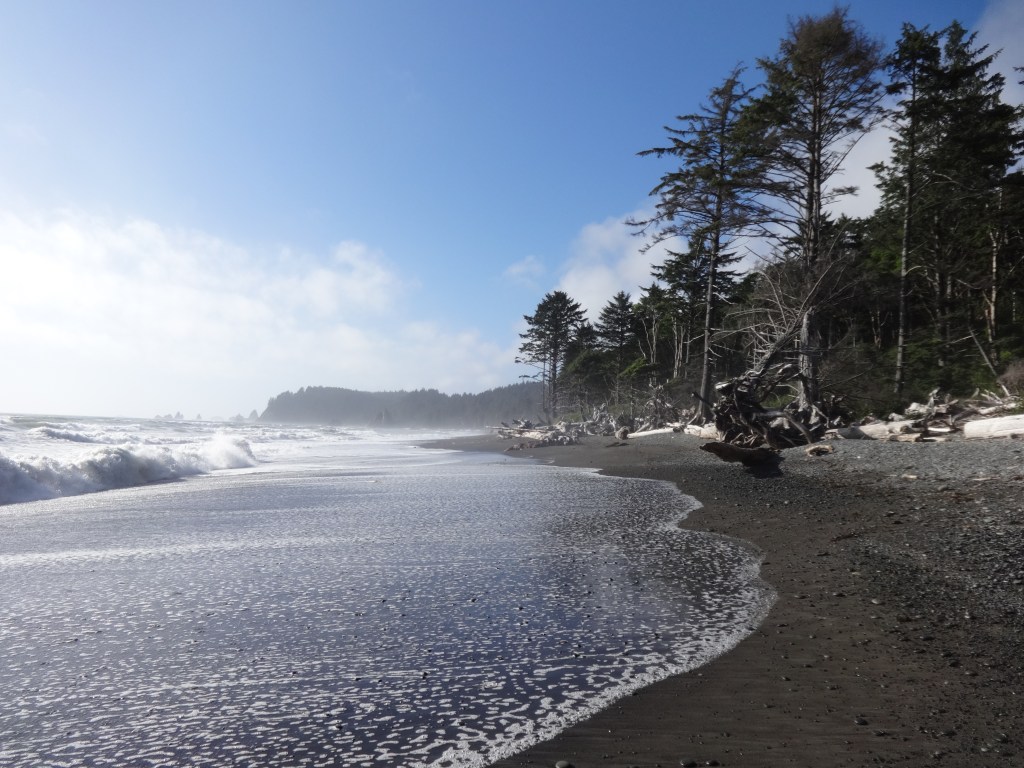
On the park map the beach is creatively labeled “Beach 2.” I parked the car and ran out onto the shore. I was glad to be out of the car and in a natural space. It felt very freeing. I had been released into the open after having been in the car driving through snuggly gathered forests.  The beach was very much like the beaches alongside the Redwoods. The gradient was low, the water shallow. When the waves weren’t crashing, the water spilled across the dark sand causing natural white foam. The big difference between here and the beaches of the Redwood was that here a flat thick pine forest stood right beside the beach’s edge instead of large green bluffs. Also littered close to the tree line was an enormous amount of driftwood, but not little odds and ends, but huge tree trunks and entire barren sun-bleached trees.  

After our brief visit to this beach I drove us a mile and a half up the road to Kalaloch Campground within the park boundary. Although the campground backs right up to the ocean, the only site I had scored online was one right after the entrance to the  campground. The ocean was not in sight. But after we quickly set up camp, I was excitedly-anxious to return to the ocean. On the itinerary we were supposed to go directly to the Hoh rainforest today, but realizing how close we were already to all these beaches, I decided it would be a beach day. We would visit the rainforest tomorrow. 

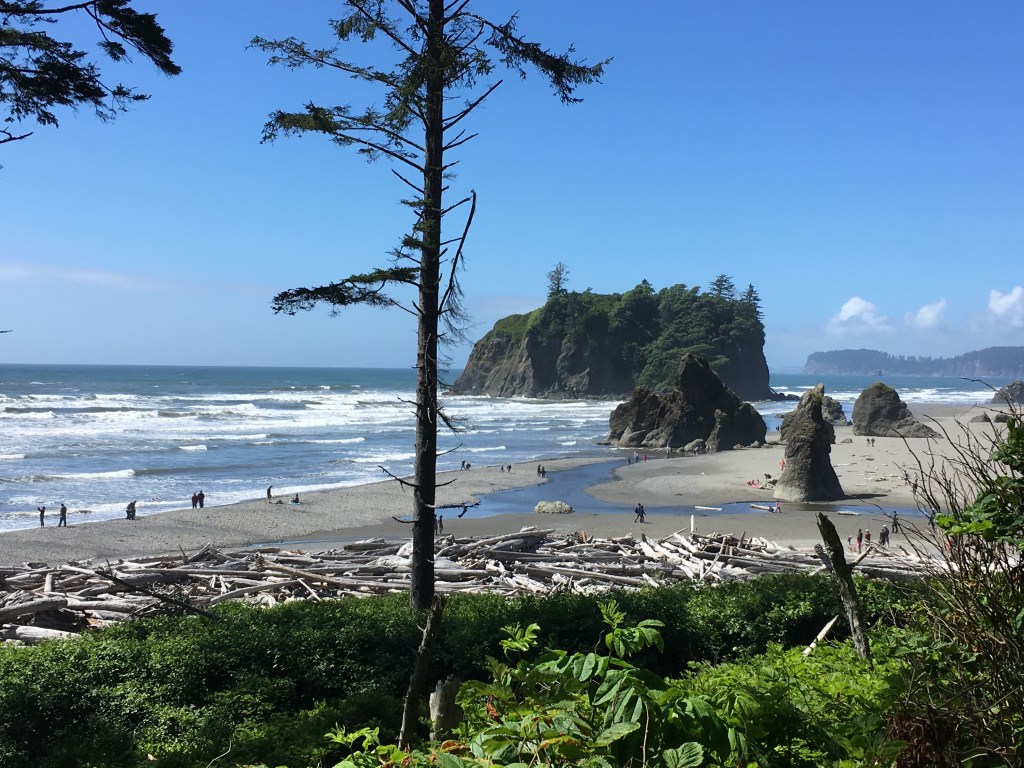
The next beach we visited was Ruby Beach. It was just seven miles up the road. Again, approaching the beach, the small path led to a beach perfectly framed by the trees. With this view I really felt like I had arrived somewhere. I’d seen this place before, and so I felt like I was somewhere famous. Although it does not have name recognition of many places in the National Parks, many people have seen this beach before on calendars, computer backgrounds, and the like. It is iconic in this sense with its tall rocks, not far out in the ocean, pointing upward like shark fins. These rocks were dark and contrasted against the white ocean foam, gray sand, and blue sky. A number of these ginormous rocks rested and stood on the sandy shore as well, apart from the water, at least for the moment. They look very epic, as if there should be great stories surrounding them: as if a pirate ship on a great voyage should go passing by; or a group of brave men on an grand odyssey finally reach the ocean after weeks of searching; or some mystic message in a bottle will wash up showing us how to find exquisite treasure. It’s exactly that kind of beach. Although the sky was blue, it was also misty and cool, adding a sense of chilling mystery.

I could not help but smile with the joy of being here, and we weren’t the only people enjoying this place. There were many others too. I wouldn’t call it crowded, but certainly not isolated either. Zach had bottled up energy and wanted to climb up the giant rocks with  maneuvers that made me nervous. I watched him for a few minutes, wondering, would he or could he really do that? Then I decided to just let him be. I didn’t need the stress of watching him risk his life. I took off my sweatshirt to make a little pillow and I laid down on the sand. I closed my eyes, took in the ocean air, and relaxed. I felt my body really needed to relax with my current deteriorating health. This would be good. When Zach found me after climbing around, we went on  to the next beach. 

It was about an hour drive with an exit from the park into the town of Forks. I started to see a few signs referencing the book and movie saga Twilight. I learned this was the home of Twilight, meaning the town in which the protagonist Bella is from. Although this is apparently directly referenced in the books, and the town’s welcome sign is shown in the movies, no other parts of the movies were filmed here. However, some of the townspeople are proud of their mention in the series and have really capitalized on it, housing the world’s largest collection of Twilight set props and costumes, and an annual Forever Twilight Festival. I also ran into a little general store and noted the extensive offering of Twilight nick-nacks and pattywhacks. I had not followed this series, but could not avoid its mention in Forks, Washington.  

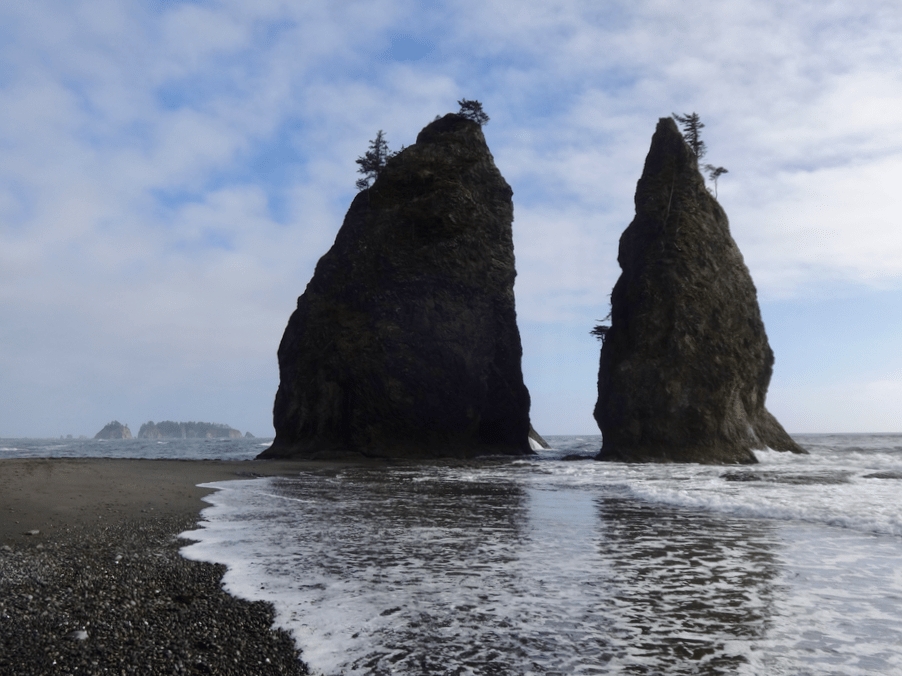
When the road led back into the park, I made our final stop in the park for the day. We were at Rialto Beach and the highlight of the day! It was similar to Ruby Beach, with its large jutting rocks, and it was like Beach 2 in that it had a lot of enormous pieces of driftwood. It was different from the others in that no one else was here. It was ours, and Rialto Beach had two distinct features to offer. One is informally known as “Split Rock” The best way to describe it is like a giant arrow head was stuck in the ground, but then a bolt of lightning struck it and separated it perfectly in the center, creating two symmetrical pieces of rock, pointing towards the sky and just the slightest bit towards each other. It was another iconic vista. Something I knew I had seen in photos, before, and to now see it in person was indeed exhilarating. 

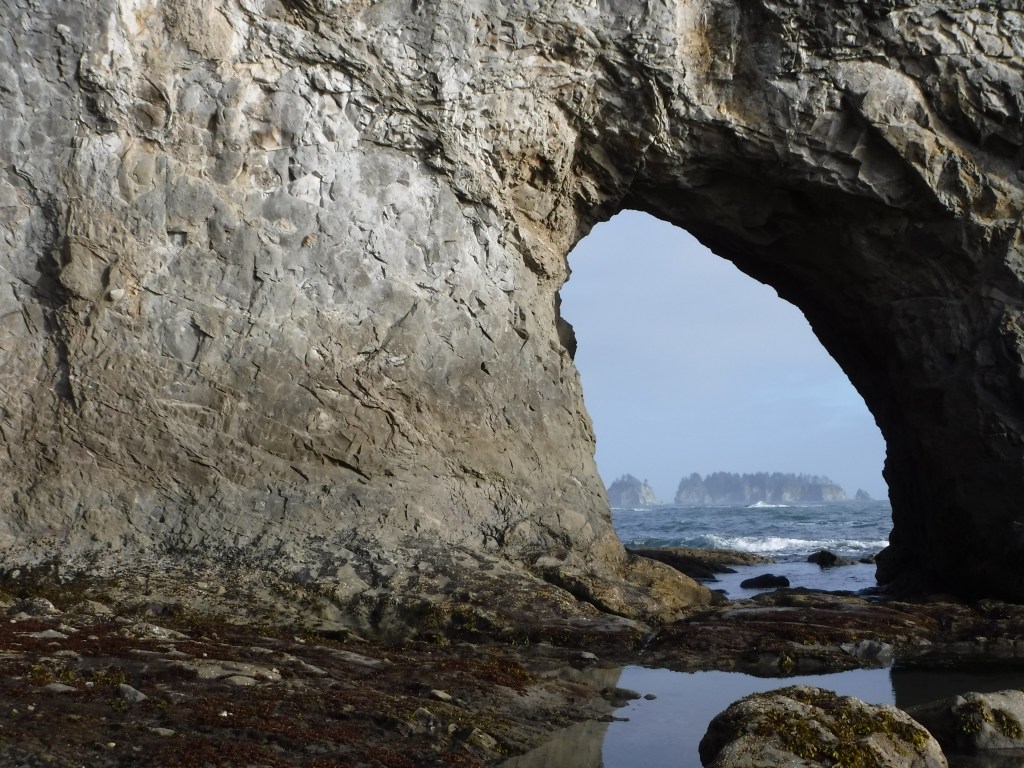
I had also done my research well for this trip, and I knew 1.7 miles up the beach was another iconic spot called “Hole-In-Wall, where the ocean carved out a hole in a rock about a story tall right at ocean level. Although it may be remembered as a hole in a giant rock out in the ocean, the rock actually is attached to the mainland. It is a peninsula, and I guess technically it can be considered a narrow rock arch. However, to the layman’s eye, and memory, it’s a hole in a rock in the ocean. What makes it particularly beautiful is that it is just at sea level and frames an ocean view perfectly.

It wasn’t enough to see if from the sand. I had to go out and walk through that hole. The place was only accessible by foot at low tide, I read. During high tide it’s straight up out in the ocean. Right now, we were somewhere between low tide and high tide, but where there’s a will there’s a way …or a concussion.  We abandoned the sand, and started carefully placing our feet around tide pools filled with all sorts of strange sea growing things, urchins and the like. Some were bright green, others were dark blood-stained red and growing tightly to the rocks, looking almost like some strangely colored sea moss. The sharp things concerned me. I didn’t want to misstep and have one impale my sole. Thus it was a challenge and fun game, I suppose. Eventually we were done with tide pools and moved onto rock jumping and scrambling in the ocean. I stood hunched, perched atop one rock I had just jumped to when a rogue ocean wave forcefully crashed against my rock spraying my face in bitter salt water- in a very Little Mermaid-esque moment. The assault caused my body to jolt in surprise. I wasn’t sure if this was a good idea at the time. I wasn’t sure if getting to Hole-In-Wall was achievable, but it was and was worth it. We took some photos and marveled at nature’s wonder. The hole in the rock in the ocean was now also, to us, an island of dark wet rocks serving as a window to the sea. The musings and observing all the fine details could have gone on, but we figured we better get on our way before the tide climbs any higher leaving us stranded on the Pacific Ocean.

Before we left the beach, we had to hike up to the top of the landmass that eventually juts out to provide Hole-In-Wall. Back on the sand, we brushed through some sea grass and shrubs, and found a very narrow informal path that led upward very steeply, making the whole body lean forward and made using the hands necessary at some moment. Alongside this path, the plant life was very jungle-like with long, large, lanky, sprawling ferns and other foreign plants to me. Atop the views were even better than from the Hole. From here we could see the shoreline spread and the large rock formation now below us. It fit all of the immense landscape into one view. 

On our walk back down the beach, I did not see any sea lions, as I was hoping for, but the sun was setting, adding slivers of silver and gold here and there, on a piece of driftwood of a certain wave. When we got back to the car we had to drive back through “Twilightville” and a quick stop for some styrofoam packaged burger and fries for Zach’s ravenous hunger. Back in the National Park, at our campsite, I noted in my journal that I was very tired of driving. I had seen some great things today, but it involved too much time in the car traveling from one place to another. I desired to be in one place and leave the card behind. That just wouldn’t be the case in this park. The car would have to take us from one place to another, but ahead of us were a lot of impressive things to yet see that would make it all worth it. There were epic vistas awaiting and first time wildlife encounters to be had! 

If you enjoyed reading this, check out my book Still, Calm, and Quiet“

Check out my previous entry here: My Personal Devastation: The horrific reality for me at Mount Saint Helens

Visit www.joshhodge.com

My Personal Devastation: The horrific reality for me at Mount Saint Helens

I’m not gonna make it, I thought. The moment was intense. I was running down the little path back to the visitor center at Mount Saint Helens National Volcanic Monument. The situation was urgent. I had the strength. I could do this. I made it in the nick of time. It was there, in the visitor center, where I had my own volcanic explosion…in the bathroom. It may seem like I’m trying to be funny, or just acting immature, but there is a sincerity and solemnity here. This moment was pivotal and not anything to take lightly. As lava spews from a volcano, blood was spewing from me. I was horrified. I can’t even say it was a nightmare, because it was unimaginable. I didn’t fear this moment, because I never thought I’d have this moment again. I had been through this before, and I thought it was all behind me. The suffering through ulcerative colitis was done, a thing of the past. I outgrew it, I thought, but it was back. In that moment emotionally I felt I had taken a stab to the gut and the wind knocked out of me. I was devastated. This in no way had been on my mind. It was unimaginable, but the blood was dark, and it was real.

Two years ago I was at the gastroenterologist. I had been in remission for six years from ulcerative colitis, but the infusion therapy which had saved me and gave me back my health eventually caused drug-induced lupus. I had to stop it. The gastroenterologist wanted to quickly put me on another new infusion therapy. I didn’t want to. When ulcerative colitis made its grand debut in my life, I didn’t know how to handle stress. I internalized all of it. I didn’t get enough sleep. I struggled with depression. I didn’t get regular exercise, and I didn’t know enough to eat healthy. I was still growing and developing physically as well. Through losing my health I learned a lot about taking care of myself. I had come to cherish moments of calm, moments to relax. I learned to let many things go. I had conquered depression. I was eating very healthy, and exercising regularly every day. I was strict on my sleeping habits, and physically my body had grown and matured. So I told the doctor I didn’t want to go on any new medication. I wanted to come off all medication, because I believed my body would hold up, and that I’d be just fine. At first I was hesitant when considering this decision, but over the course of a few weeks of prayer,  I came to a great peace about it. The doctor didn’t like my decision. “You don’t want to lose your colon, do you?” He tried to scare me, intimidate me into taking this new drug. He was obstinate in his opinion and I was just as much so in mine. I was giving up drug therapy whether he liked it or not. He closed out our appointment with “I’ll give you two months and you’ll be back in my office.” The truth is I never went back to that doctor. I fired him, but actually it was two years in which my body retained remission naturally before I was back in a doctor’s office. I proved him wrong. I thought my two years would turn into a lifetime, but now I was discovering that just wasn’t the case. 

I had become so healthy and almost obsessive about regular exercise, sleep ,and what I ate. I came to really love the body and valued my health greatly. So to learn that despite all my efforts everything was out of my control, was devastating. I had come to idolize my health so much, and now it was ripped away suddenly from me. Because I’d been through this illness before and knew how quickly it escalated, I knew my energy, my physique, my ability to eat and retain nutrients, to build muscle, to sustain myself, was all on the line. And in addition to that great sense of loss and the fear of what was to come, came memories of pain of the past. 

Ulcerative Colitis first beset me in college and the pain was persistent and at times very intense. It kept me up at night. I’d toss and turn in bed, unable to make myself comfortable, my stomach felt as if it was burning. One thing that seemed to help me a little bit was moving. To stay in bed, felt like I was letting the pain swelter and build up. I needed movement. I needed an outlet, if for anything, to distract me. I always had to distract myself from pain. So I’d card out of my dormitory at night, and I’d wander the streets for hours. When everyone else was asleep, I kept moving. Some nights, especially those leading up to being hospitalized, I was in too much pain to walk, instead I rolled around on the floor, back and form, like a crazy caged animal. The night before I was hospitalized, I was in so much pain, I wanted to pray, but my mind was so tortured by the physical pain  it couldn’t even formulate the words for prayer, so I literally just moaned and wept out to God.  In the hospital I was on a morphine pump, every two minutes morphine was pumped into my blood. So much so that I couldn’t even raise my eyelids. Even after my time in the hospital, nothing was truly resolved for a long while. The disease festered. At my 6ft 3in stature I weighed only 130 lbs. It took great effort to walk up the three flights of stairs to my dorm room, and one morning, losing a large amount of blood, I passed out in the shower. 

I could not go back to this. I just couldn’t. It had taken everything out of me, and to go through it again seemed unbearable. 

Then along with the horror came blame. I never expressed this blame to anyone at the time, but inside I was blaming the family vacation the month prior in New York. At the time the family dynamic was just a bit stressful, and I wasn’t able to follow my strict eating, exercise, and sleeping schedule. I believed it was the stress and irregularity of those events which put a toll on my body and flipped this switch from remission to active disease. Then there was Zach and myself to blame. It had been a strange dynamic between us. I was stressed about trying to make this adventure just as amazing for him as my previou adventures were for myself, but he wasn’t having that experience. He was complaining a lot and that really bothered me to the core. Also the fast few days, I felt like I was rushing around too much. I wasn’t taking the time to really relax and let nature’s restorative properties work on me. I needed to prioritize relaxing. I was convinced this return of ulcerative colitis was due to stress and not being on my regular schedule, but naturally I thought this at the time, because I had idolized my health. Looking back, maybe there are bits and pieces of these situations that are responsible, but I really don’t blame anyone or anything except the fallen state of humanity. I have learned since that yes, stress makes the active disease worse, but it will rear its ugly head provoked by stress or not. 

Earlier in the day, when I had stopped for gas, I remember getting out of the car. I felt light-headed for a moment, and something within me was not right. There was no way to explain it. I just knew intrinsically something was happening to me. I had no idea what, but looking back it was as if immediately, in that moment, my body flipped a switch and came out of remission. 

How was I going to tell Zach? I knew I had to. This was going to change the dynamic of this trip.  He had never even known this was something I dealt with in the past. We never talked about it, and it can be uncomfortable to talk about. A disease that affects the intestines and bowel with lots of blood, just isn’t pleasant. There was no casual way to bring it into conversation;  it was so deeply personal; and it wasn’t easy to bring up such deep pain. I’m going to have to modify my diet. I’m going to have to relax more. I’m going to have to try and not stress out about any details, and I am potentially going to be making much more frequent trips to the bathroom. I needed to tell him.

Leaving the visitor center, Zach bought a key chain which his dad requested as a souvenir. He remembered when the eruption of Mount Saint Helens occurred and had some connection or special fascination with it. Then we got in the car. We had a twenty mile car ride down the mountainous slopes and through the pine valleys. I was awkwardly quiet at first, and then I had to let the dam break. I told Zach what had happened, my loss of blood. I told him about my past pains and experience with dealing with the disease and all the horrible things it entailed. I knew, in my very gut, that this was not an isolated event, but the beginning of another long period of struggle, and so I wanted him to know why I felt so devastated.

I made a big mistake at this moment. I left God out. I knew Zach didn’t have a relationship with God, and so I thought I just shouldn’t bring Him up. I was shamefully weak in this regard. I had not developed the spiritual boldness which I now possess. I had some growing to do, and I was still clinging onto some sort of youthful notion that convinced me I needed to mold in with the audience at hand. 

God’s work in my life through my first episode of this illness in college was immense. It is my Crater Lake:  beautiful now, but painful at the time. God had taught me reliance on Him, dependence on His strength. He also taught me about faithfulness and gratefulness. He had me wrestle with questions of suffering, pain, and death. He also gave me healing and hope. To leave God out of my story of ulcerative colitis is basically lying by omission, and I was guilty of it. Zach, however, was a good listener, and sympathized with my pain, although I don’t think he understood how grave of a situation this was for me. I, though,  missed a great opportunity to give God glory and share of my relationship with Him. Now looking back, perhaps there was more than a lack of spiritual boldness. Maybe there was anger already boiling under the surface, a question arising in the subconscious that would come forth in a matter of weeks. I was mad, God, how can you let this happen to me again?

If you enjoyed reading this, check out my book Still, Calm, and Quiet“

Check out my previous entry here: What Kind of Mountain Are You?

Visit www.joshhodge.com

What Kind of Mountain Are You?

Finally we arrived at Mount Saint Helens National Volcanic Monument. I was in awe of the immensity of the landscape and baffled that something so grandiose and impressive didn’t get more attention. I hadn’t heard much about this place, and I only came across it while looking at a map of Washington state. Perhaps if I was alive when the volcano erupted in 1980 I may have known more about this place. 

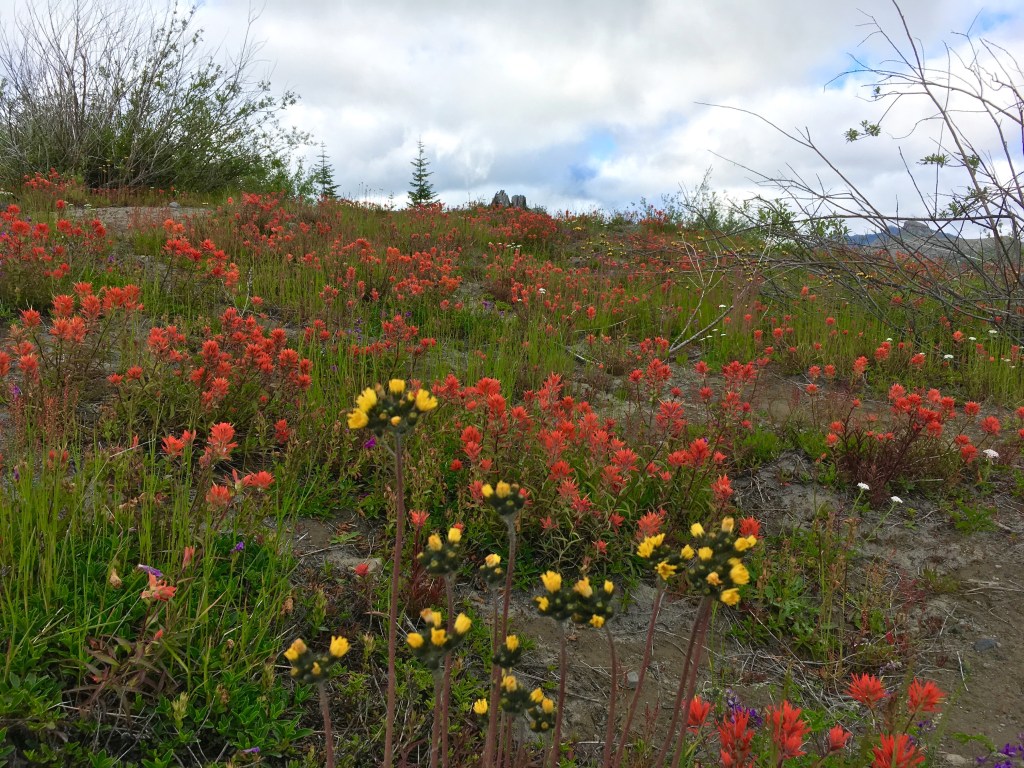
After learning about the volcanic eruption in the visitor center, Zach and I were chasing down even greater views on a small path that led from the Johnston Ridge Observatory on the foothills of the behemoth of a mountain base before us. We were free after being held captive by the journey in the car for much of the day. We were about four miles from the mouth of the beast, when I sat down alongside the path next to some Indian paintbrush and other small mountainous blooms snugly grasping onto the sides of the path between jumbled rocks. There I beheld what would have been, less than forty years ago, Washington’s fifth tallest peak, but now it was just the base of a mountain. It was still tall, nevertheless, slanting upwards to 8,363 feet, but it was missing its peak which would have topped it off at an additional 1,400 feet. Now instead of a peak it prominently displayed a giant volcanic crater. Looking at Mount Saint Helens, I knew I wasn’t looking at any ordinary mountain. It proclaimed volcano loud and clear for despite its enormous crater, it displayed its sprawling avenues and canyon ruts where lava once flowed, and much of the mountainside had been ripped barren and replaced by volcanic rocks. In some small crevices, plant life had resumed, but the sprawling directions in which its destruction spread was still very evident. 

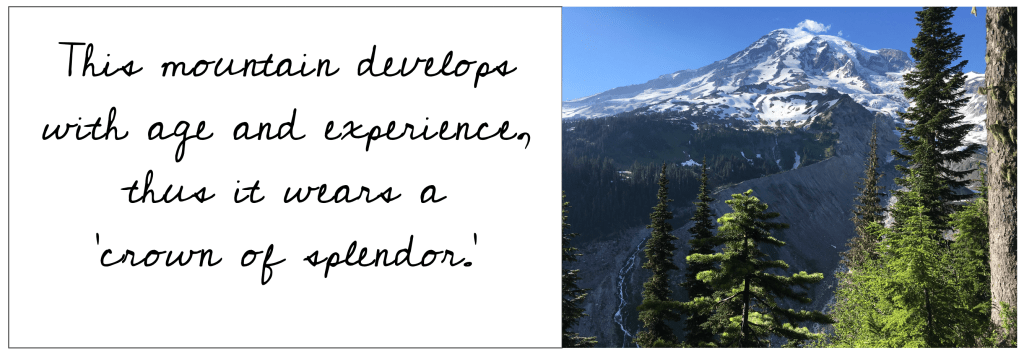
Adding to the volcanic ambience, this evening a spread of clouds hung just below the crown of the crater, giving the illusion of smoke and adding great perspective. It also made the mountain look very regal with the pointed rocks edges spiking up like the palisades of a king’s crown, and the clouds added an element of fantasy, really elevating the scene. Although Washington is a very mountainous state, here no other mountain stood in the background of this one, at least nowhere near her height. Mount Saint Helens stood alone, bold and royally, popping out against the rich blue sky. 

I was particularly fascinated by the avenues, ruts, or canyons surrounding and sprawling from the creature like veins. They were prominently displayed with the evening sun lower in the sky, casting sharp contrast against the land and allowing the canyons to cast their own dark shadows within. These were “canyonlands” not illuminated by light, as I’ve discussed before, but ones trapped in darkness. I wondered what animals roamed down there. I wondered how enormous these places would seem on foot. Have people even explored all of them? It was fascinating to think that only a handful of decades ago, these divots didn’t exist. This was once Washington’s fifth tallest mountain, but then in 1980, instigated by an earthquake, Mount Saint Helens erupted. It was the deadliest volcanic eruption in the United States, spewing ash in a 250 square mile range and sending billows up to sixteen miles into the sky. Before then, this landscape would have been so different. It had been drastically remolded. As John Muir would see it, it was God at work, still designing his earth, molding the land through natural phenomenons. 

I was still fixated on the massiveness of this area and how its present landscape was relatively new. Even the divots aside, I was wondering if the whole mountainside in general had been fully explored in its current state. What was hiding out in all of nature’s rubble? What fantastical rock formations and marvels surround this thing in its new design. It was such an enormous space, that I imagined other National Parks I’ve visited fitting entirely in the space this mountain base encompasses. I thought how even some cities could fit within the crater alone. I wish I had time to roam freely and explore this land without a care. It would be fun to disappear into this thing, getting lost in its immensity and wonder. But I couldn’t. I had responsibilities and an itinerary.

As I sat there, I did what I like to do in front of beautiful vistas: I closed my eyes, took a deep breath, and opened my eyes to be re-amazed by what was in front of me. Then the wind started to roll in, and I was getting cold. I crossed my arms, hugging myself in my flannel. Before having to leave, I had to get into the important thoughts. Observing the volcanic mountain, I posed the question, What does this mean? What is the message of Mount Saint Helens? 

I was looking towards a crater, as I had done just the day prior at Crater Lake National Park, but Crater Lake seemed entirely different from this place. Crater Lake was distinct in appearance and messaging. But there was one commonality. They both started with a volcano, meaning what they are today was birthed by a violent natural event. What made the places so distinct from each other were their outcomes after the explosion. Crater Lake was a place of serenity, of beauty, tranquility and peace. It gave the message that despite pain, loss, suffering, there is peace and beauty. Mount Saint Helens today could be described as beautiful by some too, but it’s for sure a different beauty from Crater Lake. It’s impressive and awesome, but beauty is actually not the word I’d use for it at all. It looked very much still like the aftermath of destruction. The rubble was in clear view, the paths of destruction evident. It was like a scab was ripped from a wound not fully healed. It was a raw landscape, not replacing the destruction with the serene, but blatantly announcing its story of violence. The crater was not filled with rich, pure, calming blue waters but was empty, vacant, and void. Where forest once spread across its mountainside was barren rock and pumice. 

I then had to think about what I’ve already concluded about mountains. Two summers prior, when I was at Great Basin National Park in Nevada, I was standing below Wheeler Peak thinking about how solid and strong the mountain was, and I started to think about the word unwavering.  I wrote: “I observed how the mountain is very bold despite erosion and the rock glacier. It’s still not going anywhere. The mountain is firm, steady, resolute, and then I began unpacking the word that would last and linger with me– unwavering. It’s been my observation in life that consistency in a person is hard to find. People come and go. They change, they disappoint, and the slightest variation in weather can even disrupt a person.  I do not want to be this type of person. I want to stand strong. I want to be a person others can rely on– a constant, a non-variable, dependable, and above all unwavering.” 

Mount Saint Helens was not unwavering like Wheeler Peak. This mountain had betrayed its surrounding landscape and all the life that had put trust in it. It left damage, took lives, and left voids, and its said it may eventually erupt again. This mountain did not produce the beauty of Crater Lake nor the security of Wheeler Peak. I began to adopt the notion that there are different types of mountains, and they have different meanings, but that all mountains are representative of different kinds of people. There are the bold unwavering mountains like Wheeler Peak and the majority of mountains I’ve seen, but few people I’ve met. Then there are those volcanic mountains, like people who have gone through pain, suffering, and trauma. Some volcanic mountains return from those dark moments in life with a new found peace, beauty, they are born again into something greater like Crater Lake. But other volcanic mountains, like Mount Saint Helens, are like people who have been badly hurt, but they haven’t gone through the powerful process of redemption. Instead, they have built up resentment and anger to then spew hateful words and actions. They are abusive. Their anger is not controlled, and thus they are explosive, wielding destruction around them. They abuse their children, snap at their coworkers, fight with their spouses. Their anger and discontentment change the life and environment around them. They take the books of others and scribble into them or rip out pages. They also have unfruitful mountainsides, not rich in life, but barred and covered by mistakes, leaving no fertile ground for anything to take root. I know some of these people, and we all have potential to become such volcanic mountains. It is in our nature to be ruled by our human emotions, to become heated in anger and inflict unjust punishment on others. Mount Saint Helens therefore has a message of warning and shows us the weight of our influence, even when destructive. 

I never want to be a Mount Saint Helens, but do I relate to her? Yes I do. I have my moments of anger and frustration, and in the moment I want everyone to feel the agony that I feel. I spew the lava. It’s not right, but I’ll own it. This is not to say all anger is bad. Some anger is justified. God in his love, beholds justified anger. What really matters for us as humans is the outcome of our anger. Is it productive and justified, or impulsive and destructive like the volcano? I also relate to Crater Lake. I see peace in beauty in my life from where there was pain and destruction before. Despite whatever mountain best reflects me, I aspire to be like Wheeler Peak, consistent, unwavering, unmoveable, dependable. However, there were yet other mountains to become acquainted with and this wouldn’t be the last mountain on this adventure that would hold a message for me. I was just beginning to explore this analogy of mountains and people. I’d come to find that every mountain indeed is a reflection of our own human potential. Some inspire, some challenge, some warn, some seem foreign, some truly are characteristic of our own selves. 

I was energized by this growing perspective on mountains. I was ready to explore it further and open to see what else God wanted to teach me through his creation. As I’d learn about more types of mountains, the wonder would lead me to pose the question to others: What type of mountain are you? But before I could consider mountains any further, a moment of intensity beheld the situation. Something happened that had me desperately running opposite from the volcanic mountain. This was an emergency… 

If you enjoyed reading this, check out my book Still, Calm, and Quiet“

Check out my previous entry here: How God’s Story is Written Everywhere

Visit www.joshhodge.com

How God’s Story is Written Everywhere

The most meaningful takeaway from my visit to Crater Lake National Park was not the memory of jumping into the lake itself, although that was a great moment of overcoming fear, nor was it the beautiful vistas now imprinted in my mind and in my photographs. Rather it was what I learned about the creation of the lake in the park film in the visitor center and how it relates to spiritual life.

Typically I’m not captivated with geological presentations of layers of rock, seismic activity, tectonic plates shifting, volcanic eruptions eons ago, etc. On some occasions those things can be interesting, but usually, right off the bat, I’m questioning the validity of the information presented when it all starts off talking about millions and billions of years ago. To the contrary I believe the earth to be rather young  and that God designed it with the appearance of age. Also I believe the earth was so violently shaken during the Great Flood in Genesis, that so many processes that would have taken, under normal conditions, millions of years, happened quickly in all the trauma.

Surely during the Flood volcanic activity was abundant. The earth, while covered in stormy waters, shifted rocks dramatically, and sedimentary layers formed quickly, burying things rapidly. Nearly every National Park in the Southwest references a time when the earth was covered in water or a massive flood. This should influence our understanding of rock layers, geology, and the earth’s age.

Anyhow, the geological park film about the physical creation of Crater Lake spurred fascination in other ways. The events that created the lake are believed to have taken place only 7,700 years ago, which would place it at right about the time of the Great Flood. I also learned that Crater Lake was actually Mount Mazama once upon a time. It is believed it stood as tall as 12,000 feet. Then it had a violent eruption spewing over nineteen miles of lava and sending ashes over one thousand miles, some landing in Alberta, Canada. When the volcano erupted it left a giant cavity in the earth, a crater, which over time filled with melted snow and rain water to a depth of 1,943 feet, making it the nation’s deepest lake. The National Park Service in their park brochure describe the volcano which created the lake as “catastrophic.”

After learning about such a “catastrophic” event, now one can step outside the visitor center and see a serene, beautiful, mountain gem of a lake. It’s pristine, vibrant blue, and so enjoyed by many. I was captivated  with the notion that something so violent and destructive resulted in something so peaceful and beautiful. There’s a deeper message here, I knew. I had to channel my inner John Muir first to examine how this concept of peace and beauty after destruction is exhibited across creation. Is it a design element consistent across existence or an isolated event? Then I could question what God is teaching or revealing to us about Himself in all this.

The preliminary probing question I had to ask was, what other destructive things result in beauty? I was immediately taken back to my days of being very sick with a trifecta of intestinal and digestive system destruction. I was battling ulcerative pan-colitis, pancreatitis, and a bacterial infection. At the time my body was withering away and wasn’t even breaking down food. I was malnourished and in extreme pain, losing blood in large amounts. My plans for the future were ripped away from me. The havoc it created in my life was real, and as the National Park Service might say, “catastrophic.” But during this whole time of sickness God was doing immense work on me, putting me through the refiners fire, creating who I am, and teaching me reliance on Him and trust in His goodness. I emerged stronger in every way, physically, emotionally, and spiritually. I was also given a new gratefulness for my life, my body, and the world around me. After being confined to a hospital room, bed, or exam table, too weak to move, I was now able to climb mountains, summit scorching  sand dunes in the Mojave, jump into Crater Lake, and take in a deep breath of fresh mountain air without pain. This all brought me great joy. 

I was able to see profound meaning and beauty in life after the painful time of destructive sickness. Some struggle with coming to terms of the coexistence of God and suffering. After having been through much pain and grappling with the question myself of why does God allow suffering?  I don’t. I do not believe God brought about the pain or suffering in my life at all, but I believed he used it. He redeemed it to bring about goodness and peace in my life. As Romans 8:28 says, “God uses all things for good for those who love Him and are called according to His purpose.” I truly believe God can redeem anything to bring about goodness and spiritual growth, ultimately bringing Him glory. The overall message of Crater Lake was becoming clearer. It is one of the redemptive nature of God. 

I then began to think about war, how terrible a thing it is, and how timeless it is in our fallen state of humanity. But then I considered how after war there always comes peace. We see this repeated through the ages. When right prevails there is good that follows. The destruction of war is not a good thing. It is never desired by the righteous, but eventually it results in, or is redeemed for, peace. 

We too, as followers of Christ, wage war in our own spiritual lives. We equip with the spiritual Armor of God as talked about in the book of Ephesians. We take down strongholds and defeat principalities’ weight in our lives. As it says in the book of Ephesians, “For our struggle is not against flesh and blood, but against the rulers, against the authorities, against the powers of this dark world and against the spiritual forces of evil in the heavenly realms.” These battles are fought violently through prayer, scripture, obedience, reliance on God, and with the name of Jesus. One may question my word choice of “violently” when referring to such things as Scripture and prayer, but yes, I mean it. I believe these are violent and effective weapons in the spiritual realm against the forces of evil. Spiritual war can be ugly. It’s sacrifice. It’s a shaking up and reordering of one’s life, but it ultimately leads to peace and a right relationship with God. 
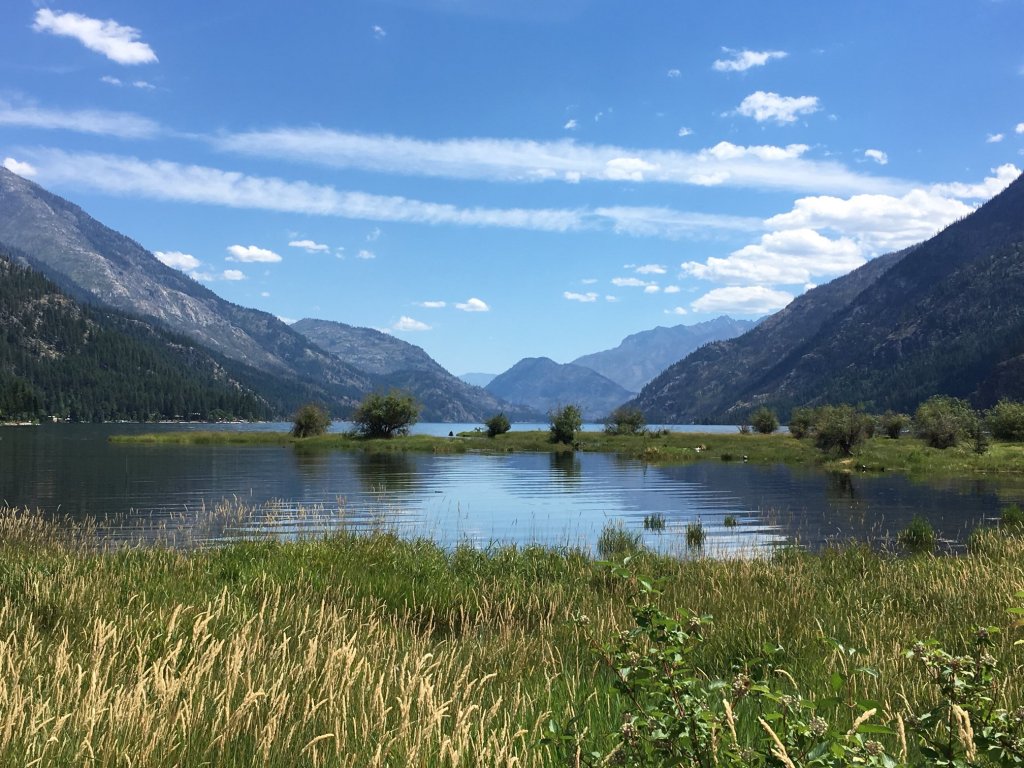
In my thoughts I then came back to the natural world. I looked towards the mountains and thought how, per the words of the experts, all mountains are created by earthquakes and volcanoes, both destructive acts of nature. Now these mountains stand tall, unwavering, and at peace. Forest fires, too, are another thing that seemingly, on the surface, are all bad, but those destructive events are redeemed as well. The aftermath is a nutrient-dense soil and room in the forest for the next generation of plant life to grow. I have seen many-a-forest both on fire and recovering from a fire. A forest fire is ugly and can be scary but recovering from a fire, the forest floor is always decorated with flowers. There are sprouting berries and mushrooms, and new saplings starting to really take root. It’s a beautiful thing. There is peace after a ravaging fire. 

I also began to think about birth and how it is such a painful and laborious process for the mother, but out of such a mess of pain comes the beauty of new life and the peacefulness of a resting baby. Then I thought of death itself. No one wants to face the process of death. Some will die tragically. Some will fight to cling onto this world. People will grow old and suffer ailments before death, but through death God reaches down and reclaims the life of his follower. Out of the end-of-life turmoil, suffering, and human-instinctive fear, He brings about ultimate peace, as he fully restores one’s spirit in his very presence. 

Ultimately this great design element from a volcano to a serene crater lake, from a forest fire to a flowering grove, from labor pains to a baby’s sigh, from war to peace, and from death to life, all show the redemptive nature of God. The message was becoming even clearer as I realized it was then pointing us to Jesus- the ultimate redeemer. Jesus felt pain on this earth. He asked for the “cup to pass” from Him when considering his approaching crucifixion, but He then went on to endure the most gruesome of deaths and the most momentous event in all of human existence. His great sacrifice, and his own redemptive rising from the grave, conquering death, brought about the possibility for salvation and the redemption of the human soul. He paid the ultimate price for our sin, making us just and acceptable, forgiven and presentable to a pure and perfect God.  This event is so great, so important, that God has painted it across his creation. The volcanos, the forest fires, the wars, the labor pains, they all point us back to the redemptive story of Jesus and salvation. 

It’s so great because and worthy to be written in the fabric of all creation because it is only through the blood of Jesus that  we can be redeemed from the destructive forces of sin in the world and in our lives. God wants to save us eternally, but eternity starts in the present, and God is here to wage war with us, from the dark spiritual powers which have a hold on us, from our self-destructive habits, from our mental and spiritual turmoil. God saves. He will deliver and redeem. As he promises, the battle is  already won through Him.Through turning to God, accepting his forgiveness, and waging war God is helping us to be “born again.” To do so is not easy, there can be labor pains as one must leave behind his old self, but ultimately we have peace knowing God is fighting our battles with us and will redeem. I think about the violent volcano spewing lava like blood, but then I look at the beauty and peacefulness of Crater Lake and I find hope. Here God reminds me of who He is and what He does. None of the wonders of nature are without meaning. God has placed his story everywhere and wastes nothing. 

If you have not called out to God and sought his forgiveness through Jesus, I hope you do, and I urge you to. If you have not waged spiritual war,  arm up! The stakes are high. Your soul and eternity is on the line. May you feel the transformative redemptive power of His love as you come to personally know God,  and may one day your pains and trouble be replaced by beautiful crater lakes and alpine streams. 

“And he who was seated on the throne said, ‘Behold, I am making all things new.’ Also he said, ‘Write this down, for these words are trustworthy and true. ‘” Revelation 21:5

If you enjoyed reading this, check out my book Still, Calm, and Quiet“

Check out my previous entry here: A Day’s Journey Around Crater Lake

Visit www.joshhodge.com

A Day’s Journey Around Crater Lake

Before we arrived at Crater Lake National Park, the day had started off waking up at the Oregon Caves Chateau, tucked away in the woods, in our secret little attic space high up in the Chateau. There was no central air system in the Chateau, so I undid the latch and swung open up one of the rustic windows in our attic. to let the cool night air in. The room was pretty warm during the day but by the next morning it had certainly cooled off. 

We made our way down a few flights of stairs to the diner-style cafe on the main level. It too had its own vintage charm. It had probably not been touched much since the 1930s when the lodge was built, but maybe it was tweaked a bit in the 1960s or 70s to give it its distinct color palette of yellows, browns, yellowish-browns, and oranges. It had a dining counter with swivelling stools that snaked around. It was smaller but very similar to the one in Jackson Lake Lodge in Grand Teton National Park, the one in which the “cougars” bought me dinner. Here I feasted upon some buckwheat pancakes and bacon, with a cup of coffee. This was the more economical dining option at the Chateau. Last night, feeling fancy, and knowing this was probably the only time I’d be out this way, I splurged, and Zach joined me. We ate at the lower level dining room in which the bubbling brook from outside flowed into the dining room in an inlet of rocks. 

I’ll admit part of me felt guilty for spending so much on a meal, and dining on tablecloths and placemats, while camping and trying to be economical. but I also felt like for such an experience, it was worth it. I had also planned on eating here, so the cost wasn’t unexpected. At the time this was the most expensive meal I had ever purchased at around $30. I had braised pork with sauteed carrots, asparagus, mashed potatoes, and a side salad with dinner rolls. It was very savory and done right. 

Before we left the Chateau in the morning, I hopped on the piano bench in the lobby, and I left a tune for the old place, a song I had written on the piano as a teenager. The piano had been calling out to me everytime I passed by, and so I finally responded.

Leaving the Chateau we uneventfully traveled through the forests of Oregon, and as we neared the small city of Grants Pass, I decided to browse the radio stations and see If I could get an idea of the local flair. In southeastern Kentucky, I can tune into some bluegrass and Southern gospel stations with local news of who died and who has married. When I drove across the Navajo Nation, I listened to traditional Navajo music in native tongue. When approaching Chicagoland, there is a wealth of Spanish language stations with a lot of ranchera music, indicative of its large Hispanic population. 

The number of country music stations, I believe, is also very telling about the overall culture of a place. There are a lot of values embedded in most types of music. In the country genre there largely is a love for country, family, nature, the land, sentimentality, hard work and blue collar grit. Rap music is another example, very telling about values. It overwhelmingly values pimping and prostituting, debauchery, carnal desires, stealing, raping, disrespecting authority, and killing. The prevalence of such stations in a particular region is a small glimpse into the overall and dominating culture. So what did I find in Oregon? Well, I landed on a yodeling station. What does yodeling tell me about the people? What values are embedded in the yodeling genre? I couldn’t tell you, but my ears were fixated and pleased. What talent! How does one even do that? Is yodeling a part of Oreganian culture? Are there little mountain yodelers atop the Cascades? I still hadn’t figured out Oregon and wasn’t sure if this was an essential part of it. 

After departing Grants Pass, we were traveling along Oregon’s Rogue RIver, which flows western to the sea from its headwaters in the Cascades just next to Crater Lake. We were zipping along highway 5, the Pacific Highway. We could see mountains ahead and heavy greenery and foliage along the highway, with a glance every once in a while of the river with its craggy natural embankments. When we split from highway 5, we started to ascend, and  pine trees took over. They were not giant Redwoods from days prior, but thick groves of moderate size pines standing perfectly straight and pointed on a dry, barren, and at times dusty ground. 

When we arrived at the park, our first order of business was setting up camp. Crater Lake has two park villages, Mazama Village and the Rim Village. We were staying at Mazama, and we were not going to do any backtracking. We had a lot to see for we only had one day to experience Crater Lake National Park. Mazama Village comes right after the park’s entrance station, thus it was our first stop. The campground was average, nothing remarkable, with large flat pine-laded tent pads under pine trees. After we set up camp we went to the visitor center, and from there we had our first glimpse at the remarkable Crater Lake, but I didn’t want to give it too much attention right away. There is an order of events for visiting a National Park, at least in my book(s), quite literally. First I had to orient myself with the park film to be able to better appreciate and understand the vista before me. The visitor center was a small cabin, half built of large chunks of rock, the other half of wood. Next to the main room was a little side room with an ad hoc set up with a television playing the film. I learned just how Crater Lake was created by a volcano. To put it simply, much simpler than the film’s details, a large and powerful eruption caused a crater, and then over time rain water and melted snow filled the crater, creating the lake. One of the many unique characteristics of Crater Lake is that it has no water flowing into it, making it one of the most pure natural bodies of water in the world. I was really fascinated how something so destructive and violent, such as a volcano, created a place now so beautiful and serene. There was a message here to unpack. There is a universal truth to be explored. I’d get back to that thought later. 

From the visitor center we began the thirty-three mile Rim Drive around Crater Lake. We stopped at just about every wayside overlook. The lake is enormous, with a six-mile diameter and about twenty miles of shore line. It is quite serene, and truly is just a giant bowl. One can see the rocky and steep rim of the bowl all around and always look at the lake from a great distance above on the rim’s tall cliff edges. The most striking feature of the lake is its color. It has the richest blue water I’ve ever seen. It’s so bright, vibrant, deep and royal. Such a particular and unique color almost makes it look artificial, as if the water was dyed, like the color of those faux waterfalls of a mini-golf course of the 1990s. But of course I knew better than to think it was fake, and it wasn’t tacky but beautiful in its surreal display. 

Surreal is a word I’ve landed on to describe the place, for to be surreal something incorporates characteristics of reality combined with fantasy.  Crater Lake, though very real,  seems to incorporate elements of sheer fantasy. Even apart from simple visual observation, there are names given to the places in the park which give way to fantasy, such as Wizard Island, Phantom Ship, Castle Point, and Wineglass. Even the visitor center and village buildings look rather fairy-tale-like, reminding me very much of Snow White’s cottage. 

Wizard Island

We took a five-mile side trip from the rim driving down Pinnacle Valley to an area simply called “The Pinnacles,” where large sharp, pointed piles of gray and brown volcanic pumice stick up from the ground, like the fingers of a giant beast reaching up to emerge from the depths of the earth. I had never seen anything quite like this before, although they did remind me a little bit of the hoodoos of Bryce Canyon. These did not, however, have the flat capstones as hoodoos. Rather these were pointed, like smooth delicate giant stalagmites. They also didn’t have the warm orange and red colors of Bryce Canyon, but rather they were mostly a ghostly pale gray and actually not beautiful at all. They were rather ugly, but in nature’s most intriguing of ways. 

Back on the Rim Drive, a very notable stop was at the Phantom Ship Overlook. From here we looked out at the lake at just the right angle to see a small island that looked like an abandoned pirate ship. It had craggy rocks that pointed like the masts of a ship, and a few pines and shrubs adorning it, looking like seaweed or barnacles, as if it had been some sunken ship summoned up from the depths of Davy Jones’ locker by some dark magic. 

Phantom Ship

Along the drive we also stopped at the Cleetwood Cove Trail, a one-mile, very steep trail of dramatic switchbacks which led down to the cliff in which I jumped into the lake. I was excited to get down to the lake and see this fantastical water up close. So far I had only seen it from high above the lake on the rim. So in excitement I suppose I was walking quickly down the trail. Zach complained I was walking too fast and then brought to my attention that he thought I always walked too fast and that I should be waiting for him. Initially I felt sorry and was more conscious of trying to walk with him instead of getting ahead, though this was nothing I was doing consciously, and by no means an indicator of me trying to put myself first, elevating myself to a position of superiority. It was just my sheer excitement propelling me forward and putting me ahead of him. This may seem like an unimportant detail, but I only note this because it was the first in a series of complaints, or at least the first I recollect in a pattern that started to develop. This pattern of complaining would eventually really get to me, but with that detail aside…

Crater Lake is by all means beautiful, but there is a very similar view from whatever side of the rim one is at. The terrain surrounding the lake is very uniform with its display of pine trees, rock and arid ground. Minus the novelty of the ghostly Pinnacles, this park doesn’t provide the diversity which some of the units of the National Park Service do  with varying views, flora, and fauna. The attraction here is not much else than Crater Lake itself. However, alone the lake is a great treasure and worthy of the National Park title. I suppose if I had given us more time to spend in this park, we may have discovered more, and thus this view would change, but from my one day visit to the park, this is my impression. 

The conclusion of our self-directed tour ended back, full-circle, at the Rim Village. I was looking forward to eating at the Rim Village Cafe. Some National Parks offer great food services, such as the Grand Canyon and Yosemite which have great cafeterias in giant scenic halls. Yellowstone has some really good options as well. Even Oregon Caves National Monument surprised with its Chateau. But at this point, I hadn’t fully understood how food service works in the National Parks. Different parks have different contracted concessionaires. Some are small businesses, most are parts of giant conglomerates, and some are certainly better than others. Some are dedicated to the guest experience and quality. They have integrity.  Others solely value profit and how to trick and trap the tourists to empty their wallets. This was one of the latter. In my first two National Park adventure books I was very careful not to criticize anything in relation to our beloved National Parks, but I have changed my approach. I believe through honesty and sincere critique about how these parks are managed, we can bring about improvement or preserve that which is good. The National Parks are our great treasures as American citizens. We should not let them become exploited and degraded, and therefore I speak honestly only out of my deep love for, and interest in, these places. 

After Zach and I disappointedly purchased some highly-priced cheap food, we went snooping around to find a place to sit down. We made our way to the second level, which was probably used only for special events. It was largely an open space, but at the end of the room there was a couch and coffee table in front of a big window pristinely displaying before us Crater Lake. We found quite a scenic place to dine on our less than desirable food, thus our dinner experience was redeemed by the view alone. 

After we ate and enjoyed the view, we went to Crater Lake Lodge, another lodge on the National Register of Historic Places. It opened in 1915 and was similar in style to the outside of  the Oregon Cave Chateau, except maybe three times bigger. Inside there was a lot of wood, giving a very cabin-like feel, especially with its exposed timber frames, and large stone fireplace. But its lobby was small and not very notable otherwise. There we sat and rested for about an hour. I used the time to write a postcard to my parents, enter some of the day’s events into my journal, and revel in the fact that I did overcome a fear and jumped into Crater Lake. We then went back to our campsite in Mazama campground, and just like that our visit to Crater Lake National Park was coming to an end. The next day we would get up very early and make our way northwards to Washington State to Mount Saint Helens, another volcanic wonderland. 

If you enjoyed reading this, check out my book Still, Calm, and Quiet“

Check out my previous entry here: Jumping Into Crater Lake

Visit www.joshhodge.com

Jumping into Crater Lake

I have to do this, I thought. I felt I just had to jump into Crater Lake. I had come this far,  but I was full of so much fear. I was staring down off a cliff into Crater Lake, into a seemingly endless abyss. Crater Lake has some of the clearest and purest water in the world. It’s a massive lake at about five miles in diameter. With a casual glance the lake is a vibrant bright royal blue, but at the right angle, looking straight down into it, I could see the blue gradually grow deeper in transparency reaching an eternal darkness. The truth is it reaches about two thousand feet in depth. From up here, that seemed like an eternity. My eyes could follow little bubbles that traveled up from the depth, growing bigger as they wobbled and floated up to the surface. I have never in my life been able to see so deep into water. These little bubbles helped show the profundity of what I was looking into. It was unsettling.

I was certainly not alone on jumping into Crater Lake. This was the thing to do. There were dozens of other young people who were doing it, each one taking his or her own turn, and just about everyone reached the rim with hesitation. It wasn’t a terribly high cliff, only thirty five feet. That’s a little over two stories, but it was the shock of looking into it and seeing an endless depth that caused just about everyone to rethink matters.

What if I don’t come back up? I questioned. The thought was irrational, I know, but it is what seeing such deep waters provoked. If I couldn’t see into the water, if it was just murky, like most of the water out east, I would just have trusted the water to propel me back up. There never would have been a question, but here, something about seeing the depth of the water, conjured up this incredible fear. 

This one irrational thought wasn’t the only fear. There were also two more aspects. Secondly, the temperature of the water was very cold. At the visitor center I learned it was about forty degrees today. That’s very cold for water. Also, I had lost trust in myself as a swimmer. The summer prior, while visiting my brother Nathan in New York City, I visited Rockaway Beach at Gateway National Recreation Area on Long Island. I had seen some people jumping around on a sandbar out in the ocean. It didn’t look far. I could swim out there too. I did and just barely made it. That was strenuous. When I lived in Houston, Texas, I went swimming everyday for exercise, and I had really built up my confidence as a swimmer, but it had been a while. My lungs were no longer in quite the swimming shape. 

After a fun time of jumping around on the sand bar, it came time to swim back to the mainland, and that’s when things got hairy. I felt as if my efforts were fruitless. I kept swimming but wasn’t going anywhere. I didn’t seem to be making progress. The ocean was just pulling me backward, and I began to panic. In my panic my limbs grew stiff. I didn’t think I was going to make it. It was quite an intense moment. At one point I decided to just give in and see how far it was to the ocean floor. I sank, and I hit rock bottom. It was not far off. So my strategy was to sink, hit the bottom, jump up for air, and gradually progress my way to the mainland. This seemed to be more effective and require less energy than trying to rotate my panic stricken limbs. When I made it to the shore, I collapsed on the sand in relief. This experience was traumatic. When I’d go swimming shortly thereafter in subsequent months, I’d find my heart racing as my mind took me back to that moment. 

Now at Crater Lake National Park in Oregon, I knew this jump wouldn’t involve much swimming afterward, maybe only fifteen feet back to the rocky shore line aside the cliff, but I was still traumatized by my incident in New York. What if I freeze up in shock of hitting such cold water? I’m sure I wasn’t the only one with such questions. There was one teenage girl, who stood there for a good fifteen minutes. She’d inch her way closer to the rim, peer off it slowly, and cower back, taking a deep breath. Very few people approached the jump with boldness. A number of people, all young guys and girls, regularly offered for each other to cut in front of themselves and go first. I was one of them. “Oh, are you ready? Go ahead….You can go first…please.” When someone did cut to the front, that person would often look off the cliff edge and motion for the next person to go ahead. It was a bit of a pile up. When someone finally mustered up enough confidence to jump in, the rest of us cheered in great applause, for we understood it was a big deal and just what it took to do it. It was a great emotional feat of conquering a fear. We all felt it. We knew how strong that fear could be. It was encouraging, fun, and genuinely so pleasing to cheer each other on. There seemed to grow an instant camaraderie among the people here on this cliff on this June evening. 

At one point I decided to just get out of the way. My nerves were only growing. I climbed down alongside the cliff to the water’s edge and captured pictures of others jumping in. I captured Zach’s jump on video, and there was another young man whose picture I caught mid-air. His feet looked like they were resting on the mountains across the otherside of the lake in the photo. I showed him the photo when he got out of the water. He really liked it and wanted a copy. He introduced me to AirDrop, which is something I never knew was possible before. 

I just had to jump in the lake too. There were a few reasons. First, I knew this was a rare opportunity to overcome a fear, and every fear I overcome will make me a stronger person. There is nothing inherently dangerous about this. In all rational observation, deep down I knew I’d be fine. It was my own human instincts and irrational fear getting in the way. I was fully aware of this. Secondly, I admit, I wanted bragging rights to say I jumped into Crater Lake. Thirdly, how could I ever live with myself knowing I was up there on the cliff’s edge set out to jump into the lake but chickened out? I had to do this. I climbed back up there. I gave myself just a brief moment of hesitation, in which a man said to me, “If you start to drown I’ll come rescue you, I promise.” I guess that little bit of assurance was enough to greenlight this endeavor, and I jumped.

Crater Lake seemed so wide and huge from my freefall into it. It was too big, too intimidating. What am I doing?! I closed my eyes and hid behind the darkness of my eyelids. The cold mountain air ripped between my feet. I felt so exposed, my little half-bare body exposed to the elements, engulfed in the air. I felt the strange sensation of having lost control. There was nothing I could do to stop that which was before me. There was absolutely no way to stop the fall, no turning back. I was at the mercy of gravity and the forces of nature, exposed and vulnerable. I thought by this point I should have reached the water, but I was still falling. It was taking a while…but I was doing it! I was already proud of myself for facing my fear and already felt accomplished. I had launched myself off that cliff despite the most paralyzing of fears. If there ever is a chance to face a fear, do it. It’s what we all must do to keep growing. Theodore Roosevelt when talking about being a fearful child once said, “There were all kinds of things I was afraid of at first, ranging from grizzly bears to ‘mean’ horses and gun-fighters, but by acting as if I was not afraid I gradually ceased to be afraid.” He also added, “The worst of all fears is the fear of living.” I was living, jumping into Crater Lake!

  Okay, where is the water? Surely I should have hit the water by now, I thought. I guess I’m still falling. I wondered just how cold this water was going to feel, and how deep I would fall  into it. What is it going to feel like? Will Zach get a good picture of this? I’m glad I could share that one guy’s photo with AirDrop. After this we will finish our drive and go check out the lodge. It’ll be nice to rest there a bit, before we go back to camp. Should we make a fire tonight, or just go to sleep? Tomorrow we’ll make our way to Mount Saint Helen and stay at a KOA. There are so many cool places left to visit on this trip. I’m hungry. I wonder what kind of food we can find around here.  I wonder what kind of fish and creatures live in this lake. I wonder what lurks in its deepest depths. Is there something like the Loch Ness Monster in these waters?  One day this will all be…

KAPLUNK!

I was in Crater Lake. 

Water was gurgling, bubbling, and ripping around my ears. I felt gravity suck me downward, pressure pound at my skull, and then I began to rise. Surface, come quickly, I begged. Don’t take as long as that fall. 

Gasp! I made it. I opened my eyes and….

I panicked. 

My knees locked up. 

It was so cold. Too cold. I was numb. 

I instantly knew I was not going to make it back to the shoreline. My presupposition was correct. Time for plan B. I didn’t have one, but I was going to make one. I was not going to make a scene as to call over the man who promised to rescue me. How embarrassing that would be. Instead I flailed my way over to the craggy cliffside just below the jump-off. There was no real rock ledge or anything to provide footing, but somehow, with the greatest of Spiderman-like moves, I fasted my grasp and curled my toes onto that rock’s face. I will wait here until I catch my breath, and so I did, and I survived. I was white, blue, shivering cold, slightly traumatized, exhausted, yet adrenaline racing, and I was a heck of a warrior, I guess you could say. I’m glad I did it. It’s a story to tell, but…never again! 

If you enjoyed reading this, check out my book Still, Calm, and Quiet“

Check out my previous entry here: What is Light? God, Science, and Emerging from the Cave

Visit www.joshhodge.com

What is Light?: God, Science, and Emerging from the Cave

What is the light? Many people are familiar with the famous Hank Williams song, “I Saw the Light.” As the first stanza goes, “ I wandered so aimless, life filled with sin, I wouldn’t let my dear Savior in, Then Jesus came like a stranger in the night, Praise the Lord, I saw the light.” A subsequent verse talks about coming to Jesus like a blind man regaining sight. There are countless songs of faith that have reference to light. Those of us who grew up in Sunday school are probably familiar with the classic song,“This Little Light of Mine” and how we are gonna let it shine. Referencing to seeing the light, and shining that light, are intertwined in not only American culture but universally in regards to God and faith. 

I was at Oregon Caves National Monument and Preserve and had just finished up a lantern cave tour where an extremely unsettling park ranger who was equating emerging from a cave into the light of day, like mankind leaving behind religious faith and walking into the eye-opening light of Science. I had to challenge this, as for a while, I had entertained the thought that emerging from a cave into the light of day is best an analogy of coming to Jesus and realizing there is so much more to life and existence than the darkness we often toil around in. 

The BIble is full of passages in reference to light. In John 8:12, Jesus calls himself the “light of the world” and says how his followers will “not walk in darkness.” I think this is telling not only of God’s character but of our own nature as well.  Without Him we are left with nothing but to walk in darkness. Like Hank Williams we wander aimless, chasing the wrong things. We are lost in that dark cave of existence. Then comes God as light, providing us clarity, direction, and vision. We can see purpose in life, as he leads us out of the cave into an existence so rich in meaning and abundant in spirit, more than we could have ever have imagined. When Jesus also says we will,  “have the light of life,”  I also believe that is not only a reference to clarity, direction, and vision, but also great joy. Light is one thing and life is another. When combined together joy is an outstanding byproduct. 

In 1 John when we read, “God is light: in him there is no darkness at all,” I think the Scripture also uses light to show the great contrast between the perfectness of God and depravity in His absence. He is the direct opposite of the darkness, of the evil so persistent in the world. He is unblemished, without a shadow of sin, incapable of it. It is Him, His truth that brings forth the distinction of good and evil. Anything antithetical to God is darkness. Anything of God is of the light. He is the source of all truth and meaning in the world. Darkness is chaos and lostness, a void and emptiness. God reveals meaning, purpose, direction, fulfillment, and wholeness. His light also helps us grow in spiritual maturity, just as a plant needs light to grow, so our spirit needs God’s light. If there was an absence of light in our universe, there would be no life on earth, just as without God so too our souls would not be. He is the source of life. 

Another very important aspect of the light of God is that it helps us understand sin and our independent hopelessness. Without God revealing himself, giving us his light, we would not know of our darkness, of our sorry state. We would not know there was salvation to be had. We would be blind slaves of the darkness. But God, who in no way is obligated to reveal Himself to us, through love and the blood of Jesus Christ, revealed his light, thus creating a contrast, allowing us to see we need a savior. Not only does He create this contrast,  illuminating our path to salvation, but he also gives us that light to carry as well.   

As Christians we believe God’s Holy Spirit dwells in God’s true followers, and that the Holy Spirit is of the light of God. That’s why we read in the Gospel of Matthew, when Jesus is talking to his followers during the Sermon on the Mount,  “You are the light of the world. A town built on a hill cannot be hidden. Neither do people light a lamp and put it under a bowl. Instead they put it on its stand, and it gives light to everyone in the house. In the same way, let your light shine before others, so that they may see your good deeds and glorify your Father in heaven.” (Matthew 5:14-16)

This light is God, is of God, and is in his followers. This light serves many purposes, and different parts of Scripture focus on different aspects. Some may attribute one specific belief to light, whether it be God the Father, Jesus, the Holy Spirit, the Christian, truth, or salvation. I believe, informed by Scripture, that the light is actually only one thing with many aspects. God is light, and in Him are all these things. In Him is the truth, salvation, and the Holy Trinity with whom the Christian partners with to carry that light. 

When Jesus calls his followers “the light of the world,”  I see it as the Christian channeling God’s light, serving as a beacon in a dark world to draw others to the Salvation of Jesus Christ. The man in search of truth, or even one whose heart remains open, will naturally be drawn to the light of God’s people. He will see this light in others, be drawn to it, only to learn that the light is the light of God beaming through the Christian. The light is not a product of the Christian, but the Christian merely serving as a conduit for God’s powerful light.  

We are also warned in Scripture that not everyone comprehends this light. No one is too far from the redeeming power of Christ, but those who succumb to darkness, subscribe to it, and are ruled by it, cannot understand the light. Secularism certainly does not have an understanding of it. Those consumed by their own selfish desires and lusts of this world don’t get it, for it is written, “In Him was life, and the life was the light of men. And the light shines in the darkness, and the darkness did not comprehend it.” – John 1:5. 

We live in a world where many have become hostile to God, have elevated themselves to the center of focus, and have replaced God with other gods. Man himself, too, wants to be his own god. This is a characteristic of humanity’s own nature.  When man follows that path, putting himself first or false gods first, he sells himself immeasurably short and lives a life depraved and in darkness, whether he fully realizes this or not. Some surely don’t realize this at all. They have lived in a cave all their life, unaware of the existence beyond the cave. Others wander in the cave, and their soul does not rest, because they know there is more. They are in search. They know there is something beyond the cave. 

I am so blessed to understand this light, to have this light. I know the light of God is so radiant. The clarity, the truth, the guidance, the salvation, the joy is so real, so powerful, so convicting, so life-giving.  It makes any sapling on a nurse log become the strong unwavering tree in the forest. It casts beautiful, rich, wonderful colors in one’s sunset. It illuminates a path out of the forest in the darkness of night, out of the cave into the full light of His glory. 

 I do not boast of myself at all when I say this, for this is not of me. No, rather I boast in Him. It is all God, and I desire for his light to be stronger in my life. I want His light in my life to guide people to Him. I know by my own efforts I always fall short from being the light God so desires for me. His desire for me is bigger than I could ever imagine, but I live by His mercy.  I must strive to draw closer to Him, to let His Spirit dwell more richly within me, for He is the light alone. 

I feel sorry for the man who replaces God with science. I am not anti-science, but I do warn of making science a God. Science does not have all the answers for life and the human condition. Science does not fulfill man’s spirit. Man’s ability to perform science is a great gift and a great tool. It has done so much good for humanity, clearly myself included. But, science is also a human study, a set of procedures made by man to serve his purposes. To rob the analogy of light from God and place it on science, is just not justified nor appropriate by any means. Science can’t but scratch the surface of the questions we have about what is true. And we must always approach science critically and skeptically, because it has also contributed to a lot of evil in the world. Science proves itself to be wrong time and time again.

 A hot button issue in the world today is race, especially in terms of racial injustices of the past. What’s often not discussed is that it was a scientific “fact” that degraded some humans over others. In the 1800s it was science that had “proven” superiority and inferiority of races. Harvard’s own Louis Agassiz was a great proponent of polygenism, using science and the then “scientific” study of craniology to claim human races were distinct species. Carolus Linnaeus of Sweden, was a naturalist, who was the father of such studies. His ideas were also propelled by Petrus Camper, a Dutch professor of anatomy. Johann Friedrich Blumenbach, a German scientist, also carried these studies on and invented the term “caucasian,” which was one of the many “scientific” terms used to distinguish the different species of humans. These scientists were no fringe individuals, but authoritative voices of the scientific community at distinguished schools. Of course their science has been invalidated today but we must acknowledge those once “scientific facts”’ as a root of racism. Notice I said “a root” and not “the root” for there are many roots on the plant of racism, including pride, fear, and power…  I acknowledge all of these, but science was also a major root and a driving justifier behind slavery. Few will ever discuss and acknowledge this, because to reveal this great flaw of the past, tarnishes the god of science whom many worship. 

Unlike the light of science,  the light of the true God never changes its facts. It has and is always consistent. It reveals to all men that they are all made in His image. We are equally inherently valuable and loved. There is no other “light” in this world that has done more to bring people out of oppression and injustice than the light we find in the Christian faith. 

Yes, science when executed rightly can shed some light on some of our questions, and I am grateful for that, but even what science gets right is pointing us to the truth of God’s light. He is the source and Creator of that truth. Sadly, the park ranger who emerged from the cave thinking he was walking into the light because of science, I believe sadly was just walking into another spiritual cave chamber. May one day he truly walk into “the light of life.”

Just the spring prior to this visit to Oregon Caves, I was exploring an unmarked cave with Zach back in western Kentucky. We were there for hours. We had grown accustomed to its cool darkness, the cold water rushing through it, and its gloom. It was fun exploring. I quite enjoyed being there, but finally emerging from the cave to the bright richness of spring, to the blooming trees and blossoming flowers, and the radiant sun, my senses had never been so incredibly overwhelmed! At that moment I thought, this is what it’s like coming to know God. 

So many people live life in the cave, unaware there is more, so much more! It also reminds me of a baby in the womb. It lives in that dark place. The womb is its world and existence, but then it’s born and awesomely emerges into a whole new consciousness and greatness. It’s from that concept Jesus talks about being spiritually born again. Whether it’s emerging from a cave into the light of day, from a womb into the world, or from one door into another place, as John Muir taught me, these are all concepts reflective of a common Creator, designed to teach us truth and bring us to Him. May you find and walk into that Light. 

If you enjoyed reading this, check out my book Still, Calm, and Quiet“

Check out my previous entry here: “Oregon Caves and the Creepiest Park Ranger”

Oregon Caves and the Creepiest Park Ranger

He’s going to kill us. This is it. Who? This park ranger. He is sick, unhinged. 

We were in the pitch black underground of Oregon Caves National Monument. He made the small group of us on his tour extinguish the candles in our lanterns, and now he was talking about the ills of humanity and death. I didn’t think he was trying to be playfully spooky at all, for it seemed no conscious effort was pointed in that direction. His gloom seemed to emit so naturally from some deep-seated bitterness and hatred within his soul. 

I didn’t trust him from the start. There was something impersonal and antisocial about him. He couldn’t relate to the guests. He didn’t know how to interact with the common pleasantry of any ordinary human, and my spirit was not at ease. I could sense discontentment within him and a resentment towards humanity. It was so evident, and now at the end of this tour, I felt things had really built to a climax. This would be a sick man’s ideal moment to take his disdain for humanity out upon us all, brandishing his weapon of choice.

Let’s backtrack. How did I end up in such a situation? Well, in the morning,my travel buddy Zach and I packed up camp at Mill Creek Campground in the Redwood Forest in northern California. Zach was not mad I had made s’mores after he went to sleep so early the evening before. It was a new day. Today’s car trip was only about sixty miles, so we had time to piddle and peruse. We started our day briefly by visiting the Tolowa Dunes State Park next to Crescent City. Essentially it was more beach access and nothing too distinct from what we had already seen, that it doesn’t even reside much in my memory. After visiting the dunes, we stopped for some breakfast at Jack-In-the-Box to appease Zach’s wild hunger. Though a small, skinny guy, he always was the hungry one. Then, after a quick breakfast,  we were on our drive into the forests of Oregon on our way to Oregon Caves National Monument and Preserve.

This would be my first trip to Oregon, and I really did not have any preconceived notions about the state other than I just imagined it as a lot of moist pine forests mysterious and deep. I was right. I had no judgment on the people. No stereotypes had ever presented themselves to me. I didn’t and still don’t know what it means to be an Oreganian. The only place in Oregon I had heard of prior was Portland. It had recently become the epicenter for Millennial hipster culture and the Leftist’s ideal progressive city. It had received much attention by the media as the place to be. I didn’t pay close attention to all that, but I heard the buzz in passing, and I learned of the city eventually showing its true colors. I have learned through my travels that you should never judge a state by its big cities. Chicago is not a reflection of the rest of Illinois, Louisville is antithetical to the rest of Kentucky, and I feel the pain of rural and small town Californians whose reputation is so tarnished by the state’s big cities.

Anyhow, we were nowhere near a big city. We were in the wilds, driving through Klamath National Forest along the border of California and Oregon. I did feel the need to stop and take my picture by the “Welcome to Oregon ” sign to add to my ever-growing collection of state welcome signs. At one point we stopped at a wayside National Forest river access called Myrtle Beach. There were some big boulders on which people were climbing up and jumping off into cold water. Zach wanted to partake. I knew I would not. It was way too cold for me, and cold water is just something my body doesn’t handle well at all. It has no appeal to me, for I turn white and blue and shiver to the greatest extremes. In contrast, I love the heat. Stick me in the scorching desert sun at 120 degrees and I’ll revel in it, well at least for a while, until I pass out, but we know that’s another story.

It was pleasant and peaceful to sit on the rocky shore of the river within this grand forest this young morning. Its water was super clear and pure. There were little cares this morning, and no pressure on time, so I simply watched the others do flips and dive into the water from the tall rocks. 

When we departed and finally reached the turn off to Oregon Caves National Monument, the road narrowed into a winding, slithering little thing, going upwards. One big feature of the monument is the historic Oregon Caves Chateau circa 1934. I had booked a room there far in advance, before I knew Zach was even coming on this trip. Luckily this room, although small,  would be just big enough to accommodate us both. From the outside I admired this dark, elegantly rustic gable roofed masterpiece. It was tucked in the forest alongside a small waterfall and babbling brook which actually ran inside the building. We followed the small wood-railed path that led to the lobby. I loved it. It was so picturesque. 

I very much favor the idea of being in a place and leaving the car behind, and this was one of those places. Here we had our accommodations, dinner, trailhead, and the cave all at our disposal. The lobby, though quite large, felt quite intimate in its very inviting aura. It was “L” shaped. Towards the front was a big stone fireplace with a large pile of chopped wood next to it. Placed throughout the lobby were leather couches, floor lamps, and rustic end tables. An old brown piano stood on dated forest green textured carpet. Through the large old windows, light filtered through the pine trees and into the lodge. The place certainly fit the classic style of the National Park architecture movement which I’ve written about before, in which the design aims to blend into the natural environment. Everything about this lodge fit its surrounding forest just perfectly. It’s character was just right. At the front desk, a friendly attendant checked us into the room, reaching into the old-fashioned wooden cubbies behind the desk for a skeleton key.


When we set out to locate the room, it was quite an interesting maneuver. The room was on the very top floor of the Chateau. It required going up the main grand staircase but then up an additional few flights up stairs, walking to the end of a hallway, making our way across a sitting area and game room, and there at the far end of that common space was a small door, which looked to be just a closet. Any casual visitor would never have known there was a staircase here which led to a room, but we opened the door and found our own private small staircase which wound up to this attic room.  We had this secret nook high above the Chateau. It felt very much like something out of a book and would be a great break from sleeping in the cold damp northern woods.

The attendant at the desk said this was the last summer to stay in the Chateau in its present state before it would undergo a major renovation and remodeling. The room was certainly dated but in the most charming of ways. Its bathroom features and lighting seemed to be straight out of the 1930s. I felt privileged to be able to be among one of the final people to see the place in its original state and also sad that it wouldn’t ever be the same. I like old things, such as decor and amenities, as long as they are kept up. It may be the historian in me that loves the novelty of being passed back in time. Sadly, I learned later that the Chateau closed indefinitely after this summer. Funds and gumption never surfaced to keep it running, despite it being on the Register of National Historic Places. It still could one day open again. 

Zach and I were in the room briefly, enough to drop off our bags, use the bathroom, and scarf down some cherries we had bought the evening before. Then we were off to our first cave tour. We simply walked a few yards outside the front of the Chateau to the small entrance to the cave. I enjoyed the plaque that read “Oregon Caves National Monument set aside by President Taft July 12, 1909.” The fall before I visited Taft’s home in Cincinnati, Ohio and later learned he was a distant relative of mine. I like being able to connect the dots and locations of people in American history.  

The tour was the standard “Discovery Tour.” It was very pleasant. The cave was not enormous like Carlsbad Caverns, but had way more character than something like Mammoth Cave, which is very uniform in appearance. Oregon Caves, is more miniature in size, and wanders and winds through a labyrinth full of a plethora of cave formations and glistening flowstones. When we finished the tour we had a quick turnaround before our second cave tour. I had booked the Lantern Cavern Tour for the novelty of such an experience. Between the two tours I thought to squeeze in a short hike. It became more of a run, however. We completed the paved Cliff Nature Trail. It led to a beautiful lookout point which presented the pine forest stretching out over the Siskiyou Mountains. It actually resembled the Smoky Mountains in the Appalachian chain in terms of the height of the mountains and how the pine forest just rolls over them. On the way back to the cave there was a friendly dear walking right on the path in front of us. It was not startled but actually turned around and started to approach us. I suppose it was looking for a handout. I’m sure it would have eaten out of our hands. 


After our quick run of a hike, we were back in the cave on the Lantern Cave Tour guided by the creepiest of park rangers. There was something so unsettling about this rangers persona from the beginning. Something was not right. He told dark tales of people dying in caves and  about numerous wars that went on in the world, while here this cave sat in silence untouched. He talked about how people during the Revolutionary War and Civil War hid out in caves. I’m not going to question the validity or the extensiveness of that, for it’s irrelevant. However, he spoke about how people remained in caves because of fear of the world. He talked about how the cave is quiet and peaceful, but the world outside is full of hate and war. He talked about God, and for ages how people were disillusioned by a belief in him. “God is not real,” he claimed. It’s a tale to control the masses and keep them living in darkness, he explained. To summarize things, in his beliefs there was no God, no good in humanity, and we were all trapped in the darkness. “There is no light. There is no hope in the world,” he said. My heart began to race. He’s going to pull out a gun and murder us all right about now, I thought. 

Then…there was an intense moment of silence. Panic was setting in…

He opened the cave door. “…Then there came the light of science,” he said. “Science takes us from darkness to light. Science illuminates our misunderstandings of the world and our fear about life. So as we walk out of this cave, walk into the light of science.”

Phew! Get me out of here! I will gladly walk into the light after being in this dark cave with this creep! Get me out into the Chateau or out into the forest. I rushed out of there and took a deep breath. That was a stressful fight or flight moment, and I had a lot of thoughts and feelings to express. 

First off, I found it extremely audacious to take this analogy of light amidst darkness and apply it to science, while denouncing and attempting to demean the religious faith of so many. It would be one thing to simply use an analogy of light and darkness with science, but to take it a step further and walk on the religious faith of others, is grossly disrespectful especially given that the analogy is so prevalent in the Bible and engrossed in religious faith. 

I would expect someone representing the United States as a U.S. Park Service ranger, preserving the nation’s natural and cultural treasures, to have a bit more sensitivity than to  flippantly disregard the deeply held religious beliefs of so many people of the country he serves.

Going back to the 8th century B.C., the prophet Isaiah, in reference to Jesus’ coming, wrote, “The people walking in darkness have seen a great light; on those living in the land of deep darkness a light has dawned.” (Isaiah 9:2). Then when the prophecy of Isaiah was fulfilled and Jesus walked this earth, Jesus is quoted in the Gospel of John saying, “I am the light of the world. Whoever follows me will never walk in darkness, but will have the light of life.” (John 8:12). Also in Scripture we read, This is the message we have heard from him and declare to you: God is light; in him there is no darkness at all. If we claim to have fellowship with him and yet walk in the darkness, we lie and do not live out the truth. But if we walk in the light, as he is in the light, we have fellowship with one another, and the blood of Jesus, his Son, purifies us from all[a] sin.” (1 John 1:5-10) . These are just a few of the Bible’s references to light. 

 The religious analogy of light is certainly deeply entrenched in religious faith, and it does raise a lot more questions than the scientific one. It’s multifaceted.  What does the Scripture mean by light? And why is Jesus described as light? And at a more personal level, how is Jesus light to me?  I did not appreciate this ranger’s assault on faith, but I will take it as a challenge to examine my own beliefs. I would conclude, God is light, the source of all clarity and Truth. Science can be a search for Truth, but is a human operation, and can get things wrong, and even when science gets things right, it points to God.

Freed from the cave and the most worrisome of rangers, I enjoyed the rest of my time at Oregon Caves National Monument and Preserve and the delightful stay at the Chateau, and I’d have some food for thought and the impetus to unpack some of my beliefs about what is light in the philosophical and spiritual sense. 

If you enjoyed reading this, check out my book Still, Calm, and Quiet“

Check out my previous entry here: “Crescent City: Tide Pools and Tsunamis”

Crescent City: Tide Pools and Tsunamis

We had survived a cold night on the sands of the Pacific coast, and I was ready to start moving and get out of here. When I emerged from my cocoon, unzipped my tent, and peeled back the fly, I saw none other than our resident elk here to grace us with his presence once again. I suppose he liked to come around meal times, although we certainly did not feed him. 

At the picnic table both Zach and I were sitting wrapped in our sleeping bags, shivering and pitifully sneaking our hands out from under our sleeping bags to pinch off a bit of Clif Bar or down a gulp of Muscle Milk. That was our breakfast. 

It was a cold gray misty morning at Golden Bluffs. The wind was whipping, the ocean waves were fiercely crashing, and nothing was quite golden this morning. The place was rather hostile to our presence, so I did not want to waste any time in getting packed up and back on the trail. We had taken a different route back through the Redwoods. It was the official “Tsunami Evacuation Route,” as one sign proclaimed, but also known as the Miner’s Ridge trail on the park map. We hiked it for 4.1 miles out to the car at Prairie Creek Redwood State Park. The trail was rather unnotable, especially after the experiences and observations of the day prior. My mind was set on the objective: get to the car and onto the next leg of the adventure. While we were hiking we came across a young couple on the trail. Zach knew them! They were from Auburn, the small town of about 1,600 that Zach’s family is from in southwestern Kentucky. They chatted for a few minutes. 

When we reached the car we drove twelve miles south to the Kuchel Visitor Center. We had already been to one visitor center the day prior, but I like to visit all the visitor centers at a given park. I suppose it’s the fear of missing out on something that drives me. Plus this was the visitor center with the park film, which is a staple in my visitation of a National Park. I also needed to get a pin to add to my collection and a park sticker for my summer’s Nalgene bottle. There Zach bought himself a brown Redwood cap. I was glad, for it was a sign he enjoyed the adventure enough to buy a souvenir. I was very concerned about Zach having a good time. I had convinced him to come on this trip and spend the money to fly to California, and I wanted to make sure it was well worth it for him. Also all my previous National Park adventures were so special and sacred to me. I wanted him to find that joy and fulfillment which I found in my park adventures. 

I admit, after finding it very difficult to connect with people after moving to Kentucky, I gave up at trying to include others. I was an outsider, with no real family connections. Everyone around me was already established in their familiar and social circIes. I could not break in. I will go do things by myself and enjoy things by myself, and I did. I had many valuable experiences at the time, but I had been convicted recently to try and share my life again. I found my life to be very rich in experiences which I so desired to share. If I was married I’d naturally share these experiences with my wife, but, being single, more effort was needed. 

One day I was listening to the song “Better Get to Livin,’” by Dolly Parton, and it really spoke to me on the topic of sharing my life. It was a pivotal moment in which a paradigm shifted. I was going to intentionally try and share my life again. This resolve was very uplifting for me. My revelation in the desert days prior confirmed this. I can open the book of another and write into his or her story tales of cherished adventures, rich in meaning. I also had the successful experience of sharing a portion of another trip, which I discuss in my first book, with my friend Dom in Bryce Canyon. I hoped I could help provide Zach with such a rich experience, but to some extent I was very naive, for much of this ability was out of my control. I should not have carried this weight. Everyone experiences everything different. Nothing is quite the same for everyone. It was all so well-intentioned, but I was carrying a self-imposed expectation that became a burden to me which in return became harmful. It would soon become increasingly apparent. 

After our detour to the visitor center, we headed northward in the Redwoods by vehicle, parallel to the ocean, on our way to Crescent City and the Northernmost unit of the Redwood National and State Parks: Jedediah Smith Redwoods State Park. There we would camp at Mill Creek Campground. Of course there were places on the way to see. One of the first stops was at High Bluff Overlook. It was one of the most memorable views of this whole summer’s trip. As the name suggests, we were high up on a rocky craggy bluff, which used to be part of an old mine quarry. We were 307 feet above the ocean looking down and around at a truly expansive view of the ocean. We could see the small sandy shore lines winding around the Redwood Forest and rough rocks sticking up from the ocean, some as quite enormous boulders but miniaturized by how high up we were. We could also see breaking waves all over, not just against the shore but out in the blue expanse and against the protruding rocks. The ocean was very much alive and busy in all corners. To add to the beauty, the sky had turned a rich blue, except for the condensation lifting from the forest behind us. With a mostly clear sky, the ocean reflected an array of blues from a light turquoise to a shallow royal. I was really taken away with all the movement of the ocean and all the hundreds of independent waves crashing. I took out my camera to capture a video of the display. I was still using a point-and-shoot. I had not fully graduated to a smartphone. 


I then sat there in silence, trying to be still, calm, and quiet for a moment, really taking in the scenery. I had quite an unusual vacancy of thought and would close my eyes, listening to the sounds of the ocean and feeling the warm sun on my face, and then open them every once-in-a-while to be surprised by the view again. 

It’s not any fault of his own, but with Zach there was just a different dynamic than what I was used to in such beautiful moments. Typically I’d find myself in places like this of such beauty alone with God, communing with Him, speaking with Him. Maybe it was simply Zach’s presence, and adding to the fact that he didn’t share the same faith, or that he was talking on the phone with his mom, interrupting the serene, but I was not connecting spiritually as I so desired. I suppose I wanted to be alone. 

We continued in the car down to Crescent Beach which was beautiful but not too different from the beach we had camped on, minus a much busier road just behind us. We were there only briefly before we made our way into the town harbor. By description it may not sound charming, but in my memory it is held as just that. There was a simplicity and sincerity about the place that added a great ease. It was not trying to be anything other than what it was. It was a blue-collar harbor and small shipping port. There were lots of small boats in the bay, next to a bunch of fishing crates, a U.S. Coast Guard Station, and a small lighthouse. Just across from all that, inland, was a trailer park next to a Super 8 hotel and a local seafood restaurant. That was all on one side. On the other side of Highway 101 was purely the Redwood Forest, which was boxed in on the other side by the Indian Reservation.  

We were both very hungry, and  although I would have just been fine breaking open the snack box in the trunk, Zach wanted a full proper meal at the restaurant, “The Fisherman’s,” and so we went. It was nice to sit down and have a full meal. Zach got some oysters, and I got Salmon. Our booth was next to a cold window where we could look out and see all the boats in the harbor. There were also dozens of tiny little ants on the windowsill which kept creeping onto the table as we ate. 

Zach bought my dinner which was very nice of him. It was a bit of relief as I did start to get concerned about money, and through some instances I was learning it was going to cost more to travel with Zach, just based on his traveling style. I was used to traveling very economically. I’d survive on Clif Bars, jerky, and dried nuts and berries for days. I would rarely pay for a sit down restaurant on an adventure like this, especially if I wasn’t really in between parks, but really still situated around one locale.

 I think it may be interesting for the record to note how much my trips have cost in the past. My last three summers of National Park adventures, each a month long, cost about $700 each. That includes plane tickets, a rental car, accommodations, gas, food, camping gear, souvenirs, and everything else.That gives a picture of how I travel. It may not sound like a lot for a month of travel, but that actually was a lot of money for me at the time. I had an excellent credit score, and so each summer I opened a credit card with introductory 0% interest for one year. I’d charge everything to that card, and then over the course of about four to five months, I’d pay it off. In the process I’d make some money by receiving cash back rewards. My $700 big summer adventures may sound quite surprising, but it goes to illustrate a few things. First it shows the state of the economy just a few years ago, prior to our grand inflation per Democrat leadership and policies. Then it hints at the salary by which public school teachers live on in Kentucky. Lastly, perhaps it shows how economical of a traveler I was. I have wanted to explain this and be transparent, because I have heard on more than one occasion, “I don’t know how you afford to travel so much.” Well, it takes planning, roughing it, skipping meals, and sleeping outside. The years of these first four National Park adventures were also lean financial times for me. I was paying off student loan debt from undergrad, paying for mandatory graduate school to keep my job, and paying off medical bills. But where there is a will, there is a way.  I digress. 

After dinner we parked further in the harbor and walked around in the tide pools. It was quite fun and just fascinating to the curious childhood marine biologist that evidently lived in both of us. We carefully moved from rock to rock, looking down in shallow pools of all sorts of sea urchins, crustaceans, and occasional rich pink and white-laced sea stars. We also walked a peninsula to Battery Point Lighthouse. It was a short stubby little thing, but quaint nevertheless with its little red roof and stout appearance. Around the lighthouse were some rocky cliffs adorned with patches of short pink wildflowers, which had to be rather tough.. We climbed around the small rocks cliffs and at one point stopped to observe some pelicans and another seabird, the murre, which was feeding and  would nose dive into the water, emerging a few seconds later to do it all again. It was quite entertaining to watch, and its maneuvers were somewhat comical, brandishing a few laughs.


As we walked back to the car, I noticed two dramatic government issued signs. One was bright red and displayed, “Danger, Deadly Waves at Any Time.” Another had five tips for surviving a Tsunami, complete diagrams and a footnote stating that “cold water can paralyze.” Warning signs for Tsunamis were new to me. That’s not something we see in Kentucky or anywhere in the Midwest. We do have some signs labeling tornado shelters however, and I remember the signs about earthquakes from my time in Mexico City but never Tsunamis.

After our enjoyable and chill evening in the harbor we stopped at a local Safeway supermarket to buy a few snacks. We purchased some cherries. This was starting to become a thing here on the fringes of the Pacific Northwest. Cherries would become increasingly popular and prevalent in Washington. We also bought the goods to treat ourselves with s’mores over a campfire tonight.

Mill Creek was a nice wooded campground. As we were setting up camp, Zach became frustrated trying to blow up his air mattress. I had bought these cheap eight dollar air mattresses at Walmart when I got out West, but I didn’t bother buying a pump. I’m always just used to using my lungs. Yes, it’s an inconvenience, but as already evidenced, I was a cheapskate. I’ll admit it does take a long while to pump up an air mattress with the power of one’s own lungs, and it does make me light-headed. I have to take frequent breaks, but it saves money. I don’t think Zach was quite ready for this, and I hadn’t evolved in person and character to the point where I could afford and pay for the convenience of an air pump. 

So when Zach was done setting up his part of camp, he was done with it all! He was done with the air mattress, done with me, and done with the day. A tsunami of sueño came over him, and he went right to sleep. It was still early in the evening, and I wanted to maybe go explore a trail near the campground, build a fire, tell stories, and make s’mores. I let him sleep for a while, then I tried to wake him. I documented in my journal that I tried to wake him six times. He would not get up. In retrospect, I understand that he was probably just very tired, especially after our two days of backpacking in the Redwood Forest, and it was likely didn’t sleep too well on the brisk Pacific coast. However, I internally was starting to become frustrated with him. Rest is important, but at the moment I viewed it as him wasting an entire evening. To strengthen my case against him, I started thinking how difficult it was to get him moving in the mornings. The poor guy was tired, but I was full of energy. These sort of trips energize me, and I’m always about packing in as many experiences as I can and seeing as much as I can.   Anyhow, I resolved that I wouldn’t wait for him any longer. I built a campfire solo, and I made s’mores by myself and then went into my tent. I documented that I had hiked 41.2 miles so far on this summer’s adventure including  a total of 12.5 miles with Zach. I then turned off my headlamp, let my head sink into my pillow and drifted off to sleep. I had a good evening at the ocean but had a pestering thought that Zach would probably be somewhat upset with me making the s’mores without him, but what could I do? He wouldn’t respond. I still hoped he was having a good trip.  

If you enjoyed reading this, check out my book Still, Calm, and Quiet“

Check out my previous entry here: “Camping at Golden Bluffs with an Unexpected Visitor”

Camping at Golden Bluffs with an Unexpected Visitor

The sun grew bold, piercing through the forest, creating stark contrast against the dark Redwoods. My adventure companion, Zach, and I were backpacking through the Redwood Forest in northern California on our way to the Pacific Ocean to the Golden Bluffs Campground. The hike in total was to be about seven miles, but just a few miles in my backpack was getting quite heavy. I kept adjusting the straps, raising it and lowering it on my back trying to find the most comfortable position. We could have driven to the campground, but I wanted the novelty of hiking across the forest and achieving that great sense of accomplishment. 

Along the way it was rather interesting. Many of the Redwoods had hollow cavities, or had fallen to make natural bridges. I did cross one such bridge, and poked my head into a few tree cavities, but I wasn’t quite as far reaching as Zach, who climbed up into a few trees, reaching great heights. One of the first times we ever went hiking together I noted how much he truly interacts with the forest. In the Big South Fork, back in Kentucky he’d shimmy his way up a tree trunk, just hugging onto it. He’d be atop a giant boulder in a matter of seconds, and he’d pick a vine or plant from the forest and tie it around his wrist. He was a creature of the wild. 

With the light shining so powerfully above and really spilling into the forest, it revealed how the forest wasn’t as dense as previously perceived. Yes, there were lots of ferns everywhere, and a Redwood can be found in any direction. However, apart from the Redwoods, other trees were absent, and the Redwoods don’t branch and sprawl like some other trees, but more like bloom towards their tops, leaving a vacancy in the forest, a void space between one tree and the next. The path we were on was also a well-worn one, so I didn’t quite feel as though I was the wildest of places that I had perhaps expected. It was a pretty well worn playground. We were on a path called the John Irvine Loop and technically we were not in the National Park, but a state park. The area’s full name is “Redwood Forest National and State Parks.” That’s what all the signage proclaimed.  It’s a conglomerate of state parks and one limited region of federal land. Its three most comprising parks are Jedediah Smith Redwoods State Park, Del Norte Coast Redwood State Park, and Prairie Creek Redwoods State Park. We were in the latter.

In my book, Canyonlands: My adventures in the National Parks and beautiful wild I made a lot of Star Wars references. I was a considerable fan at the time, but I’m sad of what has come of the franchise. I do believe however, here it is worth mentioning that the Redwood Forest is the planet of Endor in Return of the Jedi. It’s the land of Ewoks and imperial speeders zooming past Redwoods and giant ferns. If anyone has seen the movie, this just helps paint a visual. I was getting a little worn out by the scenery however. It was the weight on my back, and the hard worn trail, that I believe were getting to me. After a while the landscape was a bit monotonous. I had tried to take many photos but the great contrast in lighting made it hard for my photos to turn out desirable. I was ready to get to the ocean!

Before we emerged from the forest we passed by an area called Fern Canyon. It was all according to plan. Fern Canyon is about a mile hike through a level canyon, about as wide as a two lane road. It wanders along Home Creek, and a number of times we hopped over or walked in the creek. We also had to maneuver over a few fallen tree trunks. The canyon walls were about a couple stories high and were sprouting with moisture-loving ferns. In some breaks between the ferns adornment, I could see water dripping down the canyon walls and mosses hugging tight. It was a unique nature feature but limited in display. The canyon narrowed us in, inhibiting our view of the rest of the forest, and all we could see was green. Green ferns, and more green ferns. 

Then….

The Pacific Ocean! We ran out onto the sand, dropping our bags and taking off our boots. The hike, though, not much to report on, had taken a major part of the day. The excitement to have finally made it to the ocean was real. I changed into my swim trunks and envisioned a refreshing swim, but when my feet hit the water, I knew I would not be swimming at all. It was very cold. That was enough. 

Looking back I noticed how the forest had abruptly ended and the landscape turned immediately into sand. There was no cohesive graduation of landscape. It was drastic. We had come out of a low line of the forest, but stretching ahead and behind I saw the forest rise and fall on sandy bluffs. Much of the bluffs were covered in greenery with sand patches peeking out. We were in a very wide inlet of the ocean, but could not see where the ends of the bluffs curved, because the ocean sprayed a fine cool mist cloaking the landscape. And if it was not spraying it was creeping up from the ocean giving a hazy appearance. This was not the fun in the sun, warm summer beach I may have been hoping for. This was a damp, chilling beach, with sand of a dismal gray color. It was a large beach. I could imagine one could walk out very far into shallow water with such a low gradient, and the sand was very fine, except for the patches of small rock and shell shards that showed up every so often. 

I realized swimming or basking in the sun just wasn’t going to happen, but I did recline on the moist gray sand for a while. Zach went out into a shallow sliver of ocean, and a large wave came rolling in and really got him good. I was observing, taking in my surroundings. The way the light hit the water with the reflection of misty opaque sky, made the ocean appear as silver–  a long stream of tinsel with crescendoing waves of white. After a brief rest, we carried on, boots in hand. There was one more mile south on the sand to Golden Bluffs Campground. It was a strenuous final stretch, having backpacked for so long, and now our feet sinking into sand with each step. At some points I walked in the tire grooves of a jeep or some vehicle that had previously been out on the sand. Unfortunately those tracks had adulterated the otherwise wild and natural landscape. 

Up ahead we started to see tent domes sticking up among wispy beach grass. Some of the blades were green but most were golden. Here we were at Golden Bluffs. It did indeed look just like it did in the magazine. I had seen this campground in a Sunset Magazine edition on Best Places to Camp in the West. When I saw it printed on those pages I knew  I wanted to be there in person. I had arrived!

After passing by a number of occupied campsites, we located ours which I had reserved in advance. All the other campsites had vehicles beside them. We seemed to be the only ones who hiked here. When we reached our campsite we were surprised to find that it too was already occupied. This has happened to me before in my camping adventures. It’s usually some couple not following the rules and feeling a great sense of entitlement. But this instance was very different, for it was not occupied by any human at all. No. It was occupied by an elk–  a large bull with a full rack of antlers. It was munching on the wispy grass. We approached. It did not budge nor was it phased. It looked up once,to quickly dismiss us and keep eating. It had no cares. “Excuse me, but I have a reservation for this site,” I said. He didn’t acknowledge me. 

We plopped our backpacks down by the cement picnic table. The elk was about a mere twelve feet from us, right alongside the area to pitch the tents. It was clear the elk was in no hurry to move, so maybe we shouldn’t be either. He was by no means threatening. I took out some beef Jerky and gatorade from my backpack. We sat there on the ground propped against the seat of the picnic tables, just watching our personal elk. I thought we might as well get situated for this spectacle. I had pulled out our hors d’oeuvres and embraced this exquisite evening of intimate dining with an elk at the Golden Bluffs. How fancy!  

When it came time to set up our tents, he was right there with us. After my tent was set I went over to the beach– the pure natural beach of the northern California coast. The sun was starting to set, and it was indeed very golden, making the dismal gray sand turn gold, and the bluff behind me by the tree line glow, and the wispy grasses encompassing our tents radiant. I wanted to enjoy the moment more than I actually did. Everything looked so warm and elegant, but I was freezing cold. I was wearing a flannel shirt over my cut-off and a pair of sweatpants. It was certainly not enough. I wrapped and held my arms close for warmth. I reclined on the sand, not long, but enough to notice the dual tone of the sunset, gold and blue. It was not like the sunset at Lake Tahoe. This was a very distinct two tone sunset, but no two sunsets are the same, just as no two lives are the same. 

Back at the campground, we were searching out firewood and noticed our elk had moved on to another site. An obviously drunk camper, walking around, offered us one of his bundles of firewood. “We’ll take it.” It was enough to make a fire to heat our cans of chicken noodle soup and dip in our Triscuits. After eating and enjoying the warmth of the fire for a bit, and going over the next day’s plan with Zach, I then secured the fly of my tent, to shield from any bit of cold and wind, and I climbed inside. I nestled myself into my sleeping bag in the sand beneath my tent floor and fell asleep. 

If you enjoyed reading this, check out my book Canyonlands: My adventures in the National Parks“

Check out my previous entry here: “The Inspiration of the Redwood Forest”

The Inspiration of the Redwood Forest: an examination of the philisophical implications of Nurse Logs

It was a cool wet morning. This land was moist, damp, dark, and dripping. Beneath my feet the decaying wood on the forest floor was almost sponge-like. This sure wasn’t Southern California anymore, where I had just been the day before, where the ground is perpetually thirsty. This was a new place for me- The Redwood Forest of northern California. 

“Wow!” I exclaimed. “You have to come see this. This snail is huge!” I was impressed and also wanted to wake my travel companion, Zach. I stood outside my tent taking in the misty wet wonderland. We had arrived in the dark the night before, and I wasn’t sure of what all comprised the surroundings when we were setting up camp. So I gingerly stepped out of my tent with curiosity. What is out there? I thought. The creature I found crawling up my tent was the biggest insect I had ever seen. It was crawling very slowly, easing its way, putting its whole body into it. I had my terminology confused. It was not a snail at all. It was a banana slug. This creature had a dismal sort of earthy yellow, with a rubberlike appearance. It was rightly named, for not only do these slugs have a yellow appearance, but they also are just about the size of a small banana. I’d come to find that Zach is not an easy one to wake up and get moving in the morning, but my exclamation about a bug got him right out of his tent. He is one fascinated by critters and crawling things of all kinds. 

“That’s not a snail. That’s a slug,” he corrected, observing it and soon gently poking it with a twig, inspecting its response. I was a little bit embarrassed by my error. He went on to spy two more crawling around our camp. They are commonly associated with the Redwood Forest, but I had not read up enough about this park to know, and thus these slugs were quite a surprise for me. We had camped in Elk Prairie campground, just a short walk from one of the park’s visitor centers. After I had got the ball rolling to get the day started with my bug exclamation, I made breakfast. I fixed my campfire apple crisp in which I baked apples in a tin cup over a campfire and melted an oatly chocolate chip Clif Bar over them. After breakfast, we quickly packed up our camp, then prepared our backpacks for an overnight adventure.

Redwoods vs. Sequoias

Before embarking on our day’s big trek, we drove over to the visitor center where, next to it, we went on a stroll through the Redwood forest on an entanglement of a series of short trails with interpretive signs. We had seen some Redwoods, driving between them the evening before. It was spectacular to see the evening sun finding its golden glow between their branches on the pine floor. But now it was a distinctly different experience to be outside and in their habitat. These trees are massive, surely impressive, but they don’t quite provide the same wow factor and sense of awe as the Sequoia’s of southern California. People often assume the Redwoods are the world’s largest trees. They are the world’s tallest trees, but the mighty Sequoias are the largest in volume, having girthier trunks and therefore invoking a greater sense of awe and boldness. 

The forest flood was a bed of pine needles and moist wood decay. As we trod on top of the forest’s soft bed, we looked up at the high reaches of the Redwoods disappearing as their branches covered one another. They for sure created a canopy. We were under it. The term “inside the forest,” really is quite appropriate. We were not quite fully outside. We were inside, but a different sort of inside. We could not see the sky except for small slivers peeking in, and thus the forest was dark, dismal in appearance. Vibrance was dampened.  Looking down from the forest’s tall reaches we encountered our company, enormous ferns crowding in what otherwise would be empty space, from the trunks of the trees to the edge of the paths. I couldn’t help but make more comparisons between the Redwoods and the Sequoia. The Sequoia has a cleaner, more refined look about it. It has straight edges and is more dignified. The Redwoods are a little more wild, sloppy, unrefined, if you will. They have many knots and lumpy growths which especially congregate around their bases. They give a feebler appearance as some are split and splintering. In a couple instances we climbed up into some trees which had split, and we took our pictures in the tree cavities 

Nurse Logs

As we wandered around the interpretive paths, I could see Zach’s head just barely visibly among the ferns which grew nearly as tall as him. At one point, with him ahead, I stopped and read an interpretive sign. It had really provoked some pondering. It was next to a fallen tree. On top that fallen Redwood, or from within it rather,  other saplings were growing, and moss and greenery were laden. I had also seen, along the day’s hike, other instances in which a nearly full grown tree had grown out of the fallen trunk of another. The placard beside this tree read, “Nurse Logs.”  I read that these fallen trees provide just the right nutrients to foster growth of the next generation of plant life. They are a phenomenon of the forest. I observed this particular fallen tree in front of me. It was as if it was its own world, its own little island or little planet in the universe of the forest. This decaying tree provided so much life and created its own miniature forest. It had its own visible microbiome. 

This was very captivating to me. I knew immediately something so spectacular and  peculiar is not without a deeper meaning. What is the message God has through us through “Nurse Logs.”? I truly believe no marvel of nature goes without a message. All of nature is designed to reveal spiritual truths to mankind and point us back to God. 

I began to think about people in relation to trees. To help you follow my train of thought, or perhaps my “tree of thought,” as it branches out in many ways, let’s take this to my most rudimentary observation. A Nurse Log is dead yet it provides life. There are people who are dead, but yet provide life. Not in the sense of bodies decaying and providing nutrients for the soil or tree growth. Don’t get me wrong. Rather, I mean in the sense that those who have gone on before us enrich our lives through their past lives fully lived. Their legacies, their teachings, their love and efforts are life-giving. We often live off of or find our life-fuel through the inspiration and efforts of those who have come before us… and if we don’t, we should. There are great people of the past who are true gifts from God, whom he placed in the exact right moments of time to enrich our lives. 

Nurse Logs in Scripture

I thought about the lives of those in Scripture, whose examples provide such enrichment to our own lives. I think of the faith and commitment of Paul in the face of persecution and suffering; the openness and raw relationship between Job and God in the midst of extreme suffering; the trust of Moses despite feelings of inadequacy; and the courage of Joshua to lead a new generation in battle after their people had gone astray. As I’ve posed this question to others, there are many females in particular who find strength in Mary for her obedience to and trust in God to be the mother of His only Son. There are so many Biblical figures who enrich our lives. However, there is really only One who can truly give life, and that is God through Christ Jesus. For the sake of this Nurse Log analogy, when I say “life-giving,” I refer to one who can greatly and profoundly enrich our lives, not literally give life. There are so many life-giving people in Scripture it’s overwhelming. God has given us a record of their lives with intention to help bring about the robustness of our own lives and ultimately lead us to Him. 

Nurse Logs in History

With these thoughts, I was overwhelmed in the best sense of the word. My wheels were spinning. I decided to consider other areas of our lives or other categories of “Nurse Logs.” I thought about more recent historical figures- the Abraham Lincolns, the George Washingtons, the countless heroes of time, and the men and women who have served in the military whose sacrifices have cleared the forest for our lives to flourish, especially all the lives sacrificed in the Revolutionary War and Civil War that allow for the freedoms we have today in our country. I also considered the theologians and philosophers whose great explorations of Truth have informed my own life and enriched it, even those who more tactically have built things and made advancements in medicine. Then I took this down to a more personal level. I asked myself, Who are the specifically identifiable Nurse Logs in my life– deceased people who truly enrich my life? Whose legacy continues to feed me and provide the nutrients for my own growth?

Grandparents as Nurse Logs

First and foremost, one answer is clear: It’s my grandparents, who are all deceased. It’s their efforts, their values, their consistency which influenced the character and values of my own parents. Consequently my parents have passed on those same values to me. There are so many aspects to consider, including ones of which I will never be aware. I can, however,  examine some of the obvious ones:  faith, creativity, persistence, family, love… Those are some of the nutrients I grow out from, left by their lives. I would surely not be who I am without my grandparents, and as a matter of fact, not for my grandparents parents, and the lineage for generations. My grandparents are surely the most nutrient dense Nurse Logs in my life. Their influence, though most times not direct, is the most profound and interwoven in my life. 

Walt Disney: a Nurse Log of creativity and work ethic

I began to think of others, deceased people apart from family, who have enriched my life. When I think about my sense of creativity and work ethic I think of Walt Disney. He influences me as a writer and teacher. The broad gamut of his stories and creative work spur me on in my own creations. He adopted a principle his father gave him: “Any job worth doing is worth doing well.” I believe that. It guides me in my own creative endeavors. Walt put a great influence on the quality of my work, and his example speaks to me and influences my work. He also saw the quality and potential in others. He was a master at bringing talent together. That has influenced me to bring on outside talent into my own creative projects. I also am inspired by the value he placed in storytelling, family, and innocence.  Even my patriotism is inspired by Walt Disney’s love for his country. How sad Walt would be to see how far the company he started has strayed from his values. 

Something often overlooked about Walt Disney is that he placed a great importance on reading too. He hoped his storytelling would inspire children to read more, something I am also so passionate about. I’ve spent a few years writing for Dolly Parton’s Dollywood theme park, and in that getting to know more about Dolly Parton than I ever expected or could have imagined to in my life. I see how Walt Disney is surely a nurse log to Dolly as well, inspiring her in her theme park, resorts, and storytelling. In her book Dream More: Celebrate the Dreamer in You, she really summed up the value in reading that perhaps the three of us share. She writes, “I tend to find that people who read more are generally more engaged and therefore care more.” 

To top it all off, I am inspired that Walt made the largest entertainment company in the world out of nothing. His story is that of a poor farm boy in middle America, who moved to Kansas City with virtually nothing and was homeless. He started off on his own taking showers in a train station and sleeping in his office, but in those moments he had fierce determination, which for me is life-giving inspiration. When I feel like I make no progress in my own efforts I think back to Walt’s story and find the gumption to keep going. 

John Muir: a Nurse Log of viewing nature

Another man who inspires me, who feeds my life, is the preservationist, writer, and adventurer John Muir. I wrote about him in my book, Still Calm and Quiet: More adventures in the National Parks and the beautiful wild, when I visited his family home in Martinez, California. Through reading his work, he has shaped how I view nature- how all of creation is intricately designed with common properties reflective of a common Creator. John Muir cherished all the fine details of nature and that has helped me find delight in the most common, intricate, and most unusual things of nature. Muir has taught me to view all things in nature with awesome wonder, truly privileged to be able to look into the fantastical, artistic mind of God. This has also helped me find the great meaning in all things in nature. If it wasn’t for Muir, a number of my books would not have been written, or at least not the way they have been. I may not even have stopped to ponder the Nurse Logs and really consider what message they hold, and therefore I wouldn’t be writing any of this now. 

Muir also helped me toughen up. When I brave the elements and my uncomfortability grows strong, I think about all Muir endured on his adventures, sleeping exposed on a lump of moss or in the bitter colds of Alaska, or even walking a thousand miles across the country. 

Theodore Roosevelt: a Nurse Log of character and strength

Lastly, one who should not come as a surprise to anyone who knows me and my writing is Theodore Roosevelt. He inspires me most in terms of his character which was so solid, His commitment to principles, right and wrong, and what is just and righteous was so strong. He did not shrink from hardship but endured it to great extents, compelled by his own moral duty. 

I was initially drawn to Roosevelt learning of his childhood illnesses and the immense grief he had as a young man through tragic loss. How can someone go through such pain and suffering, yet become such a powerful and effective leader, living such a rich life, and become president? I had to study this man and learn of that which guided and sustained him. Roosevelt without a doubt would have said his own father, who passed away when he was a young man, was his greatest Nurse Log, and to me Theodore Roosevelt is certainly one of my greats. I pull great strength from his many hardships and resolve.

In 2022 when I spoke at A Badlands Chautauqua: Gathering of the Teddy Roosevelt’s in North Dakota, I began my talk with this very topic of Roosevelt as a Nurse Log. To my humbling honor, the oldest living Theodore Roosevelt repriser, the dignified Marty Jonason, told me afterward, “The part about the Nurse Logs really gave me chills.” Though I was surprised and felt so honored to receive such words, I thought of it as a challenge. Shouldn’t we all feel that sense of chill when we consider how greatly we can impact the lives of others, even when we are gone? 

Roosevelt’s Joy

Back to my study of Roosevelt, I’m most recently interested in Roosevelt’s joy. He was a man of many outward emotions, but a very prominent one was joy. A quote that often comes to mind is, “The joy of living is his who has the heart to demand it.”  One could take this to great philosophical lengths, to some interpretations that I may even disagree with. However, for me, and what I believe Roosevelt was saying, was quite simple. There is great joy in this life we are given, but it must be pursued. He follows this with his line “Life is an adventure, accept it in such a spirit,” implying that joy comes from fully embracing the adventures of life. We must remember that God wants us to be joyful, and we can find great joy in Him and his many blessings in life, but as Roosevelt says, we must pursue joy and fully live our lives. Oh, there is so much to unpack when it comes to Roosevelt. I could write a book about him… well, actually, I have, a few times.

A very important aspect of living life is also the truth that we cannot fully live our lives apart from God’s Spirit gifted through the redeeming power of Jesus. To Roosevelt’s point, we cannot fully enjoy our redeemed life without embracing all that lies in our paths and pursuing the opportunities afforded us. As he would say, this is the “adventure.”  It’s so easy to fall into gloom in an aging world that does not seem to be maturing but rather degrading. With so much going on in the world, one may think pursuing joy is but a frivolous and selfish pursuit. It’s easy to dismiss it in all our trouble, but joy is so important that God commands us at least twenty-five times in Scripture to rejoice, and joy is mentioned over two hundred times in the Bible. In Philippians 4:4 it is written, “Rejoice in the Lord always, again I say rejoice!”

With all the mention of God, amidst my discussion on Nurse Logs, one might ask, Are you going to mention Jesus as your Nurse Log? Surely Jesus is the most influential force in my life. He influences and permeates every corner of my life, and I want His influence to be even greater. If at times that’s not true, it’s yet a deeper desire to want my heart to long and let God have more control. The reason why I don’t call Jesus a Nurse Log, is because He is alive! He is not dead. This I know. Jesus was a human, but he was also divine, God in the flesh. Here I discuss the deceased purely human Nurse Logs, who nevertheless I give God all due credit for. All Nurse Logs are gifts from God.

Authors as Nurse Logs

As I’ve thought all of this over to great depths and have considered my Nurse Logs, I must also credit the countless authors through the ages whose words inspire and give us life. How fortunate we are to live in a time when we have the wisdom of the ages passed down to us in text, and so many books in print which can provide so much enrichment. It can be natural for some young people, myself at one time included, to dismiss the writings of the deceased as irreverent and outdated…but pause. I now unfold such old books with great reverence and an expectancy to learn. Some of the writers of the past were much more thoughtful than the average man today, much more conscious of God and their place in the universe. They may be gone, but the words they have left behind, may be nutrient dense. We must have sacred reverence for the past. The past too is a gift. It is all a part of God’s story. Let us cherish the wisdom of the ages and the library filled with countless examples of lives past lived.

The whole phenomenon of Nurse Logs, though fun to ponder, and an instigator of reverence and gratefulness, is also a challenge to us. Will we live lives that count for the next generations? Will they feed off of what we have done with our lives? I’ll admit I don’t know what that means for my life. I don’t know what it looks like. I have to have faith. It’s like trying to see the sky through the limbs of the Redwoods. I know it’s there, I just can’t see it. God has a plan for your life, even though you may not know the specifics. Maybe just like Marty, that should give us goosebumps. I pray that in God’s plan we may be those life-giving Nurse Logs of the forest.

Who Are Your Nurse Logs?

As you venture forward in the wilderness of the unknowns of life, take a moment to consider, Who are your Nurse Logs? and may you draw inspiration from them. 

If you enjoyed reading this, check out my book “Still, Calm, and Quiet

Check out my previous entry here: Ghosts and Gold

Flor de Mar: a poem


Flor de Mar

In the heart of the vast oceanic blue,

A bloom unlike any, a curious hue,

Flor de Mar, the siren of the sea,

She beckons with allure, voluptuous and free.

With petals flamboyant yet colors askew,

She thinks herself rare, a fantastical view,

A flower which conquers the ocean’s embrace?

But nestled in her heart is a rancorous space.

Her beauty is spoiled, her scent, repelling,

Arrogance oozes though her charm compelling,

The sea wiseley whispers, “Beware of her spell,

Her heart is all frigid, a tale she won’t tell.”

Her morals like seashells, brittle and frail,

Her life like a ship’s rigging, tangled in gale,

But Flor de Mar thinks herself second to none,

A treasure to be sought by each lord’s son.

So she tolls the sea, everything at a cost,

Thus sailors keep distance, or sanity lost, 

Oh, how the sea is her profit, her plunder,

Though her pirating ways make all hearts asunder.

Alas she dances with the waves, casting nets afar,

The seafarer wary of this Flor de Mar,

For a flower may bloom where the ocean’s waves sweep,

But her maleficent rarity makes the sailor’s soul weep.

Despite she thinks herself unique, a singular delight,

The sea tells a different tale in the hush of the night,

For it’s not the the petals nor colors so bold,

But the bitter old heart, and the stories untold.

Flor de Mar, what a nautical sight,

Presumptuous and odd, in the moon’s gentle light,

A lesson we learn from your pitiful ways,

Your heart has no holding, no anchors, no bays.

_________

Poet’s Note:

Flor de la Mar was a Portuguese ship build in 1502. It sank.

She’s also a heartless woman.