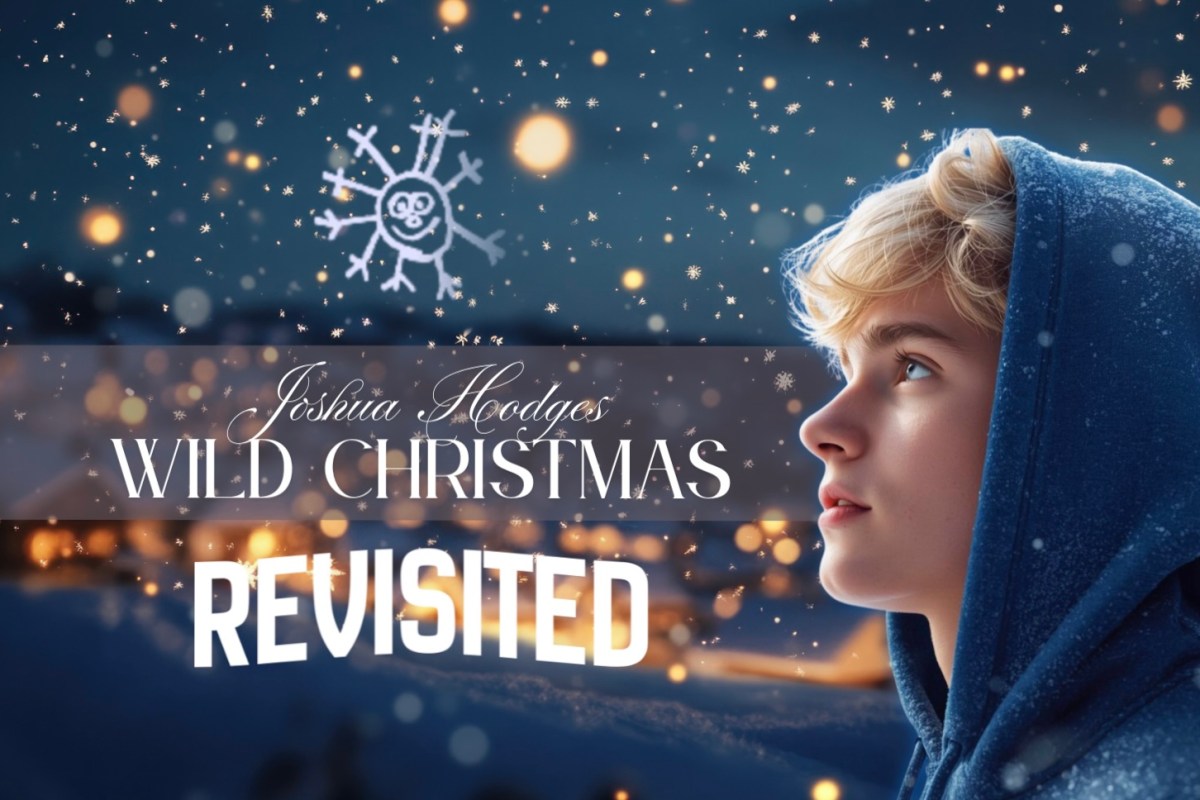
Joshua Hodge’s Wild Christmas: Chapter 1

Wild Christmas was my debut novel, first published during the Christmas season of 2006 when I was a teenager. All these years later, I return to it with a fresh eye—re-editing and reworking certain passages while honouring the spirit of the original story. In the glow of nostalgia and renewal that Christmas brings, I’m delighted to present the first chapter in its newly refreshed form:

Usually December spoke for itself, with Christmas, the holiday spirit, and a sense of hope for the year to come, but this Christmas everything was changing. 

I hope I can make it through this day, Dan thought. His head rested against the bus window, his breath forming condensation on the now foggy glass. He stared outside watching the downtown fade past him. The trees missed their leaves and the grass expressed brittleness in a weary brown. There was no snow to blanket it. To Dan, the buildings in the center of town were cold and plain, as if they were giant tombstones sticking up from the earth’s own crypt. 

Why does it have to be like this? There was something different about the town this year, as if the town was missing the December spirit, the joy of Christmas, the warmth against the cold. It seemed as if the cold was taking over. Dan shivered. He folded his arms, as to hug himself, trying to trap any warmth he could from the rickety bus heater. 

Snowflakes, delicately cut out of glittery construction paper shone in every downtown window, and gaudy plastic candy canes hung from every telephone pole. Little twinkling Christmas lights strung the small downtown together, as if casting a festive net upon the town. Maybe it wasn’t all as gloomy as Dan first thought. Yet, still, despite the decorations, something was missing. The joy and enthusiasm this teenager once felt for Christmas was gone. It had never arrived this season, never knocked upon the door of his soul. 

Of course it was expected that the peak of winter would be very cold, but this holiday season there was a different sense of cold deep down inside his very being. Perhaps this was the result of all the daily stresses which had burned him out, or maybe it was the haunts of Christmas past that seemed to linger. It was likely a combination of both. Never before had he experienced such a feeling. 

It just must be because I am getting older, he thought. Many times he was told by parents and teachers about the changes of growing up. He never wanted to hear it. It was awkward and uncomfortable. Maybe this is part of it. If this was because he was just growing up, he wanted it all to stop. He never wanted to lose the feelings he had gotten at Christmas when he was a child. Not only was Christmas a time of joy and getting presents, but this time of year also reminded him of his parents. They always went out of their way to make Christmas special for him. He could almost taste his mother’s buttery Christmas sugar cookies, but now his parents, just like the Christmas spirit, were gone. 

It was five years since the accident, which claimed the life of both of them, but the terror of that day lingered in Dan’s mind like it was yesterday. His heart would race in mournful dread at just the thought of it. When the news had first hit him, it was like the sharpest coldest icicle in the deepest spell of winter fell right into his very chest. Despite all the shock and terror of that day, Dan felt that the closest he could get to his parents was through the warm childish feelings he always felt at Christmastime. This is what troubled him the most– for some reason, this Christmas, the feelings were gone.

He grounded himself, finding security and comfort in what he had in the moment: rest against the bus window, the hood of his favorite sweatshirt, and the warmth of the bus heater, even though it wasn’t quite sufficient. The earphones, which curled around his bright blond hair, played a familiar tune. It was Winter Wonderland, a song that usually sparked that unique Christmas feeling, but not this year. As the song continued to praise the beauty of snow and winter wonderlands, this teenager stared out the window at the naked ground. There was no snow. Even if the grass were to have been considerate enough to stay green at least, it would be more festive than the lifeless brown. 

The bus, per its usual route, took a turn at the tall steepled church downtown. Out front of it, in the small church yard, stood large white letters grouped together forming the word H-O-P-E. There was not much hope this Christmas season for Dan. At least that’s what he thought. The only thing that was keeping him going was the singular hope which came from the anticipation of winter break. One more school day had to be endured, or to him, “suffered though,” in order for the school vacation to begin. Dan could sense the school day wouldn’t be easy, for it was loaded with quizzes, tests, projects, presentations, and the normal everyday struggles of a school day at Hodgeridge High. 

He opened up his backpack. It was worn and torn, and the zipper only worked half of the time. It was time for a new backpack, but he didn’t have the time to go look for a new one with the extensive amount of school work that accumulated around the Christmas holiday, yet alone the money. Out of the backpack he pulled one of his own essays which was due. He was very proud of himself for being able to finish it, because it was a hefty twelve pages long. There was sharp satisfaction when he had finished the paper and was able to sign his own name to it: Daniel Bailey.

Sooner than he would have liked, he stepped foot inside the big intimidating fortress doors of Hodgeridge High, carrying his over-stuffed backpack, and project posters for his Math and Psychology class, as well as a report for English class. For some reason, this year, school felt like home. It’s not that it’s where he wanted to be, for it was not cozy nor particularly endearing, but he spent most of his time at school so he figured it might as well be considered his home. 

He stepped up to his locker and dropped all his things at his feet, and then he quickly spun the combination. The bus driver hadn’t provided much time to spare. As soon as he opened the locker door, books fell out onto the floor, as papers dispersed in every direction. It was a genuine avalanche, a sign telling him it was time to organize the old locker, but there wasn’t a single moment of time that he would have to organize such a place. He began to stuff all of his belongings into the locker and take out the books needed for the day’s classes. Upon doing so, he found a note that had fallen out of his locker. He thought it was something he had written, for the handwriting was very similar, but it wasn’t, and it was written in some sort of particularly shiny gold ink- jotted as if in a hurry, but written with some sort of special intention and prestige. It read:

Greetings Daniel, 

You’ve been good this year.

Your help is needed, and you have been summoned. 

We are sending for you promptly.

Sincerely, Santa’s Helper

Dan wasn’t sure if he could let himself laugh at such a thing, or if it was a cringy annoyance. He questioned which of his friends would write such a thing. He had a suspect in mind. It wasn’t unusual to receive a letter through one of the three little slits in his locker. He had received many notes during his high school career, some were from admirers, some from friends, others from supporters and opponents. Last year Dan ran for school president, and he got both notes of encouragement and threats through his locker. Dan tucked the note away in  his pocket and closed his locker door, suddenly to be surprised to find his friend Linzy standing right there. Linzy was in many of the same classes as Dan, and they had been friends ever since the beginning of middle school. Linzy was very unusual but in a good sense. She always had a very positive attitude and a random spontaneity about her that was both quirky and attractive. Today Dan noticed how nice she looked in her winter outfit. She loved stripes, and today she had green and red stripes all down her sleeves. A white fuzzy snow hat fluffed atop her bright ginger hair. Even the way she dressed expressed the innocence about her. She truly was one of a kind.

“So, Dan, ready for another school day?” she asked in a tone of voice that was sweeter than eggnog, and too much for Dan this morning. “Ready to present our psychology project together?”

“Yeah, I’m sure we can tackle that,” he replied. There was a brief moment of silence as they walked together down the hallway to their homeroom. Linzy occasionally glanced over at Dan, noticing the gloom yet fiercer determination in his eyes. She was always joking, always taking things so lightly, and she liked the seriousness about Dan. It was different, and it intrigued her. She also liked to watch his wild and fair blonde hair sticking up in all directions, dancing to whichever direction he took. She always thought he was cute. Then Linzy paused. She grabbed Dan by the arms and her face lit up brighter than it already was. She looked at Dan square in the face. 

“Guess what?” she exclaimed.

“What?”

“This Christmas eve at my church I am singing a solo in the service. Can you believe it? Me, Linzy, is going to stand up in front of a crowd of people and sing.”

“Let’s hear it,” said Dan. 

“You mean the song?”

“Yeah.”

“Okay.” Linzy, uninhibited, dropped her backpack, cleared her throat, and then began to belt the words to O Holy Night. Though loud, it was proclaimed with such confidence that it flowed out of her in graceful beauty. Her singing voice was near perfect. Dan had never told her how much he appreciated her singing voice. It was just that whenever he heard her sing, he was sort of put into a trance, wondering where that beautiful voice came from, for it sounded almost divine. If he were to compliment her, it seemed so insignificant. How could his praise stand up to something so beautiful. Some of the students in the hallway stopped to listen while others scoffed at her, thinking she was full of herself, which wasn’t the case at all. Linzy just naturally bubbled over with joy and confidence from the most sincere and innocent wellspring. 

Just that song seemed to brighten Dan’s day a little. Breaking through his hesitation he complimented her, “Linzy, that was great!” He was glad that Linzy met up with him in the hallway and that she was able to sing to him. The joy Linzy had this morning was beginning to rub off on Dan, preparing him to face the treacherous school day ahead. She gave him a friendly punch on the shoulder, “Go slay the day, and jingle all the way!”

Read more about Wild Christmas on my website: www.joshhodge.com/wild-christmas

Chapter 2 Coming Soon!

A Deep Dive into Dollywood’s Jukebox Junction

Jukebox Junction is one of Dollywood’s eleven beautifully themed areas, transporting guests back to the iconic 1950s as they stroll down a small-town Main Street lined with colorful storefronts and attractions. As a Dollywood Insider from 2021–2023, I had the opportunity to take a deep dive into the history and design of this unique land, which recreates elements of Dolly Parton’s hometown of Sevierville, Tennessee, and incorporates heartfelt tributes to important people in her life. Here I present to you my investigation. When you visit Jukebox Junction be sure to slow down and appreciate the thought and meaning behind this wonderful place.


The Pines Theater

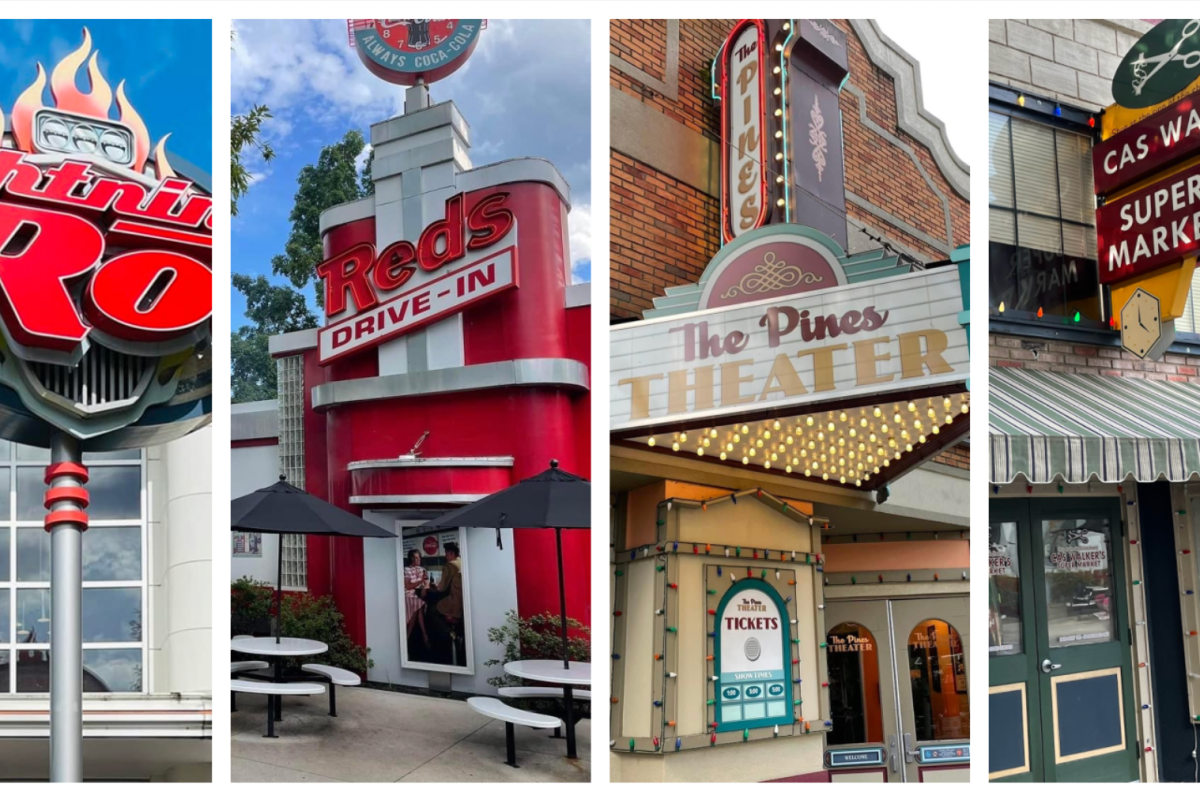
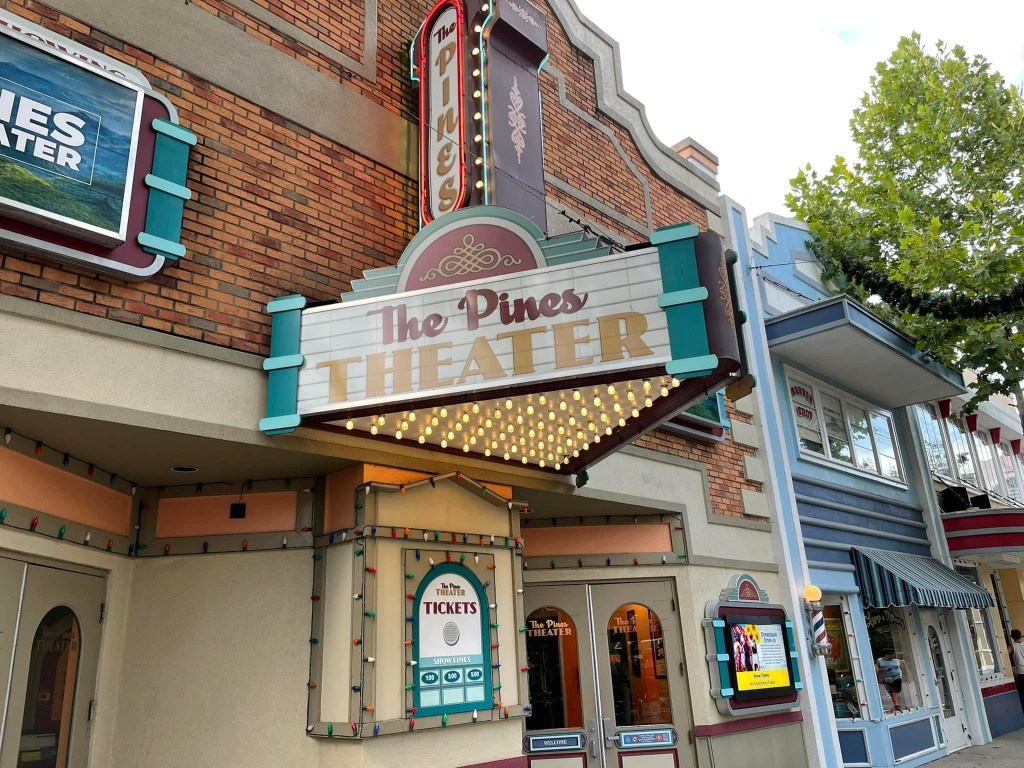
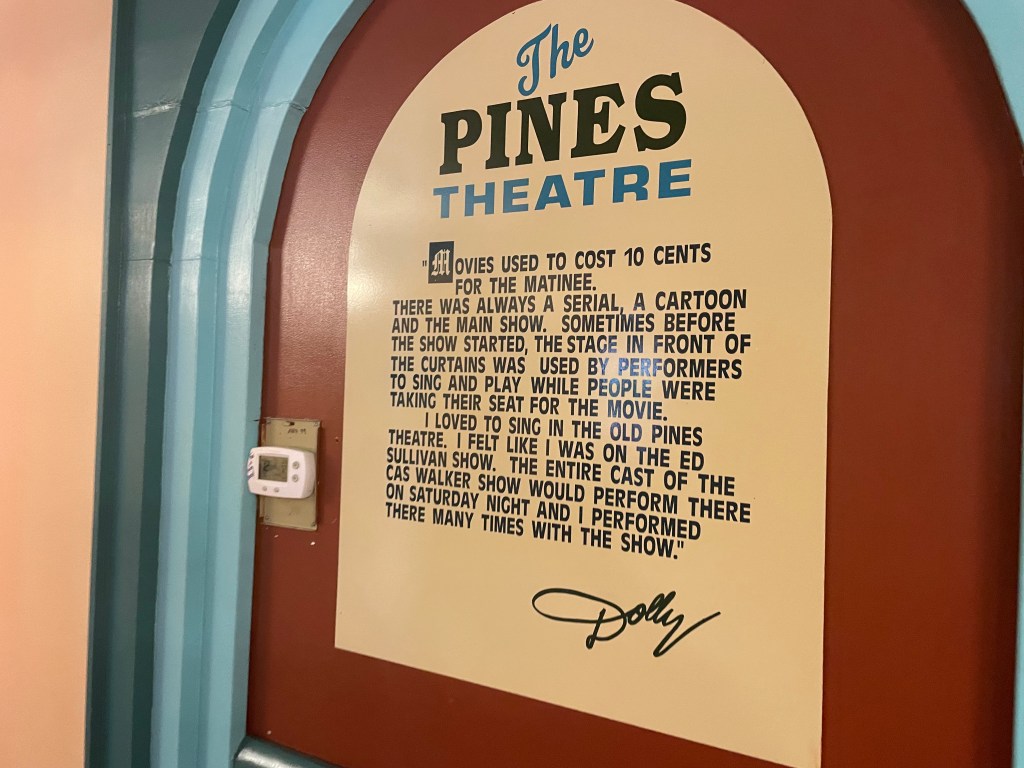
The Pines Theater in Dollywood is one of the many venues in the park that hosts great theater performances and concerts. It’s most known for its Dreamland Drive-In and Twas the Night Before Christmas musicals. Did you know the Pines Theater in Dollywood is modeled after the Pines Theatre in Sevierville, Tennessee, where Dolly had her first public stage performance at age ten? In addition to Dolly, other legends of country music performed on this stage, including Bill Monroe, Roy Acuff, the Carlise Brothers and the Carter Family. When Dolly Parton and June Carter later shared a stage at the Grand Ole Opry, they reminisced the evenings they shared the stage at the Pines Theatre. Dolly also remembers going to see movies at the theater for 10 cents. Sevierville’s Pines Theatre’s building still stands to this day. It has been used as many things throughout the years and recently reopened as a unique gathering place with “an atmosphere of gaming, lounging, and competition, you, your friends, and family can enjoy indulging in great fun, food, beverages, conversation, and overall entertainment.” (www.thepinesdowntown.com)

Red’s Drive-In

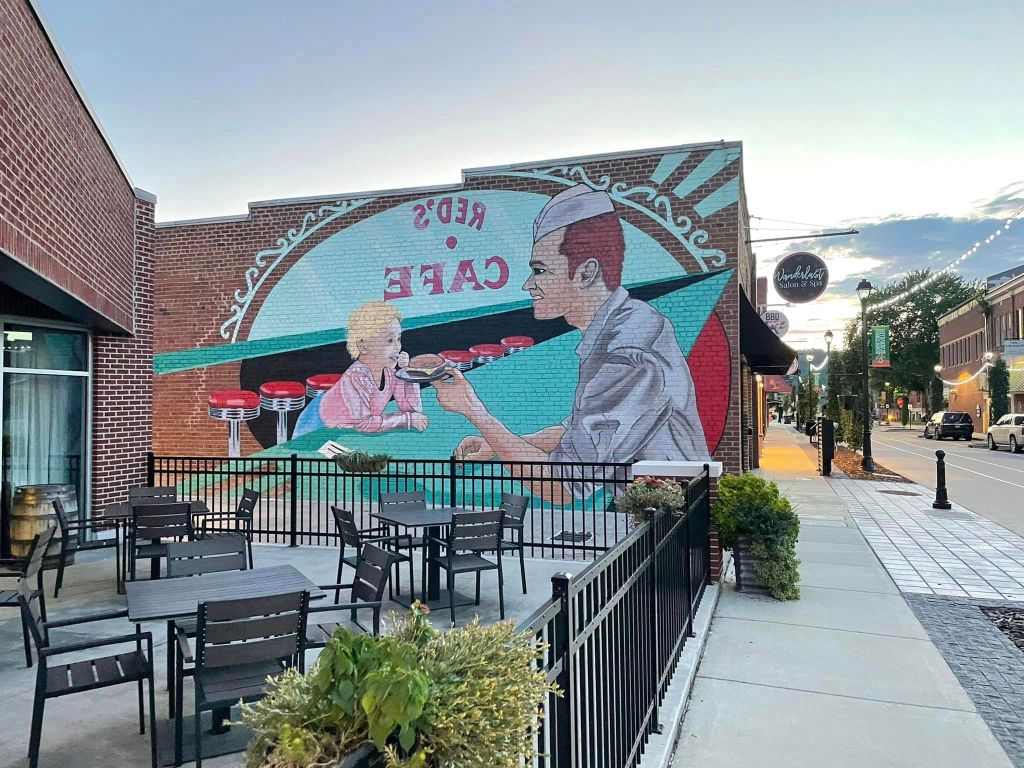
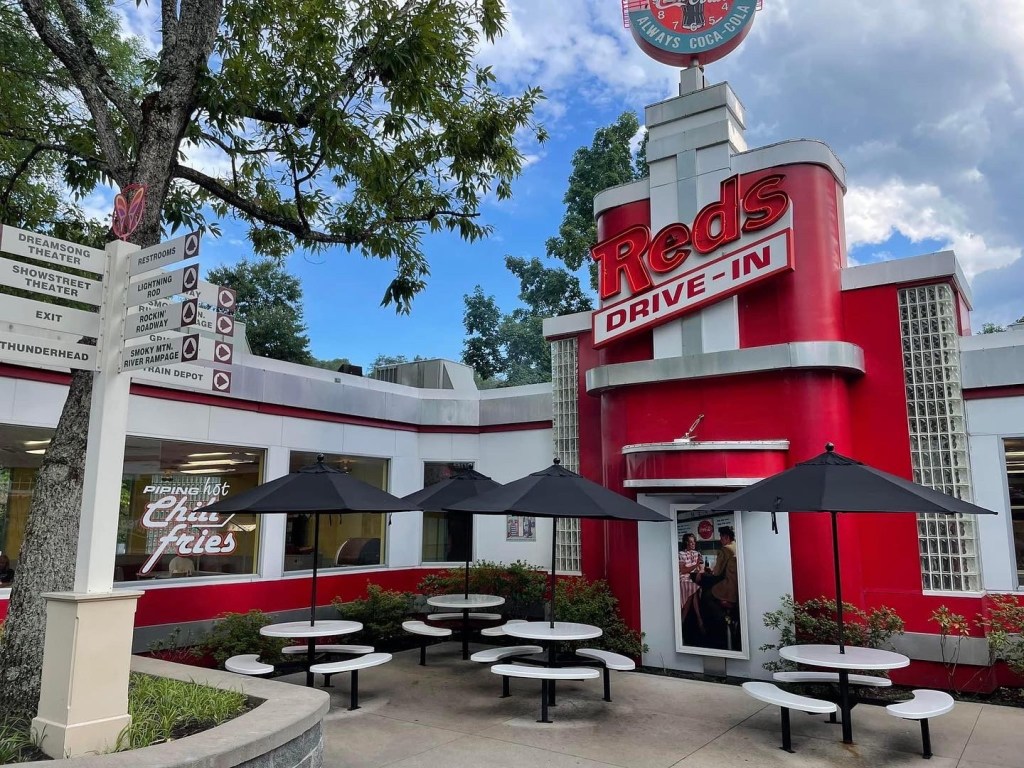
Red’s Drive-In has become one of my favorite eateries in the park. You can dress up a burger to your liking with a self-serve toppings bar, and its sleek 1950s retro interior makes for a novel experience. I recently found out that Red’s Drive-In pays tribute to Red’s Cafe which opened in 1946 in downtown Sevierville, the same year Dolly was born. It is here Dolly had her first “store bought” burger. Young Dolly would also buy coffee at Red’s Cafe which helped keep her energized for her late nights of performing at the Pines Theatre. Paul “Red” Clevenger would cook up his burgers in a cast-iron skillet over a wood-burning stove, and he was known for his kindness and generosity. When a family ordered half-sized burgers for their kids, Red often would smile and say “they look like they could eat a whole burger” and would throw in an extra burger “on the house.” Although the original Red’s Cafe does not exist in Sevierville today, at its original site stands a large mural depicting Dolly being served her first burger by Red, and across the street “Red’s” has been resurrected as Red’s Soda Fountain & Ice Cream

Cas Walker’s Super Market

Tucked in a corner of Jukebox Junction, next to Lightning Rod, you will see a recreated store front of Cas Walker’s Super Market. Cas Walker was a businessman, politician, and broadcasting personality who hosted a radio and then television show, in part to promote his chain of supermarkets that extended from Knoxville, across Tennessee, to Virginia and Kentucky. Cas Walker is credited for helping Dolly start her career, as Dolly performed regularly on his show starting at age 10. She often sang jingles to promote the store and its products. 

Rockin’ Roadway 

One fun attraction for all ages is the Rockin’ Roadway. Here you can board a miniature 1950s style convertible, each with its own radio playing 50s hits and cruise along a themed roadway. The entrance to the attraction is themed as a car dealership and shop. A sign reads “Watson Motor Company.” This too was once a real business in Sevierville. Dolly says, “I remember  going to town and seeing all those cars at the Watson Motor Company. We didn’t have a car when I was little. Daddy couldn’t afford one. Finally, Daddy bought a car and would take us to church on Sunday evening and Wednesday night prayer meetings. That’s when I started signing in church.”

Judy’s Luggage and Millinery

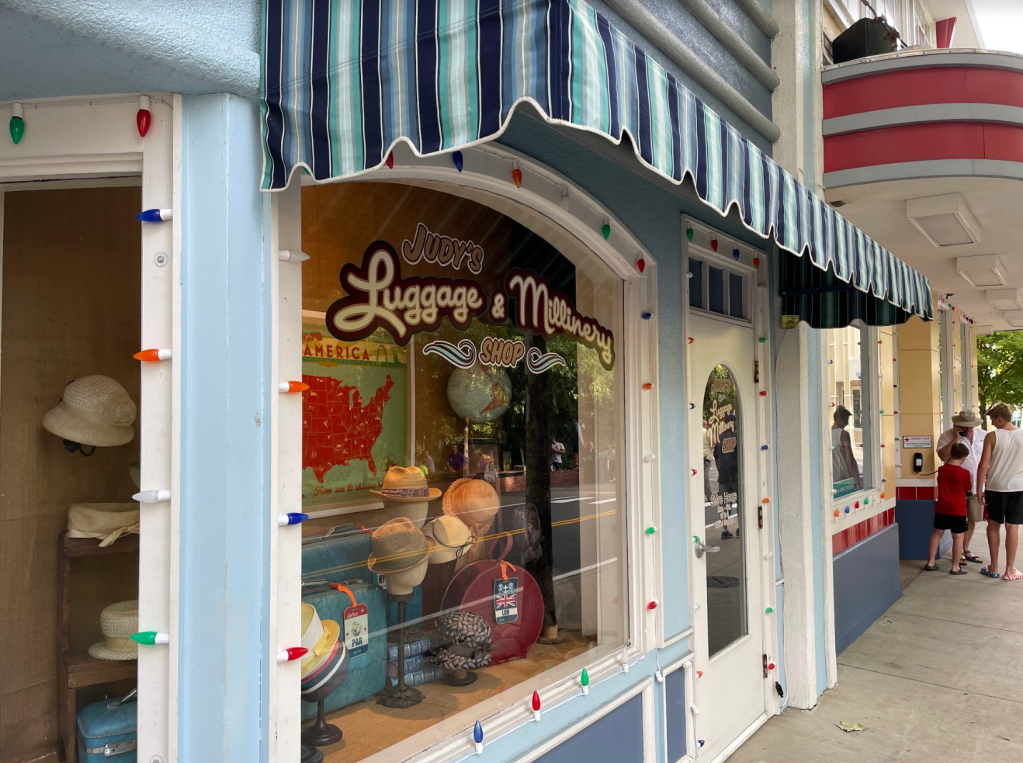
On the Main Street of Jukebox Junction, next to the Pine’s Theater is a faux storefront of Judy’s Luggage Millinery. The name is a nod to one of Dolly’s best childhood and lifelong friends, Judy Ogle. You may remember her as little Dolly Parton’s friend portrayed in the Coat of Many Colors and Christmas of Many Colors: Circle of Love movies. She has served as not only a confidant, but an assistant on many of Dolly’s film projects including Christmas on the Square, Heartstrings, and A Smoky Mountain Christmas. Why Luggage and Millinery one may ask? Well, she has been credited for wardrobe on a number of productions, and she has really helped Dolly go places, so perhaps such a shop title is fitting.

Howard’s TV Repair

Also on Jukebox Junction’s Main Street another storefront reads Howard’s TV Repair. This pays tribute to Howard De Caussin who served many years as Dollywood’s vice president of maintenance and construction. Upon his passing in 1995, Dolly wrote a song titled after him which she delivered to his widow. Until the recent renovations and creation of The Dolly Parton Experience, in the flowerbed outside DreamSong Theater, you could find a plaque in memory of Howard. 

Lightning Rod

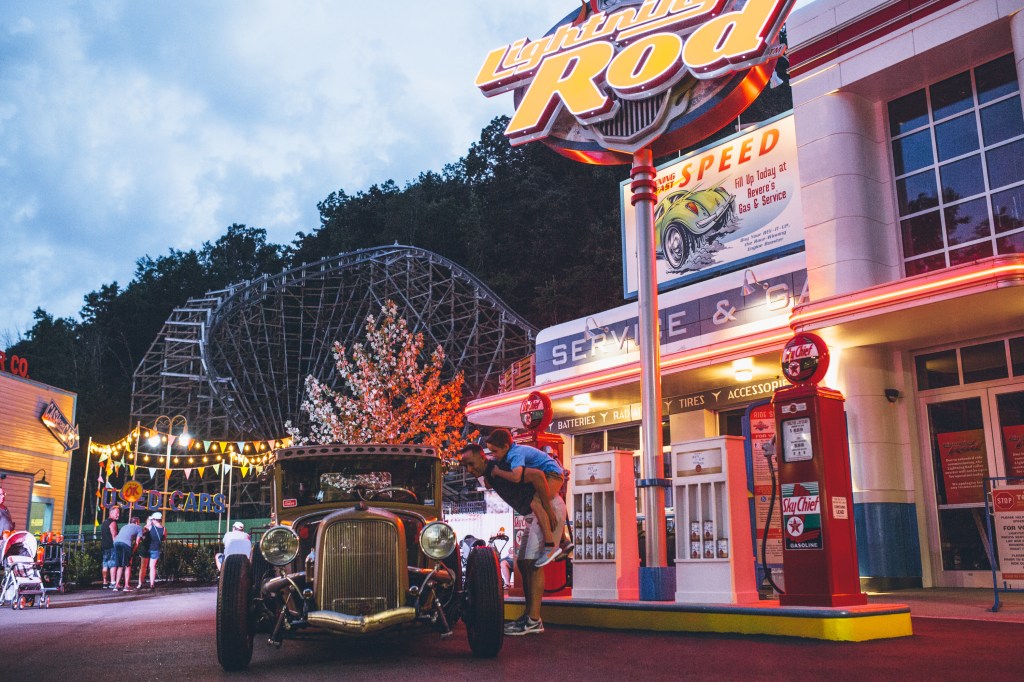
Dollywood broke records with Lightning Rod. When it first opened in 2016, Jukebox Junction’s resident roller coaster was the first wooden launch coaster in the world and the fastest wooden roller coaster at 73 mph. It’s a thrill for sure. Like everything in Jukebox Junction it relates back to Dolly’s early life in Sevierville. She says, “Lightning Rod reminds me so much of those colorful cars cruisin’ up and down Main Street in downtown Sevierville back when I was in high school. I remember all those souped up cars…” (dollyparton.com)

Has any of this sparked your interest in Jukebox Junction? Come experience it for yourself and appreciate the well thought out theming and tributes. If you are interested in learning more about the stories behind Jukebox Junction’s attractions and theming, take the time to read the infographs on the walls in Red’s Drive-In and signs in the lobby of the Pines Theater in Dollywood.

Written by Joshua Hodge. Originally published Jan. 25, 2023. Revised Nov. 21, 2025

www.joshhodge.com

Questions On My New Book: The Colors of My Sunset

My new book is here, The Colors of My Sunset: My adventures and reflections in the National Parks and beautiful wild! What is it about? Why should you read it? Here I want to address some common questions I get. This book is the most personal and meaningful thing I’ve written, and I am excited to share it with you! 

What is this book about?

This book chronicles a month-long adventure of camping and hiking in the U.S. National Parks in the summer of 2018, primarily in the Pacific Northwest. There are tales of adventure, humorous accounts, and captivating descriptions. Also nearly every chapter engages in a spiritual or philosophical discussion relating to the influence of one’s life upon another, the meaning of suffering, and the power of faith. 

Why did you write this book?

I wasn’t going to write this book, because this particular summer was, in some ways, very difficult and shed light on some faults of my own character, at the time, and my struggle with illness. I didn’t want to write about it. I was done. But I have a goal of visiting every U.S. National Park and writing about the adventures in a series of books. Two of my summer adventures are chronicled in my books Canyonlands: My adventures in the National Park and beautiful wild and Still, Calm, and Quiet: More adventures in the National Parks and beautiful wild. With time and maturity, I realized this was perhaps my most meaningful summer- a time of great personal growth, and it was a part of my story that needed to be shared. I am so pleased to share it now, and hope everyone can learn and grow from my own experiences and insights. 

Should I read your other two National Park adventure books first? 

I would love it if you read Canyonlands and Still, Calm, and Quiet, but it’s not necessary. Each book gets progressively deep and philosophical. If you are ready for the most meaty book, this is the one.

Who published this book?

I am my own independent publisher and own all rights to my work. I design and format my publications. By meeting publishing standards, I am able to work with Amazon for printing and distribution. 

How long did it take to write this book?

I began writing this book on Jan 7. 2022. It has taken me about three years. A great deal of time has elapsed since my last installment due in part to being wrapped up in other writing projects as they concern Dollywood and Theodore Roosevelt. In recollecting my advetures, I relied heavily on journal entries, photographs, itineraries, and maps.

What makes this book unique?

Each chapter is sort of its own episode and can stand alone, but, when read together, they paint a greater picture and produce more meaning. It is not a travel guide but rather describes my travels in the physical and spiritual sense. The reader will enter my mind and thoughts as I’m out exploring largely alone. The book also features 200 black and white photographs and 45 vintage illustrations. Among the many stories in the book, you’ll read about my struggle for survival in Death Valley, the time I jumped into Crater Lake, my first grizzly bear encounter, and my first ever days in Montana. 

Are the photos and illustrations your own?

198 of the 200 photos I took myself. A photo of the a grizzly bear I did not take. I also did not take the cover photo. The illustrations are not my own, but are from vintage publications in the public domain that are no longer in print. They are recycled here for your enjoyment . 

Where was the picture on the cover taken?

That is Emerald Bay on Lake Tahoe in California. 

Where can I buy this book?

Currently this book is only available on Amazon and is eligible for regular and Prime 1-2 day shipping. In a few months it should be available from walmart.com and other online retailers. Buying direct from Amazon is the greatest way to support me as the author. Buy here: https://www.amazon.com/dp/B0DZVRCQRY

Will you be releasing an ebook?

I am a traditionalist. I like my books in a good ol’ hard copy format, and so that is how I am choosing to share my book. I spend a great deal of time on the physical design of my books I have no plans to create an ebook at this time. 


Is this book the same collection of stories found on your blog?

Some of the stories are the same, but a number of them are not and are only found in the context of this book. As one of my blog readers, you will find this new and fresh.

What are the parks featured in this book?

Mojave National Preserve 

Death Valley National Park

Emerald Bay State Park

Manzanar National Historic Site

Bodie State Historic Site

Redwood National and State Parks

Oregon Caves National Monument and Preserve

Crater Lake National Park

Mount Saint Helens National Volcanic Monument

Columbia River Gorge National Scenic Area

Olympic National Park

Mount Rainier National Park

North Cascades National Park 

Lake Chelan National Recreation Area

Lake Roosevelt National Recreation Area

Glacier National Park 

Lone Pine State Park 

Is this book content appropriate for all readers?

Yes

What other books have you written?

Check out my full bibliography on my website here.

Buy your copy today!

Thank you!

My Faith Testimony- Joshua Hodge

I sat down. “You have time?” I asked Luke. “It’s going to take a while.” 

And I began…

I explained it in pretty full detail. I explained how I grew up in a family of loving parents, and how my father was a pastor. I shared how I had a good upbringing as a child. Then in high school I had acquaintances in my life and the mere mirage of friendships, but I was very alone. At school I did not connect with anyone on a deeper level. At the church youth group many of my peers were purely nasty to me. The local church was a major contributing factor to everything in my life at the time, and there was so much division and so much sickness in this church. It was the church my father was pastor at, but its troubles were not his fault. It had a long broken history and chronic sickness. Through a series of events, I became very depressed, and to top it off I had become sick with chronic juvenile pancreatitis. Many nights I cried myself to sleep between feeling loneliness, physical pain, and despair. Nobody knew this. I kept it all inside. It came to the point that I didn’t want to live. One night I cried out to God, “Why did you make me if I’m just going to suffer?” I was angry at God. Despite me and my behavior, looking back, I believe God blanketed me with peace that dark and lonely night.

I carried on and it eventually came time to graduate high school. I left Massachusetts to go to school in Kentucky amidst one of the largest episodes of drama in the church. With my dad being pastor it was inevitable that church life would be unavoidably integrated and profoundly impactful on our family life. What happened? I was an inquisitive and keen observer in my youth and I had some suspicions that held true. I caught the youth pastor embezzling money, something he had been doing for a long time with the help and assistance of other church members. Another youth leader was glorifying sexually promiscuous behavior online and flippancy towards God’s word. I felt I needed to bring these areas of darkness and expose them to light. In doing so, I felt I nearly put the nail in the coffin of the church. The fighting, backstabbing and polarization within the church reached new levels. 

When I left to go to school in Kentucky, these culminating events at the church would propel me into a faith crisis. I moved into Asbury College, far from home. Here immersed in a Christian culture, contemplating my faith and the church was inevitable. I was struggling. If the people at my church were “Christ followers” and “the people of God,” is God even real? I  considered this because their behavior was antithetical to the teachings of Christ and no different than the rest of the world. From what I had experienced, their behavior was perhaps even worse. These people were mean towards one another, lying, stealing, and giving into the lusts of this world. Not everyone at the church was this way, but it was perhaps the most influential ones to me whom I had been most focused on who behaved this way. 

During my first week of college, one night I needed some alone time. I had thoughts and things to sort out. I walked to the soccer fields. I laid down in the middle of one field and gazed up at the stars. My faith was deeply scarred. So looking up at the stars I said, “God, if you are real, I need a sign, because I feel as though I don’t have faith anymore.” I figured the all-powerful God of the universe, if that’s who He was, could prove himself to me in this moment. But I found myself walking back to my dorm thinking, well, if God can’t even prove himself to me, why should I believe? 

I used to be a staunch rule follower, and I wanted to do things the way they are to be done, and so I wanted to be the best Asbury College student I could be. Many chapel speakers and professors kept driving in their point that we all should have a life of “devotion,” meaning we needed to be reading the Bible and praying daily. If that was expected of me, I wanted to do it, even if I didn’t see the value in it, not sure I believed any of it anymore. However, the first evening I sat down for my devotion time, I found myself in the first chapter of James. It reads, “Consider it pure joy, my brothers, whenever you face trials of many kinds, for you know the testing of your faith develops perseverance, and perseverance must finish its work so that you may be mature and complete, not lacking anything. And if any of you lacks wisdom, you should ask God who gives it freely to all without finding fault…”

I was blown away, completely captivated, spoken to by this Scripture. I was to consider it “pure joy” to face trials of many kinds and the testing of my faith? My faith had surely been tested. The testing of it had been a stress on me for a while. The first directive was clear: be joyful. The second directive: to persevere. Okay, I’m going to persevere in this so-called devotion time, despite my lack of faith. Then I focused on the third directive: ask God for wisdom, and so I did just that. It was one of those prayers that started out like, “God, if you are real…,” then concluded with, “…I ask you for wisdom.” 

Then in the upcoming days, weeks, and months, things started to shake! I was still dealing with my depression, but in moments of mental anguish I always seemed to come across the right Scripture, or someone would speak a word of encouragement into my life, or I’d read something by a true believer that inspired and spoke directly to my situation. I prayed for strength. God gave it to me. I prayed for perseverance, God gifted it. I prayed for friends, and they came, and they were so very different from the so-called “Christians” from youth group. These people would engage with me in conversation, care about what I was going through. There was a light they carried I hadn’t seen before this close-up. I was starting to see, there really are “people of God.”  Their lives were evidence. I was starting to feel incredibly blessed. Day by day my faith in God was growing stronger and stronger. Eventually phrases and words would come to mind, as if out of thin air. They would provide me strength, perspective, and propel me forward– gifts from God perhaps? I’d rush back to my Bible to confirm they were in accordance with the Word. They were! God was ministering directly to my soul! He was pursuing me!

I was still feeling hurt by my past church, I was still trying to adjust to college so far from home, and I had a lot of insecurity from past hurt that caused me anxiety in making friends. A lot was going on. So in my devotion time, I had many prayers, and many prayers were answered.

One day in our college chapel service, everyone was given an index card upon entry. The chapel speaker delivered his message and we were all instructed to write a note to God. I wrote three specific things: 1. I thanked God for all the good things he was doing in my life and for all answered prayers, 2. I asked that God would show me how to worship Him. My only view of worship was through praise songs. There had to be more. What was a “life of worship,” and 3. I felt God’s presence so near to me. I prayed that I would always feel his presence close to me. I was sitting up on the balcony. I walked down to the front of the chapel where we were instructed to plsce our cards on the kneeling altar in front of the podium. We were told to grab a Bible verse out of a basket. I did so. I got back up to my seat on the balcony. I read it and burst forth silently in tears. This was the ultimate sign. God responded directly to my three requests. The card read: “‘I will make an everlasting covenant with you. I rejoice in doing good things for you. I will never stop doing good things for you. I will instill in you a heart of worship, and you will never leave me.’ Jeremiah 32:40”

My faith had been growing over the past few months, but this was the final push- the final verification. God was real! He was with me! He was here! And he had been here all along!  I also realized in the moment, this was the sign I prayed for months ago when I was laying out in the soccer field at night. I realized during the past few months God was teaching me patience and perseverance. Now I was a complete mess of gratitude. I had a class I was supposed to go to after chapel, but I stayed. I skipped my class, and wept and thanked God. This was  momentous in my life. My faith became real and became my own. 

Then it was time to get to work spiritually. God had pursued me. He caught me, and now He wanted to restore me. We had to bring my own darkness captive to the light. I thought my faith alone, my belief in God, would resolve my depression. It didn’t. Some days I didn’t want to deal with life, with my own thoughts, my own problems and insecurities, so I developed a habit of just sleeping them away. I was aware of this. It had to stop. It was a big step for me to seek counseling. I thought only truly crazy people did that. I was wrong. I had to set my pride aside. My counselor I believe was ordained by God. She was able to reach into my life and rework the wiring. I had developed some horrible snowballing thought processes that led to anxiety and depression. She taught me how to stop my thoughts in motion, hold them captive, and expose them to Truth. I also had trouble opening up to others in any capacity. I was an extremely private person, because of my own insecurities. The counselor said, after hearing all my stories and learning who I was, “I believe the world is really missing out on Josh Hodge.” That was profoundly impactful for me to hear. 

Also at this time, a part of God’s plan for my restoration, was introducing a specific friend into my life. This was the most overtly influential friend I have ever had. His name was Danny. I had seen him around campus. He was a student athlete, and I thought he was way too cool to be my friend. One day, walking across campus, he approached me for the first time. “I know I don’t know you, but I want you to know I’ve been praying for you… I’ve seen you around campus and God told me to pray for you. So I have been,” Danny said. I opened up to Danny and he did the same with me, telling me he was once a drug addict and given completely to the lusts of the world, but then he surrendered to God and his life was completely changed. He soon became my best friend. 

Every night we’d meet together to pray or read the Bible. He’d leave voice messages of encouragement I needed to hear on my phone at just the right moments. I still hold those very special to this day. He seemed to know my heart more than myself, almost in an eerie way. He also prompted me, or told me to go on a mission trip to Mexico City through one of the student missionary organizations on campus. I went. Danny told me, “God is going to use you on that mission trip. Watch and see.” I went and I shared my story of faith thus far at two churches. It was very fresh and raw to me at the time. Surprisingly it had brought some to tears, and two members of my mission team sought me out privately to say my story really spoke to them. My story of brokenness was now being used for something beautiful, for encouragement and inspiration to others. Wow! I marveled at it. My past hurts were not scars, not a dark spot on my life. Now these experiences were being redeemed. I was being redeemed! This was a new concept to me. Twice on that trip, journaling at night, sitting by a window in Mexico City, God spoke to me saying I was to come back to Mexico City. I was taken off guard, not expecting this. I wanted to know when. That detail I was not provided. God told me just to trust Him, and so I did. 

Back at Asbury College, Danny continued to bless me richly with his friendship. The theme and Bible verse of our friendship was Proverbs 27:17: “As iron sharpens Iron, so one man sharpens another.” We sharpened each other greatly. I tutored him and helped him academically, he encouraged and mentored me spiritually. He often reminded me of Romans 8:28, “We know that all things work together for good for those who love God and have been called according to His purpose.”

One night in the midst of a terrible nightmare, Danny barged into my dorm room, woke me up and prayed for me. Many things like this happened with Danny, that I simply cannot explain apart from God’s Spirit at work. How else would Danny know? It was like he was sent. 

I was very sad when I learned Danny would not be returning to Asbury the next school year, but instead would pursue seminary studies at a school in Florida. I was losing him, and for a while I was deeply saddened. Then I realized I can’t be selfish. Danny had been so powerful and influential in my life that I needed to let him go and do the same he did for me for others. The next semester, we lost contact. His phone number ceased to work, His email, invalid. I tried to reach out to him in as many ways possible. Others who knew him at Asbury experienced the same results. I do not know what happened to Danny. I have some magnificent speculations, but all I truly know is that his friendship continues to be a model for me today, and his influence lasts with me today. It has been woven into the fabric of my character. 

Between the counselor at school and Danny, God had worked a number on restoring me. I often wondered why God didn’t perform the miracles I’d read about in Scripture anymore, but I realized God had performed a miracle on me. His hands were at work through Danny and my counselor. I also came to see that He performs many miracles all around everyday. He channels His healing power and his wisdom through His people and through medicine. Who brings wisdom and knowledge to man? Who gives power for enzymes and for chemicals to react? 

Despite all my progress I came to realize I’ll never be fully restored until I am with God in His Heavenly Kingdom, but here in this life, we are able to, and should, bring darkness to light. I can say with confidence, by God’s working in my life, and his hand through the people he placed in my life, I have fully conquered and overcome depression. Glory to God! 

When I returned for my sophomore year at Asbury, I came early, for despite my rocky first year, I was chosen to become a T.A.G. leader. The acronym stands for Transition and Guidance. I was assigned a group of about twenty freshmen. Me and another sophomore would be their leaders and guides throughout freshmen orientation and throughout their first semester. We’d check up on them regularly, hold weekly meals together, and plan monthly events. 

The night before all the freshmen arrived I was starting to feel anxious. I had some social anxiety, and the thought of twenty freshmen looking at me at the same time felt overwhelming. I didn’t have the social confidence for this. Despite all the training I went through, I didn’t feel prepared. So I went for a walk at night to the same soccer field I had prayed at during my first week of college. The first time I went there I was in my faith crisis. Now, I had faith. I was just dealing with my own insecurity. Laying there, I talked to God. I wasn’t praying necessarily as one might think. I was just sharing my feelings. It went something like this, “God I feel like this is all a mistake. I don’t think I should be a T.A.G. leader. I don’t have the skills for this. I feel so anxious about talking to all these students…” I went on and on. Woe is me.

Then God spoke, and boy did He speak! It’s interesting how the first time I came to this field I had no faith, yet I sought something miraculous. Now, I had faith, and wasn’t expecting anything, but from my line of vision all the stars in the sky disappeared except for one. There was one single focal point, and God said directly to my soul, “Don’t be distracted by all the fears around you. Focus on me and everything will be fine.”  I was amazed. I ran back to campus to share the news. God’s directive was exactly what I followed. I resolved to set my fear aside and be courageous in what I do, and I truly focused on caring and loving these freshmen. I did it all sincerely and as an act of worship, focusing on God.  He was teaching me, as promised, how to worship Him through loving others.  I would say the semester was a success. After all, three of my freshmen went on to become T.A.G. leaders the next year. I felt truly blessed.

After my mission trip to Mexico, I had felt convicted to study more Spanish, knowing God was taking me back to Mexico City at some point, but I found it hard to learn Spanish in Kentucky. I wanted to study abroad so badly, and of course I was dead set on studying in Mexico City and nowhere else. However, Asbury would not approve of a study abroad semester in Mexico City. If I wanted to study there, I’d have to drop out, apply as an international student, and reapply to Asbury as a transfer student with no guarantee I’d be accepted or they’d accept my credits from Mexico. It was a big risk. I was contemplating this risk and also considering how I could follow the natural progression of leadership opportunities at Asbury and become a paid Resident Assistant and have the potential opportunity to have influence over a whole hall of students. Oh what to do?

I went for a walk to pray. Lord, should I study in Mexico or should I stay and be an R.A.? I wanted a clear answer. I got one, but it wasn’t what I was expecting. God said, “I have given you the wisdom to make this decision. Make the decision and it will be the right one.” I was incredibly humbled. I couldn’t have come up with this answer. I had incredible peace. Okay, I’m going to Mexico…and so I did. 

I could write a whole book about that experience. I shared my faith a number of times in Mexico City, and went through a time of great spiritual and personal growth. I was also able to witness to a family with a son going through grave sickness. He was expected to die in a week. That’s what the doctors said. In the hospital I prayed for the young man. He was unresponsive and on life support. A week later he was completely healed. The mother wanted to credit me, saying I was sent by God to heal her son, but I could not take any of the credit. It was all God’s power at work. Because of the miraculous healing of her son, and realizing it was God who healed him, the mother of the family developed a renewed faith and started a Bible study in her home. It’s quite amazing how God works!

I wanted to stay in Mexico. It didn’t work out. I came down with severe ulcerative colitis. I truly did have a dream of living in Mexico City. It was everything I was working for, but when I realized I could only get therapy for ulcerative colitis in the United States, my dream came crashing to the floor. It was hard being sick and dealing with a shattered dream at the same time, but I had to eventually surrender my plans for God had other plans for me. I just couldn’t see it at the time. Through my sickness God also witnessed to me immensely, speaking to me a number of times promising to restore me and make me strong and doing just that. 

I spent my first year out of college teaching in inner-city Houston, Texas. The big takeaway from that experience was the influence of the church I was a part of there. It was extraordinarily healthy. I needed to experience this after my rocky church experience as a teenager. I was a part of a study group and we went over the basics of our faith but in a indepth way. We studied topics of forgiveness, mercy, grace, glory…. These were all words I’d heard, but came to understand at a much deeper and more meaningful level. There too, in that group, I shared my faith story. I was so excited about it!

Through all the sharing of my story this, and every time, I notice in retrospect, I never have addressed repentance. That is to say, talking about asking God for forgiveness of sins through Christ Jesus. This is essential for salvation and a relationship with God. Without repentance, the relationship is damaged. There is separation from God. Jesus’ sacrifice makes it possible for the forgiveness of sins. He paid the price. If we repent and accept this forgiveness, it leads to the repairing of the relationship. It makes us right with God. Recently I’ve been pondering this as it pertains to my story. I’ve asked for forgiveness of sins countless times. It’s a continual thing. Growing up in a Christian family, I always had a solid understanding of sin and my need for forgiveness. 

When I share my story of faith, I have made it sound as if I first came to know God that day in chapel at Asbury. However, recently I’ve come to realize I did have a real and alive relationship with God as a child. I confessed my sin and prayed for forgiveness sometime as a small child, and it was real. I knew God to be real and He provided me immense comfort as a child. I had this burning desire, especially as an adolescent and young teenager, to study God’s word and know Him better, and I can recall a number of times the Spirit at work in me, speaking to me and prompting me. But during all this time, I had the faith of a child. Some might call it ignorance. I don’t think so. Rather I say pure faith. But then the world came in and corrupted it with all its confusion and all its doubt. My faith was tested, and it was tested severely. It went through the refiner’s fire for sure. I had to transition from my childhood faith to a mature faith. By mature faith I mean a faith put up to the test of the world. During the end of high school in my broken church, and in the early days of college, my faith faced that test of the world, and God carried me through. 

Now when I think back to when I was a child, I am so incredibly humbled and so full of praise and gratitude that God was pursuing me back then. How incredible that even with all the powerful figures of the world, the Lord and master of the universe, pursued a mere helpless child for His Kingdom. I am so blessed, and I am so nothing, yet He pursued me and continues to pursue me. Some think it’s crazy to believe in God, but after all I’ve experienced from my childhood to now, it would be simply crazy for me not to believe in God. 

I finished my story by telling Luke I was sick again, and I didn’t know what this meant. “I don’t know what God is teaching me, but it’s heavy and it weighs on me. Looking back I’ve seen God has carried me through a lot, and I believe he will carry me through again. I also need to remind myself of his promise to me ‘I will never stop doing good things for you.’ So all I can do is press onward in faith.” 

Upon finishing my story, Luke was eager to tell me his faith story too. In brief, and it was brief, according to him, he was tripping on acid and mushrooms in the woods and almost walked off a cliff, the very one we were sitting on. He then slipped into the spiritual realm and saw creatures with lots of eyes and the plants talking to him, and he felt God. That was it….The end. What can I say? Only God is the judge. I sincerely hope Luke has since found the richness of a true relationship with God.

Going-to-the-Sun and Grinnell Glacier

In my mind Glacier National Park was the National Parks of National Parks, like a next level experience only conquered by the very bold and adventurous, or something like that. I made it! I had seen pictures of course and was astounded by the unbelievable views, and now I was here! I turned left off Highway 2, through a little tunnel under the railway, and into the little tourist village of West Glacier. I passed by a visitor center for Alberta, Canada. Although I was not in Canada, I was so close. I also passed by a few little tourists shops, Glacier Raft Company, and a little restaurant and ice cream shop called Friedas. 

The pines hugged in closer after I crossed the bridge over the Middle Fork of the Flathead River, and there in the shade of the dark rich pines was the National Park sign. Bold and beautiful it read, Glacier National Park. I admit it’s now commonplace for me, after having spent many summers in Glacier, but at the moment this was a big deal. It was my first time here. This was an accomplishment. This was one of the more out-of-the-way National Parks I’d been to. Its mountains were extreme with moving Glaciers, and its forests held grizzly bears and wolves! This was no ordinary place to be. I was swept with a sense of accomplishment, gratitude, and wonder being here. 

Nearby I parked at the Apgar Visitor Center. It was early and it was still closed, but there was a National Park bus stop on site. The plan was to take the bus up to Logan Pass, the highest point on the famous Going-to-the-Sun Road. From there I’d hike the Skyline Trail one way about fourteen miles up to the Garden Wall to catch a view of Grinnell Glacier, then I’d continue north to the Granite Park Chalet where I’d take the Granite Park Trail down to “The Loop,” another spot on the Going-to-the-Sun Road. There I’d catch the bus back down to my car. This would be a full day endeavor hence the getting started so early. 

As I stood there waiting for the bus, I was cold. I needed the sun to rise and warm things up. I had a few layers on, including my new Under Armour base layer I bought at the thrift store outside Seattle, yet I was still just wearing shorts. I knew it would warm up. I double checked all I had in my backpack: a map, snacks, water, flashlight… just in case. I was prepared. My boot laces were pulled tight. I was ready! Anxiously I walked around, reading all the signs, observing what other tourists were doing, and checking messages on my cell phone. I had caught a wifi signal from the visitor center. 

I chose to take the bus as opposed to driving for a few reasons. I was nervous about driving the Going-To-The-Sun Road. It seemed intimidating. The road is known as the most scenic drive in America but was also snug against dramatic cliff edges gaining 2,560 feet in elevation. I knew I would have to drive it to carry through with my next few days’ itinerary, but I wanted to size it up first and just observe it with someone else behind the wheel. I didn’t have to drive it until the following day. I also read that parking can be difficult to find at Logan Pass where my trailhead was, so I didn’t want to risk not being able to park. Lastly, I like the energy in the air on a bus in a national park with everyone geared up for adventure. It’s a unique culture that I find to be part of the park experience. 

The bus ride was terrifying! I sat on the right side near the front of the bus. I swear this bus was too big for the road. Around every bend I felt as if my side of the bus was jutting off the cliffside. The first few miles of the road were easy, relaxing, just through the mysterious, dark, wet, mossy forest with light peaking through in the most intriguing and mystifying ways. The bus took us alongside Lake McDonald, the long-stretching wonder. Then we were along the beautiful McDonald Creek, where the water runs clear if not in a surreal turquoise. But then the real ascension began and things got hairy. It wasn’t so bad until rounding a place called “The Loop,”  where the road makes a dramatic turn and narrows. There’s supposed to be two lanes, but it seems more like one by any other comparison. 

The trees lessened and boulders became more prominent. I began to notice the forest below, no longer aside us. We were up in the mountains. The views were astounding, more magnificent and boisterous than anything I’d seen before, as if the mountains were calling for attention. However, I would appreciate them more the next day. Right now I was distracted by the thousands of feet expanse just beside me to which I felt I’d be plummeting down at any moment if for some reason I didn’t cling hard enough to my bus seat. The tension was real.

We proceeded through a few tunnels of which we were too big for; and a few bridges, built into the rock walls, better suited as foot paths in a Vanderbilt garden. I have never been more nervous on a ride in my life. Around each wind in the road, I felt I was just swinging out over valleys on my corner of the bus, dangling over great heights.

I could not understand how the bus driver was just so casual and relaxed, making friendly conversation with another passenger. She was loudly talking about how she was a school bus driver and this was just a summer job. I was carefully watching her in case I had to spring into emergency assistance, I suppose.  At one point she grabbed her water bottle for a sip. Two hands on the wheel! I wished to telepathically impart. 

I would be gripping that steering wheel so tight, head tilted forward, focused on the road. I wouldn’t be talking to anyone. I would have to be totally focused on the road. In fact I couldn’t even drive a bus on this road. We would already be plummeting down to McDonald Creek. Maybe if she is so relaxed I should be too. I tried to, but I was so tense. I couldn’t wait to get off this bus safely.

The bus stopped for some mountain goats crossing the road. We were getting close! We were now near the tundra. Water flowed around in many different directions and spread everywhere from the melting snow. Tight shrubs and alpine grasses hugged the rocks, and the tops of mountain peaks stood as monuments around us.

I survived! I got off at Logan Pass on top of the world. Here is the Continental Divide. Water flows east to the Atlantic, west to the Pacific, and north to the Hudson Bay. There’s a real feeling of being at the pinnacle of North America. There’s also a big parking lot where a visitor center sits along with two big flags, one of the U.S. and the other of Canada. Glacier National Park shares a boundary with Waterton National Park in Canada. Together they form what is called an “International Peace Park.”

A short distance from the parking lot at Logan Pass is the trailhead for the Highline Trail, often touted as the best hike in the park by many visitors. It begins at such an elevation that the mountain peaks around it are obviously bald, exposed to the wind and sun, reminding me of some of the rock formations of the Southwest in Arizona or Utah. The trail starts just off the Going-to-the-Sun road, and goes down a shallow decline with rich green grasses and a few pines. Then it snugs up close to a cliffside. The trail is just a couple feet wide, right up against a rock wall. The other side is a sheer cliff, plummeting hundreds, maybe thousands, of feet down. This did not bother me at all. The difference: I was in control of my body but wasn’t of the bus. This was an experience to marvel at. I loved it! The trail was already pretty busy this morning. There were other hikers right in front of me and others trailing up behind. “Be careful,” they told one another as they carefully maneuvered the small path. 

This trail lives up to its hype. It was extravagant. At times it opened up to just enormous views atop these mountainous meadows spread with yellow blooming glacier lilies and patches of snow stretching before dramatic mountain peaks carved by glaciers. Each mountain valley was framing another stunning view in the distance. There was forest too, a grand immensity of it, but I was mostly above it. The descending display of each little triangular pine tree top spoke of the grandeur of the landscape before me. The sky was rich blue, the snow bright white, the mountains gray with skirts of dark green pines around their bases, and just before me was the vibrant green and yellow of the glacier lilies. I was right in calling this a next level National Park. These were the most immense, grandiose, dramatic, and beautiful views I had seen out of any National Park. This was the cream of the crop, or as they say, “”the crown of the continent.” Each dramatic mountain peak was like the palisades on a crown, the landscape adorned with the finest things of nature: glaciers, waterfalls, forested basins, the crown jewels of God’s creation. 

This morning the sun was also very bright and positioned at just the right angle to illuminate these jewels, reaching into every little crevice and wrinkle on the mountainside, adding to the depth and detail of everything. 

After about an hour in, I stopped at one majestic meadow to shed a few layers and eat some electrolyte gummies. I was getting quite warm in the morning sun. The trail was still busy, and hikers continually passed me. I found a rock to first set my backpack on and then to sit down on for a moment and behold the landscape. Although warm from the sun, the air was cool, and I took in a deep refreshing breath of rich snow-chilled mountain air. Then I carried on. 

About seven miles in I came to the Grinnell Glacier Overlook spur trail. It was just a half mile and would lead up to the feature called the Garden Wall, which is a natural rock wall that is a definitive line of the east side of the park and the west side. It’s like a great narrow spine of the park. From here I could look down and see Grinnell Glacier. The spur trail was completely exposed above the treeline and very steep, gaining one thousand feet in a half mile distance. Sometimes when going uphill, I try to go fast and just get the exertion over with. I tried here, but the air was very thin on top of the world. My whole body felt so heavy and gravity felt extra strong. When I got there I was utterly amazed! I didn’t know what to expect. I hadn’t looked up any images prior. I was stunned. I hadn’t seen anything like this.

This may be a strange comparison, but it kind of was like when someone reveals a bloody wound, and you’re shocked by the look of it. You weren’t expecting to see something so abnormal on the skin’s surface which is usually smooth and predictable. It’s a grand abnormality on the skin and in the flesh. This glacier view was that grand abnormality on the earth’s surface and in the earth’s crust. But replace the disgust with awe, and replace the red of blood with rich turquoise blue and a white so bright and so angelic it burns.

Wow!  I had never felt so high up. I was way on top of the world. I thought I was on top of the world at Logan Pass. I was wrong. This was even next level! I sat on a rock’s edge, below me rocks crumbled down, slanting into a blanket of snow which then spread over Grinnell Glacier. Then hundreds of feet below, I could see the ice rippling with white and turquoise blue. It was the glacier descending and melting into a bright opaque turquoise glacial lake. The lake fed into another lake and then into another lake in a chain of glacial lakes spread out immensely in the forest below. I was on top of everything and looked across at the other gray mountains tops up here above the treeline, rippled through the ages with rock layers. There were blankets of snow littered amidst these mountains, drooping in every which way. It was also clear here to see the carving power of a glacier. It’s where a whole mountainous valley began. This was. and stands to be, one of the greatest sights I have ever beheld. 

I sat to snack on a Clif Bar and enjoy the view for a spell. A little chipmunk came very close. I’m sure he was hoping for a bite or two. That wasn’t going to happen, but I did take his photo, which he couldn’t have cared less about. Then shortly after, a group of Chinese tourists arrived all wearing the same off-white sun hat. They were all oohing and aahing and talking in their sharp-sounding language. 

This place was unbelievable. I had really arrived somewhere!  I couldn’t have conjured up such a view in my mind. Now it was resident in my mind. So satisfied, I began my descent to carry on back on the Highline Trail.

If you enjoyed reading this, check out my book Still, Calm, and Quiet“

Check out my previous entry here: My First Day Ever In Montana and Wresting with God’s Promise

Visit www.joshhodge.com

Stehekin Day 2: Pastries, Grouse, and Greatness

 I woke up to the strangest, most intrusive sound in my campsite just aside my tent. I could not place this sound. I was so perplexed. It sounded like a drumming, but too soft and coming from too low-down to the ground to be that of a human. A gnome? An alien? That’s ridiculous!  It was so close, approaching my tent. This is bizarre. I rolled over and pushed myself up quickly to unzip my tent. There stood the funniest looking bird. I would describe it as looking like some sort of  wild chicken, but it was strutting with its feathers on full display and its chest puffed out, like a miniature turkey. It looked so proud and pompous, yet it was so small and ridiculous, especially with its little feather tufts sticking up on the top of its head like some punk-rock motorcyclist. It was trying to be tough, but had big curious infant-like eyes. My initial thought: What the heck is that? Upon locking eyes, his feathers shrank close to his body, in what I perceived as a reaction of embarrassment, and then he scurried off into the forest in fright. 

I had never seen this type of bird before, and I don’t know how I knew, but somehow it’s name was on the tip of my tongue. As I excited my tent and slipped on my boots, I kept trying to fish this word out of my memory. I was so close. I gathered my water bottle and my new book on Stehekin and threw them into my backpack. I began walking down the hill and it hit me: It’s a Grouse!…then, Is the plural form of grouse, grease?

This was day two of camping in Stehekin, the most remote community in Washington. My encounter with the grouse was midday. When I woke up and unzipped my tent for the first time of the day, I was greeted by the tall pines, the serene lake below, and the mountains standing mightily on the other side of the lake. My camping neighbor Luna Luu was already up as well, fixing things about her camp.

“Good morning,” I greeted. “Did you get some pictures of the Milky Way?” I asked. 

“No. I didn’t end up going. It was cloudy last night,” she explained. 

It’s what I had suspected.

This morning my first order of business was to go to the bakery for some breakfast. I invited her to come along, but she had her own hiking plans. After quickly throwing myself together, I hopped on my bike and took off down the road toward the bakery: Stehekin Pastry Company. The mountain morning air was brisk and refreshing, and there was no morning bustle about this place, as is common in so many places. Here the few people that were around eased into their morning. It was relaxing, moving at the gradual pace of the rising sun, slowly, growing with every passing moment gradually more alive. 

Opening the bakery door, I was bombarded with the enticing smells of cinnamon and coffee blended with all the other aromas of the fine craftsmanship of the Pastry Company. After camping outside in the cold northern night, biking through the brisk mountain air, I knew it was going to be so relaxing and perfect to sit down with a cup of something hot to drink and a great big fresh cinnamon roll dripping with house-made icing, while sitting by a window, glancing outside to watch the forest slowly wake up and be illuminated by the morning light. I sat there in peaceful bliss doing just so.

After a while I got up to browse the nearby shelf of merchandise. There were hats, stickers, and books. A particular book caught my attention Stehekin: A Valley in Time, the true story of the valley through the eyes of Grant McConnel, a man who lived here from the 1940s until the 1990s. I bought it, along with a sticker. I wanted to learn more about this place, and this book seemed perfect. I also noticed a number of other books, all by local authors. I realized this was somewhat of an author community. I understood why. The place was ripe for inspiration with its natural beauty, and its remoteness and solitude eliminates all the distractions for the writer. I would love to live in such a place and dedicate my time to writing. So far I’d imagined myself living here as a baker, then a teacher, and now an author. I had no idea that in less than a year I’d find myself spending my whole summer on the edge of Glacier National Park, in the remote community of Polebridge, sandwiched in between parkland and national forest in the wildest river valley in the lower forty-eight states. There I’d live and work amidst the beautiful Rocky Mountains, off the grid, in the beloved Polebridge Mercantile and Bakery. I guess we could say it was a dream come true, looking at the dreams occupying my mind during my time in Stehekin. When I was interviewing for the job in Polebridge over the phone in the winter- the owner told me how he wanted to place me at the front of the store as a closing cashier. In that moment, and in fact all-through the interview, in my mind I kept seeing the Stehekin Pastry Company. It was my only point of reference to such a job. I recalled seeing the bakers back in the kitchen with their mounds of dough, working so diligently but seeming to have fun. “What about putting me in the role of a baker?” I asked. The owner, Will, explained how he believed that with my skill set as a teacher I’d be best suited for the front of the house. He was right. He told me that if things work out he’d like for me to keep a relationship with the business and return for more than just a summer. I worked there for many summers and continue to do so. My time working at the Polebridge Mercantile and Bakery are some of the richest of my life. Although oftentimes rustic and primitive, it’s my summer paradise. I love it!

After my morning cinnamon bun I got back on my bike and traveled non-stop to the other end of the road, past all the sites I had stopped at the day before: the one-room schoolhouse, the two-room schoolhouse, Rainbow Falls, Stehekin Ranch, and then bearing off the main road I rolled down a path to the Stehekin Airstrip, a field amidst the pines. Is this really an airstrip?…I guess it would do. I could imagine a little private plane landing and rattling atop this field. I supposed boat access wasn’t the only way to arrive at Stehekin but plane access had to be private. There were no commercial or charter flights. Biking past the “airstrip” I sought out “The River Trail,” from my map. When I parked my bike against a tree and started on the trail I realized it was not a very frequently trafficked area, for it was mostly overgrown and had just a narrow space barely big enough for my feet. My ankles were brushing up against the growth of the forest floor. This was a rich lush forest, more characteristic of those back East. At one point the path came close enough to the river I could see the water. At this location I’d call it more of a creek than a river. I veered off the path and stepped down onto the river bed. It was so shallow the water didn’t even reach as tall as the top of my boots. The water was also not high enough to cover all of the riverbed. The middle of the river was dry, so it was there I sat down. With my eyes closed and listening to the trickling water around me, I prayed a prayer of thankfulness for being here. I also prayed about my health. I had enough distractions from all I was seeing and experiencing in Stehekin that I hadn’t been focusing on it, but it was still, in its own aching way, always present on my mind and felt in my weakening body. 

This is good for me, I thought, to relax by the river, to take in the soothing sounds of the water and the lights beaming through between the tree branches. This was a gift from God. I had been feeling that my body was caught in this state of high tension and if I could get it to calm down, escape this state of being, I’d be okay, but it felt like a lot to do. I was up against my very self. I concluded every moment should be used to help bring my body out of this state of tension. This was one such moment. Relaxing was now a priority of mine. In my relaxed state I broke open my journal and began to write.

When I got back on my bike, calmed, settled, grounded into this time and space, I leisurely began biking back to the other end of the road. Of course I had to pass by the bakery again, and it was time for lunch. I was hungry and there were many great things on the menu for lunch. I couldn’t make up my mind of what to order so I just decided to buy two lunches, a salad with salmon and a roast beef sandwich. They were delectable- especially the salmon. I thought it was fitting to eat salmon in the Pacific Northwest. Once back in “town” I realized it had been about twenty four hours since I had rented my bike, so it was time to turn it in. Then feeling mildly handicapped without my wheels, I walked back up to my campsite. It was time for a nap. It was only afternoon, yet I had already covered great ground this morning and felt it was fine to give up some of my day to sleep. After all, relaxing was now a priority. I fell into a deep sleep in my tent, wrapped in this fold of nature, and then I woke up to the drumming grouse just outside my tent. 

I ended up spending a large portion of the evening sitting on a rock up on the mountainside behind the campground, looking down at the lake. There I read the book I had bought about Stehekin. It was a very entertaining read. Between this evening and the following morning I read the whole book. That’s very fast for me. It was that good. I especially enjoyed learning about the community back in earlier times. I read how delivering mail along the stretch of road was a shared responsibility. People took turns. In the winter, the author delivered the mail on skis. It was customary for him to stop by and visit with everyone along route. It sounded kind of nice, skiing out in the cold of winter, stopping occasionally every few miles, stepping into a warm house with a warm fire in the hearth, greeted with a cup of coffee or tea, and engaging in conversation about the latest news of the valley. It also stuck out to me the part discussing how there was only one phone in Stehekin in the post office brought in by the National Forest Service. That was the only immediate communication to the outside world, and it wasn’t very reliable. It also struck me as comical, the part about the aftermath of a  plane crash up in the woods, and how the locals, given they had very limited resources, stripped that plane and used it for building materials in their homes, and even parts of it was used for dinnerware. Remnants of the plain could be seen popping up all over the community in people’s houses. 

The author talked about how for so long Stehekin was frozen in time, and a unique and very personal community. Whenever someone had to take the boat down the valley into Chelan, people were often repulsed by the chaos and lifestyle of those “down lake.” Reading this book, everything seemed like such a far-off, foreign, yet intriguing concept. However, later in my own time working at the Polebridge Mercantile and Bakery in Montana, I would live through similar experiences. It too is, at this time,  a one phone community. The contrast between our life up the North Fork River valley couldn’t be more stark against the developing society down stream.

The following morning, day three in Stehekin, it was time for me to go “down lake” back into the real world, but I wouldn’t be spending much time in society. It was time for the next leg of my adventure and off to other wild places, soon approaching the behemoth of National Parks: Glacier National Park. Before I boarded the boat I walked to “The Garden.” This morning the gardener was there. From my understanding this was all his. I bought from him some sugar snap peas and cherries. I stood there in the garden and spoke with him for a few minutes. He told me some of his story and how he ended up here. To me, at the time, it struck me as sort of weak, running away from society and life’s problems to live up here in remoteness. I had perceived it as a negative thing, but with the evolution of society “down lake” and after my own experience living in a similar remote community, I have grown in perspective thinking back on his story. There is a healthier way of living that is lost in the bustle of growing society. I get it. 

Back on the boat, I was munching on my delicious sugar snap peas, so sweet and crisp, mixing things up every-so-often with a nice tart juicy cherry. This is going to be good for me, I was thinking, for my body and fighting the inflammation I was feeling. Some nice fresh produce, a few days in Stehekin with moments of great relaxation, and now sitting in the sunlight on the open water is going to make me just fine, I thought. My ulcerative colitis was just some strange nightmare. I’m going to put this illness behind me. It’s over. I’m okay now. 

I was wrong, very wrong. This was only the beginning. Things were going to get much worse… and much more beautiful. 

If you enjoyed reading this, check out my book Still, Calm, and Quiet“

Check out my previous entry here: Stehekin: The Most Remote Community in Washington

Visit www.joshhodge.com

Stehekin: The Most Remote Community in Washington

I was very much looking forward to this next leg of my adventure. Never before had I done something quite like this. I was going to board a boat on Lake Chelan, take it for forty miles to the other end of the lake, and get dropped off in the isolated community of Stehekin on the fringe edges of North Cascades National Park in northern Washington. The plan was to camp there for two nights, explore the area, and enjoy the remoteness. Let’s go!

I woke up at the KOA campground in Winthrop, Washington and left by 6:30 am, giving myself plenty of time to drive an hour south to the town of Chelan to board the boat at 8 am. I drove through the arid grassy hills of the region speckled with pine trees. Passing through the outskirts of the town of Chelan, I reached the harbor. There sat the vessel, “The Lady Express” alongside a single small dock. She was a moderate vessel, with a holding capacity of one hundred people. The entrance to the dock was sandwiched between two small harbor buildings. Behind it sky-blue waters lay and great mountainous peaks stood in the distance. I rounded a bend to reach the fenced-in parking lot across the street from the boat dock. It was free to park but looked like, because of the fence and gate, that it was locked up at night. How should I take this? I thought. Does this mean it’s a safe area to leave my car, because it’ll be fenced up, or is this a crime-ridden area, because it has to be locked up at night? It just seemed like a small town to me, nothing that should rear much in crime, but having witnessed Seattle area a few days prior and being a rather skeptical and untrusting person to begin with, the thought of safety did cross my mind, but I concluded I liked the fact the car would be left fenced in. 

Now, it was time to pack! I had made a list of what to bring with the night prior, and I had begun packing but hadn’t quite put everything together. First I needed to get dressed for the day. I just rolled out of bed and left the campground. I figured I’d put myself together once I had the security of being where I knew I needed to be in time. After changing clothes in the car, I fetched my overnight backpack from the depths of the trunk and finished gearing up. I needed quite a bit, not only layers for the drastically changing temperatures of the mountainous far North but also all my camping gear for two nights. My final step was changing out from my flip-flips into my hiking boots. Putting on those boots and tying those laces really puts me in the spirit for adventure. I was ready!

I checked in at the little building beside the dock where they issued my boarding pass, and soon I was on the boat and on my way! The boat was very simple, nothing to write home about. It maybe was at only a fourth of its capacity. It wasn’t a big passenger hall. I sat toward the front end. Most of the passenger access was enclosed, but I opened the window I sat next to to look outside. I noticed the hills immediately surrounding the lake here by the town of Chelan were brown from dry grasses, and buildings congregated down at the water’s edge, but the further we floated from town and out in the lake, the less and less building there were, just a few lavish luxury homes every once in a while dotted the surrounding hills. Then the hills grew larger and greener, becoming increasingly mountainous. The boat rounded a few curves in the lake, and civilization was all left behind. Now on either side of the lake stood the mountains of the North Cascades with its craggy peaks and protrusions. With each passing minute, I realized we were becoming more and more remote, and curiosity grew of what this place, Stehekin, would actually be like. What sort of place can exist so far away from any other civilization? 

The boat ride in total was two and a half hours. I knew it was coming to an end when the lake narrowed and became darker as the sun was hidden behind the mountain peaks. Then the boat couldn’t go much further because up ahead was just a large mountain and the great wilderness. The boat pulled up to a dock. I spotted a few structures, including the prominent North Cascades Lodge at Stehekin, a modest timber constructed building laying beneath the trees. There were a few vehicles too, and I knew the vehicles were resident vehicles. They didn’t go elsewhere, because they couldn’t. Stehekin only has one road. It stretches for 13 miles but does not connect to any other road. It starts here by the lodge and ends at wilderness access. Just the sight of the lodge and the vehicles assured me that perhaps this was a bit more civilized than I had imagined. I won’t be roughing it by any challenging means. I see infrastructure, if primitive, and there will be running water since there’s a lodge.

Once I got off the boat I made a beeline for the National Park’s Golden West Visitor Center, to get a camping permit. I had no experience or insight to know if it would be hard to find an open campsite here. Would this be a popular place or is this off the beaten path? I would find it to be the latter. With ease I got a camping permit and was directed to the Lakeview campground, just steps away. It was a rather developed campground with picnic tables and fire rings of little sites nestled into the mountainside overlooking the lake through the pine trees.  It was not busy, just a few other tents were set up. I found a site that backed up to some trees climbing up the mountain. I pitched my tent and unpacked. I realized I could not lock anything up. I would have to be trusting. I did take my day pack with me and walked just steps away to “downtown” which consisted solely of the visitor center, lodge, post office, and bike rental shop. There I rented a bike for two days. With this I could see it all, and I wasted no time in beginning to do so. I was ready to bike the full expanse of the road and see all the things. I had received a map from the bike concessioners that had all the points of interest along the road, and so I took off.

How cool! Just the thought of being in this isolated community that connects to nowhere but tucked away in the North Cascades was so novel and exciting. I was also relieved everything worked out to be here. I made it! The place was quiet, serene, and beautiful. The freedom to explore on bike, propelled by my own effort, zooming through the pine filled mountain air, was invigorating. To my left was largely the mountainside and forest, to my right is where a few private cabins were dispersed alongside the lake. They were picturesque, small, simple, with immaculate little landscaped green grass yards decorated with flowers that backed right up to the lake with their little docks. The glassy reflective lake waters spread behind, and mountains stood beyond. A few were of a rustic pioneer cabin style  with their little stone chimney’s standing aside their wooden frames. One looked like a miniature Swiss chalet. 

Just about a mile from where I started my bike ride the lake comes to an end and is replaced by the Stehekin River. There at the convergence lies the river delta. The road curves just enough to position the traveler right at the head of the lake by the wispy marshy grasses of the deltalands. The view was gorgeous, looking out into the valley with layers of mountains spilling into the lake. I paused to take in the beauty and serenity. 

On the other side of the road was “The Garden.” It was on the map. I stopped to find the large garden surrounded by forest and in it rows and rows of produce and flowers precisely organized and sectioned. It was bountiful and flourishing. I wasn’t sure if I was welcome to explore the grounds or not. Anyhow, I’d be back later. There were other things to see. 

About a half-mile up the road was the Stehekin Pastry Co.. I knew nothing about this place. I hadn’t come across it in my research, or at least I hadn’t taken particular note of it. Its name was painted on a wood sine propped up against a stone fence, just behind that was a lush shady decorative garden. Most of the building, which looked like a home, was overshadowed by large trees with limbs sprawling above it. I walked the little path amidst the stone fence and garden into the most delightful bakery. Cinnamon rolls, pies, and cookies stood in the display case proudly. Behind the counter, visible to all patrons, was the kitchen. I saw enormous mounds of dough on the tables, and people crafting delicious things to eat. The customer side of the establishment was rather dim, but in a cozy cabin-like feel, with wooden walls and fixtures everywhere. The bakery’s kitchen was bright and sleek. I bought myself a nice big piece of peach pie and enjoyed it. As I was waiting to check out, I was observing the bakers busy at work. They seemed to really know what they were doing and enjoyed their work. How cool it would be to work and live in such a remote place and have the National Park and wilderness a stone’s throw away! I Imagined going to work in a bakery, making the dough for the pastries and for my pocket, and then leaving work to be immersed in the natural beauty of the wild. I was a bit envious. I wanted to be making pastries, sharpening a new skill and living within a community in the remote stretches of the wild. It seemed just fanciful, just a fun thought to entertain, trying to envision myself in such a setting. I had no idea that this moment, these thoughts, were all foreshadowing of what the future had in store for me. Something like this was not unreachable for me. 

I got back on my bike, and just about a mile up the road I stopped at the Stehekin School, a rustic, one-room log cabin schoolhouse in the National Register of Historic Places. Two wooden beams served as steps up to the front porch shaded with the long roof overhang. The door was open. I entered. Inside I saw an old chalkboard in the front and a little podium for the teacher. There were old fashioned wooden and steel student desks, where behind the seat of one was attached the desk of another. I saw the little wood burning stove, the oil lanterns, maps and faded student drawings hung up on the walls, and stacks of textbooks on a table against the window. At first I was confused. Is this still in operation? It sort of looks like it’s still lived in. Then I figured it was probably frozen in time as a historical site.

The map of the sites along the road also had descriptions of each. I learned that the school was built in 1921 and was used until 1988 when the new school was built. The population had outgrown their one-room schoolhouse and thus they built a new two-room schoolhouse. Just up the road I checked out the newer schoolt. It had a sign next to the road, and a mound of freshly chopped firewood. It looked like it had just been delivered. The new school was still a log structure but didn’t have the rustic look of the original. It looked more like a large hut in that it had a long drooping roof, but it was very nice-, aesthetically constructed, beautiful in its own 1980s design. Around it was a small school yard of well cut green grass, and beside it the woods of pine tanding pall.  In that moment my heart yearned to be able to be a teacher in such a place. I had been entertaining the thought of me being in a bakery in the wild, but I had no such experience in a bakery. However, the schoolhouse was just up my alley. I am a teacher. I wonder if they are hiring? I bet it’s hard to get a position in such a place. The reality also hit me that I’m a Spanish teacher, not certified as a general education teacher. The teacher here probably had to teach all subjects to all grades. I wouldn’t be cut out for it, but I longed to live in a place like Stehekin already. Even though I was still making acquaintance, it was all love at first sight. 

Next point of interest was Rainbow Falls. A short path off the road led to it. It was very impressive. Water dropped straight down in a picturesque 312 foot tall fall. I was surprised I hadn’t heard anything about this waterfall before. It was so beautiful, and definitely a site worth seeking out. It certainly wasn’t as tall as Yosemite Falls, but it dropped in the same horsetail elegance of those falls. It gave me major Sierra Nevada vibes. 

After the falls, the road eventually turned to complete gravel and stretched on for about five miles without any other point of interest, just forest, and dispersed cabins. Then I came to Stehekin Valley Ranch. I knew it was a ranch, but wasn’t sure what that meant in this context. There was one main structure, a few other outposts, a garden, and a field tucked between the forest. There were some horses grazing, including a large Clydesdale of which I snapped a photo. 

I was nearing the end of the road when I had completed eleven miles, but it didn’t seem so long. It was so enjoyable to stop and see all the things along the way. I liked how in Stehekin everything was on the same road. Everything was in a linear progression. It was so simple, so not overwhelming. Near the end of the road I crossed a short steel and wooden framed bridge over the river and came upon the trailhead for Agnes Gorge. I parked my bike, not worrying about it not being locked up and disappearing. I hadn’t seen anybody in forever. I so enjoyed the freedom of not having to worry about my things like I often have to in the more overdeveloped and sophisticated world. As I began the trail I saw a sign nailed to a tree. Along with the official emblem were the words “The Pacific Crest Trail.” I was surprised that the national trail came through this area. I ended up hiking five miles in the Agnes Gorge. The trail led through the forest to cliff edges up high looking down at the river gorge. The forest here was very lush with greenery of all kinds, and the forest floor was hidden by growth. 

At one point it did hit me that this was probably the most remote I had ever been, if not to include my adventures in the middle of Nevada. Not only was I in Stehekin and its own remoteness to begin with, but I was way down the road at the far end, removed from everyone, now out on a trail miles in. I also hadn’t seen anyone since maybe eight miles ago at the bakery. I actually reveled in the solitude. In the physical sense, there was me and the forest. That was it. This world was mine. For some this notion might bring about a bit of anxiety, but for me it brought incredible peace. I never feel completely alone or vulnerable, for I know I’m always in God’s presence even when no other human is present. I also am the type of person who can have fun in a group of people or amidst the crowds, but I so cherish, and value moreso, one-on-one time with a friend or individual. It gives me the ability to really get to know a person and connect on a deeper level, to know that person and to be known and heard by that person. So here at the end of the road, in the Agnes Gorge, removed from everyone else, it was one-on-one time with just me and God. That brought me incredible peace. Let me wander and saunter in that.


After I biked the eleven miles back to the other end of the road to my campsite, evening was setting in, and  I noticed I had a neighbor. I don’t recall how, but she struck up a conversation with me. Her name was Luna Lu. She was a young asian lady with bleached blonde hair. As we got to talking she explained how she was from Las Angeles and was a photographer. She invited me to come sit over at her picnic table. We talked about National Parks, Los Angeles, and my day’s journey through Stehekin. Of course as the conversation progressed I was trying to figure out just why she was taking interest in me. She explained how she loved traveling and taking photos of nature. She had just come from Yosemite and was going to be here for two days just like myself. She was hoping to capture some good night-sky photos, especially of the Milky Way tonight with virtually zero light pollution. She explained how she was going to go about walking at around midnight to see what kind of night sky views she could behold. She invited me to go explore with her at night. The thought did seem intriguing and she was proving herself to be good company, but clouds were rolling in and I knew I’d be asleep by then. I could always wake up. I wasn’t convinced it was a good idea. I bid her goodnight, crawled into my tent, and quickly drifted to sleep. What a good day. I loved this place and had a whole additional day in Stehekin to look forward to.

Back at my little cabin, at great peace for a quite a productive evening, and after having a day full of great vistas and travel, I slept soundly, anticipating the adventure that lay ahead: backpacking into Steheiken. 

If you enjoyed reading this, check out my book Still, Calm, and Quiet“

Check out my previous entry here: Traveling Across North Cascades National Park

Visit www.joshhodge.com

Strange Faces, Strange Places

It was the hour to get organized, for it was time to head toward the airport and return Zach to Kentucky where he came from. So we began first-thing this morning. The trunk of the car was just a grand mess of all our things sort of mixed together: the boots, the backpacks, the flannel, flashlights, the park maps, the souvenirs.  We handed things back and forth as we got organized. “This is yours…..This is mine.” We also had to take down the tents and pack up the sleeping bags. It was quite an operation. I wasn’t sure how to feel about all this. Was I to be sad to send Zach off, continuing the adventure by myself? How would that feel after all this time together? Or should I feel happy and relieved to be able to have my solo freedom, to do everything as I wanted to and not have the stress of the complaining and the concern of trying to appease. I guess I sort of shrugged it off. I’ll find out when he’s gone, I concluded. 

Leaving Mount Rainier National Park, we stopped just outside at a little “backpacker lodge.” That’s how I described it in my journal. I didn’t bother to write down its name or provide any details, except that I bought a cup of hot tea and a scone for breakfast. I described it as a “backpacker lodge,” by the part-grungy, part-artsy nature of the place and the few patrons around sporting large backpacks. In writing about this place I’ve examined maps and have tried to locate this place, to give it a name here, but I simply cannot find it. Perhaps it doesn’t exist anymore, or perhaps it is just well hidden on the maps.

In recalling my adventures in the National Parks and the beautiful wild, this is not the only place I visited I haven’t been able to relocate. The very day I picked Zach up from the airport, and we were traveling our way up California on highway 101 in the semi-arid lands, passing by many a vineyard, I came to a sign boasting some sort of self-sustaining community. It was advertised as an all-natural farm working on renewable energy. Its signage read “visitors welcome.” I knew this was the kind of place Zach would like to see. So, I pulled off the road. This was for him. He seemed excited to see it. We pulled onto a dusty driveway. The land was dry and the sun was harsh. A box stood at a post with a suggested donation listed. We threw in a few dollars. I should have known better…Well, honestly I had no idea what was in store. 

So this was this little commune of various buildings and paths between them we could walk around on. We weren’t quite sure where we could go, or what we were to see. There was some interesting makeshift infrastructure, networks of homemade irrigation systems, green houses, lots of plants hanging around, buildings that were constructed…um…what’s the word… creatively. It was kind of intriguing, but then we came across a local. He was a middle-aged man, leathery, wrinkly skin from too much sun exposure. His hair was dirty and matted; his shirt only buttoned up halfway to show off his collection of hippie necklaces. He was super friendly and talkative…because he was drunk. The first piece of evidence was the smell on his breath. He welcomed us, and gave a slurred introduction to the grounds. He wanted to show us his home that he built himself. It was a hut, made of dirt clay and glass bottles. I’ll admit it was impressive. It even had some nice windows built into it. It had to have been a lot of work, but after I briefly saw it. I was done. I was done listening to him curse like a sailor so casually and I was ready to go! But he kept talking and talking. When we did get away, I made a comment to Zach about how drunk he was, “…and high,” Zach added. I hadn’t picked up on that, but it’s because I hadn’t been exposed to enough high people to know what that sort of behavior looks like. Then a notion started to dawned on me: I think we are on a marijuana farm. Again, I was done. I wanted to get out of here. Before we left we did go into a gift shop, which was surprisingly nice and put together, not very reflective of the jury-rigged nature of the rest of the place. By observing the type of merchandise my suspicion grew stronger.  

That was weird. We carried on. 

As I’ve gone back to maps and the internet to try and find this place, learn more about it, to confirm what exactly it was, and to give it a name, I can’t find anything. Perhaps that’s intentional, and that’s fine, because I really don’t care to know more. What I do know is that it was in California, and they can have it, and they can keep it. I suppose all I’ll ever know about it is what I remember. Just like the backpacker lodge outside Mount Rainier National Park, that’s all I got. 

After our brief stop for breakfast we only had a couple hour drive to the Seattle-Tacoma airport, so as we got close we made a few stops. Zach wanted to visit a Target to return a Nalgene bottle he had bought toward the beginning of our ttrip together. I have a tradition on my summer-long vacations to get a Nalgene bottle and sticker it up with stickers from each park I visit. I had a neon yellow bottle for stickers for my Southwest adventures I write about in my book Canyonlands: My adventures in the National Parks and beautiful wild. I have a dark green one with stickers from the Still, Calm, and Quiet: More adventures in the National Parks and beautiful wild summer, and I have two classic blue ones from parks I’ve visited on various smaller trips back in the Eastern United States. For this trip I had a dark turquoise bottle sporting my stickers. Zach had learned of my ways and wanted to do the same. Imitation is the sincerest form of flattery, as they say, so I liked that he wanted to copy me, but the Nalgene he had bought earlier on the trip had a plastic casing around it that must have, at some point, melted onto the bottle and now could not be fully separated. So he wanted to exchange it.

I also let Zach pick where to have lunch since it was his last day on the trip, and he was always the one with the large and urgent appetite. It’s definitely telling that we were no longer in the wild when he chose ihop. We were in the city of Tacoma next to Seattle. It was my first time eating at an ihop. I was surprised to learn there was more on the menu than just pancakes. 

In the later afternoon it came time to take Zach to the Seattle-Tacoma International Airport. I parked and we went inside. He checked his bag, we said goodbye, and he quickly made it through the TSA security checkpoint. I did feel a poignant sadness. As much as he frustrated me, I felt this heavy aloness set in. It was the realization that I was so far away from home and now all alone. Why should this bother me? I’ve traveled so far away so alone so many times. But as I saw him move past security towards his gate, I knew deep within me, our friendship wouldn’t recover from this trip. Our friendship was built over a love for the outdoors and recreation. Those are great things, but they can also be superficial, especially when we view nature so differently. I view it as God’s design with purpose, intention, and messages which it beholds for mankind to draw closer to Him. Zach didn’t share that view. I also value human life so greatly much differently than Zach. We argued about this. He saw human life as too abundant and in need of being lessened. This sat so incredibly unwell with meI saw it all as sacred and designed by God with even greater purpose. Humanity is God’s most prized possession. Yes, possession. We are His. I felt I couldn’t bring up these deeply held views of mine. They would cause further arguments. Zach saw human life as too abundant and needed to be lessened. 

There also was no peace in this friendship. There was complaining and conflict and never a sense of security. We were not kindred spirits. We didn’t share any weightier values. At this time in my life I was too young and immature to realize that perhaps I could be an influence upon Zach’s life, but when it comes to forming friendships it takes a great deal of effort for me to form them. I also don’t throw the word friend around casually. I take the term friendship quite seriously. In recent years I’ve been very conscious of my use of the term “friend” versus “acquaintance.” I will only use that term friend for a true kindred spirit, for someone I can rely on, whom I share great values with, whom I am willing to get behind and advocate for in life, and someone who is willing to do the same for me.

I also believe friendship is a design of God for us to build each other up spiritually. The Bible has a lot to say about friendship. Take into account Proverbs 18:24, “One who has unreliable friends soon comes to ruin, but there is a friend who sticks closer than a brother. Then Proverbs 17:17 reads, “A friend loves at all times, and a brother is born for a time of adversity.”  Lastly, I’d like to mention Proverbs 27:17, which I also think has a lot to do with friendship. It reads, “As iron sharpens iron, so one person sharpens another”. What I thought was a friendship between Zach and I was not reflective of any of these verses. 

We are all wired differently. It takes a deal of effort for me to create friendships. There’s this effort of really putting myself out there and sharing of myself that doesn’t always come naturally. I do it and delightfully so when I see the potential for a fruitful and lasting friendship. In such instances it encourages me. I get a great deal of energy from it, and my life is enriched, but to put forth the effort for a friendship based over a mere superficial hobby for nothing of substance, is exhausting. I am not saying that the way I maneuver friendship is the best and that my views are even the best for me. I find myself often to be solitary, lonely quite often. I suppose if I didn’t take friendship building so seriously, but more casually, and I put forth effort to connect even over the shallow and superficial things in life, I may have more people around me. Maybe I’d be less lonely, but also being surrounded by people on a shallow level of commonality I think is exhausting. I would probably feel even more lonely to be surrounded by people who do not share my values and outlook. I do say, that because I do take friendship so seriously, that the people I do invest in that I truly call friends mean a lot to me. I am very rich because of that, and maybe I feel a richness of friendship that some people do not, and for that I am very thankful. 

As Zach was now gone on his way back to Kentucky, a whole different mindset had to set in. I had to shift from accommodating another traveler, to just looking out for myself. I was free! Not gonna lie, this is what I wanted. 

Leaving the airport, I was able to quickly adopt the new mindset of being alone and free! The next leg of my journey would take me to North Cascades National Park, but tonight all I had to do was drive two and a half hours to a KOA northwest of Seattle, so I didn’t have to be in a rush. Therefore in Marysville, Washington, a suburb of Seattle, I stopped at a Planet Fitness. The original plan was to take a shower there, but then I realized I could just shower at the KOA tonight, and so I just enjoyed a workout. Normally I focus on one certain muscle group per day at the gym, but since I hadn’t been to a gym in a while, I decided to just do a little bit of everything. 

At this point in my life, I still hadn’t made the switch from the flip phone to the smartphone. I had an iphone, a cheap one, just to take photos and connect to wifi when the opportunity allowed. I needed to take the iphone into Planet Fitness and connect to the wifi to make a payment through mobile banking. In between sets I was trying to remember a password, reset a password, select all the images of stop-lights, get a confirmation code through the flip phone, translate that over— all of those technicalities. 

Next to the gym was a local thrift store. It was pretty large, and I was excited to check it out. Maybe I can find some fun camping gear. I’d really like to find a skateboard. That isn’t something I could have packed in my suitcase. Maybe I can find some good CDs for some different travel tunes. Since I hadn’t made the migration from flip-phone to smartphone, I also hadn’t made the switch over to digital media. I had no such luck with any of these hopes, but I did find an Under Armour base layer that would come in handy during the cold nights and mornings up in Glacier National Park. Leaving the thrift store, I did notice a couple homeless people loitering around the parking lot, one pushing a shopping cart as if it was a caravan. The way they acted, their demeanor, made it evident they were drug abusers. It was nice to get a workout in, and to wander around the thrift store, but the druggies were a stark reminder I was in the city and I wanted to be back in the wild. 

I got in the car and made my few hour drive to the KOA campground. After zipping up interstate 5, I was on highway 20 heading east along the Skagit River. Urbanization waned, and gradually more forest set in. I knew the KOA wasn’t going to be anything fancy in terms of KOAs. It was just a basic one, but all my experience with KOAs thus far had been good. Making the turn into  the KOA I was surprised to find that it was gated, and I had to press a button to open the gate. I went to the office to check in. The host seemed a bit frustrated. She went over the usual rules and explained how the gate will be located after 10pm. I wondered why this KOA needed such a security measure as a locked gate. We seemed to be in a pretty rural area, and back in nature, which is generally a safer place to be. It’s not like we were in a city. She pointed on the map where my campsite was. It was the furthest away at a dead-end road. “There was a picnic table at your campsite, but we’ve been having a problem. Some people entered in from the woods and stole the picnic table, dragging it off into the forest.” This explained her frustration, and now I knew why there was a locked gate. But who comes from out of the woods and steals a picnic table? It seemed so odd. I wasn’t bothered by the fact I wouldn’t have a picnic table, but it was unsettling that people come from out of the woods and steal things. 

I drove down the gravel path where it dead-ended at my campsite. I was farthest away I could be from any other camper in this campground, isolated. I stood there at my site and looked into the forest imagining some strange forest people emerging and scoping out what they could glean. Where were they coming from? What’s in those forests? Not having made the smartphone migration, I wasn’t accustomed to using any digital maps to check out my surroundings, so I just looked at that forest with a mysterious wonder, imagining people dragging picnic tables into its depths. Those were unsettling thoughts.

I drove back to the “recreation center” as it was called. It was like a community center in the campground next to the pool. There was a water dispenser and plastic KOA cups. I was a KOA fan and had never seen a KOA cup before. They were obviously meant to be taken. Souvenir! There I sat at a folding table, cracked open my Chromebook, connected to the wifi, and began transferring some of the photos from my point-and-shoot camera’s SD card to the Chromebook for backup and also to share some photos online. What an adventure thus far, from the Mojave Desert to the North Cascades in the Pacific Northwest. It was very relaxing to sit there for a while, and I was at great peace while looking at all these beautiful photos I had taken on my journey. I also proceeded to take a shower and was all refreshed and reset. Then I hopped back in my car and drove back down the dead-end to my campsite.

It was dark now, so there was a certain mysterious ambiance in the air. I stood there on the tent pad in the silence, alone, looking at the forest again. The host’s words reverberated in my ears, “Some people came from out of the woods…and stole the picnic table, hauling it into the forest.” I imagined them now hauling a body into the forest. I did not saunter over a decision. There was an unsettling vibe here. It was not strange enough to cause me to leave, but I was going to sleep in my car, and so I did. 

If you enjoyed reading this, check out my book Still, Calm, and Quiet“

Check out my previous entry here: Really, What Kind of Mountain Are You?

Visit www.joshhodge.com

Really, What Kind of Mountain Are You?

Mountains are some of those things in nature seen as universally beautiful. How many photographs capture mountain peaks? How many souvenirs depict their reaches? There’s a great wonderment surrounding them as well. How many stories are there about mountains? How many wondrous works of art magnify their glory, and why is there a desire in so many adventures to conquer such heights? Mountains are not just happenstance. They are designed with the richest of meanings. I’ve talked about them before, but it’s time to recap with new findings, bring it all together, and explore them further. 

I believe mountains are reflections of mankind, reflecting different types of people. They serve as inspiration and something to reach for, but they also serve as warnings of what not to become. Because mountains have a powerful reflective property, they call for us to stop and check who we are, to see who we have become. Therefore, the question I raise for myself and all my readers is, what kind of mountain are you? Of course first we must examine the different types of mountains:

The Unwavering Mountain

My first relation of mountains to people was at Wheeler Peak in Great Basin National Park in Nevada. I beheld the mountain from below. I just looked up at it and thought, that is going nowhere, and then the word, “unwavering,” was sent my way. In a world where so much is constantly changing, dependable, consistent, reliable people are rare. I wish to be that constant reliable anchor of a person on the landscape of life. This is our first type of mountain. 

The Glacial Mountain

It is great to strive to be an unwavering mountain, but an unwavering mountain can also be much more. Let’s take a look at the most recent mountain I observed: Mount Rainier. It is a glacial mountain. It’s been through many storms and trials of life, which as a result has left ice and glaciers at its peak. This mountain takes all it has experienced, the richness of life, those storms which in the moment might seem bad but in the end are used for good, for wisdom and opportunity, and creates glaciers. Then this mountain helps deliver the life-giving waters to the forest. It does so through self-sacrifice. The glaciers wear the mountain down and take a toll on it, yet it never forfeits its integrity. Through its eroding glaciers it creates rivers of life, providing so much enrichment, making things around it grow and prosper.  The glacier lilies, the flopping marmots, the forest with all its trees and wildlife are a testament to the character of the mountain. 

I believe we read about this mountain in Scripture as Jesus talks about it as the fruit-bearing Christian. He says, Thus, by their fruit you will recognize them.” This mountain is very fruitful. This mountain is also one of the “priests.” When God tells Moses His people will be a “kingdom of priests,” I believe he is talking about this kind of mountain. No, this doesn’t mean this type of person or “mountain” has to be ordained, but it means this person is connected to the Father and intercedes on the behalf of others to draw them to the salvation of Christ. This mountain has responsibility and jurisdiction over the life around it. It is a leader, a giver modeled after the Creator Himself. This mountain develops with age and wisdom, thus it wears a “crown of splendor.” Like the hairs of a wise and righteous man, it’s capped in white. And beneath its snow cap, the mountain wears wrinkles and scars on its face, but it’s revered for such things.  It’s dignified through age and experience. 

The Wooded Mountain

Another type of mountain is the wooded mountain. A glacial mountain can also be a wooden mountain, but not all wooded mountains are glacial. Take for example the Great Smoky Mountains or any of the mountains in the Appalachian chain. There are no glaciers, yet these mountains are extremely fruitful. The Smokies boast one of the most diverse and bountiful biospheres in the world. These mountains too are unwavering, but what truly sets them apart is the very thick and rich forest which stretches all over them. These deep woods are filled with many secrets and stories. It’s not to say this type of mountain or person is secretive, but it is to say this person is a confidant. It has the trust of others. Life comes to these mountains with all their stories and hurts and these mountains become a sanctuary for others. I look at how much life calls these types of mountains home. These mountains are safe people to confide in. They are nurturers. These people have a forest of knowledge of all who have trust in them. These mountains care and thus remember and retain all that comes their way. They may not be as wise and tall as the glacial mountains, but these mountains are true friends who value all you share with them. You can trust anything with them. They will fold you up in their branches. 

The Desert Mountain

Opposite of the wooded mountain is the desert mountain. Much like the Panamint Mountains in the Mojave Desert bordering Death Valley, these mountains are not fruitful. They are bitter and barren. They do not like to feed life around them. It’s evident is the lack of life around them. They are not confidants nor sanctuaries for life, for they have no forest at all. They are harsh. Their existence in life produces little, and what it does produce is prickly. Yes, they are still unwavering, but in the sense that you can depend on the mountains not for anything other than to take up space and maybe create a spectacle. It’s sad, but look around. There are a lot of desert mountains. They have nothing to show for the life they’ve been given. They are also very thirsty for Truth whether they know it or not. All the signs are there. 

The Explosive Volcanic Mountain 

Another type of undesirable mountain is the explosive volcanic mountain. They are destructive and inclined to harmful anger. They spew lava. Unlike the glacial and wooden mountains which produce much fruit, these mountains take it away. They tear others down and scorch them with words and actions. They are harassers spewing bitter words and setting friendships up in flames. These explosive volcanic mountains can erupt because of many different things, but it’s almost always because of self-centeredness at the core and the inability to adapt to the forces around them. They easily disregard the life on their mountainsides. They are not unwavering, for their nature is changing. They have great influence but in a negative way, changing the landscape of life for the worse. They are not safe people, yet many people are prone to become volcanic mountains. Let’s beware. 

The Inactive Volcanic Mountain 

The world “Inactive” might come with a negative connotation, but this doesn’t have to do with laziness or obsoletism at all. This has to do with exhibiting a great deal of self-control, regulation, and discipline. This mountain has overcome its nature. Sometimes this mountain may become active but in doing so is not explosive, and it’s not defined by being active. This type of mountain can let off steam and fumaroles without destruction, without exploding with lava. This mountain knows of its destructive nature and potential, but overcomes it. It takes its bad nature, or bad habit, and renders it “inactive,” whenever it starts to boil beneath the surface. I think of Popocatepetl next to Mexico City. It is active, but it is not feared, for it’s not destructive. It lets off steam and returns to calm, allowing forests to thrive around it. From time to time it messes up. It does have minor explosions, but it’s not defined by a destructive nature. It yet is reliable and life-giving. It longs to be made new, and that is in a righteous pursuit. 

The Crater Lake

I veer from mountains to a lake here, but Crater Lake was once a mountain, so it is to be considered among the mountains. Crater Lake has a history. It has been through a lot, but it is on the other side of explosion and now at peace. It is in a state of beauty. It’s a survivor. it’s redeemed. It has suffered to great extent and been through great pain, but now there is beauty from pain. It is born again and is a new creation, and therefore it is a testimony of redemption. Many can relate to Crater Lake for different aspects of their life that have been redeemed. For some it is their whole person who has been redeemed through forgiveness in the love of Christ. Crater Lake may be calm and not as commanding as the highest peaks, but its resolve and peace is a strong testimony. It does not go unnoticed. In a world of chaos, a countenance of peace is powerful. 

The Rock-Slide Mountain

There’s a last type of mountain I can identify as of now. It’s the rock-slide mountain. It’s a weak mountain. When the earthquakes of life come, which are inevitable, it cowers and tumbles. It doesn’t mean to, but on account of its weakness, it becomes destructive to those around it. On my later travels in Canada I would come acquainted to Turtle Mountain where Canada’s most deadly rockslide occurred. The event has come to be called “Frank Slide.” This mountain essentially buried the whole town of Frank, taking many lives with it, rendering the landscape lifeless and fruitless. This type of mountain is pitiful, for it lacks fortitude and strength. Cowardice and weakness come natural to man, but courage and strength must be fought for and pursued. The rock-slide mountain, or person, is responsible for its sorry state. It has lacked to build itself up, to form a foundation. It must be known that the foundation to weather any storm and any earthquake in life is only that found in God’s Word and through Jesus Christ. This Word also can’t just reside on the mountainside, or surface, either. It must live at the very base and core of a person. It is foundational for fortitude in this life and to become unwavering. 

So now that I’ve discussed the mountains in full, let me pose the question yet again: What kind of mountain are you? You may have attributes of a few different types of mountains. I believe many people do. Step back from yourself for a moment and observe. What do you see? What does your mountain look like? Take a photograph. Do you see affirmation? Do you see warning? Do you see conviction? May this help steer you to strive to be a better mountain and encourage you onward in the great adventure of life. 

If you enjoyed reading this, check out my book Still, Calm, and Quiet“

Check out my previous entry here: Skyline, Longmire, and My Walk of Shame

Visit www.joshhodge.com

Mount Rainier: the noblest of peaks

“Of all the fine mountains which like beacons, once blazed along the Pacific Coast, Mount Rainier is the noblest.” – John Muir

Cars were backed up to get into this park. I could see just a little bit up the forested road to the entrance gate. There a large wooden sign hung down from a rustic pine log which laying there, propped up by other pines on either side, had constructed an archway- a portal into the park. Its letters were all upper-case, bold, and carved simply into the sign. The grooves painted white displayed “MT. RAINIER NATIONAL PARK.” 

This was a top tier national park, our nation’s third behind Yellowstone and Yosemite, created in 1899 by President William McKinley signing a bill passed by Congress. This park is named and centered around one mountain peak, but deservingly so. MountRainier is a giant at 14,411 ft. It is  visible throughout most of the state of Washington and has the most glaciers than any other peak in the contiguous United States with a whopping total of 26 glaciers. We had seen this mountain much earlier in the day, traveling from the Olympic peninsula around Tacoma. It was a magnificent bold giant standing in the distance. Over the course of hours we noticed it growing bigger as we drew closer to it. Now we were at the mountain’s base about to enter the National Park!

Once officially inside, passing beneath the enormous sign and log beams, flashing my park pass and getting my park map, the road immediately began to gradually ascend. We were on our way to the Paradise village area of the park on the side of the mountain.  There in Paradise was a visitor center, a lodge, and a network of trails. On our ascent through the thick rich forest, I stopped at one point to hop out onto a short path to a platform overlook nestled between the dark pines. There at the platform’s edge I beheld the amazing wonder of Nisqually Glacier tearing down the mountainside. Up until this point this was one, if perhaps not the most, impressive view in nature. It was my first time observing a glacier- the breaking ripples of ice, deep grooves, sharp edges rolling over and tearing down the mountainside, but all seemingly still. It was action frozen in time to my eyes. I observed a depth of snow and ice I had never witnessed before, and as the glacier spread down the mountains I saw the enormous gorge it had created over many years, carving away at the mountainside. Although there was a plaque labeling Nisqually Glacier, I believe, after considering the park map, I was also looking at two other glaciers in the same view: Wilson Glacier and Von Trump Glacier. It’s hard to differentiate between all the glaciers as they run so close to each other and at times converge. 

Van Trump Glacier was named after Philemon Beacher Van Trump, an American pioneering mountaineer who made the first recorded summit of Mount Rainier. He wrote: “That first true vision of the mountain, revealing so much of its glorious beauty and grandeur, its mighty and sublime form filling up nearly all of the field of direct vision, swelling up from the plain and out of the green forest till its lofty triple summit towered immeasurably above the picturesque foothills, the westering sun flooding with golden light and softening tints its lofty summit, rugged sides and far-sweeping flanks – all this impressed me so indescribably, enthused me so thoroughly, that I then and there vowed, almost with fervency, that I would some day stand upon its glorious summit, if that feat were possible to human effort and endurance.”

Unlike P.B. Van Trump, I would not be summiting Mount Rainier, but I shared in his admonishment of the mountain, and around its base and on its mountainside I would experience many of its rich wonders. With just one up-close and unobstructed view, it was love at first sight! 

“Let’s go!”

We got back in the car and continued on our way to Paradise. It was about twenty miles of meandering parkway that climbed and switch-backed up to 5,400 feet. At Paradise the mountain peak was on full display. The terrain had leveled to an extent to allow the construction of the large visitor center, lodge, and ample parking. I was anxious to get outside. Breaking my usual protocol, I took to a trail before even watching the park film. We’d do that later. 

 Zach and I started on Nisqually Vista Loop. It’s supposed to be a casual paved loop, but pavement was only visible for a few yards, the rest was buried under multiple feet of snow. We slid, ran, trudged, fell, and laughed our way around the loop. The mountain peak with its great and scarring glaciers came into view every once in a while through the lodge-pole pine trees, and at the trail’s furthest reach we had an unobstructed view of the mountain while on enormous continuous icescape that stretched up the mountainside connecting to the glacier’s ripples. Although it was summer, and I was wearing gym shorts, this place had so much ice and so much snow, that I felt so far in the North, in an extreme arctic landscape. The one thing I had to overlook, however, was the air temperature, as it wasn’t very cold out at all. 

At one point on our hike we heard water rushing. We paused and tried to figure out where it was coming from, just  to come to the realization that it was beneath us. A mountain stream was flowing beneath the snow. We then encountered a few cavities in the snow just wide enough to fit a body. So taking turns we both hopped down, our boots landing in the shallow stream, and we raised our hands up out of the hole, taking each other’s photo trying for the illusion that we had been buried in snow. 

When we completed the loop, we went into the visitor center. It was quite large, with lots of ample space for sitting in its spacious lobby beneath a combination of timber and iron framework that supported a pointed ceiling. Its walls were almost entirely glass, giving way to much light, especially with all the sun reflecting off the snowy landscape outside. The visitor center had museum exhibits on the park on its second floor which was a combination of loft and balcony. We went into the theater to see the park film, of which I remember nothing, probably because this mountain did not need a film to speak for it. It was so grandiose and commanding of attention, that any measly park film was greatly overshadowed. After the park film, we had a quick bite to eat in the cafeteria there in the visitor center, and then we were back on the trails to visit Myrtle Falls. 

Our short hike to Myrtle Falls was lovely. I think typically it’s only about a half mile walk one way on pavement, but it was a bit more of hike for use trudging over snow banks, perhaps wandering off the official route at times, observing the many marmots lounging and flopping around, and admiring the alpine meadows full of blooming glacier lilies. We concluded our hike at around two miles. Here we weren’t exactly above the tree line, for small groupings of pines could be seen at the fringe edges of the meadows, but largely we were above the trees in rolling meadows of the mountainside. Despite it being a sunny day with a nice rich blue sky, we were cast in the shadow of a foothill, a ridge on the mountainside. As we approached the falls, we saw it sprawling down into a Edith Creek Gorge, chillingly cold in the shadows, water falling and tumbling over water, streams cascading upon protruding rocks behind the many paths of the water falling. It was a rather simple, but beautiful water fall, as from the creek it sort of bloomed as it fell, branching out in many streams down into the gorge. Just above the falls was where the trail led to a pedestrian polebridge perhaps about thirty feet long, made of timber from the forest. Behind the view of the falls, the bridge, the creek, the snow banks, and the flower laden meadows, was the towering Mount Rainier. Its highest reaches were adorned with the silver lining from the sun peeking out from behind some adjoining ridge with a cast stretching just far enough to barely reach the top of the mountain. 

With all the movement of water sprawling in every which way, falling, and cascading; and glacier lilies feeding off the melting snow, the marmots flopping around, the tourists delighting on meandering paths and trudging through snow, I thought about how rich of a place this was. I also considered how we were up high on the mountainside, and below was a rich forest, full of more  waterfalls and streams, thick pines, and forest growth; with bears, mountain lions, bobcats, foxes, minks, and all the other wild animals and tweeting birds of the forest. This mountain provided so much life! It was truly rich. I’ve written about how we can liken mountains to people. There are so many different types of mountains which exhibit the different kinds of influence and character of which a person can behold. 

I started this summer’s journey in the Mojave desert where the mountains surrounding are largely dry, harsh, and bare. They lack the richness of a place like this. They do not support an abundance of life. There is no richness of the forest like on this mountainside. 

Mount Rainier with its glaciers melting feeds the forest around it. Not only can I liken this mountain to Wheeler Peak, being bold and unwavering, but this mountain is also very life-giving. Like a nurse log, it provides rich nutrients, giving life to the forest around it through its supply of melting ice, and its delicate balance of sunlight and shade. However, unlike a nurse log, this mountain is not dead. It’s alive. I say it’s alive on the basis that it is an active volcano. Thus here lies the message: though nurse logs provide great insight showing us how even when we are dead, we can provide life to future generations, we provide life to others while still alive as well, just like Mount Rainier. I know this may seem maybe even more obvious than the nurse log analogy, but I think we ought to be aware that we should not over focus on our efforts of what we can leave behind while ignoring who we are and what we can do in the present. We have the immeasurable benefit and advantage of our present life. We can use it to take hold of the life books of others and write into them powerful influence, whether it be in the form of  encouragement, instruction, giving… Whatever it is we do, we do not do it alone, as to do so would be in vain. We do everything through the power of Christ in our lives. We may be the mountains that provide for the richness of life around us, but who provides the weather to bring snow upon our mountains? Who causes the sun to shine on our side? Who causes the water to melt and fall? Who brings the flowers to bloom? This makes me think of Scripture, of all the mentions of bearing fruit spiritually. To bear fruit spiritually is to be like Mount Rainier. Look at the life flourishing around it. There is evidence of God at work here, and there would be much more to consider and write about here in regards to the powerful symbolism of Mount Rainier. 

When we were done with our hike we went back to Paradise Inn next to the visitor center. It was an inn of beautiful rustic National Park architecture style, cozy and woodsy, with wood logs beams stretching in every direction, an “A frame” roof, dangling native american style lanterns, a blazing fireplace, and inviting little nooks to relax in. It was a great sanctuary from he snow and he evening cold outside. There I bought some tea and wrote some postcards. 

Leaving the lodge, getting ready to head down the mountainside to our site at Cougar Rock Campground, a beautiful sunset was on display with deep rich pinks and purples. The sunset reflected off the snow on the mountain peaks, providing colorful stretches of snow. Wow! It was a sunset so perfectly reflective of a mountain so rich in life. Its colors were so vibrant and deep. Most of the tourists were gone. The area was silent and serene. I had to pause a moment to take it in. John Muir knew what he was saying when he said Mount Rainier was the noblest of peaks. 

What Kind of Mountain are you?

If you enjoyed reading this, check out my book Still, Calm, and Quiet“

Check out my previous entry here: “The Mountain Goats of Hurricane Ridge”

Visit www.joshhodge.com

The Mountain Goats of Hurricane Ridge

When their procession was over there were nineteen mountain goats in total just a stone’s throw away. We were on the trail to Klahhane Ridge in Olympic National Park. The path was just a small one trodden into the side of the mountainous ridge. To detour left from the trail would be dangerous as the mountainside was sloped so steeply, and to the right it would be perilous as well. Although it was pretty and ladened in wild grasses and flowers, it too was steep and plummeted down into the valley. The truth is, this path was probably the mountain’s goats’ path before it ever was a trail in the national park. The mountain goats were loyal to this path. One by one they rounded the bend and emerged from a pocket of pine forest to this open mountainside. I’ve heard they can be aggressive when approached, and I noticed a few patriarchs of the band with tall sharp black daggers for horns. Behind them were the women and children, or I guess technically the “nannies” and their “kids”. They were all so beautiful with long coats of fur. Some of the more mature goats had strands of fur dangling from them, like the moss laid on the trees. Some of the strands of fur caught in the breeze and wisped around. It was summer shedding season, and it was obvious these goats had been carrying fur to the max. They were drenched in it, except for the young kids. Their fur was short, fluffy, and perfectly white and pure. 

Enough observing, a decision had to be made on the part of Zach and myself. The mountain goats were not the least bit inhibited by our presence, and continued walking toward us, potentially posing a threat. They had to have noticed us, but they didn’t acknowledge us. They continued about their parade, walking along their path, although not with a prideful march. They were certainly not pompous, nor were they timid. They seemed to not have a care and continued on with a quiet and steady confidence. 

I had learned from the Rock the Park show that making spitting noises can deter mountain goats. I didn’t know at the time why, but later I looked into it and learned that it’s the sound male mountain goats make to warn aggressors to retreat. So, per my lead, Zach and I started making spitting noises. The goats showed no alarm, but it did work perhaps, for casually they climbed off the trail and down onto the steep grassy slope, an area Zach and I could not have gone down for we don’t have that sort of mountain goat balance and maneuvering ability. Here they were on full display as a band. I was thrilled at the spectacle of mature mountain goats, in white shaggy fur, on a steep mountainside, contrasting the dark rich blue of the forested mountains behind them capped with snow; and the innocent little kids, taking careful steps in the wild grasses alongside wild mountain flowers. Once we felt at ease seeing the goats travel off the path, Zach and I paused to revel in the moment, exclaim to each other how cool it was, and take photos. 

This wasn’t our first wildlife encounter on this hike. When I parked the car at the Hurricane Ridge Visitor Center, right along the parking lot were four deer grazing in the grass. One was a buck with its young rack of fuzzy antlers. He was laying down but had his head propped up, alert, as if looking out for the female’s feasting in the grass nearby who came very close to us as we were observing them. I suppose this event was foreshadowing of the richness of wildlife and close proximity to it we’d encounter on this trail. 

The trail was 7.6 miles in total, starting from the visitor center and ending for us at Klahhane Ridge, although this was just a segment of a much larger network of trails. The path held snug to the side of the mountain nearly the whole time, not on a ridge but close to one. It meandered through open grassy slopes and patches of pines. Some of the pines had very shaggy bark and were ladened with moss, especially as we gradually climbed higher. 

In the open grassy areas, we would see the trail ahead snake among the mountain side. To see it slither along added great perspective to the mountainous scene. To our right, in the distance, the Cascade Mountain range sprawled. It was an overcast day, but the clouds were high enough that even the tallest mountain peaks were not covered. What the clouds did do was darken the forest, making the mountains a deep navy blue with their snowy peaks really popping out. No mountain really stood out from another. Instead it was one after another, rather uniformly, with short divots and valleys between them, and each mountain plateauing at about the same height. They stood tall like soldiers in uniform, guarding the way eastward.

Alongside our path and down the grassy mountainside were a plethora of wildflowers. As Zach had studied up on them in the visitor center, he was able to identify and call some out by name. There was one with many delicate little white petals that were brushed with pink at their veins and fine edges. Its leaves were stringy pale yellow and green, and they sprawled out like spaghetti. They were a region specific plant called Olympic Onion, actually producing a bulb that is edible and produced commercially. Another wildflower spotted was White Avalanche Lily with its bursting star bloom and dotted with yellow at its pistil. Each one stood in its own space, seeming very independent, spaced out from its counterparts. They weren’t like some wild flowers that seem more like city-dwellers, crammed into a small space together. These lilies were country folk. They had their own space, their own plot of land, their own hardy independence. At one point we came across patches of a stalky plant bearing multiple tubular bright purple blooms. They are called Penstemon and remind me a lot of Blue Bells. These were all subalpine flowers.

This hike really made me aware of how far north we were and not just in terms of the nation’s edge and proximity to Canada, but also in terms of elevation too with mountains, goats, patches of snow, deep mountainous ravines, subalpine blooms, and an arctic touch in the breeze every once in a while.  As were climbed in elevation on our windy path, we at one point ascended a series of switchbacks, and there at the higher elevation were marmots, those funny whistling flopping, nervous little guys, those beavers of the mountain, as I call them for their flabby appearance and prominent two front incisors. They smile and run, call out in a loud beeping sort of whistle, or lounge around in the sun. To me they are just simply a funny animal in appearance and behavior. They are delightful. 

When we reached our journey’s farthest peak we beheld an incredible vista. We could see out to the ocean, an inlet of the Pacific called the Salish Sea which gives way to numerous straits around Vancouver and the San Juan islands. Also boldly and majestically stood Mt. Baker on the edge of North Cascades National Park, between Seattle and Vancouver, although neither city was visible. The mountain was still around 150 miles away, but it was clearly visible with one enormous rounded peak covered in snow and another jutting peak down its side. We sat down and beheld the vista. What an enormous view! We could see so far and even see the ocean yet feeling nowhere near it.

As we were sitting there, enjoying the view and pointing things out, out of the corner of my eye I spotted something moving. I looked down to see a chipmunk getting a little too close to my backpack laying on the ground by my feet. I grabbed the backpack up, knowing the critter probably wouldn’t think twice of going inside in search of food. This chipmunk was familiar with humans. I could tell. I had no plans of carrying a chipmunk down off Klahhane Ridge. No one should feed wildlife, and there are rules and even laws against it, but before I had time to say anything, Zach had a piece of a Clif Bar in his hand which the chipmunk was eating from. Zach then reached down with his other hand to pet the little rodent’s back. After one swift swoop down the back of its coat with his finger, the chipmunk took off. 

I planned to stay here a while. I had no rush to get away from this great view, so I settled in the spot I was sitting, clearing away some small uncomfortable rocks beneath me. From my backpack I was guarding from the chipmunk, I took out my new book: The Wisdom of Wolves. “Storytime?” I proposed. I proceeded to read the introduction of the book out loud and Zach listened. 

On our hike back down Klahhane Ridge we saw more marmots, deer, and wildflowers. When we reached the car, we could agree we had completed a truly satisfying and rewarding hike. It had some of the greatest elements that make for a good hike: great wildlife spotting, diversity of plants to observe, mountainous views the entire way, and a majestic overlook at its furthest reach. Although the day was a great one, night was soon coming, and things would take another turn. Things were about to get rocky.

If you enjoyed reading this, check out my book Still, Calm, and Quiet“

Check out my previous entry here: “Gas Pump in the Wild”

Visit www.joshhodge.com

Gas Pump in the Wild

I wasn’t going to let this happen again– the stress of nearly running out of gas. We were still on our visit in Olympic National Park in Washington, but as access to the park was split up by various types of land allotments, now we were on a small piece of Indian reservation at a gas station in front of a casino. I noticed the price was $3.19 per gallon which seemed cheap after braving the gas prices elsewhere in the Pacific Northwest. I’d notice in a few days gas prices plummet leaving Washington into Idaho and Montana, which was not much of a curiosity considering the states’ politics and their effects on their economies. Here at the Indian reservation casino gas station I filled up. When I went inside the gas station convenience store, I was surprised by free coffee and tea. I got a cup of orange spice tea to calmly ease into the morning. Then we were back in the car for a short drive into the park to the Hurricane Ridge area.

A few days prior, leaving the Chateau at Oregon Caves National Monument, driving through the long expanse of national forest, we were low on gas. We were also in a very remote area, and when we finally reached an isolated gas station there was a sign that read “cash only.” We had the cash but perhaps were here too early, for no one was working. Zach couldn’t use his phone to look up the next nearest gas station either, because we were out of service range, but I was able to search in my GPS. The next nearest gas station was thirty miles away! I wasn’t sure if we would make it, or if it was even en route, but it was the only option unless we were to wait a few hours to see if someone would show up to work at this gas station. What if they didn’t? It would be a morning wasted.

So we journeyed on. There was an uncomfortable silence in the car. I probably wasn’t the only one questioning my judgment. Out the window was merely pine tree after pine tree- no people, no cars, no buildings, just the forest and us. Mile after mile, it was all in uniform, and the road was straight and unending in the dark morning forest. It made me wonder if we were getting deeper in the wild, further from any civilization. Normally I’d like this, but not without gas! There was more and more of the same drawing on, and according to the vehicle’s interface, we were out of gas. Yet we were still moving.  I was starting to feel the regret and dread of relying on this GPS. It seemed to be leading us astray, then…

“You have reached your destination,” the GPS sounded. As my journal details, I didn’t think this was in operation, but I pulled up to the singular pump. There was no store and no booth, but attached to the gas pump was a curly coiled wire phone. Zach pointed to the sign.

For gas dial 1,” it read. We looked at each other with probably the same thought. We were puzzled. What’s going to happen? We hadn’t seen anyone, just trees for dozens of miles. Was someone or something going to pop out of the forest and pump our gas? Is this sasquatch’s gas pump? I opened the car door and stepped out. The forest was silent. I lifted the phone and held it to my ear. To my surprise there was a dial tone. I punched in a “1.” It rang!

Hello,” The muffled voice came through the receiver.

“Hi. I was wondering if I could get some gas.” I believe I was too puzzled and confused to have even considered the pleasantry of bidding a “good morning.”

I’ll be right there.”

This might actually work.

We waited, looking around with suspicious anticipation in every direction.

After just a couple minutes, we saw a golf cart coming down the road- our rescue!

A pleasant older man in flannel and blue jean overalls asked how much gas we wanted. I handed him a $20. “Sorry about the wait,” he apologized, although it wasn’t much of a wait at all. “I had to find my keys at the lodge.”  I concluded there was some lodge I was unaware of, and this was their gas pump. The golf cart was used to travel around their property. 

“No problem,” I responded. “Thank you.” 

And we were on our merry way.

That was four days earlier, and I wasn’t going to find myself stuck in that sort of situation again, and that is why I filled up. In the far remote West, with distances so grand and gas stations so rare. Every opportunity to fill up should be carefully considered. Take advantage of any gas pump in the wild. 

We eventually reached the Hurricane Ridge section of the park. We were getting ready to hike about seven miles to Klahhane Ridge. There was a visitor center, and of course I had to go in. There wasn’t much to see for it was a small place. I was engrossed in the literature, the books for sale, while Zach found a binder on display with pictures and information to identify wild flowers. He studied up on the flora for the day. I ended up buying a book about wolves. The cover of the wolf’s piercing stare drew me in. Back at the car, we geared up for a beautiful hike on a trail loaded with wild flowers, majestic view, and lots of wildlife (but no wolves). 

And experience with the gas pump inspired me to write this song…

Ode to the Gas Pump in the Wild

Driving through the wild, beneath the towering trees,
Feeling the stress as the gasoline quickly depletes.
In Siskiyou National Forest, a land so vast and grand,
But stranded in the woods, was not what we had planned.
Miles of pine trees, stretching, nothing in sight,
Will anyone be our rescue, or will our day turn into night?

O gas pump in the wild, like a lifeboat in the sea,
Rescue us from drowning, would you pretty please?

Then a glimmer of hope, a steeple in the pines,
A chance to refuel? Hopeful as a child.
With a phone on the pole we dialed for our need,
And from the forest’s depths, came our lovely savior’s steed.
A golf cart in the distance, rolling into sight,
An old man with a smile, making everything alright.
In flannel and overalls, this man helped save the day,
He powered up the gas pump and sent us on our way.

O gas pump in the wild, like a lifeboat in the sea,
Rescue us from drowning, would you pretty please?

In the remote West, where gas is rare and few,
Seize every opportunity to safely see you through.
If it’s just a little gas pump, hidden in the trees,
It may be a lifeline, setting you at ease.
So now we hike the trails, where the wildflowers abound,
Learning of the animals of which us surround.
Here at Hurricane Ridge is where we will happily be
With gratitude to the gas pump forever endlessly.

O gas pump in the wild, like a lifeboat in the sea ,
Rescue us from drowning, would you pretty please?

Gas pump in the wild, a sanctuary found,
In the midst of nature’s bounty, you wear the crown
With this adventure’s end, there’s a story to compile,
Of a journey’s uncertain detour forever worthwhile.
So here’s to the gas pump, a tale to be told,
Along the Rogue River, where memories unfold.
Of a certain lonely gas pump, that will always be
In my adventurous heart forever endlessly.

If you enjoyed reading this, check out my book Still, Calm, and Quiet“

Check out my previous entry here: “The Rainforest and the Bear”

Visit www.joshhodge.com